Showing posts with label cornerstone. Show all posts

Wednesday, December 14, 2016

Jesus—offense or sanctuary?

Image: Pixabay
TODAY’S SPECIAL: Isaiah 8:3-20

TO CHEW ON: “He will be as a sanctuary,
But a stone of stumbling
And a rock of offense
To both the houses of Israel,
As a trap and a snare to the inhabitants of Jerusalem.” Isaiah 8:14


Whatever this (“He will be a stone of stumbling and rock of offense”) meant to the people of Isaiah’s time, we now recognize “Rock of Offense” as one of Christ’s names.
  • The image of an offending stone appears as early as Psalm 118:22:
“The stone which the builders rejected
Has become the chief cornerstone.”
  • Our passage speaks of of He (Messiah) as a sanctuary to some but “a stone of stumbling,” “rock of offense” and a “trap and a snare" to both Judah and Israel. (See also Jeremiah 6:21).
  • The Gospel instances of Jesus mentioned in connection with offense are many:
    • He said to John’s disciples when they asked: “‘Are You the coming one?’” “Blessed is he who is not offended because of Me” - Matthew 11:6. 
    • People of Nazareth wondered how a local boy who had grown up before they eyes could have such wisdom and supernatural power. “So they were offended at Him and their unbelief quelled His miracles among them - Matthew 13:57. 
    • He offended the Pharisees by laying bare of their hypocrisy - Matthew 16:12.
  • Paul gets at the root of the reason for this offense. By his estimation it’s all about the Jews clinging to law-keeping as a way of earning right standing with God versus accepting righteousness by faith (see Romans 9:31-33).
  • Peter sums up this dilemma well (1 Peter 2:6-8), even bringing in the  OT verses that we noted at the beginning:
"Therefore it is also contained in the Scripture,
'Behold, I lay in Zion / A chief cornerstone, elect, precious, / And he who believes on Him will by no means be put to shame.' (quoting Isaiah 28:16) 
Therefore, to you who believe, He is precious; but to those who are disobedient,'The stone which the builders rejected / 
Has become the chief cornerstone,' (quoting Psalm 118:22) 
 and 
A stone of stumbling
 / And a rock of offense” (quoting Isaiah 8:14).

I think there is a warning for us in this too. We may not be hung up on keeping the Jewish law, but there is in our culture an underlying belief that it’s on the basis of the good we do that we’ll earn our way into heaven. This “I’ve done more good things than bad” thinking fails to take into account God’s righteous, holy standard and the realization that even our best living is tainted by sin:
“All we like sheep have gone astray…” - Isaiah 53:6.

and

“All our righteousnesses are as fllthy rags” - Isaiah 64:6.
 
So let’s live in a posture of faith in Him and Him alone as our righteousness even though it’s a message that continues to offend. For it is the only way to find in this Stone a sanctuary instead of one that will someday offend, stumble, snare, even destroy (Mathew 21:44).

PRAYER: Dear Father, help me to life by faith in the sanctuary of Jesus  and His death for me as the basis of my right standing with God. Amen.

 *********
Unless otherwise noted all Scripture quotations are taken from the New King James Version®. Copyright © 1982 by Thomas Nelson, Inc. Used by permission. All rights reserved.


Saturday, April 02, 2016

Jesus: cornerstone

“The Cornerstone” by James Tissot (1836-1902)
“The Cornerstone” (1886-1894) 
by James Tissot (1836-1902)

TODAY’S SPECIAL: Psalm 118:15-29

TO CHEW ON: “The stone which the builders rejected
Has become the chief cornerstone.” Psalm 118:22

Psalm 118 was a hymn for the Feast of Tabernacles called a Hallel. The procession of the king, priests and people carried palm branches and sang this song as they approached the temple. In the first part of the psalm the king recalls his victories. In the second (our reading today), the procession moves from the temple gateway to the altar.

Maybe it was the sight of the impressive temple building that brought up the cornerstone imagery. The verses we are focusing on talk about this most important stone  (“It could have been a large stone over a doorway like a lintel; a keystone holding up an arch; or a cornerstone at the base of perpendicular walls” Quest Study Bible, p. 837). The builders in the psalm neglect to put it in, or reject it. The psalmist leaves unstated what will happen to that unfortunate building, but we can imagine!

In our reading in Zechariah a few days ago, we noted that the cornerstone was one of the metaphors used for Messiah (Zechariah 10:4). Here  Jesus quotes the reference to the cornerstone from Psalm 118 as a reference to Himself (Matthew 21:42).  He says that just like the king’s subjects kill the king's son, in the story He has just told, the scribes and Pharisees are rejecting Him and by doing that turning their backs on the foundation or cornerstone of God’s plan of salvation.

In the Easter season just past, as we remembered how Jesus was rejected by the people of His time and crucified, we may have been tempted to look with haughtiness on them, thinking we would never do that if He were with us in person now. But I wonder, sometimes, if we don’t do just that in subtle ways, as we try to twist the gospel  into a more socially acceptable message for the people of our time – people who don’t like to be told that God has set an objective standard of right and wrong, that on our own we can’t attain that standard, and that God sent Jesus to die and rise again so we can be reconciled to Him. He (His incarnation, death and resurrection) is still and will always remain the chief cornerstone and foundation of God’s plan.

PRAYER: Dear Jesus, thank You for coming to earth to fulfill God’s plan to reconcile us to Himself. Help me, as Your child, to make You the cornerstone of my life. Amen


***********
Unless otherwise noted all Scripture quotations are taken from the New King James Version®. Copyright © 1982 by Thomas Nelson, Inc. Used by permission. All rights reserved.


Thursday, March 31, 2016

Metaphors for Messiah

Tent anchored with tent pegs (Image: pixabay.com)
TODAY'S SPECIAL: Zechariah 10:1-12

TO CHEW ON: "From him [Judah] comes the cornerstone,
From him the tent peg,
From him the battle bow
From him every ruler together." Zechariah 10:4


In this passage, which Bible scholars believe to be prophetic of Messiah, we get some interesting metaphors. Messiah is likened to a:

"Cornerstone": As part of a building, the cornerstone can be ceremonial but is most often used in the Bible to signify an essential, indispensable, and basic element of the Kingdom of God. Jesus referred obliquely to Himself as the cornerstone in Matthew 21:42-44, Paul referred to Jesus as the cornerstone in Ephesians 2:20, as did Peter in 1 Peter 2:6-8.

"Tent peg": Israelites used tent pegs in much the same way we do: "…the [tent] covering is spread over poles, which are fastened in the ground. The edges of the cover have leather loops, to which are attached cords of the tent, which are sometimes stretched out tight and fastened to the ground by means of iron or wooden pins…" - James M. Freeman, Manners and Customs of the Bible, p. 244, 245.

"Battle bow": "The war bow used in fighting" - Easton's Bible Dictionary.

"Ruler" - This is not so much a metaphor as a statement of how Messiah is related to the people. He is the ruler of rulers. I like how the Amplified Bible puts this verse: "Every ruler shall proceed from him" - Zechariah 10:4 AMP.

My Bible's notes give this cryptic interpretation of Zechariah 10:4:
"The Messiah is the cornerstone, the tent peg on which humankind's destiny hinges, the battle bow that conquers, and the ruler over all" - D. W. Shibley, New Spirit-Filled Life Bible, p. l259.

Is Jesus, who we believe is the fulfillment of these Messiah prophecies, these things to us:

- Our cornerstone—the  foundation and essential element of our faith (Ephesians 2:19-22)?

- Our tent peg—that earthly connection of our human tent to God the Father (Romans 14:8)?

- Our battle bow—the weapon by which we conquer our own sinful bent and wage war on the sin around us (2 Corinthians 10:3-6)?

- Our ruler—the boss of bosses to us (Galatians 2:20)?


PRAYER:
Dear Father, thank You for Jesus, who fulfilled these Messianic prophecies of the Old Testament and is still at work in the world and in me through the Holy Spirit. May He be my cornerstone, tent peg, battle bow and supreme ruler today. Amen.

 *********
Unless otherwise noted all Scripture quotations are taken from the New King James Version®. Copyright © 1982 by Thomas Nelson, Inc. Used by permission. All rights reserved.
Scripture quotations marked AMP are taken from the Amplified® Bible,
Copyright © 1954, 1958, 1962, 1964, 1965, 1987 by The Lockman Foundation
Used by permission." (www.Lockman.org)

Sunday, April 27, 2014

Dichotomy within the gospel


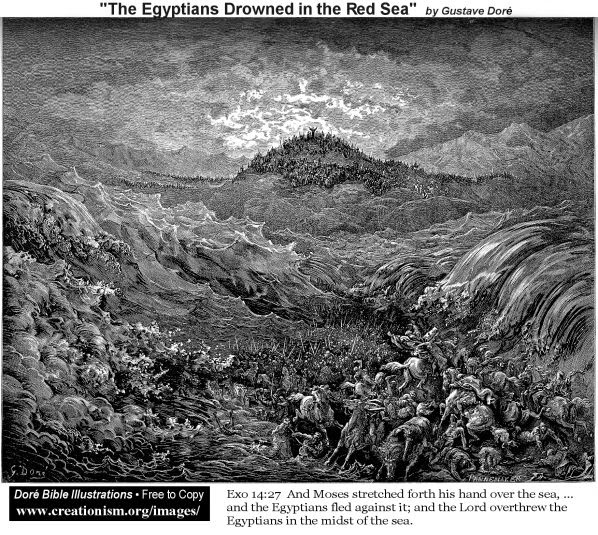
TODAY'S SPECIAL: Exodus 14:10-31

TO CHEW ON: "And the Angel of God who went before the camp of Israel moved and went behind them; and the pillar of cloud went from before them and stood behind them. … Thus it was a cloud and darkness to the one, and it gave light by night to the other, so that the one did not come near the other all that night." Exodus 14:19-20


The Egyptians were in hot pursuit of Israel after their exit from Egypt. But when the Egyptian army was about to pounce, God cut them off. His miraculous cloud served double duty, darkening the night for the Egyptians while it illuminated the journey through the sea for Israel.

This cloud reminds me of the way God's plan works double duty in other parts of the Bible.

The prophets (Isaiah 28:16; Zechariah 10:4), Jesus (Mark 12:10), and the apostles (Ephesians 2:20-22) use imagery of a cornerstone to describe Jesus and His work. But not everyone accepts Him as this. Peter describes how to those who don't believe  in Jesus, He is a "stone of stumbling and rock of offence" (1 Peter 2:8).

Paul talks about the knowledge of Christ as a fragrance. To those being saved it's the fragrance of life but to unbelievers it is the "aroma of death" - 2 Corinthians 2:14-16.

"'Do not think that I came to bring peace on earth,'" Jesus says in another instance. "'I did not come to bring peace but a sword.'" He goes on to say how belief in Him may cause a rift between people in the closest relationships (Matthew 10:34-38).

From earliest installments of the story (like our reading in Exodus) we have seeds of the gospel's potential to divide. So let's not be caught off guard when our faith offends, when our beliefs cause arguments, when even our closest relationships are affected by our loyalty to Jesus and the gospel.

PRAYER: Dear God, help me to be uncompromising in my loyalty to You and the gospel, regardless of the reaction of those around me. Amen.

 *********
Unless otherwise noted all Scripture quotations are taken from the New King James Version®. Copyright © 1982 by Thomas Nelson, Inc. Used by permission. All rights reserved.


Bookmark and Share


Sunday, December 22, 2013

Jesus: rock of offense

brick wall resting on the cornerstone of the cross
TODAY'S SPECIAL: Isaiah 8:5-18

TO CHEW ON: "The Lord of hosts, Him you shall hallow;
Let Him be your fear
And let Him be your dread.
He will be as a sanctuary,
But a stone of stumbling and a rock of offense
To both the houses of Israel…" Isaiah 8:13,14


Here Isaiah's prophecy of near events morphs into a prediction of the Messiah's coming. We see the "stone of stumbling and a rock of offense" images and immediately our thoughts flit to the words of Jesus and New Testament writers:

"Have you not even read this Scripture: ‘The stone which the builders rejected
 has become the chief cornerstone.'" - Mark 12:10.

"…they (Israel) stumbled at the stumbling stone. As it is written: 'Behold, I lay in Zion a stumbling stone and rock of offense, and whoever believes on Him will not be put to shame"  Romans 9:32,33.

"But we preach Christ crucified, to the Jews a stumbling block and to the Greeks foolishness but to those who are called … the power of God and the wisdom of God" - 1 Corinthians 1:23,24.

"Therefore to you who believe, He is precious; but to those who are disobedient, 'The stone which the builders rejected has become the chief cornerstone and a stone of stumbling and a rock of offense" - 1 Peter 2:7,8.

Jesus is no less an offense to our culture than He was to the Jewish culture of His time. They couldn't conceive of their neighbor boy being Messiah, and the mainstream wisdom of our time and place is that His claims of being the one and only way to God are outrageous. Still hidden in the beautiful and seemingly harmless celebration of His birth is the time-bomb of a question: "What will we do with Jesus?"

Will He be the precious object of our belief?

Or will He stumble us so that we suffer the fate of Jesus' own words:
"Have you never read the Scriptures? 'The stone which the builders rejected has become the chief cornerstone. …' And whoever falls on this stone will be broken; but on whomever it falls, it will grind him to powder" - Matthew 21:42,44.


PRAYER: Dear Jesus may the world, including my unbelieving family and friends, see and believe in You for who You are before it is too late. Amen.

***********

New King James Version (NKJV) Used with permission. The Holy Bible, New King James Version Copyright © 1982 by Thomas Nelson, Inc.

Bible Drive-Thru


Bookmark and Share


Wednesday, November 14, 2012

Daniel's crushing stone

TODAY'S SPECIAL: Daniel 2:24-49

TO CHEW ON: "'You watched while a stone was cut out without hands, which struck the image on its feet of iron and clay, and broke them in pieces .... And in the days of these kings the God of heaven will set up a kingdom which shall never be destroyed; and the kingdom shall not be left to other people; it shall break in pieces and consume all these kingdoms, and it shall stand forever.'"  Daniel 2:34,44

The mighty stone in Daniel's vision that crushes earth's kingdoms and becomes an everlasting kingdom of its own (Daniel 2:35) reminds us of other places the Bible refers to this everlasting kingdom—and with stone imagery too.

  • Daniel himself talks about this kingdom again, describing its king in words that signal He is Jesus (Daniel 7:13,14).
  • In several places Bible prophets refer to a coming cornerstone: Psalm 118:22, Zechariah 10:4; Isaiah 28:16.
  • Jesus in explaining the parable of the Landowner (in which we recognize Him as the owner's son, whom the wicked servants put to death - Matthew 21:33-41) connects this cornerstone prophecy to Himself and  the Kingdom of God (Matthew 21:42, 43).
  • Peter talks about Jesus being the cornerstone in his sermon to the Sanhedrin (Acts 4:11) and again in his epistle (1 Peter 2:6) as does Paul in his letter to the Ephesians (Ephesians 2:20).

What about us? Will we build our lives on Jesus the cornerstone (1 Corinthians 3:11), who saves us (Acts 4:11,12) and let ourselves be fit together with other "living stones" in a magnificent "holy temple" (Ephesians 2:20-22)? Or will we reject Him and find Him a stone that stumbles, offends and crushes us (1 Peter 2:7,8)?

PRAYER: Dear Jesus, thank You for being the stone that fulfills Daniel's prophecy. We look forward to the day Your kingdom will "become a great mountain and fill the whole earth." Amen.

MORE: "Living Stones" by Michael Card (link goes to Grooveshark Radio)


Living Stones by Michael Card on Grooveshark


Bible Drive-Thru


Bookmark and Share


Sunday, October 02, 2011

That breaking stone

TODAY'S SPECIAL: Matthew 21:33-46

TO CHEW ON: "And whoever falls on this stone will be broken; but on whomever it falls, it will grind him to powder." Matthew 21:44

Another vineyard story! This one Jesus tells to the chief priests and Pharisees during a temple teaching session. They soon suspect that when He refers to wicked vinedressers who kill the landowner's son, He is talking about them.

Jesus clears up any doubt by spelling it out:
"Have you never read the scriptures.
'The stone which the builders rejected
Has become the chief cornerstone.
This was the Lord's doing,
And it is marvelous in our eyes.'? (quoting Psalm 118:22-23).
Therefore I say to you, the kingdom of God will be taken from you and given to a nation bearing fruits of it" (Matthew 21:42-43).

In this way He foretells the inclusion of non-Jews (Gentiles) in His kingdom of God plan. It is a plan, we discover in the very next verse, which involves a crucial life altering decision not only for groups of people (nations) but for every individual who encounters Jesus:

"Whoever falls on this stone will be broken, but on whomever it falls, it will grind him to powder" (Matthew 21:44).

How does encountering Jesus break us? One way is in its cost. It costs a true disciple everything to follow Jesus. Paul describes it as being crucified (put to death) with Him (Galatians 2:20).

But if we decide to ignore Him and go our own way, that decision too has breaking consequences. Paul spells them out with stark realism in 2 Thessalonians 1:6-10 (a passage that won't win any awards for subtlety or political correctness):

"... it is a righteous thing with God to repay with tribulation those who trouble you, and to give you who are troubled rest with us when the Lord Jesus is revealed from heaven with His mighty angels, in flaming fire taking vengeance on those who do not know God, and on those who do not obey the gospel of our Lord Jesus Christ. These shall be punished with everlasting destruction from the presence of the Lord and from the glory of His power, when He comes, in that Day, to be glorified in His saints and to be admired among all those who believe, because our testimony among you was believed."

PRAYER: Dear Jesus, thank You for coming as the obedient Son and giving Yourself to die for me. May all who read this be broken by you in the disciple, not the eternal destruction way. Amen.

MORE: Doubting Jesus' deity still flourishes today

The heart of the issue of Jesus for the chief priests and Pharisees was that they didn't believe He was who He said He was. Thus everything He said was controversial and sounded like heresy to them.

The refusal, in religious leaders, to believe that Jesus is God, indeed skepticism about the very existence of God, continues to this day. Albert Mohler discusses recent developments within a prominent Protestant denomination in Holland in the article "A Laboratory for Christianity's Destruction"


Bible Drive-Thru


Bookmark and Share

Saturday, November 13, 2010

Jesus - stumblingstone or millstone?

TODAY'S SPECIAL: Luke 20:1-26

TO CHEW ON: "Then He looked at them and said, 'What then is this that is written:
"The stone which the builders rejected
Has become the chief cornerstone"?
Whoever falls on that stone will be broken; but on whomever it falls, it will grind him to powder.'" Luke 29:17-18.

When Jesus identifies the religious leaders of the day as the rebellious vine dressers in the story He tells, they take exception. But when He claims to be the rejected cornerstone of Psalm 118:22 they become incensed -- to the point of plotting His arrest.

The verse from Psalm 118 is quoted five times in the New Testament as a reference to Jesus being rejected by Jewish leadership (e.g. 1 Peter 2:7). Here Jesus follows the quote with an interesting statement: "Whoever falls on that stone will be broken; but on whomever it falls, it will grind him to powder." It seems that whatever way we encounter this stone, it injures us.

Paul is an example of a Jewish leader who stumbled on this stone but allowed it (Jesus) to break him and change the course of his life. Jesus' identity and claims altered his paradigm so completely that the things he once depended on as his ticket to eternity with God became mere rubbish. Read his testimony in Philippians 3:4-15.

That stone continues to stumble us. Here are two ways:

1. Jesus in his role as the cornerstone of God's plan, died to pay the penalty for our sins.  His death, not our works, is our way to heaven. Ask most people who don't have a personal relationship with Jesus on what grounds they think they will be accepted into heaven and they'll say something like — "I do my best. I'm sure someday the good things I've done will outweigh the bad." But that's not how God evaluates. He calls our righteousness "filthy rags". They don't save us.

Try to explain to someone how the most brutal murderer can get into heaven if he trusts Christ, even in his dying moments, while someone else who has done good things all his life will be denied entrance if it is sought purely on the basis of those good works. It doesn't seem fair. It's a stumbling block.

2. After we come to God, again we stumble on this stone as all the common-sense principles on which we've built our lives — love your friends, hate your enemies; look out for yourself first; forgive only when your enemy is really sorry and asks for forgiveness, get things to amass them for yourself etc. — get turned on their heads by Kingdom principles. We are required to change our point of reference from ourselves to God and His ways.

But how dreadful to not let Jesus stumble and break us, to resist Him, only to find that He becomes, at the end of time, not a stumblingstone, but a millstone of judgment, grinding us to destruction.

PRAYER: Dear Jesus, thank You for coming and making a way for me to be right with God. Deal with my human pride, self-sufficiency and everything else that needs breaking as I make You the cornerstone of my life. Amen.

MORE: Bible millstones

The Illustrated Manners and Customs of the Bible explains about mills and millstones:

"The simplest kind of mill used to grind grain into meal was called a mortar — a hollowed-out stone that held grain to be pounded by another stone. A more efficient mill consisted of two stones, 60 cm. (2 ft.) in diameter and 15 cm. (6 in.) thick The nether (or lower) stone was raised in the centre. The upper stone was hollowed out and had a hole in the middle. Grain was poured into the hole and the upper stone was turned by means of a handle. The grain was crushed as it fell between the two stones."
— Illustrated Manners and Customs of the Bible, edited by J. I. Packer, M. C. Tenney, p. 469.


Do your 8-12-year-olds have daily devotions? Point them to Bible Drive-Thru.

Related Posts Plugin for WordPress, Blogger...