
Showing posts with label gospel. Show all posts

Wednesday, December 19, 2018

The most profound miracle and mystery of the universe

The Child Jesus by Alexandre Bida
"The Child Jesus" - Alexandre Bida
For the next week, we're going to take a Christmas break from our Bible reading schedule to focus on Christmas and the Christmas story.

(We'll still make it reading through the Bible this year, as the schedule we're following has one week of grace built into it!)


TODAY'S SPECIAL: Psalm 85:1-13

TO CHEW ON: "Mercy and truth have met together,
Righteousness and peace have kissed." Psalm 85:10


This meeting of mercy and truth, righteousness and peace playing out in the incarnation has fascinated philosophers and theologians ever since there have been such people. They have tried to understand how it works, argued over its fine points, and parted ways over differences of belief. It is really the point of the whole Bible—the Gospel, good news.  I love how Wayne Grudem sums it up at the end of the chapter "The Person of Christ" in his Systematic Theology:

"It (the incarnation) is by far the most amazing miracle of the entire Bible—far more amazing than the resurrection and more amazing even than the creation of the universe. The fact that the infinite, omnipotent, eternal Son of God could become man and join himself to a human  nature forever, so that infinite God became one person with finite man, will remain for eternity the most profound miracle and the most profound mystery in all the universe" - p. 563.

PRAYER: Dear God, thank You for this mystery and miracle and what it means for me: I have Your mercy, I have peace with You. Thank You!

 *********
Unless otherwise noted all Scripture quotations are taken from the New King James Version®. Copyright © 1982 by Thomas Nelson, Inc. Used by permission. All rights reserved.


Wednesday, November 07, 2018

The urgent job of being a reconciler

Image: CikerFreVectorImages / pixabay.com
TODAY'S SPECIAL: 2 Corinthians 5-6; Psalm 1

TO CHEW ON: "Now all things are of God, who has reconciled us to Himself through Jesus Christ, and has given us the ministry of reconciliation." 2 Corinthians 5:18

Have you ever been at odds with someone in your family so you weren't speaking to each other, or every time you did, that issue between you got in the way? Or perhaps you've been the person trying to get family members to reconcile with each other? Either one is uncomfortable, sad, even tragic.

The need for reconciliation follows a wrong or perceived wrong or hurtful action by one of the parties. It  causes a rift in the relationship. To become reconciled, someone usually needs to forgive.

The rift in humankind's relationship with God happened when Adam and Even sinned in Eden. The story of Israel in the Old Testament and Jesus in the New is the story of God making a way of reconciliation.

The penalty for our rebellion is death. God is able to forgive our sins (yet stay true to His justice) because Jesus, God the Son, paid that death sentence for us. On the basis of Him becoming sin for us (2 Corinthians 5:21) God can now forgive our sin, yet stay true to His standard of moral perfection.

Now our job, as those whose friendship with Him has been repaired because we have admitted our sin and accepted His way of reconciliation, is to tell this good news to others. In our reading Paul calls it the "ministry of reconciliation."

Challenges to the job of being a reconciler are several:
  • To live the reconciliation lifestyle by staying in relationship with others both believers and unbelievers. We are forgiven. We need to live a life characterized by forgiveness.
  • To share the good news of possible reconciliation to God with friends, neighbours and family members who may not even acknowledge God's existence, let alone the possibility of being alienated from Him by sin.

Why is it important to persist?


Because the consequence of giving up
, implied in 2 Corinthians 5:19 "… imputing their trespasses to them…" i.e. making our loved ones bear the penalty of their own sin and rebellion, is unthinkable.

PRAYER:
Dear God, please impress on me the urgency of the ministry of reconciliation. Amen. 

PSALM TO PRAY: Psalm 1

 *********
Unless otherwise noted all Scripture quotations are taken from the New King James Version®. Copyright © 1982 by Thomas Nelson, Inc. Used by permission. All rights reserved.


Monday, November 05, 2018

Eau de Parfum of Christ

TODAY'S SPECIAL: 2 Corinthians 1-2; Psalm 149


TO CHEW ON: "Now thanks be to God who always leads us in triumph in Christ, and through us diffuses the fragrance of His knowledge in every place." 2 Corinthians 2:14

Sometimes my husband gifts me with a bottle of perfume at Christmas—one of my favourite gifts. I loved the fragrance he picked, a couple of years ago and soon found myself online, researching my new scent and the world of perfume in general. The metaphor of our lives being the perfume of God to the world reminds me of some of the characteristics of perfume I discovered.

  • Commercial perfumes come from a multitude of sources: barks, flowers and blossoms, fruits, roots, seeds, animal glands...
This speaks of how the scent of Christ wafts from many peoples and places.  Individuals of every tribe and nation and from all over the world will be in heaven (Revelation 7:9).

  • A perfume unfolds in stages. Its first impression is called its top or head note. When that fades the middle or heart note becomes prominent. Finally its base note is established, becoming the scent that lingers the longest.
This brings to mind the fact that the perfume of Christ pervades all our interactions from casual to intimate. Its fragrance should be evident in first encounters with people behind us at Starbucks and those we do business with on the phone. It should blossom in our relationships with people who know us better like neighbours, and friends. In fact, it should be the very stamp of our character so that even those we live with—spouse and children—will know its lingering fragrance.

  • The same perfume doesn't smell the same on every person. When perfume molecules come in contact with the unique chemical makeup of our skin, they react and unfold differently.
We can take this as a picture of how the perfume of Christ manifests uniquely through each person's blend of personality, talent and experience. It involves each of us growing the fruits of the Spirit (Galatians 5:22) and using our spiritual gifts (1 Corinthians 12:1-31). Instead of describing this perfume as floral, spicy, fresh or woodsy, we could name these perfume types merciful, generous, prophetic, wise, faith-filled, instructive.

  • When putting on perfume, the advice is to apply it to pulse points. That's because perfume gets stronger as it's warmed. When our pulse increases due to exertion, excitement, or stress the scent spreads more efficiently.
Does that mean that life's stresses are good for spreading the perfume of Jesus? I think so. If we are full of Him, His scent (or lack of it) will spread more than ever when our lives heat up with trouble.

  • Another tip for perfume application is to spray it into the room and enter its mist in order to be enshrouded by scent.
This reminds us of how important it is to spend time in the perfume—reading and studying God's word, praying, meditating, and spending time with other Christians.

  • Finally, we all know that wearing perfume is forbidden in many places. That's because some people are allergic to perfume scents and actually experience physical dis-ease when in their presence.
2 Corinthians 2:16 reminds us that not everyone will appreciate or welcome the Christ fragrance that we carry. To those who have rejected Him, it is the fragrance of death. It should not surprise us that there are more and more places where sharing the good news about Jesus is forbidden. When we do it anyway, we'll probably get into trouble.

How are we doing as spreaders of the perfume of Jesus? Is this world a sweeter  place because of our presence?


PRAYER: Dear God, please help me to spread Your pure scent, unmixed with notes of selfishness, jealousy, anger, covetousness, lust... Amen.


PSALM TO PRAY: Psalm 149

The Bible Project VIDEO: 2 Corinthians (Read Scripture Series)


****************
Unless otherwise noted all Scripture quotations are taken from the New King James Version®. Copyright © 1982 by Thomas Nelson, Inc. Used by permission. All rights reserved.


Sunday, October 28, 2018

The wordless wisdom of unity

Singers in church sharing hymn book
TODAY'S SPECIAL: 1 Corinthians 1-2; Psalm 141

TO CHEW ON: "Now I plead with you, brethren, by the name of our Lord Jesus Christ, that you all speak the same thing, and that there be no divisions among you, but that you be perfectly joined together in the same mind and in the same judgment." 1 Corinthians 1:10

If there's one thing our society is not, it's united. Listen to any open line talk show and you will hear a variety of points of view on most subjects. Perhaps it's our democratic outlook that makes us value individualism along with knowing and speaking our own minds. And so Paul's plea for unity: "Speak the same thing … no divisions … perfectly joined together" seems impossible—even undesirable—to us.

Yet Paul wasn't the only one with the ideal of unity in mind for people of faith. It was Jesus' idea in the first place. He talked about "'one flock and one shepherd'" (John 10:16) and pleaded in prayer for oneness among His disciples: "'… that they may all be one, as You Father, are in Me, and I in You; that they also may be one in us, that the world may believe that You sent Me'" (John 17:21).

The persuasive apologetic of unity may be what Paul is referring to in the last verse of our reading when he says: "For Christ did not send me to baptize, but to preach the gospel, not with wisdom of words…" What other wisdom would preach and convince?  Perhaps the wisdom of lifestyle—like a body of people supernaturally united in love?

Maintaining unity is work though, otherwise why would Paul have had to "plead" with them to be united? It might be even more work for us individualists.

  • It may mean keeping silent when issues come up that would divide us, especially issues non-essential to salvation - Galatians 3:28.
  • It means body-part-like cooperation instead of competition - 1 Corinthians 12:12.
  • It means, above all things, other-centred love - 1 Peter 3:8.

I ask myself, is my church community a persuasive wisdom-without-words apologetic for the gospel? Is yours? What are you and I doing to make it more so?

PRAYER: Dear God, so often I lose sight of Your ideal of unity as I glory in my own opinions and rightness. Help me to catch Your vision of a united body of believers. Amen. 

PSALM TO PRAY: Psalm 141

The Bible Project VIDEO: 1 Corinthians (Read Scripture Series)


***********

New King James Version (NKJV) Used with permission. The Holy Bible, New King James Version Copyright © 1982 by Thomas Nelson, Inc.


Wednesday, October 24, 2018

Say the words and seal your faith

The Crucifixion - Alexandre Bida
TODAY'S SPECIAL: Romans 9-10; Psalm 137

TO CHEW ON: "If you confess with your mouth the Lord Jesus and believe in your heart that God has raised Him from the dead, you will be saved." Romans 10:9

In this passage, which gets at the nub of the good news—that we can be saved from our default sinful state—Paul makes several points.

1. Christ is the end of the law. He fulfilled it.
My Bible's notes explain: "Thus Paul emphasizes the sufficiency of faith in receiving the righteousness of God because in fulfilling the law's demands, Christ terminated its claim" - Wayne Grudem, notes on Romans, New Spirit-Filled Life Bible, p. 1565.
We no longer have to be concerned about keeping the law perfectly to earn salvation—something we could never do in any case. Jesus did it for us.

2. Accepting this good news and having it apply to our lives is not hard or complicated. It involves two steps:
- Confessing our belief with our mouth—aloud, to ourselves, to others.
- Believing in our hearts that Jesus' death and resurrection (not keeping the rules of the law, not our good works) are the basis of our being saved from the death penalty our sins deserve.

I find the order of Paul's words here interesting. Wouldn't you think the sensible order would be to believe first and then confess? But he says confess, then believe.

I submit this order is no mistake. For though the germ of belief exists in thoughts (before they are uttered as words) there is something about saying the words that nails down the belief. As my Bible commenter puts it: "Oral confession declares, confirms and seals the belief in the heart" - Ibid.

If you're a believer who never expresses your faith aloud, complete the process. Say the words to yourself and to others. Say something like this (or put it in your own words): "I believe Jesus' death was not for His sins but for the sins of the world—mine included. I believe that God raised Him from the dead. Because I trust in His death and resurrection (not my own efforts), I am saved."

PRAYER: Dear God, thank You for making this way for me to be saved from my sinful condition and sinful acts. Help me to express my beliefs out loud and often. Amen. 

PSALM TO PRAY: Psalm 137

 *********
Unless otherwise noted all Scripture quotations are taken from the New King James Version®. Copyright © 1982 by Thomas Nelson, Inc. Used by permission. All rights reserved.


Sunday, October 21, 2018

Jesus, my mercy seat

TODAY'S SPECIAL: Romans 3-4; Psalm 134


TO CHEW ON: "...Christ Jesus, whom God set forth as a propitiation by His blood..." Romans 3:24b-25a

Within the word "propitiation" we have one of the most amazing and offending aspects of the Gospel.

In English when we talk of propitiating someone, we mean that we appease, conciliate and cause them to be favourably disposed toward us.

The Greek word for "propitiation" is hilasterion  which actually means "mercy seat." It refers to the place of atonement between the two cherubim on the top of the ark. "The root meaning of hilasterion is that of appeasing and placating an offended god" - New Spirit Filled Life Bible, p. 1738.

The idea that a loving God would personally exercise wrath against His creatures is what's offensive to some. However, the Bible makes it clear that that's the way it is (for example, see Isaiah 53:4-5; Romans 5:9; Ephesians 5:6; Revelation 6:16-17).

But that's not the end of the story. Though we deserved God's wrath, Jesus took it for us. God "set forth" Jesus as a propitiation. "...By His blood" refers to the fact that He died: "Blood is a reference to Christ's death as a substitute sacrifice for us. Christ's blood poured out is a clear evidence that His life was given for us" - New Spirit-Filled Life Bible, p. 1553.

And so God was able to satisfy both His holiness in its complete abhorrence of and wrath against sin, and His love. It really is the most incredible good news (gospel)!

PRAYER: Dear Jesus, thank You for being my mercy seat. May I never take my sin lightly, but keep in mind God's wrath visited on you for me. Amen.

PSALM TO PRAY: Psalm 134

MORE: More on propitiation
"What is a 'propitiation'? It is a sacrifice that averts wrath through expiating sin, and cancelling guilt.


This...is the real heart of the gospel: that Jesus Christ, by virtue of His death on the cross as our substitute and sin-bearer, 'is the propitiation for our sins' (1 John 2:2). Between us sinners and the thunderclouds of divine wrath stands the cross of the Lord Jesus. If we are Christ's, through faith, then we are justified through his cross, and the wrath will never touch us, neither here nor hereafter. Jesus 'delivers us from the wrath to come' (1 Thessalonians 1:10)" - J. I. Packer, Knowing God, p. 173.


If you're interested in reading more, check the "Theological Term of the Week," propitiation page of the Rebecca Writes blog.


*****************
Unless otherwise noted all Scripture quotations are taken from the New King James Version®. Copyright © 1982 by Thomas Nelson, Inc. Used by permission. All rights reserved.

Saturday, October 20, 2018

Not ashamed of the WORD

Bible - open at Romans
TODAY'S SPECIAL: Romans 1-2; Psalm 133

TO CHEW ON:
"For I am not ashamed of the gospel of Christ, for it is the power of God to salvation for everyone who believes, for the Jew first and also for the Greek." Romans 1:16

You have probably memorized this flag-plant statement of Paul's—a manifesto well worth committing to memory because of its many goodies. Today let's delve into a couple.

Far from being intimidated, Paul states he is unashamed of the GOSPEL.

[Gospel - euangelion  in Ancient Greek was the reward for bringing good news. It later came to mean the good news itself. The New Testament meaning encompasses the promise of salvation and its fulfillment by the life, death, resurrection and ascension of Jesus - Dick Mills (Word Wealth) - New Spirit-Filled Life Bible, p. 1349]

Why is Paul not ashamed? Because the gospel is the POWER of God to salvation for everyone

[Power - dunamis  means energy, power, might, great force, great ability, strength. It is sometimes used to describe the powers of the world to come at work upon the Earth and divine power overcoming all resistance … The dunamis in Jesus resulted in dramatic transformations. This is the norm for the Spirit-led church - Dick Mills (Word Wealth) - New Spirit-Filled Life Bible, p. 1498.]

Bible writers describe this power of the Word (Gospel) in vivid ways:
  • God promised to make His word fire in Jeremiah's mouth to devour the wood of the people that heard it - Jeremiah 5:14.
  • In another place Jeremiah compares God's word to a hammer that breaks rocks in pieces - Jeremiah 23:29.
  • In Ezekiel the prophesied word is a uniting force bringing bones together in preparation for the life-giving breath of the Spirit - Ezekiel 37:7,14.
  • Luke describes the increase / growth of God's word: "So the word of the Lord grew mightily and prevailed" - Acts 19:20.
  • Paul, the author of Hebrews, and John describe the word as a sword - Ephesians 6:17; Hebrews 4:12; Revelation 19:15.

A modern testimony of the power of God's word is Rosaria Butterfield's ("My Train Wreck Conversion" in Christianity Today). This former lesbian university professor came to faith in Christ primarily through reading the Bible (as she stayed in touch with a pastor who answered her questions and a Presbyterian congregation who loved her without conditions).

Let's engrave Romans 1:16 into our memories and hearts afresh. God's word is powerful. We have every reason to be bold, courageous, and unashamed to anchor our lives on it and claim and proclaim it for and over the circumstances of life and the people we love.

PRAYER: Dear God, thank You for the power of the gospel. Amen.

PSALM TO PRAY: Psalm 133

The Bible Project VIDEO: Romans  - Part 1 of 2 (Read Scripture Series)


 *********
Unless otherwise noted all Scripture quotations are taken from the New King James Version®. Copyright © 1982 by Thomas Nelson, Inc. Used by permission. All rights reserved.


Sunday, October 14, 2018

The ready Christian

alter to the unknown god
TODAY'S SPECIAL: Acts 17-18; Psalm 127

TO CHEW ON:
"Now while Paul waited for them at Athens, his spirit was provoked within him when he saw that the city was given over to idols." Acts 17:16.

Paul is such a good example of the ready Christian: "… always be ready to give a defense to everyone who asks you a reason for the hope that is in you…" - 1 Peter 3:15. Here, in new-to-him Athens, watch how he does it:

1. He starts by observing his surroundings (Acts 17:16).

2. He goes to the hotbeds of thought and discussion—the synagogue and the marketplace to listen and talk. (Acts 17:17-18).

3. He accepts an invitation to speak at the Areopagus, even though the invite is hardly given in a  complimentary way. (They call him a babbler - Acts 17:18. According to my Bible's footnotes, a babbler was one who picked up scraps of learning here and there and peddled them. It seems this is a better description of those who "… spent their time in nothing else but either to tell or hear some new thing" - Acts 17:21).

4. He grabs their interest with something from their own culture—an inscription to an Unknown God seen on an altar. He dangles this need for something they haven't yet found in front of them: "Wouldn't you like to know Him?" (Acts 17:22-23)

5. He's a good closer. At the end of his message he urges them to take action: repent because judgment is coming (Acts 17:30-31).

6. He does all this while killing time in Athens—waiting for ministry partners to join him.

I ask myself, what would I have done if I had been in Paul's shoes? Sightsee? Probably. But with a view to giving my testimony and sharing the gospel? I don't know. I'd probably have viewed this as time off from ministry.

But for Paul—really for all of us—there is no time off. This story shows us that all kinds of situations can be a springboard for the gospel.

Though the fruit of Paul's ministry here is minimal ("For reasons Luke does not explain, results here were meagre—no baptisms, no new church, and no letter to the Athenians in the New Testament" - Gary Kinnaman, notes on Acts, New Spirit-Filled Bible, p. 1524), some believed. But Luke/Paul don't dwell on the low numbers. Paul has been faithful, and now it's time to move on (Act 18:1).

PRAYER: Dear God, please help me to become a ready Christian—alert to any and all opportunities to tell about and defend my faith in You, and not discouraged by small results. Amen.

PSALM TO PRAY: Psalm 127

*********
Unless otherwise noted all Scripture quotations are taken from the New King James Version®. Copyright © 1982 by Thomas Nelson, Inc. Used by permission. All rights reserved.


Monday, October 08, 2018

The gifted speaker who served food

TODAY’S SPECIAL: Acts 5-6; Psalm 121

TO CHEW ON: “Then the word of God spread, and the number of the disciples multiplied greatly in Jerusalem … “ Acts 6:7

When the distraction of serving food to widows became too much for “the twelve” they called a meeting of “the multitude of the disciples” and put a new committee—a food committee— into place. Stephen was one of the men chosen for that committee (Acts 6:1-6).

As we read on we find out, however, that Stephen was also a gifted speaker—perhaps more powerful and anointed and talented than some of the original twelve (Acts 6:8-10). I suppose he could have said, “Why must I give up speaking and teaching to do this menial work? What makes your seminars more important than mine?”

Of course he didn’t say or give us any reason to believe he thought that, but served, without a ripple, along with the rest of the committee.

The result: “Then the word of God spread and the number of the disciples multiplied greatly in Jerusalem…” Acts 6:7.

I see in this an important example for myself, indeed the contemporary church. When we put ourselves at God’s disposal to use in any way He wishes, we may not always be doing the things we think are our strengths or especially enjoy. But we do launch ourselves into the river of God’s activity—a productive and exciting place to be.

So let’s not be too proud or picky to accept even the humblest jobs we’re asked to do. God needs and uses chair stackers, pancake flippers, parking lot attendants, spreadsheet makers etc. as well as preachers, teachers, and worship leaders. It’s the full complement of all of us doing the behind-the-scenes and upfront jobs that causes the gospel to flourish.

PRAYER: Dear Father, help me to be willing to do any job You have for me. Amen. 

PSALM TO PRAY: Psalm 121


 *********
Unless otherwise noted all Scripture quotations are taken from the New King James Version®. Copyright © 1982 by Thomas Nelson, Inc. Used by permission. All rights reserved.


Friday, October 05, 2018

Burning hearts

"The disciples at Emmaus"
 - Alexandre Bida

The Disciples at Emmaus - Alexandre Bida
TODAY'S SPECIAL: Luke 23-24; Psalm 119:129-152

TO CHEW ON: "And they said t one another, 'Did not our heart burn within us while He talked with us on the road, and while He opened the Scriptures to us?'" Luke 24:32

The story of the travelers meeting Jesus on the road to Emmaus is one of my favourites. Perhaps it's because I see myself in those sight-restrained disciples. I've often wondered, why did they not recognize Him?

Perhaps Jesus' physical look had changed. We read the stories of other people not recognizing Him either (Mary Magdalene John 20:14; the disciples - Luke 24:36-37). He was the last person they expected to meet on that journey. And our reading says, "their eyes were restrained" suggesting that there was also a supernatural aspect to their blindness. (God operates, even in the smallest details, in the fullness of time.)

Then, after they had walked, talked, and listened to Jesus explain the Scriptures and convinced Him to eat with them, He went through those familiar motions: "… He took bread, blessed and broke it, and gave it to them…" Luke 24:30. They had seen this exact ritual before—at the feeding of the 5,000 (Matthew 14:19), the feeding of the 4,000 (Mark 8:6) and the last supper (Matthew 26:26). What a wonderful thing for which to be recognized!

Jesus left after that. It seems His purpose was not to hang out with them in the way He had before. That time was over. Now they simply needed to know He was alive and how the events that had just taken place fulfilled prophecy.

After he left, the disciples recalled and recognized their reaction to Jesus on the road: "…'Did not our hearts burn within us?'…" Henri Nouwen describes how Jesus may come to us in the same way:

"Jesus joins us as we walk in sadness and explains the scriptures to us. But we do not know that it is Jesus. We think of him as a stranger who knows less than we do of what is happening in our lives. And still—we know something, we sense something, we intuit something: our hearts begin to burn. At the very moment that he is with us we can't fully understand what is happening. We can't speak about it to each other. Later, yes, later, when it is all over, we might be able to say, 'Did not our hearts burn within us as he talked to us on the road and explained the scriptures to us?' But when he walks with us it is all too close for reflection" - Henri Nouwen, With Burning Hearts, p. 50.

PRAYER: Dear Jesus help me to recognize Your voice. Thank You for the witness of a burning heart. Please stir up the coals to a hotter fire. Amen.

MORE: Inner fire


  • Jesus came to ignite inner fire - Luke 12:49.
  • It is kindled by meditation, and bursts into speech - Psalm 39:3.
  • It is fed by fellowship with Jesus - Luke 24:32.
  • The light in our hearts is a reflection of "the glory of God in the face of Christ" - 2 Corinthians 4:6.
  • That inner fire makes it impossible not to speak - Jeremiah 20:9.

"So they rose up that very hour and returned to Jerusalem …. And they told about the things that had happened on the road, and how He was known to them in the breaking of bread" - Mark 24:33,35.

PSALM TO PRAY: Psalm 119:129-152

The Bible Project VIDEO: Luke Ch. 24 (Luke Mini-series)


***********

The Holy Bible, New King James Version Copyright © 1982 by Thomas Nelson, Inc. - Used with permission.


Thursday, May 17, 2018

Good news of PEACE

Bible journaling - Isaiah 26:3 (V.Nesdoly)
TODAY’S SPECIAL: Nahum 1-3; Psalm 132

TO CHEW ON: “Behold on the mountains
The feet of him who brings good tidings,
Who proclaims peace!” - Nahum 1:15

The book of Nahum delivers one main prophecy—the defeat of Nineveh (the capital of Assyria). Quoting from my study Bible’s introduction to the book:
“The kingdom of the Assyrians, with their capital at Nineveh, had been a thriving nation for centuries by the time Nahum appeared on the scene. … Ancient documents attest to the cruelty of the Assyrians against other nations. Assyrian kings boast of their savagery, celebrating the abuse and torture they inflicted on conquered peoples” - Timothy Mark Powell, “Introduction to Nahum,” New Spirit-Filled Life Bible p. 1214.

The introduction to Nahum goes on to describe how the prediction of Nineveh’s doom was a consoling message to Judah (Nahum 1:15). But how does this little book relate to us?

Nahum speaks of God’s ability and desire to judge wickedness—personified in this book by Nineveh. The book’s introduction goes on:
“Nineveh was indeed destroyed, but that partial and temporary defeat of evil awaited the complete and permanent conquest that would come only through Jesus Christ” - Op. Cit, p. 1215.

Nahum alludes to the messenger who brings that message of peace in Nahum 1:15 (as does Isaiah in Isaiah 52:7). His words bring to mind a chorus of Handel’s Messiah that we often perform or listen to during the Christmas season.


"How beautiful are the feet"


What message does that mountain messenger bring?

News of Peace

[Peace: shalom: Completeness, wholeness, peace, health, welfare, safety, soundness, prosperity, fullness, rest, harmony … shalom is much more than the absence of war and conflict; it is the wholeness that the entire race seeks” - Dick Mills, Word Wealth, New Spirit-Filled Life Bible p. 1218.]

In our world of personal and interpersonal, national and international conflict, isn’t shalom what we long for—for ourselves, our families, neighbourhoods, our nation, our world?

Where is that peace found but in Jesus (John 14:27)?

PRAYER: Dear Jesus, thank you for these Old Testament prophets who point us to You in whom we find peace for ourselves and learn peace with each other. Amen.

PSALM TO PRAY: Psalm 132

The Bible Project VIDEO: Nahum (Read Scripture Series)


*********
Unless otherwise noted all Scripture quotations are taken from the New King James Version®. Copyright © 1982 by Thomas Nelson, Inc. Used by permission. All rights reserved.


Thursday, November 30, 2017

The dark and glorious conclusion

film graphic
Image: Pixabay
TODAY’S SPECIAL: John 12:12-26

TO CHEW ON: “Now there were certain Greeks among those who came up to worship at the feast. Then they came to Philip …and asked him, saying, ‘Sir, we wish to see Jesus.’ … But Jesus answered them, saying, ‘The hour has come that the Son of Man should be glorified.’” John 12:20, 21, 23.

Jesus had just swept into Jerusalem on the back of a donkey accompanied by the delirious cheers of the crowd. Their Messiah had arrived at last! But when some Greek proselytes approached Philip asking to see Jesus, Jesus answered Philip with a cryptic and mysterious statement about being glorified. Then He added to the puzzlement by talking about His death. How does His answer relate to the Greeks who have come to see Him? And how is death glorification?

The IVP New Testament Commentary Series comments on John 12.

“…now we come to the beginning of the end. Instead of seeing Jesus doing signs, we see signs occurring through what others do to him."
- Mary anointed Jesus’ feet (John 12:1-8)
- Jesus made His triumphal entry into Jerusalem to the applause of the crowd (John 12:12-15).
- Gentiles came to Him. “… which signals that the long expected hour has arrived. Jesus announces the coming of his hour and speaks of his death.
- The Father endorsed Him - John 12:27-28. 
- IVP New Testament Commentary Series, accessed through Biblegateway.com

So perhaps Jesus’ answer to Philip speaks, as this commentary suggests, to the larger issue of what the visit of these Gentiles portends.  The nations are being drawn to Him. It’s prophecy being fulfilled so that His story can continue (see Psalm 2:8; Isaiah 2:2,3).

Jesus, speaking of His death, began by saying:‘The hour has come that the Son of Man should be glorified.’ How can death be glorification?

IVP Commentary again:

“…death is at the heart of the Son's revelation of the Father, for God is love and love is the laying down of one's life (cf. 1 John 4:8;  3:16). So in the cross the heart of God is revealed most clearly” - Ibid.

Today, the last day of November, we're on the verge of Advent.  During the next 24 days we prepare to celebrate the early part of Jesus’ life—the cute, happy, cuddly part. But that wasn’t all there was to it.

Now is a good time to pause and think about the whole story, including its hard end.

It’s an end that is stitched into Jesus’ story from its beginning when Simeon said to Mary: “‘Behold this Child is destined for the fall and rising of many in Israel, and for a sign which will be spoken against (yes, a sword will pierce through your own soul also)'” Luke 2:34,35. 

It’s an end Jesus Himself was well aware of, for we hear Him say, just beyond the scope of today’s reading:‘Now my soul is troubled and what shall I say? ‘Father, save Me from this hour’? But for this purpose I came to this hour’” - John 12:27.

That purpose again? To come as a baby, live the Father before us, fulfill the plan God had set in motion from the beginning of revelation (Genesis 3:15), conclude its earthly chapter by loving you and me to the extent of laying down His life in our stead, and then defeating death in resurrection.

PRAYER: Dear Father, thank You for sending Jesus, who became that sacrificial grain of wheat for me. Jesus, I want to follow You, serve You, and be with You now and forever (John 12:26). Amen.

MORE: Feast of St. Andrew
Today the church celebrates the Feast of St. Andrew, apostle. The day's liturgy begins with this collect prayer:

Almighty God, who gave such grace to your apostle Andrew that he readily obeyed the call of your Son Jesus Christ, and brought his brother with him: Give us, who are called by your Holy Word, grace to follow him without delay, and to bring those near to us into his gracious presence; who lives and reigns with you and the Holy Spirit, one God, now and for ever. Amen.
 *********
Unless otherwise noted all Scripture quotations are taken from the New King James Version®. Copyright © 1982 by Thomas Nelson, Inc. Used by permission. All rights reserved.


Sunday, November 12, 2017

The beginning of the end?

TODAY'S SPECIAL: Matthew 24:1-22

TO CHEW ON:
" ' All these are the beginning of sorrows.' " Matthew 24:8

If you had never read today's passage and someone handed you its contents on a scrap of paper, would your impression would be (choose one):
a] This sounds entirely unfamiliar.
b] This sounds a lot like current conditions in the world.
c] This sounds like something that could never happen.

If you're like me, you chose b, because this sounds like the writings of someone in the room with me as I watch the nightly news or scan the latest headlines on the computer.

In early parts of this passage (Matthew 24:5-7) Jesus gives us a list of spookily familiar events that herald the near coming of His return to earth / the End:*
- The appearance of false and deceptive Christs.
- Wars and rumours of wars.
- Famines, pestilences and earthquakes.

But, Jesus says, these things are just the beginning of "sorrows." Some translations call them "birth pains" (NIV, NLT, NASB, ESV)—an interesting comparison suggesting earth-shaking events will become more frequent and intense as they near a climax. Could this be the time we're living in right now? If so, what do we have to look forward to? Jesus' answer:

" 'Then they will deliver you up to tribulation and kill you and you will be hated by all nations for My name's sake' " - Matthew 24:9.

Who is the "you" Jesus refers to here? It was to His band of disciples He delivered this private message (Matthew 24:3). So we can, I think, conclude that His disciples of all eras are on notice. That's us. Jesus warns and advises (Matthew 24:10-14):

- We can expect offenses, betrayals, hatred, and death.
- We must be on guard against false prophets.
- We need to be aware of the potential for spiritual lawlessness and coldness.
- Our endurance will be challenged.
- While the above is happening there will also be a great spread of the Gospel to peoples of every nation.

Let's live alert in these perilous days!

PRAYER: Dear God, please help me to remain watchful, to be unfazed if I am hated, and persecuted for being a Christ-follower, and to stay the course as I do my little bit in spreading the Gospel. Amen.

* "In His private teaching to the disciples on the Mount of Olives, Jesus responded to three questions, concerning 1] the destruction of the temple, 2] His Second Coming, 3] the End. These topics are interwoven and sometimes it is difficult to determine which event is being described. This difficulty is partially resolved with the realization that most prophecy is capable of both a near and remote fulfillment. Jesus uses the tragic events surrounding the destruction of Jerusalem in A.D.70 as a picture of conditions preceding His own return" - J. Lyle Story, Study notes on Matthew 24:1-51, New Spirit-Filled Life Bible, p. 1334.


 *********
Unless otherwise noted all Scripture quotations are taken from the New King James Version®. Copyright © 1982 by Thomas Nelson, Inc. Used by permission. All rights reserved.


Friday, August 11, 2017

How to have beautiful feet

TODAY’S SPECIAL: Romans 10:1-21

TO CHEW ON: "How then shall they call on Him in whom they have not believed? And how shall they believe in Him of whom they have not heard? And how shall they hear without a preacher? And how shall they preach unless they are sent? As it is written: 'How beautiful are the feet of those who preach the gospel of peace, Who bring glad tidings of good things!'" - Romans 10:14,15


This passage tells us some foundational things about the gospel (good news).
1. Its content is simple. To be saved (that would be saved from eternal separation from God) all we need to do is call on Jesus.

2. We nail it down with our words. This faith (calling on Jesus) works together with our confession (speaking about our faith) to cement God’s work in our hearts.

3. The gospel is for any- and everyone. Race or ethnic background is no consideration.

4. God needs and uses people to spread it.

Has it ever struck you that the feet of the gospel spreaders are called beautiful, and not their mouths? This says something about the importance of spreading the gospel far and wide.

Though not all of us may be sent to do this in a physical, cross-the-ocean kind of way, we can still all have a part in Operation Beautiful Feet.
  • We can support the ones God calls to go physically – with money, prayers, and thoughtful service when they return on furlough (like supplying a place to live, vehicle etc.).
  • We can support organizations that translate and distribute the Bible to peoples around the world (like Wycliffe, and our national Bible Society).
  • We can now go virtually. With the internet, distance and boundaries have all but disappeared. Web sites proclaiming the gospel abound. (Over the 2+ years my children’s devotional has been running, for example, people from dozens of countries have visited. If you write a blog, I’m sure you’ve had the same experience.)
  • Of course, no matter how much we feel “sent” to stay home, there’s nothing stopping us from taking the good news next door, across the street, across town – using our beautiful feet to reach our neighbors.

I ask myself, how have I done in the beautiful feet department? How have you? As we work together, we can accomplish the beautiful feet goal: “Their sound has gone out to all the earth, and their words to the end of the world.” Romans 10:18


PRAYER: Dear God, please make me more aware of my responsibility (and privilege) to share the gospel wherever I am and by whatever means I have. Amen.

MORE:
“Shout to the North” by Delirious


***********
Unless otherwise noted all Scripture quotations are taken from the New King James Version®. Copyright © 1982 by Thomas Nelson, Inc. Used by permission. All rights reserved.

Wednesday, June 21, 2017

Cost to a "sent out" one

"Take Up His Cross"- Pictures from 
Children's Bible Story Books.

TODAY'S SPECIAL: Matthew 10:32-11:1

TO CHEW ON: "He who finds his life will lose it, and he who loses his life for My sake will find it." Matthew 10:39

Matthew 10 is mostly a set of instructions Jesus gave to His twelve disciples before sending them out to their Jewish neighbours. Their mission was to preach and demonstrate the nearness of the Kingdom of Heaven (Matthew 10:7-8). By Jesus' instructions we can tell that the reaction to their message would be mixed. In other words this would be no sightseeing jaunt or cushy vacation.

In the end, this assignment seemed to be as much about the apprenticeship of the disciples as it was about the delivery of the Kingdom message to their countrymen. A warning that Jesus gave at least three times in this chapter was to expect opposition that would test their loyalties.

1. Their message and commitment to Jesus would get them in trouble with governing authorities to the extent of being forced to defend themselves before councils, governors, and kings. The will even be beaten (Matthew 10:17-20).

2. Their commitment to Jesus would test family ties. Jesus warned of treachery coming from even within their own households (Matthew 10:34-36).

3. Their commitment to Jesus would test their loyalty to themselves (Matthew 10:37-39). Jesus challenged His disciples to love Him more than their own lives. He couched it in the language of death — called it  taking up one's cross. Such a thing probably doesn't ring many alarm bells in our society where crosses aren't used for execution. To get the shock value of His statement let's say it differently. How about: "He who does not take with him his lethal injection and follow Me is not worthy of Me"?

Jesus' warning words are a stark reminder of humanity's default reaction to the gospel. Therefore you and I shouldn't be surprised when people respond to the good news of the Kingdom of Heaven (and all it entails of mankind's sinful state, our need for redemption and the ultimate lordship of Jesus over our life and all of creation) with incredulity, challenge, confrontation, ultimatums, anger... In fact, we're probably naive if we don't expect it.

And personally, am I ready to kill that part of me that wants the world to accept me and like me? On top of that, am I ready to put to death that part of me that wants to do as I please in choice of vocation, relationships, how I spend my time, money etc.? Am I that loyal to Jesus?

PRAYER: Dear Jesus, Your description of true discipleship in this chapter is sobering and startling. I don't think I've begun to be a disciple like this. Please show me what it means in daily living. Amen.

MORE: "Jesus I My Cross Have Taken"

This Bob Dylan-esque rendition of this old hymn is from the second Indelible Grace CD, Pilgrim Days. I love it! Many verses that's why it's so long. Read along with the singers by following the link to the lyrics below.


Follow the lyrics as you listen

**********
Unless otherwise noted all Scripture quotations are taken from the New King James Version®. Copyright © 1982 by Thomas Nelson, Inc. Used by permission. All rights reserved.

Wednesday, April 26, 2017

A changed man

Apostles Baptized with the Holy Spirit (From Treasures of the Bible).
TODAY’S SPECIAL: Acts 2:22-39

TO CHEW ON:
“Now when they heard this, they were cut to the heart, and said to Peter and the rest of the apostles, ‘Men and brethren, what shall we do?’” Acts 2:37

Yesterday we read the end of Mark, where Jesus commissions His disciples to  spread the good news of all that has happened (Mark 16:15-18). Bible scholars believe that the book of Mark is Peter’s account of events surrounding the life and death of Jesus as told to his close companion John Mark (calls him “my son” in 1 Peter 5:13).

It’s interesting to contrast the fearful and foundation-rocked Peter of just before the crucifixion (Luke 22:31-34; 54-62) to the Peter we see here. In just over 50 days, in the interim never attending an hour of Bible school or Theology college, he is a changed man. Now he is confident, bold, articulate, insightful, absolutely clear about what all the events and happenings regarding Jesus mean, and how they fit into God’s plan revealed in the Old Testament. How does that difference come about?

I’m sure this new Peter is the result of what has just happened—the giving of the Holy Spirit baptism - Acts 2:1-14. Jesus had told the disciples to wait with carrying out their assignment of telling the gospel until after they had received the Holy Spirit (Luke 24:48,49). They had done so and it wouldn’t surprise me if the outcome shocked even them.

So much was available to the disciples and is available to us through the Holy Spirit:
  • Given by Christ - Matthew 3:11.
  • We can ask for Him - Luke 11:13.
  • He is called Helper - John 14:16; 16:7.
  • He gives power for witness and ministry - Acts 1:8.
  • He gives unique abilities to prophesy and speak in other tongues - Acts 19:6.
  • His anointing comes with downloads of knowledge (1 John 2:20,27) including what to say in dangerous situations (Luke 12:12; Mark 13:11) and an ability to remember Christ’s relevant words and teachings (John 14:26).
  • He reassures us we are God’s children - Romans 8:16.
  • He teaches and enlightens us in spiritual truth - 1 Corinthians 2:13.

This is only a partial list but we get the idea. It is through the Holy Spirit that Peter becomes an eloquent and bold speaker in a day and it is that same Spirit that accompanies, changes, and empowers us!

PRAYER: Dear Father, I ask for courage and faith to make more of myself available to Your Holy Spirit. Amen.

 *********
Unless otherwise noted all Scripture quotations are taken from the New King James Version®. Copyright © 1982 by Thomas Nelson, Inc. Used by permission. All rights reserved.


Saturday, March 04, 2017

The Gospel in 33 words

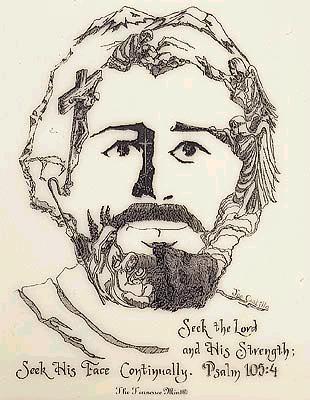
Study this drawing. It is full of detail sketches from Christ's life.


TODAY'S SPECIAL
: Romans 5:12-19

TO CHEW ON: "Therefore, as through one man's offence judgment came to all men resulting in condemnation, even so through one Man's righteous act the free gift came to all men, resulting in justification of life." Romans 5:18

I admire the writers of dictionaries for their abilities to state the meaning of words with precision and economy. Paul shows a similar talent in our reading today as he explains how all of humankind is implicated in Adam's sin and how Christ's incarnation, death, and resurrection was/is effective to pay the penalty of that collective sin.

His communication powers reach their height in verse 18 where he sketches out the Gospel as it plays out through history in a mere 33 words.

Therefore as through one man's offense: refers to the event of Adam's sin and how he became separated from God. (Genesis 2:17 followed by Genesis 3:1-8)

judgment came to all men: all of mankind is implicated in Adam's sin. (Romans 5:12; Isaiah 64:6)

resulting in condemnation: mankind is headed for death—not only physical death but the death of eternal separation from God. (Romans 6:23)

even so, through one Man's righteous act: that "one Man" is Jesus, God's Son. His righteous act is that He came to earth, lived a sinless life, died in our stead to pay the punishment our sin deserved, then rose to defeat death. (John 3:16).

the free gift: Jesus died in my place. I can escape the penalty my sins deserve because I believe and accept that fact as applying to me personally. I can't earn or pay for this—it's free! (Ephesians 2:8)

came to all men: this gift is available to all men everywhere (Romans 10:12; 1 Timothy 2:4-6) and covers the sins of people past, present and future (John 10:16).

resulting in justification of life: all of the above results in God considering the person who puts his/her confidence in Jesus to be vindicated, declared blameless, absolved, excused from death and delivered to life. (1 John 5:11-12)

What a grand, mind-boggling, worship-inspiring plan. (And I'm so glad that God inspired brilliant thinkers like Paul to express it concisely.) I have accepted this free gift - have you?

PRAYER: Dear God, thank You that Your plan for humankind involves justification - and that it's free for anyone who will accept it. Please give me the wisdom and the right words to communicate this good news to those who have never heard or understood. Amen.

MORE: Hillsong sings "Mighty to Save"


**********
Unless otherwise noted all Scripture quotations are taken from the New King James Version®. Copyright © 1982 by Thomas Nelson, Inc. Used by permission. All rights reserved.

Do your 8-12-year-olds have daily devotions? Point them to Bible Drive-Thru.

Sunday, February 05, 2017

The "salty" Christian

Salt pouring out of a salt shaker
Image: Pixabay
TODAY’S SPECIAL: Matthew 5:13-20

TO CHEW ON: “‘You are the salt of the earth, but if the salt loses its flavor, how shall it be seasoned? It is then good for nothing but to be thrown out and trampled underfoot by men.’” Matthew 5:13


Jesus’ use of salt as a metaphor for those who believe in Him is clever. For salt (NaCl - sodium chloride) is surprisingly versatile.

We may think of it primarily for how it’s used as a seasoning in food. That seems to be the comparison Jesus is making here because He refers to how it might lose its flavor. In food, just a little salt is all that’s needed to enhance other flavors and bring about a balance pleasing to the palate.

Salt can be used as a preservative of food and other things. We have probably tapped into its germ-killing qualities when we gargle with salt water to treat a sore throat.

However, salt has many more uses. The Maldon Salt Company website claims that as a society we use salt in more than 14,000 different ways. Their graph shows that its greatest use is in industrial chemicals (where it’s used to make plastic, paper, rubber, fertilzer, bleach, detergent, dyes and more), followed by water conditioning, highway de-icing, food, and agriculture. (During a recent bout of cold weather we experienced the usefulness of salt, especially that which was “trampled underfoot.”)

Some additional facts about salt:
  • Salt can remove some stains.
  • Salt removes traces of water from purified aviation fuel.
  • Every cell in the body contains salt.
  • Sodium is key in the operation of all signals within, as well as to and from the brain.

All that to say when Jesus compared believers to salt, He was implying a lot! Here are some parallels I’d suggest:
  • Just as a little salt accomplishes much, so though we as Christians may be few in number, our presence can have a seasoning and purifying effect on any society we inhabit.
  • Salt is used for many purposes and processes. Similarly Christians (bearers of the salt) can be found in a multitude of places in many careers doing many jobs.
  • Just as salt is found in every body  cell and needed for brain function, so the saltiness of the gospel in us unites us as Christians and helps us work together as the body of Christ.
  • Salt can be an agent of safety and we can be that too. As a pastor in my church prayed recently, “Help us Christians be like the salt on the icy sidewalk, keeping people from slipping and falling.”


PRAYER: Dear Jesus, please help me to be a salty Christian. Amen.

 *********
Unless otherwise noted all Scripture quotations are taken from the New King James Version®. Copyright © 1982 by Thomas Nelson, Inc. Used by permission. All rights reserved.

Friday, October 07, 2016

Focus, Rules, Perseverance

Image: pixabay
TODAY’S SPECIAL: 2 Timothy 2:1-13

TO CHEW ON: “You, therefore must endure hardship…” 2 Timothy 2:3


Paul here is addressing Timothy, a church leader, likening the hardship of endurance he must exercise as a leader to the roles of  the soldier, the  athlete, and the farmer. Each image adds a layer of understanding of the role, not only of church leaders, but all of us “kings and priests" (Revelation 1:6).

Soldier:
If we haven’t been soldiers ourselves, we’ve seen film clips of military training and battle and don’t need to be convinced that soldiers face hardship and need endurance. Soldier-type endurance is highlighted here for its focus. It’s a singular attention to battle, not distracted with everyday life (2 Timothy 2:3,4).

Athlete:
The recent Olympics remind us of the endurance of the athlete. Most Olympic-level athletes have endured the hardship of countless hours of training and carefully controlled what they ate and drank. But they also need to be aware of another angle of endurance—the rules of the game. Those hours of work won’t win them success if they break the rules of competition and are disqualified (2 Timothy 2:5).

Farmer:
The farmer’s hardship is one of patience and perseverance as he nurtures his crop through the cycle of seasons and the vagaries of weather. If he sticks with it, though, he’ll be the first to experience the reward of his work (2 Timothy 2:6).

These three aspects of hardship also apply to us.

Focus: It’s easy to become distracted from the task Paul describes as his (and ours): “…so that everyone God calls will get in on the salvation of Christ in all its glory.” - 2 Timothy 2:10 MSG.

Rules: What would these be for the Christian? Some things that come to mind: Personal holiness, as in living a life that won’t stumble others, and ministry and message integrity as in speaking the message of the gospel—not wealth, or success, or salvation by works.

Perseverance: If we are faithful and patient and persevere, the fruit of our ministry may surprise us with reward at the most unexpected times, not to speak of the heavenly reward we look forward to when we see Jesus.

PRAYER: Dear Father, I need the mentality of the soldier, the athlete, and the farmer. Please deliver me from softness. Amen.

 *********
Unless otherwise noted all Scripture quotations are taken from the New King James Version®. Copyright © 1982 by Thomas Nelson, Inc. Used by permission. All rights reserved.

Scripture quotations marked MSG are taken from The Message. Copyright © 1993, 1994, 1995, 1996, 2000, 2001, 2002. Used by permission of NavPress Publishing Group.


Saturday, April 02, 2016

Jesus: cornerstone

“The Cornerstone” by James Tissot (1836-1902)
“The Cornerstone” (1886-1894) 
by James Tissot (1836-1902)

TODAY’S SPECIAL: Psalm 118:15-29

TO CHEW ON: “The stone which the builders rejected
Has become the chief cornerstone.” Psalm 118:22

Psalm 118 was a hymn for the Feast of Tabernacles called a Hallel. The procession of the king, priests and people carried palm branches and sang this song as they approached the temple. In the first part of the psalm the king recalls his victories. In the second (our reading today), the procession moves from the temple gateway to the altar.

Maybe it was the sight of the impressive temple building that brought up the cornerstone imagery. The verses we are focusing on talk about this most important stone  (“It could have been a large stone over a doorway like a lintel; a keystone holding up an arch; or a cornerstone at the base of perpendicular walls” Quest Study Bible, p. 837). The builders in the psalm neglect to put it in, or reject it. The psalmist leaves unstated what will happen to that unfortunate building, but we can imagine!

In our reading in Zechariah a few days ago, we noted that the cornerstone was one of the metaphors used for Messiah (Zechariah 10:4). Here  Jesus quotes the reference to the cornerstone from Psalm 118 as a reference to Himself (Matthew 21:42).  He says that just like the king’s subjects kill the king's son, in the story He has just told, the scribes and Pharisees are rejecting Him and by doing that turning their backs on the foundation or cornerstone of God’s plan of salvation.

In the Easter season just past, as we remembered how Jesus was rejected by the people of His time and crucified, we may have been tempted to look with haughtiness on them, thinking we would never do that if He were with us in person now. But I wonder, sometimes, if we don’t do just that in subtle ways, as we try to twist the gospel  into a more socially acceptable message for the people of our time – people who don’t like to be told that God has set an objective standard of right and wrong, that on our own we can’t attain that standard, and that God sent Jesus to die and rise again so we can be reconciled to Him. He (His incarnation, death and resurrection) is still and will always remain the chief cornerstone and foundation of God’s plan.

PRAYER: Dear Jesus, thank You for coming to earth to fulfill God’s plan to reconcile us to Himself. Help me, as Your child, to make You the cornerstone of my life. Amen


***********
Unless otherwise noted all Scripture quotations are taken from the New King James Version®. Copyright © 1982 by Thomas Nelson, Inc. Used by permission. All rights reserved.


Related Posts Plugin for WordPress, Blogger...