Showing posts with label civil disobedience. Show all posts

Monday, July 30, 2018

Civil servant with an excellent spirit

Daniel praying by G.C.H. - Daniel 6:10
Daniel praying (Daniel 6:10)
TODAY'S SPECIAL: Daniel 4-6; Psalm 56

TO CHEW ON: "'I make a decree that in every dominion of my kingdom men must tremble and fear before the God of Daniel.
For He is the living God,
And steadfast forever;
His kingdom is the one which shall not be destroyed,
And His dominion shall endure to the end.'" Daniel 6:26


Daniel in the lion's den—what a gripping story. It has all the elements of a good read: a noble hero, jealous villains, a naive king, and an insurmountable problem. But it is so much more than just entertainment.

Three things stand out for me in this incident.
1. The description of Daniel having an "excellent spirit" (Daniel 6:3).  That tells me he had a reputation for good things—good work, making wise decisions, perhaps a pleasing manner.

2. Daniel's unshakeable, even stubborn devotion to God (Daniel 6:10). When it came down to choosing between faith in God or his life, he chose God with not even a flicker of hesitation.

3. The incident resulted in praise and glory going to God, not Daniel, shown by Darius's prayer at the end of the chapter (Daniel 6:25-27).

We can draw three lessons for our own lives:
1. We can make it our goal to have an "excellent spirit." What would that look like? Perhaps a heart of service, a cheerful attitude, a considerate manner, a reputation for fairness... Leslyn Musch in her Truth-In-Action Through Daniel article, calls it "godliness" ("Try to reflect godliness in all you do" - New Spirit-Filled Life Bible, p. 1140). That would imply the that the attributes we see in God would make up an excellent spirit in us.

2. We can stay loyal to God no matter what the consequences. In our time that may or may not be reason for civil disobedience, as it was for Daniel.

3. The goal of all this is the only worth one: that glory goes to God, not us.

PRAYER:
Dear God, please help me to cooperate with You in developing an excellent spirit within me. May it be the goal of my life to bring glory to You, no matter what the cost. Amen.

PSALM TO PRAY: Psalm 56

**************
Unless otherwise noted all Scripture quotations are taken from the New King James Version®. Copyright © 1982 by Thomas Nelson, Inc. Used by permission. All rights reserved.


Friday, September 08, 2017

Government and you

The legislative buildings in Victoria, BC,
outlined in lights. - Photo © 2013 by V. Nesdoly

TODAY'S SPECIAL: Romans 13:1-14

TO CHEW ON: "Let every soul be subject to the governing authorities. For there is no authority except from God and the authorities that exist are appointed by God." Romans 13:1

If you listen to talk shows on radio or watch news channels on TV, you'll know that one of the favourite topics is to criticize the government. People have made careers out of it! Our practice of second-guessing political decisions and freely offering our opinions — often in strong language — has made serving as an elected official an often thankless and unattractive job.

What a different attitude toward government Paul tells Christians to take in Romans 13. Some ideas he puts forward that should impact our behaviour:

1. Governing authorities are actually "appointed by God" (Romans 13:1 - see also Daniel 4:32; Psalm 75:6-7).
Even evil governments, we ask? The footnotes in my study Bible comments:
"Paul does not suggest that God approves corrupt government, ungodly officials or unjust legislation. Sometimes, however, in punishment for the sins of a people or for other reasons known to Him, God allows evil rulers to have authority for a time, as the Old Testament prophets frequently testify" (New Spirit Filled Life Bible, p. 1570).

2. We should be subject to authorities (Romans 13:2).
If they are there by God's permission, even appointment, they are, in effect, God's government of us. Being subject means that we obey the laws of a particular government's jurisdiction (federal, provincial or civic).

However, we can make the case for civil disobedience. If obeying the laws of the land causes us to sin, our first loyalty is to God (Esther 4:16; Daniel 3:12-18; 6:10; Matthew 2:12; Acts 5:29; Hebrews 11:23).

3. Killing done by the state — to keep order and to hand out retribution — is different from murder (Romans 13:4).
Paul talks about the government officials who "bear the sword" (and why would one bear a sword unless to kill, or as a threat to kill?) as "God's minister" and "avenger." My Bible's footnotes explain:
"The fact that God authorizes governments as His servants to use force even to the point of taking human life does not contradict the command 'You shall not murder' in Exodus 20:13. The word used in that commandment refers to criminal murder and does not include judicial taking of life or killing in war, for which the OT uses other words. The same is true of the Greek word translated "kill" or "murder' in such NT passages as Matthew 5:21" - New Spirit Filled Life Bible, p. 1570.

4. We should obey government as a matter of good conscience toward God and not only because we're in danger of getting caught and punished if we don't, (Romans 13:5-7). This includes paying taxes without complaining (...ouch!).

In a democratic society, it's often hard to submit meekly to government as Paul tells us we should. To be fair, we need to utilize all the ways our democratic freedoms give us to get a government we can support (like vote, give feedback to our representatives, even join and support the political party of our choice). But if we really believed that our government was there by God's ordaining, and we spent as much time praying for our authorities as we do criticizing them, we'd probably find them much easier to obey.

PRAYER: Dear God, please help me to have an attitude toward government that pleases You. Today I bring before You Prime Minister Trudeau, Premier Horgan and the mayor of my town. May Your will be done in their lives and, through them, in my country, province and city today. Amen.

***************
Unless otherwise noted all Scripture quotations are taken from the New King James Version®. Copyright © 1982 by Thomas Nelson, Inc. Used by permission. All rights reserved.


Do your 8-12-year-olds have daily devotions? Point them to Bible Drive-Thru.

Sunday, August 27, 2017

It costs to fight for life

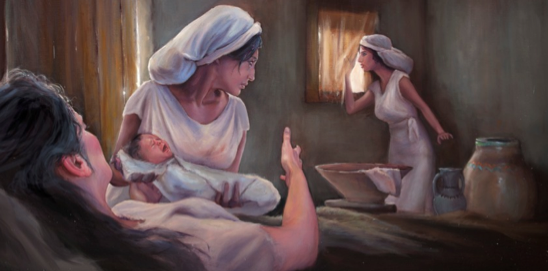
Shiphrah and Puah allow male
children to live

Shiphrah and Puah allow male children to live - Exodus 1:17
TODAY'S SPECIAL: Exodus 1:15-2:10


TO CHEW ON: "But the midwives feared God and did not do as the king of Egypt commanded them, but saved the male children alive." - Exodus 1:17

Imagine the anguish and soul-searching these women must have wrestled with when they heard Pharaoh's command to kill each male Israelite baby on delivery. With all their instincts and training shouting "Live!" I wonder if they, for even a moment, considered obeying Pharaoh's demonic order?

There's no doubt Pharaoh and his law sparked a smoulder of fear within them. But there was One they feared more: "... the midwives feared God..."

["Feared - yare'— means to fear, be afraid of someone or something, to stand in awe of something or someone possessing great power; to revere someone. ... The fear of God is not a terror that He is against us or will strike without cause or warning. Rather, the fear of the Lord produces wise, healthy actions, as in the present reference; the midwives were more afraid of angering God by destroying innocent babies than they were of disobeying Pharaoh" - Dick Mills & David Michaels, "Word Wealth - Feared," New Spirit-Filled Life Bible, p. 78.]

I can't help but see the similarities between the situations of these midwives and people who work in the medical profession in Canada. Here the practice of abortion is widespread with no law against it regardless of how far along the mother is.

Canada has also passed right-to-die legislation, so people can request that their life be ended.

I would suggest we are well on our way down a proverbial "slippery slope."  With state-paid-for medical costs rising, it's easy to foresee the day when it will be the law to abort any child that could be a potential drain on the medical system while the pressure to euthanize those that are becoming too expensive to maintain (the elderly, those with disabilities) will be overwhelming.

And so the question comes to us who are in these situations, indeed, to people in any place where convictions clash with the state's rules: Who do we fear more, Pharaoh or God?


PRAYER: Dear God, thank You for the example of these Hebrew women who feared You to the extent of putting their careers and lives in jeopardy. Help me to fear You above any human custom or law. Amen.

MORE: LifeCanada

An organization which has taken on the task of fighting for and educating on the Pro-Life position is LifeCanada. From their "About" page:

"LifeCanada was established in 2000 to operate as a national association of local and provincial educational pro-life groups across Canada in order to promote the value of human life, to serve our members, and to advocate for the most vulnerable members of society."

Check out their "Articles" for news and opinion on life and death issues in Canada.

****************
Unless otherwise noted all Scripture quotations are taken from the New King James Version®. Copyright © 1982 by Thomas Nelson, Inc. Used by permission. All rights reserved.
Bible Drive-Thru


Thursday, September 24, 2015

Responsibility of influence

Vashti's defiance - Alexandre Cabanel
"Vashti's Defiance" - Alexandre Cabanel
TODAY'S SPECIAL: Esther 1:1-22

TO CHEW ON: "But Queen Vashti refused to come at the king's command brought by his eunuchs therefore the king was furious and his anger burned within him." Esther 1:12

Do we blame Queen Vashti for refusing to come before the drunken King Ahasuerus and his male guests to show off her beauty? I can think of several reasons for her refusal. Maybe such a debauch had happened before and been uncomfortable for her. Maybe it was a bad time for her to leave her own party. Or perhaps she had an independent streak that simply resisted being ordered around.

Whatever it was, her refusal ended badly. The king wasn't too drunk to ask for the input of others. His coterie of male advisors told him to be decisive with her for fear her attitude would spread to other women in the realm—and that would never do in their male-dominant culture.

It's easy for us, looking at this event through our western civilization lenses, to sympathize with Queen Vashti. And yet the king and his advisors had a point. My Bible's notes contain this observation on Vashti's actions:

"Leadership involves both responsibilities and influence. In her rebellion Vashti ignores her responsibility to her authority King Ahasuerus" - A. Joy Dawson, notes on Esther, New Spirit-Filled Life Bible, p. 634.

We can take away at least two lessons from these opening scenes of Esther:
1. When we are in positions of leadership our actions have the potential to affect and influence others, and we need to carefully consider their effect.

2. If we feel civil disobedience is really warranted, we should be prepared for consequences.

PRAYER: Dear God, please give me the wisdom to know when defying civil authority is warranted. At all other times help me to have a compliant spirit that acknowledges Your will and design in placing over me the rulers of Your choice. Amen.

MORE: More about Esther, the book
We will be reading all of the book of Esther in the coming days so here are a few facts about this little book.
  • The author is unknown. But it was a Jew, familiar with Persian words and customs. Mordecai or Ezra may have been the author.
  • It was written shortly after 465 B.C. and the story takes place over four years starting with the third year of King Ahasuerus (also called Xerxes') reign.
  • A unique feature of the book is that the name of God is never mentioned.
*******
 Unless otherwise noted all Scripture quotations are taken from the New King James Version®. Copyright © 1982 by Thomas Nelson, Inc. Used by permission. All rights reserved.

Bible Drive-Thru


Sunday, June 28, 2015

A deadly lie

"Report of Saul's Death to David" - Jean Fouquet, c. 1470

TODAY'S SPECIAL: 2 Samuel 1:1-29

TO CHEW ON:
"'So I stood over him and killed him because I was sure that he could not live after he had fallen. And I took the crown that was on his head and the bracelet that was on his arm, and have brought them here to my lord.'
Therefore David took hold of his own clothes and tore them and so did all the men who were with him." 2 Samuel 1:10,11


In this curious scene, an Amalekite warrior, in visible grief ("clothes torn and dust on his head") delivered to David the news that Saul was dead at his hand. We'd expect David to celebrate and reward the killer. Finally the man who had kept him on the run for years was dead. But instead he and his men tore their clothes in mourning, wept and fasted, expressing their own grief.

The Amalekite who delivered the news (it happened to be a lie; 1 Samuel 31:4 records Saul's suicide) was probably shocked when instead of  commending him, David told his soldiers to kill him.

All through his time of fleeing from Saul, David showed similar respect for him as the Lord's anointed. In fact at one point when Saul happened to enter the very cave where David and his men were hiding, David's men urged him to kill the king. David gave in a little when he cut a piece of Saul's robe. But immediately he had a conscience attack, spoke his regret to his men and made sure they let Saul get away (1 Samuel 24:5-7).

A footnote in my Bible describes the situation well:
"David always considered Saul as God's anointed, even though Saul was rejected by God, hated David, and sought to kill him. David's reverence was for God who had anointed Saul" - Jerry Cook from the notes on 2 Samuel, New Spirit-Filled Life Bible, p. 403.

Who are "God's anointed" in our lives?

In a way all those in authority over us, as Paul explains in Romans 13:1-7. Though we may find lots of reasons not to respect and honor them like David could have listed for Saul, Paul makes it clear that they are there with the permission of a higher authority—God.

I am reminded of Moses' words to the Israelites when he explained the reason for their hardships in the wilderness. "And you shall remember that the Lord your God led you all the way these forty years in the wilderness, to humble you and test you, to know what was in your heart, whether you would keep His commandments or not" Deuteronomy 8:2.

Perhaps our subjection to "God's anointed" is part of our own wilderness testing and training like it was for the Israelites and for David.

PRAYER: Dear God, thank You for David's example of respect for Your choice of Saul as king and his refusal to manipulate the situation for his own advantage. Help me to recognize the people you have anointed in my life, and to have a similar attitude of respect for Your authority in placing them over me. Amen.

MORE: Civil disobedience?

Is it ever right for a Christian to disobey the "Lord's anointed" authorities, especially those of civil government?

An article on "Got Questions" site states:
"The position the Scriptures uphold is one of biblical submission, with a Christian being allowed to act in civil disobedience to the government if it commands evil, such that it requires a Christian to act in a manner that is contrary to the clear teachings and requirements of God’s Word."

Read all of "When is civil disobedience allowed for a Christian?" Do you agree?

***********
Unless otherwise noted all Scripture quotations are taken from the New King James Version®. Copyright © 1982 by Thomas Nelson, Inc. Used by permission. All rights reserved.

Bible Drive-Thru


Friday, August 22, 2014

Who do we fear?

Shiphrah & Puah - Artist unknown
TODAY'S SPECIAL: Exodus 1:1-22

TO CHEW ON:
"The midwives, however, feared God and did not do what the king of Egypt had told them to do; they let the boys live." Exodus 1:17


These Hebrew midwives, Shiphrah and Puah, were doing a brave, maybe even foolhardy thing by saving the lives of newborn boys in the face of Pharaoh's command. But then, as we see the God they feared in action, we realize they were doing a very sensible thing (remarkable about their respect for God: they spared these babies even before God showed His power in the plagues of Egypt and the miracles of the desert).

I think about their stand and I see a lesson in it for me, perhaps for all of us. As our society drifts ever farther from Christian principles, I can imagine scenarios where we might need to take similar stands against our society's laws and social pressures.

For example, a few weeks ago a same-sex couple made local news when they broadcast the fact that the extended family of the baby they were set to adopt withdrew their consent for the baby's adoption because the family didn't want it to be raised by a same-sex couple. Though the family was legally allowed to do this, their actions were labelled homophobic. One of the rejected partners mused about solving such situations with legislation.

The family's stand made me ask myself, what would I have done? It's a valid question, for I believe it will be just a matter of time before the rights of Canadians (and other western, supposedly freedom-of-religion cultures) to express religious convictions in ways that go against the grain of culture, will be illegal.

I submit the answer to how we would react will always be based on who we fear more—God, who has expressed His attitude toward homosexuality and a myriad other things in His word, or the society in which we live?

PRAYER: Dear God, please help me live my life for Your eyes, respecting and lining up my life with what You approve more than what society approves. Amen.

 *********
Unless otherwise noted all Scripture quotations are taken from the New King James Version®. Copyright © 1982 by Thomas Nelson, Inc. Used by permission. All rights reserved.
********
Subscribe to my newsletter coming September 1st. 

Get book recommendations, Bible study tips, author news plus a full-colour 18-month Pathways Scripture text calendar when you sign up!  

Sign up below:


Bookmark and Share


Sunday, August 21, 2011

It costs to fight for life

Shiphrah and Puah allow male
children to live

TODAY'S SPECIAL: Exodus 1:1-22


TO CHEW ON: "But the midwives feared God and did not do as the king of Egypt commanded them, but saved the male children alive." - Exodus 1:17

Imagine the anguish and soul-searching these women must have wrestled with when they heard Pharaoh's command to kill each male Israelite baby on delivery. With all their instincts and training shouting "Live!" I wonder if they, for even a moment, considered obeying Pharaoh's demonic order?

There's no doubt Pharaoh and his law sparked a smoulder of fear within them. But there was One they feared more: "... the midwives feared God..."

["Feared - yare'— means to fear, be afraid of someone or something, to stand in awe of something or someone possessing great power; to revere someone. ... The fear of God is not a terror that He is against us or will strike without cause or warning. Rather, the fear of the Lord produces wise, healthy actions, as in the present reference; the midwives were more afraid of angering God by destroying innocent babies than they were of disobeying Pharaoh" - Dick Mills & David Michaels, "Word Wealth - Feared," New Spirit-Filled Life Bible, p. 78.]

I can't help but see the similarities between the situations of these midwives and people who work in the medical profession in Canada. Here the practice of abortion is widespread with no law against it regardless of how far along the mother is. In many hospitals nurses and doctors have the option of refusing to perform abortions, but not in all. Additionally, with state-paid-for medical costs rising, it's easy to foresee the day when it will be the law to abort any child that could be a potential drain on the medical system.

And so the question comes to us who are in these situations, indeed, to people in any place where convictions clash with the state's rules: Who do we fear more, Pharaoh or God?


PRAYER: Dear God, thank You for the example of these Hebrew women who feared You to the extent of putting their careers and lives in jeopardy. Help me to fear You above any human custom or law. Amen.

MORE: Civil disobedience

The fallout for civil disobedience for these Hebrew midwives was good: Exodus 1:21. But that is not the fate of all such actions. Whenever we disobey the law of the land in adherence to a higher law we risk consequences. Mary-Lynn McPherson describes the situation for pro-life nurses in Canada:

"Some hospitals require nurses to agree to 'perform any health service' as a requirement of hiring. Across Canada, nurses do not have the legal right to refuse to participate in procedures to which they are morally or religiously opposed. Some have been disciplined, and even fired, for discussing options to abortion with patients." (Read all of "Freedom of Conscience.")

Our willingness to suffer these consequences in the here and now tests our faith in many areas including our faith in God, the rightness of His standards, and His ability to bring about ultimate justice.

For those of us not on the front lines in these battles, let's pray for the people who are. In this particular battle in Canada they include physicians and pharmacists as well as nurses.


Bible Drive-Thru


Bookmark and Share

Related Posts Plugin for WordPress, Blogger...