Showing posts with label fear. Show all posts

Wednesday, September 05, 2018

The biggest pay check you'll ever get

Servant hiding his talent - Artist unknown
TODAY'S SPECIAL: Matthew 25-25; Psalm 93

TO CHEW ON: " ' For to everyone who has, more will be given and he will have abundance; but from him who does not have, even what he has will be taken away.' " Matthew 25:29

After a career which included many stages (hospital clerk, medical records clerk, school teacher, visiting homemaker, medical transcriptionist, stay-at-home mom) it was this parable that spoke to me about pursuing my lifelong interest in writing.

Note how the word for the unit of money used in the NKJV ("talent") is the same word we use to describe "a particular and uncommon aptitude for some special work or ability; a faculty or gift" (Funk and Wagnalls Dictionary). Thus the connection between stewarding what we have—money and abilities—is impossible to miss.

Some things that jump out at me from this story:
1. Both of the servants who invested their talents received the same commendation even though their returns were different (Matthew 25:21,23).

2. The master's commendation doesn't lead to a holiday but to more responsibility: "… you have been faithful over a few things. I will make you ruler over many things" - (Matthew 25:21,23).

3. This work of faithful stewardship is the doorway to joy: "Enter into the joy of your lord" are the master's final words to them (Matthew 25:21,23).

4. The servant who received one talent seems to have had an underlying critical attitude. He justified his non-action by suggesting that the master was cruel and unpredictable (Matthew 25:24).

5. He also confessed to fear—so great it paralyzed him and he hid the talent away so he could return it, uninvested, to the master (Matthew 25:25).

We can apply things from this story to our lives.

Like the master in the parable gave different amounts of money to different servants, God gives us different talents, abilities, and resources. Let's not become jealous and bitter because we have only one talent while the person beside us has five, or boastful because it's the other way around. Paul addresses this issue with the Corinthians when he says:
"For who makes you differ from another? And what do you have that you did not receive? Now if you did indeed receive it, why do you boast as if you had not received it?" - 1 Corinthians 4:7.

God doesn't expect a five-talent return from a two-talent person. Let's steward the money and abilities we do have and not denigrate our increase by comparing it to someone else's.

Let's conquer fear. We can always find reasons—multiple reasons—why our talent investment efforts will fail. But these fear-whispers are not from God. When He puts a talent in our hands and gives us the investment idea, we can go forward with the assurance that:
"I can do all things through Christ who gives me strength" - Philippians 4:13.

When our faithfulness leads to more and larger responsibilities, let's not shrink back into retirement or laziness but embrace the new load with the knowledge that using our gifts to serve the master is the doorway to joy. It is the key to receiving what I believe will be the biggest pay check we could ever get—God's "Well done, good and faithful servant."

PRAYER:
Dear God, thank You that in Your wisdom You give us differing abilities and opportunities. Help me today to steward well what You have entrusted to me. Amen.

PSALM TO PRAY: Psalm 93

 *********
Unless otherwise noted all Scripture quotations are taken from the New King James Version®. Copyright © 1982 by Thomas Nelson, Inc. Used by permission. All rights reserved.


Monday, August 20, 2018

The Asaph approach to conquering fear

TODAY'S SPECIAL: 2 Chronicles 25-27; Psalm 77

TO CHEW ON: "And I said, 'This is my anguish; But I will remember the years of the right hand of the Most High.' I will remember the works of the Lord; Surely I will remember Your wonders of old." Psalm 77:10-11


One characteristic of memory is that it is selective. We tend to remember the good over the bad. Think back to your childhood. Chances are it will seem an idyllic, happy time. "Those were the good old days," we say. Somehow the fears, embarrassments, boredoms and dissatisfactions are not what we remember first about the past.

Memories -- good memories -- are what Asaph, the psalmist, uses to conquer his fearful thoughts during a very bad time. He is in a "day of trouble" where he prays all night long (Psalm 77:2). He feels so overwhelmed even thoughts of God don't comfort him (Psalm 77:3). He is troubled sleepless and speechless (Psalm 77:4).

Then he decides to take himself and his negative thoughts in hand. "But I will remember the years of the right hand of the Most High." He reviews God's attributes in a series of rhetorical questions (Psalm 77:7-8) and recalls times from the past when God appeared unbeatable:

There was the time God redeemed "the sons of Jacob and Joseph" (Psalm 77:15) -- a reference, perhaps, to God saving the Israelites from famine by bringing them to Egypt where Joseph had stored up food.

There was the time "The waters saw You and they were afraid" (Psalm 77:16) -- a reference to the parting of the Red Sea when the Egyptians were hot on their heels.

There was the time "You led Your people like a flock, By the hand of Moses and Aaron" (Psalm 77:20) -- a reference to their 40 years in the wilderness.

Are you in a desperate, fearful, can't-sleep-because-of-troubled-thoughts time? Or maybe it's just a thin-cloud-of-anxiety, or bad-premonition, or can't-stop-worrying-about-things-up-ahead time. Whatever causes your spirit to "complain" use the Asaph approach to conquering fear.

1. Ask yourself the rhetorical questions he asks, to remind yourself about the bigness of God:
- "Will the Lord cast off forever?"
- Will He be favourable no more?"
- Has His mercy ceased forever?" etc. (Psalm 77:7-9).
The answer: Of course not!

2. Think back to specific instances in your life when God has come through for you. Has He preserved your life in a dramatic way? Has He helped you through financial difficulties? Has He answered prayers, made you a part of amazing "coincidences," showered you with everyday mercies? Go back even farther to reviewing the history of your family, your people. Reminisce yourself into a place where you can exclaim like Asaph did: "Who is so great a God as our God? You are the God who does wonders; You have declared Your strength among the peoples" (Psalm 77:13-14).

PRAYER: Dear God, thank You for evidences of Your presence in my life. Thank You for memories that reassure me of Your ability, power and love. Amen.

PSALM TO PRAY: Psalm 77

*****************
Unless otherwise noted all Scripture quotations are taken from the New King James Version®. Copyright © 1982 by Thomas Nelson, Inc. Used by permission. All rights reserved.


Saturday, July 28, 2018

Invincible

The king extends his sceptre to Esther - Artist unknown
TODAY'S SPECIAL: Esther 6-10; Psalm 54

TO CHEW ON: "The Jews gathered together in their cities …. And no one could withstand them, because fear of them fell upon all people." Esther 9:2

Here we read again what we've read before—of God coming to the aid of His helpless and outnumbered people, the Jews, using the psychological weapon of fear in their enemies.

This fear of the Jews is an old theme from when God promised to help the Israelites conquer Canaan. Moses reminded the Israelites of this repeatedly in passages like Numbers 14:9, Deuteronomy 7:24, 11:25; 28:7; 32:30.

When Joshua became their leader, God promised to help him in the same way - Joshua 1:5; 10:8. We read of the results of this fear in places like Joshua 12:1; 21:44; 23:9.

The Old Testament prophets continued to predict fear in the enemies of the Jews. God was intent on preserving the people out of which His Son would be born to bring salvation for the world  - Isaiah 19:17; Jeremiah 15:20; Daniel 11:16; Zechariah 9:13.  This incident in Persia is an example of this fear in action.

When Jesus walked the earth, we recall the many times during his life when the scribes and Pharisees, who were intent on killing him, were mysteriously hindered from harming Him by fear of one kind or another - Matthew 21:26,46; Mark 12:12; Luke 5:26; 20:19.

And the wonderful thing is that the promise of invincibility comes down to us.

Jesus promised about the church that the "... gates of hell shall not prevail against it" - Matthew 16:18.

Paul tells Christians to put on the armor of God, take up the shield of faith and in this way they would be able to "... quench all the fiery darts of the wicked one" - Ephesians 6:16.

No wonder the demons believe and "... tremble" - James 2:19.

When we feel small, insignificant, and badly outnumbered in an unbelieving world, let's not lose sight of the fact that God is still at work in the enemy's ranks. And He still has the weapon of fear in His arsenal.

PRAYER:
Dear God, please help me to live with confidence that Your plans and purposes for this world will never be thwarted. Amen.


PSALM TO PRAY: Psalm 54

MORE: Modern fear of the Jews
When former KGB spy Jack Barsky (a Soviet spy in the U.S. during the Cold War years) recently talked to Steve Kroft of 60 Minutes, he said that the Jews were one of three things the Soviets feared most during those years. (The others were AIDS and Ronald Reagan).

 *********
Unless otherwise noted all Scripture quotations are taken from the New King James Version®. Copyright © 1982 by Thomas Nelson, Inc. Used by permission. All rights reserved.


Wednesday, July 11, 2018

Do not fret

TODAY'S SPECIAL: Ezekiel  22-24; Psalm 37

TO CHEW ON: "Cease from anger and forsake wrath
Do not fret — it only causes harm (it only leads to evildoing - NASB)." Psalm 37:8


So much of our frame of mind and sense of well-being depends on our thoughts. In Psalm 37 David gives us some good thought guidelines. He begins by telling us some thought patterns to shun: anger, wrath, and fretting. In fact, he warns against fretting three times (vs. 1, vs. 7, vs. 8).

"Fret" in Hebrew is charah, a primitive root also translated angry, and kindled. Its English definitions are so telling for our context:
1] to be vexed, annoyed, troubled.
2] to become worn, chafed or corroded.
3] to bite away bit after bit of something with or as with the teeth.
4] to eat through something by or as if by corrosion.
5] to rankle, fester.
6] to become rough or agitated, as water.
Synonyms are irritate, vexation, annoyance, uneasiness.

Do you tend to fret? I know I do. When something troubles me I am like a dog with a bone, biting, chewing, gnawing, then burying but always coming back to uncover my worry so that I can bite, chew and gnaw some more.

David doesn't leave us to fend for ourselves against the negative thoughts  of anger, envy and fretting. Psalm 37 is full of good thought options. We can instead:

"Trust in the Lord" (Psalm 37:3). This is putting the weight of ourselves - our past histories, present circumstances, and future hopes, dreams, expectations, and fears - on God.

"Dwell in the land" (Psalm 37:3). Though not a thought per se, dwelling connotes a rooted, settled, contented existence.

"Delight yourself in the Lord" (Psalm 37:4). We need to focus on God's good character and gifts to us and not on our lacks as compared to what someone else has.

"Commit your way to the Lord" (Psalm 37:5).  Literally, we roll ourselves and our way onto God. We let God take the wheel of life, not fixated on the route we take but giving Him the right to move us here or there,

"Rest in the Lord" (Psalm 37:7).  We are silent, still, at ease, relaxed.

"...wait patiently" (Psalm 37:7).  We aren't in a hurry to see things completed. We live by God's timetable.

"Cease from anger" (Psalm 37:8). We refrain from, let go of, withdraw from anger. This is something we can do — a willful action on our part.

We don't need to be at the whim of negative thinking. But to avoid the tyranny of our destructive thoughts we need to first recognize, then put the brakes on angry, anxious, fretful ones, and finally replace them with thoughts of trust, contentment, delight, commitment, rest, and patience.

PRAYER: Dear God, in the days ahead, even today I'm sure I'll be tempted to fret. Help me to replace fretting with constructive thoughts of You and Your goodness to me. Amen.

PSALM TO PRAY: Psalm 37 

*******************
Unless otherwise noted all Scripture quotations are taken from the New King James Version®. Copyright © 1982 by Thomas Nelson, Inc. Used by permission. All rights reserved.

Friday, June 08, 2018

Insomnia

TODAY'S SPECIAL: Proverbs 19-21; Psalm 4


TO CHEW ON: "I will both lie down in peace and sleep;
For You alone, O LORD, Make me dwell in safety." Psalm 4:8

Are you ever troubled with insomnia? I certainly am. I think perhaps David was too. For in this psalm he reminds himself (and us, the readers/listeners) that he should be able to sleep:

"Meditate within your heart on your bed and be still ...
I will both lie down in peace and sleep ..."

The Bible speaks of peaceful sleep coming as a result of:

  • Doing a hard day's physical work - Ecclesiastes 5:12.
  • Entrusting the final outcome of our work to God - Psalm 127:2
  • Trusting God for general well-being and protection - Psalm 3:5; Proverbs 3:24 and our focus verse,Psalm 4:8.
  • Trusting God in even extreme circumstances, like Jesus did in the storm-tossed boat (Mark 4:38) and Peter did in prison (Acts 12:6).

I would submit that often 'trust' is the secret to our ability to sleep well:

"... put your trust in the Lord ... For You alone, O Lord, make me dwell in safety."


PRAYER: Dear God, it is so easy to take the responsibility for my life on my shoulders and with it a load of fear and anxiety that keep me awake. Help me to trust You to the extent that I can relax in sleep. Amen.


PSALM TO PRAY: Psalm 4

MORE: Insomniac prayers

One thing many of us do at night when we can't sleep is pray. (David mentions communication with God four times in this short psalm.)

I love how Donna Farley writes of nighttime prayers in her poem "The Geography of Prayer." Here is a sampling:


THE GEOGRAPHY OF PRAYER

my midnight wakeful prayers
the gift of insomnia
I hold a globe cradled in my hands
and the wave of prayer begins:

a slingshot drawn back to the west coast
then as if the daylight terminator reversed itself
sweeping eastward with mercy, healing,
over the homes of people I know
and people I don't...

....

But I can't be the only one who lies
awake nights like this.
Like lines of magnetic force
caressing the world I imagine prayers
emanating from the faithful
wrapping the world up like string
wound around the core of a baseball....

© 1999 by Donna Farley (Used with permission)
Read the entire peom here.

*************
Unless otherwise noted all Scripture quotations are taken from the New King James Version®. Copyright © 1982 by Thomas Nelson, Inc. Used by permission. All rights reserved.


Saturday, June 02, 2018

Wisdom's lens

TODAY'S SPECIAL: Proverbs 1-3; Psalm 148

TO CHEW ON: 
"The fear of the lord is the beginning of knowledge,
But fools despise wisdom and instruction." Proverbs 1:7


My first thought as I read this key verse at the beginning of Proverbs is 'worldview.' It seems that Solomon is saying that the knowledgeable, wise, educated-in-what-is-true person sees life through what we call a worldview of the fear of the Lord.

What is a worldview? Nancy Pearcey talks about it in her book Total Truth:

"... understanding how worldviews are formed, and how they guide or confine thought, is the essential step toward understanding everything else. Understanding worldview is a bit like trying to see the lens of one's own eye. we do not ordinarily see our own worldview, but we see everything else by looking through it. Put simply, our worldview is the window by which we view the world and decide, often subconsciously, what is real and important or unreal and unimportant" - Nancy Pearcey, Total Truth, Kindle Location 425.

What does it mean to have a 'fear of the Lord' worldview? Leslyn Musch describes it well in her "Truth-In-Action-Through Proverbs" article:

"Learning to walk in the fear of the Lord is learning to live in awe and reverence of God. It is foundational to our walk of faith. God is loving and full of grace and mercy, but He is also all-powerful, awesome, holy, righteous and sovereign over all things" - Leslyn Musch, New Spirit-Filled Life Bible, p. 842.

We can test whether or not we have a fear-of-the-Lord worldview by looking at the way we live our lives, and answering questions like:
- Who are we more concerned about pleasing, the people around us, or God?
- Which road do we choose when the path of following God splits from the path of pleasing self or others?
- On what do we spend our time and money?

Is it possible that we don't fear God as much as we think or say that we do?

PRAYER:
Dear God, please open my eyes and inform my understanding in the things that offend You and please You. Help me to see where I am kidding myself, saying I fear You but living differently. Then help me to line up my attitudes and actions with the truths in the Bible. Amen.

MORE: Examples of Bible characters who feared / didn't fear God.
  • DID: Nathan the prophet feared God as shown by his obedience to turn around and change his message to David when God told him he had said the wrong thing - 1 Chronicles 17:1-15.
  • DIDN'T: David neglected to follow God's instructions when moving the ark, putting it on a cart instead of having the priests carry it on their shoulders in the way God had said. When a man touched the ark to steady it, he was killed - 2 Samuel 6:1-9
  • DID: When the Jewish leaders told Peter and John to stop talking about Jesus and preaching in His name, they expressed their fear-of-God worldview clearly: "'We ought to obey God rather than man'" - Acts 5:29.

Can you think of more?

PSALM TO PRAY: Psalm 148

The Bible Project VIDEO: Proverbs (Read Scripture Series)


***************
Unless otherwise noted all Scripture quotations are taken from the New King James Version®. Copyright © 1982 by Thomas Nelson, Inc. Used by permission. All rights reserved. 


Monday, March 12, 2018

A sanctified imagination

TODAY'S SPECIAL: Judges 4-5; Psalm 71

TO CHEW ON: "'Thus let all your enemies perish, O Lord!
But let those who love Him be like the sun
When it comes out in full strength.'" Judges 5:31


Judge Deborah was a woman with a vivid imagination. The "Thus..." in the verse above refers to the details of her victory over Sisera as we find them in her song (Judges 5:1-31). This victory ballad is full of imaginative specifics.

She describes the incident of Jael, the tent peg, and the hammer in gory detail (Judges 5:24-27).

She imagines Sisera's mother waiting for her son to return from battle. When he delays, she envisions how this woman and her maids will explain his lateness to themselves:

"Are they not finding and dividing the spoil:
To every man a girl or two;
For Sisera plunder of dyed garments..." (Judges 5:30).

But Deborah's most inspiring use of her imagination is in Judges 4, before she ever had reason to sing that song. Then the situation was still dire. Israel under the thumb of Canaanite King Jabin (and Sisera, his army commander), hadn't seen a ray of hope in twenty years (Judges 4:3). Yet Deborah said to Barak (the commander of Israel's army):


"Up! For this is the day in which the Lord has delivered Sisera into your hand. Has not the Lord gone out before you?" (Judges 4:14).
Her faith in God fueled her imagination so that she saw the victory before it ever actually happened.

Deborah's use of imagination demonstrates three ways we can use our imaginative ability.

  • To communicate the human experience in literature: Her description of Jael's actions is imagination put to use in the service of story and poetry. It is one God-given way we can use our visionary ability.
  • To reassure ourselves: Deborah's speculation of how Sisera's mother was handling her son's delay shows how imagination can bolster feelings of well-being. However this kind of imagining can easily disintegrate into worry when we  fuel it with pictures of the bad things that could be happening.
  • To affirm our faith: We sanctify our imaginings when we use them in the service of faith like Deborah did. This is building a visionary future on God—His person and promises—and then going into action to make it a reality.

May we have more of the kind of imagination that, ignited by God's promises and fed by faith, sees victory before the battle has even begun.

PRAYER: Dear God, thank You for my imagination. Please help me to fuel it not with fear but with faith in You. Amen.

PSALM TO PRAY: Psalm 71 

MORE: The gift of imagination
"Imagination is the greatest gift God has given us and it ought to be devoted entirely to Him. If you have been bringing every thought into captivity to the obedience of Christ, it will be one of the greatest assets to faith when the time of trial comes, because your faith and the Spirit of God will work together" - Oswald Chambers, February 12th entry in My Utmost for His Highest.
*************
Unless otherwise noted all Scripture quotations are taken from the New King James Version®. Copyright © 1982 by Thomas Nelson, Inc. Used by permission. All rights reserved.


Saturday, February 03, 2018

Praise seminar

TODAY’S SPECIAL: : Leviticus  14-15 Psalm 34

TO CHEW ON: “I will bless the Lord at all times; His praise shall continually be in my mouth.” Psalm 34:1

This little psalm helps us understand some of the facets of praising God, both in speech and song.

Our praise encourages others to praise Him:
“The humble shall hear of it and be glad
Oh, magnify the Lord with me
And let us exalt His name together (34:2-3)
Oh fear the Lord you His saints!
There is no want to those who fear Him.” (34:9)

Our praise dispels fear and brings boldness:
“I sought the Lord and He heard me
And delivered me from all my fears.
They looked to Him and were radiant
And their faces were not ashamed.” (34:4-5)

Our praise can be an act of faith as we invoke God’s presence into our situation, no matter how fearful or mundane:
“This poor man cried out, and the Lord heard him
And saved him out of all his troubles.
The angel of the Lord encamps all around those who fear Him
And delivers them. (34:6-7,17-22)
So many things in life are out of our control. Right now, I'm writing the talks for a class I'll be giving at church, and making my talks into slide presentations. But I don't have a projector. So I'm trusting that the media department at our church can help me put this together. In the last few months it's becoming evident that our little granddaughter is facing a probable diagnosis of cerebral palsy. A few years ago when we were away on a summer holiday, our fridge began dispensing water all on its own so we came home to a flooded house and a big renovation. So many things in life, little to big, can and sometimes do go wrong (or what we consider wrong).

In all of life's uncertainties the tendency is to worry. But it's a choice. So right now I’m going to turn my thoughts from fear, worry, and anxiety to praise. I will open my  mouth in praise for all aspects of the situations I'm in. I will remind myself that God is bigger than all the things that make me fearful. And I can do this in the blink of an eye, whenever a fearful thought wants my attention, all day long--that is, continuously.

What will your continuous praise encompass today?

PRAYER: Dear Lord, thank You for Your greatness, so worthy of my continuous praise. Help me to have a disciplined mind and mouth to choose to praise You above every other response. Amen. 

PSALM TO PRAY: Psalm 34

*************

Unless otherwise noted all Scripture quotations are taken from the New King James Version®. Copyright © 1982 by Thomas Nelson, Inc. Used by permission. All rights reserved.

Thursday, January 25, 2018

Fear and friendship

TODAY'S SPECIAL: Exodus 25-27 and Psalm 26

TO CHEW ON: "Who is the man who fears the Lord? Him will he instruct in the way he should choose.... The friendship of the Lord is for those who fear him, and he will teach him in the way he chooses." PSALM 25:12,14 ESV


It's interesting that this psalm promises God's guidance and friendship to those who fear Him.

The word fear (yare') here doesn't only mean to be afraid in its usual English sense. It also means to "Stand in awe of, be awed, reverence, honour and respect." The Amplified translation includes those shades of meaning: "Who is the man who reverently fears and worships the Lord? ....The secret [of the sweet satisfying companionship] of the Lord have they who fear (revere and worship) Him and He will show them His covenant and reveal to them its [deep inner] meaning."

The words worship and revere imply that our relationship with God is not one of equals. It is similar in some ways to the relationship of subjects to a monarch. Even a king's son or daughter must treat him with special deference observing protocol, at least in public.

When we fear God we become good candidates for His instruction and guidance. It means we will pay attention to what pleases Him. We will accept His correction and discipline. We will obey Him when He tells us what to do and how to do it.

The wonderful thing is God is not some cold distant sovereign ordering us around, but a God who, in response to our fear (respect, reverence, worship), extends (amazing thought) "sweet, satisfying companionship" i.e. "friendship."

PRAYER: Dear God, when I think about You and all Your power, authority, wisdom, creativity, and compassion, the only appropriate response is fear.  I am amazed and incredibly grateful that in response to my fear, You offer friendship. Amen.

PSALM TO PRAY: Psalm 25 

MORE: "The Fear of the Lord is the beginning of wisdom"
"The fear of the Lord is the beginning of wisdom" (Prov. 1:7). Happy the soul that has been awed by a view of God's majesty, that has had a vision of God's awful greatness, His ineffable holiness, His perfect righteousness, His irresistible power, His sovereign grace. Does someone say, "But it is only the unsaved, those outside of Christ, who need to fear God"? Then the sufficient answer is that the saved, those who are in Christ, are admonished to work out their own salvation with "fear and trembling" - by A. W. Pink. Read all of "The fear of the Lord is the beginning of wisdom."
*********
Unless otherwise noted all Scripture quotations are taken from the New King James Version®. Copyright © 1982 by Thomas Nelson, Inc. Used by permission. All rights reserved.

Scriptures marked ESV are from the ESV® Bible (The Holy Bible, English Standard Version®) copyright © 2001 by Crossway, a publishing ministry of Good News Publishers. ESV® Text Edition: 2011. The ESV® text has been reproduced in cooperation with and by permission of Good News Publishers. Unauthorized reproduction of this publication is prohibited. All rights reserved.

Scripture quotations marked AMPLIFIED are taken from the Amplified® Bible, Copyright © 1954, 1958, 1962, 1964, 1965, 1987 by The Lockman Foundation. Used by permission." (www.Lockman.org)


Wednesday, January 24, 2018

Promises never claimed

Israel at Mt. Sinai - artist unknown
Israel at Mt. Sinai - Artist unknown
TODAY'S SPECIAL: Exodus 23:20-35

TO CHEW ON:
"'And I will send My fear before you, I will cause confusion among all the people to whom you come and will make all your enemies turn their backs to you.'" Exodus 23:27.

In exchange for obedience and a thoroughness in destroying idol worship in Canaan, God made a covenant with Israel at the foot of Sinai to:
  • Lead them with His Angel (the cloud by day, pillar of fire by night) to the land He had promised them (Exodus 23:23).
  • Bless their food and water (Exodus 23:25).
  • Take sickness away (Exodus 23:25).
  • Keep them from miscarrying (Exodus 23:26).
  • Cause the people in the land to which they were going to be filled with fear and confusion (Exodus 23:27).
  • Drive the inhabitants out before them, though slowly and in manageable amounts (Exodus 23:29,30).

What an exciting future of possibilities God painted for them. And they eagerly signed on:
"So Moses came and told the people all the words of the Lord and all the judgments. And all the people answered with one voice and said, 'All the words which the Lord has said we will do'" - Exodus 24:3.

How sad to read then, perhaps a year or so later, the reaction of these same people to the report of the spies Moses had sent out to view Canaan before they began to enter it. The first ones who failed the faith test were ten of the spies themselves. They reported back what they tasted, heard, and saw but without taking into account any part of God's earlier promise. After talking about the land's agricultural wealth the conclusion of ten of the spies was:
"'Nevertheless the people who dwell in the land are strong, the cities fortified and very large …'" - Number 13:28.

When Caleb, one of the two spies who saw things differently, said, "'Let us go up at once and take possession for we are well able to overcome it,'" the others argued him down with negativity, fear and doubt: "'The land … is a land that devours its inhabitants. … and we were like grasshoppers in our own sight, and so we were in their sight'" - Numbers 13: 30-33.

But men, what did God tell you? Just the opposite—that these people are full of fear and confusion over you, not confidence. They are conquerable. Didn't you hear? Didn't you believe?

What a tragic consequence these Israelites were about to suffer. Because of their unbelief, they were doomed to spend forty more years wandering in the wilderness.

Let's remember this tragic example of unbelief next time we're tempted to face a life challenge with fear and negativity. In their places, let's review God's promises and put our faith in Him—not ourselves and what we see.


PRAYER: Dear God, please help me to have a long memory for Your promises and the wisdom to apply them to the challenges of my life. Amen. 

PSALM TO PRAY: Psalm 24

The Bible Project VIDEO: Exodus 19-40 (Torah Series)


 *********
Unless otherwise noted all Scripture quotations are taken from the New King James Version®. Copyright © 1982 by Thomas Nelson, Inc. Used by permission. All rights reserved.


Thursday, January 04, 2018

Fear vs. faith

Image: Pixabay
TODAY’S SPECIAL: Genesis 12-15

TO CHEW ON: “Then He brought him outside and said, ‘Look now toward heaven, and count the stars if you are able to number them.’ And He said to him, ‘So shall your descendants be.’ And he believed in the Lord, and He accounted it to him for righteousness.” Genesis 15:5-6


Abram and his wife Sarai were childless when God came to him with a promise of innumerable descendants. Despite what it looked like, Abram believed this would happen – believed to the extent that God, who saw into his deepest heart, “accounted it to him as righteousness.

What we believe has everything to do with our thoughts. Here Abram gave mental assent to God’s promise despite how circumstances pointed to the contrary.

Are there things in your life that are at odds with God’s promises to you? Are you reacting to those circumstances with worry, anxiety, fear, and confusion instead of faith? Joyce Meyer in her article “Where the Mind Goes the Man Follows” says:

“I like to think of our inner life as a house made of thoughts that is constantly being built. It is within these ‘walls’ of our thinking that each of us lives. Every thought we accept is like another brick in the wall of the house we are building….

[…] One of the greatest weapons that you and I have is the truth of God’s Word. The Bible says in 2 Corinthians 10:4-5, ‘For the weapons of our warfare are not physical [weapons of flesh and blood] but they are mighty before God for the overthrow and destruction of strongholds, [Inasmuch as we] refute arguments and theories and reasonings and every proud and lofty thing that sets itself up against the [true] knowledge of God; and we lead every thought and purpose away captive into the obedience of Christ.’ If we don’t lead wrong thoughts away captive, the wrong thoughts will lead us away captive.” – Joyce Meyer.

If there is something over which you fret because of the way the situation looks, try this. In one column write down your worry. In a column beside it write what God’s Word says about it. Now every time thoughts of anxiety, fear, worry, and confusion come into your mind about this thing, counter them with God’s promise to you.

Do this with day-to-day worries like:

- Flu is going around and I fear for the safety of my family - versus Psalm 91

to big life-direction issues:

- I’m afraid I’ll miss God’s will for my life – versus Isaiah 30:21


PRAYER: Dear God, please help me establish the discipline of replacing fear and unbelief thoughts with faith thoughts from Your word. Amen.

PSALM TO PRAY: Psalm 4

The Bible Project VIDEO: Genesis Part 2 of 2 (Read Scripture Series)


**************
Unless otherwise noted all Scripture quotations are taken from the New King James Version®. Copyright © 1982 by Thomas Nelson, Inc. Used by permission. All rights reserved.

Monday, November 27, 2017

A remedy for spiritual complacency

Image: Pixabay
TODAY’S SPECIAL: Isaiah 64:1-12

TO CHEW ON:
“And there is no one who calls on Your name
Who stirs himself up to take hold of You;
For You have hidden Your face from us
And have consumed us because of our iniquities” - Isaiah 64:7


Isaiah’s concept of God was rooted in the fearful, awe-inspiring moments when God gave him a glimpse of Himself and eternal things. The account of this is in Isaiah 6, where he saw God on His throne. The train of His robe filled the temple. Angels, their faces veiled from God’s holy presence with wings, shouted across to each other “Holy, holy holy is the LORD God of hosts / The whole earth is full of His glory!” Then an earthquake shook the place and it filled with smoke.

Isaiah became exquisitely aware of his own pollution. He felt dirty, sinful, alarmed at his unworthiness, conscious of his foul mouth. Read the account in Isaiah 6:1-8.

In our reading this same Isaiah (now years later) rues the complacency of his fellow citizens: “… there is no one who calls on Your name, / Who stirs himself up to take hold of You.” God feels absent and the people live as if God can’t see them and may as well not exist.

But Isaiah knows better. Just because God doesn’t show Himself at their bidding doesn’t change anything about Him. And so his prayer is full of apologies and repentance on behalf of himself and the people: “But we are all like an unclean thing … We are the clay and You our potter … Do not be furious, O Lord, / Nor remember iniquity forever” - Isaiah 64:6,8,9.

This reminds me of something I read recently. David Kitz, in his book Psalms Alive tells (in the chapter on Psalm 32:6-7) the story of how he and his brother avoided a stalking cougar on their Saskatchewan farm because of the barking of their dog. He makes this application:
“In a peculiar way, an unexpected encounter with the living God can be a lot like an encounter with a cougar. Suddenly, we realize our every move has been studied and watched; we are not alone. And that other being out there, watching us, is much bigger and more powerful than we are. Are you really prepared to meet Him around the next curve in the road, or just over the next hill?” - Psalms Alive p. 72.

I don’t know about you, but I can become as spiritually complacent as Isaiah’s countrymen. As a result I fail to see and acknowledge God in my day-to-day. I want to resist that. You too?  Let’s “stir ourselves up to take hold of” Him. One way to do this is to become aware of what He is really like.

PRAYER:
Dear Father, please forgive my frequent indifference and blasé attitude toward You. Please give me a glimpse of who You really are so that my relationship with You is rooted in fact, not some fantasy concocted by myself or those around me as to what You are like. Amen.


MORE: Francis Chan - Francis' Personal Testimony - Newday 2017


I recently watched a video in which Francis Chan tells some of his life story to a group of high school students in England. In it, he describes how Isaiah 6 impacted him: “Here’s what changed my life; when I understood reverence for God.”


*********
Unless otherwise noted all Scripture quotations are taken from the New King James Version®. Copyright © 1982 by Thomas Nelson, Inc. Used by permission. All rights reserved.


Wednesday, August 02, 2017

Alone but not alone

TODAY’S SPECIAL: Genesis 31:43-32:5

TO CHEW ON:
“So Jacob went on his way, and the angels of God met him.” - Genesis 32:1

As we read the story of Jacob, we can feel the tension building in him. After years of living by the largesse of his father-in-law (and under the blessing of God), he wanted to make a break and strike out on his own. In fact, God had told him to do so - Genesis 31:3.

There were lots of reasons to stay put. His father-in-law Laban wanted that. And probably at the back of Jacob’s mind was the thought that to move anywhere, especially back to his paternal home, he’d have to deal with the Esau issue. He had left home those many years ago to escape his twin brother’s murderous threats after he (Jacob) stole Esau’s birthright blessing.

Finally, though, it was too much. In the section of Genesis 31 just before our reading is the story of Jacob and his multitude sneaking away from Laban. But Laban would have none of it. He pursued Jacob, caught up to him, and scolded him for not leaving properly.

Today we read how the two families parted ways in Oriental style with ceremony, offerings, memorials, a big meal, promises, hugs, and kisses. Then, at long last, Jacob and his family were officially on their own.

Jacob was, bit by bit, dealing with the roadblocks to what he knew he must do—break with Laban and travel back home. It’s telling that when he was finally alone, God visited him again: “So Jacob went on his way, and the angels of God met him” - Genesis 32:1. His experience reminds us of Abraham’s and how God showed up to him too just after he had parted ways from Lot (Genesis 13:14-18).

Perhaps there’s a lesson here for us. When we’re surrounded by a crowd and all manner of supports, life is too full, too noisy, too complete. We feel we don’t need God.

But when He finally gets us off to ourselves and we face our limitations, past mistakes that still need fixing, fears of all kinds, we find that He is there with us, reassuring us that we aren’t alone at all but in far safer company than when we were in the crowd we just left.

PRAYER:
Dear Father, help me to trust in You more than other people and circumstances. Please give me the courage to obey You and leave my securities when You say so. Amen.
 *********
Unless otherwise noted all Scripture quotations are taken from the New King James Version®. Copyright © 1982 by Thomas Nelson, Inc. Used by permission. All rights reserved.


Sunday, June 11, 2017

Worry and Fear

Sanhedrin - Artist unknown
Before the Sanhedrin - Artist unknown
TODAY'S SPECIAL: Matthew 10:16-31

TO CHEW ON:
" ' And do not fear those who kill the body but cannot kill the soul. But rather fear Him who is able to destroy both soul and body in hell.' " Matthew 10:28

What a grim result Jesus predicts for His disciples as He sends them out. Two words jump out at me from our reading: WORRY and FEAR.

Jesus says, when, as a result of their message, they are brought before synagogue councils, governors and kings, they are not to WORRY beforehand about how or what to say (Matthew 10:19).

[Worry - merimnao comes from merizo which means to divide into parts. The word suggests distraction, a preoccupation with things causing anxiety, stress, and pressure - Dick Mills, Word Wealth, New Spirit-Filled Life Bible, p. 1301.]

They are not to be distracted, preoccupied, stressed and pressured over how to defend themselves because if they are, they'll miss the best defense they could have—the one from the Holy Spirit: " 'For it will be given to you in that hour what you should speak; for it is not you who speak, but the Spirit of your Father who speaks in you' "  Jesus says - Matthew 10:19-20.

You'd think words coming from God Himself would guarantee freedom. But not so. For Jesus goes on to speak of continuing persecution and even death which they are not to FEAR (Matthew 10:26,28).

[Fear - phobeo is a panic that grips a person causing him to run away, be alarmed, scared, frightened, dismayed, fill with dread, intimidated, anxious, apprehensive. (Notice the similarity with our word phobia) - Dick Mills, Word Wealth, New Spirit-Filled Life Bible, p. 1308.]

At first this appears puzzling. If the persecutors can do the ultimate—kill one—why would the objects of their persecution not fear?

Because, Jesus implies, killing the body isn't the worst thing that could happen to one. The worst is something only God can do (and reason to fear Him): "destroy both soul and body in hell."

So, Jesus tells His disciples, take the long eternal view. Life doesn't stop here. So don't let your witness be extinguished by worry or fear of the worst that can happen in life. Rather, set your course by how you want to spend eternity.

Jesus' advice about worry and fear is timely for us in our day when expression of our Christian worldview and faith is being met with increasing hostility.

PRAYER: Dear Jesus, Your command to not worry or fear goes straight to my heart. Help me to be so controlled by Your Spirit that I will not only stop worrying about how to defend the gospel, but will speak it with Spirit-breathed boldness. Amen.

MORE: Trinity Sunday

I love how a reference to the trinity (God the Father, Jesus the Son, and the Holy Spirit) is embedded so subtly in our reading.  Persecution comes because of allegiance to Jesus. The Spirit of the Father gives the persecuted one the words to speak in a good defense (Matthew 10:19,20).

Today the church celebrates Trinity Sunday. The liturgy for the day begins with this prayer:

Almighty and everlasting God, you have given to us your servants grace, by the confession of a true faith, to acknowledge the glory of the eternal Trinity, and in the power of your divine Majesty to worship the Unity: Keep us steadfast in this faith and worship, and bring us at last to see you in your one and eternal glory, O Father; who with the Son and the Holy Spirit live and reign, one God, for ever and ever. Amen.
*********
Unless otherwise noted all Scripture quotations are taken from the New King James Version®. Copyright © 1982 by Thomas Nelson, Inc. Used by permission. All rights reserved.



Sunday, April 16, 2017

Do not fear!

Image: Pixabay

TODAY'S SPECIAL: Matthew 28:1-15

TO CHEW ON: "But the angel answered and said to the women, 'Do not be afraid'.... Then Jesus said to them, 'Do not be afraid...'" Matthew 28:5,10

So often in the Bible, the first words heaven speaks when it encounters earth is "Do not fear. Do not be afraid."

Why is that? Perhaps because there is within those encounters all the fear-producing elements:

Fear: 1] an agitated feeling aroused by awareness of actual or threatening danger, trouble, etc., 2] An uneasy feeling that something may happen contrary to one's desires. 3] A feeling of deep reverential awe and dread 'the fear of God.' 4] A continuing state or attitude of fright, dread or alarmed concern."

Angel encounters are beyond the ordinary, the explainable, and outside usual human experience. Our sinful state and tendencies anchor in reality the fears that come out in such meetings. It is natural to react like Isaiah did: "Woe is me, for I am undone! Because I am a man of unclean lips, And I dwell in the midst of a people of unclean lips" - Isaiah 6:5.

The word 'fear' used by the angels and Jesus here is phobeo, defined as "panic that grips a person causing him to run away, be scared, alarmed, frightened, dismayed, intimidated, anxious and apprehensive (compare 'phobia)"  - New Spirit-Filled Life Bible p. 1308.

"Don't do that — run away, be scared, alarmed, frightened," say the angels and Jesus at the unveiling of the resurrection. "For this is good news. Now your most basic fear — the fear of death — is conquered."

Imagine how incredible must have been the realization for Jesus' disciples and friends that He was back. But even greater the joy when it finally sunk in what He had accomplished. That what He had said to Martha just before raising Lazarus ("Jesus said to her, 'I am the resurrection and the life. He who believes in Me, though he may die, he shall live. And whoever lives and believes in Me shall never die'" - John 11:25-26) was now a reality for them, indeed for all who believe in Him. For us! We do not need to be afraid of our last great enemy - death.

PRAYER: Dear God, thank You for conquering death in Your resurrection. May the knowledge of what that means for me sink deep into my psyche, helping me life free-fear. Amen.

MORE: Easter! "Christ the Lord Is Risen Today" - Steve Green


The Easter Day liturgy begins with this collect:

O God, who for our redemption gave your only-begotten Son to the death of the cross, and by his glorious resurrection delivered us from the power of our enemy: Grant us so to die daily to sin, that we may evermore live with him in the joy of his resurrection; through Jesus Christ your Son our Lord, who lives and reigns with you and the Holy Spirit, one God, now and for ever. Amen.

***********
Unless otherwise noted all Scripture quotations are taken from the New King James Version®. Copyright © 1982 by Thomas Nelson, Inc. Used by permission. All rights reserved.

Tuesday, March 21, 2017

What defies you?

TODAY'S SPECIAL: 1 Samuel 17:1-16

TO CHEW ON: "And the Philstine said, 'I defy the armies of Israel this day; give me a man that we may fight together.' 
When Saul and all Israel heard these words of the Philistines they were dismayed and greatly afraid." - 1 Samuel 17:10,11


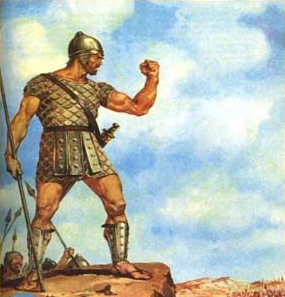
Consider the description of this nine-foot, nine-inch man. His head-to-foot  metal armor weighed as much as a person (about 126 lbs.). He carried a bronze javelin between his shoulders (trying to envision how that would look!) and an iron spear with a 16-lb. head. He walked behind a shield that took another soldier to carry.

He reminds me of the superhero action figures of kids' TV shows or video games. Only, he was no cartoon, but real and heart-stoppingly scary as his voice boomed out, above the clinking and clanging of his armor: "I defy the armies of Israel..."

The way today's reading stops short of giving us God's solution to the Goliath problem has me looking at the problem aspect of the story more closely than I usually do. It reminds me of some of the giants that shout, "I defy you..." in my life: an issue that has persisted for over a year in our strata complex, family members who stay away from God, illnesses that threaten loved ones, a career challenge that's forcing me out of my comfort zone. These things easily bring out the "dismayed and greatly afraid" feelings in me that Goliath evoked in Saul's soldiers.

What things shout, "I defy you..." in your life? Identify and name your giants because I have a feeling we'll be taking steps to deal with them in the days ahead.


PRAYER: Dear God, thank You for this first step of facing and naming the things that seem too big for me to conquer. Help me to be honest with myself about the giants in my life. Amen.

MORE: A local giant experience

I am working on this post the morning after we attended the first meeting of Vancouver’s Festival of Hope—a series of meetings in Rogers Arena with lots of contemporary worship bands and keynote speaker Franklin Graham (Billy Graham Association).

There was much controversy over these meetings.
- Christianity Today ran a critical piece.

- So did the Vancouver Sun.

- Vancouver’s mayor opposed it with even some leaders of Vancouver’s church community wanting it shut down, or at least get the speaker changed from Franklin Graham to someone else (and not only leaders from mainline, liberal churches but so-called conservative, evangelical denominations like Baptists and Christian and Missionary Alliance).

It felt like a “I defy you” moment for the church and Christian community in greater Vancouver and it certainly spurred us on to pray.

This article details the results of that first meeting: “Opposition turns to opportunity for good news in Vancouver."


Thousands were in attendance. Rogers Arena was filled to the rafters March 3, 2017. Praises to Jesus rocked the place! (Photo © 2017 by V. Nesdoly)

Seven hundred came forward at decision time. Thank You Lord!!

*************
Unless otherwise noted all Scripture quotations are taken from the New King James Version®. Copyright © 1982 by Thomas Nelson, Inc. Used by permission. All rights reserved.


Bible Drive-Thru


Wednesday, January 11, 2017

Getting God's direction

"Flight Into Egypt" by Gustave Doré

TODAY’S SPECIAL: Matthew 2:13-23

TO CHEW ON: “But when he heard that Archelaus was reigning over Judea instead of his father Herod, he was afraid to go there. And being warned by God in a dream, he turned aside into the region of Galilee.” Matthew 2:22

On Christmas Eve we watched a movie called “The Nativity.” Watching it I was impressed with how earth-shattering the events of the incarnation must have been to Mary, Joseph, and their families.

After an angel convinced Joseph of Mary’s purity and he took Mary as his wife, Jesus as his son, much rested on his shoulders. At least three times he had to break with routine so that Jesus would be safe—rush off in the middle of the night, move to a foreign country, move back home, but to which home (Matthew 2:13-14, 19-20, 22)?

We who know the whole story probably don’t appreciate the weight on his shoulders. Was that dream I just had a word from God or the result of my over-active imagination? Is my uneasiness at returning to Judea justified or am I being paranoid?

God directed Joseph, yes sometimes through voice and dream communication but also through his human emotions and intuition. It’s the same way I believe He directs us.

Even when we’re not sure which path to take, He is there, as He has promised (“I will instruct you and teach you in the way you should go; / I will guide you with My eye” - Psalm 32:8).

He leads, sometimes in ways as obvious as an angel visit or a voice (”Your ears shall hear a word behind you, saying,/ “This is the way, walk in it,”/ Whenever you turn to the right hand/ Or whenever you turn to the left” - Isaiah 30:21).

At other times His leading is as subtle as that almost imperceptible check inside us we call “fear,” or “this is right,” or “just take the next step”  (“I will bring the blind by a way they did not know; / I will lead them in paths they have not known. / I will make darkness light before them, / And crooked places straight. / These things I will do for them, / And not forsake them.” Isaiah 48:17).

PRAYER: Dear Father, thank You for my mind, emotions and experience that work together with Your word and presence to give me guidance. Amen.
 
 *********
Unless otherwise noted all Scripture quotations are taken from the New King James Version®. Copyright © 1982 by Thomas Nelson, Inc. Used by permission. All rights reserved.


Tuesday, November 22, 2016

Working for the real boss

"Best Boss Ever" on mug
TODAY'S SPECIAL: Ephesians 6:5-24

TO CHEW ON: "Obey them (earthly masters) not only to win their favor when their eye is on you, but as slaves of Christ, doing the will of God from your heart." Ephesians 6:6


Though Paul's instructions are addressed to slaves, I believe they are applicable to workers of any kind—those of us who work as employees, as freelancers, and as volunteers.

The qualities of God-pleasing workers that Paul lists are obedience, respect / fear, sincerity, integrity (working hard even when supervisors aren't watching), and wholeheartedness. They were to exercise all of these as if God were one's actual boss (because He is; He is the one who doles out the ultimate and eternal wages).

I find this straightforward and practical teaching for us. Personally, it means I should put as much effort into these blog devotions that I write for free as I put into an article I hope to publish for pay. I need to give myself as wholeheartedly to my housework as I do to a volunteer job I do at church.

Living as if God were our real boss in every endeavor helps us view all work, even lowly jobs like cleaning a toilet, in a whole new light.

PRAYER: Dear God, please help me internalize the reality of You as my real boss in each job of my life's work. Amen.

********
Unless noted otherwise, all Scriptures quoted in this meditation are taken from THE HOLY BIBLE, NEW INTERNATIONAL VERSION®, NIV® Copyright © 1973, 1978, 1984, 2011 by Biblica, Inc.® Used by permission. All rights reserved worldwide.

Thursday, October 06, 2016

"Sound mind" thinking

Image: Pixabay.com
TODAY’S SPECIAL: 2 Timothy 1:1-18

TO CHEW ON: “For God has not given us a spirit of fear, but of power and of love and of a sound mind.” 2 Timothy 1:7

In the next little while we’ll be reading through the book of 2 Timothy. In preparation for that I read the book notes in my study Bible and discovered some facts that put the book in its history context and gave me a deeper appreciation for it. Maybe they’ll help you see it in a new light too.

1. Paul wrote this book shortly before he died. Scholars believe he was executed before Nero’s death in A.D. 68 and that he wrote this letter in 66 or 67 A.D.

2. He was in prison when he wrote it.
This was not the private house arrest he’d been under earlier. “Now he was confined in a dungeon and friends could see him only with difficulty. Formerly he had expected to be released but now he looked forward to death (2 Timothy 4:6-8)” - James L. Beall, Study notes on 2 Timothy, New Spirit-Filled Life Bible, p. 1709.

3. The foremost purpose of the letter was to encourage his young trainee leader Timothy: “… the letter is not an orderly, well-planned literary production but a personal note passionately expressing the apostle’s last will and testament” - Ibid.

Keeping the above in mind, Paul’s encouragement to Timothy not to fear is especially moving. If anyone had reason to fear, it was Paul. But it seems long ago he had made peace with his own mortality (“For to me, to live is Christ, and to die is gain. “ - Philippians 1:21) and so he could bolster Timothy’s faith with words that resonate down through the centuries to us today: For God has not given us a spirit of fear but of power, and of love and of a sound mind” - 2 Timothy 1:7.

A Word Wealth article in my Bible elaborates on “sound mind”:
[Sound mind - sophronismos - a combination of sos (“safe”) and phren (“the mind”) hence, safe thinking. The word denotes good judgment, disciplined thought patterns and the ability to understand and make right decisions. It includes the qualities of self control and self-discipline - Dick Mills, New Spirit-Filled Life Bible, p. 1711 - emphasis added]

How might we defeat the opposite of a sound mind—a fearful, timid mind—in ourselves? One way is to cultivate a sound mind, i.e. guard our thought life.

Some verses that speak eloquently of how to set that guard in place:
“The tools of our trade aren’t for marketing or manipulation, but they are for demolishing that entire massively corrupt culture. We use our powerful God-tools for smashing warped philosophies, tearing down barriers erected against the truth of God, fitting every loose thought and emotion and impulse into the structure of life shaped by Christ" - 2 Corinthians 10:4,5 MSG.

“And now, brothers, as I close this letter, let me say this one more thing: Fix your thoughts on what is true and good and right. Think about things that are pure and lovely, and dwell on the fine, good things in others. Think about all you can praise God for and be glad about” - Philippians 4:8 TLB


PRAYER: Dear Father, help me to do my part in defeating fearful, timid thoughts. Amen.

 *********
Unless otherwise noted all Scripture quotations are taken from the New King James Version®. Copyright © 1982 by Thomas Nelson, Inc. Used by permission. All rights reserved.

Scriptures marked The Living Bible (or TLB) copyright © 1971 by Tyndale House Foundation. Used by permission of Tyndale House Publishers Inc., Carol Stream, Illinois 60188. All rights reserved. The Living Bible, TLB, and the The Living Bible logo are registered trademarks of Tyndale House Publishers.

Scripture quotations marked MSG are taken from The Message. Copyright © 1993, 1994, 1995, 1996, 2000, 2001, 2002. Used by permission of NavPress Publishing Group.

Friday, June 24, 2016

Sometimes God's ways get everyone talking

Zacharias and Elizabeth praying - Artist unknown

TODAY'S SPECIAL: Luke 1:57-80

TO CHEW ON: "Then fear came on all who dwelt around them; and all these things were discussed throughout all the hill country of Judea." Luke 1:65

Little Annabel Bean started having stomach troubles when she was just four. Her parents' quest for a diagnosis finally led to "pseudo obstruction motility disorder," an incurable condition where the stomach muscles don't work properly.

One afternoon when she was nine, weary of the house and bed, she—a tomboy like her older sister whenever she had the energy—joined her sister on the high branch of an old tree. The branch started to creak and then move and the girls scrambled for the safest way down. In that scramble, Anna fell headfirst into a grotto-like hole in the tree's trunk near where they had been sitting.

It turned out the hole wasn't the entrance to a shallow wooden cave but the mouth of the trunk that was hollow to the ground. Anna fell 30 feet that day. She should have been killed.

But instead, she had a heavenly vision. "I sat in Jesus' lap," she told her parents later. When rescuers finally lowered a rope sling to rescue her, she told how an angel provided light so she could find and grab onto it. And that day was the beginning of her healing. Her story caused quite a buzz.*

Another story that got everyone talking was the birth of John the Baptist. His birth to elderly parents, his father Zacharias's inability to speak throughout Elizabeth's entire pregnancy, then his parents' choice of name for him—John instead of Zacharias II, defying all convention—provoked "fear" (phobos - dread, fear, reverence) in all who lived nearby.

Though we may never have experienced God working in our lives in such dramatic ways as did John the Baptist's parents or Anna Bean, He is at work in our lives too. Let's stay alert to His activity. When we do sense His presence in things like little "coincidences" to the miracles we may experience, hear, or read about, let's not rationalize away His working: Anna was just lucky to fall the right way. Her vision was the product of an overactive imagination. The fact she never needed another pain pill after this was just coincidence….

No.

Rather, let's view God activity in our lives and the lives of those around us with the fear, dread, and reverence of Zacharias and Elizabeth's Judean neighbours. Let's let such examples strengthen our faith and reassure us that God is alive and active in our world.

PRAYER: Dear God, thank You that in my time, though filled with technological savvy where the tendency is to look for a natural explanation for everything, there are evidences that You still break through in miracles. Help me to believe, "The Lord's hand is not shortened that it cannot save; neither His ear heavy that it cannot hear" (Isaiah 59:1). Amen.

MORE: Nativity of St. John the Baptist

Today the church celebrates the Feast of the Nativity of John the Baptist. The day's liturgy begins with this collect:

Almighty God, by whose providence your servant John the Baptist was wonderfully born, and sent to prepare the way of your Son our Savior by preaching repentance: Make us so to follow his teaching and holy life, that we may truly repent according to his preaching; and, following his example, constantly speak the truth, boldly rebuke vice, and patiently suffer for the truth's sake; through Jesus Christ your Son our Lord, who lives and reigns with you and the Holy Spirit, one God, for ever and ever. Amen.

* Annabel's mother has told her story in the book Miracles from Heaven. A movie based on the story (Miracles From Heaven) was released in March, 2016.

 *********
Unless otherwise noted all Scripture quotations are taken from the New King James Version®. Copyright © 1982 by Thomas Nelson, Inc. Used by permission. All rights reserved.


Related Posts Plugin for WordPress, Blogger...