Showing posts with label David. Show all posts

Monday, August 13, 2018

An ancient father's advice

Image: Pixabay
TODAY’S SPECIAL: 1 Chronicles 25-29; Psalm 70

TO CHEW ON:
“‘As for you, my son Solomon, know the God of your father and serve Him with a loyal heart and with a willing mind; for the LORD searches all hearts and understands all the intent of the thoughts.’” 1 Chronicles 28:9

David’s advice to his newly crowned son, Solomon, is good advice for us too.

David told Solomon:

“know the God of your father…”
Know (yada) is transliterated know, learn, perceive and see, know by experience, recognize, admit, acknowledge and confess.

“…and serve Him…”
Serve (abad) - work serve, labour, serve another by labour.

“…with a loyal (whole - NASB) heart…”
Whole (shalem) - complete, full, perfect.

“… and a willing mind.”

Willing (chaphets) - desiring, delighting in, having pleasure in.

Living out this advice is bound to impact life in practical ways. In Psalm 37, written perhaps around the same time David gave the advice to Solomon (Psalm 37:25), David declares:
“Trust in the LORD and do good;
Dwell in the land and feed on His faithfulness.
Delight yourself also in the LORD
And He shall give you the desires of your heart” - Psalm 37:3,4.

Notice the word “delight” - an aspect of the willing mind.

David, in Psalm 37, argues against fretting (Psalm 37:7,8), and for keeping life’s big picture in mind (Psalm 37:9-22; 34-40), trusting God to direct the steps of everyday living (Psalm 37:23,24), and of treasuring God and His word in one’s heart (Psalm 37:31 cf. 1 Chronicles 28:9).

In this day of distraction and many shiny things to explore with the accompanying temptation to give one’s heart and mind to them, David’s simple advice to Solomon may be more difficult for us to follow than it would seem. Yet I believe it is the solution to many of the issues we deal with—stress, worry, decision-making, and being scorned, overlooked, and ignored by the world as people of faith, to name some.

PRAYER: Dear Father, I want to know You and serve You with a loyal (my whole) heart, and a willing mind. Please nudge me today when my heart wanders to lesser things.

PSALM TO PRAY: Psalm 70

 *********
Unless otherwise noted all Scripture quotations are taken from the New King James Version®. Copyright © 1982 by Thomas Nelson, Inc. Used by permission. All rights reserved.

Thanks for reading! This year we are using The Bible Project "Timeless Reading Plan" to read through the Bible in 2018. If you'd like to read along in your own Bible, you can download a pdf of the reading plan HERE.

Friday, August 10, 2018

Avoid the fate of the worship judge

"David dancing before the ark with all his might" by James Tissot
TODAY'S SPECIAL: 1 Chronicles 15-17; Psalm 67

TO CHEW ON: "And it happened, as the ark of the covenant of the Lord came to the city of David, that Michal, Saul's daughter, looked through a window and saw King David whirling and playing music; and she despised him in her heart." 1 Chronicles 15:29

Michal is an interesting Bible character. Here's what we know about her:

  • She is Saul's younger daughter (1 Samuel 14:49).
  • She loves David and David pays the grisly bride price to get her as a wife (1 Samuel 18:20, 27).
  • She helps David escape from Saul's murderous rage (1 Samuel 19:12).
  • After David leaves the city to live on-the-run, Saul gives Michal in marriage to another man (1 Samuel 25:44).
  • When David becomes king in Hebron he demands Michal be returned to him (2 Samuel 3:3).
  • On bringing the ark to Jerusalem David celebrates "leaping and whirling before the Lord." Michal watches and despises him (2 Samuel 6:16; 1 Chronicles 15:29). 
  • She goes to meet David, and accosts him with scorn and sarcasm: "How glorious was the king of Israel today, uncovering himself today in the eyes of the maids of his servants, as one of the base fellow shamelessly uncovers himself!" (2 Samuel 6:20).
  • But David doesn't give an inch. He tells her, "'It was before the Lord … Therefore I will play music before the Lord. And I will be even more undignified than this…" (2 Samuel 6:21-22).
  • Michal is doomed to barrenness (2 Samuel 6:23).

Why is Michal so critical of David's worship? There may be many reasons.

Maybe she is a prisoner of her own undemonstrative personality. Perhaps her palace upbringing has engrained in her a sense of how royalty should act. She is obviously hung up on appearances and what others will think. Perhaps too, her own spiritual life is lacking and so she has no category for the passion David feels and exhibits when he worships.  Whatever it is, her scornful reaction to David and his worship seals her fate of barrenness.

I think of this story when I hear people criticize the worship of others. Oh, I know there are guidelines laid down in the New Testament about church decorum. And I believe we should follow these. But in the area of how my Christian brothers and sisters personally interact with God, who am I, who are we to criticize how much emotion they display, whether they kneel or raise their hands, dance or lie face down, weep or whirl? They are, after all, presenting their worship to God, not us. It's for Him to read their hearts. And don't we want to stay out of the realm of spiritual Michal-barrenness?

PRAYER: Dear God, help me to worship You with the abandon that David shows, and to keep from judging others for their worship. Amen. 

PSALM TO PRAY: Psalm 67

***********

New King James Version (NKJV) Used with permission. The Holy Bible, New King James Version Copyright © 1982 by Thomas Nelson, Inc.


Wednesday, July 25, 2018

I'm sorry. Please forgive me

"David Asking Forgiveness" by Julius Schnorr Von Carolsfeld (1851-60)

TODAY'S SPECIAL: Nehemiah 10-11; Psalm 51

TO CHEW ON: "The sacrifices of God are a broken spirit,
A broken and a contrite heart—
These, O God, You will not despise. Psalm 51:17


Psalm 51 is David's eloquent prayer of repentance, prayed after the prophet Nathan confronted him with God's reaction to his role in the Bathsheba affair. I wonder, had he been avoiding God in the interim? Or had he carried on as usual, pretending everything was fine between them? Now that he knew things weren't fine, a lot of seemingly pent-up realizations came bubbling to the surface:

  • He's been feeling dirty: "wash me thoroughly ... purge me with hyssop ... wash me..." (Psalm 51:2, 7, 10). My Bible's footnotes explain, "The Hebrew word for wash (vs. 10)  is not the one used for the simple cleansing of a dish in water but rather the washing of clothes by beating and pounding them" - New Spirit-Filled Life Bible p. 727.
  • His sin has been bothering him—even if he squelched it down pretending it was no big deal: "...my sin is always before me..." (Psalm 51:3,4).
  • He admits that he deceived himself and needs God's help for that not to happen again: "Behold You desire truth in the inward parts / And in the hidden part you will make me know wisdom" (Psalm 51:6).
  • His sin has sucked the joy out of life: "Make me hear joy and gladness .... Restore to me the joy of Your salvation" (Psalm 51:8,12).
  • It has silenced his praise: "O Lord, open my lips / And my mouth shall sing aloud of Your righteousness" (Psalm 51:15).
  • He fears God's Spirit has left or will leave him: "Do not cast me away from Your presence / And do not take Your Holy Spirit from me" (Psalm 51:11).
  • He has a renewed realization that God is holy and not someone with whom to toy: "Have mercy upon me, O God ... Deliver me from the guilt of bloodshed" (Psalm 51:1, 14).
  • No bargaining, he gives God carte blanche to deal with him over this sin: "Do good in Your good pleasure to Zion" (Psalm 51:18).

I would suggest that David's reactions to his uncovered sin are frequently ours as well. That's why Psalm 51 is often our destination when we've sinned and we're needing to confess and repent.

May our words be as sincere, our spirits as broken, our hearts as contrite as David's appear to be when we read or recite this sacrifice of confession and repentance.

PRAYER: Dear God, You know how easily and often I sin and feel the same emotions as David expresses here. Help me to be as repentant as he was. May I learn from these times so that "truth in the inner parts" and wisdom in the "hidden part" become my lifestyle. Amen.

PSALM TO PRAY: Psalm 51


**********
Unless otherwise noted all Scripture quotations are taken from the New King James Version®. Copyright © 1982 by Thomas Nelson, Inc. Used by permission. All rights reserved.


Tuesday, April 03, 2018

Whose word is on my tongue?

colorful swirls
Graphic courtesy Pixabay.com
TODAY'S SPECIAL: 2 Samuel 22-24; Psalm 93

TO CHEW ON:
"The Spirit of the Lord spoke by me,
And His word was on my tongue." 2 Samuel 23:2


Today our reading contains a couple of magnificent passages attributed to David. 2 Samuel 22 is a psalm titled, in my Bible, "Praise for God's Deliverance." It's full of affirmations and testimony of God's excellence, goodness, help, and faithfulness.

The section from which our focus verse is taken is titled "David's Last Words"—a heading that makes us sit up and take notice.

In this last speech one of the things David emphasized was the fact that he was God's mouthpiece: "The Spirit of the Lord spoke by me…" It's a claim that seems proven by the longevity of the many poems and psalms he wrote. Across the ages till today they communicate deep truths about God and our relationship with Him.

[The Hebrew word for "Spirit" is rauch. A sidebar article in my Bible explains that this word occurs nearly 400 times in the Bible. It is translated "spirit, wind, breath" and can refer to the breath of life (Genesis 6:17), "spirit" as in human spirit (1 Samuel 16:23) or the Spirit of God (Isaiah 42:1; 44:3; 48:16; 61:1-3) - Dick Mills, Word Wealth, New Spirit-Filled Life Bible p. 431.]

This Spirit of God's inspiration makes many appearances in the Old Testament.

  • The seventy elders commissioned to help Moses were inspired to prophesy (albeit only once) - Numbers 11:25.
  • For the prophet Balaam, who King Balak hoped would curse Israel for him, God's Spirit put in his mouth only words of blessing - Numbers 23:5, 12, 16.
  • Likewise the Spirit came on many Old Testament prophets - Zechariah (2 Chronicles 24:20), Jeremiah (Jeremiah 1:9), Ezekiel (Ezekiel 3:17) and Micah (Micah 3:8).
  • Of course we recall the story of the Day of Pentecost when that Spirit wind blew into the Jerusalem upper room:
"And suddenly there came a sound from heaven, as of a rushing mighty wind, and it filled the whole house where they were sitting. Then there appeared to them divided tongues, as of fire, and one sat upon each of them. And they were all filled with the Holy Spirit and began to speak with other tongues, as the Spirit gave them utterance" Acts 2:2-4 (emphasis added).

There was a shift that day in how and where the Spirit worked. No longer was His presence limited to select individuals as it was in the Old Testament. From that day on, His presence and working was and is available to all who put their faith in Christ for salvation (1 Corinthians 6:19).

The question then becomes, are we available to Him? Does the wind of His words blow through us? Does it issue from our mouths and pens and keyboards? Will we be able to say someday: "The Spirit of the Lord spoke by me. / And His word was on my tongue"?
 

PRAYER: Dear Spirit, please blow into and through my life. May my actions and words be Spirit-inspired. Amen. 

PSALM TO PRAY: Psalm 93 
 
 *********
Unless otherwise noted all Scripture quotations are taken from the New King James Version®. Copyright © 1982 by Thomas Nelson, Inc. Used by permission. All rights reserved.


Sunday, April 01, 2018

Bit players in God's story

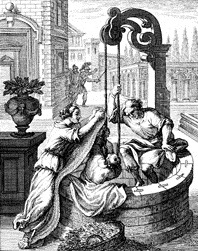
Jonathan and Ahimaaz - Johann Christoph Weigel
Jonathan and Ahimaaz - J.C. Weigel
He is risen; He is risen indeed. Happy Easter!

TODAY'S SPECIAL: 2 Samuel 16-18; Psalm 91

TO CHEW ON: "Now Jonathan and Ahimaaz stayed at En Rogel, for they dared not be seen coming into the city; so a female servant would come and tell them, and they would go and tell King David." 2 Samuel 17:17

David's plan was working! Absalom chose to follow Husahi's advice instead of Ahithophel's This bought David some time.

Hushai sent word of this to the priests' sons Jonathan and Ahimaaz (who had promised to be the snail-mail between Jerusalem and on-the-run David - 2 Samuel 15:27-28). However, even getting the word to Jonathan and Ahimaaz was now a two-step process as Absalom had eyes and ears everywhere. So Hushai gave the message for Jonathan and Ahimaaz to a "servant girl" to take to En Rogel where the runners were hiding.

A youngster saw them get the message, though and told Absalom. J. & A., realizing they'd been sighted, took refuge in a well in Bahurim, where the householder's wife covered their hiding place and spread ground grain on top of it. When Absalom's servants came to search they didn't find anyone. (Whew!)

Jonathan and Ahimaaz eventually got the message to David. He followed Hushai's advice, left the area and crossed over the Jordan to the wilderness.  There, before he even had time to worry about how he was going to take care of his army, three locals, Shobi, Machir, and Barzillai came laden with supplies because, "The people are hungry and weary and thirsty in the wilderness" - 2 Samuel 17:27-29.

Though it's customary for us to focus on the big-name players in the Bible's story—the Davids, Absaloms, Hushais, and Ahithophels—these narratives are also often full of bit players, some named, like Jonathan and Ahimaaz, but many unnamed as well, who are really as vital to bringing about the end result as the main players. In this story there are at least seven. Each one needed to play his or her part in order for God to accomplish His plan of preserving David's life.

Being a bit player is often our role. While we're not the big name speaker or the worship leader, when we do our part to make the phone calls, send the emails, set up the sound system, visit the sick, bring the food, open up our homes etc., things roll along smoothly. God's story plays out. Ours may seem like small, unimportant roles, but they are no less important than the role of the main characters to allow God's story to unfold in the way He has planned.

PRAYER: Dear God, help me to be willing to play whatever part You have for me in Your story. Amen. 

PSALM TO PRAY: Psalm 91

MORE: Easter Sunday
Carrying on with our theme of noticing insignificant characters, how many can you find in the story of Jesus' passion? Are we not among them—sinners for whom Christ's death paid our sins' penalty, and whose resurrection guarantees our life? 

 *********
Unless otherwise noted all Scripture quotations are taken from the New King James Version®. Copyright © 1982 by Thomas Nelson, Inc. Used by permission. All rights reserved.


Saturday, March 31, 2018

Three relationship lessons from David and Absalom

Absalom - James Tissot
TODAY'S SPECIAL: 2 Samuel 13-15; Psalm 90

TO CHEW ON: And Absalom answered Joab, "Look, I sent to you, saying, 'Come here, so that I may send you to the king, to say, "Why have I come from Geshur? It would be better for me to be there still." ' Now therefore, let me see the king's face; but if there is iniquity in me, let him execute me." 2 Samuel 14:32


The story of David and his sons is full of relationship game-playing.

It starts with David and two of his sons—half brothers Amnon and Absalom. When Amnon rapes Absalom's sister Tamar, David doesn't do anything about it even though there is a specific law against and punishment prescribed for incest (death) (2 Samuel 13:1-22; Leviticus 20:17). So Absalom takes revenge for the sin against his sister, kills Amnon, and flees to Geshur (2 Samuel 13:23-37). David us understandably heartbroken, and upset with Absalom.

Three years pass. When Joab, captain of David's army, sees that David is pining for Absalom, he devises a scheme whereby David's conversation with a wise woman gets him to recall Absalom to Jerusalem (2 Samuel 14:1-24).

That brings us to our today's reading where, after two years of David and Absalom living in the same town, David still hasn't called Absalom to see him or given him any indication that he's forgiven. When Absalom requests Joab come to him, Joab ignores him too. Absalom, in desperation, lights Joab's field on fire and that finally brings them face to face.

The result is a clear request for a meeting from Absalom to David (via Joab). When they meet, Absalom bows before his father, gets his dad's kiss (forgiveness) and things are good between them again… well, not quite.

For somehow, all this relationship drama has nurtured the thought in Absalom that he is more fit to be king than David is. And so we leave him conspiring to take over the throne.

I see in this story some relationship mistakes. They show us some things we can learn and apply as we interact within our families and communities:

1. David is lax in the way he handles Amnon's incest. This causes Absalom to distrust his father, who no longer appears to be acting righteously and justly.

David's failure here underlines the need for justice and integrity in us as parents and leaders—in front of our children and everyone who watches us.

2. Joab and David send mixed messages to Absalom. David calls him back to Jerusalem but then they never get together. Joab is instrumental in getting Absalom to return but then he ignores Absalom's request for an audience. Absalom is justifiably confused. Why has he been recalled? Has David forgiven him, or is he planning to kill him in revenge for Amnon's death?

We too need to give clear messages with our words and actions: " 'Let your yes be yes and your no, no' " Jesus says in Matthew 5:37.

3. Finally, Absalom lets his hurt and confusion fester into a plan to hurt his father back. If David is remiss in delaying his expression of forgiveness, Absalom is wrong in cultivating bitterness toward his dad.

When we've been wronged, we too need to forgive—completely and without secret plans to retaliate.

PRAYER: Dear God, please help me to live out these relationship qualities of justice transparency and forgiveness. Amen. 

PSALM TO PRAY: Psalm 90


 *********
Unless otherwise noted all Scripture quotations are taken from the New King James Version®. Copyright © 1982 by Thomas Nelson, Inc. Used by permission. All rights reserved.


Friday, March 30, 2018

Secret?

Nathan Confronts David
TODAY'S SPECIAL: 2 Samuel 9-12; Psalm 89

TO CHEW ON: "But what David had done was evil in the Lord's eyes .... 'You did what you did secretly, but I will do what I am doing before all Israel in the light of day.'" 2 Samuel 11:27b, 12:12.

On the day of Nathan the prophet's visit, at least nine months, perhaps a year or more had passed since David had begun his affair with Bathsheba, been foiled in his attempt to cover it up with a visit from the front by her husband Uriah, and then had Uriah murdered. Now, with his relationship to Bathsheba legitimized by marriage, he probably thought that he'd gotten away with what he'd done. Not so fast, David!

Nathan told David of God's deep displeasure. This showed David that his attempt to be sneaky with God was useless. No wonder David penned the words:

"If I say, 'Surely the darkness shall fall on me,'
Even the night shall be light about me;
Indeed, the darkness shall not hide from you,
But the night shines as the day;
The darkness and the light are both alike to You'" - Psalm 139:11,12.

Other Bible incidents remind us of God's all-seeing ability:
  • Adam and Even couldn't hide from God - Genesis 3:18
  • The garment and the gold and silver Achan secretly took from Jericho were uncovered - Joshua 7:18
  • Ananias's and Sapphira's lie to Peter came to light - Acts 5:1-11
And there are many more Bible examples of secrets becoming public knowledge.

Our attempts to sneak around behind God's back will prove just as futile. He still knows, sees, and has the ability to expose us. Let's let the words of Jesus Himself warn us:

"For there is nothing covered that will not be revealed, nor hidden that will not be known. Therefore whatever you have spoken in the dark will be heard in the light, and what you have spoken in the ear in inner rooms will be proclaimed on the housetops" -Luke 12:2,3 (emphasis added).

PRAYER: Dear God, help me to be honest in the way I live, first with myself, and then with You and others. If I have committed secret sins, please give me the courage to confess them and make them right. Amen. 

PSALM TO PRAY: Psalm 89

MORE: A false declaration

I remember exactly where I was when I recalled that I had lied on my declaration of the value of goods I brought into Canada after my Europe trip (back in the '70s). Seemingly from out of the blue, as I was walking down the hallway at Bible School where I was attending an alumni event, the realization came to me, and the thought: I'm going to have to make this right.

Don't kid yourself, it was a struggle. I had a mighty argument with myself:
- This happened a while ago. Why bring it up now? I just won't do anything like this again.
- I don't have the precise numbers.
-  What would the consequences be? Could Canadian Customs and Excise go after me?

Eventually, though, I wrote and mailed a letter, and felt better. Now there was nothing between God and me. And, as often occurs with such confessions, all my fears were groundless. I think I received a confirmation that they got my letter, but nothing more happened. It was an action so worth doing to have my relationship with Jesus clear and open again.

*****************
Unless otherwise noted all Scripture quotations are taken from the New King James Version®. Copyright © 1982 by Thomas Nelson, Inc. Used by permission. All rights reserved.

Thursday, March 29, 2018

Sit before God

David by Rembrandt
"David" - by Rembrandt
TODAY'S SPECIAL: 2 Samuel 4-8; Psalm 88

TO CHEW ON:
"Then King David went in a sat before the Lord ...." 2 Samuel 7:18

In today's reading we see how David became king over all Israel and Judah, consolidated his rule, and buitd a house for himself. Then it occurred to him to build a permanent home for the ark. He told Nathan the prophet, who gave his blessing to this plan. But God thought otherwise. He told Nathan to return to David and tell him, 'No. You are not to build Me a house.'

Did David feel shock and disappointment at the change? Did he have the urge to question and argue? Nathan's message obviously got him thinking and wanting to be in touch with God about what was going on. So he went in and "... sat before the Lord."

"'Sat' actually means remained," says my Bible footnote to this verse. "David spends a lengthy time before the Lord, that is, in the tent where the ark stood"- Jerry Cook,  commentary on 2 Samuel, New Spirit-Filled Life Bible, p. 411.

As he sat there, his thoughts ranged:
  • He saw his own puniness and insignificance - 2 Samuel 7:18.
  • He marveled at God's grace and favour to his family, given for reasons only God knows - 2 Samuel 7:18-21.
  • In God's blessing of him and the nation of Israel, he recognized God's greatness and he foresaw Israel becoming a blessing to the whole earth - 2 Samuel 7:22-24.

By the end of his time of sitting before God any vestige of a snit is gone. He was completely back in sync with God's plan - 2 Samuel 7:27-29.

What a great example David is to us. When things catch us by surprise, when our expectations come crashing down in disappointment or failure, when the road forks and we sense God tugging us in a direction we hadn't planned on going—and tens of other times—is a good time for us to stop and sit before God.

There we can let Him impress us with His person. He may reassure us with memories of His help in the past. And no doubt He will feed our imaginations with the possibilities of the course He is setting us on for the future.

PRAYER: Dear God, in the hustle and bustle of life, I don't take enough time to sit before You. Please draw me aside to do this, and to make a habit to spend time regularly sitting in Your presence. Amen.

PSALM TO PRAY: Psalm 88


The Bible Project VIDEO: Messiah (Theme series) 


MORE: His presence—a cure for anxiety

"Our eyes should be taken off self, removed from our own weakness and allowed to rest implicitly upon God's strength .... A simple confiding faith, living day by day and casting its burden on the Lord, each hour of the day, will dissipate fear, drive away misgiving and deliver from doubt (Philippians 4:6).

"That is the divine cure for all fear, anxiety and undue concern of soul, all of which are closely akin to doubt and unbelief" - E. M. Bounds, E. M. Bounds on Prayer, Kindle location p. 20)


******
Unless otherwise noted all Scripture quotations are taken from the New King James Version®. Copyright © 1982 by Thomas Nelson, Inc. Used by permission. All rights reserved.


Wednesday, March 28, 2018

Are you like David or Abner?

David anointed king over Judah
TODAY'S SPECIAL: 2 Samuel 1-3; Psalm 87

TO CHEW ON: "'Now that Saul is dead, I ask you to be my strong loyal subjects like the people of Judah, who have anointed me as their new king.'
But Abner son of Ner, the commander of Saul's army, had already gone to Mahanaim with Saul's son Ishbosheth. There he proclaimed Ishbosheth king over Gilead ... and all the rest of Israel." 2 Samuel 2:7-8 NLT


After years of running from Saul, David is free of his persecutor at last. Samuel had anointed David king years earlier so we might expect him to now make a play for the throne. But instead of acting on his own initiative, he keeps depending on God as much as ever.

He begins this new stage of life by asking God about two rather small practical matters: "Should I move  back to the towns of Judah?" and "Which town should I go to?" Then he does exactly what God tells him.

After he is crowned king by Judah, he offers his kingly services to the rest of Israel. Abner, Saul's army commander, takes it upon himself to answer by crowning Saul's 40-year-old son Ishbosheth king at Mahanaim.

What does David do about that? Nothing. He doesn't challenge Abner's action and insist that they crown him king, even though he knows he is God's anointed.

David and his dependence on God is quite a contrast to Abner whose claim to power is rooted in family (his father Ner was Saul's uncle, he was Saul's cousin - 1 Samuel 14:50) and his own manipulations. As a result it takes seven and a half more years and much more bloodshed before the remaining tribes approach David and ask him to be their king (2 Samuel 5:1-3).

I love David's dependence on God, especially as it contrasts with Abner's self-reliance. We would do well to copy David's example, praying about the minutest details of life, listening for and taking God's advice, and exercising patience as we wait for events to take their course (even as we cling to God-given dreams and promises made long ago). It's a course of action described so well by James: "Humble yourselves in the sight of the Lord and He will lift you up." James 4:10.

PRAYER: Dear God, thank You for these examples of David's dependence on You. Help me to translate his attitude to the details of my life. Amen.

PSALM TO PRAY: Psalm 87

The Bible Project VIDEO: 2 Samuel (Read Scripture series)


**************
Scripture quotations marked NLT are taken from the Holy Bible, New Living Translation, copyright © 1996, 2004, 2007 by Tyndale House Foundation. Used by permission of Tyndale House Publishers, Inc., Carol Stream, Illinois 60188. All rights reserved.


Friday, March 23, 2018

The "see" that really matters

Image from The Story of the Bible
 by Charles Foster (© 1873-84)
Drawings by F. B. Schell and others

David anointed at Bethlehem - F.B. Schell
David anointed at Bethlehem
TODAY’S SPECIAL: 1 Samuel 15-17; Psalm 82

TO CHEW ON: “But the LORD said to Samuel, ‘Do not look at his appearance or at his physical stature, because I have refused him. For the LORD does not see as man sees; for man looks at the outward appearance, but the LORD looks at the heart.’” 1 Samuel 16:7


In 1 Samuel 16 and 17 we have at least seven different views of David, who was soon to become an important character for the people of Israel and a pivotal player in the story of redemption.

The Parent (Jesse, David’s father):
In the eyes of his earthly father, David didn’t even rate the day off to meet with Samuel. When Samuel had gone through the first seven and asked if that was it for sons, Jesse replied: “‘There remains yet the youngest, and there he is, keeping the sheep’” - 1 Samuel 16:11. David was the youngest. He was needed for work when the other older, more distinguished looking, filled out, fully grown sons got an invitation to worship with the prophet.

The Prophet (Samuel):
According to 1 Samuel’s introduction in my Bible, scholars believe that Samuel wrote 1 Samuel. So this description of David in the narration: “… ruddy, with bright eyes, and good looking” is probably how David looked to Samuel at this, their first meeting (1 Samuel 16:12).

A Fellow Citizen (Saul’s servant):
Later, when King Saul had “distressing spirit” problems and asked for help finding someone who could ease him with music, a servant who knew the populace suggested David. This is how he saw him: “‘… a son of Jesse the Bethlehemite, who is skillful in playing, a mighty man of valour, a man of war, prudent in speech and a handsome person; and the LORD is with him” - 1 Samuel 16:18. Talk about a fabulous referral!

The Boss (King Saul):

So Saul summoned David for a job interview and he was hired on the spot for Saul “… loved him greatly.” David obviously passed his employment probation, for Saul soon requested of Jesse that David be released from shepherding to work for him full-time because David had “found favour” with him and could also chase the dark spirit away from Saul with his music - 1 Samuel 16:21-23.

Eliab, Joseph’s older brother:
I sense a little sibling rivalry in Eliab’s view of David and his insulting comments to his “baby” brother. He belittled David’s occupation, called him proud and insolent, and implied that he was a shirker. David’s nonchalant response: ”’What have I done now?’” tells me that this was not the first time Eliab was on his case (1 Samuel 17:28,29.

Goliath:

This Philistine giant was beyond scornful of the insignificant champion and his weapons the Israelites sent out to spar with him.  His sarcastic “Am I a dog that you come to me with sticks” was followed by a string of curses and threats (1 Samuel 17:42-44). 

God:
God’s reaction to David is found in his words to Samuel: “‘Arise, anoint him for this is the one!’” - 1 Samuel 16:12. God chose David by what He saw in David’s heart, for he had just had Samuel turn down seven of Jesse’s sons on the basis of what was, or wasn’t, in their hearts: “‘I have refused him (and him, and him…). For the LORD… looks at the heart’” - 1 Samuel 16:7.

What came next is also significant, for following Samuel’s anointing of David “The Spirit of the LORD came on David from that day forward” - 1 Samuel 6:13. The story of Goliath's defeat at David's hand is proof of that something remarkable took place.


Two take-aways:


1. God still sees and evaluates us by our hearts. No matter how young or old, ugly or beautiful, insignificant or important, skillful or klutzy we are, He sees beyond all exteriors to our inner selves. There’s no fooling Him with a fancy outside.

2. I love how David’s anointing and the Spirit’s coming upon him only enhanced his appearance, reputation, and favour. Even strangers like Saul’s servant noticed that “… the LORD is with him.” And his boss Saul experienced it through David’s work and then through the defeat of Goliath. May we, in this time when the Spirit is available for all who accept Jesus, be so filled that others would say: “The Lord is with him /her.”

PRAYER: Dear Father, I know You see my heart. Help me to see and understand myself better. And may Your Spirit on and in me be evident in the skill with which I do my work, my courageous attitude, my prudent speech, and in the favour my life attracts. Amen.

PSALM TO PRAY: Psalm 82

 *********
Unless otherwise noted all Scripture quotations are taken from the New King James Version®. Copyright © 1982 by Thomas Nelson, Inc. Used by permission. All rights reserved.


Tuesday, February 20, 2018

Discovering the truth about ourselves

David and Nathan - Matthias Scheits
"David and Nathan" - Matthias Scheits
TODAY'S SPECIAL: Numbers 33-34; Psalm 51

TO CHEW ON: "Behold You desire truth in the inward parts,
And in the hidden part You will make me know wisdom." Psalm 51:6


David prayed this prayer after the uncanny experience of having Nathan the prophet come to him and expose his sin with Bathsheba (2 Samuel 12).

Had Nathan caught him in the act?

No. It was God who revealed David's sin to Nathan—the God who:
  • spotted Noah as righteous - Genesis 7:1.
  • whispered the secrets of Saul to Samuel - 1 Samuel 9:19.
  • alerted Elisha to Gehazi's sin of lying to Naaman - 2 Kings 5:26.
  • kept Jesus in-the-know about the thoughts and attitudes of those around Him - Matthew 22:18; Mark 2:8; Luke 6:8; 11:17.
  • gave the disciples confidence to offer the gospel to the Gentiles - Acts 15:8.

But David was a Spirit-filled man, wasn't he? Why did God need to send someone else to tell him how displeasing his sin was?

Perhaps because his involvement in that sin had opened him up to deception. Whenever his sin bothered him, which it no doubt did, he silenced the pangs of conscience or the voice of God with, 'It's no big deal' or, 'I had no other option,' or any number of other excuses we too give for committing sin. Then it took someone else, someone who heard God's voice clearly, to bring him to his senses. It was only after Nathan confronted him that he confessed to his sin (2 Samuel 12: 7,13).

God wants us to be just as scrupulously honest with ourselves—to live in truth at the deepest level. He can show us the state of our hearts. I love another David psalm where he prays: "Search me O God, and know my heart; Try me and know my anxieties; And see if there is any wicked way in me, And lead me in the way everlasting" - Psalm 139:23,24.

But if we insist on living in deception, God can also send someone—our own Nathan—to tell us the truth about ourselves. The question is, will we be as receptive to such an exposé as David was? However it happens may we be as quick to acknowledge our sin and repent.

PRAYER: Dear God, please alert me to self deception. I want to have a life of truth and wisdom. Amen.

PSALM TO PRAY: Psalm 51

MORE:  Repentance
"Repentance always brings a man to this point: I have sinned. The surest sign that God is at work is when a man says that and means it. Anything less than this is a remorse for having made blunders, the reflex action of disgust at himself.

The entrance into the Kingdom is through the panging pains of repentance crashing into a man's respectable goodness; then the Holy God, who produces these agonies, begins the formation of the Son of God in the life. The new life will manifest itself in conscious repentance and unconscious holiness, never the other way about" - Oswald Chambers, My Utmost for His Highest, October 7 reading.

*********
Unless otherwise noted all Scripture quotations are taken from the New King James Version®. Copyright © 1982 by Thomas Nelson, Inc. Used by permission. All rights reserved.
 

Monday, December 18, 2017

King forever

TODAY'S SPECIAL: 2 Samuel 7:1-17

TO CHEW ON: "And your house and your kingdom shall be established forever before you. Your throne will be established forever." 2 Samuel 7:16

David's desire to build God a stationary house of worship ended in quite a tradeoff. Through Nathan the prophet, God said to David, "...the Lord tells you that He will make you a house" 2 Samuel 7:16.

[House (bayit) can mean a dwelling, a family or a temple. Here God was making a promise to David about the permanence of his family and unendingness of his kingdom (2 Samuel 7:11, 16).]

We know that in the short term David saw his son Solomon succeed him. But David's human line eventually petered out. So we see that this was a promise about something bigger than a mere earthly dynasty. Matthew Henry explains:

"These promises relate to Solomon... but they also relate to Christ, who is often called David and the Son of David. To him God gave all power in heaven and earth with authority to execute judgment. He was to build the gospel Temple, a house for God's name; the spiritual temple of true believers, to be a habitation of God through the Spirit. The establishing of his house, his throne and his kingdom forever can be applied to no other than to Christ and his Kingdom" - Matthew Henry's Concise Commentary.

Note how the Bible bears this out:
  • In Isaiah 9, a passage recognized as a prediction of Christ's coming, Isaiah says: "Of the increase of His government and peace there will be no end, upon the throne of David and over His kingdom to order and establish it ... from that time forward, even forever" - Isaiah 9:7.
  • The prophet Daniel's visions are clear about who this everlasting king is: "...And behold One like the Son of Man, Coming with the clouds of heaven!....Then to Him was given dominion and glory and a kingdom...His dominion is an everlasting dominion. Which shall not pass away...shall not be destroyed" - Daniel 7:13-14.
  • When the angel Gabriel came to Mary, his announcement reiterated the identity of the baby she was to bear: "He will be great, and will be called the Son of the Highest; and the Lord God will give Him the throne of His father David. And He will reign over the house of Jacob forever, and of his kingdom there will be no end" - Luke 1:32-33.
  • John's vision of things still to come underlines the fact that Jesus is this everlasting king: "Then the seventh angel sounded: And there were loud voices in heaven, saying, "The kingdoms of our Lord and of His Christ, and He shall reign forever and ever!" Revelation 11:15.

This is the King whose birth we celebrate this season. Let's sing with the carollers:

"Who is He that from His throne
Rules through all the world alone?
'Tis the Lord...the King of glory"  (from "Who is He in Yonder Stall" - Benjamin R. Hanby).

"Hark! the herald angels sing,
'Glory to the newborn King...'" (from "Hark! the Herald Angels Sing" by Charles Wesley).

"So bring Him incense gold and myrrh
Come, peasant, king to own Him;
The King of Kings salvation brings,
Let loving hearts enthrone Him" (from "What Child is This" by William C. Dix).


PRAYER: Dear Jesus, King of Kings and Lord of Lords, I pledge my allegiance and loyalty to You again today. I am honoured to be Your subject. Be the King of my heart, my mind, my home, and my life today. Amen.

**************
Unless otherwise noted all Scripture quotations are taken from the New King James Version®. Copyright © 1982 by Thomas Nelson, Inc. Used by permission. All rights reserved.


Bible Drive-Thru


Monday, June 26, 2017

Magnify God with your gratitude

magnifying glass with pencil TODAY'S SPECIAL: Psalm 69:19-36

TO CHEW ON: "But I am poor and sorrowful;
Let Your salvation, O God, set me up on high.
I will praise the name of God with a song,
And will magnify Him with thanksgiving." Psalm 69:29-30


David continues on with his list of negatives.

(Several of them remind us of passages from the gospels and Acts, where the writers quote the very words of this psalm.

  • Psalm 69:6 - John recalls this verse after witnessing Jesus' early cleansing of the temple in John 2:17.
  • Psalm 69:21 - Jesus is offered gall and sour vinegar while on the cross in Matthew 27:34.
  • Psalm 69:25 - Peter refers to this verse in relation to Judas when the apostles discuss finding about a replacement for him in Acts 1:16-20.)

Then notice how he changes course. At the junction of verses 29 and 30 it's as if he says to himself, Enough of this dwelling on the negative! And he begins to give God praise and thanksgiving.

He chooses to praise "with a song" getting his vocal cords involved.

He determines to "magnify Him with thanksgiving." I envision him peering at God and who He is through the magnifying lens of gratitude and appreciation. This makes Him bigger than the bad stuff that's happening to him; it magnifies Him.

Another meaning of magnify is to extol and exalt. We do that too as we direct our attention and fill our thoughts and our mouths with praise of God and thanksgiving to Him.

How can we do that practically?

You know all those blank notebooks people give as gifts? I've labelled the spine of one of them GRATITUDE. I write in it things for which I'm thankful. As I've persisted with this, guess what? A grateful, thankful attitude is becoming my habit!

PRAYER: Dear God, thank You for being bigger than all my problems and for loading my life with good things. Help me to look away from my troubles to You and Your good gifts. Amen.

****************
Unless otherwise noted all Scripture quotations are taken from the New King James Version®. Copyright © 1982 by Thomas Nelson, Inc. Used by permission. All rights reserved.


Friday, May 12, 2017

Write yourself out of a funk

TODAY'S SPECIAL: Psalm 31:1-24

TO CHEW ON: "Be of good courage,
And He shall strengthen your heart
All you who hope in the Lord." Psalm 31:24


Do you notice how the writer's mood changes as we make our way through this psalm? David starts off in an emotional funk but ends in a much better place. Let's track his thoughts as he journeys from desperation to hope.

1. He cries for help (vs. 1-5):
From his bad place David cries to God "Deliver me...bow down Your ear...Deliver me speedily...Be my rock of refuge...Pull me out of the net...Into Your hand I commit my spirit."

2. He does some self-lecturing (even though, judging by what follows, his feelings aren't yet on-board) (vs. 6-8):
"I will be glad...You have considered my trouble...You have known my soul in adversities...(You) have not shut me up into the hand of the enemy; You have set my feet in a wide place."

3. He lays it all out (vs. 9-13):
David speaks his feelings and fears:  
"I am in trouble...I am a reproach...I am repulsive...I am forgotten...I am like a broken vessel...They scheme to take away my life." 
Thankfully he doesn't stay there!

4. He declares his faith in God (vs. 14-15a):
"But as for me, I trust in You, O Lord;
I say 'You are my God'
My times are in Your hand..."
In other words, even considering the worst that people can do, David reminds himself that God, not his enemies, is ultimately in charge of his life.

5. He requests specific help (vs. 15b-18):
David puts into words exactly what he needs:
"Deliver me from the hand of my enemies and from those who persecute me... Make Your face shine on me...Let the wicked be ashamed...Let the lying lips be put to silence."

6. Finally he offers praise to God, in faith that God has heard and will answer (vs.19-24):
"Oh how great is Your goodness...You shall hide them (those who fear You) in the secret place of Your presence...Blessed be the Lord...You heard the voice of my supplication when I cried out to You...Be of good courage ...All you who hope in the Lord."

My journal entries are sometimes a bit like this — a writing journey from trouble to trust. I find it helps to pour it all out on paper: the mixed-up feelings, the fears, the self-recrimination and revulsion. But it's important not to stay there but to move from a focus on self back to a focus on God.

If you're in trouble today, try writing your own version of Psalm 31. Just make sure you end up in the place David did — with your eyes on His face that shines on you.

PRAYER: Dear God, thank You for David's very real relationship with You, showing even his dark moments. I have them too. Help me to work my way out of them and back to You like he did. Amen.

MORE: Journaling resources

How to Keep a Spiritual Journal

Journaling: Being a Brave Soul (with more resources listed within the post and a link to more articles in Ann Voskamp's 2009 series about journaling).

************
Unless otherwise noted all Scripture quotations are taken from the New King James Version®. Copyright © 1982 by Thomas Nelson, Inc. Used by permission. All rights reserved.


Bible Drive-Thru


Thursday, March 23, 2017

Providence meets faith

TODAY’S SPECIAL: 1 Samuel 17:41-57

TO CHEW ON:
“Then David put his hand in his bag and took out a stone; and he slung it and struck the Philistine in his forehead, so that the stone sank into his forehead, and he fell on his face to the earth.” 1 Samuel 17:49

What are the chances that this youthful armed-only-with-a-sling shepherd would get the best of a 9 foot, 9 inch fully armed warrior? Pretty slim, I’d say. Yet here it happens before our eyes. What’s the explanation?

Surely David was skillful with his primitive weapon, so that’s one thing. However, I believe much bigger forces were at war here as they had been numerous times before in Israel’s history.

Right now our pastor is teaching a Bible study on Judges. There too we see unlikely Israelite victories.

  • Judge Ehud managed to get alone with Eglon, King of Moab, kill him with one thrust of his homemade sword, and get well away before the servants discovered the deed—a catalyst to Israel’s victory over Moab (Judges 3:15-30).
  • Tentwife Jael invited fleeing army general Sisera into her tent and, after he fell asleep,  killed him by driving a tent peg through his temple - Judges 4:18-24.
  • Gideon defeated an army of thousands of Midianites and Amalekites with only 300 men armed with pitchers, torches, and trumpets - Judges 7:16-25.

What’s at work in each of these incidents is people of faith and courage taking action. That faith combined with the providence of God is what led to these stunning victories.

David had zeal for God’s honour (1 Samuel 17:45-47). That zeal combined with his past experience of God’s help (1 Samuel 17:34-36) filled him with courage and faith, so that he took up what was at hand to do battle. But I believe it wasn’t only his skill that felled Goliath that day, but God’s providence that clinched his success.

My challenge from the story of David and Goliath is wrapped up in these snippets from my study notes on Judges:

“We take steps of faith and courage, and trust in the providence of God … Providence continues to be God’s gift to His people. What’s in your hand? As you partner with God, His grace will come on you. Take a risk this week. Believe God to be with you. Your “hand tool” will make a difference” - Derrick Hamre.

PRAYER:  Dear Father, thank You that as I step out in faith with You on my side, I too can win unlikely victories. Amen.

*********
Unless otherwise noted all Scripture quotations are taken from the New King James Version®. Copyright © 1982 by Thomas Nelson, Inc. Used by permission. All rights reserved.


Wednesday, March 22, 2017

God sees past birth order

Siblings (Image: Pixabay)
TODAY’S SPECIAL: 1 Samuel 17:26-40

TO CHEW ON: “Now Eliab, his oldest brother, heard when he spoke to the men; and Eliab’s anger was aroused against David, and he said, ‘Why did you come down here? And with whom have you left those few sheep in the wilderness? I know your pride and the insolence of your heart, for you have come down to see the battle.’”  1 Samuel 17:28


Two days ago we looked at how various people viewed David. Here we see him from another angle—as his older brother saw him. David’s answer to Eliab’s “Why did you come here?” is almost a nonchalant shrug: ”’What have I done now?’” It tells me that this was not the first time Eliab was on his case.

Their interchange reminds me of other Bible first born / later-born conflicts.
  • Cain killed his younger brother Abel. 
  • Jacob connived how to get his father’s firstborn blessing from older Esau. 
  • Joseph (the second-youngest) was hated by his older brothers. 
  • In Jesus’ parable of the prodigal son, it’s the oldest dutiful big brother who ends up being the antihero of the story.

Perhaps one reason Bible firstborns had trouble with their younger siblings getting special treatment was because in Israel special privilege was supposed to go to the oldest son, as in:
“… a larger inheritance, a special paternal blessing, family leadership, and an honored place at mealtimes (Genesis 25:5-6; 27:35-37; 37:21; 42:37; 43:33; Deuteronomy 21:15-17). … In Israelite ritual, the firstborn belonged to God (Exodus 13:2; 22:29-30; Numbers 3:13)” - “What's the significance of 'first-born' in the Bible” from GotAnswers.org.

As an oldest myself, I am not unsympathetic toward these Bible firstborns. Psychologist Dr. Kevin Leman has studied and written about characteristics that are often found in people according to their birth order (The Birth Order Book). I can see how many of the qualities typically found in last borns readily grate on firstborns.

Firstborn qualities: conscientious, well-organized, serious, goal-oriented, achieving, people pleaser, believer in authority, perfectionist, reliable, list-maker, critical, self-sacrificing, conservative, supporter of law and order, legalistic, self-reliant .


Lastborn qualities: manipulative, charming, blame others, attention seekers, tenacious, people person, natural salesperson, precocious, engaging, affectionate, love surprises - Kevin Leman, The Birth Order Book, 80,167.

God often chose those born later in the family for special assignments:
  • Of the sons of Jacob, middle-born Judah established the ancestral line of Jesus.
  • Moses, a youngest son, led Israel out of Egypt.
  • Solomon (not the oldest but middle or youngest) was the one chosen of David’s sons to become king.
But God also chose firstborns. Jesus, a firstborn, is our Messiah and Saviour.

All this to say that whatever qualities we’re born with or that our family has nurtured in us, we still need to be yielded to God for His purposes. It’s not birth order or societally mandated privilege that determines whether God can use us or not. It’s what’s in our hearts (1 Samuel 16:7).

PRAYER:
Dear Father, thank You for my family and how they have molded me. Help me to yield my firstborn tendencies to You for whatever destiny You have planned for me. Amen.

 *********
Unless otherwise noted all Scripture quotations are taken from the New King James Version®. Copyright © 1982 by Thomas Nelson, Inc. Used by permission. All rights reserved.


Saturday, March 11, 2017

Grace that stretches over centuries

Cross, against sun and reflection on water
TODAY'S SPECIAL: Romans 4:1-12

TO CHEW ON: "For what does the Scripture say? 'Abraham believed God, and it was accounted to him for righteousness.' " Romans 4:3


In his typically logical style, Paul sets out here to show how Abraham's and David's faith and God's grace and forgiveness combined to guarantee their salvation even though they lived millennia before Christ.

It wasn't works, Paul says using Genesis 15:6 as his proof text. Wages for work would be considered a debt, not a tally on the grace side as this is (Romans 4:4).

The work under consideration is circumcision. But Abraham believed before he was circumcised. Circumcision was only a sign of his faith, implemented later to mark those who were of his faith line (Romans 4:9-11). Some who weren't circumcised also had this faith (Romans 4:12)

It was faith. The column accounted for righteousness in the ledger of a life was faith in God's forgiveness says Paul, quoting David from Psalm 32:1,2. It was God forgiving, covering, not imputing committed sins to our account.

The implication for his readers—including us—is that salvation comes to us this way too. It is all grace flowing from Jesus' death for us. It flows back through the centuries to believers like Abraham and David, and forward to us. Our faith is in Christ and His death in our stead, which means our sins that should condemn us to death are similarly forgiven, covered, not imputed to our account.

I believe only eternity will bring home to us the immensity and blessedness of this truth.

PRAYER: Dear God thank You for your plan of salvation, enacted in a moment of time, but with efficacy for all people who have ever lived. Amen.

 *********
Unless otherwise noted all Scripture quotations are taken from the New King James Version®. Copyright © 1982 by Thomas Nelson, Inc. Used by permission. All rights reserved.


Friday, February 26, 2016

Attitude turnaround

Desert in the Middle East (Image: ejaugsburg/Pixabay.com)

TODAY'S SPECIAL: Psalm 63:1-11

TO CHEW ON: "My soul thirsts for You;
My flesh longs for You
In a dry and thirsty land
Where there is no water…
My soul shall be satisfied as with marrow and fatness,
And my mouth shall praise You with joyful lips." Psalm 63:1,5


Do you notice how David goes from being spiritually hungry and thirsty to satisfied and full in the space of four verses? Let's delve into this psalm for a bit to see how he does it.

At first:
Notice the occasion and setting of the writing: "A psalm of David when he was in the wilderness of Judah." No wonder he's thinking "dry," "thirst," "no water"! He is on the run from King Saul and hiding out in an arid place of caves and only parched vegetation. The opening of this psalm reflects his nasty circumstances.

How does he turn himself around? These are some things he does:

1. "So I have looked for You in the sanctuary…"  - Psalm 63:2:
I see the word "sanctuary and I think "church" or other sacred building. But David is far from the Tabernacle. What "sanctuary" could he be referring to?

[The Hebrew word translated "sanctuary" is qodesh . It means apartness, holiness, sacredness, separateness of God, of places and of things.]

Since David couldn't make the trek to the actual sanctuary I would imagine he entered the God's sacred presence much like we do when we meet with God in our daily devotions at home—using his imagination, directing his thoughts to God's "power and glory" and all His attributes, getting distracted from his worries and complaints by soaking in God's presence.

2. "My lips shall praise You…" - Psalm 63:3
David speaks praise out loud, with his mouth.

3. "I will lift up my hands in Your name…" - Psalm 63:4:

David continues praising with even more expressiveness. Lifting hands can mean many things—surrender, trust, pleading, adoration, or loyalty (as in a type of salute).

4. "I remember You on my bed,
I meditate on You in the night watches" - Psalm 63:6:
David's attitude turnaround affects even how he spends the hours he can't sleep or the time he's trying to stay awake through the night watch of guard duty. Instead of worrying, he meditates on God, recalls God's help and presence, and rejoices in God's protection ("Your wings") instead of worrying.

Next time circumstances overwhelm us with how poor and needy we are, let's try out some of David's techniques to return ourselves to the place of plenty:
- Enter the sanctuary of God's presence.
- Praise with our lips and bodies.
- Rein in our thoughts and focus on Him
instead of worrying, especially during the trying times of night.


PRAYER: Dear Father, please help me to make a habit of turning my thoughts to You in difficult circumstances and, like David did, to praise You, worship You and trust in Your ability to see me through. Amen.

 *********
Unless otherwise noted all Scripture quotations are taken from the New King James Version®. Copyright © 1982 by Thomas Nelson, Inc. Used by permission. All rights reserved.


Friday, February 19, 2016

Choose to linger


person in praise,  hands raised, music superimposed
Image: mccartyv / Pixabay.com
TODAY'S SPECIAL: Psalm 27:1-14

TO CHEW ON: "One thing I have desired of the Lord;
That I will seek:
That I may dwell in the house of the Lord
All the days of my life,
To behold the beauty of the Lord,
And to inquire in His temple."  Psalm 27:4


"This desire of David gives us a key to understanding why he was a 'man after God's own heart,' and so beloved and blessed by Him" says Dick Iverson, writer of my Bible's commentary on the Psalms (New Spirit-Filled Life Bible, p. 706).

Several other Bible characters also come to mind when we think of people desiring to linger in God's presence.

Moses spent days on end with God ("So the Lord speaks to Moses face to face as a man speaks to his friend" Exodus 33:11). When he returned to everyday life from these times he covered his face with a veil to shield the Israelites' eyes from the glory that shone there (Exodus 34:29-35).

Simeon and Anna
, two senior citizens of Jesus' day, seemed to have experienced that intimacy. Both were in the temple the day Jesus' parents presented Him to God. Of Simeon Luke says he was "… waiting for the consolation of Israel, and the Holy Spirit was upon him … So he came by the spirit into the temple" (Luke 2:25,27). Similarly Anna, the elderly widow "… who did not depart from the temple but served God with fasting and prayer day and night"  was there (Luke 2:37,38). To these two God told His secret, giving them a glimpse of Jesus—Messiah—and allowing them to hold Him, bless Him, and spread the news of Him (Luke 2:28-32,38).

And there was Mary of Bethany, sister of Martha and Lazarus. She sat at Jesus' feet, drinking in what He said and who He was while harried Martha fretted in the kitchen. When Martha complained and asked Jesus to put Mary to work, Jesus said, "'Martha, Martha, you are worried and troubled about many things. But one thing is needed, and Mary has chosen that good part, which will not be taken away from her'" - Luke 10:39-42.

The word "chosen" pops out at me (and, from our focus verse, "desire," "seek," "dwell," "behold," and "inquire"). For as spending time with God was an intentional choice for David, Moses, Simeon, Anna, and Mary, so it is for us. I ask myself, when given the array of ways to spend my minutes, hours, days, how much do I choose to spend with the Lord, beholding His beauty in the temple of His presence?

PRAYER: Dear God, please help me to tune out the noise and clamor of my life and spend quality and quantity time with You. Amen.

***********

New King James Version (NKJV) Used with permission. The Holy Bible, New King James Version Copyright © 1982 by Thomas Nelson, Inc.

Bible Drive-Thru


Saturday, January 23, 2016

The Bible - amazing book

TODAY’S SPECIAL: Psalm 19:1-14

TO CHEW ON: “The law of the Lord is perfect, converting the soul;

The testimony of the Lord is sure, making wise the simple.” Psalm 19:7

Product recall! The thought makes us cringe even as we perk up our ears to hear what is being recalled this time. Sometimes it's food that's been tainted with bacteria. Lately many cars have been recalled for faulty parts that make them dangerous to drive. Baby products are especially vulnerable to recall as we attempt to shield our most vulnerable and helpless from danger and risk.

 Probably nothing is as damaging to a company’s reputation as having to send out a warning about the safety of its products – though denying there is a problem and continuing to circulate dangerous goods is, in the end, even worse.

Our reading today talks about something that will never need to be recalled. God’s word – the Bible – has been around for centuries and it will continue to remain perfect, sure, right, pure, clean, true, righteous, desirable, sweet, effective to warn us and, if we follow its advice, to deliver us to God as acceptable.

How can I say such a thing with such certainty? Well okay, I’ll admit there is an element of faith here. But my faith is based on more than just the Bible’s claims for itself. My trust in the Bible is also based on these things:

- It’s indestructibility. How long do most books last? Not long! But the Bible, despite the passage of time and numerous efforts to exterminate it, is going stronger than ever.

- Its character in both message and unity. Where else will you find a collection of 66 books from 50 different authors written over about 1600 years that contains “One doctrinal system, one moral standard, one plan of salvation, one program of the ages”? (Lectures in Systematic Theology – Thiessen, p. 85)

- Its influence. It has and continues to cross cultural and language barriers around the world.

- Its fulfilled prophecies. “Only God can reveal the future and we have many proofs in the Scriptures that He did reveal it to His servants” (Thiessen, p. 88).

For these reasons I have anchored my life to the bedrock of the Bible – and don’t expect to ever find out it is broken, faulty, mistaken or polluted. What about you? On what have you built the house of your life?

PRAYER: Dear God, I thank You for the Bible, which is rich beyond words. Help me to understand it and live by its principles today. Amen.

********
Unless otherwise noted all Scripture quotations are taken from the New King James Version®. Copyright © 1982 by Thomas Nelson, Inc. Used by permission. All rights reserved.

Bible Drive-Thru


Related Posts Plugin for WordPress, Blogger...