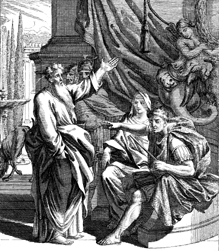
Showing posts with label influence. Show all posts

Friday, December 28, 2018

Your works - they're following you!

TODAY'S SPECIAL: Revelation 14-16; Psalm 45

TO CHEW ON: "Then I heard a voice from heaven saying to me, 'Write: "Blessed are the dead who die in the Lord from now on."' '"Yes," says the Spirit, "that they may rest from their labours and their works follow them."'" Revelation 14:13

In the midst of the mayhem and chaos of Revelation 14, the thunderous voices and the smoke of everlasting torment comes the reassuring benediction of our focus verse to those who "die in the Lord."

Though death is something we all try to avoid, here the heavenly voice tells John to call them "Blessed."
["The word "blessed"  comes from the root "mak" meaning large or of long duration. "It suggests happy, supremely blessed, a condition in which congratulations are in order. It is a grace word that expresses the special joys and satisfaction granted the person who experiences salvation" "Word Wealth," New Spirit Filled Life Bible, p. 1296.]

These dead are blessed for more than just the reason the cynical author of Ecclesiastes gives — because oppressions of life are finally over. Paul in 1 Corinthians 15 lays out in detail why death for the believer is so hope filled. It's because Christ conquered death. Since He rose from the dead, we too can looking forward to resurrection — a life that goes on into eternity (1 Corinthians 15:20-23).

In Revelation 14, the Spirit refers to death as "rest." The time for working is done. But the effects of that work go on.

There are some interesting examples of after-death influence in the Bible:

1. On her death, Dorcas's friends mourn and show Peter her very tangible "work" — the tunics and garments she made (Acts 9:39).

2. Jesus predicted that the act of the woman who poured oil on His head would be retold wherever the gospel was preached (Matthew 26:6-13).

3. Perhaps one of the most curious examples is of  after-death influence is the story Elisha's. When a dead man was hurriedly buried in his tomb (the rush because of approaching raiders) on touching Elisha's bones, the man sprang to life (2 Kings 13:21).

4. However, it is clear that our works will follow each one of us to a final day where their quality will be revealed:
"...for the Day will declare it, because it will be revealed by fire; and the fire will test each one's work, of what sort it is..." 1 Corinthians 3:13.

What a challenge to consider carefully how we live, what we live for, and the eternal reverberation potential of the common things on which we spend our time each day!

PRAYER: Dear God, help me to live mindful of how significant are the everyday choices I make. Help me to not to waste time or fritter away opportunities to do lasting work, work that will follow me, in any case, into eternity. Amen.

PSALM TO PRAY: Psalm 45

***************
Unless otherwise noted all Scripture quotations are taken from the New King James Version®. Copyright © 1982 by Thomas Nelson, Inc. Used by permission. All rights reserved.


Monday, November 05, 2018

Eau de Parfum of Christ

TODAY'S SPECIAL: 2 Corinthians 1-2; Psalm 149


TO CHEW ON: "Now thanks be to God who always leads us in triumph in Christ, and through us diffuses the fragrance of His knowledge in every place." 2 Corinthians 2:14

Sometimes my husband gifts me with a bottle of perfume at Christmas—one of my favourite gifts. I loved the fragrance he picked, a couple of years ago and soon found myself online, researching my new scent and the world of perfume in general. The metaphor of our lives being the perfume of God to the world reminds me of some of the characteristics of perfume I discovered.

  • Commercial perfumes come from a multitude of sources: barks, flowers and blossoms, fruits, roots, seeds, animal glands...
This speaks of how the scent of Christ wafts from many peoples and places.  Individuals of every tribe and nation and from all over the world will be in heaven (Revelation 7:9).

  • A perfume unfolds in stages. Its first impression is called its top or head note. When that fades the middle or heart note becomes prominent. Finally its base note is established, becoming the scent that lingers the longest.
This brings to mind the fact that the perfume of Christ pervades all our interactions from casual to intimate. Its fragrance should be evident in first encounters with people behind us at Starbucks and those we do business with on the phone. It should blossom in our relationships with people who know us better like neighbours, and friends. In fact, it should be the very stamp of our character so that even those we live with—spouse and children—will know its lingering fragrance.

  • The same perfume doesn't smell the same on every person. When perfume molecules come in contact with the unique chemical makeup of our skin, they react and unfold differently.
We can take this as a picture of how the perfume of Christ manifests uniquely through each person's blend of personality, talent and experience. It involves each of us growing the fruits of the Spirit (Galatians 5:22) and using our spiritual gifts (1 Corinthians 12:1-31). Instead of describing this perfume as floral, spicy, fresh or woodsy, we could name these perfume types merciful, generous, prophetic, wise, faith-filled, instructive.

  • When putting on perfume, the advice is to apply it to pulse points. That's because perfume gets stronger as it's warmed. When our pulse increases due to exertion, excitement, or stress the scent spreads more efficiently.
Does that mean that life's stresses are good for spreading the perfume of Jesus? I think so. If we are full of Him, His scent (or lack of it) will spread more than ever when our lives heat up with trouble.

  • Another tip for perfume application is to spray it into the room and enter its mist in order to be enshrouded by scent.
This reminds us of how important it is to spend time in the perfume—reading and studying God's word, praying, meditating, and spending time with other Christians.

  • Finally, we all know that wearing perfume is forbidden in many places. That's because some people are allergic to perfume scents and actually experience physical dis-ease when in their presence.
2 Corinthians 2:16 reminds us that not everyone will appreciate or welcome the Christ fragrance that we carry. To those who have rejected Him, it is the fragrance of death. It should not surprise us that there are more and more places where sharing the good news about Jesus is forbidden. When we do it anyway, we'll probably get into trouble.

How are we doing as spreaders of the perfume of Jesus? Is this world a sweeter  place because of our presence?


PRAYER: Dear God, please help me to spread Your pure scent, unmixed with notes of selfishness, jealousy, anger, covetousness, lust... Amen.


PSALM TO PRAY: Psalm 149

The Bible Project VIDEO: 2 Corinthians (Read Scripture Series)


****************
Unless otherwise noted all Scripture quotations are taken from the New King James Version®. Copyright © 1982 by Thomas Nelson, Inc. Used by permission. All rights reserved.


Sunday, August 19, 2018

Two Cautionary Tales

King Joash Repairs the Temple - 2 Chron. 24
TODAY’S SPECIAL: 2 Chronicles 21-24; Psalm 76

TO CHEW ON:
“Then the Spirit of God came upon Zechariah, the son of Jehoiada the priest, who stood above the people and said to them, ’Thus says God: “Why do you transgress the commandments of the LORD so that you cannot prosper? Because you have forsaken the LORD, He also has forsaken you”’

So they conspired against him, and at the command of the king they stoned him with stones in the court of the house of the LORD.” 2 Chronicles 24:20,21


Our reading today is the sad story of Joash. He came to Judah’s throne when he was a mere seven years old. Under the influence of priest Joehoiada, he made an excellent start, repairing the neglected temple and restoring worship.

But after Jehoiada died, Joash allowed the leaders of Judah to influence him. They had a very different agenda. They steered him away from the worshiping Yahweh to idols and his idolatry became so entrenched even the “wrath that came upon Judah and Jerusalem because of their trespass” didn’t move him from it.

When Zechariah, son of Joash’s old mentor Jehoiada, warned him in a bold Holy Spirit-inspired prophecy of the inevitable consequence (“Because you have forsaken the LORD, He also has forsaken you” - 2 Chronicles 24:20), Joash had him stoned to death.

Zecharaiah reminds us a a New Testament character who was also stoned when he spoke out against the perverted worship of his day. That would be Stephen. Their ends are eerily alike (Acts 7:51-60).

Two lessons jump out at me from these two tales:

1. We need to be aware of and intentional about who we allow to influence us. When Joash was under the tutelage of Jehoiada, he was inspired to honour God by fixing up the temple and restoring the worship of Yahweh. But when Jehoiada died, he allowed himself to be led by Judah’s leaders right back into the swamp of idolatry.

We too put ourselves under influencers. Who we spend time with, what we read, what we watch, listen to, the music we play—all affect our loyalties. Let’s not slip into modern idolatry by being careless about who and what we allow to influence us.

2. Being a mouthpiece for God can be dangerous. Zechariah and Stephen discovered that. As our society drifts ever farther from Judeo-Christian principles, we do well to remind ourselves of the price we too may be asked to pay when we allow the Holy Spirit carte blanche to our lives.

PRAYER: Dear Father, please help me to choose my influencers well. Help me, in turn, to be a good mentor to others. May I be willing to pay the price of being the temple of Your Spirit, no matter what the price. Amen.

PSALM TO PRAY: Psalm 76

 *********
Unless otherwise noted all Scripture quotations are taken from the New King James Version®. Copyright © 1982 by Thomas Nelson, Inc. Used by permission. All rights reserved.


Sunday, December 31, 2017

Are you worth imitating?

TODAY'S SPECIAL: 3 John 1-14

TO CHEW ON: "Beloved, do not imitate what is evil, but what is good. He who does good is of God, but he who does evil has not seen God."  3 John 11


John mentions three men in this letter: Gaius, Diotrephes, and Demetrius.

Gaius is the man to whom John writes. John loves him, calls him "Beloved" three times after describing him "the beloved Gaius" in his greeting (3 John 1, 2, 5,11). John feels his "soul prospers" (though we're not as sure about his physical health - 3 John 2). John commends him for walking in truth. He is faithful in ministry especially hospitality, both to those he knows and strangers. He may have been young and impressionable for John tells him not to be influenced and copy Diotrephes.

Diotrephes is apparently a church leader who feels John and Co. threaten his leadership (his "preeminence among them"). He refuses to take these apostles in and spreads malicious stories about them. As if his cold shoulder isn't enough, he also forbids others to receive them (3 John 9-11).

Demetrius, on the other hand "has a good testimony from all and from the truth itself" (3 John 12).

We humans, being the social creatures we are, influence and imitate each other. We can choose good or bad people to copy. And others watch us. What if one of our church leaders wrote about us. Would he or she call us "beloved," commend us for walking in truth and being faithful in ministry, and recommend us as someone to imitate? Or would that letter contain a warning about us because we are rebellious, self-serving, undisciplined in speech and divisive?

PRAYER:
Dear God, I often minimize and even forget about the impact that my life has on others. Help me to be a person of truth and genuine good deeds that flow out of love for You. Please forgive me for times that I have undermined leadership. Help me to remember that I am always on display—before others, but especially before You. Amen.

MORE: Spiritual reputation
Over our lifetime with the Lord and in church, you and I build a spiritual reputation.

  • Demetrius had a "good testimony from all."
  • The early church had "favor with all people" - Acts 2:47.
  • Joses had the reputation of being an encourager to the extent that the apostles nicknamed him Barnabas (Son of Encouragement) - Acts 4:36.
  • Stephen had a reputation of being full of faith and power - Acts 6:8.
  • Hebrews 11 is full of examples of people whose lives were characterized by faith.

I ask myself: What is my spiritual reputation? What is yours?  

**********
Unless otherwise noted all Scripture quotations are taken from the New King James Version®. Copyright © 1982 by Thomas Nelson, Inc. Used by permission. All rights reserved.


Bible Drive-Thru


Thursday, November 16, 2017

When mothers arise

"Deborah" by Gustave Dore

TODAY'S SPECIAL: Judges 4:21-5:11

TO CHEW ON: "In the days of Shamgar, son of Anath,
In the days of Jael,
The highways were deserted,
And the travelers walked along the byways,
Village life ceased, it ceased in Israel
Until I Deborah arose,
Arose a mother in Israel." Judges 5:6-7


A mother arising—I love that picture. I can identify with it, especially as it relates to mothers arising in defence of their children.

  • Sarah was such a mother when she asked Abraham to expel Hagar and Ishmael from their home to guarantee that Isaac would be Abraham's sole heir (Genesis 21:9-13).
  • Jochebed, Moses' mother, arose, albeit ever so secretly, to protect her infant son from Pharaoh's butchers (Exodus 2:1-3).
  • Hannah's arising in the form of pleading prayers caused God to open her womb and she became the mother of prophet Samuel (1 Samuel 1:9-17).
  • Bathsheba's arising took the form of a meeting with elderly King David to remind him of his promise to anoint Solomon as his successor, even as Solomon's brother Adonijah was organizing his own coronation (1 Kings 1:15-17).

But Deborahs's arising was on another level altogether. Her mother-heart embraced all the citizens of the nation as her children. The forsaken villages and deserted highways—emptied as people hid in fortifications for fear of Jabin and Sisera—outraged her. She, together with Barak and their army of 10,000 eventually routed Sisera and his iron chariots. He alone fled on foot to Jael's tent where she dealt the final blow (Judges 4:21).

As mothers we have tremendous influence. The proverb "The hand that rocks the cradle rules the world" is no idle saying. And that influence isn't only through the impact of our kids. It comes in other ways too. Have you noticed, for example, how many women have arisen, often out of personal tragedy, to form organizations that bring good things out of bad:

Candace (Candy) Lightner started Mothers Against Drunk Drivers (MADD) after a drunk hit-and-run driver killed her 13-year-old daughter.

Betty Fox formed the Terry Fox Foundation (an organization that raises money for cancer research) after cancer took the life of her son Terry.

Wilma Derksen was instrumental in bringing Child Find to Manitoba and started Victim's Voice, an organization that supports victims of crime, after her 13-year-old daughter Candace was abducted and murdered. (She tells her story in Have You Seen Candace?)

As mothers let's harness the powerful nurturing force within us by rising up first within our families, and then by following God's leading into other ventures in our communities and nations.


PRAYER: Dear God, thank You for the example of Deborah's mother-heart for her nation. Help me to take my place with all the godly mothers who have arisen to make an impact in their homes, their communities, their nations, and the world. Amen.

MORE: Wilma's story

In the 2011 100 Huntley Street video "Wilma Derksen—A Victim's Voice," Wilma and Cliff Derksen talk with Magdalene John about the impact of Candace's death, how God helped her through this time of unthinkable tragedy, and the good things that have come out of it.


The man accused and sentenced for Candace's murder in 2011 has since been retried and in October of 2017 declared not guilty. Read the Derksen's reaction to this development in "It's over for us" - (National Post).

**********

Unless otherwise noted all Scripture quotations are taken from the New King James Version®. Copyright © 1982 by Thomas Nelson, Inc. Used by permission. All rights reserved.
Bible Drive-Thru


Wednesday, October 25, 2017

Exploring Jesus' authority

Image: Pixabay
TODAY’S SPECIAL: Matthew 7:15-29

TO CHEW ON:
“And so it was when Jesus had ended these sayings, that the people were astonished at His teaching, for He taught them as one having authority and not as the scribes.”  Matthew 7:29

Oh, I wish I could have sat in on one of Jesus’ hillside lectures! Mathew puts his finger on at least one aspect of Jesus' appeal—the authority with which He taught. Our passage contrasts it to the scribes.

What was the scribe’s teaching like. The IVP New Testament Commentary says:
“Other Jewish teachers regularly cited earlier sages' opinions, and though later teachers sometimes came to regard their tradition as tantamount to God's Word, Jesus' contemporaries never would have claimed, like Jesus, that people would be judged according to how they treated their words.

With greater authority than the scribes who expound the law, greater authority than Moses who gave it (5:1), the authority indeed of the One who will judge humanity on the final day (7:21-23), Jesus declares God's word, and the people recognize that he speaks with authority unlike their other teachers” - IVP New Testament Commentary accessed through Biblegateway.com.

The word authority here is exousia. It means:
1. The power of choice - liberty of doing as one pleases.
2. Physical and mental power - the ability or strength with which one is endued.
3. The power of authority (influence) and of right (privilege).
4. The power of rule or government (the power of him whose will and commands must be submitted to by others and obeyed.


The lexicon I used to look up exousia lists other places in the Bible this word is used. I checked out the ones from the gospels and have tried to pair the times Jesus claimed or showed this authority with the various definitions:

1. Power of choice:
'Therefore My Father loves Me, because I lay down My life that I may take it again. No one takes it from Me, but I lay it down of Myself. I have power to lay it down, and I have power to take it again.'" John 10:17,18
2. Physical or mental power, ability or strength:
"Then they were all amazed and spoke among themselves, saying, 'What a word this is! For with authority and power He commands the unclean spirits, and they come out'" - Luke 4:36
3. Power of authority (influence) and right (privilege): 
"But as many as received Him, to them He gave the right to become children of God, to those who believe in His name'" John 1:12 
"'For as the Father has life in Himself, so He has granted the Son to have life in Himself, and has given Him authority to execute judgment also, because He is the Son of Man'" John 5:26,27.

4. Power of rule or government:

"Then Pilate said to Him, “Are You not speaking to me? Do You not know that I have power to crucify You, and power to release You?”
Jesus answered, 'You could have no power at all against Me unless it had been given you from above. Therefore the one who delivered Me to you has the greater sin'” John 19:10,11

 Furthermore, Jesus gave His followers His authority:
- Over demons, disease and Satan’s power: 
"Then He called His twelve disciples together and gave them power and authority over all demons, and to cure diseases" Luke 9:1.

"'Behold, I give you the authority to trample on serpents and scorpions, and over all the power of the enemy, and nothing shall by any means hurt you'" Luke 10:19.
- At Jesus' ascension, on the strength of His authority He commissioned His followers—us—to use that authority:
 "And Jesus came and spoke to them, saying, 'All authority has been given to Me in heaven and on earth. Go therefore and make disciples of all the nations, baptizing them in the name of the Father and of the Son and of the Holy Spirit, teaching them to observe all things that I have commanded you; and lo, I am with you always, even to the end of the age.' Amen"  - Matthew 28:18-20.

PRAYER: Dear Jesus, help me to experience Your authority coursing through me by the presence of the Holy Spirit to fulfill Your great commission. Amen.

 *********
Unless otherwise noted all Scripture quotations are taken from the New King James Version®. Copyright © 1982 by Thomas Nelson, Inc. Used by permission. All rights reserved.


Tuesday, October 10, 2017

Second-chance Aaron

Worshiping the Golden Calf - Artist unknown
TODAY'S SPECIAL: Exodus 32:1-18

TO CHEW ON: "And he received the gold from their hand, and he fashioned it with an engraving tool and made a moulded calf. Then they said, 'This is your god, O Israel, that brought you out of the land of Egypt.' " Exodus 32:4


The difference between the brothers Moses and Aaron shows up in stark contrast in the incidents of the exodus. While Moses repeatedly stood firm against the multitude, his older brother Aaron was more of a people pleaser.

In our story today, he offered not a whisper of resistance to the people's demand for a new god. In fact, the calf statue seems to have been his idea. (The irony is that even as this was playing out, God was dictating to Moses the details of Aaron's priestly uniform - Exodus 28:1-12.)

Another time when Aaron and Miriam insisted that they were God's mouthpieces as much as Moses was, God struck Miriam with leprosy but spared Aaron. Some commenters suggest this was because she was the instigator and Aaron the influenced.

Still, God never put Aaron aside but continued to use him despite his character flaws and failures. When the Levite Korah questioned Aaron's high priestly position, God confirmed His choice of Aaron with censer fire that did not kill and a budding rod (Numbers 16 & 17).

We can take encouragement from Aaron's life. Even if, like him, we've blown it, with God there are second chances—though there may also be consequences to pay (in the Golden Calf incident, thousands died - Exodus 32:28; Miriam and Aaron's rebellion led to Miriam getting leprosy - Numbers 12:10-16).

Asaph's psalm does a good job of describing our God of second, third, and fourth chances:
"But He, being full of compassion,
forgave their iniquity,
And did not destroy them.
Yes, many a time He turned His anger away,
And did not stir up all His wrath;
For He remembered that they were but flesh,
A breath that passes away and does not come again." - Psalm 78:38,39.

PRAYER:
Dear God, thank You for mercy toward my weaknesses and grace in forgiving sins and giving me more than one chance. Amen.

 *********
Unless otherwise noted all Scripture quotations are taken from the New King James Version®. Copyright © 1982 by Thomas Nelson, Inc. Used by permission. All rights reserved.

Sunday, February 05, 2017

The "salty" Christian

Salt pouring out of a salt shaker
Image: Pixabay
TODAY’S SPECIAL: Matthew 5:13-20

TO CHEW ON: “‘You are the salt of the earth, but if the salt loses its flavor, how shall it be seasoned? It is then good for nothing but to be thrown out and trampled underfoot by men.’” Matthew 5:13


Jesus’ use of salt as a metaphor for those who believe in Him is clever. For salt (NaCl - sodium chloride) is surprisingly versatile.

We may think of it primarily for how it’s used as a seasoning in food. That seems to be the comparison Jesus is making here because He refers to how it might lose its flavor. In food, just a little salt is all that’s needed to enhance other flavors and bring about a balance pleasing to the palate.

Salt can be used as a preservative of food and other things. We have probably tapped into its germ-killing qualities when we gargle with salt water to treat a sore throat.

However, salt has many more uses. The Maldon Salt Company website claims that as a society we use salt in more than 14,000 different ways. Their graph shows that its greatest use is in industrial chemicals (where it’s used to make plastic, paper, rubber, fertilzer, bleach, detergent, dyes and more), followed by water conditioning, highway de-icing, food, and agriculture. (During a recent bout of cold weather we experienced the usefulness of salt, especially that which was “trampled underfoot.”)

Some additional facts about salt:
  • Salt can remove some stains.
  • Salt removes traces of water from purified aviation fuel.
  • Every cell in the body contains salt.
  • Sodium is key in the operation of all signals within, as well as to and from the brain.

All that to say when Jesus compared believers to salt, He was implying a lot! Here are some parallels I’d suggest:
  • Just as a little salt accomplishes much, so though we as Christians may be few in number, our presence can have a seasoning and purifying effect on any society we inhabit.
  • Salt is used for many purposes and processes. Similarly Christians (bearers of the salt) can be found in a multitude of places in many careers doing many jobs.
  • Just as salt is found in every body  cell and needed for brain function, so the saltiness of the gospel in us unites us as Christians and helps us work together as the body of Christ.
  • Salt can be an agent of safety and we can be that too. As a pastor in my church prayed recently, “Help us Christians be like the salt on the icy sidewalk, keeping people from slipping and falling.”


PRAYER: Dear Jesus, please help me to be a salty Christian. Amen.

 *********
Unless otherwise noted all Scripture quotations are taken from the New King James Version®. Copyright © 1982 by Thomas Nelson, Inc. Used by permission. All rights reserved.


Wednesday, June 29, 2016

The fickle crowd

Image: Pixabay.com
TODAY'S SPECIAL: Acts 14:1-20

TO CHEW ON:
"But the multitude of the city was divided: part sided with the Jews, and part with the apostles … Now when the people saw what Paul had done, they raised their voices, saying in the Lycaonian language, 'The gods have come down to us...' … And having persuaded the multitudes, they stoned Paul." Acts 14:4,11,19

If you are a watcher of the news, you will doubtless have seen film footage of out-of-control crowds. Groups of people get riled up for lots of reasons: victory or defeat of a sports team; politics; perceived racial inequality; social issues like abortion, pot-smoking, or killing animals.

In our reading today the crowd and its reaction functions almost like another character. When the Iconium multitude was divided, half for, half against Paul and Barnabas, they continued to hold their meetings (Acts 14:1-4). But then something changed and the majority turned against them with murderous intent. When they became aware of the plans of the crowd they fled to Lystra (Acts 14:6).

There they healed a man who had never walked. The multitude's reaction was to recognize them as Zeus and Hermes (Greek gods) and the crowd tried to worship them (Acts 14:8-13). Paul quickly put a stop to this (Acts 14:14-18).

Shortly after Jews from Antioch and Iconium descended on Lystra and "…persuaded the multitudes, they stoned Paul," leaving him for dead (though he wasn't - Acts 14:19,20).

Crowds also played a big part in the life of Jesus. Throughout His ministry years Jesus was surrounded by multitudes (of sick, spiritually hungry, curious). The adoring, worshiping crowd that lined the streets of Jerusalem as He rode in on a donkey on Palm Sunday was soon replaced by a crowd that clamored for His death on the day He was crucified. Then where were those crowds who had heard His teaching, observed His miracles, welcomed Him into Jerusalem?

Crowd dynamics is a specialty area of study in psychology. Researchers who study crowd psychology have many theories about why crowds act like they do. They have identified at least two things that often contribute to mob behavior: an individual's feeling that he or she is anonymous (anonymity) and that everyone is doing it (universality).

I believe Satan is savvy about crowds, their power, and fickleness. He used them in the past and continues to use them now to incite opposition to the Gospel on one side while silencing and intimidating on the other. We need to be impervious to the ups and downs of crowds—both in the flesh and on social medial.

I love John's account of Jesus' reaction to a crowd:
"Now when He was in Jerusalem at the Passover, during the feast, many believed in His name when they saw the signs which He did. But Jesus did not commit Himself to them, because He knew all men, and had no need that anyone should testify of man, for He knew what was in man" - John 2:23-25 (emphasis added).

PRAYER: Dear Jesus, help me to live constantly aware that You always see me and that not everyone is doing it. Please make me aware of when I am being influenced by a negative crowd. Amen.
MORE: The Feast of Saint Peter and Saint Paul

Today the church celebrates the apostles Peter and Paul. The liturgy of the day begins with this collect:

"Almighty God, whose blessed apostles Peter and Paul glorified you by their martyrdom: Grant that your Church, instructed by their teaching and example, and knit together in unity by your Spirit, may ever stand firm upon the one foundation, which is Jesus Christ our Lord; who lives and reigns with you, in the unity of the Holy Spirit, one God, now and for ever. Amen."


 *********
Unless otherwise noted all Scripture quotations are taken from the New King James Version®. Copyright © 1982 by Thomas Nelson, Inc. Used by permission. All rights reserved.


Wednesday, May 25, 2016

God's covert operators

TODAY'S SPECIAL: 1 Kings 18:1-19

TO CHEW ON: "And Ahab had called Obadiah, who was in charge of his house. (Now Obadiah feared the Lord greatly. For so it was, while Jezebel massacred the prophets of the Lord, that Obadiah had taken one hundred prophets, and hidden them, fifty to a cave, and had fed them with bread and water.)" 1 Kings 18:3-4

Here's an interesting scenario. Ahab married Jezebel, a Sidonian princess. Fanatical in following the religion of her homeland—Baal worship—she commanded the massacre of all Israel's prophets of God.

But one of Ahab's chief servants (the one in charge of his house) was a dedicated servant of Yahweh. He secretly hid 100 of those prophets from Jezebel. Tucked away in a couple of caves, he had made sure that these God-followers got bread and water for the duration of the famine.

This modus operandi was not untypical. Some other instances when God placed His person in the top echelons of government were Joseph, Esther, Daniel, and Nehemiah. In each case the person stayed loyal to God and wielded unusual power and influence for good.

God still works in this way. In early April this year I attended the MLA's Prayer Breakfast in Victoria (our province's capital city). It was so encouraging to see members from all political parties there, acknowledging that they needed more than just their own wits and intelligence to govern well. I think of these folks as covert operators, undercover agents for the Kingdom. They are working on the side of all that is good for the benefit of all of us.

We're told to pray for our leaders in any case (1 Timothy 2:1,2).  How much more should we do this for those leaders who are also part of the "household of faith" (Galatians 6:9,10?

PRAYER: Dear God, thank You for putting people who love and fear You in positions of power in my country and city. I pray for the ones I know ______ (name them) today. When I am critical of government, please remind me to pray for leaders instead of complaining. Amen.

MORE: William Wilberforce

William Wilberforce (1759-1833) is another example of a person of faith in a position of influence. He worked tirelessly for the abolition of slavery and saw his dream come true just weeks before he died.The Abolition Project website describes how he got involved in politics and why he decided to stay there after his conversion:

"He enrolled at Cambridge University and became friends with William Pitt. At the age of 21, Wilberforce was elected to Parliament.  He was well suited to politics as he was an extremely eloquent speaker and very witty. In 1783, he met James Ramsay and, for the first time, discussed slavery. Around 1884-6, he underwent a gradual but 'intense religious conversion' whilst traveling with a friend. He considered leaving Parliament but his friend and mentor, John Newton, advised him against this, so, instead, he decided to serve God in public life."

 Read the entire article.

Amazing Grace  is a 2007 movie about Wilberforce's life.

***********
Unless otherwise noted all Scripture quotations are taken from the New King James Version®. Copyright © 1982 by Thomas Nelson, Inc. Used by permission. All rights reserved.

Do your 8-12-year-olds have daily devotions? Point them to Bible Drive-Thru.

Saturday, November 14, 2015

Arrested—oh no. Oh yes!

Felix and Drusilla - Johann Christoph Weigel
Paul before Felix and Drusilla - J.C.Weigel
TODAY'S SPECIAL: Mark 13:1-13

TO CHEW ON: "'But watch out for yourselves, for they will deliver you up to councils, and you will be beaten in the synagogues. You will be brought before rulers and kings for My sake, for a testimony to them .... But when they arrest you and deliver you up, do not worry beforehand, or premeditate what you will speak. But whatever is given you in that hour, speak that; for it is not you who speak, but the Holy Spirit'" Mark 13:9,11.

Jesus' prophetic words in Mark 13 always make me squirm a little. False Christs, wars and war rumors, earthquakes, famines, and troubles are bad enough but beatings and jail time for believers too?

However when I read this passage closely, it sinks in why—to give rulers and kings an opportunity to accept Jesus: "You will be brought before rulers and kings for My sake for a testimony to them." Believers will be brought before these government officials to tell their stories and relay the good news that Jesus died for them too.

[Testimony (marturion) means proof, evidence, witness, proclamation of personal experience. Compare "martyr" and "martyrology" - Dick Mills, Word Wealth, New Spirit-Filled Bible, p. 1837.]

Don't you hear Jesus' heart beating with love for all people,  His attitude of "...not willing that any should perish but that all should come to repentance" (2 Peter 3:9)? He wants to reach even secular rulers for whom the most convincing testimony may be the witness of someone arrested because of belief in Jesus.

Mark 13:11 tells us why it is so important to keep clear our connection with God the Holy Spirit. For when you or I have a chance to speak and the communication lines between God and us are open, He can 'feed' the words to say to those needy lost rulers, or any lost soul—words straight from the heart of God—through our mouths.

Suddenly such a possible arrest and incarceration become a privilege!

PRAYER: Dear God, too often I see my circumstances through my desire for life to be safe, comfortable and stress-free rather than through Your eyes of love for every person. Please change my point of view. Amen.  

MORE: Example of Paul
The apostle Paul is a great example of someone God used in this way. As a result of his arrest some of the rulers he gave his testimony to were:
  • Governor Felix (Acts 24:10-22)
  • Felix's wife Drusilla (Acts 24:24,25)
  • Festus (Acts 25:6-12)
  • King Agrippa and Bernice (Acts 25:23-26:32)

********
Unless otherwise noted all Scripture quotations are taken from the New King James Version®. Copyright © 1982 by Thomas Nelson, Inc. Used by permission. All rights reserved.


Bible Drive-Thru


Monday, September 28, 2015

Which Zeresh traits do you have?

Haman, Zeresh and friends - Artist unknown
TODAY'S SPECIAL: Esther 5:1-14

TO CHEW ON: "Then his wife Zeresh and all his friends said to him, 'Let a gallows be made fifty cubits high, and in the morning suggest to the king that Mordecai be hanged on it; then go merrily with the king to the banquet.' And the thing pleased Haman; so he had the gallows made." Esther 5:14

All Haman's honors amount to nothing in the face of Mordecai's continued disdain for him. Haman can't seem to get the better of that little man and it rankles him beyond all the feel-good emotions aroused by the king's and queen's honors.

At such a time, there's nothing like a sympathetic, imaginative—and ruthless—wife. Zeresh is such a one. She is the first person Haman wants to see on arriving home (Esther 5:10). He knows she'll salve his hurt ego.

She does more. Proposes he build a gallows of 50 cubits (75 feet) on which to hang Mordecai. This will ensure that his death is a public spectacle.

But then, as we read on, we see that events turn against Haman. Zeresh sees it too. She can read the tide as well as anyone and tells it like it is (Esther 6:13).

Zeresh is an example of a great wife in several ways. The fact that she is the first one Haman wants to see on coming home with hurt feelings tells us that she is a sympathetic and supportive mate. He knows she is on his side. Later when things start to go sideways, she is honest about what she sees—another good trait in a wife.

However, she uses her influence to encourage Haman to do evil—more evil than he has planned. She feeds his base emotion of envy with fantasies and then concrete plans of revenge, which eventually come back to bite him (Esther 5:14; 7:9-10).

As partners and friends, let's learn from Zeresh. Like her we should be supportive and honest. But unlike her we can resist the urge to ramp up evil, instead influencing our spouse or friends toward good— that is toward love and forgiveness and away from hatred and revenge.

PRAYER: Dear God, please help me to be a partner and friend who spurs others on to love and good deeds (not hatred and evil). Amen.

MORE:  "And let us consider how we may spur one another on toward love and good deeds" - Hebrews 10:24 NIV

 *********
Unless otherwise noted all Scripture quotations are taken from the New King James Version®. Copyright © 1982 by Thomas Nelson, Inc. Used by permission. All rights reserved.

Scripture quotations marked NIV are taken from THE HOLY BIBLE, NEW INTERNATIONAL VERSION®, NIV® Copyright © 1973, 1978, 1984, 2011 by Biblica, Inc.® Used by permission. All rights reserved worldwide.


Thursday, September 24, 2015

Responsibility of influence

Vashti's defiance - Alexandre Cabanel
"Vashti's Defiance" - Alexandre Cabanel
TODAY'S SPECIAL: Esther 1:1-22

TO CHEW ON: "But Queen Vashti refused to come at the king's command brought by his eunuchs therefore the king was furious and his anger burned within him." Esther 1:12

Do we blame Queen Vashti for refusing to come before the drunken King Ahasuerus and his male guests to show off her beauty? I can think of several reasons for her refusal. Maybe such a debauch had happened before and been uncomfortable for her. Maybe it was a bad time for her to leave her own party. Or perhaps she had an independent streak that simply resisted being ordered around.

Whatever it was, her refusal ended badly. The king wasn't too drunk to ask for the input of others. His coterie of male advisors told him to be decisive with her for fear her attitude would spread to other women in the realm—and that would never do in their male-dominant culture.

It's easy for us, looking at this event through our western civilization lenses, to sympathize with Queen Vashti. And yet the king and his advisors had a point. My Bible's notes contain this observation on Vashti's actions:

"Leadership involves both responsibilities and influence. In her rebellion Vashti ignores her responsibility to her authority King Ahasuerus" - A. Joy Dawson, notes on Esther, New Spirit-Filled Life Bible, p. 634.

We can take away at least two lessons from these opening scenes of Esther:
1. When we are in positions of leadership our actions have the potential to affect and influence others, and we need to carefully consider their effect.

2. If we feel civil disobedience is really warranted, we should be prepared for consequences.

PRAYER: Dear God, please give me the wisdom to know when defying civil authority is warranted. At all other times help me to have a compliant spirit that acknowledges Your will and design in placing over me the rulers of Your choice. Amen.

MORE: More about Esther, the book
We will be reading all of the book of Esther in the coming days so here are a few facts about this little book.
  • The author is unknown. But it was a Jew, familiar with Persian words and customs. Mordecai or Ezra may have been the author.
  • It was written shortly after 465 B.C. and the story takes place over four years starting with the third year of King Ahasuerus (also called Xerxes') reign.
  • A unique feature of the book is that the name of God is never mentioned.
*******
 Unless otherwise noted all Scripture quotations are taken from the New King James Version®. Copyright © 1982 by Thomas Nelson, Inc. Used by permission. All rights reserved.

Bible Drive-Thru


Friday, June 19, 2015

Single focus

David - Bible Story Reader Book One

David - Bible Story Reader Book One (Artist unknown)
TODAY'S SPECIAL: 1 Samuel 17:17-40

TO CHEW ON: "Moreover David said, 'The Lord, who delivered me from the paw of the lion and from the paw of the bear, He will deliver me from the hand of this Philistine.'" 1 Samuel 17:37.

So much of how we handle life's challenges depends on our outlook. That is molded by what voices we listen to and what we tell ourselves.

David could have been discouraged from facing Goliath at several points.
  • His older brother questioned his right to be there. He reminded David that he was merely a shepherd, not a soldier. He accused David of wrong motives, of coming to the battlefield out of curiosity, insolence, and pride.
  • Saul reminded him of his youth and inexperience.
  • David could have backed down after taking a good look at Goliath. But David saw this enemy in an interesting way. Goliath's defiance of God prompted David to put him in the same category as the brute beasts—the lion and bear that God had helped him defeat.

Instead of looking at himself or the enemy, David's entire focus was on God. In the light of God's power and greatness David's lack of training, youth, inexperience, and the size and ferocity of the enemy were non-issues.

He models a very basic principle of faith for us. For we too need to keep our eyes on God and nothing else. We can very quickly talk ourselves away from the battlefield if we focus on the big problem and our lacks. But when we focus on God, recalling how the Bible describes Him and reviewing how He has helped us in the past, we'll have the faith to go out and face our giants.

PRAYER: Dear God, thank You for David's incredible faith. Please help me to put my faith in You and not listen to voices that tell me the problem is too big and I am inadequate. Amen.

MORE: God-focus verses to memorize

Philippians 4:13

2 Corinthians 12:9

Ephesians 3:16

Colossians 1:11

1 Timothy 1:12

**********
Unless otherwise noted all Scripture quotations are taken from the New King James Version®. Copyright © 1982 by Thomas Nelson, Inc. Used by permission. All rights reserved.

Bible Drive-Thru


Monday, November 03, 2014

A leader's influence

TODAY'S SPECIAL: Joshua 24:1-15

TO CHEW ON: "And if it seems evil to you to serve the Lord, choose for yourselves this day whom you will serve, whether the gods which your fathers served that were on the other side of the River, or the gods of the Amorites, in whose land you dwell. But as for me and my house, we will serve the Lord." Joshua 24:15

When Joshua called for all the elders, judges, and officers of Israel to meet at Shechem, they probably knew it was a significant event. For they had been at Shechem before.

Shechem (in the valley between Mt. Ebal and Mt. Gerizim) was where, years earlier, Joshua had reread all the law and renewed the covenant with God after the second Battle of Ai (Joshua 8:30-35).

This time he reviewed the history of how God had worked in the nation from Abraham to the present. His message seems like a simple rousing pep talk until we read in verse 14: "Now... put away the gods which your fathers served on the other side of the River and in Egypt. Serve the Lord!"
Oh oh. It sounds like some of them were worshiping idols.

Joshua did a wise thing when he gave them a choice (Joshua 24:15).  As Matthew Henry says in his commentary:
"It is essential that the service of God's people be performed with a willing mind. For LOVE is the only genuine principle whence all acceptable service of God can spring. The Father seeks only such to worship him, as worship him in spirit and in truth" (Read all of Matthew Henry's commentary and more here.)
Joshua was clear about his own decision. As far as he was concerned he and his family would serve the Lord.

The people seemed moved by his resolve, for they answered: "Far be it from us that we should forsake the Lord...etc. etc."- Joshua 24:16-18.

By Joshua's response it seems he detected a note of glibness in their words. For he made it harder: "You cannot serve the Lord for He is a holy God...."(Joshua 24:19-20).  In other words, You can't keep doing what you're doing (worshiping idols and God too) and think it's okay. God's holiness and jealousy demand your utmost separation to Him.

The people replied, perhaps more knowingly this time, "No, but we will serve the Lord" (Joshua 24:21).

I love how the resolve of this leader was contagious. Joshua can be our model in this. Though we are not leaders of a nation like he was, each of us is a leader to someone—our kids, our friends, our Bible study class, our garden club... Let's reaffirm our personal uncompromising loyalty to God, make it public, and live it out. We never know who will be influenced by our stand.

PRAYER:
Dear God, help me to recognize and get rid of any idols that would compete with my loyalty to You. No matter what others do, I want to make Joshua's declaration my own: "As for me and my house, we will serve the Lord." Amen.

MORE: "Leadership Versus Control"

Joshua is a good example of someone who influenced his people by his own example. Michael Hyatt writes:

"I often hear leaders, particularly younger ones, complaining about their lack of control in various situations. 'If only the sales department reported to me, I could consistently hit my budget,' they lament. Or, 'If the production department reported to me, I would not have run out of inventory!'

What they are really saying is, 'If I could control these people, I could guarantee the results.' The truth is that control is an illusion. You can’t control anyone, even the people that report to you.

However, while you can’t control anyone (except perhaps yourself), you can influence nearly everyone. This is the essence of true leadership. By this definition, Jesus, Mahatma Gandhi, and Martin Luther King were great leaders. They had control of virtually no one, yet their influence changed the course of history..." Read all of "Leadership Versus Control."


**********
Unless otherwise noted all Scripture quotations are taken from the New King James Version®. Copyright © 1982 by Thomas Nelson, Inc. Used by permission. All rights reserved.


Bookmark and Share

Saturday, August 23, 2014

Very early training

"Jochebed Returns Moses"
Artist unknown

TODAY'S SPECIAL: Exodus 2:1-25


TO CHEW ON: "Now it came to pass in those days, when Moses was grown, that he went out to his brethren and looked at their burdens" - Exodus 2:11

Moses grew up as an adopted son and thus a prince in Pharaoh's household. How did he even know that the Hebrews were his brothers?

I think we can blame—or credit—Jochebed, Moses' mother. As his official hired nurse (Exodus 2:7-9) who may even have raised him in her home ("And the child grew; and she brought him to Pharaoh's daughter...") she had a window of three to five years of undiluted influence. As my Bible's footnotes explain:

"A nurse was a hired woman who breast-fed an infant or helped to raise a child. She usually became a respected member of the household she served. Children were not weaned until they were three to five years of age, which allowed ample time for religious training about God and the Hebrews" - James Carroll Tollett, New Spirit-Filled Life Bible, p. 78.

That early training must have made an indelible impression on Moses, willing as he was, when grown, to defend his people to the point of murder (Exodus 2:12).

"Give me a child till he is seven and I will give you the man," is a saying attributed to Francis Xavier, one of the founders of the Jesuits. The effectiveness of early training is used by terrorist organizations when they recruit the young, and by anti-Christian societies when they pass laws against teaching children about God and the Bible.

In our society, where many mothers clamor to have their little ones off their hands ASAP so they can get back to work (and yes, often getting back to work is an economic necessity), we appear to have forgotten this, or are ignoring it, or think that someone other than parents should be giving this early training, or perhaps don't really believe very early training makes that kind of a lifelong imprint. But the Bible is not shy in stating its importance.

  • Moses himself instructed it, telling parents and grandparents to tell their offspring about their encounters with God (Deuteronomy 4:9), and to teach them Godly principles in the midst of daily living Deuteronomy 6:7, 11:19, 31:13).
  • Solomon promised lifelong results from early training (Proverbs 22:6).
  • Jesus commissioned Peter to not only feed the sheep but also the lambs (John 22:15), putting some of the responsibility for early training onto the Christian community.

The apparent impact of Moses' mother's early influence is a lesson to me of the importance of our kids' and grandkids' beginnings. I can't go back and redo the things I didn't do well when I was a young mom. But I can do all in my power of babysitting, helping in the church nursery, buying gifts (like faith-building books and videos), to help my kids and the parents of young children in my church raise their little ones today.


PRAYER: Dear God, help me to understand and acknowledge the importance of a child's early years. Show me where I can help the young moms in my life in this task. Amen.

********
Unless otherwise noted all Scripture quotations are taken from the New King James Version®. Copyright © 1982 by Thomas Nelson, Inc. Used by permission. All rights reserved.
********
Subscribe to my newsletter coming September 1st. 

Get book recommendations, Bible study tips, author news plus a full-colour 18-month Pathways Scripture text calendar when you sign up!  

Sign up below:


Bookmark and Share

Friday, March 28, 2014

The aroma of a life

TODAY'S SPECIAL: Ephesians 5:1-20

TO CHEW ON: "And walk in love as Christ also has loved us and given Himself for us as an offering to God for a sweet-smelling aroma." Ephesians 5:2

For someone who loves perfume as much as I do, Ephesians 5:2 resonates. Here Paul calls Jesus' death a "sweet-smelling aroma." This aroma (euodia) metaphor has its roots way back in the Old Testament, and drifts, as smells do, through to the end of the New.

We find God's reaction to Noah's sacrifice after the flood described in terms of smell: "And the Lord smelled a soothing aroma" - Genesis 8:21. In many more places the writers described sacrifices as aromas. A ram offered in Exodus 29:18 was called "a sweet aroma, an offering made of fire." Loaves of bread burned were "..a sweet aroma to the Lord" - Exodus 29:25. (See also Leviticus 1:9, 13, 17; 2:9; 3:5 etc.)

In our reading today Paul hearkens back to this aroma of sacrifice when he says that Jesus is to us "an offering to God for a sweet-smelling aroma" - Ephesians 5:2. In other words, the aroma of Jesus' death as a sacrifice in our stead satisfied God.

In 2 Corinthians Paul extends the aroma metaphor to the way we live our lives. He says the scent we exude (by how we live and what we say) communicates a message to those who have trusted Christ and to those who haven't:
"For we are the sweet fragrance of Christ [which exhales] unto God, [discernible alike] among those who are being saved and among those who are perishing:    
 To the latter it is an aroma [wafted] from death to death [a fatal odor, the smell of doom]; to the former it is an aroma from life to life [a vital fragrance, living and fresh]" 2 Corinthians 2:14-16 - Amp.

This life-aroma picture is pretty powerful, especially if we add to it that Old Testament aroma of sacrifice (bringing to mind, for example, verse like Romans 12:1: "I beseech you therefore, brethren, by the mercies of God, that you present your bodies a living sacrifice, holy, acceptable to God..." - NKJV).

In another place, Paul calls the material gifts of the Christians from Philippi "a fragrant aroma, an acceptable sacrifice, well pleasing to God" (Philippians 4:18).

And finally, in Revelation, the prayers of the saints are compared to incense—the aroma-producing substance burned in celebrations of worship throughout the Bible (Revelation 5:7-9 and 8:3-5).

Whether we love actual perfume, or don't, these pictures of the perfumed life apply to all of us. I ask myself, is my life a fragrant sacrifice which pleases God? Do I spread the aroma of the gospel? Do I pray?

PRAYER: Dear God, I want my life to be a pleasing aroma to You and those around me. Please make me aware of areas in me that are foul smelling. Amen.

MORE: Sense of smell

The ability to smell is a wonderful part of our physical makeup. Here are some facts about this sense:

  • Everyone has his or her own unique odor-identity or "smell fingerprint."
  • A woman's sense of smell is keener than a man's.
  • Our sense of smell is least acute in the morning; our ability to perceive odors increases as the day wears on.

These facts about our sense of smell from the Sense of Smell Institute - Fun Facts with Professor Nosetradamus page (no longer online).

*********
Unless otherwise noted all Scripture quotations are taken from the New King James Version®. Copyright © 1982 by Thomas Nelson, Inc. Used by permission. All rights reserved.


Bookmark and Share

Sunday, February 09, 2014

A salty life

Salt being added to a pot of food
TODAY'S SPECIAL: Matthew 5:13-20

TO CHEW ON: "'You are the salt of the earth; but if the salt loses its flavour, how shall it be seasoned? It is then good for nothing but to be thrown out and trampled underfoot by men.'" Matthew 5:13


Jesus' metaphors of how kingdom citizens penetrate secular society by being salt and light ignite the imagination. Let's take a close look at SALT.
  • We know how as a seasoning it enhances flavours.
  • We are familiar with its antiseptic properties that make it a preservative and a germ killer. No doubt many of us have  gargled salt water when we're fighting a cold.
An article titled "Over 60 Ways to Use Salt" includes these additional diverse uses of salt, many of which I was not aware.
Salt:
  • relieves insect bites.
  • removes mineral deposits from glass.
  • helps lift stuck food from baking dishes.
  • speeds up the cooking time of boiling water.
  • stops cut fruit from browning. And on… *

Salt is a pretty useful compound!

About salt, we also know that:
  • A little goes a long way. One of the easiest ways to spoil the edibility of food is to over salt it.
  • It's invisible. The way salt dissolves in liquids means that its presence is difficult to detect except by taste. So it can easily penetrate all kinds of places without us even knowing it.
  • Once salt is in something, it's virtually impossible to remove it.

How might these properties of salt correlate to the influence of our lives in the world around us?

* By our lives and speech we can be an antiseptic against evil and a preservative of God's ways—the righteous principles of holy living found in the Bible.

* The cleansing properties of salt may be represented by our attitudes of grace, compassion, and forgiveness.

* We need to trust the integrity of the small pinch of salt each one of us is in our surroundings. We may feel that our influence is hardly noticeable, but like a few grains of salt perk up a batch of bread or a pot of porridge, so our small but salty influence makes a difference.

* We can penetrate, practically invisibly, into many places. As part of our communities, we can be that salty presence wherever we are, from our homes to places of political office, in person to impersonally as we spread our words  through the media and online. And let them try and flush us away. It won't work. Like taking the salt out of a pot of soup, it will be virtually impossible!

PRAYER:
Dear God, help me to be that penetrating influence for good in my community that salt is in our natural world. Amen.

*Read entire article "Over 60 Ways to Use Salt"

 *********
Unless otherwise noted all Scripture quotations are taken from the New King James Version®. Copyright © 1982 by Thomas Nelson, Inc. Used by permission. All rights reserved.


Bookmark and Share


Monday, August 29, 2011

Women of influence

"Dance of Salome" by Louis Chalon

TODAY'S SPECIAL: Matthew 14:1-12

TO CHEW ON: "...the daughter of Herodias danced ... and pleased Herod. Therefore he promised with an oath to give her whatever she might ask. So she, having been prompted by her mother, said, 'Give me John the Baptist's head on a platter.'" Matthew 14:6-8

Doesn't this grisly scenario give you chills? Here we have a beautiful young girl, dancing for her mother's new husband. When she "pleases" him and he asks her what he can give her as a gift, she requests not royal stuff or pretty things but a head on a platter.

Herodias, the young girl's mother and the woman behind that macabre idea of a reward, is Herod's niece and former wife of his brother Philip. Herod has seduced her, then persuaded her to divorce Philip and marry him instead.

I can just see Herodias rubbing her hands in delight at this turn of events that gives her an opportunity to get back at the man (John the Baptist) who makes her new husband squirm. I hate to think what kind of woman Herodias' daughter grows up to become!

Herodias is just one of many women in the Bible who use their influence for evil:
  • Eve persuades Adam to join her in giving in to temptation - Genesis 3:6.
  • Samson's wife Delilah nags at him till he finally divulges the secret of his strength, which she then tells his enemies and Samson is captured, jailed, and eventually killed - Judges 16:1-20.
  • Jezebel suggests murder to King Ahab so he can have the garden of his desire - 1 Kings 21:7,25.
  • Haman's wife Zeresh has the idea to build a backyard gallows to execute Mordecai - Esther 5:14.
  • Job's wife suggests to him that he curse God after he is pummeled with problems and then gets afflicted with boils - Job 2:9-10.

Contrast these women with the women who use their influence for good:
  • Deborah's strength of character and personality elevate her to become a judge in Israel -- and one of the few women political leaders in the Bible - Judges 4:4.
  • Ruth leaves her native country and gods to stay with her Hebrew mother-in-law - Ruth 1:16. She becomes part of Jesus' lineage.
  • Hannah is a mother who prays for a son, promises him to God, and keeps her promise - 1 Samuel 1:20; 2:18-20.
  • Abigail's quick thinking keeps David from reacting in anger against Abigail's foolish husband - 1 Samuel 25:32-35.
  • Esther is a queen who is willing to risk her own life for her people - Esther 4:16.

As women, and men, let's be careful who influences us, realizing our own potential to influence our families, our churches, our communities, and the wider world for bad or good.


PRAYER: Dear God, help me to be a woman whose influence is good, in my family, my church, my community and wherever my presence is felt. Amen.

MORE: Bad girls have their own books

Liz Curtis Higgs has written several books  (Bad Girls of the Bible and Really Bad Girls of the Bible) that focus on some of the Bible's darker female characters. Her website describes the first book:

In Bad Girls of the Bible, Liz offers a clear-sighted, life-changing approach to understanding those "other women" in Scripture—Delilah,  Jezebel, Rahab, Lot's wife, and six more.  Liz combines a contemporary fictional retelling of their stories with a solid, verse-by-verse study of their lives and the lessons we can learn from them.


I haven't read these books, but they do sound interesting!

Bible Drive-Thru


Bookmark and Share

Related Posts Plugin for WordPress, Blogger...