Showing posts with label Moses. Show all posts

Monday, March 05, 2018

Moses—incredible senior

Moses on Mt. Nebo by Thomas Nast
TODAY'S SPECIAL: Deuteronomy 32-34; Psalm 64

TO CHEW ON: "Moses was one hundred and twenty years old when he died. His eyes were not dim nor his natural vigor diminished." Deuteronomy 34:7

There is an unofficial rule in our society that after a certain age it's time for the shelf. Obviously God and Moses didn't get that memo. Moses would have made a fascinating study for our gerontologists.

At 40 years of age, when we would consider him in his prime,  Moses' self-generated plans to realize what he may have thought of as his life purpose (freeing his countrymen from slavery), failed miserably. As a wanted murderer, he had to flee Egypt - Acts 7:22-29.

For 40 years he lived the life of a nobody. He married, he and his wife had kids, but in our estimation he was pretty much a failure with no land, no flock of his own, living with and working for his father-in-law (Exodus 2:16-23; 3:1).

Then at 80 God met him at that burning bush and gave him back his dream. Only now he didn't want it. After a lot of arm-twisting Moses decided to cooperate with God's destiny for him.

The books of Exodus, Leviticus, Numbers, and Deuteronomy tell the story of Moses' next 40 years (from 80-120 years old). They are an incredible tale of leadership as Moses faced the resistance of Pharaoh, getting a multitude of thousands out of Egypt and through the wilderness, rebellion within the ranks, physical testing and hardship, victory and disappointment…

We meet him in today's reading at 120 years—no glasses, hearing aids, false teeth or walker needed. He's still physically acute and fit and wanting more, though God had said no (Deuteronomy 3:23-29). So he's saying goodbye to this life on a high note, both physically and spiritually.

I take from Moses' life some encouragement for our own lives:
  • God isn't boxed into our norms and expectations. If he has a job for us to do, age isn't a hindrance.
  • Zest for life can extend into old age. I love Moses' description of his rekindled desire to live on and how he begs God to be able to finish job of leading the Israelites into the promised land (Deuteronomy 3:23-25).
  • When it's our time to go, God will take us. (Or we could turn that around and say, God won't take us until it's our time to go.) For Moses it wasn't even a matter of being sick or wearing out. It was simply his time and that was it. But he lived fully right to the end. May we be so blessed!

PRAYER:
Dear God, May I live fully and usefully till my last breath, like Moses did. Amen.


PSALM TO PRAY: Psalm 64

 *********
Unless otherwise noted all Scripture quotations are taken from the New King James Version®. Copyright © 1982 by Thomas Nelson, Inc. Used by permission. All rights reserved.


Sunday, March 04, 2018

Choose life!

"Moses speaks to Israel"
by Paul Hardy

TODAY'S SPECIAL: Deuteronomy 30-31; Psalm 63

TO CHEW ON: "I call heaven and earth as witnesses today against you that I have set before you life and death, blessing and cursing; therefore choose life that both you and your descendants may live." Deuteronomy 30:19


The book of Deuteronomy is a series of farewell talks that 120-year-old Moses gave to the Israelites just before they entered Canaan. Our reading today is the end of his third message, where he begs the people to choose God and by choosing Him, choose life.

Look at how he persuades, instructs, and pleads:

1. They can come home (Deuteronomy 30:1-5):
If they've wandered (as he says they will) God's call for them to return is mighty appealing. It's a call from captivity to freedom, from separation to togetherness. It's an invitation to come HOME!

2. God will change them at the deepest level (Deuteronomy 30:6):
How will God keep them from wandering away again? He will circumcise their hearts. We know how male circumcision was a physical sign of God's covenant with the Israelites. Here God promises to carve that same incision of covenant into their hearts. It's a mark that will, like physical circumcision, affect them spiritually at the deepest most private place (their hearts). And like physical circumcision is irreversible, so this heart circumcision will help them stay the course.

3. God is for them (Deuteronomy 30:7, 9):
When they choose God, the tables will be turned on their persecutors while God blesses them in quantifiable ways — more kids, more cows, more carrots!

4. The choice is clear (Deuteronomy 30:11-14):
This is no new, hidden, mysterious, distant or confusing matter. It's a choice they've faced before. It's near them, in them. What is it?
- A choice to love God (Deuteronomy 30:6).
- A choice to obey God (Deuteronomy 30:10).

5. The choice is important (Deuteronomy 30:15-20):
It's important because it's a choice between good and evil, life and death. "Choose life," Moses begs, "so that you and your children will live."

Imagine Moses preaching this sermon in my church or yours. It would be fitting, wouldn't it — his plea for backsliders to return with the assurance that God can permanently change hearts. His confronting us with the challenge to love and obey God in the context of all the things that clamor for our allegiance (worship?). His plea that we make the right decision because it will impact our eternal destiny.

I ask myself have I chosen life? Or have I, in my heart, wandered away, even set up some idolatrous outposts? What about you?

PRAYER: Father God, help me in today's every decision to understand what's at stake and to choose life. Amen.

PSALM TO PRAY: Psalm 63

**************
Unless otherwise noted all Scripture quotations are taken from the New King James Version®. Copyright © 1982 by Thomas Nelson, Inc. Used by permission. All rights reserved.

Sunday, January 28, 2018

Unpopular restraint

Celebration around the Golden Calf - Artist unknown
TODAY'S SPECIAL: Exodus 32-34; Psalm 28

TO CHEW ON: "…Moses saw that the people were unrestrained (for Aaron had not restrained them…)." Exodus 32:25

If a royal commission had been struck to get to the bottom of how the golden calf incident could happen, a conclusion like Exodus 32:25 may well have been in the report.

[Restraint means to hold back from acting, proceeding or advancing; to keep in check, repress; to deprive of freedom or liberty; to restrict or limit - Funk and Wagnalls Dictionary.]

People-pleasing, want-to-be-liked Aaron would have found that hard to do. He wasn't the only one. The priest Eli didn't restrain his sons and this brought a sobering judgment on his family and eventually the whole nation (1 Samuel 3:13; 4:15-22). King David was another indulgent parent with at least one of his sons—Adonijah: "And his father had not rebuked him at any time by saying, 'Why have you done so?' " (1 Kings 1:6). Adonijah ended up trying to become king behind his father's back.

In our time, when the trend in parenting (and leadership in general) is to give more freedom than less, a parent or leader who disciplines and enforces restraint needs to be resolute to go against the grain. But the Bible supports parents and leaders in this.
  • Discipline is really a manifestation of love - Proverbs 3:12; 13:24.
  • Lack of early discipline leads toward destruction - Proverbs 19:18.
  • Discipliners (fathers, parents) also need to be disciplined in the way they train their children- Ephesians 6:4.
  • Paul tells Timothy that the ideal leader acts "… in humility, correcting those who are in opposition" - 2 Timothy 2:25.

Restraint—self-restraint, parental and leadership enforcement of restraint—may not be fashionable with our society but it is something God values and rewards. Let's take up our courage to buck the trend as we practice restraint in our own lives and teach it to those for whom we're responsible.

PRAYER: Dear God, please help me first to restrain myself in thoughts, speech and actions. Amen. 

PSALM TO PRAY: Psalm 28

 *********
Unless otherwise noted all Scripture quotations are taken from the New King James Version®. Copyright © 1982 by Thomas Nelson, Inc. Used by permission. All rights reserved.

Thursday, January 18, 2018

The Zipporah spirit

Moses, Zipporah and her sisters
by James Tissot

Moses, Zipporah and her sisters by James Tissot
TODAY'S SPECIAL: Exodus 4-6

TO CHEW ON: "Then Zipporah took a sharp stone and cut off the foreskin of her son and cast it at Moses' feet, and said, 'Surely you are a husband of blood to me!'" Exodus 4:25


In a curious little side story we read of Moses, his wife Zipporah, and their two sons Gershom and Eliezer on their way to Egypt. But something serious happened to Moses along the way. He was at death's door, having apparently roused God's wrath. Zipporah remedied the situation by circumcising their son.

Male circumcision was the sign of God's covenant. We don't know why Moses omitted doing this when Eliezer was a baby (it was to be done at eight days old - Genesis 17:10-12). Herbert Lockyer, author of  All the Women of the Bible* suggests: "Zipporah as a woman of Midian, did not share the spiritual values of her notable husband who found himself acting against the sacred tradition of Israel. … To keep the peace, Moses compromised with his unbelieving wife and withheld circumcision, the sign of God's covenant, from Eliezer."

However, Zipporah was not gracious about this, as she exclaimed (in abhorrence, anger?) "You are a husband of blood!" It would seem at that point relations between them were so strained, Zipporah and the boys turned around and went home to dad (Jethro) while Moses traveled on alone.

Zipporah appears only one more time in the Bible when she, her sons, and father meet Moses during the Israelites' wanderings (Exodus 18:2-5). After that "She disappears without comment from the history of the Jewish people in which her husband figured so prominently. … Neither as the wife of her husband nor as the mother of her children did she leave behind her a legacy of spiritual riches" - Ibid.

I take this as a cautionary tale. We too can become infected with the Zipporah spirit that would resist spiritual expression, growth, and obedience in our husbands. Rather than doing that, let's support and encourage them in their biblical role as the head of the home (Ephesians 5:23).

PRAYER: Dear God, help me to uphold Your pattern in marriage and in supporting and encouraging my husband in spiritual things. Amen.

PSALM TO PRAY: Psalm 18

The Bible Project VIDEO: Exodus 1-18 (Torah Series)


*********
*  All the Women of the Bible  by Herbert Lockyer, Zondervan, 1988, one of the Related Resources available for this passage on BibleGateway.com

Unless otherwise noted all Scripture quotations are taken from the New King James Version®. Copyright © 1982 by Thomas Nelson, Inc. Used by permission. All rights reserved.

Wednesday, January 17, 2018

Excuses, excuses

Graphic: gerait / pixabay.com
TODAY'S SPECIAL: Exodus 1-3

TO CHEW ON: "But Moses said to God, 'Who am I that I should bring the children of Israel out of Egypt?'" Exodus 3:11

In the Bible we meet many people who are not that different from us.

Today we read a discussion between God and Moses where God gives Moses the job to lead Israel out of Egypt but Moses counters God with excuses at every turn:

Moses: I'm nobody.
God: I will be with you - Exodus 3:11,12.

Moses: The people won't believe that You really sent me.
God: I'll give you supernatural signs - Exodus 4:1-9.

Moses
: I'm not a good speaker.
God: I'll be with your tongue - Exodus 4:10-12.

Moses wasn't the only Bible character to make excuses.
When God called Gideon to lead the people in opposing raiding Midianites:
Gideon: My family is small and insignificant.
God: Because I sent you, I will be with you - Judges 6:13-16.

When God called Jeremiah to be His prophet:
Jeremiah: I'm too young.
God: Don't say that; you shall go and you shall speak - Jeremiah 1:6,7.

When God sent Ananias to meet with Saul / Paul:
Ananias:  This job is too dangerous.
God: I know what I'm doing. My plan is way bigger than what you see - Acts 9:13-16.

The sobering thing is that God doesn't put up with excuses forever.
When Moses persisted in arguing with God, God appeared to lose patience and promised to send him a human helper, brother Aaron, who turned out to be a mixed blessing (Exodus 4:14).

As for people in Jesus' parables who had only excuses for the Master, most of them came to a bad end.

When the master returned and asked for an accounting of what his servants had done with what He had given them:
One-talent servant: I didn't do anything because I was afraid of you.
Master: You're lazy. You could have at least done something. Away with him! - Matthew 25:26-30

In the parable of those standing before the Son of Man as judge:
Those on the judge's left: You didn't come to us hungry, naked, sick or in prison.
Son of Man: I was there, as the hungry, naked, sick and imprisoned person you ignored. Away with you! - Matthew 25:41-46.

In the story of the Great Supper invitation, the master of the feast received these RSVPs:
Guest 1: I can't come; I'm too busy with my property.
Guest 2: I can't come; I'm too busy with my work.
Guest 3:
I can't come; I'm too busy with my family.
Master of the feast: Their invitations are cancelled.  Invite someone else - Luke 14:16-24.

You and I do well to ask ourselves, what is God asking us to do, and how are we responding? Let's take stock of our lives in this department and stop making excuses and get busy at what He's asking us to do, while we still have the opportunity.

PRAYER: Dear God, please help me to trust You for help instead of making excuses.

PSALM TO PRAY: Psalm 17

The Bible Project VIDEO: Exodus 1-18 (Read Scripture Series)


*********
Unless otherwise noted all Scripture quotations are taken from the New King James Version®. Copyright © 1982 by Thomas Nelson, Inc. Used by permission. All rights reserved.


Friday, October 27, 2017

God's apprenticeship program for leaders

TODAY'S SPECIAL: Deuteronomy 34:1-12

TO CHEW ON: "Now Joshua the son of Nun was full of the spirit of wisdom for Moses had laid his hands on him; so the children of Israel heeded him, and did as the Lord commanded Moses." Deuteronomy 34:9


I wonder how Joshua first came to Moses' attention, and why. Perhaps it was his innate leadership ability, for he was first mentioned as a leader of the Hebrew fighters when they battled Amalek (Exodus 17:9). (That's the battle that the Israelites won as Moses kept his hands raised with the help of Aaron and Hur.)

He then became Moses' servant—someone who did a lot of lingering in the background. It was Joshua who accompanied Moses partway up Mount Sinai waiting around while Moses got the commandments (Exodus 24:12-13). His staying behind at the tent of meeting after Moses met with God there is fascinating (Exodus 33:11). One gets the sense that he so enjoyed being in God's presence he didn't want to leave.

When Moses sent spies into Canaan, Joshua was one of two (Caleb was the other) who came back with an encouraging report—whose view of God was bigger than fear of the giant Philistines (Numbers 14:6-30). That incident was about 40 years before the events in today's reading.

Moses had recently laid his hand on Joshua in ordination. He was God's choice: "And the Lord said to Moses, 'Take Joshua the son of Nun, a man in whom is the Spirit, and lay your hand on him...and inaugurate him..." (Numbers 27:18-21). Moses then challenged the Israelites to respect and follow him (Deuteronomy 31:1-8). And so here he was, their leader after Moses 'disappeared.'

Joshua is an example of how God sometimes puts future leaders into an apprenticeship program where they serve more than lead.  Elisha serving Elijah is another instance of this.

It doesn't always work out that way with servants, though. Remember Gehazi, Elisha's servant? Elisha may have been trying to mentor him. After all, he sent Gehazi back with the Shunamite woman to raise her son from death. Gehazi couldn't do it (2 Kings 4:29-31). And later, he proved himself unworthy as even a servant when he went after Naaman for the gift he had offered Elisha, lying to both Naaman and his boss (2 Kings 5:20-27).

Perhaps you sense that you're really leader material but feel stuck in the background serving. Don't grow impatient. Rather let this time of service sift and strengthen you. For if leadership is God's plan for your future, you are in the perfect apprenticeship program.


PRAYER: Dear God, thank You for the example of wise, godly Joshua who served before he led. Help me to be a willing and faithful servant, waiting for You to raise me to more responsibility—or not. Amen.

MORE: A verse to memorize

"Humble yourselves in the sight of the Lord, and He will lift you up." James 4:10

*****************
Unless otherwise noted all Scripture quotations are taken from the New King James Version®. Copyright © 1982 by Thomas Nelson, Inc. Used by permission. All rights reserved.

Bible Drive-Thru

Monday, October 16, 2017

Intimate

TODAY'S SPECIAL: Exodus 33:12-23

TO CHEW ON: "So the Lord said to Moses, 'I will also do this thing that you have spoken; for you have found grace in my sight, and I know you by name.'" Exodus 33:17

Moses was close to God. God was close to Moses. Our reading today shows how intimate they were. Let's take a look at their relationship to discover some of its secrets.


Respectful
God and Moses had conversations. In this one (Exodus 33:1-3, 5), God gave Moses a hard message for the Israelites. Moses' respect for God meant that he didn't try to defend or justify the sins of the people he led. Instead, he relayed all God's hard words and for once the people were grieved and repented.


Intentional
Moses made his own little tent "tabernacle" before the elaborate one that God designed ever existed. It was "outside the camp," away from the hustle and bustle, the commerce and labor, the interruptions and emergencies of everyday life. There God met him in a visible way (Exodus 33:9-10) and "...spoke to Moses face to face as a man speaks to his friend" (Exodus 33:11).


Transparent
Moses felt weighed own by the burden of leadership and asked God to send someone to work alongside him. I wonder if he was surprised by God's answer to his request: "My Presence will go with you and I will give you rest."

Expressive
In response to God's promise of Presence, Moses pledged to keep God's people separate—a people to Him alone (Exodus 33:16). God replied by reassuring Moses of their special relationship: "I know you by name."


Intimate
Finally Moses asked for God for an actual sensory experience of Him: "Please show me Your glory" (Exodus 33:18). God gave him a visual glimpse of His receding presence (Exodus 33:20-23).

Do we want to be intimate with God like that? If we do, let's examine our lives for the characteristics of intimate relationships found in Moses' friendship with God.
  • Are we respectful of what He says, or do we argue and justify ourselves to Him?
  • Are we intentional about setting aside a time and meeting Him there?
  • When we meet, are we transparent? Do we bare our hearts? Are we honest about our fears and insecurities? Do we listen for God's (sometimes surprising) answers?
  • Are we expressive? Do we tell God how much we love Him? Do we pray, praise, and worship using our voices (not saying the words only in our heads)?
  • Do we want more intimacy? Do we keep pressing in?

PRAYER: Dear God, I love this description of Your relationship with Moses. Please show me where I can improve my relationship with You. I want to you say of me, "I know you by name." Amen.

MORE: Intimate with Jesus
"When once we get intimate with Jesus we are never lonely, we never need sympathy, we can pour out all the time without being pathetic The saint who is intimate with Jesus will never leave impressions of himself, but only the impression that Jesus is having unhindered way, because the last abyss of his nature has been satisfied by Jesus. The only impression left by such a life is that of the strong calm sanity that Our Lord gives to those who are intimate with Him" - Oswald Chambers, My Utmost for His Highest, January 7 reading.
************
Unless otherwise noted all Scripture quotations are taken from the New King James Version®. Copyright © 1982 by Thomas Nelson, Inc. Used by permission. All rights reserved.

Monday, October 02, 2017

Taking advice

Image: Pixabay
TODAY’S SPECIAL: Exodus 18:1-27

TO CHEW ON: “So when Moses’ father-in-law saw all that he did for the people, he said, “What is this thing that you are doing for the people? Why do you alone sit and all the people stand before you from morning until evening?” Exodus 18:14

It is interesting to watch Moses’ interactions with Jethro, this in-law parent. Gone is the authoritative, often slightly annoyed and irritated-appearing leader. Toward his father-in-law Moses is all congenial hospitality.

He goes out to meet him and welcomes him along with Moses’ wife and sons. He tells the older man the good news of what has occurred in Egypt and at the Red Sea. He summons Aaron and the elders to break bread with them (Interestingly, very little mention is made of Moses’ wife. Hmm.)

The next day Moses goes to his post as lawyer, judge, and jury of the peoples’ disputes and quarrels. Jethro watches as from light to dark the line of people slow-snakes past Moses. At the end of the day Jethro gives Moses a bit of good advice—to share the load of responsibility for judging with his leaders (Exodus 18:14-23).

I love that this advice comes from a family member, an in-law no less. Sometimes we’re blind to a situation and its solution. It’s then that often a family member, who loves us and has our best interest at heart, but also isn’t intimidated by us, the success we’ve achieved or our position, can open his or her mouth with good, common sense advice. It’s one of the benefits of families and parents (both natural and acquired).

Are we open to the observations and advice of parents? Maybe, like Moses (Exodus 18:24), we should be.

PRAYER: Dear Father, thank You for my family. Though my parents are no longer alive to give me advice, I can still often sense how they would respond to a situation. Help me to be a wise and courageous parent and parent-in-law. Amen.

 *********
Unless otherwise noted all Scripture quotations are taken from the New King James Version®. Copyright © 1982 by Thomas Nelson, Inc. Used by permission. All rights reserved.


Monday, September 04, 2017

Prayer and wildfire

Image: Pixabay
TODAY’S SPECIAL: Exodus 3:1-17

TO CHEW ON: “And the Angel of the Lord appeared to him in a flame of fire from the midst of a bush…” Exodus 3:2

This summer has been devastating for the province where I live. Wildfires, many of which began in early July, continued burning through most of July and August destroying vast forests, grasslands, and driving people from their homes. We’ve seen in pictures and firsthand the power of fire. We also know that each one was started by something--a lightning strike, a cigarette butt, a spark from a nearby fire...

If you ask Google what fire is, you’re answered with a variety of articles explaining its physical process. "How Fire Works" (on How Stuff Works), is one of the easier ones to understand. It makes the points:
  • Fire is a chemical reaction between flammable substances and oxygen.
  • Fires don’t start spontaneously; to ignite, a fire need its fuel to rise to “ignition temperature.”
  • Once a fire does ignite, the heat it generates sustains the fire and keeps it burning.

Yesterday we read about the Israelites groaning and calling out to God because of their bondage and slavery. We read that God heard, remembered, looked, and acknowledged their cries (Genesis 2:24,25).

Today we see that answer. It began with a fire—with Moses noticing a bush burning. He looked, must have watched, for he realized that the bush was staying the same size so he went closer to investigate. Then God spoke to him from that bush. The answer to the Israelites’ prayer was put in motion. Their prayers had ignited God’s fire.

God answered prayers with fire in other places as well:
  • God sent fire to consume Abram’s offering the day He made His covenant with Abram - Genesis 5:17.
  • He sent fire in response to prayers of dedication at the consecration of the tabernacle (Leviticus 9:24) and the temple (2 Chronicles 7:1).
  • He answered the prayers of Gideon and Elijah with offering-consuming fires (Judges 6:21; 1 Kings 18:24,38-39).
  • And in the New Testament, in response to the “one accord in prayer and supplication…” of the believers (Acts 1:14), God sent the Holy Spirit who appeared like “tongues as of fire and one sat on each of them” (Acts 2:3).

Combining what we know of physical fire with these instances of God’s fire, would it be too much of a stretch to suggest:
- That our prayers are needed to ignite the fire of God’s answers?

- That it is our persistent, persevering prayers that bring the fuel of our life’s issues to ignition temperature?

- That the fire of God, wherever it flares up on earth will sustain and grow that fire even bigger?

That the fire of the Holy Spirit within us will continue to devastate Satan’s plans for Earth?

PRAYER: Dear Father, help me to pray with more consistency, persistence, and perseverance. The wildfire of Your working would be a fire I would welcome!  Amen.

 *********
Unless otherwise noted all Scripture quotations are taken from the New King James Version®. Copyright © 1982 by Thomas Nelson, Inc. Used by permission. All rights reserved.


Sunday, September 03, 2017

Is prayer really necessary?

Image: Pixabay
TODAY’S SPECIAL: Exodus 2:11-25

TO CHEW ON:
“So God heard their groaning, and God remembered His covenant with Abraham, Isaac, and with Jacob. And God looked upon the children of Israel and God acknowledged them.” Exodus 2:24,25

Meanwhile back in Egypt, where we left the Israelites a week ago, the people were getting desperate  Under their cruel slave masters they “groaned” and “cried out” - Exodus 2:23.

Then God heard, remembered, looked and acknowledged - Exodus 2:24,25. I looked up each of these words in the Hebrews. Their meanings are pretty straightforward:

Heard - Shama
Remembered - Zakar
Looked - Ra’ah
Acknowledged - Yada


It appears the Israelites got God’s attention But they did something to get it: they groaned and cried out.

This isn’t the only time such a thing is mentioned. Notice what Abraham’s divine visitor said about why God chose to act over the situation in Sodom and Gomorrah: “‘I will go down now and see whether they (the citizens of Sodom and Gomorrah) have done altogether according to the outcry against it that has come to me…’” Genesis 18:21.

The word for “outcry” is tsaqah. The same word is used in God’s conversation with Moses to describe Israel’s present condition in the next chapter - Exodus 3:7.

That outcry was also the action of the Israelites that God responded to when He gave them a king - 1 Samuel 9:16.

To me this speaks of the necessity of prayer. Here is how some of history’s prayer warriors have described the importance of prayer:

“Prayer is the contact of a living soul with God. In prayer, God stoops to kiss man, to bless man, and to aid in everything that God can devise or man can need” - E. M. Bounds
“Prayer is the slender nerve that moveth the muscles of omnipotence” - Charles Spurgeon.
“In prayer you align yourselves to the purpose and power of God and He is able to do things through you that He couldn’t do otherwise. For this is an open universe, where some things are left open, contingent upon our doing them. If we do not do them, they will never be done. For God has left certain things open to prayer—things which will never be done except as we pray” - E. Stanley Jones.
- All quotes taken from the “Introduction” to The Hour that Changes the World by Dick Eastman, emphasis added.

What things distress us to the point of crying out? What issues in our lives need God’s hearing, remembering, looking, and acknowledging? Let’s keep crying out in prayer over these things.


PRAYER: Dear Father, thank You for the privilege and responsibility of prayer. Help me to pray with faith that You will, in Your time, hear, remember, look, and acknowledge. Amen.

 *********
Unless otherwise noted all Scripture quotations are taken from the New King James Version®. Copyright © 1982 by Thomas Nelson, Inc. Used by permission. All rights reserved.


Wednesday, May 10, 2017

God brings us full-circle

Image: Pixabay
TODAY’S SPECIAL: Acts 7:9-34

TO CHEW ON: “For he supposed that his brethren would have understood that God would deliver them by his hand, but they did not understand.” Acts 7:25.

Stephen’s retelling of Moses’ story adds some interesting details that the original telling (Exodus 2:11-14) doesn’t include.

  • Stephen makes it sound as if Moses never visited the Hebrews until he was 40 years old. Maybe he didn’t even know his origins—although since his own mother nursed him, probably through toddlerhood (“Children were not weaned until they were three to five years of age," study notes on Exodus, New Spirit-Filled Life Bible, p. 78), her training was no doubt a memory. I love how Stephen phrases it: “.. it came into his heart to visit his brethren…” Acts 7:23.
  • Stephen gives us an insight into Moses’ thoughts at that time: “For he supposed that his brethren would have understood that God would deliver them by his hand” - Acts 7:25.
I wish we knew more. Did Moses’ mother whisper her dreams for his future into his ear when he was just a child? Had he been sitting for years on the notion that he’d been spared for the purpose of freeing the Hebrew slaves, perhaps not quite sure what to do next?

Of course his attempt to realize that destiny went horribly wrong. It took another 40 years before one surprising day God came to him.

I can only imagine the emotion Moses felt when Yahweh Himself acknowledged the legtimacy of his Egypt emotions: “‘I have surely seen the oppression of My people … I have heard their groaning and have come down to deliver them’” - Acts 7:34. Now God’s plan was to use Moses for the job Moses had earlier dreamed of, but in God's time and way.

We can take away from this, I think, that the things that are in our hearts, the memories, pulls, old dreams, are not there by accident. We know who put it into Moses’ heart to visit his brothers and hope to free them. Surely it was God.

We also know that God took a long time to incubate that dream. By Moses’ reaction to God’s assignment, we can conclude that he had all but given up on it (Exodus 3:11). But God hadn’t. And it didn’t matter to Him that Moses was now 80 years old (Exodus 7:7). He would still use the faux Egyptian prince-turned-shepherd to accomplish the dream He had planted in Moses’ heart 40+ years prior.

So let’s not give up on the dreams God has planted in our hearts, even if they are decades old. God brought Moses’ full-circle, back to his dream, and has wonderful ways of bringing us there too.

PRAYER: Dear Father, help me to be alert to Your signals and quick to follow Your directions, delighted when You in Your wisdom lead me back to see the fulfillment of youthful dreams. Amen.

 *********
Unless otherwise noted all Scripture quotations are taken from the New King James Version®. Copyright © 1982 by Thomas Nelson, Inc. Used by permission. All rights reserved.


Tuesday, March 14, 2017

Prayer—the battle on another level

Public Domain image from The Story of the Bible by Charles Foster,   Illustrations by F. B. Schell and others
Public Domain image from The Story of the Bible by Charles Foster, 
Illustrations by F. B. Schell and others

TODAY’S SPECIAL: Exodus 17:1-16

TO CHEW ON: “But Moses’ hands became heavy; so they took a stone and put it under him, and he sat on it. And Aaron and Hur supported his hands, one on one side, and the other on the other side; and his hands were steady until the going down of the sun.” Exodus 17:12

We might consider the battle strategy that God gave Moses to defeat Amalek a little strange. There was an army and a captain (Joshua) naturally enough, but there were also onlookers. The main one was their leader, Moses, observing the battle from a hilltop. He had his arms raised to heaven. As long as he kept them up, the Israelite army prevailed. But when his arms got tired and he lowered them, Amalek prevailed.

So Aaron and Hur stood on either side of him and helped him keep his arms raised. By the end of the day, using these tactics, Joshua and the army below defeated Amalek.

I see this as a picture of how we need to fight our day-to-day battles.

  • They are also waged on two levels—the actual battleground of our life or church, or school, or community and in the spiritual realm.
  • Moses with his hands raised is a picture of our dependence on God. Moses is the personification, here, of prayer which should accompany each earthly battle of ours as well, from the war against our own sinful nature to the battle against the forces of evil and darkness in our families, churches, communities, countries, and the world.
  • Aaron and Hur are the intercessors—the pray-ers who help us to pray without ceasing, who keep our hands of prayer raised when we become too tired to keep them up on our own.
  • Israel’s battle went on for the whole day. It wasn’t until sunset that Israel left the battlefield victorious. Joshua and Hur stayed with Moses and kept his arms raised for the duration. We’d like our battles and those of our friends’ to be won and over in an instant. But that’s not how it works most of the time. Do we stick it out till the final victory in our own battles and in our intercession for others?

PRAYER: Dear Father, thank You for this picture of prayer. Help me to be faithful and persevering in prayer for the battles I face and in holding up the arms of others in intercession. Amen.

 *********
Unless otherwise noted all Scripture quotations are taken from the New King James Version®. Copyright © 1982 by Thomas Nelson, Inc. Used by permission. All rights reserved.


Saturday, September 10, 2016

Descent into idolatry

TODAY'S SPECIAL: Exodus 32: 1-18

TO CHEW ON: "Now when the people saw that Moses delayed coming down from the mountain, the people gathered together to Aaron, and said to him, 'Come, make us gods that shall go before us, for as for this Moses, the man who brought us up out of the land of Egypt, we do not know what has become of him." Exodus 32:1


The Israelites' descent into idolatry is frighteningly swift. As we read the story closely, we can detect some of the catalysts:

  • Impatience: "...the people saw that Moses delayed..."
  • Alienation from God/Moses and the new order that had begun. It's as if the people had never really bought into or identified with Moses and the lifestyle reforms and religious observances he had instituted under God's direction: They referred to him as if he were a stranger: "...this Moses, the man who brought us up out of Egypt..."
  • Feeling abandoned: "...this Moses...we do not know what has become of him."

Aaron's reaction is surprising too. He doesn't offer any argument or resistance to their request. It's almost as if the same thing has been on his mind and he's all too eager to comply.

So despite the miracles of the journey—the Red Sea crossing, their GPS cloud, the bitter water of Mara turned sweet, the daily manna and more—they're back to the idol worshiping ways of Egypt. The ease with which they slip into their idolatrous celebration gives us reason to think such a practice may have been part of their Egypt experience.

I see several lesson from this story for me—for us.

1. Beware of impatience. Again and again in the Bible it sabotaged people, causing them to stray from God's best outcome (e.g. Abraham having a son by Hagar, Saul refusing to wait for Samuel to sacrifice and by this act forfeiting the monarchy of Israel to David's line).

2. Our quickness to fall back on our own devices may be evidence we aren't totally committed to doing life God's way. A knowledge of God's word and memorized Bible words can come to our rescue here. Also, have we cleaned out all the bits and pieces of our old lives so that it's hard to go back (thrown out the tarot cards, the astrology charts, the lucky charms, the books, CDs and DVDs that lure us to old ways of thinking, acting, being)?

3. When God feels absent, we can remind ourselves that no matter how it feels, God is never absent from any situation (Psalm 139:7-12).


PRAYER: Dear God, how easily I too slip into living by my own devices, doing things the old way, impatient with how slowly things are going, try to introduce action myself. Help me to learn from this sobering experience of the Israelites and the golden calf. Amen.

MORE: Our heart idols

"Idolatry is still a danger to the people of God, though it isn’t always so open or obvious. Idols are usually more subtle and hard to detect, for they set up their home in the hidden places of our heart.

If we want to know our idols, we need to consider our predominant thoughts, for what we think about most of the time may be an idol. Our last thought before we sleep, our first thought when we awake, our reveries throughout the day, are spent on the items and issues we treasure and trust. Any possession or person we put our hope in to bring us fulfillment, any goal or aspiration that becomes more important to us than God—these are the “gods” that attract our allegiance and subtly control our lives" - David H. Roper, Our Daily Bread Devotional for February 26, 2004.
*********
Unless otherwise noted all Scripture quotations are taken from the New King James Version®. Copyright © 1982 by Thomas Nelson, Inc. Used by permission. All rights reserved.


Bible Drive-Thru


Tuesday, February 09, 2016

Veiled or unveiled?

The rending of the veil - 1890 by William Bell Scott (1811-1890)
“The rending of the veil” 1890 by William Bell Scott (1811-1890)
Copyright © 2016 Peter Nahum. All Rights Reserved.

TODAY’S SPECIAL: 2 Corinthians 3:12-4:5

TO CHEW ON: “But we all with unveiled face beholding as in a mirror the glory of the Lord are being transformed into the same image from glory to glory, just as by the Spirit of the Lord” 2 Corinthians 3:18

Moses had been away from the camp for a long time. His second 40-day absence didn’t end in a golden calf though, but a golden face. The joy that Aaron and the people of Israel felt when they saw the familiar figure approach turned to fear as he got closer. Something had happened to his face. It shone so brightly they could scarcely look at it. The time Moses had spent with God and the intimacy of their fellowship resulted in God’s visible glory remaining evident on his physical features (Exodus 34:29-35).

This is the incident to which Paul refers in this passage, so rich with veil imagery. Out of consideration for the people, Moses got into the habit of covering his face with a veil after he had spent time with God. That way the people didn’t have to fear him – or damage their eyes.

Paul refers to other types of veils here too. There is the veil of understanding (2 Corinthians 3:14-15). God the Holy Spirit is the One who removes that barrier to belief in Jesus by helping us make sense of the Bible (2 Corinthians 3:16-18).

The "veil taken away in Christ" (2 Corinthians 3:14) is the veil between the Holy Place and the Most Holy Place in the temple. Only select priests could go behind the veil into the Most Holy Place where the Ark of the Covenant sat and God’s glory rested. But at Jesus’ death that veil was torn in two. Now anyone can come to God.

That’s why we can approach Jesus face-to-face now. Actually Paul describes our interaction with Him as “beholding as in a mirror the glory of the Lord.” Jesus, the physical man, was God’s glory reflected in a human form.

As we study His face and His life, and make Him our example in attitude and action, an amazing thing happens. We ourselves are transformed, through the Holy Spirit’s work in us, into carriers of His glory.

Just as Moses didn’t realize his face shone, you might be unaware of the glory of God’s presence on you. But as you exalt Jesus, God’s light shines through you, illuminating dark hearts and drawing the veil from puzzled faces.

PRAYER: Dear God, what a privilege to be a reflector of Your glory. Please show me anything in my life that might obscure it from shining through. Amen.


************
Unless otherwise noted all Scripture quotations are taken from the New King James Version®. Copyright © 1982 by Thomas Nelson, Inc. Used by permission. All rights reserved.


Bible Drive-Thru


Thursday, October 16, 2014

Do you have an "outside the camp" place?

Closet
TODAY'S SPECIAL: Exodus 33:1-11

TO CHEW ON: "Moses took his tent and pitched it outside the camp, far from the camp, and called it the tabernacle of meeting. And it came to pass that everyone who sought the Lord went out to the tabernacle of meeting which was outside the camp." Exodus 33:7

This is a story of the exodus, when the people of Israel lived in portable houses—tents. "Outside the camp"—beyond the boundaries of their tent city—was a place that always seemed negative to me. But on checking references to it in the Bible, I discover it had a mixed connotation. It was:

Neutral:
"Outside the camp" was a necessary and frequently visited place because it was the desert's bathroom facilities - Deuteronomy 23:12.

Negative:
- For the person with a contagious disease like leprosy, or for someone who was unclean because of  having touched a dead body for example, "outside the camp" was a place they were sent to live in short- or long-term isolation - Leviticus 13:46; Numbers 5:3.
- Capital punishments, like stonings, happened outside the camp - Numbers 15:35.

Positive:
- Parts of offerings were performed "outside the camp" - Leviticus 4:12,26.  (The writer of Hebrews likened Jesus' death outside the Jerusalem gates to the animal sacrifices killed outside the camp of Israel - Hebrews 13:11-13)
- A clean place outside the camp was where the priests were to store the ashes of the purification ceremony, for example (Numbers 9: 3,9).
- In our reading, we see Moses going outside the camp to meet with God.

Why do you suppose he chose that place?

  • My Bible's commenter says: "Moses placed it (the tabernacle of meeting) a great distance from the camp because of the desecration by the moulded calf" - J. C. Tollett commentary on Exodus, New Spirit-Filled Life Bible, p. 119.

I can think of other advantages to having this meeting place outside the camp:
  • It forced a break in Moses' day-to-day routine.
  • It gave him some distance from the immediacy and urgency of his problems and the problems in the camp.
  • It was a buffer against distractions and interruptions.
  • In Moses' case, the distance may also have been protection for the people from God's glory cloud.

I, perhaps you too, would do well to have a place where we meet with God "outside the camp." No, we may not be able to literally leave our houses for this but we can find our own "outside the camp" place. Jesus talks about going into one's closet and shutting the door to pray - Matthew 6:6 KJV. Susannah Wesley threw her apron over her head and prayed behind it. David Wilkerson went to a place in the woods near his home. Sometimes we may feel the need to do more and also break our eating routine with a fast.

However we do it, let's meet with God outside the camp. You've got to love Joshua in this. He enjoyed God's presence so much he "did not depart from the tabernacle" (though he probably didn't have crying babies or a hungry family waiting for his attention back in the camp either!).

PRAYER: Dear God, what a powerful place Moses' prayer tabernacle must have been! Help me to establish my own tabernacle of meeting "outside the camp" where I regularly meet with You. Amen.

 *********
Unless otherwise noted all Scripture quotations are taken from the New King James Version®. Copyright © 1982 by Thomas Nelson, Inc. Used by permission. All rights reserved.


Bookmark and Share


Thursday, September 04, 2014

The power of FAVOR

treasure chest
TODAY'S SPECIAL: Exodus 11:1-10

TO CHEW ON:
"And the Lord gave the people favor in the sight of the Egyptians. Moreover, the man Moses was very great in the land of Egypt, in the sight of Pharaoh's servants and in the sight of the people." Exodus 11:3

One of the ways God uses to accomplish His purposes on earth is to give His human servants favor.

[What is favor? The dictionary defines it as: something helpful, advantageous or considerate done or granted freely as a gesture of goodwill; an attitude of friendliness; being looked upon with liking or approval; special treatment; kind permission; something that helps or furthers an undertaking.]

God predicted to Moses at the burning bush that He would give the Israelites favor with the Egyptians (Exodus 3:21). Our focus verse is the writer's observation that this prediction came about. And we see it playing out in the next chapter as the Israelites "plundered" the Egyptians, receiving from them whatever they asked of gold, silver, and clothes (Exodus 12:35,36).

This is not the only place in the Bible where we see people blessed with favor.
  • Joseph found favor, first with Potiphar, then the prison keeper, and later with Pharaoh himself (Genesis 39:4; 21-23; 41:39,42).
  • Esther was favored by all who saw her and King Xerxes, who chose her to be his queen. He later granted her favor by enacting a law that allowed the Jews to defend themselves against their enemies (Esther 2:15, 17; 8:5).
  • The boy Jesus had favor (Luke 2:52).
  • So did the early Christians (Acts 2:47).

I believe we can and should ask for favor to carry out the assignments God gives us. Barbara Billet in the introduction to the scripture prayer for favor on her book Praying with Fire says:

"The favor of God will open doors that men say are impossible to open. It will change regulations and give you preferential treatment to get you where God wants you to go. … Favor … will cause you to be noticed and cause people to be drawn to you like a magnet" Praying With Fire p. 88, emphasis added.


PRAYER: Dear God, please open doors of favor so that I and my activities will further Your kingdom today. Amen.

 *********
Unless otherwise noted all Scripture quotations are taken from the New King James Version®. Copyright © 1982 by Thomas Nelson, Inc. Used by permission. All rights reserved.


Bookmark and Share


Wednesday, August 27, 2014

The downside of arguing with God

Moses and the Burning Bush - Isaac's Cathedral - St. Peterburg
TODAY'S SPECIAL: Exodus 3:18-4:17

TO CHEW ON: "' Now therefore, go and I will be with your mouth and teach you what you shall say.' But he said, 'O my Lord, please send by the hand of whomever else you may send.'" Exodus 4:12,13


In this portion of the conversation between God and Moses, God gives Moses the job of confronting Pharaoh and leading the Israelites out of Egypt. He promises to be everything Moses needs for the job.

But Moses argues back. He doesn't want the assignment, or at least he doesn't want to do it alone. He is a bad speaker, he says, so thus ill-equipped (even though God, the maker of his equipment says He will tell Moses what to say).  At Moses' insistence God gives him his older brother Aaron. Aaron will be his mouth.

I wonder if Moses ever had regrets later about bringing on Aaron as such a close ministry partner.
  • Think about how cumbersome the speaking sessions must have been—like talking through a translator.
  • They were men of different personalities. Moses was made of the stuff of a leader. He often stood alone against the multitude while Aaron buckled under their demands.
  • This dual leadership may also have been confusing for the Israelites when Aaron was the voice giving them instructions and commands. Who was the real leader here?

When we feel inadequate for tasks God gives us do we similarly argue and bargain with God? Do we ask Him to send someone else, or make job adjustments so we don't have to depend on Him so completely?

Let's learn a lesson from Moses. If God asks us to do something, let's take His word that He will give us the tools to do it (Exodus 4:11). For when we insist on changes, we might be adding needless complications for later.

PRAYER: Dear God, help me to learn the lesson of depending on you completely to do the assignments You give. Amen.

 *********
Unless otherwise noted all Scripture quotations are taken from the New King James Version®. Copyright © 1982 by Thomas Nelson, Inc. Used by permission. All rights reserved.

***********
Subscribe to my newsletter coming September 1st. 

Get book recommendations, Bible study tips, author news plus a full-colour 18-month Pathways Scripture text calendar when you sign up!  

Sign up below:


Bookmark and Share


Tuesday, August 26, 2014

God sees, hears, and knows

TODAY'S SPECIAL: Exodus 3:1-17


TO CHEW ON: "And the Lord said, 'I have surely seen the oppression of My people who are in Egypt, and have heard their cry because of their taskmasters, for I know their sorrows.'" Exodus 3:7

How the Israelites back in Egypt must have wept with relief and celebrated with joy when Moses came with these words straight from the Almighty:

"I have seen
I have heard
I know"

We too may feel despairing if God has been silent and seemingly indifferent to whatever hard circumstance we're in. But His knowledge of our hard time and His action behind the scenes again and again in the Bible demonstrates the kind of aware and compassionate God He is.

  • He saw and came to the outcast slave/concubine Hagar - Genesis 16:7-13.
  • In today's reading He saw the enslaved and beleaguered Israelites.
  • He heard the cry of the Israelites oppressed by the Philistines and sent Samuel to anoint King Saul to be their leader and conqueror of their enemy - 1 Samuel 9:16.
  • He showed Himself patient and compassionate when He sent prophet after prophet to warn the sinning Israelites - 2 Chronicles 36:15-16.
  • Psalm writers Asaph (Psalm 78:38; 79:11) and David (Psalm 86:15) declared and praised His patience toward wrongdoers and His graciousness toward all humans.
  • Jesus' description of the Father in the Prodigal Son story pictures our heavenly Father, waiting and watching for us if we have 'left home' - Luke 15:20.

So whatever oppression we're under (physical illness, suffering at the hands of individuals, groups of people, the society we live in, or our government), let's take with us the assurance that God sees, God hears, God knows.


PRAYER: Dear God, please help me to trust You even when You are silent. Help me too, to be patient as You untangle my circumstances in Your time. Amen.

*********
Unless otherwise noted all Scripture quotations are taken from the New King James Version®. Copyright © 1982 by Thomas Nelson, Inc. Used by permission. All rights reserved.

*********
Subscribe to my newsletter coming September 1st. 

Get book recommendations, Bible study tips, author news plus a full-colour 18-month Pathways Scripture text calendar when you sign up!  

Sign up below:


Bookmark and Share

Saturday, August 23, 2014

Very early training

"Jochebed Returns Moses"
Artist unknown

TODAY'S SPECIAL: Exodus 2:1-25


TO CHEW ON: "Now it came to pass in those days, when Moses was grown, that he went out to his brethren and looked at their burdens" - Exodus 2:11

Moses grew up as an adopted son and thus a prince in Pharaoh's household. How did he even know that the Hebrews were his brothers?

I think we can blame—or credit—Jochebed, Moses' mother. As his official hired nurse (Exodus 2:7-9) who may even have raised him in her home ("And the child grew; and she brought him to Pharaoh's daughter...") she had a window of three to five years of undiluted influence. As my Bible's footnotes explain:

"A nurse was a hired woman who breast-fed an infant or helped to raise a child. She usually became a respected member of the household she served. Children were not weaned until they were three to five years of age, which allowed ample time for religious training about God and the Hebrews" - James Carroll Tollett, New Spirit-Filled Life Bible, p. 78.

That early training must have made an indelible impression on Moses, willing as he was, when grown, to defend his people to the point of murder (Exodus 2:12).

"Give me a child till he is seven and I will give you the man," is a saying attributed to Francis Xavier, one of the founders of the Jesuits. The effectiveness of early training is used by terrorist organizations when they recruit the young, and by anti-Christian societies when they pass laws against teaching children about God and the Bible.

In our society, where many mothers clamor to have their little ones off their hands ASAP so they can get back to work (and yes, often getting back to work is an economic necessity), we appear to have forgotten this, or are ignoring it, or think that someone other than parents should be giving this early training, or perhaps don't really believe very early training makes that kind of a lifelong imprint. But the Bible is not shy in stating its importance.

  • Moses himself instructed it, telling parents and grandparents to tell their offspring about their encounters with God (Deuteronomy 4:9), and to teach them Godly principles in the midst of daily living Deuteronomy 6:7, 11:19, 31:13).
  • Solomon promised lifelong results from early training (Proverbs 22:6).
  • Jesus commissioned Peter to not only feed the sheep but also the lambs (John 22:15), putting some of the responsibility for early training onto the Christian community.

The apparent impact of Moses' mother's early influence is a lesson to me of the importance of our kids' and grandkids' beginnings. I can't go back and redo the things I didn't do well when I was a young mom. But I can do all in my power of babysitting, helping in the church nursery, buying gifts (like faith-building books and videos), to help my kids and the parents of young children in my church raise their little ones today.


PRAYER: Dear God, help me to understand and acknowledge the importance of a child's early years. Show me where I can help the young moms in my life in this task. Amen.

********
Unless otherwise noted all Scripture quotations are taken from the New King James Version®. Copyright © 1982 by Thomas Nelson, Inc. Used by permission. All rights reserved.
********
Subscribe to my newsletter coming September 1st. 

Get book recommendations, Bible study tips, author news plus a full-colour 18-month Pathways Scripture text calendar when you sign up!  

Sign up below:


Bookmark and Share

Friday, August 22, 2014

Who do we fear?

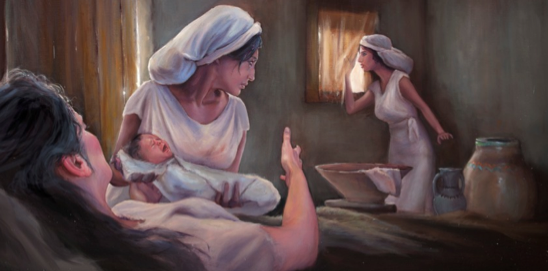
Shiphrah & Puah - Artist unknown
TODAY'S SPECIAL: Exodus 1:1-22

TO CHEW ON:
"The midwives, however, feared God and did not do what the king of Egypt had told them to do; they let the boys live." Exodus 1:17


These Hebrew midwives, Shiphrah and Puah, were doing a brave, maybe even foolhardy thing by saving the lives of newborn boys in the face of Pharaoh's command. But then, as we see the God they feared in action, we realize they were doing a very sensible thing (remarkable about their respect for God: they spared these babies even before God showed His power in the plagues of Egypt and the miracles of the desert).

I think about their stand and I see a lesson in it for me, perhaps for all of us. As our society drifts ever farther from Christian principles, I can imagine scenarios where we might need to take similar stands against our society's laws and social pressures.

For example, a few weeks ago a same-sex couple made local news when they broadcast the fact that the extended family of the baby they were set to adopt withdrew their consent for the baby's adoption because the family didn't want it to be raised by a same-sex couple. Though the family was legally allowed to do this, their actions were labelled homophobic. One of the rejected partners mused about solving such situations with legislation.

The family's stand made me ask myself, what would I have done? It's a valid question, for I believe it will be just a matter of time before the rights of Canadians (and other western, supposedly freedom-of-religion cultures) to express religious convictions in ways that go against the grain of culture, will be illegal.

I submit the answer to how we would react will always be based on who we fear more—God, who has expressed His attitude toward homosexuality and a myriad other things in His word, or the society in which we live?

PRAYER: Dear God, please help me live my life for Your eyes, respecting and lining up my life with what You approve more than what society approves. Amen.

 *********
Unless otherwise noted all Scripture quotations are taken from the New King James Version®. Copyright © 1982 by Thomas Nelson, Inc. Used by permission. All rights reserved.
********
Subscribe to my newsletter coming September 1st. 

Get book recommendations, Bible study tips, author news plus a full-colour 18-month Pathways Scripture text calendar when you sign up!  

Sign up below:


Bookmark and Share


Related Posts Plugin for WordPress, Blogger...