Showing posts with label image of God. Show all posts

Wednesday, January 04, 2017

Create!

Child building sand castle
Image: Pixabay
TODAY’S SPECIAL: Genesis 2:4b-25

TO CHEW ON:
“The LORD God planted a garden eastward in Eden, and there He put the man whom He had formed.” Genesis 2:8

Have you ever watched a child create their own world with sand, blocks, or Lego? “This is going to be a castle with a big moat. And there will be a shell fence so no one can get close, and towers for lookouts, and a flag, with kelp decorations all around. It will be awesome!”

That’s what this chapter reminds me of, only with God as creator on a global scale: “I’ll make a garden and water it with mist. I’ll put creatures in it and a creature somewhat like me to take charge. And there will be life, and resources, and riches, and beauty, with only one rule. It will be awesome!”

(If only it had all ended there!)

I take from this description the permission—no, the appropriateness, even necessity for us humans (made in God’s image - Genesis 1:26,27) to create too. We have within us the urge to imagine and form in a multitude of ways. It is part of who we are, of what makes us tick, function, and flourish.

This year let’s embrace our creative projects with the excitement of God creating Earth:
“I’ll do the reno, knock out this wall, put in a window here, a door there; get that motor running; paint that scene; write that book… and it will be awesome!”

PRAYER: Dear Father God, thank You for the urge to create that’s within me. Help me to affirm it with my effort, energy, and faith. Amen.

 *********
Unless otherwise noted all Scripture quotations are taken from the New King James Version®. Copyright © 1982 by Thomas Nelson, Inc. Used by permission. All rights reserved.


Tuesday, January 03, 2017

Humanity's place in creation

creation scene
TODAY'S SPECIAL: Genesis 1:20-2:4a

TO CHEW ON:
"Then God said, 'Let Us make man in Our image, according to Our likeness; let them have dominion over the fish of the sea, over the birds of the air, and over the cattle, over all the earth and over every creeping thing that creeps on the earth.'" Genesis 1:26

Man as created thing is different from the other parts of God's creation. Our reading today points out some ways. Several sidebar articles in my Bible delve into these differences:

1. God determined to create man in His likeness and image. Both male and female are reflections of that image (Genesis 1:26,27).


Man is a spiritual being who is not only body, but also soul and spirit," writes Charles Blake in the article "Man's Intrinsic Value."  "He is a moral being whose intelligence, perception and self-determination far exceed that of any other earthly being" - New Spirit-Filled Life Bible, p. 5 (emphasis added).

2. God gave humanity dominion over all other creatures (Genesis 1:28). Jack Hayford elaborates in the article "Man's Delegated Dominion":

"In creating man, the Sovereign of the universe makes a choice to delegate to man 'dominion … on the earth.' (vs. 28). Man's power and authority for exercising this rule originate in God's intent to make man in His own image and likeness." Hayford goes on to suggest that man's ability to play this role is eroded when he is disobedient to God's law - NSFLB p. 6 (emphasis added).

3. God gave man a quality of life He didn't give to other creatures—He "breathed into his nostrils the breath of life and man became a living being" Genesis 2:7. The creatures were living too, so the words "breath of life" and  "living being" here seem to imply life of a different quality.

Writers Charles Blake and Jesse Miranda write: "The likeness of man to the creator is in the favor and function of personal unity. God designed the human personality to consist of self-consciousness and self-determination with both the freedom and the awareness to respond to God, to other human beings, and to the environment" (emphasis added). The authors also point out the destiny of those who choose to trust Christ—already in God's mind at this point: "… just as He chose us in Him before the foundation of the world that we should be holy and without blame before Him"  - Ephesians 1:4 (read all of Ephesians 1:3-6) NSFLB p. 7.

How might we respond to these creation principles?

- We need to realize the preciousness of each human being.


- We need to be aware that human philosophies that exalt animals to practically human status aren't supported by the Bible. Though we need to care for animals, humanity's position is not as equals but as dominant over them.  In practical living, our society has drifted from these foundations, killing its own with abandon (in abortion for example) while insisting on ever more rights for animals. I believe we need to be aware of the spiritual underpinnings of initiatives like the animal rights movement.

- We need to live with our final destiny in mind.
If He "chose us in Hm before the foundation of the world" our lives are not accidental. Each of us has a unique role to fulfill. May we find it and fill it!


PRAYER: Dear God, thank You for creation which includes plants, animals and human beings. Please give us wisdom in our assignment to have dominion over other parts of creation. Help me to fulfill the destiny for which You chose me "before the foundation of the world." Amen.

 *********
Unless otherwise noted all Scripture quotations are taken from the New King James Version®. Copyright © 1982 by Thomas Nelson, Inc. Used by permission. All rights reserved.

Monday, January 12, 2015

Elihu—a good conversationalist

"Job in His Adversity" by Arthur Ackland Hunt
"Job In His Adversity" by Arthur Ackland Hunt
TODAY'S SPECIAL: Job 32:1-22

TO CHEW ON: "But there is a spirit in man,
And the breath of the Almighty gives him understanding." Job 32:8


As we begin today's reading of Job 32, does it feel as if we're walking in on the middle of a conversation? Well we are.

You have probably heard or read the story of Job, how in the heavenlies Satan and God's attention become focused on him. Satan gets God's permission to trouble him and so in one day he loses practically everything and is eventually left with only his pessimistic wife and his unhealthy life (Job 1:1-2:10).

One by one his friends "comfort" him. But the comfort of Eliphaz, Bildad and Zophar is cold. They urge him to examine his life for the cause of his misfortune because in their experience (Eliphaz) and by their tradition (Bildad) such bad fortune is always a consequence of some sin. Job answers them, justifying himself. Zophar condemns him for being verbose, presumptuous and sinful, and concludes that Job is actually getting less than he deserves (Job 11:6). We come on the scene after Job has defended himself against this variety of accusations.

The speaker in our reading is Elihu, a younger man who has respectfully kept silent while the others talked. Now he steps forward. Today's reading is his preamble to his reasons for Job's suffering and what he says underlines the specialness of the human species (that we talked about a few days ago):
"There is a spirit in man.
And the breath of the Almighty gives him understanding."

Elihu elaborates as to why he has the nerve to speak up and contradict his elders. His reasons (in my words):
  • Just because you're a great man or have lived a long time doesn't mean you're wise  - Job 32:9.
  • I've listened closely to everything you've all said but you haven't convinced Job or me - Job 32:12-13, 18-19.
  • I have an opinion and I need to express it - Job 32:18,19.
  • What I have to say is, before God, the unvarnished truth and contains no flattery - Job 32:21-22.

I see in this passage a practical example of good human interaction—some things we can learn from young Elihu:

Elihu waited respectfully to have his say. 
But he finally asks to be heard despite his youth because of the spirit within him, breathed by God, which gives him insight.

In our interactions, do we view others, no matter what their age, race, status, or education, as worth respect and attention simply because they are created in God's "image and likeness," endowed by God's "breath" with understanding?
Elihu listened to the conversation before asking for the floor.
Do we listen first before we talk?
He spoke courageously out of conviction and integrity.
Do we speak just to hear ourselves give an opinion, or does our talk come from deeply held beliefs? If our beliefs contradict current wisdom, do we have the courage to speak them anyway? Is our talk sincere, or mixed with flattery to make it more palatable to those who may disagree with us?


PRAYER: Dear God, please help me to interact respectfully with others, honouring Your image and likeness within them. Amen.

 *********
Unless otherwise noted all Scripture quotations are taken from the New King James Version®. Copyright © 1982 by Thomas Nelson, Inc. Used by permission. All rights reserved.


Thursday, January 08, 2015

Image-bearers

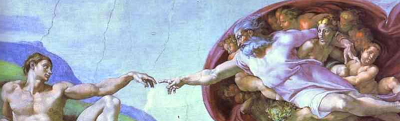
Detail from Michelangelo's "The Creation of Adam"

TODAY'S SPECIAL: Genesis 1:20-2:4

TO CHEW ON: "So God created man in His own image; in the image of God He created him, male and female He created them." Genesis 1:27

As we read this passage, particularly the part about our (man's) creation, the question that comes to mind is, what does it mean to be created in the image of God?

I certainly struggled with how to answer that when I wrote my children's devotions (Bible Drive-Thru). Eventually I came up with this list:

The image of God in people sets them apart form the rest of creation in that they have creativity, are self-conscious, have personality, can think about more than what they see, hear, and feel (think abstractly), have soul and spirit as well as body, can make decisions and choices that lead to feelings.

Wayne Grudem, in his Systematic Theology simplifies—and complicates—the concept when he says:

"When God says, 'Let us make man in our image, after our likeness' (Genesis 1:26), the meaning is that God plans to make a creature similar to Himself. Both the Hebrew words for 'image' (tselem) and the Hebrew word for 'likeness' (demut) refer to something that is similar but not identical to the thing it represents or is an 'image' of. The word 'image' can also be used of something that represents something else" Wayne Grudem, Systematic Theology, p. 442,3.

He goes on to explain how this definition steers us away from defining the image of God in man in too narrow terms, list-like, as I have done, for example "… because no such list could do justice to the subject. … In fact as we read the rest of scripture, we realize that a full understanding of man's likeness to God would  require a full knowledge of who God is in his being and in his actions and a full understanding of who man is and what he does" - Op. Cit., p. 443,4.

(Then Grudem does go on to give list of specific examples of what the image of God means.)

Practically, the fact that we humans are created in God's image should fill us with gratitude and respect—self-respect and respect for other humans. Grudem again:

"Every single human being, no matter how much the image of God is marred by sin, or illness, or weakness, or age, or any other disability, still has the status of being in God's image and therefore must be treated with the dignity and respect that is due to God's image-bearer" - Op. Cit., p. 450.

He lists those that might typically need to be kept in mind here—people of every race, the elderly, the seriously ill, the mentally retarded, children yet unborn and concludes:

"If we ever deny our unique status in creation as God's only image-bearers, we will soon begin to depreciate the value of human life, will tend to see humans as merely a higher form of animal, and will begin to treat others as such. We will also lose much of our sense of meaning in life" - Ibid.

Developments in current Canadian thought and practice—e.g. abortion on demand, the animal rights movement, and the push to legalize doctor-assisted suicide—illustrate that we are well down that road of human deprecation.

PRAYER:
Dear God, thank You for how I am made. Help me to get to know You and thus myself. Help me to view all fellow humans as Your image-bearers and to treat them as such. Amen.

 *********
Unless otherwise noted all Scripture quotations are taken from the New King James Version®. Copyright © 1982 by Thomas Nelson, Inc. Used by permission. All rights reserved.

Related Posts Plugin for WordPress, Blogger...