Showing posts with label humanity. Show all posts

Wednesday, January 03, 2018

"Let us build"

TODAY'S SPECIAL:  Genesis 8-11

TO CHEW ON: "And they said, 'Come, let us build ourselves a city and a tower whose top is in the heavens, let us make a name for ourselves, lest we be scattered abroad over the face of the whole earth.'" Genesis 11:4

On April 15, 2010  the Eyjafjallajokull volcano in Iceland began spewing its magma and ash clouds in earnest.  It took only a day until thousands of flights in Europe and America were grounded.

The ability of such a relatively small and commonplace natural event to impact the lives of millions of people on earth illustrates how fragile our life on planet Earth is and how out of human control. The systems which are the very foundations of our civilization are vulnerable. We've seen this before. Events like 9-11, computer viruses, physical plagues and pandemics, natural disasters like earthquakes, hurricanes and tornadoes bring proud human societies to their knees.

Humanism, a thought system that looks to and depends on  human wisdom for the answer to all of life's questions, is attractive to our proud, independent, ambitious human spirits. The seeds of this worldview were planted by Satan in Eden (Genesis 3:5). It was flowering nicely at the time of Babel (our reading today)and continues to proliferate till our time.  Dreams of reaching heaven by a building then have morphed into continuing attempts to defeat gravity, illness, even death. And human discoveries have led to innovations which benefit us all, impacting how we travel, communicate, and the length and comfort of our lives.  But despite all that, we humans are still not in control. God is.

He works in the lives of individuals  (Proverbs 16:9) and rulers (Proverbs 21:1). He can frustrate the plans of the wisest  (Isaiah 44:25) and control the destiny of nations (Jeremiah 18:7) He can punish oppressors and mete out justice (Isaiah 49:26). Nature is in His power (Job 26:5-14).

In view  of this, we may be tempted to take the opposite approach from the humanist and become passive, saying, What does it matter what I do? It's all controlled by God anyway.

Two scriptures come to mind. (Clicking on the linked words, below, takes you to the verse in four different translations.)
  • Jesus told a story (Luke 19:12-26) of a man who lived passively . His master scolded and punished him when he found the man had done nothing with the money he had been given. It shows us that we will be held responsible for how we steward our talents and opportunities.
  • James speaks about making plans (James 4:13-17). The upshot of his advice is - make plans but view them with realism and humility.    

PRAYER: Dear God, You have all power and might over nature and people. Help me to live realistically before You today, stewarding everything You have given me and acknowledging You as the source of it all. Amen.

PSALM TO PRAY - Psalm 3

The Bible Project  VIDEO: Genesis 1-11 (Torah Series)


MORE: What do humanists believe?
The Humanist Manifestos are documents which outline the basic tenets of humanism.

Here is the original "Humanist Manifesto i," dated 1933. Its handling of religion and what religion means to the humanist is particularly interesting.

The most recent version, Humanist Manifesto iii, was revised in  2003.

What strikes me about the ideas in them is how familiar they are! Isn't this the worldview of science, education, and the media?

**************
Unless otherwise noted all Scripture quotations are taken from the New King James Version®. Copyright © 1982 by Thomas Nelson, Inc. Used by permission. All rights reserved.

Thursday, December 07, 2017

Depend on what lasts

Image: Pixabay
TODAY’S SPECIAL: Isaiah 40:1-17

TO CHEW ON: “All flesh is grass,
And all its loveliness is like the flower of the field,
The grass withers, the flower fades,
Because the breath of the LORD blows upon it;
Surely the people are grass.
The grass withers, the flower fades,
But the word of our God stands forever.” - Isaiah 40:6-8


I mark the seasons with photographs. If you took a tour of my photo albums you would see burgeoning life creep into them perhaps as early as February with the first snowdrops and the thickening magnolia buds. By April I can hardly keep up with all the “flowers of the field” popping out in beauty around me. Then in September that record of flower life tapers off. The cold winds of December to January shut it down completely.

Wind testing life’s vigor is what Isaiah pictures in today’s reading. This wind is no weather gale, though, but the breath of God.

I usually think of the breath of God as life-giving (e.g. the creation of Adam:
“And the LORD God formed man of the dust of the ground, and breathed into his nostrils the breath of life, and man became a living being” - Genesis 2:7 (emphasis added).

Here God’s breath is a test, providing proof of man’s frailty:
“The grass withers, the flower fades
Because the breath of the LORD blows
upon it" (emphasis added).

That breath proves the worthiness of another entity through—“the word of our God.” It stands forever. I take that “word” as the things God has decreed will happen, both the things He has revealed in His written word—the Bible—and the secret things known only to Him.

As withering, fading humans, we can lean our weakening selves on that certainty. I like how the writer of my Bible’s study notes o Isaiah expresses it:
“The Spirit-breath of the LORD blows in the life of man, amplifying the frailty of his humanity by picturing man as a fading flower and withering grass. This fading, withering man is both comforted and given strength by the Word of God and the Spirit-breath of God. Failing man must focus his faith on the unfailing Word of God and the unfaltering resources of the Spirit of God” - Nathaneal Van Cleave, New Spirit-Filled Life Bible, p. 918 (my emphasis).

PRAYER: Dear Father, help me to be realistic about my fragility and limited lifespan. Help me to shift my confidence away from the false security of people and all mankind has accomplished, to the lasting rock of Your Word. Amen.

 *********
Unless otherwise noted all Scripture quotations are taken from the New King James Version®. Copyright © 1982 by Thomas Nelson, Inc. Used by permission. All rights reserved.


Sunday, October 29, 2017

Enduring legacy

TODAY'S SPECIAL: Psalm 90:1-17


TO CHEW ON: "And let the beauty of the Lord our God be upon us,
And establish the work of our hands for us;
Yes, establish the work of our hands." Psalm 90:17

Does it seem to you that the seasons are changing faster than they ever did? That Christmas, another birthday, your  anniversary is always just around the corner and that they keep coming at you faster than they ever did when you were a child?I don't know what it is about getting older that makes time seem to fly. Perhaps it's the realization that it's running out. The top of the timer is only half full, one third full, one quarter full...

The theme of Psalm 90 is the brevity of life and the stewardship of time. What vivid pictures the writer, Moses, paints to show how short life is:

To God a thousand years are like yesterday (before you realize it, only a memory), and a watch in the night (a few hours on duty) - Psalm 90:4.

To us life is like a flash flood, a sleep when time passes without our awareness, grass that grows in the morning but by evening is cut down, as slight as a sigh - Psalm 90:5-6,9.

Other Bible passages add paintings to the "Life is Brief" gallery:
  • "Our days on earth as as a shadow" - 1 Chronicles 29:15.
  • "My days are swifter than a weaver's shuttle" - Job 7:6.
  • "My life span is gone, taken from me like a shepherd's tent; I have cut off my life like a weaver. He cuts me off from the loom" - Isaiah 38:12.
  • "You have made my days as handbreadths" - Psalm 39:5.
  • "He comes forth like a flower and fades away" - Job 14:2.
  • "For what is your life? It is even a vapour that appears for a little time and then vanishes away" - James 4:14.

In the setting of such fragility and brevity, Moses' request seems almost brash: "...establish the work of our hands for us; Yes, establish the work of our hands."

[Establish = kun means to be firmly established, stable, secure, enduring, directed aright, fixed aright, steadfast.]

Isn't this what we all want—to do something significant, to leave something that endures past the span of our short lives?

Just over a month ago we celebrated the sixteenth anniversary of 9-11. I would suppose that the men who designed those twin towers thought they had left a multi-generational legacy in the massive structures. Yet they came down in mere hours. What everyone celebrated on the anniversary was not the memory of those buildings but the acts of heroism, self-sacrifice, and love performed by many who died that day and how they made a lasting difference to lives.

Our love for people, as it works itself out in a hundred different ways, is also the best legacy we can leave. It is an investment in never-dying souls. Let's concern ourselves with leaving such a legacy especially as it involves introducing those souls to Jesus, the giver of eternal life.


PRAYER: Dear God, Moses' prayer is my prayer today: 'Let the beauty of the Lord my God be upon me. And establish the work of my hands for me. Yes, establish the work of my hands. Amen.


MORE: a poem...


**************
Unless otherwise noted all Scripture quotations are taken from the New King James Version®. Copyright © 1982 by Thomas Nelson, Inc. Used by permission. All rights reserved.


Thursday, June 01, 2017

The Frustrated Leader

Image: Pixabay
TODAY’S SPECIAL: Numbers 11:1-15

TO CHEW ON: “So Moses said to the LORD, ‘Why have you afflicted Your servant? And why have I not found favor in Your eyes that You have laid the burden of all these people on me? … If You treat me like this, please kill me here and now if I have found favor in Your sight—and do not let me see my wretchedness” - Numbers 11:11,15

How totally frustrated Moses sounds here! And who could blame him? Every step forward that he took the Israelites was met with pushback and complaining!

I did a short survey of other times people in the Bible felt discouraged, frustrated, and inadequate in their roles.
  • David was no stranger to discouragement as seen in vulnerable psalms like Psalm 6:2.
  • King Solomon started his reign feeling naive and inadequate - 1 Kings 3:9.
  • Elijah comes to mind. He hid out for three years during a drought and famine that shriveled the land. Then he met with the Baal prophets in a showdown, defeated them, and the rain came. But did the people turn to God? No. Instead, Queen Jezebel threatened to kill him and he had to run for his life. His discouraged wish to die is in 1 Kings 19:4.
  • Isaiah talks of how weakness and weariness is the experience of all, even the young - Isaiah 40:30.
  • The disciples couldn’t stay awake to pray with Jesus in Gethsemane - Matthew 26:40.

What all this says to me is that discouragement, weakness, and human frailty is a fact of life. When I acknowledge these things in myself, I’m finally facing reality.

But, thank God, Moses didn’t stay in that down place, and neither do we have to. Tomorrow we’ll look at how God lifted him out of this I-want-to-die pit.

PRAYER: Dear Jesus, thank You for being a High Priest who can sympathize with my weaknesses. I come to Your throne of grace to find mercy and grace to help in my time of need. Amen (prayer based on Hebrews 4:15,16).

 *********
Unless otherwise noted all Scripture quotations are taken from the New King James Version®. Copyright © 1982 by Thomas Nelson, Inc. Used by permission. All rights reserved.


Thursday, January 05, 2017

Human nature on display

Image: Pixabay
TODAY’S SPECIAL:  Genesis 3:1-15

TO CHEW ON:
“And they heard the sound of the LORD God walking in the garden in the cool of the day, and Adam and his wife hid themselves from the presence of the LORD God among the trees of the garden.” Genesis 3:8

As I read the account of Adam and Eve’s fall into sin, I see things that are surprisingly (or, maybe not surprisingly) familiar. Even before Eve yielded to the temptation to eat that fruit, some of these things were present:

  • A tendency to exaggerate or embellish
Eve’s report to the serpent of what God had said about the tree: “‘You shall not eat of it, nor shall you touch it, lest you die.’” wasn’t exactly what God had said. He really said, simply, “‘You shall not eat…’” Genesis 3:3, cf. Genesis 2:17 (emphasis added).

  • Intellectually gullible
Eve never even questioned the serpent’s claims but took them at face value - Genesis 3:4-6.

  • Easily swayed to disbelieve what God had said.
For Eve this included considering and believing the serpent’s suggestion that God didn’t have their best interests at heart but was really keeping the best back from them - Genesis 3:4-6.

  • Undue trust in appearance.
Eve was easily taken in by the fruit’s appearance when she looked at it closely and saw that it looked delicious, was beautiful and, according to the serpent, had great benefits - Genesis 3:6.

  • Secrecy
After they sinned, both Adam and Eve gave in the overwhelming compulsion to hide from God - Genesis 3:8.

  • Blame-shifting
Both refused to take responsibility for their action. Adam blamed Eve. Eve blamed the serpent - Genesis 3:12,13.

Seeing the first four qualities in Eve even before the fall and the latter two in both Adam and Eve immediately after, leads me to believe these tendencies are part of our human nature. We all have them. They strut their stuff especially when we’re under the pressure of temptation. So let’s be on guard against ourselves and not taken in by the serpent's empty accusations against God, false claims, and half-truth promises.


PRAYER: Dear Father God, help me to know myself—to recognize my human tendencies and weaknesses that would draw me away from You. Amen.

 *********
Unless otherwise noted all Scripture quotations are taken from the New King James Version®. Copyright © 1982 by Thomas Nelson, Inc. Used by permission. All rights reserved.


Tuesday, January 03, 2017

Humanity's place in creation

creation scene
TODAY'S SPECIAL: Genesis 1:20-2:4a

TO CHEW ON:
"Then God said, 'Let Us make man in Our image, according to Our likeness; let them have dominion over the fish of the sea, over the birds of the air, and over the cattle, over all the earth and over every creeping thing that creeps on the earth.'" Genesis 1:26

Man as created thing is different from the other parts of God's creation. Our reading today points out some ways. Several sidebar articles in my Bible delve into these differences:

1. God determined to create man in His likeness and image. Both male and female are reflections of that image (Genesis 1:26,27).


Man is a spiritual being who is not only body, but also soul and spirit," writes Charles Blake in the article "Man's Intrinsic Value."  "He is a moral being whose intelligence, perception and self-determination far exceed that of any other earthly being" - New Spirit-Filled Life Bible, p. 5 (emphasis added).

2. God gave humanity dominion over all other creatures (Genesis 1:28). Jack Hayford elaborates in the article "Man's Delegated Dominion":

"In creating man, the Sovereign of the universe makes a choice to delegate to man 'dominion … on the earth.' (vs. 28). Man's power and authority for exercising this rule originate in God's intent to make man in His own image and likeness." Hayford goes on to suggest that man's ability to play this role is eroded when he is disobedient to God's law - NSFLB p. 6 (emphasis added).

3. God gave man a quality of life He didn't give to other creatures—He "breathed into his nostrils the breath of life and man became a living being" Genesis 2:7. The creatures were living too, so the words "breath of life" and  "living being" here seem to imply life of a different quality.

Writers Charles Blake and Jesse Miranda write: "The likeness of man to the creator is in the favor and function of personal unity. God designed the human personality to consist of self-consciousness and self-determination with both the freedom and the awareness to respond to God, to other human beings, and to the environment" (emphasis added). The authors also point out the destiny of those who choose to trust Christ—already in God's mind at this point: "… just as He chose us in Him before the foundation of the world that we should be holy and without blame before Him"  - Ephesians 1:4 (read all of Ephesians 1:3-6) NSFLB p. 7.

How might we respond to these creation principles?

- We need to realize the preciousness of each human being.


- We need to be aware that human philosophies that exalt animals to practically human status aren't supported by the Bible. Though we need to care for animals, humanity's position is not as equals but as dominant over them.  In practical living, our society has drifted from these foundations, killing its own with abandon (in abortion for example) while insisting on ever more rights for animals. I believe we need to be aware of the spiritual underpinnings of initiatives like the animal rights movement.

- We need to live with our final destiny in mind.
If He "chose us in Hm before the foundation of the world" our lives are not accidental. Each of us has a unique role to fulfill. May we find it and fill it!


PRAYER: Dear God, thank You for creation which includes plants, animals and human beings. Please give us wisdom in our assignment to have dominion over other parts of creation. Help me to fulfill the destiny for which You chose me "before the foundation of the world." Amen.

 *********
Unless otherwise noted all Scripture quotations are taken from the New King James Version®. Copyright © 1982 by Thomas Nelson, Inc. Used by permission. All rights reserved.

Sunday, December 27, 2015

Creation, praise the Lord!

TODAY'S SPECIAL: Psalm 148:1-14

TO CHEW ON: "Let them praise the name of the Lord,
For He commanded and they were created." Psalm 148:5

My Bible subtitles this psalm "Praise to the Lord from Creation." The writer puts God's praise into the mouths of all aspects of the created world: Sun and moon, stars, heavens of heavens, waters above the heavens, earth, sea creatures and all depths, fire, hall, snow and clouds, wind, mountains, hills, trees, beasts and cattle, creeping things and flying birds. - Psalm 148:3-10.

This isn't the only place in the Bible where creation sings its Creator's praises.
  • The heavens and earth rejoice in God's reign in 1 Chronicles 16:31.
  • The flock-covered pastures and grain-clothed valleys shout for joy in Psalm 65:13.
  • The rivers clap their hands and the hills are joyful in Psalm 98:8.
  • Isaiah tells the heavens and earth to shout and break into singing because of God's redemption of Israel in Isaiah 49:13.
  • Isaiah also talks about the mountains and hills breaking into song and the trees clapping their hands in Isaiah 55:12.

There is one more praising part of creation that the writer of Psalm 148 mentions. It is us humans:
Kings of the earth and all peoples;
Princes and all judges of the earth;
Both young men and maidens;
Old men and children.
Let them praise the name of the Lord,
For His name alone is exalted;
His glory is above the earth and heaven." - Psalm 148:11-13

Jesus acknowledged how good, fitting, and inevitable it is for people to praise Him. When He swept into Jerusalem riding on a donkey accompanied by the praises of His disciples, some Pharisees said to Him: "'Teacher, rebuke Your disciples.'" But He answered, "'I tell you that if these should keep silent, the stones would immediately cry out'" - Luke 19:39-40.

So let's fill our mouths with His praise so the stones will have no reason to put us to shame!

PRAYER: Mighty God, I praise You for Your wisdom and skill on display in created things. I praise You for the grace, mercy, and love seen in Your plan of salvation. I praise You just because You are You— the sovereign One who is above and beyond me, Your creature. Amen.


***********
Unless otherwise noted all Scripture quotations are taken from the New King James Version®. Copyright © 1982 by Thomas Nelson, Inc. Used by permission. All rights reserved.

Bible Drive-Thru


Saturday, August 29, 2015

A vixen in the palace

TODAY'S SPECIAL: Mark 6:14-29

TO CHEW ON: "Because John had said to Herod, 'It is not lawful for you to have your brother's wife.' Therefore Herodias held it against him and wanted to kill him, but she could not." Mark 6:18,19

Herodias was a female force to be reckoned with in Herod's palace. Our reading today paints a picture of her as:
  • a seducable woman. She let herself fall for Herod even though she was married to his brother Philip.
  • an influential woman.  She instigated Herod's arrest of John. Later her daughter came running to her for advice about what to ask for after Herod promised the girl anything following her dance routine.
  • a bitter, revengeful woman who held against John the fact that he had denounced her illicit union with Herod.
  • an opportunistic woman, who recognized and seized the chance to get back at John.
  • a ruthless woman who demanded John's death by beheading.

Guess what—I've seen many of these evil qualities in myself. Oh, I haven't acted on them to the extent Herodias did, but have, to my shame, known myself to hang onto bitterness, imagine revenge scenarios. I have seized opportunities to get back at a person and slipped in snide asides to sway my husband and kids...

I would submit tha there may be a little of Herodias in most of us.

An attitude that is impervious to sensuous flattery, forgives wrongs, leaves revenge in God's hands, and responds with humility to criticism (deserved or not) does not come naturally to me or most of us. The Herodias in us is someone only God can change.

"Then I will sprinkle clean water on you, and you shall be clean; I will cleanse you from all your filthiness and from all your idols. I will give you a new heart and put a new spirit within you; I will take the heart of stone out of your flesh and give you a heart of flesh. I will put My Spirit within you and cause you to walk in My statutes, and you will keep My judgments and do them." - Ezekiel 36:25-27

See also 2 Corinthians 5:17 and 1 John 1:7-9

PRAYER: Dear God, please help me to put to death (i.e. crucify - Galatians 2:20) the life of carnal emotion and response that rises naturally within me. Amen.

MORE: Wisdom about women and wives

From Solomon (who had his share of experience):

"Like a gold ring in a pig's snout
is a beautiful women who shows no discretion." - Proverbs 11:22 NIV

"A wife of noble character is her husband's crown,
but a disgraceful wife is like decay in his bones." - Proverbs 12:4 NIV

"Houses and wealth are inherited from parents
but a prudent wife is from the Lord." - Proverbs 19:14 NIV

"A quarrelsome wife is like
a constant dripping on a rainy day'
restringing her is like restraining the wind
or grasping oil with the hand." - Proverbs 27:15,16 NIV


********
Unless otherwise noted all Scripture quotations are taken from the New King James Version®. Copyright © 1982 by Thomas Nelson, Inc. Used by permission. All rights reserved.

Scripture quotations marked NIV are taken from THE HOLY BIBLE, NEW INTERNATIONAL VERSION®, NIV® Copyright © 1973, 1978, 1984, 2011 by Biblica, Inc.® Used by permission. All rights reserved worldwide.


Bible Drive-Thru


Sunday, June 21, 2015

Our Father's pity

Image: geoffjhyland/Pixabay.com
TODAY'S SPECIAL: PSALM 103:1-22

TO CHEW ON: "As a father pities his children,
So the Lord pities those who fear Him." Psalm 103:13

Watch parents with their newborn infant. See the gentle touch and the adoring gaze, hear the soft, soothing tone. That's "pities" - "racham" — the way God the Father regards us ("those who fear Him"), His children.

[Pities - racham means to feel or show compassion, to love deeply, to show pity or mercy, to tenderly regard someone; to tenderly love (especially as parents love their infant child). Racham is the origin of the Hebrew word for womb - rechem. In Isaiah 49:15 God asks, "Can a woman forget her nursing child and not have compassion on (racham) the son of her womb (rechem)?"- Dick Mills, "Word Wealth," New Spirit-Filled Life Bible, p. 1146.]

One reason human parents treat their infant with such tenderness is because they know the helplessness and vulnerability of this tiny creature for whom they are responsible. God's impulse of tenderness toward us comes from similar feelings (if we can call them that). "He knows our frame," assures the psalm-writer, David. "He remembers that we are dust" - Psalm 103:14.

David goes on to remind us about life's brevity—grass, flowers—and insignificance: "For the wind passes over it, and it is gone,/ And its place remembers it no more" - Psalm 103:16

In contrast, God's mercy "is from everlasting to everlasting ... His righteousness to children's children" - Psalm 103:17. God's attention elevates those who fear Him from disposable grass to something worth loving and preserving.

As I grow older, I am more keenly aware than ever of my own grass-like lifespan, my flower-like vulnerability. Soon I'll too be gone and the meadow will forget me. But God won't. As we saw when we focused our attention on the ascension yesterday, there is another chapter. In it:

  • we will see God - Job 19:26; Psalm 49:15.
  • we will be beyond the grasp of death and decay - John 8:51; 11:26.
  • we will live with Jesus - John 14:3; 2 Corinthians 5:1; 1 Thessalonians 4:17.


PRAYER: Dear God, thank You that because of Jesus my life can have significance beyond its mortal span. Amen.

*********
Unless otherwise noted all Scripture quotations are taken from the New King James Version®. Copyright © 1982 by Thomas Nelson, Inc. Used by permission. All rights reserved.

Bible Drive-Thru

Sunday, March 08, 2015

The case for realism about people

With Passover Approaching, Jesus Goes Up to Jerusalem - James Tissot
"With Passover Approaching, Jesus Goes Up to Jerusalem" by James Tissot

TODAY'S SPECIAL: John 2:13-25

TO CHEW ON: "But Jesus did not commit Himself to them, because He knew all men, and had no need that anyone should testify of man, for He knew what was in man." John 2:24-25.

In Canada we're coming quickly to the time of another federal election and the pundits have their noses to the ground. Every resignation or intention not to run again, every defection or new name in the ring has them abuzz as they sift the past and prognisticate about the future. How will this new person affect the fortunes of the party currently in power or help the opposition? What do the polls say? Will he or she affect the result of the next election?

No matter how things turn out, we will be pleasantly surprised by some of our politicians and disappointed by others. For we do not have the insight Jesus had, of whom it was said, "He knew all men, and had no need that anyone should testify of man for He knew what was in man."

Though no other human will ever have His insight, I believe we should be more like Him in our realism toward our fellowmen, especially our faith leaders. When we idolize them—expecting them to be practically perfect—we set ourselves up to be disappointed and disillusioned. Some even abandon faith altogether when human leaders fail.

Jesus is the only human leader who will never let us down. Let's keep our eyes on Him (Hebrews 12:1-2).

PRAYER: Dear Jesus, thank You for the way You held back Your endorsement of people. Help me to be as realistic. I look to You as the only human hero worthy of complete trust and worship. Amen.

MORE: Jesus—a man forever

I did not slip the phrase "human hero" into my prayer, above, without some thought. Because we need to keep in mind that Jesus was and is truly human and as such is one with whom we can identify and who can identify with us. He can truly be our human example and hero. As Wayne Grudem elaborates in his Systematic Theology:

"Jesus did not give up his human nature after his death and resurrection, for he appeared to his disciples as a man after the resurrection, even with the scars of the nail prints in his hands (John 20:24-27) ....


All of these texts (Luke 24:39; Luke 24:41-42; Acts 1:11; Acts 7:56; Acts 9:5; 1 Corinthians 9:1; 15:8; Revelation 1:13-17 cited within the ellipses) indicate that Jesus did not temporarily become man but that his divine nature was permanently united to his human nature, and he lives forever not just as the eternal Son of God, the second person of the Trinity, but also as Jesus, the man who was born of Mary and as Christ Messiah and Savior of his people. Jesus will remain fully God and fully man" - Wayne Grudem, Systematic Theology, pp. 542, 543.

*********
Unless otherwise noted all Scripture quotations are taken from the New King James Version®. Copyright © 1982 by Thomas Nelson, Inc. Used by permission. All rights reserved.

Bible Drive-Thru


Thursday, January 08, 2015

Image-bearers

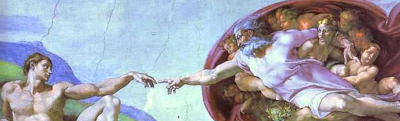
Detail from Michelangelo's "The Creation of Adam"

TODAY'S SPECIAL: Genesis 1:20-2:4

TO CHEW ON: "So God created man in His own image; in the image of God He created him, male and female He created them." Genesis 1:27

As we read this passage, particularly the part about our (man's) creation, the question that comes to mind is, what does it mean to be created in the image of God?

I certainly struggled with how to answer that when I wrote my children's devotions (Bible Drive-Thru). Eventually I came up with this list:

The image of God in people sets them apart form the rest of creation in that they have creativity, are self-conscious, have personality, can think about more than what they see, hear, and feel (think abstractly), have soul and spirit as well as body, can make decisions and choices that lead to feelings.

Wayne Grudem, in his Systematic Theology simplifies—and complicates—the concept when he says:

"When God says, 'Let us make man in our image, after our likeness' (Genesis 1:26), the meaning is that God plans to make a creature similar to Himself. Both the Hebrew words for 'image' (tselem) and the Hebrew word for 'likeness' (demut) refer to something that is similar but not identical to the thing it represents or is an 'image' of. The word 'image' can also be used of something that represents something else" Wayne Grudem, Systematic Theology, p. 442,3.

He goes on to explain how this definition steers us away from defining the image of God in man in too narrow terms, list-like, as I have done, for example "… because no such list could do justice to the subject. … In fact as we read the rest of scripture, we realize that a full understanding of man's likeness to God would  require a full knowledge of who God is in his being and in his actions and a full understanding of who man is and what he does" - Op. Cit., p. 443,4.

(Then Grudem does go on to give list of specific examples of what the image of God means.)

Practically, the fact that we humans are created in God's image should fill us with gratitude and respect—self-respect and respect for other humans. Grudem again:

"Every single human being, no matter how much the image of God is marred by sin, or illness, or weakness, or age, or any other disability, still has the status of being in God's image and therefore must be treated with the dignity and respect that is due to God's image-bearer" - Op. Cit., p. 450.

He lists those that might typically need to be kept in mind here—people of every race, the elderly, the seriously ill, the mentally retarded, children yet unborn and concludes:

"If we ever deny our unique status in creation as God's only image-bearers, we will soon begin to depreciate the value of human life, will tend to see humans as merely a higher form of animal, and will begin to treat others as such. We will also lose much of our sense of meaning in life" - Ibid.

Developments in current Canadian thought and practice—e.g. abortion on demand, the animal rights movement, and the push to legalize doctor-assisted suicide—illustrate that we are well down that road of human deprecation.

PRAYER:
Dear God, thank You for how I am made. Help me to get to know You and thus myself. Help me to view all fellow humans as Your image-bearers and to treat them as such. Amen.

 *********
Unless otherwise noted all Scripture quotations are taken from the New King James Version®. Copyright © 1982 by Thomas Nelson, Inc. Used by permission. All rights reserved.


Saturday, October 18, 2014

Leaders are human too

Luke the Evangelist (detail from the Saint Luke Alterpiece, Andrea Mantegna
Luke the Evangelist - by Andrea Mantegna
TODAY'S SPECIAL: 2 Timothy 4:9-22

TO CHEW ON: "Only Luke is with me…" 2 Timothy 4:11

Demas, attracted by worldly things, has left for Thessalonica, Crescens for Galatia, Titus for Dalmatia. I could use Mark. I'm cold, bring my cloak. I'd love the books and parchments. Alexander the coppersmith has done a lot of damage to me. At my trial, everyone deserted me… (my paraphrase of 2 Timothy 4:10-16)

This is hardly a list we would expect to read from the pen of the man who wrote: "I can do all things through Christ who gives me strength (Philippians 4:13); "Take up the whole armour of God" (Ephesians 6:13); and "For the kingdom of God is not in word but in power" (1 Corinthians 4:20).

It shows us that even our strongest and seemingly most invincible leaders have down days. They are not immune from feeling forsaken, lonely, persecuted, physically and mentally needy, and generally discouraged.

But there is a bright spot for Paul. "Luke is with me." Luke, the doctor who wrote the Gospel of Luke and the Acts of the Apostles stood by his beleaguered friend and leader, apparently unaffected by his downturn in fortune, his unpopularity and beaten-up spirit.

Our leaders have their ups and downs too. Do we realize this? Or do we put them on some sort of pedestal, expecting them to be always cheerful, upbeat, encouraging, energetic?

What do we do when someone bends our ear with a complaint about our pastor? Do we listen, sympathize and pass it on? Or do we defend him or her, and make sure the complaint stops with us?

Let's be Lukes who support and are loyal to our leaders through the good times and the bad.

PRAYER: Dear God, help me to resist any temptation to criticize and gossip about my pastor. Help me to remember that he is as human as I am, and to pray for him and his family regularly. Amen.

MORE: The Feast of St. Luke the Evangelist

Today the church celebrates Luke in the Feast of St. Luke.

Today's liturgy begins with this Collect:

Almighty God, who inspired your servant Luke the physician to set forth in the Gospel the love and healing power of your Son: Graciously continue in your Church this love and power to heal, to the praise and glory of your Name; through Jesus Christ our Lord, who lives and reigns with you, in the unity of the Holy Spirit, one God, now and for ever. Amen.


 *********
Unless otherwise noted all Scripture quotations are taken from the New King James Version®. Copyright © 1982 by Thomas Nelson, Inc. Used by permission. All rights reserved.


Bookmark and Share


Friday, May 02, 2014

The long view

person looking through a telescope
TODAY'S SPECIAL: 1 Corinthians 4:16-5:10

TO CHEW ON:
Therefore we make it our aim, whether present or absent, to be well pleasing to Him." 2 Corinthians 5:9


Sometimes it's a good idea to pull back and look at life's big picture. That's what Paul appears to be doing here.

Something seems to have made him super aware of the fragility of his mortal life. It could have been pain, sickness, aging, or simply weariness that sparked statements like: "… we have this treasure in earthen vessels. … We are hard-pressed on every side … we do not lose heart. Even though our outward man is perishing. … For we who are in this tent groan…" (2 Corinthians 4:7,8,16; 5:4).

And so he reasons with himself and his readers about why it is important to not lose heart but keep going.

Because this life we live, encased in its frail body, is not all there is.
"For we know that if our earthly house, this tent, is destroyed, we have a building from God, a house not made with hands, eternal in the heavens" - 2 Corinthians 5:1.

Because inevitable death is not something to be feared. Rather it is the means of realizing the hope that energizes us.
"We are confident, yes well pleased rather to be absent form the body and to be present with the Lord" - 2 Corinthians 5:8.

Because we will be held accountable for how we have lived our lives.
"For we must all appear before the judgment seat of Christ, that each one may receive the things done in the body, according to what he has done, whether good or bad" - 2 Corinthians 5:10.

I keep getting reminders of life's frailty and brevity. A recent hip fracture has showed me how little it takes to slow me down and put a crimp in my independence. More and more now I hear of people my age and younger dying. Their last days often appear to be the test of a lifetime as they soldier through illness and pain. And so Paul's encouragement here to keep going in view of what's ahead past all this mortal life stuff is a good reminder for me. You too?

PRAYER: Dear God, it's easy for me to get fixated on this life. Please help me to raise my sights to what's beyond and live  focused on eternal values. Amen.

 *********
Unless otherwise noted all Scripture quotations are taken from the New King James Version®. Copyright © 1982 by Thomas Nelson, Inc. Used by permission. All rights reserved.

Bookmark and Share


Wednesday, October 30, 2013

Jesus' uncanny knowledge of God

TODAY'S SPECIAL: John 8:12-30

TO CHEW ON: "'And He who sent Me is with Me. The Father has not left Me alone; for I always do those things that please Him.'" John 8:29

Some of Jesus' statements about His relationship to God and His knowledge of God's will and thoughts didn't only raise the eyebrows of the scribes and Pharisees, but get us pondering too.

Three 'controversial' statements of His jump out at me from today's reading:

''He who sent Me is true; and I speak to the world those things which I heard from Him'" (John 8:26).
"'...I do nothing of Myself, but as My Father taught Me, I speak these things'" (John 8:28).
"'The Father has not left Me alone, for I always do those things that please Him'" (John 8:29).

When and how did the human Jesus hear things from God? Was He tapping into pre-birth memories of life with the Father in heaven? Was this knowledge the fruit of the communion that went on between them when Jesus spent all those hours praying? Or did God the Father stay in constant touch with Him, guiding His thoughts and actions throughout the day?

Jesus' statements imply a connection with deity that no other person has ever been able to make. They support the conclusion that He was not only human but also divine.

Of course my speculation of how Jesus knew God so intimately is futile. Way bigger minds than mine have tried to plumb the mystery of the divine incarnated in the human. I like how Wayne Grudem summarizes the incarnation* (using an unattributed quote and explaining it):

"'Remaining what he was, he became what he was not.' In other words while Jesus continued remaining what he was (that is fully divine) he also became what he previously had not been (that is fully human as well)" - Wayne Grudem, Systematic Theology, p. 562.

What implications does this have for us?
  • We can trust the words Jesus says to be in agreement with the words of God.
  • We can look at His life and see what God would do in various situations.
  • We have in Him our pattern, example, mentor, and teacher, to live a life in the light that is in agreement with truth.

PRAYER: Dear Jesus, thank You for coming as a person, giving us a glimpse of God in human terms. Help me to copy, through the power and enabling of the Holy Spirit, the things I see Jesus do. Amen.

MORE: The mystery of incarnation
"To complete the biblical teaching about Jesus Christ, we must affirm not only that he was fully human, but also that he was fully divine. Although the word does not explicitly occur in Scripture, the church has used the term incarnation to refer to the fact that Jesus was God in human flesh. The incarnation* was the act of God the Son whereby he took to himself a human nature" - Wayne Grudem, Systematic Theology, p. 543.

Bible Drive-Thru


Bookmark and Share

Related Posts Plugin for WordPress, Blogger...