Showing posts with label Job. Show all posts

Thursday, May 31, 2018

You don't know what you don't know

Behemoth - Job 40:15-24
Leviathan - Job 41:1-34

Behemoth and Leviathan - Wm. Blake
Behemoth & Leviathan - Wm. Blake
TODAY'S SPECIAL: Job 40-42; Psalm 146

TO CHEW ON:
"'Now prepare yourself like a man;
I will question you, and you shall answer Me.'" Job 40:7


Have you heard the saying, "You don't know what you don't know"? I've heard it quoted to writers who think their work is perfect just the way it is and needs no editing. But this little truism could also apply to life in general. It reminds us that there are a multitude of things about which we don't have a clue.

This is, in effect, what God says to Job in our reading today, along with "You can't do what you can't do." I love how Eugene Peterson puts it in The Message:

6-7 God addressed Job next from the eye of the storm, and this is what he said:
“I have some more questions for you,
    and I want straight answers.
8-14 “Do you presume to tell me what I’m doing wrong?
    Are you calling me a sinner so you can be a saint?
Do you have an arm like my arm?
    Can you shout in thunder the way I can?
Go ahead, show your stuff.
    Let’s see what you’re made of, what you can do.
Unleash your outrage.
    Target the arrogant and lay them flat.
Target the arrogant and bring them to their knees.
    Stop the wicked in their tracks—make mincemeat of them!
Dig a mass grave and dump them in it—
    faceless corpses in an unmarked grave.
I’ll gladly step aside and hand things over to you—
    you can surely save yourself with no help from me! - Job 40:6-14 MSG

I need—we all need to remind ourselves of God's comeback to Job here when we hear people criticizing Him for His mishandling of the earth and the people on it—indeed, when we ourselves question His goodness, His wisdom, His justice, His power… For we see only part of the picture. We have only limited information. And we're impotent to do much about what we do think we know and understand.

So what is our realistic stance here?
  • Humility in admitting our limitations - Ecclesiastes 8:7; 9:12; 11:5.
  • Repentance for our arrogance - Job 42:5,6.
  • Prayer for God's help to be able to live wisely during the time and in the place God has set us - James 1:5-8


PRAYER:
Dear God, please help me to face life realistically. I don't think You want me to throw up my hands in despair that I'm powerless. At the same time, You don't need my help and advice on how to run the world. Please help me to fulfill the destiny You have for me in humility and obedience as I trust You with the big picture. Amen.

PSALM TO PRAY: Psalm 146

 *********
Unless otherwise noted all Scripture quotations are taken from the New King James Version®. Copyright © 1982 by Thomas Nelson, Inc. Used by permission. All rights reserved.

Scripture quotations marked MSG are taken from The Message. Copyright © 1993, 1994, 1995, 1996, 2000, 2001, 2002. Used by permission of NavPress Publishing Group.

Wednesday, May 30, 2018

Do you know?

Mountain goat kid
Mountain goat kid - Photo from Pixabay.com
TODAY'S SPECIAL: Job 38-39; Psalm 145

TO CHEW ON: "Do you know…?" Job 39:1

In His reply to Job, God draws Job's attention to several animals that humans only observe from afar. They have little or no use to mankind and we often don't understand their mysterious ways.

The wild mountain goats go through their cycles of bearing young without any help or attention from people. They even seem heartless in the way they abandon them - Job 39:1-4.

The wild donkeys shun the city and are useless as beasts of burden that would obey and help people - Job 39:5-8.

The wild ox, though strong, is not an animal people would entrust with their precious harvest - Job 39:9-12.

The ostrich is without wisdom. She challenges the horse for speed but doesn't even have the good sense to incubate her eggs in a safe place - Job 39:13-18.

I'm sure we could all come up with similar lists of things about creation that we don't understand. Much of it may be of little use to us and even seem frivolous. For example, what's the point of high alpine meadows filled with summer flowers when there's no one there to see? Why did God create the vast expanse of stars and galaxies or the mysterious creatures of the ocean depths?

However, there is also much we do understand. Modern microscopes, telescopes, and nature cameras have revealed things to us that the people of Job's day had no idea about.  

The wonderful thing is that the more closely we look and drill down, the more (not less) awed we become at our creator God's wisdom, foresight, creativity, and design smarts. It brings us to the place of admitting that there's enough we do understand to be confident of the intelligence and intention of the One behind all the things about creation and life that we don't know.


PRAYER: Dear God, I am amazed at the intricacy and intelligence that's obvious in creation. Thank You for the beauty, variety, and attention to detail that You gave to created things. I worship you! Amen. 

PSALM TO PRAY: Psalm 145

 *********
Unless otherwise noted all Scripture quotations are taken from the New King James Version®. Copyright © 1982 by Thomas Nelson, Inc. Used by permission. All rights reserved.


Tuesday, May 29, 2018

Resisting the temptation of pat answers

man with questions
TODAY'S SPECIAL: Job 35-37; Psalm 144

TO CHEW ON: "Then He tells them their work and their transgression—
That they have acted defiantly.
He also opens their ear to instruction,
And commands that they turn from iniquity." Job 36:9,10


In the beginning  of his fourth speech, Elihu lectures Job about a purpose of suffering that Job's other friends have left out: that it is instructive.

God despises no one, Elihu insists (Job 36:5). He doesn't preserve the life of the wicked (Job 36:6) despite what Job thinks (Job 21:7). Rather, God speaks to the righteous person through his or her suffering (Job 36:9) in that way alerting them to sin so they can repent (Job 36:10). If they do, prosperity will result (Job 36:11). If they don't, they are doomed (Job 36:12).

Though what Elihu says may contain general truth, his cut-and-dried explanation that this is why Job is suffering is inadequate. We see how wrong he is when he applies this to Job (Job 36:16-18). For as the heavenly prologue to all these speeches has told us, Job's suffering is neither punishment nor instruction but a demonstration and proof to Satan of Job's integrity (Job 2:1-6).

If Elihu is teaching us anything it is that we need to temper our defense of God, always leaving room for what we don't know. To us earth-bound humans there remains mystery in His actions or lack of them. Though the Bible is clear in its description of God and what He is like (love, omnipotent, omnipresent, righteous, just, holy etc.) we will not understand the outworking of these attributes in our lives and the lives of those we love, until we see Him face to face and "…know even as we are known" - 1 Corinthians 13:12.


PRAYER: Dear God, when I or my loved ones suffer, I long for explanations. Help me to avoid the temptation of giving myself and others pat answers because, frankly, I don't see what's happening behind the scenes and what You are accomplishing through these hard times. Amen.


PSALM TO PRAY: Psalm 144 

 *********
Unless otherwise noted all Scripture quotations are taken from the New King James Version®. Copyright © 1982 by Thomas Nelson, Inc. Used by permission. All rights reserved.


Monday, May 28, 2018

Is God just when ...?

"Job and His Friends" - Ilya Repin (1844-1930)
TODAY'S SPECIAL: Job 32-34; Psalm 143

TO CHEW ON: " 'Surely God will never do wickedly
Nor will the Almighty pervert justice.' " Job 34:13


I must admit that after three chapters of Elihu I'm finding him a little hard to take. The writer of my Bible's study notes describes him: "He is not a friend seeking to comfort but he is a young, developing sage attempting to offer new insight while the others are waiting to hear from God" - Charles E. Blair, New Spirit-Filled Life Bible, p. 673.

Like apologists are sometimes wont to do, he leads from his head rather than his heart, throwing punches of pride (" 'Hear my word you wise men; / Give ear to me, you who have knowledge…' " - Job 34:2) and sarcasm (" ' What man is like Job, / Who drinks scorn like water, / Who goes in company with the workers of iniquity …. / For he has said, "It profits a man nothing / That he should delight in God" ' " - Job 34:7-9).

However, if we can get past our emotional resistance to this upstart and set ourselves to focus on his words rather than the spirit in which they're spoken, we realize that Elihu is speaking an important truth about God: He is just: " ' Surely God will never do wickedly
Nor will the Almighty pervert justice' " - Job 34:13.


The theme of God's justice runs through the Bible:
  • Abraham appeals to it when bartering with the angel of the Lord to spare Sodom and Gomorah - Genesis 18:25.
  • Moses defends it after 40+ years of working under His direction as the Israelites' leader - Deuteronomy 32:4.
  • Numerous psalms praise God's justice - Psalm 17:2; 37:28; 101:1.
  • Proverbs implies that God's own justice should characterize the business dealings of those who identify with Him - Proverbs 16:11.
  • God speaks about His justice in the first person through the mouths of prophets like Isaiah (Isaiah 61:8), Jeremiah (Jeremiah 23:5), and Ezekiel (Ezekiel 14:23).
  • Jesus, who existed from eternity with God, is unequivocal about it: "…'My judgment is righteous because I do not seek My own will but the will of the Father who sent Me' " - John 5:30.

All of the above notwithstanding, the decision to believe that God is just when He deals with us in ways we don't understand is still ours to make. Like Job was faced with it here, so we will be at some point. When the diagnosis is dire, the baby doesn't live, the accident leaves us in a wheelchair etc., will we still choose to believe that God is righteous in his justice?

PRAYER: Dear God, Paul was so right when he said "For now we see through a glass darkly; but then face to face; now I know in part; but then shall I know even as also I am known" (1 Corinthians 13:12 KJV).  Help me to trust You in any and every life circumstance, even when I don't understand You. Amen.

PSALM TO PRAY: Psalm 143

*********
Unless otherwise noted all Scripture quotations are taken from the New King James Version®. Copyright © 1982 by Thomas Nelson, Inc. Used by permission. All rights reserved.


Saturday, May 26, 2018

God's whispers

TODAY'S SPECIAL: Job 24-28; Psalm 141

TO CHEW ON: "Indeed these are the mere edges of His ways,
And how small a whisper we hear of Him!
But the thunder of His power who can understand?" Job 26:14


Job did not struggle with the fact of God's existence. He found evidence of God wherever he looked, and credits Him with the massive brush strokes of creation (for a man in physical distress, he sure hadn't lost his knack for poetry!):

"He hangs the earth on nothing
He binds up the water in His thick clouds,
Yet the clouds are not broken under it
He drew a circular horizon on the face of the waters
At the boundary of light and darkness..." Job 26:7-10

And these things, Job says, are just the 'edges of His ways,' a mere whisper of what He is really like.

I wonder if, in that mention of God's whisper, there isn't a hint too of Job's longing to hear God's voice more clearly? He seems to be saying, evidences of God's power are everywhere but does He see me? Is He aware of what's going on in my life? Couldn't He speak to me more loudly about why these things are happening?

I have felt this way. Perhaps you have too. That's why I'm glad that the Bible also contains passages that reassure us of God's detailed knowledge of us. Psalm 139 is one. If you're feeling abandoned or ignored by God as Job was so often during his illness, let the words of David reassure you:

"O Lord, You have searched me and known me.

You know my sitting down and my rising up.
You understand my thought afar off.
You comprehend my path and my lying down,
And are acquainted with all my ways..." Read all of Psalm 139:1-24.


PRAYER: Dear God, thank You for seeing me completely down to my thoughts, always and everywhere, and that Your eyes are eyes of love. Amen.

PSALM TO PRAY: Psalm 141

****************
Unless otherwise noted all Scripture quotations are taken from the New King James Version®. Copyright © 1982 by Thomas Nelson, Inc. Used by permission. All rights reserved.


Friday, May 25, 2018

When God feels absent

TODAY'S SPECIAL: Job 20-23; Psalm 140

TO CHEW ON: "Look, I go forward, but He is not there,
And backward, but I cannot perceive Him;
When He works on the left hand, I cannot behold Him;
When He turns to the right hand, I cannot see Him.
But He knows the way that I take,
When He has tested me, I shall come forth as gold." - Job 23:8-10


We left Job sitting in the ash heap, scraping his itchy, painful boils, mourning the loss of his children and possessions, and confused about why all this has happened. After sitting with him in silence for seven days, his three friends try to answer his question.

His friend Eliphaz thinks Job is suffering because he has sinned.

Bildad thinks he is a hypocrite.

Zophar condemns him for being verbose and presumptuous in his attempts to answer their accusations. *

Our reading today is one of Job's responses to his accusing friends. He, in effect, ignores all their finger-pointing and pleads his integrity. If only he could find God, God would "take note of" him. But God feels absent.

Still Job doesn't give up. Instead he puts into words his unswerving faith: "But He knows the way I take; When He has tested me, I shall come forth as gold" - Job 23:10.

Job does a number of things that we would do well to copy when we're going through trials:

1. He restates his belief that God is fair and is for him, even though it doesn't feel that way (Job 23:1-6).

2. He expresses the belief that God has a purpose for what is going on in his life even though He feels absent (Job 23:8-10).

3. He honours God with his statements of respect, trust and awe (Job 23:13-17).

The attitude he displays reminds me of the advice Jerry Bridges gives in his book Trusting God: Even When Life Hurts:

"Again, let me emphasize that trusting God does not mean we do not experience pain. It means we believe that God is at work through the occasion of our pain for our ultimate good. It means we work back through the Scriptures regarding His sovereignty, wisdom, and goodness, and ask Him to use those Scriptures to bring peace and comfort to our hearts. It means above all, that we do not sin against God by allowing distrustful and hard thoughts about Him to hold sway in our minds. It will often mean that we may have to say, 'God I don't understand, but I trust You'" - Jerry Bridges,  Trusting God: Even When Life Hurts, Kindle edition p. 214 (emphasis added)
I sure have far to go in this department! What about you?

PRAYER: Dear God, I can't tell how I would react in a tough situation like Job's—neither do I want to have to find out.  Please engrave Job's faith and confidence in You into my spirit so that I will be as solid as he was when troubles come to me, as I know they will. Amen.

PSALM TO PRAY: Psalm 140


* Job summarized with help from "Introduction to Job," New Spirit-Filled Life Bible, pp. 644, 645.

**********
Unless otherwise noted all Scripture quotations are taken from the New King James Version®. Copyright © 1982 by Thomas Nelson, Inc. Used by permission. All rights reserved.

Monday, May 21, 2018

Calamities and spiritual warfare

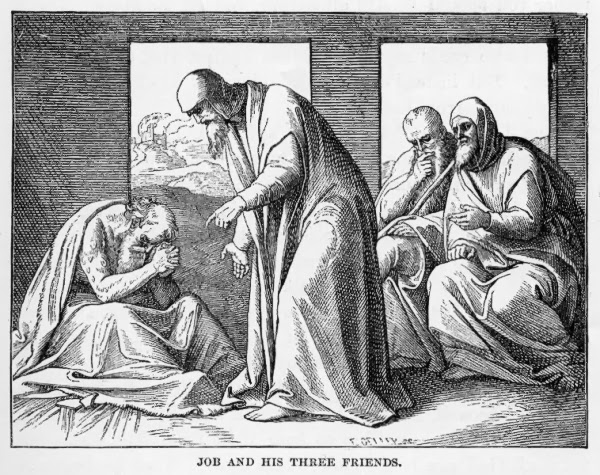
Job and his three friends
TODAY'S SPECIAL: Job 4-7; Psalm 136

TO CHEW ON: "'Oh that I might have my request,
That God would grant me the thing that I long for!
That it would please God to crush me,
that He would loose His hand and cut me off!'" Job 6:8,9


Does Job sound depressed or what?

You will recall the beginning of the story, how in one day Job's life falls apart when calamity strikes from all directions. And then he gets sick (Job 1-2:10). His friends come to comfort him. Here he responds to the speech of his friend Eliphaz.

Job sounds like he feels betrayed, double-crossed, and attacked by the God he has been trying to please: "'For the arrows of the Almighty are within me; My spirit drinks their poison; The terrors of God are arrayed against me'" - Job 6:4.

He feels physically unable to bear the agony: "'Is my strength the strength of stones? Or is my flesh bronze?'" - Job 6:12.

He begs to die: "'Oh that I would have my request … That it would please God to crush me, That He would loose HIs hand and cut me off.'" - Job 6:8,9.

Is there a reply to what Job has said that isn't shallow and trite? Job's friends certainly don't have it for they keep insisting Job is responsible for the horrible scenario. We, however, have information that Job and his friends didn't have about what was happening behind the scenes. Charles E. Blair, my Bible's commenter on Job says:

"Job's criticisms of God that appear in chapters 6 and 7 as well as in his other responses to his friends can best be understood as a man's feeble attempts to make sense of a scenario for which he is missing an essential piece of information, namely that there is something happening between God and Satan—that there are spiritual purposes overriding earthly circumstances. Because he is unaware of this dimension of the spiritual realm, his understanding is severely impaired" - New Spirit-Filled Life Bible, p. 652.

Could unseen spiritual battles also be a part of the troubles, illnesses, calamities, and disasters that come to us? I believe they could. When we feel puzzled, let down, even betrayed by God, let's remember this aspect of Job's story. Let's pray over and into the activities in the spiritual realm, of which we're unaware, and let's keep despair and bitterness toward God from creeping into our hearts.

PRAYER: Dear God, please help me to see troubles that come to me and those around me with insight into spiritual warfare. Amen.

PSALM TO PRAY: Psalm 136

The Bible Project - VIDEO: Job (Wisdom Series)


*********
Unless otherwise noted all Scripture quotations are taken from the New King James Version®. Copyright © 1982 by Thomas Nelson, Inc. Used by permission. All rights reserved.




Sunday, May 20, 2018

Accuser

"Inter filios die affuit etiam Satan 
Job 2 6 1967 " by Salvidor Dali

TODAY'S SPECIAL: Job1-3; Psalm 135

TO CHEW ON: "Now there was a day when the sons of God came to present themselves before the Lord, and Satan also came among them.
And the Lord said to Satan, 'From where do you come?' So Satan answered the Lord and said, 'From going to and fro on the earth, and from walking back and forth on it.'" Job 1:6-7


Here we get a rare behind-the-scenes glimpse of cosmic persons—God and Satan—in conversation. God draws attention to Job and what a unique, upright man he is.

We recognize the sly, cynical tone in Satan's response. It's the same voice we heard in the Garden:
* Satan to Eve in Eden: "Has God indeed said, 'You shall not eat of every tree of the garden?'" - Genesis 3:1
* Satan to God about Job: "Does Job fear God for nothing?" - Job 1:9.

Who is this Satan? A Word Wealth article in my Bible explains him in terms of the meaning of his name:

[Satan - satan - means an Opponent or the Accuser; the hater, adversary, enemy; one who resists, obstructs and hinders whatever is good. Satan comes from the verb which means to 'be an opponent,' or 'to withstand.' - Dick Mills, "Word Wealth - Satan" - New Spirit-Filled Life Bible, p. 648.]

Where did Satan come from? Wayne Grudem says of the origins of Satan and demons:
"When God created the world, he 'saw everything that he had made, and behold, it was very good (Genesis 1:31). This means that even the angelic world that God had created did not have evil angels or demons in it at that time. But by the time of Genesis 3, we find that Satan, in the form of a serpent, was tempting Eve to sin (Genesis 3:1-5). Therefore sometime between the events of Genesis 1:31 and Genesis 3:1, there must have been a rebellion in the angelic world with many angels turning against God and becoming evil" - Wayne Grudem, Systematic Theology, p. 412.

Though no human witnessed Satan's fall, God gave Bible authors insight into it: 2 Peter 2:4; Jude 6, and Isaiah 14:12-15.

Satan, as the hater, is the polar opposite of God who is love (1 John 4:7,8). And we align ourselves with one or the other. John says that we prove we are either children of God or children of the devil by the way we live and love - 1 John 3:10-15.

When I read this beginning of Job passage, I often wonder, what would God say about me? Would He recognize me as one of His own, demonstrated by my family trait of love? And how would Satan reply?

Finally, my response to pressure and temptation can change if I realize I am in the fire of a test that God allows because of His confidence that I'll pass that test—as my Bible's commenter on Job explains:
 "God does not allow trials to see if we will fail; He allows trials to strengthen our faith. The trial is, in fact, a statement of God's faith in our faithfulness and integrity" - Charles E. Blair, New Spirit-Filled Life Bible, p. 648 (emphasis added).

PRAYER:
Dear God, when I am tested, help me to remember that there are bigger issues at play than my comfort and well-being. Amen.

PSALM TO PRAY: Psalm 135

The Bible Project VIDEO: Job (Read Scripture Series)


***********
Unless otherwise noted all Scripture quotations are taken from the New King James Version®. Copyright © 1982 by Thomas Nelson, Inc. Used by permission. All rights reserved.


Monday, October 26, 2015

Three prayer principles

Man praying in church
TODAY'S SPECIAL: Job 42:1-17

TO CHEW ON: "And the Lord restored Job's losses when he prayed for his friends. Indeed the Lord gave Job twice as much as he had before." Job 42:10

We see some principles of prayer at play here in the happy ending to Job's story.

1. Prayer operates as a go-between.
Here it's Job's prayers that God wants to use to reconcile Job's friends to Himself. What Job does here reminds us of Jesus. When God told Job's friends that Job would offer a sacrifice and pray for them (Job 42:8), he (Job) was foreshadowing what Jesus did for us when He sacrificed His life and prayed for us from the cross.

2. Prayer operates beyond the boundaries of the natural.
Job was to pray for these friends who had insulted him and made him feel even worse than he did. We are reminded of Jesus' words: " 'But I say to you, love your enemies, bless those who curse you, do good to those who hate you, and pray for those who spitefully use you and persecute you' " Matthew 5:44. The result for Job was a doubled restoring of his fortunes. How did that work?!

3. Prayer may require forgiveness on the part of the pray-er.
Job's friends had, in effect, called him a windbag (Job 8:2), empty-headed (Job 11:3), and wicked (Job 22:5). He was distressed and hurt by them (Job: "Miserable comforters are you all!" - Job 16:2 and "How long will you torment my soul and break me in pieces with words?" - Job 19:2).

Now he was to pray for them. Surely that required some attitude adjustments on his part—as in a complete relinquishment of bad feelings and grudge-holding against Eliphaz, Bildad and Zophar. We call that forgiveness. We are reminded of Jesus' words from the cross: "'Father, forgive them, for they know not what they do…'" and Stephen's when he was being stoned: "Lay not this sin to their charge" (Luke 23:34 and Acts 7:60).

Let's keep these thoughts about prayer in mind as we pray.

PRAYER: Dear God, please help me to acknowledge the importance and power of prayer by actually spending more time praying, especially for those who have hurt, offended or troubled me. Amen.

 *********
Unless otherwise noted all Scripture quotations are taken from the New King James Version®. Copyright © 1982 by Thomas Nelson, Inc. Used by permission. All rights reserved.

Sunday, October 25, 2015

Beastly king of the proud

Destruction of Leviathan by Gustave Dore

TODAY'S SPECIAL: Job 41:12-34

TO CHEW ON: "He beholds every high thing;
He is king over all the children of pride." Job 41:34


If you read these details, what creature would you think I was describing?

He has "mighty power," "terrible teeth all around," "rows of scales," his armor is impervious to spear, dart, javelin, or arrow. Light flashes when he sneezes, sparks shoot of his mouth, smoke billows from his nostrils, his breath is so hot it starts a fire. He moves about with "crashings," churns up the sea to a muddy slurry, and makes pointy footprints on the beach.

It sounds a lot like a dinosaur or a medieval dragon, doesn't it?

The description is for the most part non-judgmental, though we sense from the beast's actions that he is not good, kind or safe. However, in the last verse of Job 41, the writer shows his hand when he says of this creature: "He is king over all the children of pride."

This powerful "king over all the children of pride" beast of Job 41 reminds me of Satan. Satan's identification with pride is seen from his first appearance on the cosmic scene:

"For you (Lucifer—Satan's name when he was an angel) have said in your heart: I will ascend into heaven, I will exalt my throne above the stars of God; … I will ascend above the heights of the clouds, I will be like the Most High" - Isaiah 14:12-14.

Let's remember the context here. In Job 41 God is questioning Job. The description of this beast is part of his query from the beginning of the chapter: Can you draw out, snare etc. this beast? The implied answer is, No, Job, you can't, but I (God) can.

The reference to pride also draws us back to Job 40:10,11, when God asks Job if he has the smarts and power to make moral judgements: "Would you indeed annul My judgment … Then … look on everyone who is proud and humble him. Look on everyone who is proud and bring him low" - Job 40:8,11,12.

In these chapters of Job then (Job 40,41), I think we can conclude that God is not so much impressing Job with His power over these creatures as natural monsters but is using them as images of evil. He is impressing on Job that even the most ferocious evil is still in His power. And that's still true today!


PRAYER: Dear God, whatever the beast Satan throws at the world or at me of fright, upheaval, chaos, and destruction, I take comfort in the fact that You are not intimidated or confused. You can draw him out with a hook, snare him, fill his scales with harpoons and finally overcome him. Amen.

 *********
Unless otherwise noted all Scripture quotations are taken from the New King James Version®. Copyright © 1982 by Thomas Nelson, Inc. Used by permission. All rights reserved.


Friday, October 23, 2015

Seeing God

God questions Job - Artist unknown
TODAY'S SPECIAL: Job 39:19-40:6


TO CHEW ON: "Then Job answered the Lord and said, 'Behold I am vile; What shall I answer You? I lay my hand over my mouth.'" Job 40:3-4

Here we see a Job quite unlike the cocky self-assured man who said, "I would declare to Him the number of my steps; Like a prince I would approach Him" - Job 31:37. What made the difference? Hearing God speak and being in His presence.

This reaction of Job's made me curious about how God's presence affected others. Here is a quick survey of how God's presence affected some people in the Bible:

  • For Hagar, fleeing from abusive Sarai after conceiving Ishmael by Abraham the "Angel of the Lord" was comfort and hope - Genesis 16:13.
  • For Jacob, after wrestling all night with a mysterious "Man" it was a physical disability and a blessing - Genesis 32:30.
  • For Aaron and Miriam it was a humbling rebuke at challenging the leadership of their brother Moses, who was intimate with God - Numbers 12:8.
  • For Israel it was the reputation of God living among them, striking terror in the soldiers of the surrounding nations - Numbers 14:14. (David calls the sight of God His refuge Psalm 141:8.)
  • For the elders of Israel and David it was an inexpressibly beautiful place and experience - Exodus 24:10; Psalm 27:4.
  • For Manoah and his wife it was the announcement of a baby and a new responsibility of raising Israel's leader Samson - Judges 13:1-23.
  • For Isaiah and Job it was a sense of unworthy sinfulness and self-loathing - Isaiah 6:5; Job 42:5 (along with our focus verses today).

Can we hope to see God face to face? Jesus said "Blessed are the pure in heart for they shall see God" - Matthew 5:8. One day in discussion with Jesus, Philip said, "'Lord, show us the Father and it is sufficient for us.'" Jesus replied: "'He who has seen Me has seen the Father'" - John 14:9.

What does this say to us? My sense is that, like the earlier Job, we often don't have a clue about what an awesome, fearful, holy place God's presence really is judging by how blasé and casual we are about invoking and entering it. At the same time we have a clue in that we have Jesus. We can view His life in the Bible record and see the Father. And through His gift of salvation, we can be pure in heart.

PRAYER: Dear God, I struggle to put my mind around what I read about Your encounters with us humans in the Bible. Please give me a realistic, experiential understanding and awe about who You are and what it means to be in Your presence.  Amen. 


************
Unless otherwise noted all Scripture quotations are taken from the New King James Version®. Copyright © 1982 by Thomas Nelson, Inc. Used by permission. All rights reserved.

Bible Drive-Thru


Sunday, October 18, 2015

Genius design

TODAY'S SPECIAL: Job 38:22-41

TO CHEW ON:
"Have you entered the treasury of snow? ....
Who has divided a channel for the overflowing water
Or a path for the thunderbolt?...
Can you send out lightnings that they may go
And say to you 'Here we are'?" Job 38:22, 25, 35


A few years ago I received a fascinating book to review. Nature Never Stops Talking by Samuel J. Alibrando is a collection of short essays on the wonders of nature. Alibrando comments in the Introduction: "Personally, I see hard evidence of intelligence in every tree, every flower, every star, and every single natural thing in the universe" - S. J. Alibrando, Nature Never Stops Talking, p. 13.

Reading Job 38 this morning reminds me of Alibrando's book. Let me share two bits from his essays on snow and lightning.

Snow:
"My fascination with snowflakes was renewed when I recently read that they are not white. In fact, they are ice crystals formed from water vapour. The crystalline shape is a product of the below-freezing temperatures that converts the moisture. Once formed, each crystal attracts a microscopic dust or salt particle as its own core. As its descent continues toward earth, it continues attracting more particles enlarging its size and uniqueness ....

"Each one contains millions of tiny, clear, light-reactive prisms. Imagine millions of prisms. What a sight to consider. While these prisms break up the light that strikes them into all the colors of the rainbow our own eyes receive a sensory overload; it is too many colors, we are unable to perceive the dazzling display, so our eyes see "white" instead. With all the mystery of such splendour as snowflakes, I learned that we don't see the half of it. The Millions of prisms creating millions of colors in each snowflake are too beautiful to even perceive"
- Alibrando, pp. 17,18.


Lightning:
"Clouds build up positive and negative charges like on a battery. Why they separate is unknown....

"Typically within the cloud, the charge (negative) moves downward about 165 feet in microseconds. This aimed collective movement is called a 'stepped leader.' When the stepped leader reaches 330 feet ANOTHER stepped leader from the ground (positive) moves UP. This especially happens on protruding objects such as trees or buildings. The swift climb of the positive stepped leader meets the descending stepped leader and BAM! The brilliant light we call 'lightning.'

"Several subsequent strokes can follow the same channel in less than a second, until the negative charge centre in the cloud is eliminated....

"Lightning is huge. It is powerful. It is constant. We don't know much about what would happen to our world if lightning stopped but it is here with all of its properties with millions impressed by its dramatic power"
- Alibrando pp. 21,22.

We love it when people appreciate and enjoy the things we create (actually we don't create at all, but assemble and re-assemble). But do we ever pause to consider what God has made—truly created—out of nothing? Job 38 is an invitation to us to ponder the wonder and variety in God's creation. Let's spend some time today appreciating His creation all around us.


PRAYER:
Dear God, Your creative ability, imagination and ingenuity boggles my mind. Thank You for Earth, the miracle of a liveable climate, and my body with its millions of cells that work together as a unit. You are amazing! Amen.

MORE: A few more Job-like questions

In an article about Earth and the solar system, Alibrando describes earth's size in relation to the planets and the sun:
Uranus's diameter = 32,500 miles (compared to Earth's 8,000-mile diameter).
Neptune = 72 times larger than Earth.
Jupiter = so big, 1400 Earths would fit inside it.
The sun (only a medium-sized star) = 1.3 million times larger than earth with a surface temperature of 9300 F but an inner temperature of 29,000,000 F.

Alibrando then asks:

"So, what percent of all this space does man think he has mastered? Does he understand what he sees? Does he understand what keeps the planets spinning? Does he know why the planets orbit counter-clockwise instead of clockwise? Does he know why some moons go in opposite directions on other planets? Does he know why the sun itself revolves every 27 days? Can we make our own miniature solar system that is more accurate than any clock? Can we then make that man-made miniature solar system float in the air, orbit around a centre ball with mini-orbits of moons and satellites around the orbiting planets?

.... What percentage of all knowledge does man really have, 50%, 10%, 1% or some tiny fraction of one percent? We don't even know.

Yet we still have the gall to shake our fist at the very notion of any greater intelligence than ourselves.

Amazing!"
- Alibrando, pp. 24, 25.

Nature Never Stops Talking on Amazon.ca

*******
Unless otherwise noted all Scripture quotations are taken from the New King James Version®. Copyright © 1982 by Thomas Nelson, Inc. Used by permission. All rights reserved.

Bible Drive-Thru


Saturday, October 17, 2015

Lessons from the sea

Ferries on the Pacific Ocean between mainland BC 
and Vancouver Island (Photo © 2012 by V. Nesdoly)

Ferries on the Pacific Ocean between mainland BC and Vancouver Island

TODAY'S SPECIAL: Job 38:1-21

TO CHEW ON: "Or who shut in the sea with doors,
When it burst forth and issued from the womb ....
When I fixed My limit for it,
And set bars and doors;
When I said,
"This far you may come, but no farther,
And here your proud waves must stop!" - Job 38:8,10-11


At last God 'shows up' out of the whirlwind. In a series of rhetorical questions He speaks to  Job about His creative power and wisdom. Some facts about nature that he draws to Job's attention:
- Job and his friends weren't present at creation.
- Only God can enforce the boundary between sea and land.
- He is the author of the predictable daily changes in the sky that come with morning and night.
- He even understands the mystery of death.

Though we humans have figured out the physics of why many of these things happen, we are still as ignorant of their beginning moments as Job and his friends were. We find ourselves believing either human-generated guesses and theories, or that God created it all, as we're told in Genesis.

The fact of God's control over nature is echoed in other Bible passages. Look, for example, at His control of the sea:

  • God changed the border of the Red Sea so the Israelites could cross - Exodus 14:21; Psalm 106:9.
  • He also controlled the waters of the Jordan River so they could cross into Canaan - Joshua 3:16.
  • The psalmist speaks often of God's sea-controlling power - Psalm 33:7; 77:16; 93:4; 104:9.
  • God declares His power over the sea through Isaiah - Isaiah 50:2.
  • And who can forget the story of Jesus, calming the storm at sea - Luke 8:24?

If God has such power over the literal sea, how can we not trust him with our seas, both literal and metaphorical?  
>Will changes in earth's temperature lead to higher sea levels and destroy life on earth as we know it? 
>Will God abandon us to life's storms of problems and difficulties?

Let's let the words of God through Jeremiah and Isaiah be our answer:

"Do you not fear Me?" says the Lord. "Will you not tremble at My presence, who have placed the sand as the bound of the sea, by a perpetual decree that it cannot pass beyond it? And though its waves toss to and fro, yet they cannot prevail. Though they roar, yet they cannot pass over it" - Jeremiah 5:22
and
"When you pass through the waters, I will be with you; and through the rivers, they shall not overflow you" - Isaiah 43:2.

PRAYER: Dear God, I acknowledge Your power over nature as its creator. Help me to trust You in the storms of my life. Amen.  

MORE: Sea Facts

  • There are 328,000,000 cubic miles of seawater on earth, covering approximately 71 percent of earth's surface.
  • By volume, the ocean makes up 99 percent of the planet's living space- the largest space in our universe known to be inhabited by living organisms.
  • About 97 percent of all water on earth is in our oceans, 2 percent is frozen in our ice caps and glaciers, less than 0.3 percent is carried in the atmosphere in the form of clouds, rain, and snow. All of our inland seas, lakes and channels combined add up to only 0.02 percent of earth's water.
  • Earth's largest continuous mountain chain is the Mid-Ocean Ridge, stretching for 40,000 miles, rising above the surface of the water in a few places, such as Iceland. It is four times longer than the Andes, Rocky Mountains, and Himalayas combined.
  • Canada has the longest coastline of any country, at 56,453 miles or around 15 percent of the world's 372,384 miles of coastlines.
  • The highest tides in the world are at the Bay of Fundy, which separates New Brunswick from Nova Scotia. At some times of the year the difference between high and low tide is 53 feet 6 inches, the equivalent of a five-story building.

From Ocean Facts (See the Sea.org)

***********
Unless otherwise noted all Scripture quotations are taken from the New King James Version®. Copyright © 1982 by Thomas Nelson, Inc. Used by permission. All rights reserved.

Bible Drive-Thru


Friday, October 09, 2015

Do you eat every day?

Sandwiches with pickles and fruit

TODAY'S SPECIAL: Job 23:1-17

TO CHEW ON:
"I have treasured the words of His mouth
More than my necessary food." - Job 23:12


Because of this blog's foody title and the way daily Bible reading, meditation, and prayer have always seemed like needed spiritual rations to me, it's no wonder that Job's mention of God's word as food caught my attention.

  • Job pictures God's word as treasured and essential food—more important than physical food.

Here are some other benefits of "eating" God's word:
  • It keeps us spiritually alive.
"… man shall not live by bread alone; but man lives by every word that proceeds from the mouth of the Lord" - Deuteronomy 8:3, also Matthew 4:4.

  • It satisfies our desire for what is truly sweet:
"How sweet are Your words to my taste
Also sweeter than honey to my mouth" - Psalm 119:103; Psalm 19:10.


  • It leaves us feeling joyful:
"Your words were found, and I ate them;
And Your word was to me the joy and rejoicing of my heart" - Jeremiah 15:16.

  • It delivers essentials for ministry (a spiritual vitamin pill, if you will):
"Moreover He said to me, 'Son of man, eat what you find, eat this scroll and go, speak to the house of Israel" - Ezekiel 3:1.

  • Drinking and eating it helps us grow:
"As newborn babes desire the pure milk of the word that you may grow thereby" - 1 Peter 2:2; Acts 20:32; Hebrews 5:13.

  • Through ingesting it we remain doctrinally healthy:
"… nourished in the words of faith and of the good doctrine which you have carefully followed" - 1 Timothy 4:6.

  • Biting off and chewing its more complex and difficult portions matures us and sharpens our palette to discern good and evil:
"But solid food belongs to those who are of full age, that is, those who by reason of use have their senses exercised to discern both good and evil" - Hebrews 5:14.

I don't know what form those "words of His mouth" came to Job. An audible voice? A deep heart conviction? Words written on a clay tablet or scroll? However, for us there is no question about this. For us who have the Bible translated in our language and available in dozens of versions, God's word is as available and handy as the pantry or fridge in our house—a banquet book that never runs out. Let's eat it regularly!

PRAYER: Dear God, thank You for the Bible. Help me to read it, understand it, and obey it. Amen. 

 *********
Unless otherwise noted all Scripture quotations are taken from the New King James Version®. Copyright © 1982 by Thomas Nelson, Inc. Used by permission. All rights reserved.


Thursday, October 08, 2015

Job's comforters

Job is visited by his three friends
"Job Is Visited by His Three Friends" - Artist Unknown

TODAY'S SPECIAL: Job 2:1-13

TO CHEW ON: "So they (Job's three friends) sat down with him on the ground seven days and seven nights and no one spoke a word to him for they saw that his grief was very great." Job 2:13

Life is full of bad news. We're always glad when that bad news isn't ours and we can comfort instead of grieve. How should we respond to someone who has lost a loved one through death, suffered a life-changing accident, or got the worst diagnosis?

We actually have two responses here:
  • Job's wife advised him to give up. "Curse God and die!" she said (Job 2:9). Having just listened in on the conversation between Satan and God, where Satan said, "But now, stretch out Your hand ... and he will surely curse You to Your face" (Job 1:11) the source of Job's wife's idea becomes clear. It was part of Satan's test, inspired by the father of lies and destruction himself. Job's answer was a definite 'no '(Job 2:10) and it was probably therapeutic for Job to hear himself put into words his faith in God in the face of all that had happened.
  • Job's friends also came to commiserate with him. These are the three men whose later attempts to comfort fell so flat people have coined the phrase "Job's comforter" to describe a person whose attempts to comfort hurt more than they help. But I would say that in today's reading, they did at least two things right:
- They came to be with Job.
- For one week they sat in silent empathy with him.
What are some other right things to do to comfort someone who is grieving. Rebecca's husband died of cancer in the prime of his life so she has had experience with grief. In an article called "What to do when someone you know dies," she gives ten suggestions of actions we can take after someone's death:


1. Send a card or letter.
2. Send flowers.
3. Give food.
4. Give to a good cause in the deceased person's name.
5. Visit.
6. Tell them your memories of their loved one.
7. Offer to do something specific for them.
8. Go to the funeral or memorial service.
9. Invite the family over for coffee.
10. Pray for them.
Of course the ways to comfort people going through other tragedies would be slightly different, but some of these items would apply.

Rebecca ends her article with this advice:
"The most important thing to remember is that exactly what you do isn’t as important as that you do something to acknowledge the death. If you’ve procrastinated until you’re afraid it’s too late, take heart; it’s not. A month later or half a year later, your gesture will still be appreciated. Who knows, it might even be more appreciated, because by then the dust has settled and reality has set in." Read entire article...

So before we dump all over Job's friends, let's give credit where it's due. They came and they sat with Job as he grieved the death of his kids and the state of his health. That was a good thing.

PRAYER: Dear God, please help me to have empathy with those who are grieving and to know how to show it in tactful and comforting ways. Amen.

MORE: A passage about comfort

"Blessed be the God and Father of our Lord Jesus Christ, the Father of mercies and God of all comfort, who comforts us in all our tribulation, that we may be able to comfort those who are in any trouble, with the comfort with which we ourselves are comforted by God."- 2 Corinthians 1:3-4
********
Unless otherwise noted all Scripture quotations are taken from the New King James Version®. Copyright © 1982 by Thomas Nelson, Inc. Used by permission. All rights reserved.


Bible Drive-Thru

Wednesday, October 07, 2015

Satan's to-do list

Daily Activities list - photo
TODAY'S SPECIAL: Job 1:1-22

TO CHEW ON: " ' But now, stretch out Your hand and touch all that he has and he will surely curse You to Your face." Job 1:11


What an interesting drama we see playing out in today's reading: Satan intermingling with the good angels as they appear before God (Job 1:6); God singling him out with a question (Job 1:8); and Satan rising to the occasion with a challenge back to God (Job 1:9-11). It appears that one of the tasks he has set for himself is to slander the saints (something he continues to do - Revelation 12:10).

A short stroll through the Bible makes us privy to some of the other nasty things on his to-do list:
  • Tempt people to be disobedient. He was behind Eve's and Adam's sin (Genesis 3:4,5) and he was also behind David's sin of commanding a census when God was not for it (1 Chronicles 21:1).
  • Inflict disease. As we read further on in Job, we see the active role Satan played in Job's case of boils (Job 2:7).
  • Oppose God's ministers—as Zechariah saw in his vision of priest Joshua in the temple (Zechariah 3:1).
  • Tempt Christ (Matthew 4:1,3).
  • Remove truth with falsehood. Jesus, in His parables, shows Satan removing the good seed or truth (Matthew 13:19) and sowing tares or what is false (Matthew 13:38,39).
  • Torture those in his possession. The Bible is full of the mental and physical anguish of the demon-oppressed and possessed (Luke 9:42; 13:16).
  • Lie, lie lie (John 8:44).
  • Instigate sin. This is what he did in the heart of Judas to betray Jesus (John 13:2) and Ananias and Sapphira to lie about their offering (Acts 5:3).
  • Hassle, persecute, and kill Christians. Paul attributed his "thorn in the flesh" as a "messenger of Satan" to "buffet" him (2 Corinthians 12:7). In Revelation, John sees those who have been killed for their faith--who "...overcame him (Satan) by the blood of the Lamb, and by the word of their testimony; and they loved not their lives unto the death" (Revelation 12:11).
  • Hinder Christian activity. Paul blames Satan for keeping him from visiting the church in Thessalonica (1 Thessalonians 2:18).
  • Prey on people. Peter and John clearly alert us to this in 1 Peter 5:8 and Revelation 2:10.

Though we will probably never have as clear a behind-the-scenes clip of Satan at work in our lives as we get in Job, when we review the above list of his activities it's not hard to see his fingerprints all over our circumstances as well. Let's follow Peter's advice to:

"Be well balanced (temperate, sober of mind), be vigilant and cautious at all times; for that enemy of yours, the devil, roams around like a lion roaring [in fierce hunger], seeking someone to seize upon and devour. 
"Withstand him; be firm in faith [against his onset—rooted, established, strong, immovable, and determined], knowing that the same (identical) sufferings are appointed to your brotherhood (the whole body of Christians) throughout the world." - 1 Peter 5:8,9 AMP.

PRAYER: Dear God, thank You that Satan is , through Christ, a defeated enemy. Help me to live alert to his methods and schemes in my life and in the world around me. Amen.

 *********
Unless otherwise noted all Scripture quotations are taken from the New King James Version®. Copyright © 1982 by Thomas Nelson, Inc. Used by permission. All rights reserved.

Scripture quotations marked AMP are taken from the Amplified® Bible,
Copyright © 1954, 1958, 1962, 1964, 1965, 1987 by The Lockman Foundation
Used by permission." (www.Lockman.org)

Saturday, February 07, 2015

Missing information

night birds
TODAY'S SPECIAL: Job 7:1-8

TO CHEW ON: "When I lie down, I say, 'When shall I arise,
And the night be ended?'
For I have had my fill of tossing till dawn." Job 7:4


Why is night always the worst time when we're sick? Maybe it's because we expect to sleep and are disappointed. Maybe because in the still and dark there is nothing to distract from the pain, discomfort, and worry? May it's merely that the prone position causes gravity to augment the pull on our sore cells. Whatever it is, it's interesting to note that it was the same for the ancients.

There's not much encouraging or uplifting here. In this section of his first speech to his friends, Job is entirely negative, speaking of the futility of his life and work, complaining that he can't sleep, describing his loathsome disease, and referring to the fact that his life will soon be over.

My Bible's commenter makes this observation:

"Job's criticisms of God that appear in Job 6 and 7 as well as his other responses to his friends, can best be understood as man's feeble attempts to make sense of a scenario for which he is missing an essential piece of information, namely that there is something happening between God and Satan—that there are spiritual purposes overriding earthly circumstances. Because he is unaware of this dimension of the spiritual realm, his understanding is severely impaired" - Charles E. Blair, commentary on Job, New Spirit-Filled Life Bible, p. 652 (emphasis added).

Could that be the case in our lives as well—that our trials, whatever they are, are connected to spiritual skirmishes unseen and unknown to us? Imaginative writers have riffed on that thought in books like The Screwtape Letters (C. S. Lewis), This Present Darkness (Frank Peretti), and The Ishbane Conspiracy (Angela, Karina and Randy Alcorn).

The Bible certainly supports such a thing:

"For we do not wrestle against flesh and blood, but against principalities, against powers, against the rulers of the darkness of this age, against spiritual hosts of wickedness in the heavenly places" - Ephesians 6:12

"Fight the good fight of faith, lay hold on eternal life, to which you were also called and have confessed the good confession in the presence of many witnesses" - 1 Timothy 6:12.

PRAYER:
Dear God, when troubles, sickness, and death impact me, help me remember that I am in a battle You have won. Please give me courage and hope through bad days and nights. Amen.

 *********
Unless otherwise noted all Scripture quotations are taken from the New King James Version®. Copyright © 1982 by Thomas Nelson, Inc. Used by permission. All rights reserved.


Wednesday, January 21, 2015

Living with questions

TODAY'S SPECIAL: Job 37:1-24

TO CHEW ON:
"God thunders marvelously with His voice;
He does great things which we cannot comprehend." Job 37:5


After Job's three elderly friends are done speaking, a younger man, Elihu, joins the conversation (Job 32-37). Our reading today is the end of Elihu's final speech. His argument (quoting from my Bible's Introduction to Job) is:

"... God is greater than any human being; therefore a person has no right or authority to require an explanation of Him. He argues that some things that God does are humanly incomprehensible. At the same time, Elihu suggests that God will speak if we will listen. His emphasis is on the attitude of the sufferer, that is, an attitude of humility allows God to intervene .... Elihu's appeal to Job is: 1] to have faith in God Himself rather than demand an explanation; 2] to change his attitude to one of humility" Charles E. Blair, Introduction to Job, New Spirit-Filled Life Bible, p. 645.

In our reading, Elihu refers to the mysteries of nature—the grandeur of thunder and lightning, the cycling of rain and snow, the capriciousness of clouds, the instinctive wisdom of animals in response to seasonal changes.

What strikes me about several of these speeches is how closely Job and his friends observe nature and the seasons. They attribute its enigmas and splendours to the mind and intention of God. In today's chapter Elihu describes them in glowing terms: "thunders marvelously .... great things .... wondrous works of God .... awesome majesty .... He is excellent in power."

So much of what they say still expresses our awe of these things.

But what about when nature does more than put on a show for us while we're watching from the safety of our homes? Because when hurricanes and tornadoes bring devastation and floods, when lightning sparks wildfires burning homes along with vast tracts of forest or grass, when earthquakes destroy communities forever we, along with Elihu, are also puzzled:

"He does great things which we cannot comprehend...

"He causes it to come
Whether for correction
Or for His land
Or for mercy
" - Job 37:5,13.

Are there any answers to the theological and existential questions Job and his friends have been grappling with? Our consecutive readings in Job end here, but the Bible account continues with God's reply to Job (and his four friends) in Job 38:1-41:34. It's an answer well worth reading for our own lives.

PRAYER: Dear God, I find it uncomfortable to live with questions. Help me to wait for Your answers and to recognize them when they come. Amen.

**********
Unless otherwise noted all Scripture quotations are taken from the New King James Version®. Copyright © 1982 by Thomas Nelson, Inc. Used by permission. All rights reserved.

Tuesday, January 20, 2015

God our teacher

Teachder's desk with apple
TODAY'S SPECIAL: Job 36:16-33


TO CHEW ON:
"Behold, God is exalted by His power;
Who teaches like Him?
Who has assigned Him His way,
Or who has said, 'You have done wrong?'" Job 36:23


Though I continue to find Elihu's pompous, I-have-all-the-answers attitude grating, he does make some wise observations. One of them is that God teaches. As we look through the Bible at a sampling of verses about God teaching, we see that His instructions come not only through difficulties but in other settings as well.

He teaches us how to do our work.

  • He promises to teach Moses how to do his special assignment of leading the Israelites out of Egypt (Exodus 4:15).
  • He also gives lessons in more everyday tasks like how and when to plant and harvest certain crops (Isaiah 28:26-29) and how to choose the right way that will lead to profit (Isaiah 48:17).

He teaches about the future (Daniel 8:19).

God's school is lifelong learning that begins in childhood (Isaiah 54:13), carries on into youth, and the old psalmist begs God to continue to teach him into his "old and grayheaded" years (Psalm 71:17-18).

God teaches:
  • Through signs and wonders like the Israelites experienced in the wilderness (Deuteronomy 4:36).
  • Through His word - Psalm 119:26, 66, 135.
  • Through His Spirit - 1 Corinthians 2:12.
  • And, Elihu would insist, through the events of our lives, good and bad (Job 36:22,23).

The best students have a teachable spirit.

  • God teaches the ones who fear the Lord, according to David (Psalm 25:12).
  • However if there is sin in our lives, we may need to repent in order to again hear God's voice (Psalm 32:1-5; 8-9).

God's teaching is for everyone.
  • It's for the Jews: Isaiah sees the "Day of the Lord" when Israel will willingly go to God's house to be taught in His ways and how to walk in His paths (Isaiah 2:3).
  • But it's for other nationalities too. Micah prophesies a day when the desire to sit under God's instruction will pull in citizens of many nations (Micah 4:2).

Let's open ourselves to the favour and blessing of God's instruction
(Psalm 94:10-12; 119:135).  For we ignore it at our peril (Jeremiah 32:33,36).


PRAYER:

Dear God, please develop in me a teachable spirit and keen ears to hear Your instructions. May it truly be lifelong learning. Amen. 

 *********
Unless otherwise noted all Scripture quotations are taken from the New King James Version®. Copyright © 1982 by Thomas Nelson, Inc. Used by permission. All rights reserved.


Friday, January 16, 2015

When God feels far away

planet in black space
TODAY'S SPECIAL: Job 35:1-16

TO CHEW ON: "For you say, 'What advantage will it be to you? What profit shall I have, more than if I had sinned?' " Job 35:3

In this third speech of Elihu's, he answers two questions he has heard Job ask:
1] What is the value of virtue (Job 35:2-8)?
2] Why doesn't God answer the prayers of the afflicted (Job 35:9-16)?

I'm going to focus on Elihu's response to the first question.: "What is the value of virtue?" See Job's own phrasing of it in Job 21:15.

Elihu answers by establishing God's remoteness. He is distant, says Elihu, and thus untouched by human actions. But, Elihu has himself said earlier that God does interact with people (Job 33:10-11, 24-26).

The commentary writer elaborates on Elihu's mixed messages:
"By stressing God's transcendence, he has protected God from the actions of people. But the reasoning here contradicts his earlier claim that God reacts to the sins by punishment and discipline and to righteousness by reward. ... By suggesting that God is indifferent, Elihu comes close to Job's position of challenging his justice" - Asbury Bible Commentary - accessed via "Study This" on BibleGateway.

We too may sometimes side with Elihua here, feeling that what we do makes no difference to God; that He is above and beyond our puny existence. I love how Wayne Grudem tackles this issue in his Systematic Theology:
"The term often used to say that God is much greater than creation is the word transcendent. Very simply, this means that God is far "above" the creation in the sense that he is greater than the creation and he is independent of it. 
God is also very much involved in creation … The technical term used to speak of God's involvement in creation is the word immanent, meaning "remaining in" creation. The God of the Bible is no abstract deity removed from and uninterested in his creation. The Bible is the story of God's involvement with his creation and particularly the people in it" - Wayne Grudem, Systematic Theology, p. 267.

God sending Jesus is evidence of that involvement—His literal skin in the game (John 1:14). Through Jesus we are intimately connected to Him, despite what our feelings say:
  • " 'Lo I am with you always…' " - Matthew 28:29.
  • " 'Neither shall anyone snatch them out of My hand' " - John  10:28.
  • " 'Abide in Me and I in you' " - John 15:4.
  • "For I am persuaded that neither death nor life (nor angels, principalities powers etc.) shall be able to separate us from the love of God which is in Christ Jesus our Lord" - Romans 8:38.

PRAYER: Dear God, I know the facts about Your presence. Help me to apply them to my life when my feelings say otherwise. Amen.

 *********
Unless otherwise noted all Scripture quotations are taken from the New King James Version®. Copyright © 1982 by Thomas Nelson, Inc. Used by permission. All rights reserved.


Related Posts Plugin for WordPress, Blogger...