Showing posts with label Jack Hayford. Show all posts

Wednesday, July 04, 2018

Turn back

TODAY'S SPECIAL: Lamentations 4-5; Psalm 30

TO CHEW ON: "Turn us back to You, O Lord, and we will be restored; Renew our days as of old." Lamentations 5:21

The bleak book of Lamentations ends on a bright note—the possibility of returning to God.

Stories of repentance (turning back to God) run through the Bible.
  • David repented after committing adultery and murder (Psalm 51:1-19).
  • Josiah repented when the priests found and read the books of the law (2 Kings 22:11,19).
  • The pagan Ninevites repented at the preaching of Jonah (Jonah 3:6-9).
  • Even evil King Ahab repented after hearing about God's coming judgment from Elijah (1 Kings 21:27).

I love the story of the Prodigal Son and the wording Luke uses to describe his return: "But when he came to himself he said...I will arise and go to my father and will say to him, 'Father, I have sinned...'" (Luke 15:17-18).

I'm sure you can remember your own coming to yourself, that moment when you 'repented' (turned, changed direction) from unbelief to faith, self-direction to God-direction. I know I can. I tell my story here (end of "My Rambling Story").

Of course following that one moment of big repentance when life takes a whole different direction, there are hundreds of smaller repentances. Each time we find ourselves again taking control of our lives and letting our old carnal self have the upper hand we can repent, turn back and be restored and renewed.

Jack Hayford says about repentance:

"The implications of biblical repentance are threefold:
1. Renunciation and reversal.
2. Submission and teachability.
3. Continued shapeability.


There is no birth into the kingdom without hearing the call to salvation, renouncing one's sin and turning from sin toward Christ the Saviour (Acts 3:19)" - Jack Hayford, "Repentance," New Spirit Filled Life Bible, p. 1293.

PRAYER: Dear God, thank You for drawing me back go Yourself. I pray for the prodigals in my life, that You will bring them home in the same way. Amen.

MORE: Praise is Rising by Brenton Brown and Paul Baloche
"Hear the sound of hearts returning to You
We turn to You
In Your kingdom broken lives are renewed;
You make us new..."


Unless otherwise noted all Scripture quotations are taken from the New King James Version®. Copyright © 1982 by Thomas Nelson, Inc. Used by permission. All rights reserved.

Do your 8-12-year-olds have daily devotions? Point them to Bible Drive-Thru.

Sunday, March 18, 2018

Tell your story—and tell it well

Image: Pixabay.com
TODAY'S SPECIAL: Ruth1-4; Psalm 77

TO CHEW ON: "There was a relative of Naomi's husband, a man of great wealth of the family of Elimelech. His name was Boaz." Ruth 2:1

Don't you just love reading a story as skilfully told as this one? The tale that starts out with two unfortunate widows expands as wealthy Boaz comes on the scene. There is just enough detail and zoom in on specific incidents to make the characters come alive.

We see conscientious Ruth doing all she can to provide for her aging mother-in-law. Her stellar reputation has reached the ears of landowner Boaz who arrives in a flourish of hoofbeats and dust (my imagination here). We watch his gentleness with her and her trusting response. We notice Naomi perk up when Ruth tells her of the day. We look forward to what will happen next as the at-a-safe-distance Boaz-Ruth relationship continues through the harvest season.

The question, Who wrote this? occurred to me. My Bible's introduction to Ruth suggests Samuel:
"It is also reasonable to suppose that Samuel, who witnessed the decline of Saul's rule and was directed by God to anoint David as God's heir-apparent to the throne, could have penned this himself. The lovely story would already have attracted oral retelling among the people of Israel, and the concluding genealogy would have secured a link with the patriarchs—thus giving a steady answer to all in Israel who would desire their king's family background" - Jack Hayford, Introduction to Ruth, New Spirit-Filled Life Bible, p. 349.

Ruth's story brings to mind the power and usefulness of our stories. I love hearing accounts of how God works in lives—stories that reassure us of God's faithfulness and thus build our own faith. Hayford's defense of Samuel as author (above) suggests other things about stories. They are sometimes first told orally before being written down. They serve as a link to the past. They also provide valuable information about the background of a prominent person.

We can tell our stories in many ways:

  • Orally to friends and family, and especially to the next generation.
  • More formally as part of a talk, presentation, or sermon.
  • In a written devotional.
  • In a memoir.
  • Through poetry. 
  • Via the actions and words of a fictional character in a novel.
  • In a play.

Do you tell your story? Do you know how to tell it well?
Are you conscious of things like how and when to introduce characters and events with a view to timing, tension and keeping the listener or reader on the interest hook?

Your story is worth telling—and worth telling well!


PRAYER: Dear God, thank You for the beautiful narrative of Ruth and the stories You are telling through each of our lives. Help me to tell my story with skill and Holy Spirit anointing. Amen. 

PSALM TO PRAY: Psalm 77

The Bible Project VIDEO: Ruth (Read Scripture series)


MORE: More on story-telling

Another word Bible writers use for story is testimony Here are a few verses that encourage us to tell our stories / testimonies:
  • Psalm 60:4
  • Psalm 107:2
  • Isaiah 12:4
  • Acts 1:8
  • 2 Timothy 1:81 Peter 3:15
  • Revelation 12:11

Get some story-telling hints from Jeff Goins:


 *********
Unless otherwise noted all Scripture quotations are taken from the New King James Version®. Copyright © 1982 by Thomas Nelson, Inc. Used by permission. All rights reserved.


Tuesday, January 03, 2017

Humanity's place in creation

creation scene
TODAY'S SPECIAL: Genesis 1:20-2:4a

TO CHEW ON:
"Then God said, 'Let Us make man in Our image, according to Our likeness; let them have dominion over the fish of the sea, over the birds of the air, and over the cattle, over all the earth and over every creeping thing that creeps on the earth.'" Genesis 1:26

Man as created thing is different from the other parts of God's creation. Our reading today points out some ways. Several sidebar articles in my Bible delve into these differences:

1. God determined to create man in His likeness and image. Both male and female are reflections of that image (Genesis 1:26,27).


Man is a spiritual being who is not only body, but also soul and spirit," writes Charles Blake in the article "Man's Intrinsic Value."  "He is a moral being whose intelligence, perception and self-determination far exceed that of any other earthly being" - New Spirit-Filled Life Bible, p. 5 (emphasis added).

2. God gave humanity dominion over all other creatures (Genesis 1:28). Jack Hayford elaborates in the article "Man's Delegated Dominion":

"In creating man, the Sovereign of the universe makes a choice to delegate to man 'dominion … on the earth.' (vs. 28). Man's power and authority for exercising this rule originate in God's intent to make man in His own image and likeness." Hayford goes on to suggest that man's ability to play this role is eroded when he is disobedient to God's law - NSFLB p. 6 (emphasis added).

3. God gave man a quality of life He didn't give to other creatures—He "breathed into his nostrils the breath of life and man became a living being" Genesis 2:7. The creatures were living too, so the words "breath of life" and  "living being" here seem to imply life of a different quality.

Writers Charles Blake and Jesse Miranda write: "The likeness of man to the creator is in the favor and function of personal unity. God designed the human personality to consist of self-consciousness and self-determination with both the freedom and the awareness to respond to God, to other human beings, and to the environment" (emphasis added). The authors also point out the destiny of those who choose to trust Christ—already in God's mind at this point: "… just as He chose us in Him before the foundation of the world that we should be holy and without blame before Him"  - Ephesians 1:4 (read all of Ephesians 1:3-6) NSFLB p. 7.

How might we respond to these creation principles?

- We need to realize the preciousness of each human being.


- We need to be aware that human philosophies that exalt animals to practically human status aren't supported by the Bible. Though we need to care for animals, humanity's position is not as equals but as dominant over them.  In practical living, our society has drifted from these foundations, killing its own with abandon (in abortion for example) while insisting on ever more rights for animals. I believe we need to be aware of the spiritual underpinnings of initiatives like the animal rights movement.

- We need to live with our final destiny in mind.
If He "chose us in Hm before the foundation of the world" our lives are not accidental. Each of us has a unique role to fulfill. May we find it and fill it!


PRAYER: Dear God, thank You for creation which includes plants, animals and human beings. Please give us wisdom in our assignment to have dominion over other parts of creation. Help me to fulfill the destiny for which You chose me "before the foundation of the world." Amen.

 *********
Unless otherwise noted all Scripture quotations are taken from the New King James Version®. Copyright © 1982 by Thomas Nelson, Inc. Used by permission. All rights reserved.

Sunday, December 11, 2016

Kingdom violence

"Saint John the Baptist Sees Jesus From Afar" 
James Tissot, 1886-1894

TODAY'S SPECIAL: Matthew 11:2-15

TO CHEW ON: "'And from the days of John the Baptist until now the kingdom of heaven suffers violence, and the violent take it by force.'" Matthew 11:12  (link is to five translations)


Jesus has just finished describing the opposition His disciples will encounter (Matthew 10:17-20). Then in the very next chapter we see in John the Baptist, a living example of what He is talking about.

King Herod has imprisoned John for criticizing his morals. From his prison cell, John sends two of his disciples to see Jesus and bring back a little reassurance. "Are you the One?" they ask. "Or do we look for another?"

Jesus, in His typical way gives them an answer that both probes their expectations and enlists their commitment (Matthew 11:4-6). Then He praises John the Baptist and makes this curious statement: "And from the days of John the Baptist until now the kingdom of heaven suffers violence, and the violent take it by force." What does that mean?

An article that discusses the themes of the Synoptic Gospels (Matthew, Mark & Luke) says this:

"A dominant theme of Jesus' teaching is the kingdom of God. Jesus presents numerous word-pictures of what this supernatural realm "is like." But the kingdom is not merely to be understood with the mind. Rather, it is spiritual and is to be comprehended and entered into by spiritual means and in practical living....Enter the kingdom of God by "violent" determination. Be aggressive about serving Christ" - New Spirit-Filled Life Bible, p. 1439.

Jack Hayford explains it another way:

"Jesus asserts the "violence" of the kingdom....Jesus' references to the nonreligious style of John and the confrontative, miraculous ministry of Elijah teach that the kingdom of God makes its penetration by a kind of violent entry opposing the human status quo ...The upheaval caused by the kingdom of God is not caused by political provocation or armed advance. It is the result of God's order shaking relationships, households, cities, and nations by the entry of the Holy Spirit's power working in people. (See also Luke 16:6)" - New Spirit-Filled Life Bible, p. 1310. (All emphases added.)
Whether Jesus was talking about:
- our violent determination as we enter the kingdom,
- or the violence with which it enters our lives (playing havoc with our old life),
- or the violence with which it penetrates society (as we its citizens are empowered by the Holy Spirit to be salt and light),
- or the violent reaction society has to it, Jesus' statement embodies an energy and determination we don't often equate with religious belief—at least not in our day and not about the Christian faith. It sounds almost fanatical.

I ask myself, am I such a determined, committed, "violent" one? Are you?

PRAYER: Dear God, I hate being labeled a fanatic and yet the martyr faith in Jesus of believers across the centuries and even in my own time illustrates the price I should be willing to pay. Help me to come to terms with the true cost of following You. Amen.

MORE: Third Sunday of Advent
Today is the third Sunday of Advent. The liturgy for the day begins with this collect:

"Stir up your power, O Lord, and with great might come among us; and, because we are sorely hindered by our sins, let your bountiful grace and mercy speedily help and deliver us; through Jesus Christ our Lord, to whom, with you and the Holy Spirit, be honor and glory, now and for ever. Amen."
**************
Unless otherwise noted all Scripture quotations are taken from the New King James Version®. Copyright © 1982 by Thomas Nelson, Inc. Used by permission. All rights reserved.


Bible Drive-Thru

Friday, October 14, 2016

The kingdom within


"Christ Enthroned" - Master of the Ingeborg Psalter
(France, 1195-1210) from the Getty Trust. 
Used with Permission.


TODAY'S SPECIAL: Luke 17:20-37

TO CHEW ON:
Now when He was asked by the Pharisees when the kingdom of God would come, He answered them and said, 'The kingdom of God does not come with observation; nor will they say, "See here!" or "See there!" For indeed the kingdom of God is within you.'"  Luke 20:20,21NKJV

"'For behold, the kingdom of God is within you (in your hearts) and among you (surrounding you).'" Luke 20:21 Amplified


The Pharisees are expecting and looking for an external, visible, physical kingdom. But Jesus tells them that the kingdom of God is not that at all. Rather it's "within you" and "among you."

One of the ways we understand the "among you" part is that Jesus Himself brings that kingdom. Note how, early in His ministry, He claims Himself the kingdom-bringer when He reads from the Isaiah scroll in His hometown synagogue. After reading these words:  "The Spirit of the Lord is upon Me / Because He has anointed Me to preach the gospel to the poor… etc." (Luke 4:18,19), He says, "'Today this Scripture is fulfilled in your hearing.'" His hearers understand these Isaiah prophecies to refer to Messiah and His reign.

Clues to how the kingdom of God is "within" us are scattered throughout the New Testament.
  • Jesus tells Nicodemus he can't enter the kingdom without being born again - John 3:3.
  • Jesus says of the "poor in spirit" and the "persecuted" that "theirs is the kingdom of heaven" - Matthew 5:3,10.
  • Persecution and suffering are also linked with the kingdom of God in Acts 14:22 and 2 Thessalonians 1:5.
  • Those who have looked after the needy and homeless "inherit" the kingdom - Matthew 25:34,35.
  • Perseverance proves us fit for the kingdom - Luke 9:62.

Jack Hayford in an article commenting on this passage explains how Jesus' kingdom anointing becomes ours:

"Jesus has sent the Holy Spirit to cause the anointing of His messiahship to be transmitted to us (Isaiah 61:1-3; Luke 4:18; John 1:16; 1 John 2:20,27; 4:17). So it is, and on these terms only, that a human being can say 'The kingdom of God is within me'" - Jack Hayford, "The Kingdom Within You," New Spirit-Filled Life Bible, p. 1423 (emphasis added).

I ask myself, is my heart the kingdom of God, and not of me (1 Corinthians 6:19-20)? Are there evidences of the kingdom of God in my life—the humility, the willingness to be persecuted and suffer,  the concern for the down-and-out, the perseverance, to name a few? Can Jesus' words, "'The kingdom of God is within you'" truly be said of me? Of you?

PRAYER: Dear Jesus, I want Your kingdom to have full sway in my life. Please show me where I have left myself on my life's throne. Help me dethrone self and put You there. Amen.

***********

New King James Version (NKJV) Used with permission. The Holy Bible, New King James Version Copyright © 1982 by Thomas Nelson, Inc.

Bible Drive-Thru

Sunday, September 18, 2016

What does it mean to "press in"?

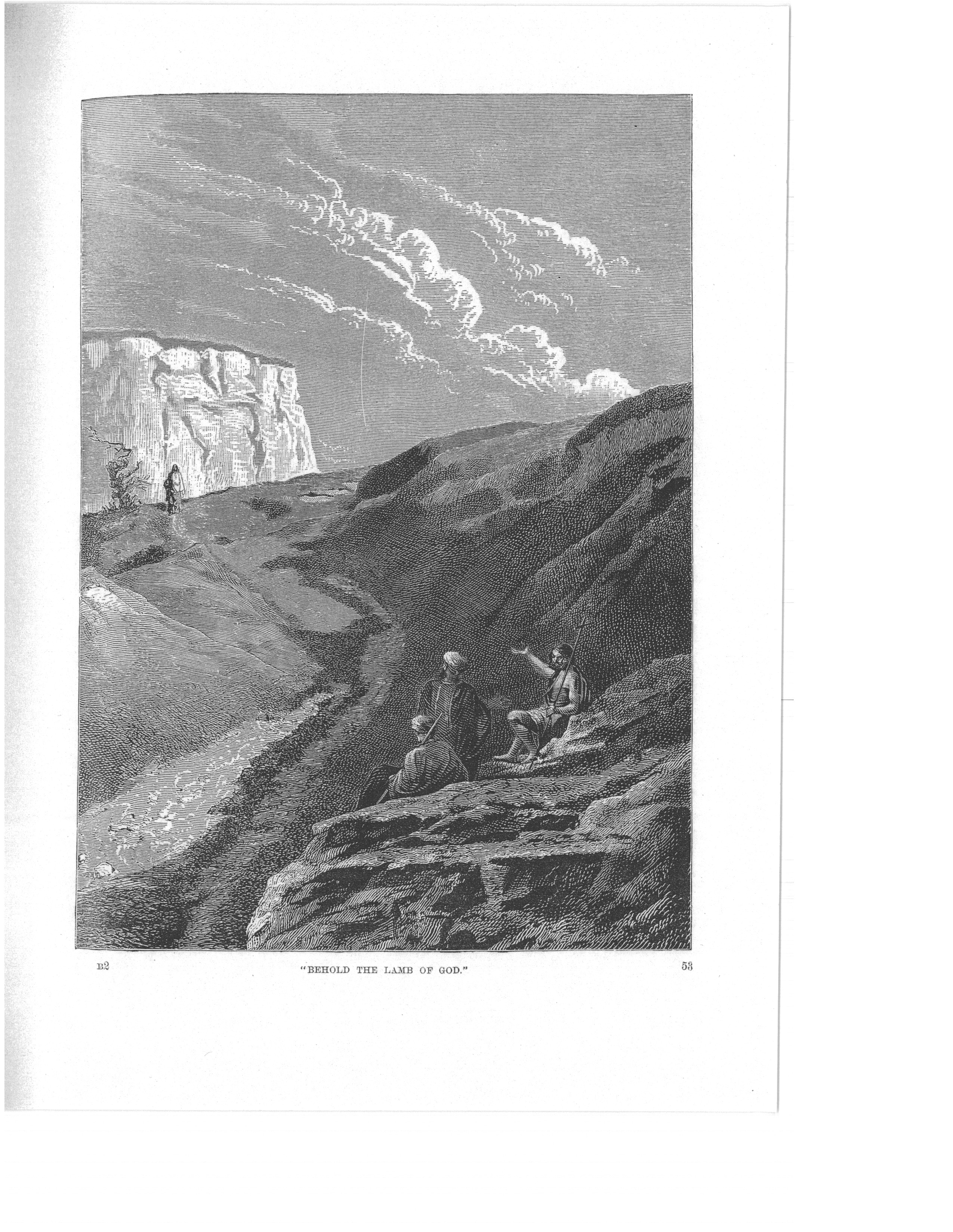
"Behold the Lamb of God" by Alexandre Bida
John: "Behold the Lamb of God."  by A. Bida
TODAY'S SPECIAL: Luke 16:1-18

TO CHEW ON: "'The law and the prophets were until John. Since that time the kingdom of God has been preached, and everyone is pressing into it.'" Luke 16:16

From time to time I've heard preachers admonish us to "press in" to God, the things of God etc. I've wondered what exactly they meant and thought it was a preacher-invented expression. But no—it comes from Jesus! He uses it here to talk about the advancement of the kingdom of God: "'Since that time (the time of John) the kingdom of God has been preached, and everyone is pressing into it.'"

[The expression "pressing into it' is a transliteration of biazo. It means to use, force, to apply force, to inflict violence on. The word biazo is used one other place in the NT, in Matthew 11:12: "'From the days of John the Baptist until now the kingdom of heaven suffers violence, and the violent take it by force.'"]

Other translations render the NKJV'S Luke 16:16 "…pressing into it" as "…forcing his way into it" (NAS), "… everyone tries forcefully to get into it" (AMP), "… eager multitudes are pressing in" (TLB), "… everyone is forcing their way into it" (NIV).

How does one press in to advance the kingdom of God? A sidebar article by Jack Hayford in my Bible is helpful. Below I quote and paraphrase his thoughts:

"Jesus declares the advance of the kingdom of God is the result of two things: preaching and pressing in."

Those who hear the preaching must respond or they will grow passive. That kingdom is advanced by words of truth and acts of love, but: "… apart from 1] an impassioned pursuit of prayer, 2] confrontation with the demonic, 3] expectation of the miraculous, and 4] a burning heart for evangelism, the kingdom of God makes little penetration in the world."

We must not go overboard in politicizing the kingdom and trying to advance it forcefully through "Earth-level rule" methods as they did during the Crusades. Rather: "Pressing in is accomplished first in prayer warfare, coupled with a will to surrender one's life and self interests, in order to gain God's kingdom goals" - Jack Hayford, "Pressing In," New Spirit-Filled Life Bible, p. 1420.

It sounds a lot like sold-out discipleship to me

PRAYER:
Dear Father, please create within me the desire, will, and energy to press in to You and the bringing about of Your kingdom. Amen.

 *********
Unless otherwise noted all Scripture quotations are taken from the New King James Version®. Copyright © 1982 by Thomas Nelson, Inc. Used by permission. All rights reserved.


Tuesday, July 12, 2016

The work of God

TODAY'S SPECIAL: Colossians 1:15-29

TO CHEW ON: "Him (Christ) we preach, warning every man and teaching every man in all wisdom that we may present every man perfect in Christ Jesus. To this end I also labor, striving according to His working which works in me mightily." Colossians 1:28-29

When the goal is in mind and the focus is clear we may surprise even ourselves with how single-purposed we can be. Hours spent designing those house plans, writing that book, preparing for that talk just melt away as we strive toward the goal we see so clearly.

Yesterday we looked at the part of Colossians 1 where Paul prayed that the Christians in Colosse would know God's will. That's like conceptualizing the goal. Today we can see what can happen when that knowledge is energized not only by our own desire to see it happen, but by the very working of God in us.

Paul's goal is to get the news, that eternal life is available through Jesus, out to "every man." But he doesn't do this in his own strength. He is energized by "His (Jesus') working which works in me mightily" (vs. 29).

This Christ-in-me working accomplishes more than just energizing the spread of the gospel. It has the potential to impact all of life as Jack Hayford explains in a sidebar article in my Bible:

"'In Christ' is the expression Paul most frequently uses to designate the new life potential through the gospel. The Messiah (Christ) being King, the term clearly places the believer in the circle of all that is represented and contained in the King, His salvation conquest, and His personal rule.


The essential truth is that the Savior-King has come, and in Him the rule of God has altered the limits sin has heretofore placed on individuals. People no longer need be ruled by their carnality (flesh) or controlled by evil (the Devil)" - Jack Hayford, "Terminology of the Kingdom," New Spirit Filled Life Bible, p. 1673 (emphasis added).

May we all cooperate with "His working which works in me mightily" to flesh  this out into purposeful, victorious living.

PRAYER: Dear God, please give me a fresh picture of Your will for me, my neighbours and my world. Help me to find my place in accomplishing it as You work in me (mightily too, please). Amen.

MORE: Different roles
I'd be the first to admit I'm no evangelist. That's probably why Paul's passion for spreading the Gospel makes me feel guilty. However, I can get excited about other jobs that are part of kingdom work - like being a "waterer." I take inspiration from passages like 1 Corinthians 3:5-9:

Who then is Paul, and who is Apollos, but ministers through whom you believed, as the Lord gave to each one? I planted, Apollos watered, but God gave the increase. So then neither he who plants is anything, nor he who waters, but God who gives the increase. Now he who plants and he who waters are one, and each one will receive his own reward according to his own labor.  For we are God’s fellow workers…"

What do you consider your role in God's work?

*********

Unless otherwise noted all Scripture quotations are taken from the New King James Version®. Copyright © 1982 by Thomas Nelson, Inc. Used by permission. All rights reserved.

Thursday, July 07, 2016

Personal prophecies


"Agabus' prophecy concerning Paul"
Image courtesy Bizzell Bible Collection, University of Oklahoma Libraries

TODAY'S SPECIAL: Acts 21:17-40

TO CHEW ON: "When he had come to us, he took Paul's belt, bound his own hands and feet, and said, 'Thus says the Holy Spirit, "So shall the Jews at Jerusalem bind the man who owns this belt and deliver him into the hands of the Gentiles."' Acts 21:11


"Then the commander came near and took him, and commanded him to be bound with two chains; and he asked who he was and what he had done." Acts 21:33

The brutal beating and arrest that Paul experienced in our reading today were part of a bigger story. A little context:

- Just before this Jerusalem beating, Paul had concluded his third missionary journey (Acts 18:23-21:14).

- At the last several stops, he had been warned not to go to Jerusalem. In Tyre " … disciples … told Paul through the Spirit not to go up to Jerusalem" - Acts 21:4. Then at Caesarea Agabus " … took Paul's belt etc..." (verse quoted above) - Acts 21:11.

But Paul went anyway. Was it a mistake on his part? What about the personal prophecies we see delivered here—were they a legitimate word from the Lord? Should we be seeing such personal prophecy ministries in our churches.

Such ministry does happen in Pentecostal and charismatic churches, but it can be abused. Jack Hayford addresses the issue of personal prophecy in a sidebar article of the New Spirit-Filled Life Bible. He lists five safeguards against personal prophecy abuses:

1. The "word" will usually not be new to the mind of the person addressed. (This was true in Paul's case - Acts 20:22-24; 21:4.)
2. The character of the person bringing the "word" ought to be weighed. (Agabus had a reputation as a prophet - Acts 11:28; 21:10.)

3. Remember that the prophecy or "word" is not to be considered controlling. In other words, such prophecies should never be perceived as dominating anyone's free will.

4. All prophecy is "in part" (1 Corinthians 13:9) which means as true as the "part" may be it does not give the whole picture. (Paul's arrest led to a trip to Rome and an opportunity to share his testimony there.)
5. In the light of a "word" we should prayerfully consider that word as Mary did the shepherds' report (Luke 2:19). 
(All green-shaded areas are quotes from "The Issue of Personal Prophecy" by Jack Hayford, New Spirit-Filled Life Bible, p. 1531.

Paul was certainly not taken by surprise when he was mobbed, beaten, and bound. Instead he not only kept his wits about him but, as we will see tomorrow, used his infamy as a platform for his testimony.

PRAYER:
Dear Father, help me to be in tune with You and Your Spirit, regardless of the way how You choose to speak to me. Amen.

 *********
Unless otherwise noted all Scripture quotations are taken from the New King James Version®. Copyright © 1982 by Thomas Nelson, Inc. Used by permission. All rights reserved.


Thursday, June 30, 2016

Muscle and snew

TODAY'S SPECIAL: Acts 14:21-15:2

TO CHEW ON: "And when they had preached the gospel to that city and made many disciples, they returned to Lystra, Iconium, and Antioch, strengthening the souls of the disciples, exhorting them to continue in the faith, and saying, 'We must through many tribulations enter the kingdom of God.'" Acts 14:21,22

At the beginning of our reading today, Paul was in Derbe. It was practically the only city on this whole trip from which he wasn't run out of town.

But, spiritual father and pastor that he was, nothing could keep him away from his spiritual babies. When retracing his steps back to Antioch (his sending church - Acts 13:1,2) he went through Lystra (where he had been stoned and left for dead - Acts 14:19,20), Iconium (where he had been the object of abuse and near stoning - Acts 14:5,6), and Antioch in Pisidia (where the city leadership had expelled him - Acts 13:50). Would we have been so bold and brave?

On visiting the fledgling congregations he had 'hatched,' he built them up with a blend of realism and optimism. I love how Eugene Peterson puts it in The Message:
"After proclaiming the Message in Derbe and establishing a strong core of disciples, they retraced their steps to Lystra, then Iconium, and then Antioch, putting muscle and sinew in the lives of the disciples, urging them to stick with what they had begun to believe and not quit, making it clear to them that it wouldn’t be easy: 'Anyone signing up for the kingdom of God has to go through plenty of hard times'" - Acts 14:21,22 MSG  (emphasis added).

Jack Hayford interprets this combination of suffering and victory for our time:
"Triumph and victory may characterized the attitude of each citizen of the kingdom of God, and Holy Spirit-empowered authority is given to be applied to realize results. Yet God did not promise life without struggle.

"[…]The Bible teaches that suffering, trial, and all order of human difficulty are unavoidable; but God's Word also teaches that they may all be overcome. The presence of the King and the power of His kingdom in our lives make us neither invulnerable nor immune to life's struggles. But they do bring the promise of victory: provision in need, strength for the day, and healing, comfort, and saving help" - Jack Hayford, "Suffering, Tribulation," New Spirit-Filled Bible, p. 1518 (emphasis added).

PRAYER: Dear Father, thank You for Paul's example in suffering and tribulation. When problems come my way, help me to shun self pity, instead view them as a means to grow my faith and character. Amen.

 *********
Unless otherwise noted all Scripture quotations are taken from the New King James Version®. Copyright © 1982 by Thomas Nelson, Inc. Used by permission. All rights reserved.

Scripture quotations marked MSG are taken from The Message. Copyright © 1993, 1994, 1995, 1996, 2000, 2001, 2002. Used by permission of NavPress Publishing Group.


Friday, September 18, 2015

Getting a friend-of-God mindset


TODAY'S SPECIAL: James 3:13-4:10

TO CHEW ON: "Adulterers and adulteresses! Do you now know that friendship of the world is enmity with God? Whoever therefore wants to be a friend of the world makes himself an enemy of God." James 4:4


These are stern words for us who, as Christians, may already feel sidelined and snubbed by our culture. But, according to James, this is how it's meant to be.

A sidebar article in my Bible comments on the "world" and what our relationship with it should be:

"The spirit of the world (Greek: aion) is one of the perennial enemies of the believer. "World" refers to the world system—to its values, mind-set, philosophies of life, and priorities that run contrary to the will and way of God. … Romans 12:2 provides a strategy to combat the pull of the world through the renewal or 'reprogramming' of our minds. The Holy Spirit's power can transform our minds (Philippians 2:5,13; Titus 3:5) and redirect us toward the things of God (Philippians 4:8)" - Kenneth C. Ulmer, "Growth Inhibitor," New Spirit-Filled Life Bible, p. 1756 (emphasis added).

Romans 12:2 says;
"And do not be conformed to this world but be transformed by the renewing of your mind that you may prove what is that good and acceptable and perfect will of God."

Jack Hayford's sidebar article "Renewal of the mind" fleshes out the concept:

"To 'renew' is 'to renovate' implying restoration to freshness or to an original state. … Being 'transformed' by the renewal of the mind indicates a literal 'change in the form or formulas of thought or being.' This describes redemption's provision of power to instil godliness in us—a power that transforms
1) our thoughts, which lead to formulating
2) our purposes, which proceed to dictate our actions; and thus
3) our actions become character-determining habits, shaping the life and setting the course for the future" - Jack Hayford, "Renewal of the Mind," New Spirit-Filled life Bible, p. 1569 (emphasis added; formatting changed a bit from the original).

Nurturing a friendship with God or the world starts out as such a small, private matter. Our thoughts are invisible and silent to all but ourselves and God. However these thoughts—these inhabitants of our minds—eventually set the course of our lives.

I ask myself, am I allowing God access to my thoughts, through His word, godly speakers, uplifting music? Or have I invited enemy-of-God stuff into my mind through what I look at, read, listen to? Do I understand the gravity of this and how it can jeopardize my friendship with Him and the renovating work He wants to do in my mind and thus my life?

PRAYER: Dear God, please help me to understand how crucial my mind and thoughts are to my friendship with You and the direction of my life. Amen. 


***********

New King James Version (NKJV) Used with permission. The Holy Bible, New King James Version Copyright © 1982 by Thomas Nelson, Inc.

Bible Drive-Thru


Saturday, August 22, 2015

What's the devil doing in heavenly places?


TODAY'S SPECIAL: Ephesians 6:10-24

TO CHEW ON: "For we do not wrestle against flesh and blood, but against principalities, against powers, against the rulers of the darkness of this age, against spiritual hosts of wickedness in the heavenly places." Ephesians 6:12

"Heavenly places"—the phrase brings to mind heaven, paradise, a place beyond the petty conflicts of earth. But according to Paul, conflict abounds there too—conflict of the most intense variety.

Paul talks about "heavenly places" several times in Ephesians (as pointed out by Jack Hayford,  the writer of my Bible's notes on Ephesians):

  • The spiritual blessings available to the church through Christ are located in heavenly places - Ephesians 1:3.
  • Christ's post-resurrection power and authority issues from heavenly places - Ephesians 1:19-22.
  • After we have accepted God's good news and have come alive in Christ, we are spiritually seated with Christ in heavenly places - Ephesians 2:4-6.
  • The church's destiny is to make known the will of God to the principalities and power in heavenly places - Ephesians 3:10.

Hayford concludes: "On these grounds this passage announces the church's corporate assignment to prayer warfare in order that evil can be driven back and the will of God advanced" - notes on Ephesians, New Spirit-Filled Life Bible, p. 1654.

I like that: prayer warfare. But what exactly does it mean?

Daniel Henderson in his book Transforming Prayer dispels some of the mystique around prayer that does spiritual warfare:

"Many who write about spiritual warfare seem to think that we must be astute in a variety of extra-biblical tactics and special insights about the names and addresses of demons. Some people promote grandiose sketches of the evil hierarchy and fascinating geographical exposes of their organizational battle plan....

I may be naive compared to the warfare experts but I have discovered that a life of passionate worship—one that delights in biblical truth about God's character, seeks the empowerment of the Spirit for application and articulation, then surrenders in every way as prompted by this intimate encounter, is equipped to 'fight the good fight' every day. Jesus, on the heels of forty days of prayer and fasting, wielded the truth of God's Word in facing down the devil in the wilderness (Matthew 4:4-11). We, too, are equipped by His sufficiency to brandish the 'sword of the Spirit,' which is the spoken word of God - Ephesians 6:17" - Daniel Henderson, Transforming Prayer, pp. 143, 144 (emphasis added).

PRAYER: Dear God, thank you that You have won the battle over evil. Help me to face the onslaughts of the devil and his demonic cohorts with the truth of Your word in my mind, and praise and worship for that victory on my tongue. Amen.

MORE: Prayer: a wartime walkie-talkie

"The number one reason why prayer malfunctions in the hands of believers is that they try to turn a wartime walkie-talkie into a domestic intercom. Until you believe that life is war, you cannot know what prayer is for. Prayer is for the accomplishment of a wartime mission" - John Piper, (quoted in Transforming Prayer, p. 143) from the sermon "Prayer: the Work of Missions."

********

Unless otherwise noted all Scripture quotations are taken from the New King James Version®. Copyright © 1982 by Thomas Nelson, Inc. Used by permission. All rights reserved.


Bible Drive-Thru


Saturday, April 26, 2014

Equipped to work

TODAY'S SPECIAL: Ephesians 4:1-16

TO CHEW ON: "And He Himself gave some to be apostles, some prophets, some evangelists, and some pastors and teachers for the equipping of the saints for the work of ministry, for the edifying of the body of Christ." Ephesians 4:11-12

What is your perception of your pastor's purpose? Do you see him as someone whose job it is to entertain, educate and challenge you in his Sunday sermons, to encourage you, to visit you when you're sick and generally cater to you? Or in your mind, does his job description also include getting you ready to do some of those things for others?

Paul talks about the role of leadership in this passage in terms of equipping. Jack Hayford in his notes on Ephesians, comments: "Equipping implies: 1) a recovered wholeness as when a broken limb is set and mended; 2) a discovered function as when a physical member is properly operating" - New Spirit-Filled Life Bible p. 1650.

Paul's language here is quite clear about the role of church leaders. While one of their jobs is to care for us as in help us recover wholeness, another is to help us to discover our ministry role and equip us to care for others.

What others?

I would suggest all those whose lives touch ours in some way. This would include people we live with (family), the people we live beside, the people we interact with not only face-to-face but virtually through Facebook, and email. Even the writing I'm doing here is the fruit of my pastor's equipping in my life.

I see a couple of implications for everyday living:

1. If we're leaders (one of those apostles,* prophets, evangelists or teachers) one of our goals should be to equip our 'disciples' to do ministry.

2. As disciples / parishioners / church members, we need to realize that our pastor's role is not all about us—how entertaining he is as a speaker, how often he visits us when we're sick, how wise he is as a counselor, etc. Rather, it is to prepare us to take on some of those ministry responsibilities as we share the burden for the well-being of the body of Christ.

PRAYER: Dear God, help me to be a giver, not just a taker when it comes to responsibility in the body of Christ. And help my pastor and other church leaders as they work in their many roles. Amen.

MORE: Spiritual leadership

Bob Hamp, in a guest post on Michael Hyatt's blog says, "Not all leaders in religious organizations are spiritual leaders. This is not a criticism as much as a distinction. Distinguishing spiritual leadership from other forms of leadership can free people from unrealistic expectations of some leaders.

At the same time, making this distinction can help identify who the spiritual leaders in your organization are..." 

Hamp's observation alerts us to the possibility that we, as laypeople, can be spiritual leaders. His article goes on to give six characteristics of spiritual leaders:

1. They lead others into their own encounters with God.
2. They lead others to discover their own purpose and identity.
3. They lead others into transformation—not just production.
4. They impact their atmosphere.
5. They help people see old things in new ways.
6. They gain a following because of who they are—not because of a position they hold.

Read all of "6 Characteristics of Spiritual Leaders."

**************
* Apostles: Are there still apostles today? Many insist that office ended in the New Testament era. Jack Hayford, in his notes on Ephesians says:
"Beyond the distinct role filled by the original founding apostles, the NT mentions enough additional apostles to indicate that this office, with that of prophets, is as continuing a ministry in the church as the more commonly acknowledged offices of evangelist, pastors and teachers" New Spirit-Filled Life Bible, p. 1650.

**********
Unless otherwise noted all Scripture quotations are taken from the New King James Version®. Copyright © 1982 by Thomas Nelson, Inc. Used by permission. All rights reserved.

Bookmark and Share

Thursday, February 13, 2014

Signs of spiritual malnutrition

TODAY'S SPECIAL: 1 Corinthians 3:1-9

TO CHEW ON: "For you are still carnal. For where there are envy, strife and divisions among you, are you not carnal and behaving like mere men?" 1 Corinthians 3:3

A few days ago we talked about the way Paul divides people into three categories: natural (1 Corinthians 2:14), spiritual (1 Corinthians 2:15-16) and carnal (1 Corinthians 3:1-4). Today we're going to take a closer look at what it means to be carnal.  A footnote in my Bible defines it:


"The carnal man, regenerate but living much like an unregenerate is a believer with childish ways, as seen in a jealous and sectarian spirit. An immature Christian lives more for human opinion than for Christ" - Donald Pickerill,  New Spirit-Filled Life Bible, p. 1582 (emphasis added).
Paul points out attitudes of envy, quarreling and division in his readers as signs of their carnal bent. Other scriptures that talk about the carnal / earthly / natural / governed-by-human-nature outlook describe it as:
  • Living without regard to its mortality (Psalm 49:11).
  • Anti-God, refusing to be governed by His laws and principles (Romans 8:7).
  • Living dependent on human intelligence and insight alone (Ephesians 4:17). 
  •  Alienated from God because if its own wicked deeds and actions (Colossians 1:21).
  • Proud of its humanly imagined belief systems (Colossians 2:18).
  • In a tug-of-war with the Holy Spirit (Galatians 5:17).
  • Controlled by lust (Ephesians 2:3).
  • Controlled by physical appetites (Philippians 3:19).
  • Opportunistic, looking at godliness as a means of making money (1 Timothy 6:5).

Some of the above are references to out-and-out non-believers. But the disturbing thing is that in some cases the people Paul is talking to are supposedly Christ-followers—part of the church family. How did they get to such a state?

Malnutrition (1 Corinthians 3:2). They are stunted babies, not growing because they won't eat anything but the mildest of spiritual milk. They can't handle hearty spiritual food.

And let's not let ourselves get smug in thinking that we are immune from carnality in all its manifestations. A sidebar article in my Bible sums it up so well:

"The demanding truth of this passage is that no amount of supposed spiritual insight or experience reflects genuine spiritual growth if it is separated from our basic growth in the knowledge of God's Word in the Bible. Without this rootedness in the Word, we may be deluded about our growth. Such "rootedness" is in truth and love, not merely in learning knowledge or accomplished study. In order to experience true spiritual growth, we must spend time in the Word and separate ourselves from the hindrances of lovelessness and competitiveness and strife" - Jack W. Hayford, New Spirit-Filled Life Bible, p. 1583.

PRAYER: Dear God, help me to read and apply Your truths to my life. Help me to deal with sin where You by Your Word and Spirit convict me. I want my "spiritual man" to win over my "carnal man" tendencies. Amen.


MORE: A difference of degree
"The difference between the spiritual Christian and the carnal Christian is one of degree. Becoming spiritual (= mature) is a gradual process in which the enthroned Christ subdues more and more of our remaining corruption, and we become more and more in tune with his Spirit. The fruit of the Holy Spirit pervades more and more of our lives, and the old sins lose more and more of their hold. This comes to pass as we trust Christ more and more fully as the all-satisfying friend and guide of our daily lives" - from  "Rethinking the Carnal Christian"  By John Piper. 

© Desiring God. 

Website: desiringGod.org

************
Unless otherwise noted all Scripture quotations are taken from the New King James Version®. Copyright © 1982 by Thomas Nelson, Inc. Used by permission. All rights reserved.

Bookmark and Share

Wednesday, August 07, 2013

Meanwhile the battle rages on

Knight prepared for Christian battle
TODAY'S SPECIAL: Daniel 7:15-28

TO CHEW ON:
"He shall speak pompous words against the Most High,
Shall persecute the saints of the Most High,
And shall intend to change times and law.
Then the saints shall be given into his hand
For a time and times and half a time." Daniel 7:25


Recently a local talk show host, responding to someone's suggestion that all references to God be removed from "O Canada," invited listeners to call in and say whether they believed in God or not.

Though the results seemed to slightly favour those who believed (I didn't count), the opinions expressed showed the polarization of the two sides at war in our reading today. Some of the anti-God diatribes could well have been labeled "pompous words against the Most High."

No matter how much we would like to get along with everyone, beliefs about God's existence and what He is like will continue to divide us. Jack Hayford, in an explanation about Daniel 7, says that Daniel's prophecy and the warfare it describes "…spans the spiritual struggle covering the ages through Messiah's First and Second Coming."

The concluding words  of his commentary help us see where we fit in this 'fight to the finish':

"… an age-long struggle between 'the saints' and the power of evil in the world calls each believer to a commitment to steadfast battle, a mixture of victories with setbacks, and a consummate triumph anticipated at Christ's coming.

In the meantime we 'receive' the kingdom and pursue victories for our King, by His power making intermittent gains—all of which are based on 'the judgment' achieved through the Cross. See Revelation 12:10-11" - Jack Hayford, Old Testament, Possessing the Kingdom, New Spirit-Filled Life Bible, p. 1132 (emphasis added).


PRAYER: Dear Jesus, when people come against me with scorn and mocking for my belief in You, help me to remember the big picture,  to renew my faith in the victory of Your death and resurrection, and to keep pressing on with hope as I wait for Your "everlasting kingdom." Amen.

***********

The Holy Bible, New King James Version Copyright © 1982 by Thomas Nelson, Inc. - Used with permission.
Bible Drive-Thru


Bookmark and Share


Sunday, July 28, 2013

Expand the Lord's Prayer for your situation

Jesus Prays for His Disciples - Alexandre Bida
"Jesus Prays for His Disciples" - Alexandre Bida
TODAY'S SPECIAL: Luke 11:1-23

TO CHEW ON: "So He said to them, 'When you pray say: Our Father in heaven, Hallowed be Your name. Your kingdom come. Your will be done on earth as it is in heaven.'" - Luke 11:2

"This prayer is not a formula for repetition so much as it is an outline for expansion," says Jack Hayford in a sidebar article in my Bible.*

Let's separate Jesus' model prayer into its different sorts of praying and look at how we might expand what He said:

Worship
"Our Father in heaven,
Hallowed be Your name…"


To expand our worship we could:
- Praise God for who He is as portrayed by the various names He is called in the Bible.
- Recite or read praise passages and psalms back to Him.
- Sing praise songs that draw our attention to His excellence.
- Recall specific things God has done for us, then praise and thank Him for them.

Intercession
"Your kingdom come.
Your will be done
On earth as it is in heaven."


Hayford explains, "Jesus' words 'Your kingdom come' are more than a suggestion to pray for a distant millennial day …. The verb, mood, and tense of 'Your kingdom come' essentially says, 'Father, let your kingdom come here and now!'"*

It shouldn't be hard for us to expand on this. All we need ask ourselves is:
- Where, to whom, in what situations are we burdened to see the kingdom of God come? People with illness, troubled relationships, money and job problems, away from the Lord, overcome by trauma of any kind will come to mind. Regions and whole countries caught in the throes of unrest and war also need our intercession.

Petition
"Give us this day our daily bread…"

Most of us, in North America at least, probably have all the bread we need and more. But this part of Jesus' prayer is an invitation to bring to Him the specifics of what we do need, whether it's physical or mental, ministry-related or personal. Do we need help in finding a new car to replace our old jalopy?  Wisdom to know how to deal with a rebellious child? Help in finding volunteers for the church nursery? Whatever it is, we can bring these specifics to God in petition.

Repentance
"And forgive us our sins
For we also forgive everyone who is indebted to us."


That was easy! Not so quick. Asking for forgiveness also needs to be in specifics. As we search our consciences before God, He can bring to mind sins of commission (bad things we've done) and omission (things we should have done but didn't). By naming and confessing them, we not only empty our hearts of guilt and shame, but alert ourselves the wrongness of our actions and in this way set a guard against committing them again.

Hayford again:

"…the praying is ours to do: unless we ask for the intervention of His kingdom and obey His prayer lessons, nothing will change. All kingdom ministry begins with and is sustained by, and will triumph through prayer."*

PRAYER: Dear Jesus, help me to not only learn how to pray but to spend more time in sincere, effective, kingdom-invoking prayer as it relates to my life. Amen.

*All Hayford quotes taken from the article "Prayer and Intercession," New Spirit-Filled Life Bible, p. 1409.
***********

The Holy Bible, New King James Version Copyright © 1982 by Thomas Nelson, Inc. - Used with permission.
Bible Drive-Thru


Bookmark and Share


Wednesday, April 18, 2012

Is this the last hour?

TODAY'S SPECIAL: 1 John 2:18-29

TO CHEW ON: "Little Children, it is the last hour; and as you have heard that the Antichrist is coming, even now many antichrists have come, by which we know that it is the last hour." 1 John 2:18

John thought it was "the last hour." that was over 2000 years ago. He's sounding a lot like some of us who also believe we're living in the last days.

Jack Hayford, commenting on this passage says:

"In this text, John describes the times in which he wrote as 'the last hour,' evidencing that he, as vital Christians in every generation, both lived in immediate anticipation of Christ's Second Coming and saw his era as one in which the present evidence seemed to argue that his was possibly the concluding generation. This is not an unhealthy attitude. Christ Jesus desires that people expectantly anticipate His return (Matthew 25:1-13; 2 Timothy 4:8)" - Jack Hayford, "The Prophecies of Last Things," New Spirit-Filled Life Bible, p. 1785.

Though we don't know whether we're living in "the last hour," we do know a couple of things:

1. We are closer now than ever to Jesus' Second Coming.

2. Some of us will meet Him face to face sooner than we realize, for life is short.

Jacob's lifespan was 130 years (Genesis 47:9). The Psalm 90:10 life expectancy number of 70 to 80 years is closer to ours.

Our lives are described as:
  • a shadow - 1 Chronicles 29:15; Job 8:9.
  • passing as swiftly as a weaver's shuttle (Job 7:6), a runner (Job 9:25).
  • a fading flower - Job 14:2.
  • a handbreadth - Psalm 39:5
  • a sigh - Psalm 90:9
  • smoke - Psalm 102:3
  • a shepherd's tent - Isaiah 38:2
  • a vapor - James 4:14

It is interesting to speculate which events on the world's stage make up fulfilled prophecies, suggesting Jesus' Second Coming may be soon. But let's not get distracted from the fact of our own brief lifespan and imminent meeting with Him: "As for me .... I shall be fully satisfied when I awake to find myself beholding Your form and having sweet communion with You" - Psalm 17:15 (Amplified).


PRAYER: Dear Jesus, help me to live with the sober expectation of seeing You soon, when You return or at my death, whichever comes first. Amen.

MORE: Misgivings about pinpointing Second Coming events

In a 1974 article that responds to Hal Lindsays' book The Late Great Planet Earth (a book that sought to make a correlation with then-current events and Jesus' imminent return), John Piper lists four problems with trying to line up Jesus' promised return with specific current events.

1. The more detailed one attempts to map out the future, the more inferences one must make which are not explicit in the Scripture. Therefore, the tendency of the imagination to fill the gaps increases and the probability of erroneous calculation grows.

2. The stress on the present course of events attracts a great deal of attention from fascinated Christians .... The description of a particular sequence of current events as a manifestation of God’s faithfulness to his predictions creates an emotional and intellectual connection between the Christian’s faith and the events around him. The result, too often, is that the ups and downs of his life of faith are caused by the fluctuations of world affairs and his ability or inability to fit these into a complex eschatological pattern.

3. When a person thinks he knows exactly what role a nation is going to play in God’s battle plan ... then he tends to think less responsibly as a citizen who is to pray for all rulers (1 Timothy 2:2) and seek peace with all men (Romans 12:18). He loses interest in such things as trade agreements, arms talks, currency stability, world food problems, etc.

4. This is the most important: among those who calculate about the time and sequence of the coming events and who try to give detailed descriptions of how it will be, there is, I think, a fundamentally wrong focus, a dislocation of our “blessed hope.” Throughout the New Testament the all-important focus of our hope is personal fellowship with God and our Lord Jesus Christ (Revelation 21:3; 1 Peter 5:9; 1 Thessalonians 4:17; Philippians 1:23; John 14:3).

Read all of "Misgivings About Hal Lindsay's 'Planet Earth" - By John Piper. © Desiring God. Website: desiringGod.org

Bible Drive-Thru


Bookmark and Share

Sunday, December 11, 2011

Inspired communique

TODAY'S SPECIAL: 2 Timothy 3:10-17

TO CHEW ON: "All Scripture is given by inspiration of God and is profitable for doctrine, for reproof, for correction, for instruction in righteousness, that the man of God may be complete, thoroughly equipped for every good work." 2 Timothy 3:16-17

We toss around the word "inspired" almost as loosely as we do the word "love." We describe a variety of things as inspired from ways of preparing food to how we feel when we experience an aha moment. So we are not to be blamed when we ask, what does Paul mean, here, when he says, "All scripture is given by the inspiration of God"?

[Of the nine shades of meaning my dictionary gives for "inspire" three seem related to the kind of inspiration Paul is talking about: * to impart or suggest by divine intervention, *to breathe or blow upon, and * to breathe in or inhale.]

In a sidebar article about our focus verse, Jack Hayford explains the method and extent of divine inspiration:

1. It (the Word of God, the Bible) is the word of the Holy Spirit. "Theopneustos" (Greek, meaning inspiration of God) literally means "God breathed." This describes the source of the whole Bible's derivation...the Bible is not the product of elevated human consciousness or enlightened human intellect but is directly "breathed" from God Himself.
2. 2 Peter 1:20-21 elaborates this truth and adds that none of what was given was merely the private opinion of the writer and that each writer involved... was 'moved by' (literally "being borne along") the Holy Spirit ...
3. 1 Corinthians 2:10-13...says that even the words used in the giving of the Bible (not just the ideas but the precise terminology) were planned by the Holy Spirit, who deployed the respective authors of the Bible books to write "comparing spiritual things with spiritual" (literally "matching spiritual words to spiritual ideas"). This biblical view of the Bible's derivation is called the plenary verbal inspiration of the Scriptures, meaning every word is inspired by the Holy Spirit of God." - Jack Hayford, "The Divine Inspiration of the Bible," New Spirit-Filled Life Bible, pp. 1714-15.

Have you not felt awe and amazement as you have seen evidence of this divine inspiration yourself? Take for example, how various Bible writers expound on similar ideas, using similar images in passages that were written centuries apart. They do it about:
  • Sheep - Psalm 23:1; Isaiah 53:6; John 10:11
  • Water - Isaiah 41:18; John 7:37; Revelation 7:17
  • Bread - Exodus 16:4; John 6:32-35; Matthew 26:26, and many others.

Let's view God's word as the miracle communique it is, and let it speak into our lives as doctrine, reproof and instruction, equipping us for "every good work."

PRAYER: Dear God, thank You for the Bible. Help me to apply its teachings and truths in my everyday life. Amen.

MORE: Only 14 more sleeps

Advent Calendar - December 11

Christmas Fact:

The earliest known Christmas tree ornaments were apples. Medieval actors used them to decorate the paradise tree, the central prop of the paradise play, a medieval European mystery play often performed on December 24th. The apples represented the temptation of Adam and Eve in the garden of Eden. Later, unconsecrated communion wafers were added to the tree, representing the salvation offered to humankind by Jesus Christ.

Encyclopedia of Christmas, p. 439


Directions to make homemade Christmas ornaments here.


Bible Drive-Thru


Bookmark and Share

Tuesday, May 03, 2011

That was close!

TODAY'S SPECIAL: Psalm 116:1-19

TO CHEW ON: "I love the Lord because He has heard my voice and my supplications." Psalm 116:1

Writings where the author expresses what we are feeling are pieces we read over and over. Psalm 116 is such a passage for anyone who has been through a life-threatening, near-death experience. Note the writer's varied reactions to the resolution of his too-close-for comfort event. To which can you relate?

1. Uninhibited love: "I love the Lord..." - Psalm 116:1
It's obvious the speaker was desperate when he cried out to God. Now he is full of love for the God who responded.

2. Resolve to pray more - Psalm 116:2
Because God answered his prayer, he is now determined to pray as long as he lives.


3. Fresh testimony - Psalm 116:3-6; 10-11
He can't help but relive the close call he had. "I was at death's door when I prayed," he tells us. "All I could do was utter a simple call out to God."


4. Time to get back to normal living - Psalm 116:7-8
"Soul, you can relax again," he says to his overwrought emotions.


5. New commitment to do God proud - Psalm 116:9
When he resolves, "I will walk before the Lord in the land of the living," it's as if he's saying, 'You won't be sorry you rescued me, God. I'll show you that I was worth it.'

6. New appreciation of salvation - Psalm 116:12-13
I see the writer here, holding up his cup that is full of salvation wine, giving a toast to God.

7. Determined to keep sickbed promises - Psalm 116: 14, 18-19
He obviously did a little bargaining with God, a little vowing and promising when he was down. Now he reminds himself of these promises and determines to keep them.


8. New insights into death - Psalm 116:15
It's as if the writer has looked death in the face and realized it wasn't all terror. For death would usher him into the presence of God, and God's celebration of their being face to face.


9. Renewed commitment to serve God - Psalm 116:16
"I am Your servant," he says, and repeats it, as if determined that his servant role will define him from now on.


10. An overflow of thanksgiving - Psalm 116:17
What else but thanksgiving could flow from an experience like that?

Don't these responses ring true — the overwhelming love we feel for God after He answers a desperate prayer, the urge to tell everyone what has just happened, the remembrance of promises made to God when in the thick of trouble, new insights into death, a strengthened resolve to serve God and be thankful for extraordinary and ordinary blessings...

If you're in a desperate place right now, let Psalm 116 be the light at the end of your tunnel. You might even want to pray its words and promises over your situation in faith. If you've come through such a time, let this psalm express your love, renewed loyalty and gratitude to God.


PRAYER: I love You Lord, because You hear my prayer. I will walk before You now, in the land of the living. I will keep my promises to You and be full of thanksgiving. Amen.


MORE: Prayer and Hope

"After you've worshiped and petitioned to the best of your Holy-Spirit-energized ability, rest it all with Him. The answers may not come in the size packages you suppose, or be delivered at the moment you have in mind. But trust in Him. All power and glory are His. And in freely and praisefully speaking that, you open the door to His invitation that you share it with Him...in His way, at His time." Jack Hayford quoted in Prayer Powerpoints, p.223 (taken from Prayer is Invading the Impossible p. 107).


Bible Drive-Thru


Bookmark and Share

Related Posts Plugin for WordPress, Blogger...