Showing posts with label moral relativism. Show all posts

Friday, April 27, 2018

Truth—is there such a thing?

Image: Pixabay

TODAY’S SPECIAL: Isaiah 36-38; Psalm 117

TO CHEW ON:
“For His merciful kindness is great toward us,
And the truth of the LORD endures forever.” Psalm 117:2


Our reading today contains the shortest chapter in the Bible (Psalm 117). But its subject is neither small nor transitory but vast and eternal: “The truth of the LORD endures forever.” 


The Hebrew word for “truth” is  - emeth: sureness, reliability, stability, continuance, faithfulness. It includes truth as spoken; of testimony and judgment; of divine instruction; truth as a body of ethical or religious knowledge; true doctrine.

The English dictionary’s first three definitions of truth are: 1] The true or actual state of a matter; 2] Conformity with fact or reality; 3] A verified or indisputable fact, proposition, principle or the like.


This sounds cut-and-dried. However, truth has come to have a muddied meaning in our culture. We talk about “your truth” and “my truth.” If something seems true to you, it’s your truth, and has as much validity as my truth. Many scorn the possibility of, especially, objective moral truth—something that’s true despite human opinion. (The article “Objective truth is one thing but objective moral truth is another” by J. Warner Wallace discusses this subject.)

The Bible's use of truth, however, would lead us to believe that it exists independent of human opinion and acceptance. Here are some of the facets of truth found just in some Psalms that use the same Hebrew word for truth that's used in our passage.

Truth is:


  • Found in God - Psalm 86:15.
  • Intrinsic in all of God’s initiatives: the “works of His hands” (Psalm 111:7,8; Psalm 57:10; 85:10,11; 108:4) and his communication (“precepts”) - Psalm 111:7-8.
  • Identified with God’s judgments, laws, commandments, and word - Psalm 19:9; 119:142, 151, 160.
  • Mankind’s salvation and preservation - Psalm 69:13; 40:10,11.
  • Inspiration to worship - Psalm 43:3.
  • The subject of human praise - Psalm 71:22; 115:1.In fact, truth evokes praise from  all people on earth - Psalm 117:1,2 (our today’s reading).
  • A quality God wants to find within us - Psalm 51:6
  • A path we can follow and walk in - Psalm 25:10; 26:3.
  • Something we can speak - Psalm 119:43
 Let's make our lives a search for and pursuit of God's truth!

PRAYER: Dear Father, help me to recognize and acknowledge Your truth, and make it the foundation of my life. Amen. 

PSALM TO PRAY: Psalm 117

 *********
Unless otherwise noted all Scripture quotations are taken from the New King James Version®. Copyright © 1982 by Thomas Nelson, Inc. Used by permission. All rights reserved.


Thursday, June 15, 2017

Morality—taught and caught

TODAY’S SPECIAL: Genesis 20:1-18

TO CHEW ON:
“And Abimelech called Abraham and said to him, ‘What have you done to us? How have I offended you, that you have brought on me and on my kingdom a great sin? You have done deeds to me that ought not to be done.’” Genesis 20:9

What horrible thing had Abraham done to the Philistine King Abimelech?

Lied about the state of Sarah, who was his wife and also his half-sister. He told this half-truth because of Sarah’s beauty and his fear that other men, powerful men, would want her and do away with him to get her for themselves.

He had done this previously as well, in Egypt (Genesis 12:10-20).

There’s a sequel to today’s story in Genesis 26:1-11. There we see Isaac doing the exact same thing as his dad—saying Rebekah was his sister when she was really his wife, again to save his own skin. In Isaac’s case it wasn’t even half true, but a total lie.

I am struck by the generational aspect of this. Did Isaac witness Abraham do it? Probably not because it happened before his time. Perhaps his dad told him the stories of these events, glossing over the evil of them? Or maybe Isaac picked up something in his father’s general moral code that was unspoken permission to act in this way—an attitude and other actions that sacrificed honesty on the altar of expediency?

Whatever it was, I think there’s a lesson for us in this. We don’t only teach morality (what’s right and wrong) to our kids, but they also catch our morality from us. They pick it up from our attitudes and the way we act.
 
PRAYER: Dear Father, please help me to live in such a way that I can say to others, don’t just do as I say but also as I do. Amen.

 *********
Unless otherwise noted all Scripture quotations are taken from the New King James Version®. Copyright © 1982 by Thomas Nelson, Inc. Used by permission. All rights reserved.

Thursday, April 16, 2015

Is sin just an opinion?

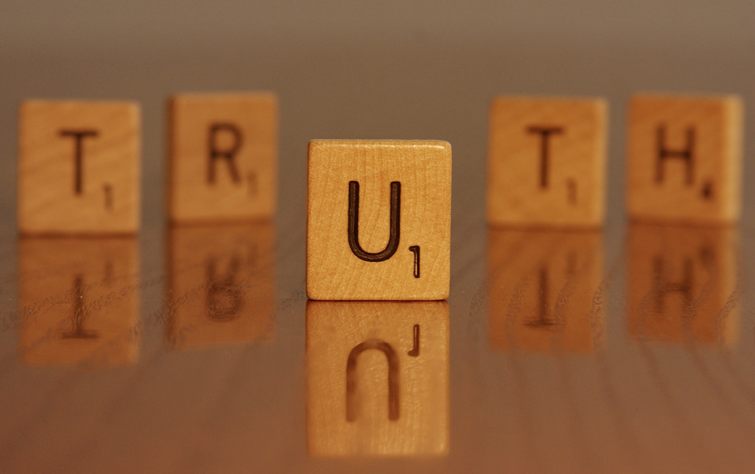
Truth spelled in Scrabble letters
TODAY'S SPECIAL: 1 John 3:1-10

TO CHEW ON: "Whoever commits sin also commits lawlessness, and sin is lawlessness." 1 John 3:4

More and more our society is losing its connection to moral absolutes. Justin P. McBrayer (a Colorado professor of philosophy) writes recently in the Opinionator column of the New York Times: "What would you say if you found out that our public schools were teaching children it is not true to say that it's wrong to kill people for fun or cheat on tests? Would you be surprised?"

He goes on to describe his visit to his son's Grade 2 classroom where two definitions hung over the bulletin board:

"Fact: Something that is true about a subject and can be tested or proven.
Opinion: What someone thinks, feels or believes."

These two definitions, he points out, leave no room for things that are true even if no once can prove them and things that we believe which can also be proven, like historical facts. He found assignments where kids were asked to categorize statements as facts or opinions. When sorting statements such as  "Copying homework assignments is wrong" and "Cursing in school is inappropriate behaviour" the correct answer was that they were opinions. His conclusion:

"In summary, our public schools teach students that all claims are either facts or opinions and that all value and moral claims fall into the latter camp. The punchline: there are no moral facts. And if there are no moral facts, then there are no moral truths" - reported by Dr. Albert Mohler in "The Briefing 03-20-15," original article:  "Why Our Children Don't Think There Are Moral Facts").

This, of course, is a far cry from what the Bible teaches. Today's reading from 1 John 3 repeats the word "sin" in various forms ten times. Sin, by its very definition, assumes that moral facts (truths) exist:

[Sin - hamartia: to miss the mark; to err, be mistaken; to wander from the law of Gd; violate God's law.]

What is sin, according to the Bible?
  • The verse we're focusing on defines sin as lawlessness or rebellion against God's law - 1 John 3:4.
  • Unrestrained talk and foolishness are both called sin - Proverbs 10:19; 24:9.
  • Contempt for others is sin - Proverbs 14:21.
  • Whatever is not done from faith is sin - Romans 14:23.
  • Failing to do something good when we have the ability/opportunity to do it is sin - James 4:17.
  • All unrighteousness is sin - 1 John 5:17.

Though governing our lives by these standards may put us increasingly out of step with a world that insists God's standards are mere opinions, I'd rather find myself in the company that John describes at the beginning of the chapter: "called children of God," "like Him," full of the "hope" of seeing Him. As a result I need to line up my life with His standards of purity (1 John 3:1-3) no matter what others think of them.

PRAYER: Dear God, help me grow in my sensitivity and abhorrence to the things You consider sin and to live for the day I see You. Amen.

 *********
Unless otherwise noted all Scripture quotations are taken from the New King James Version®. Copyright © 1982 by Thomas Nelson, Inc. Used by permission. All rights reserved.


Thursday, April 10, 2014

The right that doesn't change

TODAY'S SPECIAL: Isaiah 51:1-23

TO CHEW ON:
"Do not fear the reproach of men, nor be afraid of their insults. For the moth will eat them up like a garment, and the worm will eat them like wool. But My righteousness will be forever, and My salvation from generation to generation." Isaiah 51:7,8


I often listen to Ravi Zacharias's weekday radio broadcast Just Thinking. In the last while he has been talking about moral relativism. He explains how our society no longer acknowledges that there is a code of absolutes. Instead, what's considered right and wrong shifts with public opinion.

He tells of how prominent atheist Richard Dawkins illustrated this. A chef prepared human placenta using garlic, lime juice, shallots and other ingredients to make it into a gourmet pate. When served to a group of people (who didn't know what it was), all exclaimed how good it tasted.

Dawkins concluded, "Eating a placenta is eating a baby's clone. Science can't tell you whether it's right or wrong to do that but it can tell you that that's what you're doing. Then you decide for yourself whether it's right or wrong."

It brings up the question in us, 'Where does it end?' The answer implied here is, 'No where.'

 Zacharias, in his talk, shows the logical fallacy of such thinking when he says, "Would he (Dawkins) believe that, if I decided to carve up one of his children just because I liked it?"

Isaiah here tells us God's righteousness—and that includes the biblical laws that tell us what is right wrong—"will be forever."

In a culture where standards are always changing, upholding those laws may get us into ever more trouble with our fellow citizens. There may well be "reproach" and "insults," even lawsuits and jail.  But as Isaiah reminds us, the purveyors of such relativism are as vulnerable and short-lived as wool in the presence of hungry moths while God's standards "will not be abolished … will be forever … from generation to generation" - Isaiah 51:6,8.  

PRAYER: Dear God, please help me to take Your standards as my own and live by them despite the changing standards of the society around me. Amen.

MORE: Listen to the whole talk

You can listen to Ravi Zacharias's entire talk referred to above HERE.


 *********
Unless otherwise noted all Scripture quotations are taken from the New King James Version®. Copyright © 1982 by Thomas Nelson, Inc. Used by permission. All rights reserved.


Bookmark and Share


Related Posts Plugin for WordPress, Blogger...