Showing posts with label character. Show all posts

Wednesday, September 19, 2018

Do our lives reveal the works of God?

Image: Pixabay
TODAY’S SPECIAL: John 9-10; Psalm  107

TO CHEW ON:
“And His disciples asked Him, saying, ‘Rabbi, who sinned, this man or his parents, that he was born blind?’

Jesus answered, ‘Neither this man nor his parents sinned, but that the works of God should be revealed in Him.’” John 9:23


This little story raises a question. We ask, did God allow this man’s congenital blindness, which he suffered with for many years before Jesus healed him, just so Jesus’ power could be on display at this moment in time?

Jesus’ entry into his life at this moment and saying what He did implies to me that all of the man’s life—even the time he was blind, was part of God’s plan for him.

God didn’t create the world with flaws. These things entered when Adam and Eve chose disobedience and rebellion. However, the disciples believed that the man’s blindness was caused by specific sins he or his parents had committed. Jesus said “no” to that. The writer of my Bible’s study notes explains:

“Assuming that an individual case of suffering was due to specific sin, the disciples inquired into the cause of the man’s blindness. Jesus, however, notes that beyond the tragedy of human defects, which result in a general way from man’s fall and the consequent entry of sin, sickness, affliction, and death into the world, God’s merciful and sovereign grace is available” - Siegfried Schatzmann, New Spirit-Filled Life Bible, p. 1460.

What does this mean for us today? How do we square the fact that God does heal some, but not everyone who prays for healing gets healed? Is it that some don’t have enough faith? That they’re praying the wrong way? That there’s sin in the life?

For me the answer lies in Jesus explanation of why the man was born blind in the first place: '… that the works of God should be revealed.' In this man’s case it was a work of miraculous healing. But we also see the works of God displayed in lives lived under lifelong clouds of sickness, pain, debilitation—any one of the heavy consequences of the fall. To me the life of Joni Earickson Tada is an example of such a work of God on display in a many-year quadriplegic.

Here's Paul talking about a similar situation:
 "And lest I should be exalted above measure by the abundance of the revelations, a thorn in the flesh was given to me, a messenger of Satan to buffet me, lest I be exalted above measure. Concerning this thing I pleaded with the Lord three times that it might depart from me. And He said to me, “My grace is sufficient for you, for My strength is made perfect in weakness.” Therefore most gladly I will rather boast in my infirmities, that the power of Christ may rest upon me. 10 Therefore I take pleasure in infirmities, in reproaches, in needs, in persecutions, in distresses, for Christ’s sake. For when I am weak, then I am strong. - 2 Corinthians 12:7-10.


PRAYER: Dear Father, on this side of seeing You, it’s easy to be puzzled by our health (and other) problems. Help me to live by faith that You have a good reason for everything that You allow into my life. May Your presence within me reveal the works of God, whether works of healing or works of trust, faith, and rejoicing in and through pain, suffering, and sickness. Amen.

PSALM TO PRAY: Psalm 107

*********
Unless otherwise noted all Scripture quotations are taken from the New King James Version®. Copyright © 1982 by Thomas Nelson, Inc. Used by permission. All rights reserved.


Friday, August 31, 2018

Change your mind, change your mouth

Image: Pixabay
TODAY’S SPECIAL: Matthew 15-16; Psalm 88

TO CHEW ON:
‘But those things which proceed out of the mouth come from the heart and they defile a man. For out of the heart proceed evil thoughts, murders, adulteries, fornications, thefts, false witness, blasphemies’”  Matthew 15:18,19

Have you ever surprised yourself by what came out of your mind or mouth? You spill a jug of juice and it’s “Oh ____!” Someone cuts you off in traffic and, mentally at least, you flip them the bird. Or you find yourself harboring, toward public figures like politicians and journalists, all manner of critical thoughts, clever put-downs, even rants at the TV.

So, we recognize within ourselves the defilements which Jesus pointed out. Can we do anything more about them than pray for a supernatural heart transplant?  I think we can.

Paul’s advice to the Ephesians is full of action, suggesting that a change of heart on our part is a joint effort of God and us. That we even have the desire to change is God’s work. But there’s something we can do too. Here is the Ephesians passage from The Living Bible (relevant words in bold—my emphasis):
Stop lying to each other; tell the truth, for we are parts of each other and when we lie to each other we are hurting ourselves.  If you are angry, don’t sin by nursing your grudge. Don’t let the sun go down with you still angry—get over it quickly; for when you are angry, you give a mighty foothold to the devil. If anyone is stealing he must stop it and begin using those hands of his for honest work so he can give to others in need. Don’t use bad language. Say only what is good and helpful to those you are talking to, and what will give them a blessing” - Ephesians 5:25-29 TLB.

And one more bit of to-do from James 1:19:
Dear brothers, don’t ever forget that it is best to listen much, speak little, and not become angry” - James 1:19 TLB

As Joyce Meyer says in the introduction to her book Battlefield of the Mind:

“So many people’s problems are rooted in thinking patterns that actually produce the problems they experience in their lives. Satan offers wrong thinking to everyone, but we do not have to accept his offer. Learn what types of thinking are acceptable to the Holy Spirit and what types are not acceptable.

“Second Corinthians 10:4,5 clearly indicates that we must know the Word of God well enough to be able to compare what is in our mind with what is in the mind of God

“The mind is the battlefield. It is a vital necessity that we line up our thoughts with God’s thoughts. This is a process that will take time and study” - Joyce Meyer, Battlefield of the Mind p. 4 (emphasis mind).
PRAYER: Help me to be aware of faulty (according to Your word) thoughts and thought patterns within me and not just bemoan them, but act to change them. Amen. 

PSALM TO PRAY: Psalm 88

The Bible Project VIDEO: Matthew Part 2 - ch.14-28 (Read Scripture Series)


 *********
Unless otherwise noted all Scripture quotations are taken from the New King James Version®. Copyright © 1982 by Thomas Nelson, Inc. Used by permission. All rights reserved.

Scriptures marked The Living Bible (or TLB) copyright © 1971 by Tyndale House Foundation. Used by permission of Tyndale House Publishers Inc., Carol Stream, Illinois 60188. All rights reserved. The Living Bible, TLB, and the The Living Bible logo are registered trademarks of Tyndale House Publishers.


Sunday, April 01, 2018

Bit players in God's story

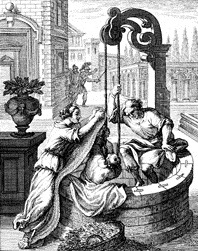
Jonathan and Ahimaaz - Johann Christoph Weigel
Jonathan and Ahimaaz - J.C. Weigel
He is risen; He is risen indeed. Happy Easter!

TODAY'S SPECIAL: 2 Samuel 16-18; Psalm 91

TO CHEW ON: "Now Jonathan and Ahimaaz stayed at En Rogel, for they dared not be seen coming into the city; so a female servant would come and tell them, and they would go and tell King David." 2 Samuel 17:17

David's plan was working! Absalom chose to follow Husahi's advice instead of Ahithophel's This bought David some time.

Hushai sent word of this to the priests' sons Jonathan and Ahimaaz (who had promised to be the snail-mail between Jerusalem and on-the-run David - 2 Samuel 15:27-28). However, even getting the word to Jonathan and Ahimaaz was now a two-step process as Absalom had eyes and ears everywhere. So Hushai gave the message for Jonathan and Ahimaaz to a "servant girl" to take to En Rogel where the runners were hiding.

A youngster saw them get the message, though and told Absalom. J. & A., realizing they'd been sighted, took refuge in a well in Bahurim, where the householder's wife covered their hiding place and spread ground grain on top of it. When Absalom's servants came to search they didn't find anyone. (Whew!)

Jonathan and Ahimaaz eventually got the message to David. He followed Hushai's advice, left the area and crossed over the Jordan to the wilderness.  There, before he even had time to worry about how he was going to take care of his army, three locals, Shobi, Machir, and Barzillai came laden with supplies because, "The people are hungry and weary and thirsty in the wilderness" - 2 Samuel 17:27-29.

Though it's customary for us to focus on the big-name players in the Bible's story—the Davids, Absaloms, Hushais, and Ahithophels—these narratives are also often full of bit players, some named, like Jonathan and Ahimaaz, but many unnamed as well, who are really as vital to bringing about the end result as the main players. In this story there are at least seven. Each one needed to play his or her part in order for God to accomplish His plan of preserving David's life.

Being a bit player is often our role. While we're not the big name speaker or the worship leader, when we do our part to make the phone calls, send the emails, set up the sound system, visit the sick, bring the food, open up our homes etc., things roll along smoothly. God's story plays out. Ours may seem like small, unimportant roles, but they are no less important than the role of the main characters to allow God's story to unfold in the way He has planned.

PRAYER: Dear God, help me to be willing to play whatever part You have for me in Your story. Amen. 

PSALM TO PRAY: Psalm 91

MORE: Easter Sunday
Carrying on with our theme of noticing insignificant characters, how many can you find in the story of Jesus' passion? Are we not among them—sinners for whom Christ's death paid our sins' penalty, and whose resurrection guarantees our life? 

 *********
Unless otherwise noted all Scripture quotations are taken from the New King James Version®. Copyright © 1982 by Thomas Nelson, Inc. Used by permission. All rights reserved.


Sunday, December 24, 2017

Joseph—God's yes-man

"Joseph and the Christ Child" - Murilla 1670-75
"Joseph and the Christ Child"  - Murillo (1670-75)
TODAY'S SPECIAL: Matthew 1:18-25

TO CHEW ON:
"Then Joseph, being roused from sleep, did as the angel of the Lord commanded him and took to him his wife." Matthew 1:24

Though the Bible doesn't mention Jesus' earthly father Joseph often, what it does say gives us some insights into the man God picked to be the most influential male in the human Jesus's life. We discover Joseph was:

1. A descendant of King David. - Luke 1:27.

2. Kind. Even though he must have been incredibly hurt and confused at the discovery of Mary's pregnancy, his impulse was to spare her public disgrace and worse by putting her away secretly - Matthew 1:19.

3. Promptly obedient. He took Mary as his wife and left for Egypt in the middle of the night after angelic visits - Matthew 1:24; 2:13-14.

4. Self-controlled. He refrained from having intimate relations with Mary, even after they were married, in respect for the sanctity of Mary's pregnancy - Matthew 1:25.

5. A compliant citizen, obedient to Caesar's decree to register in Bethlehem, even though it "happened" at a most inconvenient time  (for him, but not for God's larger plan) - Luke 2:4.

6. Faithful and devoted in his religious practice, having Jesus circumcised on the eighth day and going up to Jerusalem every year to celebrate Passover - Luke 2:22-24; 41.

7. Sensitive, along with Mary, to the spiritual immensity and mystery of Jesus' destiny - Luke 2:33.

8. Sensible. He used common sense (which was confirmed by another angelic dream) when deciding where to settle on the family's return from Egypt - Matthew 2:22.

9. Trusting. He must have trusted the adolescent Jesus because at Jesus' 12-year-old trip to Jerusalem, he and Mary didn't keep close tabs on His whereabouts - Luke 2:43-44.

10. A responsible father. He and Mary searched for three days for their 12-year-old - Luke 2:45-46.

11. Puzzled? I wonder how he felt when Jesus intimated that His real loyalty was to a different Father - Luke 2:49-50.

12. Ordinary. To Jesus' neighbors and friends, He was known as "Joseph's son." Their surprise at His "gracious words" in the light of His supposed lineage tells us that Joseph was probably a very ordinary, unexceptional person in most ways - Luke 4:22; John 1:45.

I love it that Jesus' earthly father was so humble and ordinary. It gives us hope that all us ordinary nobodies can also be part of God's plan and purpose as we put ourselves at His disposal and keep saying "yes" like Joseph did.


PRAYER: Dear God, thank You for the example of Joseph. I want my life to be remembered by my yes's to You. Amen.

MORE: Fourth Sunday of Advent

Today is the fourth Sunday of Advent. The liturgy for this day begins with this Collect:

Purify our conscience, Almighty God, by your daily visitation, that your Son Jesus Christ, at his coming, may find in us a mansion prepared for himself; who lives and reigns with you, in the unity of the Holy Spirit, one God, now and for ever. Amen.


Handel's Messiah lyrics

The lyrics of the contralto recitative "Behold A Virgin Shall Conceive" are taken from Matthew 1:23 (which is a quote from Isaiah 7:14).


In this Tafelmusik rendition, the recitative is followed by the solo "O Thou That Tellest Good Tidings to Zion."


*************

Unless otherwise noted all Scripture quotes are taken from the New King James Version (NKJV) Used with permission. The Holy Bible, New King James Version Copyright © 1982 by Thomas Nelson, Inc.

Thursday, June 15, 2017

Morality—taught and caught

TODAY’S SPECIAL: Genesis 20:1-18

TO CHEW ON:
“And Abimelech called Abraham and said to him, ‘What have you done to us? How have I offended you, that you have brought on me and on my kingdom a great sin? You have done deeds to me that ought not to be done.’” Genesis 20:9

What horrible thing had Abraham done to the Philistine King Abimelech?

Lied about the state of Sarah, who was his wife and also his half-sister. He told this half-truth because of Sarah’s beauty and his fear that other men, powerful men, would want her and do away with him to get her for themselves.

He had done this previously as well, in Egypt (Genesis 12:10-20).

There’s a sequel to today’s story in Genesis 26:1-11. There we see Isaac doing the exact same thing as his dad—saying Rebekah was his sister when she was really his wife, again to save his own skin. In Isaac’s case it wasn’t even half true, but a total lie.

I am struck by the generational aspect of this. Did Isaac witness Abraham do it? Probably not because it happened before his time. Perhaps his dad told him the stories of these events, glossing over the evil of them? Or maybe Isaac picked up something in his father’s general moral code that was unspoken permission to act in this way—an attitude and other actions that sacrificed honesty on the altar of expediency?

Whatever it was, I think there’s a lesson for us in this. We don’t only teach morality (what’s right and wrong) to our kids, but they also catch our morality from us. They pick it up from our attitudes and the way we act.
 
PRAYER: Dear Father, please help me to live in such a way that I can say to others, don’t just do as I say but also as I do. Amen.

 *********
Unless otherwise noted all Scripture quotations are taken from the New King James Version®. Copyright © 1982 by Thomas Nelson, Inc. Used by permission. All rights reserved.


Tuesday, March 07, 2017

Do you know what is in your heart?

TODAY'S SPECIAL: Deuteronomy 8:1-10

TO CHEW ON: "And you shall remember that the Lord your God led you all the way these forty years in the wilderness to humble you and test you, to know what was in your heart, whether you would keep His commandments or not." Deuteronomy 8:2


If you want to discover your grumpiness, irritability, and general unpleasantness potential, put yourself under stress. For me, even something as ordinary as camping in the rain with little kids was enough to expose impatience and short-temper just under the thin veneer of pleasantness and longsuffering.

I often ask myself, when I watch people on the news as they react to natural disasters—how would I do in that situation? It's the same with stories of the Exodus in the Bible. Though it's easy to be condemning of the Israelites as they make their grumbling way through the desert, I wonder, would I have been any different?

In our reading today, Moses, in a farewell message to the Israelites, explains the why behind God's dealings with them. Their hardship, hunger, and thirst show them how helpless they are on their own and how much they need God. The way their clothes don't wear out and their feet don't swell show them they can trust God for the most practical, down-to-earth details. Their testing is never arbitrary or random but for a purpose, to show them how much they need God and to strengthen character in them. It is to build a people who, even when the stress is off, will remember the origins of their supply and good fortune.

We may be dismayed at how difficulties show us up as selfish, fearful, impatient etc. At such times it's easy to get discouraged with our many immaturities. But we mustn't stay down on ourselves too long. For such self-revelations are also positive:

  • They give us glimpses of who we really are.
  • They keep us from being proud and judgmental of others.
  • They throw us on God. We can ask Him to help us understand the roots of our reactions.  We can go to Him for daily spiritual nourishment, just like the Israelites went out to gather manna six days a week. In this way our difficulties will help us change. They will "do you good in the end" - Deuteronomy 8:16.

PRAYER: Dear God, please help me understand the roots of my irritability, impatience, worry — all the things that show up in me when I'm under stress. Help me to deal with them in a way that will build character and trust in You. Amen.

*****************
Unless otherwise noted all Scripture quotations are taken from the New King James Version®. Copyright © 1982 by Thomas Nelson, Inc. Used by permission. All rights reserved.

Do your 8-12-year-olds have daily devotions? Point them to Bible Drive-Thru.

Friday, January 27, 2017

Your words = your character

Image: Pixabay
TODAY’S SPECIAL: Psalm 15:1-5

TO CHEW ON:
“Who may abide in Your tabernacle? … He who … speaks truth in his heart.” Psalm 15:1,2


In this short psalm, titled in my Bible “The Character of Those Who May Dwell with the LORD,” it is interesting to note how many of these items that show off character involve speech.

A person of good character, according to David, demonstrates it largely by what he or she says and doesn’t say. A person of good character:
  • Cultivates a truthful heart.
Character starts with what we say to ourselves: “LORD, who may abide in Your tabernacle? … He who … speaks truth in his heart” (Psalm 15:1,2). We must begin by speaking honestly with ourselves and, from that inner place, acknowledge and agree with God in what He says about Himself and us.

  • Does not “backbite with his tongue” - Psalm 15:3.
The Amplified Bible renders “backbite” “slander”: “He who does not slander with his tongue” - Psalm 15:3 AMP.

  • Does not “take up a reproach against a friend” - Psalm 15:3.
A “reproach” (noun) means blame, censure, disgrace, discredit. The person with character shows his/her character by refusing to receive such blame, censure, disgrace, discredit (what we might call gossip) about his friend or neighbor and then pass it on.

  • Honors good people, specifically “those who fear the LORD” - Psalm 15:4.
This honor could be shown with actions but certainly could involve words too.

  • “… swears to his own hurt and does not change” - Psalm 15:4.
A sidebar article in my Bible rephrases this as a personal application:Honor commitments and your word even when it is costly to do so” - Leslyn Musch, Truth-In-Action-Through Psalms, New Spirit-Filled Life Bible, p. 719.

Despite the saying “Actions speak louder than words,” judging by how often speech is mentioned in this character-defining psalm, what we say or don’t say is undeniably important in displaying our own and discerning another’s character. We do well to ask ourselves, what do my words tell me, what do they tell you of my character?

PRAYER:
Dear Lord, “Let the words of my mouth and the meditation of my heart / Be acceptable in Your sight, / O LORD, my strength and my Redeemer” (Psalm 19:14). Amen.
************

 Unless otherwise noted all Scripture quotations are taken from the New King James Version®. Copyright © 1982 by Thomas Nelson, Inc. Used by permission. All rights reserved.

Scripture quotations marked AMP are taken from the Amplified® Bible. Copyright © 1954, 1958, 1962, 1964, 1965, 1987 by The Lockman Foundation. Used by permission." (www.Lockman.org)

Wednesday, July 20, 2016

Part of a bigger story

TODAY'S SPECIAL: Ruth 4:1-22

TO CHEW ON: "And they called his name Obed. He is the father of Jesse, the father of David." Ruth 4:17.

The story of Boaz and Ruth ends happily. The other relative and first-in-line with a right to redeem Naomi's land (and inherit Ruth as his wife) declines. And so Boaz gets the land and the wife, and soon there is a baby on the way.

Naomi becomes a grandma whose happy lot is lauded by the "chorus"—the women of Bethlehem. They sing the praises of Ruth while Naomi cuddles little Obed (Ruth 4:14-17).

And then the author does something interesting—recites a genealogy. By doing this, I believe he is telling us this story of Naomi and Ruth, Boaz and Obed fits into a much larger one.

Some of the characters of this larger story:

Perez

Perez was the son of Judah (son of Jacob, son of Isaac, son of Israel's patriarch Abraham) and Tamar. Tamar was that woman first married to Judah's firstborn son, who, when he died, Judah gave her to his second son. When he died too, Judah promised her to the third son. Tamar, not trusting Judah to keep his word, dressed as a prostitute and got pregnant by Judah himself. Yikes! (Read the story in Genesis 38. Perez appears in Genesis 38:29).

Nahshon

Nahshon was the head of the tribe of Judah during their time of wandering in the wilderness under Moses - Numbers 1:7; 2:3.

David
He was the second king of Israel and the prophets predicted Messiah would come from His house and line - Jeremiah 23:5; Isaiah 9:7; 11:1; Acts 13:34.

Flipping over to the New Testament book of Matthew, we see a continuation of the genealogy begun in Ruth and how it eventually leads to—Jesus! (Matthew 1:1-16).

All our stories are also part of a larger story. Just like Naomi, Ruth, and Boaz had no idea they were living out an episode in the narrative of God's big story of redemption, neither do we know the plot line or significance of the story of our lives.

God does, though:
"And in Your book they all were written,
The days fashioned for me,
When as yet there were none of them" - Psalm 139:16
and
"For we are His workmanship, created in Christ Jesus for good works which God prepared beforehand that we should walk in them" - Ephesians 2:10 (emphases added).

I'm looking forward to heaven—when I'll be able to read and understand the whole book, including my little chapter of it! You too?

PRAYER:
Dear Father, how exciting to zoom in on these little episodes of Your story and see You working in the details of the lives of ordinary people. May I be a sympathetic character in Your story on earth. Amen. 

MORE: I came across a short video about the book of Ruth by Dr. Daniel I Block (professor of Old Testament at Wheaton College). He has recently written the commentary on Ruth in the  Zondervan Exegetical Commentary on the Old Testament series. This under 5-minute video puts a perfect cherry on top of our short study! Watch it. It's so worthwhile!


 *********
Unless otherwise noted all Scripture quotations are taken from the New King James Version®. Copyright © 1982 by Thomas Nelson, Inc. Used by permission. All rights reserved.


Thursday, June 30, 2016

Muscle and snew

TODAY'S SPECIAL: Acts 14:21-15:2

TO CHEW ON: "And when they had preached the gospel to that city and made many disciples, they returned to Lystra, Iconium, and Antioch, strengthening the souls of the disciples, exhorting them to continue in the faith, and saying, 'We must through many tribulations enter the kingdom of God.'" Acts 14:21,22

At the beginning of our reading today, Paul was in Derbe. It was practically the only city on this whole trip from which he wasn't run out of town.

But, spiritual father and pastor that he was, nothing could keep him away from his spiritual babies. When retracing his steps back to Antioch (his sending church - Acts 13:1,2) he went through Lystra (where he had been stoned and left for dead - Acts 14:19,20), Iconium (where he had been the object of abuse and near stoning - Acts 14:5,6), and Antioch in Pisidia (where the city leadership had expelled him - Acts 13:50). Would we have been so bold and brave?

On visiting the fledgling congregations he had 'hatched,' he built them up with a blend of realism and optimism. I love how Eugene Peterson puts it in The Message:
"After proclaiming the Message in Derbe and establishing a strong core of disciples, they retraced their steps to Lystra, then Iconium, and then Antioch, putting muscle and sinew in the lives of the disciples, urging them to stick with what they had begun to believe and not quit, making it clear to them that it wouldn’t be easy: 'Anyone signing up for the kingdom of God has to go through plenty of hard times'" - Acts 14:21,22 MSG  (emphasis added).

Jack Hayford interprets this combination of suffering and victory for our time:
"Triumph and victory may characterized the attitude of each citizen of the kingdom of God, and Holy Spirit-empowered authority is given to be applied to realize results. Yet God did not promise life without struggle.

"[…]The Bible teaches that suffering, trial, and all order of human difficulty are unavoidable; but God's Word also teaches that they may all be overcome. The presence of the King and the power of His kingdom in our lives make us neither invulnerable nor immune to life's struggles. But they do bring the promise of victory: provision in need, strength for the day, and healing, comfort, and saving help" - Jack Hayford, "Suffering, Tribulation," New Spirit-Filled Bible, p. 1518 (emphasis added).

PRAYER: Dear Father, thank You for Paul's example in suffering and tribulation. When problems come my way, help me to shun self pity, instead view them as a means to grow my faith and character. Amen.

 *********
Unless otherwise noted all Scripture quotations are taken from the New King James Version®. Copyright © 1982 by Thomas Nelson, Inc. Used by permission. All rights reserved.

Scripture quotations marked MSG are taken from The Message. Copyright © 1993, 1994, 1995, 1996, 2000, 2001, 2002. Used by permission of NavPress Publishing Group.


Saturday, June 11, 2016

The impression of a life

TODAY'S SPECIAL: Acts 13:1-12


TO CHEW ON: "As they ministered to the Lord and fasted, the Holy Spirit said, 'Now separate to Me Barnabas and Saul to the work to which I have called them.'" Acts 13:2

Some Bible characters are depicted in more glowing terms than others. Barnabas is one of those about which it's hard to find anything bad.

He first appeared early in Acts as one of the believers who sold his property and gave the money to the apostles. Perhaps it was this lightness of possessions that made it possible for him to play the prominent role he did in the early church. Here are some other things we discover about him as we follow him through the New Testament:
  • His brand was encouragement.
Right from the outset he was known as an encourager with his real name Joses replaced by the nickname Barnabas - "Son of Encouragement" - Acts 4:36-37.
  • He championed the cause of the outsider.
He brought Saul/Paul into the fellowship in Jerusalem when everyone else was afraid of him (Acts 9:27). Then he encouraged a Gentile church plant (Acts 11:22-24).
  • He was trustworthy.
He was chosen by the Antioch church to courier an offering to famine-stricken believers in Judea (Acts 11:30).
  • He was useful for the spread of the gospel.
In our reading today, we see that the Holy Spirit singled him out, with Paul, for a special assignment - Acts 13:1-2.
  • He was tough.
He endured persecution, and gladly - Acts 13:50-52. In fact he had a reputation for risking his life for Jesus and the Gospel - Acts 15:25-26.
  • He wasn't a free-loader.
He labored, along with Paul, at a day-job to cover his expenses - 1 Corinthians 9:6.
  • He was content to let his student shine.
He went out of his way to get Paul involved in the church, but once Paul came into his own, Barnabas let him take the limelight as the chief speaker - Acts 14:12.

But even Barnabas wasn't perfect.
  • He was stubborn determined
Because he was fixed on his plan to take his cousin John Mark with them on a second missionary journey (JM had proved himself a quitter by leaving them on a previous trip), the Paul-and-Barnabas-duo split up - Acts 15:36-39.
  • He could be influenced by the wrong crowd.
He let himself be swayed by those Christian leaders who counseled that they separate themselves from uncircumcised Gentiles — a move that Paul labeled hypocritical - Galatians 2:13.

All in all, though, this overview of Barnabas leaves us with the impression of a life well lived. It brings me to the question what would the various snippets of my life add up to if someone gathered them into a list of characteristics, as I have done with Barnbas's? What about yours?

PRAYER: Dear God, thank You for Bible characters like Barnabas, whose human failings assure me that You use even the imperfect. May the final impression of my life be as positive as Barnabas's is. Amen.

MORE: The Feast of St. Barnabas

Today is the Feast of St. Barnabas. The liturgy for today begins with this collect:

"Grant, O God, that we may follow the example of your faithful servant Barnabas, who, seeking not his own renown but the well-­being of your Church, gave generously of his life and substance for the relief of the poor and the spread of the Gospel; through Jesus Christ our Lord, who lives and reigns with you and the Holy Spirit, one God, for ever and ever. Amen."
**********
Unless otherwise noted all Scripture quotations are taken from the New King James Version®. Copyright © 1982 by Thomas Nelson, Inc. Used by permission. All rights reserved.


Bible Drive-Thru


Friday, April 29, 2016

Barnabas—extraordinarily ordinary

Paul and Barnabas sent - Artist unknown
TODAY'S SPECIAL: Acts 11:19-12:5

TO CHEW ON:
"For he was a good man, full of the Holy Spirit and of faith." Acts 11:24

In the New Testament we have many major characters like Peter, John, and Paul on whom we often focus. But there are also minor ones like Barnabas—a man Luke describes as "a good man full of the Holy Spirit and faith." What qualities of character and action did he have to merit such a description? In our reading today Barnabas lives out five.

Barnabas was:

Perceptive.
We can conclude this because the disciples chose him to check out what was happening in Antioch with the new Greek converts. And when he got to Antioch, he recognized that God was at work there (Acts 11:22,23).

Positive and encouraging.
What he saw when he arrived in Antioch made him glad and he encouraged them all (Acts 11:23).

A worker who served the crowd.
He rolled up his sleeves and pitched in, working beside the original evangelists. His faith and Holy Spirit-empowered life accounted for many more conversions (Acts 11:24).

A worker who focused on one.
He remembered that new convert Saul, the one everyone had earlier feared because of his reputation for persecuting believers. But Barnabas had trusted him and introduced Saul to the fellowship in Jerusalem sometime back (Acts 9:26-30). Now he went to Tarsus to fetch Saul and add him to the Antioch ministry team (Acts 11:25,26).

Honest with money.
When Agabus prophesied a famine for Judea the believers (now called Christians) took up an offering and sent Barnabas and Saul to Judea with it.

I don't know what you picture when you hear that someone is full of the Holy Spirit and faith. A person who performs miracles? A powerful orator? Someone who lives a notch above us everyday plodders?

I love this picture of Barnabas whose life is a demonstration of how ordinary are the qualities the Spirit uses: discernment, a positive encouraging attitude, a work ethic, an awareness of others' strengths and where they could be of use in the church, and reliability and honesty.

PRAYER: Dear God, thank You for the example of Barnabas. Help me not to spurn the lowly character qualities that, when empowered by Your Spirit and faith, can enable us to accomplish much in Your kingdom. Amen.

 *********

Unless otherwise noted all Scripture quotations are taken from the New King James Version®. Copyright © 1982 by Thomas Nelson, Inc. Used by permission. All rights reserved.




Thursday, November 05, 2015

Ruth at the crossroads

Ruth & Naomi - Harold Copping
Ruth and Naomi by Harold Copping
TODAY'S SPECIAL: Ruth 1:1-22

TO CHEW ON: "But Ruth said, 'Entreat me not to leave you or to turn back from following after you;
For wherever you go, I will go;
And wherever you lodge, I will lodge;
Your people shall be my people
And your God my God.'" Ruth 1:16


Ruth was about to make the second-most important decision in her life. The first had been marrying Mahlon and being joined to his Jewish family. Now Naomi was urging her to return home to her Moabite family. Orpah had already decided to go back and all eyes were on Ruth.

Her reply suggests she may have been mulling over her options for a while and made up her mind before this moment. It reflects her character and more. It shows that her marriage to Mahlon had also had spiritual implications for her. She had left behind the gods of Moab to worship Yahweh.

Now she stuck with that decision. Her profession of loyalty was deep, eloquent and has proved durable, for it is often quoted, especially in wedding services, to this day.

Her decision not only proved her character and spiritual resolve, but it  had/has eternal repercussions. For Ruth was a great, great, great... grandmother of Jesus.

I ask, what do my under-pressure decisions say about my character? What do yours? Do we realize and take into consideration how today's choices will impact our future and the future of those we love?

PRAYER: Dear God, thank You for this story of Ruth with its picture of character and faith in You. Help me to be a woman of character and faith like she was. Amen.

*********
Unless otherwise noted all Scripture quotations are taken from the New King James Version®. Copyright © 1982 by Thomas Nelson, Inc. Used by permission. All rights reserved.

Bible Drive-Thru


Monday, September 28, 2015

Which Zeresh traits do you have?

Haman, Zeresh and friends - Artist unknown
TODAY'S SPECIAL: Esther 5:1-14

TO CHEW ON: "Then his wife Zeresh and all his friends said to him, 'Let a gallows be made fifty cubits high, and in the morning suggest to the king that Mordecai be hanged on it; then go merrily with the king to the banquet.' And the thing pleased Haman; so he had the gallows made." Esther 5:14

All Haman's honors amount to nothing in the face of Mordecai's continued disdain for him. Haman can't seem to get the better of that little man and it rankles him beyond all the feel-good emotions aroused by the king's and queen's honors.

At such a time, there's nothing like a sympathetic, imaginative—and ruthless—wife. Zeresh is such a one. She is the first person Haman wants to see on arriving home (Esther 5:10). He knows she'll salve his hurt ego.

She does more. Proposes he build a gallows of 50 cubits (75 feet) on which to hang Mordecai. This will ensure that his death is a public spectacle.

But then, as we read on, we see that events turn against Haman. Zeresh sees it too. She can read the tide as well as anyone and tells it like it is (Esther 6:13).

Zeresh is an example of a great wife in several ways. The fact that she is the first one Haman wants to see on coming home with hurt feelings tells us that she is a sympathetic and supportive mate. He knows she is on his side. Later when things start to go sideways, she is honest about what she sees—another good trait in a wife.

However, she uses her influence to encourage Haman to do evil—more evil than he has planned. She feeds his base emotion of envy with fantasies and then concrete plans of revenge, which eventually come back to bite him (Esther 5:14; 7:9-10).

As partners and friends, let's learn from Zeresh. Like her we should be supportive and honest. But unlike her we can resist the urge to ramp up evil, instead influencing our spouse or friends toward good— that is toward love and forgiveness and away from hatred and revenge.

PRAYER: Dear God, please help me to be a partner and friend who spurs others on to love and good deeds (not hatred and evil). Amen.

MORE:  "And let us consider how we may spur one another on toward love and good deeds" - Hebrews 10:24 NIV

 *********
Unless otherwise noted all Scripture quotations are taken from the New King James Version®. Copyright © 1982 by Thomas Nelson, Inc. Used by permission. All rights reserved.

Scripture quotations marked NIV are taken from THE HOLY BIBLE, NEW INTERNATIONAL VERSION®, NIV® Copyright © 1973, 1978, 1984, 2011 by Biblica, Inc.® Used by permission. All rights reserved worldwide.


Friday, September 18, 2015

Getting a friend-of-God mindset


TODAY'S SPECIAL: James 3:13-4:10

TO CHEW ON: "Adulterers and adulteresses! Do you now know that friendship of the world is enmity with God? Whoever therefore wants to be a friend of the world makes himself an enemy of God." James 4:4


These are stern words for us who, as Christians, may already feel sidelined and snubbed by our culture. But, according to James, this is how it's meant to be.

A sidebar article in my Bible comments on the "world" and what our relationship with it should be:

"The spirit of the world (Greek: aion) is one of the perennial enemies of the believer. "World" refers to the world system—to its values, mind-set, philosophies of life, and priorities that run contrary to the will and way of God. … Romans 12:2 provides a strategy to combat the pull of the world through the renewal or 'reprogramming' of our minds. The Holy Spirit's power can transform our minds (Philippians 2:5,13; Titus 3:5) and redirect us toward the things of God (Philippians 4:8)" - Kenneth C. Ulmer, "Growth Inhibitor," New Spirit-Filled Life Bible, p. 1756 (emphasis added).

Romans 12:2 says;
"And do not be conformed to this world but be transformed by the renewing of your mind that you may prove what is that good and acceptable and perfect will of God."

Jack Hayford's sidebar article "Renewal of the mind" fleshes out the concept:

"To 'renew' is 'to renovate' implying restoration to freshness or to an original state. … Being 'transformed' by the renewal of the mind indicates a literal 'change in the form or formulas of thought or being.' This describes redemption's provision of power to instil godliness in us—a power that transforms
1) our thoughts, which lead to formulating
2) our purposes, which proceed to dictate our actions; and thus
3) our actions become character-determining habits, shaping the life and setting the course for the future" - Jack Hayford, "Renewal of the Mind," New Spirit-Filled life Bible, p. 1569 (emphasis added; formatting changed a bit from the original).

Nurturing a friendship with God or the world starts out as such a small, private matter. Our thoughts are invisible and silent to all but ourselves and God. However these thoughts—these inhabitants of our minds—eventually set the course of our lives.

I ask myself, am I allowing God access to my thoughts, through His word, godly speakers, uplifting music? Or have I invited enemy-of-God stuff into my mind through what I look at, read, listen to? Do I understand the gravity of this and how it can jeopardize my friendship with Him and the renovating work He wants to do in my mind and thus my life?

PRAYER: Dear God, please help me to understand how crucial my mind and thoughts are to my friendship with You and the direction of my life. Amen. 


***********

New King James Version (NKJV) Used with permission. The Holy Bible, New King James Version Copyright © 1982 by Thomas Nelson, Inc.

Bible Drive-Thru


Friday, August 14, 2015

Actions speak louder than words

Adonijah Petitions Bathsheba - Artist unknown
TODAY'S SPECIAL: 1 Kings 1:42-2:12

TO CHEW ON: "Then Solomon said, 'If he proves himself a worthy man, not one hair of him shall fall to the earth; but if wickedness is found in him, he shall die.'" 1 Kings 1:52.

The palace drama continues. Solomon becomes king. Would-be king Adonijah flees to the place of worship taking hold of the horns of the altar—an ancient custom that symbolized the seeking of sanctuary from execution.

Solomon assures him, no worries: "If he proves himself a worthy man, not one hair of him shall fall to the earth but if wickedness is found in him..."

That seems to be one of the characteristics of Solomon's wisdom—to give people the chance to clear or incriminate themselves (remember his judgment of the two women who claimed to be the mother of the same child - 1 Kings 3:16-28?).

All goes smoothly for Adonijah until he decides to test his personal theory that Solomon is really naive and innocent. He asks to wed Abishag, David's final virgin companion.

Though that request may seem harmless enough to us, in that culture it was loaded with significance. As my Bible's notes explain: "Abishag was a member of David's harem, which was considered his royal property and was to be passed on to his successor" (see 2 Samuel 12:8 and 16:20-22).- 2 Samuel 16:20-22 - New Spirit-Filled Life Bible.

It's the crack in Adonijah's character that we suspect Solomon knows is there all along. With this proof of Adonijah's treacherous heart, Solomon has grounds to do away with his rival.

The lesson for us in this is two-sided.
  • We do well to measure someone's trustworthiness and integrity by actions as well as words.
  • We need to apply this to ourselves as well. Do we say one thing but live another?   

PRAYER:
Dear God, please help me to have insight into my dealings with others, and to live with integrity so that my life matches my words. Amen.
 

MORE: Proverbs about duplicity

Solomon shared his wisdom about duplicity in several proverbs. Here are a few:


"People who wink at wrong cause trouble,
 but a bold reproof promotes peace.
The words of the godly are a life-giving fountain;
    the words of the wicked conceal violent intentions"
- Proverbs 10:10-11 NLT

"The integrity of the upright guides them,
    but the unfaithful are destroyed by their duplicity."
- Proverbs 11:3 NIV (1984)


"Smooth talk from an evil heart
   is like glaze on cracked pottery.
Your enemy shakes hands and greets you like an old friend,
   all the while conniving against you.
When he speaks warmly to you, don't believe him for a minute;
   he's just waiting for the chance to rip you off.
No matter how cunningly he conceals his malice,
   eventually his evil will be exposed in public."
- Proverbs 26:23-25 MSG.
**********
Unless otherwise noted all Scripture quotations are taken from the New King James Version®. Copyright © 1982 by Thomas Nelson, Inc. Used by permission. All rights reserved.

Scripture quotations marked NLT are taken from the Holy Bible, New Living Translation, copyright © 1996, 2004, 2007 by Tyndale House Foundation. Used by permission of Tyndale House Publishers, Inc., Carol Stream, Illinois 60188. All rights reserved.

Scripture quotations marked NIV are taken from THE HOLY BIBLE, NEW INTERNATIONAL VERSION®, NIV® Copyright © 1973, 1978, 1984, 2011 by Biblica, Inc.® Used by permission. All rights reserved worldwide.

Scripture quotations marked MSG are taken from The Message. Copyright © 1993, 1994, 1995, 1996, 2000, 2001, 2002. Used by permission of NavPress Publishing Group.
Bible Drive-Thru


Sunday, November 17, 2013

How would Jesus describe you?

Jesus with scribes and Pharisees by James Tissot

TODAY'S SPECIAL: Luke 20:41-21:6

TO CHEW ON: "Them, in the hearing of all the people, He said to His disciples, 'Beware of the scribes, who desire to go around in long robes, love greetings in the marketplaces, the best seats in the synagogues, and the best places at feasts. …'" Luke 20:45,46

I wonder how the scribes felt about Jesus' public "Beware the scribes..." So who were these people that Jesus spoke of so negatively?

The Victor Handbook of Bible Knowledge says of scribes:
"Reading and writing were skills learned by only a select few in Bible times. Scribes were the writers of the ancient world, and an Israelite man was usually trained for 15-20 years to become one."

And of New Testament scribes it says:
"All three (chief priests, scribes, and elders of the people) were religious leaders of the Jews. … The scribes were scholars who knew the Jewish law. They could be either Pharisees or sadducees. Some of them later became rabbis" - V. Gilbert Beers, Victor Handbook of Bible Knowledge pp. 281 & 479.

It wasn't for their work as Scripture scholars Jesus criticized them though. Rather it was for their attitudes, which they showed in various ways.
  • They were showy - "they desire to go around in long robes …" Luke 20:46.
  • They loved attention and deference - "…love greetings in the marketplaces."
  • They loved prominence - "…the best seats in the synagogues and the best places at feasts."
  • They were greedy, stooping to prey on the poorest and most vulnerable - "…who devour widows' houses" - Luke 20:47.
  • They were sanctimonious, praying long showy prayers meant to impress onlookers with their piety - "…and for  pretense make long prayers."

Jesus declared them false—a sham. In his lengthy denunciation of them in Matthew 23, He describes their fate: "'Serpents, brood of vipers! How can you escape the condemnation of hell?'" - Matthew 23:33.

Chilling words. They make us pause and examine our own lives. Do we have some of their ambitions—the desire to be seen and noticed, the love of attention and prominence? What's our attitude toward the poor and vulnerable? Do we ever pray with the secret desire to be thought pious and spiritually mature?

How would Jesus view us? Let's ask for His perspective and then repent of and clear out the rubble of sinful attitude and action. For we would never want to hear the words "Beware ___" with our names in the blank!


PRAYER: Dear Jesus, it's easy to feel superior as I read about these religious hypocrites. But help me to view my own attitudes and life through Your eyes and deal with the sin You show me. Amen. 

***********

New King James Version (NKJV) Used with permission. The Holy Bible, New King James Version Copyright © 1982 by Thomas Nelson, Inc.

Bible Drive-Thru


Bookmark and Share


Thursday, July 18, 2013

Character exposed

TODAY'S SPECIAL: Psalm 15:1-5

TO CHEW ON: "Lord, who shall dwell [temporarily] in Your tabernacle? Who shall dwell [permanently] in Your holy hill?" Psalm 15:1 (Amplified)

Years ago when I had a cigarette smoking habit, I remember coming home to the farm, opening my suitcase and feeling shocked at how rank my clothes smelled. In my town apartment I never noticed because the smell of cigarette smoke was everywhere. But in my farm bedroom where the air was clean, that foul smell was impossible to miss.

David begins Psalm 15 with a question: 'Who can live with God?' His readers know God's presence is pure, holy and sinless. They expect a meditation on what it means to live in a way that won't offend God's holiness. David delivers by drawing attention to character traits. These are showcased by actions (actually, he speaks of them here as a lack of actions). As I read through them I find myself asking - am I like this, or the opposite?

David's conclusions about the man (or woman) who may dwell with God. He/she:
  • Lives a life of "uprightness" - honesty, goodness, blamelessness and truth, even in his thoughts (Psalm 15:2).
  • Watches what he says, taking care to avoid the smart comeback (sarcastic? cruel? - called a "backbite") and slander (Psalm 15:3).
  • Doesn't take up a reproach (Psalm 15:3). I understand this as refraining to take up my friend's cause thus making a rift between me and someone who hasn't hurt me but has hurt my friend. I have heard of situations where the wronged person and the perpetrator have long settled their quarrel, but the reproach-taker still carries a grudge.
  • Is a good judge of the character of others (Psalm 15:4). In our day of hero and star worship, we need more of this.
  • Keeps his promises even when he loses money by doing it (Psalm 15:4).
  • Refuses to take advantage of someone when they're down (Psalm 15:5).
  • Doesn't use underhanded methods to get his own way (Psalm 15:5).

The clothes in my bag looked just fine. They smelled okay to me too - until, exposed to clean air, I discovered they were impregnated with something that smelled bad.

In the same way we may think our lives are just fine - until we spend time in God's pure, sinless presence. Let's let His word and Spirit deal with the hidden aspects of our characters today (the ones mentioned above, and any others).

PRAYER: Dear God, please show me anything within that displeases You. "I acknowledge my sin to You and my iniquity I have not hidden….I confess my transgressions to the Lord and You forgave the iniquity of my sin" Psalm 32:5.


More:
Copyright Gospel Communications International, Inc - www.reverendfun.com

Do your 8-12-year-olds have daily devotions? Point them to Bible Drive-Thru.

Related Posts Plugin for WordPress, Blogger...