Showing posts with label God's word. Show all posts

Thursday, December 27, 2018

The Christmas story with prequel and sequel

The woman and the Dragon - Rev. 12 (Artist unknown)
TODAY'S SPECIAL: Revelation 12-13; Psalm 44

TO CHEW ON: "She bore a male Child who was to rule all nations with a rod of iron. And her child was caught up to God and His throne." Revelation 12:5


After our Christmas focus during this month, do you recognize the Christmas story in today's reading? John skips telling the story of the Nativity in his gospel, but he gives his version of it here in Revelation. As we read, we see that he puts the events of Jesus' birth into a far larger story.

It's a story told here in apocalyptic literature style using lots of symbols. But they're not hard to unlock. Even common readers like us can get their meanings.
  • The woman (Revelation 12:1 and on) is Israel ("garland of twelve stars" = the twelve tribes of Israel).
  • The child to which she gives birth is Jesus.
  • The fiery red dragon is Satan.
  • Revelation 12:7-9 is a flashback scene (the prequel) of Satan being cast out of heaven to earth. (Remember Jesus' words: "'I saw Satan fall like lightning from heaven'" Luke 10:18?)
  • Satan's current battle is with Israel and her offspring (Christians) - Revelation 12:7.

This view of history explains so much. It helps us understand:


  • The persistent persecution of the Jews and their survival (Revelation 12:13-16). 
  • The force behind all the evil on earth—the bloodshed, hatred, natural disasters, sickness, interpersonal conflict in wars and terrorism etc. Our world is in its desperate state because it's under the influence of Satan "… who deceives the whole world; he was cast to earth and his angels were cast out with him. … For the devil has come down to you, having great wrath because he knows that he has a short time" - Revelation 12:9,12 (emphasis added).
  • Where we fit in. This story isn't finished. We are right now part of the sequel of the Christmas installment, involved in the thick of the battle of the last verse: "And the dragon was enraged with the woman and he went to make war with the rest of her offspring who keep the commandments of God and have the testimony of Jesus Christ" - Revelation 12:17 (emphasis added).

However, victory over this red, angry, teeth-gnashing, tail-lashing dragon is possible. How?
"And they overcame him by the blood of the Lamb and by the word of their testimony" - Revelation 12:10 (emphasis added).

Our weapons are the blood of Jesus painted on the doorposts of our hearts that keeps out the death angel and the word—God's plan in history and our own involvement in it ("the word of their testimony" in both the Bible and our lives). When we find ourselves in the thick of any battle, let's not forget what our weapons are and not cease to use them.


PRAYER: Dear God, thank You for giving us this behind-the-scenes glimpse of history. Help me to keep this big picture in mind and my weapons in hand when I'm in the thick of battle. 


PSALM TO PRAY: Psalm 44

The Bible Project VIDEO: Revelation - Part 2 of the Read Scripture series


 *********
Unless otherwise noted all Scripture quotations are taken from the New King James Version®. Copyright © 1982 by Thomas Nelson, Inc. Used by permission. All rights reserved.


Wednesday, November 28, 2018

Last days religion

Image: Pixabay
TODAY’S SPECIAL: 2 Timothy 1-4; Psalm 22

TO CHEW ON: “Having a form of godliness but dying its power. And from such people turn away.” 2 Timothy 3:5.


I have been following with interest the story of Gretta Vosper, the atheist pastor of a United Church in Toronto. That there should even be a debate over whether she keeps her job seems to me the big story here. Of course Ms. Vosper is free to believe what she likes. But to call herself a minister and leader of a faith in which belief in God and the Bible are the foundation while she has bluntly stated she “… does not believe in God or the Bible” shows how far down the path we as a society have wandered toward the last days scenario of “having a form of godliness, but denying its power.” (In early November 2018, her "heresy trial" was called off and she was assured a continuing position with the United Church despite her beliefs that go against the doctrinal statement of the denomination.)


Such a theological symptom is part of a quite horrendous list of self-absorbed behaviours:
“Men will be lovers of themselves, lovers of money, disobedient to parents, unthankful, unholy, unloving, unforgiving, slanderers, without self control, brutal, despairs of good, traitors, headstrong, haughty, lovers of pleasure rather than lovers of God” - 2 Timothy 3:2-4. 

(Had Paul been watching, in prophetic foresight, one of our newscasts?)

A little further along in the passage, Paul gives more insight into “last days” religion: “… always learning and never able to come to the knowledge of the truth” - 2 Timothy 3:7.

This reminds me of the description of a modern stream of the Protestant church called "Emergent" found in the book Why We’re Not Emergent:
“Certainty for the emergent church is the same as pinning down Jesus and summing up God, while uncertainty is a breath of fresh air.”
 The authors quote Brian McLaren (a man prominent in the Emergent church movement): 
“‘ Drop any affair you may have with certainty, proof, argument—and replace it with dialogue, conversation, intrigue and search … since reality is seldom clear but usually fuzzy and mysterious, not black-and-white but in living colour’” - Kevin DeYoung & Ted Kluck, Why We’re Not Emergent: By Two Guys Who Should Be, Kindle Location 522, Brian McLaren quote source: Adventures in Missing the Point, by McLaren & Campolo, 84.

What does Paul advise Timothy to do in the face of such beliefs and behaviours? He says simply: “And from such people turn away.”

[“Turn away” - apotrepo - means to turn oneself away from, shun, avoid.]

It might be tempting to get a little involved in the self-first behaviours that are so common today (often whipped up and spurred on by social media). Doubt is cool. It’s sophisticated to keep one’s belief options open to any and every belief system. But, Paul tells Timothy and us, that isn’t the path of the Jesus follower who lives by the certainty of God’s word - 2 Timothy 3:16,17.

PRAYER: Dear Father help me to detect any side trips I may be tempted to take into the realm of self first and denying of the truth and power of Your word. Amen. 

PSALM TO PRAY: Psalm 22

The Bible Project VIDEO: 2 Timothy (Read Scripture Series)


 *********
Unless otherwise noted all Scripture quotations are taken from the New King James Version®. Copyright © 1982 by Thomas Nelson, Inc. Used by permission. All rights reserved.


Wednesday, October 31, 2018

When should someone else's conscience rule your behavior?

Emoticon drinking wine
TODAY'S SPECIAL: 1 Corinthians 7-8; Psalm 144

TO CHEW ON: "But beware lest somehow this liberty of yours become a stumbling block to those who are weak." 1 Corinthians 8:9

Are you aware of your conscience? We all have one, you know, though this part of our consciousness gets little attention in the secular world. However, writer Joe Carter believes the conscience is making a comeback among Christians. In an article on The Gospel Coalition, he describes what the conscience is and isn't, does and doesn't do for us. He makes these points:
1. Conscience is an internal rational capacity that bears witness to our value system.
He likens a bothered conscience to physical pain, alerting us to the fact that we've done something we consider wrong.

2. Conscience is a trustworthy guide only when it is informed and ruled by God.

3. Conscience is to be subordinated to and informed by the revealed Word of God.

4. To willfully act against conscience is always a sin.

5. Conscience can be suppressed by sin.

Paul here is going one further, telling his readers not to merely follow their own consciences (he assumes they already do) but to alter their behavior so as not to offend the conscience of a more sensitive brother or sister.

And why would they do that?

Out of genuine care for that more sensitive Christian, realizing that when they indulge their greater freedom, their example may encourage the person with the sensitive conscience to join in the activity and thus go against his conscience and thus sin (1 Corinthians 8:9).

The example Paul uses—eating meat offered to idols—will hardly apply to us. But many modern behaviors could. For example, if your conscience allows you to drink alcohol in moderation, would you refrain from drinking it if you were with someone who had scruples against drinking alcohol?

Jim Cymbala in the book Storm makes an impassioned plea for this kind of consideration of others exactly in this area. His dad, who was an alcoholic, didn't even attend his wedding. Cymbala says:

"That's what I always think about when I hear people flaunting their so-called 'freedom in Christ' or their enlightened view of twenty-first century ethics. One drink at one party did my dad in. And I don't know what weakness lies resident in me. That's why I forgo anything with alcohol content. Not because wine with a meal is wrong, but rather who knows where that drink might lead me? Or someone who watches me drink it? ...  Can't we all, regardless of our differing views on what's 'lawful,' put other people's welfare first?" - Jim Cymbala, Storm, Kindle Location 1576.

PRAYER: Dear God, please help me to put into practice the principle of caring as much about others and their spiritual welfare as I care about my own. Amen. 

PSALM TO PRAY:
Psalm 144

 *********
Unless otherwise noted all Scripture quotations are taken from the New King James Version®. Copyright © 1982 by Thomas Nelson, Inc. Used by permission. All rights reserved.


Saturday, October 20, 2018

Not ashamed of the WORD

Bible - open at Romans
TODAY'S SPECIAL: Romans 1-2; Psalm 133

TO CHEW ON:
"For I am not ashamed of the gospel of Christ, for it is the power of God to salvation for everyone who believes, for the Jew first and also for the Greek." Romans 1:16

You have probably memorized this flag-plant statement of Paul's—a manifesto well worth committing to memory because of its many goodies. Today let's delve into a couple.

Far from being intimidated, Paul states he is unashamed of the GOSPEL.

[Gospel - euangelion  in Ancient Greek was the reward for bringing good news. It later came to mean the good news itself. The New Testament meaning encompasses the promise of salvation and its fulfillment by the life, death, resurrection and ascension of Jesus - Dick Mills (Word Wealth) - New Spirit-Filled Life Bible, p. 1349]

Why is Paul not ashamed? Because the gospel is the POWER of God to salvation for everyone

[Power - dunamis  means energy, power, might, great force, great ability, strength. It is sometimes used to describe the powers of the world to come at work upon the Earth and divine power overcoming all resistance … The dunamis in Jesus resulted in dramatic transformations. This is the norm for the Spirit-led church - Dick Mills (Word Wealth) - New Spirit-Filled Life Bible, p. 1498.]

Bible writers describe this power of the Word (Gospel) in vivid ways:
  • God promised to make His word fire in Jeremiah's mouth to devour the wood of the people that heard it - Jeremiah 5:14.
  • In another place Jeremiah compares God's word to a hammer that breaks rocks in pieces - Jeremiah 23:29.
  • In Ezekiel the prophesied word is a uniting force bringing bones together in preparation for the life-giving breath of the Spirit - Ezekiel 37:7,14.
  • Luke describes the increase / growth of God's word: "So the word of the Lord grew mightily and prevailed" - Acts 19:20.
  • Paul, the author of Hebrews, and John describe the word as a sword - Ephesians 6:17; Hebrews 4:12; Revelation 19:15.

A modern testimony of the power of God's word is Rosaria Butterfield's ("My Train Wreck Conversion" in Christianity Today). This former lesbian university professor came to faith in Christ primarily through reading the Bible (as she stayed in touch with a pastor who answered her questions and a Presbyterian congregation who loved her without conditions).

Let's engrave Romans 1:16 into our memories and hearts afresh. God's word is powerful. We have every reason to be bold, courageous, and unashamed to anchor our lives on it and claim and proclaim it for and over the circumstances of life and the people we love.

PRAYER: Dear God, thank You for the power of the gospel. Amen.

PSALM TO PRAY: Psalm 133

The Bible Project VIDEO: Romans  - Part 1 of 2 (Read Scripture Series)


 *********
Unless otherwise noted all Scripture quotations are taken from the New King James Version®. Copyright © 1982 by Thomas Nelson, Inc. Used by permission. All rights reserved.


Saturday, October 06, 2018

The word that cuts


TODAY'S SPECIAL: Acts1-2; Psalm 119:153-176

TO CHEW ON: "Now when they heard this, they were cut to the heart, and said to Peter and the rest of the apostles, 'Men and brethren, what shall we do?'" Acts 2:37

 Lydia Christensen was a 36-year-old Danish teacher who had it all—a great career, loving family, and a good man who wanted to marry her. But the Christmas of 1926 found her dissatisfied and searching for more.

Back in her apartment after celebrating with her family, she felt like reading and went to her bookshelf:

"I read off the names of the authors: Kierkegaard, Oenslaeger, Ibsen, Shakespeare, Dickens, Tolstoy, Plato. I had read them, quoted them, lectured about them—but they offered me no answer now. At the extreme right of the top row, my eye rested on a plain volume bound in black. … For a moment I hesitated, then I reached up and pulled it down" - Appointment in Jerusalem, Derek & Lydia Prince, Kindle Location 409.

The book Lydia pulled down was a Bible. She had been required to read it for one of her college courses. Soon she was immersed in the story of Jesus from Matthew and then the Sermon on the Mount.

"At the fourth beatitude I suddenly caught my breath: 'Blessed are they which do hunger and thirst after righteousness: for they shall be filled" (Matthew 5:6). Hunger and thirst … Could this be the very longing that I felt for something I could not express in words? Did I dare to apply these words to myself?" Ibid, KL 419.

Lydia did apply those words to herself and her life was changed that day. Her experience is just another example of the power of God's word which cut to the heart of the listeners in Acts (notice how much of Peter's sermon is Scripture quotes), and continues to impact people around the world.

I ask, am I opening myself to this enlightening (Psalm 119:105), burning, pulverizing (Jeremiah 23:29), growing (Acts 19:20), cutting (Hebrews 4:12) word? Are you?

PRAYER: Dear God, thank You for the power of Your word. Help me to be guided, broken, cut,  molded, formed, disciplined, fertilized, encouraged, and challenged by it today. Amen. 

PSALM TO PRAY: Psalm 119:153-176

The Bible Project VIDEO: Acts - Part 1 (Read Scripture Series)


Quotes taken from Appointment in Jerusalem by Derek & Lydia Prince, Kindle Edition. Read my review of it HERE.


*********
Unless otherwise noted all Scripture quotations are taken from the New King James Version®. Copyright © 1982 by Thomas Nelson, Inc. Used by permission. All rights reserved.





Friday, August 31, 2018

Change your mind, change your mouth

Image: Pixabay
TODAY’S SPECIAL: Matthew 15-16; Psalm 88

TO CHEW ON:
‘But those things which proceed out of the mouth come from the heart and they defile a man. For out of the heart proceed evil thoughts, murders, adulteries, fornications, thefts, false witness, blasphemies’”  Matthew 15:18,19

Have you ever surprised yourself by what came out of your mind or mouth? You spill a jug of juice and it’s “Oh ____!” Someone cuts you off in traffic and, mentally at least, you flip them the bird. Or you find yourself harboring, toward public figures like politicians and journalists, all manner of critical thoughts, clever put-downs, even rants at the TV.

So, we recognize within ourselves the defilements which Jesus pointed out. Can we do anything more about them than pray for a supernatural heart transplant?  I think we can.

Paul’s advice to the Ephesians is full of action, suggesting that a change of heart on our part is a joint effort of God and us. That we even have the desire to change is God’s work. But there’s something we can do too. Here is the Ephesians passage from The Living Bible (relevant words in bold—my emphasis):
Stop lying to each other; tell the truth, for we are parts of each other and when we lie to each other we are hurting ourselves.  If you are angry, don’t sin by nursing your grudge. Don’t let the sun go down with you still angry—get over it quickly; for when you are angry, you give a mighty foothold to the devil. If anyone is stealing he must stop it and begin using those hands of his for honest work so he can give to others in need. Don’t use bad language. Say only what is good and helpful to those you are talking to, and what will give them a blessing” - Ephesians 5:25-29 TLB.

And one more bit of to-do from James 1:19:
Dear brothers, don’t ever forget that it is best to listen much, speak little, and not become angry” - James 1:19 TLB

As Joyce Meyer says in the introduction to her book Battlefield of the Mind:

“So many people’s problems are rooted in thinking patterns that actually produce the problems they experience in their lives. Satan offers wrong thinking to everyone, but we do not have to accept his offer. Learn what types of thinking are acceptable to the Holy Spirit and what types are not acceptable.

“Second Corinthians 10:4,5 clearly indicates that we must know the Word of God well enough to be able to compare what is in our mind with what is in the mind of God

“The mind is the battlefield. It is a vital necessity that we line up our thoughts with God’s thoughts. This is a process that will take time and study” - Joyce Meyer, Battlefield of the Mind p. 4 (emphasis mind).
PRAYER: Help me to be aware of faulty (according to Your word) thoughts and thought patterns within me and not just bemoan them, but act to change them. Amen. 

PSALM TO PRAY: Psalm 88

The Bible Project VIDEO: Matthew Part 2 - ch.14-28 (Read Scripture Series)


 *********
Unless otherwise noted all Scripture quotations are taken from the New King James Version®. Copyright © 1982 by Thomas Nelson, Inc. Used by permission. All rights reserved.

Scriptures marked The Living Bible (or TLB) copyright © 1971 by Tyndale House Foundation. Used by permission of Tyndale House Publishers Inc., Carol Stream, Illinois 60188. All rights reserved. The Living Bible, TLB, and the The Living Bible logo are registered trademarks of Tyndale House Publishers.


Tuesday, July 24, 2018

Weep at the Word

Reading the law - Artist unknown
Reading the Law - Artist unknown
TODAY'S SPECIAL: Nehemiah 7-9; Psalm 50

TO CHEW ON: "And Nehemiah, who was the governor, Ezra the priest and scribe, and the Levites who taught the people said to all the people, 'This day is holy to the Lord your God; do not mourn nor weep.' For all the people wept, when they heard the words of the law." Nehemiah 8:9

If you are familiar with Moses' law—that part of the Bible we find in sections of Exodus and Leviticus—you may well be surprised to see people weeping when it is read. Why would they weep on hearing a bunch of rules?

On thinking about it, I can come up with several reasons;
  • It may have been the emotion they felt as they again connected with their religious and cultural roots. It seems that these people were unschooled in the law. We can assume that because of the way they needed a lot of explanation when it was read (Nehemiah 8:7). Even so, they probably had glimmerings of it, passed down through generations. But on this momentous day, as they respectfully stood for its reading, they were hearing the real thing for the first time in their lives. No wonder they got choked up.
  • They were saddened by how far they had strayed from the law's requirements. But their teachers urged them—don't look at yourselves; focus on God. Make this day holy or separate to God. Let the joy of who God is and what He is doing now, energize you (Nehemiah 8:9-10).
  • They were under conviction and their tears were evidence that God was at work in their lives. I love how this incident is the climax of their wall-repair project—an experience that had been both exhilarating and stressful. But they had completed it
Fresh from the victory of re-establishing the integrity of their city, they were primed for the victory of returning to God in spirit. Their sensitivity to God's will and eagerness to obey is on display as they jumped to obey the instructions to keep the Feast of Booths—something that had apparently not been done since the time of Joshua (Nehemiah 8:13-18).

What is our reaction to God's word? We have not only the Law, but the stories, the prophets, the New Testament, much of it plain and easy to understand.
  • Do we respect it (to the extent of willingly standing for its reading when our pastors instruct us to, of course) as these people did?
  • Do we hear it with the sense that it applies to us personally?
  • Do we focus on how badly we've messed up, or on God and His goodness to us, His plan of salvation, and the hopeful outlook that trust in Him brings?
  • Are we quick to change our ways when we see where we have been disobedient?
May our lives be evidence of us going from one obedience to the next (like these people did), as we let the hammer / fire / lamp / sword of God's word do its work.

PRAYER: Dear God, thank You for Your word which tells me about You and educates me in Your ways. May I take it as personally as these people who, on hearing, wept, repented, and obeyed. Amen.

PSALM TO PRAY: Psalm 50


*********
Unless otherwise noted all Scripture quotations are taken from the New King James Version®. Copyright © 1982 by Thomas Nelson, Inc. Used by permission. All rights reserved.


Thursday, July 05, 2018

"Eat this scroll"

God's word is sweet - Ezekiel 3:3
TODAY'S SPECIAL: Ezekiel 1-4; Psalm 31

TO CHEW ON:
"Moreover He said to me, 'Son of man, eat what you find; eat this scroll, and go speak to the house of Israel.' ... Moreover He said to me: 'Son of man, receive into your heart all My words that I speak to you, and hear with your ears.'" Ezekiel 3:1,10

I love this food/eating metaphor of how we are to relate to God's word. I think of many ways it applies:

  • We eat by taking a bite of something.
Similarly we assimilate God's word in small portions.

  • We chew our food, mixing it with a part of us (saliva) to make it digestible.
In the same way we think about and meditate on Bible words, mixing them with aspects of our lives to make them our own.

  • We swallow food, taking it into our inner beings. In the stomach the assimilation continues, unseen, unfelt but but very real as our bodies change the food  we have eaten into energy, body parts, and fat.
Hopefully God's word gets into us energizing, restoring, and changing us in the same DNA-changing way. As God told Ezekiel, "...receive into your heart all my words..." Ezekiel 3:10.

  • Physically we fill our stomachs, eating until our hunger is assuaged. God tells Ezekiel here "...fill your stomach with this scroll..."Ezekiel 3:3.
[Fill - male - means fill, fill up, be full. Male is the source of Hebrew words relating to fullness and fulfillment: filling something to the brim, causing something to be thoroughly saturated... Dick Mills, Word Wealth, New Spirit-Filled Life Bible p. 992]
Would this filling imply that there is room for nothing else in Ezekiel's stomach / heart? Maybe part of why we're spiritually malnourished is because we view God's word as a snack or appetizer instead of the main course.

  • Of course our appetite and eating is not an end in itself but a means to an end. We eat so we have energy to live, work, and raise families.
Spiritually our eating has a similar purpose. God told Ezekiel, "eat this scroll and go speak to the house of Israel."  How do we use the spiritual energy we get from Bible study?  Is it just to satisfy ourselves? Or does it fuel testimony, witness, and kingdom work?

PRAYER: Dear God, help me to ingest Your words into my life so that my very self is changed. Then help me to use that stored word as the energy for testimony, witness, and work. Amen.

PSALM TO PRAY: Psalm 31

The Bible Project VIDEO: Ezekiel - Part 1 (Read Scripture Series)


***********
Unless otherwise noted all Scripture quotations are taken from the New King James Version®. Copyright © 1982 by Thomas Nelson, Inc. Used by permission. All rights reserved.


Tuesday, June 05, 2018

Walks-stands-sits

TODAY'S SPECIAL: Proverbs 10-12; Psalm 1

TO CHEW ON:"Blessed is the man
Who walks not in the counsel of the ungodly
Nor stands in the path of sinners
Nor sits in the seat of the scornful:
But his delight is in the law of the LORD" - Psalm 1:1,2


It's easy to pick up the movement here. As my Bible's comments points out:
"The walks-stands-sits seems to suggest a progression of influence that results from initially turning one's attention in this wrong direction" K. R. "Dick" Iverson, commentary on Psalms, New Spirit-Filled Life Bible, p. 686.

How is our attention attracted, then turned to the "counsel of the ungodly, the path of sinners, the seat of the scornful"? In our multisensory world it happens in dozens of ways:
  • through what we read on the internet, the papers, books.
  • through what we watch on TV, movies, the internet.
  • through the people we interact with, from family to strangers.

Trouble is, what surrounds us seems so normal, natural, safe. Do we even recognize the threats to our spiritual well-being? The 'everywhere' presence of the secular is why it's so important to guard our spiritual lives. How do we do that?

  • by regularly spending time in the "law of the LORD" — the Bible.
  • by spending time with godly people who love, respect and live by this law.
  • by attending church where we immerse ourselves in an atmosphere of worship and physically identify with fellow believers.
  • by intentionally filling our homes and our heads with sounds of worship and instruction. (For example, next time you're making dinner or cleaning the house, or doing anything that doesn't demand silence for concentration, try putting on a worship CD or podcast message by a favourite speaker.)

"A journey of a thousand miles begins with a single step" goes the old saying (attributed to Confucius). I would submit that that first step is usually taken in our minds. Let's be watchful over the thought steps we take in our minds so we don't inexplicably find ourselves one day following ungodly counsel, walking in the path of sinners, sitting in the seat of the scornful.


PRAYER: Dear God, please help me to recognize the ungodly counsel, the sinner's path, and the scornful seat embedded in the stimuli around me. I want to be a genuine lover and follower of Your words. Amen. 

PSALM TO PRAY: Psalm 1

MORE: The mind is the leader
"The mind is the leader or forerunner of all actions. Romans 8:5 makes it clear .... Our actions are a direct result of our thoughts. If we have a negative mind, we will have a negative life. If, on the other hand, we renew our minds according to God's Word, we will as Romans 12:2 promises, prove out in our experience 'the good and acceptable and perfect will of God for our lives'" - Joyce Meyer, Battlefield of the Mind, p. 3


******************
Unless otherwise noted all Scripture quotations are taken from the New King James Version®. Copyright © 1982 by Thomas Nelson, Inc. Used by permission. All rights reserved.


Thursday, May 03, 2018

Words that accomplish and prosper

   
TODAY’S SPECIAL: Isaiah 55-57; Psalm 119:129-152

TO CHEW ON: “For as the rain comes down, and the snow from heaven, and do not return there, but water the earth and make it bring forth and bud that it may give seed to the sower and bread to the eater, so shall My word be that goes forth from my mouth; It shall not return to me void, but it shall accomplish what I please, and it shall prosper in the thing for which I sent it.” Isaiah 55: 10-11


A few years ago we received the beautiful coffee table book Eye to Eye, Heart to Heart. This book of photographs was put together by Dave and Deborah Crough. Dave is a many-year photographer for Wycliffe Bible Translators. The volume is full of images of people whose lives have been impacted by the rain, snow, seed, and bread of God’s word that our focus verse talks about. The variety of skin color and ethnic dress show how widely the Gospel has spread. But you feel the book’s real impact when you focus on the eyes of the subjects. So many sparkle with hope.

A sidebar article about this passage in my Bible begins to scratch the surface in explaining the power of God’s word to give that sparkle.

“Evangelism (the spreading of the Good News) and expansion (the enlarging of life’s potential under God) both multiply by the “seeds” of God’s word. Jesus described the Word as “seed” also (Luke 8:11), the source of all saving life and growth possibilities transmitted from the Father to mankind…

Fruitfulness is the guaranteed byproduct – whether for the salvation of a lost soul or the provision of a disciple’s need. God’s Word cannot be barren or fruitless. his own life power is within it.” – Jack Hayford – New Spirit Filled Life Bible – p. 939.

This passage tells us:
- All increase of life comes by His word.
- Whether we receive it or disseminate it, God’s word will not be empty (void) but will accomplish and prosper God’s purposes.
- The power of His word fulfills the promise of His word. (Now there’s a thought to bend the mind!)

Is there an area in your life that is barren and fruitless.
  • Search God’s word for insight about it. 
  • Apply His advice. 
  • Obey if there is something you need to do. 
  • Then trust Him and His word to be the refreshing rain and snow, the seed and the bread in your life and circumstance.

PRAYER: Dear God, thank You for the Bible – Your amazing communication to us. Help me to apply it to my life and obey it. Amen.

PSALM TO PRAY: Psalm 119:129-152


MORE: Some thoughts on the way to make God’s word effective in life:

"The golden rule for understanding spiritually is not intellect, but obedience. If a man wants scientific knowledge, intellectual curiosity is his guide; but if he wants insight into what Jesus Christ teaches, he can only get it by obedience. …

When Jesus brings a thing home by His word, don't shirk it. If you do, you will become a religious humbug. Watch the things you shrug your shoulders over, and you will know why you do not go on spiritually. First go - at the risk of being thought fanatical you must obey what God tells you."

– Oswald Chambers, from My Utmost for His Highest (July 27th reading)

********
Unless otherwise noted all Scripture quotations are taken from the New King James Version®. Copyright © 1982 by Thomas Nelson, Inc. Used by permission. All rights reserved.

Friday, April 27, 2018

Truth—is there such a thing?

Image: Pixabay

TODAY’S SPECIAL: Isaiah 36-38; Psalm 117

TO CHEW ON:
“For His merciful kindness is great toward us,
And the truth of the LORD endures forever.” Psalm 117:2


Our reading today contains the shortest chapter in the Bible (Psalm 117). But its subject is neither small nor transitory but vast and eternal: “The truth of the LORD endures forever.” 


The Hebrew word for “truth” is  - emeth: sureness, reliability, stability, continuance, faithfulness. It includes truth as spoken; of testimony and judgment; of divine instruction; truth as a body of ethical or religious knowledge; true doctrine.

The English dictionary’s first three definitions of truth are: 1] The true or actual state of a matter; 2] Conformity with fact or reality; 3] A verified or indisputable fact, proposition, principle or the like.


This sounds cut-and-dried. However, truth has come to have a muddied meaning in our culture. We talk about “your truth” and “my truth.” If something seems true to you, it’s your truth, and has as much validity as my truth. Many scorn the possibility of, especially, objective moral truth—something that’s true despite human opinion. (The article “Objective truth is one thing but objective moral truth is another” by J. Warner Wallace discusses this subject.)

The Bible's use of truth, however, would lead us to believe that it exists independent of human opinion and acceptance. Here are some of the facets of truth found just in some Psalms that use the same Hebrew word for truth that's used in our passage.

Truth is:


  • Found in God - Psalm 86:15.
  • Intrinsic in all of God’s initiatives: the “works of His hands” (Psalm 111:7,8; Psalm 57:10; 85:10,11; 108:4) and his communication (“precepts”) - Psalm 111:7-8.
  • Identified with God’s judgments, laws, commandments, and word - Psalm 19:9; 119:142, 151, 160.
  • Mankind’s salvation and preservation - Psalm 69:13; 40:10,11.
  • Inspiration to worship - Psalm 43:3.
  • The subject of human praise - Psalm 71:22; 115:1.In fact, truth evokes praise from  all people on earth - Psalm 117:1,2 (our today’s reading).
  • A quality God wants to find within us - Psalm 51:6
  • A path we can follow and walk in - Psalm 25:10; 26:3.
  • Something we can speak - Psalm 119:43
 Let's make our lives a search for and pursuit of God's truth!

PRAYER: Dear Father, help me to recognize and acknowledge Your truth, and make it the foundation of my life. Amen. 

PSALM TO PRAY: Psalm 117

 *********
Unless otherwise noted all Scripture quotations are taken from the New King James Version®. Copyright © 1982 by Thomas Nelson, Inc. Used by permission. All rights reserved.


Monday, April 23, 2018

God's sure word

Image: Pixabay
TODAY’S SPECIAL: Isaiah18-22; Psalm 113

TO CHEW ON: “…for the LORD God of Israel has spoken it.” Isaiah 21:17

In our reading today Isaiah prophesies about the nations around as well as Judah. We see proclamations against Ethiopia and Egypt (Isaiah 18-20), Babylon, Edom or Dumah and Arabia (Isaiah 21), and Jerusalem (Isaiah 22).

I’m not sure how much of Isaiah 21 (the proclamation against Babylon, the chapter from which our focus verse is taken) was written after the fact and what was prophetic. My Bible’s notes explain distress at seeing Babylon fall: “Here news arrives in Jerusalem of Babylon’s 703 B.C. defeat by Sennacherib of Assyria. This terrorizes Jerusalem who fears she is next …Isaiah’s emotional response identified with Jerusalem’s at the thought of what Babylon’s fall might mean” - Nathaniel M. Van Cleave, New Spirit-Filled Life Bible, p. 896.

Some life observations and applications we can take from this section (emphases added):
  • Like Isaiah did, we who believe in and acknowledge God and His sovereignty will experience our nation’s fate like every other citizen.
  • No matter how prepared we are, international events that have implications for us are traumatic and can be deeply troubling. Isaiah was not blasé about the fate of his nation:
“Therefore my loins are filled with pain;
Pangs have taken hold of me, like the pangs of a woman in labor.
I was distressed when I heard it;
I was dismayed when I saw it.
My heart wavered, fearfulness frightened me;
The night for which I longed He turned into fear for me” - Isaiah 21:3,4.

  • God’s words and promises are dependable: “For the LORD God of Israel has spoken it,” declared Isaiah, before Arabia ever fell (Isaiah 21:17).
Other prophets asserted this too:

“For thus says the Lord: After seventy years are completed at Babylon, I will visit you and perform My good word toward you, and cause you to return to this place” - Jeremiah 29:10.
 
"'For I am the Lord. I speak, and the word which I speak will come to pass; it will no more be postponed; for in your days, O rebellious house, I will say the word and perform it,' says the Lord God.” - Ezekiel 12:25.

"And He has confirmed His words, which He spoke against us and against our judges who judged us, by bringing upon us a great disaster; for under the whole heaven such has never been done as what has been done to Jerusalem.” - Daniel 9:12.

So did Jesus:
 "'For assuredly, I say to you, till heaven and earth pass away, one jot or one tittle will by no means pass from the law till all is fulfilled'" - Matthew 5:18
"'Heaven and earth will pass away, but My words will by no means pass away'" - Luke 21:33

We too live in the context of international conflict and uncertainty. Let’s familiarize ourselves with the words and promises of God, and build our lives on their firm foundation.

PRAYER
: Dear Father, please help me find and apply the Bible promises on which I can build my life, no matter what is going on in current events around me. Amen.

PSALM TO PRAY: Psalm 113

 *********
Unless otherwise noted all Scripture quotations are taken from the New King James Version®. Copyright © 1982 by Thomas Nelson, Inc. Used by permission. All rights reserved.


Wednesday, April 18, 2018

Pursuing personal revival

Image: Pixabay
TODAY’S SPECIAL: 2 Kings 23-25; Psalm 108

TO CHEW ON: “Then the king stood by a pillar and made a covenant before the LORD to follow the LORD and to keep His commandments and His testimonies and His statues with all his heart and all his soul to perform the words of this covenant that were written in this book. And all the people took a stand for the covenant.” 2 Kings 23:3

In the up-and-down story of Judah’s kings we were introduced to Josiah in yesterday’s reading. He became Judah’s king at a mere eight years old. He was one of the rare kings that “...did what was right in the sight of the LORD” (2 Kings 22:2). This involved cleaning up the temple.

The cleanup unearthed a copy of the Book of the Law. When Shaphan the scribe read it to the king (who would probably have been in his early to mid-20s by then - 2 Kings 23:23), he tore his clothes in distress.

Our reading today continues the story, telling of how Josiah covenanted to follow that Book of the Law with his whole being. That involved ridding the land of pagan worship.

The details of this (2 Kings 23:4-20, 24,25) show the extent of Judah’s degradation. But wow, he really cleaned house! He burned idols, desecrated and destroyed pagan shrines, and rounded up priests and other practitioners and did away with them. Finally, he celebrated Passover once again. I think we could call what happened to Josiah “revival.”

I see in his story, some parallels of how we might pursue personal revival.


1. He rediscovered God’s Word (2 Kings 22:10,11)
Though we may not have lost God’s word physically, have we perhaps misplaced it in other ways? If we read it only rarely or as a matter of rote, let’s “find” it again and read it regularly with receptive hearts as God’s communication—His love letter—to us.

2. He cleaned up the land (2 Kings 23:4-20,24,25)
Maybe we too need to do some spiritual housecleaning. We might view what we’re reading, watching, and browsing with an eye to what these things are doing to us spiritually. We might search for objects of worship, like money, success, image, reputation etc. that have become our “idols” and “high places” and again put God on the throne of our lives.

3. He re-instituted Passover (2 Kings 23:21-23)
For us this might be as simple as once again meeting with Him regularly to pray and read the Bible, attend church, cultivate Christian friends, sign up for a Bible study, or listen to Christian programs and podcasts.

4. He led a generation back to God (2 Kings 23:3)
I love how Josiah’s decision impacted not only him but the whole nation: “And all the people took a stand for the covenant” - 2 Kings 23:3. Though we don’t have the clout of a king, our personal revival is bound to affect more than just ourselves. Nowadays with the internet and social media, we have the means to influence not only those with whom we interact face-to-face but virtually the whole world. Only eternity will reveal the impact of our decision to wholeheartedly follow Jesus.

PRAYER: Dear Father, thank You for the example of young Josiah. May I be as resolute in obedience and as ruthless in rooting sin out of my life and following You with my whole heart and soul.

PSALM TO PRAY: Psalm 108

 *********
Unless otherwise noted all Scripture quotations are taken from the New King James Version®. Copyright © 1982 by Thomas Nelson, Inc. Used by permission. All rights reserved.

Thanks for reading! This year we are using The Bible Project "Timeless Reading Plan" to read through the Bible in 2018. If you'd like to read along in your own Bible, you can download a pdf of the reading plan HERE.

Tuesday, April 03, 2018

Whose word is on my tongue?

colorful swirls
Graphic courtesy Pixabay.com
TODAY'S SPECIAL: 2 Samuel 22-24; Psalm 93

TO CHEW ON:
"The Spirit of the Lord spoke by me,
And His word was on my tongue." 2 Samuel 23:2


Today our reading contains a couple of magnificent passages attributed to David. 2 Samuel 22 is a psalm titled, in my Bible, "Praise for God's Deliverance." It's full of affirmations and testimony of God's excellence, goodness, help, and faithfulness.

The section from which our focus verse is taken is titled "David's Last Words"—a heading that makes us sit up and take notice.

In this last speech one of the things David emphasized was the fact that he was God's mouthpiece: "The Spirit of the Lord spoke by me…" It's a claim that seems proven by the longevity of the many poems and psalms he wrote. Across the ages till today they communicate deep truths about God and our relationship with Him.

[The Hebrew word for "Spirit" is rauch. A sidebar article in my Bible explains that this word occurs nearly 400 times in the Bible. It is translated "spirit, wind, breath" and can refer to the breath of life (Genesis 6:17), "spirit" as in human spirit (1 Samuel 16:23) or the Spirit of God (Isaiah 42:1; 44:3; 48:16; 61:1-3) - Dick Mills, Word Wealth, New Spirit-Filled Life Bible p. 431.]

This Spirit of God's inspiration makes many appearances in the Old Testament.

  • The seventy elders commissioned to help Moses were inspired to prophesy (albeit only once) - Numbers 11:25.
  • For the prophet Balaam, who King Balak hoped would curse Israel for him, God's Spirit put in his mouth only words of blessing - Numbers 23:5, 12, 16.
  • Likewise the Spirit came on many Old Testament prophets - Zechariah (2 Chronicles 24:20), Jeremiah (Jeremiah 1:9), Ezekiel (Ezekiel 3:17) and Micah (Micah 3:8).
  • Of course we recall the story of the Day of Pentecost when that Spirit wind blew into the Jerusalem upper room:
"And suddenly there came a sound from heaven, as of a rushing mighty wind, and it filled the whole house where they were sitting. Then there appeared to them divided tongues, as of fire, and one sat upon each of them. And they were all filled with the Holy Spirit and began to speak with other tongues, as the Spirit gave them utterance" Acts 2:2-4 (emphasis added).

There was a shift that day in how and where the Spirit worked. No longer was His presence limited to select individuals as it was in the Old Testament. From that day on, His presence and working was and is available to all who put their faith in Christ for salvation (1 Corinthians 6:19).

The question then becomes, are we available to Him? Does the wind of His words blow through us? Does it issue from our mouths and pens and keyboards? Will we be able to say someday: "The Spirit of the Lord spoke by me. / And His word was on my tongue"?
 

PRAYER: Dear Spirit, please blow into and through my life. May my actions and words be Spirit-inspired. Amen. 

PSALM TO PRAY: Psalm 93 
 
 *********
Unless otherwise noted all Scripture quotations are taken from the New King James Version®. Copyright © 1982 by Thomas Nelson, Inc. Used by permission. All rights reserved.


Tuesday, March 27, 2018

A united heart

heart with crack down the middle
TODAY'S SPECIAL: 1 Samuel 28-31; Psalm 86

TO CHEW ON: "Teach me Your way, O Lord;
I will walk in Your truth;
Unite my heart to fear Your name." Psalm 86:11


In the world of words, prevailing wisdom says if you want to make it as a writer, stick to one thing. If you've had success with mysteries, for example, don't suddenly switch to writing historical romances and then over to contemporary suspense and, for a change, science fiction.

Why?  Because it confuses your readers and erodes their trust in you. Fans of your mysteries will be put off when they pick up your newest and find it's not another whodunit but a tale about life on Mars. What they wanted, and thought they were getting, when they saw your name on the cover was a puzzle, not a space fantasy.

David in our reading today asks for God's help with something similar in the realm of his life and affections when he prays: "Unite my heart to fear Your name." My Bible's notes suggest other ways of expressing "Unite my heart": "Give me singleness of heart" and "Do not let the heart have many allegiances or distractions" - Dick Iverson, study notes on Psalms, New Spirit-Filled Life Bible, p. 752. 

Why is a divided heart a bad thing? For one, it blunts the impact our lives will have because it confuses those who observe us. But even worse, it confuses us too (James 1:4-8).

It takes only a few minutes to come up with a list of things that could compete for the allegiance of our hearts: money, security, desire to be liked, success, popularity, personal appearance and image, pleasure, leisure…

How do we get to that place of having an undivided, undistracted, unified heart?

"Teach me Your ways," the psalmist begins his request here. Teach (yarah) means to instruct, direct, teach, point, shoot, aim, cast in a straight direction. One Bible word derived from Yarah is Torah which means instruction, teaching, as in the instruction Moses got from God written in the first books of the Bible (from "Word Wealth" by Dick Mills, New Spirit-Filled Life Bible p. 710).

I believe we can make the leap and conclude that spending time in God's word (for us the Old and New Testaments) will also teach us what it means to have an undivided heart.

I love how Leslyn Musch sums up this thought in her Truth-In-Action Through Psalms: "God desires for our hearts to be undivided, fully devoted to Him, daily choosing Him above all else in all decisions of our lives" - New Spirit-Filled Life Bible, p. 755 (emphasis added)


PRAYER: Dear God, as I read the Bible, please help me to understand how its teachings apply to me. Help me to choose to put You first in every aspect of my life. Amen.

PSALM TO PRAY: Psalm 86

*********
Unless otherwise noted all Scripture quotations are taken from the New King James Version®. Copyright © 1982 by Thomas Nelson, Inc. Used by permission. All rights reserved.


Monday, March 19, 2018

When God spoke again

"Eli and Samuel" by William Brassey Hole

"Eli and Samuel" by William Brassey Hole
TODAY'S SPECIAL: 1 Samuel 1-3; Psalm 78

TO CHEW ON: "... And the word of the Lord was rare in those days; there was no widespread revelation .... Then the Lord appeared again in Shiloh. For the Lord revealed Himself to Samuel by the word of the Lord." 1 Samuel 3:1,21


What a contrast between the beginning and end of 1 Samuel 3. Israel went from
"the word of the Lord was rare" and "no widespread revelation" to "The Lord revealed Himself..." What made the difference? A boy—and a young boy at that.

That boy was Samuel. What made him a good candidate to hear and pass on God's words? Some things we see as we study his life:

1. His mother's prayers and a kept promise.
He had a heritage of faith and was pledged to God from before birth. His mother Hannah prayed for him making a promise to God that if she had a son, she would dedicate him to God's service. After God answered her prayer she kept her promise and brought him to Eli when he was weaned (at three or four years old) - 1 Samuel 1:1-28.

2. He stayed pure.
The old priest Eli and his lewd and rebellious sons, Hophni and Phinehas, mentored Samuel. Despite the awful example of the sons, Samuel kept his innocence. With his mother hovering in the background, bringing, every year, a new ephod, you've got to think those mother-prayers were still ascending and effective to keep little Samuel pure despite his surroundings - 1 Samuel 2: 12-10.

3. He was attentive and obedient
In our reading today we see Samuel jump out of bed three times in response to what he thought was Eli's call - 1 Samuel 3:4-8.

4. He passed on the message.
God's words to Samuel were a chilling denunciation of Eli and his sons, along with a prediction of judgment. Notice that after hearing them, Samuel didn't rush off to tell Eli. In fact, the next morning Eli had to pry God's message out of him. But Samuel did finally tell him exactly what God had said, even though it was nasty. Perhaps this was an apprenticeship test for Samuel, because throughout his ministry God would give him many more unpleasant messages to deliver.

We can apply some of these qualities to our lives to ensure the word of the Lord is not rare in our days.
  • We can pray for, dedicate, and support the next generation in the things of God—our children and the young people in our churches.
  • We can ourselves cultivate a keen ear to hear God's voice and be quick to respond to His voice.
  • We must then be willing to speak God's words to our generation, both the pleasant and the not-so-pleasant, the words of life and the words of judgment.

PRAYER: Dear God, thank You for Samuel and his inspiring example. I love how all his words were significant. May it be said of me, "The Lord was with her and let none of her words fall to the ground (1 Samuel 3:19). Amen.

PSALM TO PRAY: Psalm 78

The Bible Project VIDEO: 1 Samuel - Read Scripture series


**********
Unless otherwise noted all Scripture quotations are taken from the New King James Version®. Copyright © 1982 by Thomas Nelson, Inc. Used by permission. All rights reserved.

Friday, March 09, 2018

Company of proclaimers

magnifying glass focuses on 'communication'
TODAY'S SPECIAL: Numbers 13-21; Psalm 68

TO CHEW ON: "The Lord gave the word;
Great was the company of those who proclaimed it." Psalm 68:11


Some verses in the Bible remind me of icebergs—relatively small and seemingly simple. But below the surface they are huge. Psalm 68:11 is one such verse.

It seems a little out of place, sandwiched between words of praise to God and a poetic description of battle. It feels almost like David's thoughts in parenthesis—an aside: 

"The Lord gave the word; Great was the company of those who proclaimed it."

What word?

We may think of creation. The Genesis account is that—God creating with words: "Then God said 'Let there be light …' Then God said, 'Let there be a firmament…' Then God said, 'Let the waters under the heavens be gathered…'" Genesis 1 3,6,9.

Paul writes to the Romans about how this creation communicates or spreads the word about God: "For since the creation of the world His invisible attributes are clearly seen, being understood by the things that are made, even His eternal power and God head" - Romans 1:20.

But there's more. For word also brings to mind the beautiful passage in John 1 that links creation with Jesus God's Son: "In the beginning was the Word, and the Word was with God. … All things were made through Him. … And the Word became flesh and dwelt among us" - John 1:1,3,14.

So aspects of word are God's creation and Jesus (including all that He did and is)—two ways we come to know God. They are proclaimed by a company.

Who is that company?

  • It is the hosts of heaven—the stars, planets, black holes, galaxies, nebulae - Psalm 33:6.
  • It is the hosts of earth - Genesis 2:1.
  • It was Israel's leaders like Moses - Numbers 11:24.
  • It was individuals like the prophets and apostles - Ezekiel 2:7; Acts 18:9.
  • It was a couple of disciples set free from prison by angels - Acts 5:20.
  • It was bands of persecuted Christians - Acts 8:4; 1 Peter 4:9.10.
  • It was ministers in training - Titus 2:15
  • Someday it will be the armies of heaven - Revelation 19:11-14.
  • And today it is us, communicating the gospel using the written word (Bible) and our words - Matthew 28:18-20; Mark 16:14; Acts 1:8.

I ask myself, am I being faithful as part of that company of proclaimers? Are you?

PRAYER: Dear God, thank You for the word—Your creative power, Jesus the Word come in the flesh, the words of good news that His life accomplished as recorded in the Bible. Help me to be faithful as part of the company who proclaims this word. Amen. 

PSALM TO PRAY: Psalm 68

*********
Unless otherwise noted all Scripture quotations are taken from the New King James Version®. Copyright © 1982 by Thomas Nelson, Inc. Used by permission. All rights reserved.

Thursday, January 04, 2018

Fear vs. faith

Image: Pixabay
TODAY’S SPECIAL: Genesis 12-15

TO CHEW ON: “Then He brought him outside and said, ‘Look now toward heaven, and count the stars if you are able to number them.’ And He said to him, ‘So shall your descendants be.’ And he believed in the Lord, and He accounted it to him for righteousness.” Genesis 15:5-6


Abram and his wife Sarai were childless when God came to him with a promise of innumerable descendants. Despite what it looked like, Abram believed this would happen – believed to the extent that God, who saw into his deepest heart, “accounted it to him as righteousness.

What we believe has everything to do with our thoughts. Here Abram gave mental assent to God’s promise despite how circumstances pointed to the contrary.

Are there things in your life that are at odds with God’s promises to you? Are you reacting to those circumstances with worry, anxiety, fear, and confusion instead of faith? Joyce Meyer in her article “Where the Mind Goes the Man Follows” says:

“I like to think of our inner life as a house made of thoughts that is constantly being built. It is within these ‘walls’ of our thinking that each of us lives. Every thought we accept is like another brick in the wall of the house we are building….

[…] One of the greatest weapons that you and I have is the truth of God’s Word. The Bible says in 2 Corinthians 10:4-5, ‘For the weapons of our warfare are not physical [weapons of flesh and blood] but they are mighty before God for the overthrow and destruction of strongholds, [Inasmuch as we] refute arguments and theories and reasonings and every proud and lofty thing that sets itself up against the [true] knowledge of God; and we lead every thought and purpose away captive into the obedience of Christ.’ If we don’t lead wrong thoughts away captive, the wrong thoughts will lead us away captive.” – Joyce Meyer.

If there is something over which you fret because of the way the situation looks, try this. In one column write down your worry. In a column beside it write what God’s Word says about it. Now every time thoughts of anxiety, fear, worry, and confusion come into your mind about this thing, counter them with God’s promise to you.

Do this with day-to-day worries like:

- Flu is going around and I fear for the safety of my family - versus Psalm 91

to big life-direction issues:

- I’m afraid I’ll miss God’s will for my life – versus Isaiah 30:21


PRAYER: Dear God, please help me establish the discipline of replacing fear and unbelief thoughts with faith thoughts from Your word. Amen.

PSALM TO PRAY: Psalm 4

The Bible Project VIDEO: Genesis Part 2 of 2 (Read Scripture Series)


**************
Unless otherwise noted all Scripture quotations are taken from the New King James Version®. Copyright © 1982 by Thomas Nelson, Inc. Used by permission. All rights reserved.

Thursday, December 07, 2017

Depend on what lasts

Image: Pixabay
TODAY’S SPECIAL: Isaiah 40:1-17

TO CHEW ON: “All flesh is grass,
And all its loveliness is like the flower of the field,
The grass withers, the flower fades,
Because the breath of the LORD blows upon it;
Surely the people are grass.
The grass withers, the flower fades,
But the word of our God stands forever.” - Isaiah 40:6-8


I mark the seasons with photographs. If you took a tour of my photo albums you would see burgeoning life creep into them perhaps as early as February with the first snowdrops and the thickening magnolia buds. By April I can hardly keep up with all the “flowers of the field” popping out in beauty around me. Then in September that record of flower life tapers off. The cold winds of December to January shut it down completely.

Wind testing life’s vigor is what Isaiah pictures in today’s reading. This wind is no weather gale, though, but the breath of God.

I usually think of the breath of God as life-giving (e.g. the creation of Adam:
“And the LORD God formed man of the dust of the ground, and breathed into his nostrils the breath of life, and man became a living being” - Genesis 2:7 (emphasis added).

Here God’s breath is a test, providing proof of man’s frailty:
The grass withers, the flower fades
Because the breath of the LORD blows
upon it" (emphasis added).

That breath proves the worthiness of another entity through—“the word of our God.” It stands forever. I take that “word” as the things God has decreed will happen, both the things He has revealed in His written word—the Bible—and the secret things known only to Him.

As withering, fading humans, we can lean our weakening selves on that certainty. I like how the writer of my Bible’s study notes o Isaiah expresses it:
“The Spirit-breath of the LORD blows in the life of man, amplifying the frailty of his humanity by picturing man as a fading flower and withering grass. This fading, withering man is both comforted and given strength by the Word of God and the Spirit-breath of God. Failing man must focus his faith on the unfailing Word of God and the unfaltering resources of the Spirit of God” - Nathaneal Van Cleave, New Spirit-Filled Life Bible, p. 918 (my emphasis).

PRAYER: Dear Father, help me to be realistic about my fragility and limited lifespan. Help me to shift my confidence away from the false security of people and all mankind has accomplished, to the lasting rock of Your Word. Amen.

 *********
Unless otherwise noted all Scripture quotations are taken from the New King James Version®. Copyright © 1982 by Thomas Nelson, Inc. Used by permission. All rights reserved.


Monday, November 06, 2017

Woe to hypocrites!

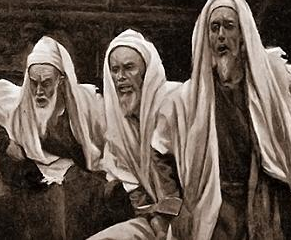
Pharisees by James Tissot
TODAY'S SPECIAL: Matthew 23:13-39

TO CHEW ON: " 'But woe to you scribes and Pharisees, hypocrites! For you shut up the kingdom of heaven against men; for you neither go in yourselves, nor do you allow those who are entering to go in.' " Matthew 23:13

In one of His most impassioned speeches, Jesus denounces seven examples of Pharisaic hypocrisy:

1. They were legalistic. The Pharisees' strict legalism kept them and everyone else out of the kingdom (Matthew 23:13).

2. They were unjust. The Pharisees' long prayers, meant to impress others with their righteousness, were contrary to the way they treated the poorest people, like widows - Matthew 23:14.

3. They were evangelists of evil - Matthew 23:15. One thinks of a missionary or evangelist as one doing a good thing. But these missionaries were converting others to become fanatics of a tarnished religion.

4. They were blind guides
- Matthew 23:16-22. If anyone should be able to see, it's a guide! Yet Jesus showed how blind these men were by poking holes in the reasoning by which they came to rules about which oaths were binding and which weren't. The IVP Commentary explains the custom:
"An oath involved invoking a deity as a witness to the veracity of one's claim. On the popular level people had begun using many surrogate phrases for God's name hoping to avoid judgment if they broke the oath. Pharisees endeavoured to distinguish which oath phrases were actually binding" - IVP Commentary, accessed via biblegateway.com.
Jesus' attack was not just against these oath standards, though, but also against the Pharisees' inconsistent standards of holiness and the profanity of using God's name in such frivolous ways.

5. Their standards were inconsistent and out of proportion - Matthew 23:23-24. The Pharisees emphasized tithing the tiniest of spices while ignoring big issues like practicing justice, mercy, and faith.

6. Their lives were superficial - Matthew 23:25-28. Their fine exteriors masked a polluted inner condition.

7. They were self-deceived - Matthew 23:29-36. They claimed that if they'd lived in the time of the prophets, they would never have treated God's servants the way their countrymen did. Jesus' response: " 'Serpents, brood of vipers!' " You will prove how deceived you are by the way you kill, crucify and scourge the prophets, wise men, and scribes that come to your generation (my paraphrase).

Before we look with too much disdain on this lot, we do well to examine our own lives for similar hypocritical behavior:

  • Have we developed legalistic standards of our own that are barriers to people entering God's kingdom?
  • Do we give lip service to a holiness we don't practice?
  • Do we have self-made, inconsistent-with-God's-word standards that, for example, rail against body sins like smoking and overeating, but are indulgent toward TV and movies that pollute the mind?
  • Do our priorities line up with Scripture's? Do our lives reflect the things that matter to God? Or do we break fellowship over sidebar matters like which version of the Bible to read and the order of prophesied end-time events?
  • Are our lives authentic—the same in private as public? Or do we practice secret sin?
  • Are we realistic about who we are? Or does our lifestyle contradict what comes out of our mouths?

PRAYER:
Dear Jesus, Your denunciation of the hypocritical scribes and Pharisees shows me that my nature is not all that different. Please help me to detect hypocrisy in my life and to deal with it. Amen.

 *********
Unless otherwise noted all Scripture quotations are taken from the New King James Version®. Copyright © 1982 by Thomas Nelson, Inc. Used by permission. All rights reserved.


Related Posts Plugin for WordPress, Blogger...