Showing posts with label deception. Show all posts

Sunday, December 02, 2018

Sin—not exactly as shown

TODAY'S SPECIAL: Hebrews 3-4; Psalm 26

TO CHEW ON: "Beware, brethren, lest there be in any of you an evil heart of unbelief in departing from the living God; but exhort one another daily, while it is called 'Today,' lest any of you be hardened through the deceitfulness of sin." Hebrews 3:12-13

I remember how, when we were little, my siblings and I begged our parents to buy cereal because of the prize inside. Almost always, though, we were disappointed by that prize. For the large, sturdy toy pictured on the outside of the box turned out to be a fraction of the size and often broke even as we were trying to put it together.

Sin is like that. It looks attractive, desirable, must-have, must-do. But it never ends up as good as the picture.

Sin and deceit
  • Satan's deceitful depiction of sin's consequences (he said there were none) convinced Eve to disobey God and put us on the sinful road we're on (Genesis 3:13).
  • Deceit drags others into its net (2 Timothy 2:14).
  • Deceit multiplies (2 Timothy 3:13).
  • The deceived life is one of dissipation and selfishness (Titus 3:3).
  • Continuing to live in deceit results in corruption (Ephesians 4:22) and death (Romans 7:11).
  • We are to exhort our Christian brother or sister if we see them being deceived by sin (Hebrews 3:13).

The reason identifying sin's deceit is so important is because being fooled by it is the first step down the road that leads away from God. A footnote in my Bible says it well:

"Unbelief is caused by a hardened heart, which is caused by the deceitfulness of sin. The result is apostasy, departing from the living God .... Constant encouragement in the midst of a caring fellowship will help believers remain faithful" - Guy P. Duffield, New Spirit-Filled Life Bible, notes on Hebrews, p. 1733.

I vaguely recall that often there was, beside those cereal box pictures, a disclaimer that read (in very small print) "Not exactly as shown." Next time we're tempted by sin's attractive image let's imagine those same words beside it: "Not exactly as shown."

PRAYER: Dear God, please open my eyes to sin's deceit. Help me to see past the pretty picture to the lie it represents. And give me the love and courage to exhort others when I see them being deceived. Amen.

PSALM TO PRAY: Psalm 26

MORE: "Sin lives in a costume..."

"Sin lives in a costume; that’s why it’s so hard to recognize. The fact that sin looks so good is one of the things that make it so bad. In order for it to do its evil work, it must present itself as something that is anything but evil. Life in a fallen world is like attending the ultimate masquerade party.

Impatient yelling wears the costume of a zeal for truth. Lust can masquerade as a love for beauty. Gossip does its evil work by living in the costume of concern and prayer. Craving for power and control wears the mask of biblical leadership. Fear of man gets dressed up as a servant heart. The pride of always being right masquerades as a love for biblical wisdom. Evil simply doesn’t present itself as evil, which is part of its draw.

You’ll never understand sin’s sleight of hand until you acknowledge that the DNA of sin is deception. Now, what this means personally is that as sinners we are all very committed and gifted self-swindlers . . . . We’re all too skilled at looking at our own wrong and seeing good." - Paul David Tripp, Whiter Than Snow: Meditations on Sin and Mercy, p. 32 (quoted in The Glorious Deeds of Christ, "Why Does Sin Look So Good?")


*************
Unless otherwise noted all Scripture quotations are taken from the New King James Version®. Copyright © 1982 by Thomas Nelson, Inc. Used by permission. All rights reserved.


Friday, September 07, 2018

Would Jesus be grieved at our hard hearts?

Christ healing the withered hand by James Tissot

TODAY'S SPECIAL: Mark 1-2; Psalm 95

TO CHEW ON:
"And when He had looked around at them with anger, being grieved by the hardness of their hearts, He said to the man, 'Stretch out your hand.' And he stretched it out, and his hand was restored as whole as the other." Mark 3:5

In our reading today we see a rare thing—Jesus angry. What angered Him? It was the attitude of the Pharisees. They objected to Him healing the withered hand of a fellow worshipper because it was against their rules of what's allowed on the Sabbath. Mark described the source of Jesus' anger as "being grieved by the hardness of their hearts"  - Mark 2:5.

["Hard/hardness  is porosis— hardening, callousness. It's a medical term used to describe the process by which fractured bones are set by an ossifying or calloused petrifying. Sometimes it describes a hard substance in the eye that blinds. Used metaphorically porosis denotes a dulled spiritual perceptivity, spiritual blindness and hardness" - Dick Mills, New Spirit-Filled Life Bible p. 1568.]

We find lots of hard hearts in the Bible, in both Old and New Testaments.

1. People's hearts are hard towards believing in God even after seeing supernatural evidences of Him.
  • Pharaoh's heart is described as "hard" during the plagues. Repeatedly when a plague ends, he reneged on his promise to let the people go - Exodus 8:15; 9:34.
  • Even the Israelites had hard hearts despite seeing signs and experiencing wonders during the exodus and the years they spent in the wilderness - Psalm 78:32.

2. Hard-heartedness toward God continued throughout Israel's OT history
- Jeremiah 5:3; Zechariah 7:8-14.

3. It was often a top-down attitude, beginning with the king.
  • Judah's King Zedekiah was only 21 when he took the throne and his 11-year reign was summed up: "…he stiffened his neck and hardened his heart against turing to the LORD God of Israel" - 2 Chronicles 36:13.
  • It caused King Jehoiakim to systematically burn the scroll Jeremiah had just dictated to Baruch the scribe - Jeremiah 36:24.

4. Some hard heart causes and characteristics:

  • It was caused by pride (Daniel 5:20) and the the deceitfulness of sin (Hebrews 3:13).
  • It resulted in a lack of compassion (Mark 3:2-6—our reading), spiritual dullness (Mark 8:17), doubt and unbelief (Mark 16:14), broken relationships (Mark 10:4,5), and a withdrawal of God's presence (through His people and the Holy Spirit - Acts 19:9).  

5. It is remedied by repentance and confession
- Nehemiah 9:17.

6. If persisted in, its end consequence is judgement - Romans 2:5.

I would have loved to be a synagogue spider watching this interchange between Jesus and the Pharisees. But then the thought occurs, what if He came to my church—to yours? Is there a chance He would be grieved and angered by what He sees there of our attitude toward the withered hand types—the homeless, the mentally ill, the poor, the sexually broken, the addicts?

PRAYER:
Dear Jesus, please help me to see my heart as You see it, and to recognize any hard-heartedness. I need You to replace it with a heart of flesh (Ezekiel 36:26). Amen. 

PSALM TO PRAY: Psalm 95

The Bible Project VIDEO: Mark (Read Scripture Series)


 *********
Unless otherwise noted all Scripture quotations are taken from the New King James Version®. Copyright © 1982 by Thomas Nelson, Inc. Used by permission. All rights reserved.


Sunday, July 08, 2018

Building with untempered mortar

TODAY’S SPECIAL: Ezekiel 13-15; Psalm 34

TO CHEW ON:
“So I will break down the wall you have plastered with untempered mortar, and bring it down to the ground, so that its foundation will be uncovered; it will fall, and you shall be consumed in the midst of it. Then you shall know that I am the LORD.” Ezekiel 13:14

“The LORD is near to those who have a broken heart
And saves such as have a contrite spirit.” Psalm 34:18


I read the blog of Rod Dreher (author of The Benedict Option). In a series of posts last week, he reported on accusations of sexual abuse of a teenage boy by Cardinal Theodore McCarrick 50 years ago. Though McCarrick denies that this happened, Dreher uncovers the picadilloes of McCarrick and other priests, actions that have gone on for years and which were widely known (read “Church: Cardinal McCarrick is a  Molester”).

Dreher was investigating allegations of McCarrick’s sexual activity with student priests (adults) as long ago as 2002 but no one would testify “on the record” and so the story went nowhere. The Catholic priest sex scandal drove Dreher to leave the Catholic church years ago in disillusionment.

At the end of another post (“Uncle Ted & the Grand Inquisitor”) Dreher quotes an email he received from a reader about his reporting on these things. It says, in part: “I simply don’t understand your eagerness with this prosecution of McCarrick. … We must protect our brand, our shield, our faith! … In short, we must handle these issues swiftly, legally, but privately. … Image is everything and when it comes to the One True Church we MUST protect her” (emphasis in the original).

The false prophets of Ezekiel’s time would agree that “Image is everything.” But it’s not everything to God. And when the protection of image comes at the price of truth, I would submit that that’s pretty much building a wall or a life with “untempered mortar.”

I ask myself, am I doing that—are you—building a life and reputation on image that’s covering up sin and rottenness?

David, in Psalm 34, tells us how to get back on track with God (the only One to whom our image really matters). It’s with a broken heart and a contrite spirit, by coming clean with tears of “sorry,” then leaving our sinful ways behind.

PRAYER: Dear Father You see everything. I can’t cover anything from You. Help me to build my life with the trusted mortar of truth, not the “untempered mortar” of lies. Amen.

PSALM TO PRAY: Psalm 34.

 *********
Unless otherwise noted all Scripture quotations are taken from the New King James Version®. Copyright © 1982 by Thomas Nelson, Inc. Used by permission. All rights reserved.
Thanks for reading! This year we are using The Bible Project "Timeless Reading Plan" to read through the Bible in 2018. If you'd like to read along in your own Bible, you can download a pdf of the reading plan HERE.

Thursday, March 08, 2018

Failure to consult with God

Joshua and the Gibeonites - from FreeBibleImages.org

TODAY’S SPECIAL: Joshua 9-12; Psalm 67

TO CHEW ON: “Then the men of Israel took some of their provisions; but they did not ask the counsel of the LORD.” Joshua 9:14

The Hivites, people who lived in the Canaanite city of Gibeon about six miles northwest of Jerusalem, were terrified of Israel—scared not witless but witty. They organized a trip to Joshua and the marauding Israeltes that involved worn out wine skins, tattered clothes, and moldy bread. Their story: the wine skins had been new when they began their journey, the bread hot out of the oven, the new clothes completely worn out on the long long trip from their home to where Israel was camped. They came to request a peace treaty with Israel.

(Perhaps they knew of the stipulation God had given Moses. Israel was to utterly destroy all the Canaanites but was allowed to make peace with distant peoples - Deuteronomy 7:2; 20:10-16.)

Joshua and other leaders looked at the worn out skins and the tattered clothes. They tasted the moldly bread. It all convinced them of the truth of the Hivites’ tale and so they made a covenant of peace with them (Joshua 9:15).

But one thing they neglected to do: “… they did not ask the counsel of the LORD.” Big oops!

I feel convicted by this story as I think of how often I make decisions on my own, without asking for the “counsel of the Lord”—convinced by how things look or what seems obvious. Like the Israelites I know so little, am naïve, easily duped, and unaware of what is transpiring in the unseen spiritual realm. Do you ever do the same?

Joshua and the his fellow leaders then experienced the consequences of their rash decision. Their own people were upset with them but now there was no way out but to let these people live (Joshua 9:18,19). And there was more bloodshed later. When King Saul violated the covenant, killed the Gibeonites, and God sent a famine to punish this broken promise. In order to break the famine, more lives—Israelite lives—were required (2 Samuel 21:1,6).

Similarly, we should not be surprised when our impetuous, self-inspired moves result in consequences to us and those around us.

PRAYER: Dear Father, please help me to pause and pray, to really consult You and await Your answer, when I face decisions. Amen.

PSALM TO PRAY: Psalm 67

 *********
Unless otherwise noted all Scripture quotations are taken from the New King James Version®. Copyright © 1982 by Thomas Nelson, Inc. Used by permission. All rights reserved.

Thanks for reading! This year we are using The Bible Project "Timeless Reading Plan" to read through the Bible in 2018. If you'd like to read along in your own Bible, you can download a pdf of the reading plan HERE.

Monday, January 08, 2018

The power of a blessing

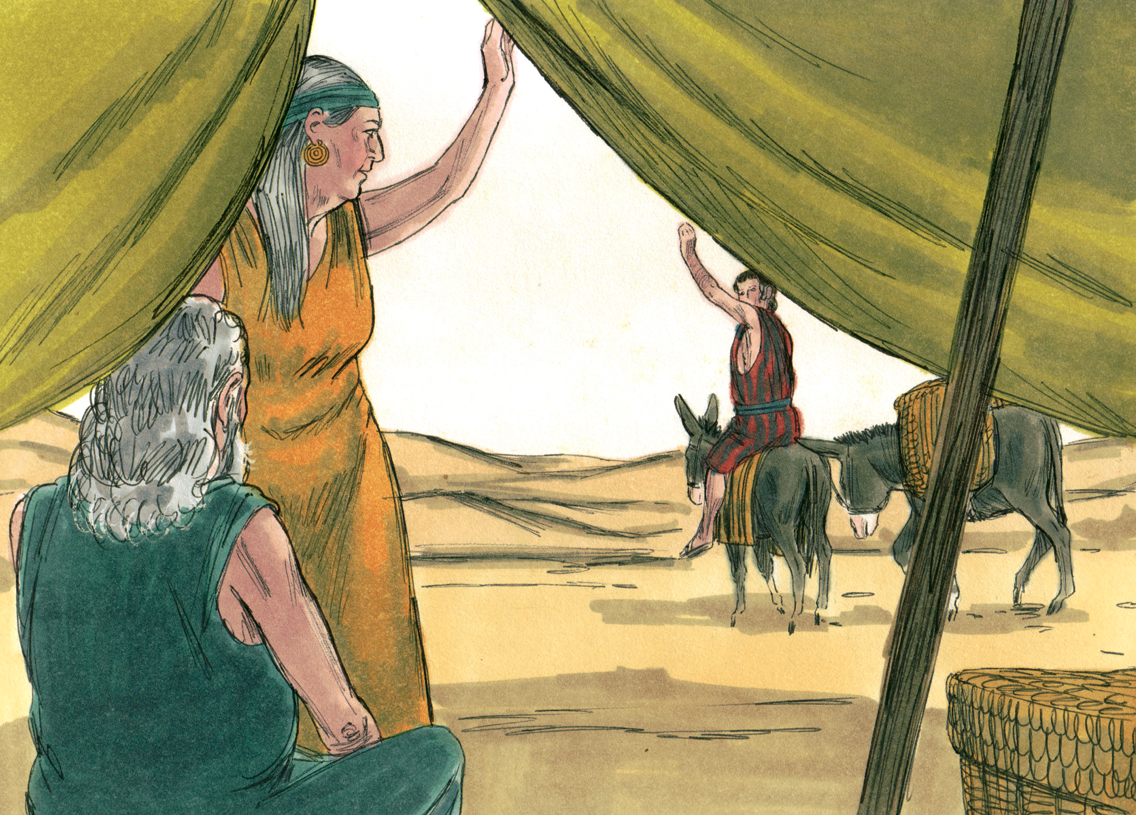
Jacob leaves home - Artist unknown
TODAY'S SPECIAL: Genesis 25-28

TO CHEW ON: " ' May God Almighty bless you and make you fruitful and increase your numbers until you become a community of peoples.' " Genesis 28:3 NIV

The answer to Isaac and Rebekah's prayers, the twins Esau and Jacob, are who we read about today. Theirs sounds like a toxic family where father and mother favor different children. Mother and son #2 trick father and son #1 out of bestowing and receiving the blessing usually reserved for the firstborn son. In such a less-than-perfect beginning the destiny of nations is set.

This incident contains three blessings.
- The blessing Isaac gives to Jacob (thinking he is blessing Esau) - Genesis 27:27-29.
- The blessing Isaac speaks over Esau (after the one he has planned for him is spoken over Jacob) Genesis 27:39-40.
- The blessing with which Isaac sends Jacob away from home - Genesis 28:3-4.

["Bless: behrahch #1288 - To bless, salute, congratulate, thank, praise, to kneel down. In OT times, one got down on his knees when preparing to speak or receive words of blessing … From God's side, he is the Blesser, the One who gives the capacity for living a full rich life" - Dick Mills, Word Wealth, New Spirit-Filled Live Bible NIV, Kindle location 126,606.]

Several things strike me as I read about these blessings.

1. They are a big deal. Esau is distraught when he discovers Jacob has tricked Isaac into giving him the firstborn's blessing (Genesis 27:34).

2. The words of blessings, once spoken, cannot be retracted. My Bible's notes expand:
"The ancients knew far better than we moderns about the power of the spoken word. A blessing, a curse, a creative word, a destructive word, can all have great effects when spoken in faith" - R. Russell Bixler, notes on Genesis, New Spirit-Filled Life Bible, KL 9792.

3. These blessings address the big picture and change the course of history.
  • Isaac's inadvertent blessing of Jacob contains a blessing of spiritual prosperity (Genesis 27:28), political supremacy (Genesis 27:29), and a curse on enemies (Genesis 27:29).
  • Isaac's blessing of Esau is as big as he can make it without contradicting his words to Jacob. The conflict predicted between his descendants (the Arabs) and the descendants of Jacob (the Jews) continues to this day.
  • Isaac's blessing on sending Jacob away is warm and expansive, pronouncing a blessing of many children and an inherited land.

Though we don't have a custom of bestowing blessings on our children in a formal way, we do bless and curse them when we praise or belittle them, tell them they have what it takes or give them the message we think they are failures. Let's watch our words to them. We can also bless them even when they're not present as we pray into their futures. We have no idea of the impact our words of blessing or cursing will have on their histories, let alone the destinies of our families, communities, nation, even the world.

PRAYER: Dear God, please help me to bless my children and grandchildren with positive words and faith-filled prayers. Amen.

PSALM TO PRAY: Psalm 8

*****************

  Unless otherwise noted, all Scripture quotations are taken from the THE HOLY BIBLE, NEW INTERNATIONAL VERSION®, NIV® Copyright © 1973, 1978, 1984, 2011 by Biblica, Inc.® Used by permission. All rights reserved worldwide.

Thanks for reading! This year we are using The Bible Project "Timeless Reading Plan" to read through the Bible in 2018. If you'd like to read along in your own Bible, you can download a pdf of the reading plan HERE.

Saturday, December 30, 2017

Discerning truth and error

Image: Pixabay
TODAY’S SPECIAL: 2 JOHN 1-13

TO CHEW ON: “Whoever transgresses and does not abide in the doctrine of Christ does not have God. he who abides in the doctrine of Christ has both the Father and the Son.” 2 John 9


This short book/letter of only 13 verses is nevertheless deep and thought provoking. Its key words are “love” (four occurrences) and “truth” (five occurrences). Its main themes are truth and error—concepts we’d expect to see addressed by the philosophical Apostle John. With efficiency John lays out the territory of each.

What is truth and how does it relate to the believer? *
  • It unites them in fellowship - 2 John 1
  • It lives in them forever - 2 John 2.
  • They remind each other of the truth they believe and affirm it in their greeting of each other - 2 John 3.
  • It manifests itself in their obedience to God - 2 John 4-6.  

What is error?
  • Its advocates are deceitful - 2 John 7.
  • They deny Christ’s incarnation - 2 John 7.
  • They ignore the teachings of Jesus and disobey Him - 2 John 9.
  • They are to be guarded against, even shunned (John tells his readers to not even invite them into their homes) - 2 John 8, 11.

In our time when a smorgasbord of Bible teaching is available through books and online, maybe we should keep some of John’s points in mind as we evaluate who speaks truth and whose teachings come with shades of deceit and error. Some questions we might ask as we evaluate what we read and hear:
  • Does this teacher acknowledge the deity of Jesus?
  • Does he/she teach what Jesus taught, or are they selective, leaving out controversial bits?
  • Is their teaching clear or filled with questions and an unwillingness to state clearly what they believe (so that what they really believe remains fuzzy; we can’t pin them down)?
  • What does their lifestyle say about their beliefs?

Such spiritual perception implies a familiarity with the Bible and Jesus' teachings on our part in the first place, so we can tell what’s off. Let’s be studious and biblically literate so we can be discriminating in choosing what teachers to put ourselves under.

PRAYER: Dear Father, please fill me with Your Spirit of wisdom so I will recognize truth and error. Amen.

* These points are taken from the Study Notes on 2 John from the NKJV Thompson Chain Bible, p. 2099.

 *********
Unless otherwise noted all Scripture quotations are taken from the New King James Version®. Copyright © 1982 by Thomas Nelson, Inc. Used by permission. All rights reserved.

Monday, November 06, 2017

Woe to hypocrites!

Pharisees by James Tissot
TODAY'S SPECIAL: Matthew 23:13-39

TO CHEW ON: " 'But woe to you scribes and Pharisees, hypocrites! For you shut up the kingdom of heaven against men; for you neither go in yourselves, nor do you allow those who are entering to go in.' " Matthew 23:13

In one of His most impassioned speeches, Jesus denounces seven examples of Pharisaic hypocrisy:

1. They were legalistic. The Pharisees' strict legalism kept them and everyone else out of the kingdom (Matthew 23:13).

2. They were unjust. The Pharisees' long prayers, meant to impress others with their righteousness, were contrary to the way they treated the poorest people, like widows - Matthew 23:14.

3. They were evangelists of evil - Matthew 23:15. One thinks of a missionary or evangelist as one doing a good thing. But these missionaries were converting others to become fanatics of a tarnished religion.

4. They were blind guides
- Matthew 23:16-22. If anyone should be able to see, it's a guide! Yet Jesus showed how blind these men were by poking holes in the reasoning by which they came to rules about which oaths were binding and which weren't. The IVP Commentary explains the custom:
"An oath involved invoking a deity as a witness to the veracity of one's claim. On the popular level people had begun using many surrogate phrases for God's name hoping to avoid judgment if they broke the oath. Pharisees endeavoured to distinguish which oath phrases were actually binding" - IVP Commentary, accessed via biblegateway.com.
Jesus' attack was not just against these oath standards, though, but also against the Pharisees' inconsistent standards of holiness and the profanity of using God's name in such frivolous ways.

5. Their standards were inconsistent and out of proportion - Matthew 23:23-24. The Pharisees emphasized tithing the tiniest of spices while ignoring big issues like practicing justice, mercy, and faith.

6. Their lives were superficial - Matthew 23:25-28. Their fine exteriors masked a polluted inner condition.

7. They were self-deceived - Matthew 23:29-36. They claimed that if they'd lived in the time of the prophets, they would never have treated God's servants the way their countrymen did. Jesus' response: " 'Serpents, brood of vipers!' " You will prove how deceived you are by the way you kill, crucify and scourge the prophets, wise men, and scribes that come to your generation (my paraphrase).

Before we look with too much disdain on this lot, we do well to examine our own lives for similar hypocritical behavior:

  • Have we developed legalistic standards of our own that are barriers to people entering God's kingdom?
  • Do we give lip service to a holiness we don't practice?
  • Do we have self-made, inconsistent-with-God's-word standards that, for example, rail against body sins like smoking and overeating, but are indulgent toward TV and movies that pollute the mind?
  • Do our priorities line up with Scripture's? Do our lives reflect the things that matter to God? Or do we break fellowship over sidebar matters like which version of the Bible to read and the order of prophesied end-time events?
  • Are our lives authentic—the same in private as public? Or do we practice secret sin?
  • Are we realistic about who we are? Or does our lifestyle contradict what comes out of our mouths?

PRAYER:
Dear Jesus, Your denunciation of the hypocritical scribes and Pharisees shows me that my nature is not all that different. Please help me to detect hypocrisy in my life and to deal with it. Amen.

 *********
Unless otherwise noted all Scripture quotations are taken from the New King James Version®. Copyright © 1982 by Thomas Nelson, Inc. Used by permission. All rights reserved.


Wednesday, August 30, 2017

Would Jesus call your words satanic?

"Get thee behind Me, Satan" - by James Tissot

TODAY'S SPECIAL: Matthew 16:21-28

TO CHEW ON: "Then Peter took Him aside and began to rebuke Him, saying, 'Far be it from You, Lord; this shall not happen to you!' But He turned and said to Peter, 'Get behind Me Satan! You are an offense to Me, for you are not mindful of the things of God but the things of men.'" Matthew 16:22,23


What a shock Peter must have felt when Jesus called him "Satan" and described his words as an offense (trap). Perhaps he thought, But Jesus, I was only trying to encourage You and draw You from these pessimistic thoughts about death.

Jesus, however, recognized the oily tone, the sneaky lie in Peter's words. (Compare what Peter said to what the serpent said to Eve way back: "'You shall not surely die…'" - Genesis 3:4.) Jesus scolded him for being unmindful of the things of God while mindful of the things of men. What are those things?

A word the Bible uses for the "things of men" is "carnal." Some things that characterize the carnal mind are:
  • Preoccupation with this life - Psalm 49:11.
  • Unwillingness to acknowledge God or bow to Him - Romans 1:28; 8:7.
  • Living by our intellect alone - Ephesians 4:17.
  • Pursuing different forms of spirituality - Colossians 2:18.
  • Allowing the outlook of the world to taint and sully our thoughts and consciences - Titus 1:15.
  • In Peter's case here it was denying the necessity of Jesus' death and resurrection—a temptation to abort God's plan of salvation.

Jesus told Peter he should be mindful of the "things of God." What are those things? They include:
  • Preoccupying ourselves with God's word—what it says and how we can live it out - Joshua 1:8; Psalm 119:99.
  • Recognizing and being thankful for God's "lovingkindness" - Psalm 48:9.
  • Viewing ourselves realistically and through eyes of faith - Romans 12:3.
  • Taking our thoughts in hand; directing them along routes of what is true, noble, just, pure, lovely, virtuous, praiseworthy - Philippians 4:8.
  • For Peter the things of God in this situation would have been to hear what Jesus was saying, and grasp the necessity of God's big plan and Jesus' role in it. With these insights he might have been better prepared for what was coming.

As I compare my thoughts and words with the two lists, I see that I often have a carnal, Satan-influenced mindset. Oh to recognize the difference and avoid these traps of thought that too often exit my mouth in words!


PRAYER: Dear God, please show me today where I am living by the "things of men." Help me to steer my focus toward the "things of God." Amen.

 *********
Unless otherwise noted all Scripture quotations are taken from the New King James Version®. Copyright © 1982 by Thomas Nelson, Inc. Used by permission. All rights reserved.


Thursday, August 03, 2017

Acknowledge the past before transformation

Jacob Wrestles - Matthaeus Merian I (1593-1650)
TODAY’S SPECIAL: Genesis 32:6-32

TO CHEW ON:
“So He said to him, ‘What is your name?’
He said, ‘Jacob’
(supplanter, deceiver).
And He said, ‘Your name shall no longer be called Jacob but Israel (Prince with God)…’” - Genesis 32:27,28


We left Jacob yesterday alone and determined to deal with his past. For not only had he broken with Laban, but he sent servants to tell Esau, his estranged twin brother, that he was passing through (Genesis 32:1-5).

The servants returned with the news that Esau was on his way to meet Jacob, accompanied by 400 men.

That put the scare into Jacob!

He did all he could to prepare for this meeting that he feared would end badly.
- He prayed - reminding God of His promise to him - Genesis 32:9-12.
- He prepared and sent on ahead herds of animals as gifts for Esau - Genesis 32:13-15.
- He separated his most precious possessions, his wives and children, from the main company and sent them to the other side of the Jabbok River.

In the fear-filled and sleepless night before the meeting, Jacob experienced perhaps the greatest preparation for the day ahead (and the rest of his life). He met a mysterious stranger who wrestled with him. This man (a theophany? an angel?) made Jacob say his name (acknowledge his identity, Jacob—deceiver, supplanter) before He would pronounce the blessing for which Jacob begged.

Then God blessed him with a new name (identity): Israel—Prince with God, a reminder of the encounter (a lifelong limp), and a formal blessing (Genesis 32:26-29)

Perhaps what happened to Jacob may also be applicable to us. Before we get God’s blessing of transformation, we may also need to admit what we were, to acknowledge the human means we’ve used to this point to make our way in life. This so we can forsake them and in their stead lean on God and trust His ways of working.

PRAYER:
Dear Father, thank You for faithfully bringing me face to face with my human coping mechanisms in order to transform me into a person who relies on You.

MORE: The rest of the story…


To read how Jacob and Esau’s meeting went, read Genesis 33:1-16.

 *********
Unless otherwise noted all Scripture quotations are taken from the New King James Version®. Copyright © 1982 by Thomas Nelson, Inc. Used by permission. All rights reserved.


Tuesday, August 01, 2017

Prospering against all odds

Jacob laying the peeled rods before Laban's flock - Bartolomé Esteban Murillo - 1617-1682

TODAY'S SPECIAL: Genesis 30:22-43

TO CHEW ON: "Thus the man became exceedingly prosperous, and had large flocks, female and male servants, and camels and donkeys." Genesis 30:43

The trickery between Laban and Jacob continued. When Jacob wanted to leave, Laban pressured him to stay, not for Jacob's benefit but for his own. He recognized that God's blessing on Jacob was seeping into his life as well.

Yet he seemed forever suspicious that what Jacob was actually doing was stealing from him. So Jacob suggested a foolproof way to determine his wages. His pay would be the less desirable sheep and goats of the flock—the speckled and spotted sheep and goats, and the brown lambs.

Laban agreed to this, after which he immediately removed all such animals from his current flocks, giving them to his sons. Then he separated his flocks (tended by Jacob) and the flocks of his sons by a three-day-journey distance.

Our reading describes Jacob's way of provoking "flawed" animals. My Bible's commentary says about Jacob's system of peeled rods:
"Jacob was not practicing superstition, he was exercising faith which he somehow associated with the rods. God, having designed the laws of genetics, intervened and honored Jacob's faith" R. Russell Bixler, commentary on Genesis, New Spirit-Filled Life Bible, p. 46.

Whether Jacob was at heart superstitious or faith-filled, only he and God know. But it worked—not, I would submit, because of anything Jacob did but because God wanted it so and had planned it so. Jacob's survival and prospering was one of the pieces needed to complete the picture of our redemption through Jesus. Mr.Bixler again:
"God's blessings are always able to exceed man's defrauding" - Ibid.

How encouraging this story can be to us. Even when events, circumstances, and people are arrayed against us, nothing can or will stop God's purposes as He determines (with our cooperation of course) to enact them through us.

PRAYER: Dear God, help me to look to You and not circumstances, people or my own wits for success in the assignments You give me. Amen.

 *********
Unless otherwise noted all Scripture quotations are taken from the New King James Version®. Copyright © 1982 by Thomas Nelson, Inc. Used by permission. All rights reserved.

Saturday, July 29, 2017

What we can learn from an unloved wife

"Leah and Rachel" by Johann Friedrich Overbeck
TODAY'S SPECIAL: Genesis 29:19-35

TO CHEW ON: "And she conceived again and bore a son, and said, 'Now I will praise the Lord.' Therefore she called his name Judah. Then she stopped bearing." Genesis 29:35

Trickery ran in the family it seems. Just as Rebekah had set up Jacob to trick Isaac about his identity, so Laban, Rebekah's older brother, set up Leah to trick Jacob about her identity on his wedding night. I'm sure the irony wasn't lost on the groom.

Leah, who was probably a willing participant, ended up being the third wheel in this marriage—at least affection-wise. But not otherwise. For in the area of having babies, which mattered a lot in that culture, she conceived and birthed son after beautiful son for Jacob.

Her reaction to each is interesting:
- "Now my husband will love me," she said after Reuben, son #1.

- "Because the Lord has heard that I am unloved, He has therefore given me this son also," she said after Simeon, son #2.

- "Now this time my husband will become attached to me," she said after Levi, #3.

- But after son #4, her focus shifted from her husband to God. "Now I will praise the Lord," she said and named the baby Judah which means 'praised.' Jacob later blessed Judah with the highest blessing of all his sons (Genesis 49:8-12). And indeed, King David and Jesus are descendants of Judah.

Some lessons from life we can take from Leah's story:

1. Our choices have consequences. They can last a lifetime.

2. We can praise God in spite of our circumstances—in our circumstances, as Leah did. After Judah's birth her focus was no longer on what, in the situation, she wanted to change, but on God.

3. God can bring good things out of bad. Unloved Leah was the mother of both Levi—the ancestor of Moses, Aaron and all Israel's priests, and Judah, the ancestor of David and Jesus. My Bible's study notes: "God's love for Leah is displayed in her becoming mother to the priestly and kingly tribes, Levi and Judah" - R. Russell Bixler, New Spirit-Filled Life Bible, p. 44.

One aspect of bringing good out of bad is conveyed by the word redemption. One of my favorite redemption passages underlines God's abilities here:

"So I will restore to you the years that the swarming locust has eaten,
The crawling locust,
The consuming locust,
And the chewing locust,
My great army which I sent among you.
You shall eat in plenty and be satisfied,
And praise the name of the Lord your God,
Who has dealt wondrously with you;
And my people shall never be put to shame."
- Joel 2:25,26

PRAYER: Dear God, please help me to consider my choices carefully, mindful of the consequences they hold.  Help me to praise You in the middle of right now, whatever my right now holds. Thank You that You can redeem  any situation. Amen.  

 ********* *********
Unless otherwise noted all Scripture quotations are taken from the New King James Version®. Copyright © 1982 by Thomas Nelson, Inc. Used by permission. All rights reserved.

Friday, June 30, 2017

Leaders who lie

Hananiah confronting Jeremiah - St. Takla.org
TODAY’S SPECIAL: Jeremiah 28:1-17

TO CHEW ON: “‘As for the prophet who prophesies of peace, when the word of the prophet comes to pass, the prophet will be known as the one whom the LORD has truly sent.’” Jeremiah 28:9

In today’s reading, we witness a showdown between two prophets, Jeremiah and Hananiah. The drama becomes even more tense when we’re aware of its context.

Nebuchadnezzar, Babylon’s king, was gaining power. His army had already swept into Jerusalem and taken away many temple accessories. He was adding other nations to his kingdom as well. In Jeremiah 27:2, God told Jeremiah to put on “bonds and yokes” to symbolize Judah’s subservience to Babylon. And God told Jeremiah to advise the people not to resist Nebuchadnezzar, for those nations that “bring their necks under his yoke” would be able to stay in their land - Jeremiah 27:11.

There were more prophets than Jeremiah in Judah. They were obviously contradicting what Jeremiah had said, because at least four times in Jeremiah 27 God told him not to listen to these prophets (Jeremiah 27:9, 14, 16, 17).

In Jeremiah 28, then, we witness a showdown between one of the nay-saying prophets, Hananiah, and Jeremiah. Who was Hananiah?
  • He was born of good prophetic stock - Jeremiah 28:1.
  • He sounded like a prophet with his “Thus says the Lord” - Jeremiah 28:2,11.
  • He even acted like a prophet, dramatically taking the wooden yoke God had told Jeremiah to wear from off his neck and breaking it - Jeremiah 28:10.

Jeremiah wished what Hananiah said was true: “'Amen! The LORD do so; the LORD perform your words…'" etc. - Jeremiah 28:6. But keeping in mind God’s warning to him and the tenor of prophecies delivered previously, Jeremiah expressed his doubts - Jeremiah 28:8,9.

Later God came to Jeremiah and told him that Hananiah was indeed a false prophet and to relay to him that his act of freeing Jeremiah from the wooden yoke only strengthened Nebuchadnezzar’s grip on the nation under an iron yoke. Also, because Hananiah was deluding the people, he would die within the year - Jeremiah 28:13-16

It happened - Jeremiah 28:17.

What a chilling story! What is there here for us to learn? Four things come to mind:
  • Just because someone comes from a line of ministers and sounds like one doesn’t mean he’s reliable.
  • It’s a modern tendency too for leaders and people in ministry to tell people what they want to hear. Modern examples: there’s no hell; God is OK with sexual perversion.
  • Given time, what is true will distinguish itself from the false: “… when the word of the prophet comes to pass, the prophet will be known as one whom the LORD has truly sent” - Jeremiah 28:9.
  • In this era of the Bible and the Holy Spirit available to all believers, we need the teaching of the whole Bible, applied under the direction of the Holy Spirit to discern what is true and what is a lie.


PRAYER:
Dear Father, help me not to be taken in by smooth speakers whose message is appeals to my human preferences and wishes. Please give me the discernment to recognize what is true and what is false. Amen.

 *********
Unless otherwise noted all Scripture quotations are taken from the New King James Version®. Copyright © 1982 by Thomas Nelson, Inc. Used by permission. All rights reserved.


Thursday, June 15, 2017

Morality—taught and caught

TODAY’S SPECIAL: Genesis 20:1-18

TO CHEW ON:
“And Abimelech called Abraham and said to him, ‘What have you done to us? How have I offended you, that you have brought on me and on my kingdom a great sin? You have done deeds to me that ought not to be done.’” Genesis 20:9

What horrible thing had Abraham done to the Philistine King Abimelech?

Lied about the state of Sarah, who was his wife and also his half-sister. He told this half-truth because of Sarah’s beauty and his fear that other men, powerful men, would want her and do away with him to get her for themselves.

He had done this previously as well, in Egypt (Genesis 12:10-20).

There’s a sequel to today’s story in Genesis 26:1-11. There we see Isaac doing the exact same thing as his dad—saying Rebekah was his sister when she was really his wife, again to save his own skin. In Isaac’s case it wasn’t even half true, but a total lie.

I am struck by the generational aspect of this. Did Isaac witness Abraham do it? Probably not because it happened before his time. Perhaps his dad told him the stories of these events, glossing over the evil of them? Or maybe Isaac picked up something in his father’s general moral code that was unspoken permission to act in this way—an attitude and other actions that sacrificed honesty on the altar of expediency?

Whatever it was, I think there’s a lesson for us in this. We don’t only teach morality (what’s right and wrong) to our kids, but they also catch our morality from us. They pick it up from our attitudes and the way we act.
 
PRAYER: Dear Father, please help me to live in such a way that I can say to others, don’t just do as I say but also as I do. Amen.

 *********
Unless otherwise noted all Scripture quotations are taken from the New King James Version®. Copyright © 1982 by Thomas Nelson, Inc. Used by permission. All rights reserved.


Monday, February 20, 2017

Hypocrisy

The Prayer in Secret - Alexandre Bida
TODAY’S SPECIAL: Matthew 6:1-15

TO CHEW ON:
“‘Therefore, when you do a charitable deed, do not sound a trumpet before you as the hypocrites do in the synagogue and in the streets, that they may have glory from men. Assuredly, I say to you, they have their reward.’” Matthew 6:2

Hypocrite (hypokrites) is an interesting word. My study Bible describes how it comes from the Greek word hypokrinomai—the dialogue of actors who wore masks that amplified their voices. A hypokrites was one who acted in a play or read a script.

The dictionary definition of hypocrite is:
1] A person who pretends to have virtues, moral or religious beliefs, principles etc. that he or she does not actually possess; 2] A person who feigns some desirable or publicly approved attitude, whose private life, opinions or statements belie his or her public statements.

A short survey of “hypocrisy” in the Bible shows us some of its faces.
Hypocrisy can be:

  • Words that don’t agree with intentions, especially when they relate to others, like our neighbours - Isaiah 55:21 also Psalm 28:3; Isaiah 62:4; Jeremiah 9:8.

  • Flattery -  Psalm 78:36; Matthew 22:16.

  • Actions or words that set a trap - Jeremiah 9:8; Proverbs 7:15; Mark 12:15.

  • Actions or words that shirk responsibility - e.g. Pilate, when he washed his hands of Jesus making like he was helpless to do anything but give in to the wishes of the mob was a hypocrite - Matthew 27:24.

  • Religious words or actions that are insincere- Jeremiah 12;2; 22:20.

  • Religious words or actions performed to fool God- Jeremiah 3:10.

  • Religious words or actions performed to manipulate God - Isaiah 58:3.

  • Religious words or actions to further one’s own ends - Zechariah 7:5, our passage Matthew 6:1-15;  James 2:1-4.

I love the picturesque language Jesus used to describe hypocrisy (which He pointed out often in the Pharisees and scribes):
- He said hypocrites were like whitewashed tombs, beautiful on the outside but inside full of uncleanness and dead bones (Matthew 23:28).
- He said they were like cups and dishes, clean on the outside but full of greed and wickedness inside - Luke 11:39.
- He said the hypocrisy of the Pharisees permeated everything they did, like yeast permeates bread - Luke 12:1.

What a mess! Who'd want to have anything to do with a hypocrite or hypocrisy? Yet when I’m honest with myself, I have to admit I’ve been a hypocrite in both my dealings with others and God.

To eliminate hypocrisy, a good place to start is to be self-aware and recognize hypocrisy where it first appears—in our thoughts. Proverbs says of the miser, who invites you to eat and drink but is inwardly critical: “As he thinks in his heart, so is he” - Proverbs 23:7.

Then we need to acknowledge it as sin - 1 John 1:10.

Finally, we need to make a conscious effort to purge hypocrisy from our lives
as we  love everyone—God and our fellow humans—sincerely and with pure motives. “Let love be without hypocrisy” - Romans 12:9.


PRAYER: Dear Father, help me to be aware of hypocrisy in my life, to acknowledge it as sin and to learn to love sincerely. Amen.

 *********
Unless otherwise noted all Scripture quotations are taken from the New King James Version®. Copyright © 1982 by Thomas Nelson, Inc. Used by permission. All rights reserved.


Thursday, January 26, 2017

The work of fruitless effort

Image: Pixabay
TODAY’S SPECIAL: Micah 6:1-16

TO CHEW ON: “You shall sow, but not reap;
You shall tread the olives, but not anoint yourselves with oil;
And make sweet wine but not drink wine.” Micah 6:15


Have you ever experienced fruitless effort—worked hard on a project only to have it fall apart before it was finished; created a product that didn’t sell; put years into training that never yielded a dollar of return in salary?

Fruitless effort is what Micah is predicting here for the people of Judah and Israel? But why? The preceding verses of Micah 6 give us some clues:
  • Their worship had become a dead form and ritual (Micah 6:6,7). The attitude of their hearts was far from complying with the three things that God required: “But to do justly / To love mercy, / And to walk humbly with your God” - Micah 6:8.
  • Their work was characterized by evil and deceit. Notice the list of things that offended God in the way they went about their day-to-day business: “...wickedness … short measure … wicked scales … deceitful weights … violence … lies … tongue is deceitful…” Micah 6:10-12.
  • These practices seemed to have become part of their culture, a culture that developed under ungodly kings: “For the statues of Omri are kept/ All the works of Ahab’s house are done; / And you walk in their counsels” - Micah 6:16.

Could it be that some of our work failures, our fruitless effort fiascos, come about for the same reasons? We shove justice and mercy to the bottom of the priority list (aren’t they more for bleeding hearts?). Instead of walking with God we drag behind or race ahead of Him, working to our own timetables and ambitions? We mimic the work practices of the culture around us. Why not work for cash and so avoid reporting income and paying tax? Why not take a few office supplies home for the kids? Why not call in sick when we feel we need a day off? Everyone else is doing and getting away with it!

A paragraph on this passage in the Theology of Work Bible Commentary sums it up well:

“This is a reminder that the world of work does not exist in a vacuum, separated from the rest of life. If we do not ground our values and priorities in God’s covenant, then our lives and work will be ethically and spiritually incoherent. If we do not please God in our work, we cannot please him in our worship” -  Theology of Work Commentary, accessed through BibleGateway.com (emphasis added).

And if we do not please Him in our work, we should not be surprised if He withholds His blessing from our efforts.

PRAYER: Dear Father, please help me to keep justice, mercy, and walking with you (not ahead or behind) at the top of my work priorities. Amen.

 *********
Unless otherwise noted all Scripture quotations are taken from the New King James Version®. Copyright © 1982 by Thomas Nelson, Inc. Used by permission. All rights reserved.


Thursday, January 05, 2017

Human nature on display

Image: Pixabay
TODAY’S SPECIAL:  Genesis 3:1-15

TO CHEW ON:
“And they heard the sound of the LORD God walking in the garden in the cool of the day, and Adam and his wife hid themselves from the presence of the LORD God among the trees of the garden.” Genesis 3:8

As I read the account of Adam and Eve’s fall into sin, I see things that are surprisingly (or, maybe not surprisingly) familiar. Even before Eve yielded to the temptation to eat that fruit, some of these things were present:

  • A tendency to exaggerate or embellish
Eve’s report to the serpent of what God had said about the tree: “‘You shall not eat of it, nor shall you touch it, lest you die.’” wasn’t exactly what God had said. He really said, simply, “‘You shall not eat…’” Genesis 3:3, cf. Genesis 2:17 (emphasis added).

  • Intellectually gullible
Eve never even questioned the serpent’s claims but took them at face value - Genesis 3:4-6.

  • Easily swayed to disbelieve what God had said.
For Eve this included considering and believing the serpent’s suggestion that God didn’t have their best interests at heart but was really keeping the best back from them - Genesis 3:4-6.

  • Undue trust in appearance.
Eve was easily taken in by the fruit’s appearance when she looked at it closely and saw that it looked delicious, was beautiful and, according to the serpent, had great benefits - Genesis 3:6.

  • Secrecy
After they sinned, both Adam and Eve gave in the overwhelming compulsion to hide from God - Genesis 3:8.

  • Blame-shifting
Both refused to take responsibility for their action. Adam blamed Eve. Eve blamed the serpent - Genesis 3:12,13.

Seeing the first four qualities in Eve even before the fall and the latter two in both Adam and Eve immediately after, leads me to believe these tendencies are part of our human nature. We all have them. They strut their stuff especially when we’re under the pressure of temptation. So let’s be on guard against ourselves and not taken in by the serpent's empty accusations against God, false claims, and half-truth promises.


PRAYER: Dear Father God, help me to know myself—to recognize my human tendencies and weaknesses that would draw me away from You. Amen.

 *********
Unless otherwise noted all Scripture quotations are taken from the New King James Version®. Copyright © 1982 by Thomas Nelson, Inc. Used by permission. All rights reserved.


Saturday, December 26, 2015

Our enemy's DNA

Death of Stephen - Lyman Abbott Commentary on Acts
TODAY'S SPECIAL: Acts 6:1-15

TO CHEW ON:
"They also set up false witnesses who said, 'This man does not cease to speak blasphemous words against this holy place and the law.'" Acts 6:13


In the last few years, DNA* analysis has helped the police solve many crimes. Detectives can send microscopic amounts of blood, skin, saliva, or hair to the lab, have them analyzed and identify who they come from when they match the DNA profile of a person on file.

I would submit that the devil often leaves behind incriminating DNA evidence too. We see it today in the story of Stephen and the way the religious Jewish leads shut him down. They did it with lies: "… secretly induced men to say…"  things Stephen hadn't said, and "… set up false witnesses" - Acts 6:11,13.

Remembering what Jesus said about Satan in His back-and-forth with the religious leaders...
" 'You are of your father the devil, and it is your will to practice the desires [which are characteristic] of your father. He was a murderer from the beginning, and does not stand in the truth because there is no truth in him. When he lies, he speaks what is natural to him, for he is a liar and the father of lies and half-truths' " - John 8:44 AMP
... we see, it's a match! Lying is part of Satan's DNA.

I can think of two things as a practical takeaway from this:

1. When lies and slander are used against us, we know their real source.
 

2. We must guard against our own tendency to lie.
Jeremiah reminds us: "The heart is deceitful and desperately wicked, who can know it?" - Jeremiah 17:9.

But, and this is where the DNA metaphor breaks down (hopefully), we can be changed, get a new DNA. Paul says: "Do not lie to one another since you have put off the old man and his deeds" - Colossians 3:9.
And "Therefore if anyone is in Christ [that is, grafted in, joined to Him by faith in Him as Savior], he is a new creature [reborn and renewed by the Holy Spirit]; the old things [the previous moral and spiritual condition] have passed away. Behold, new things have come [because spiritual awakening brings a new life]" - 2 Corinthians 5:17 AMP.

PRAYER:
Dear God, please help me to recognize lies and their real origin, and to resist all temptation to lie. Amen.

 MORE: Feast of St. Stephen

Today we celebrate Stephen the first martyr. Here is the collect that begins the liturgy for this day:

"We give you thanks, O Lord of glory, for the example of the first martyr Stephen, who looked up to heaven and prayed for his persecutors to your Son Jesus Christ, who stands at your right hand; where he lives and reigns with you and the Holy Spirit, one God, in glory everlasting. Amen."


[*DNA - 1. Genetics - deoxyribonucleic acid: an extremely long macromolecule that is the main component of chromosomes and is the material that transfers genetic characteristics in all life forms…

2. the set of nongenetic traits, qualities, or features that characterize a person or thing

From the definition of DNA on Dictionary.com.]


 *********
Unless otherwise noted all Scripture quotations are taken from the New King James Version®. Copyright © 1982 by Thomas Nelson, Inc. Used by permission. All rights reserved.

Scripture quotations marked AMP are taken from the Amplified® Bible, Copyright © 1954, 1958, 1962, 1964, 1965, 1987 by The Lockman Foundation. Used by permission." (www.Lockman.org)


Friday, August 14, 2015

Actions speak louder than words

Adonijah Petitions Bathsheba - Artist unknown
TODAY'S SPECIAL: 1 Kings 1:42-2:12

TO CHEW ON: "Then Solomon said, 'If he proves himself a worthy man, not one hair of him shall fall to the earth; but if wickedness is found in him, he shall die.'" 1 Kings 1:52.

The palace drama continues. Solomon becomes king. Would-be king Adonijah flees to the place of worship taking hold of the horns of the altar—an ancient custom that symbolized the seeking of sanctuary from execution.

Solomon assures him, no worries: "If he proves himself a worthy man, not one hair of him shall fall to the earth but if wickedness is found in him..."

That seems to be one of the characteristics of Solomon's wisdom—to give people the chance to clear or incriminate themselves (remember his judgment of the two women who claimed to be the mother of the same child - 1 Kings 3:16-28?).

All goes smoothly for Adonijah until he decides to test his personal theory that Solomon is really naive and innocent. He asks to wed Abishag, David's final virgin companion.

Though that request may seem harmless enough to us, in that culture it was loaded with significance. As my Bible's notes explain: "Abishag was a member of David's harem, which was considered his royal property and was to be passed on to his successor" (see 2 Samuel 12:8 and 16:20-22).- 2 Samuel 16:20-22 - New Spirit-Filled Life Bible.

It's the crack in Adonijah's character that we suspect Solomon knows is there all along. With this proof of Adonijah's treacherous heart, Solomon has grounds to do away with his rival.

The lesson for us in this is two-sided.
  • We do well to measure someone's trustworthiness and integrity by actions as well as words.
  • We need to apply this to ourselves as well. Do we say one thing but live another?   

PRAYER:
Dear God, please help me to have insight into my dealings with others, and to live with integrity so that my life matches my words. Amen.
 

MORE: Proverbs about duplicity

Solomon shared his wisdom about duplicity in several proverbs. Here are a few:


"People who wink at wrong cause trouble,
 but a bold reproof promotes peace.
The words of the godly are a life-giving fountain;
    the words of the wicked conceal violent intentions"
- Proverbs 10:10-11 NLT

"The integrity of the upright guides them,
    but the unfaithful are destroyed by their duplicity."
- Proverbs 11:3 NIV (1984)


"Smooth talk from an evil heart
   is like glaze on cracked pottery.
Your enemy shakes hands and greets you like an old friend,
   all the while conniving against you.
When he speaks warmly to you, don't believe him for a minute;
   he's just waiting for the chance to rip you off.
No matter how cunningly he conceals his malice,
   eventually his evil will be exposed in public."
- Proverbs 26:23-25 MSG.
**********
Unless otherwise noted all Scripture quotations are taken from the New King James Version®. Copyright © 1982 by Thomas Nelson, Inc. Used by permission. All rights reserved.

Scripture quotations marked NLT are taken from the Holy Bible, New Living Translation, copyright © 1996, 2004, 2007 by Tyndale House Foundation. Used by permission of Tyndale House Publishers, Inc., Carol Stream, Illinois 60188. All rights reserved.

Scripture quotations marked NIV are taken from THE HOLY BIBLE, NEW INTERNATIONAL VERSION®, NIV® Copyright © 1973, 1978, 1984, 2011 by Biblica, Inc.® Used by permission. All rights reserved worldwide.

Scripture quotations marked MSG are taken from The Message. Copyright © 1993, 1994, 1995, 1996, 2000, 2001, 2002. Used by permission of NavPress Publishing Group.
Bible Drive-Thru


Wednesday, August 05, 2015

Given over to lewdness

TODAY'S SPECIAL: Ephesians 4:17-5:2

TO CHEW ON: "...you should no longer walk as the rest of the Gentiles walk, in the futility of their mind, having their understanding darkened, being alienated from the life of God because of the ignorance that is in them, because of the blindness of their heart; who being past feeling have given themselves over to lewdness, to work all uncleanness with greediness." Ephesians 4:17-19

Michael Leehan was mad at  God. After a difficult childhood and a painful divorce he made a decision:

"One Saturday afternoon as I sat on my red corduroy couch, my heart filled with anger toward a God who seemed distant even cruel. My tiny snatches of knowledge about this God of the Bible had built the picture of a tyrant in my mind's eye: a God who is never satisfied, just waiting for one of His followers to step out of line ....

Hadn't God created a fear-based system with the threat of hell that forced people to bend their knees to Him, not out of love, but out of self-preservation? What did free will mean in all this? I was consumed by my tortured thoughts.

Finally, I said, 'God, I will not serve You. I will not serve a God of fear and punishment who forces His victims into submission. I will serve the dark side.' And I blurted out, 'Satan, come into my life. You are now my god. Use me, have me, and control me for your purposes.' ....

Immediately, a power swept over me"
- Michael Leehan, Ascent From Darkness, Kindle Location 486.

Leehan tells that story and what followed in his memoir Ascent From Darkness. His activities included multiple affairs, cutting (as in self-mutilation), and performing animal sacrifice. He particularly had it in for Christians and would do things like join Bible studies or attend church singles groups with the intention of sowing doctrinal confusion and seducing women.

Admittedly Michael Leehan is an extreme example of someone given over to lewdness.* But as I read his story, I got more than one 'Aha' moment as I saw traces of what he was and did reflected in the behaviors of unbelievers I know—indeed in my own behavior during the years I was backslidden.

Let's keep in mind the fact that Satan is still behind such rebellious attitudes and actions in whomever they occur. Let's not give ourselves over to any of them. And let's pray more fervently for our unsaved family members, friends and acquaintances, that they will be free to "learn Christ" - Ephesians 4:20, to "put off ... the old man" - Ephesians 4:22, and to "...put on the new nature (the regenerate self) created in God’s image, [Godlike] in true righteousness and holiness" - Ephesians 4:24, Amplified.

PRAYER: Dear God, it is easy to rationalize rebellious attitudes in myself and others as a natural human response to authority. Help me to recognize its roots in the enemy Satan. Please continually renew my mind. Amen.

MORE: Lewdness
[*Lewdness - aselgeia means "Total debauchery, unashamed indecency, unbridled lust, unrestrained depravity. The person with this characteristic has an insolent defiance of public opinion, sinning in broad daylight with arrogance and contempt" - Dick Mills, Word Wealth, New Spirit-filled Life Bible, p. 1768.]
*********
Unless otherwise noted all Scripture quotations are taken from the New King James Version®. Copyright © 1982 by Thomas Nelson, Inc. Used by permission. All rights reserved.

Bible Drive-Thru


Monday, July 20, 2015

Do our lives cast a shadow on God's name?

"You are the man" - Artist unknown
TODAY'S SPECIAL: 2 Samuel 12:1-15a

TO CHEW ON: " … by this deed you have given great occasion to the enemies of the Lord to blaspheme…" 2 Samuel 12:14

David's outrage at the unfairness of the rich man stealing the poor man's sheep in Nathan's story, and his moralistic prescription, show how callous and blind to his own sin his heart had become.

Nathan's response to him: "You are the man!" must have felt like a plunge into cold water for David - Oh, oh! Busted!

It was during the time that David was cleaning this up and getting back into a good relationship with God that he wrote Psalm 51. It shows the depth of his regret and the extent of his repentance.

However, life events can't be undone no matter how sincere the "sorry" is. There are consequences. For David they were serious:
  • Killing and death would characterize his family (2 Samuel 12:10).
  • He would be humiliated by someone ("from your own house… your neighbour") having his way with David's own harem (2 Samuel 12:11,12.
  •  Because his actions brought disgrace on all God's followers and gave reason "to the enemies of the Lord to blaspheme," the child Bathsheba had conceived with him would die (2 Samuel 12:14).

Thinking especially of the last one, these many years later it's not unusual for the sin of prominent Christians to cause God's enemies to continue that blasphemy. Just a few weeks ago another example of such a case came to light in Canada when a senator—a married family man and pastor of a church—was outed as having had an affair with a 16-year-old girl. All of Christendom gets a black eye from these cases.

However, before we get too self-righteous about this, we do well to examine our own lives for habits, reactions, and incidents that have contributed to bringing disgrace on God and His people. Things like lashing out in anger, spreading gossip, telling questionable jokes, small cheats in business or relationships are just a few examples of things that can be just as damaging to God's holy name as outright adultery (Romans 2:21-24).

If we have such things hiding in our lives, instead of waiting for a Nathan to come along and expose us, let's ask God to show us where we're kidding ourselves that everything is just fine. And then let's make it right—apologize, repay what isn't rightfully ours, clean up our mouths, end the questionable relationship—do all we can to thwart the enemy's opportunities to blaspheme because of us.

PRAYER: Dear God, please open my eyes to the sins in my own life that could cause Christians and non-Christians to disrespect You. Help me to deal with my own sins instead of judging others. Amen.

 *********
Unless otherwise noted all Scripture quotations are taken from the New King James Version®. Copyright © 1982 by Thomas Nelson, Inc. Used by permission. All rights reserved.


Related Posts Plugin for WordPress, Blogger...