Showing posts with label self-sufficiency. Show all posts

Wednesday, May 09, 2018

The amnesia of self-sufficiency

TODAY'S SPECIAL: Hosea 11-14; Psalm 124

TO CHEW ON: "When they had pasture, they were filled;
They were filled and their heart was exalted;
Therefore they forgot me." Hosea 13:6


Forgetting who one's source of supply is and becoming self-reliant and self-satisfied is a state that Bible writers talk about again and again. Here Hosea names it as one of the reasons for Israel's spiritual prostitution.

We find warnings against God-forgetful self-sufficiency throughout the Bible. Let's examine a few to see what conditions predispose to such an attitude.

1. Plenty of food. Forgetting God is often linked with having enough and more than enough to eat; fatness, even obesity - Deuteronomy 32:15; Psalm 17:10; Isaiah 10:16; Jeremiah 5:28; Jeremiah 50:11; Ezekiel 16:49.

2. Full of their own ways - Proverbs 14:14.

3. Spiritual dullards and lethargic. Isaiah talks about people with dull hearts, heavy ears, shut eyes - Isaiah 6:10. Jeremiah speaks of spiritual ease and lethargy - Jeremiah 48:11.

4. Pride, idleness, and ignoring the needs of the poor - Ezekiel 16:49.

5. Preoccupation with the superficial things of life - Luke 6:25.

6. And perhaps the most sobering condition of all, there is no awareness of one's own need - Revelation 3:17.

In our technologically advanced, wealthy society we are more prone than ever to forget that God is our source of supply. Often in the Bible, God's remedy for this was to send trouble so that the people would again remember Him and renew their allegiance to Him.

Though we may feel immune from the troubles of Bible-time people, even for us it really takes very little to feel our vulnerability. A storm wiping out our dwelling, a lost job, a deathly illness, a computer virus, even a few days with no electricity show us how susceptible we are to things beyond our control.

Let's take to heart Hosea's words to Israel, whatever state we find ourselves in.
"O Israel (or insert your name here___________)
You are (or 'easily can be') destroyed.
But your help is from Me.
I will be your King
Where is any other
That He may save you in all your cities?"
- Hosea 13:9-10.


PRAYER: Dear God, please help me to always remember that I need You — no matter how well, or poorly, things are going. Amen.

PSALM TO PRAY: Psalm 124

*****************
Unless otherwise noted all Scripture quotations are taken from the New King James Version®. Copyright © 1982 by Thomas Nelson, Inc. Used by permission. All rights reserved.

Wednesday, March 28, 2018

Are you like David or Abner?

David anointed king over Judah
TODAY'S SPECIAL: 2 Samuel 1-3; Psalm 87

TO CHEW ON: "'Now that Saul is dead, I ask you to be my strong loyal subjects like the people of Judah, who have anointed me as their new king.'
But Abner son of Ner, the commander of Saul's army, had already gone to Mahanaim with Saul's son Ishbosheth. There he proclaimed Ishbosheth king over Gilead ... and all the rest of Israel." 2 Samuel 2:7-8 NLT


After years of running from Saul, David is free of his persecutor at last. Samuel had anointed David king years earlier so we might expect him to now make a play for the throne. But instead of acting on his own initiative, he keeps depending on God as much as ever.

He begins this new stage of life by asking God about two rather small practical matters: "Should I move  back to the towns of Judah?" and "Which town should I go to?" Then he does exactly what God tells him.

After he is crowned king by Judah, he offers his kingly services to the rest of Israel. Abner, Saul's army commander, takes it upon himself to answer by crowning Saul's 40-year-old son Ishbosheth king at Mahanaim.

What does David do about that? Nothing. He doesn't challenge Abner's action and insist that they crown him king, even though he knows he is God's anointed.

David and his dependence on God is quite a contrast to Abner whose claim to power is rooted in family (his father Ner was Saul's uncle, he was Saul's cousin - 1 Samuel 14:50) and his own manipulations. As a result it takes seven and a half more years and much more bloodshed before the remaining tribes approach David and ask him to be their king (2 Samuel 5:1-3).

I love David's dependence on God, especially as it contrasts with Abner's self-reliance. We would do well to copy David's example, praying about the minutest details of life, listening for and taking God's advice, and exercising patience as we wait for events to take their course (even as we cling to God-given dreams and promises made long ago). It's a course of action described so well by James: "Humble yourselves in the sight of the Lord and He will lift you up." James 4:10.

PRAYER: Dear God, thank You for these examples of David's dependence on You. Help me to translate his attitude to the details of my life. Amen.

PSALM TO PRAY: Psalm 87

The Bible Project VIDEO: 2 Samuel (Read Scripture series)


**************
Scripture quotations marked NLT are taken from the Holy Bible, New Living Translation, copyright © 1996, 2004, 2007 by Tyndale House Foundation. Used by permission of Tyndale House Publishers, Inc., Carol Stream, Illinois 60188. All rights reserved.


Wednesday, March 14, 2018

Destructive cycles

Image: Pixabay
TODAY’S SPECIAL: Judges 9-12; Psalm 73

TO CHEW ON: “Then the children of Israel again did evil in th sight of the LORD and served the Baals and the Ashtoreths…

So the anger of the LORD was hot against Israel and He sold them into the hands of the Philistines …


And the children of Israel cried out to the LORD…


And the children of Israel said to the LORD, ‘We have sinned…’


So they put away the foreign gods from among them and served the LORD. And His soul could no longer endure the misery of Israel.” Judges 10:6,7,10,15,16).


In the depressing chapters of our reading today we see firsthand the living out of the summary of this book from Judges 2:
1] The people leave God to worship idols - Judges 2:11-13. 
2] God gives them over to plundering neighbours and nomads who wreck their land and livelihood - Judges 2:14-16. 
3] In desperation the Israelites pray to God for help - Judges 2:15,18. 
4] God sends a leader—a judge—to deliver them - Judges 2:16. 
5] They have peace during the judge’s lifetime but on his death revert back to idol-worshiping ways - Judges 2:19. 
6] The cycle begins again - Judges 2:20-23.

As we read today’s stories of Israel descending with every generation and judge into greater anarchy, chaos, and depravity, it’s easy for us to feel critical. How could they not recognize the self-sabotage in their cycles?

Yet I would submit that their actions are only an outworking of the condition of the human heart that by default rebels against God and looks for other deities.  And I’m not so sure we’re immune from these same kinds of cyclical reactions that keep us from freedom and forward motion.

Do we find ourselves in the same spot of joblessness or debt or hoarding or obesity or addiction or relationship problems that we’ve broken free from in the past? 

Could the answer to complete and final breakthrough be that we need victory over spiritual rebellion in some chamber of our own hearts? Are we returning to our own idols of self, indulgence, fear of not enough, lust, etc. 

Let’s pray for God to give us insight into our own destructive cycles.

PRAYER: The destructive cycles of Israel are not unfamiliar to me. Please help me to see and recognize the rebellions and idols of my own heart that have me going in circles. Please show me the path to breakthrough. Amen.
 
PSALM TO PRAY: Psalm 73

 *********
Unless otherwise noted all Scripture quotations are taken from the New King James Version®. Copyright © 1982 by Thomas Nelson, Inc. Used by permission. All rights reserved.

Thanks for reading! This year we are using The Bible Project "Timeless Reading Plan" to read through the Bible in 2018. If you'd like to read along in your own Bible, you can download a pdf of the reading plan HERE.

Friday, December 08, 2017

God will take it from here

Eagle in flight
TODAY'S SPECIAL: Isaiah 40:18-31

 TO CHEW ON: "He gives power to the weak
And to those who have no might He increases strength." Isaiah 40:29


This chapter, that highlights in picturesque language God's cans, humankind's can'ts, His power, man's fragility, ends with a reminder of something we've all experienced—our exhaustion. It happens even to youths (Isaiah 40:30). God is the answer to this too.

Isaiah tells us the person who waits on God will be re-energized. That's how the NKJV renders it: "But those who wait on the Lord / Shall renew their strength..." - Isaiah 40:31. We get a picture of God, present and the supplicant waiting for His command or action. The NASB uses "for": "Those who wait for the Lord will gain new strength..." We see someone waiting for God to arrive on the scene. Which is it?

The Amplified mixes the two together in its typically wordy and helpful way: "But those who wait for the Lord—who expect, look for and hope in Him—shall change and renew their strength and power…" - Isaiah 40:31 AMP.

So we hope and wait for Him to arrive and expect and look for His action (though He is present everywhere, so I suppose it's more a waiting to feel or sense His presence).

I believe one has to experience this to understand it. One way this has proved true in my life is when I take my hand off an exhausting situation, as in stop trying to control it so that it turns out the way I want it to.  It takes a lot of energy and worry and thought and focus to stay in control. As soon as I relinquish it to Him, I feel myself relax. With relaxation comes a sense of well-being and new energy. 

Another way this waiting on/for God works is to be tuned in to Him continually—not only in a crisis. My Thompson Chain Bible refers, beside verse 31, to a list of verses titled "Seven Attitudes for the Spiritual Life"—a great template for balance.
  • Lying down for spiritual rest - Psalm 23:2.
  • Sitting for instruction - Luke 10:39.
  • Standing for warfare - Ephesians 6:14.
  • Walking for fellowship - 1 John 1:7.
  • Running for progress - Hebrews 12:1.
  • Leaping for ecstasy - Acts 3:8.
  • Mounting up for exaltation - Isaiah 40:31.


PRAYER: Dear God, please help me to give You all the things in my day, especially those that exhaust me when I try to handle them on my own. Amen.

 *********
Unless otherwise noted all Scripture quotations are taken from the New King James Version®. Copyright © 1982 by Thomas Nelson, Inc. Used by permission. All rights reserved.

Scripture quotations marked AMP are taken from the Amplified® Bible,
Copyright © 1954, 1958, 1962, 1964, 1965, 1987 by The Lockman Foundation
Used by permission." (www.Lockman.org)

Scripture quotations marked NASB are taken from the New American Standard Bible®,Copyright © 1960, 1962, 1963, 1968, 1971, 1972, 1973,1975, 1977, 1995 by The Lockman Foundation. Used by permission." (www.Lockman.org)

Monday, January 09, 2017

Could goals be an idol?

Pixabay
TODAY’S SPECIAL: Isaiah 42:14-25

 TO CHEW ON: “They shall be turned back,
They shall be greatly ashamed,
Who trust in carved images,
Who say to the molded images
‘You are our gods.’” Isaiah 42:17.


This section of Isaiah 42, says my Bible’s study notes, is a “… lament looking back on the disobedience that led to God’s judging anger. The fundamental problem leading to the judgments was trust in carved images (Isaiah 42:17)” - Nathaniel M. Van Cleave, New Spirit-Filled Life Bible notes on Isaiah, p. 992.

Here at the beginning of a new year, the internet is full of hints on how to make resolutions that we’ll keep and goals that we’ll accomplish. The pristine calendars of 2017 ooze with optimism. So much could fill their pages!

For me there is in this a temptation to a 21st century brand of idolatry—not of the worship of molded images but of the worship of oneself—one’s own abilities, determination, agenda, 5-year-plan, productivity.

Now I’m not against writing down resolutions and goals for the new year. But I must always guard against making them and the accomplishing of them the main thing. I realize that what must trump them for me is the willingness to change all, or maybe not to make them in the first place, when the shepherd says something different.

My “one little word” for 2017 is LISTEN. My verses for 2017 are the words of Jesus in John 10:3,4,11:‘To him (the shepherd of the sheep - John 10:2) the doorkeeper opens, and the sheep hear his voice, and he calls his own sheep by name and leads them out. And when he brings out his own sheep, he goes before them; and the sheep follow him, for they know his voice. … I am the good shepherd.’”  

May all my / our idolatrous supports and confidences for 2017 lose their siren appeal as we listen for and obey the Shepherd’s voice.

“Get into the habit of saying, ‘Speak Lord’ and life will become a romance” - Oswald Chambers, My Utmost for His Highest - January 30 reading.

“Obey Him with glad reckless joy … ‘Whatsoever He saith unto you, do it’” - Oswald Chambers, My Utmost for His Highest, March 28 reading.


PRAYER:
Dear Father, help me to recognize the idols in my life and turn from them for good. Amen.
 *********
Unless otherwise noted all Scripture quotations are taken from the New King James Version®. Copyright © 1982 by Thomas Nelson, Inc. Used by permission. All rights reserved.


Friday, June 17, 2016

Backsliding

TODAY'S SPECIAL: Galatians 4:8-31

TO CHEW ON: "But now after you have known God, or rather are known by God, how is it that you turn again to the weak and beggarly elements, to which you desire again to be in bondage?" Galatians 4:9


In our reading today Paul continues to make his case against the Galatians returning to life under the law. What he calls a "turn again" we might label backsliding  [a relapse into bad ways or error]. We find the tendency to turn again, turn back, or backslide throughout the Bible.

Backsliding in the Bible

  • Moses warned the Israelites about returning to the ways of Egypt in his Deuteronomy sermon - Deuteronomy 17:16.
  • Throughout the Old Testament the prophets pleaded with the Israelites to stop their backsliding - e.g. Hosea 6:4. For them the symptom was often idol worship. Such backsliding was called a sin against God (Jeremiah 14:7) and a sin that angered God (Isaiah 1:4).
  • The backslider's heart was affected. It was self-absorbed (Proverbs 14:14), stubborn (Hosea 11:7), cold (Matthew 24:12), and loveless (Revelation 2:4).
  • Backsliding caused people to make nonsensical substitutions. The psalmist called it  a return to "folly" (Psalm 85:8). In Galatians 1:6 Paul called it a return to a "different gospel." In our reading he described that to which they were returning as the "weak and beggarly elements" which would put them in "bondage" (Galatians 4:9). Peter described such a return to the old as becoming "again entangled" (2 Peter 2:20).
  • Backsliding made the backslider unfit for kingdom work (Luke 9:62; Hebrews 10:38).

How to keep from backsliding


We recognize that we are as apt to backslide as were the Israelites and the Galatians. What can we do to keep from going back, both into old sinful lifestyles and/or old spiritual forms and practices?

* Guard who we associate with.
  Solomon was lured into backsliding by his idol-worshiping wives (1 Kings 11:4).

* Beware of the world's attractions (2 Timothy 5:10).

* Don't let success change us and tempt us to become self-sufficient (Zephaniah 1:6).

* Become rooted in God's word  (Luke 8:13).

* Fill our lives with good things (Luke 11:24-26).

* Depend on the Holy Spirit's insights (John 6:63,64,66).


PRAYER: Dear Father, please help me to be aware of my own tendency to backslide in big and little ways. May my life be one of progress in Kingdom growth, not regression into faithless fear, self-direction, and independence. Amen. 

 *********
Unless otherwise noted all Scripture quotations are taken from the New King James Version®. Copyright © 1982 by Thomas Nelson, Inc. Used by permission. All rights reserved.


Saturday, March 14, 2015

A way God calls "perverse"

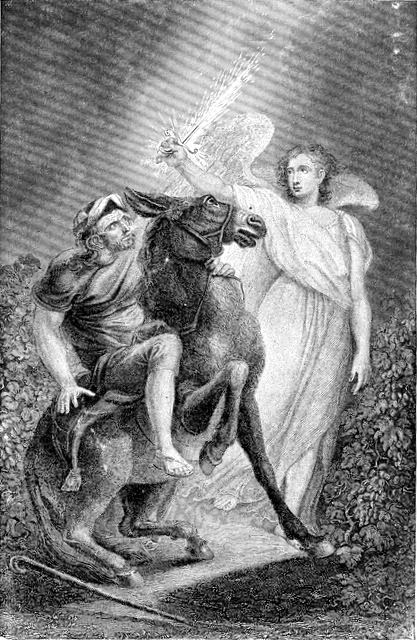
"Balaam's Eyes Were Opened" 
Artist Unknown 
From Treasures of the Bible (Moses)

"Balaam's Eyes Were Opened"   Artist Unknown
"Balaam's Eyes Were Opened"
TODAY'S SPECIAL: Numbers 22:22-40

TO CHEW ON:
"And the Angel of the Lord said to him, 'Why have you struck your donkey these three times? Behold I have come out to stand against you, because your way is perverse before Me.' " Numbers 22:32


Balaam really does want to go with Balak's men. His hastily acquired permission (Numbers 22:20) means that the morning after the second delegation arrives, he is on his way back to Balak with them (though there is no record that God's condition: "'If the men come to call you…'" is ever met).

What happens next on the road—the donkey crushing Balaam's foot, lying down, refusing to go further and actually speaking to Balaam—is a familiar Sunday School story. The Angel of the LORD's words (God's words) to Balaam are sobering (Numbers 22:32-33). He describes Balaam's way as "perverse."

[Perverse - yarat means to precipitate, to be precipitate, to push headlong, drive recklessly.]

The use of that word gives us the sense that Balaam's decision to go with Balak's men is impulsive, reckless, and headstrong. Peter gives us a clue about his motivation. He really did want all that stuff, that attention, that honor:
 "They (Peter, referring here to false teachers) have forsaken the right way and gone astray, following the way of Balaam the son of Beor, who loved the wages of unrighteousness…" - 2 Peter 2:15.

In Balaam's reaction we see a flashing caution light for ourselves and our own tendencies to impetuously push ahead with what we want to do. I like how Priscilla Shirer expresses it:

"I am learning that God will use the appropriate means to reveal His will in His timing. … If you feel an overwhelming urge to act spontaneously, pull in the reins" - Priscilla Shirer, Discerning the Voice of God, pp. 92,93

PRAYER: Dear God, please help me to be aware of my own tendency to act on my own, rashly, spontaneously, and recklessly. Help me, instead, to wait for Your clear timing and direction before I move ahead with plans and projects. Amen.

 *********
Unless otherwise noted all Scripture quotations are taken from the New King James Version®. Copyright © 1982 by Thomas Nelson, Inc. Used by permission. All rights reserved.


Friday, January 02, 2015

Realistic resolutions

List with one item checked off
TODAY'S SPECIAL: Psalm 147:1-20

TO CHEW ON: "He does not delight in the strength of the horse;
He takes no pleasure in the legs of a man.
The Lord takes pleasure in those who fear Him,
In this who hope in His mercy." Psalm 147:10-11


If we're resolution-makers we are in our glory right about now, composing hopeful lists of what to do more and less of this year. The beginning of a new year is, typically, a time to take stock, evaluate where we are in achieving the plans we made in previous years, and set new targets for the year ahead.

To keep us from getting too caught up in our self-made ways, too confident that we can direct the course of life, today's focus verses add a pinch of realism to the resolution-making process.

The "strength of the horse…legs of a man" that God doesn't delight in suggest not only personal self-determination but national. The psalmist may well have introduced these images to plant the idea of an army and war (compare Psalm 33:16,17). He is saying that the outcomes of even nations are not self-determined.

So what, or who, determines success—personal or national? Psalm 147:11 tells us that God is the basis of it all. His mercy, not our cunning and intelligence and strength, foundation successful hopes and plans for the future.

Does that mean we shouldn't plan ahead, make goals, write down what we plan to do more of and less of in the days ahead?

I don't think so. Jesus recommended "counting the cost" of building a tower, going to war, and discipleship (Luke 14:26-33). In His parable of the minas, the man who refused to think ahead to when His master would return but buried His investment capital in the ground as if there would never be a day of reckoning, was punished for not being a good steward of what he had been given (Luke 19:20-26).

However, I believe we need to make our plans in pencil, acknowledging that we are not, finally, the masters of our fate. It is all His mercy, not our strong horses and well-toned selves.

PRAYER: Dear God, thank You for Your mercy that underlies all predictable life. I give my plans for 2015 to You, acknowledging that Your providence and will determine their ultimate achievement, and not me at all. Amen.

MORE: Are we in danger of worshiping our work?

"Beware of any work for God which enables you to evade concentration on Him. A great many Christian workers worship their work. The one concern of a worker should be concentration on God and this will mean that all the other margins of life, mental, moral and spiritual, are free with the freedom of a child, a worshiping child, not a wayward child" - Oswald Chambers, My Utmost for His Highest  (April 23rd reading).


 *********
Unless otherwise noted all Scripture quotations are taken from the New King James Version®. Copyright © 1982 by Thomas Nelson, Inc. Used by permission. All rights reserved.


Tuesday, September 30, 2014

Presumptuous sins

TODAY'S SPECIAL: Psalm 19:1-14


TO CHEW ON: "Keep back Your servant also from presumptuous sins;
Let them not have dominion over me." Psalm 19:13


"Presumptuous sins"? What is this category of sin?

[Presume, the verb from which the adjective presumptuous derives, means to take for granted, assume to be true, to take upon oneself without warrant or permission, dare, venture, to act or proceed over-confidently.

The Hebrew word zed here translated "presumptuous" means arrogant, proud, insolent, presumptuous]

Barnes' Notes on the Bible gives one explanation of "presumptuous sins" in Psalm 19:
"...the reference is particularly to sins which proceed from self-confidence; from reliance on one's own strength. The word does not mean open sins, or flagrant sins so much as those which spring from self-reliance or pride. The prayer is substantially that he might have proper distrust of himself and might not be left by an improper reliance on his own power to the commission of sin" (emphasis added).
When might we be guilty of presumptuous sins?

Perhaps when we act like the man in Jesus' story who congratulated himself for his full barns and depended on them for the future, never acknowledging God (Luke 12:16-21)?

In our time it is easy to live life this way. We have our paychecks or our pensions and the government will take care of us if we lose them. We have our doctors and hospitals so going to God when we get sick is hardly our first thought. We have our books, the internet and TV so where do we need's God's input when we don't know what to do?

The fact that David prays such sins will not have dominion him over tells us he knows and fears they easily could become his habitual response.

I have a feeling I am more prone to presumptuous sins than I care to admit, and need a new sensitivity to see where I am depending on myself and not Him.

PRAYER: Dear God, please alert me to presumptuous habits and behaviours in my life. Help me to label them sin and to turn from pride and self-reliance to reliance on You. Amen.

MORE: "Give Me Jesus" - Fernando Ortega


***********
Unless otherwise noted all Scripture quotations are taken from the New King James Version®. Copyright © 1982 by Thomas Nelson, Inc. Used by permission. All rights reserved.




Bookmark and Share

Sunday, October 27, 2013

Are your prayers tainted?

TODAY'S SPECIAL: Luke 18:9-27

TO CHEW ON:
"'I tell you, this man went down to his house justified rather than the other, for everyone who exalts himself will be humbled, and he who humbles himself will be exalted.'" Luke 18:14

Luke tells us at the beginning of Jesus' parable that this teaching is going to address the attitude of self-righteousness (Luke 18:9). In the story two men go to the temple to pray: an obviously sinful man—a tax collector, and an obviously good one—a Pharisee. But in Jesus' world, the world of the Kingdom of Heaven, things turn out exactly the opposite of what we expect. The reason is shown by the attitude of each man when he prays.

  • The Pharisee has an attitude of pride, obvious even though his words are dressed up in the pious clothes of thanksgiving: "I thank You that I am not like other men…" (Luke 18:11).
  • He has an attitude of comparison. He looks at others, then himself, and concludes that he is so much better (Luke 18:11).
  • He also has an attitude of self-sufficiency, shown by how he lists all the good things that he does (Luke 18:12).

The tax-collector, meanwhile is completely undone. Overcome by his unworthiness, he doesn't even look up but beats his breast as he begs for mercy. There is not a whiff of entitlement in him, not a whisker of the attitude that he could earn God's favor. He throws himself entirely on God's mercy.

And that, says Jesus, is the attitude that moves God's heart, so that the sinner goes home justified while the saint leaves the temple in the same state as he came (Luke 18:14).

The cultural setting and the extent of Jesus' exaggeration may blind our eyes to see how we too may sometimes be the players in this parable. Who of us hasn't ever thought, 'I don't deserve that,' when trouble comes to us despite our faithful service to God? Who hasn't harboured an attitude of at least slight disdain over what we might see as the self-inflicted griefs of the homeless person, the drug addict, the prostitute? Of course these attitudes taint our prayer life, even as the Pharisee's attitudes defiled his.

My Bible commenter sums up this story well:
"Not all prayer is genuine. Attitude is just as important as persistence. Jesus also corrects the mistaken notion that righteousness is a human achievement instead of a gift of God's grace" - J. Lyle Story, New Spirit-Filled Life Bible, p. 1424 (emphasis added).


PRAYER: Dear God, please help me to see and deal with the self-righteousness and pride within me. Amen.

***********

New King James Version (NKJV) Used with permission. The Holy Bible, New King James Version Copyright © 1982 by Thomas Nelson, Inc.

Bible Drive-Thru


Bookmark and Share


Related Posts Plugin for WordPress, Blogger...