Showing posts with label Hosea. Show all posts

Wednesday, May 09, 2018

The amnesia of self-sufficiency

TODAY'S SPECIAL: Hosea 11-14; Psalm 124

TO CHEW ON: "When they had pasture, they were filled;
They were filled and their heart was exalted;
Therefore they forgot me." Hosea 13:6


Forgetting who one's source of supply is and becoming self-reliant and self-satisfied is a state that Bible writers talk about again and again. Here Hosea names it as one of the reasons for Israel's spiritual prostitution.

We find warnings against God-forgetful self-sufficiency throughout the Bible. Let's examine a few to see what conditions predispose to such an attitude.

1. Plenty of food. Forgetting God is often linked with having enough and more than enough to eat; fatness, even obesity - Deuteronomy 32:15; Psalm 17:10; Isaiah 10:16; Jeremiah 5:28; Jeremiah 50:11; Ezekiel 16:49.

2. Full of their own ways - Proverbs 14:14.

3. Spiritual dullards and lethargic. Isaiah talks about people with dull hearts, heavy ears, shut eyes - Isaiah 6:10. Jeremiah speaks of spiritual ease and lethargy - Jeremiah 48:11.

4. Pride, idleness, and ignoring the needs of the poor - Ezekiel 16:49.

5. Preoccupation with the superficial things of life - Luke 6:25.

6. And perhaps the most sobering condition of all, there is no awareness of one's own need - Revelation 3:17.

In our technologically advanced, wealthy society we are more prone than ever to forget that God is our source of supply. Often in the Bible, God's remedy for this was to send trouble so that the people would again remember Him and renew their allegiance to Him.

Though we may feel immune from the troubles of Bible-time people, even for us it really takes very little to feel our vulnerability. A storm wiping out our dwelling, a lost job, a deathly illness, a computer virus, even a few days with no electricity show us how susceptible we are to things beyond our control.

Let's take to heart Hosea's words to Israel, whatever state we find ourselves in.
"O Israel (or insert your name here___________)
You are (or 'easily can be') destroyed.
But your help is from Me.
I will be your King
Where is any other
That He may save you in all your cities?"
- Hosea 13:9-10.


PRAYER: Dear God, please help me to always remember that I need You — no matter how well, or poorly, things are going. Amen.

PSALM TO PRAY: Psalm 124

*****************
Unless otherwise noted all Scripture quotations are taken from the New King James Version®. Copyright © 1982 by Thomas Nelson, Inc. Used by permission. All rights reserved.

Tuesday, May 08, 2018

Sowing and reaping

TODAY'S SPECIAL: Hosea 6-10; Psalm 123


TO CHEW ON: "Sow for yourselves righteousness;
Reap in mercy;
Break up your fallow ground,
for it is time to seek the Lord
Till He comes and rains righteousness on you." - Hosea 10:12


Hosea is full of the imagery of farming and nature. Here are some images from Hosea 10.

Hosea 10:1 talks about how Israel has enjoyed good harvests of the vine. But they have spent it on themselves and on improving idol altars and poles.

Hosea 10:4 talks about their system of justice. It's faulty and as a result "...judgment springs up like hemlock in the furrows of the field." I see weeds sprouting in newly plowed fields. But these aren't just any weeds. These are hemlock — a deadly poison that destroys the land's fruitfulness.

Hosea 10:7-8 talks about how Samaria will become desolate. Her king will be "cut off like a twig on the water" (a severed tree branch floating downriver?). Her idol altars for worshiping idols at Aven will no longer be used but will become the home of thorns and thistles. ("Aven" is short for Beth Aven a play on the name Bethel. Beth Aven means "House of Iniquity." Bethel which means "House of God.")

Hosea 10:10-11 tells us that as a result of their sins, the Israelites will be punished by other nations ("Peoples shall be gathered against them / When I bind them for their two transgressions"). Instead of enjoying the fruit of their work in an independent way ("Ephraim is a trained heifer / that loves to thresh grain"), they will now be forced to do menial work. "Ephraim will pull a plow...Jacob shall break his clods."

In the middle of these gloomy predictions God begs them to again take up farming His way:


"Sow for yourselves righteousness;
Reap in mercy;
Break up your fallow ground
For it is time to seek the Lord,"
It would result in His blessing of rain:

"Till He comes and rains
righteousness on you" - Hosea 10:12.

Instead of complying this is what they have done: "...plowed wickedness...reaped iniquity...eaten the fruit of lies / Because you trusted in your own way..." Hosea 10:13.

It all comes back to the old truism, for us as it did for them:

We reap what we sow.

This is true in nature and it's true spiritually. Let's ask ourselves:
  • What are we sowing personally — watching, reading, listening to, thinking and meditating about?
  • What are we sowing in our families — modeling for our kids and grand-kids, saying with our words and attitudes, spending our money on?
  • What are we sowing in our communities, our churches, cities, the nation? How do we care for the poor? Is our justice system really just? I think about how much our governments depend on income streams from questionable sources like gambling. This can't be a good thing, can it?

PRAYER: Dear God, it's easy to shrug off warnings like we have in Hosea as applicable to people in a different time and place. Help me to take these personally and do what I can about sowing good things in my life, my family's life, my community. Help me to remember to pray for my country and other big areas where I feel like I have little influence. Amen.

PSALM TO PRAY: Psalm 123

MORE: "Someday we will be amazed"
"We never know what God might be growing in the fields of obscurity we are tending. What might God do through the child whose diaper you’re changing, or the grandchild of the boy in your Sunday school class, or the bored teen in your small church, or the coworker who currently mocks your faith in Jesus, or the hardened inmate who looks impossible to reach? We can be confident of this: he is doing more than we can see. He always is. Someday we will be amazed." - Excerpt from a Bethlehem Baptist Church Newsletter "You Never Know What God is Growing"  by Jon Bloom, December 2007. Read entire...   © Desiring God. Website: desiringGod.org 

****************
Unless otherwise noted all Scripture quotations are taken from the New King James Version®. Copyright © 1982 by Thomas Nelson, Inc. Used by permission. All rights reserved.

Monday, May 07, 2018

Spirit of harlotry

TODAY'S SPECIAL: Hosea1-5; Psalm 122

TO CHEW ON: "For the spirit of harlotry has caused them to stray. And they have played the harlot against their God." Hosea 4:12b

"Harlot" is a word we don't use a lot. It simply means an unchaste woman, a whore, a strumpet. "Harlotry" is the trade or behaviour of a harlot.

I am struck by the phrase "spirit of harlotry" in our reading. Hosea points his finger at that spirit or attitude as the underlying cause of Israel's straying. A close look at Hosea 3 and 4 give us information about such a spirit. Here are some of its characteristics:

1. God's law is ignored (Hosea 4:2,6).

2. There is an impact on the natural world of earth and animals (Hosea 4:3).

3. Respect for leaders is absent, replaced by argument and contention (Hosea 4:4-5).

4. Evil multiplies (Hosea 4:7).

5. Dissatisfaction is typical (Hosea 4:10).

6. Addiction is everywhere (Hosea 4:11).

7. People seek advice from occult sources (Hosea 4:12).

8. There is a proliferation of idolatrous customs and rituals (Hosea 4:13).

9. Both men and women are affected (Hosea 4:13b, 14).

10. A rebellious spirit rules the land (Hosea 4:16-18).

As I read that list and look at my own country, I am not reassured. It is uncanny how many of these attitudes are typical of Canada. Do you see any of these characteristics where you live?

What to do? Besides resisting these things in our own lives, I believe we need to focus our prayers against that spirit of harlotry in our own nation. Dick Eastman in his book Love on Its Knees says about praying for nations: "When praying for a nation, we should try to determine which satanic strongholds exist there, then exercise our God-given spiritual authority to confront these bastions."

He lists some general areas of strongholds and how to pray for them.

1. Government strongholds. Intercessors should pay special attention to the political characteristics of a nation...


2. Cultural strongholds. Every nation possesses behavioural characteristics. Collectively we refer to these as the culture of a people, and in some cases such characteristics restrict the spread of the Gospel....


3. Religious strongholds. This focus touches the spiritual characteristics of a land... In some countries of the world today it is virtually impossible to engage in open evangelism because of the religious restrictions...


4. Material strongholds. A final focus regarding strongholds in nations concerns the materialistic characteristics of a land. Some nations appear to be free and have experienced prosperity. Yet there is often lukewarmness in the churches of those nations. Soon apathy toward spiritual things moves a people toward humanism which puts the emphasis on human development and rejects spiritual values...." - Dick Eastman, Love On Its Knees pp. 110-112.

The result of this harlotry spirit for Israel was God's sober warning: "I will destroy your mothers ...forget your children...change their glory into shame" (Hosea 4: 5-7). The nation will be characterized by futility: "The wind has wrapped her up in its wings..." Hosea 4:19.

Let's pray for a turning from the spirit of harlotry in our land, lest we find ourselves setting up for the same fate.

PRAYER: Dear God, please help me to resist the spirit of harlotry in my own life. Then help me to see my country and people realistically and with spiritual insight so I can pray effectively and be salt and light in the ways You direct. Amen.

PSALM TO PRAY: Psalm 122
 
The Bible Project VIDEO: Hosea (Read Scripture Series)


Andrew Peterson has written a powerful song called "Hosea." Hosea - the song - from Andrew Peterson's blog, with the lyrics

****************
Unless otherwise noted all Scripture quotations are taken from the New King James Version®. Copyright © 1982 by Thomas Nelson, Inc. Used by permission. All rights reserved.

Friday, July 26, 2013

Hosea - object lesson life

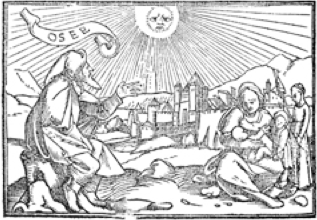
"Hosea and his family"
Woodcut - 1552, artist unknown

TODAY'S SPECIAL: Hosea 1:1-2:1

TO CHEW ON: "When the Lord began to speak by Hosea, the Lord said to Hosea:
'Go, take yourself a wife of harlotry
and children of harlotry
for the land has committed great harlotry
by departing form the Lord.'
So he went..." Hosea 1:2,3

Imagine being told to embark on marriage, one of life's most challenging relationships even in ideal circumstances, knowing your partner has a habit of being unfaithful. That's what God told Hosea to do—marry a prostitute. He did it without argument.

Later, when children came along (and my Bible's notes indicate that Hosea may not even have been their father), God told Hosea to name them odd, doom-filled names:

His firstborn son was to be called Jezreel
It  meant "God scatters, or "God Sows."
"Jezreel was the name of the place where Jehu had killed 70 sons of Ahab (2 Kings 10:11). As Jehu brought an end to the line of Ahab, so now God will bring an end to the whole dynasty of Israel. By 722 B.C. the northern kingdom and its capital will fall." - endnotes to Hosea 1:4 New Spirit-Filled Life Bible, p. 1144.

(That would be in about 28 years from when Hosea penned this if the date of the book's writing—750 B.C.—is accurate.)

His second child—a daughter—was to be named Lo-Ruhamah.
It meant "No Mercy," and 'indicated a lifting of the Lord's compassion from the rebellious nation" (source as above).

A third child—another son—got the name Lo-Ammi.
It meant "Not My People" and "indicated the end of the relationship" (p. 1145 - source above).

Through all this we never hear a whisper of objection from Hosea. He simply listened and complied. Which tells us at least two things about him:

1. He recognized God's voice. Why else would a devout man do such outlandish, even morally questionable things?

2. He trusted God and obeyed with a simplicity of heart that is quite beautiful.

God has never asked me to do such things—probably not you either. But, to my shame, I even argue and try to talk Him out of things that make sense, things like finishing a hard job, making contact with certain people, how I spend my time... Oh for Hosea's jump-to-it attitude whenever God speaks!


PRAYER: Dear God, Hosea's unquestioning obedience is refreshing to see. Help me to follow that pattern of hearing and immediately obeying. Amen.

MORE: "No religious singles in God's eyes"

John Piper on Hosea:

"...God made him (Hosea) live the tragedy of Israel's unfaithfulness by marrying a harlot.... Some Christians who would never dream of marrying a pimp or a prostitute will fall in love with a well-bred unbeliever. But in God's eyes, everyone who forsakes the Lord is a whore. There are no religious singles in God's eyes. Everyone is either faithfully married to God or is a prostitute. God made you (not just Israel) for himself. If you get your kicks from somewhere else, you commit great harlotry against God. That was Israel's condition. And so God took Hosea and said, as it were, "Before I give you a word of judgment and grace, I am going to make you know what it's like to be married to an unfaithful wife. Go, marry a harlot!" Hosea obeys and has a son. His marriage is an acted-out parable of God's relation to Israel.
Read all of "Call Me Husband, Not Baal"
By John Piper. © Desiring God. Website: desiringGod.org


Bible Drive-Thru


Bookmark and Share

Thursday, January 10, 2013

Are you a backslider?

TODAY'S SPECIAL: Hosea 11:1-11

TO CHEW ON: "My people are bent on backsliding from Me.
Though they call to the Most high,
None at all exalt Him." Hosea 11:7

We so easily turn from God's highest and best for us. The Bible has a word for that: backsliding - "to return to wrong or sinful ways." Hosea characterized his audience as "bent on backsliding." Oh, they were religious all right, but their religion was heartless--a lifeless sham that didn't please God at all.

We can learn a lot about backsliding by looking at the Bible passages that talk about it. Let's think of the conditions they describe as spiritual symptoms and ask ourselves, do I exhibit any of these?

Symptoms of backsliding include:
  • Self-absorption (Proverbs 14:14).
  • Religious lawlessness and independence (Matthew 24:12).
  • Bondage to ritual (Galatians 4:9).
  • Loss of spiritual love and enthusiasm (Revelation 2:4).

Just like a physical illness puts us out of commission, the chronic backslider may find him or herself, spiritually laid up.

Some of the results of backsliding are:
  • It makes the victim unfit for kingdom work (Luke 9:62).
  • It results in God's displeasure and discipline (Hebrews 10:38-39).

What brings about this condition? The Bible shows us that there is a variety of spiritual germs and viruses that cause backsliding to begin and continue.

Causes of backsliding include:
  • An absence of spiritual leadership. When Moses was on Mount Sinai with God, wishy-washy Aaron, who Moses had put in charge of the people, easily gave in to the peoples' demands to make a calf idol for them to worship (Exodus 32:1-4).
  • Evil associates - Solomon turned from following God by letting his idolatrous wives influence him (1 Kings 11:4).
  • Worldly success - Amaziah returned from successful battle only to set up images for worship (2 Chronicles 25:1-2,14).
  • Shallowness - according to Jesus' warning in the parable of the sower and the seed (Luke 8:13).
  • An empty life - according to Jesus' story, the person who was freed from demonic oppression, but neglected to fill the void with Godly things was soon under the same influences as before (Luke 11:24-26).
  • Lack of spiritual insight, brought about by lack of faith (John 6:63-66).
  • Being in love with the world - as Demas, who left Paul, was (2 Timothy 4:10).

Do you see any symptoms of backsliding in yourself? I know I do in me. Let's follow Hosea's advice:

 Come, and let us return to the LORD;
      For He has torn, but He will heal us;
      He has stricken, but He will bind us up.
After two days He will revive us;
      On the third day He will raise us up,
      That we may live in His sight.
 
 Let us know,
      Let us pursue the knowledge of the LORD.
      His going forth is established as the morning;
      He will come to us like the rain,
      Like the latter and former rain to the earth.

   
    Hosea 6:1-3
PRAYER: Dear God, I so easily get distracted from Your highest and best for me. Please show my my points of vulnerability toward backsliding. Help me to fall in love with You again. Amen.

MORE: "Holy Spirit Rain Down" sung by Hillsong


Bible Drive-Thru


Bookmark and Share


Friday, May 27, 2011

Confession template

TODAY'S SPECIAL: Hosea 14:1-9

TO CHEW ON: "Take words with you
And return to the Lord
Say to Him,
'Take away all iniquity
Receive us graciously,
For we will offer the sacrifices
of our lips.'" Hosea 14:2

Nothing helps the act of confession like speaking it aloud to God in words. There is something about actually saying the words that cements feelings of remorse into something more.

One of the most well-known prayers of confession in the Bible comes from David. Psalm 51 is David's prayer of confession and repentance, prayed after the prophet Nathan confronted him about his affair with Bathsheba -- that one-night-stand that morphed into murder after David got Bathsheba pregnant and had her husband killed to cover up his sin (2 Samuel 11-12:15). Though it took a pointed story to get David to acknowledge his sin, once he did, his repentance seems altogether genuine.

Let's look at Psalm 51, taking from it a template for confession. (I'm not sure how important the order is. I'll roughly follow the order of the psalm.) Here are some of the things David, and we, can express in words to God.

- Ask for forgiveness (Psalm 51:1).

- Name our sin (51:3, 14). Though at first David calls his action simply "my sin" and "my transgressions," later he refers to it as the "guilt of bloodshed." It's good to be specific.

- Acknowledge that our deed was an action against God (as well as a person, if it was a sin against another person) (Psalm 51:4).

- Ask for cleansing (51:2, 7, 10).

- Ask for restoration (51:12).

- Accept God's forgiveness -- and that you are forgiven (51:15-17).

- Anticipate and expect that God will continue to use you (51:13).

Our God is so merciful, His forgiveness so unconditional, it's easy to become blasé about our sin. Thoughts like, Oh, God knows my heart; He knows I'm sorry, easily follow sinful actions. However, when we come to God with words, our off-handed mental penitence changes in a subtle way, becoming more real, more serious, more owned.

Of course there may be repercussions to our sin, as there were with David's. Even God's forgiveness doesn't blot out sin's consequences.

PRAYER: Dear God, please help me to learn about true confession and how helpful it is to say the words aloud. Amen.

MORE: "Create In Me A Clean Heart" by Keith Green


Do your 8-12-year-olds have daily devotions? Point them to Bible Drive-Thru.

Wednesday, May 25, 2011

Are you a backslider?

TODAY'S SPECIAL: Hosea 11:1-11

TO CHEW ON: "My people are bent on backsliding from Me.
Though they call to the Most high,
None at all exalt Him." Hosea 11:7

We so easily turn from God's highest and best for us. The Bible has a word for that: backsliding - "to return to wrong or sinful ways." Hosea characterized his audience as "bent on backsliding." Oh, they were religious all right, but their religion was heartless -- a lifeless sham that didn't please God at all.

We can learn a lot about backsliding by looking at the Bible passages that talk about it. Let's think of the conditions they describe as spiritual symptoms and ask ourselves, do I exhibit any of these?

Symptoms of backsliding include:

Just like a physical illness puts us out of commission, the chronic backslider may find him or herself, spiritually laid up.

Some of the results of backsliding are:
  • It makes the victim unfit for kingdom work (Luke 9:62).

What brings about this condition? The Bible shows us that there is a variety of spiritual germs and viruses that cause backsliding to begin and continue.

Causes of backsliding include:
  • An absence of spiritual leadership. When Moses was on Mount Sinai with God, wishy-washy Aaron, who Moses had put in charge of the people, easily gave in to the peoples' demands to make a calf idol for them to worship (Exodus 32:1-4).
  • Evil associates - Solomon turned from following God by letting his idolatrous wives influence him (1 Kings 11:4).
  • Worldly success - Amaziah returned from successful battle only to set up images for worship (2 Chronicles 25:1-2,14).
  • Shallowness - according to Jesus' warning in the parable of the sower and the seed (Luke 8:13).
  • An empty life - according to Jesus' story, the person who was freed from demonic oppression, but neglected to fill the void with Godly things was soon under the same influences as before (Luke 11:24-26).
  • Lack of spiritual insight, brought about by lack of faith (John 6:63-66).
  • Being in love with the world - as Demas, who left Paul, was (2 Timothy 4:10).

Do you see any symptoms of backsliding in yourself? I know I do in me. Let's follow Hosea's advice:

 Come, and let us return to the LORD;
      For He has torn, but He will heal us;
      He has stricken, but He will bind us up.
After two days He will revive us;
      On the third day He will raise us up,
      That we may live in His sight.
 
 Let us know,
      Let us pursue the knowledge of the LORD.
      His going forth is established as the morning;
      He will come to us like the rain,
      Like the latter and former rain to the earth.
   
    Hosea 6:1-3
PRAYER: Dear God, I so easily get distracted from Your highest and best for me. Please show my my points of vulnerability toward backsliding. Help me to fall in love with You again. Amen.

MORE: "Holy Spirit Rain Down" sung by Hillsong


Do your 8-12-year-olds have daily devotions? Point them to Bible Drive-Thru.

Monday, May 23, 2011

Spiritual watchmen

TODAY'S SPECIAL: Hosea 9:1-17

TO CHEW ON: "But the watchman of Ephraim is with my God; But the prophet is a fowler's snare in all his ways — Enmity in the house of his God." Hosea 9:8

Continuing on with his denouncement of Israel, Hosea speaks of another means of warning — the watchman. The watchman Tsaphah — was a "Person who peered into the distance, spied, kept watch, scoped something out especially in order to see approaching danger and to warn those endangered" - New Spirit-Filled Life Bible, p. 1152.

  • Sometimes watchmen were king's guards (1 Samuel 14:16).
  • More often they were men positioned in a place that commanded a view of the surrounding territory of a city, like in a tower or on a city wall. When they saw suspicious or threatening activity it was their job to alert the city's inhabitants of danger (2 Kings 9:17-18).
  • Often in the Bible, watchmen were spiritual, the prophets that God sent to warn the people of things to come unless they changed their ways. Such was the case with Ezekiel. God told him plainly that he was a prophetic spiritual watchman (Ezekiel 3:17).
  • Like their natural counterparts, these spiritual watchmen could be good or bad. Sometimes they did their job well and saw good results (Isaiah 52:8). At other times they refused to do their job. Jeremiah (Jeremiah 6:17) talks about prophet watchmen who refused to listen for the sound of the warning trumpet (shofar — yesterday's devotion) and so didn't warn the people.
  • It was often the watchman's job to actually blow the trumpet (shofar) that sounded the warning. In a probing section of Ezekiel there is an explanation of how this worked. If the watchman saw danger, sounded the trumpet and the people didn't listen, their blood would be on their own hands. But if he saw trouble and didn't blow the trumpet, the blood of the people who perished in the calamity that followed would be on the watchman's hands (Ezekiel 33:2-7).

Hosea was a responsible watchman. Though our verse describes how the people viewed him (as an annoying fowler's snare - a bird trap) he was faithful and consistent in speaking his unpopular message.

What kind of watchmen are we? In this time when there is no appetite to hear about God's objective standard of right and wrong, are we still faithful in talking about sin and God's remedy for it? Or are we guilty of altering the message, saying there really isn't a problem? Or are we altogether silent?

Ezekiel's disturbing warning haunts me as I consider my own action/inaction in this regard:

"But if the watchman sees the enemy coming and doesn’t sound the alarm to warn the people, he is responsible for their captivity. They will die in their sins, but I will hold the watchman responsible for their deaths" - Ezekiel 33:6 NLT

PRAYER: Dear God, this is a sobering word to me. Help me to be a better watchman on the wall of my family, community, country, unafraid to speak about and explain what You say about our lostness and eventual destination without You. Amen.

MORE: Holy Visitation - Lyrics by Charlie Hall, sung by Rita Springer

Sound the alarm,
gather the people,
gather the elders,
Let the ministers wail...


Sound the alarm
Awaken the watchmen
Open their ears let their voices be loud
We prophesy, You'll come to this nation
Touch this generation with a holy visitation.


Bible Drive-Thru


Bookmark and Share

Sunday, May 22, 2011

Shofar

TODAY'S SPECIAL: Hosea 7:8-8:14

TO CHEW ON: "Set the trumpet to your mouth!" Hosea 8:1

In the midst of poetic images of cakes and ovens, doves and eagles, treacherous bows and wild donkeys comes a very real sound — the sound of the trumpet.

A Hebrew trumpet (shofar) was made from a curved animal horn. It was the national trumpet of the Israelites and used on military and religious occasions to summon the people (New Spirit-Filled Life Bible, p. 1151, New Bible Dictionary p. 855).

The shofar's sound communicated a variety of messages.
  • It was first heard in Exodus when it heralded God's coming down and His presence on Mount Sinai at the time He gave Moses the law (Exodus 19:16, 19, 29 and Exodus 20:18). It said God is holy.
  • The shofar was an important part of God's strategy to defeat Jericho (Joshua 6:1-20). It said God is powerful.
  • In Ezekiel 33:2-9 the prophet's voice became the shofar, warning the city of danger. That would also be the case here in Hosea. This shofar said, God is merciful in His warnings, but He judges sin.
  • The shofar was also used in religious services. It announced the Day of Atonement (Leviticus 25:9) and the return of the ark to Jerusalem (2 Samuel 6:15). It said God invites and welcomes worship.
  • All these trumpet sounds remind me of another trumpet, called the "last" one. Paul refers to it in 1 Corinthians 15:52 and again in 1 Thessalonians 4:16: "For the Lord Himself will descend from heaven with a shout, with the voice of the archangel, and with the trumpet of God." This time it says, Jesus is coming again!
As we meet with fellow Christians today wherever we attend church, let's do so with an awareness of the messages of the shofar: God is holy, powerful, and merciful but just. He invites our worship. But in order to welcome the sound of the shofar of His return, we need to be ready. We get ready by accepting His offer of eternal life. (John 14:6; John 3:16).


PRAYER: Dear God, thank You for Your word which communicates truth in multisensory ways. May I live with these shofar sounds in mind today. Amen.

MORE: Sound of the Shofar


Bible Drive-Thru


Bookmark and Share

Saturday, May 21, 2011

God wants relationship

TODAY'S SPECIAL: Hosea 6:1–7:7

TO CHEW ON: "For I desire mercy and not sacrifice;
And the knowledge of God more than burnt offerings." Hosea 6:6

In this meaning-packed little verse we discover what God did and didn't want from Israel back in Hosea's time.


He didn't want sacrifices and offerings that were insincere and showy piety. His feelings about sacrifices made with the wrong attitude is clear. Here, for example, are His strong words through prophet Micah:

What can we bring to the Lord?
      What kind of offerings should we give him?
   Should we bow before God
      with offerings of yearling calves?
 Should we offer him thousands of rams
      and ten thousand rivers of olive oil?
   Should we sacrifice our firstborn children
      to pay for our sins?
 No, O people, the Lord has told you what is good,
      and this is what he requires of you:
   to do what is right, to love mercy,
      and to walk humbly with your God. - Micah 6:6-8, NLT

What He did want was relationship. It's the kind of relationship wrapped up in the phrase "knowledge of God."

[Knowledge = da'ath  means knowledge, understanding, intelligence, wisdom, discernment, skills.]

Earlier in his message, Hosea had pointed to a lack of knowledge as the reason why the people were in their present distressed state: "My people are destroyed for lack of knowledge" Hosea 4:6

Jesus referred to this knowledge not as knowing something intellectually, but knowing a person: "And this is eternal life, that they may know You, the only true God and Jesus Christ whom You have sent" - John 17:3. It's a relationship powerful enough to change mere life to eternal life.

He also wanted mercy. The way Jesus applied this verse (He quoted Hosea 6:6 at least twice - both times in response to criticism from the Pharisees) sheds light on what receiving and extending mercy might look like in our own lives.

In one instance it was after the Pharisees chided Him for eating with tax collectors and sinners. He replied: "Those who are well have no need of a physician but those who are sick. But go and learn what this means, 'I desire mercy and not sacrifice.' For I did not call the righteous but sinners to repentance" - Matthew 9:13.

Another time the Pharisees were critical of Jesus' hungry disciples harvesting a few grain heads on the Sabbath. According to the Pharisees, this was work and work of any kind on the Sabbath was a strict no-no. Jesus debunked their rule with examples of historical exceptions, concluding: "But if you had known what this means, 'I desire mercy and not sacrifice,' you would not have condemned the guiltless. For the Son of Man is Lord even of the Sabbath" Matthew 12:7-8.

For us today, this little verse speaks on at least two issues:
  • God is still more concerned with our knowing Him than serving Him or keeping rules — especially when those two things are done in a rote way to soothe our consciences so that we can keep on living the way we like.
  • He extends mercy to us, but also expects us to give this mercy to others, so that they too will know God in relationship.
PRAYER: Dear God, Thank You for pursuing a relationship with me by sending Jesus. Now Jesus' words, "Go and learn what this means, 'I desire mercy and not sacrifice,'" feel like a stone in my shoe. Help me to understand this mercy, and live it out in the circumstances of my life. Amen.

MORE: Mercy

Enjoy the lively "Mercy is Falling".


Bible Drive-Thru


Bookmark and Share

Friday, May 20, 2011

Seek (baqash) My face

TODAY'S SPECIAL: Hosea 5:1-15

TO CHEW ON: "I will return again to My place
Till they acknowledge their offense.
Then they will seek My face;
In their affliction they will earnestly seek Me." Hosea 5:15

Though it is surely more 'politically correct' these days to speak about how God responds to our sinful ways with grace (and He does that) another response is on display in our passage today. Hosea warns of three negative ways God will respond to Israel's the habitual sinning:

1. He will withdraw from them (Hosea 5:6)
God will be silent. He will feel distant.

2. He will come as destruction from within (Hosea 5:12).
A wool garment taken out of storage and found to be riddled with moth holes, or a bathroom wall covering mould and dry rot come to mind. Inner destroyers like moths and rot work silently, secretly, but surely. They may refer to hidden sins like cheating, stealing, and sexual secrets.

3. He will come as a predator (Hosea 5:14).
For Israel this happened when they were carried away into exile. For us it could be natural disasters, political troubles or personal tragedy.

God does not send or allow these things because He is mean or vindictive. Rather they are to get our attention so that they will again seek him.

[Seek = baqash  means to seek, to diligently look for, to search earnestly until the object of the search is located. Baqash can apply to seeking a person, a particular item, or a goal. Peace is to be searched for earnestly - Psalm 34:14. The Lord's face, that is His presence, must be especially sought (Psalm 27:8) "Word Wealth - seek," New Spirit-Filled Life Bible, p. 1149).]

We too can examine our lives to see if God's apparent absence is His discipline. He has not interfered with us as we have allowed secret sins to feed on our integrity like moths on wool, or rot on organic material. He has not intervened as outright tragedy has carried away our comfortable existence. If not us, maybe these things are happening to someone we love.

Let's resist allowing bitterness or anger toward God take root in our lives as a result of these devastations. Rather, may we understand them as God's invitation to seek Him more fervently with baqash earnestness, diligence and perseverance.

PRAYER: Dear God, help me to see the things that happen in my world — both the big, grand-scale things and the day-to-day of my life — through spiritual eyes. Help me to search my heart for reasons why You feel absent. Help me to root out secret sins. May I understand trouble as an invitation to crowd closer to You.

MORE: "God is determined to make you pure and holy and right..."

"There is no heaven with a little corner of hell in it. God is determined to make you pure and holy and right; He will not allow you to escape for one moment from the scrutiny of the Holy Spirit. He urged you to come to judgment right away when He convicted you, but you did not; the inevitable process began to work and now you are in prison, and you will only get out when you have paid the uttermost farthing. 

'Is this a God of mercy, and of love?' you say. Seen from God's side, it is a glorious ministry of love. God is going to bring you out pure and spotless and undefiled; but He wants you to recognize the disposition you were showing - the disposition of your right to yourself. 

The moment you are willing that God should alter your disposition, His recreating forces will begin to work. The moment you realize God's purpose, which is to get you rightly related to Himself and then to your fellow men, He will tax the last limit of the universe to help you take the right road. Decide it now - 'Yes, Lord, I will write that letter to-night;' 'I will be reconciled to that man now'"  - Oswald Chambers, My Utmost for His Highest, July 1 reading.


Bible Drive-Thru


Bookmark and Share

Wednesday, May 18, 2011

A temporal spanking?

TODAY'S SPECIAL: Hosea 2:2-23

TO CHEW ON: "For she did not know
That I gave her grain, new wine, and oil,
And multiplied her silver and gold —
Which they prepared for Baal.
Therefore I will return and take away
My grain in its time
And My new wine in its season
And will take back My wool and My linen
Given to cover her nakedness." Hosea 2:8-9

When children are little, physical punishment is something they understand often better than words and reasoning (even though spanking is certainly out of favour with the modern parenting gurus). Here God threatens to administer a temporal spanking to Israel, who has been pursuing affairs with idols, just as Hosea's wife Gomer has gone after other men.

God's tone is one of hurt aroused to the point of indignation as He speaks to Israel about her unfaithfulness:

"She did not know that I gave her grain, new wine, oil; Therefore I will return and take away My grain...and new wine...She has said 'These are my wages that my lovers have given me,' so I will make them a forest..." Hosea 2: 8, 9, 12.

Israel is interpreting her physical abundance as the payment for her allegiance to Baal instead of coming from the God of heaven. So God says, in effect, I'll take it away. Maybe that will drive you back to Me.

As I read this, I think how we are often like that too. We attribute success, provision, all the good stuff we have as resulting from our own hard work, or keen intellect, or stable government, or luck, or karma — anything but God. It's interesting to view, as a contrast, the range of temporal blessings that the Bible says come from God's hand and are an evidence of His favour:*

  • The wealth of the patriarchs - Genesis 24:35; Genesis 26:12.
  • The sturdiness of the Israelites' clothes and shoes while they wandered for 40 years over rough desert terrain - Deuteronomy 29:5.
  • The well-being of Obed-Edom's household while he housed the Ark of the Covenant - 2 Samuel 6:11.
  • The riches and honour of Solomon, given as a by-product of his request for wisdom - 1 Kings 3:13.
  • Rain and the seasons to make earth productive - Psalm 65:9; Acts 4:17.
  • The success of secular rulers to the extent that even the animal kingdom is on their side, as they serve God's purposes (though they may not realize or acknowledge it) - Jeremiah 27:6
  • Along with material wealth, the ability to flourish spiritually - 2 Corinthians 9:10.

Do we acknowledge the real Source of the myriad blessings in our lives? When week after week there is food in the fridge, money for gas, health to live comfortably, do we thank God? Or do we, like the Israelites, attribute those blessings to ourselves or someone else? If we do we may, like them, be at risk of God withdrawing His bounty as He seeks to draw our attention back to Him.


PRAYER: Dear God, help me to understand the degree to which I am dependent on You for all the good things in life. Help me to be a person of habitual thankfulness for Your blessings to me throughout my days. Amen.


MORE: "How is God making my life full right here, right now?"

In her book One Thousand Gifts, Ann Voskamp writes about how nurturing an attitude of gratitude toward God changed the outlook of her life. Moira Brown of 100 Huntley Street interviewed Ann about the book in March 2011. In the two segments below, Ann explains what brought about the focus of gratitude in her life and how she continues to foster it.

Part 1 − 8:30 minutes

Part 2 − 9:38 minutes

*Email subscribers: to read the verses without looking them up, visit the article on the web, where a text box widget displays the verse when you hover the mouse over the reference.


Bible Drive-Thru


Bookmark and Share

Tuesday, July 27, 2010

Know Him

TODAY'S SPECIAL: Hosea 2:14-3:5

TO CHEW ON: "I will betroth you to Me forever;
Yes, I will betroth you to Me
In righteousness and justice
In lovingkindness and mercy
I will betroth you to Me in faithfulness
And you shall know the Lord." Hosea 2:19-20

God lays bare His heart in Hosea with almost shocking vulnerability. Like a rejected earthly lover, we see His reflex to hurt the one who has hurt Him: "I will take away…take back…uncover…cause mirth to cease…destroy…punish" (Hosea 2:9-13).

Then He will win His loved one (Israel) back "…allure her…speak comfort…give her..." He recalls their early relationship -- the days Israel was completely dependent on Him during the exodus from Egypt to Canaan. He wants that relationship with her again. Then she will call Him Husband, not Master. She will be so taken up with Him, she will forget the names of her former lovers. She will know him (Hosea 2:14-18).

There was the nub of the matter. God wanted a relationship with His people. He wanted them to know Him. He still wants such a relationship with us. The outward trappings of religious ritual and observance are not what He's after. Rather, He wants a relationship that invades us, takes us over, claims our loyalties to the deepest levels.

It's easy to fool ourselves into thinking we are already there. Until we observe our natural reactions to life. What are our preoccupations? Our pursuits? Do we worry? Our answers to these questions may show us we still have a long way to go before we can say He is truly engraved on our minds and hearts -- that we are experiencing the eternal life potential of knowing Him.

PRAYER: Dear God, please show me where I am going after other lovers. Help me to know You at a deep, personal, life-impacting level. Amen.

MORE: "Knowing You" by Graham Kendrick, sung by Robin Mark


Do your 8-12-year-olds have daily devotions? Point them to Bible Drive-Thru.

Monday, July 26, 2010

Living object lesson

"Hosea"
by James Tissot

TODAY'S SPECIAL: Hosea 1:1-2:13

TO CHEW ON: "When the Lord began to speak by Hosea, the Lord said to Hosea:
'Go take yourself a wife of harlotry
And children of harlotry,
For the land has committed great harlotry
by departing from the Lord." Hosea 1:2

Of all the incredible things God asked the Old Testament prophets to do, His assignment for Hosea was among the most shocking. He was to marry a prostitute. His children were called "children of harlotry," either because they were children of a known prostitute or because they weren't even necessarily Hosea's biological kids.

God asked other prophets to be object lessons of His message too. Isaiah was to name his children names that foretold coming events. For example, one of his kids was to be named Maher-shalal-hashbaz, meaning "speed the spoil, hasten the booty," which referred to impending international events (Isaiah 8:3-4). He was also told to go around partially clothed for a while as a picture of how destitute the people of Egypt and Ethiopia would be when they were led away captive (Isaiah 20:2-4). God instructed Ezekiel to lie on his left side, and then his right a required number of days and in this way picture the siege of Jerusalem (Ezekiel 4:1-6).

God was clear in what He was trying to communicate through Hosea's choice of Gomer for a wife. He was picturing the way His people had let themselves be lured away by other religions. He portrayed then as fickle and making fools of themselves by pursuing other lovers (gods). When their search came to nothing, they returned to their "first husband" (2:7) as Gomer left then returned to Hosea.

If God sent a prophet among us today, I wonder what kind of object lesson he would be asked to live out. Perhaps God would draw attention to our obsession with technology by having His prophet make a home with a demanding robot.

Or perhaps he would open our eyes to see how things are often not as they look by choosing as His messenger a person who seemed healthy but was actually full of deadly cancer.

Or would He be able to point to what we all aspire to be -- pure, beautiful and waiting for His return -- by using a woman prophet, glowing and radiant in gorgeous bride-wear (Revelation 21:2,9)?

PRAYER: Dear God, please help me to learn about myself and my tendency to stray from you pictured in these prophetic object lessons. May I align my life with the highest ideals in Your word. Amen.

MORE: A modern Hosea story

Redeeming Love is a fictional portrayal of the Hosea / Gomer story by Francine Rivers. Set in California's gold country in the 1850s, the book tells the story of the prostitute Angel and Michael Hosea, who loves her with a love that never gives up. Since the book first came out in 1997 it has sold over 1 million copies.


Do your 8-12-year-olds have daily devotions? Point them to Bible Drive-Thru.

Related Posts Plugin for WordPress, Blogger...