Showing posts with label stewardship. Show all posts

Monday, October 29, 2018

Steward

TODAY'S SPECIAL: 1 Corinthians 3-4; Psalm 142

TO CHEW ON:"Moreover it is required in stewards that one be found faithful." 1 Corinthians 4:2

In Paul's day a steward was an important part of wealthy households. It was the steward's job to oversee particularly the feeding of the household. He was in full charge and accountable only to the owner.

A steward in our time has no less responsibilities. He is, by my dictionary:
1) One entrusted with the management of property, finances, or other affairs not his own — an administrator.

2) One in charge of buying provisions, managing servants etc.

3) One with a unique role in various settings:
  • on a ship, in charge of food and the guests' comforts.
  • on an airplane or bus, one who waits on the passengers.
  • in a union, a shop steward is the intermediary between the workers and the union leadership.

When Paul was calling himself a steward he was identifying himself as a person who dedicated himself to the spiritual nourishment needs of others. Whatever his role (and he had many: explainer of God's word, teacher, preacher, church planter, mentor) he lived it under the overarching principles of being a "servant of Christ" which included being "a steward of the mysteries of God" (1 Corinthians 4:1).

Though we may not have an official position of leadership, all of us have those in our lives to whom we can be spiritual stewards. Whether those who look to us are our children, or friends, or members of our Bible study class, or whole churches, let's take personally Paul's challenge to be faithful stewards of the things God has entrusted to us:
  • God's word - the Bible, in our country freely available in multi-translations with an accompanying embarrassment of riches in the Bible helps and commentaries department.
  • Time, talents and opportunities (from internet access to an opening in conversation with our local barista).

We could make the faithful steward in the story Jesus told, our model (Luke 12:42-43).

PRAYER: Dear God, what a privilege to be a steward of the eternal truths of the Bible. Help me to be faithful. Amen.

PSALM TO PRAY: Psalm 142

************
Unless otherwise noted all Scripture quotations are taken from the New King James Version®. Copyright © 1982 by Thomas Nelson, Inc. Used by permission. All rights reserved.


Sunday, September 30, 2018

Our stuff

TODAY'S SPECIAL: Luke 12-13; Psalm 118


TO CHEW ON: "And He said to them, 'Take heed and beware of covetousness, for one's life does not consist in the abundance of things he possesses.'" Luke 12:15


Jesus, the ultimate teacher, sure knew how to grab those teaching moments. Here the request of someone in the crowd for Him to intervene in an estate division problem gave rise to a proverb and a parable about the stuff people own.

The man who called out, "Teacher, tell my brother to divide the inheritance with me," was probably surprised when Jesus took him back to considering the basics of possessions. One of the ideas that He alluded to in His answer: "...one's life does not consist in the abundance of the things he possesses," is the fact that people very easily let their possessions define them.

We still do that. Notice, for example, how TV commercials tap into our desire to project a good image. One way, according to the ads, is by being the owner of that new car, living in that home on the golf course development with all its amenities, surrounded by brand-name fixtures and furniture.

Jesus' parable draws our attention away from the glittery stuff we love to posses to our impending separation from those things by death. It's inevitable. It may be much nearer than we think. We can't predict when it will arrive in any case. When it does come, "this night" or that, and our souls are required of us, "whose will those things be which you have provided?"

The implied answer is, "They won't be ours." We'll leave them all behind.

A footnote in my Bible says it concisely:

"Possessions neither give life nor provide security; because death separates from things. The fool in the parable mistakenly looked upon his possessions as his own, not gifts dependent upon the will of God and to be used unselfishly." - New Spirit Filled Life Bible, p. 1413.

We can't get through life without possessions. But we can hang onto them loosely, knowing they are lent for a little while. The challenge is to steward them wisely and in a way that will show us "rich toward God." 

PRAYER: Dear God, please help me to have Your perspective on possessions. She me how to use them in a way that pleases You. Amen.

PSALM TO PRAY: Psalm 118

*****************
Unless otherwise noted all Scripture quotations are taken from the New King James Version®. Copyright © 1982 by Thomas Nelson, Inc. Used by permission. All rights reserved.

Wednesday, September 05, 2018

The biggest pay check you'll ever get

Servant hiding his talent - Artist unknown
TODAY'S SPECIAL: Matthew 25-25; Psalm 93

TO CHEW ON: " ' For to everyone who has, more will be given and he will have abundance; but from him who does not have, even what he has will be taken away.' " Matthew 25:29

After a career which included many stages (hospital clerk, medical records clerk, school teacher, visiting homemaker, medical transcriptionist, stay-at-home mom) it was this parable that spoke to me about pursuing my lifelong interest in writing.

Note how the word for the unit of money used in the NKJV ("talent") is the same word we use to describe "a particular and uncommon aptitude for some special work or ability; a faculty or gift" (Funk and Wagnalls Dictionary). Thus the connection between stewarding what we have—money and abilities—is impossible to miss.

Some things that jump out at me from this story:
1. Both of the servants who invested their talents received the same commendation even though their returns were different (Matthew 25:21,23).

2. The master's commendation doesn't lead to a holiday but to more responsibility: "… you have been faithful over a few things. I will make you ruler over many things" - (Matthew 25:21,23).

3. This work of faithful stewardship is the doorway to joy: "Enter into the joy of your lord" are the master's final words to them (Matthew 25:21,23).

4. The servant who received one talent seems to have had an underlying critical attitude. He justified his non-action by suggesting that the master was cruel and unpredictable (Matthew 25:24).

5. He also confessed to fear—so great it paralyzed him and he hid the talent away so he could return it, uninvested, to the master (Matthew 25:25).

We can apply things from this story to our lives.

Like the master in the parable gave different amounts of money to different servants, God gives us different talents, abilities, and resources. Let's not become jealous and bitter because we have only one talent while the person beside us has five, or boastful because it's the other way around. Paul addresses this issue with the Corinthians when he says:
"For who makes you differ from another? And what do you have that you did not receive? Now if you did indeed receive it, why do you boast as if you had not received it?" - 1 Corinthians 4:7.

God doesn't expect a five-talent return from a two-talent person. Let's steward the money and abilities we do have and not denigrate our increase by comparing it to someone else's.

Let's conquer fear. We can always find reasons—multiple reasons—why our talent investment efforts will fail. But these fear-whispers are not from God. When He puts a talent in our hands and gives us the investment idea, we can go forward with the assurance that:
"I can do all things through Christ who gives me strength" - Philippians 4:13.

When our faithfulness leads to more and larger responsibilities, let's not shrink back into retirement or laziness but embrace the new load with the knowledge that using our gifts to serve the master is the doorway to joy. It is the key to receiving what I believe will be the biggest pay check we could ever get—God's "Well done, good and faithful servant."

PRAYER:
Dear God, thank You that in Your wisdom You give us differing abilities and opportunities. Help me today to steward well what You have entrusted to me. Amen.

PSALM TO PRAY: Psalm 93

 *********
Unless otherwise noted all Scripture quotations are taken from the New King James Version®. Copyright © 1982 by Thomas Nelson, Inc. Used by permission. All rights reserved.


Sunday, September 02, 2018

Prepare to be surprised

child doing handstand
TODAY'S SPECIAL: Matthew 19-20; Psalm 90

TO CHEW ON: " ' But many who are first will be last, and the last first.' " Matthew 19:30


Again and again Jesus reminds His disciples that the kingdom of heaven is characterized by reversal. That's the word the Thompson Chain Bible uses to head a section that traces the kinds of reversals taught and illustrated in the Bible.

[Reverse: Adjective: having a contrary or opposite direction or character, order etc., turned backward. Noun: that which is directly opposite or contrary; a change to an opposite position, direction, state. Verb: to turn upside down, inside out, to turn in an opposite direction - Funk & Wagnall's Dictionary.]

- God reverses fortunes - Psalm 75:7; 107:41; "…Nothing shall remain the same…" Ezekiel 21:26.

- God hates pride. The proud person is a target for reversal - Psalm 147:6.

- God can remove the life props we make for ourselves - Isaiah 22:25. He can destroy the things we have accomplished and in which we trust: "The lofty city; He lays it low…" - Isaiah 26:5.

- God can bring down rulers - Isaiah 40:23; Luke 1:52. Nebuchadnezzar is an example of this, when he goes from being a proud king to a mentally deranged "beast" - Daniel 4:28-33.

- God sees the poor, neglected by the rich and reverses their state - Luke 6:25; 16:25.

- On the other hand, He also rewards good stewardship with more, that is, gives more to the person who already has while taking away from the one who has little - Matthew 25:29.

- Our expectations will be challenged. Over and over we hear Jesus say: " 'The last shall be first, the first last' " - Matthew 19:30; 20:16; Mark 10:31; Luke 13:30.


Some thoughts we can take from this into our day:

1. God hates pride. When we give ourselves credit for what we have and get puffed over what we've done, we set ourselves up for reversal.

2. The material things in which we put our confidence aren't as trustworthy as we think.

3. The world's rulers, those we love or hate, follow or resist, admire or fear, are targets for God's reversal. Let's remember that as we pray for our nation and the world.
 

4. We are responsible to be good stewards of what we have, whether it's much or little.

5. Knowing all the above, we'll probably still be surprised when, someday, we stand before God and see things as they really are.


PRAYER:
Dear God, please help me to live in the upside down, back-to-front paradigm of the kingdom of heaven while I'm here on earth. Amen.


PSALM TO PRAY: Psalm 90

*********
Unless otherwise noted all Scripture quotations are taken from the New King James Version®. Copyright © 1982 by Thomas Nelson, Inc. Used by permission. All rights reserved.

Thursday, June 14, 2018

Wisdom for work

TODAY'S SPECIAL: Ecclesiastes 9-12; Psalm 10


TO CHEW ON:
"Cast your bread upon the waters,
For you will find it after many days." 11:1

"He who observes the wind will not sow,
And he who regards the clouds will not reap." 11:4

"In the morning sow your seed,
And in the evening do not withhold your hand;
For you do not know which will prosper,
Either this or that,

Or whether both alike will be good." 11:6

I don't know whether you read the positive thinkers (Dale Carnegie, Robert Schuller et al). I know I have and, though some of their writings seem unrealistically optimistic, I do admit to feeling empowered, energized, and hopeful after spending some time with them.

That's also how the three verses above make me feel. They provide a refreshingly positive outlook in a book that takes a mostly gloomy view of human effort.

These three proverbs speak to three aspects of work. I'll tell you how they speak to me as a writer. Perhaps that will give you thoughts about how they relate to you and your work.

  • The "Cast your bread..." verse says to me: "Make investments even though the return isn't immediately apparent; risk effort rather than withholding it out of an abundance of caution." This verse is in my stack of "writing verses." I think of it when I send away a manuscript. It is true in more ways than one. For it is often many days before I hear back the fate of something I have submitted.
  • I've paraphrased the "He who observes..." verse: "Don't delay effort by making excuses that the conditions aren't exactly right." In my field of endeavor, this is easy to do. I can tell myself, this piece isn't quite ready and continue tweaking it forever. Or I can think up reasons why now is not the right time to submit (in summer editors will be on holidays, in fall -- swamped with submissions, close to Christmas -- preoccupied etc.). This verse advises me not to rationalize myself into paralysis. Rather, I should expend myself, even if conditions don't look ideal.
  • "In the morning sow your seed..." says to me, "Diversify your efforts/investments for you don't know which will succeed, or if they all will. (I like the positive note "...or whether both alike will be good." He could just as easily have said, "Or whether both alike will fail.") As a writer, this verse gives me permission to diversify (work in a variety of genres), something which the common wisdom doesn't recommend but which suits my style and personality only too well.
These proverbs all advise wise stewardship of effort. It's a work ethic of which Jesus approves. Whatever your line of work, may their wisdom liberate, motivate, energize, and empower you too!

PRAYER:
 Dear God, please deliver me from laziness, over-cautiousness and fear, Help me to act on your promptings, and live carefree as I leave the results in Your hands. Amen.
PSALM TO PRAY: Psalm 10

*****************
Unless otherwise noted all Scripture quotations are taken from the New King James Version®. Copyright © 1982 by Thomas Nelson, Inc. Used by permission. All rights reserved.

Saturday, November 18, 2017

What kind of a steward are you?

Image: Pixabay
TODAY’S SPECIAL: Matthew 25:14-30

TO CHEW ON: “‘For the kingdom of heaven is like a man traveling to a far country, who called his own servants and delivered his goods to them.’” Matthew 25:14


We might be excused if, at the beginning of this story, we thought the owner had given his possessions to his servants. However, when we read the whole thing, we realize that the relationship with those possessions (here “talents”—a unit of money), was not one of ownership at all but management. Another word for that is “stewardship.”

[Stewardship: The position and duties of a steward—a person who acts as the surrogate of another or others, especially by managing property, financial affairs, an estate etc. - from Dictionary.com.]

Stewardship comes up in other places in the Bible as well. Biblical stewardship is:
  • Tailored to the individual.
In our story, the owner gave his servants different amounts of money to manage dependent on each one’s ability - Matthew 25:15.

  • Not ownership.
The stewarding aspect of our story’s handout comes out more clearly in the Luke version of this same parable - Luke 19:13.
  • Judged by faithfulness.
It’s the main characteristic of a steward: "Moreover it is required in stewards that one be found faithful" - 1 Corinthians 4:2.

  • A sacred trust that impacts all of life.
Paul instructed Timothy on what it meant to be a steward in practical living: "O Timothy! Guard what was committed to your trust, avoiding the profane and idle babblings and contradictions of what is falsely called knowledge"  - 1 Timothy 6:20.

  • What God expects us to do with our spiritual gifts.
"As each one has received a gift, minister it to one another, as good stewards of the manifold grace of God" 1 Peter 4:10.

  • Important because our salvation came at a high price.
    "For you were bought at a price; therefore glorify God in your body and in your spirit, which are God’s" - 1 Corinthians 6:20.
  • Important because we have a divine Master - Ephesians 6:7.
"...with goodwill doing service, as to the Lord, and not to men knowing that whatever good anyone does, he will receive the same from the Lord, whether he is a slave or free" Ephesians 6:7,8.

So we might ask, what has God asked us to steward?

The answer will be slightly different for each one of us but will include things like the Gospel—the good news that we sinful humans can be reconciled to God through the death and resurrection of Jesus—our spiritual gifts, our material possessions, our network of family, friends, and colleagues, modern technology with its potential for fast and widespread communication, and the list could go on.

We have much to steward. Are we aware of our positions as stewards? Are we looking forward to the day we hear His “Well done, good and faithful servant?” Or will we be caught unaware at our Master’s return, embarrassed, ashamed, and casting about for excuses of why we haven't been good stewards?

PRAYER: Dear Father, help me to be aware of all You have entrusted to me, and to steward it well. May I keep the hope of Your “Well done,” always in mind. Amen.

 *********
Unless otherwise noted all Scripture quotations are taken from the New King James Version®. Copyright © 1982 by Thomas Nelson, Inc. Used by permission. All rights reserved.


Sunday, October 29, 2017

Enduring legacy

TODAY'S SPECIAL: Psalm 90:1-17


TO CHEW ON: "And let the beauty of the Lord our God be upon us,
And establish the work of our hands for us;
Yes, establish the work of our hands." Psalm 90:17

Does it seem to you that the seasons are changing faster than they ever did? That Christmas, another birthday, your  anniversary is always just around the corner and that they keep coming at you faster than they ever did when you were a child?I don't know what it is about getting older that makes time seem to fly. Perhaps it's the realization that it's running out. The top of the timer is only half full, one third full, one quarter full...

The theme of Psalm 90 is the brevity of life and the stewardship of time. What vivid pictures the writer, Moses, paints to show how short life is:

To God a thousand years are like yesterday (before you realize it, only a memory), and a watch in the night (a few hours on duty) - Psalm 90:4.

To us life is like a flash flood, a sleep when time passes without our awareness, grass that grows in the morning but by evening is cut down, as slight as a sigh - Psalm 90:5-6,9.

Other Bible passages add paintings to the "Life is Brief" gallery:
  • "Our days on earth as as a shadow" - 1 Chronicles 29:15.
  • "My days are swifter than a weaver's shuttle" - Job 7:6.
  • "My life span is gone, taken from me like a shepherd's tent; I have cut off my life like a weaver. He cuts me off from the loom" - Isaiah 38:12.
  • "You have made my days as handbreadths" - Psalm 39:5.
  • "He comes forth like a flower and fades away" - Job 14:2.
  • "For what is your life? It is even a vapour that appears for a little time and then vanishes away" - James 4:14.

In the setting of such fragility and brevity, Moses' request seems almost brash: "...establish the work of our hands for us; Yes, establish the work of our hands."

[Establish = kun means to be firmly established, stable, secure, enduring, directed aright, fixed aright, steadfast.]

Isn't this what we all want—to do something significant, to leave something that endures past the span of our short lives?

Just over a month ago we celebrated the sixteenth anniversary of 9-11. I would suppose that the men who designed those twin towers thought they had left a multi-generational legacy in the massive structures. Yet they came down in mere hours. What everyone celebrated on the anniversary was not the memory of those buildings but the acts of heroism, self-sacrifice, and love performed by many who died that day and how they made a lasting difference to lives.

Our love for people, as it works itself out in a hundred different ways, is also the best legacy we can leave. It is an investment in never-dying souls. Let's concern ourselves with leaving such a legacy especially as it involves introducing those souls to Jesus, the giver of eternal life.


PRAYER: Dear God, Moses' prayer is my prayer today: 'Let the beauty of the Lord my God be upon me. And establish the work of my hands for me. Yes, establish the work of my hands. Amen.


MORE: a poem...


**************
Unless otherwise noted all Scripture quotations are taken from the New King James Version®. Copyright © 1982 by Thomas Nelson, Inc. Used by permission. All rights reserved.


Wednesday, October 26, 2016

What are you doing with your mina?

Servants appear before the king - Luke 19
TODAY'S SPECIAL: Luke 19:11-27

TO CHEW ON: "'For I say to you, that to everyone who has will be given; and from him who does not have, even what he has will be taken away from him.'" Luke 19:26


In this favourite story of mine Jesus tells of a hated king who, before he leaves on a journey to establish another kingdom, gathers ten servants and entrusts to each a mina (50 shekels, worth about three months' wages). While he is on his business, the servants are on theirs. What they have done with their mina becomes clear when the king returns.

The first has invested his wisely and has ten minas to show for his work. The master rewards him with responsibility for ten cities.

The second has also worked hard and seen an increase of five minas. He gets responsibility for five cities.

A third servant has only the original mina to return to the king.

The monarch is furious. He scolds the servant for his inaction, takes the amount from him and gives it to the servant who made ten. When those watching object: "But he already has ten minas," the king replies: "'Risk your life and get more than you dreamed of. Play it safe and end up holding the bag'" - Luke 19:26 (Message).

Here are some things that I believe this story teaches in the area of stewarding what we have been given of natural abilities and opportunities:

1. Fear can easily get in the way of wise stewardship—fear of making a fool of oneself, fear of hard work, fear of doing it wrong, fear of failure.

2. What we say reveals what's in our thoughts and can become prophetic of our destiny
("'Out of your own mouth I will judge you'" - Luke 19:22).

3. Success and good results don't lead to time off but to more responsibility. I love how writer Mike Duran expressed this idea, in terms of the work of writing, on literary agent Rachelle Gardner's blog:
“How does God reward the person who has been faithful with their talent? He does not relieve them of their duties and send them on an all-expenses paid holiday. Instead, He gives them more responsibilities.

So you’ve signed your first book contract. Amen and hallelujah. Most likely, receiving that contract is validation that you’ve done something right, you’ve been “faithful” with your talent. This is worth celebrating. But this is only one stop in a long journey. Next up – more responsibility, more demands, more deadlines, more pressure, more items to juggle, and more things you will be held accountable for” - Mike Duran (read all of "After the Contract… or Is That Another Mountain?").

This Luke 19 passage was instrumental in launching and keeping me in the business of writing. But I believe it is applicable to whatever one's talent and opportunity.

What is your mina? How are you investing it?


PRAYER: Dear Jesus help me to use the abilities and seize the opportunities you give me to advance Your kingdom. I want You to be proud of me when You return. Amen. 


***********

New King James Version (NKJV) Used with permission. The Holy Bible, New King James Version Copyright © 1982 by Thomas Nelson, Inc.

Bible Drive-Thru

Sunday, August 14, 2016

What kind of a steward are you?

TODAY'S SPECIAL: Luke 12:41-59

TO CHEW ON: "And the Lord said, 'Who then is that faithful and wise steward whom his master will make ruler over his household to give them their portion of food in due season? Blessed is that servant whom his master will find so doing when he comes. Truly I say to you that he will make him ruler over all that he has.'" Luke 12:42-44

Stewardship, accountability and reward are three things that Jesus talks about more than once.  His story in Luke 12:42-48 includes all three. In this parable a steward is responsible for giving the people under him regular portions of food. It has a choose-your-own-ending.

Ending 1: The master finds his steward doing his job faithfully so the master rewards him with greater responsibility.

Ending 2: The steward (thinking that his master sure is taking a long time to return; maybe he never will) abuses and neglects his underlings. On his return, the master punishes him—and even more severely then he would punish someone who had done the same things but didn't have the same knowledge, position and responsibility.

Does this story apply to us? I think it does. For if we know and believe the Gospel, each of us is a spiritual steward to someone.

Who are the people of your "household"?
The members of the class that you teach. Your exercise buddies. Your kids, or grandkids.

What has the Master given you to steward?
The Gospel. The things you have learned from the Bible. The experiences that have made you the person you are today. What you're passionate about.

In what ways could you steward these things?
Give your testimony. Write a book. Start a Bible study group in your neighbourhood. Help out in Sunday School or VBS. (My conviction that I wasn't being a good steward is one of the reasons I write these daily devotions and post them on a blog. Maybe that's what you could do too.)

Let God search you about your stewardship. Then be faithful and choose ending number one for your life's story. For as surely as you will stand before your Master one day, you will be held accountable for the kind of steward you were.

PRAYER: Dear God, please help me to be faithful and responsible in stewarding the Gospel by using the abilities and opportunities You have provided for me. Amen.

MORE: "Make My Life a Prayer to You" - Keith Green

**********
Unless otherwise noted all Scripture quotations are taken from the New King James Version®. Copyright © 1982 by Thomas Nelson, Inc. Used by permission. All rights reserved.


Do your 8-12-year-olds have daily devotions? Point them to Bible Drive-Thru.

Friday, May 20, 2016

Earth-keepers

TODAY'S SPECIAL: Psalm 8:1-9

TO CHEW ON: "You have made him (man) to have dominion over the works of Your hands; 
You have put all things under his feet,
All sheep and oxen --
Even the beasts of the field,
The birds of the air,
And the fish of the sea
That pass through the paths of the seas." Psalm 8:6-8


Though I find myself resisting the messages of tree-hugger, save-the-earth organizations like the Sierra Club, the David Suzuki Foundation, the Sea Shepherd Conservation Society because of their lack of balance and extremist ways,  many of their warnings are worth listening to. I often disagree with their motivations and methods, but they are definitely on the side of preserving nature from mankind's carelessness and greed—something God gave humankind responsibility for when He said to Adam: "…have dominion over the fish of the sea, over the birds of the air, and over every living thing that moves on the earth." (Genesis 1:28). As a sidebar article in my Bible puts it:
"The world literally stands or falls based on the actions and stewardship of human beings….we should never be satisfied to dwell on a mere lower level of creaturely existence, but strive to live at the highest and fullest level of our human nature. God designed for man a more noble destiny than creation could ever bestow. We should continue to explore what it is to be human, made in the image and likeness of God and given dominion (stewardship) over all the Earth."
Charles Blake /Jesse Miranda "Twin Truths: Man's Dominion and Responsibility" New Spirit Filled Life Bible, p. 691.

It's not hard to find green initiatives with which to align oneself. The trouble is, many of them arise out of world views that are anti-Christian in their origins (Naturalism, Materialism or Pantheism for example) and lead finally to their own brands of idolatry (e.g. the reverence with which our society treats animals).

Still, the fact remains that in general we humans (Christians included) are doing a lousy job of stewarding the earth. Which is why I think we're wise to go along with local initiatives that are for stewardship wherever, in good conscience, we can—things like recycling, obeying bans on cosmetic pesticides, treating pets and work animals with kindness, picking up after ourselves etc.

As each of us does his or her part, we can make a difference. In this one thing, at least, we find ourselves on the side of political correctness, even though our actions may flow from a motivation many eco-warriors would find unacceptable. 

PRAYER: Dear God, please help me to do my part in stewarding Your magnificent creation. Amen.

MORE:
 Eating close-to-home
Eating foods produced close to home is one green initiative that is growing in popularity. It's based on the desire to limit the need for transporting foods from afar and all that that entails. The 50-mile Diet encourages people to eat only things grown within a 50-mile radius of where they live.

Simply In Season carries a similar message. This colorful (and gorgeous!) spiral-bound cookbook was commissioned by the MCC, and helps North Americans identify and prepare foods that are local and in season.

*********
Unless otherwise noted all Scripture quotations are taken from the New King James Version®. Copyright © 1982 by Thomas Nelson, Inc. Used by permission. All rights reserved.


Do your 8-12-year-olds have daily devotions? Point them to Bible Drive-Thru.

Tuesday, September 22, 2015

Is it wrong to plan?

Photo courtesy RGBStock.com
TODAY'S SPECIAL: James 4:11-5:6

TO CHEW ON: "Come now, you who say, 'Today or tomorrow we will go to such and such a city, spend a year there, buy and sell and make a profit,' whereas you do not know what will happen tomorrow. … Instead you ought to say, 'If the Lord wills, we will live and do this and that.' " James 4:13-15

The writer of my Bible's notes makes a startling statement about James 4:13-15:
"A clear characteristic of having an affair with worldliness is making plans without consulting God. Such action is boasting, that is a presumption that oneself, not God is in control of the circumstances of life" - Jon Mark Ruthven, study notes on James, New Spirit-Filled Life Bible, p. 1757.

As I see it, the problem is not with the making of plans. God is in favour of that. He dictated some pretty big plans for Noah's ark and the tabernacle. And Jesus, in an illustration about counting discipleship's cost pointed out the foolishness of the person who set about building a tower or going to war before planning and calculating how much it would cost (Luke 14:28-33). Our error is if we make those plans with the wrong attitude.

One wrong attitude James points out is that we think we control the future, when we don't at all. Some other erroneous presumptions on which we might base our plans:
  • Life will continue on just as it always has - Isaiah 56:12.
  • Trouble is far away - Amos 6:3.
  • We have a long future ahead of us - Luke 12:19.
  • There will always be another opportunity - Acts 24:25.

What then is the attitude we should have when we plan?

  • Our passage suggests one: that we submit all our plans to the Lord ("… If the Lord wills…"). Practically that might mean we delay giving an answer when someone asks us to take on a new commitment in order to pray about it and perhaps get a scripture promise or some affirmation that this is indeed what God wants us to do.

Jesus, in Matthew 24, gives more pointers on the attitude we need as we plan for the future.
  • We're to live with an awareness that He could return at any time. That is, we view all our plans through the lens of Jesus' imminent return (Matthew 24:44). Of course we know that there's a right and a wrong way to do that (In 2 Thessalonians, Paul encourages the people to keep working. Bible scholars believe they had stopped  because they thought the Day of the Lord had already come - 2 Thessalonians 3:10-11).
  • We carry on being faithful in our current assignments (Matthew 24:45-46). And I assume that includes being faithful in planning ahead when that is necessary (in faith, trusting God to interrupt us, change our direction, and convict us if our planning again takes a presumptuous turn).

PRAYER:  Dear God, I know I've made plans without consulting You, but never thought of that as having an affair with worldliness. I'm sorry! Please help me to remember to bring all my plans to You. Amen.

 *********
Unless otherwise noted all Scripture quotations are taken from the New King James Version®. Copyright © 1982 by Thomas Nelson, Inc. Used by permission. All rights reserved.


Saturday, November 08, 2014

The most dreaded words

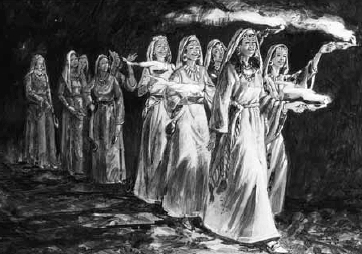
Ten Virgins - Matthew 25:1-13
TODAY'S SPECIAL: Matthew 25:1-13

TO CHEW ON: " 'But he answered and said, 'Assuredly I say to you, I do not know you." ' " Matthew 25:12


In this parable Jesus draws lessons abut the Kingdom of Heaven from a traditional Jewish wedding procession. The main characters in the story are the bridesmaids. They were waiting to be part of the procession leading the bride and bridegroom from the bride's to the groom's home.

These processions, that usually happened at night, were accompanied by singing and dancing. The lamps needed to light the parade were more like torches than our oil-filled lamps. Some suggest that an oil-rag-wrapped torch could only burn for 15 minutes before it needed refreshing, thus the need for extra oil. Delays were common due to the bride's relatives haggling over the bride's great quality versus the amount and value of the groom's gifts.

It was an honor to be part of a wedding procession and a matter of esteem on the bride and groom's part that it should go well. This, the IVP Commentary on this passage suggests, is why the wise virgins in the story didn't share their extra oil with the foolish. For if they had, none of the lamps would have had enough oil to light the whole journey and the bride and groom would have been insulted and embarrassed. (Information on the cultural background from the IVP Commentary, accessed through Biblegateway.com).

This parable is commonly interpreted to be about Jesus' return to earth—the promise of the angels when He ascended into heaven (Acts 1:11). Some of the things it teaches us about His second coming are:

It may be delayed and take what, to those watching for it, feels like a long time.
This is not the only place in the Bible we're told that Jesus' coming may be delayed. See also Matthew 25:19, Luke 1:38, and 2 Peter 3:3-9.

It needs our watchful readiness. The fault of the foolish virgins was that they hadn't thought ahead to prepare for what was surely to be expected—the bridegroom's delay. How do we stay ready for Jesus, our bridegroom's, coming? Some ways:
  • We watch for it - Matthew 24:42, Mark 13:32-37, Revelation 16:15.
  • We serve faithfully - Matthew 24:45-51.
  • We live soberly - 1 Thessalonians 5:4-8.

It ends the era of grace and ushers in the era of "too late." The foolish virgins arrived after the door was closed and heard the dreadful words: "I do not know you." What do we need to do so that we never hear those fateful words spoken to us?
  • We accept God's way of salvation through faith in Jesus - 1 Thessalonians 5:9,10. 
  • Jesus called it being " 'born again' " - John 3:3-8.

PRAYER:
Dear Jesus, though Your return has been delayed these 2000+ years, I believe Your promise that you will return. Help me to life in faithful, sober watchfulness. Amen.

 *********
Unless otherwise noted all Scripture quotations are taken from the New King James Version®. Copyright © 1982 by Thomas Nelson, Inc. Used by permission. All rights reserved.


Bookmark and Share


Sunday, September 22, 2013

Faithfulness test

TODAY'S SPECIAL: Luke 16:1-18

 TO CHEW ON:"'He who is faithful in what is least is faithful also in much; and he who is unjust in what is least is unjust also in much. Therefore if you have not been faithful in the unrighteous mammon, who will commit to your trust the true riches?'" Luke 16:10-11

Has it ever occurred to you that your current material plenty may be a test? Jesus' teaching here indicates that how we handle "unrighteous mammon" may set the stage for how much of the "true riches" we become responsible.


["Unrighteous mammon" is translated: deceitful riches, money, possessions [Amplified], worldly wealth [NIV & NLT], unrighteous wealth [NASB].

"True riches" - is translated true riches in each version I checked. It comes from the Greek word "Alethinos" - Strong's #228:
"1. that which has not only the name and resemblance, but the real nature corresponding to the name, in every respect corresponding to the idea signified by the name, real, true genuine


2. true, veracious, sincere.]

The goal for such stewardship is "faithfulness" [Pistos - one who keeps his plighted faith, worthy of trust, someone who can be relied on].

It is interesting to look up some of the Bible passages that use this word.
- Paul describes God as faithful. We get our standard and resources for faithfulness from Him.
- Paul also describes Timothy as faithful.
- Faithfulness precedes promotion.
- It is our goal as servants of Christ.

So, what does faithfulness in the area of material wealth consist of? Does it mean we give everything away? Or lavish our extra on what we considered to be "true riches" projects and causes? What about going into debt? (Verse 12 might be considered an indirect reference to it: "And if you have not been faithful in what is another man's, who will give you what is your own?")

A sidebar article in my Bible suggests a simple formula for faithful stewardship:
"Pay God (give), pay yourself (save), pay your bills. Being trustworthy in these matters opens the door to greater spiritual wealth." Clark Whitten "Stewardship and Debt," New Spirit Filled Life Bible, p. 1420.

PRAYER: Dear God, I have so much compared to people in many parts of the world. Help me to see my wealth in terms of eternity — and as a means of proving myself worthy to administer "true wealth" of which my money, house and car are only blurry shadows. Amen.

MORE: "Find Us Faithful" by Steve Green and the Gaither Vocal Band


Thursday, July 04, 2013

Whose stars are we working for?

Four stars

 TODAY'S SPECIAL: Galatians 6:1-18

TO CHEW ON: "But let each one examine his own work, and then he will have rejoicing in himself alone, and not in another." Galatians 6:4

A year ago my novel Destiny's Hands came out. I remember the trepidation with which I mailed the first copies to readers. Would people like it? Would they give it good reviews? Five stars, four stars, three…?

Predictably, I felt great when readers liked it, crushed when they didn't, elated when they "couldn't put it down," ashamed when they pointed out things I could have done better. I think of my reaction to these reviews and criticisms when I read my Bible's footnotes to today's verse:
"Self-conceit leads to pride in one's own accomplishments when compared to those of someone else. Such comparisons are out of order, since each person will be accountable on Judgment Day for his own actions..." - Jerry Horner, commentary on Galatians, New Spirit-Filled Life Bible, p. 1639.

What will I, what will we be accountable for?

I believe we will be held accountable to whether or not we were obedient in doing the job He laid on our hearts. In my case, I felt it was to communicate to the best of my ability the thoughts, ideas, and concepts He had impressed on me through the fictional retelling of a Bible story, and to steward my capabilities and the opportunities He had provided by publishing my efforts as a book.

So I asked myself, did I feel crushed and ashamed before Him about that?

Not really. I can honestly say I was obedient to what I thought He was telling me to do and I did the best I could.

What has God asked you to do? In the light of that, from where does your sense of worth come--your obedience or how people are responding to your efforts?

The world of comparison won't be going away any time soon. And, human as I am, I'm sure I will continue to be affected by the comparisons of me and my work with others, not only in writing but in a variety of fields. However, I believe I, we, must all learn to live most intentionally for the audience of One, to examine our motives and the sincerity and quality of our efforts before Him, to strive for His "Well done, good and faithful servant," and leave the earthly results with Him. After all, His stars are the ones that will last for eternity.

PRAYER: Dear God, please help me to live and work for Your approval above that of people. Amen.

MORE: Judging others
"If you have been shrewd in finding out the defects in others, remember that will be exactly the measure given to you. Life serves back in the coin you pay. This law works from God's throne downwards (cf. Psalm 18:25-26)" - Oswald Chambers, My Utmost for His Highest, June 22nd reading. 
***********

The Holy Bible, New King James Version Copyright © 1982 by Thomas Nelson, Inc. - Used with permission.
Bible Drive-Thru


Bookmark and Share


Monday, July 09, 2012

Multiplied seed

TODAY'S SPECIAL: 2 Corinthians 8:16-9:15

TO CHEW ON: "Now may He who supplies seed to the sower and bread for food, supply and multiply the seed you have sown, and increase the fruit of your righteousness." 2 Corinthians 9:10.

Today—the day I am writing this, June 9th—I am looking at a box that wasn't in my office yesterday. It is a box filled with glossy folders. Each contains five sheets of paper. They make up what is called a press kit or media package, supplied by my publisher to help me sell a novel that I have written, and should be out by the time you read this. As I read our passage this morning, the focus verse, 2 Corinthians 9:10, jumps out at me as a benediction on my project.

Writing Destiny's Hands, a Bible fiction based on the character of Bezalel (the man God filled with His Spirit to make the tabernacle and its accessories) has been years in coming to fruition. Its history is full of seeds.

It started with the seed of an idea and grew into a story. Now I have these media packages—more seeds to help me grow interest in the book. Finally the book itself will work as seed, to plant truth within readers. Thus this prayer that Paul prays over the offering he is encouraging the Corinthians to give (for them the seed of money) resonates with me. It is what I pray will happen when the seed of the book I have written is flung around the world.

What seed has God supplied you with? Perhaps it's a creative project similar to mine. Perhaps it's people, a family of little or not-so-little ones, or the people you serve and mentor in your job. Maybe it's the money you make in your work, or your abundance of time.

For whatever seed we have and are planting, let's pray together that God will supply and multiple the seed we have sown and increase the fruit of our righteousness into more seed.

PRAYER: Dear God, thank You for the many people who have contributed to the making of my novel. Now I need You more than ever to oversee its distribution. Please help all who read this with their seed. May our efforts come together to produce a wonderful harvest for Your glory. Amen.

MORE: A little more about Destiny's Hands
  • The book released on June 29th and I got my copies last Thursday, July 5th. The book is now available for purchase!
Amazon (e-book version available)
Barnes and Noble
Chapters
Word Alive Press

OR

Get a signed copy from me sent directly to you.
$17.99 Cdn. + Shipping and handling
  • Within Canada: $4.25 
  • To the U.S.: $7.75
Email your order.
PayPal is available.

Bible Drive-Thru


Bookmark and Share


Sunday, November 13, 2011

Triple threat

TODAY'S SPECIAL: Matthew 25:14-30

TO CHEW ON: "His lord said to him, 'Well done, good and faithful servant; you were faithful over a few things, I will make you ruler over many things. Enter into the joy of your lord.'" Matthew 25:21, 23.

Aren't the words of the lord to his multi-talented servants in this story exactly what we want to hear when we meet Jesus face to face someday? On the other hand, the harsh words of the master for the one-talent servant are words we hope never to hear. Let's look closely at that servant to see the attitudes and actions of which he was guilty so we can avoid them.

Comparison
The one-talent servant hid his talent (a denomination of money calculated by weight) in the ground (Matthew 25:25). It's almost as if he was ashamed of it. Could it be that it was the result of comparison? Perhaps he looked at the way his master entrusted him with only one talent while the others got two and five, and was ashamed.

Fear
With his own mouth he confessed fear (Matthew 25:25). But this angst resulted in the master visiting on him the very harshness he was afraid of when his attitude paralyzed him into inaction.

Laziness
The master uncovered another problem: laziness. That third servant seemingly didn't want to be bothered with all the work it took to make a profit from his one talent.

We need to beware of these three pitfalls as we steward our abilities and opportunities. Comparison is deadly to wise stewardship. Personally, God has given me a standard rhetorical question to ask myself whenever I am in comparison mode (wondering why I don't have this person's abilities, that one's successes and another's opportunities): "Did I ask you to do that?" But God will hold me responsible for times I "buried my talent in the ground" when I could have invested it.

Fear is the opposite of faith. A verse I love to quote to myself when I face the fear of failure, rejection and wasted effort is "Cast your bread upon the waters, for you will find it after many days" - Ecclesiastes 11:1.

Laziness is a subtle but insidious temptation that comes in words like: 'You shouldn't have to do all this work to be successful,' or 'now that you've lived a certain number of years, it's time to take things easy.' How different from the attitude of someone like Paul: "I have fought the good fight, I have finished the race, I have kept the faith" - 2 Timothy 4:7.

As good steward of all God has given us, let's be on guard against comparison, fear, and laziness.

PRAYER: Dear God, someday I want to hear your "Well done, good and faithful servant." Help me to recognize and overcome the temptation to compare myself to others, to live paralyzed by fear and to loll about in laziness Amen.

MORE: Stewardship of money
"Godfrey Davis, who wrote a biography of the Duke of Wellington, said, 'I found an old account ledger that showed how the Duke spent his money. It was a far better clue to what he thought was really important than the reading of his letters or speeches.'

How we handle money reveals much about our priorities."
- Haddon W. Robinson, in "Money Matters," Our Daily Bread Devotions.


Bible Drive-Thru


Bookmark and Share

Saturday, November 05, 2011

What to do while we wait

TODAY'S SPECIAL: Matthew 24:29-51

TO CHEW ON: "Who then is the faithful and wise servant whom his master has set over his household, to give them their food at the proper time? Blessed is the servant whom his master will find so doing when he comes." Matthew 24:45-46

In all the chaos and mayhem of tribulation, failing moon, falling stars, marrying, partying, and people snatched away as by a thief, we have one scene of normalcy: a servant doing his boring old duty. According to Jesus, he/she is the one with no reason to worry or fear the master's return.

The word for servant here is "bondservant."

[A bondservant - doulos  - was a slave, a person of servile condition. Metaphorically it signifies one who gives himself up to another's will, those whose service is used by Christ in extending and advancing His cause among men.]

In a parallel passage where Jesus talks similarly about a master returning unexpectedly (Luke 12:35-48), the servant is called a "steward."

[A steward - oikonomos - was a manager of a household or of household affairs. In this role the head of the house or the proprietor of the business entrusted the steward the management of his affairs, the care of receipts and expenditures, the duty of doling out the proper portion to every servant and even to the children not yet of age.]

It sounds like a pretty mundane, administrative sort of role where, in the Matthew passage, the Master valued faithfulness (as in carrying out duties in a timely and routine way - Matthew 25:45-46), fairness, and personal discipline (as in sober vs. drunken or decadent living - Matthew 25:48-51).

I love how John Gill's commentary expands on the idea of a steward's job (this man lived long ago--1697-1771; please don't let the old-fashioned language bother you):
"The post that such a person is put in, and the work he is to do, follow:
Whom his Lord hath made ruler over his household; or "family", the church of God ... in which are believers of various growths and sizes; some fathers, some young men, some children.
Over these, the ministers are, by their Lord, made and placed as rulers; not as lords and tyrants over God's heritage, to govern them in an arbitrary way, but as over them in the Lord, to rule them according to the word of God, and the laws of his house.... whose principal business it is to give them meat in due season; even "their portion" of it, as in Luke 12:42.
Not all of us are designated "ministers" as in church leaders. But I would submit that most of us are stewards or spiritually responsible for someone: our children, our spouse, our friends newer in the faith than we are, or still on the journey to accepting Jesus. We can steward God's Word in the ways Gill suggests:

"For the word of God is to be cut and rightly divided, and everyone in the family, according to his age, appetite, and digestion, is to have his proper part and portion given him: 


It must be meat, proper food, such as is solid, substantial, and nourishing; even the wholesome words of Christ Jesus, that must be given them, and not husks and empty trash; and all in due season, in its proper time, as their cases and circumstances require, and call for; as whether weary, or uncomfortable, or in the dark, or under temptations and afflictions: for a word fitly and seasonably spoken, how useful is it!" (Read all of Gill's commentary and more here.)
PRAYER: Dear God, please help me to be a faithful steward to those under my care, so I can be unashamed and unembarrassed to meet You face to face. Amen.

MORE: "Find us Faithful"


Bible Drive-Thru


Bookmark and Share

Wednesday, October 27, 2010

Excuses

TODAY'S SPECIAL: Luke 19:11-27

TO CHEW ON:
"For I say to you, that to everyone who has will be given; and from him who does not have, even what he has will be taken away from him." Luke 19:26

On first reading the above, we might be tempted to say, "Not fair!" For those of us brought up on the precepts of democracy, where everyone is supposedly equal, taking away from someone who doesn't have, to give to someone who does, seems wrong.

In context, though, we see this parable Jesus told is a story about taking responsibility for what one has. It's a story about being a good steward of something one has been entrusted with, and being rewarded for that.

The third servant — the one who hid his money (mina) instead of investing it — intrigues me. Why do you suppose someone would do what he did? I can imagine several reasons;

- Lack of confidence
Maybe, when he saw the others entrusted with multiples of what he got, he thought, The master sure doesn't think much of me by giving me only one mina. I must be lacking in some way. Then he let his lack of confidence immobilize him.

- Naturally cautious
Maybe he was a man who just didn't like to take risks. It's ironic, though, that by refusing the do the most unrisky thing — deposit the mina in a place where it could at least earn interest — he was putting himself at the greatest risk of all.

- Insignificant sum
Perhaps he thought, This small amount is so insignificant when compared with what the others have been given, it doesn't really matter what I do with it.

- Perfectionism
Jesus reports the servant's reply when the King asks him to explain his investment paralysis: "I feared you because you are an austere man..." Could that reveal his underlying fear of doing it wrong? So, because he wasn't sure he could do this exactly as the king expected, he didn't do anything?

- Ideological differences
This king was hated. Maybe the servant — independent thinker that he was — decided to show the king that he didn't give a fig for his kingdom, didn't want to play the king's game and showed it by treating the master's gift with indifference and disdain.

The above is speculation, of course. But these are all reasons we don't invest our minas — the gifts and talents with which we were born — in the Kingdom of God.

This parable has been a significant one in my life. It is one of the reasons why, a few years ago, I decided to take up writing in a more serious way.

What is your mina? Have you invested it in God's Kingdom, or used one of the excuses, above, to hide it away in a handkerchief?

PRAYER:
Dear God, help me to be a good steward of all You have given me. Amen.

MORE: Mina
A mina (called a "talent" in a similar story Jesus told recorded in Matthew 25:14-29) was a weight equal to 50 shekels (according to a footnote in my Bible). Here it refers to approximately a pound of money. Each minah (Hebrew) was worth about three months' salary, not an insignificant sum if you think of it in term's of today's wages.


Do your 8-12-year-olds have daily devotions? Point them to Bible Drive-Thru.

Related Posts Plugin for WordPress, Blogger...