Showing posts with label faithfulness. Show all posts

Friday, October 19, 2018

The Christian's memory

Return of the Ark to Bethshemesh by Gustave Dore
"Return of the Ark" - Gustave Dore (1 Samuel 6:13)
TODAY'S SPECIAL: Acts 27-28; Psalm 132

TO CHEW ON: "Behold we heard of it in Ephratheh
We found it in the fields of the woods." - Psalm 132:6


What is the "it" the psalmist is talking about? It is the ark—that box that symbolized the presence of God among the Israelites.

The first verses of this psalm refer to specific stories about the ark that pilgrims marching to Jerusalem* would have known. They recall the time that David vowed to bring the ark back to Jerusalem. They remember an even earlier time when Samuel located it in "the field of the woods," that is, Kirjath Jearim ("City of Forests") - 1 Samuel 7:1,2.

What's the point of bringing up these memories? It is to help the people get a vision for their future with God (Psalm 132:11-18).

Eugene Peterson enlarges on this psalm in A Long Obedience in the Same Direction. He says about the importance of memory in matters of faith:

"This history is important, for without it we are at the mercy of whims. Memory is a databank we use to evaluate our position and make decisions. With a biblical memory we have two thousand years of experience from which to make the off-the-cuff responses that are required each day in the life of faith.

"[...] The past is not, for the person of faith, a restored historical site that we tour when we are on vacation; it is a field that we plow and harrow and plant and fertilize and work for a harvest" - Eugene Peterson, A Long Obedience in the Same Direction, pp. 166, 168 (emphasis added).

What are we facing today that is making us nervous, upset, panicky, desperate, scared? Let's recall our history with God and how He has proved Himself faithful to help us in the past. Let's obey His instructions to us, whatever they are in the situation. Maybe it's to:
  • acknowledge Him and trust Him for directions (Proverbs 3:5-6).
  • pray and not worry (Philippians 4:6-7).
  • tell the truth and live with integrity (Matthew 5:37)
  • be single-hearted (Luke 6:13; James 1:5-8)
  • or ...
Peterson again:

"What we require is obedience—the strength to stand and the willingness to leap, and the sense to know when to do which. Which is exactly what we get when an accurate memory of God's ways is combined with a lively hope in his promises" - p. 171.

PRAYER: Dear God, I bring the specific situation of ___ to You. You know the dis-ease I have in my spirit over it. Please settle me down as I remember Your faithfulness to me in the past. Help me to hear Your instructions about what to do (or perhaps it's to be still)  and to obey. Amen.

PSALM TO PRAY: Psalm 132

MORE: Defective memory

"A Christian with a defective memory has to start everything from scratch and spends far too much of his or her time backtracking, repairing, starting over. A Christian with a good memory avoids repeating old sins, knows the easiest way through complex situations and instead of starting over each day continues what was begun in Adam" - Peterson, p. 167 (emphasis added). 

*This psalm is one of the "Songs of Ascent" which pilgrims sang as they went to Jerusalem to celebrate the yearly festivals.

********
Unless otherwise noted all Scripture quotations are taken from the New King James Version®. Copyright © 1982 by Thomas Nelson, Inc. Used by permission. All rights reserved.


Monday, August 20, 2018

The Asaph approach to conquering fear

TODAY'S SPECIAL: 2 Chronicles 25-27; Psalm 77

TO CHEW ON: "And I said, 'This is my anguish; But I will remember the years of the right hand of the Most High.' I will remember the works of the Lord; Surely I will remember Your wonders of old." Psalm 77:10-11


One characteristic of memory is that it is selective. We tend to remember the good over the bad. Think back to your childhood. Chances are it will seem an idyllic, happy time. "Those were the good old days," we say. Somehow the fears, embarrassments, boredoms and dissatisfactions are not what we remember first about the past.

Memories -- good memories -- are what Asaph, the psalmist, uses to conquer his fearful thoughts during a very bad time. He is in a "day of trouble" where he prays all night long (Psalm 77:2). He feels so overwhelmed even thoughts of God don't comfort him (Psalm 77:3). He is troubled sleepless and speechless (Psalm 77:4).

Then he decides to take himself and his negative thoughts in hand. "But I will remember the years of the right hand of the Most High." He reviews God's attributes in a series of rhetorical questions (Psalm 77:7-8) and recalls times from the past when God appeared unbeatable:

There was the time God redeemed "the sons of Jacob and Joseph" (Psalm 77:15) -- a reference, perhaps, to God saving the Israelites from famine by bringing them to Egypt where Joseph had stored up food.

There was the time "The waters saw You and they were afraid" (Psalm 77:16) -- a reference to the parting of the Red Sea when the Egyptians were hot on their heels.

There was the time "You led Your people like a flock, By the hand of Moses and Aaron" (Psalm 77:20) -- a reference to their 40 years in the wilderness.

Are you in a desperate, fearful, can't-sleep-because-of-troubled-thoughts time? Or maybe it's just a thin-cloud-of-anxiety, or bad-premonition, or can't-stop-worrying-about-things-up-ahead time. Whatever causes your spirit to "complain" use the Asaph approach to conquering fear.

1. Ask yourself the rhetorical questions he asks, to remind yourself about the bigness of God:
- "Will the Lord cast off forever?"
- Will He be favourable no more?"
- Has His mercy ceased forever?" etc. (Psalm 77:7-9).
The answer: Of course not!

2. Think back to specific instances in your life when God has come through for you. Has He preserved your life in a dramatic way? Has He helped you through financial difficulties? Has He answered prayers, made you a part of amazing "coincidences," showered you with everyday mercies? Go back even farther to reviewing the history of your family, your people. Reminisce yourself into a place where you can exclaim like Asaph did: "Who is so great a God as our God? You are the God who does wonders; You have declared Your strength among the peoples" (Psalm 77:13-14).

PRAYER: Dear God, thank You for evidences of Your presence in my life. Thank You for memories that reassure me of Your ability, power and love. Amen.

PSALM TO PRAY: Psalm 77

*****************
Unless otherwise noted all Scripture quotations are taken from the New King James Version®. Copyright © 1982 by Thomas Nelson, Inc. Used by permission. All rights reserved.


Saturday, May 05, 2018

Stay the waiting course

TODAY'S SPECIAL: Isaiah 61-64; Psalm 120

TO CHEW ON: "For since the beginning of the world
Men have not heard nor perceived by the ear,
Nor has the eye seen any God besides You,
Who acts for the one who waits for Him." Isaiah 64:5


Do you like to be kept waiting? I don't! But God, whose wisdom trumps our likes and dislikes, may often keep us waiting.

[Wait means 1) To stay or remain in expectation as of an anticipated action or event. 2) To be or remain in readiness. 3) To remain temporarily neglected or undone.]

Isn't that third definition apt? For when we are kept waiting, neglected is just how we feel.

The Bible is full of people who God kept waiting.
  • Abraham and Sarah waited for an heir. When they got impatient and tried to achieve this their own way (through Abraham having Ishmael by Sarah's maid Hagar) they brought trouble into their lives.
  • Samuel told King Saul to wait for him to offer a sacrifice before he (Saul) went to war. When members of his army started slipping away, Saul grew impatient and offered the sacrifice himself. Samuel arrived at the end of the ceremony and told Saul that because of his disobedience, the kingship would be taken from his family (1 Samuel 13:1-15).
  • The disciples, on the other hand, waited in Jerusalem as Jesus had told them to, until the Holy Spirit descended. Then, indwelt with God's power, they "turned the world upside down" (Acts 17:6).

Are you waiting for something today? Take heart from today's verse and words like David's in Psalm 37 as you stay the waiting course:

"Commit your way to the Lord
Trust also in Him
And He shall bring it to pass...
Rest in the Lord and wait patiently for Him
Do not fret..." (Psalm 37:5-7).


PRAYER: Dear God, please help me to commit my way to You and wait for You to "bring it to pass" and "act" for me. Amen


PSALM TO PRAY: Psalm 120

********
Unless otherwise noted all Scripture quotations are taken from the New King James Version®. Copyright © 1982 by Thomas Nelson, Inc. Used by permission. All rights reserved.


Thursday, December 21, 2017

A promise-keeping God

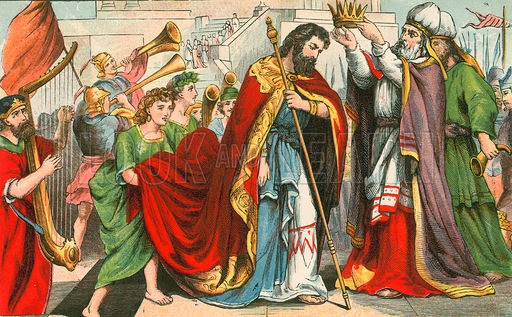
David crowned king in Hebron - Artist unknown

TODAY'S SPECIAL: Psalm 89:19-37

TO CHEW ON:
"Nevertheless My lovingkindness I will not utterly take from him,
Nor allow My faithfulness to fail." Psalm 89:33


In this psalm Ethan the Ezrahite praises God for His faithfulness to Israel for giving her David as a king (Psalm 89:20,21). Through David's line and God's covenant with him, they will survive as a nation (Psalm 89:22-29). Even their disobedience won't cause God to go back on His promises, though God will punish their sin (Psalm 89:30-37).

This psalm also has a prophetic tone. There are many places in it that remind us of Jesus:
  • He had power over the sea (Psalm 89:25 compare Matthew 8:26,27).
  • He repeatedly referred to God as His Father (Psalm 89:26 compare to John 5, 8, 10, 14, 15).
  • Paul called Him the "firstborn over all creation" (Psalm 89:27 compare to Colossians 1:15-17).
  • His throne / kingdom will last forever (Psalm 89:29, 36-37 compare to Luke 1:33).
  • He took the stripes for our sin (Psalm 89:32 compare to Isaiah 53:5 and Mark 15:15, Matthew 27:26).

God keeps His promises. The nation of Israel survives to this day. Millions have accepted God's free gift of salvation over the centuries because Jesus paid the penalty for our sin on the cross and then rose again to conquer sin's final penalty, death.

Are you in a place today where God seems distant and His promises broken?  Do you feel like He's forgotten you and left you to your own devices? Remember He is still the God of Ethan the Ezrahite and Moses and the New Testament writers. His faithfulness will not fail:
"Therefore know that the LORD your God, He is God the faithful God who keeps covenant and mercy for a thousand generations with those who love Him and keep His commandments" - Deuteronomy 7:9.

"Jesus Christ is the same yesterday, today and forever" - Hebrews 13:8.


PRAYER: Dear God, thank You for being a God who keeps promises. When You feel far away, help me to keep trusting You and the promises You have made. Amen.

 *********
Unless otherwise noted all Scripture quotations are taken from the New King James Version®. Copyright © 1982 by Thomas Nelson, Inc. Used by permission. All rights reserved.
Saturday, November 18, 2017

What kind of a steward are you?

Image: Pixabay
TODAY’S SPECIAL: Matthew 25:14-30

TO CHEW ON: “‘For the kingdom of heaven is like a man traveling to a far country, who called his own servants and delivered his goods to them.’” Matthew 25:14


We might be excused if, at the beginning of this story, we thought the owner had given his possessions to his servants. However, when we read the whole thing, we realize that the relationship with those possessions (here “talents”—a unit of money), was not one of ownership at all but management. Another word for that is “stewardship.”

[Stewardship: The position and duties of a steward—a person who acts as the surrogate of another or others, especially by managing property, financial affairs, an estate etc. - from Dictionary.com.]

Stewardship comes up in other places in the Bible as well. Biblical stewardship is:
  • Tailored to the individual.
In our story, the owner gave his servants different amounts of money to manage dependent on each one’s ability - Matthew 25:15.

  • Not ownership.
The stewarding aspect of our story’s handout comes out more clearly in the Luke version of this same parable - Luke 19:13.
  • Judged by faithfulness.
It’s the main characteristic of a steward: "Moreover it is required in stewards that one be found faithful" - 1 Corinthians 4:2.

  • A sacred trust that impacts all of life.
Paul instructed Timothy on what it meant to be a steward in practical living: "O Timothy! Guard what was committed to your trust, avoiding the profane and idle babblings and contradictions of what is falsely called knowledge"  - 1 Timothy 6:20.

  • What God expects us to do with our spiritual gifts.
"As each one has received a gift, minister it to one another, as good stewards of the manifold grace of God" 1 Peter 4:10.

  • Important because our salvation came at a high price.
    "For you were bought at a price; therefore glorify God in your body and in your spirit, which are God’s" - 1 Corinthians 6:20.
  • Important because we have a divine Master - Ephesians 6:7.
"...with goodwill doing service, as to the Lord, and not to men knowing that whatever good anyone does, he will receive the same from the Lord, whether he is a slave or free" Ephesians 6:7,8.

So we might ask, what has God asked us to steward?

The answer will be slightly different for each one of us but will include things like the Gospel—the good news that we sinful humans can be reconciled to God through the death and resurrection of Jesus—our spiritual gifts, our material possessions, our network of family, friends, and colleagues, modern technology with its potential for fast and widespread communication, and the list could go on.

We have much to steward. Are we aware of our positions as stewards? Are we looking forward to the day we hear His “Well done, good and faithful servant?” Or will we be caught unaware at our Master’s return, embarrassed, ashamed, and casting about for excuses of why we haven't been good stewards?

PRAYER: Dear Father, help me to be aware of all You have entrusted to me, and to steward it well. May I keep the hope of Your “Well done,” always in mind. Amen.

 *********
Unless otherwise noted all Scripture quotations are taken from the New King James Version®. Copyright © 1982 by Thomas Nelson, Inc. Used by permission. All rights reserved.


Tuesday, November 14, 2017

Avoiding spiritual osteoporosis

Image: Pixabay
TODAY’S SPECIAL: Matthew 24:45-25:13

TO CHEW ON: “‘Who then is a faithful and wise servant, whom his master made ruler over his household, to give them food in due season? Blessed is that servant whom his master, when he comes, will find so doing.’” Matthew 24:25

This passage has been a rhema word to me this morning. Let me explain.

Over the past few weeks I’ve toyed with the thought of ceasing to write these devotions. My idea has been to use the several hours of morning writing time for other projects. In fact, I’ve tried that out for a few weeks (frequently re-posting devotions here).

Yes, I’ve still had a short Bible reading and prayer time before the other writing. But the clock moves quickly and the start time for “work” comes all too soon. So these personal devotion times have felt unsatisfying.

Further, as I thought of no longer having a place to document what I’m learning (yes, I can record things in a my writing journal, but it’s not the same), I felt like I was about to demolish an important part of the structure of my daily life. (Reminds me of the verse “The wise woman builds her house, / But the foolish pulls it down with her hands” Proverbs 14:1.)

My decision to quit has been bugging me. In fact, before going to this Matthew passage this morning, I spilled some thoughts in my journal. As I did that, two verses came to mind:

"When I kept silent, my bones grew old
Through my groaning all the day long.

For day and night Your hand was heavy upon me;
My vitality was turned into the drought of summer" Psalm 32:3,4.

"Then I said, “I will not make mention of Him,
Nor speak anymore in His name.”
But His word was in my heart like a burning fire
Shut up in my bones;
I was weary of holding it back,
And I could not" Jeremiah 20:9. 

I noticed both had to do with deteriorating bones and wrote to myself: “I’m sensing a possible bone condition. Interesting thing about bones. They need exercise to stay strong. Perhaps God is saying to me—‘Violet, you can do this, stop writing these daily devos and posting them. But there will be consequences to you, just like if you stopped your daily physical walk. Do you want to get spiritual osteoporosis?  For your bones will weaken if you don’t feed and exercise them. This daily devo writing is a  good way to feed and exercise those bones and keep them from growing old.’”

And then I opened my Bible to work on the next devo and read Matthew 24:45. It’s not lost on me that the name I’ve chosen for this blog has to do with food.

When one reaches a certain age, one is expected to retire, at least in my culture. But God has made it clear to me this morning that the time to retire from writing these isn’t quite yet. I need to keep faithfully “so doing”—giving out this Other food in “due season.”

What about you? What is God telling you to be faithfully found “so doing”?


PRAYER: Dear Father, You are faithful in giving me the direction I need at the moment I need it. Help me to listen to Your voice above all others. so that I will be found doing the things You’ve tasked me with when You return, or call me home to You. Amen.

 *********
Unless otherwise noted all Scripture quotations are taken from the New King James Version®. Copyright © 1982 by Thomas Nelson, Inc. Used by permission. All rights reserved.


Sunday, May 28, 2017

God keeps us

hand cradling feet
TODAY'S SPECIAL: John 17:1-11

TO CHEW ON: " ' Now I am no longer in the world, but these are in the world, and I come to You. Holy Father keep through Your name those whom You have given Me, that they may be one as We are.' " John 17:11

How wonderful to hear Jesus pray for us—because this prayer was not only for the disciples present but also " ' … for those who will believe in Me through their word' " John 17:20. He prays that God will keep us. the need for such a prayer signals a danger of which we need to be aware: the possibility we could lose faith.

A short sweep through the Bible shows us some of the ways.  God keeps us:

  • Wherever we go. Like He was with Jacob, God is with us - Genesis 28:15; Proverbs 2:8.
  • Physically. The psalmist expresses it: "He guards all his bones. Not one of them is broken" - Psalm 34:20.
  • Always. He never sleeps - Psalm 121:4.
  • Through His name. What does it mean to be kept "through His name"? The Amplified Bible expresses John 17:11: " 'Holy Father, keep in You name [in the knowledge of Yourself] them whom You have given Me' " - John 17:11 AMP. I understand it as getting to know the breadth and depth of His essence (His name) and seeing how capable He is of whatever we need.
  • As we lay our anxieties on Him. He then guards our hearts and minds with His peace - Philippians 4:6,7.
  • From the evil one - 2 Thessalonians 3:3.
  • ...and what we have committed to Him - 2 Timothy 1:12. If we have committed our lives, His power can keep us through our lifespan until we see our salvation - 1 Peter 1:5.
  • From stumbling, so we will be able to stand in His presence with joy - Jude 1:24.
  • From the extreme test of end-time events, the "...  the hour of trial which shall come upon the whole world to test those who dwell on the earth" - Revelation 3:10.

When we feel we are on precarious footing in our faith—perhaps after going through a test of sickness, bereavement, family troubles or whatever, we can take comfort in the fact that Jesus prayed for us to be kept. We can trust Him to make a way for us, through the difficulties, back to a firm footing of faith.

PRAYER: Dear God, thank You for Your keeping power. When my grip on faith in You is weak, please send an answer to Jesus' prayer for me. Amen.

 *********
Unless otherwise noted all Scripture quotations are taken from the New King James Version®. Copyright © 1982 by Thomas Nelson, Inc. Used by permission. All rights reserved.

Scripture quotations marked AMP are taken from the Amplified® Bible, Copyright © 1954, 1958, 1962, 1964, 1965, 1987 by The Lockman Foundation. Used by permission." (www.Lockman.org)


Monday, March 06, 2017

How has God brought you out?

People gathered around a campfire
Image: Pixabay
TODAY’S SPECIAL: Deuteronomy 6:10-25

TO CHEW ON: “When your son asks you, in time to come, saying, ‘What is the meaning of the testimonies, the statutes, and the judgements which the LORD our God has commanded you?’ then you shall say to your son: “We were slaves of Pharaoh in Egypt, and the LORD brought us out of Egypt with a mighty hand…’”  Deuteronomy 6:20-21

Here Moses, in one of his last sermons to the Israelites, commanded them to tell their story to the next generation.

The psalmist Asaph gave a similar instruction:
“I will open my mouth in a parable;
I will utter dark sayings of old,
 Which we have heard and known,
And our fathers have told us.
We will not hide them from their children,
Telling to the generation to come the praises of the Lord,
And His strength and His wonderful works that He has done….

That they may set their hope in God,
And not forget the works of God,
But keep His commandments.” - Psalm 78: 2-4, 7

I am currently involved in a weekly Bible study of Judges. The book is an illustration of what happens when people don’t pass on their stories of faith to the next generation. Judges 2:10 summarizes it in one verse:
“When all that generation had been gathered to their fathers, another generation arose after them who did not know the LORD nor the work which He had done for them” (emphasis added).

Why didn’t they know the Lord or His work? Because no one had bothered to tell them the stories—of Passover night and the escape from Egypt, the crossing of the Red Sea, the daily manna and the cloud that never left them by day or night, the sweetened water at Mara… etc.

Asaph recognized that lack and referred to it and the resulting up and down cycles (sin, conquest, repentance deliverance, and freedom) that Israel went through time and again in Judges (Psalm 78:56-64).

The example of Israel is a lesson to us. Faith for us too is one generation away from extinction. How do we keep that from happening? One way is to tell the stories of God at work in history and in our lives:

1. Read Bible stories to our children and grandchildren.

2. Encourage our elders (parents, grandparents) to tell their faith stories and record them in some way (written, audio, video).

3. Tell our own faith stories to our children, write them in journals or books to pass on and / or make audio and video recordings.

4. Read the stories of Christian pioneers and missionaries (biographies, autobiographies, memoirs) to our children and grandchildren.

In our fast-paced world:
  • We may need to become intentional about this, making time and space to do it. 
  • We need to be aware of the best moments to share: with children—at bedtime, around the campfire, during car rides. 
  • We may need to take a writing course on the best way to write our story, or join a writers group that encourages us along those lines.

Whatever it takes, let’s not neglect to tell our stories, to pass on the stories of how God has brought our forefathers (and how God has brought us and is bringing us) out!

PRAYER: Dear Father, thank You for the way You have worked in my life. Help me to be faithful in passing on my story to the next generation. Amen.
 *********
Unless otherwise noted all Scripture quotations are taken from the New King James Version®. Copyright © 1982 by Thomas Nelson, Inc. Used by permission. All rights reserved.


Friday, February 17, 2017

"Faithful" affliction?

TODAY’S SPECIAL: Psalm 119:75

TO CHEW ON: “I know, O LORD, that Your judgments are right,
And that in faithfulness You have afflicted me.” Psalm 119:75


I was talking recently to a friend whose husband had a stroke seven or eight months ago. She said something like, God has seemed closer and more real through this time than ever before.

A few days before our conversation, her husband—who is now in a wheelchair and can no longer speak—had had an unexpected seizure. My friend said about that: I have unusual peace. I’m not running around agitated and fretting like I did right after the stroke because God has been faithful through this whole time and I know He’ll take us through this as well.

My friend and her situation come to mind this morning as I read the psalmist’s reaction to being “afflicted.”

[Afflicted - anah - means afflict, oppress, humble, be afflicted, bowed down.] That definition encompasses a lot. It could mean being humbled / oppressed / made to bow in a variety of ways from physical illness, to business failure, to social humiliation, and more.

The psalmist regarded his affliction as a positive thing in the three times he mentioned it:

1. It became a magnet that drew him back to God
“Before I was afflicted I went astray
But now I keep Your word” - Psalm 119:67.

2. It drove him to study God and His communication:
“It is good for me that I have been afflicted
That I may learn Your statutes” - Psalm 119:71.

3. His affliction was / is testing and strengthening his faith in God’s goodness:
“I know, O LORD, that Your judgments are right,
And that in faithfulness You have afflicted me” - Psalm 119:75.  

[Faithfulness - emuwnah means firmness, fidelity, steadfastness, steadiness]

I understand this as God allowing these afflictions to come the psalmist's way, our way with intention—good intention.

[Fidelity means loyalty, strict observance of promises, adherence to detail.
Steadfast means fixed in direction, firm in purpose, unwavering.]


I know my first reaction to affliction of any kind is to pray: “Help! Get me out of this!” But maybe that’s not always the best prayer. Maybe a better one would be:

PRAYER: Dear Father God, please use this affliction to crowd me to You, to help me learn about You and Your ways, and to prove Your faithfulness to me and others. Amen.

 *********
Unless otherwise noted all Scripture quotations are taken from the New King James Version®. Copyright © 1982 by Thomas Nelson, Inc. Used by permission. All rights reserved.


Monday, December 28, 2015

Unveiling of the Bride-City

The New Jerusalem - Artist unknown

TODAY'S SPECIAL: Revelation 21:1-21

TO CHEW ON: "Then I, John, saw the holy city, New Jerusalem, coming down out of heaven from God, prepared as a bride adorned for her husband… 'Come, I will show you the bride, the Lamb's wife."  Revelation 21:2,9

What an interesting comparison—likening a city to a bride.

Bride Imagery is used in other places in the Bible.
  • Already way back in Isaiah we have Jerusalem referred to as a bride - Isaiah 52:1.
  • And Paul often refers to believers in bride terms:
    • He urges Christians in Rome to leave their old loyalty to law-keeping and "be married to another—to Him who was raised from the dead" - Romans 7:4.
    • He exhorts the Christians in Corinth to be faithful to Christ as a bride would be faithful to her husband sexually - 1 Corinthians 6:15.
    • He also challenges the Corinthian Christians to loyalty and purity as if they were a chaste virgin whom he (Paul) anticipates presenting to Christ - 2 Corinthians 11:2.
    • He talks plainly to the church in Ephesus about their ideal intimacy with Christ using words that remind us of the marriage covenant: "For we are members of His body, of His flesh and of His bones" - Ephesians 5:30 (compare Genesis 2:24; Mark 10:8 and Ephesians 3:31). In fact in Ephesians 5:32, Paul spells it out: "This is a great mystery, but I speak concerning Christ and the church."
  • These Bible bride metaphors often refer, as well, to getting ready and being prepared. We see this in John's writings:
    • "… the marriage of the Lamb has come and His wife has made herself ready" - Revelation 19:7.
    • "… the holy city, New Jerusalem, coming down… prepared as a bride adorned for her husband" - Revelation 2:20 (our verse for today).

Which takes us back to John's vision, of which my Bible's study notes explain:
"The holy city is the bride of Christ, the church as well as the abode of the saints" - Earl Wesley Morey, New Spirit-Filled Life Bible, p. 1845.

The vision of this bride-city is rich with symbolism. We might interpret:*
  • The gates to it, located on all sides, to mean that it's open to all peoples (Revelation 21:12,13).
  • The "twelve tribes" and "twelve apostles" to mean that it incorporates both Old and New Testaments (Revelation 21:12,14).
  • The "twelve foundations" as a reference to the "household of God" that Paul talks about, which is built on the foundation of the apostles and prophets with Christ as the cornerstone (Revelation 21:14; Ephesians 2:20).
  • The cube shape of the city as a symbol of its perfection (Revelation 21:15-17).
  • The precious materials used in the city as symbols of its value, beauty, and glory (Revelation 21:18-21).  (*Morey's study notes used in the above.)

Doesn't reading this wondrous description of the New Jerusalem Bride of Christ (of which we're a part) make you want to stay loyal to Jesus and not get involved with anyone else? Doesn't it also make you want to prepare yourself for the day of this amazing unveiling?


PRAYER: Dear God, in the midst of my mundane, often disappointing, sometimes hostile-to-Christianity life on earth, help me to keep my sites on the real and glorious future You have for Your church and for me as part of it. Amen.

 *********
Unless otherwise noted all Scripture quotations are taken from the New King James Version®. Copyright © 1982 by Thomas Nelson, Inc. Used by permission. All rights reserved.


Sunday, September 06, 2015

Courtship and marriage lessons in Solomon's Song

TODAY'S SPECIAL: Song of Solomon 8:5-14

TO CHEW ON: "Set me as a seal upon your heart,
As a seal upon your arm
For love is as strong as death..." Song of Solomon 8:6


The Song of Solomon when viewed as a poem about marital love—which it is—can give us many pointers on courtship and marriage.

In the area of courtship:
  • It speaks of not awakening love too seen (Song of Solomon 2:7; 3:5). I shudder when I think of how we have violated this principle in our society with sexually charged images and language targeted at even preteens. Then there is the whole area of child sexual abuse—taboo, but still happening way more often than we acknowledge, taking away innocence and robbing kids of the beauty and goodness of this relationship for a lifetime.
  • Christian families should get involved in the development of children's views and choices (Song of Solomon 8:8,9).
  • Wedding day purity is the ideal: "You are all fair my love and there is no spot in you...A garden enclosed ... A spring shut up" - Song of Solomon 4:7,12.

Once love has been awakened and marriage established:
  • We move from a mindset of "me" and "mine" to "we" and "ours" (Song of Solomon 1:4, 16-17).
  • We enthusiastically acknowledge the rightness of this relationship by:
- Expressing love to our partner verbally in positive and creative ways (Song of Solomon 5:10-16; 7:1-9).
- Giving free rein to the physical expression of our love (Song of Solomon 1:2-13; 4:9, 11; 7:6-9).
- Being available to each other (Song of Solomon 5:2-8).
- Getting away together (Song of Solomon 7:10-13).
- Remaining faithful to each other (Song of Solomon 8:6-7).
- Staying friends, not only lovers (Song of Solomon 5:16). 
(These points adapted from "Truth-In-Action through Song of Solomon" by Leslyn Musch, New Spirit-Filled Life Bible, pages 868-869.)

I love how Ms. Musch acknowledges that for some of us this is only an ideal. For those who have violated these principles she says:
"Keep yourself sexually pure .... If it is too late for that, ask God to forgive you, purify you and redeem what has been lost. Ask your fiancé or spouse for their forgiveness too. Seek godly counsel, if needed, to work through this potentially difficult issue. Pray together and ask the Lord to restore and heal your relationship" - L. Musch, New Spirit-Filled Life Bible, p. 869.

PRAYER: Thank You, God, for this beautiful love poem that affirms Your plan for love and marriage. Help me to take its lessons to heart in my own marriage and as I give direction to others. Amen.

********
Unless otherwise noted all Scripture quotations are taken from the New King James Version®. Copyright © 1982 by Thomas Nelson, Inc. Used by permission. All rights reserved.

Bible Drive-Thru


Saturday, September 05, 2015

Marriage = 1+1

TODAY'S SPECIAL: Song of Solomon 6:4-8:4

TO CHEW ON: "There are sixty queens
And eighty concubines
And virgins without number.
My dove, my perfect one,
Is the only one..." Song of Solomon 6:8,9


The TV trailers are full of intense conversation and emotion between four women and one man. The scene usually ends in one of the women dissolving into tears. I'm talking about Sister Wives, the TV reality show about a polygamous marriage that looks nothing but painful.

Our society supposedly frowns on multiple marriage partners. Yet our actions show us to be hypocritical. Books, shows, and real life are full of adultery. The use of pornography (a type of unfaithfulness), is rampant not only among men and women but even teens.

Though the Bible contains many examples of polygamy (Solomon being its most numerous polygamist - 1 Kings 11:3) its ideal is monogamy.
  • God instituted marriage between one man and one woman when He formed the first couple - Genesis 2:24.
  • Moses' instructions to Israel's future king was "neither shall he multiply wives for himself..." Deuteronomy 17:17.
  • Malachi 2 talks about being faithful to "the wife of your youth."
  • Jesus referred to God's plan of one woman being joined to one man in Matthew 19:4-6  and quoted Genesis 2:24.
  • Paul's instructions to a leader was that he was to be "the husband of one wife" - 1 Timothy 3:2.

I like how Leslyn Musch sums up the Song of Solomon's message about satisfying one-man-one-woman marriage:

"Faithfulness, verbal affirmation, friendship, romantic getaways, working through conflict, and availability are but a few of the keys given in the Song of Solomon to building a godly marriage. It is not Solomon's life we are to examine for instruction in a godly marriage. However, this Song—God's inspired picture of what a godly loving marriage can be—invites us to reach toward it wholeheartedly" - Leslyn Musch, Truth-In-Action through Song of Solomon, New Spirit-Filled Life Bible, p 868.

PRAYER:
Dear God please help me to stay completely faithful to my husband and to work at making my marriage the best it can be. Amen.

MORE: "10 Reasons not to have sex outside of marriage"

Though the heading above is the title of an article written for the not-yet-married person, many of its reasons also apply to  extramarital relationships. A few of them are:

- We will be physically healthier.
- We will be emotionally healthier.
- we will be spiritually healthier.

Read all 10 reasons and the scriptures to back them up HERE


********
Unless otherwise noted all Scripture quotations are taken from the New King James Version®. Copyright © 1982 by Thomas Nelson, Inc. Used by permission. All rights reserved.

Bible Drive-Thru


Saturday, November 08, 2014

The most dreaded words

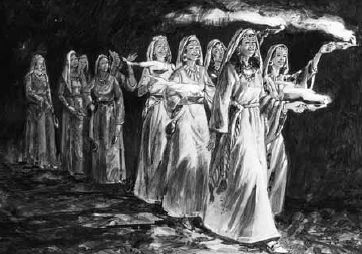
Ten Virgins - Matthew 25:1-13
TODAY'S SPECIAL: Matthew 25:1-13

TO CHEW ON: " 'But he answered and said, 'Assuredly I say to you, I do not know you." ' " Matthew 25:12


In this parable Jesus draws lessons abut the Kingdom of Heaven from a traditional Jewish wedding procession. The main characters in the story are the bridesmaids. They were waiting to be part of the procession leading the bride and bridegroom from the bride's to the groom's home.

These processions, that usually happened at night, were accompanied by singing and dancing. The lamps needed to light the parade were more like torches than our oil-filled lamps. Some suggest that an oil-rag-wrapped torch could only burn for 15 minutes before it needed refreshing, thus the need for extra oil. Delays were common due to the bride's relatives haggling over the bride's great quality versus the amount and value of the groom's gifts.

It was an honor to be part of a wedding procession and a matter of esteem on the bride and groom's part that it should go well. This, the IVP Commentary on this passage suggests, is why the wise virgins in the story didn't share their extra oil with the foolish. For if they had, none of the lamps would have had enough oil to light the whole journey and the bride and groom would have been insulted and embarrassed. (Information on the cultural background from the IVP Commentary, accessed through Biblegateway.com).

This parable is commonly interpreted to be about Jesus' return to earth—the promise of the angels when He ascended into heaven (Acts 1:11). Some of the things it teaches us about His second coming are:

It may be delayed and take what, to those watching for it, feels like a long time.
This is not the only place in the Bible we're told that Jesus' coming may be delayed. See also Matthew 25:19, Luke 1:38, and 2 Peter 3:3-9.

It needs our watchful readiness. The fault of the foolish virgins was that they hadn't thought ahead to prepare for what was surely to be expected—the bridegroom's delay. How do we stay ready for Jesus, our bridegroom's, coming? Some ways:
  • We watch for it - Matthew 24:42, Mark 13:32-37, Revelation 16:15.
  • We serve faithfully - Matthew 24:45-51.
  • We live soberly - 1 Thessalonians 5:4-8.

It ends the era of grace and ushers in the era of "too late." The foolish virgins arrived after the door was closed and heard the dreadful words: "I do not know you." What do we need to do so that we never hear those fateful words spoken to us?
  • We accept God's way of salvation through faith in Jesus - 1 Thessalonians 5:9,10. 
  • Jesus called it being " 'born again' " - John 3:3-8.

PRAYER:
Dear Jesus, though Your return has been delayed these 2000+ years, I believe Your promise that you will return. Help me to life in faithful, sober watchfulness. Amen.

 *********
Unless otherwise noted all Scripture quotations are taken from the New King James Version®. Copyright © 1982 by Thomas Nelson, Inc. Used by permission. All rights reserved.


Bookmark and Share


Saturday, September 08, 2012

Secure because He is faithful

Jerusalem
Modern Jerusalem - photo by beggs
(on flickr, via everystockphoto.com - used with permission)

TODAY'S SPECIAL: Psalm 125:1-5

TO CHEW ON: "As the mountains surround Jerusalem,
So the Lord surrounds His people
From this time forth and forever." Psalm 125:2


Psalm 125 is a "Song of Ascent"—one of the songs Jewish pilgrims sang on their way to Jerusalem to celebrate the yearly feasts (Psalms 120-134).  In this one, the writer likens the travellers' security to the security of their destination, Zion (Jerusalem).

Eugene Peterson in his book about these psalms talks about Jerusalem's physical situation and draws a spiritual parallel:

"Jerusalem was set in a saucer of hills. It was the safest of cities because of the protective fortress these hills provided. Just so is the person of faith surrounded by the Lord" - Eugene Peterson, A Long Obedience in the Same Direction, p. 85 (all page numbers below from the same book).

If we are so secure ("surrounded by the Lord") why do we often feel insecure? Peterson points out three possible sources of insecurity and how God anchors us even in them.

1. We listen to our feelings which change with circumstances
. One day we're up, the next we're down.
To counter that, Peterson says, "... we learn to live not by our feelings about God but by the facts about God .... My security comes from who God is, not from how I feel" - p. 87.

2. We experience pain and suffering.
But these conditions are not permanent: "Nothing counter to God's justice has any eternity to it - 1 Corinthians 10:13" - p. 89.

3. We fear we will defect, give up, backslide.
About this insecurity Peterson says, "It is not possible to drift unconsciously from faith to perdition .... Defection requires a deliberate sustained and determined rejection.... We are secure not because we are sure of ourselves but because we trust that God is sure of us" - pp. 89,90.

Whatever life throws at us in the form of feelings, physical challenges, or self-doubts, we are secure because our security is not in ourselves but in our God who never changes!

PRAYER: Dear God, I am so glad that in You there is no "shadow of turning" and that You never change and that I can trust You to hang onto me even when I am discouraged, hurting or fearful. Amen.

MORE: Great is Thy Faithfulness sung by Chris Rice


Bible Drive-Thru


Bookmark and Share


Related Posts Plugin for WordPress, Blogger...