Showing posts with label serving. Show all posts

Monday, October 29, 2018

Steward

TODAY'S SPECIAL: 1 Corinthians 3-4; Psalm 142

TO CHEW ON:"Moreover it is required in stewards that one be found faithful." 1 Corinthians 4:2

In Paul's day a steward was an important part of wealthy households. It was the steward's job to oversee particularly the feeding of the household. He was in full charge and accountable only to the owner.

A steward in our time has no less responsibilities. He is, by my dictionary:
1) One entrusted with the management of property, finances, or other affairs not his own — an administrator.

2) One in charge of buying provisions, managing servants etc.

3) One with a unique role in various settings:
  • on a ship, in charge of food and the guests' comforts.
  • on an airplane or bus, one who waits on the passengers.
  • in a union, a shop steward is the intermediary between the workers and the union leadership.

When Paul was calling himself a steward he was identifying himself as a person who dedicated himself to the spiritual nourishment needs of others. Whatever his role (and he had many: explainer of God's word, teacher, preacher, church planter, mentor) he lived it under the overarching principles of being a "servant of Christ" which included being "a steward of the mysteries of God" (1 Corinthians 4:1).

Though we may not have an official position of leadership, all of us have those in our lives to whom we can be spiritual stewards. Whether those who look to us are our children, or friends, or members of our Bible study class, or whole churches, let's take personally Paul's challenge to be faithful stewards of the things God has entrusted to us:
  • God's word - the Bible, in our country freely available in multi-translations with an accompanying embarrassment of riches in the Bible helps and commentaries department.
  • Time, talents and opportunities (from internet access to an opening in conversation with our local barista).

We could make the faithful steward in the story Jesus told, our model (Luke 12:42-43).

PRAYER: Dear God, what a privilege to be a steward of the eternal truths of the Bible. Help me to be faithful. Amen.

PSALM TO PRAY: Psalm 142

************
Unless otherwise noted all Scripture quotations are taken from the New King James Version®. Copyright © 1982 by Thomas Nelson, Inc. Used by permission. All rights reserved.


Monday, October 08, 2018

The gifted speaker who served food

TODAY’S SPECIAL: Acts 5-6; Psalm 121

TO CHEW ON: “Then the word of God spread, and the number of the disciples multiplied greatly in Jerusalem … “ Acts 6:7

When the distraction of serving food to widows became too much for “the twelve” they called a meeting of “the multitude of the disciples” and put a new committee—a food committee— into place. Stephen was one of the men chosen for that committee (Acts 6:1-6).

As we read on we find out, however, that Stephen was also a gifted speaker—perhaps more powerful and anointed and talented than some of the original twelve (Acts 6:8-10). I suppose he could have said, “Why must I give up speaking and teaching to do this menial work? What makes your seminars more important than mine?”

Of course he didn’t say or give us any reason to believe he thought that, but served, without a ripple, along with the rest of the committee.

The result: “Then the word of God spread and the number of the disciples multiplied greatly in Jerusalem…” Acts 6:7.

I see in this an important example for myself, indeed the contemporary church. When we put ourselves at God’s disposal to use in any way He wishes, we may not always be doing the things we think are our strengths or especially enjoy. But we do launch ourselves into the river of God’s activity—a productive and exciting place to be.

So let’s not be too proud or picky to accept even the humblest jobs we’re asked to do. God needs and uses chair stackers, pancake flippers, parking lot attendants, spreadsheet makers etc. as well as preachers, teachers, and worship leaders. It’s the full complement of all of us doing the behind-the-scenes and upfront jobs that causes the gospel to flourish.

PRAYER: Dear Father, help me to be willing to do any job You have for me. Amen. 

PSALM TO PRAY: Psalm 121


 *********
Unless otherwise noted all Scripture quotations are taken from the New King James Version®. Copyright © 1982 by Thomas Nelson, Inc. Used by permission. All rights reserved.


Sunday, April 01, 2018

Bit players in God's story

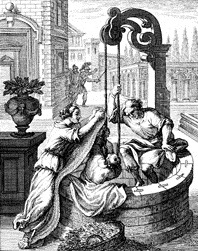
Jonathan and Ahimaaz - Johann Christoph Weigel
Jonathan and Ahimaaz - J.C. Weigel
He is risen; He is risen indeed. Happy Easter!

TODAY'S SPECIAL: 2 Samuel 16-18; Psalm 91

TO CHEW ON: "Now Jonathan and Ahimaaz stayed at En Rogel, for they dared not be seen coming into the city; so a female servant would come and tell them, and they would go and tell King David." 2 Samuel 17:17

David's plan was working! Absalom chose to follow Husahi's advice instead of Ahithophel's This bought David some time.

Hushai sent word of this to the priests' sons Jonathan and Ahimaaz (who had promised to be the snail-mail between Jerusalem and on-the-run David - 2 Samuel 15:27-28). However, even getting the word to Jonathan and Ahimaaz was now a two-step process as Absalom had eyes and ears everywhere. So Hushai gave the message for Jonathan and Ahimaaz to a "servant girl" to take to En Rogel where the runners were hiding.

A youngster saw them get the message, though and told Absalom. J. & A., realizing they'd been sighted, took refuge in a well in Bahurim, where the householder's wife covered their hiding place and spread ground grain on top of it. When Absalom's servants came to search they didn't find anyone. (Whew!)

Jonathan and Ahimaaz eventually got the message to David. He followed Hushai's advice, left the area and crossed over the Jordan to the wilderness.  There, before he even had time to worry about how he was going to take care of his army, three locals, Shobi, Machir, and Barzillai came laden with supplies because, "The people are hungry and weary and thirsty in the wilderness" - 2 Samuel 17:27-29.

Though it's customary for us to focus on the big-name players in the Bible's story—the Davids, Absaloms, Hushais, and Ahithophels—these narratives are also often full of bit players, some named, like Jonathan and Ahimaaz, but many unnamed as well, who are really as vital to bringing about the end result as the main players. In this story there are at least seven. Each one needed to play his or her part in order for God to accomplish His plan of preserving David's life.

Being a bit player is often our role. While we're not the big name speaker or the worship leader, when we do our part to make the phone calls, send the emails, set up the sound system, visit the sick, bring the food, open up our homes etc., things roll along smoothly. God's story plays out. Ours may seem like small, unimportant roles, but they are no less important than the role of the main characters to allow God's story to unfold in the way He has planned.

PRAYER: Dear God, help me to be willing to play whatever part You have for me in Your story. Amen. 

PSALM TO PRAY: Psalm 91

MORE: Easter Sunday
Carrying on with our theme of noticing insignificant characters, how many can you find in the story of Jesus' passion? Are we not among them—sinners for whom Christ's death paid our sins' penalty, and whose resurrection guarantees our life? 

 *********
Unless otherwise noted all Scripture quotations are taken from the New King James Version®. Copyright © 1982 by Thomas Nelson, Inc. Used by permission. All rights reserved.


Sunday, November 26, 2017

Recognizing Jesus

TODAY'S SPECIAL: Matthew 25:31-46

TO CHEW ON: " ' And the King will answer and say to them, "Assuredly, I say to you, inasmuch as you did it to one of the least of these My brethren, you did it to Me." ' " Matthew 25:40


One of the popular motifs of the Christmas dramas we used to put on in Sunday School was the poor, beggarly misfit becoming a type of the Christ child. It turned out that the person who noticed and served this unfortunate one amid the hustle and decorations, the shopping and food preparations, was the one who had the true Christmas spirit.

Recognizing Christ in unusual places and people is the theme of our reading today. Seeing and caring for His needs in those around us—the hungry and thirsty, the lonely stranger, the forsaken prisoner, the person who needs warm clothes ("naked") and sick—brings not only the King's commendation but the label of "righteous" and escape from eternal punishment (Matthew 25:34, 45-46).

Jesus talks in other places of coming in disguise:

  • In Mark 9:41 the person who serves Christ's disciples with as little as a cup of cold water gets a reward.
  • " 'Whoever receives one of these little children in My name receives Me; and whoever receives Me receives not Me but Him who sent Me' " says Jesus in Mark 9:37.
  • At another time, Jesus answered a question about how to inherit eternal life with the parable we call the Good Samaritan. In it, the person (Samaritan) who helps his needy neighbour (a beat-up Jew) is the one who loves his neighbour as himself, fulfilling one of the conditions for inheriting eternal life (Luke 10:28-37).

I look at these examples and ask myself—do I recognize Jesus when He comes to me disguised as a child, or a needy stranger, or a sister in trouble? Or am I more like those "goats" in our reading, who will someday appear before the King with 'Duh… Lord, when did I see you hungry or thirsty or a stranger or naked or sick or in prison?'

PRAYER: Dear Jesus, please take the scales off my eyes. Help me to recognize You however  and wherever You appear. Amen.

 *********
Unless otherwise noted all Scripture quotations are taken from the New King James Version®. Copyright © 1982 by Thomas Nelson, Inc. Used by permission. All rights reserved.

Sunday, November 05, 2017

Serving versus impressing

Image: Pixabay
TODAY’S SPECIAL: Matthew 23:1-22

TO CHEW ON:‘But all their works they do to be seen by men.’” Matthew 23:5


This word stabs me right where I live this morning, coming as it does on the heels of a prayer for how to handle something nasty I’ve seen in my own heart.

Pride! It stinks. And it’s so adaptable. You think you’ve finally dealt with it once and for all and then you sniff it coming from another area of your life.

The trouble with pride is it’s also subtle. You share a moment from your life on Facebook, perhaps, and then catch yourself growing more and more puffed up as the likes, reactions, and comments come in. Or you slip little bits about yourself into the conversation and feel miffed when someone changes the subject away from you. Yuck!

I see dealing with pride as similar to dealing with the eating / overeating issue. The trouble with weight control is you can’t just stop eating or you’d die. It’s similar with ego control. You can’t stop communicating as in sharing yourself with others. If you did you’d die socially and emotionally.

Detecting when that self-disclosure changes from a desire to share your life  in a healthy way to grubbing for compliments, praise, and strokes is similar, I think, to sensing when eating goes from a legitimate need for nourishment to indulgence.

Thankfully, Jesus didn’t stop talking at verse five. His solution to our easy-to-come-by overweening, self-exalting attitude comes in Matthew 23:11:

‘But he who is greatest among you shall be your servant.’

PRAYER: Dear Father, thank You for answering my personal and specific request with this passage today. Help me to give pride the boot by focusing on serving rather than impressing. Amen.

 *********
Unless otherwise noted all Scripture quotations are taken from the New King James Version®. Copyright © 1982 by Thomas Nelson, Inc. Used by permission. All rights reserved.


Friday, October 27, 2017

God's apprenticeship program for leaders

TODAY'S SPECIAL: Deuteronomy 34:1-12

TO CHEW ON: "Now Joshua the son of Nun was full of the spirit of wisdom for Moses had laid his hands on him; so the children of Israel heeded him, and did as the Lord commanded Moses." Deuteronomy 34:9


I wonder how Joshua first came to Moses' attention, and why. Perhaps it was his innate leadership ability, for he was first mentioned as a leader of the Hebrew fighters when they battled Amalek (Exodus 17:9). (That's the battle that the Israelites won as Moses kept his hands raised with the help of Aaron and Hur.)

He then became Moses' servant—someone who did a lot of lingering in the background. It was Joshua who accompanied Moses partway up Mount Sinai waiting around while Moses got the commandments (Exodus 24:12-13). His staying behind at the tent of meeting after Moses met with God there is fascinating (Exodus 33:11). One gets the sense that he so enjoyed being in God's presence he didn't want to leave.

When Moses sent spies into Canaan, Joshua was one of two (Caleb was the other) who came back with an encouraging report—whose view of God was bigger than fear of the giant Philistines (Numbers 14:6-30). That incident was about 40 years before the events in today's reading.

Moses had recently laid his hand on Joshua in ordination. He was God's choice: "And the Lord said to Moses, 'Take Joshua the son of Nun, a man in whom is the Spirit, and lay your hand on him...and inaugurate him..." (Numbers 27:18-21). Moses then challenged the Israelites to respect and follow him (Deuteronomy 31:1-8). And so here he was, their leader after Moses 'disappeared.'

Joshua is an example of how God sometimes puts future leaders into an apprenticeship program where they serve more than lead.  Elisha serving Elijah is another instance of this.

It doesn't always work out that way with servants, though. Remember Gehazi, Elisha's servant? Elisha may have been trying to mentor him. After all, he sent Gehazi back with the Shunamite woman to raise her son from death. Gehazi couldn't do it (2 Kings 4:29-31). And later, he proved himself unworthy as even a servant when he went after Naaman for the gift he had offered Elisha, lying to both Naaman and his boss (2 Kings 5:20-27).

Perhaps you sense that you're really leader material but feel stuck in the background serving. Don't grow impatient. Rather let this time of service sift and strengthen you. For if leadership is God's plan for your future, you are in the perfect apprenticeship program.


PRAYER: Dear God, thank You for the example of wise, godly Joshua who served before he led. Help me to be a willing and faithful servant, waiting for You to raise me to more responsibility—or not. Amen.

MORE: A verse to memorize

"Humble yourselves in the sight of the Lord, and He will lift you up." James 4:10

*****************
Unless otherwise noted all Scripture quotations are taken from the New King James Version®. Copyright © 1982 by Thomas Nelson, Inc. Used by permission. All rights reserved.

Bible Drive-Thru

Tuesday, July 25, 2017

Jesus - model servant

Foot-washing - at my daughter's wedding
 (they both washed each other's feet).

TODAY'S SPECIAL: Matthew 20:17-34

TO CHEW ON: " 'And whoever desires to be first among you, let him be your slave — just as the Son of Man did not come to be served but to serve, and to give His life a ransom for many.' " Matthew 20:27-28

Jesus didn't just point the disciples to the way they should live, He modelled it. He lived and breathed service during His time of ministry on earth. Skim through any of the synoptic gospels and you may come away exhausted yourself by his gruelling schedule of traveling, teaching, healing and then, when he tried to get away to rest, teaching and healing some more when the crowds followed Him to even remote places.

He also spelled out the importance of service. Our passage today is one such place (as is Mark 10:35-45). His washing of the disciples' feet (John 13:3-5; 14,15) was another dramatic object lesson of service where He again said plainly how this was something His followers should emulate: " 'Now that I, your Lord and Teacher, have washed your feet, you also should wash one another’s feet. I have set you an example that you should do as I have done for you.' "

Paul in Philippians describes the extremity of His service. The New Living Translation says it so clearly:

Though he was God,
      he did not think of equality with God
      as something to cling to.
Instead, he gave up his divine privileges;
      he took the humble position of a slave
      and was born as a human being.
   When he appeared in human form..." Philippians 2:6-7 - NLT

The NKJV says He came "taking the form of a bondservant..." A bondservant was a Hebrew slave who had served out his six years of required service but instead of going free, insisted on continuing to serve the household he loved. His master would then pierce his ear as a sign of his state and accept his service for life (see Exodus 21:1-6).

A sidebar article in my Bible talks about the faithful servant:

"The character of a faithful servant reveals devotion to the interests of others; the thoughtfulness of rendering untiring care, the delight in the prosperity, honour and happiness of someone besides himself" -Fuchsia T. Pickett  New Spirit-Filled Life Bible p. 1328.

We can personalize such servanthood by asking — in my role as wife, mother, teacher, clerk, bank teller, waitress, CEO or... what does it look like to:
  • Devote myself to the interests of others?
  • Render untiring care?
  • Delight in the prosperity, honour and happiness of others?

PRAYER: Dear Jesus, thank You for Your clear teaching about the importance of having a servant's heart and Your modelling of service. Help me to make a permanent paradigm shift and pursue this quality above the ways to be great that my culture recognizes. Amen.

MORE: Feast of St. James the Apostle

It's a pity that James the Apostle is remembered most for this rather crass request (made by his mother, for sure, but it's clear that he and his brother John were in on it, for she "came to Him with her sons..."). I wonder how Jesus' teaching on this occasion, impacted him.

Here is a little more about this close friend of Jesus's:

Not much is known of his ministry after Jesus' resurrection.  It is believed, however, that he lived another 14 years before his martyrdom.  In fact, the apostle James was the first apostle to suffer martyrdom.  By order of Herod Agrippa I, James was beheaded in Jerusalem about the feast of Easter, 44 AD.


It is believed that within this 14 year period, James visited the Jewish colonist and slaves in Spain to preach the Gospel.
from "The Apostle James, son of Zebedee"
from this Bible Path article.

There is a church in Spain where the Apostle James' is believed to be buried.

Today is the day the church celebrates James the Apostle. The liturgy for the day begins with this collect:

"O gracious God, we remember before you today your servant and apostle James, first among the Twelve to suffer martyrdom for the Name of Jesus Christ; and we pray that you will pour out upon the leaders of your Church that spirit of self-denying service by which alone they may have true authority among your people; through Jesus Christ our Lord, who lives and reigns with you and the Holy Spirit, one God, now and for ever. Amen."
************
Unless otherwise noted all Scripture quotations are taken from the New King James Version®. Copyright © 1982 by Thomas Nelson, Inc. Used by permission. All rights reserved.

Scripture quotations marked NLT are taken from the Holy Bible, New Living Translation, copyright © 1996, 2004, 2007 by Tyndale House Foundation. Used by permission of Tyndale House Publishers, Inc., Carol Stream, Illinois 60188. All rights reserved.


Monday, July 25, 2016

Servants rule

Image from Pixabay.com
 TODAY'S SPECIAL: Mark 10:34-45

TO CHEW ON: "But Jesus called them to Himself and said to them, 'You know that those who are considered rulers over the Gentiles lord it over them, and their great ones exercise authority over them. Yet it shall not be so among you but whoever desires to become great among you shall be your servant. And whoever of you desires to be first shall be slave of all.'" Mark 10:42-44


If you are a reader of science fiction or fantasy you will be familiar with the idea of an alternate universe. It is the setting an author creates, where the sky may be pink, the animals talk, or people communicate by electronic waves filtered through nerve endings -- whatever the author has imagined and created.

In a way the Kingdom of Heaven, or Kingdom of God is like that alternate universe. When we give Jesus our lives and enter that kingdom, we soon discover that the 'laws of gravity' have changed.

In Mark 10 Jesus explains one of those changes to His disciples. The Zebedee brothers, James and John, have just come to Jesus asking for a special position in the kingdom they expect Jesus to set up (which they think will be earthly and happen any day now). The other disciples are understandably outraged. Who do these two think they are -- asking for special treatment!?

Instead of scolding them. Jesus gathers all the disciples around to take advantage of this teaching moment. He explains that, unlike the universe they have lived in their whole lives, where the great ones are the people with recognized position, in the Kingdom of Heaven, the great ones are the ones who serve. For, Jesus explains, even the Son of Man (God incarnate), came not to be served but to serve (vs.45).

We, or at least I, still struggle with this concept. I'm easily star-struck by someone's outward popularity or power, judging greatness by outward appearances (look how the media fawns over her, how often he is quoted, how many Twitter and Facebook followers she has, how many people follow his blog). But that's not what impresses God. He takes note of the unknown person who may be doing the lowest, most behind-the-scenes job (cleaning toilets, typing the minutes, cooking and serving the food) with an attitude of willing service. In His eyes, those are the truly great ones, the ones in first place, the ones who rule.

PRAYER: Dear God, please give me the heart of a genuine servant. Amen.

MORE: Feast of St. James the Apostle

Today is the day church liturgy remembers and honours the Apostle James, who is known for more than his request to get special treatment in Jesus' kingdom. Tradition credits him with being the first of the twelve apostles to suffer martyrdom for the name of Jesus. The liturgy for the Feast of James the Apostle begins with this prayer:

O gracious God, we remember before you today your servant and apostle James, first among the Twelve to suffer martyrdom for the Name of Jesus Christ; and we pray that you will pour out upon the leaders of your Church that spirit of self-denying service by which alone they may have true authority among your people; through Jesus Christ our Lord, who lives and reigns with you and the Holy Spirit, one God, now and for ever. Amen.


***********
Unless otherwise noted all Scripture quotations are taken from the New King James Version®. Copyright © 1982 by Thomas Nelson, Inc. Used by permission. All rights reserved.

Bible Drive-Thru

Tuesday, December 29, 2015

Heaven's work

TODAY'S SPECIAL:  Revelation 21:22-22:5

TO CHEW ON: “And there shall be no more curse but the throne of God and of the Lamb shall be in it, and His servants shall serve Him.” Revelation 22:3

“They say there’s a heaven for those who will wait
Some say it’s better, but I say it ain’t
I’d rather laugh with the sinner than cry with the saints.
Sinners are much more fun" – Billy Joel

“Go to Heaven for the climate, Hell for the company.” – Mark Twain

The attempt to put down something we don’t understand by making jokes about it, as the above quotes do about heaven, is something I’m sure you’ve encountered. C. S. Lewis had his own comeback: “There is no need to be worried by facetious people who try to make the Christian hope of 'Heaven' ridiculous by saying they do not want to 'spend eternity playing harps'. The answer to such people is that if they cannot understand books written for grown-ups, they should not talk about them.” He goes on to explain that much of the imagery of heaven is symbolism and not meant to be taken literally.

While Lewis's interpretation may or may not be accurate, it seems clear that the notion of sitting around heaven playing harps all day is pure fantasy. The Bible talks about the inhabitants of heaven doing something far more prosaic: they serve.

It is interesting to follow the idea of servanthood through the New Testament.
  • Jesus taught that for the servant, faithfulness and going beyond one’s comfort is a duty (Luke 17:5-10).
  • Serving like He served us involves giving up all rights – even the right to life (John 12:23-26).
  • The apostles carried on this idea of serving to the death. In Romans 14:7-8 Paul talks of living and dying to the Lord.
  • They equate their service to God with slavery. (Romans 1:1; James 1:1 ; 2 Peter 1:1).
  • On earth, serving faithfully in your place of employment (whether voluntarily or as a slave) can be counted as faithful service to Jesus because if you are His, everything you do is service to Him (Colossians 3:22-24).
  • Jesus, in the parable about the minas, indicates that our faithfulness in stewarding His gifts and opportunities in this life will lead to future responsibility in the kingdom. (Life on earth is our training ground; our service seminar – Luke 19:16-20).
  • In today’s focus verse Jesus’ servants “serve Him.” In Revelation 7:15 they “serve Him continually in His temple.”

So our time in heaven won’t be taken up with playing harps – at least not exclusively (although it might involve some of that; one of the shades of meaning of “serve” [latreuo from latris] is to worship). We will be working, serving God. But that work will be under “no more curse.”

It makes me want to serve here on earth with more intention, realizing my service to Him here is part of a continuum of meaning and purpose that stretches into eternity.

PRAYER: Dear God, thank You for this glimpse into eternity that helps me put my earthly life into perspective. Help me to view all my service on earth as really done for You. Amen.

MORE: In the chapter “Made to Last Forever – of his book The Purpose Driven Life, Rick Warren says:

"Life on earth is just the dress rehearsal for the real production. You will spend far more time on the other side of death – in eternity – than you will here. Earth is the staging area, the preschool, the tryout for your life in eternity. It is the practice workout before the actual game; the warm-up lap before the race begins. This life is preparation for the next….


[…] Measured against eternity our time on earth is just a blink of an eye, but the consequences of it will last forever. The deeds of this life are the destiny of the next. ….Matthew Henry said, “It ought to be the business of every day to prepare for our final day.”
- Rick Warren, The Purpose Driven Life, page 36, 40.
**********
Unless otherwise noted all Scripture quotations are taken from the New King James Version®. Copyright © 1982 by Thomas Nelson, Inc. Used by permission. All rights reserved.

Do your 8-12-year-olds have daily devotions? Point them to Bible Drive-Thru.

Wednesday, August 05, 2015

Given over to lewdness

TODAY'S SPECIAL: Ephesians 4:17-5:2

TO CHEW ON: "...you should no longer walk as the rest of the Gentiles walk, in the futility of their mind, having their understanding darkened, being alienated from the life of God because of the ignorance that is in them, because of the blindness of their heart; who being past feeling have given themselves over to lewdness, to work all uncleanness with greediness." Ephesians 4:17-19

Michael Leehan was mad at  God. After a difficult childhood and a painful divorce he made a decision:

"One Saturday afternoon as I sat on my red corduroy couch, my heart filled with anger toward a God who seemed distant even cruel. My tiny snatches of knowledge about this God of the Bible had built the picture of a tyrant in my mind's eye: a God who is never satisfied, just waiting for one of His followers to step out of line ....

Hadn't God created a fear-based system with the threat of hell that forced people to bend their knees to Him, not out of love, but out of self-preservation? What did free will mean in all this? I was consumed by my tortured thoughts.

Finally, I said, 'God, I will not serve You. I will not serve a God of fear and punishment who forces His victims into submission. I will serve the dark side.' And I blurted out, 'Satan, come into my life. You are now my god. Use me, have me, and control me for your purposes.' ....

Immediately, a power swept over me"
- Michael Leehan, Ascent From Darkness, Kindle Location 486.

Leehan tells that story and what followed in his memoir Ascent From Darkness. His activities included multiple affairs, cutting (as in self-mutilation), and performing animal sacrifice. He particularly had it in for Christians and would do things like join Bible studies or attend church singles groups with the intention of sowing doctrinal confusion and seducing women.

Admittedly Michael Leehan is an extreme example of someone given over to lewdness.* But as I read his story, I got more than one 'Aha' moment as I saw traces of what he was and did reflected in the behaviors of unbelievers I know—indeed in my own behavior during the years I was backslidden.

Let's keep in mind the fact that Satan is still behind such rebellious attitudes and actions in whomever they occur. Let's not give ourselves over to any of them. And let's pray more fervently for our unsaved family members, friends and acquaintances, that they will be free to "learn Christ" - Ephesians 4:20, to "put off ... the old man" - Ephesians 4:22, and to "...put on the new nature (the regenerate self) created in God’s image, [Godlike] in true righteousness and holiness" - Ephesians 4:24, Amplified.

PRAYER: Dear God, it is easy to rationalize rebellious attitudes in myself and others as a natural human response to authority. Help me to recognize its roots in the enemy Satan. Please continually renew my mind. Amen.

MORE: Lewdness
[*Lewdness - aselgeia means "Total debauchery, unashamed indecency, unbridled lust, unrestrained depravity. The person with this characteristic has an insolent defiance of public opinion, sinning in broad daylight with arrogance and contempt" - Dick Mills, Word Wealth, New Spirit-filled Life Bible, p. 1768.]
*********
Unless otherwise noted all Scripture quotations are taken from the New King James Version®. Copyright © 1982 by Thomas Nelson, Inc. Used by permission. All rights reserved.

Bible Drive-Thru


Saturday, July 25, 2015

Rulers serve

spaghetti served with tongs
TODAY'S SPECIAL: Mark 10:35-45

TO CHEW ON: "… whoever desires to become great among you shall be your servant. And whoever of you desires to be first shall be slave of all." Mark 10:43,44

James and John's idea of ruling was to sit in a high place next to Jesus and share the glory of His position.

Jesus looked at the job of a ruler quite differently. To Him it was drinking the cup—of betrayal, mocking, beating, nailing—and experiencing the baptism of death to resurrection. Being a ruler or leader was all summed up in the word 'servant.'

[What is a servant? My dictionary defines it as "A person hired to assist in domestic matters, sometimes living within the employer's house." The Greek word used here is diakonos  that means servant, servant of a king, waiter, deacon. Other places it occurs it is translated deacon, servant, minister.]

What do servants do?
  • A household servant does all kinds of jobs from washing toilets to driving the boss to the embassy.
  • If a servant lives in-house, he is accessible at all hours. He may have his defined workday but if there's an emergency, the master will get him up.
  • A good servant works with the right attitude: willing, eager, enthusiastic, always doing the job to the best of his or her ability, not only when the master is watching.
Keri Wyatt Kent in her book about New Testament words says in her "Serve/Service" entry:
"For the Christian, service is not an occasional activity, somehow separate from the rest of our lives. As Bob Dylan famously sang, 'You gotta serve somebody.' Whether we're aware of it or not, each of us has decided to orient our life around someone or something. That decision colors all our other choices" - Keri Wyatt Kent, Deeper Into the Word - New Testament, p. 188 (emphasis added).

We do well to ask, who am I serving—Jesus or someone else? Maybe it's myself. If we settle in our hearts that we're serving Jesus, we might ask, what sort of servant am I?
  • Am I available for any job—high or low?
  • Am I always available?
  • Do I serve with the right attitude?

PRAYER: Dear Jesus, thank You for Your example of extreme servanthood. I want to be Your good servant. Help me to grow in this. Amen.

MORE: Bob Dylan singing "Gotta Serve Somebody"

Lyrics to "Gotta Serve Somebody"

***********

The Holy Bible, New King James Version Copyright © 1982 by Thomas Nelson, Inc. - Used with permission.

Bible Drive-Thru


Thursday, April 23, 2015

Leadership - it's not about me

TODAY'S SPECIAL: Ezekiel 34:1-166

TO CHEW ON: "Thus says the Lord God: 'Behold I am against the shepherds, and I will require My flock at their hand; I will cause them to cease feeding the sheep, and the shepherds shall feed themselves no more; for I will deliver My flock that they may no longer be food for them'" Ezekiel 34:10

Is God here ranting against the men that are out in the Judean hillsides watching their sheep — actual shepherds? No. This is a diatribe against leaders of people who had failed to do what leaders should do. Looking over verses 1-10 we can discover what some of those failings were:

1. They were concerned primarily about themselves and not the people they led (Ezekiel 34:2).

2. They acted out this self-interest by ravaging the flock. They used their underlings for their own ends (Ezekiel 34:3).

3. They took no responsibility for their flock's health or well-being. They didn't look after its sick or hurt members and didn't go after the ones who went wandering or got lost. The result was a scattered, weak, sickly flock, vulnerable to any danger that came along from weather to wild animals, to wandering (Ezekiel 34:4-6).

4. They were held accountable and lost their jobs (Ezekiel 34:7-10).

This is a good warning to take to heart for those of us who lead in any capacity (in our churches as pastors, teachers, or small group leaders, in society as presidents, committee heads or coaches, in our homes as parents and grandparents). When we turn God's four scolds of Israel's irresponsible leaders into positives, we have a template for our own leadership. Good leadership is:


1. Concerned primarily with the well-being of those who follow.

2. Untainted by motives of personal gain.

3. All about responsibility.
Of course the look of this will be different for the different kinds of shepherding we do. For the spiritual leader of people — say as a small group leader in church — it might involve making sure you have some good spiritual food prepared for your next meeting, listening to your people to discover their hurts and challenges, phoning the ones who are absent, visiting the sick ones in hospital, bringing meals to the home where Mom has just had a baby, getting other healthy members involved in the care of the flock so it doesn't all fall on your shoulders...

4. Expecting to be held accountable. How much better to hear His "Well done, good and faithful servant" than that you've lost your flock and your job because you weren't a good shepherd!


PRAYER: Dear God, please put within me the heart of a good leader/shepherd who thinks of others first before myself. Help me to demonstrate servant leadership whenever I lead. Amen.

MORE: Advice to leaders

Michael Hyatt,  a speaker and author who writes often about leadership this advice to his successor as  CEO of Thomas Nelson Publishing in 2011 It is good advice to anyone who is a leader:

1. Your position is a role not your identity.


2. Your position is temporary not permanent.


3. Your position is a privilege not a right.


4. Your position is about faithfulness not achievement.


5. Your position is about them not you.


6. Your position is about stewardship not ownership.


7. Your position will require more than you can provide on your own.

Read all of "Advice to a New CEO (or to any Leader)" to see how he expands on each of these points.
*********
Unless otherwise noted all Scripture quotations are taken from the New King James Version®. Copyright © 1982 by Thomas Nelson, Inc. Used by permission. All rights reserved.


Bible Drive-Thru


Bookmark and Share

Saturday, March 28, 2015

Shades of humility

"The Lord's Blessing"
by Kathy Lawrence

"The Lord's Blessing" by Kathy Lawrence
TODAY'S SPECIAL: Philippians 2:1-11


TO CHEW ON: "Let nothing be done through selfish ambition or conceit, but in lowliness of mind let each esteem others better than himself...Let this mind be in you which was also in Christ Jesus..."  (2:3-5)

Humility. I think we'd all agree it's a quality that's attractive in other people, yet easy to transgress in ourselves. A close look at our reading today along with a few other Bible bits will help us discover shades of biblical humility and give us ideas on how we can nurture it in ourselves.

  • Other-centered
Paul alludes to one of the big reasons it's hard to be humble in Philippians 2:4 — because each one of us is at the centre of our own universe (as Adrian Plass says it: "Everyone is I"). We take a big step down the road to humility when we "look out not only for our own interests, but also for the interests of others."

  • Childlike
In Matthew 18:4 Jesus talks about humbling oneself as a child. A childlike attitude toward God is rooted in the reality of His power and bigness, and our dependence on Him.

  • Live for the praise of the One who matters
If we have trouble being humble, James 4:10 tells us to put ourselves before God — the One whose opinion really counts. From this place we say, I don't know best, but You do. I'll take whatever lot in life or assignment You give. I'll let You decide.

  • Defer to the deserving
Peter in 1 Peter 5:5 gives common sense advice when he says tells us to defer to those who deserve honour — like wise elders. But then he quickly enlarges the net: "all of you be submissive to one another and clothed with humility."

  • Free from the need to prove anything
Back at our Philippians passage, I love how a sidebar article in my Bible describes Jesus' humility (Philippians 2:5-8):

"Christlike humility is manifested in the freedom of God's Son to affirm the fullness of all God has placed in Him, without needing to flaunt, prove, or push it through self-advancement. Jesus' complete absence of any need to 'clutch' for power or attention is manifest humility. It is the royal spirit that the King of heaven Himself displayed in servantlike graciousness" - Fuchsia Pickett, New Spirit-Filled Life Bible, p. 1662.

That's what I want — freedom from a need to flaunt, prove, push for self-advancement, clutch for power or attention. I want my life to display that "royal spirit" Jesus lived by His "servantlike graciousness," don't you?


PRAYER: Dear Jesus, please help me to live the humility that You modelled. Show me where I need to humble myself so that I won't need Your disciplinary hand to humble me. Amen.

********
Unless otherwise noted all Scripture quotations are taken from the New King James Version®. Copyright © 1982 by Thomas Nelson, Inc. Used by permission. All rights reserved.


Bible Drive-Thru


Sunday, March 22, 2015

Is our goal God's glory?

germinating seed
"Unless a grain of wheat ... dies, it remains alone"
TODAY'S SPECIAL: John 12:20-36a

TO CHEW ON:
" 'Father, glorify Your name.' Then a voice came from heaven, saying, 'I have both glorified it and will glorify it again.' " John 12:28

I see three upside-down realities of the kingdom of God in today's reading:

1. To preserve life, we give ours away—like a seed dies to produce the next crop of seedlings (John 12:24-25).

2. To get honor that really counts—God's honor—we don't king it over people but serve (John 12:26).

3. To attract the world Jesus had to be "lifted up" in crucifixion (John 12:32-33).

How easy it is for us to lose sight of these counter-intuitive aspects of God's kingdom as we respond and react to life's daily challenges. We are careful to preserve our lives for ourselves instead of flinging them on Jesus. We like to be served instead of serve. We find Jesus' death almost an embarrassment instead of an attraction  because of the way it draws attention to the sinful and helpless condition of each person on earth. In our humanistic self-sufficient culture, such a thing is politically incorrect.

Perhaps we're also so often unmotivated to pursue this kingdom point-of-view in our lives because we aren't fully invested in its eventual goal—that God get the glory. We secretly want glory for ourselves.

Theologian J.I. Packer confronts this tension of viewpoints in his book Knowing God:

"The Christians instincts of trust and worship are stimulated very powerfully by knowledge of the greatness of God. But this is knowledge which Christians today largely lack and that is one reason why our faith is so feeble and our worship so flabby. We are modern men, and modern me, though they cherish great thoughts of man, have, as a rule, small thoughts of God. ...

"Today vast stress is laid on the thought that God is personal, but this truth is so stated as to leave the impression that God is a person of the same sort as we are—weak, inadequate, ineffective, a little pathetic ...

"Like us He is personal, but unlike us He is great. In all its constant stress on the reality of God's personal concern for His people, and on the gentleness, tenderness, sympathy, patience, and yearning compassion that He shows towards them, the Bible never lets us lose sight of His majesty, and His unlimited dominion over all His creatures" - J.I. Packer, Knowing God pp. 87,88 (italic emphasis in the original, bold emphasis added).

When we feast our minds on the greatness of God, we begin to understand why He (not us) deserves glory. Then investing our lives for the furthering of His glory begins to make sense. And the price we may be asked to pay of losing our lives, of serving, and of spreading the good news of rescue becomes every bit worth it.

PRAYER:
Dear God, help me to know You better and be fully committed to furthering the glory of Your being, name, and reputation. Amen.

 *********
Unless otherwise noted all Scripture quotations are taken from the New King James Version®. Copyright © 1982 by Thomas Nelson, Inc. Used by permission. All rights reserved.


Saturday, November 15, 2014

Looking for mercy

TODAY' SPECIAL: Psalm 122:1-123:4

TO CHEW ON: "Behold as the eyes of servants look to the hands of their masters,
As the eyes of a maid to the hand of her mistress,
So our eyes look to the Lord our God,
Until He has mercy on us." Psalm 123:2


I've always liked this picturesque little verse, reading it as servants keeping an eye on the master for the next command. But on a close look today, I see that that's not what the servant is waiting for at all. Rather, he or she is waiting, looking up, hoping for mercy

[Mercy (chanan) means to be gracious, show pity, favour.
In English mercy is defined as kind or compassionate treatment of an offender, adversary, prisoner etc. in one's power; compassion where severity is expected or deserved.]

This request for mercy from the lips of man to God—from our own lips—reminds us of who God is and who we are. Eugene Peterson comments on this psalm and the stance of the person praying:

"The person of faith looks up to God, not at him or down on him. The servant assumes a certain posture, a stance. If he or she fails to take that posture, attentive responsiveness to the master's commands will be hard" - Eugene Peterson, A Long Obedience in the Same Direction, p. 61.

The definition of mercy reminds us of why it is only realistic to take that low, looking-up posture: because we are people who deserve and, except for Jesus and His substitutionary death for us, expect severity.

It's easy to get in the 'ordering God around' mode in our prayers. This little psalm reminds us of who we are and what our realistic posture before God is. And yet, because He is good, this grovelling for mercy is not fear-filled but optimistic. Peterson again:

"In obedience we pray 'Mercy!' instead of 'Give us what we want. We prayer 'Mercy!' and not 'Reward us for our goodness so our neighbors will acknowledge our superiority." We pray "Mercy!" and not "Punish us for our badness so we will feel better.' We pray 'Mercy!' and not 'Be nice to us because we have been such good people.'


We live under the mercy. God does not treat us as alien others, lining us up so that he can evaluate our competence or our usefulness or our worth. He rules, guides, commands, loves us as children whose destinies he carries in his heart" - Peterson, Ibid., p. 64.

PRAYER: Dear God, thank You for this reminder of my realistic position before You. Thank You for Your mercy that looks on me with soft, compassionate eyes, instead of with the condemnation I deserve. Help me to extend Your mercy to others. Amen.

MORE: Kyrie Eleison (As We Come Before You) by Stuart Townend & Keith Getty


**********
Unless otherwise noted all Scripture quotations are taken from the New King James Version®. Copyright © 1982 by Thomas Nelson, Inc. Used by permission. All rights reserved.


Saturday, June 07, 2014

Embrace diversity

teamwork - team putting a puzzle together
TODAY'S SPECIAL: 1 Corinthians 12:1-13

TO CHEW ON: "There are diversities of gifts, but the same Spirit. There are differences of ministries but the same Lord. And there are diversities of activities but it is the same God who works all in all." 1 Corinthians 12:4-6

Our focus verses talk about three means through which God works in and through the life of a believer and so the life of the church.

He gives GIFTS. I like how the Amplified enlarges on "diversities of gifts": "Now there are distinctive varieties and distributions of endowments [extraordinary powers of distinguishing certain Christians, due to the power of divine grace operating in their souls by the Holy Spirit] and they vary…" (1 Corinthians 12:4 AMP). Paul lists the gifts of the Spirit in verses 1 Corinthians 12:8-10 of our reading.

He works through MINISTRIES. [Ministries—diakonia—means service, ministering religion, charity, food.] It may require teamwork with each person willing to do what's required. A few years ago my husband and I worked in the Alpha ministry of our church—not as table leaders but as kitchen workers. When it came time for testimony night, the leader asked that we, the kitchen crew, be present to hear the testimonies so we would get a sense of what we had been a part.

He works through a diversity of ACTIVITIES. [Activities —energema—means "thing wrought" and "effect operation."] Verse 6 in the Amplified Bible explains it well: "And there are distinctive varieties of operation—or working to accomplish things—but it is the same God Who inspires and energies them all in all." (1 Corinthians 12:6 AMP).

To me this speaks of how people have different styles of working, taking different routes to the same goal. Some make detailed plans while others are open to whatever comes along. Some are organized, doing jobs ahead while others are last-minute, working best under pressure. Some have neat work spaces while others are most creative in chaos. The beautiful thing is there's no one right way. God is present and moving even in our different styles of working.

How freeing to know that we don't have to be like others in our gifts, our ministries, or our styles of working. When God the Holy Spirit lives in us, He will give the gifts we need for the ministry in which we're involved, to accomplish His work through us, as individuals and the church. We can not only embrace but celebrate our diversity!

PRAYER: Dear God, thank You for Your presence in my life. Help me to refrain from comparing myself with others in gifts, ministries and the way I work at things. Amen.

 *********
Unless otherwise noted all Scripture quotations are taken from the New King James Version®. Copyright © 1982 by Thomas Nelson, Inc. Used by permission. All rights reserved.

Scripture quotations marked AMP are taken from the Amplified® Bible,
Copyright © 1954, 1958, 1962, 1964, 1965, 1987 by The Lockman Foundation
Used by permission." (www.Lockman.org)


Bookmark and Share


Saturday, April 26, 2014

Equipped to work

TODAY'S SPECIAL: Ephesians 4:1-16

TO CHEW ON: "And He Himself gave some to be apostles, some prophets, some evangelists, and some pastors and teachers for the equipping of the saints for the work of ministry, for the edifying of the body of Christ." Ephesians 4:11-12

What is your perception of your pastor's purpose? Do you see him as someone whose job it is to entertain, educate and challenge you in his Sunday sermons, to encourage you, to visit you when you're sick and generally cater to you? Or in your mind, does his job description also include getting you ready to do some of those things for others?

Paul talks about the role of leadership in this passage in terms of equipping. Jack Hayford in his notes on Ephesians, comments: "Equipping implies: 1) a recovered wholeness as when a broken limb is set and mended; 2) a discovered function as when a physical member is properly operating" - New Spirit-Filled Life Bible p. 1650.

Paul's language here is quite clear about the role of church leaders. While one of their jobs is to care for us as in help us recover wholeness, another is to help us to discover our ministry role and equip us to care for others.

What others?

I would suggest all those whose lives touch ours in some way. This would include people we live with (family), the people we live beside, the people we interact with not only face-to-face but virtually through Facebook, and email. Even the writing I'm doing here is the fruit of my pastor's equipping in my life.

I see a couple of implications for everyday living:

1. If we're leaders (one of those apostles,* prophets, evangelists or teachers) one of our goals should be to equip our 'disciples' to do ministry.

2. As disciples / parishioners / church members, we need to realize that our pastor's role is not all about us—how entertaining he is as a speaker, how often he visits us when we're sick, how wise he is as a counselor, etc. Rather, it is to prepare us to take on some of those ministry responsibilities as we share the burden for the well-being of the body of Christ.

PRAYER: Dear God, help me to be a giver, not just a taker when it comes to responsibility in the body of Christ. And help my pastor and other church leaders as they work in their many roles. Amen.

MORE: Spiritual leadership

Bob Hamp, in a guest post on Michael Hyatt's blog says, "Not all leaders in religious organizations are spiritual leaders. This is not a criticism as much as a distinction. Distinguishing spiritual leadership from other forms of leadership can free people from unrealistic expectations of some leaders.

At the same time, making this distinction can help identify who the spiritual leaders in your organization are..." 

Hamp's observation alerts us to the possibility that we, as laypeople, can be spiritual leaders. His article goes on to give six characteristics of spiritual leaders:

1. They lead others into their own encounters with God.
2. They lead others to discover their own purpose and identity.
3. They lead others into transformation—not just production.
4. They impact their atmosphere.
5. They help people see old things in new ways.
6. They gain a following because of who they are—not because of a position they hold.

Read all of "6 Characteristics of Spiritual Leaders."

**************
* Apostles: Are there still apostles today? Many insist that office ended in the New Testament era. Jack Hayford, in his notes on Ephesians says:
"Beyond the distinct role filled by the original founding apostles, the NT mentions enough additional apostles to indicate that this office, with that of prophets, is as continuing a ministry in the church as the more commonly acknowledged offices of evangelist, pastors and teachers" New Spirit-Filled Life Bible, p. 1650.

**********
Unless otherwise noted all Scripture quotations are taken from the New King James Version®. Copyright © 1982 by Thomas Nelson, Inc. Used by permission. All rights reserved.

Bookmark and Share

Tuesday, April 08, 2014

Mentor-servant

TODAY'S SPECIAL: John 12:20-43

TO CHEW ON: "If anyone serves Me, let him follow Me, and where I am, there my servant will be also. If anyone serves Me, him My Father will honor." John 12:26

 "Who is investing in you and who are you investing in?" asked author/speaker Joel Rosenberg in a talk I once heard him give.

Jesus talked about that kind of relationship in John 12. We call it mentoring. He was, of course the mentor, the one the disciples followed [akoloutheo: joined as His attendants, accompanied Him as disciples]. In that role they served Him [diakoneo: to be a servant, wait at table, offer food and drink, minister, attend to anything that may serve another's interests].

An explanatory article in my Bible explores this type of serving:
"What personal service has qualified a leader? In both OT and NT, authentic ministry presupposes a leader has a record of personal service to someone: servanthood is the time-tested entrance prerequisite for trustworthy ministry. Since God's Word seems to reveal such service as the basis for any advancement in leadership, we are wise to be cautious if such credentials are not found in a rising leader today" - Joseph Garlington - "Servant, Leader Traits," New Spirit-Filled Life Bible, p. 1466 (emphasis added). 

Of course now, 2000 years since Jesus walked the earth, we can't up and literally follow or serve Him. But in the spirit of "whatever you did for one of the least of these brothers and sisters of mine, you did for me" (Matthew 21:40), let's enact this type of discipleship by:

1. Living alert for opportunities to serve "the least of these."

2. Making ourselves available to being discipled and to discipling others.

3. Following the biblical model of leader preparation. Notice how many leaders were first servants: 
  • Joshua served Moses (Exodus 24:13; Joshua 1:1).
  • Elisha served Elisha (2 Kings 3:11). 
  • David served Saul (1 Samuel 16:21, 17:32).
  • Jesus' disciples served Him. 
Time spent in service to a mentor is not an uncommon part of a leader's resume. 

PRAYER: Dear God, it seems with You the way up is usually the way down. Please help me to have the heart of a genuine servant, both as a mentor and as someone who is being mentored by others.

***********

Unless otherwise noted all Scripture quotations are taken from the New King James Version®. Copyright © 1982 by Thomas Nelson, Inc. Used by permission. All rights reserved.


Bookmark and Share

Saturday, July 20, 2013

Treating the Martha Syndrome

TODAY'S SPECIAL: Luke 10:38-42

TO CHEW ON: "But Martha was distracted with much serving and she approached Him and said, 'Lord do you not care that my sister has left me to serve alone? Therefore tell her to help me.'" Luke 10:40

I have on my bookshelf a thoughtful book that makes me want to sit at the feet of Jesus and listen. Embracing Your Second Calling by Dale Hanson Bourke helps women, specifically women in the second half of life, find direction and purpose for the rest of the journey. She makes a statement in a chapter on idols that I think is relevant to this little Mary-Martha vignette:

"I have come to believe that leaving false idols is at the heart of our ability to hear and obey our second callings" (p. 85).

Luke describes Martha as "distracted with much serving." But that is merely the outer symptom of obedience to a dictator in her heart which, I think, we could call an idol. Because there is nothing wrong with serving. But Martha's petulance at being left to do it alone shows that something besides serving is at stake here. There's an agenda (idol) that she's finding hard to satisfy.

Perhaps the motive for her dedicated service is to maintain her reputation as a good hostess and cook. On this of all days, she can't risk a shoddy or late meal. Or maybe she's fussing because this just isn't how you entertain guests—sit around listening to them while neglecting to do the usual. Tradition isn't being served. Or perhaps this is the Mary she's lived with all her life—the one who always slipped away from chores to do the interesting stuff. Today she's had enough. She is simply wanting Jesus, who would know what's fair if anyone would, to recognize and uphold her right to have help.

I've been all three of these Marthas. My sympathy is with her all the way. Mostly, I'd like to help her / myself get to the bottom of this and any dis-ease in my spirit that shows me some little demigod isn't happy. Sniffing out those idols is, I think, the key.

PRAYER: Dear God, You can have the full run of my heart today. Please help me identify and root out idols that keep me from hearing and following You. Amen.

MORE: Other thoughts on this passage

Having a Mary Heart in a Martha World is a twelve week devotional by Joanna Weaver that delves into this little story in depth. Here is a reader's guide to the book (which gives a taste of what it's about).

Weaver has since come out with another book exploring the topic in even more depth. Janet Sketchley reviews Having a Mary Spirit (2006) on her blog here.

I've written about this Martha/Mary story previously before in a poem, which begins:

The Martha In Me

Too often Martha takes charge–
I schedule service with conditions,
workboots clomp on everything
threatening my control –
I curse the one who’s late,
ignore the longing in my daughter’s eyes to chat,
dismiss women with Watchtower at my door –
not aware I’ve stamped out
embers of His presence.

Read entire
 

Related Posts Plugin for WordPress, Blogger...