Showing posts with label God's judgment. Show all posts

Wednesday, November 14, 2018

Passing through foreign territory

Image: Pixabay
TODAY'S SPECIAL: Ephesians 1-2; Psalm 8

TO CHEW ON:
"And you He made alive, who were dead in trespasses and sins, in which you once walked according to the course of this world, according to the prince of the power of the air, the spirit who now works in the sons of disobedience." Ephesians 2:1,2

Do you sometimes feel like the society in which you live is against many of the things you value? Marriage and the family are under attack. Public education removes any reference to God. The people most honored, admired, and influential are the beautiful, wealthy, and entertaining who charm and excite through movies, music and sports.

Feeling like we're misfits, traveling through a foreign land shouldn't surprise us. One of the reasons why is found in Ephesians 2:2 where Paul talks about a character, "the prince of the power of the air," who directs these things. The writer of my Bible's study notes describes his influence:
"The mood and manner of society is shaped by the prince of the power of the air, a title for Satan as he exercises influence globally and within each culture" Jack W. Hayford,  New Spirit-Filled Life Bible, p. 1646.

We see Satan referred to as a princely ruler in other places:

  • He tempted Jesus on the basis of this position: "'And the devil said to Him, “All this authority I will give You, and their glory; for this has been delivered to me, and I give it to whomever I wish'" - Luke 4:5,6.
  • Jesus predicted, and God the Father agreed, that Jesus' death would "'cast out'" the "'ruler of the world'" as He (Jesus) would " '…draw all peoples to Myself'" John 12:28-32.
  • Satan and his system had no claim to or presence in Jesus - John 14:30.
  • Jesus, before He died, told the disciples of the Holy Spirit who would come to them after He left. One of the Holy Spirit's functions would be (and is) to "…convict the world of sin, and of righteousness and of judgment …. of judgment because the ruler of this world will be judged.'" John 16:11. In other worlds, through the Holy Spirit we understand that God will someday judge this world's ruler and the system he oversees.
  • Satan has power over the minds of those locked in his system - 2 Corinthians 4:3,4.
  • And in our passage—Ephesians 2:2—Paul describes those in the clutches of this prince as "dead in trespasses and sins."

So maybe we should view our discomfort within our society and our sense of living at enmity with it as a good thing. When we feel like "strangers and pilgrims" it's a sign that we are really citizens of a different tribe, traveling through this earth system to a "homeland" and "heavenly country" - Hebrews 11:13-16.


PRAYER:
Dear Father, help me to know how to conduct myself while I'm in this world system controlled by the "prince of the power of the air." Amen.

PSALM TO PRAY: Psalm 8

The Bible Project VIDEO: Ephesians (Read Scripture Series)


 *********
Unless otherwise noted all Scripture quotations are taken from the New King James Version®. Copyright © 1982 by Thomas Nelson, Inc. Used by permission. All rights reserved.


Friday, July 13, 2018

A Cautionary Tale

Image: Pixabay
TODAY’S SPECIAL: Ezekiel 28-30; Psalm 39

TO CHEW ON: “You were perfect in your ways from the day you were created,
Till iniquity was found in you.” Ezekiel 28:15


This part of the “Proclamation Against the King of Tyre” (the title given this chapter in my Bible) sounds a lot like a description of Satan and his fall. Like Lucifer’s (Satan’s) fall is described within the prophecy against the King of Babylon in Isaiah (Isaiah 14:12-21), so it seems to be described here in the prophecy against the King of Tyre (Ezekiel 28:2-19).

We can learn several things about Satan from this passage:

1. He was beautiful, gifted and favoured:
“You were the seal of perfection
Full of wisdom and perfect in beauty” - Ezekiel 28:11,12.

2. He was created for a special purpose and assignment:

“The workmanship of your timbrels and pipes
Was prepared for you on the day you were created.
You were the anointed cherub who covers’
I established you;
You were on the holy mountain of God” - Ezekiel 28:13,14.
My Bible’s study notes explain:
'Anointed cherub who covers' indicates high office with authority and responsibility to protect and defend 'the holy mountain of God,' an illusion to God’s throne. The high order and specific placement of Lucifer prior to his fall afforded unique opportunity to bring glory to God. Verse 13 suggests his role included leading heaven’s choirs in worship of the Most HIgh” -  Howard M. Ervin, New Spirit-Filled Life Bible, p. 1086.

3. His fall came because of pride, unchecked ambition and self-will:
“How you have fallen from heaven,
O Lucifer, son of the morning!…
For you have said in your heart:
I will ascend into heaven,
I will exalt my throne above the stars of God;
I will sit on the mount of the congregation…
I will… I will…” Isaiah 14:12-14.
and
“By the abundance of your trading
You became filled with violence within
And you sinned;
Therefore I cast you as a profane thing
Out of the mountain of God
And I destroyed you, O covering cherub …
Your heart was lifted up because of your beauty;
You corrupted your wisdom for the sake of your splendor
I cast you to the ground…” Ezekiel 28:16,17.

The sobering part of this is that the sins that caused Lucifer to be expelled from God’s presence and thrown out of heaven—pride, ambition, self-will—are no strangers to us. They are what drive many in our society and so easily and readily infect us. Can you say that you are a stranger to them? Neither can I!

Let’s take this sobering account of Lucifer’s fall as a cautionary tale, a warning about the end of pride, personal ambition, and self-will (Isaiah 14:15; Ezekiel 28:17-19; Revelation 12:7-9).

Instead of being captive to these things, let's give ourselves to lifting up and making big the One who is truly praiseworthy and good. Not ourselves but our creator God and all HIs works and ways.


PRAYER: Dear Father, please help me to detect all whiffs of pride, selfish ambition, and self-will within me. I know their origin and I want no part of them in my life and destiny. Amen.

PSALM TO PRAY: Psalm 39
 *********
Unless otherwise noted all Scripture quotations are taken from the New King James Version®. Copyright © 1982 by Thomas Nelson, Inc. Used by permission. All rights reserved.

Thanks for reading! This year we are using The Bible Project "Timeless Reading Plan" to read through the Bible in 2018. If you'd like to read along in your own Bible, you can download a pdf of the reading plan HERE.

Thursday, June 21, 2018

Is trouble our fault?

Image: Pixabay.com
TODAY’S  SPECIAL: Jeremiah 14-17; Psalm 17

TO CHEW ON: “Thus says the LORD to this people;
‘They have loved to wander;
They have not restrained their feet.
Therefore the LORD does not accept them;
He will remember their iniquity now,
And punish their sins’ “ Jeremiah 14:10.


There is probably nothing that draws our attention toward or away from God like tragedy. Whether it’s the personal tragedy of sickness, death, or accident or mass disasters like flood, earthquake, fire, or war, when such things touch our lives we feel compelled to ask life's hard questions.

In Jeremiah 14 of our reading today Jeremiah describes horrendous drought conditions. There is no water anywhere. Man and beast alike languish (Jeremiah 14:1-6).

He links these physical conditions to the spiritual state of the land’s inhabitants - Jeremiah 14:10 (our focus verse).

As if that isn’t bad enough, God goes on to command Jeremiah not to pray for these people because even if they perform outward signs of repentance (fast, bring offerings) God knows that their repentance isn’t genuine (Jeremiah 14:11,12).

God is especially hard on the religious leaders—false prophets—who claim to speak for God but don’t (Jeremiah 14:13-15).

Back to us, we hesitate—maybe too much—to link difficult circumstances and tragedies to our spiritual condition. Maybe there’s a stronger connection than we acknowledge. For starters, we live in a fallen world where things devolve into chaos rather than evolve into order. Additionally, as citizens of nations that have, in effect, turned their backs on God, Christians are not immune from feeling the effects of God’s punishment on the countries in which we live.

Maybe the consequences resulting from spiritual hardness of sword, famine, and pestilence is one that should not surprise us, both personally and nationally (Leviticus 26:25,26).

PRAYER: Dear God, help me to search my own heart and keep clear accounts with You in good times and in bad. Amen. 

PSALM TO PRAY: Psalm 17

 *********
Unless otherwise noted all Scripture quotations are taken from the New King James Version®. Copyright © 1982 by Thomas Nelson, Inc. Used by permission. All rights reserved.


Monday, May 28, 2018

Is God just when ...?

"Job and His Friends" - Ilya Repin (1844-1930)
TODAY'S SPECIAL: Job 32-34; Psalm 143

TO CHEW ON: " 'Surely God will never do wickedly
Nor will the Almighty pervert justice.' " Job 34:13


I must admit that after three chapters of Elihu I'm finding him a little hard to take. The writer of my Bible's study notes describes him: "He is not a friend seeking to comfort but he is a young, developing sage attempting to offer new insight while the others are waiting to hear from God" - Charles E. Blair, New Spirit-Filled Life Bible, p. 673.

Like apologists are sometimes wont to do, he leads from his head rather than his heart, throwing punches of pride (" 'Hear my word you wise men; / Give ear to me, you who have knowledge…' " - Job 34:2) and sarcasm (" ' What man is like Job, / Who drinks scorn like water, / Who goes in company with the workers of iniquity …. / For he has said, "It profits a man nothing / That he should delight in God" ' " - Job 34:7-9).

However, if we can get past our emotional resistance to this upstart and set ourselves to focus on his words rather than the spirit in which they're spoken, we realize that Elihu is speaking an important truth about God: He is just: " ' Surely God will never do wickedly
Nor will the Almighty pervert justice' " - Job 34:13.


The theme of God's justice runs through the Bible:
  • Abraham appeals to it when bartering with the angel of the Lord to spare Sodom and Gomorah - Genesis 18:25.
  • Moses defends it after 40+ years of working under His direction as the Israelites' leader - Deuteronomy 32:4.
  • Numerous psalms praise God's justice - Psalm 17:2; 37:28; 101:1.
  • Proverbs implies that God's own justice should characterize the business dealings of those who identify with Him - Proverbs 16:11.
  • God speaks about His justice in the first person through the mouths of prophets like Isaiah (Isaiah 61:8), Jeremiah (Jeremiah 23:5), and Ezekiel (Ezekiel 14:23).
  • Jesus, who existed from eternity with God, is unequivocal about it: "…'My judgment is righteous because I do not seek My own will but the will of the Father who sent Me' " - John 5:30.

All of the above notwithstanding, the decision to believe that God is just when He deals with us in ways we don't understand is still ours to make. Like Job was faced with it here, so we will be at some point. When the diagnosis is dire, the baby doesn't live, the accident leaves us in a wheelchair etc., will we still choose to believe that God is righteous in his justice?

PRAYER: Dear God, Paul was so right when he said "For now we see through a glass darkly; but then face to face; now I know in part; but then shall I know even as also I am known" (1 Corinthians 13:12 KJV).  Help me to trust You in any and every life circumstance, even when I don't understand You. Amen.

PSALM TO PRAY: Psalm 143

*********
Unless otherwise noted all Scripture quotations are taken from the New King James Version®. Copyright © 1982 by Thomas Nelson, Inc. Used by permission. All rights reserved.


Thursday, February 01, 2018

A shocking conclusion to a beautiful day

Image: Pixabay
TODAY’S SPECIAL: Leviticus 8-10; Psalm 32

TO CHEW ON:
“Then Nadab and Abihu, the sons of Aaron, each took his censer and put fire in it, and offered profane fire before the LORD, which He had not commanded them.
So fire went out from the LORD and devoured them, and they died before the LORD.” Leviticus 10:1,2


Things were going so well on this day when the tabernacle worship was begun. Just before our focus verses we read of how God’s glory appeared and His fire came down supernaturally, devouring the offering. The amazed and dazzled congregation fell on their faces at this sight of God’s presence and approval.

Even as this was going on, Aaron’s sons snatched their censers, filled them with incense and fire, and began making their own offering.

What were they up to? Was this an attempt to gain a little credit for their service? Or perhaps they were showing off. Or maybe they were experimenting to see what glorious thing God would do next.  Or could they have been confused by too much wine?

We’ll never know. But lest we leave thinking God harsh and arbitrary for judging them in this way, let’s look behind their seemingly small “sin” and think about how their actions can be a warning to us.

1. Proud ambition:
Matthew Henry’s commentary suggests they were “… proud of the honour they were newly advanced to and ambitions.” What we don’t find in the passage is God’s command that they make this extracurricular offering. It was their own idea.

2. Unlawful fire:
Their presumption included taking, not the fire from the altar that was to be used in offerings but with blatant disregard filling those censers with their own fire.

3. Impulsive:

It sounds like their act was done quickly, on impulse, while Moses, Aaron and the people were preoccupied.

4. Drunk:
They may have been drunk, for immediately after this happened God addressed Aaron with a warning about serving sober (Leviticus 10:8-11).

We take away from this incident a reminder that God is holy, other, different from us. No matter what the culture of our times says about permissiveness and how breaking rules is no big deal, He doesn’t change. From this story we can learn:
  • Personal ambition has no place in God’s service.
  • No matter what our status or position, we shouldn’t presume to step out on our own but wait for God’s direction.
  • Obedience is important, even when no one is looking.
  • God’s service calls for our best focus and concentration.

PRAYER:
Oh Father God, this story reminds me that You are not to be taken lightly. Please give me a renewed realization of Your holiness and respect for who You are and what You say. Amen.

PSALM TO PRAY:
Psalm 32

The Bible Project VIDEO: Leviticus (Torah Series)


*********
Unless otherwise noted all Scripture quotations are taken from the New King James Version®. Copyright © 1982 by Thomas Nelson, Inc. Used by permission. All rights reserved.

Thanks for reading! This year we are using The Bible Project "Timeless Reading Plan" to read through the Bible in 2018. If you'd like to read along in your own Bible, you can download a pdf of the reading plan HERE.

Wednesday, December 06, 2017

Ripe for a fall

Figs - Nahum 3:12
TODAY'S SPECIAL: Nahum 3:1-19

TO CHEW ON: "All your strongholds are fig trees with ripened figs;
They fall into the mouth of the eater." - Nahum 3:12


I wonder how the people living in Nahum's time felt about his prophecies. Did they think he was crazy, predicting the fall of such a strong, brutal nation and in graphic detail? Or perhaps they thought his writings were patriotic wishful thinking? Or maybe they did take him seriously, shining his words onto the bleak future like a miner's lamp lights an underground tunnel?

His predictions remind me of a book I read a while back. Implosion: Can America Recover From its  Economic & Spiritual Challenges In Time? by Joel Rosenberg (Tyndale House, 2013) predicts the possible implosion of America unless there are turnarounds on many fronts, especially the spiritual. He begins:

"Is it possible that the American economy—and more broadly, American society in general—is not simply facing serious challenges or a season of decline? Could America actually collapse in the not-too-distant future if serious, fundamental, and sweeping changes are not made soon? Once, such a question would have struck most Americans as ludicrous—even offensive. But times have changed ....

"Many Americans genuinely fear that God is preparing to remove his hand of protection and blessing from our country—or perhaps already has. They fear that unlike previous dark times in our national history, God may not intend to help us turn things around and get us back on the right track" - Implosion p. 1, 10.

He goes on to detail the situation the country is in, delving into many subjects in chapters titled: "America's Rising Anxiety," "Signs of the Times," "The Significance of the Rebirth of Israel," and "What Happens to America in the Last Days?"

He paints several possible scenarios of catastrophe in "The Financial Implosion Scenario," "The War and Terrorism Scenario," and "The Natural Disaster Scenarios," showing us how little it would take to bring a country even as strong and seemingly vigorous as America to its knees. (Of course, we have only to remember back to the impact of the terrorist attack of 9-11, the ongoing devastation that is left in the wake of recent hurricanes, wildfires and other natural disasters, and the jitters caused by tiny North Korea's nuclear capability, to grasp the truth of even America's fragility.)

Rosenberg feels that America is not unlike that Assyrian fig tree with its conquest as easy as shaking fruit from a tree, and that only a great spiritual awakening will turn the situation around.

Though I live in Canada, where many things aren't in quite the same state as the U.S., the moral climate here is, if anything, even more secular. The question for us is, what can we as individual citizens of these countries—that seem intent on marching to their doom—do about our ripe-for-judgment nations?  Here is the answer suggested by Rosenberg at the end of his book:

"... I believe with all my heart that if we are to avoid implosion as a nation, we must repent of our sins and turn to Christ—personally and nationally.

"Will you join me in that endeavor? Will you pray with me for our nation, for the church, and for a Third Great Awakening? Will you examine your own heart and seek your own personal revival? Will you work to engage your church and your culture with the truths of Scripture? Will you ask God to show you whether he wants you to be involved in political change, and if so, how? .... What are you and I willing to devote to saving this country?" -  p. 348

 PRAYER: Dear God, please help me to see Canada as You see it, and to do what I can to be salt and light in my little sphere of influence. Amen.

MORE: Christians and politics

In the last chapter of Implosion, Rosenberg suggests five answers to the question: "What role—if any—should Christians play in politics?" (Of course in the book he elaborates on each suggestion.)

Christians need to:

1. Pray faithfully and consistently for wisdom and direction for our national leaders.
2. Exercise their right to vote and mobilize others to vote as well.
3. Some Christians need to run for elected office, serve in some other governmental capacity, or serve as advisors to national leaders who are affecting the future of our country.
4. Some Christians need to stay completely away from the political arena.
5. Christians must not become addicted to partisanship - pp. 336-344.
***********
Unless otherwise noted all Scripture quotations are taken from the New King James Version®. Copyright © 1982 by Thomas Nelson, Inc. Used by permission. All rights reserved.

Wednesday, November 22, 2017

Day of distress, disaster, desolation, darkness

funnel cloud, wind
TODAY'S SPECIAL: Zephaniah 1:1-18

TO  CHEW ON: "The great day of the Lord is near …
That day is a day of wrath,
A day of trouble and distress,
A day of devastation and desolation
A day of darkness and gloominess
A day of clouds and thick darkness." Zephaniah 1:14,15


In the next three days we'll be reading the entire book of Zephaniah. It's written by Zephaniah, a princely prophet (a descendant of King Hezekiah) who was a contemporary of the prophets Jeremiah and Nahum. He prophesied during the reign of King Josiah.

King Josiah was the king of Judah who purged the land of idols and idolatrous priests and practices. During the cleaning of the temple, the priests of God found the Book of the Law. That led to the people again celebrating feasts like Passover.

The feeling in the land was one of relief. The threat of the Assyrians was diminishing. Josiah's reforms led to a sense of complacency: All was again right between God and man in the Kingdom of Judah.
"Into this complacent atmosphere the devastating message (of Zephaniah) comes like a searing blast" writes Mary LaVonne Phillips in my Bible's introduction to Zephaniah (New Spirit-Filled Life Bible, p. 1231).
Why the doomful message when things were apparently going so well?

"In retrospect the reform was one of externals since the hearts of the people had not been changed" - Ibid.
Like many prophetic messages, Zephaniah's has three parts:
1. A pronouncement of judgment.
2. An appeal for repentance.
3. A promise of salvation.

It's easy to see that the part of the message we're reading today is the pronouncement of judgment. And lest we think predictions of "the day," or "the day of the Lord" or "judgment" are just in the Old Testament, consider these words:

Jesus: " 'He who rejects Me … the word that I have spoken will judge him in the last day' " - John 12:48.

Paul: "But in accordance with your hardness and your impenitent heart you are treasuring up for yourself wrath and revelation of the righteous judgment of God" - Romans 2:5.

Jude: "And the angels … He has reserved in everlasting chains and darkness for the judgment of the great day" - Jude 1:6.

John: "For the great day of His wrath has come, and who is able to stand" - Revelation 6:17.

It's a message of coming judgment that is out-of-fashion for us moderns—even Bible-believing Christians. Hearing about judgment makes us squirmy and uneasy in the climate of the present evangelical world that emphasizes the love, grace, and mercy of God. But there it is in the Bible—an uncomfortable truth that we all must face.

There is a day of distress, devastation, desolation and darkness ahead. But thank God that is only the first part of the message!


PRAYER: Dear God, help me to view You realistically as not only the source of infinite, boundless love, but as Someone whose standards of purity and holiness demand a day of reckoning. Amen.

 *********
Unless otherwise noted all Scripture quotations are taken from the New King James Version®. Copyright © 1982 by Thomas Nelson, Inc. Used by permission. All rights reserved.
Saturday, March 04, 2017

The Gospel in 33 words

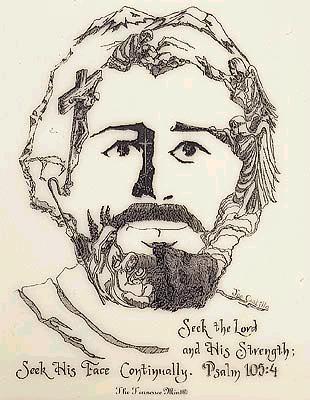
Study this drawing. It is full of detail sketches from Christ's life.


TODAY'S SPECIAL
: Romans 5:12-19

TO CHEW ON: "Therefore, as through one man's offence judgment came to all men resulting in condemnation, even so through one Man's righteous act the free gift came to all men, resulting in justification of life." Romans 5:18

I admire the writers of dictionaries for their abilities to state the meaning of words with precision and economy. Paul shows a similar talent in our reading today as he explains how all of humankind is implicated in Adam's sin and how Christ's incarnation, death, and resurrection was/is effective to pay the penalty of that collective sin.

His communication powers reach their height in verse 18 where he sketches out the Gospel as it plays out through history in a mere 33 words.

Therefore as through one man's offense: refers to the event of Adam's sin and how he became separated from God. (Genesis 2:17 followed by Genesis 3:1-8)

judgment came to all men: all of mankind is implicated in Adam's sin. (Romans 5:12; Isaiah 64:6)

resulting in condemnation: mankind is headed for death—not only physical death but the death of eternal separation from God. (Romans 6:23)

even so, through one Man's righteous act: that "one Man" is Jesus, God's Son. His righteous act is that He came to earth, lived a sinless life, died in our stead to pay the punishment our sin deserved, then rose to defeat death. (John 3:16).

the free gift: Jesus died in my place. I can escape the penalty my sins deserve because I believe and accept that fact as applying to me personally. I can't earn or pay for this—it's free! (Ephesians 2:8)

came to all men: this gift is available to all men everywhere (Romans 10:12; 1 Timothy 2:4-6) and covers the sins of people past, present and future (John 10:16).

resulting in justification of life: all of the above results in God considering the person who puts his/her confidence in Jesus to be vindicated, declared blameless, absolved, excused from death and delivered to life. (1 John 5:11-12)

What a grand, mind-boggling, worship-inspiring plan. (And I'm so glad that God inspired brilliant thinkers like Paul to express it concisely.) I have accepted this free gift - have you?

PRAYER: Dear God, thank You that Your plan for humankind involves justification - and that it's free for anyone who will accept it. Please give me the wisdom and the right words to communicate this good news to those who have never heard or understood. Amen.

MORE: Hillsong sings "Mighty to Save"


**********
Unless otherwise noted all Scripture quotations are taken from the New King James Version®. Copyright © 1982 by Thomas Nelson, Inc. Used by permission. All rights reserved.

Do your 8-12-year-olds have daily devotions? Point them to Bible Drive-Thru.

Monday, May 09, 2016

God of Fire

Photo © 2016 by V. Nesdoly
TODAY'S SPECIAL: Psalm 97:1-12

TO CHEW ON: "A fire goes before Him,
And burns up His enemies round about." Psalm 97:3


All of us no doubt have experience with fire. We've used it in helpful, controlled ways to cook, bring heat to our homes, and drive. We wear jewelry made of metal refined and shaped in the heat of fire and have enjoyed the atmospheric lighting of a candlelit dinner.

With experience we also gain a healthy respect for fire. We know the damage and deadly destruction it can do to a forest and our homes.

Interestingly, the Bible often depicts God's presence in terms of fire. Bringing what we know of fire to this connection with God makes for an interesting study:

1. God appeared to Moses in a bush that didn't burn - Exodus 3:2.

2. The cloud
He gave the Israelites to accompany and direct them through their 40 years in the wilderness appeared as a pillar of fire by night - Exodus 13:21,22. Moses reminded the Israelites how God had talked to them from that cloud - Deuteronomy 4:36.

3. Several Bible writers talk about the fiery aspect of God's presence—a fire of righteous judgment. That seems to be the message of our focus verse, especially when we read it in context (Psalm 97:2,3). One gets the sense from this passage and others (Psalm 50:3; Isaiah 10:17; 66:15) that God's holiness can't help but consume all  that is unworthy in its path.

4. God's presence can also be too much for nature.
In Psalm 97:5 and Micah 1:4 His coming melts the mountains.

5. Ezekiel's heavenly vision included fire with living creatures whose "… appearance was like burning coals of fire, like the appearance of torches going back and forth." Does this mean there's fire in heaven?

6. The coming of the Holy Spirit at Pentecost was with tongues of fire - Acts 2:3.

In our time when we think of God as friendly and approachable
(and He is those things, thanks to Jesus), let's not put out of our minds completely this picture of Him associated with fire. For Paul talks of a future Day when God's fire will test the work of our lives - 1 Corinthians 3:10-15.

The words of Hebrews express so well a realistic response to our fiery God: "Therefore since we are receiving a Kingdom which cannot be shaken, let us have grace, by which we may serve God acceptably with reverence and godly fear. For our God is a consuming fire" - Hebrews 12:29 (emphasis added).

PRAYER:
Dear Father, may I never become blasé toward Your fiery side, which is just as real as your grace, mercy, and love. Amen.

 *********
Unless otherwise noted all Scripture quotations are taken from the New King James Version®. Copyright © 1982 by Thomas Nelson, Inc. Used by permission. All rights reserved.


Wednesday, April 27, 2016

The Day of the Lord is coming

credit cards and open padlock
"The day of the Lord is coming
like a thief in the night" - 2 Peter 3:10
Photo courtesy RGBStock.com

TODAY'S SPECIAL: Zechariah 14:1-21

TO CHEW ON: "Behold the day of the Lord is coming…" Zechariah 14:1

What a heavy duty ending to the book of Zechariah! For a moment I thought I was reading Revelation. My Bible's study notes echo that sentiment, describing this chapter: "… it coincides with many of the events in Revelation. The nature of the language, like that in Revelation is apocalyptic (highly symbolic, prophetic language" - D. W. Shibley,  Zechariah study notes, New Spirit-Filled Life  Bible p. 1262.

Besides its similarity to Revelation, I am struck by the phrases and scenarios in Zechariah 14 that sound familiar. We find something very similar in other places in the Bible:

- The gathering of all nations: Zechariah 14:2 compare Joel 3:2.
- The return of Messiah - Zechariah 14:4 compare Acts 1:9-12.
- A battle in a valley - Zechariah 14:4,5 compare Joel 3:2.
- A time of terror and running away - Zechariah 14:5 compare Matthew 24:16-20.
- The Lord returns with His saints - Zechariah 14:5,6 compare 1 Thessalonians 4:14-17.
- There will be unusual and untimely darkness - Zechariah 14:6-7 compare Matthew 24:29.
- A river flows from Jerusalem - Zechariah 14:8 compare Ezekiel 47:1-12.
- The Lord is king over all the earth - Zechariah 14:9 compare Revelation 11:15.
- Jerusalem survives - Zechariah 14:11 compare Jeremiah 31:40.
- A time of panic and confusion is coming - Zechariah 14:13 compare Matthew 24:10.

As we read these predictions of terrifying judgment that echo through the pages of the Bible, how should we respond?

One thought that keeps occurring to me is—we've been warned. When God gives prophetic visions with so many similar elements to different men across the ages, and Jesus Himself predicts them, it's only a matter of time before these things will come about. So we'd best be prepared.

How do we get ready? Jesus ended His prophecy about end times in Matthew with three parables about being ready.
  • We need to be like the five wise virgins of Matthew 25:1-13 by keeping our lamps full of oil, that is, our lives full of and available to the Holy Spirit.
  • We need to be like the good servants in Jesus' parable of the talents of Matthew 25:14-30 by faithfully stewarding what we've been given of gifts and opportunities.
  • We need to be like the sheep in the final judgments scenes recorded in Matthew 25:31-46, busy extending mercy to those whose plight breaks the heart of God.


PRAYER: Dear God, please burn into my consciousness the inevitability of the Day of the Lord. Help me to live today and each day with that day in mind. Amen.

 *********
Unless otherwise noted all Scripture quotations are taken from the New King James Version®. Copyright © 1982 by Thomas Nelson, Inc. Used by permission. All rights reserved.


Sunday, February 21, 2016

"I do not know you"

Jesus weeps over Jerusalem - James Tissot
TODAY’S SPECIAL: Luke 13:22-35

TO CHEW ON: “But He will say, ‘I tell you I do not know you, where you are from. Depart from me, all you workers of iniquity.’....O Jerusalem, Jerusalem, the one who kills the prophets and stones those who are sent to her! How often I wanted to gather your children together as a hen gathers her brood under her wings, but you were not willing!” Luke 13: 27,34

“He is not safe, but he is good.” I'm thinking this description of the lion Aslan from C. S.Lewis’s The Lion the Witch and the Wardrobe might be a caption for today’s reading.

The Jewish leaders thought they had God all figured out. In their theology, His favor was on the Jews. The very fact that someone was born one, and especially if that one tried to keep the law, guaranteed them a ticket to paradise with God.

In our reading today Jesus' teaching puts the boot to that notion. His illustrations of the narrow gate and broad gate and entry through only the narrow,  His stories of people coming to the Master of the house claiming familiarity only to be turned away from the door by, “I do not know you,” would breathe a chill into any heart. But simple knowledge of Him as a person when He was on earth, or about Him and His teachings now, was not and is not enough to secure us a place with Him in heaven. Here He seems dangerous – someone who will act in a way they (and perhaps some of us) would never expect.

A few verses later, though, we see Him weeping over Jerusalem, longing to protect her people like a hen protects her chicks. His goodness is shown in His tender love for even those who reject Him.

What a cameo of God – on one hand finding it necessary to exclude people from heaven because they refuse to come His way, on the other weeping over those same people.

So what is God’s way of coming? It is through Jesus (John 14:6). We must admit our sinfulness and inability to be acceptable to God on our own. (Isaiah 53:6; Isaiah 64:6). We need to realize that Jesus paid the penalty for our sin (Romans 5:8). When we accept and believe this about ourselves (John 3:16,17) and come to Him His way, we will never need to fear hearing those dreaded words – “I do not know you.”

PRAYER: Dear Jesus, thank You for making a way back to God for me. Help me to not only come to You for salvation, but to live my life on earth by the principles of Your kingdom. Amen.

**********
Unless otherwise noted all Scripture quotations are taken from the New King James Version®. Copyright © 1982 by Thomas Nelson, Inc. Used by permission. All rights reserved.

Bible Drive-Thru


Thursday, January 14, 2016

Earth's hope

"Sing to the Lord all the earth..." - Psalm 96:1  (Image: cjost/Pixabay.com)


TODAY'S SPECIAL: Psalm 96:1-13

TO CHEW ON:
"Let the field be joyful and all that is in it.
Then all the trees of the woods will rejoice before the Lord.
For He is coming, for He is coming to judge the earth."  Psalm 96:12,13


The picture of Earth (specifically the world of nature) celebrating as it anticipates God's future judgment brings up the question, what would cause the natural world to look forward to judgment?

Paging back, way back in my Bible, I review what happened to Earth as a result of Adam and Eve's sin in Eden.  At that time God made this pronouncement on Earth:

“Cursed is the ground for your sake;
In toil you shall eat of it
All the days of your life.
18 Both thorns and thistles it shall bring forth for you,
And you shall eat the herb of the field.
19 In the sweat of your face you shall eat bread
Till you return to the ground,
For out of it you were taken;
For dust you are,
And to dust you shall return.”
- Exodus 3:17-19.

In a sidebar article, Jack Hayford elaborates on how this curse affects us humans and planet Earth:

"Everything of his delegated realm (Earth) comes under  a curse as his relationship with God, the fountainhead of his power to rule, is severed (Genesis 3:17,18). … Beyond the tragedy of man's loss two other facts unfold. First … man's rule has been forfeited to the Serpent. … A second fact offers hope … God begins to move redemptively, and a plan for recovering man's lost estate is promised (Genesis 3:15)." Jack Hayford, "Impact of the Fall" - New Spirit-Filled Life Bible, p. 10.

I would suggest it is that redemptive plan, that includes judgment of Satan Earth's current administrator, that the heavens, seas, fields, trees, and woods applaud and celebrate.

Though we still inhabit this very-much-under-a-curse planet with every day news of natural disasters wreaking havoc on homes and people, not to speak of what we humans do to each other, let's take our cue from nature. Let's look forward with HOPE to the day God will bring nature and humankind as part of it, back under His reign of righteousness and truth—the last verse in our psalm:
"For He is coming, for He is coming to judge the earth.
He shall judge the world with righteousness,
And the peoples with His truth." Psalm 96:13.

PRAYER: Dear God, thank You for the hope of all being set right in nature and with people when You return. Amen.

 *********
Unless otherwise noted all Scripture quotations are taken from the New King James Version®. Copyright © 1982 by Thomas Nelson, Inc. Used by permission. All rights reserved.


Sunday, January 10, 2016

Two sides of Christ

Royal purple fabric
TODAY'S SPECIAL: Psalm 2:1-12

TO CHEW ON: "Kiss the Son, lest He be angry,
And you perish in the way,
When His wrath is kindled but a little.
Blessed are those who put their trust in Him." Psalm 2:12


Who is the fearful leader pictured in Psalm 2, against whom the nations rage and plot, who evoke His derisive laughter at their puny efforts at rebellion? Who is the "Son" who requests and gets these nations for an inheritance, who can "break them" and "dash them to pieces"?

The writer of my Bibles notes says: "This is a messianic psalm in which nations and kings are warned to serve God because ultimate judgment has been entrusted to Christ" - Dick Iverson, New Spirit-Filled Life Bible, p. 687.

Indeed, bits of this psalm are quoted or seen to come true in relation to Jesus numerous times in the New Testament.
  • In Acts, Peter and John, after being released from jail for healing the lame man, quoted Psalm 2:1,2 ("Why do the nations rage; / And the people plot a vain thing?…") in their prayer for boldness (Acts 4:25,26).
  • We see Psalm 2:2 ("And the rulers take counsel together, / Against the LORD and against His Anointed…") coming true in how the Jewish rulers plotted and schemed to kill Jesus in Mark 3:6 and 11:18.
  • Psalm 2:3 (" ' Let us break Their bonds in pieces / And cast away Their cords from us' ") could well be the words spoken by the rebellious subjects in Jesus' parable depicting the faithful stewards and the Kingdom of Heaven in Luke 19:14.
  • The writer of Hebrews quotes Psalm 2:7 ("You are My Son, / Today I have begotten You") when referring to Jesus in Hebrews 1:5 and 5:5.
  • And Psalm 2:12 ("Kiss the Son, lest He be angry, / And you perish in the way, / When His wrath is kindled but a little") is pictured in vivid detail in Revelation 6:15-17:
 "And the kings of the earth, the great men, the rich men, the commanders, the mighty men, every slave and every free man, hid themselves in the caves and in the rocks of the mountains, and said to the mountains and rocks, 'Fall on us and hide us from the face of Him who sits on the throne and from the wrath of the Lamb! For the great day of His wrath has come, and who is able to stand?' ”

And so I think we can say with confidence, the judging ruler in Psalm 2 is none other than Jesus Christ, who we usually picture as loving, gentle, meek, gracious, forgiving… Even Psalm 2 references this softer side of Him when it speaks of Him as someone trustworthy who bestows blessings: "Blessed are those who put their trust in Him."

We are wise to keep in mind both sides of Jesus—the judging Jesus and the trustworthy, blessing Jesus. For they both have a bearing on how we live our lives in that:
  • we don't take sin lightly.
  • we live willingly under His authority now—trusting that He knows what's best for us and that the things He sends into our lives are ultimately blessings (even though they may not always appear that way on the surface).
  • we include both the judging and merciful sides of Him as we share the gospel.


PRAYER: Dear Jesus, this glimpse of You as judge of nations is sobering. Help me to factor this judging side of You into my day-to-day living. Amen. 

 *********
Unless otherwise noted all Scripture quotations are taken from the New King James Version®. Copyright © 1982 by Thomas Nelson, Inc. Used by permission. All rights reserved.


Thursday, December 10, 2015

Hidden

Rabbit hiding in grass
Photo © 2015 by V. Nesdoly
TODAY'S SPECIAL: Zephaniah 2:1-15

TO CHEW ON: "Seek the Lord, all you meek of the earth,
Who have upheld His justice
Seek righteousness, seek humility
It may be that you will be hidden
In the day of the Lord's anger." Zephaniah 2:3


We hear too many stories lately of people needing to hide during angry attacks. Whether they're playing dead in the presence of a crazed terrorist or locking themselves in a bathroom or closet during a school shooting, the urge to hide is one of the first instincts that kicks in during such a time.

Zephaniah here, talks about the same reflex. Only this time it's hiding, not to escape from human anger but from the poured out anger of the Lord. Zephaniah has just described that anger in Zephaniah 1, where he detailed "The great day of the Lord" and "That day."

It's an anger sinful humans deserve to suffer the full effects of. But Zephaniah gives a ray of hope that there is an escape for the meek and repentant:
"It may be that you will be hidden
In the day of the Lord's anger."

The theme of hiding may have had special significance for Zephaniah, as his name means "The Lord has hidden." My Bible's introduction to the book points out how Zephaniah's words about hiding here are connected to the ministry of Jesus:
"The truth of the Passover in Egypt, where those hidden behind blood-marked doors were protected from the angel of death is repeated in the promise of Zephaniah 2:3, where the meek of the earth who have upheld God's justice will be hidden in the day of the Lord's anger" - Mary LaVonne Phillips, New Spirit-Filled Life Bible, p. 1233.

Paul picks up this theme of hiding in Colossians, naming Jesus as the One in whom God has hidden His deepest secrets: "… the mystery which has been hidden from ages and from generations but now has been revealed to His saints … Christ in you, the hope of glory" - Colossians 1:26,27.
"… in whom are hidden all the treasures of wisdom and knowledge" - Colossians 2:3.

And, after we have accepted Him Paul points out, we are hidden in Him:
"For you died and your life is hidden with Christ in God" - Colossians 3:3.

Of course the death Paul refers to is not literal physical death but a death (unresponsiveness) to sin. We keep living in this trouble-worn word where we may still have very real reasons  to call for God to hide us—as Cory Ten Boom describes The Hiding Place—her book about her experiences during WWII.

An encouraging hiding verse to memorize:
"You are my hiding place
You shall preserve me from trouble
You shall surround me with songs of deliverance" - Psalm 32:7

PRAYER:
Dear God, thank You for sending Jesus in whom I hide from Your righteous and justified anger against my sin and Your judgment. Amen.

 *********
Unless otherwise noted all Scripture quotations are taken from the New King James Version®. Copyright © 1982 by Thomas Nelson, Inc. Used by permission. All rights reserved.


Thursday, November 26, 2015

God's promise fulfilled in the Branch

tree reaching upwards
Image from Pixabay.com
TODAY'S SPECIAL: Jeremiah 33:14-26

TO CHEW ON:
" 'Behold the days are coming,' says the Lord, 'that I will perform that good thing which I have promised to the house of Israel and to the house of Judah:
 

In those days and at that time
I will cause to grow up to David
A Branch of righteousness;
He shall execute judgement and righteousness in the earth.' " Jeremiah 33:14,15


Whenever we hear the word "covenant" come from God's mouth, we know that He is referring to a serious promise. In today's reading He reminds the people, through Jeremiah, of His covenant with David. God compared the surety of its fulfillment to the everyday occurrences of sunrise and sunset, saying He would no more break His promise to David than abolish night and day (Jeremiah 33:19,20).

And what was that promise? That "David shall never lack a man to sit on the throne of the house of Israel" - Isaiah 33:17, 2 Samuel 7:15,16.

But we know that David's earthly dynasty did end. So how could God say He would never, did never break this promise?

Because this is a new kind of king, with a new kind of kingdom. This descendant of David's line would be called a "A Branch of righteousness." And like the kingdom Jesus described  as His kingdom in other Bible passages we've read recently, this Branch's rule would be in  ..."judgment and righteousness in the earth" - Jeremiah 33:15.

Other prophets referred to this Branch:
  • Isaiah: "In that day the Branch of the LORD shall be beautiful and glorious…" - Isaiah 4:2, and "There shall come forth a Rod from the stem of Jesse, / And a Branch shall grow out of his roots" - Isaiah 11:2.
  • Jeremiah himself first spoke a prophecy very similar to the one in our reading earlier in Jeremiah: "Behold, the days are coming,” says the Lord,
    “That I will raise to David a Branch of righteousness;
    A King shall reign and prosper,
    And execute judgment and righteousness in the earth" - Jeremiah 23:5
  • Zechariah referred to this Branch in his prophecy of a vision of Joshua the High Priest, where an angel said to Joshua: " ' Hear, O Joshua, the high priest. / … For behold, I am bringing forth My Servant the Branch' " - Zechariah 3:8.

We believe that Jesus was and is this Branch. Why?

He was an earthly descendant of David, thus a branch of David's line and eligible to be a king (Matthew 1:1-17; Jesse and David are mentioned in Matthew 1:5,6).

Paul referred to Jesus Christ as coming from the "root of Jesse."  And he extended the hope of coming under Jesus' reign to the Gentiles:
"Now I say that Jesus Christ has become a servant to the circumcision for the truth of God to confirm the promise made to the fathers, and that the Gentiles might glorify God for His mercy as it is written … 'There shall be a root of Jesse;
And He who shall rise to reign over the Gentiles,
In Him the Gentiles shall hope' "  - Romans 15:8,9.12, quoting Isaiah 11:10.

As we celebrate Jesus' incarnation during the Advent season coming up, let's include in our meditation the beautiful teaching of Jesus as the Branch. And let's, in faith, give thanks for the righteous and just nature of His forever kingdom.

PRAYER:
Dear Jesus, thank You for being the Branch, the fulfillment of God's covenant promise to David. I look forward to seeing Your righteous and just kingdom in real time. Amen.

 *********
Unless otherwise noted all Scripture quotations are taken from the New King James Version®. Copyright © 1982 by Thomas Nelson, Inc. Used by permission. All rights reserved.


Monday, October 12, 2015

Thanks to God for what is and what is not yet

Grape vines loaded with purple grapes
"Then the earth shall yield her increase" - Psalm 67:6

TODAY'S SPECIAL: Psalm 67:1-7

TO CHEW ON: "Let the peoples praise You, O God;
Let all the peoples praise You." Psalm 67:3,5


This is Thanksgiving Monday in Canada. We are admonished by many voices to have a thankful attitude. But there is a curious lack in speaking of who to thank.

I suppose that's not surprising. In a society that has largely abandoned a belief in God, or at least in a God who is involved and interested in our personal lives, who or what is there to thank? Our lucky stars, a rabbit foot, the feng shui of our house?

The praise in this psalm is not a peon to capricious good luck, however, but to God—the God of creation, of covenant with forefathers, of story and history, of redemption, salvation, reclamation, and righteous endings. This is the God I too praise and thank.

As I read and re-read Psalm 67 I sense inner affirmation but also tension. Two of the things the psalmist names I can say a big "Yes" to:
- Thanks for salvation (Psalm 67:1,2).
- Thanks for the abundance that fills my life (Psalm 67:5-7).

But the middle item:
"O let the nations be glad and sing for joy!
For You shall judge the people righteously,
And govern the nations on earth."
raises objections. So many nations are not glad or singing for joy. Where is God, the righteous judge, in those places?  What if I lived in one of them? How would I testify to the truth of this?

I suppose we need to focus on the little word "shall" here ("For you shall judge the people righteously…"). It tells us this is something that hasn't happened yet but is still in the future. And so our thanksgiving becomes a matter of praising God not only for what we have, but for what we still look for Him, in faith, to be and do.

PRAYER: Dear God, we thank You that Your actions in the past have given us confidence to put our faith in You for the present and future. Amen.

 *********
Unless otherwise noted all Scripture quotations are taken from the New King James Version®. Copyright © 1982 by Thomas Nelson, Inc. Used by permission. All rights reserved.


Tuesday, May 05, 2015

All celebrate God—the judge

sea waves
"Let the sea roar and all its fullness" - Psalm 98:7
TODAY'S SPECIAL: Psalm 98:1-9

TO CHEW ON: "The Lord has made known His salvation … Shout joyfully to the Lord all the earth … Let the sea roar and all its fullness." Psalm 98:2,4,7

The psalmist here urges three types of praisers to give it up for God:

Israel - Psalm 98:1-3: "For He has done marvelous things … The Lord has made known His salvation; His righteousness He has revealed in the sight of the nations."

All the earth - Psalm 98:4-6: "Shout joyfully to the Lord all the earth…"

Nature - Psalm 98:7-9: "Let the sea roar … the rivers clap their hands; Let the hills be joyful together before the Lord."

What's the reason for this praisefest?

"For He is coming to judge the earth" - Psalm 98:9


Really! We're to be joyful about God's judgment?

Yet, if we think about it, isn't a fair, just, righteous settlement of all our disagreements and wars what we long for? Don't we crave a final authority who can and will see through actions to motivations? Imagine a time when even nature is restored from the changes brought about by the fall.

We can look forward to God's judgment because:

1. God knows us deeply. He understands our motivations and sees through them to the deepest wellsprings of our actions. Sarai appealed to God's judgment in this way when she argued with Abram about Hagar (Genesis 16:5).

2. God knows His own and is able to come to the aid of those who appeal to Him for justice - Psalm 76:9.

3. His insight and power allow Him to best judge who should rule earth's temporal kingdoms to serve His purposes - Psalm 75:7; Ecclesiastes 3:17; Revelation 18:8.

4. His judgments are based on truth and righteousness - Psalm 96:13.

5. He will someday pass fair judgement on all lives - Revelation 20:12.

In the light of God's present and final judgment that will be based on truth and fairness and that will enhance His glory, let's join the praise celebration with Israel, the earth, and nature.

PRAYER: Dear God, I long for a day when wrongs will be made right, when injustices will be addressed, when even nature will be in complete sync with You. I celebrate and praise You as judge. Amen.

 *********
Unless otherwise noted all Scripture quotations are taken from the New King James Version®. Copyright © 1982 by Thomas Nelson, Inc. Used by permission. All rights reserved.


Thursday, April 09, 2015

Propitiation

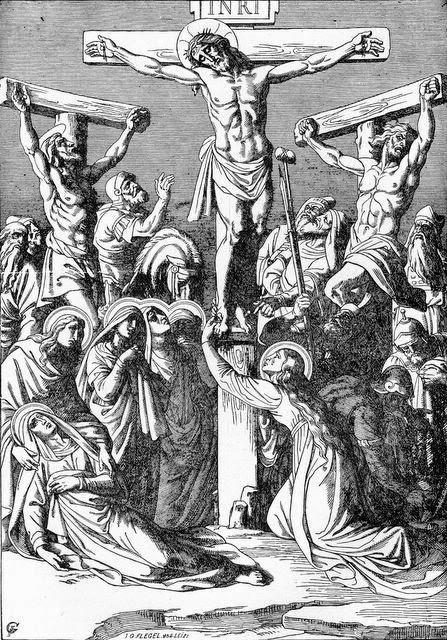
Jesus Crucified Between Two Thieves   - Artist unknown
Jesus Crucified Between Two Thieves 
- Artist unknown 
From Treasures of the Bible

TODAY'S SPECIAL: 1 John 1:1-2:2

TO CHEW ON: "And He Himself is the propitiation for our sins, and not for ours only but also for the whole world." 1 John 2:2

In our time when we love to focus on the grace, mercy, and love of God, it's easy to lose sight of one of His other attributes—His righteousness. That is the attribute of God that has Him responding with white-hot anger to sin. His perfect justice demands that sin be punished.

We see illustrations of this in the Old Testament.
  • When Achan sinned by taking beautiful things from Jericho, he was punished by stoning. Only then "… the Lord turned from the fierceness of His anger" - Joshua 7:26.
  • When Israel flirted with idol worship, God allowed other nations to brutalize her (Ezekiel 16:40,41) and "… so I will lay to rest My fury toward you, and My jealousy shall depart from you" - Ezekiel 16:42.
  • When Israel returned to God in repentance, Hosea describes God's quickness to take back the repentant one: "… For my anger has turned away from him" - Hosea 14:4.
 But these were all only stop-gap measures. God's fallen creation—all of us—can't keep from sinning. What's a perfectly merciful, perfectly righteous God to do, a God  whose perfect justice demands that the wages of sin (death - Romans 6:23) be paid?

Our focus verse today gives us the answer. This is what He did:
"...And if anyone sins, we have an Advocate with the Father, Jesus Christ the righteous. And He himself is the propitiation for our sins, and not for ours only but also for the whole world" - 1 John 4:1,2

That word propitiation is key here.

[This particular word for propitiation (hilasmos) is used only twice in the Bible, here and in 1 John 4:10. it  "describes Christ through His sacrificial death as appeasing the wrath of God on account of sin. It also pictures His death as expiatory, providing a covering for sin. By means of the atoning death of Christ, God can be merciful to the sinner who believes in Him and reconciliation is effected" - Dick Mills, Word Wealth, New Spirit-Filled Life Bible, p. 1788.]

Here's another shorter definition of propitiation: "A sacrifice that bears God's wrath to the end and in so doing changes God's wrath toward us into favour" - Wayne Grudem, Systematic Theology, p. 575.

Isn't that incredible! God sent His own Son—Jesus—to take His white-hot anger against our sin. He (Jesus) paid the penalty—death—in our stead.  The words of John in 1 John 4:10 express perfectly how this act keeps God in sync with His love and mercy—those attributes of His we prefer to dwell on:

"In this is love, not that we loved God, but that He loved us and sent His Son to be the propitiation for our sin."

PRAYER: Thank You, Jesus, for bearing the fury of God's righteous wrath over my sin, in my stead. Amen.

 *********
Unless otherwise noted all Scripture quotations are taken from the New King James Version®. Copyright © 1982 by Thomas Nelson, Inc. Used by permission. All rights reserved.

Related Posts Plugin for WordPress, Blogger...