Showing posts with label crucifixion. Show all posts

Saturday, September 22, 2018

He put Himself in our hands

Judas guides the soldiers - Alexandre Bida
Judas guides the soldiers - A. Bida
TODAY'S SPECIAL: John 16-18; Psalm 110

TO CHEW ON:
 "Now when He said to them, 'I am He,' they drew back and fell to the ground." - John 18:5

Even in this darkest of moments, when one of Jesus' friends is in the act of betraying Him and another is about to deny Him, flashes of His God-essence come through. Otherwise what was it that caused these soldiers to "fall to the ground"?

"Man was not made to handle the electricity of God" someone once said (or words to that effect; I can't find the exact quote). Which makes what Jesus did when He surrendered Himself up to die for us all the more amazing. He could have immobilized that whole detachment long enough to get away. But instead, a little later when Peter did some damage with his sword in Jesus' defense, Jesus rebuked: "Put your sword into the sheath. Shall I not drink the cup which My Father has given Me?" - John 18:11.

In a few months we'll again celebrate Christmas and Jesus' birth. It's more evidence of how intentionally the God of the universe put Himself in human hands as He took on human flesh and surrendered Himself to the human condition. Let's let the enormity of what He did give depth and breadth to our praise, worship, and thanksgiving.

PRAYER:
Dear Jesus, Your life was not taken from You; You laid it down, and for me. Help me to comprehend just how amazing and wonderful this is. I thank You. Love, V. Amen. 

PSALM TO PRAY: Psalm 110

****************
Unless otherwise noted all Scripture quotations are taken from the New King James Version®. Copyright © 1982 by Thomas Nelson, Inc. Used by permission. All rights reserved.

Friday, September 14, 2018

Abandoned

"The Crucifixion" by Alexandre Bida

TODAY'S SPECIAL: Mark 15-16; Psalm 102

TO CHEW ON: "And at the ninth hour, Jesus cried out with a loud voice saying, 'Eloi, Eloi, lama sabachthani' which is translated 'My God, My God why have You forsaken Me?'" Mark 15:34

No matter how often I read the story of Jesus' death, these words from the cross (the echo of Psalm 22:1) wrench at my heart. They carry the tones of utter despair and abandonment.

A footnote in my Bible describes them as a "...cry of dereliction from Jesus that reflects the burden of humanity's sin, complete identification with sinners and a real abandonment by God" - New Spirit-Filled Life Bible, p. 1379.

Wayne Grudem names four aspects of the pain of the cross:
1. Physical pain and death ... death by crucifixion was one of the most horrible forms of execution ever devised by men...


2. The pain of bearing sin: More awful than the pain of physical suffering that Jesus endured was the psychological pain of bearing the guilt of our sin (Isaiah 53:6; 2 Corinthians 5:21; Galatians 3:13).


3. Abandonment ... Jesus faced this pain alone (Mark 15:34; Matthew 26:56).


4. Bearing the wrath of God ... As Jesus bore the guilt of our sins alone, God the Father, the mighty Creator, the Lord of the universe, poured out on Jesus the fury of his wrath: Jesus became the object of the intense hatred of sin and vengeance against sin which God had patiently stored up since the beginning of the world (Romans 3:24-25; Hebrews 2:17; 1 John 2:2). - Wayne Grudem, Systematic Theology, pp. 573-575.

Which makes that desolate cry from the cross all the more impacting. It has something to do with me. My sin—my pride, jealousy, anger, greed, covetousness etc. etc. were part of that black burden that not only separated Jesus from His Father but made Jesus (instead of me) the object of the Father's wrath.

PRAYER: Dear Jesus, thank You for not turning away from the terrible "cup." I am forever grateful that You became sin, a curse, for me. Amen.

PSALM TO PRAY: Psalm 102


***************
Unless otherwise noted all Scripture quotations are taken from the New King James Version®. Copyright © 1982 by Thomas Nelson, Inc. Used by permission. All rights reserved.


Sunday, August 05, 2018

The Spirit who moves in world affairs and the hearts of people

Prayer
Prayer - Photo courtesy Pixabay.com
TODAY'S SPECIAL: Zechariah 9-14; Psalm 62

TO CHEW ON: "And I will pour on the house of David and on the inhabitants of Jerusalem the Spirit of grace and supplication; then they will look on Me whom they pierced. Yes, they will mourn for Him as one mourns for his only son, and grieve for Him as one grieves for a firstborn" - Zechariah 12:10

The prophet Zechariah was a contemporary of Haggai. He prophesied to the Jews who had returned from exile under Zerubbabel and Joshua. These returnees quickly set about rebuilding the temple. But their Samaritan neighbors resisted them, went to the King of Persia, and got an order for them to stop the rebuild. This project was then on hold for twelve years.

Into this context of discouragement and distraction (for in the meantime, the returned exiles became absorbed in fixing their own homes) Zechariah encouraged them to finish the job. He did this by pointing them to a day when Messiah will rule from a restored temple in a restored city.

I see two unexpected, we could say miraculous pictures in Zechariah 12.

The first is a picture of a restored Jerusalem (Zechariah 12:1-9).

This is something God does. Earth's armies don't stand a chance when God makes Jerusalem a "cup of drunkenness to all the surrounding peoples" (vs. 2) and a "heavy stone" (vs. 3), when He strikes "every horse with confusion... blindness" (vs. 4), and causes Judah's governors to be "like a fiery torch in the sheaves" (vs. 6). God says in plain language: "It shall be in that day that I will seek to destroy all the nations that come against Israel" - Zechariah 12:9.

The second is a picture of the Jews understanding and accepting "Me whom they pierced" (vs. 10).

How can this be a reference to anything other than Jesus on the cross? The cross was an instrument of torture and extreme humiliation. How will the Jews' scornful, mocking attitude toward Jesus change? Via another miracle. It happens when God pours on the "house of David and on the inhabitants of Jerusalem the Spirit of Grace and supplication" - Zechariah 12:10.

I take encouragement for our own times from these pictures.

1. God's Spirit is active in nations.
God isn't governed by polls, the political pundits, or the media when it comes to who governs us and how successful they are. Whenever we're in election mode, it's easy to become smug or discouraged about the outcome depending on how our favorite party or leader is doing, based on the natural ways of measuring public support and the vote that will result. Do we believe that God is in these things too—that He can move in circumstances relating to who comes to power, no matter how it looks along the way? Let's not stop praying for the things God has laid on our hearts for our country, knowing that He is sovereign in who comes to power.

2. God's Spirit can enlighten the darkest heart.
Here God pours out His Spirit on those who killed Him so that they recognize who He is and understand what He did. He can also enlighten our loved ones.  In the words of a sidebar article in my Bible:

"This obvious prophetic reference to the Cross is a dramatic witness to the ministry and power of the Holy Spirit, whose mission is to glorify the Messiah and draw hearts to Him. It explains how the outpouring of the Holy Spirit has caused and will cause Jesus' death and sacrifice to become understood from Pentecost until He comes again" Scott G.Bauer, "The Holy Spirit Witnesses to the Cross of the Messiah," New Spirit-Filled Life Bible, p. 1261.

PRAYER: Dear God, thank You for these encouraging pictures of how You move in world affairs and in the hearts of people. Help me to continue to pray in faith that You are at work in my land and in the people I love. Amen.

PSALM TO PRAY: Psalm 62

********
Unless otherwise noted all Scripture quotations are taken from the New King James Version®. Copyright © 1982 by Thomas Nelson, Inc. Used by permission. All rights reserved.


Wednesday, May 02, 2018

Forgiven and healed

Jesus wearing a crown of thorns
TODAY'S SPECIAL: Isaiah 52-54; Psalm 119:97-128

TO CHEW ON: "But He was wounded for our transgressions, He was bruised for our iniquities; The chastisement for our peace was upon Him, and by His stripes we are healed."  Isaiah 53:5

Isaiah 53:5 has to be one of the most moving verses in the Bible. In it we see God's Servant mutilated, stripped of any attractiveness, despised, rejected, and treated with utter revulsion as He bears sin. Not just someone else's sin, but "our sin."

Isaiah uses two words to describe sin: transgressions and iniquities.

["Transgressions - pesha  means rebellion, transgression, trespass. Pesha comes from pasha which means to revolt, rebel, and trespass.  … a trespass has to do with revolting against law, God or government and was a transgressing, that is, going b beyond established limits" - Dick Mills, New Spirit-Filled Life Bible, p. 1072.]

[Iniquities - avon  means evil, fault, sin, blame, moral crookedness and perversion.]  It's the word that describes the inborn tendency to sin in which we are born: "Behold I was brought forth in iniquity, and in sin my mother conceived me" - Psalm 51:5.

Here we see My Servant—whom we believe was Jesus—taking the punishment for our rebellion, revolt, trespass, evil, and moral crookedness. He is chastised, beaten, and crucified to buy our peace. He bears our sins and intercedes for us, the transgressors (Isaiah 53:12).

With this act, not only is our penalty paid but we are healed. I believe this healing includes all aspects. Jesus' death purchased our healing from rebellious crookedness along with healing from physical diseases.

May the enormity of what Jesus did never cease to impress us. May we never become casual or blasé about how He took my place and yours as the object of God's wrath against sin and made possible our health and wholeness.

PRAYER: Dear Jesus, thank You for taking the punishment for my sin, and making it possible for me to be healed. Help me to cooperate with Your Spirit to make possible  healing from my rebellious tendencies. Amen.

PSALM TO PRAY: Psalm 119:97-128

 *********
Unless otherwise noted all Scripture quotations are taken from the New King James Version®. Copyright © 1982 by Thomas Nelson, Inc. Used by permission. All rights reserved.

Thursday, February 15, 2018

Discouraged

TODAY'S SPECIAL: Numbers 19-21; Psalm 46

TO CHEW ON:  "Then they journeyed from Mount Hor by the Way of the Red Sea, to go around the land of Edom; and the soul of the people became very discouraged on the way." Numbers 21:4


Have you ever noticed how one little choice of bad attitude leads to the next and the next until you've worked yourself into a full-blown funk? That seems to be what happened to the Israelites in today's reading.

They have just conquered King Arad, destroying all the cities of his small kingdom south of Canaan. Perhaps the Israelites expected to enter Canaan from that point. Instead God led them on a detour away from the promised land. That understandable disappointment may have sparked their initial complaints.

They began with an attitude that is common — at least to me: discouragement — "discouraged" is also translated "impatient" (Amp, NIV, NLT), "depressed" (Amp), "irritable and cross" (Message).

Their complaints had typical characteristics:
- they were against leadership: "the people spoke against God and against Moses."
- they were against conditions: "There is no food and no water and our soul loathes this worthless bread."
- they had the typical faithless tone: "Why have you brought us out of Egypt to die in the wilderness?"

God's response—sending poisonous snakes among them—may have seemed harsh. But it certainly got their attention. The remedy—Moses erecting a bronze snake to which the bitten looked and were cured—foreshadowed God's final blow to sin through Jesus on the cross (John 3:14-15).

I ask myself, am I struggling with a typical though negative attitude today? Discouragement, impatience, irritability in my situation may seem like a harmless, even expected response to irritations, disappointments, and difficulties. But it is just such common attitude choices that got the Israelites into trouble way back in the wilderness and still easily trip us up today.

PRAYER: Dear God, please help me to guard my attitudes. I want to nip my faithless bent in the bud before it blooms its toxic flowers of complaining, unbelief and depression. Amen

PSALM TO PRAY:  Psalm 46

********************

Unless otherwise noted all Scripture quotations are taken from the New King James Version®. Copyright © 1982 by Thomas Nelson, Inc. Used by permission. All rights reserved.

Thursday, November 30, 2017

The dark and glorious conclusion

film graphic
Image: Pixabay
TODAY’S SPECIAL: John 12:12-26

TO CHEW ON: “Now there were certain Greeks among those who came up to worship at the feast. Then they came to Philip …and asked him, saying, ‘Sir, we wish to see Jesus.’ … But Jesus answered them, saying, ‘The hour has come that the Son of Man should be glorified.’” John 12:20, 21, 23.

Jesus had just swept into Jerusalem on the back of a donkey accompanied by the delirious cheers of the crowd. Their Messiah had arrived at last! But when some Greek proselytes approached Philip asking to see Jesus, Jesus answered Philip with a cryptic and mysterious statement about being glorified. Then He added to the puzzlement by talking about His death. How does His answer relate to the Greeks who have come to see Him? And how is death glorification?

The IVP New Testament Commentary Series comments on John 12.

“…now we come to the beginning of the end. Instead of seeing Jesus doing signs, we see signs occurring through what others do to him."
- Mary anointed Jesus’ feet (John 12:1-8)
- Jesus made His triumphal entry into Jerusalem to the applause of the crowd (John 12:12-15).
- Gentiles came to Him. “… which signals that the long expected hour has arrived. Jesus announces the coming of his hour and speaks of his death.
- The Father endorsed Him - John 12:27-28. 
- IVP New Testament Commentary Series, accessed through Biblegateway.com

So perhaps Jesus’ answer to Philip speaks, as this commentary suggests, to the larger issue of what the visit of these Gentiles portends.  The nations are being drawn to Him. It’s prophecy being fulfilled so that His story can continue (see Psalm 2:8; Isaiah 2:2,3).

Jesus, speaking of His death, began by saying:‘The hour has come that the Son of Man should be glorified.’ How can death be glorification?

IVP Commentary again:

“…death is at the heart of the Son's revelation of the Father, for God is love and love is the laying down of one's life (cf. 1 John 4:8;  3:16). So in the cross the heart of God is revealed most clearly” - Ibid.

Today, the last day of November, we're on the verge of Advent.  During the next 24 days we prepare to celebrate the early part of Jesus’ life—the cute, happy, cuddly part. But that wasn’t all there was to it.

Now is a good time to pause and think about the whole story, including its hard end.

It’s an end that is stitched into Jesus’ story from its beginning when Simeon said to Mary: “‘Behold this Child is destined for the fall and rising of many in Israel, and for a sign which will be spoken against (yes, a sword will pierce through your own soul also)'” Luke 2:34,35. 

It’s an end Jesus Himself was well aware of, for we hear Him say, just beyond the scope of today’s reading:‘Now my soul is troubled and what shall I say? ‘Father, save Me from this hour’? But for this purpose I came to this hour’” - John 12:27.

That purpose again? To come as a baby, live the Father before us, fulfill the plan God had set in motion from the beginning of revelation (Genesis 3:15), conclude its earthly chapter by loving you and me to the extent of laying down His life in our stead, and then defeating death in resurrection.

PRAYER: Dear Father, thank You for sending Jesus, who became that sacrificial grain of wheat for me. Jesus, I want to follow You, serve You, and be with You now and forever (John 12:26). Amen.

MORE: Feast of St. Andrew
Today the church celebrates the Feast of St. Andrew, apostle. The day's liturgy begins with this collect prayer:

Almighty God, who gave such grace to your apostle Andrew that he readily obeyed the call of your Son Jesus Christ, and brought his brother with him: Give us, who are called by your Holy Word, grace to follow him without delay, and to bring those near to us into his gracious presence; who lives and reigns with you and the Holy Spirit, one God, now and for ever. Amen.
 *********
Unless otherwise noted all Scripture quotations are taken from the New King James Version®. Copyright © 1982 by Thomas Nelson, Inc. Used by permission. All rights reserved.


Saturday, April 08, 2017

Bruised

TODAY'S SPECIAL: Isaiah 52:13-53:12


TO CHEW ON: "He was wounded for our transgressions,
He was bruised for our iniquities.
The chastisement of our peace was upon Him
And by His stripes we are healed." Isaiah 53:5


Today's magnificent reading is Isaiah's final Servant Song. A footnote in my Bible describes it: "...one of the greatest passages in the Bible, the mountain peak of Isaiah's book, the most sublime messianic prophecy in the Old Testament, relating to so many features of Jesus Christ's redemptive work" - New Spirit-Filled Life Bible, p. 936.

This passage is teeming with prophecies fulfilled through Jesus (listed in a sidebar article in my Bible - p. 937):

  • He will be exalted (Isaiah 52:13) - Philippians 2:9.
  • He will be disfigured by suffering (Isaiah 52:14; 53:2) - Mark 15:17,19.
  • He will be widely rejected (Isaiah 53:1,3) - John 12:37-38.
  • He will bear our sins and sorrows (Isaiah 53:4) - Romans 4:25; 1 Peter 2: 24-25.
  • He will make a blood atonement (Isaiah 53:5) - Romans 3:25.
  • He will be our substitute (Isaiah 53:6,8) - 2 Corinthians 5:21.
  • He will stand silently, giving no defence (Isaiah 53:7) - Matthew 26:63; 27:12-14.
  • He will voluntarily accept our guilt and punishment (Isaiah 53:7) - John 10:11.
  • He will be buried in a rich man's tomb (Isaiah 53:9) - John 19:38-42.
  • He will justify many from their sin (Isaiah 53:10,11) - Romans 5:15-19.
  • He will die with transgressors (Isaiah 53:12) - Mark 15:27; Luke 22:37.

What I am most struck by, though, is the tenderness of Isaiah's writing as He depicts this Servant. There is no doubt this is God, the Holy Spirit inspiring Isaiah. It is God the Father seeing Jesus through Isaiah's eyes, describing His one and only Son through Isaiah's pen:

"His visage was marred...He shall grow up before Him as a tender plant.... He is despised and rejected...He was wounded...He was bruised... He was oppressed and He was afflicted...He was taken...He was cut off..."

At the same time, it is Isaiah's regret-filled reaction:

"And we hid as it were, our faces from Him. He was despised and we did not esteem Him... Surely He has borne out griefs and carried our sorrows; Yet we esteemed Him stricken by God and afflicted. But He was wounded for our transgressions, bruised for our iniquities..."

It's as if he is saying "What have we done?"

That is the emotional response that wells up in me as I read this. And not only what have "we" done, but what have "I" done? I doubt that I would have been much different from the people in Jesus' time who scorned and accused Him, who refused to realize He was dying not for His own sins but theirs (Isaiah 53:4-5). I too am a sheep who has gone astray in the past and still easily wanders.

I turn my eyes away. I can't look as this "tender plant" is "cut off" for me. Thank You Jesus!

PRAYER: Dear Jesus, thank You for taking my sin on You. Thank You for enduring all the pain, humiliation and undeserved blame to buy me back. Words feel inadequate to describe what You've done, and how much I am indebted to You. Thank You over and over! Amen

MORE: When I Survey the Wondrous Cross - Kathryn Scott


***********
Unless otherwise noted all Scripture quotations are taken from the New King James Version®. Copyright © 1982 by Thomas Nelson, Inc. Used by permission. All rights reserved.


Bible Drive-Thru


Wednesday, September 14, 2016

The either / or message of the cross

TODAY'S SPECIAL: John 8:12-30

TO CHEW ON: "Then Jesus said to them, 'When you lift up the Son of Man, then you will know that I am He, and that I do nothing of Myself, but as My Father taught Me, I speak these things.'" John 8:28


Here Jesus, in a reference to His death on the cross at the hands of the very people He is conversing with (" 'When you lift up the Son of Man' "), makes an interesting claim. He says " '...then you will know that I am He' " (the embodiment of all the other claims He has been making about Himself  - John 8:16, 19, 21, 22, 23, 26).

This is a bold prediction. How was it so?

Supernatural events at the time of Jesus' crucifixion:
If the hearts of the Pharisees were at all open to the possibility that what He said here was true, then the unnatural happenings at the time of the crucifixion (the day's premature darkness, the earthquake, the ripping of the temple curtain, the dead raised) would have been powerful witnesses.

Jesus' death on the cross was / is also a personal sifting:
I believe this knowledge was and is more personal—a sorting event that revealed to the Pharisees in Jesus' time and continues to reveal, down to us today, our very hearts.

"They may be confused now, but they will know then. Whether this knowledge will result in salvation or judgment is not said. The idea is probably that they will at that point see the revelation shining at its brightest and have their hearts revealed as, in the light of that revelation, they either embrace or reject Christ and the God He reveals" - IVP Commentary on John 8, accessed through Biblegateway.com - emphasis added.

Still today the message of the cross sifts us (the message that entails our innate sinfulness, our need of a Saviour, and God's mercy, love and grace in sending Jesus to die in the place of each one of us). Some believe and accept it, some don't. It's either / or. 

Paul expresses it so well in 1 Corinthians:
"For the message of the cross is foolishness to those who are perishing, but to us who are being saved it is the power of God. …For Jews request a sign, and Greeks seek after wisdom; but we preach Christ crucified, to the Jews a stumbling block and to the Greeks foolishness, but to those who are called, both Jews and Greeks, Christ the power of God and the wisdom of God" - 1 Corinthians 1:18, 22-24.

PRAYER:
Dear Jesus, thank You for obeying the Father in dying on the cross for us. Please continue to open the eyes and hearts of people all over the world to how this is the power and wisdom of God. Amen.

MORE: Holy Cross Day

Today the church celebrates HOLY CROSS DAY    .

The liturgy of the day begins with this prayer:

Almighty God, whose Son our Savior Jesus Christ was lifted high upon the cross that he might draw the whole world to himself: Mercifully grant that we, who glory in the mystery of our redemption, may have grace to take up our cross and follow him; who lives and reigns with you and the Holy Spirit, one God, in glory everlasting. Amen.

 *********
Unless otherwise noted all Scripture quotations are taken from the New King James Version®. Copyright © 1982 by Thomas Nelson, Inc. Used by permission. All rights reserved.


Monday, March 14, 2016

Seeing Jesus

Image: Aitoff / pixabay.com
TODAY'S SPECIAL: John 12:12-26

TO CHEW ON: "Now there were certain Greeks among those who came up to worship at the feast. Then they came to Philip who was from Bethsaida of Galilee and asked him saying, 'Sir, we wish to see Jesus.' " John 12:20,21


The scene was a Messiah-seeker's dream. Jesus' good reputation from raising Lazarus had spread so that when He rode into Jerusalem on a donkey (fulfilling the prophecy of Zechariah 9:9), He was accompanied by an adoring crowd. The significance of this act would not be lost on any Jew in the crowd familiar with Old Testament prophecy. They saw Him as their expected Messiah—a savior from Roman rule.

But now Greeks, proselytes who worshiped with the Jews to the extent they were allowed, came to Philip asking permission to see Jesus too. Jesus' answer to Philip and Andrew is puzzling: "'The hour has come that the Son of Man should be glorified.'" What does that have to do with their request to see Him?

The invitation to see Jesus weaves through John. Jesus first issued it when two disciples met Him for the first time and asked, "'Where do you stay?'"  His answer: "'Come and see'" - John 1:39. Later the same Philip from our story answered Nathanael's question about Jesus: "'Can any good come out of Galilee?'" with "'Come and see'" - John 1:46. Then the Samaritan woman invited her neighbours to check out Jesus with, "'Come, see a Man who told me all things I ever did'" - John 4:29.

The people of Jesus' day saw Him as a human marvel of miracle-working and mind-reading wisdom. As He rode into Jerusalem, they saw Him as their Messiah. However, in our passage today we are ushered into a whole new stage of "seeing' Jesus. The IVP Commentary explains it well:

"When Andrew and Philip announce the coming of the Greeks something wondrous happens. It triggers the moment the reader has been anticipating since the story began: Jesus replied, "The hour has come for the Son of Man to be glorified" (v. 23). As with all his cryptic sayings, this response addresses the issue, but it does so in ways incomprehensible at the time. He does not speak directly to the Greeks, but he speaks of their place in his community in the future. For he reveals that it is time for his death to take place, through which a great crop will be produced (v. 24) as he draws all men to himself (v. 32)" - The IVP New Testament Commentary Series  accessed through Biblegateway.com.

Jesus calls his death "'glorification.'" How can death on a cross be considered this?

"It may seem strange to refer to Jesus' death as a glorification. But the death is at the heart of the Son's revelation of the Father, for God is love and love is the laying down of one's life (cf. 1 Jn 4:8; 3:16). So in the cross the heart of God is revealed most clearly" - Ibid.

In this time of our preparation to celebrate Jesus' passion, let's review the significance of these scenes and teachings from Jesus' life and "see" in Him God's love, willing to be sacrificed as a seed so we could have eternal life.

PRAYER:
Dear Jesus, thank You for this image of You as the seed of a God of love, willing to sacrifice Yourself so we could have life. Amen. 

 *********
Unless otherwise noted all Scripture quotations are taken from the New King James Version®. Copyright © 1982 by Thomas Nelson, Inc. Used by permission. All rights reserved.


Wednesday, October 21, 2015

Beloved Son

manger and cross
TODAY'S SPECIAL: Mark 12:1-17

TO CHEW ON: "'Therefore still having one son, his beloved, he also sent him to them at last, saying, 'They will respect my son.'"  Mark 12:6


It's hard not to feel a pang when we read this story.

The phrase "beloved son" snags my attention. Who of us who have children can't relate to the word beloved describing our offspring? We make great sacrifices to ensure their well-being. We go great distances to help them when they're in trouble. We do everything in our power to defend them and fight for them. When they're sick or in trouble we hurt for them...

God, who knew the whole story, knew that when He would send Jesus, this story would have a middle chapter of unbelievable agony and then death for His beloved Son, summed up in Mark 12:7-8:

"But those vinedressers said among themselves, 'This is the heir. Come let us kill him and the inheritance will be ours.'

So they took him and killed him and cast him out of the vineyard.'"

But God also knew that tough middle was worth the glorious end:

"But God so loved the world that He gave his only begotten Son, that whosoever believes in Him should not perish but have everlasting life. For God did not send His Son into the world to condemn the world, but that the world through might be saved'" John 3:16-17.

As we meditate on the incarnation and all it signifies, let's not forget to thank God for sending and then sacrificing His beloved Son for you and me!

PRAYER: Dear God, thank You for sending Jesus, Your beloved Son, with the purpose of having Him die in my stead. Help me to never take this lightly. Amen.

********
Unless otherwise noted all Scripture quotations are taken from the New King James Version®. Copyright © 1982 by Thomas Nelson, Inc. Used by permission. All rights reserved.

Bible Drive-Thru


Monday, September 14, 2015

The horror of crucifixion

TODAY'S SPECIAL: John 19:16-37

TO CHEW ON: "And He, bearing His cross, went out to a place called the Place of the Skull which is called in Hebrew Golgotha." John 19:17

As someone who is accustomed to seeing the cross as a religious symbol, it's hard to conceive of it as an instrument of execution. However, a footnote in my Bible says:

"Crucifixion was the most hideous Roman method of execution, reserved only for slaves and criminals" - Siegfried Schatzmann, Notes on John,  New Spirit-Filled Life Bible, p. 1477.

A little research fills in the blanks as to what crucifixion involved. Here are a few facts about crucifixion which help us understand why it was such a dreaded death:

  • Before crucifixion, the victim was often beaten or scourged, leading to blood loss and shock.
  • The condemned person was often forced to carry the crossbeam on his shoulders (though an entire cross could weight about 300 lbs., the crossbeam was between 75-125 lbs.).
  • The condemned person would be attached (nailed or tied) to the crossbeam while on the ground: "Upright posts would presumably be fixed permanently in that place, and the crossbeam, with the condemned person perhaps already nailed to it, would then be attached to the post" - "Crucifixion" article on - Wikipedia.
  • Crucifixion was not only a means of death but a public humiliation. The condemned person was completely vulnerable and on display. Victims were usually crucified nude. Urination and defecation were on display and became an attraction to insects.
  • The legs of the crucified person were often broken or shattered to hasten death and act as a further deterrent to onlookers.
  • The length of time till death could be hours to days.
  • The cause of death could be one or a combination of blood loss, sepsis because of wound infection from the nails and/or the pre-crucifixion beating, dehydration or asphyxiation.
  • Victims were often left on display after death (as a warning to others who might be contemplating committing similar crimes) - from "Crucifixion" on Wikipedia.

It's ugly, isn't it; a far cry from the gold-plated, bejewelled crosses we wear around our necks or dangling from arms or ears.

And just think—He suffered this humiliation, pain and death for you and me.

PRAYER:
Dear Jesus, depictions of You on the cross in art and film can only begin to get at the horror of what You experienced in the hours before You cried, "It is finished." Burn the immensity of what You went through for me deep into my mind and heart. And Thank you! Amen.

MORE: Holy Cross Day


Today is the day the church celebrates the cross. "While Good Friday is dedicated to the Passion of Christ, and the crucifixion, these days (September 14th and sometimes the days just preceding and following) celebrate the cross itself as the instrument of salvation" - "The Feast of the Cross" - Wikipedia.

The liturgy for this day begins with the prayer:


"Almighty God, whose Son our Savior Jesus Christ was lifted high upon the cross that he might draw the whole world to himself: Mercifully grant that we, who glory in the mystery of our redemption, may have grace to take up our cross and follow him; who lives and reigns with you and the Holy Spirit, one God, in glory everlasting. Amen."

********
Unless otherwise noted all Scripture quotations are taken from the New King James Version®. Copyright © 1982 by Thomas Nelson, Inc. Used by permission. All rights reserved.

Bible Drive-Thru


Thursday, April 09, 2015

Propitiation

Jesus Crucified Between Two Thieves   - Artist unknown
Jesus Crucified Between Two Thieves 
- Artist unknown 
From Treasures of the Bible

TODAY'S SPECIAL: 1 John 1:1-2:2

TO CHEW ON: "And He Himself is the propitiation for our sins, and not for ours only but also for the whole world." 1 John 2:2

In our time when we love to focus on the grace, mercy, and love of God, it's easy to lose sight of one of His other attributes—His righteousness. That is the attribute of God that has Him responding with white-hot anger to sin. His perfect justice demands that sin be punished.

We see illustrations of this in the Old Testament.
  • When Achan sinned by taking beautiful things from Jericho, he was punished by stoning. Only then "… the Lord turned from the fierceness of His anger" - Joshua 7:26.
  • When Israel flirted with idol worship, God allowed other nations to brutalize her (Ezekiel 16:40,41) and "… so I will lay to rest My fury toward you, and My jealousy shall depart from you" - Ezekiel 16:42.
  • When Israel returned to God in repentance, Hosea describes God's quickness to take back the repentant one: "… For my anger has turned away from him" - Hosea 14:4.
 But these were all only stop-gap measures. God's fallen creation—all of us—can't keep from sinning. What's a perfectly merciful, perfectly righteous God to do, a God  whose perfect justice demands that the wages of sin (death - Romans 6:23) be paid?

Our focus verse today gives us the answer. This is what He did:
"...And if anyone sins, we have an Advocate with the Father, Jesus Christ the righteous. And He himself is the propitiation for our sins, and not for ours only but also for the whole world" - 1 John 4:1,2

That word propitiation is key here.

[This particular word for propitiation (hilasmos) is used only twice in the Bible, here and in 1 John 4:10. it  "describes Christ through His sacrificial death as appeasing the wrath of God on account of sin. It also pictures His death as expiatory, providing a covering for sin. By means of the atoning death of Christ, God can be merciful to the sinner who believes in Him and reconciliation is effected" - Dick Mills, Word Wealth, New Spirit-Filled Life Bible, p. 1788.]

Here's another shorter definition of propitiation: "A sacrifice that bears God's wrath to the end and in so doing changes God's wrath toward us into favour" - Wayne Grudem, Systematic Theology, p. 575.

Isn't that incredible! God sent His own Son—Jesus—to take His white-hot anger against our sin. He (Jesus) paid the penalty—death—in our stead.  The words of John in 1 John 4:10 express perfectly how this act keeps God in sync with His love and mercy—those attributes of His we prefer to dwell on:

"In this is love, not that we loved God, but that He loved us and sent His Son to be the propitiation for our sin."

PRAYER: Thank You, Jesus, for bearing the fury of God's righteous wrath over my sin, in my stead. Amen.

 *********
Unless otherwise noted all Scripture quotations are taken from the New King James Version®. Copyright © 1982 by Thomas Nelson, Inc. Used by permission. All rights reserved.

Friday, April 03, 2015

Why we can call this day "good"

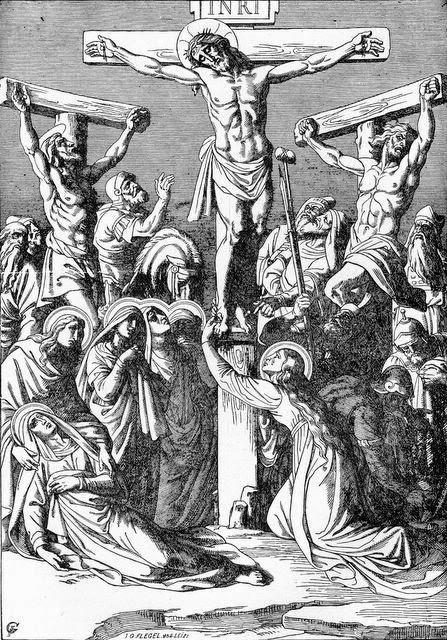
The Crucifixion - Alexandre Bida
TODAY'S SPECIAL: Mark 15:1-41

 TO CHEW ON: "So when the centurion who stood opposite Him saw that He cried out like this and breathed His last, he said, 'Truly this Man was the Son of God.' " Mark 15:39

As we read the detailed account of the hours leading up to the cross and the hours Jesus spent on the cross, we get the sense of several things:
  • How typically human this whole drama was.
The religious leaders had manipulated things their way—finally. The crowd was as wishy-washy as crowds typically are. The soldiers gloried in their power and got themselves a few laughs even as they meted out Roman punishment.

  • How inevitable this whole drama was.
We got glimmerings of that inevitability yesterday as we heard the resignation in Jesus' voice when He prayed through (Mark 14:36). In today's reading He was silent in His own defense (Mark 15:2-5). As the scene played out, He fulfilled prophecy (as Mark points out: Mark 15:28).

  • How pivotal this event was.
Jesus' words from the cross, His quick death without the aid of numbing myrrh or wine, and the temple veil torn in two from top to bottom (no human hand could do that!) were all sources of incredulity. Even that hardened Roman soldier looking on recognized that this was no ordinary man being crucified (Mark 15:39).

These many years later we are still seeking to get our minds around how that moment changed everything. Bible writers have probed it too, both prophetically and in hindsight. Here are some of the accomplishments of Jesus' death—and resurrection three days later:

  • Jesus  bore our sin, became sin for us - Isaiah 53:12; Romans 5:6; Hebrews 2:9.
  • He laid down His life for our lives as He said He would - John 10:11.
  • In dying He made possible the crop of Christ-followers that has sprung up over successive generations, and around the world - John 12:24.
  • His death and resurrection conquers life and death - Romans 14:9.
  • He fulfilled Scriptures showing that this chain of events was no fluke but in God's plan from the beginning - Genesis 3:15; 1 Corinthians 15:3.
  • His death gives those He died for the motivation to live for Him - 2 Corinthians 5:15.
  • His death makes it possible for us to stand before God "blameless and above reproach" - Colossians 1:22.
  • His death results in His glory as the world's Redeemer - John 12:23; Revelation 5:9.

No wonder we call this "good" Friday!


PRAYER: Dear Jesus, thank You for going through with this! I know how only eternity will reveal the true weight of what You accomplished that day on Calvary. For all that I understand of it now, I thank you, thank you, thank you!

MORE: Good Friday

Today the church celebrates Good Friday. The Good Friday liturgy begins with this Collect:

Almighty God, we pray you graciously to behold this your family, for whom our Lord Jesus Christ was willing to be betrayed, and given into the hands of sinners, and to suffer death upon the cross; who now lives and reigns with you and the Holy Spirit, one God, for ever and ever. Amen.


 *********
Unless otherwise noted all Scripture quotations are taken from the New King James Version®. Copyright © 1982 by Thomas Nelson, Inc. Used by permission. All rights reserved.

Wednesday, March 11, 2015

Toxic grumbling

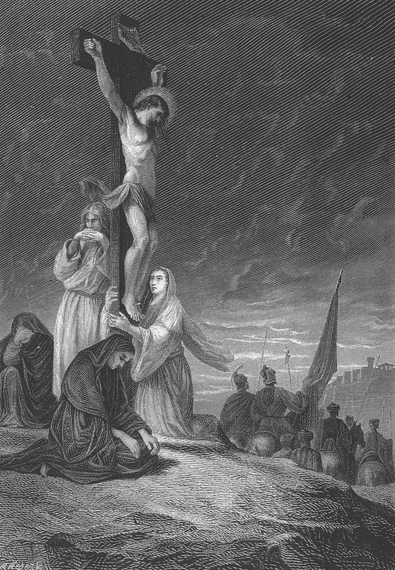
"The Brazen Serpent" - James Tissot

The Brazen Serpent by James Tissot
TODAY'S SPECIAL: Numbers 21:4-18

TO CHEW ON: "So Moses made a bronze serpent, and put it on a pole; and so it was, if a serpent had bitten anyone, when he looked at the bronze serpent, he lived." Numbers 21:9

Desert hardships continually tripped up the Israelites. We would expect their God-given victory at Hormah (Numbers 21:1-3) would have sealed their confidence in God. But no. A little while later "The soul of the people became very discouraged on the way."

They vented their discouragement to Moses: "Why have you brought us out of Egypt to die in the wilderness? There is no food and no water, and our soul loathes this worthless bread."

After that the test only got worse when God allowed poisonous snakes to slither among them, killing many.

This time, not like some others, the people approached Moses in repentance: "We have sinned for we have spoken against the Lord and against you."

Moses prayed and God told him to erect a bronze snake statue, to which the people could look and be healed.

This story convicts us as we recognize ourselves in those discontented Israelites.

1. How often don't we grumble about situations far less severe than what the Israelites were going through? But grumbling of any kind and about anything is toxic.

2. The Israelites' grumbling was sparked by simple discouragement—an attitude that is hardly uncommon among us. It's an attitude that begins with negative, discouraged thinking. Joyce Meyer says:
"Discouragement destroys hope .... The Bible repeatedly tells us not to be discouraged or dismayed. God knows that we will not come through to victory if we get discouraged, so He always encourages us .... God wants us to be encouraged, not discouraged.


When discouragement or condemnation tries to overtake you, examine your thought life. What kind of thoughts have you been thinking?" Joyce Meyer, Battlefield of the Mind, p. 33.

3. The Israelites' grumbling about Moses was really grumbling about God (Numbers 21:5,7). When we grumble about people in our lives, church leadership, or our circumstances we too are really grumbling against God who has brought us to this place and allowed these things into our lives. Paul warns the Corinthians (and us) about this attitude in 1 Corinthians 10:9-11.

PRAYER: Dear God, please forgive me for sinning against You by grumbling and complaining. Help me to nip in the bud negative thoughts of discouragement and fault-finding, and instead to make it a habit to put my hope in You - Psalm 42:5. Amen.

MORE: The foreshadow of Divine healing

A sidebar note in my Bible reminds us that Jesus was intimately connected to this event:
"The plague of fiery serpents sent upon God's people was, in reality, a self-inflicted punishment, resulting from their frequent murmuring. God's judgment was in allowing what their own presumption invited, and many died from the bites of the serpents.


But in answer to the repentance of His people, God prescribed the erecting of a bronze serpent to which any might look in faith and be healed. Jesus referred to this account in John 3:13-14. He clearly implied that the bronze serpent typified His being raised upon the cross. Our healing, both spiritual and physical, comes from looking to and identifying with Christ crucified, 'by whose stripes you were healed' - 1 Peter 2:24" - Nathaniel M. Van Cleave, "The Focus of Divine Healing," New Spirit-Filled Life Bible, p. 205.
**********
Unless otherwise noted all Scripture quotations are taken from the New King James Version®. Copyright © 1982 by Thomas Nelson, Inc. Used by permission. All rights reserved.

Bible Drive-Thru


Saturday, February 28, 2015

God's answer

"The Empty Tomb"
 Illustration from a book by Martin Luther.

The Empty Tomb - from a book by Martin Luther
TODAY'S SPECIAL: Psalm 22:16-31

TO CHEW ON: "You have answered Me." Psalm 22:21b

This psalm pivots at verse 21. There the speaker (prophetically Jesus, Messiah) comes to the triumphant conclusion "You have answered Me."

Up to that point He has dwelt on the dreadful things that would and did happen as His life spiraled toward death. Today's reading includes the howls of the suggestible crowed insisting Barabbas go free and Jesus die, His pierced hands and feet, the gawking scorn of onlookers, and the dice game for His robe. And then He proclaims, "You have answered Me."

But He died. So we ask,  how did God answer Him?

The answer came three days later. As explained by the writer of my Bible's Psalm footnotes: "The resurrection of Jesus was an answer to His prayer and to the agonizing prayer of every sin-laden human soul"-  K.R. "Dick" Iverson, New Spirit-Filled Life Bible, p. 702.

That last phrase snags my attention: "...every sin-laden human soul." That includes me. It prompts me to ask: How does Christ's resurrection impact me—and you?

Wayne Grudem devotes an entire chapter to the resurrection and ascension of Jesus in his Systematic Theology. Here are some bits, gleaned from that chapter to answer our question: 

How does Jesus' resurrection impact us?

1. We are made spiritually alive.
"When Jesus rose from the dead he had a new quality of life .... When we become Christians our bodies remain as they were .... But in our spirits we are made alive with new resurrection power."

2. The penalty for our sin is paid.
"When Christ was raised from the dead, it was God's declaration of approval of Christ's work of redemption .... There was no penalty left to pay for sin, no more wrath of God to bear, no more guilt or liability to punishment—all had been completely paid for."

3. There will be resurrection bodies for us.
"In calling Christ the 'first fruits' (1 Corinthians 15:20) Paul uses a metaphor from agriculture to indicate we will be like Christ .... Christ as the 'first fruits' shows what our resurrection bodies will be like when, in God's final 'harvest' he raises us from the dead and brings us into his presence" - quotes from Wayne Grudem, Systematic Theology, pp. 614-616.

The rest of Psalm 22 sparkles with the joy of this resurrection answer. Praise God, we can join in Messiah's celebration!

PRAYER: Dear God, "My praise shall be of You in the great assembly .... All the ends of the world shall remember and turn to the Lord, all the families of the nations shall worship before You. For the kingdom is the Lord's and He rules over the nations." Amen (quoting Psalm 22:25, 27-28)

*******
Unless otherwise noted all Scripture quotations are taken from the New King James Version®. Copyright © 1982 by Thomas Nelson, Inc. Used by permission. All rights reserved.
    Bible Drive-Thru


Thursday, September 13, 2012

Implicated

TODAY'S SPECIAL: John 19:1-16

TO CHEW ON:
"Therefore when the chief priests and officers saw Him they cried out saying, 'Crucify Him, crucify Him!'" - John 19:16

Here we see enacted what we read about in Proverbs yesterday. The Jews' rejection of Jesus was the coming true of:
"...scorners delight in their scorning
And fools hate knowledge ...
...I have called you and you refused
I have stretched out my hand no no one regarded
... you disdained my counsel
And would have none of my rebuke
... they hated knowledge
And did not choose the fear of the Lord  - Proverbs 1:22, 24,25,29.

It's easy for me to shake my head and think, I would never do those things. But then I am reminded of the list of sin's fruits (yesterday's devo) and how I have tolerated them in my own life. Why all I need to do is think back to yesterday to find contention, dissension, selfishness, an 'outburst of wrath.' What Isaiah said is so true:

"All we like sheep have gone astray
We have turned every one to his own way
And the Lord has laid on Him the iniquity of us all" - Isaiah 53:6

So I find myself—we all find ourselves—in the scene of Jesus before Pilate and feel a pang when He says, "You could have no power at all against Me unless it had been given you from above. Therefore the one who delivered Me to you has the greater sin." For we are all implicated as "the one who delivered Me to you."

PRAYER:
Dear Jesus, thank You for letting Yourself be put in Pilate's hands and paying the death penalty for my sin.

More: Above All - Michael W. Smith


Bible Drive-Thru


Bookmark and Share


Saturday, November 20, 2010

You get to choose your king

Pilate presents Jesus to the crowd
Ecce Homo (c. 1849-52) - by Honore Daumier

TODAY'S SPECIAL: John 18:28-40

TO CHEW ON: "'But you have a custom that I should release someone to you at the Passover. Do you therefore want me to release to you the King of the Jews?'
Then they all cried again, saying, 'Not this Man but Barabbas.'" John 18:39-40

Yesterday we read a psalm that praised God's kingly majesty. The psalmist pictured Him clothed in omnipotence, reigning forever from His holiness-adorned palace. It was a grand picture but one that made us feel very tiny, insignificant and unworthy — as we are.

Today we see that omnipotent, eternal king as a person. It's Jesus!

Look at Him, standing alone in the front of Pilate in the Praetorium, even as the religious leaders, who finally have His death in their hands, wait outside inciting the crowd as they gloat.

"Are you the king of the Jews?" Pilate asks.

"You say rightly I am a king..." Jesus answers.

We reflect back over Jesus' life as told to us in the gospels. We have seen him socializing with sinners, touching lepers, scorning the status endowed by possessions and property, living instead the life of a vagabond. Now He stands before Pilate forsaken by even His friends, tired, disheveled, looking altogether pathetic. So this is how a heavenly king handles Himself? He's so unlikely. It's true what Isaiah says of Him: "He has no form or comeliness; And when we see Him, There is no beauty that we should desire Him" (Isaiah 53:2). He is surely not a king by the company He keeps, His worldly wealth, or His physical appearance. On what basis, then, is He a king?

Listen in as He continues explaining His kingship to Pilate: "For this cause I was born, and for this cause I have come into the world, that I should bear witness to the truth. Everyone who is of the truth hears My voice."

Jesus' claim, that he spoke truth, lived truth, represented (and represents) the Kingdom of Truth is as controversial today as ever. The meaning of His claim, "I am the way the truth and the life. No one comes to the Father except through me" (John 14:6), is debated more hotly today than ever, even in some Christian circles.

Today, as in each generation, we are presented with the choice Pilate gave the Jerusalem crowd. Whose claims do we believe? Who will we choose to follow, obey, and give allegiance to? Who will be our king?

PRAYER: Dear Jesus, I choose You. Please help me to live my everyday life now, as a subject in Your Kingdom of Truth. Amen.

MORE: "Give Me Jesus" by Fernando Ortega


Do your 8-12-year-olds have daily devotions? Point them to Bible Drive-Thru.

Thursday, April 01, 2010

The will of the mob

TODAY’S SPECIAL: Luke 23:1-25

TO CHEW ON: “They were more fierce, saying, ‘He stirs up the people…’”

And they all cried at once saying, ‘Away with this man.’
But they shouted, ‘Crucify Him, crucify Him.’
But they were insistent, demanding with loud voices that He be crucified. And the voices of these men and of the chief priests prevailed.” Luke 23:5, 18, 21, 23
"Give us Barabbas"  by Charles Louis Lucien Muller (1815-1892)

The picture of this angry mob demanding Jesus’ death brings to mind mobs I have seen (mostly via TV and the safety of my living room).
- Muslim demonstrations after the publication of the Danish cartoons.
- Mobs on the streets of Kiev during the Orange Revolution movement in Ukraine.
- Partisan fans at soccer games in Britain and Europe.
- Bloodthirsty crowds during wars of genocide in Rwanda and Kenya.
- Most lately the multitudes on the streets of Vancouver during the 2010 Olympics, cheering on Canadian athletes.

While being a part of these mobs can be fun and non-threatening (as in the last one), I can imagine feeling only terror should one be on the opposite side of the will of most mobs. Mob psychology is unpredictable but often results in actions of apparent insanity that would never happen during moments of cooler emotion. Before we are too hard on the disciples for never raising a hand to defend Jesus but running away, we should put ourselves in their places. Would we have done any different? I see this angry mob during the events of Jesus’ passion as another ploy of Satan. He would use every trick in the book. Frenzied voices raised in unison against Jesus suited him just fine.

But not even a mob is bigger than God. In this case, the will of the mob prevailed because it was part of God’s plan of how He would accomplish our salvation. When we are tempted to fear mobs in whatever guise they take – public opinion, the results of polls, anti-Christian articles on the internet along with supportive and often abusive comments, voices rallied by satirical shows like SNL that mock Christians and Christianity – here are some Bible words to help encourage you and bolster your faith:

Psalm 3:6, Psalm 27:3; Psalm 112:8; Psalm 118:6; Isaiah 6:12; Isaiah 12:2; 2 Timothy 1:7; 1 John 4:18

PRAYER: Dear God, it is easy for me to become intimidated by a multitude of voices. In such times, please remind me that You are Lord, even of the mob. Amen.

MORE:  
"It is no fun to be in a room where everyone assumes a particular view and you do not hold it. Only the very brave, the very wise, or fools rush to expose their minority opinions. Few of us are brave or wise and fools simply confirm the stereotypes. The rest of the very religious keep quiet and so nobody learns. " - John Mark Reynolds, Professor of Philosophy & Director of the Torrey Honors Institute, Biola University.

The article from which the quote was taken: “Ignorance of Christianity No Virtue.”


Do your 8-12-year-olds have daily devotions? Point them to Bible Drive-Thru.

Related Posts Plugin for WordPress, Blogger...