Showing posts with label God's love. Show all posts

Tuesday, November 27, 2018

What to pursue

TODAY'S SPECIAL: 1 Timothy 5-6; Psalm 21

TO CHEW ON: "But flee from these things, you man of God, and pursue righteousness, godliness, faith, love, perseverance, and gentleness." 1 Timothy 6:11

It is more probable that we will succeed in reaching a goal if we focus on the positive (the thing or action we are striving toward) rather than the negative (the thing or action were are to avoid). Paul, after warning Timothy about the dangers of pursuing "these things" — he's been talking about the love of money — tells Timothy what to pursue:

Pursue [Strong's #1377) Dioko] means to press on. Figuratively it is used of one who in a race runs swiftly to reach the goal.] In this context it is pursuit without the idea of hostility, to run after, follow after; to pursue or to seek after eagerly, earnestly endeavour to acquire. In plain words, to go after something with all one's might.

Righteousness: [Strong's #1343  Dikaiosune means in a broad sense to be in a condition acceptable to God. In a narrower sense it is used of someone who is just and gives each his due.]

Godliness: [Strong's #2150  Eusebeia  means to have reverence, respect and piety towards God.]

Faith: [Strong's #4102 Pistis refers to the conviction of the truth of anything; belief. In the NT faith implies a conviction or belief about man's relationship to God and divine things.] This includes the conviction that God exists and is the creator and ruler of all things, the provider and bestower of eternal salvation through Christ. Relating to Christ, it is a conviction that Jesus is the Messiah through whom we obtain eternal salvation in the Kingdom of God. Toward men, it implies qualities of fidelity or faithfulness — we say we have faith in someone because he can be relied on.


Love: [Strong's #26 Agape is brotherly love, affection, good will, love, benevolence.] For a practical description, read 1 Corinthians 13.

Patience: [Strong's #5281 Hupomone is steadfastness, constancy, endurance.] Patience (also translated "perseverance" in the NT is the characteristic of a man who is not swerved from his deliberate purpose and his loyalty to faith and piety by even the greatest trials and sufferings.

Gentleness: [Strong's #4236 Praotes refers to gentleness, mildness, and meekness.] A "Word Wealth" article in my Bible says about gentleness:
"A disposition that is even-tempered, tranquil, balanced in spirit, unpretentious, and that has the passions under control. The word is best translated "meekness" not as an indication of weakness but of power and strength under control. The person who possesses this quality pardons injuries, corrects faults and rules his own spirit well." New Spirit Filled Life Bible, p. 1706
(All emphases mine)

What a list! Where to start?

If you're like me, the quality or characteristic that you're currently pursuing will change from circumstance to circumstance. If you're speaking with someone who argues persuasively against the existence of God, your faith may need shoring up. If you are having issues with a difficult neighbour, your attention will be drawn toward pursuing love. If you're living with a wilfull child, your focus may be on pursuing gentleness.

One thing is sure: If we give ourselves fully to these pursuits, we won't have a lot of time or energy left to chase after money, fame, power or any of "these things" about which Paul warns Timothy.

PRAYER: Dear God, please help me focus on pursuing righteousness, godliness, faith, love, patience, and gentleness in my life. Amen

PSALM TO PRAY: Psalm 21

*****************

Unless otherwise noted all Scripture quotations are taken from the New King James Version®. Copyright © 1982 by Thomas Nelson, Inc. Used by permission. All rights reserved.

Thursday, August 30, 2018

Moved to mercy

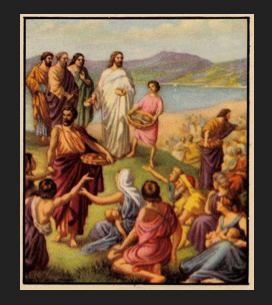
Jesus feeds the multitude - artist unknown
TODAY'S SPECIAL: Matthew 13-14; Psalm 87

TO CHEW ON:
"And when Jesus went out He saw a great multitude; and He was moved with compassion for them, and healed their sick." Matthew 14:14

Our reading today starts out with Jesus trying to get away from the crowds: "When Jesus heard it, He departed from there by boat…" The "it" is news that his friend and relative John (the Baptist) has just been killed (decapitated no less!) by Herod, instigated by Herod's concubine Herodias.

We can understand Jesus' need to be alone at such a time. But when He gets to land, a crowd is there to meet Him. However, instead of being annoyed at this (how I would have felt if my expectations of a quiet afternoon had been dashed like that) He is "moved with compassion."

["Moved with compassion" is splanchnizomai is from the word splanchna - bowels. The Hebrews regarded splanchna as the place where tender mercies and feelings of affection, compassion, sympathy, and pity originated - Dick Mills, Word Wealth, New Spirit-Filled Life Bible, p. 1317.]

Out of this compassion Jesus spends the afternoon healing the sick and, when it gets late, multiplying the five loaves and two fish to feed everyone before He sends them home.

Jesus performed other miracles as a result of splanchnizomai.
  • He fed another large crowd after a three-day healing and teaching 'conference' (Matthew 15:32).
  • He restored the sight of two blind men who sat beside the road calling out, even as the people around told them to shut up (Matthew 20:34).
  • He healed a leper (Mark 1:41).
  • He raised a widow's son back to life (Luke 7:13).
  • He gave this compassion to two parable characters: the Good Samaritan (Luke 19:33) and the father of the prodigal son (Luke 15:20).

I need more of this compassion in my life. Instead of seeing people as threats, or irritants, or losers, or rivals, or… I would like to see under and beyond behavior to the need of which it's a symptom—a need that's best filled by Jesus and what He offers.

What about you?

PRAYER: Dear Jesus, please give me a softer heart, that is moved by the things that move You. Amen.

PSALM TO PRAY: Psalm 87

**********
Unless otherwise noted all Scripture quotations are taken from the New King James Version®. Copyright © 1982 by Thomas Nelson, Inc. Used by permission. All rights reserved.


 

Bookmark and Share


Tuesday, July 10, 2018

Faithful

A faithful eagle pair guard nest and young
TODAY’S SPECIAL:  Ezekiel 19-21; Psalm 36

TO CHEW ON: “Your mercy, O Lord, is in the heavens;
Your faithfulness reaches to the clouds.” Psalm 36:5
 

Faithfulness. It’s a quality as old fashioned as afghans made by grandmas – and just as comforting. Faithfulness isn’t particularly trendy or sexy. In fact it’s unfaithfulness that contributes to the Hollywood mystique and puts our society’s heroes and stars on ET.

God, on the other hand, is faithful. What does that mean?

Faithful is from emunah (eh-moo-nah) which means firmness, stability, faithfulness, fidelity, conscientiousness, steadiness, certainty, that which is permanent, enduring, steadfast. The word “Amen” (It is firmly, truly so) comes from the same root.


This psalm details some of the ways God is faithful:
- He preserves man and beast.
- He shows lovingkindness.
- He is trustworthy and provides security.
- He provides abundantly and His provisions satisfy physically, emotionally and spiritually.
- His ways are ways of life and light.

 How has God been faithful to you? Can you see His hand maneuvering your circumstances, bringing things together in wonderful little seeming-coincidences?

Or perhaps there are times in your life when (on the surface at least) God has appeared unfaithful? If you look closely, can you see evidences of His faithfulness below the surface, or working in the background of even dreadful situations?

PRAYER: Dear God, I thank You for Your faithfulness. Help me to see evidences of that faithfulness even in times when I feel forsaken. Help me to take the knowledge and experience of Your faithfulness through this year. Amen.

PSALM TO PRAY: Psalm 36

MORE: When I think of God’s faithfulness, I think of the song “Great is Thy Faithfulness.” Here is a little background to that song:

“The author of this hymn, Thomas Obediah Chisholm, was born in a log cabin in Kentucky. At age 16, he began teaching school, despite the paucity of his own education. He came to Christ at age 27 under the ministry of evangelist H. C. Morrison. But Chisholm’s health was unstable, and he alternated between bouts of illness and gainful employment in which he did everything from journalism to insurance to evangelistic work. Through all the ups and downs he discovered new blessings from God every morning. The third chapter of Lamentations 3 became precious to him: “His compassions fail not. They are new every morning; Great is Your faithfulness” (Lamentations 3:22-23).

- From Then Sings My Soul – Hymn Stories by Robert J. Morgan – p. 285, emphasis mine.
**************
Unless otherwise noted all Scripture quotations are taken from the New King James Version®. Copyright © 1982 by Thomas Nelson, Inc. Used by permission. All rights reserved.


Sunday, July 01, 2018

Abandoned

TODAY'S SPECIAL: Jeremiah 51-52 Psalm 27


TO CHEW ON: "When my father and my mother forsake me,
Then the Lord will take care of me." Psalm 27:10


"Abandoned on a street corner by his mother at the age of 12, Pastor Bill (Wilson) sat and waited for her at that corner for 3 days. She never came back. A Christian layman who was on his way to see his son in the hospital stopped and picked him up. Anybody could have stopped, but it was the Christian man who stopped. After getting him a hot meal, this gentleman paid for Pastor Bill to attend a Sunday School camp, where he gave his life to Christ. This was the start of his incredible walk with God – one that would change thousands of lives..." - Bill Wilson, founder of the Metro World Child organization, a Christian, non-profit organization dedicated to serving inner-city children throughout New York City and various urban centers around the world.

The love and care of one's parents is pretty well a given. We view it to be foundational to growing up as normal, healthy adults. The belief that kids need their parents is behind the current outrage over the children of people crossing the Mexican US border being separated from their parents. Parents are being jailed for crossing the border illegally while the kids are kept in children's centers while their parents' fate is decided ("Separation of parents, kids at US Mexican border" - CBC news)

 How many stories haven't we heard of messed up adults whose problems are attributed to being neglected or abandoned as kids? Does our focus verse today mean that God can counteract such a basic lack in one's life?

I believe it does. Look at the stories of noteworthy Bible characters torn from parental care and love: Joseph, Daniel, Esther, the little Jewish maid of Naaman's wife.

Look at God's heart toward the abandoned as it comes out in other scripture passages:


Exodus 22:22-23:
“You shall not afflict any widow or fatherless child. If you afflict them in any way, and they cry at all to Me, I will surely hear their cry"

Deuteronomy 10:18
"He administers justice for the fatherless and the widow, and loves the stranger, giving him food and clothing."


Psalm 10:14
"But You have seen, for You observe trouble and grief,
To repay it by Your hand. 
The helpless commits himself to You; 
You are the helper of the fatherless."

Psalm 68:5
"A father of the fatherless, a defender of widows,
 Is God in His holy habitation."

Psalm 146:9
"The LORD watches over the stranger
He relieves the fatherless and widow;
But the way of the wicked He turns upside down."

Proverbs 15:25
"The LORD will destroy the house of the proud,
  But He will establish the boundary of the widow."

Jeremiah 49:11 
"Leave your fatherless children,
I will preserve them alive; And let your widows trust in Me.”

Malachi 3:5
"And I will come near you for judgment;
I will be a swift witness
Against ... those who exploit wage earners and widows and orphans,
And against those who turn away an alien—
Because they do not fear Me,”
Says the LORD of hosts."

If you have been abandoned, remember that God is for you. He promises to take care of you. He will fill in the physical and emotional holes that your experiences have caused. You can say with confidence:

"When my mother and father (or my spouse, or my children) forsake me,
Then the Lord will take care of me."

PRAYER: Dear God thank You that You are for the abandoned, neglected, forgotten, bereaved, and passed-over ones. Help me, as Your child, to inherit Your heart of compassion, concern and care for them. Amen.

PSALM TO PRAY: Psalm 27

MORE: Covenant House
Covenant House is an organization that houses and takes care of homeless and abandoned youth in cities around North America.


*************

Unless otherwise noted all Scripture quotations are taken from the New King James Version®. Copyright © 1982 by Thomas Nelson, Inc. Used by permission. All rights reserved.


Monday, June 25, 2018

Together again

"Prodigal Son" - Artist unknown
TODAY'S SPECIAL: Jeremiah 30-32; Psalm 21

TO CHEW ON: "Again I will build you and you shall be rebuilt,
O virgin of Israel!
You shall again be adorned with your tambourines,
And shall go forth in the dances of those who rejoice."  Jeremiah 31:4


A family feud, a rift between you and an old friend, a church split, a betrayal by a business partner… Most of us have experienced the severing of a trusted relationship and know its fallout of sadness, disillusionment and the ache of an empty place at the table, empty pews in church, the empty office.

Israel and Judah had split into two nations during the reign of Solomon's son Rehoboam. That was about 300 years before Jeremiah's time. Though the crisis pain of that split had no doubt long healed, the desire that the two nations of God's chosen people be reunited lingered. In today's reading we hear it in Jeremiah's prediction of  together again: "I will be the God of all the families of Israel and they shall all be my people" - Jeremiah 31:1.

Let's look at the bright picture Jeremiah paints of that reuniting:

This is a worldwide ingathering "I will bring them from the north country, And gather them from the ends of the earth…" Jeremiah 31:8, 10.

There is repentance and renewed spiritual sensitivity: "They shall come with weeping, And with supplications I will lead them" - Jeremiah 31:9.

There is celebration, singing and dancing - "You shall again be adorned with your tambourines, And shall go forth in the dances of those who rejoice …. Then shall the virgin rejoice in the dance, And the young men and the old together;  For I will turn their mourning to joy…" Jeremiah 31:4,13.

There is vibrant praise and worship - " ' Sing with gladness for Jacob, And shout among the chief of the nations; Proclaim, give praise and say, "O Lord, save Your people…" ' "  Jeremiah 31:7.

There is hope: "Again I will build you and you shall be rebuilt" - Jeremiah 31:4.

There is new life and productivity - "You shall yet plant vines on the mountains of Samaria …. Their souls shall be like a well-watered garden…" Jeremiah 31:5, 12.

Over it all there is a sense of God's love, protection, and care - "Yes, I have loved you with an everlasting love; Therefore with lovingkindness I have drawn you … He who scattered Israel will gather him, and Keep him as a shepherd does his flock … And My people shall be satisfied with My goodness says the Lord" - Jeremiah 31:3, 10-11,14.

The picture of God reclaiming His people Israel can be compared to what it's like when He brings humanity back to Himself, healing the rift that split us and God apart when Adam and Eve sinned.

He brings us from wherever we are and accepts us no matter what our condition. Our tears of repentance and renewed spiritual sensitivity soon change to joy, singing, celebration, praise, and worship as we realize our happy condition. Our relationship with our Creator leads to renewed life and creativity. In the Shepherd's care we find security and satisfaction.

If you haven't come home to the Father, He calls to you today: "Yes, I have loved you with an everlasting love; Therefore with lovingkindess I have drawn you…"

Come to Him today!.

PRAYER: Dear God, thank You for wanting me back and making a way. Help me today to appreciate and enjoy the benefits of being Your child. Amen.

PSALM TO PRAY: Psalm 21

 *********
Unless otherwise noted all Scripture quotations are taken from the New King James Version®. Copyright © 1982 by Thomas Nelson, Inc. Used by permission. All rights reserved.


Friday, February 23, 2018

Seek your Lover

TODAY'S SPECIAL: Deuteronomy 4-6; Psalm 54


TO CHEW ON: "But from there you will seek the Lord your God, and you will find Him if you seek Him with all your soul." Deuteronomy 4:29

The Bible is a love story describing the wooing and pursuing, the back-and-forth between lovers—God and us humans. In many places Bible writers remind us of how God is seeking us. Here Moses prods Israel to seek God.

The little word "but" that begins our focus verse signals a change of thought direction. We see Moses is warning Israel in a prophetic way, that they will stray from following God. When they settle in Canaan they will serve idols and images (Deuteronomy 4:28). God doesn't give them up to these. If and when they seek Him, Moses promises, God will be there for them.

Moses goes on to remind them of all the reasons it makes sense to seek God over idols (a recitation of ways God has pursued them):
  • Because of His merciful and faithful nature (Deuteronomy 4:31).
  • Because of His creativity and power (Deuteronomy 4:32,33).
  • Because He showed them special favor in Egypt when He helped them escape slavery with power signs (Deuteronomy 4:34-35).
  • Because He guided them with His voice through the wilderness (Deuteronomy 4:36).
  • Because He helped them gain independence from Egypt and other nations (Deuteronomy 4:37-38).

We can find many parallels between God's wooing of Israel and how He pursues us:
1. We too turn to Him from idols. No, these are probably not images of stone or gold, but things we serve more than Him (like success, money, fame, pleasure etc.). That turning may come when we get into trouble, or find ourselves dissatisfied, or over our heads, or any number of reasons.

2. When we return to God, He faithfully meets us with mercy, creativity, and power.

3. Our histories remind us of His faithfulness.
  • This could be recent history. Many of his have faith-filled family members who have prayed for us, and whose prayers are answered by our return to God.
  • It could be distant history, where we look back at the long story of God's work in our family, community, or nation through immigrants who came to experience freedom of religion, or missionaries who first brought the gospel.

For Israel and for us, the result of being rightly related to God is a future of well-being: "...that it may go well with you and your children after you and that you may prolong your days" (Deuteronomy 4:40).


Where are you and I in relation to our lover, God, today? Do we sense He is pursuing us? Are we seeking Him?


PRAYER: Dear God, thank You for this reminder of Your love and pursuit of Israel and me. Please help me to see where I am being lured away by idols and to serve You with renewed vigor. Amen.

PSALM TO PRAY: Psalm 54

The Bible Project VIDEO: SHEMA: Listen (Shema Word Study Series)


Unless otherwise noted all Scripture quotations are taken from the New King James Version®. Copyright © 1982 by Thomas Nelson, Inc. Used by permission. All rights reserved.


Saturday, February 10, 2018

Be blessed

Jacob blessing Joseph's sons
- Artist unknown

TODAY'S SPECIAL: Numbers 5-7; Psalm 41

TO CHEW ON: "The Lord bless you and keep you." Numbers 6:24

Doesn't your heart just take a deep breath and settle down as you read the verses of blessing in today's scripture? There is something in this Aaronic blessing that feels like a warm blanket when you're shivering, or a cool breeze on a hot day, or a table loaded with food when you're hungry.

This blessing of only three lines (actually one, partitioned by semicolons) contains six actions. Let's look closely at them in order to soak up every bit of this blessing's goodness.

"The Lord bless..."
To bless someone means to consecrate, make holy, honour, exalt, glorify, bestow happiness and prosperity on. It's a powerful enough interaction between people—how much more when the blessing bestowed is the blessing of the Lord. How rich we are!

"..and keep you"
Keep (shamar) means to guard, keep watch and ward, protect, save the life of. When we keep something we retain the possession of it; we don't give it away. God holds onto us in that way. How safe we are!

"The Lord make His face shine upon you..."
The word "shine" ('owr) alludes to the shine of the sun, to illumine, to become lighted up, to make shine as of the face. Watch a mother's face light up when she sees her child. That's how God's face lights up when He looks at you and me. How loved we are!

"...and be gracious to you"
Gracious (chanan[a]) means to show favour, be gracious toward, have mercy on. It is characterized by showing kindness, affability. To be gracious means to be full of compassion and mercy. God is disposed that way toward us. How favored we are!

"The Lord lift up His countenance upon you..."
The picture here is similar to God making His face shine on us. I see, in addition, a focused attention, like a parent looking straight into a child's eyes. God looks straight at and into us. How known we are!

"...and give you peace."
Give (suwm) means to extend, establish, bring to pass peace - a state of mental or physical quiet or tranquility, calm, repose, reconciliation, freedom from mental agitation or anxiety. When God pours His peace over  and into us, how settled we are!

May we realize every part of this blessing as we head into 2015.

PRAYER: Dear God, Your blessing is what we need and want more than anything else, as we enter the new year. Amen.

PSALM TO PRAY: Psalm 41

The Bible Project VIDEO: Numbers (Torah Series)


*********
Unless otherwise noted all Scripture quotations are taken from the New King James Version®. Copyright © 1982 by Thomas Nelson, Inc. Used by permission. All rights reserved.


Sunday, January 14, 2018

Through what lens do you view life?

Joseph reveals himself to his brothers

Joseph meets Benjamin (Artist unknown)
TODAY'S SPECIAL: Genesis 43-45

TO CHEW ON: "'And God sent me before you to preserve a posterity for you in the earth and to save your lives by a great deliverance. So now, it was not you who sent me here, but God...'" Genesis 45:7-8

Relationships within families have the potential to dredge up deep emotion. We get an insight into Joseph's at least three times in the story of how he is reunited with his family as we watch him weep.

The first time was just after his brothers came to Egypt seeking food. He recognized them but they didn't recognize him (Genesis 42:8). The first time he met them he spoke roughly to them, imprisoned them for three days and, before sending them on their way, demanded they return with their younger brother. Then he overheard this conversation amongst them (spoken in their native tongue—not the language of the Egyptians - Genesis 42:23):
"Then they said to one another, 'We are truly guilty concerning our brother, for we saw the anguish of his soul when he pleaded with us, and we would not hear; therefore this distress has come upon us.'
And Reuben answered them, saying, 'Did I not speak to you, saying, ‘Do not sin against the boy’; and you would not listen? Therefore behold, his blood is now required of us.'” - Genesis 42:21-22.

He realized they hadn't forgotten about him. In fact their treatment of him haunted them and they were feeling guilty. His reaction: "And he turned himself away from them and wept."

Again in today's reading, just before he told his brothers who he was, he "...wept aloud and the Egyptians and the house of Pharaoh heard it" (Genesis 45:2). He wept again when he met his full brother Benjamin (Genesis 45:14).

But I don't believe these were primarily tears of hurt and pain. For in the years between when his brothers sold him and this time of reuniting, he had worked through the bitterness, self pity, blame etc. Because now instead of scolding his brothers, he put the responsibility of what had happened to him on God: "'So now it was not you who sent me here, but God'" Genesis 45:8.

Oh to have a similarly God-centered view of life that cancels out blaming others and instead interprets all circumstances through the lens of God's sovereignty as Joseph does: "And God sent me before you to preserve a posterity for you in the earth and to save your lives by a great deliverance" - Genesis 45:7.

As a commentary on this verse in my Bible expresses it:

"Trust in God's sovereign providence. He causes all things to work for your good as you remain faithful to His calling and purpose for you" - R. Russell Bixler,  notes on Genesis, New Spirit-Filled Life Bible, p. 74.

PRAYER: Dear God, thank You for Your sovereign working in my life. Please help me to view the circumstances of my life (even the difficult, bitter ones) through the glasses of Your providential love. Amen. 

PSALM TO PRAY: Psalm 14

**********
Unless otherwise noted all Scripture quotations are taken from the New King James Version®. Copyright © 1982 by Thomas Nelson, Inc. Used by permission. All rights reserved.

Thanks for reading! This year we are using The Bible Project "Timeless Reading Plan" to read through the Bible in 2018. If you'd like to read along in your own Bible, you can download a pdf of the reading plan HERE.


Saturday, December 30, 2017

Discerning truth and error

Image: Pixabay
TODAY’S SPECIAL: 2 JOHN 1-13

TO CHEW ON: “Whoever transgresses and does not abide in the doctrine of Christ does not have God. he who abides in the doctrine of Christ has both the Father and the Son.” 2 John 9


This short book/letter of only 13 verses is nevertheless deep and thought provoking. Its key words are “love” (four occurrences) and “truth” (five occurrences). Its main themes are truth and error—concepts we’d expect to see addressed by the philosophical Apostle John. With efficiency John lays out the territory of each.

What is truth and how does it relate to the believer? *
  • It unites them in fellowship - 2 John 1
  • It lives in them forever - 2 John 2.
  • They remind each other of the truth they believe and affirm it in their greeting of each other - 2 John 3.
  • It manifests itself in their obedience to God - 2 John 4-6.  

What is error?
  • Its advocates are deceitful - 2 John 7.
  • They deny Christ’s incarnation - 2 John 7.
  • They ignore the teachings of Jesus and disobey Him - 2 John 9.
  • They are to be guarded against, even shunned (John tells his readers to not even invite them into their homes) - 2 John 8, 11.

In our time when a smorgasbord of Bible teaching is available through books and online, maybe we should keep some of John’s points in mind as we evaluate who speaks truth and whose teachings come with shades of deceit and error. Some questions we might ask as we evaluate what we read and hear:
  • Does this teacher acknowledge the deity of Jesus?
  • Does he/she teach what Jesus taught, or are they selective, leaving out controversial bits?
  • Is their teaching clear or filled with questions and an unwillingness to state clearly what they believe (so that what they really believe remains fuzzy; we can’t pin them down)?
  • What does their lifestyle say about their beliefs?

Such spiritual perception implies a familiarity with the Bible and Jesus' teachings on our part in the first place, so we can tell what’s off. Let’s be studious and biblically literate so we can be discriminating in choosing what teachers to put ourselves under.

PRAYER: Dear Father, please fill me with Your Spirit of wisdom so I will recognize truth and error. Amen.

* These points are taken from the Study Notes on 2 John from the NKJV Thompson Chain Bible, p. 2099.

 *********
Unless otherwise noted all Scripture quotations are taken from the New King James Version®. Copyright © 1982 by Thomas Nelson, Inc. Used by permission. All rights reserved.


Saturday, October 28, 2017

Love—antibiotic for a toxic church

TODAY'S SPECIAL: Jude 1:1-25

TO CHEW ON: "Keep yourselves in the love of God, looking for the mercy of the Lord Jesus Christ unto eternal life." Jude 1:21


The first part of Jude's letter is a warning about "certain men" who have "crept in" to the church. Jude exposes their behaviors and teachings which include immoral and sensual lifestyles, a denial of Jesus, slandering authority, made-up teachings, greed which shows itself in an over-concern about profit, grumbling, complaining, flattering people in order to take advantage of them, mocking, dividing the congregation and all this obviously without the Holy Spirit. If there ever was a toxic church, this sounds like one!

In the face of this mess, Jude gives two instructions:
- Build yourselves up in your faith.
and
- Keep yourselves in the love of God.

I've written about building ourselves up in the faith in other devos about this passage, so today let's drill down a bit into what it means to keep oneself in the love of God. Though we can't know for certain what this meant to the people in the church to which Jude was writing, we'll make some assumptions. And because we're still part of imperfect churches and living in a hostile world, this focus on love remains as relevant for us today as it ever was.

I can see keeping oneself in the love of God as having three parts.

First, we remind ourselves of the quality and extent of God's love for us. This helps to counteract the twisted doctrine that interlopers are so eager to dispense.
"The Lord has appeared of old to me, saying:
“Yes, I have loved you with an everlasting love;
Therefore with lovingkindness I have drawn you" - Jeremiah 31:3.
"For God so loved the world that He gave His only begotten Son, that whoever believes in Him should not perish but have everlasting life" - John 3:16.
"But God demonstrates His own love toward us, in that while we were still sinners, Christ died for us" - Romans 5:8.

Second, we put muscle into loving God back. This sets us on the path of the morally straight and narrow, to live a lifestyle that  pleases God, who loved us so much.

"You shall love the Lord your God with all your heart, with all your soul, and with all your strength" - Deuteronomy 6:5.

"Oh, love the Lord, all you His saints!
For the Lord preserves the faithful,
And fully repays the proud person" - Psalm 31:23.

"Now may the Lord direct your hearts into the love of God and into the patience of Christ" - 2 Thessalonians 3:5.

Third, we express the love God has showered on us and which we reciprocate to Him, to others in the church and in the world around us. This sets a guard in our lives against ways we would sin against others.
" Love suffers long and is kind; love does not envy; love does not parade itself, is not puffed up; does not behave rudely, does not seek its own, is not provoked, thinks no evil; does not rejoice in iniquity, but rejoices in the truth; bears all things, believes all things, hopes all things, endures all things" - 1 Corinthians 13:4-7.

"And walk in love, as Christ also has loved us and given Himself for us, an offering and a sacrifice to God for a sweet-smelling aroma" - Ephesians 5:2.

"But above all these things put on love, which is the bond of perfection" - Colossians 3:14.

Love—it's a simple yet powerful antibiotic against moral bacteria of every strain.


PRAYER: Dear God, when I'm troubled by the evil in the church and life in this world, help me remember this simple instruction about keeping myself in love. Amen. 

MORE: Feast of St. Simon and St. Jude

Today the church celebrates the Feast of St. Simon and St. Jude. (Simon and Jude, the writer of our reading today, were brothers of Jesus - Mark 6:3). The day's liturgy begins with this prayer:

"O God, we thank you for the glorious company of the apostles, and especially on this day for Simon and Jude; and we pray that, as they were faithful and zealous in their mission, so we may with ardent devotion make known the love and mercy of our Lord and Savior Jesus Christ; who lives and reigns with you and the Holy Spirit, one God, for ever and ever. Amen."

 *********
Unless otherwise noted all Scripture quotations are taken from the New King James Version®. Copyright © 1982 by Thomas Nelson, Inc. Used by permission. All rights reserved.


Saturday, September 09, 2017

Children matter

Image: Pixabay
TODAY’S SPECIAL: Matthew 18:1-14

TO CHEW ON: “'Whoever receives one little child like this in My name receives Me.'” Matthew 14:5


Has it ever happened that as you sat quietly in your seat in church one Sunday, a family with children came and sight right beside you or behind you? Suddenly your peaceful morning became restless with those wee ones not able to sit still, asking for snacks, kicking the back of your seat with their little shoes.  (And I’m talking here about someone else's children, not your own or your grand-kids.)

How did you feel? Be honest. Was there not a glimmer of irritation? At the least a tiny a sigh of annoyance? At such times Matthew 18:1-14 would be a good bit to read and remember. In it Jesus invited a child to join him at center stage. Then He gave a little talk based on this living illustration. Some of His points:
  • You need to become humble like a child to be great in the kingdom of heaven - Matthew 18:3,4.
  • Receiving a child in My (Jesus’) name is equivalent to welcoming Me - Matthew 18:5.
  • Enticing a believing child to sin is super-serious - Matthew 18:6-9.
  • Despising one of these little ones puts you at odds with the paradigm of heaven where their angels have continuous access to Father God - Matthew 18:10.
  • Lost children are worth going to great lengths to save—God doesn’t want even one to stay lost - Matthew 18:11-14.

I’m going to remind myself of Matthew 18:1-14 next time I’m tempted to be irritated by kids racing down church corridors, leaving a mess, making too much noise, just being kids. Will you join me? Jesus loves them; let’s love them too!

PRAYER: Dear Father, I need to remember what it felt like to be a child. I need patience, kindness and Your point of view about children. Help me to see and love them as You do. Amen.

 *********
Unless otherwise noted all Scripture quotations are taken from the New King James Version®. Copyright © 1982 by Thomas Nelson, Inc. Used by permission. All rights reserved.


Wednesday, September 06, 2017

Three basics of Revival

Image: Pixabay
TODAY’S SPECIAL: Psalm 119:145-160

TO CHEW ON: “Revive me…” Psalm 119:154, 156, 159

Do you ever hear comments like, “We need a revival in Canada, the U.S., Europe”, or “Oh, for the revivals of the old days”?

The quest for spiritual revival isn’t new. The prayer “Revive me” occurs three times in an eight verse section of our reading (Psalm 119:153-160).

"Revive" is chayah in Hebrew. It means to live, to have life, remain alive, sustain life, live prosperously, be quickened, be restored to life or health.
The psalmist names three possible catalysts of revival:

“Your word” (vs. 154): "word" = imrah - the word of God, Torah.
“Your judgments” (vs. 156
): "judgments" =  mishpat - judgment, justice, ordinance, legal decision.
“Your lovingkindness” (vs. 159): "lovingkindness" = chesed - goodness, kindness, faithfulness.

How might these things be catalysts for revival in our own time?

- Revived by the Word (Psalm 119:154):
For us this is the Bible. We need to read it, get it into us as much as and more than we allow TV, the news, political pundits, movies, etc. get into us. God’s word puts an entirely different slant on life than does our culture. It tells us what's important to God; what He values.

- Revived by God’s judgments (Psalm 119:156):
God, as revealed especially in the Old Testament, often appears harsh, a God of black-and-white, of judgment. David, the writer of many psalms (perhaps even this one?) discovered that when he tried to move the ark to the tabernacle in Jerusalem (a good thing) in the wrong way (on a cart instead of secured with poles and carried on priests’ shoulders). The man who reached out to steady the ark from falling, touched it (something God had expressly forbidden - Numbers 4:15), and died on the spot. Read the story in 1 Chronicles 13:1-14.

God’s judgment side carries on in the New Testament where He allows His own Son to present Himself as a sacrifice for sin on our behalf.

I think if there is any aspect of the Gospel we moderns have watered down, it is the fact of God’s holiness, His hatred of sin, and the inevitability of sin’s judgment. We easily live with a mindset of “cheap grace.” The picture we have of God is a version of ourselves (Psalm 50:21).

- Revived by God’s lovingkindness:

 We also see the merciful, kind, faithful side of God throughout the Bible and highlighted in the cross. In the words of Paul:
“…God was in Christ, reconciling the world to Himself, not imputing their trespasses to them. … we implore you on Christ’s behalf, be reconciled to God. For He made Him who knew no sin to be sin for us that we might become the righteousness of God in Him” - 2 Corinthians 5:19,21.

I’m also reminded of the verse: “Or do you despise the riches of His goodness, forbearance, and longsuffering, not knowing that the goodness of God leads you to repentance?’ Romans 2:4 (emphasis added).

In our quest for revival, let’s not miss going deep into these three basics!

PRAYER:
“Revive me” I pray with the psalmist. Please use Your word, an awareness of Your holiness, and the deep inner experience of Your love in this process. Amen.

 *********
Unless otherwise noted all Scripture quotations are taken from the New King James Version®. Copyright © 1982 by Thomas Nelson, Inc. Used by permission. All rights reserved.


Friday, June 16, 2017

The birth of Laughter

TODAY'S SPECIAL: Genesis 21:1-21

TO CHEW ON:
 "And Abraham called the name of his son who was born to him — whom Sarah bore to him — Isaac....And Sarah said, 'God has made me laugh, and all who hear will laugh with me.'" Genesis 21:3,6
Have you noticed how many times laughter bubbles up in the story of Isaac?

Abraham's reaction to God's reassurance that he would have a child by Sarah — a child that would be the first in a line of descendants that would one day become a nation— was: "Then Abraham fell on his face and laughed..." (Genesis 17:17).

When the angel visitor reiterated that message to Abraham, Sarah, who "...had passed the age of childbearing" overheard their conversation and "...laughed within herself" (Genesis 18:11-12).

After Isaac was born, Sarah said, "God has made me laugh and all who hear with laugh with me" (Genesis 21:6).

Is it any wonder they called the baby Isaac, which means laughter?

My dictionary's first definition of laugh not only describes the physical act of laughing but also names some of the reasons we laugh: "To produce the characteristic explosive or inarticulate sounds, facial expression and other physical manifestations expressive of merriment, elation, derision, discomposure etc."

Robert Hemley on the topic of what makes something laughable says:
"Unpredictability. We laugh at what surprises us...we laugh because we have been shaken out of our normal perceptions" - Robert Hemley in "Relaxing the Rules of Reason" from How to Write Funny, p. 15.

"Shaken out of normal perceptions" — that would describe Abraham and Sarah. Who would blame 100-year-old Abraham or menopausal Sarah for laughing when God told them they would parent a son? However, their initial laughter of skepticism, cynicism, even derision turned to that of sheer joy when this most unlikely thing happened.

Isaac was the beginning of the nation from which Jesus was born--a birth that was also full of unpredictability. That the creator of the universe would shrink Himself to embryo size to be born in a barn?! Our incredulous laughter at the unlikelihood of such a thing turns to the laughter of elation as we ponder why He did it (John 3:16).

PRAYER: Dear Jesus, thank You for coming as a baby, born to humble parents, in the lowliest place. Thank You for what Your coming means to me. It is beyond laughing incredible! Amen.

************
Unless otherwise noted all Scripture quotations are taken from the New King James Version®. Copyright © 1982 by Thomas Nelson, Inc. Used by permission. All rights reserved.


Bible Drive-Thru

Sunday, April 02, 2017

Jesus is sympathetic


Child - adult holding hands
Image: Pixabay
TODAY’S SPECIAL: John 11:20-44

TO CHEW ON: “Jesus wept.” John 11:35

As the shortest verse in the Bible, John 11:35 has received its share of attention. But that’s not the reason for our focus on it today. For though brief, this verse shines a light on one of Jesus’ most endearing qualities—His sympathy.

  • Matthew recognized this quality in Him. After his account of Jesus’ gentle manner in healing the man with the withered arm, and His refusal to confront His enemies prematurely, he points out how the prophecy of Isaiah 42:1-4 (… a bruised reed He will not break, / And smoking flax He will not quench…”) was fulfilled in Jesus - Matthew 12:18-21.
  • In our reading today we see how He wept with His grieving friends, even though He knew that their grief was about to turn to incredulous joy.
  • As Jerusalem came in view during His triumphal donkey ride into the city, “He saw the city and wept over it.” It seems that he had prophetic insight over Jerusalem’s fate and it broke His heart - Luke 19:41-43.
  • He was thoroughly aware of human frailty when He found the disciples asleep, though He needed them to watch and pray for His sake and their own. His words show His knowledge of human nature: “'Watch and pray lest you enter into temptation. The spirit indeed is willing but the flesh is weak'” - Matthew 26:41 (emphasis added); also in Mark 14:38.
  • His sympathy as the risen Lord is the subject of a wonderful passage in Hebrews. Because He, our “High Priest” can sympathize with our weaknesses and “was in all points tempted as we are…” we are invited to come, indeed come “boldly” to Him for help when we need it. 
I love how the Message puts this:
“We don’t have a priest who is out of touch with our reality. He’s been through weakness and testing, experienced it all—all but the sin. So let’s walk right up to him and get what he is so ready to give. Take the mercy, accept the help” - Hebrews 4:15-16 MSG.

As we go through today, let’s remember that Jesus’ eyes on us are full of understanding, sympathy, maybe even tears. And His hand is stretched out, inviting us to grab hold and hang on.

PRAYER: Dear Jesus, thank You for these reminders of Your sympathetic heart toward us fragile and needy humans. Help me to come to You without hesitation whenever I feel needy. Amen.

 *********
Unless otherwise noted all Scripture quotations are taken from the New King James Version®. Copyright © 1982 by Thomas Nelson, Inc. Used by permission. All rights reserved.

Scripture quotations marked MSG are taken from The Message. Copyright © 1993, 1994, 1995, 1996, 2000, 2001, 2002. Used by permission of NavPress Publishing Group.

Saturday, April 01, 2017

When love doesn't make sense

Mary anoints Jesus' feet - Alexandre Bida

'It was that Mary who anointed the Lord with fragrant oil 
and wiped His feet with her hair 
whose brother Lazarus was sick" - John 11:2

TODAY’S SPECIAL: John 11:1-19

TO CHEW ON: “Now Jesus loved Martha and her sister and Lazarus. So when He heard that he was sick, He stayed two more days in the place where He was. Then after this He said to the disciples, ‘Let us go to Judea again.’” John 11:5-7


“Tough love” is a common English expression. The Urban Dictionary defines it as “Another version of ‘being cruel to be kind.’ To show somebody some tough love today will save them heartache in the future but may cause a small amount of upset for the receiver immediately after ‘tough love’ has been dispensed.”

Tough love is what I would call Jesus staying “… beyond the Jordan” (John 10:40) for a full two days after hearing from Martha and Mary that their brother and His close friend Lazarus was sick in Bethany. His love and His delay are connected in our reading with the word “So.” However, His delay and his love don’t seem to fit together, do they?

Even before the incident played out, Jesus named for His disciples two reasons for His hanging back:
1] “'that the Son of God may be glorified through it'” - John 11:4.

2] “'that you may believe'” - John 11:15.

God’s glory and a reason to believe weren’t apparent in those first hours. Our today’s reading leaves us in the middle of the story with Martha, Mary, and crowd of friends and neighbors mourning Lazarus, who had actually died (John 11:19).

I take three thoughts about God’s tough love from this part of the story:

1. God’s tough love impacts more than just those involved in the incident.
Though Jesus stayed away because He loved these particular people, what was about to happen would impact a far larger group of people. God would be glorified for all (Martha and Mary, the disciples, all the bystanders and those who heard their report) to see.

2. God’s tough love invites a personal reaction.
Jesus told the disciples this incident would help them believe in Him (John 11:15). But belief wasn’t always the result of observing His miracles. A few days ago we read the story of Jesus healing the blind man and watched as the Pharisees looked under every stone for a reason not to believe in Him (John 9). We too have a choice. Will we view His actions toward us through a lens of belief or unbelief?

3. In the middle of the story, God’s tough love may be confusing.
If we read a few verses beyond today’s passage, we can hear the disappointment, almost blame in Martha’s words: “‘Lord, if You had been here my brother would not have died’” - John 11:21. In fact, I would go so far as to say that for us, we may never, in this life, understand all the times and ways that the seemingly unfortunate incidents in our lives have been God hugging us with some tough love.


PRAYER: Dear Father, help me to trust your love and ultimate good purposes for me even when life seems to be going all wrong. Amen.

 *********
Unless otherwise noted all Scripture quotations are taken from the New King James Version®. Copyright © 1982 by Thomas Nelson, Inc. Used by permission. All rights reserved.


Wednesday, February 22, 2017

The argument of power

Image: Pixabay
TODAY’S SPECIAL: 1 Corinthians 4:1-21

TO CHEW ON: “For the kingdom of God is not in word but in power.” 1 Corinthians 4:20

Does it seem to you that some folks are impervious to the gospel? No argument, no matter how logical or compelling, convinces them of the existence of God and His evaluation of and remedy for mankind.

If I’m understanding Paul correctly here, he is saying there is a way to conquer even such refusal to believe. It’s not with words, though, but with the power of God.

The Bible speaks often about the power of God. The references below are a few places. They give us an idea of the areas and ways God’s power has shown up in the past and may again.

1. Israel’s Chronicles historian told how historical figures, here David and a “man of God,” understood the rise and fall of nations to be due to God’s help or withdrawal of help - 1 Chronicles 29:12; 2 Chronicles 25:8.

2. The Spirit of the Lord gave the prophets the courage and power to rebuke sin - Micah 3:8.

3. Jesus’ life was characterized by the power of the Spirit - Luke 3:22; 4:14,15. The gospels are full of accounts of His teachings and miracles that repeatedly overcame unbelief.

4. On the day of Pentecost the Spirit descended on the disciples with physical sounds, sights, and manifestations - Acts 2:2-4.

5. That spiritual power was on display in the lives of the disciples, in their witnessing power, favour, miracles, and eventually, opposition - Acts 4:33; 6:7-15.

6. Paul prayed in his letter to the Ephesians that the power of God’s Spirit would strengthen his readers in the inner person - Ephesians 3:16.

7. Paul encouraged Timothy to use his spiritual gift to conquer fear and live in power, love, and a sound mind - 2 Timothy 1:17.

Does God still show up today in supernatural power, miracles, signs, and wonders? I believe He does. One example is in the dreams and visions of Jesus that many Muslims who come to faith tell about.

I am praying for the kingdom to come in supernatural power to some folks I know, who remain unmoved by words.  

PRAYER: Dear Holy Spirit, may Your power flow in and through us as a means to convince a skeptical world of the kingdom of God and win them into it. Amen.

 *********
Unless otherwise noted all Scripture quotations are taken from the New King James Version®. Copyright © 1982 by Thomas Nelson, Inc. Used by permission. All rights reserved.


Friday, February 17, 2017

"Faithful" affliction?

TODAY’S SPECIAL: Psalm 119:75

TO CHEW ON: “I know, O LORD, that Your judgments are right,
And that in faithfulness You have afflicted me.” Psalm 119:75


I was talking recently to a friend whose husband had a stroke seven or eight months ago. She said something like, God has seemed closer and more real through this time than ever before.

A few days before our conversation, her husband—who is now in a wheelchair and can no longer speak—had had an unexpected seizure. My friend said about that: I have unusual peace. I’m not running around agitated and fretting like I did right after the stroke because God has been faithful through this whole time and I know He’ll take us through this as well.

My friend and her situation come to mind this morning as I read the psalmist’s reaction to being “afflicted.”

[Afflicted - anah - means afflict, oppress, humble, be afflicted, bowed down.] That definition encompasses a lot. It could mean being humbled / oppressed / made to bow in a variety of ways from physical illness, to business failure, to social humiliation, and more.

The psalmist regarded his affliction as a positive thing in the three times he mentioned it:

1. It became a magnet that drew him back to God
“Before I was afflicted I went astray
But now I keep Your word” - Psalm 119:67.

2. It drove him to study God and His communication:
“It is good for me that I have been afflicted
That I may learn Your statutes” - Psalm 119:71.

3. His affliction was / is testing and strengthening his faith in God’s goodness:
“I know, O LORD, that Your judgments are right,
And that in faithfulness You have afflicted me” - Psalm 119:75.  

[Faithfulness - emuwnah means firmness, fidelity, steadfastness, steadiness]

I understand this as God allowing these afflictions to come the psalmist's way, our way with intention—good intention.

[Fidelity means loyalty, strict observance of promises, adherence to detail.
Steadfast means fixed in direction, firm in purpose, unwavering.]


I know my first reaction to affliction of any kind is to pray: “Help! Get me out of this!” But maybe that’s not always the best prayer. Maybe a better one would be:

PRAYER: Dear Father God, please use this affliction to crowd me to You, to help me learn about You and Your ways, and to prove Your faithfulness to me and others. Amen.

 *********
Unless otherwise noted all Scripture quotations are taken from the New King James Version®. Copyright © 1982 by Thomas Nelson, Inc. Used by permission. All rights reserved.


Thursday, January 12, 2017

The Lord of storms

lightning & storm clouds
Image: Pixabay
TODAY’S SPECIAL: Psalm 29:1-11

TO CHEW ON: “The LORD sits enthroned at the Flood,
And the LORD sits as King forever.
The LORD will give strength to His people;
The LORD will bless His people with peace.” Psalm 29:10,11


In Psalm 29 God is pictured as a storm-bringer. There is noise: “thunder” and a powerful “voice.” There is destruction: the storm “breaks the cedars” and makes them “skip.” It “shakes the wilderness” and even causes the deer to give birth prematurely.

The writer of my Bible’s notes says about this passage:
“Poetically the psalmist refers to an earthquake or thunderous quake in the Lebanon mountain range and at Sirion (Mt. Herman) which splinters the biggest trees, the mighty cedars, as if they were matchsticks” - K.R. Iverson, New Spirit-Filled Life Bible, p. 707.

What interests me about this storm, though, is the way the psalmist (David) sees God through it. He sees God not as pagan peoples did—a deity who needed to be placated to stop the storm (Jonah 1:4,5,6)—but as lord over it, commanding it.

We can conclude David trusted God, even His stormy side, because of the way he ended this psalm:
“The LORD will give strength to His people.
The LORD will bless His people with peace” - Psalm 29:11.

I ask myself can I, can we learn to trust God in storms—the physical and the circumstantial—like that? Do we still believe in Him, in His love, righteousness, and justice toward us when the house is torn apart in a hurricane or when our lives are torn apart by cancer, a stroke, or heart attack? It’s easy to proclaim to someone else: “The Lord will give you strength and peace.”  But how does one actually experience it?

Perhaps one way is to prepare to trust Him in big storms by building our trust muscles now, as we exercise them in the little storms we face each day.

PRAYER:
Dear Father, these sentiments—God will give you strength and peace—are easy to speak when I’m in the calm. Help me to grow in trust as I lean on You daily in the small storms that come my way. Amen.

 *********
Unless otherwise noted all Scripture quotations are taken from the New King James Version®. Copyright © 1982 by Thomas Nelson, Inc. Used by permission. All rights reserved.


Tuesday, January 10, 2017

No barriers

Cornelius - Acts 10 (Artist unknown)
Cornelius - Artist unknown
TODAY'S SPECIAL: Acts 10:30-48

TO CHEW ON: "And those of the circumcision who believed were astonished, as many as came with Peter, because the gift of the Holy Spirit had been poured out on Gentiles also." Acts 10:45.


Here Peter is at the house of Cornelius, a Roman centurion. Under ordinary circumstances that's the last place you'd expect to find him. But on this day, after seeing a vision and being summoned by Cornelius's servants because of his vision (Acts 10:9-16 & 3-7), he is convinced that this is a divine mission.

He has just finished explaining about Jesus and how "'… whoever believes in Him will receive remission of sins'" when it happens: "… the Holy Spirit fell upon all those who heard the word" - Acts 10:44.

How do they know? They hear them speak with tongues and magnify God, just as it had happened on the day of Pentecost for Peter and the believers in that upper room (Acts 10:46).

The incredible thing to these onlookers (the Jewish "brethren from Joppa" who went with him - Acts 10:23) is that God has bestowed Himself on Gentiles in this way. It blows their idea of God's plan all to pieces.

Even Peter who earlier linked Joel's prophecy ("I will pour out My Spirit on all flesh - Joel 2:28) with the initial out-pouring of the Spirit  (Acts 2:16-21) seems taken aback. But he is open to affirming this paradigm shift. For he suggests that there's no reason why these new believers can't be baptized (Acts 10:47).

In our day after a couple thousand years of living with the idea of the Gentiles included in God's plan, the incredulity of these early Jewish believers seems almost humorous. But I would submit we still have, in our minds, some Jew-Gentile-type barriers.  These aren't based on race but other things like intelligence, education, the lifestyle a person has lived or the sins he or she has committed.

Does God really call, forgive, save everyone? Can the Holy Spirit indwell and empower someone who is mentally challenged? Someone with minimal education (who, say, can't even read)? What about the person who comes to Jesus after having a sex change, or is a repentant thief, pornographer, or child serial killer?

Whatever barriers we have erected towards some of these groups, the Bible doesn't support them. It tells us over and over, God's grace is for everyone.

  • "Look to Me and be saved, All you ends of the earth…" Isaiah 45:22.
  •  "Ho! Everyone who thirsts, Come to the waters …" Isaiah 55:1.
  • "… as many as you find, invite to the wedding" - Matthew 22:9.
  • "'If anyone thirsts, let him come to Me and drink'" - Jesus in John 7:37.
  • "For there is no distinction between Jew and Greek for the same Lord over all is rich to all who call upon Him" - Romans 10:12.
  • "… who desires all men to be saved" - 1 Timothy 2:4.
  • "Whoever desires let him take the water of life freely" - Revelation 22:17.

PRAYER: Dear God, thank You for Your invitation to ALL. Help me to demolish any barriers I might have toward people of any kind. May I see them all as candidates to receive Your saving grace and the Holy Spirit. Amen.


***********

 Unless otherwise indicated, all scripture quotes are taken from the New King James Version (NKJV) Used with permission. The Holy Bible, New King James Version Copyright © 1982 by Thomas Nelson, Inc.

Friday, December 23, 2016

A Christmas psalm

Image: Pixabay
TODAY’S SPECIAL: Psalm 98:1-9

TO CHEW ON: “All the ends of the earth have seen the salvation of our God.” Psalm 98:3


When a Bible passage is assigned near Christmas, we look for aspects of the incarnation story in it. They are easy to find in Psalm 98.

There is singing:

“O sing to the LORD a new song!  … Break forth in song, rejoice and sing praises. Sing to the LORD with the harp” - Psalm 98:1,4,5.

There is wonder:

“For He has done marvelous things” - Psalm 98:1.

There is victory:
“His right hand and His holy arm have gained for Him the victory” - Psalm 98:1.

There is mercy:

“He has remembered His mercy” - Psalm 98:3.

There is joy:

“Shout joyfully to the LORD, all the earth … Shout joyfully before the LORD the King” - Psalm 98:4,6.

There is a band:
“Sing … with the harp and the sound of a song. With trumpets and the sound of a horn” - Psalm 98:5,6.

Even nature celebrates:

“Let the sea roar and all its fullness. … Let the rivers clap their hands; Let the hills be joyful together before the LORD” - Psalm 98:8,9.

For...

There is righteous judgment and fairness for all:
“His (the LORD’s) righteousness He has revealed in the sight of the nations … For He is coming to judge the earth, With righteousness He shall judge the world, And the peoples with equity” - Psalm 98:2,9.

And there is salvation:

“The LORD has made known His salvation; …All the ends of the earth have seen the salvation of our God” - Psalm 98:2,3.

This Psalm reminds us that though things weren’t right with the world, the LORD had a remedy. It’s what we celebrate at Christmas.
 
PRAYER: Dear Father, thank You for this song of praise foreshadowing Your solution to the world’s need for a Saviour.

 *********
Unless otherwise noted all Scripture quotations are taken from the New King James Version®. Copyright © 1982 by Thomas Nelson, Inc. Used by permission. All rights reserved.


Related Posts Plugin for WordPress, Blogger...