Showing posts with label sickness. Show all posts

Wednesday, September 19, 2018

Do our lives reveal the works of God?

Image: Pixabay
TODAY’S SPECIAL: John 9-10; Psalm  107

TO CHEW ON:
“And His disciples asked Him, saying, ‘Rabbi, who sinned, this man or his parents, that he was born blind?’

Jesus answered, ‘Neither this man nor his parents sinned, but that the works of God should be revealed in Him.’” John 9:23


This little story raises a question. We ask, did God allow this man’s congenital blindness, which he suffered with for many years before Jesus healed him, just so Jesus’ power could be on display at this moment in time?

Jesus’ entry into his life at this moment and saying what He did implies to me that all of the man’s life—even the time he was blind, was part of God’s plan for him.

God didn’t create the world with flaws. These things entered when Adam and Eve chose disobedience and rebellion. However, the disciples believed that the man’s blindness was caused by specific sins he or his parents had committed. Jesus said “no” to that. The writer of my Bible’s study notes explains:

“Assuming that an individual case of suffering was due to specific sin, the disciples inquired into the cause of the man’s blindness. Jesus, however, notes that beyond the tragedy of human defects, which result in a general way from man’s fall and the consequent entry of sin, sickness, affliction, and death into the world, God’s merciful and sovereign grace is available” - Siegfried Schatzmann, New Spirit-Filled Life Bible, p. 1460.

What does this mean for us today? How do we square the fact that God does heal some, but not everyone who prays for healing gets healed? Is it that some don’t have enough faith? That they’re praying the wrong way? That there’s sin in the life?

For me the answer lies in Jesus explanation of why the man was born blind in the first place: “'… that the works of God should be revealed.'” In this man’s case it was a work of miraculous healing. But we also see the works of God displayed in lives lived under lifelong clouds of sickness, pain, debilitation—any one of the heavy consequences of the fall. To me the life of Joni Earickson Tada is an example of such a work of God on display in a many-year quadriplegic.

Here's Paul talking about a similar situation:
 "And lest I should be exalted above measure by the abundance of the revelations, a thorn in the flesh was given to me, a messenger of Satan to buffet me, lest I be exalted above measure. 8 Concerning this thing I pleaded with the Lord three times that it might depart from me. 9 And He said to me, “My grace is sufficient for you, for My strength is made perfect in weakness.” Therefore most gladly I will rather boast in my infirmities, that the power of Christ may rest upon me. 10 Therefore I take pleasure in infirmities, in reproaches, in needs, in persecutions, in distresses, for Christ’s sake. For when I am weak, then I am strong. - 2 Corinthians 12:7-10.


PRAYER: Dear Father, on this side of seeing You, it’s easy to be puzzled by our health (and other) problems. Help me to live by faith that You have a good reason for everything that You allow into my life. May Your presence within me reveal the works of God, whether works of healing or works of trust, faith, and rejoicing in and through pain, suffering, and sickness. Amen.

PSALM TO PRAY: Psalm 107

*********
Unless otherwise noted all Scripture quotations are taken from the New King James Version®. Copyright © 1982 by Thomas Nelson, Inc. Used by permission. All rights reserved.


Thursday, August 23, 2018

When your belly is full of tears

TODAY'S SPECIAL: 2 Chronicles 35-36; Psalm 80

TO CHEW ON: "Return, we beseech You, O God of hosts;
Look down from heaven and see,
And visit this vine." Psalm 80:14


From the vantage point of hindsight we know the "vine's" story—the ups and downs of Israel's history. It's easy for us gloss over generations of slavery in Egypt, the back-and-forth between oppression and freedom of the judges' period, the waves of invaders that led to the exile of the Jews in at the end of the Old Testament.  Our Bible reading takes us through millennia in mere hours. We readily forget how horrible it must have been to live in any one of those dark times.

This psalm, however, seems like a cry from the middle of one of them:
"O Lord God of hosts,
How long will You be angry
Against the prayer of Your people?
You have fed them with the bread of tears,
And given them tears to drink in great measure" - Psalm 80:4,5 (emphasis added).

One of the powerful things about the psalms is how they express the experience and emotion we all go through, no matter when we live. Can't you just hear the Christians of Syria, hounded and killed by ISIS terrorists weeping these verses, or the family in Africa devastated by the  Ebola virus, or the family in North America cut apart by cancer, or…?

In this psalm there is only one resolution to whatever tragedy the pray-er is experiencing. It is God.

Our prayers can echo the psalmist's as we cry from whatever dark place we're in:
"Restore us ... Restore us ... Return we beseech You...
Restore us, O Lord God of hosts,
Cause Your face to shine,
And we shall be saved" - Psalm 80:3,7,14,19.

PRAYER: Dear God, please restore and return to those with their bellies full of tears who call on You today. Amen. 

PSALM TO PRAY: Psalm 80

 *********
Unless otherwise noted all Scripture quotations are taken from the New King James Version®. Copyright © 1982 by Thomas Nelson, Inc. Used by permission. All rights reserved.

Thursday, June 21, 2018

Is trouble our fault?

Image: Pixabay.com
TODAY’S  SPECIAL: Jeremiah 14-17; Psalm 17

TO CHEW ON: “Thus says the LORD to this people;
‘They have loved to wander;
They have not restrained their feet.
Therefore the LORD does not accept them;
He will remember their iniquity now,
And punish their sins’ “ Jeremiah 14:10.


There is probably nothing that draws our attention toward or away from God like tragedy. Whether it’s the personal tragedy of sickness, death, or accident or mass disasters like flood, earthquake, fire, or war, when such things touch our lives we feel compelled to ask life's hard questions.

In Jeremiah 14 of our reading today Jeremiah describes horrendous drought conditions. There is no water anywhere. Man and beast alike languish (Jeremiah 14:1-6).

He links these physical conditions to the spiritual state of the land’s inhabitants - Jeremiah 14:10 (our focus verse).

As if that isn’t bad enough, God goes on to command Jeremiah not to pray for these people because even if they perform outward signs of repentance (fast, bring offerings) God knows that their repentance isn’t genuine (Jeremiah 14:11,12).

God is especially hard on the religious leaders—false prophets—who claim to speak for God but don’t (Jeremiah 14:13-15).

Back to us, we hesitate—maybe too much—to link difficult circumstances and tragedies to our spiritual condition. Maybe there’s a stronger connection than we acknowledge. For starters, we live in a fallen world where things devolve into chaos rather than evolve into order. Additionally, as citizens of nations that have, in effect, turned their backs on God, Christians are not immune from feeling the effects of God’s punishment on the countries in which we live.

Maybe the consequences resulting from spiritual hardness of sword, famine, and pestilence is one that should not surprise us, both personally and nationally (Leviticus 26:25,26).

PRAYER: Dear God, help me to search my own heart and keep clear accounts with You in good times and in bad. Amen. 

PSALM TO PRAY: Psalm 17

 *********
Unless otherwise noted all Scripture quotations are taken from the New King James Version®. Copyright © 1982 by Thomas Nelson, Inc. Used by permission. All rights reserved.


Monday, May 28, 2018

Is God just when ...?

"Job and His Friends" - Ilya Repin (1844-1930)
TODAY'S SPECIAL: Job 32-34; Psalm 143

TO CHEW ON: " 'Surely God will never do wickedly
Nor will the Almighty pervert justice.' " Job 34:13


I must admit that after three chapters of Elihu I'm finding him a little hard to take. The writer of my Bible's study notes describes him: "He is not a friend seeking to comfort but he is a young, developing sage attempting to offer new insight while the others are waiting to hear from God" - Charles E. Blair, New Spirit-Filled Life Bible, p. 673.

Like apologists are sometimes wont to do, he leads from his head rather than his heart, throwing punches of pride (" 'Hear my word you wise men; / Give ear to me, you who have knowledge…' " - Job 34:2) and sarcasm (" ' What man is like Job, / Who drinks scorn like water, / Who goes in company with the workers of iniquity …. / For he has said, "It profits a man nothing / That he should delight in God" ' " - Job 34:7-9).

However, if we can get past our emotional resistance to this upstart and set ourselves to focus on his words rather than the spirit in which they're spoken, we realize that Elihu is speaking an important truth about God: He is just: " ' Surely God will never do wickedly
Nor will the Almighty pervert justice' " - Job 34:13.


The theme of God's justice runs through the Bible:
  • Abraham appeals to it when bartering with the angel of the Lord to spare Sodom and Gomorah - Genesis 18:25.
  • Moses defends it after 40+ years of working under His direction as the Israelites' leader - Deuteronomy 32:4.
  • Numerous psalms praise God's justice - Psalm 17:2; 37:28; 101:1.
  • Proverbs implies that God's own justice should characterize the business dealings of those who identify with Him - Proverbs 16:11.
  • God speaks about His justice in the first person through the mouths of prophets like Isaiah (Isaiah 61:8), Jeremiah (Jeremiah 23:5), and Ezekiel (Ezekiel 14:23).
  • Jesus, who existed from eternity with God, is unequivocal about it: "…'My judgment is righteous because I do not seek My own will but the will of the Father who sent Me' " - John 5:30.

All of the above notwithstanding, the decision to believe that God is just when He deals with us in ways we don't understand is still ours to make. Like Job was faced with it here, so we will be at some point. When the diagnosis is dire, the baby doesn't live, the accident leaves us in a wheelchair etc., will we still choose to believe that God is righteous in his justice?

PRAYER: Dear God, Paul was so right when he said "For now we see through a glass darkly; but then face to face; now I know in part; but then shall I know even as also I am known" (1 Corinthians 13:12 KJV).  Help me to trust You in any and every life circumstance, even when I don't understand You. Amen.

PSALM TO PRAY: Psalm 143

*********
Unless otherwise noted all Scripture quotations are taken from the New King James Version®. Copyright © 1982 by Thomas Nelson, Inc. Used by permission. All rights reserved.


Wednesday, May 23, 2018

God is committed to our perfection

roped tent peg
Image: Pixabay
TODAY’S SPECIAL: Job 12-15; Psalm 138

TO CHEW ON: “The LORD will perfect that which concerns me.” Psalm 138:8

David drives a big stake of faith to anchor the tent of his life here when he declares: “God will perfect that which concerns me.”

The word perfect here is the Hebrew word gamar which has two meanings: 1] to come to an end, be no more, cease; and 2] to bring to an end, finish, accomplish, perfect, perform, fulfill. Twice (in the Old Testament) it takes that second meaning, referring to the completing, finishing and perfecting of God’s work in one’s life (Psalm 57:2 and Psalm 138:8)

The author of the word studies in my Bible explains:
“The idea is that God begins to work out His purposes in the life of His servant and continues His work until it is absolutely and completely done” - Dick Mills, Word Wealth, New Spirit-Filled Life Bible, p. 792.

At least two New Testament writers echo that promise.
Paul writes:
“Being confident of this very thing; that He who has begun a good work in you will complete it until the day of Jesus Christ” - Philippians 1:6.

Peter writes:
“But may the God of all grace, who called us to His eternal glory by Christ Jesus, after you have suffered a while, perfect, establish, strengthen, and settle you” - 1 Peter 5:10.

I don’t like the idea of suffering, of having myself hammered into shape (Romans 8:29), of going through tests and exercises meant to strengthen and perfect me any more than the next person. But knowing that God is in these things, that He knows just the amount of stress, tension, stretching, discomfort, pain, inconvenience needed to “perfect that which concerns me” is a huge comfort to me—and I hope to you too.
 
PRAYER: Dear Father, thank You for Your commitment to me. Help me to cooperate with you, learning and growing and becoming more like Jesus at every stage of this perfecting process. Amen.
 

PSALM TO PRAY: Psalm 138

 *********
Unless otherwise noted all Scripture quotations are taken from the New King James Version®. Copyright © 1982 by Thomas Nelson, Inc. Used by permission. All rights reserved.

Thanks for reading! This year we are using The Bible Project "Timeless Reading Plan" to read through the Bible in 2018. If you'd like to read along in your own Bible, you can download a pdf of the reading plan HERE.

Monday, May 21, 2018

Calamities and spiritual warfare

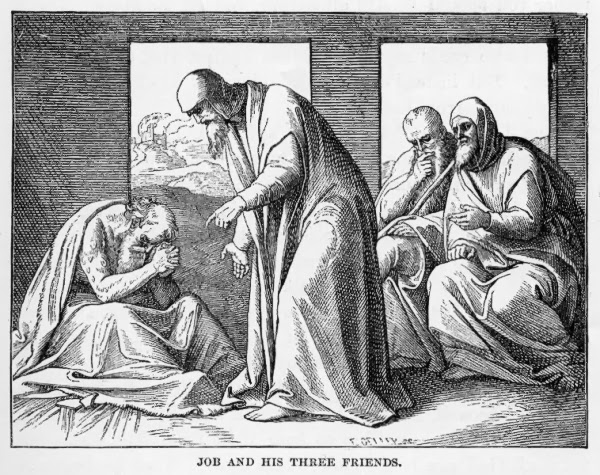
Job and his three friends
TODAY'S SPECIAL: Job 4-7; Psalm 136

TO CHEW ON: "'Oh that I might have my request,
That God would grant me the thing that I long for!
That it would please God to crush me,
that He would loose His hand and cut me off!'" Job 6:8,9


Does Job sound depressed or what?

You will recall the beginning of the story, how in one day Job's life falls apart when calamity strikes from all directions. And then he gets sick (Job 1-2:10). His friends come to comfort him. Here he responds to the speech of his friend Eliphaz.

Job sounds like he feels betrayed, double-crossed, and attacked by the God he has been trying to please: "'For the arrows of the Almighty are within me; My spirit drinks their poison; The terrors of God are arrayed against me'" - Job 6:4.

He feels physically unable to bear the agony: "'Is my strength the strength of stones? Or is my flesh bronze?'" - Job 6:12.

He begs to die: "'Oh that I would have my request … That it would please God to crush me, That He would loose HIs hand and cut me off.'" - Job 6:8,9.

Is there a reply to what Job has said that isn't shallow and trite? Job's friends certainly don't have it for they keep insisting Job is responsible for the horrible scenario. We, however, have information that Job and his friends didn't have about what was happening behind the scenes. Charles E. Blair, my Bible's commenter on Job says:

"Job's criticisms of God that appear in chapters 6 and 7 as well as in his other responses to his friends can best be understood as a man's feeble attempts to make sense of a scenario for which he is missing an essential piece of information, namely that there is something happening between God and Satan—that there are spiritual purposes overriding earthly circumstances. Because he is unaware of this dimension of the spiritual realm, his understanding is severely impaired" - New Spirit-Filled Life Bible, p. 652.

Could unseen spiritual battles also be a part of the troubles, illnesses, calamities, and disasters that come to us? I believe they could. When we feel puzzled, let down, even betrayed by God, let's remember this aspect of Job's story. Let's pray over and into the activities in the spiritual realm, of which we're unaware, and let's keep despair and bitterness toward God from creeping into our hearts.

PRAYER: Dear God, please help me to see troubles that come to me and those around me with insight into spiritual warfare. Amen.

PSALM TO PRAY: Psalm 136

The Bible Project - VIDEO: Job (Wisdom Series)


*********
Unless otherwise noted all Scripture quotations are taken from the New King James Version®. Copyright © 1982 by Thomas Nelson, Inc. Used by permission. All rights reserved.


Tuesday, April 17, 2018

Don't face trouble alone

"For He satisfies the longing soul, / And fills the hungry soul with goodness" Ps. 107:9
TODAY'S SPECIAL: 2 Kings 20-22; Psalm 107

TO CHEW ON: "Then they cried out to the Lord in their trouble,
And He saved them out of their distresses." Psalm 107:19


The first part of Psalm 107 talks about many kinds of trouble, described in the language of bondage.
  • There is the bondage of being owned by the enemy (Psalm 107:2,3).
  • There is the bondage of homelessness and not enough to eat and drink (Psalm 107:4-7).
  • There is the bondage of terminal illness (physical—and spiritual? "… sat in darkness") that is caused by rebellion and insisting on one's own way (Psalm 107:10-14).
  • There is the bondage of foolish, self-destructive behaviour (Psalm 107:17,18).

The writer uses a variety of words to describe this subjection: "…wandered … distresses … longing soul … hungry soul … sat in darkness and in the shadow of death, Bound in affliction and irons … chains … gates of bronze … bars of iron … gates of death … destructions…"

It's easy to recognize ourselves described here. Perhaps we see ourselves as we were before we came to Jesus, lost and wandering. Or we've experienced the humiliating bondage of an illness or accident (when I was convalescing from my broken hip in 2014, the feeling of being limited and bound by pain and weakness was very real). It doesn't even have to be a big thing or event that binds us. I'm intrigued by the words:
"He sent His word and healed them,
And delivered them from their destructions" - Psalm 107:20
(emphasis added).
Sometimes slavery comes from within ourselves—our appetites for food, entertainment, our physical, emotional and social longings.

When we feel bound by a physical condition or mentally, emotionally or spiritually, do we do what the psalmist says to do here—cry to God in our trouble (Psalm 107:6,13,19)?

How He answers in our specific case—by supplying food and drink, or healing from illness, or helping us break chains of habit and addiction—is up to Him and will be tailored to us and our situation. But we do need to take advantage of the recourse we have.

PRAYER: Dear Father, when I am in trouble, help me to remember whose I am, and to call out to You for help, intervention, and deliverance. Amen.

PSALM TO PRAY: Psalm 107

 *********
Unless otherwise noted all Scripture quotations are taken from the New King James Version®. Copyright © 1982 by Thomas Nelson, Inc. Used by permission. All rights reserved.

Friday, April 13, 2018

This life--not the end of the story

Image: Pixabay
TODAY'S SPECIAL: 2 Kings 8-11; Psalm 103

TO CHEW ON: "Bless the Lord, O my soul,
And forget not all His benefits:
Who forgives all your iniquities
Who heals all your diseases." Psalm 103:2,3


I recall the funeral of the daughter of dear friends a few years ago. She was first diagnosed with cancer in 2003. Thirteen years later, it killed her. As I read this passage, the words "who heals all your diseases" jump out at me and a voice in my mind says, "That's not true. God doesn't heal our all diseases. Despite our prayers, God didn't heal Kathy."

Have you ever found yourself weary of trying to understand God and defend Him in the face of such apparent contradiction? That was my first impulse on reading this. And yet…

I believe in the end, it all comes down to timing. We prayed for God to heal our friend in this life. That didn't happen. But is she healed now? Yes undoubtedly.

All the other promises in this passage will also come true, be experienced, and understood more fully in the real time of that future time beyond earth time:
- the promise of redemption from destruction - Psalm 103:4.
- seeing perfect righteous justice for the oppressed - Psalm 103:6.
- the removal (forgiveness) of our transgressions - Psalm 103:12.

I do believe that God can and does heal in this life, and often does. But not always. I can and do accept this, without an erosion of my trust in His integrity, especially as I view the whole panorama of God's promises in the light of the words:
"But the mercy of the LORD is from everlasting to everlasting" - Psalm 103:17. 
In other words, it transcends time. And this life is not the end of the story! It is only the briefest part, as David reminds us so poignantly:
"For He remembers our frame; 
He remembers that we are dust.
As for man, his days are like grass,
As a flower of the field, so he fourishes.
For the wind passes over it, and it is gone..." Psalm 103:14-16.

PRAYER:
Dear Father, I need Your mercy throughout my life and beyond. Help me to trust Your wisdom, goodness, and love in this life and to eternity. Amen.

PSALM TO PRAY: Psalm 103

 *********
Unless otherwise noted all Scripture quotations are taken from the New King James Version®. Copyright © 1982 by Thomas Nelson, Inc. Used by permission. All rights reserved.


Wednesday, February 07, 2018

Orient your fragile life by the North Star of eternity

TODAY’S SPECIAL: Leviticus 24,25; Psalm 38

TO CHEW ON:
“My heart pants, my strength fails me;
As for the light of my eyes, it also has gone from me.” Psalm 38:10


It doesn’t take much to knock the breath out of us. An accident, a natural disaster, or a bout of sickness (as David seems to be suffering in this psalm) and we are flat on our backs and wondering if we’ll see next month, let alone next year.

Bible imagery of the brevity and fragility of life brings home the sobering facts. A lifespan is referred to as a shepherd’s tent and a weaver’s loom (Isaiah 38:12), grass and field flower (Isaiah 40:6), and a faded leaf carried away by the wind (Isaiah 64:6).

God is aware of our slightness: “He remembered that they were but flesh, / A breath that passes away and does not come again” (Psalm 78:39); “He knows our frame;/ He remembers that we are dust” (Psalm 103:14).

But are we as aware? Most of the time, probably not. But when our lives are threatened (as David’s was by Saul - 1 Samuel 20:3), or we get sick (Psalm 38:10-12), suddenly we’re face to face with our mortality.

These can be depressing thoughts. However,  the facts of our fragility, brevity and apparent futility lose their power to get us down when we shine on them our hope of spending eternity with God. I love how Paul expresses this hope in 2 Corinthians 5:

“For while we are still in this tent, we groan under the burden and sigh deeply—weighed down, depressed, oppressed; not that we want to put off the body (the clothing of the spirit), but rather that we would be further clothed so that what is mortal (our dying body) may be swallowed up by life [after the resurrection]” - 2 Corinthians 5:4 AMP.

Whether life is good for us now and we would love for it to go on like this indefinitely or we’re down and seemingly at death’s door, let’s hang onto the fact that when life here ends (which it will for all of us sooner or later) it’s not all over for us. And let’s orient our lives by the North Star of life in eternity with God:

“Therefore, whether we are at home [on earth away from Him] or away from home [and with Him] we are constantly ambitious and strive earnestly to be well pleasing to Him” - 2 Corinthians 5:9 AMP (emphasis added).

PRAYER: Dear Father, help me to orient my life here and now by the coordinates of eternity with You in heaven. Amen.
 
PSALM TO PRAY: Psalm 38


 *********
Unless otherwise noted all Scripture quotations are taken from the New King James Version®. Copyright © 1982 by Thomas Nelson, Inc. Used by permission. All rights reserved.

Thanks for reading! This year we are using The Bible Project "Timeless Reading Plan" to read through the Bible in 2018. If you'd like to read along in your own Bible, you can download a pdf of the reading plan HERE.

Sunday, November 12, 2017

The beginning of the end?

TODAY'S SPECIAL: Matthew 24:1-22

TO CHEW ON:
" ' All these are the beginning of sorrows.' " Matthew 24:8

If you had never read today's passage and someone handed you its contents on a scrap of paper, would your impression would be (choose one):
a] This sounds entirely unfamiliar.
b] This sounds a lot like current conditions in the world.
c] This sounds like something that could never happen.

If you're like me, you chose b, because this sounds like the writings of someone in the room with me as I watch the nightly news or scan the latest headlines on the computer.

In early parts of this passage (Matthew 24:5-7) Jesus gives us a list of spookily familiar events that herald the near coming of His return to earth / the End:*
- The appearance of false and deceptive Christs.
- Wars and rumours of wars.
- Famines, pestilences and earthquakes.

But, Jesus says, these things are just the beginning of "sorrows." Some translations call them "birth pains" (NIV, NLT, NASB, ESV)—an interesting comparison suggesting earth-shaking events will become more frequent and intense as they near a climax. Could this be the time we're living in right now? If so, what do we have to look forward to? Jesus' answer:

" 'Then they will deliver you up to tribulation and kill you and you will be hated by all nations for My name's sake' " - Matthew 24:9.

Who is the "you" Jesus refers to here? It was to His band of disciples He delivered this private message (Matthew 24:3). So we can, I think, conclude that His disciples of all eras are on notice. That's us. Jesus warns and advises (Matthew 24:10-14):

- We can expect offenses, betrayals, hatred, and death.
- We must be on guard against false prophets.
- We need to be aware of the potential for spiritual lawlessness and coldness.
- Our endurance will be challenged.
- While the above is happening there will also be a great spread of the Gospel to peoples of every nation.

Let's live alert in these perilous days!

PRAYER: Dear God, please help me to remain watchful, to be unfazed if I am hated, and persecuted for being a Christ-follower, and to stay the course as I do my little bit in spreading the Gospel. Amen.

* "In His private teaching to the disciples on the Mount of Olives, Jesus responded to three questions, concerning 1] the destruction of the temple, 2] His Second Coming, 3] the End. These topics are interwoven and sometimes it is difficult to determine which event is being described. This difficulty is partially resolved with the realization that most prophecy is capable of both a near and remote fulfillment. Jesus uses the tragic events surrounding the destruction of Jerusalem in A.D.70 as a picture of conditions preceding His own return" - J. Lyle Story, Study notes on Matthew 24:1-51, New Spirit-Filled Life Bible, p. 1334.


 *********
Unless otherwise noted all Scripture quotations are taken from the New King James Version®. Copyright © 1982 by Thomas Nelson, Inc. Used by permission. All rights reserved.


Saturday, June 10, 2017

The Kingdom—already, not yet

TODAY'S SPECIAL: Matthew 10:1-15

TO CHEW ON: " ' And as you go, preach saying, "The kingdom of heaven is at hand." Heal the sick, cleanse the lepers, raise the dead, cast out demons. Freely you have received, freely give.' " Matthew 10:7,8

Jesus spoke a lot about a spiritual kingdom (sometimes called the kingdom of heaven, sometimes the kingdom of God).
  • He promised that the poor in spirit and the persecuted would inherit it (Matthew 5:3,10).
  • He taught us to pray for its coming (Matthew 6:10).
  • He told Nicodemus the way to enter it was to be born again (John 3:3).
  • He told Pilate that His kingdom was not of this world (John 18:36).
  • And yet here, He tells His disciples it is "at hand" ("has drawn near").

It's interesting to notice the details of the job on which Jesus sends the disciples and what they say about the kingdom. I think we can conclude, by Jesus' job description, that some things are incompatible with His kingdom:

- Sickness ("heal the sick").

- Leprosy ("cleanse the lepers"). How was leprosy different from other sickness? For one it was a chronic condition or conditions. Two - it made those infected unclean outcasts. There is no place for such stigma in the kingdom.

- Death ("raise the dead").

- Demons ("cast out demons"). I don't know how much power and influence in this world and our society we credit to the demonic. That its influence is more pervasive than ever I have no doubt, given modern curiosity about and fascination with the paranormal.

Though the kingdom is something we have yet to see in its full flower, we do see glimmerings of it now in the operation of Christ's body on earth—the church. For Jesus said while still on earth, " '… the Kingdom of God is within you' " - Luke 17:21. And He commissioned the disciples (who became the church) to be witnesses to Him and His teachings, which included this message of the kingdom (Acts 1:8).

May the kingdom of heaven find fertile ground in my life and yours!

PRAYER: Dear Jesus, I long to see and experience kingdom life to the full, as much as it's possible here on earth. May its presence be operating in and through my life. Amen.

MORE: The Kingdom—"already," and "not yet"

Wayne Grudem in his Systematic Theology: An Introduction to Biblical Doctrine quotes George Ladd on this topic. Ladd summarizes five ways the church and the kingdom are related (I'll just quote the points; he elaborates on each point and supports with scriptures):
1. The church is not the kingdom.
2. The kingdom creates the church.
3. The church witnesses to the kingdom.
4. The church is the instrument of the kingdom.
5. The church is the custodian of the kingdom.

Grudem concludes:
 "Therefore we should not identify the kingdom of God and the church, nor should we see the kingdom of God as entirely future. … Rather we should recognize that there is a close connection between the kingdom of God and the church. As the church proclaims the good news of the kingdom, people will come to the church and begin to experience the blessings of God's rule in their lives. The kingdom manifests itself through the church and thereby the future reign of God breaks into the present (it is "already" here - Matthew 12:28; Romans 14:17; and "not yet" here fully - Matthew 25:34; 1 Corinthians 6:9-10)" - Wayne Grudem, Systematic Theology, pp. 863, 864 (emphasis added).


 *********
Unless otherwise noted all Scripture quotations are taken from the New King James Version®. Copyright © 1982 by Thomas Nelson, Inc. Used by permission. All rights reserved.

Thursday, April 27, 2017

A love-psalm to God

Image: Pixabay
TODAY’S SPECIAL: Psalm 116:1-19

TO CHEW ON: “I love the LORD, because He has heard
My voice and my supplications” - Psalm 116:1


The writer of this psalm has just been through a terrifying and life-threatening experience - Psalm 116:3, 6, 8, 9.

He refers to some of the things he did (and that we typically do) during this time:
  • Pray (make “supplication” = humble prayer, entreaty, petition); call on God , “implore” for deliverance - Psalm 116:1,2, 4.
  • Invoke God’s name (which implies an acknowledgement of His ability, power, and reputation) - Psalm 116:4.
  • Cry - Psalm 116:8.
  • Believe - Psalm 116:10.
  • Make vows (promises) to God of what we’ll do if we get better - Psalm 116:14,18.

Now recovered, he:

  • Tells God he loves Him - Psalm 116:1. (I love how my Bible’s study notes elaborate on this: “‘I love he LORD’ is the exact response God’s heart desires as a result of God’s interventions in our lives” - Dick Iverson, New Spirit-Filled Life Bible, p. 777.)
  • Declares that he will pray to God as long as he lives - Psalm 116:2.
  • States that he will keep walking with God - Psalm 116:9.
  • Gives thanks for salvation - Psalm 116:13, and recovery - Psalm 116:16.
  • Promises to pay his vows, to keep those sickbed promises - Psalm 116:16.

Doesn’t Psalm 116 express well those feelings of relief and gratitude we also feel on getting better?  It would be a wonderful praying-the-Bible passage to express thanks for recovery from sickness or other life-threatening time.

It also has a beautiful reminder for us when God denies our prayers to get better:
“Precious in the sight of the Lord
Is the death of His saints” - Psalm 116:15.


PRAYER: Dear Father, thank You for so often being Healer and Helper to me. Help me to respond with gratitude, praise, kept promises, and love. Amen.

 *********
Unless otherwise noted all Scripture quotations are taken from the New King James Version®. Copyright © 1982 by Thomas Nelson, Inc. Used by permission. All rights reserved.


Friday, February 17, 2017

"Faithful" affliction?

TODAY’S SPECIAL: Psalm 119:75

TO CHEW ON: “I know, O LORD, that Your judgments are right,
And that in faithfulness You have afflicted me.” Psalm 119:75


I was talking recently to a friend whose husband had a stroke seven or eight months ago. She said something like, God has seemed closer and more real through this time than ever before.

A few days before our conversation, her husband—who is now in a wheelchair and can no longer speak—had had an unexpected seizure. My friend said about that: I have unusual peace. I’m not running around agitated and fretting like I did right after the stroke because God has been faithful through this whole time and I know He’ll take us through this as well.

My friend and her situation come to mind this morning as I read the psalmist’s reaction to being “afflicted.”

[Afflicted - anah - means afflict, oppress, humble, be afflicted, bowed down.] That definition encompasses a lot. It could mean being humbled / oppressed / made to bow in a variety of ways from physical illness, to business failure, to social humiliation, and more.

The psalmist regarded his affliction as a positive thing in the three times he mentioned it:

1. It became a magnet that drew him back to God
“Before I was afflicted I went astray
But now I keep Your word” - Psalm 119:67.

2. It drove him to study God and His communication:
“It is good for me that I have been afflicted
That I may learn Your statutes” - Psalm 119:71.

3. His affliction was / is testing and strengthening his faith in God’s goodness:
“I know, O LORD, that Your judgments are right,
And that in faithfulness You have afflicted me” - Psalm 119:75.  

[Faithfulness - emuwnah means firmness, fidelity, steadfastness, steadiness]

I understand this as God allowing these afflictions to come the psalmist's way, our way with intention—good intention.

[Fidelity means loyalty, strict observance of promises, adherence to detail.
Steadfast means fixed in direction, firm in purpose, unwavering.]


I know my first reaction to affliction of any kind is to pray: “Help! Get me out of this!” But maybe that’s not always the best prayer. Maybe a better one would be:

PRAYER: Dear Father God, please use this affliction to crowd me to You, to help me learn about You and Your ways, and to prove Your faithfulness to me and others. Amen.

 *********
Unless otherwise noted all Scripture quotations are taken from the New King James Version®. Copyright © 1982 by Thomas Nelson, Inc. Used by permission. All rights reserved.


Thursday, November 10, 2016

Till Alzheimer's do us part?

TODAY'S SPECIAL: Malachi 2:1-17

TO CHEW ON: "Did he not make them one with a portion of the Spirit in their union? And what was the one God seeking? Godly offspring. So guard yourselves in your spirit and let none of you be faithless to the wife of your youth." Malachi 2:15


Pat Robertson's answer to the question of what to do when a spouse has Alzheimer's sent shock waves through the audience of the 700 Club show. "He should divorce her and start all over again," he said. "Since Alzheimer's is a kind of living death," he went on, "divorce and remarriage wouldn't be violating the marriage vows of being faithful 'till death do us part.'"

Dr. Robert McQuilkin did the opposite. When this theologian's wife took ill, he stayed faithfully at the side of his wife of 40 years to the extent of quitting his job so he could provide around-the-clock care. He cared for her until she died--a total of 25 years.

Sickness is one of many reasons we could find, if we're looking, to rationalize breaking our marriage vows. But the Bible is clear that marital separation should be a rare thing. Here are some things the Bible says about the marriage bond:

  • Husbands are to love their wives as themselves and as sacrificially as Christ loved the church, while wives are to respect their husbands (Ephesians 5:25,28, 33; Colossians 3:19).
  • Wives of unbelieving husbands should stay with them, hopefully winning them to belief by their outer and inner beauty (1 Peter 3:1-4).
  • Our prayers may be hindered by marital strife (1 Peter 3:7).
...and there's no expiry date on any of these.

PRAYER: Dear God, my heart goes out to people whose spouses are ill with dementia or any debilitating condition. Help me to find no crack in my resolve to be true to my husband, no matter what. Amen.


MORE: This story in more depth

ABC News story "Pat Robertson Says Alzheimer's Makes Divorce OK"

"Living By Vows" by Dr. Robert McQuilkin (download pdf of the article)

************
Unless otherwise noted all Scripture quotations are taken from the New King James Version®. Copyright © 1982 by Thomas Nelson, Inc. Used by permission. All rights reserved.


Bible Drive-Thru


Tuesday, March 15, 2016

Dominion

"He shall have dominion also from sea to sea" - 
words from Zechariah 9:10 are carved 
into Canada's Peace Tower, in Ottawa, Ontario
Image: werner22brigitte / pixabay.com

TODAY'S SPECIAL: Zechariah 9:1-17

TO CHEW ON: "... He shall speak peace to the nations;
His dominion shall be from sea to sea,
And from the River to the ends of the earth." Zechariah 9:10


Who is the "He"  and "His" Zechariah talks about here? The answer is just above today's verse in Zechariah 9:9:
"Behold your King is coming to you;
He is just and having salvation
Lowly and riding on a donkey,
A colt, the foal of a donkey."

Immediately we see the scene of Jesus riding into Jerusalem on what we celebrate as Palm Sunday. And we realize it's Jesus, Messiah, who Zechariah is talking about. He is the One with the dominion.

[Dominion - moshal means sovereignty, jurisdiction, rulership. Moshel (noun) comes from mashal (verb) that means to rule, govern, reign, have dominion, exercise authority. "This verb conveys the thought of a strong and sovereign ruling over one's subjects" - Dick Mills, Word Wealth, New Spirit-Filled Life Bible, p. 1258.]

The extent of Christ's past, present, and future dominion are spoken of in other places in the Old and New Testaments.
  • The prediction of Messiah's dominion is not original with Zechariah. The exact same words are found in Solomon's prayer of Psalm 72:8.
  • His rule comes from Zion and the psalmist invokes victory over enemies through it - Psalm 110:2.
  • Isaiah's prophecy again corroborates that this ruler is Jesus:
"For unto us a Child is born, Unto us a Son is given. And the government will be upon His shoulder. And His name will be called Wonderful, Counselor, Mighty God, Everlasting Father, Prince of Peace - Isaiah 9:6 (see also John 3:35).
  • Isaiah also speaks of this governance going on forever - Isaiah 9:7 (see also Daniel 4:3).
  • This Messiah rule is powerful, done with a "strong hand" - Isaiah 40:10.
  • His dominion is international, everlasting, and indestructible - Daniel 7:14.
  • It is a rule that brings and enforces peace (our focus verse - Zechariah 9:10).
  • While He was on earth, Christ showed that He had power over nature - Matthew 8:27.
  • He had power over sickness and disease (and commissioned His disciples with power to heal) - Matthew 10:1.
  • He also had power over unclean spirits - Mark 1:27.
  • He has dominion over the church - Ephesians 1:22.
  • He is now seated at the right hand of God where heaven's citizens, its authorities and powers, are subject to Him - 1 Peter 3:22.

Let's keep this picture of Christ's ultimate dominion in mind as we hear and watch our seemingly out-of-control world on the daily news, and experience firsthand the devastation of the fall (Genesis 3:14-19).


PRAYER: Dear Jesus, these predictions of Your ultimate dominion over everything give me hope and security in a world that sometimes feels doomed and dangerous. Help me to live with an alive expectation of Your dominion. Amen.

 *********
Unless otherwise noted all Scripture quotations are taken from the New King James Version®. Copyright © 1982 by Thomas Nelson, Inc. Used by permission. All rights reserved.


Wednesday, October 07, 2015

Satan's to-do list

Daily Activities list - photo
TODAY'S SPECIAL: Job 1:1-22

TO CHEW ON: " ' But now, stretch out Your hand and touch all that he has and he will surely curse You to Your face." Job 1:11


What an interesting drama we see playing out in today's reading: Satan intermingling with the good angels as they appear before God (Job 1:6); God singling him out with a question (Job 1:8); and Satan rising to the occasion with a challenge back to God (Job 1:9-11). It appears that one of the tasks he has set for himself is to slander the saints (something he continues to do - Revelation 12:10).

A short stroll through the Bible makes us privy to some of the other nasty things on his to-do list:
  • Tempt people to be disobedient. He was behind Eve's and Adam's sin (Genesis 3:4,5) and he was also behind David's sin of commanding a census when God was not for it (1 Chronicles 21:1).
  • Inflict disease. As we read further on in Job, we see the active role Satan played in Job's case of boils (Job 2:7).
  • Oppose God's ministers—as Zechariah saw in his vision of priest Joshua in the temple (Zechariah 3:1).
  • Tempt Christ (Matthew 4:1,3).
  • Remove truth with falsehood. Jesus, in His parables, shows Satan removing the good seed or truth (Matthew 13:19) and sowing tares or what is false (Matthew 13:38,39).
  • Torture those in his possession. The Bible is full of the mental and physical anguish of the demon-oppressed and possessed (Luke 9:42; 13:16).
  • Lie, lie lie (John 8:44).
  • Instigate sin. This is what he did in the heart of Judas to betray Jesus (John 13:2) and Ananias and Sapphira to lie about their offering (Acts 5:3).
  • Hassle, persecute, and kill Christians. Paul attributed his "thorn in the flesh" as a "messenger of Satan" to "buffet" him (2 Corinthians 12:7). In Revelation, John sees those who have been killed for their faith--who "...overcame him (Satan) by the blood of the Lamb, and by the word of their testimony; and they loved not their lives unto the death" (Revelation 12:11).
  • Hinder Christian activity. Paul blames Satan for keeping him from visiting the church in Thessalonica (1 Thessalonians 2:18).
  • Prey on people. Peter and John clearly alert us to this in 1 Peter 5:8 and Revelation 2:10.

Though we will probably never have as clear a behind-the-scenes clip of Satan at work in our lives as we get in Job, when we review the above list of his activities it's not hard to see his fingerprints all over our circumstances as well. Let's follow Peter's advice to:

"Be well balanced (temperate, sober of mind), be vigilant and cautious at all times; for that enemy of yours, the devil, roams around like a lion roaring [in fierce hunger], seeking someone to seize upon and devour. 
"Withstand him; be firm in faith [against his onset—rooted, established, strong, immovable, and determined], knowing that the same (identical) sufferings are appointed to your brotherhood (the whole body of Christians) throughout the world." - 1 Peter 5:8,9 AMP.

PRAYER: Dear God, thank You that Satan is , through Christ, a defeated enemy. Help me to live alert to his methods and schemes in my life and in the world around me. Amen.

 *********
Unless otherwise noted all Scripture quotations are taken from the New King James Version®. Copyright © 1982 by Thomas Nelson, Inc. Used by permission. All rights reserved.

Scripture quotations marked AMP are taken from the Amplified® Bible,
Copyright © 1954, 1958, 1962, 1964, 1965, 1987 by The Lockman Foundation
Used by permission." (www.Lockman.org)

Monday, September 21, 2015

The unhealthiness of sin

TODAY'S SPECIAL: Mark 2:1-17


TO CHEW ON: "'Which is easier to say to the paralytic, "Your sins are forgiven you," or to say "Arise, take up your bed and walk?"
'But that you may know that the Son of Man has power on earth to forgive sins'—He said to the paralytic, 'I say to you, arise, take up your bed and go to your house.'" Mark 2:9-11

Was Jesus, in this healing, dealing with two separate issues: 1) the man's guilt and sinfulness, and 2) his physical paralysis? Or were they linked? In other words, is personal sin implicated in our physical illnesses?

A brief study of some Bible passages shows us that the two are mentioned together more than just this once.

  • Ananias and Sapphira experienced the ultimate end of sin's physical effects (death) when they lied to the Holy Spirit (Acts 5:1-10).
  • Paul pronounced blindness on the sorcerer Bar Jesus (Elymas) when he tried to dissuade the proconsul Sergius Paulus from putting his faith in Christ (Acts 13:11-12).
  • Paul, in his letter to the Corinthians, links physical sickness and death within the church to taking the Lord's Supper flippantly (1 Corinthians 11:29,30).
  • James reassures those who are sick that the "prayer of faith" prayed over them by church elders will not only bring physical healing but forgiveness of sins too (James 5:14-16).

Though I would never say that all our sicknesses are a direct result of personal sin, neither can we ignore the connection. Matthew Henry says of the two in his comment on our passage:

"Sin is the cause of all our pains and sicknesses. The way to remove the effect, is to take away the cause. Pardon of sin strikes at the root of all diseases. Christ proved his power to forgive sin, by showing his power to cure the man sick of the palsy. And his curing diseases was a figure of his pardoning sin, for sin is the disease of the soul; when it is pardoned, it is healed" Matthew Henry's Commentary.

As we pray for healing for ourselves and others, let's not forget to examine our lives for causative sin in the light of God's word and with the help of the Holy Spirit.

PRAYER: Dear God, help me to live transparently before You. Please convict me of sin which always has the potential to lead to physical repercussions. Amen.

MORE: Breaking it down

The temptation is to stay in the realm of theory when connecting sin and sickness. But a little brainstorming leads to a list of sins and their physical effects that we may find ourselves guilty of. I'm sure you can think of more.

  • Sins of unbelief, unforgiveness, pride etc. can lead to emotional and mental dis-ease.
  • Sins of sensuousness and indulgence can lead to obesity, drunkenness, addictions, and their complications.
  • The sin of sexual looseness can lead to STDs.
  • The sin of anger can lead to impaired judgment resulting in fights and accidents.

Bible Drive-Thru


Tuesday, July 21, 2015

A parent's prayers

David prays for his child - Artist unknown
TODAY'S SPECIAL: 2 Samuel 12:15b-25

TO CHEW ON: "David therefore pleaded with God for the child, and David fasted and went in and lay all night on the ground." 2 Samuel 12:16

Though Nathan told David the child he had with Bathsheba would die, yet David continued to intercede, fast, and plead for the baby's life until it actually died.

I get that. I'm sure you do too. As parents, we are the ones most invested in the lives brought into the world through us. No one else cares for our kids and grand-kids like we do. Seeing them grow and develop is like opening a package—so this is what God has gifted us with.

Sometimes, along with the pleasant surprises, come some not so pleasant. This child has a physical challenge, that one a learning disability, another has trouble keeping friends. Whatever the issue, we're the constant in their lives—their cheering section, helping them cope, loving them through it all, and praying for them every step of the way.

We're in good company here, joining the ranks of David in our today's reading, and:
  • of Abraham and Job who prayed for the spiritual well-being of their children - Genesis 17:18 and Job 1:5.
  • of the father who pleaded for his epileptic son - Matthew 17:15.
  • of the Greek mother whose persistent requests for her daughter with an unclean spirit moved Jesus to heal her - Mark 7:25-28.

PRAYER:
Dear God, please help us to have the faith of these Bible parents to persistently bring my children's and grand-children's illnesses, troubles, challenges, and spiritual well-being to You. Amen.

 *********
Unless otherwise noted all Scripture quotations are taken from the New King James Version®. Copyright © 1982 by Thomas Nelson, Inc. Used by permission. All rights reserved.


Thursday, July 09, 2015

Thorn-plagued life

Thorny branch
Photo courtesy RGBStock.com
TODAY'S SPECIAL: 2 Corinthians 12:1-18

TO CHEW ON: "And lest I should be exalted above measure by the abundance of the revelations, a thorn in the flesh was given to me, a messenger of Satan to buffet me, lest I be exalted above measure." 2 Corinthians 12:7

We don't know what Paul's "thorn in the flesh" was. My Bible's commenter describes it as "an intense wearying difficulty or affliction."* It might have been some bodily condition like migraines, epilepsy, an eye disease, even a person ("What was Paul's thorn in the flesh?"  - from Got Questions.org).

From this passage, we do know, however that:
1. Paul attributes this negative thing to Satan - "… a messenger of Satan to buffet me."

2. At the same he implies that God has allowed it - "… a thorn in the flesh was given to me." My Bible's notes explain that this is "grammatically a 'divine passive,' indicating God as the unseen agent overseeing the entire process."*

3. Paul prays that this thorn will be removed. But God's answer to Paul has been "No." Instead, Jesus answers Paul: " 'My strength is sufficient for you, for My strength is made perfect in weakness.' " Even more Paul doesn't have the strength to only tolerate the irritation but to be happy about it because God's grace shining through his life will reflect glory back to God and His ability to bring good things out of bad ("Therefore most gladly I will rather boast in my infirmities, that the power of Christ may rest upon me.")

This is easy for us to relate to, isn't it?

  • We too suffer from "thorns"—irritations, conditions, situations that stick to us like burrs, that let us know, every step of the way, they are still there.
  • They too could be said to be messengers of Satan. For every evil thing in life and nature is a consequence of Satan's fingerprints on creation after humankind's fall into sin. As Paul expresses it in another place: "For we know that the whole creation groans and labors with birth pangs together until now" - Romans 8:22 (the entire passage is relevant - Romans 8:18-28).
  • But Satan's intent to do us harm, to bring us down, is still under God's permission. As we draw grace-strength from Him, our thorn hassled lives can do an end-run around Satan's schemes and score goals for God and His glory instead of defeating us.

Of course, like Paul, we probably keep praying that these thorns be removed. But when they aren't, let's not berate ourselves for too little faith, or give Satan credit for too much strength. For God is still in control, working His will in our lives, using even these Satan-conceived thorns to do it.

PRAYER: Dear God, help me to recognize the thorns in my life for what they are to to respond to them by leaning on You and Your grace for strength to not only endure them but to shine through them. Amen.

*Arden Conrad Autry, commentary on 2 Corinthians, New Spirit-Filled Life Bible, p. 1624.

 *********
Unless otherwise noted all Scripture quotations are taken from the New King James Version®. Copyright © 1982 by Thomas Nelson, Inc. Used by permission. All rights reserved.


Saturday, February 07, 2015

Missing information

night birds
TODAY'S SPECIAL: Job 7:1-8

TO CHEW ON: "When I lie down, I say, 'When shall I arise,
And the night be ended?'
For I have had my fill of tossing till dawn." Job 7:4


Why is night always the worst time when we're sick? Maybe it's because we expect to sleep and are disappointed. Maybe because in the still and dark there is nothing to distract from the pain, discomfort, and worry? May it's merely that the prone position causes gravity to augment the pull on our sore cells. Whatever it is, it's interesting to note that it was the same for the ancients.

There's not much encouraging or uplifting here. In this section of his first speech to his friends, Job is entirely negative, speaking of the futility of his life and work, complaining that he can't sleep, describing his loathsome disease, and referring to the fact that his life will soon be over.

My Bible's commenter makes this observation:

"Job's criticisms of God that appear in Job 6 and 7 as well as his other responses to his friends, can best be understood as man's feeble attempts to make sense of a scenario for which he is missing an essential piece of information, namely that there is something happening between God and Satan—that there are spiritual purposes overriding earthly circumstances. Because he is unaware of this dimension of the spiritual realm, his understanding is severely impaired" - Charles E. Blair, commentary on Job, New Spirit-Filled Life Bible, p. 652 (emphasis added).

Could that be the case in our lives as well—that our trials, whatever they are, are connected to spiritual skirmishes unseen and unknown to us? Imaginative writers have riffed on that thought in books like The Screwtape Letters (C. S. Lewis), This Present Darkness (Frank Peretti), and The Ishbane Conspiracy (Angela, Karina and Randy Alcorn).

The Bible certainly supports such a thing:

"For we do not wrestle against flesh and blood, but against principalities, against powers, against the rulers of the darkness of this age, against spiritual hosts of wickedness in the heavenly places" - Ephesians 6:12

"Fight the good fight of faith, lay hold on eternal life, to which you were also called and have confessed the good confession in the presence of many witnesses" - 1 Timothy 6:12.

PRAYER:
Dear God, when troubles, sickness, and death impact me, help me remember that I am in a battle You have won. Please give me courage and hope through bad days and nights. Amen.

 *********
Unless otherwise noted all Scripture quotations are taken from the New King James Version®. Copyright © 1982 by Thomas Nelson, Inc. Used by permission. All rights reserved.


Related Posts Plugin for WordPress, Blogger...