Showing posts with label propitiate. Show all posts

Sunday, October 21, 2018

Jesus, my mercy seat

TODAY'S SPECIAL: Romans 3-4; Psalm 134


TO CHEW ON: "...Christ Jesus, whom God set forth as a propitiation by His blood..." Romans 3:24b-25a

Within the word "propitiation" we have one of the most amazing and offending aspects of the Gospel.

In English when we talk of propitiating someone, we mean that we appease, conciliate and cause them to be favourably disposed toward us.

The Greek word for "propitiation" is hilasterion  which actually means "mercy seat." It refers to the place of atonement between the two cherubim on the top of the ark. "The root meaning of hilasterion is that of appeasing and placating an offended god" - New Spirit Filled Life Bible, p. 1738.

The idea that a loving God would personally exercise wrath against His creatures is what's offensive to some. However, the Bible makes it clear that that's the way it is (for example, see Isaiah 53:4-5; Romans 5:9; Ephesians 5:6; Revelation 6:16-17).

But that's not the end of the story. Though we deserved God's wrath, Jesus took it for us. God "set forth" Jesus as a propitiation. "...By His blood" refers to the fact that He died: "Blood is a reference to Christ's death as a substitute sacrifice for us. Christ's blood poured out is a clear evidence that His life was given for us" - New Spirit-Filled Life Bible, p. 1553.

And so God was able to satisfy both His holiness in its complete abhorrence of and wrath against sin, and His love. It really is the most incredible good news (gospel)!

PRAYER: Dear Jesus, thank You for being my mercy seat. May I never take my sin lightly, but keep in mind God's wrath visited on you for me. Amen.

PSALM TO PRAY: Psalm 134

MORE: More on propitiation
"What is a 'propitiation'? It is a sacrifice that averts wrath through expiating sin, and cancelling guilt.


This...is the real heart of the gospel: that Jesus Christ, by virtue of His death on the cross as our substitute and sin-bearer, 'is the propitiation for our sins' (1 John 2:2). Between us sinners and the thunderclouds of divine wrath stands the cross of the Lord Jesus. If we are Christ's, through faith, then we are justified through his cross, and the wrath will never touch us, neither here nor hereafter. Jesus 'delivers us from the wrath to come' (1 Thessalonians 1:10)" - J. I. Packer, Knowing God, p. 173.


If you're interested in reading more, check the "Theological Term of the Week," propitiation page of the Rebecca Writes blog.


*****************
Unless otherwise noted all Scripture quotations are taken from the New King James Version®. Copyright © 1982 by Thomas Nelson, Inc. Used by permission. All rights reserved.

Friday, September 14, 2018

Abandoned

"The Crucifixion" by Alexandre Bida

TODAY'S SPECIAL: Mark 15-16; Psalm 102

TO CHEW ON: "And at the ninth hour, Jesus cried out with a loud voice saying, 'Eloi, Eloi, lama sabachthani' which is translated 'My God, My God why have You forsaken Me?'" Mark 15:34

No matter how often I read the story of Jesus' death, these words from the cross (the echo of Psalm 22:1) wrench at my heart. They carry the tones of utter despair and abandonment.

A footnote in my Bible describes them as a "...cry of dereliction from Jesus that reflects the burden of humanity's sin, complete identification with sinners and a real abandonment by God" - New Spirit-Filled Life Bible, p. 1379.

Wayne Grudem names four aspects of the pain of the cross:
1. Physical pain and death ... death by crucifixion was one of the most horrible forms of execution ever devised by men...


2. The pain of bearing sin: More awful than the pain of physical suffering that Jesus endured was the psychological pain of bearing the guilt of our sin (Isaiah 53:6; 2 Corinthians 5:21; Galatians 3:13).


3. Abandonment ... Jesus faced this pain alone (Mark 15:34; Matthew 26:56).


4. Bearing the wrath of God ... As Jesus bore the guilt of our sins alone, God the Father, the mighty Creator, the Lord of the universe, poured out on Jesus the fury of his wrath: Jesus became the object of the intense hatred of sin and vengeance against sin which God had patiently stored up since the beginning of the world (Romans 3:24-25; Hebrews 2:17; 1 John 2:2). - Wayne Grudem, Systematic Theology, pp. 573-575.

Which makes that desolate cry from the cross all the more impacting. It has something to do with me. My sin—my pride, jealousy, anger, greed, covetousness etc. etc. were part of that black burden that not only separated Jesus from His Father but made Jesus (instead of me) the object of the Father's wrath.

PRAYER: Dear Jesus, thank You for not turning away from the terrible "cup." I am forever grateful that You became sin, a curse, for me. Amen.

PSALM TO PRAY: Psalm 102


***************
Unless otherwise noted all Scripture quotations are taken from the New King James Version®. Copyright © 1982 by Thomas Nelson, Inc. Used by permission. All rights reserved.



Thursday, March 16, 2017

God's wrath

TODAY'S SPECIAL: John 3:22-36

TO CHEW ON: "He who believes in the Son has everlasting life; and he who does not believe the Son shall not see life but the wrath of God abides on him." John 3:36


We 21st century Christians struggle with the concept of God's wrath. Why? Perhaps because we interpret it in human terms, as a loss of self control, or a sign that God feels powerless, has wounded pride, or is just bad-tempered and miserable. The tendency is to equate God's wrath with the wrath of, say, a parent that furied down on us out of the blue, seemed unusually harsh for our 'crime,' but was unpredictable too in that sometimes we got away with wrongdoing — it sort of depended on the parent's mood.

J. I. Packer has devoted an entire chapter of Knowing God to God's wrath. Hear his explanation of what God's wrath means and how it fits with His more popular attributes like love, mercy, and justice:

"God's wrath in the Bible is never the capricious, self-indulgent, irritable, morally ignoble thing that human anger so often is. It is, instead, a right and necessary reaction to objective moral evil. God is only angry where anger is called for. Even among men, there is such a thing as righteous indignation, though it is, perhaps rarely found. But all God's indignation is righteous. Would a God who took as much pleasure in evil as He did in good be a good God? Would a God who did not react adversely to evil in His world be morally perfect? Surely not. But it is precisely this adverse reaction to evil, which is a necessary part of moral perfection, that the Bible has in view when it speaks of God's wrath" - p. 167.

He goes on to explain how God's wrath doesn't make Him a monster because:
1. It is always judicious — the wrath of a judge administering justice (Romans 2:4-11).
2. It is something we choose for ourselves. Two verses from John 3 bear that out: Jesus' testimony about Himself (3:18) and John's testimony about Jesus (3:36).
"The basic choice was and is simple — either to respond to the summons 'come unto me...take my yoke upon you and learn of me' (Matthew 11:28 ff), or not; either to 'save' one's life by keeping it from Jesus's censure, and resisting His demand to take it over, or to 'lose' it by denying oneself, shouldering one's cross, becoming a disciple and letting Jesus have His own disruptive way with with one" - J. I. Packer, Knowing God, p. 169.
What is my response to the fact of God's wrath? What is yours? 
  • Do we begin to comprehend God's total and complete aversion to sin? 
  • Does His hatred and wrath against it put in us a healthy fear of Him and aversion to that same sin into us? 
  • Do we begin to appreciate what Jesus did for us when He died, taking the blow of God's wrath in our place?


PRAYER: Dear God, thank You for being against sin and moral evil. Please work in me the same revulsion against sin that so readily wiggles its way into my life in so many manifestations. Than You Jesus, for taking the wrath of God for me. Amen.

MORE: Want to read more?

If you want to read more about God's wrath, check out the quotes and links in the "wrath" entry of Rebecca Writes blog series "Theological Term of the Week."


**********
Unless otherwise noted all Scripture quotations are taken from the New King James Version®. Copyright © 1982 by Thomas Nelson, Inc. Used by permission. All rights reserved.
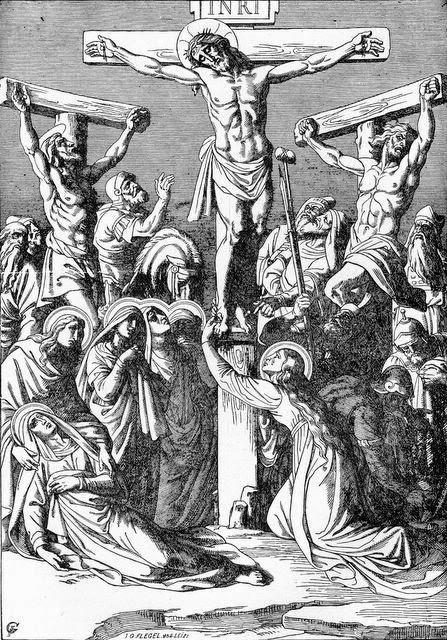
Thursday, April 09, 2015

Propitiation

Jesus Crucified Between Two Thieves   - Artist unknown
Jesus Crucified Between Two Thieves 
- Artist unknown 
From Treasures of the Bible

TODAY'S SPECIAL: 1 John 1:1-2:2

TO CHEW ON: "And He Himself is the propitiation for our sins, and not for ours only but also for the whole world." 1 John 2:2

In our time when we love to focus on the grace, mercy, and love of God, it's easy to lose sight of one of His other attributes—His righteousness. That is the attribute of God that has Him responding with white-hot anger to sin. His perfect justice demands that sin be punished.

We see illustrations of this in the Old Testament.
  • When Achan sinned by taking beautiful things from Jericho, he was punished by stoning. Only then "… the Lord turned from the fierceness of His anger" - Joshua 7:26.
  • When Israel flirted with idol worship, God allowed other nations to brutalize her (Ezekiel 16:40,41) and "… so I will lay to rest My fury toward you, and My jealousy shall depart from you" - Ezekiel 16:42.
  • When Israel returned to God in repentance, Hosea describes God's quickness to take back the repentant one: "… For my anger has turned away from him" - Hosea 14:4.
 But these were all only stop-gap measures. God's fallen creation—all of us—can't keep from sinning. What's a perfectly merciful, perfectly righteous God to do, a God  whose perfect justice demands that the wages of sin (death - Romans 6:23) be paid?

Our focus verse today gives us the answer. This is what He did:
"...And if anyone sins, we have an Advocate with the Father, Jesus Christ the righteous. And He himself is the propitiation for our sins, and not for ours only but also for the whole world" - 1 John 4:1,2

That word propitiation is key here.

[This particular word for propitiation (hilasmos) is used only twice in the Bible, here and in 1 John 4:10. it  "describes Christ through His sacrificial death as appeasing the wrath of God on account of sin. It also pictures His death as expiatory, providing a covering for sin. By means of the atoning death of Christ, God can be merciful to the sinner who believes in Him and reconciliation is effected" - Dick Mills, Word Wealth, New Spirit-Filled Life Bible, p. 1788.]

Here's another shorter definition of propitiation: "A sacrifice that bears God's wrath to the end and in so doing changes God's wrath toward us into favour" - Wayne Grudem, Systematic Theology, p. 575.

Isn't that incredible! God sent His own Son—Jesus—to take His white-hot anger against our sin. He (Jesus) paid the penalty—death—in our stead.  The words of John in 1 John 4:10 express perfectly how this act keeps God in sync with His love and mercy—those attributes of His we prefer to dwell on:

"In this is love, not that we loved God, but that He loved us and sent His Son to be the propitiation for our sin."

PRAYER: Thank You, Jesus, for bearing the fury of God's righteous wrath over my sin, in my stead. Amen.

 *********
Unless otherwise noted all Scripture quotations are taken from the New King James Version®. Copyright © 1982 by Thomas Nelson, Inc. Used by permission. All rights reserved.


Sunday, January 11, 2015

He identifies with us

"Baptism of Jesus" by Isabella Colette

"Baptism of Jesus" by Isabella Colette
TODAY'S SPECIAL: Mark 1:1-13

TO CHEW ON: "And it came to pass in those days that Jesus came from Nazareth of Galilee, and was baptized by John in the Jordan." Mark 1:9

Mark makes it clear that people were coming to John for baptism to confess their sins and for the remission of their sins. So why did Jesus (who was sinless—2 Corinthians 5:21; Hebrews 4:15; 7:26—ask to be baptized?

I would submit that one purpose for His baptism was to identify with us. How so?

He would become sin for us. Paul says that God "...made Him who knew no sin to be sin for us, that we might become the righteousness of God in Him.." Though Jesus never committed sin, in His baptism He foreshadowed those awful / wonderful hours on the cross when He bore all the sins of all the people that had ever lived and would ever live (including yours and mine).

We can trust Him because He understands the human experience. Hebrews 2 talks more about what His identifying with us means:
  • He was subject to physical death (Hebrews 2:14). But His death was loaded with significance in that He would, by dying, satisfy God's wrath against sin ("make propitiation for the sins of the people" - Hebrews 2:17).
  • By taking on human existence, He understood/understands our temptation and is able to help us when we are tempted (Hebrews 2:18; 1 Corinthians 10:13).
  • When He limited Himself to a human body, He became subject to our weaknesses and so has compassion (deals gently) with us in them (Hebrews 2:5).

I love the aspect of Holy Spirit 's involvement in Jesus' baptism that unfolded when Jesus came up from the water and "He saw the heavens parting (torn open) and the Spirit descending upon Him like a dove" accompanied by the message of Father God's approval: "You are My beloved Son in whom I am well pleased" - Mark 1:11.

This scene pictures the trinity—Father, Son and Holy Spirit. It reminds us of the source and energy of spiritual life following repentance: the Holy Spirit.

Let's thank God for Jesus, our older brother (Hebrews 2:17) who was there first and who understands and sympathizes with our human struggles.

PRAYER: Dear God, thank You for Jesus's humility and obedience to subject Himself to a human body and go through with the act of baptism. Help me to live the post-baptism Holy Spirit-empowered life. Amen.

MORE: More on Jesus' identity with us
"All through the Bible it is revealed that Our Lord bore the sin of the world by identification, not by sympathy. He deliberately took upon His own shoulders, and bore in His own Person, the whole massed sin of the human race - "He hath made Him to be sin for us, who knew no sin," and by so doing He put the whole human race on the basis of Redemption. Jesus Christ rehabilitated the human race; He put it back to where God designed it to be, and anyone can enter into union with God on the ground of what Our Lord has done on the Cross" - Oswald Chambers, My Utmost for His Highest, October 7 reading.
***********
Unless otherwise noted all Scripture quotations are taken from the New King James Version®. Copyright © 1982 by Thomas Nelson, Inc. Used by permission. All rights reserved.


Saturday, March 08, 2014

Reconciled!

TODAY'S SPECIAL: Romans 5:1-21

TO CHEW ON: "But God demonstrates His own love toward us, in that while we were still sinners, Christ died for us. Much more then, having now been justified by His blood, we shall be saved from wrath through Him. For if when we were enemies we were reconciled to God through the death of His Son, much more having been reconciled, we shall be saved by His life." Romans 5:8-10

Yesterday we left Adam and Eve cowering in the trees. No longer did they look forward to meeting with God. The guilt of their disobedience had made a rift between God and them.

Romans 5 talks about how Jesus' death healed that rift by reconciling humanity to God. Reconciliation is just one of many meanings of Christ's death. The grand list below is from the book Lectures in Systematic Theology by H. C. Thiessen, pages 321-329.

"The Meaning of Christ's Death":

1. It is vicarious. "Vicarious suffering is suffering endured by one person instead of another, i.e. in another's place" - p. 321. Jesus' death was a substitute for our (Isaiah 53:5,6).

2. It is satisfaction in that;
  • It satisfies the justice of God. "God rightly exacts the penalty of a broken law. He cannot free the sinner until the demands of justice are satisfied. Christ's death freely satisfied those demands" - p. 324.
  • It satisfies the law of God.
  • It is involved in atonement. To make atonement means literally to cover over so as not to be seen. In Leviticus 6:2-7 we find the means of individual atonement. Leviticus 4:13-20 describes the means of national atonement for national transgressions. In each case a ram acts as the substitute for the sinner(s). The ram's death covers over the guilt of the real criminal, making it invisible to God's eyes. Jesus, in His death, becomes our ram of atonement.
  • It is involved in propitiation. Propitiate means to appease. The Bible often speaks about the wrath of God. Jesus' death appeased God's wrath - Romans 5:9.
  • It is involved in reconciliation. "Closely connected with the idea of propitiation is the thought of reconciliation. The two ideas seem to be related to each other as cause had effect: Christ's death 'propitiated' God, and as a result He is 'reconciled' - Romans 5:10." - p. 327

In plain words:

"In sinning, Adam turned his back upon God. Then God turned His back upon Adam. Christ's death has satisfied the demands of God and now God has again turned His face toward man. It remains for man to turn round about and face God. Since God has been reconciled by the death of his Son, man is now entreated to be reconciled to God" - p. 327-8.

3. It is ransom. It represents the payment of a ransom price - Matthew 20:28. ("This ransom is not paid to Satan ... but to God. The debt that requires cancelling is due to God's attribute of justice; Satan has no legal claim against the sinner" - p. 328).

I don't know about you, but all this makes me say WOW! Only God could have conceived and executed such a grand, all-encompassing, love-and-justice-driven way to heal our rift, to get us together with Him again.

PRAYER: Dear Jesus, thank You for dying for me. Forgive me for when I have looked lightly on Your death. Help me to live, facing You in reconciliation. Amen.

***********
Unless otherwise noted all Scripture quotations are taken from the New King James Version®. Copyright © 1982 by Thomas Nelson, Inc. Used by permission. All rights reserved.


Bookmark and Share

Wednesday, February 01, 2012

You can be God's friend

Bronze crucifix by Donatello - c. 1448
TODAY’S SPECIAL: Hebrews 2:1-18

TO CHEW ON: “So it is evident that it was essential that He be made like His brethren in every respect, in order that He might become a merciful (sympathetic) and faithful High Priest in the things related to God to make atonement and propitiation for the people’s sins. - Hebrews 2:17 – Amplified.

In many ways we moderns have adapted God to our culture. We are soft on sin in ourselves, saying we can’t help sinning for a myriad of reasons. In such a thought climate it’s hard to view realistically God's holiness and inability to tolerate sin.*

But if God possesses all the attributes we credit Him with, His holiness, which can’t bear the presence of sin, and His mercy, which loves us, can only coexist if the price for sin – death – is paid.

That’s where the concept of propitiation comes in. When Jesus, who was human (like us), and sinless (unlike us) took the punishment for our sin, God was appeased or propitiated and we are reconciled to Him.

In our tolerant-of-sin culture, I don’t think we begin to appreciate the hugeness of what this means. H. C. Thiessen, author of a favorite old systematic theology textbook I own says it simply yet profoundly:
“The thought is something like this: At first God and man stood face to face with each other. In sinning, Adam turned his back upon God. Then God turned His back upon Adam. Christ’s death has satisfied the demands of God and now God has again turned His face toward man. It remains for man to turn round about and face God. Since God has been reconciled by the death of His Son, man is now entreated to be reconciled to God.”
- Lectures in Systematic Theology by H. C. Thiessen (1949), p. 328.

PRAYER: Thank you God for making a way for me to be reconciled to You. Thank you Jesus, for dying for me. Amen.

MORE:  "Worthy, You Are Worthy"

How can we respond to such good news but with praise?


* Some parts of Christendom have such a problem with this they have played down the atonement aspect of what Jesus did, questioning whether it really happened and using language like “cosmic child abuse” (on linked page skip down to the heading “Penal Substitution”) to describe God sending Jesus to be the sacrifice for our sins .

Also:
J. I. Packer’s response
Adrian Warnock

(From the archives)
Bible Drive-Thru


Bookmark and Share

Monday, February 01, 2010

You can be God's friend

TODAY’S SPECIAL: Hebrews 2:5-18

TO CHEW ON: “So it is evident that it was essential that He be made like His brethren in every respect, in order that He might become a merciful (sympathetic) and faithful High Priest in the things related to God to make atonement and propitiation for the people’s sins. - Hebrews 2:17 – Amplified.

In many ways we moderns have adapted God to our culture. We are soft on sin in ourselves, saying we can’t help sinning for a myriad of reasons. In such a thought climate it’s hard to view realistically God's holiness and inability to tolerate sin.*

But if God possesses all the attributes we credit Him with, His holiness, which can’t bear the presence of sin, and His mercy, which loves us, can only coexist if the price for sin – death – is paid.

Bronze crucifix by Donatello - c. 1448

That’s where the concept of propitiation comes in. When Jesus, who was human (like us), and sinless (unlike us) took the punishment for our sin, God was appeased or propitiated and we are reconciled to Him.

In our tolerant-of-sin culture, I don’t think we begin to appreciate the hugeness of what this means. H. C. Thiessen, author of a favorite old systematic theology textbook I own says it simply yet profoundly:

“The thought is something like this: At first God and man stood face to face with each other. In sinning, Adam turned his back upon God. Then God turned His back upon Adam. Christ’s death has satisfied the demands of God and now God has again turned His face toward man. It remains for man to turn round about and face God. Since God has been reconciled by the death of His Son, man is now entreated to be reconciled to God.”
- Lectures in Systematic Theology by H. C. Thiessen (1949), p. 328.

PRAYER: Thank you God for making a way for me to be reconciled to You. Thank you Jesus, for dying for me. Amen.

MORE: How can we respond to such good news but with praise?
Worship along with Matt Redman in “Worthy, You Are Worthy.”


* Some parts of Christendom have such a problem with this they have played down the atonement aspect of what Jesus did, questioning whether it really happened and using language like “cosmic child abuse” (the heading “Penal Substitution”) to describe God sending Jesus to be the sacrifice for our sins .

Also:
J. I. Packer’s response
Adrian Warnock

Related Posts Plugin for WordPress, Blogger...