Showing posts with label atonement. Show all posts

Thursday, December 06, 2018

Sacrifice of praise

People praising with arms outstretched toward the cross
TODAY'S SPECIAL: Hebrews 11-13; Psalm 30

TO CHEW ON:
"Therefore by Him let us continually offer the sacrifice of praise to God, that is, the fruit of our lips, giving thanks to His name." Hebrews 13:15


Not only does the writer of Hebrews challenge us to continuous contentment (Hebrews 13:5,6) but to an even more radical habit. He suggests we live lives of continuous praise.

The phrase "sacrifice of praise" snags my attention. How is our praise a sacrifice? A sidebar article in my Bible gives this insight:

"The word 'sacrifice' (Greek thusia) comes from the root thuo, a verb meaning "to kill or slaughter for a purpose." Praise often requires that we 'kill' our pride, fear, or sloth—anything that threatens to diminish or interfere with our worship of the Lord" Guy P. Duffield, Hebrews commenter, New Spirit-Filled Life Bible, p. 1746.

I look with chagrin at the trivialities that can quench my praise: the weather, problems with my stuff, a headache, a stressful schedule... Yes, praising God in and through the above will need a sacrifice on my part, though a tiny one. Perhaps those little irritants are meant as rehearsal for the big problems that will inevitably come along—terminal illness, catastrophe, death—so I can be praising through those things as well.

Of course our praise isn't a Pollyanna-ish refusal to look at life realistically. It is based on our thankfulness to God who, in Jesus, stepped into time and space. He sacrificed everything for me so that my eternal destiny is sure, no matter what my circumstances here on earth.

Our Bible commenter again:

"Praise will never be successfully hindered when we keep its focus on Him."

PRAYER: Dear Jesus, help me today to sacrifice any and all thoughts of discontent, irritation, worry, fear … substituting them with the fruit  (thoughts and words) of praise. Amen.

PSALM TO PRAY: Psalm 30
***********

The Holy Bible, New King James Version Copyright © 1982 by Thomas Nelson, Inc. - Used with permission.

Friday, September 14, 2018

Abandoned

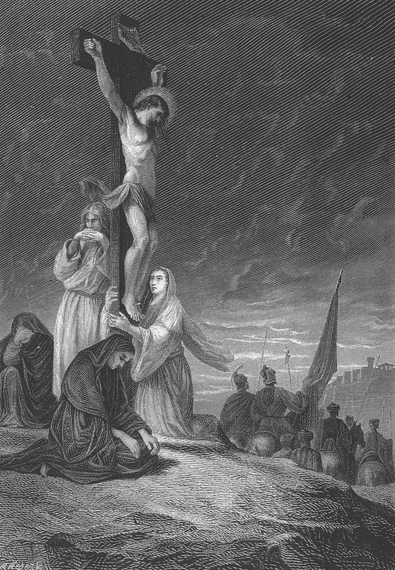
"The Crucifixion" by Alexandre Bida

TODAY'S SPECIAL: Mark 15-16; Psalm 102

TO CHEW ON: "And at the ninth hour, Jesus cried out with a loud voice saying, 'Eloi, Eloi, lama sabachthani' which is translated 'My God, My God why have You forsaken Me?'" Mark 15:34

No matter how often I read the story of Jesus' death, these words from the cross (the echo of Psalm 22:1) wrench at my heart. They carry the tones of utter despair and abandonment.

A footnote in my Bible describes them as a "...cry of dereliction from Jesus that reflects the burden of humanity's sin, complete identification with sinners and a real abandonment by God" - New Spirit-Filled Life Bible, p. 1379.

Wayne Grudem names four aspects of the pain of the cross:
1. Physical pain and death ... death by crucifixion was one of the most horrible forms of execution ever devised by men...


2. The pain of bearing sin: More awful than the pain of physical suffering that Jesus endured was the psychological pain of bearing the guilt of our sin (Isaiah 53:6; 2 Corinthians 5:21; Galatians 3:13).


3. Abandonment ... Jesus faced this pain alone (Mark 15:34; Matthew 26:56).


4. Bearing the wrath of God ... As Jesus bore the guilt of our sins alone, God the Father, the mighty Creator, the Lord of the universe, poured out on Jesus the fury of his wrath: Jesus became the object of the intense hatred of sin and vengeance against sin which God had patiently stored up since the beginning of the world (Romans 3:24-25; Hebrews 2:17; 1 John 2:2). - Wayne Grudem, Systematic Theology, pp. 573-575.

Which makes that desolate cry from the cross all the more impacting. It has something to do with me. My sin—my pride, jealousy, anger, greed, covetousness etc. etc. were part of that black burden that not only separated Jesus from His Father but made Jesus (instead of me) the object of the Father's wrath.

PRAYER: Dear Jesus, thank You for not turning away from the terrible "cup." I am forever grateful that You became sin, a curse, for me. Amen.

PSALM TO PRAY: Psalm 102


***************
Unless otherwise noted all Scripture quotations are taken from the New King James Version®. Copyright © 1982 by Thomas Nelson, Inc. Used by permission. All rights reserved.


Thursday, March 01, 2018

A test of family loyalty

Image: Pixabay
TODAY’S SPECIAL: Deuteronomy 21-23; Psalm 60

TO CHEW ON: “If a man has a stubborn and rebellious son who will not obey the voice of his father or the voice of his mother and who, when they have chastened him, will not heed them, then his father and his mother shall take hold of him and bring him out to the elders of the city, to the gate of his city.” Deuteronomy 21:18,19


One day before the February 14th Florida school shooting, a grandmother in Everett Washington reported her grandson to the police. This was after reading disturbing entries in his journal, entries in which he talked about shooting up his school (Read CNN article.)

What a test of family loyalty! And yet, for the greater good—the good of the community and this kid— this grandma reported her grandson for short-term pain.

The test of family ties in our reading is even more extreme. Parents were to bring their stubborn, rebellious, disobedient, gluttonous, alcoholic son to the elders, not for a scolding or a fine or lockup but stoning (Deuteronomy 21:21).

We’ve been studying the SHEMA which the Israelites prayed regularly:
“You shall love the LORD your God with all your heart, with all your soul, and with all your strength” - Deuteronomy 6:5. 

Such a radical family “betrayal,” then, could be seen as part of that heart, soul and strength love for a God who hated, condemned and punished these sins.

Of course we now live in the New Testament church era. Jesus’ death on the cross has atoned for our sins of stubbornness, rebellion, disobedience, gluttony, addiction etc. It’s not that our current sin is any less serious, but that God’s holy wrath at our wrong-doing has been satisfied by Jesus’ death in our stead.

Still, I believe there is a principle for us here, seen in the singlehearted focus of the parents. Jesus in the NT also referred to the cost of following Him in Matthew 10:34-39. In that section he described how His coming into a life could have the potential to mess with relationships, especially in the family:
‘For I have come to set a man against his father, a daughter against her mother, and a daughter-in-law against her mother-in; and a man’s enemies will be those of his own household. He who loves father or more more than Me is not worthy of Me. And he who loves son or daughter more than Me is not worth of Me'” - Matthew 10:35-37.

Do we have this OT/NT devotion to Jesus that trumps even blood ties?


PRAYER: Dear Jesus, may my love for You be stronger than any love tie on earth. Amen.

PSALM TO PRAY: Psalm 60

The Bible Project VIDEO: The Law (Theme series)


 *********
Unless otherwise noted all Scripture quotations are taken from the New King James Version®. Copyright © 1982 by Thomas Nelson, Inc. Used by permission. All rights reserved.

Thanks for reading! This year we are using The Bible Project "Timeless Reading Plan" to read through the Bible in 2018. If you'd like to read along in your own Bible, you can download a pdf of the reading plan HERE.

Wednesday, January 31, 2018

Hiding Place


Jochebed makes a basket for
Moses - Exodus 2:1-8
(Illustrator of Lillie A. Faris's
'Standard Bible Story Readers,
Book 1-5', 1925-28)

TODAY'S SPECIAL: Leviticus 5-7; Psalm 31

TO CHEW ON: "You shall hide them in the secret place of Your presence from the plots of man; You shall keep them secretly in a pavilion from the strife of tongues." Psalm 31:20

When I think about God and hiding, I recall Corrie Ten Boom's book, The Hiding Place. In it, not only did the Ten Boom family hide the Jews, but God was a hiding place for them. (Remember the story of how Corrie and Betsy got a Bible past the guards and into prison with them?)

Whether we're in trouble or just need a refuge from the wear and tear of life, the thought of a hiding place in God is mighty attractive. The definition of the word "hide" expands our view of what this can mean.

[hide: To put or keep oneself out of sight, conceal. To keep secret, withhold from knowledge. To block or obstruct the sight of, keep from view. To keep oneself out of sight, remain concealed. To remain concealed as a fugitive.]

With those definitions in mind, let's look at some of the mentions of hiding and God in the Bible.

  • God conceals us:
David is asking God to conceal him from the "plots of man" and the "strife of tongues" in our focus verse today. He prays similarly in Psalm 27:5 for God to hide him in the time of trouble, and in Psalm 64:2 from "secret plots" and "rebellious workers of iniquity."


  • We hide in God:
We are the ones who run to God for hiding. "You are my hiding place," says David in Psalm 32:7; "In You I take shelter" - Psalm 143:9.


  • We're close to God:
When we're hiding this way we stay close to God: "under the shadow of your wings" - Psalm 17:8.

  • He hides and protects:
God becomes to us both a hiding place and a protection (shield). How? Through His word - Psalm 119:114.

  • Hidden lifestyle
Hiding in God is where we can actually live: "He who dwells in the secret place of the most high shall abide under the shadow of the Almighty" - Psalm 91:1. I think of an iceberg and how it is nine tenths under water. That's how I envision this hidden life with God and ask myself, is the one tenth public part part of my life evidence that the nine tenths part is actually living and hidden in God?

PRAYER: Dear God, please help me to hide in You in every sense of the word. May Your presence shield me from trials, enemies, tongue strife etc. But mostly, may the part of my life that people see be evidence that I am close to You, hidden in You. Amen.

PSALM TO PRAY: Psalm 31

The Bible Project VIDEO: Atonement (Theme Series)


****************
Unless otherwise noted all Scripture quotations are taken from the New King James Version®. Copyright © 1982 by Thomas Nelson, Inc. Used by permission. All rights reserved.

Thursday, March 30, 2017

Crookedness—it's in our genes

TODAY'S SPECIAL: Psalm 130:1-8

TO CHEW ON: "If you, Lord, should mark iniquities, O Lord who could stand?" Psalm 130:3


Iniquities is an old-fashioned word we don't often use in everyday talk. However, the psalmist uses it here to tell us an uncomfortable fact about ourselves that remains true even if we no longer use the word. According to a word Wealth article in my Bible:

[Iniquities - (avon) means evil, fault, sin, iniquity, guilt, blame, moral illness, perversion, crookedness. It's derived from avah which means to bend or distort. Thus iniquity is the "evil bent' within human beings or the "crooked" direction or "warped" deeds of sinners - Dick Mills, Word Wealth, New Spirit-Filled Life Bible, p. 788.]

Think about that for a bit as it relates to us. No matter how our society tries to downplay that evil bent, even contradict it, have we not seen that sneaky self inside who wants its own way (selfishness), goes after honor and attention (pride), secretly desires the biggest and best (greed), yearns to have the stuff and good fortune of others (covetousness), etc.?

Cain used the word iniquity way back in the beginning when he said, after killing his brother in a jealous rage, "My punishment (iniquity) is greater than I can bear" - Genesis 4:13. That would be the reaction of each one of us—too much to bear.

What is the solution to this inborn natural tendency to be crooked? It's not in us. But it is with God:

"There is forgiveness with You," says the psalmist here (Psalm 130:4)

Isaiah makes it clear that forgiveness is in a specific person, the Suffering Servant, the Messiah—Jesus:
"He was bruised for our iniquities … and the Lord has laid on Him the iniquity of us all … For He shall bear their iniquities" - Isaiah 53:5, 6, 11.

What a gift of grace for us to ponder and give thanks for as we approach Good Friday and Easter when we commemorate Jesus' death. He carried all our iniquities on the cross. With that act God was able to forgive and our iniquity is no longer held against us as a death-worthy crime.

PRAYER: Dear God, thank You for Your forgiveness, rooted in Your substitutionary atonement on the cross. Amen.

 *********
Unless otherwise noted all Scripture quotations are taken from the New King James Version®. Copyright © 1982 by Thomas Nelson, Inc. Used by permission. All rights reserved.


Sunday, October 30, 2016

The river of God

Bridal Falls - BC, Canada
TODAY'S SPECIAL: Psalm 46:1-11

TO CHEW ON:
"There is a river whose streams shall make glad the city of God,
The holy place of the tabernacle of the Most High." Psalm 46:4.


Though there was no actual river flowing through Jerusalem, it seems the city had a subterranean water supply that was the source of various fountains and pools throughout the city (K. R. Dick Iverson - study notes on Psalms, New Spirit-Filled Life Bible, p. 723).

That unseen river makes a wonderful symbol of the hidden life of God for believers then and still today. All three members of the Godhead have a part in that flow.

God the Father: He begs the wayward to come back to Him as their life-giver - "For My people have committed two evils: They have forsaken Me, the fountain of living waters, and hewn themselves cisterns—broken cisterns that can hold no water" - Jeremiah 2:13.

God the Son:
After a chapter in which the prophet Zechariah foresees Jesus' death (specifically Zechariah 12:10) he says: "In that day a fountain shall be opened for the house of David and for the inhabitants of Jerusalem, for sin and for uncleanness" - Zechariah 13:1.

God the Holy Spirit:
Jesus' offer of life-giving water to the Samaritan woman:
"'…but whoever drinks of the water that I shall give him will never thirst. But the water that I shall give him will become in him a fountain of water springing up into everlasting life'" - John 14:4,

This is elaborated on later as the fountain of the Holy Spirit:
 "'He who believes in Me, as the Scripture has said, out of his heart will flow rivers of living water.' But this He spoke concerning the Spirit, whom those believing in Him would receive; for the Holy Spirit was not yet given because Jesus was not yet glorified" - John 7;38,39.

What a picture of God's refreshing supply of life for us.
1. We leave our own stale cisterns of self-help and self-determination and turn to God.

2. We are cleansed from sin in the fountain of Jesus' blood:
"There is a fountain filled with blood
drawn from Immanuel's veins
and sinners plunged beneath that flood
lose all their guilty stains" - from the hymn by William Cowper.

3. We now live this new life by the power of the Holy Spirit. Its evidence is joy (Acts 13:52; 1 Thessalonians 1:6).

I ask you, have we taken advantage of this cleansing river? Is it refreshing and renewing us? Is living water flowing from our lives?

PRAYER:
Thank You for this beautiful picture of life in and with You. May streams of living water flow from my life today. Amen. 

MORE: "There is a Fountain Filled with Blood"

 
***********

New King James Version (NKJV) Used with permission. The Holy Bible, New King James Version Copyright © 1982 by Thomas Nelson, Inc.

Bible Drive-Thru

Wednesday, May 11, 2016

A mind set on "flesh"

Dessert garnish of smudge with hearts
TODAY'S SPECIAL: Romans 8:1-17

TO CHEW ON:
"For those who live according to the flesh set their minds on the things of the flesh, but those who live according to the Spirit, the things of the Spirit." Romans 8:5


Paul talks about two opposing states of being here—in the Spirit and in the flesh. In another meditation on this passage, I focused on what it means to be set on the Spirit. Today let's look at what a flesh setting looks look. Of course, we're all still in the flesh physically. But being in the flesh (carnal) also has soul and spirit connotations.

To start with, our passage gives us some clues:
- There is spiritual condemnation for those who live by the flesh alone - Romans 8:1.

- It is its own law - Romans 8:2.

- In God's eyes, Jesus' death in the flesh—His perfect flesh—is the substitutionary death for us sinners and fulfilled God's righteous requirement that sin be punished - Romans 8:3,4.

- As people who have accepted Christ's death in our stead, we become people of the Spirit and now have the freedom and right to set our minds on the things of the Spirit; to live in the Spirit- Romans 8:5.

However, Paul's emphasis on the necessity of this and the possibility that even people of the Spirit may still be living under the tyranny of the flesh alerts us to that possibility for us.

A walk through scripture helps us understand what a carnal (fleshly) mindset and life looks like in attitude and behavior.

- It prefers the tangible to the intangible.
  • Esau sold his birthright for a bowl of food - Genesis 25:34.
  • The Israelites were ready to exchange their freedom to be able to again fill up on that fabulous Egyptian food - Exodus 16:3.
- It is controlled by appetite. Numbers 11:4 calls it "intense craving."

- It is sacrilegious.
  • God scolds Eli for not correcting his sons, who treated the sacrifice elements with disdain - 1 Samuel 2:29.
  • Paul brings up the same attitude to the Corinthians in regard to the Lord's Supper - 1 Corinthians 11:21.
- It resents God's restrictions and pushes His limits - Psalm 78:18; 106:14.

- It has no thought of anything past this life - Isaiah 22:13; Matthew 24:38; Luke 17:27; Philippians 3:19.

- Its repentance is insincere - Hosea 7:14.

- It finds reassurance in false prophecy - Micah 2:11.

- It seeks God for His benefits - John 6:26. Fleshly pastors (shepherds) are in ministry to benefit themselves - Zechariah 11:16.

- It is characterized by worry over the things of this life - Matthew 6:25. Those cares choke out the working of God's word - Mark 4:19.

- It is a captive of sin - Romans 7:14.
  • In the Christian who has tasted the Spirit life, this results in internal conflict - Romans 7:23, 24.
  • This conflict can lead to discord with other believers - James 4:1-5.
- When the flesh wins, the end result is a love of the world - 1 John 2:15,16.

- It is living the "works" of Galatians 5:19-21.

- The sobering end of someone who lives life solely in the flesh is spelled out in Revelation 18:9-18, i.e. they will someday find that all they had put their hopes in has burned up.

Do you find elements of your self described in the above list? Sadly, I do. Let's heed the advice of Paul and carefully guard the set of our minds, moving it off "Flesh" to "Spirit" whenever necessary.

PRAYER: Dear Jesus, thank You for making a life set on the Spirit possible. Please alert me to when my mind slips into its old flesh setting of worry, envy, jealousy, anger etc. I want the Spirit setting to be the habit of my life. Amen.

 *********
Unless otherwise noted all Scripture quotations are taken from the New King James Version®. Copyright © 1982 by Thomas Nelson, Inc. Used by permission. All rights reserved.


Sunday, July 26, 2015

Jesus' descent

Golgotha - from The Children's Friend - Part 5

TODAY'S SPECIAL: Ephesians 4:1-16

TO CHEW ON: "He who descended is also the One who ascended far above all heavens, that He might fill all things." Ephesians 4:10

Where was Jesus in the hours between His death and resurrection?

Paul suggests one possibility here as he explains a quote from Psalm 68:28, applying it to the ascended Christ:  "Now this, 'He ascended'—what does it mean but that He also first descended into the lower parts of the earth? ..."(verse 9).

What that descent meant has been a source of discussion. Peter, preaching in Acts 2 from the text of Psalm 16:8-11 says:
"…he (David, the writer of the psalm) foreseeing this (the resurrection) spoke concerning the resurrection of the Christ, that His soul was not left in Hades, nor did His flesh see corruption" (Acts 2:31)
Isn't Peter implying that Christ visited Hades? Was that what we call hell? It was some aspect of the underworld in any case.  Peter refers to this again in 1 Peter 3:19-20.

Another view is that Jesus' descent refers to His coming to earth from heaven. Paul describes the extent of that lowering beautifully in Philippians 2:5-11:
"… Christ Jesus, who being in the form of God, did not consider it robbery to be equal with God but made Himself of no reputation, taking the form of a bondservant, and coming in the likeness of men.  And being found in appearance as a man, He humbled Himself and became obedient to the point of death, even the death of the cross..." - Philippians 2:5-8.

Still another view is that Jesus suffered in hell. Of that view the writer of my Bible's notes on Ephesians says, "… there is no biblical support for the notion that Jesus suffered in hell, only that He descended to hell to release the righteous dead into eternal glory, proclaiming the adequacy of the Atonement and validating the testimony of the prophets" - Jack W. Hayford, notes on Ephesians,  New Spirit-Filled Life Bible, p. 1650.

Surely He was enjoying Paradise, for at least part of the time. After all, He said to the believing thief on the cross, "Today you will be with Me in Paradise" - Luke 23:43.

Whatever, wherever, it was enough! No part of earth or hell has been unaffected by His death and resurrection. As Paul says it in our focus verse:
"He who descended is the [very] same as He who also has ascended high above all the heavens, that He [His presence] might fill all things—the whole universe, from the lowest to the highest" - Ephesians 3:10 (Amplified Bible).

PRAYER: Dear God, thank You for Jesus and Your plan for my atonement, which was enough. Amen.

MORE: It Is Finished - Gaither Vocal Band

***********


The Holy Bible, New King James Version Copyright © 1982 by Thomas Nelson, Inc. - Used with permission.

Amplified Bible (AMP) Copyright © 1954, 1958, 1962, 1964, 1965, 1987 by The Lockman Foundation - Used with permission.

Bible Drive-Thru


Friday, April 03, 2015

Why we can call this day "good"

The Crucifixion - Alexandre Bida
TODAY'S SPECIAL: Mark 15:1-41

 TO CHEW ON: "So when the centurion who stood opposite Him saw that He cried out like this and breathed His last, he said, 'Truly this Man was the Son of God.' " Mark 15:39

As we read the detailed account of the hours leading up to the cross and the hours Jesus spent on the cross, we get the sense of several things:
  • How typically human this whole drama was.
The religious leaders had manipulated things their way—finally. The crowd was as wishy-washy as crowds typically are. The soldiers gloried in their power and got themselves a few laughs even as they meted out Roman punishment.

  • How inevitable this whole drama was.
We got glimmerings of that inevitability yesterday as we heard the resignation in Jesus' voice when He prayed through (Mark 14:36). In today's reading He was silent in His own defense (Mark 15:2-5). As the scene played out, He fulfilled prophecy (as Mark points out: Mark 15:28).

  • How pivotal this event was.
Jesus' words from the cross, His quick death without the aid of numbing myrrh or wine, and the temple veil torn in two from top to bottom (no human hand could do that!) were all sources of incredulity. Even that hardened Roman soldier looking on recognized that this was no ordinary man being crucified (Mark 15:39).

These many years later we are still seeking to get our minds around how that moment changed everything. Bible writers have probed it too, both prophetically and in hindsight. Here are some of the accomplishments of Jesus' death—and resurrection three days later:

  • Jesus  bore our sin, became sin for us - Isaiah 53:12; Romans 5:6; Hebrews 2:9.
  • He laid down His life for our lives as He said He would - John 10:11.
  • In dying He made possible the crop of Christ-followers that has sprung up over successive generations, and around the world - John 12:24.
  • His death and resurrection conquers life and death - Romans 14:9.
  • He fulfilled Scriptures showing that this chain of events was no fluke but in God's plan from the beginning - Genesis 3:15; 1 Corinthians 15:3.
  • His death gives those He died for the motivation to live for Him - 2 Corinthians 5:15.
  • His death makes it possible for us to stand before God "blameless and above reproach" - Colossians 1:22.
  • His death results in His glory as the world's Redeemer - John 12:23; Revelation 5:9.

No wonder we call this "good" Friday!


PRAYER: Dear Jesus, thank You for going through with this! I know how only eternity will reveal the true weight of what You accomplished that day on Calvary. For all that I understand of it now, I thank you, thank you, thank you!

MORE: Good Friday

Today the church celebrates Good Friday. The Good Friday liturgy begins with this Collect:

Almighty God, we pray you graciously to behold this your family, for whom our Lord Jesus Christ was willing to be betrayed, and given into the hands of sinners, and to suffer death upon the cross; who now lives and reigns with you and the Holy Spirit, one God, for ever and ever. Amen.


 *********
Unless otherwise noted all Scripture quotations are taken from the New King James Version®. Copyright © 1982 by Thomas Nelson, Inc. Used by permission. All rights reserved.


Friday, September 05, 2014

Blood

"Blood of the Passover"
by Ted Larson

TODAY'S SPECIAL: Exodus 12:1-14

TO CHEW ON: "Now the blood shall be a sign for you on the houses where you are. And when I see the blood, I will pass over you; and the plague shall not be on you to destroy you when I strike the land of Egypt." Exodus 12:13

If you ever do house renovations or watch them on TV, you will know that all walls are not created equal. People who look at a fixer-upper with an eye to knocking down walls must do at least one thing before they get busy with the sledge hammer—check to see whether or not the wall they're planning to remove is load-bearing. If it is (i.e. supports parts of the house's basic structure) they know they can't remove it without compromising the soundness of the whole house.

Blood is that kind of load-bearing wall in Christianity. In today's reading we see the beginning of its importance in the Passover. It plays a key role in this ritual which God instituted through Moses just before the exodus of the Israelites from Egypt after 400 years of slavery.

The instruction about how it was to be used was particular. The blood of each household's sacrificed animal was to be painted on the sides and top of their entryway. God promised it would act as a barrier to "the plague" and "the destroyer."  When the death angel saw the blood, he would pass over that doorway, as he was not allowed to enter that household to do his deadly task (Exodus 12:13,23).

The blood "wall" doesn't only provide a protection, but it does much more. Some of the things it supports, as seen through the Bible:

  • Atonement - Exodus 30:10; Leviticus 17:11
  • Liberation - Zechariah 9:11
  • Pardon - Hebrews 9:7
  • Cleansing - Hebrews 9:22.
Centuries later Christ came and offered Himself as our Passover lamb. He shed His blood for each one of us.

We must never let the criticism that Christianity is too bloody cause us to look for ways we can remove that supporting "blood wall" from our faith.

PRAYER: Dear God, thank You for the rich images resident in the Passover story and especially the blood. Thank You for being my Passover lamb. Amen.

**********
Unless otherwise noted all Scripture quotations are taken from the New King James Version®. Copyright © 1982 by Thomas Nelson, Inc. Used by permission. All rights reserved.


Bookmark and Share

Saturday, April 03, 2010

Paid in full!

TODAY’S SPECIAL: Ephesians 4:1-16

TO CHEW ON: “Therefore He says:

‘When He ascended on high
He led captivity captive
And gave gifts to men.’
(Now this, ‘He ascended’ – what does it mean but that He also first descended into the lower parts of the earth?) Ephesians 4:8-9

On this day between when we celebrate Jesus’ death and His resurrection it is appropriate to spend some time thinking about the price Jesus paid to procure our salvation. What was He doing between when He died and rose again? Paul alludes to Jesus’ activity in this interval. He quotes part of a prophetic psalm (68:18) then takes a word from that psalm, “ascends” to deduce that if Jesus ascended, He necessarily first descended.

"Jesus in Hades"  
Woodcut by an unknown Master 
connected to the Protestant Reformation era 
writings. Published in 1550.
An endnote article in my Bible explains the possible meaning of that descent, coming up with three possible explanations of what Paul meant by “descended into the lower parts of the earth”:
1. A descent into hell (1 Peter 3:18-19).
2. A descent into Sheol/Hades the realm of the dead (Acts 2:25-35).*
3. A symbolic reference to His incarnation, where His coming to earth from heaven was the descent.

Whatever He did, it was sufficient. It purchased our salvation. Praise the Lord! And it made possible the “gifts’ that are the main subject of this passage – those talents and abilities the Holy Spirit gives us and empowers with supernatural effectiveness to ensure the health of His earthly body, the church.

PRAYER: Dear Jesus, thank You for paying the price for my salvation. Help me to live full-out, expending my talents, using my gifts for Your glory. Amen.

MORE: Whatever the cost and procedure (a descent into hell included, if that was indeed the case) Jesus paid it all. An old hymn of the church by that name had its origins in this poem:

I hear my Savior say
Thy strength indeed is small,
Thou has naught My debt to pay,
Find in Me thy all in all.

Yea, nothing good have I,
Whereby Thy grace to claim;
I wash my garments white
In the blood of Calvary’s Lamb.

And now complete in Him,
My robe His righteousness,
Close sheltered ‘neath His side,
I am divinely blest.

When from my dying bed
My ransomed soul shall rise,
Jesus paid it all
Shall rend the vaulted skies.

Elvina M. Hall (1865)


Kristian Stanfill sings a modern version of “Jesus Paid It All”
http://www.youtube.com/watch?v=brVIlXlJRkQ


*Referring to the descent into hell or Sheol, the writer of the article makes this statement: “There is no biblical support for the notion that Jesus suffered in hell, only that He descended to Sheol to release the righteous dead into eternal glory, proclaiming the adequacy of the Atonement and validating the testimony of the prophets.” New Spirit Filled Life Bible, p. 1650.


Do your 8-12-year-olds have daily devotions? Point them to Bible Drive-Thru.

Related Posts Plugin for WordPress, Blogger...