Showing posts with label Mark. Show all posts

Friday, September 14, 2018

Abandoned

"The Crucifixion" by Alexandre Bida

TODAY'S SPECIAL: Mark 15-16; Psalm 102

TO CHEW ON: "And at the ninth hour, Jesus cried out with a loud voice saying, 'Eloi, Eloi, lama sabachthani' which is translated 'My God, My God why have You forsaken Me?'" Mark 15:34

No matter how often I read the story of Jesus' death, these words from the cross (the echo of Psalm 22:1) wrench at my heart. They carry the tones of utter despair and abandonment.

A footnote in my Bible describes them as a "...cry of dereliction from Jesus that reflects the burden of humanity's sin, complete identification with sinners and a real abandonment by God" - New Spirit-Filled Life Bible, p. 1379.

Wayne Grudem names four aspects of the pain of the cross:
1. Physical pain and death ... death by crucifixion was one of the most horrible forms of execution ever devised by men...


2. The pain of bearing sin: More awful than the pain of physical suffering that Jesus endured was the psychological pain of bearing the guilt of our sin (Isaiah 53:6; 2 Corinthians 5:21; Galatians 3:13).


3. Abandonment ... Jesus faced this pain alone (Mark 15:34; Matthew 26:56).


4. Bearing the wrath of God ... As Jesus bore the guilt of our sins alone, God the Father, the mighty Creator, the Lord of the universe, poured out on Jesus the fury of his wrath: Jesus became the object of the intense hatred of sin and vengeance against sin which God had patiently stored up since the beginning of the world (Romans 3:24-25; Hebrews 2:17; 1 John 2:2). - Wayne Grudem, Systematic Theology, pp. 573-575.

Which makes that desolate cry from the cross all the more impacting. It has something to do with me. My sin—my pride, jealousy, anger, greed, covetousness etc. etc. were part of that black burden that not only separated Jesus from His Father but made Jesus (instead of me) the object of the Father's wrath.

PRAYER: Dear Jesus, thank You for not turning away from the terrible "cup." I am forever grateful that You became sin, a curse, for me. Amen.

PSALM TO PRAY: Psalm 102


***************
Unless otherwise noted all Scripture quotations are taken from the New King James Version®. Copyright © 1982 by Thomas Nelson, Inc. Used by permission. All rights reserved.


Thursday, September 13, 2018

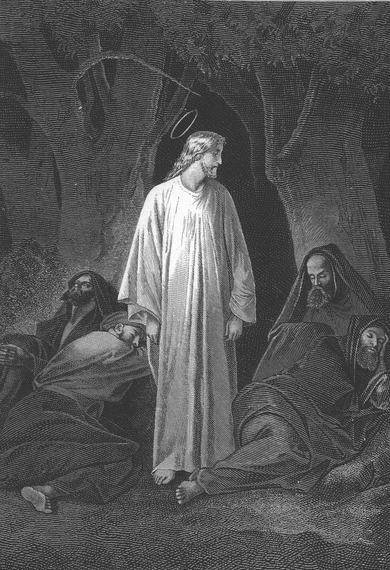
The fight between sleep and prayer

The Sleep of the Disciples - Alexandre Bida

TODAY'S SPECIAL: Mark 13-14; Psalm 101

TO CHEW ON:
"And He came and found them sleeping, and said to Peter, 'Simon, are you sleeping? Could you not watch one hour? Watch and pray, lest you enter into temptation' … And when He returned, He found them asleep again, for their eyes were heavy; and they did not know what to answer Him." Mark 14: 37,38,40

No doubt the disciples' sleep was a legitimate physical response to physical fatigue. Yet one gets the sense that there is also a spiritual component to their napping here, while a few feet away, Jesus agonizes in prayer.

Several thoughts...

On prayer:
1. Jesus, the very Son of God, who had unprecedented access to the Father, still desired the disciples' prayer company and support. " 'Could you not watch one hour?' "  Mark reports Jesus saying (Mark 14:37). Matthew adds " 'Could you not watch with me one hour?' " (Matthew 26:40).

2. Jesus' desire for them to be praying was also for their benefit: " 'Watch and pray, lest you enter into temptation. The spirit indeed is willing but the flesh is weak' " Mark 14:38.

On sleep:
1. The persistence of the disciples' sleep, even after Jesus' warning, alerts us to the fact this may have been more than mere fatigue. They were seemingly embarrassed and perhaps even puzzled by their inability to stay awake: " … they did not know what to answer Him" - Mark 14:39.

2. Luke's account says: "He found them sleeping from sorrow" - Luke 22:45. This suggests their sleep may also have been a form of escapism.

Some insights for our lives as modern disciples from this part of the passion story:
- Prayer: 

  • It aids us even as it supports others.

- Sleep:

  • We do need a healthy amount to function. But could an inordinate sleepiness at times when we set out to pray be an aspect of spiritual warfare?
  • When we're overwhelmed by life situations, maybe we should more often escape into prayer than sleep!
  • Could our inability to stay awake during prayer be a symptom of a dull spiritual state? Perhaps spiritual things just don't seem real enough; prayer doesn't seem important enough to keep us alert and awake. The Bible uses sleep as a metaphor to illustrate spiritual dullness and oblivion:
"… now it is high time to awake out of sleep; for now our salvation is nearer than when we first believed" - Romans 13:11.

"Therefore let us not sleep as others do, but let us watch and be sober" - 1 Thessalonians 5:6.


See also Mark 13:35,36  |  Romans 11:8  |  Ephesians 5:14.

PRAYER: Dear Jesus, I confess I have often slept when I should be praying. Please help me to understand what's at stake in maintaining times of prayer. Amen. 

PSALM TO PRAY: Psalm 101

 *********
Unless otherwise noted all Scripture quotations are taken from the New King James Version®. Copyright © 1982 by Thomas Nelson, Inc. Used by permission. All rights reserved.


Wednesday, September 12, 2018

Jesus the people-watcher

Bible story book illustration - Artist unknown
TODAY'S SPECIAL: Mark 11-12; Psalm 100

TO CHEW ON: "So He called His disciples to Himself and said to them, 'Assuredly I say to you that this poor widow has put in more than all those who have given to the treasury; for they all put in out of their abundance but she out of her poverty put in all that she had, her whole livelihood.'" Mark 12:43-44

I love the story of Jesus and His disciples people-watching—and Jesus' attention caught by a poor widow. She stood out because she put so little into the treasury.

Jesus drew His disciples' attention to her, not to hold her up as an example of stinginess, but generosity. Because of His divine insight, He saw and understood the extent of her gift and praised her as the greatest giver of the day.

This story can speak to us on two levels—as the watcher and the watched.

We watch people—observe what they give (not only money in church but time, hospitality, friendship, service...), and make judgments about them. Without Jesus' interpretation of her act, the disciples may well have drawn a different conclusion about her and her gift. We need to be careful not to jump to judgment on the basis of appearances.

We are also being watched. Realizing that the God who knows our circumstances and motivations is constantly watching us can be comforting or unnerving.

If we give with honesty, integrity, courage and stretched faith out of our love for Him we have the comfort of knowing He sees and appreciates, even if our gifts' outward appearances are small.

Of course if we give with mixed motives—to impress others, or as a down-payment on blessings we hope we'll get from Him, or out of habit or duty, He sees that too and is probably as unimpressed by our gift as Jesus was with the "much" given by the wealthy.


PRAYER: Dear God, please help me not to judge people by the appearance of what they give. When I give, please reveal any unworthy motives to me. Amen. 

PSALM TO PRAY: Psalm 100


********************
Unless otherwise noted all Scripture quotations are taken from the New King James Version®. Copyright © 1982 by Thomas Nelson, Inc. Used by permission. All rights reserved.


Tuesday, September 11, 2018

Approachable Jesus

TODAY'S SPECIAL: Mark 9-10; Psalm 99

TO CHEW ON: "Then they brought little children to Him that He might touch them; but the disciples rebuked those who brought them. But when Jesus saw it, He was greatly displeased .... And He took them up in His arms, laid His hands on them, and blessed them." Mark 10:13,16


Jesus' disciples had their boundaries in place. When they saw children coming to Jesus, they ordered them and their parents to leave. It seems they saw children as an inconvenience and an unwanted interruption not worthy of Jesus' time.

But Jesus didn't join His disciples in scolding the parents. Instead, He scolded the disciples for sending the little ones away (at least we read He was "greatly displeased").

I wonder what the parents expected Jesus' touch to do for their kids. I wonder after He had taken them in His arms and blessed them, were they forever changed?

Gary Chapman in his book The Love Languages of God holds out the idea that there are five main ways people express and understand love. (He calls them Love Languages. They are: words of affirmation, quality time, acts of service, gifts, and physical touch). At one point he comes to this conclusion:

"It is my premise that the love languages observed in human relationships are a reflection of divine love. If man is indeed made in the image of God, then we would expect to find all five love languages expressed in the character and nature of God. It is also my premise that God speaks all five love languages fluently and that people tend to be attracted to God most deeply when they sense that God is speaking their primary love language" - Gary Chapman, The Love Languages of God, pp. 28, 29 (republished under the title God Speaks Your Love Language).

In the chapter on touch, Chapman points out how often Jesus touched people. He often touched them when He healed them (John 9:11; Matthew 8:2-3, 15; Matthew 9:27, 29-30). He touched His disciples to revive them on the Mount of Transfiguration (Matthew 17:7). He washed their feet (John 13:1-4). And here He touched the children.

Touch is certainly the first communication of love that children get. And it can remain a powerful communicator of love throughout life. So what do children 'hear' when we touch them with our hands and our voices? Gentleness? Respect (in that we don't force ourselves on them if they are wary of us)? Purity? Love? What do we communicate to the adults we touch?

May our touching be Jesus' hands, extended in love to touch the world through us.

PRAYER: Dear Jesus, what a beautiful picture of You touching, holding, and blessing little children. Help my touch to be Your hand extended in love to whomever You send into my life to touch today. Amen.

PSALM TO PRAY: Psalm 99

MORE: Perverted touch

Josh McDowell in the book Undaunted, tells of how he was sexually abused by a man his mother had hired to help with housework. From ages six to twelve this man touched and caressed Josh in impure ways.

That perverted touch left its mark. In an interview with Jim Cantelon on 100 Huntley Street, McDowell told of how to this day (he's now in his late 70s) he cannot stand to be touched. When people put their hands on his shoulders or back when praying for him, he stops and asks them to remove their hands. His reaction shows how long-lasting the effects of wrong, perverted, and impure touch can be.


***************
Unless otherwise noted all Scripture quotations are taken from the New King James Version®. Copyright © 1982 by Thomas Nelson, Inc. Used by permission. All rights reserved.


Monday, September 10, 2018

Is there leaven in our lives?

Hands mixing dough
Courtesy RGBStock.com
TODAY'S SPECIAL: Mark 7-8; Psalm 98

TO CHEW ON: "Then He charged them, saying, 'Take heed, beware of the leaven of the Pharisees and the leaven of Herod.' " Mark 8:15

In a conversation that makes us smile because of its misunderstandings, Jesus warned the disciples about the leaven of the Pharisees and of Herod. The disciples thought He was talking about real bread—seen by their discussion amongst themselves (Mark 8:16).

But that wasn't it at all. What Jesus was really referring to is leaven as a metaphor. "Often the term has an evil connotation, that is, what is small may corrupt the whole," says J. Lyle Story in his notes on Mark (New Spirit-Filled Life Bible, p. 1364).

The leaven, or evil Jesus tells them to avoid here is that of the Pharisees and Herod. My Bible's notes suggest the leaven of the Pharisees is lack of faith so that ever more signs are needed, and the leaven of Herod is the worldly outlook of godlessness.

The meaning of leaven as a small thing that disseminates through the whole batch is borne out in other references to leaven. In 1 Corinthians Paul said, "Do you not know that a little leaven leavens the whole lump?" Then he told the Corinthians to purge out the leaven of "malice and wickedness" - 1 Corinthians 5:6-8.

In Galatians Paul repeated the leaven proverb (Galatians 2:9) and warned readers about the leaven of returning to the bondage of the law (practicing and insisting on circumcision) as a way to earn salvation - Galatians 2:2-12.

These references to leaven as a small, seemingly insignificant thing that can corrupt the whole has me asking, might there be leaven in my life?

It could be some secret and unconfessed sin that saps my spiritual energy by its whispers: "You sinner! You have no right to spiritual power and success." Or it could be an attitude like the fear of man, or a lack of faith that the Bible is really truth, or pride that says, "I would never do that" and then sits in judgment on others. It could be any number of things—bits of leaven that eventually affect every part of life and ministry.

PRAYER:
Dear God, please help me to discern the leaven in my life and, with the help of Your spirit, rid myself of it. Amen. 

PSALM TO PRAY: Psalm 98

 *********
Unless otherwise noted all Scripture quotations are taken from the New King James Version®. Copyright © 1982 by Thomas Nelson, Inc. Used by permission. All rights reserved.


Sunday, September 09, 2018

But He's just a carpenter

Jesus in the Nazareth synagogue - Artist unknown
TODAY'S SPECIAL: Mark 5-6; Psalm 97


TO CHEW ON: " ' Is this not the carpenter, the Son of Mary and brother of James, Joses, Judas, and Simon? Are not His sisters here with us?' So they were offended at Him." Mark 6:3

That old saying, "Familiarity breeds contempt" is enacted here right before our eyes. At the synagogue in His home town the wisdom of Jesus' teaching and the miracles He performed astonished His old neighbors. But because they had seen him grow up, knew Him as an ordinary carpenter, and were acquainted with His family, they were "offended" at Him.

[Offended - scandalizo originally meant to put a literal snare or stumbling block in front of someone. The noun it relates to is a snare or bait stick. According to my Bible's Word Wealth author, "In the NT scandalizo is always used metaphorically of that which hinders right conduct or thought hence, 'to cause to stumble' " - Dick Mills, Word Wealth, New Spirit-Filled Life Bible, p. 1309.]

Could the same attitude be true of us and our leaders? The pastor is the little kid we knew from our Sunday School class years ago. The evangelist went to school with our younger siblings. We made better marks than the author. How could they be anything special?

But when we think like this, we don't take into account the difference the presence of the Holy Spirit makes in a life. When He lives within, everything changes.

  • The Spirit of the Lord in Saul changed him into a new person - 1 Samuel 10:6.
  • This renewal comes by waiting on the Lord - Isaiah 40:31.
  • The Spirit renews minds enabling people to be in sync with God's will - Romans 12:2; Ephesians 4:23, 24.
  • This renewal is not dependent on the look or state of the physical body- 2 Corinthians 4:16.
  • The individual's choices influence this renewal. Paul tells Christ-followers to "put off" old ways of behaving and to "put on the new man who is renewed in knowledge according to the image of Him who created him" - Colossians 3:8-10.
  • But this renewal is still essentially the work of the Holy Spirit - Titus 3:5.

As we relate to our leaders and each other, let's not be similarly "offended" by what we know of someone's family tree, childhood, past, or occupation. Rather, let's recognize that the Spirit of God within opens up a whole new realm of wisdom, power, and ministry effectiveness.

PRAYER: Dear God, please open my eyes to see past ordinary exteriors to the Holy Spirit working in and through people, making their lives extraordinary. Amen.  

PSALM TO PRAY: Psalm 97

 *********
Unless otherwise noted all Scripture quotations are taken from the New King James Version®. Copyright © 1982 by Thomas Nelson, Inc. Used by permission. All rights reserved.


Saturday, September 08, 2018

Technology Word-snatch

TODAY'S SPECIAL: Mark 3-4; Psalm 96

TO CHEW ON: "The sower sows the word. And there are the ones by the wayside where the word is sown. When they hear, Satan comes immediately and takes away the word that was sown in their hearts" - Mark 4:14-15


Jesus' parable describes the ancient practice of sowing but the modern process of snatching. On reading Jesus' explanation of the Sower Parable, something inside me says, the things He's describing—the sown word immediately taken away, the no-root, the preoccupation with the cares of this world, riches and other things—is very familiar. It is how I often feel especially since the coming of the Internet, email, Facebook blogging, twitter, and the smart phone. Something is always vying for my attention—and it isn't usually the Word!

Tim Challies writes about technology and a Christian's response to it in The Next Story. He says:
"Here is one of the greatest dangers we face as Christians: With the ever-present distractions in our lives, we are quickly becoming a people of shallow thoughts and shallow thoughts will lead to shallow living. There is a simple and inevitable progression at work here:

Distraction —> Shallow Thinking —> Shallow Living

All of this distraction is reshaping us in two dangerous ways. First we are tempted to forsake quality for quantity, believing the lie that virtue comes through speed, productivity and efficiency ... Second, as this happens, we lose our ability to engage in deeper ways of thinking—concentrated, focused thought requires time and cannot be rushed" - Tim Challies, The Next Story, Kindle Location 2037.

Isn't that what Jesus is talking about here—letting God's words, thoughts and principles land, penetrate, germinate, sprout, grow, and produce fruit in our lives? We do that as we think deeply and at length about what the Bible says, relating its teachings to our ways of being and acting.

Though our outward ways of relating Jesus' teachings and the Bible to our lives may be different from how people would have done it in the first century, our motivations and trip-ups are so similar. God's word snatched away, shallowly rooted, and choked is something of which we need to be vigilant more than ever!


PRAYER: Dear God, this ancient warning about distracted living is modern. Help me to discipline myself to turn off my devices and listen to You and let Your words preoccupy me. Amen. 

PSALM TO PRAY: Psalm 96


The Bible Project VIDEO: Mark (Gospel Series)


*************
Unless otherwise noted all Scripture quotations are taken from the New King James Version®. Copyright © 1982 by Thomas Nelson, Inc. Used by permission. All rights reserved.


Friday, September 07, 2018

Would Jesus be grieved at our hard hearts?

Christ healing the withered hand by James Tissot

TODAY'S SPECIAL: Mark 1-2; Psalm 95

TO CHEW ON:
"And when He had looked around at them with anger, being grieved by the hardness of their hearts, He said to the man, 'Stretch out your hand.' And he stretched it out, and his hand was restored as whole as the other." Mark 3:5

In our reading today we see a rare thing—Jesus angry. What angered Him? It was the attitude of the Pharisees. They objected to Him healing the withered hand of a fellow worshipper because it was against their rules of what's allowed on the Sabbath. Mark described the source of Jesus' anger as "being grieved by the hardness of their hearts"  - Mark 2:5.

["Hard/hardness  is porosis— hardening, callousness. It's a medical term used to describe the process by which fractured bones are set by an ossifying or calloused petrifying. Sometimes it describes a hard substance in the eye that blinds. Used metaphorically porosis denotes a dulled spiritual perceptivity, spiritual blindness and hardness" - Dick Mills, New Spirit-Filled Life Bible p. 1568.]

We find lots of hard hearts in the Bible, in both Old and New Testaments.

1. People's hearts are hard towards believing in God even after seeing supernatural evidences of Him.
  • Pharaoh's heart is described as "hard" during the plagues. Repeatedly when a plague ends, he reneged on his promise to let the people go - Exodus 8:15; 9:34.
  • Even the Israelites had hard hearts despite seeing signs and experiencing wonders during the exodus and the years they spent in the wilderness - Psalm 78:32.

2. Hard-heartedness toward God continued throughout Israel's OT history
- Jeremiah 5:3; Zechariah 7:8-14.

3. It was often a top-down attitude, beginning with the king.
  • Judah's King Zedekiah was only 21 when he took the throne and his 11-year reign was summed up: "…he stiffened his neck and hardened his heart against turing to the LORD God of Israel" - 2 Chronicles 36:13.
  • It caused King Jehoiakim to systematically burn the scroll Jeremiah had just dictated to Baruch the scribe - Jeremiah 36:24.

4. Some hard heart causes and characteristics:

  • It was caused by pride (Daniel 5:20) and the the deceitfulness of sin (Hebrews 3:13).
  • It resulted in a lack of compassion (Mark 3:2-6—our reading), spiritual dullness (Mark 8:17), doubt and unbelief (Mark 16:14), broken relationships (Mark 10:4,5), and a withdrawal of God's presence (through His people and the Holy Spirit - Acts 19:9).  

5. It is remedied by repentance and confession
- Nehemiah 9:17.

6. If persisted in, its end consequence is judgement - Romans 2:5.

I would have loved to be a synagogue spider watching this interchange between Jesus and the Pharisees. But then the thought occurs, what if He came to my church—to yours? Is there a chance He would be grieved and angered by what He sees there of our attitude toward the withered hand types—the homeless, the mentally ill, the poor, the sexually broken, the addicts?

PRAYER:
Dear Jesus, please help me to see my heart as You see it, and to recognize any hard-heartedness. I need You to replace it with a heart of flesh (Ezekiel 36:26). Amen. 

PSALM TO PRAY: Psalm 95

The Bible Project VIDEO: Mark (Read Scripture Series)


 *********
Unless otherwise noted all Scripture quotations are taken from the New King James Version®. Copyright © 1982 by Thomas Nelson, Inc. Used by permission. All rights reserved.


Sunday, December 10, 2017

Preparing the way

Image: Pixabay
TODAY’S SPECIAL: Mark 1:1-18

TO CHEW ON: “As it is written in the Prophets:
‘Behold, I send My messenger before Your face,
Who will prepare Your way before You
The voice of one crying in the wilderness
“Prepare the way of the LORD;
Make His paths straight.”’”  Mark 1:2,3


Mark’s quote is straight from Isaiah 40—part of our reading three days ago. As we complete reading today’s passage we discover that the author is referring to the message and messenger John the Baptist, Jesus’ way-preparer.

In Mark John’s message was to get ready to meet Someone mighty and worthy who had spiritual power. In Luke, where John’s beginning and ministry are described in more detail, we discover his message of preparation focused largely on getting his audience to repent. He even detailed what repentance would look like to various of his listeners in real life:
- To the general public: give to the needy.
- To the tax collector: do your work honestly.
- To the soldier: don’t abuse your position or power and be content with pay
(Luke 3:8-14).

During Advent, as we review the story Jesus coming to earth as God in human flesh we also focus on our readiness. How do we ready our lives for Him to live with us and in us more fully?

Of course we know there is nothing we can do to earn His presence and our salvation. It is a free gift. But we also know that there are things we can do to prepare a comfortable home within us for Him.

I like the four Steps of Readiness  suggested in my Thompson Chain Bible. To make a comfortable home for Jesus with us, we:

1. Abandon idols
“Then Samuel spoke to all the house of Israel, saying, “If you return to the Lord with all your hearts, then put away the foreign gods and the Ashtoreths from among you, and prepare your hearts for the Lord, and serve Him only…” - 1 Samuel 7:3 (emphasis added).

2. Cleanse the temple (our lives)

 “And they gathered their brethren, sanctified themselves, and went according to the commandment of the king, at the words of the Lord, to cleanse the house of the Lord.  2 Chronicles 29:15. 
The whole story (2 Chronicles 29:1-17) is of Hezekiah the king purifying the temple so that Yahweh would again be among them and help them defeat their enemies in.

3. Return to the Lord
"He will also go before Him in the spirit and power of Elijah, ‘to turn the hearts of the fathers to the children,’ and the disobedient to the wisdom of the just, to make ready a people prepared for the Lord” Luke 1:17 (emphasis added).
Here’s that “repentance” that John the Baptist admonished the people of his time to do. The words  quoted are what the angel told John’s father Zacharias, what his (John’s) role would be.

4. Pursue personal purity
“ Now in a large house there are not only vessels and objects of gold and silver, but also vessels and objects of wood and of earthenware, and some are for honorable (noble, good) use and some for dishonorable (ignoble, common). Therefore, if anyone cleanses himself from these things [which are dishonorable—disobedient, sinful], he will be a vessel for honor, sanctified [set apart for a special purpose and], useful to the Master, prepared for every good work. 2 Timothy 2:20,21 AMP (emphasis added).


PRAYER:
Dear Holy Spirit, please help to make my life a more welcoming and comfortable home for Jesus this Advent. Amen. 

MORE: Second Sunday of Advent

Today is the Second Sunday of Advent. The liturgy for the day begins with this prayer:

Merciful God, who sent your messengers the prophets to preach repentance and prepare the way for our salvation: Give us grace to heed their warnings and forsake our sins, that we may greet with joy the coming of Jesus Christ our Redeemer; who lives and reigns with you and the Holy Spirit, one God, now and for ever. Amen.

 *********
Unless otherwise noted all Scripture quotations are taken from the New King James Version®. Copyright © 1982 by Thomas Nelson, Inc. Used by permission. All rights reserved.


Scripture quotations marked AMP are taken from the Amplified® Bible, Copyright © 1954, 1958, 1962, 1964, 1965, 1987 by The Lockman Foundation. Used by permission." (www.Lockman.org)


Friday, December 01, 2017

Two Advents

Fig tree coming into leaf (Image: Pixabay)
TODAY’S SPECIAL: Mark 13:24-37

TO CHEW ON: “Now learn this parable from the fig tree; When its branch has already become tender and puts forth leaves, you know that summer is near. So also , when you see these things happening, know that it (Son of Man’s coming - Mark 13:26) is near—at the door.” Mark 13:28,29.

Today is the first day of Advent. I’m participating with others on my friend’s Advent blog again this year. In the next 24 days, as we count down to Christmas, we’ll be noting milestones in Jesus’ story—a Jesse Tree Advent Calendar. (Jesse Tree because Jesse was the father of David, from whose kingly line Jesus came - 1 Samuel 16:1-13; Isaiah 11:1-10).

Today’s icon is “leaves.” So what a lovely surprise to find leaves in our Bible Society reading—the leaves of a budding fig tree, those leaves signalling that Jesus’ second coming is near.

Again (as we’ve seen in other accounts of His second coming predictions) Jesus’ emphasizes several things to us expectant ones here on earth.

- No one knows the exact time of that coming, only the Father.
A little aside: This reminds me of the ancient Jewish wedding custom where the groom’s father made the final decision of when all was ready and the groom could go fetch his bride. This wedding custom in connection with Jesus’ return, recalls the gorgeous wedding symbolism around that event (Revelation 19:7-10)

- The big word is WATCH.
  • Watch and pray - Mark 13:33.
  • Watch and work - Mark 13:34.
  • Watch all the time (so you’re not caught napping) - Mark 13:35,36.

- Finally, even the parable snippet Jesus uses fits with Christmas. That “man” who went far away is like Jesus who traveled a great distance for us by first leaving heaven for earth at His first coming, then leaving earth for heaven at His ascension.

As we watch the leaves unfold in looking back at Jesus’ story, let’s also remember to look ahead and watch for the leaves on our end-of-time fig tree, signalling Jesus’ soon second coming.


PRAYER: Dear Jesus, thank You for making that long journey and more, for bridging the gap between our sinful selves and Father God for me when You came and showed us the Father, then paid the sacrifice my sins deserved by dying for us. Help me to faithfully WATCH for Your second coming. Amen.

MORE: Toward Christmas

If you’d like to follow the unfolding of Jesus’ Jesse’ Tree story with us, my friend Laurel’s Advent Calendar blog is HERE.


 *********
Unless otherwise noted all Scripture quotations are taken from the New King James Version®. Copyright © 1982 by Thomas Nelson, Inc. Used by permission. All rights reserved.


Tuesday, April 25, 2017

The supernatural good-news life

Paul and the Viper
Paul and the Viper*
TODAY'S SPECIAL: Mark 16:9-20

TO CHEW ON: " ' And these signs will follow those who believe: In my name they will cast out demons; they will speak with new tongues; they will take up serpents, and if they will drink anything deadly, it will by no means hurt them; they will lay hands on the sick and they will recover.' " Mark 16:17-18

What an incredible list of predictions Jesus makes here, of signs that will follow those who spread the gospel:

1. They will have power over the demonic realm (Mark 16:17).
Luke recounts an almost humorous incident showing the unique power that Jesus' followers have in this area. When some Jewish exorcists use the name of Jesus without the power of true faith in Him, the demon responds: "Jesus I know and Paul I know but who are you?" Then the possessed man beats up the exorcists - Acts 19:13-16.


2, They will have new powers of communication: " ' … speak with new tongues' " (Mark 16:17).
I understand this promise to involve more than only the glossolalia of the day of Pentecost (Acts 2:4). It is that for sure, i.e. the power to communicate in languages not learned. But I believe it is also the tongue used in private prayer and self-edification (1 Corinthians 14:2,4, 14-16). And, I would submit, we could also make a case for the new tongue including the tongue of boldness, so evident in the early Christians (Acts 4:31).

3. They will have remarkable protection
(Mark 16:18).
The experience of Paul in the Island of Malta brings Jesus' words to life about protection from snakes (Acts 28:3-6). And to the protection stories from Acts we could add the testimony of Christians experiencing unusual protection through the centuries. In this department, I love the saying attributed to Henry Martyn: "I am immortal until God's work for me to do is done. The Lord reigns" (from Inspirational Quotes).

4. They will have unusual power
to heal (Mark 16:18).
This comes true for the Apostles in Acts as we see them perform numerous healings, sometimes even raising people from the dead (Acts 3:7-11; 5:12-16; 9:3-9, 32-35, 39-42; Acts 14:8-18; 16:18; 20:8-12; 28:8-9).

The question I ask myself is, do these signs still follow the spread of the gospel today? Are these things our experience? Some have developed a hermeneutic which says the signs and wonders seen in Acts were only for that time. However the words we read today are attributed to Jesus. The evangelical church doesn't take His command to " ' preach the gospel to every creature' " as only for the apostolic time. So why do we often wave off the signs that confirm the gospel as meant exclusively for an earlier age?


PRAYER: Dear Lord, please confirm Your reality, power and word with signs and wonders again. Amen.

MORE: Modern prayer for spiritual awakening

Bible teacher Beth Moore has written an impassioned "Intercessory Prayer for Awakening." Read it HERE.

The Feast of St. Mark Evangelist.

Today the church celebrates the Feast of Mark the Evangelist, the author of the Gospel of Mark and today's Bible reading.

This Collect begins the day's liturgy:

 Almighty God, by the hand of Mark the evangelist you have given to your Church the Gospel of Jesus Christ the Son of God: We thank you for this witness, and pray that we may be firmly grounded in its truth; through Jesus Christ our Lord, who lives and reigns with you and the Holy Spirit, one God, for ever and ever. Amen.

* Illustration of "Paul and the Viper"
Illustration from Volume 10 of The Bible and its Story Taught by One Thousand Picture Lessons, edited by Charles F. Horne and Julius A. Bewer, published by Francis R. Niglutsch, New York, in 1910. Many of the original paintings were in color, but were published in this book in black and white.

 *********
Unless otherwise noted all Scripture quotations are taken from the New King James Version®. Copyright © 1982 by Thomas Nelson, Inc. Used by permission. All rights reserved.


Monday, July 25, 2016

Servants rule

Image from Pixabay.com
 TODAY'S SPECIAL: Mark 10:34-45

TO CHEW ON: "But Jesus called them to Himself and said to them, 'You know that those who are considered rulers over the Gentiles lord it over them, and their great ones exercise authority over them. Yet it shall not be so among you but whoever desires to become great among you shall be your servant. And whoever of you desires to be first shall be slave of all.'" Mark 10:42-44


If you are a reader of science fiction or fantasy you will be familiar with the idea of an alternate universe. It is the setting an author creates, where the sky may be pink, the animals talk, or people communicate by electronic waves filtered through nerve endings -- whatever the author has imagined and created.

In a way the Kingdom of Heaven, or Kingdom of God is like that alternate universe. When we give Jesus our lives and enter that kingdom, we soon discover that the 'laws of gravity' have changed.

In Mark 10 Jesus explains one of those changes to His disciples. The Zebedee brothers, James and John, have just come to Jesus asking for a special position in the kingdom they expect Jesus to set up (which they think will be earthly and happen any day now). The other disciples are understandably outraged. Who do these two think they are -- asking for special treatment!?

Instead of scolding them. Jesus gathers all the disciples around to take advantage of this teaching moment. He explains that, unlike the universe they have lived in their whole lives, where the great ones are the people with recognized position, in the Kingdom of Heaven, the great ones are the ones who serve. For, Jesus explains, even the Son of Man (God incarnate), came not to be served but to serve (vs.45).

We, or at least I, still struggle with this concept. I'm easily star-struck by someone's outward popularity or power, judging greatness by outward appearances (look how the media fawns over her, how often he is quoted, how many Twitter and Facebook followers she has, how many people follow his blog). But that's not what impresses God. He takes note of the unknown person who may be doing the lowest, most behind-the-scenes job (cleaning toilets, typing the minutes, cooking and serving the food) with an attitude of willing service. In His eyes, those are the truly great ones, the ones in first place, the ones who rule.

PRAYER: Dear God, please give me the heart of a genuine servant. Amen.

MORE: Feast of St. James the Apostle

Today is the day church liturgy remembers and honours the Apostle James, who is known for more than his request to get special treatment in Jesus' kingdom. Tradition credits him with being the first of the twelve apostles to suffer martyrdom for the name of Jesus. The liturgy for the Feast of James the Apostle begins with this prayer:

O gracious God, we remember before you today your servant and apostle James, first among the Twelve to suffer martyrdom for the Name of Jesus Christ; and we pray that you will pour out upon the leaders of your Church that spirit of self-denying service by which alone they may have true authority among your people; through Jesus Christ our Lord, who lives and reigns with you and the Holy Spirit, one God, now and for ever. Amen.


***********
Unless otherwise noted all Scripture quotations are taken from the New King James Version®. Copyright © 1982 by Thomas Nelson, Inc. Used by permission. All rights reserved.

Bible Drive-Thru

Tuesday, June 07, 2016

Why the resurrection is important

TODAY'S SPECIAL: 1 Corinthians 15:12-28


TO CHEW ON: "And if Christ is not risen, then our preaching is empty and your faith is also empty .... and if Christ is not risen, your faith is futile; you are still in your sins." 1 Corinthians 15:14,17

Every Easter we celebrate Christ's resurrection. The New Testament testimony that it was an event that actually happened is overwhelming. As Wayne Grudem summarizes:
"The Gospels contain abundant testimony to the resurrection of Christ ... the book of Acts is the story of the apostles' proclamation of the resurrection of Christ and of continued prayer to Christ ... The Epistles depend entirely on the assumption that Jesus is a living, reigning Savior .... The book of Revelation repeatedly shows the risen Christ reigning in heaven and predicts his return ..." - Wayne Grudem, Systematic Theology, p. 608.
In our reading today, Paul underlines why it is important that Jesus' resurrection did actually happen. If it didn't, he says, his preaching is empty, believers' faith is empty / futile, and we are still in our sins.

What did/does Christ's resurrection actually accomplish? Grudem names three things Jesus' resurrection ensures for the believer:

1. Regeneration - 1 Peter 1:3
"When Jesus rose from the dead he had a new quality of life, a resurrection life ... perfectly suited for fellowship and obedience to God forever. In his resurrection Jesus earned for us a new life ... We do not receive all of that resurrection life when we become Christians for our bodies remain as they were ... But in our spirits we are made alive with new resurrection power..."

2. Justification - Romans 4:25
"When Christ was raised from the dead, it was God's declaration of approval of Christ's work of redemption .... There was no penalty left to pay for sin, no more wrath of God to bear, no more guilt or liability to punishment—all had been completely paid for, and no guilt remained. In the resurrection, God was saying to Christ, 'I approve of what you have done, and you find favor in my sight.'"

3. We will receive resurrection bodies - 1 Corinthians 15:20,51,52
"In calling Christ the 'first fruits' (1 Corinthians 15:20), Paul uses a metaphor from agriculture to indicate that we will be like Christ. Just as the 'first fruits' or the first taste of the ripening crop show what the rest of the harvest will be like for that crop, so Christ as the 'first fruits' shows what our resurrection bodies will be like when in God's final 'harvest,' he raises us from the dead and brings us into his presence" - quotes from Wayne Grudem, Systematic Theology, pages 614-616.

What riches! We are right with God (#2). We become His friends and have a new spirit of obedience (#1). And the best is yet to come (#3).


PRAYER: Dear God, thank You for Your amazing plan which included the resurrection of Jesus. Help me to begin to comprehend what this means to me practically. Amen

********
Unless otherwise noted all Scripture quotations are taken from the New King James Version®. Copyright © 1982 by Thomas Nelson, Inc. Used by permission. All rights reserved.

Bible Drive-Thru


Friday, May 06, 2016

Church fights

Image: pixabay.com
TODAY’S SPECIAL: Acts 15:36-16:15

TO CHEW ON: “Then the contention became so sharp that they parted from one another. Acts 15:39.

I’ll never forget some of the first church member-only meetings I attended after  joining when I was about 14. At these meetings sensitive issues were brought into the open and discussed pro and con – sometimes with a lot of heat. Seeing adults who I respected speaking passionately for one solution, while others I also respected were just as passionate for another solution shook me up and gave my youthful idealism a dose of this-is-the-way-it-really-is in the church.

It’s interesting to see that the early church had disagreements too. The first part of Acts 15 talks how they dealt with the contentious problem of circumcision. The discussion was whether or not to demand that Gentile believers submit themselves to this rite. The letter recorded in verses 23-29 lays out the compromise decision the leadership came to about this.

In the latter part of the chapter we have a personnel problem. Barnabas wanted to take John Mark on the next missionary trip. Paul didn’t because they took him on an earlier trip and he deserted them partway through. Their disagreement “became so sharp that they parted from one another.”

If you are part of a local church you are probably no stranger to these kinds of problems. The church is made up of individuals. Many of us have strong opinions. The sad thing is that such intra-church conflict often has permanent negative effects. The aftermath of disagreements can be bitterness, unforgiveness, church splits, a party spirit, negativity toward the church as a whole, and on and on.

We can learn some positive things about how to deal with church problems from Acts 15.

1. Discussion is good (Acts 15:6,7). People feel better when their concerns have been heard. 

2. A decision is necessary. Leadership is important to reach this point. In the circumcision dispute Peter talked about his experience. The leaders who had gathered to discuss this listened. James helped to spell out a compromise (Acts 15:7-12). If some were unhappy with the final outcome, they didn’t make a big deal about it and the church remained united.

3. Publicize and explain the new policy to everyone concerned. In Acts 15:22-29 the disciples crafted a letter and sent it via “chosen men” to the affected congregations.

4. Part ways if you must, but do it amicably. In Paul and Barnabas’s disagreement, two mission teams were sent out as a result of their split (Acts 15:39-41).  Like a cell divides to help growth, their painful separation served, in the end, to help spread the gospel even more. Thankfully there was no permanent damage. Later John Mark became a faithful co-worker with Paul - 2 Timothy 4:11

Are you scarred from church fights? What are your thoughts?

PRAYER: Dear God, please help me to love the church and be a part of finding solutions when there are problems. Amen.

***********
Unless otherwise noted all Scripture quotations are taken from the New King James Version®. Copyright © 1982 by Thomas Nelson, Inc. Used by permission. All rights reserved.

Do your 8-12-year-olds have daily devotions? Point them to Bible Drive-Thru.

Monday, April 25, 2016

The importance of BELIEF

Jesus appears to Mary - Artist unknown
TODAY'S SPECIAL: Mark 16:9-20

TO CHEW ON: "'He who believes and is baptized will be saved, but he who does not believe will be condemned.'" Mark 16:16

The word "believe" in one form or another occurs seven times in our reading. The dictionary defines believe as: "To have confidence in the truth, the existence, or the reliability of something, although without absolute proof that one is right in doing so."

What did these disciples believe or disbelieve? There seem to be two matters:
- That Jesus had actually appeared to those who told of seeing Him.
- That Jesus was who He said He was and could do what He said He could do (implied by what he says in Mark 16:16).

Their belief or lack of it affected them in several ways:


1. It made a difference in their relationship with each other. I'm sure wedges appeared in their friendships when they didn't believe the accounts of the eye witnesses—Mary Magdalene and the Emmaus disciples.

2. It affected their own spiritual health and receptivity. Jesus "… rebuked their unbelief and hardness of heart" - Mark 16:14.

3. Their belief or unbelief had the potential to determine their salvation and eternal destiny - Mark 16:16.

4. It affected their ability to do miracles. Jesus promised signs following and confirming the word preached to those who "'...believe...'" - Mark 16:17.

Before we're too hard on the disciples, though, let's look at ourselves. When we hear a story of an instant healing, or of someone having a vision, or of some unexplainable escape from disaster, do we believe the account, or in our hearts pooh-pooh it? Do we really believe that a person's faith in Jesus, or their disbelief, affects their eternal destiny? Do miracles confirm our ministry? Maybe we too are guilty of unbelief and hard hearts.


PRAYER: Dear Jesus, I confess I have been guilty of unbelief and having a hard heart. I want my faith to be an asset to Your Kingdom and the church. Amen.

 *********
Unless otherwise noted all Scripture quotations are taken from the New King James Version®. Copyright © 1982 by Thomas Nelson, Inc. Used by permission. All rights reserved.


Monday, November 16, 2015

Fighting end-time distractions

Man looking at smartphone
Photo from Pixabay.com
TODAY'S SPECIAL: Mark 13:24-37

TO CHEW ON:
"'Watch therefore, for you do not know when the master of the house is coming—in the evening, at midnight, at the crowing of the rooster, or in the morning—lest coming suddenly, he find you sleeping.'" Mark 13:35,36

If there ever was a time that is full of distractions, it's now. Go to any public place and you'll see people engrossed in their phones or tablets as they walk, drive, eat, converse… It's an era characterized by multi-tasking, by doing or trying to do a whole lot of things at once and by having our activity, focus, or thoughts repeatedly interrupted by beeps or ring-tones: "Gotta check my messages… Facebook… Twitter."

I know from experience how easy it is to get swept along in a chain of replying, clicking on links, checking out just one more thing online. Before I know it 30, 45, 60 minutes have gone by. All of which makes Jesus' plea for us to watch and be alert to the signs of His near return all the more challenging.

The Bible talks in other places of things that distract us from a posture of watchfulness and readiness:
  • The everything's-going-well-so-let's-have-a-party attitude of the days before the flood - Matthew 24:38-39.
  • The feeling that Jesus' coming and the day of accountability is still a long way off - Matthew 24:48-51.
  • The failure to prepare ahead of time, so that the unexpected catches us without resources - Matthew 25:6-10.
  • Absorption in the joys and problems of this life - Luke 21:34,35.
  • Physical fatigue and exhaustion - Mark 14:34-41.
  • Dullness because of apparent peace and safety - 1 Thessalonians 5:3.

So what do we do to stay watchful, alert, and prepared for these end days?
1.  We familiarize ourselves with the Bible's predictions for the end—that list we talked about yesterday, of signs that Jesus' coming is approaching.

2. We get mentally and spiritually prepared for society's increasing rejection of Christians and Christianity, even in so-called freedom-of-religion countries like Canada and the U.S.

3. We get serious about storing up some oil. We get to know our Bibles and memorize verses and passages against the day the Bible may be banned as a hateful and subversive book.
4. We stay alert in prayer as Jesus told His disciples in Gethsemane.
Do you think I'm being alarmist? Can you think of more?


PRAYER:
Dear Jesus, I know my own distractibility. Help me to get on Your wavelength of watchfulness so I'm alert and equipped for Your return and the events that precede it. Amen.

 *********
Unless otherwise noted all Scripture quotations are taken from the New King James Version®. Copyright © 1982 by Thomas Nelson, Inc. Used by permission. All rights reserved.


Sunday, November 15, 2015

Alert to the times

TODAY'S SPECIAL: Mark 13:14-23

TO CHEW ON:
"But take heed; see, I have told you all things beforehand."Mark 13:23

It is impossible for me to read the list of Jesus' predictions of the end times without feeling a chill of recognition. So many of these things are happening and ramping up right now in our time.

For interest's sake, I've made a list of end-time predictions below, basically repeated in three places: Matthew 24, Mark 13, and Luke 21. These are parallel passages, reporting on what is commonly called Jesus' Olivet Discourse—His sermon from the Mount of Olives. According to my Bible's "Harmony of the Gospels," Jesus gave this talk on the Tuesday of crucifixion week. So these are some of His crucial and final words.

Here are the things He predicted when His disciples asked: "What will be the signs when all these things will be fulfilled?" - Mark 13:4. He had just predicted the fall of the temple (Mark 13:2):

  • False Christs announcing themselves.
  • Wars and rumors of wars.
  • Earthquakes.
  • Famines.
  • Troubles and pestilences.
  • Natural disasters.
  • Heavenly phenomena.
  • Sea phenomena.
  • Betrayal, even within families.
  • Christians hated, arrested, and brought to trial. Some killed, others preserved.
  • The Gospel preached to all nations.
All these things are leading toward the climax of the Son of man coming visibly in the clouds in power and glory.

Despite the detail, we're cautioned about trying to predict the exact date of Jesus' return - 1 Thessalonians 5:1,2.

Instead, Jesus told His disciples to observe these things and be prepared (Mark 13:28-29, parallel passage Matthew 24:32-33,  p.p. Luke 21:29-31). We can also be like the Sons of Issachar, who studied their times with a view to gaining wisdom about how to live in them - 1Ch 12:32

I appreciate how the Asbury Bible Commentary summarizes prophetic Mark 13:

"In apocalyptic thought ... the present age is a battleground with no neutral territory. The disasters enumerated are manifestations of this battle, birth pangs that give rise to the fullness of God's kingdom. Threading its way through this discourse is the theme of readiness. Disciples are to stay on guard; stand firm; and, with the empowerment of the Holy Spirit, serve as witnesses"
- Accessed through Biblegateway.com, emphasis added.


PRAYER:
Dear Jesus. please help me to live alert to the time I am in, preparing for, but not fearing what is ahead. Amen.

 *********
Unless otherwise noted all Scripture quotations are taken from the New King James Version®. Copyright © 1982 by Thomas Nelson, Inc. Used by permission. All rights reserved.

Saturday, November 14, 2015

Arrested—oh no. Oh yes!

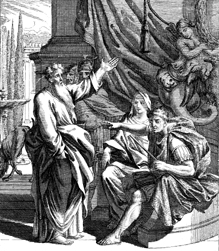
Felix and Drusilla - Johann Christoph Weigel
Paul before Felix and Drusilla - J.C.Weigel
TODAY'S SPECIAL: Mark 13:1-13

TO CHEW ON: "'But watch out for yourselves, for they will deliver you up to councils, and you will be beaten in the synagogues. You will be brought before rulers and kings for My sake, for a testimony to them .... But when they arrest you and deliver you up, do not worry beforehand, or premeditate what you will speak. But whatever is given you in that hour, speak that; for it is not you who speak, but the Holy Spirit'" Mark 13:9,11.

Jesus' prophetic words in Mark 13 always make me squirm a little. False Christs, wars and war rumors, earthquakes, famines, and troubles are bad enough but beatings and jail time for believers too?

However when I read this passage closely, it sinks in why—to give rulers and kings an opportunity to accept Jesus: "You will be brought before rulers and kings for My sake for a testimony to them." Believers will be brought before these government officials to tell their stories and relay the good news that Jesus died for them too.

[Testimony (marturion) means proof, evidence, witness, proclamation of personal experience. Compare "martyr" and "martyrology" - Dick Mills, Word Wealth, New Spirit-Filled Bible, p. 1837.]

Don't you hear Jesus' heart beating with love for all people,  His attitude of "...not willing that any should perish but that all should come to repentance" (2 Peter 3:9)? He wants to reach even secular rulers for whom the most convincing testimony may be the witness of someone arrested because of belief in Jesus.

Mark 13:11 tells us why it is so important to keep clear our connection with God the Holy Spirit. For when you or I have a chance to speak and the communication lines between God and us are open, He can 'feed' the words to say to those needy lost rulers, or any lost soul—words straight from the heart of God—through our mouths.

Suddenly such a possible arrest and incarceration become a privilege!

PRAYER: Dear God, too often I see my circumstances through my desire for life to be safe, comfortable and stress-free rather than through Your eyes of love for every person. Please change my point of view. Amen.  

MORE: Example of Paul
The apostle Paul is a great example of someone God used in this way. As a result of his arrest some of the rulers he gave his testimony to were:
  • Governor Felix (Acts 24:10-22)
  • Felix's wife Drusilla (Acts 24:24,25)
  • Festus (Acts 25:6-12)
  • King Agrippa and Bernice (Acts 25:23-26:32)

********
Unless otherwise noted all Scripture quotations are taken from the New King James Version®. Copyright © 1982 by Thomas Nelson, Inc. Used by permission. All rights reserved.


Bible Drive-Thru


Wednesday, November 04, 2015

All is not as it appears

The Widow's Mite by Harold Copping
TODAY'S SPECIAL: Mark 12:34-44

TO CHEW ON:
"'Beware of the scribes … who devour widows' houses …. Assuredly I say to you that this poor widow has put in more than all those who have given to the treasury.'" Mark 12:38,40,43

In our reading in Mark today the message seems to be "Watch out—all is not as it appears." Jesus has just had a discussion with a scribe who got it right (Mark 12:32-34). But for the most part, these religious leaders were in Jesus' bad books because of their pretentious behavior (long robes, effusive greetings, going after the best seats). Their elevated place in society was permission, it seemed, for doing things that were downright evil (preying on the most vulnerable—widows).

It's no mistake that the person Jesus next drew the disciples' attention to was a widow—the very class that the scribes oppressed. Jesus watched her give her pittance into the treasury and then said, " '… this poor widow has put in more than all those who have given to the treasury' " - Mark 12:43.

How so? She only gave 2 mites (the smallest coin in circulation).

Because proportionately it was more. It was her all. Perhaps she was one of those widows whose house had been devoured by a scribe. Whatever the reason for poverty and despite her poor clothes and low status her heart was right and she stayed generous toward God.

This incident has lessons for us.
  • Let's not let social custom or status blind us to wrongdoing—our own or someone elses.
  • Let's examine our behaviors for pride and a desire to be seen doing the right things, in the right places, so that we're welcomed and cultivated by the right people.
  • Let's remember, though people can be fooled, God can't. Just as Jesus saw through the behavior of the scribes and widow, He sees down into us  and understands us even better than we understand ourselves.

PRAYER: Dear Jesus, please help me to know myself, to become aware of my own devious attempts at showing off and getting honor, to understand how repulsive these things are to You. Amen.

 *********
Unless otherwise noted all Scripture quotations are taken from the New King James Version®. Copyright © 1982 by Thomas Nelson, Inc. Used by permission. All rights reserved.


Tuesday, November 03, 2015

Heaven's out-of-the-box life

Golden pier at sunset
Photo courtesy Pixabay.com
TODAY'S SPECIAL: Mark 12:18-34

TO CHEW ON:
" 'He is not the God of the dead, but the God of the living. You are therefore greatly mistaken.' " - Jesus, Mark 12:27


Continuing on with the theme of resurrection and the resurrected life, in our passage today we read of the Sadducees (who didn't believe in a resurrection) trying to trip up Jesus. They posed a situation (based on Deuteronomy 25:5-10) to which there was no resurrection-consistent answer—at least that was their hope.

Jesus turned their question into an exposure of their mistaken thinking by answering with Scripture (a bit from the Pentateuch—something they did believe in). He took them back to the story of the burning bush, where God said to Moses, "'I am the God of Abraham, the God of Isaac, and the God of Jacob' " (Exodus 3:6,16). Of course by Moses' time, Abraham, Isaac, and Jacob were long dead. Yet God said "I am…" (present tense) their God now. Therefore, Jesus reasoned, they were not dead but existing in some post-dead, resurrected state, for "He is not the God of the dead but the God of the living."

Jesus' answer to these Sadducees, in addition to affirming that there is such a thing as resurrection, gives us another little glimpse behind the scenes into the afterlife—a glimpse that is both revealing and mysterious. The writer of my Bible's notes says:
"It is erroneous to think of heaven in terms of earth. Life in heaven will not be an extension of the present temporal existence. The power of God will provide for new and greater relationships that transcend the physical relationships of the present order" - J. Lyle Story, study notes, New Spirit-Filled Life Bible, p. 1332.

This bit "Life will not be an extension of the present temporal existence" got me hunting for more details about heaven's out-of-the-box life. Here are some things I found:
  • We won't be in marriage relationships but like the angels (from our passage - Mark 12:25).
  • Death will no longer exist - Isaiah 28:5; 1 Corinthians 15:54.
  • God will be the panacea to all the sorrow, crying, and pain we may feel on our arrival and banish those things forever after - Revelation 21:4.
  • Inhabitants of heaven will have transformed bodies - Philippians 3:21.
  • People "… of all nations, tribes, peoples and tongues" will be there, praising God - Revelation 7:9.
  • There won't be night there or the need of physical light-producing stars like the sun - Revelation 22:5.
  • In heaven, we'll see earth's trials and hardships in true perspective - 2 Corinthians 4:17; Ephesians 1:18.
  • We will be with Jesus (John 14:3), see His glory (John 17:24) and contribute to it (Matthew 13:43; Romans 8:17).

There are probably more but I'm sure you get the picture.

So today, when you and I are tempted to let the realities of this life get us down, let's remember to meditate on the future and our post-earth life, till we can identify with Paul who said: "For I consider that the sufferings of this present time are not worthy to be compared with the glory which shall be revealed in us" - Romans 8:18.
 

PRAYER: Dear Jesus, I long for the time when the things I've listed above are fact. "Even so, come Lord Jesus." Amen.

 *********
Unless otherwise noted all Scripture quotations are taken from the New King James Version®. Copyright © 1982 by Thomas Nelson, Inc. Used by permission. All rights reserved.


Related Posts Plugin for WordPress, Blogger...