Showing posts with label grace. Show all posts

Monday, December 24, 2018

Humiliation

TODAY'S SPECIAL: Luke 2:11-17

TO CHEW ON: "'For there is born to you this day in the city of David a Savior, who is Christ the Lord. And this will be the sign to you: You will find the Babe wrapped in swaddling cloths, lying in a manger.*'" Luke 2:11,12

*"Feed trough" is how my Bible footnotes "manger." It's a bassinet painted with animal drool, and decorated with cobwebs. What a contrast - Savior, Lord — lying in a manger! This is a sign indeed.

But it is consistent. For throughout His life, Jesus' trademark association was with  humble things:
  • He spoke easily and graciously with women, even socially despised ones (John 4:5-7; John 8:2-11).
  • He ate with tax collectors and sinners (Mark 2:13-17).
  • He taught the dignity and worth of the poor, humble, needy state (Matthew 5:2-12, 11:29; Luke 9:58)
  • He welcomed and blessed children (Mark 10:13-16).
  • He washed His disciples feet (John 13:5).
  • He was "numbered with the transgressors" (Luke 22:37) when He was "crucified..." and, as if that way of death was not bad enough, "between two robbers" (Matthew 27:38).

I have two reactions:

1. Amazement, that the exalted, all-powerful, all-knowing Creator of heaven and earth chose to identify with us in this way. The contrast is almost inconceivable.

2. Gratitude. Paul expresses that the reasons for our thankfulness so eloquently in 2 Corinthians 8:9.
"You are familiar with the generosity of our Master, Jesus Christ. Rich as he was, he gave it all away for us—in one stroke he became poor and we became rich" MSG.

PRAYER:
 Dear Jesus, thank You for coming to earth and in such a  humble way. No one of us needs to feel You can't identify with our lowness, for You came into the poorest situation. Help me reflect the value You modeled, of looking past the outer appearances to the inner worth of every person. Amen.


MORE: "Who is He in Yonder Stall?" - sung by the Collingsworth Family


*************
Unless otherwise noted all Scripture quotations are taken from the New King James Version®. Copyright © 1982 by Thomas Nelson, Inc. Used by permission. All rights reserved.

Scripture quotations marked MSG are taken from The Message. Copyright © 1993, 1994, 1995, 1996, 2000, 2001, 2002. Used by permission of NavPress Publishing Group.

Thursday, November 15, 2018

Revealing speech

Image: Pixabay.com
TODAY’S SPECIAL: Ephesians 3-4; Psalm 9

TO CHEW ON: “Let no corrupt word proceed out of your mouth, but what is good for necessary edification, that it may impart grace to the hearers.” Ephesians 4:29

Paul sets out a high standard for how a Christian should act in everyday life in Ephesians 4. In verse 29 he talks particularly about speech. There are three parts to his advice:

1. What speech should not be: “Let no corrupt word proceed out of your mouth…”

[
“Corrupt” (sapros) means rotten, putrefied, of poor quality, bad, unfit for use, worthless.]

The Amplified Bible spells out quite clearly what such corrupt speech sounds like: “Let no foul or polluting language, nor evil word, nor unwholesome or worthless talk [ever] come out of your mouth…” - Ephesians 4:29 AMP.

This says to me that certain words, some humor, and certainly unkindness and viciousness toward others (gossip, slander) are inappropriate.

2. What speech should be:
“…good for necessary edification…”

“… but only such [speech] as is good and beneficial to the spiritual progress of others as is fitting to the need and the occasion…” (AMP).

This says to me that helpful speech comes out of knowing the need of the person you’re talking to, out of empathy, and out of an awareness of the spiritual dimension of the situation. Good speech builds up rather than discourages.

3. What speech should accomplish: “… impart grace to the hearers.”  
“… that it may be a blessing and give grace (God’s favor) to those who hear it” AMP.

[“Grace” (charis) is that which affords joy, pleasure, delight, sweetness, charm, loveliness, grace of speech, good will, loving-kindness, favor.]

Of course behind all speech is the mind/heart of the speaker. Jesus’ words (“‘…For out of the abundance of the heart the mouth speaks’” - Luke 6:45) remind us that at its root, speech is a heart issue.

If we’re finding the above speech standards difficult or impossible to uphold, maybe our energy would be best spent looking at and dealing with what’s in our hearts.

PRAYER: Dear Jesus, please help me to see speech problems as symptoms of a heart that needs Your touch. Amen.

PSALM TO PRAY: Psalm 9

 *********
Unless otherwise noted all Scripture quotations are taken from the New King James Version®. Copyright © 1982 by Thomas Nelson, Inc. Used by permission. All rights reserved.

Scripture quotations marked AMP are taken from the Amplified® Bible,
Copyright © 1954, 1958, 1962, 1964, 1965, 1987 by The Lockman Foundation
Used by permission." (www.Lockman.org)

Thursday, November 08, 2018

The upside-down grace of giving

TODAY'S SPECIAL: 2 Corinthians 7-8; Psalm 2

TO CHEW ON: "...they gave themselves to the Lord, and then to us by the will of God." 2 Corinthians 8:5

Giving could be considered one of those upside-down realities of the Kingdom of Heaven. Though it seems contradictory to think our enjoyment of life will increase when we give away the things that we own (supposedly meant to enhance our enjoyment in life), that's what Paul seems to be implying here.

I see six aspects of giving in our reading today:

1. Giving can be a powerful movement.
The Macedonian Christians, though persecuted and poor, gave willingly and beyond their means to be a part of the churches' generosity to the Jerusalem churches (2 Corinthians 8:1-4).

2. Carefree giving is rooted in belonging to God (2 Corinthians 8:5).

3. Giving is a "grace" that proves mere words of loyalty and love (2 Corinthians 8:6,7).

4. Jesus was our shining example of giving when He left behind the riches of heaven to give up the most valuable thing He had—His life—so we could be rich (2 Corinthians 8:9).

5. Good intentions and yesterday's promises are not enough. We need to finish the giving we've begun (2 Corinthians 8:10-11).

6. Giving should be realistic (2 Corinthians 8:12-14).

I can relate to several of these.
  • I know how good it feels to be part of a 'giving' event. There is something uplifting, energizing and unifying in participating with others to support a noble cause.
  • It's no surprise that giving is called a grace. Don't we call generous people 'gracious'?
  • I easily fall into the category of giver with mere good intentions, or the one who doesn't give because my small gift doesn't seem important.
  • But Paul's point about the Macedonians being able to give so generously because they gave themselves to God first resonates with me the most. The thought of me being God's dependent takes away the anxiety of fending for myself. It changes my outlook so that I can go from being a collector of things to a distributor of them—from a dam to a channel if you will. I need more of this attitude in my life. What about you?  

PRAYER:
Dear God, help me to see that as Your dependent, you will take care of my needs. Help me to be open-handed with not only my money and possessions, but also with my time, energy and love. Amen.  

PSALM TO READ: Psalm 2

MORE: Hoarders

The opposite of givers are hoarders. If you've ever watched the depressing reality show called Hoarders: Buried Alive, you will have seen the pathological end of someone who can't bear to get rid of stuff or give anything away. It proves the deceitfulness of the lie we so often live by—that life consists in the abundance of things we have.

*****************
Unless otherwise noted all Scripture quotations are taken from the New King James Version®. Copyright © 1982 by Thomas Nelson, Inc. Used by permission. All rights reserved.

Thursday, October 04, 2018

Heaven's surprising kingdom

Crown of thorns
Crown of thorns - Image from RGBStock.com
TODAY'S SPECIAL: Luke 21-22; Psalm 119:97-128

 TO CHEW ON: " 'And I confer on you a kingdom, just as my Father conferred one on me, so that you may eat and drink at my table in my kingdom.' " Luke 22:29,30


Jesus talks a lot about His kingdom (also referred to as the Kingdom of Heaven and the Kingdom of God). In His teaching and parables about it, we discover some interesting things.
  • Here we see that it doesn't operate by society's usual rules of prominence. Its prominent ones are those who distinguish themselves, not by their sophistication and worldly wisdom but by their "youngest" qualities. I take that to mean their complete, innocent, and unquestioning faith.
  • They are also willing to serve (Luke 22:26).
  • The kingdom is not fair but unfair in the wonderful way of elevating those who, by the class and status into which they're born, aren't candidates for elevation. Jesus confers entry into and prominence in the kingdom. It's a gift (Luke 22:29).
In other places Jesus gives more clues about His kingdom:
  • Luke 14:15 describes more unlikely kingdom recruits. It's not who we would expect but the poor, crippled, blind, and lame; all those who respond to the Master's invitation.
  • In Matthew 25:34+, Jesus describes the unusual way its makeup will be determined. He talks of a day "When the Son of Man comes in his glory"  (Matthew 25:31) as a day of sorting when He'll admit those who, unbeknownst to them, passed the kingdom's entry test by their compassion on earth (Matthew 25:35,36).
  • In 2 Timothy 2:12 the kingdom is given to those who "endure."

Though we are probably well familiar with these descriptions of the Kingdom, we do well to ask ourselves, have we internalized them? Does knowing them change our behavior?

Or, despite what we read in the Bible and hear expounded from the pulpit and elsewhere, will we still be surprised when, someday, we see the answer to what we've prayed thousands of times: "Your kingdom come..."?

PRAYER: Dear Jesus, You've left us with plenty of information about your kingdom—which is already and which we hope to see in its fullness someday. Help me to order my life here on earth by its principles. Amen.

PSALM TO PRAY: Psalm 119:97-128


********
Unless noted otherwise, all Scriptures quoted in this meditation are taken from THE HOLY BIBLE, NEW INTERNATIONAL VERSION®, NIV® Copyright © 1973, 1978, 1984, 2011 by Biblica, Inc.® Used by permission. All rights reserved worldwide.


Wednesday, September 26, 2018

Jesus woos us

Jesus Preaches from a Ship - Alexandre Bida
Jesus Preaches from a Ship - A. Bida
TODAY'S SPECIAL: Luke 4-5; Psalm 114

TO CHEW ON:
"So when they had brought their boats to land, they forsook all and followed Him." Luke 5:11


It's fascinating to watch Jesus woo the disciples (who were not yet disciples) in this passage.

His popularity with the crowd needed a bit of a stage that provided both visibility and distance. A boat would be just the thing. He chose Simon's (Peter's), asked him to interrupt his net-washing and "put out a little from the land" and taught the crowds from there.

Imagine being the one from whom this upstart asked such a favor. I wonder, did Peter feel annoyed that Jesus just commandeered his boat for several hours, or honored and flattered?

It didn't end there, though. After the teaching session, Jesus turned His attention from the crowds to the boat owner. He told Peter to move to deep water and start fishing. Peter, probably still smarting from the previous unsuccessful night, started to argue but then changed his mind and did as Jesus said.

A great miraculous catch followed. "They" (Peter and probably his brother Andrew) got help from partners James and John to haul in the multitudes of fish. At Jesus' next words "'Do not be afraid. From now on you will catch men,'" Peter was completely smitten. He (and his partners) "...brought their boats to land, they forsook all and followed Him" - Luke 5:11.

I would love to have interviewed Peter and asked him, what was going on in his mind and heart that synchronized with Jesus' actions and words to cause this life change in him.

Perhaps he was wondering how he could continue looking after his family's needs with such unpredictable fishing luck. Jesus had just showed him His supernatural power in that department.

Perhaps he'd been wishing, all his life, to live for something bigger and had for some time been questioning the usefulness of what he was doing. Jesus told him he would "catch men." Peter may not have completely understood, but would surely have been intrigued.

We don't know. But we do know that on that particular day in Peter's life, Jesus ticked all the boxes and the decision to follow Him was easy.

On listening to people's stories of how they come to Jesus, I've noticed something similar. Jesus woos us in different ways. Sometimes it's through unaccountable blessing. Sometimes it's via an inner search for more purpose and meaning. Sometimes Jesus is the last option to stop a downward spiral that, if something doesn't change, will lead to destruction.

Let's pray for friends, colleagues, and loved ones who have yet to meet Jesus, that He will continue to work His wooing ways in their lives and that they will respond like Peter did.

PRAYER:
Dear Jesus, I see how You won Peter and his crew over in a few well-timed interventions and actions. Please continue to work that way in the lives of my loved ones who don't know You. Amen. 

PSALM TO PRAY: Psalm 114

The Bible Project VIDEO: Luke ch. 3-9 (Gospel of Luke series)


*********
Unless otherwise noted all Scripture quotations are taken from the New King James Version®. Copyright © 1982 by Thomas Nelson, Inc. Used by permission. All rights reserved.


Tuesday, September 25, 2018

Jesus—blessed child

The boy Jesus - Artist unknown
TODAY'S SPECIAL: Luke 2-3; Psalm 113

TO CHEW ON: "And the child grew and became strong in spirit, filled with wisdom and the grace of God was upon Him." Luke 2:40

Day eight of Jesus' life brought Joseph and Mary, with Jesus, to the temple in Jerusalem to perform the purification rites for Mary (Leviticus 12:2-8) and present Jesus, their firstborn male, to God (Exodus 13:2).

It was a day of ritual—and surprises when two elderly people came to them at separate times, prophesied over, and blessed Jesus. Mary and Joseph marveled over Simeon's predictions (Luke 2:29-31) and Anna's referring to their baby as a redeemer (Luke 2:38). No doubt Simeon's blessing addendum, about their baby's divisive destiny that would lead to a sword piercing Mary's own soul, was disturbing.

How reassuring to read, then, after all this was over and life settled down again, that Jesus "… grew and became strong in spirit, filled with wisdom; and the grace of God was upon Him."

This verse witnesses to His humanity and his normal development as a child:

  • "He grew..." Luke 2:52 tells us He "… increased in wisdom and stature…"
  • "...and became strong in spirit..." 
The phrase "strong in spirit"  used in the NKJV is not included in all versions. But that very phrase is used of Jesus' relative John the Baptist (Luke 1:80). I like its inclusion. It portrays Him as a physically healthy and spirited, perhaps strong-willed child—in a good way, of course. 
  • "...filled with wisdom..."  
[Sophia: broad and full of intelligence; the varied knowledge of things human and divine, acquired by acuteness and experience, extreme intelligence such as belongs to God.]

Wayne Gruden reminds us that " … he went through a learning process just as other children do—he learned how to eat, how to talk, how to read and write, and how to be obedient to his parents (see Hebrews 5:8). This ordinary learning process was part of the genuine humanity of Christ" - Wayne Grudem, Systematic Theology, p. 533.
  • "… and the grace of God was upon Him."  
[CharisGoodwill, lovingkindness, favor; that which affords pleasure, delight, sweetness, charm, loveliness, grace of speech.]

Perhaps this "grace" was evident in how life treated Him, how well-liked He was, how easily He learned, how easy He was to get along with. No doubt the qualities of charis (sweetness, charm, loveliness, grace of speech) also emanated from Him.

I love to imagine what Jesus must have been like as a youngster—dark, curly hair, olive skin, lively eyes, with a quick mind and sharp intelligence, full of questions, probably surprising and delighting His parents with funny and wise observations.

Reading how Jesus' childhood turned out, I don't think it's surprising to admit we want something similar for our own children and grandchildren. Let's turn this description of His blessed growing-up years into a prayer for our own little ones.

PRAYER: Dear Jesus, as You did, may the little ones in my life grow, become strong in body and spirit, be filled with wisdom and have God's grace upon them in every way. Amen.

PSALM TO PRAY: Psalm 113

The Bible Project VIDEO: Luke ch. 1-2 (Gospel of Luke mini-series)


*********
Unless otherwise noted all Scripture quotations are taken from the New King James Version®. Copyright © 1982 by Thomas Nelson, Inc. Used by permission. All rights reserved.


Tuesday, October 10, 2017

Second-chance Aaron

Worshiping the Golden Calf - Artist unknown
TODAY'S SPECIAL: Exodus 32:1-18

TO CHEW ON: "And he received the gold from their hand, and he fashioned it with an engraving tool and made a moulded calf. Then they said, 'This is your god, O Israel, that brought you out of the land of Egypt.' " Exodus 32:4


The difference between the brothers Moses and Aaron shows up in stark contrast in the incidents of the exodus. While Moses repeatedly stood firm against the multitude, his older brother Aaron was more of a people pleaser.

In our story today, he offered not a whisper of resistance to the people's demand for a new god. In fact, the calf statue seems to have been his idea. (The irony is that even as this was playing out, God was dictating to Moses the details of Aaron's priestly uniform - Exodus 28:1-12.)

Another time when Aaron and Miriam insisted that they were God's mouthpieces as much as Moses was, God struck Miriam with leprosy but spared Aaron. Some commenters suggest this was because she was the instigator and Aaron the influenced.

Still, God never put Aaron aside but continued to use him despite his character flaws and failures. When the Levite Korah questioned Aaron's high priestly position, God confirmed His choice of Aaron with censer fire that did not kill and a budding rod (Numbers 16 & 17).

We can take encouragement from Aaron's life. Even if, like him, we've blown it, with God there are second chances—though there may also be consequences to pay (in the Golden Calf incident, thousands died - Exodus 32:28; Miriam and Aaron's rebellion led to Miriam getting leprosy - Numbers 12:10-16).

Asaph's psalm does a good job of describing our God of second, third, and fourth chances:
"But He, being full of compassion,
forgave their iniquity,
And did not destroy them.
Yes, many a time He turned His anger away,
And did not stir up all His wrath;
For He remembered that they were but flesh,
A breath that passes away and does not come again." - Psalm 78:38,39.

PRAYER:
Dear God, thank You for mercy toward my weaknesses and grace in forgiving sins and giving me more than one chance. Amen.

 *********
Unless otherwise noted all Scripture quotations are taken from the New King James Version®. Copyright © 1982 by Thomas Nelson, Inc. Used by permission. All rights reserved.

Sunday, September 24, 2017

Labor negotiations

TODAY'S SPECIAL: Matthew 20:1-16

TO CHEW ON: " ' Is it not lawful for me to do what I wish with my own things? Or is your eye evil because I am good?' " Matthew 20:15

Jesus, master storyteller that He was, created the problem in His parable by structuring it the way He did. The all-day workers would probably not have argued about their pay if they'd been paid first. But, alas, they were paid last after they saw the latecomers get the same amount they had agreed to work for. And so they expected more.

The takeaway from this story comes in the last two verses, where the landowner addresses his discontented servants. He makes several points.

- His money is his to do with as he likes. If we take the landowner to be God, we can see this is an affirmation of His sovereignty. He is sovereign over Earth and what happens on it.

- His generosity (goodness) with his late-coming workers brings out the envy/outrage (evil) in his all-day servants: " ' Is your eye evil because I am good?' "

- The "laws" of the kingdom of heaven (those principles by which it operates) are different than the kingdom of this world: " ' So the last will be first, and the first last. For many are called, but few chosen.' "

Several points rise out of this for our own self-examination:
  • God's sovereignty is great when we understand it. But like these discontented servants, it's easy to question what He's doing when we don't. We grapple with things as small as perceived unfairnesses to the old question: "Why do bad things happen to good people?" This brings us to our own interchanges with God like Job's:
GOD: " 'Would you indeed annul My judgment? 
Would you condemn Me that you may be justified?' " - Job 40:8.
JOB: 'I know that You can do everything,
And that no purpose of Yours can be withheld from You.

You asked, ‘Who is this who hides counsel without knowledge?’
Therefore I have uttered what I did not understand,
Things too wonderful for me, which I did not know
' " - Job 42:2-3
(emphasis added).

  • God's goodness underlies everything He does. When we get that stained deep into the grain of our belief, we'll find fewer occasions to gripe. The fact that we can even expect a reward at all is grace. "The parable affirms that God is absolutely sovereign and gracious in granting rewards. Those who serve Him can trust His grace" - J. Lyle Story, commentary on Matthew, New Spirit-Filled Life Bible p. 1327.

  • The kingdom of heaven never ceases to surprise. Let's continue to explore its "laws of gravity" and live according to them, even as we continue to walk this earth.


PRAYER:
Dear Jesus, thank You for Your sovereignty and goodness.  Help me to learn and apply these principles of Your kingdom as I continue to live and work on Earth.

 *********
Unless otherwise noted all Scripture quotations are taken from the New King James Version®. Copyright © 1982 by Thomas Nelson, Inc. Used by permission. All rights reserved.


Saturday, May 27, 2017

Beautiful humility

Image: Pixabay
TODAY’S SPECIAL: 1 Peter 5:1-14

TO CHEW ON:
“… Yes, all of you be submissive to one another, and be clothed with humility, for ‘God resists the proud / But gives grace to the humble.’” 1 Peter 5:5 (the quote is Proverbs 3:34)


Genuine humility has to be one of the most attractive qualities a person can possess.

The word “humble” serves as both an adjective and a verb. Its noun form is “humility.”

[Humble means - Adjective: not proud or arrogant but modest; having a feeling of insignificance; low in rank, importance or status; courteously respectful. Verb: to lower in condition, importance, or dignity; to make meek.]

A partial list of synonyms for humble helps us understand what humility feels like and how we communicate humility through actions: content, courteous, deferential, gentle, lowly, mild, modest, obliging, polite, quiet, respectful, sedate, simple, soft-spoken, submissive, unostentatious, unpretentious.

Aside from the fact that humility makes us attractive to others, it is also desirable because it is hugely attractive to God.
  • God “regards” the lowly (Psalm 138:6) “…For though the Lord is high yet has He respect to the lowly bringing them into fellowship with Him” - Psalm 138:6 AMP.
  • He will look “… on him who is poor and of a contrite spirit” - Isaiah 66:2
  • We are great in God’s eyes when we welcome the “least” person, e.g. a child - Luke 9:48.
  • Humility sets us up to be exalted by God while pride sets us up for divine humiliation - Luke 14:11; James 4:10.
  • God “gives grace” to the humble - Jame 4:6 and our focus verse, 1 Peter 5:5.

As we contemplate who God is and compare with who we are, humility is the only rational response. May we take this realistic sense of ourselves into the day, and more … may humility pervade our lives.

PRAYER: Dear Father, help me to see myself realistically and respond with appropriate humility. Amen.

 *********
Unless otherwise noted all Scripture quotations are taken from the New King James Version®. Copyright © 1982 by Thomas Nelson, Inc. Used by permission. All rights reserved.

Scripture quotations marked AMP are taken from the Amplified® Bible,
Copyright © 1954, 1958, 1962, 1964, 1965, 1987 by The Lockman Foundation
Used by permission." (www.Lockman.org)


Thursday, March 30, 2017

Crookedness—it's in our genes

TODAY'S SPECIAL: Psalm 130:1-8

TO CHEW ON: "If you, Lord, should mark iniquities, O Lord who could stand?" Psalm 130:3


Iniquities is an old-fashioned word we don't often use in everyday talk. However, the psalmist uses it here to tell us an uncomfortable fact about ourselves that remains true even if we no longer use the word. According to a word Wealth article in my Bible:

[Iniquities - (avon) means evil, fault, sin, iniquity, guilt, blame, moral illness, perversion, crookedness. It's derived from avah which means to bend or distort. Thus iniquity is the "evil bent' within human beings or the "crooked" direction or "warped" deeds of sinners - Dick Mills, Word Wealth, New Spirit-Filled Life Bible, p. 788.]

Think about that for a bit as it relates to us. No matter how our society tries to downplay that evil bent, even contradict it, have we not seen that sneaky self inside who wants its own way (selfishness), goes after honor and attention (pride), secretly desires the biggest and best (greed), yearns to have the stuff and good fortune of others (covetousness), etc.?

Cain used the word iniquity way back in the beginning when he said, after killing his brother in a jealous rage, "My punishment (iniquity) is greater than I can bear" - Genesis 4:13. That would be the reaction of each one of us—too much to bear.

What is the solution to this inborn natural tendency to be crooked? It's not in us. But it is with God:

"There is forgiveness with You," says the psalmist here (Psalm 130:4)

Isaiah makes it clear that forgiveness is in a specific person, the Suffering Servant, the Messiah—Jesus:
"He was bruised for our iniquities … and the Lord has laid on Him the iniquity of us all … For He shall bear their iniquities" - Isaiah 53:5, 6, 11.

What a gift of grace for us to ponder and give thanks for as we approach Good Friday and Easter when we commemorate Jesus' death. He carried all our iniquities on the cross. With that act God was able to forgive and our iniquity is no longer held against us as a death-worthy crime.

PRAYER: Dear God, thank You for Your forgiveness, rooted in Your substitutionary atonement on the cross. Amen.

 *********
Unless otherwise noted all Scripture quotations are taken from the New King James Version®. Copyright © 1982 by Thomas Nelson, Inc. Used by permission. All rights reserved.


Saturday, March 11, 2017

Grace that stretches over centuries

Cross, against sun and reflection on water
TODAY'S SPECIAL: Romans 4:1-12

TO CHEW ON: "For what does the Scripture say? 'Abraham believed God, and it was accounted to him for righteousness.' " Romans 4:3


In his typically logical style, Paul sets out here to show how Abraham's and David's faith and God's grace and forgiveness combined to guarantee their salvation even though they lived millennia before Christ.

It wasn't works, Paul says using Genesis 15:6 as his proof text. Wages for work would be considered a debt, not a tally on the grace side as this is (Romans 4:4).

The work under consideration is circumcision. But Abraham believed before he was circumcised. Circumcision was only a sign of his faith, implemented later to mark those who were of his faith line (Romans 4:9-11). Some who weren't circumcised also had this faith (Romans 4:12)

It was faith. The column accounted for righteousness in the ledger of a life was faith in God's forgiveness says Paul, quoting David from Psalm 32:1,2. It was God forgiving, covering, not imputing committed sins to our account.

The implication for his readers—including us—is that salvation comes to us this way too. It is all grace flowing from Jesus' death for us. It flows back through the centuries to believers like Abraham and David, and forward to us. Our faith is in Christ and His death in our stead, which means our sins that should condemn us to death are similarly forgiven, covered, not imputed to our account.

I believe only eternity will bring home to us the immensity and blessedness of this truth.

PRAYER: Dear God thank You for your plan of salvation, enacted in a moment of time, but with efficacy for all people who have ever lived. Amen.

 *********
Unless otherwise noted all Scripture quotations are taken from the New King James Version®. Copyright © 1982 by Thomas Nelson, Inc. Used by permission. All rights reserved.


Tuesday, January 10, 2017

No barriers

Cornelius - Acts 10 (Artist unknown)
Cornelius - Artist unknown
TODAY'S SPECIAL: Acts 10:30-48

TO CHEW ON: "And those of the circumcision who believed were astonished, as many as came with Peter, because the gift of the Holy Spirit had been poured out on Gentiles also." Acts 10:45.


Here Peter is at the house of Cornelius, a Roman centurion. Under ordinary circumstances that's the last place you'd expect to find him. But on this day, after seeing a vision and being summoned by Cornelius's servants because of his vision (Acts 10:9-16 & 3-7), he is convinced that this is a divine mission.

He has just finished explaining about Jesus and how "'… whoever believes in Him will receive remission of sins'" when it happens: "… the Holy Spirit fell upon all those who heard the word" - Acts 10:44.

How do they know? They hear them speak with tongues and magnify God, just as it had happened on the day of Pentecost for Peter and the believers in that upper room (Acts 10:46).

The incredible thing to these onlookers (the Jewish "brethren from Joppa" who went with him - Acts 10:23) is that God has bestowed Himself on Gentiles in this way. It blows their idea of God's plan all to pieces.

Even Peter who earlier linked Joel's prophecy ("I will pour out My Spirit on all flesh - Joel 2:28) with the initial out-pouring of the Spirit  (Acts 2:16-21) seems taken aback. But he is open to affirming this paradigm shift. For he suggests that there's no reason why these new believers can't be baptized (Acts 10:47).

In our day after a couple thousand years of living with the idea of the Gentiles included in God's plan, the incredulity of these early Jewish believers seems almost humorous. But I would submit we still have, in our minds, some Jew-Gentile-type barriers.  These aren't based on race but other things like intelligence, education, the lifestyle a person has lived or the sins he or she has committed.

Does God really call, forgive, save everyone? Can the Holy Spirit indwell and empower someone who is mentally challenged? Someone with minimal education (who, say, can't even read)? What about the person who comes to Jesus after having a sex change, or is a repentant thief, pornographer, or child serial killer?

Whatever barriers we have erected towards some of these groups, the Bible doesn't support them. It tells us over and over, God's grace is for everyone.

  • "Look to Me and be saved, All you ends of the earth…" Isaiah 45:22.
  •  "Ho! Everyone who thirsts, Come to the waters …" Isaiah 55:1.
  • "… as many as you find, invite to the wedding" - Matthew 22:9.
  • "'If anyone thirsts, let him come to Me and drink'" - Jesus in John 7:37.
  • "For there is no distinction between Jew and Greek for the same Lord over all is rich to all who call upon Him" - Romans 10:12.
  • "… who desires all men to be saved" - 1 Timothy 2:4.
  • "Whoever desires let him take the water of life freely" - Revelation 22:17.

PRAYER: Dear God, thank You for Your invitation to ALL. Help me to demolish any barriers I might have toward people of any kind. May I see them all as candidates to receive Your saving grace and the Holy Spirit. Amen.


***********

 Unless otherwise indicated, all scripture quotes are taken from the New King James Version (NKJV) Used with permission. The Holy Bible, New King James Version Copyright © 1982 by Thomas Nelson, Inc.

Monday, December 19, 2016

When grace is our teacher

"Christ and His Disciples by Rembrandt

TODAY'S SPECIAL: Titus 2:1-15

TO CHEW ON: "For the grace of God that brings salvation has appeared to all men, teaching us that denying ungodliness and worldly lusts, we should live soberly, righteously and godly in the present age." Titus 2:11-12


We are all to some degree products of our education. Many a life has been put on track by the words and actions of an encouraging teacher. Our reading today tells us that God's grace also teaches us. What does it teach?

First, we are to deny certain things:
- ungodliness [asebeia is a lack of reverence and regard for God.]

- worldly lusts. Lust [epithumia] is a strong desire and intense craving for something. Worldly lusts would include things like the "gratification of sensual cravings, desiring the forbidden, longing for evil, coveting what belongs to someone else, and striving for things, persons, and experiences contrary to the will of God" - New Spirit-Filled Life Bible, p. 1713.

Instead we are to live:
- soberly [sophronos that is "act in a responsible manner, sensibly, prudently, being in self-control and in full possession of intellectual and emotional faculties" - New Spirit-Filled Life Bible, p. 1721]

- righteously [dikaios meaning properly as is right, agreeable to the law of right.]

- godly [eusebos that is piously with our actions set in motion by reverence for God.]

What impresses me about Paul's interpretation of God's grace teaching us is how much our will is involved. Right attitudes don't just fall into place or come over us. We choose to deny [arneomai - disregard, reject] certain mind-sets and actions, and to intentionally cultivate or live [zao - breathe, be among the living, be active in] others.

Living this way is not some unpleasant heavy duty but a ticket to freedom. Leslyn Musch explains it well:

"God's grace teaches us to do good works not to earn salvation, but because we are free from sinful behaviors and free to do good things for God. This is the privilege and inheritance of God's people and not a harsh law to be followed and fulfilled. Holy living is the response of God's chosen and special people to the redeeming love and immeasurable grace of Jesus Christ" - Leslyn Musch, "Truth-In-Action through Titus, New Spirit-Filled Life Bible, p. 1723 (emphasis added).

PRAYER: Dear God, please help me to deny impulses within me to take You lightly and to gratify my selfish and worldly cravings. Help me to choose the sober, righteous, and godly response to the circumstances of my life today. Amen.

**************
Unless otherwise noted all Scripture quotations are taken from the New King James Version®. Copyright © 1982 by Thomas Nelson, Inc. Used by permission. All rights reserved.


Bible Drive-Thru

Saturday, December 10, 2016

Some things life has taught me

TODAY'S SPECIAL: Philippians 4:10-23

TO CHEW ON: "I know how to be abased and I know how to abound. Everywhere and in all things I have learned both to be full and to be hungry, both to abound and to suffer need." Philippians 4:12 (emphasis added)

As an elderly, life-worn man, Paul was schooled by a variety of experiences and states. So are you. So am I. Here are some of the things life has taught me:

1. What you fill your mind with is important.
This principle is always important and is underlined for me each time I am bedridden by illness or sidelined with an injury. Years ago during a difficult pregnancy, I spent many hours on the living room couch and found myself immersed in a Christian book about dealing with the occult. A pastor who came to pray for me saw the book and gently admonished, "That might not be the best reading material for you right now."

A few months later, when I was again out of commission, I determined to read something more uplifting. J. I. Packer's Knowing God proved to be the perfect mind food for someone longing to understand God during a difficult event. I still recall that time as one of intimacy with God and spiritual growth. Philippians 4:8 contains a list of wholesome mind-fillers.

2. Do things now, not later.
If you're prompted to work ahead on assignments with a distant deadline, don't put it off with "There's still lots of time." You have no idea how much time you really have.

What happened in the spring of 2014 before I went to visit family members in northern B.C. reinforced that for me. Before I left home, I worked ahead on all the deadlines I knew about. Then halfway through my time away I broke my hip. Was I ever glad I had obeyed those promptings to work ahead! "… these things do, and the God of peace will be with you" - Philippians 4:9.

3. Remember, "No condition is permanent."
I mull over these words of a former pastor whenever I am in a stressful, uncomfortable, wish-this-were-over place. In the meantime, I try to practice contentment - Philippians 4:11.


4. It is important to finish jobs.
I've learned this from quitting difficult things a few times. The instant gratification of quitting is never worth the long-term erosion in self-esteem and self-confidence. Rather, I need to continue to take Philippians 4:13 as my motto: "I can do all things through Christ who strengthens me."

What has life taught you?

PRAYER: Dear God, please help me to live by the principles of Your word and to recognize Your grace for me in each circumstance. Amen.

 *********
Unless otherwise noted all Scripture quotations are taken from the New King James Version®. Copyright © 1982 by Thomas Nelson, Inc. Used by permission. All rights reserved.

Tuesday, October 25, 2016

Would you exclude someone from Jesus?

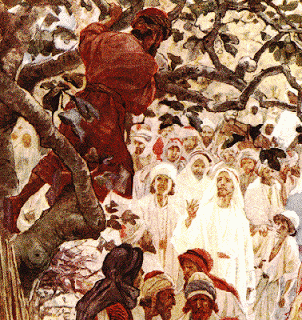
Zacchaeus and Jesus - Luke 19:1-10
TODAY'S SPECIAL: Luke 19:1-10

TO CHEW ON: "But when they saw it, they all complained, saying, 'He has gone to be a guest with a man who is a sinner.'" Luke 19:7

Zacchaeus did not have the crowd on his side. Who were these citizens that surrounded Jesus and complained (murmured, grumbled, muttered) about Him inviting Himself to Zacchaeus's house for a meal?

"This very inclusive statement 'they all' shows the general intensely Jewish spirit of the age, narrow and sectarian. The people could not imagine goodness, or earnestness, or generosity in one who served the hateful Roman power. Probably in priestly Jericho this stern exclusive spirit was especially dominant" - Pulpit Commentary.

We think bad things of the crowd who would deny someone access to Jesus. But are we so different?

How do we feel, in our heart of hearts, when someone living in sin, or rich, or on the wrong side of our theological fence gets an obvious dose of God's grace? Perhaps they get an answer to prayer (even though they pray the wrong way), or more blessing (when they are already too blessed, in our estimation), or they talk about interacting with God (even though they're living in sin).

Don't we have some of the same murmuring thoughts as this crowd: "He has gone to be a guest with a man who is a sinner"? Don 't we too want God to abide by our miserly sense of the way His economy should work, and demand a down payment of repentance and change before He extends His grace?

Meanwhile, we forget that He gave us grace while we were still in our Prodigal Son pigpen clothes. And we have no clue what big changes are happening even now with these "sinners" and Jesus behind closed doors.

PRAYER:
Dear Jesus, thank You for demonstrating Your extravagant love for sinners by how You treated Zacchaeus. Help me to have a spirit of generous grace to everyone. Amen.

***********
 
New King James Version (NKJV) Used with permission. The Holy Bible, New King James Version Copyright © 1982 by Thomas Nelson, Inc.

Bible Drive-Thru

Thursday, September 08, 2016

The potent tongue

Image: Pixabay.com
TODAY'S SPECIAL: James 2:18-3:12

TO CHEW ON:
"For we all stumble in many things. If anyone does not stumble in word, he is a perfect man, able also to bridle the whole body." James 3:2

In our reading, James uses some picturesque speech to illustrate the potency of the tongue. He likens the tongue to:

- A bit - that small piece of metal put in a horse's mouth. Attached to reins it is the bit that makes it possible to turn a horse to go in one direction or another - James 3:3.

- A ship's rudder - that movable appendage at the bottom of a ship that steers its course in the water - James 3:4.

- A hellish fire that "sets on fire the course of nature and it is set on fire by hell" - James 3:6.

- A confused spring that sends out "fresh water and bitter from the same opening" - James 3:11.

- An impossible tree that yields both figs and olives - James 3:12.

I don't know about you, but I have tongue problems. I'm not the perfect (wo)man who doesn't stumble in word.

How to do better? Here are some scriptural pointers:
  • Speak less, with more thought, suppress passion, "bridle" the tongue and thus control the whole body - Proverbs 17:27; and our focus verse - James 3:2.
  • Speak simply and truthfully - Matthew 5:37.
  • Speak with grace having the "salt" of the gospel in mind - Colossians 4:6; Ecclesiastes 10:12.
  • Pattern our speech on Jesus—His love and our faith in Him - 2 Timothy 1:13.
  • Speak encouragement and inspiration - Ecclesiastes 12:11.
  • Speak words of comfort - Isaiah 50:4.
  • Guard our mouths from speech that corrupts (curses, dirty jokes, lying etc.) - Ephesians 4:29.

I'm sure this will continue to be a lifelong project!

PRAYER: "Let the words of my mouth and the meditation of my heart be acceptable in Your sight, O LORD" - PSALM 19:14.

 *********
Unless otherwise noted all Scripture quotations are taken from the New King James Version®. Copyright © 1982 by Thomas Nelson, Inc. Used by permission. All rights reserved.


Wednesday, June 15, 2016

Law-living—so yesterday

Image: Pixabay.com
TODAY'S SPECIAL: Galatians 3:6-25

TO CHEW ON:
"What purpose then does the law serve?" Galatians 3:19


Paul attempts to dissuade the Galatians from reverting back to living by the Jewish law. His argument includes some facts about the law. Embedded in those facts are ways that the law is inferior to faith.

1. The law makes us aware of sin (without giving us a way to deal, finally, with sin). I love how clearly the Amplified puts it: "It (the Law) was added—later on, after the promise, to disclose and expose to men their guilt…" - Galatians 3:19 AMP.

2. It was given by angels and Moses
(while faith came through the "Seed," Jesus). The Amplified again: "…and [the Law] was ordained through angels and delivered to Israel by the hand of a mediator [Moses, the mediator between God and Israel, to be in effect] until the Seed would come to whom the promise had been made" - Galatians 3:19 AMP.

3. The law was complementary to the promises of God, not contrary to them. Though it couldn't give life, it led to Jesus fulfilling it and offering His life in our stead - Galatians 3:21,22.

4. Paul pictures the law as a set of rules that has people under arrest, in jail to sin, guarded by the law, which no one could ever completely live up to:  "But the Scripture has imprisoned everyone [everything—the entire world] under sin..." Galatians 3:22 (AMP); " But before faith came, we were kept under guard by the law" - Galatians 3:23 NKJV.

5. The law is also a tutor or trainer
to prepare its adherents for full privileges as sons: "Therefore the law was our tutor to bring us to Christ..."  Galatians 3:24

What do these things have to do with us who have never struggled with the pressure of living under the Jewish law? Some things that come to mind:
  • Viewing the Galatians' struggle between law-based versus faith-based righteousness helps us understand God's plan and His gradual revealing of it.
  • The contrast between law vs. faith helps us appreciate the immensity of what Christ did on the cross.
  • The comparison between the two also gives us an understanding of how living by faith is better than living by law.
  • We are warned of the danger of getting enslaved by any set of laws.

I love the way Paul concludes his thought, one verse beyond today's prescribed reading: "For you are all sons of God through faith in Christ" - Galatians 3:26.

By faith we're not guilty and helpless to change, not jailed as prisoners to a set of rules we can never fulfill, not  students under discipline and training, but have the privileges of family, called God's very sons (and daughters)!

PRAYER: Dear Father, help me understand at a life-level how Your death and resurrection has set me free from earning my salvation by fulfilling any set of law requirements. Amen.

 *********
Unless otherwise noted all Scripture quotations are taken from the New King James Version®. Copyright © 1982 by Thomas Nelson, Inc. Used by permission. All rights reserved.

Scripture quotations marked AMP are taken from the Amplified® Bible, Copyright © 1954, 1958, 1962, 1964, 1965, 1987 by The Lockman Foundation. Used by permission." (www.Lockman.org)


Tuesday, June 14, 2016

Don't slip back into legalism

Image: Pixabay.com
TODAY'S SPECIAL: Galatians 2:15-3:5

TO CHEW ON: "'For if I build again those things which I destroyed, I make myself a transgressor.'" Galatians 2:18

It's easy for us to slip back into legalistic ways if we have been brought up under a legalistic system. Our reading today is Paul's reasoning against that.

In the first part, Paul repeats to the Galatians what he said to Peter and other apostles (Galatians 2:14-21). It is the argument he made in Jerusalem for justification (appearing pure before God—"just as if I had never sinned") by faith, not by keeping the law (Galatians 2:16).

Then he addresses the Galatians directly about their tendency to do the same thing: "O foolish Galatians! … Did you receive the Spirit by the works of the law, or by the hearing of faith?" (Galatians 2:1,2).

I love how Leslyn Musch sums up this principle in the "Truth-In-Action Through Galatians" article in my Bible. Under the title "The Walk of Faith" she writes:
"Faith accepts God's testimony in a trusting, childlike manner and salvation as a free gift. The Law was given to lead us to Christ; thus any use of the Law as a means of earning our salvation is a distortion. By nature mankind presumes to seek salvation by works. It seems offensive to the flesh to believe we cannot. But God's word says it is an offense to Him to believe we can" - New Spirit-Filled Life Bible, p. 1641.

And so Paul would say to us, who feel in our heart of hearts that God loves us more and accepts us on the basis of what we do and how we live—No.
 "Tell me this one thing: did you receive God's Spirit by doing what the Law requires or by hearing the gospel and believing it? How can you be so foolish! You began by God's Spirit; do you now want to finish by your own power? " - Galatians 3:2,3 (GNT).

Let's not rebuild for ourselves and others the legalistic structures of our time—church attendance, financial giving, time spent in fasting and prayer, amount of serving and ministry we do, etc.,—as ways to gauge how well we and they are living the Christian life and how much we're pleasing God and earning His love. For it's all a gift:

"Saving is all his idea, and all his work. All we do is trust him enough to let him do it. It’s God’s gift from start to finish! We don’t play the major role. If we did, we’d probably go around bragging that we’d done the whole thing! No, we neither make nor save ourselves. God does both the making and saving. He creates each of us by Christ Jesus to join him in the work he does, the good work he has gotten ready for us to do, work we had better be doing" - Ephesians 2:8-10 (MSG) emphasis added.  

PRAYER: Dear Jesus, thank You for paying the complete price for my salvation. Help that my motivation for living in ways You condone arises from my love for You and the realization that Your ways are designed for my best present and future. Amen.

 *********
Unless otherwise noted all Scripture quotations are taken from the New King James Version®. Copyright © 1982 by Thomas Nelson, Inc. Used by permission. All rights reserved.

Scripture quotations marked GNT are from the Good News Translation® (Today’s English Version, Second Edition). Copyright © 1992 American Bible Society. All rights reserved.


Scripture quotations marked MSG are taken from The Message. Copyright © 1993, 1994, 1995, 1996, 2000, 2001, 2002. Used by permission of NavPress Publishing Group.


Friday, April 15, 2016

Grace to believe

Traditional Jewish man (Image: Pixabay.com)
TODAY'S SPECIAL: Zechariah 12:1-14

TO CHEW ON: "And I will pour on the house of David and on the inhabitants of Jerusalem the Spirit of grace and supplication; then they will look on Me whom they pierced. Yes, they will mourn for his only son and grieve for Him as one grieves for a firstborn." Zechariah 12:10


In her 2015 memoir Love Triangles, Bobbie Ann Cole (a British-born Jew who recognizes Jesus as Messiah) tells the story of her sojourn in Israel where she, with her Gentile husband decided to become citizens. (For her it was called making aliyah.)

However, the cloud over the whole experience was the fact that she felt she had to hide her belief in Jesus as Messiah in order to be accepted. Though in public speeches the Prime Minister lauded Israeli democracy and tolerance, she knew of many Messianic Jews who experienced nothing but roadblocks in their attempts to become Israeli citizens. Her conclusion: "The nation whose vision I heartily embraced had a policy of waging war on Jewish believers like me" - Love Triangles, Kindle Location 1898.

The prophecy in our today's reading predicts a time when there will be a change, not only in Israel's political position from besieged to besieger (Zechariah 12:6), but also its spiritual position from rejection to acceptance of "… Me whom they pierced …"  (Zechariah 12:10).

"Me whom they pierced" sounds like Jesus.

How will this change take place? Through an outpouring of "the Spirit of grace and supplication." A sidebar article in my Bible explaining the word grace says:

"God's grace poured out upon Jerusalem enables them to look longingly and beseechingly toward their pierced King. God's grace will result in Israel's seeing Jesus as someone of infinite beauty" - Dick Mills, New Spirit-Filled Life Bible, p. 1261.

I would submit that God's grace is necessary to open the eyes of not only Jewish people but Gentiles as well concerning who Jesus is, what He did, and its personal significance. Let's pray for God to pour on all our unbelieving loved ones this "Spirit of grace and supplication" even as we continue to pray for currently beleaguered Jerusalem and its peace (Psalm 122:6).

PRAYER: Dear Father, Help me to never overlook the necessity of the wooing of Your Spirit to draw people to Jesus. I pray that He will be active in the lives of my loved ones who don't recognize Jesus for who He is and what He did. Amen.

 *********
Unless otherwise noted all Scripture quotations are taken from the New King James Version®. Copyright © 1982 by Thomas Nelson, Inc. Used by permission. All rights reserved.


Sunday, January 03, 2016

The softer side of God

TODAY'S SPECIAL: John 1:1-18

TO CHEW ON:  “The law was given through Moses, but grace and truth came through Jesus Christ.”  John 1:17


Suppose you read only the Old Testament part of the Bible. What picture of God would you have? Someone who is stern, sometimes angry, and jealous? You would be right. Because under the Law, God’s justice, righteousness and holiness were especially evident. And He was and is still those things today.

However, when He enfleshed Himself in Jesus, He showed us that He has a soft side too. His unbending truth is combined with grace.

[Grace - charis: from joy and rejoice. “It is the word for God’s grace as extended to sinful man. It signifies unmerited favor, undeserved blessing, a free gift.” (Word Wealth – NKJV – New Spirit Filled Life Bible).

Truth - aletheia: the opposite of fictitious, feigned or false. “It means veracity, reality, sincerity, accuracy, integrity, truthfulness, dependability, propriety.” ((Word Wealth  – New Spirit Filled Life Bible).]

These are God-qualities that Jesus lived out before us. When we see Him healing twisted limbs and blind eyes, raising sons and brothers from the dead, straightening backs, staunching blood flows, and taking the punishment for our sins, we see the grace side of God.

When we see Jesus exposing the past of a Samaritan woman and a man stuck by a pool, confronting temple merchants and hypocritical Pharisees, putting Satan and the disciples in their place, and taking the punishment for our sins, we see the truth side of God.

Aren’t you glad that God didn’t end His revelation of Himself with the Old Testament? Our picture of Him would be so different. So when God seems stern, distant, even unapproachable, look at Jesus. Though He never glosses over or bends the truth about you, He still wraps you in His grace.


PRAYER: Dear Lord, help me to live today in the light of Your truth and the warmth of Your grace. Amen
MORE: Hear Fernando Ortega sing “Give Me Jesus."


**********
Unless otherwise noted all Scripture quotations are taken from the New King James Version®. Copyright © 1982 by Thomas Nelson, Inc. Used by permission. All rights reserved.

Related Posts Plugin for WordPress, Blogger...