Showing posts with label resurrection. Show all posts

Monday, December 03, 2018

Milk vs. solid food

TODAY'S SPECIAL: Hebrews 5-6; Psalm 27

TO CHEW ON: "For everyone who partakes only of milk is unskilled in the word of righteousness, for he is a babe. But solid food belongs to those who are full of age that is, those who by reason of use have their senses exercised to discern both good and evil." Hebrews 5:13,14

What does the writer of Hebrews mean by "milk" and "solid food"? Where do you and I fit in this picture? Are we milk Christians, or do we eat solid food?

The writer gives us a clue when he talks about milk-requiring Christians as those who still haven't come to accept the "first principles" of the faith  (Hebrews 5:12) and again  refers to "elementary principles"  in Hebrews 6:1,2 where he goes on to name those six principles—the foundation on which faith is to be built. They are:

1. Repentance from dead works (see also Hebrews 9:14).
2. Faith toward God (John 3:16 comes to mind).
3. Baptism (see Acts 19:35).
4. Laying on of hands (some examples: Acts 8:17 and 19:6 where "laying on of hands" preceded people receiving the Holy Spirit; Acts 6:6 where it accompanied the commissioning of men for a special assignment).
5. Resurrection of the dead  (Acts 17:31).
6. Eternal judgment (Acts 24:25).

I ask myself, do I have a problem with / argue about / try to rationalize away any of these foundation stones of the faith? Because if I do, the writer would probably consider me a milk-limited Christian too.

On the other hand a "solid food" Christian is one builds a life of obedient practice ("...those who by reason of use have their senses exercised to discern both good and evil") upon this foundation.

PRAYER:  Dear God, please help me to settle any issues I have with the basics, so I can go on to live a life of maturity and usefulness in Your kingdom.

PSALM TO PRAY: Psalm 27

***************
Unless otherwise noted all Scripture quotations are taken from the New King James Version®. Copyright © 1982 by Thomas Nelson, Inc. Used by permission. All rights reserved.

Sunday, November 18, 2018

The upward call

Image: wdietz / pixabay.com
TODAY'S SPECIAL: Philippians 3-4; Psalm 12

TO CHEW ON: "Not that I have already attained or am already perfect, but I press on, that I may lay hold of that for which Christ Jesus has also laid hold of me." Philippians 3:12

For those of us who believe God has a plan and purpose for each individual life, this is an interesting verse to puzzle over and explore. It sounds like Paul here is striving ("press on") to  understand ("lay hold of") that destiny, purpose, or life work for which God "laid hold of" him (love the wordplay!).

Don't we all want to discover the same thing? Why did God draw me to Himself yet leave me on this earth? How am I meant to spend my time here?

Pressing toward the goal of the resurrected life


A question we ask as we begin to slice and dice this verse is, what is Paul referring to when he says, "Not that I have already attained" - Philippians 3:12? To what has he not attained?

A hint of what he is striving to attain is found in Philippians 3:11: "… if by any means I may attain to the resurrection of the dead."

He seems to be telling us he hasn't attained to the resurrection of the dead (obviously, because he's not dead) but also, if we read further on, that to a point this resurrected life can be realized in this life ("Nevertheless to the degree that we have already attained…" - Philippians 3:16) though the real essence of it is to come ("For our citizenship is in heaven, from which we also eagerly wait for the Savior … who will transform our lowly body…" etc. Philippians 3:20,21). So he appears to be striving, as much as possible, to live the resurrected life during his mortal life.

How to make progress toward that goal


Paul goes on to list some things he does to make progress toward the goal of living the resurrected life here on earth:

  • He leaves the past behind - Philippians 3:13.
  • He keeps the goal in mind, that final goal of getting "the prize of the upward call of God in Christ Jesus." In other words, receiving God's commendation for fulfilling the destiny for which he was saved - Philippians 3:14.
  • He works for unity with fellow Christians - Philippians 3:15,16.
  • He seeks to live what he preaches, i.e. set an example that others can follow - Philippians 3:17.
  • He reminds himself of his real citizenship - Philippians 3:20.

In the light of today's passage I ask myself, what is my goal? What is yours? Some earthly glory or perk, comfort or pleasure? Or does it involve some of the things Paul dreams of: God's "Well done"? The resurrection life future, and present? And what does how we live say about the goals we really have (not just claim to have)?


PRAYER:
Dear God, please tattoo permanently into my spirit the truth of my identity and destiny in You. Help me begin living out the resurrected life here on earth. Amen

PSALM TO PRAY: Psalm 12

 *********
Unless otherwise noted all Scripture quotations are taken from the New King James Version®. Copyright © 1982 by Thomas Nelson, Inc. Used by permission. All rights reserved.


Sunday, November 04, 2018

Sound of the trumpet

TODAY'S SPECIAL: 1 Corinthians 15-16; Psalm 148

TO CHEW ON: "Behold I tell you a mystery: We shall not all sleep, but we shall all be changed—in a moment, in a twinkling of an eye, at the last trumpet. For the trumpet will sound, and the dead will be raised incorruptible, and we shall be changed." 1 Corinthians 15:51,52

Trumpets played a big role in Hebrew life. They were made or improvised of various materials and served a variety of uses.

One kind of trumpet was what we call a shofar and fashioned out of a ram's horn. Another type was made of beaten silver on God's instruction. Others were improvised from bones, shells or made from other metals: bronze, copper, and gold as well as silver.

These trumpets were not musical instruments in the sense that they couldn't play different pitched notes. But they could play their one note in legato, staccato and trills, and thus convey complicated signals. In this way they were used as communication.

Only Aaron and his Levite descendants were to sound the two silver trumpets God commissioned (Numbers 10:1-10).
  • When both trumpets sounded together all the congregation was to assemble at the tabernacle. If only one trumpet sounded only the leaders and heads of divisions were to meet.
  • Another trumpet sound was that of alarm, as the Israelites went into war: "When you go to war … then you shall sound an alarm with the trumpets, and you will be remembered before the LORD your God, and you will be saved from your enemies" - Numbers 10:9. What an aural reminder of where their trust and hope for help lay!
  • A more common use of trumpets was to get the people moving during their forty years in the wilderness. For this the trumpet sounded an advance to signal which parts of the camp were to set out on their journey (Numbers 10:5,6).

Paul in 1 Corinthians 15 explains how Jesus' resurrection makes possible our resurrection too. It will be heralded by a trumpet sound. What will that sound be to us?

Will it be the summons to assemble?

Will it be the call to advance to a new body, in a new place?

Or will it be the call of alarm, and judgment (Revelation  8 & 9) as we find ourselves on the wrong side? It doesn't have to be that. It can be the sound or victory if we trust in Jesus: "But thanks be to God who gives us the victory through our Lord Jesus Christ" - 1 Corinthians 15:57.

PRAYER: Dear God, may all of us be ready and anticipating Your victory-over-death trumpet sound! Amen.

PSALM TO PRAY: Psalm 148

MORE: 1 Corinthians in Handel's Messiah (The Trumpet Shall Sound)

Handel dipped often into 1 Corinthians 15:42-58 when he wrote the Messiah. He put to music:


  • 1 Corinthians 15:54b, also Isaiah 25:8 in "Then shall be brought to pass" and 1 Corinthians 15:55-56, also Hosea 13:14 in "O death, where is thy sting?" (Choruses 49 & 50).

***********

The Holy Bible, New King James Version Copyright © 1982 by Thomas Nelson, Inc. - Used with permission.

Friday, October 05, 2018

Burning hearts

"The disciples at Emmaus"
 - Alexandre Bida

The Disciples at Emmaus - Alexandre Bida
TODAY'S SPECIAL: Luke 23-24; Psalm 119:129-152

TO CHEW ON: "And they said t one another, 'Did not our heart burn within us while He talked with us on the road, and while He opened the Scriptures to us?'" Luke 24:32

The story of the travelers meeting Jesus on the road to Emmaus is one of my favourites. Perhaps it's because I see myself in those sight-restrained disciples. I've often wondered, why did they not recognize Him?

Perhaps Jesus' physical look had changed. We read the stories of other people not recognizing Him either (Mary Magdalene John 20:14; the disciples - Luke 24:36-37). He was the last person they expected to meet on that journey. And our reading says, "their eyes were restrained" suggesting that there was also a supernatural aspect to their blindness. (God operates, even in the smallest details, in the fullness of time.)

Then, after they had walked, talked, and listened to Jesus explain the Scriptures and convinced Him to eat with them, He went through those familiar motions: "… He took bread, blessed and broke it, and gave it to them…" Luke 24:30. They had seen this exact ritual before—at the feeding of the 5,000 (Matthew 14:19), the feeding of the 4,000 (Mark 8:6) and the last supper (Matthew 26:26). What a wonderful thing for which to be recognized!

Jesus left after that. It seems His purpose was not to hang out with them in the way He had before. That time was over. Now they simply needed to know He was alive and how the events that had just taken place fulfilled prophecy.

After he left, the disciples recalled and recognized their reaction to Jesus on the road: "…'Did not our hearts burn within us?'…" Henri Nouwen describes how Jesus may come to us in the same way:

"Jesus joins us as we walk in sadness and explains the scriptures to us. But we do not know that it is Jesus. We think of him as a stranger who knows less than we do of what is happening in our lives. And still—we know something, we sense something, we intuit something: our hearts begin to burn. At the very moment that he is with us we can't fully understand what is happening. We can't speak about it to each other. Later, yes, later, when it is all over, we might be able to say, 'Did not our hearts burn within us as he talked to us on the road and explained the scriptures to us?' But when he walks with us it is all too close for reflection" - Henri Nouwen, With Burning Hearts, p. 50.

PRAYER: Dear Jesus help me to recognize Your voice. Thank You for the witness of a burning heart. Please stir up the coals to a hotter fire. Amen.

MORE: Inner fire


  • Jesus came to ignite inner fire - Luke 12:49.
  • It is kindled by meditation, and bursts into speech - Psalm 39:3.
  • It is fed by fellowship with Jesus - Luke 24:32.
  • The light in our hearts is a reflection of "the glory of God in the face of Christ" - 2 Corinthians 4:6.
  • That inner fire makes it impossible not to speak - Jeremiah 20:9.

"So they rose up that very hour and returned to Jerusalem …. And they told about the things that had happened on the road, and how He was known to them in the breaking of bread" - Mark 24:33,35.

PSALM TO PRAY: Psalm 119:129-152

The Bible Project VIDEO: Luke Ch. 24 (Luke Mini-series)


***********

The Holy Bible, New King James Version Copyright © 1982 by Thomas Nelson, Inc. - Used with permission.


Tuesday, April 24, 2018

Your dead shall live

Tombstones
Image courtesy Pixabay.com
TODAY'S SPECIAL: Isaiah 23-27; Psalm 114

TO CHEW ON:
"Your dead shall live;
Together with my dead body they shall arise.
Awake and sing, you who dwell in dusk;
For your dew is like the dew of herbs,
And the earth shall cast out the dead." Isaiah 26:19


Bible commenters view Isaiah 26:19 with its reference to the dead living again in several ways.

- Spiritual Resurrection
My Thompson Chain Bible links this passage to the topic of "Spiritual Resurrection." So does the Asbury Bible Commentary: "Isaiah 26:19 is an oracle of salvation, a shout of joy that the dead will live. There will be a national restoration (this is similar to Ezekiel's prophecy concerning the dry bones and is not a reference to individual resurrection."

- Bodily Resurrection

My Bible's notes view it as referring to a bodily resurrection: "Dead shall live: The resurrection of the righteous dead affirms the hope of eternal life." The Reformation Study Bible says something similar: "The Old Testament expresses faith in the resurrection of the body since death is an invasion of God's created order." (RSB accessed through biblegateway.com.)


Does it really matter which it is? I don't think so because a spiritual resurrection—a born again experience as Jesus called it—is the beginning of what the Bible calls eternal life which includes a physical resurrection: "The future event of finally being raised to glory with Jesus Christ" - Dictionary of Bible Terms.
Let's camp for a bit on the Bible promise that our bodies will be resurrected.
- It is the hope of psalmists
"But God will redeem my soul from the power of the grave,
For He shall receive me" - Psalm 49:15.

"You, who have shown me great and severe troubles,
Shall revive me again,
And bring me up again from the depths of the earth" - 71:29.

- Hosea describes release from death in terms of freedom from a kidnapper
"I will ransom them from the power of the grave;
I will redeem them from death.
O Death, I will be your plagues!
O Grave, I will be your destruction!" - Hosea 13:14.

John recalls Jesus' words about death and resurrection. He said:
- The dead would respond and come alive at His voice:"'Most assuredly, I say to you, the hour is coming, and now is, when the dead will hear the voice of the Son of God; and those who hear will live'"  - John 5:25. 

- He said said of every one who believes in Him: "I will raise him up at the last day" - John 6:40. 
- Resurrection is promised through belief in Him:"Jesus said to her, 'I am the resurrection and the life. He who believes in Me, though he may die, he shall live' " John 11:25.

Paul describes the coming resurrection in interesting detail:
 "For the Lord Himself will descend from heaven with a shout, with the voice of an archangel, and with the trumpet of God. And the dead in Christ will rise first" - 1 Thessalonians 4:16.

In Revelation, John talks about the extent of this resurrection: 

" The sea gave up the dead who were in it, and Death and Hades delivered up the dead who were in them. And they were judged, each one according to his works" - Revelation 20:13.

What an event to look forward to! No wonder the "Resurrection" listing in the Dictionary of Bible terms includes the topics:"The resurrection as an incentive to godliness and perseverance" and "The resurrection as an incentive to endurance and suffering."

Let's keep this hope—this promise—of resurrection in mind as we ride the waves of life, and especially as we say goodbye to those we love who die in the Lord. How wonderful to know that our earthly goodbyes are not final farewells!

PRAYER:
Dear God, help me to cling to Your promise of resurrection through the ups and downs of my earthly life.

PSALM TO PRAY: Psalm 114

 *********
Unless otherwise noted all Scripture quotations are taken from the New King James Version®. Copyright © 1982 by Thomas Nelson, Inc. Used by permission. All rights reserved.


Friday, December 15, 2017

Come Desire of All Nations

Wise men worshiping Jesus - William Hole
TODAY'S SPECIAL: Haggai 2:1-9

TO CHEW ON: "For thus says the Lord of hosts: once more (it is a little while) I will shake the heaven and earth, the sea and dry land. And I will shake all nations and they shall come to the Desire of All Nations, and I will fill this temple with glory, says the Lord of Hosts." Haggai 2:6-7

Imagine having a clear sense, on a particular day, that God wants to use your tongue for His message. That seems to have been Haggai's experience "on the seventh month, on the twenty-first of the month." Thanks to his cooperation, we have his words to ponder these many years later.

As we read his prophetic message, we get the sense of double, perhaps multiple fulfillments. Some of these predictions came true shortly after Haggai's time, some were for a time in the distant future and some for the end of time. Even in our short  focus passage we see this.

"And I will shake heaven and earth, the sea and dry land. And I will shake all nations" (vs. 6-7) brings to mind passages we have recently read about the great end-of-earth disturbances Jesus predicts in Matthew 24:7,29.

"..and they shall come to the Desire of All Nations ..."(vs. 7) sounds Messianic. It reminds us of Jesus coming to earth as a baby and how representatives of the earth's nations came to Bethlehem to honour Him as King (Matthew 2:1-12).  But there is also a future picture here—one we see in John's vision (Revelation 7:9-10).

"… and I will fill this temple with glory"
is a prophecy that also has multiple fulfillments.

It was fulfilled in a sense when Haggai's contemporaries completed the temple and worship resumed there.

Jesus interpreted "temple" on several levels: the actual building standing in Jerusalem and His own body. His double meaning led to Him making controversial statements like  "'Destroy this temple and in three days I will raise it up' " (John 2:19)— claims which eventually became part of the case that ended in His crucifixion (Mark 15:48; Matthew 26:61) and his body-temple being changed to one of resurrected glory.

My Bible's introduction to Haggai explains how this is also a prophecy  for the future:
 "… what God will do in the new temple will one day gain international attention. After an upheaval among the peoples of the Earth, the nations will be drawn to the temple to discover that they had been looking for: the One whom all the nations have desired will be displayed in splendour in the temple. The presence of this One will cause the memory of Solomon's glorious temple to fade so that only Christ's glory remains…" Sam Middlebrook, New Spirit-Filled Life Bible, p. 1241.

As we celebrate the coming of the Desire of All Nations to earth as a baby, let's not lose hope in the fulfillment of the parts of Haggai's prophecy that have yet to be realized.

PRAYER: Dear Desire of All Nations, thank You for coming as a baby. We look forward to the day You return in glory and bring peace. Amen.

 *********
Unless otherwise noted all Scripture quotations are taken from the New King James Version®. Copyright © 1982 by Thomas Nelson, Inc. Used by permission. All rights reserved.


Saturday, October 14, 2017

The death of death

TODAY’S SPECIAL: Isaiah 25:1-9

TO CHEW ON: “He will swallow up death forever. And the Lord God will wipe away tears from all faces. The rebuke of His people He will take away from all the earth; for the Lord has spoken. Isaiah 25:8

Death is a subject that brings up a variety of responses in people.

  • As much as possible we avoid thinking or talking about it:
“Death is a distant rumor to the young.” ~ Andy Rooney

“We say that the hour of death cannot be forecast, but when we say this we imagine that hour as placed in an obscure and distant future. It never occurs to us that it has any connection with the day already begun or that death could arrive this same afternoon, this afternoon which is so certain and which has every hour filled in advance.” ~Marcel Proust
  • We try to take the sting out of it by making it poetic:
“Our death is not an end if we can live on in our children and the younger generation. For they are us, our bodies are only wilted leaves on the tree of life.” ~Albert Einstein
  • We call it by other names:
“After all, to the well-organized mind, death is but the next great adventure.” ~J.K. Rowling
“Death is a delightful hiding place for weary men.” ~Herodotus
  • We make fun of it:
“Death is caused by swallowing small amounts of saliva over a long period of time.” ~Attributed to George Carlin
  • But its reality sinks in when someone we love dies:
“We understand death for the first time when he puts his hand upon one whom we love.” ~Madame de Stael
  • Its inevitability is one of life’s truisms…
“No one can confidently say that he will still be living tomorrow.” ~Euripides
“Death is the surest calculation that can be made.” ~Ludwig Büchner, Force and Matter
“You can be a king or a street sweeper,
but everybody dances with the Grim Reaper.” ~Robert Alton Harris

OR IS IT SO INEVITABLE?

Isaiah, in our reading today, predicts a time when death will no longer exist. Jesus’ resurrection from the dead is beginning of that coming true for all of us.

H. C. Thiessen in his Systematic Theology's discussion of the importance of Christ’s resurrection says, “It is important as a polemic for miracles….in attempting to prove the miracles of the Bible, we should not begin with Balaam’s ass or Jonah and the big fish but with Christ’s resurrection.” H. C. Thiessen, Lectures in Systematic Theology p. 332.

This is what we celebrate at Easter–Jesus alive again after He was dead, a miracle! When everything else – all the laws of nature and our experience say that death is inevitable for everyone who lives, Jesus broke those laws when He came to life again.

The results of the resurrection are many:*

 
1. It proves that Christ is really God - Romans 1:3-4.
2. Through Jesus' death we are saved; through His risen life we are reconciled to God - Romans 5:9-10.
3. God demonstrated his power through the resurrection and made Christ the head of the church - Romans 8:34
4.The resurrected Jesus prays and intercedes for us - 1 Timothy 2:5; Romans 8:34.
4. Because He rose and ascended into heaven we have the Holy Spirit - Acts 2:33
5. Because He rose, we have power for life and service - Ephesians 1:18-20.
6. And His resurrection is a guarantee that we will live again as well. That's why we can say goodbye to our loved ones who know the Lord with hope. That's why we can die (because we still do die) without fear - 1 Corinthians 15:20-23.

No wonder we will gladly relinquish all our earthly sadnesses when He wipes the tears from our eyes.

PRAYER: Dear Jesus, Thank You for the hope that Your resurrection gives me. Please give me boldness to share it with a skeptical world. Amen.


*These points also taken from my trusty old Systematic Theology book – which has it way more together than I do!

***********
Unless otherwise noted all Scripture quotations are taken from the New King James Version®. Copyright © 1982 by Thomas Nelson, Inc. Used by permission. All rights reserved.

Sunday, April 23, 2017

Breath of new life

Resurrected Jesus and His disciples - Artist Unknown
TODAY'S SPECIAL: John 20:19-31

TO CHEW ON: "And when He had said this, He breathed on them, and said to them, 'Receive the Holy Spirit.'" John 20:22

Jesus breathing on the disciples brings to mind another time God breathed on a man: "And the Lord God formed man out of the dust of the ground, and breathed into his nostrils the breath of life" - Genesis 2:7.

God as the source and sustainer of our human breath (life) is a theme that flows through the Bible (e.g. Job 33:4; Ecclesiastes 3:19; Acts 17:25). But even in the Old Testament there are inklings of a new quality of life ahead.

Isaiah 42 is a Servant Song (a prophetic reference to Jesus) where God, the giver of physical life (Isaiah 42:5) speaks of the Servant doing a "new thing." He will be a "… light to the Gentiles / To open blind eyes / To bring out prisoners from the prison…" - Isaiah 42:7.

God speaking to Ezekiel in the Valley of Dry Bones vision says, "Surely I will cause breath to enter into you and you shall live" - Ezekiel 37:5.

Them comes Jesus. He tells Nicodemus it is necessary to receive Him and being reborn (John 1:12-13), and that that rebirth is necessary to see the kingdom of God (John 3:3).

And here we see Him performing the very act—breathing on the disciples—that God had performed when He created the first man to give him physical life. My Bible's footnote to his verse explain it simply: "The old creation began with the breath of God; now the new creation begins with the breath of God the Son" Siegfried Schatzmann (notes on John), New Spirit-Filled Life Bible, p. 1480.

Has Jesus breathed on you? Have you been reborn of the Spirit in this way? Here's how Jesus explained it to Nicodemus:
"Jesus said, 'You’re not listening. Let me say it again. Unless a person submits to this original creation—the ‘wind-hovering-over-the-water’ creation, the invisible moving the visible, a baptism into a new life—it’s not possible to enter God’s kingdom. When you look at a baby, it’s just that: a body you can look at and touch. But the person who takes shape within is formed by something you can’t see and touch—the Spirit—and becomes a living spirit'"  - John 3:5-6 - The Message.

PRAYER: Dear God, thank You for this life that You breathed into me when I accepted to You. Help me to let the life of Your Spirit have access to all of me. Amen.

MORE: More about the new life:
  • It makes us a new creation - 2 Corinthians 5:17.
  • It is not achieved through our works but by God's mercy - Titus 3:5.
  • Our hope is a living hope because of Jesus' resurrection - 1 Peter 1:3.
  • This life is visible and obvious to others by the way we love people - 1 John 4:7; 5:1.

***********

The Message (MSG) Copyright © 1993, 1994, 1995, 1996, 2000, 2001, 2002 by Eugene H. Peterson - Used with permission.

The Holy Bible, New King James Version Copyright © 1982 by Thomas Nelson, Inc. - Used with permission.

Bible Drive-Thru


Sunday, April 16, 2017

Do not fear!

Image: Pixabay

TODAY'S SPECIAL: Matthew 28:1-15

TO CHEW ON: "But the angel answered and said to the women, 'Do not be afraid'.... Then Jesus said to them, 'Do not be afraid...'" Matthew 28:5,10

So often in the Bible, the first words heaven speaks when it encounters earth is "Do not fear. Do not be afraid."

Why is that? Perhaps because there is within those encounters all the fear-producing elements:

Fear: 1] an agitated feeling aroused by awareness of actual or threatening danger, trouble, etc., 2] An uneasy feeling that something may happen contrary to one's desires. 3] A feeling of deep reverential awe and dread 'the fear of God.' 4] A continuing state or attitude of fright, dread or alarmed concern."

Angel encounters are beyond the ordinary, the explainable, and outside usual human experience. Our sinful state and tendencies anchor in reality the fears that come out in such meetings. It is natural to react like Isaiah did: "Woe is me, for I am undone! Because I am a man of unclean lips, And I dwell in the midst of a people of unclean lips" - Isaiah 6:5.

The word 'fear' used by the angels and Jesus here is phobeo, defined as "panic that grips a person causing him to run away, be scared, alarmed, frightened, dismayed, intimidated, anxious and apprehensive (compare 'phobia)"  - New Spirit-Filled Life Bible p. 1308.

"Don't do that — run away, be scared, alarmed, frightened," say the angels and Jesus at the unveiling of the resurrection. "For this is good news. Now your most basic fear — the fear of death — is conquered."

Imagine how incredible must have been the realization for Jesus' disciples and friends that He was back. But even greater the joy when it finally sunk in what He had accomplished. That what He had said to Martha just before raising Lazarus ("Jesus said to her, 'I am the resurrection and the life. He who believes in Me, though he may die, he shall live. And whoever lives and believes in Me shall never die'" - John 11:25-26) was now a reality for them, indeed for all who believe in Him. For us! We do not need to be afraid of our last great enemy - death.

PRAYER: Dear God, thank You for conquering death in Your resurrection. May the knowledge of what that means for me sink deep into my psyche, helping me life free-fear. Amen.

MORE: Easter! "Christ the Lord Is Risen Today" - Steve Green


The Easter Day liturgy begins with this collect:

O God, who for our redemption gave your only-begotten Son to the death of the cross, and by his glorious resurrection delivered us from the power of our enemy: Grant us so to die daily to sin, that we may evermore live with him in the joy of his resurrection; through Jesus Christ your Son our Lord, who lives and reigns with you and the Holy Spirit, one God, now and for ever. Amen.

***********
Unless otherwise noted all Scripture quotations are taken from the New King James Version®. Copyright © 1982 by Thomas Nelson, Inc. Used by permission. All rights reserved.

Saturday, April 01, 2017

When love doesn't make sense

Mary anoints Jesus' feet - Alexandre Bida

'It was that Mary who anointed the Lord with fragrant oil 
and wiped His feet with her hair 
whose brother Lazarus was sick" - John 11:2

TODAY’S SPECIAL: John 11:1-19

TO CHEW ON: “Now Jesus loved Martha and her sister and Lazarus. So when He heard that he was sick, He stayed two more days in the place where He was. Then after this He said to the disciples, ‘Let us go to Judea again.’” John 11:5-7


“Tough love” is a common English expression. The Urban Dictionary defines it as “Another version of ‘being cruel to be kind.’ To show somebody some tough love today will save them heartache in the future but may cause a small amount of upset for the receiver immediately after ‘tough love’ has been dispensed.”

Tough love is what I would call Jesus staying “… beyond the Jordan” (John 10:40) for a full two days after hearing from Martha and Mary that their brother and His close friend Lazarus was sick in Bethany. His love and His delay are connected in our reading with the word “So.” However, His delay and his love don’t seem to fit together, do they?

Even before the incident played out, Jesus named for His disciples two reasons for His hanging back:
1] 'that the Son of God may be glorified through it'” - John 11:4.

2] 'that you may believe'” - John 11:15.

God’s glory and a reason to believe weren’t apparent in those first hours. Our today’s reading leaves us in the middle of the story with Martha, Mary, and crowd of friends and neighbors mourning Lazarus, who had actually died (John 11:19).

I take three thoughts about God’s tough love from this part of the story:

1. God’s tough love impacts more than just those involved in the incident.
Though Jesus stayed away because He loved these particular people, what was about to happen would impact a far larger group of people. God would be glorified for all (Martha and Mary, the disciples, all the bystanders and those who heard their report) to see.

2. God’s tough love invites a personal reaction.
Jesus told the disciples this incident would help them believe in Him (John 11:15). But belief wasn’t always the result of observing His miracles. A few days ago we read the story of Jesus healing the blind man and watched as the Pharisees looked under every stone for a reason not to believe in Him (John 9). We too have a choice. Will we view His actions toward us through a lens of belief or unbelief?

3. In the middle of the story, God’s tough love may be confusing.
If we read a few verses beyond today’s passage, we can hear the disappointment, almost blame in Martha’s words: “‘Lord, if You had been here my brother would not have died’” - John 11:21. In fact, I would go so far as to say that for us, we may never, in this life, understand all the times and ways that the seemingly unfortunate incidents in our lives have been God hugging us with some tough love.


PRAYER: Dear Father, help me to trust your love and ultimate good purposes for me even when life seems to be going all wrong. Amen.

 *********
Unless otherwise noted all Scripture quotations are taken from the New King James Version®. Copyright © 1982 by Thomas Nelson, Inc. Used by permission. All rights reserved.


Friday, July 22, 2016

"Do not cling..."

Mary Magdalene Repentant - Gustave Dore
TODAY'S SPECIAL: John 20:1-18

TO CHEW ON:
"Jesus said to her, 'Do not cling to Me, for I have not yet ascended to My Father; but go to My brethren and say to them, 'I am ascending to My Father and your Father, and to My God and your God.'"  John 20:17

Jesus was dead and now Mary was being denied even the last thing she could do for Him. I can sense her outrage: "'They have taken away my Lord and I do not know where they have laid Him.'" So when Jesus revealed Himself to her, it was beyond incredible. Not only was His body returned, but Himself, alive, warm, touchable, talking!

It was different than before though. "'Don't cling to Me,'" Jesus said. He wouldn't be held down. His mission continued and involved ascension—His permanent physical removal from earth.

Was it bittersweet for Mary, I wonder, having Him back and yet not? Being told to deliver this mysterious message about His coming ascension to the disciples?

It's easy for us, who know how the story continues, to think it was no big deal for them. Jesus ascended, the Holy Spirit came, and so the Spirit of Jesus was available to everyone—way better than when His physical presence was limited to one place at a time.

But Mary had no idea how events would unfold. It was as much a walk of faith for her as dealing with the unknown is for us. And just as Mary and the disciples came to understand the wisdom of God's plan as it played out, so we may see the same as we resist the temptation to cling to the past, and live in faith and obedience in the inscrutable now.

PRAYER: Dear God, help me not to cling to the past but to embrace Your plan as it unfolds in my life and circumstances. Amen.

MORE: The Feast of St. Mary Magdalene

The liturgy for this day begins with this Collect:

"Almighty God, whose blessed Son restored Mary Magdalene to health of body and of mind, and called her to be a witness of his resurrection: Mercifully grant that by your grace we may be healed from all our infirmities and know you in the power of his unending life; who with you and the Holy Spirit lives and reigns, one God, now and for ever. Amen."
***********

The Holy Bible, New King James Version Copyright © 1982 by Thomas Nelson, Inc. - Used with permission.

Bible Drive-Thru

Tuesday, June 07, 2016

Why the resurrection is important

TODAY'S SPECIAL: 1 Corinthians 15:12-28


TO CHEW ON: "And if Christ is not risen, then our preaching is empty and your faith is also empty .... and if Christ is not risen, your faith is futile; you are still in your sins." 1 Corinthians 15:14,17

Every Easter we celebrate Christ's resurrection. The New Testament testimony that it was an event that actually happened is overwhelming. As Wayne Grudem summarizes:
"The Gospels contain abundant testimony to the resurrection of Christ ... the book of Acts is the story of the apostles' proclamation of the resurrection of Christ and of continued prayer to Christ ... The Epistles depend entirely on the assumption that Jesus is a living, reigning Savior .... The book of Revelation repeatedly shows the risen Christ reigning in heaven and predicts his return ..." - Wayne Grudem, Systematic Theology, p. 608.
In our reading today, Paul underlines why it is important that Jesus' resurrection did actually happen. If it didn't, he says, his preaching is empty, believers' faith is empty / futile, and we are still in our sins.

What did/does Christ's resurrection actually accomplish? Grudem names three things Jesus' resurrection ensures for the believer:

1. Regeneration - 1 Peter 1:3
"When Jesus rose from the dead he had a new quality of life, a resurrection life ... perfectly suited for fellowship and obedience to God forever. In his resurrection Jesus earned for us a new life ... We do not receive all of that resurrection life when we become Christians for our bodies remain as they were ... But in our spirits we are made alive with new resurrection power..."

2. Justification - Romans 4:25
"When Christ was raised from the dead, it was God's declaration of approval of Christ's work of redemption .... There was no penalty left to pay for sin, no more wrath of God to bear, no more guilt or liability to punishment—all had been completely paid for, and no guilt remained. In the resurrection, God was saying to Christ, 'I approve of what you have done, and you find favor in my sight.'"

3. We will receive resurrection bodies - 1 Corinthians 15:20,51,52
"In calling Christ the 'first fruits' (1 Corinthians 15:20), Paul uses a metaphor from agriculture to indicate that we will be like Christ. Just as the 'first fruits' or the first taste of the ripening crop show what the rest of the harvest will be like for that crop, so Christ as the 'first fruits' shows what our resurrection bodies will be like when in God's final 'harvest,' he raises us from the dead and brings us into his presence" - quotes from Wayne Grudem, Systematic Theology, pages 614-616.

What riches! We are right with God (#2). We become His friends and have a new spirit of obedience (#1). And the best is yet to come (#3).


PRAYER: Dear God, thank You for Your amazing plan which included the resurrection of Jesus. Help me to begin to comprehend what this means to me practically. Amen

********
Unless otherwise noted all Scripture quotations are taken from the New King James Version®. Copyright © 1982 by Thomas Nelson, Inc. Used by permission. All rights reserved.

Bible Drive-Thru


Thursday, May 05, 2016

Forty-day seminar

"Jesus appears to His disciples" - Alexandre Bida

TODAY'S SPECIAL: Acts 1:1-11


TO CHEW ON: "…to whom He also presented Himself alive after His suffering by many infallible proofs, being seen by them during forty days and speaking of the things pertaining to the kingdom of God." Acts 1:3

How I would love to have been present in the room with the disciples during Jesus' post-resurrection teaching sessions!

Matthew describes the disciples meeting with Jesus on the mountain in Galilee. He left them with the assignment we call the Great Commission (Matthew 28:18-20).

Mark describes Jesus meeting the eleven disciples for a meal when he rebuked them for not believing the word of previous eye-witnesses. Mark ends His gospel with another version of the Jesus' Great Commission - Mark 16:15-18.

Luke's gospel has the story of the disciples on the road to Emmaus where Jesus says to the two (after they have told Him their tale of grief over Jesus' death and disappointment over dashed hopes that He would have redeemed Israel): "'O foolish ones … Ought not the Christ to have suffered these things and to enter into His glory?'" And beginning at Moses and all the Prophets, He expounded to them an all the Scriptures the things concerning Himself" - Luke 24:25-27.

When these same two disciples hurried back to Jerusalem to tell the others, Jesus appeared among them and again ended up teaching: "He opened their understanding that they might comprehend the Scriptures" - Luke 24:45.

And here in Acts, author Luke talks of Jesus "speaking of the things pertaining to the kingdom of God."

Even so, some didn't get it. For they ask, "'Lord, will You at this time restore the kingdom to Israel?'" Jesus' answer gently turns their attention away from immediate national concerns to the next step. It's not your business to know what God has planned, he tells them, but you will receive Holy Spirit power to witness to Me everywhere (Acts 1:7,8).


Jesus' teaching does eventually sink in. I know of no record in the New Testament or tradition that tells of any of the eleven disciples defecting from faith because the political scene didn't change.Their protegé Paul, who wrote many of the New Testament books, was clear on the place of Jesus in the continuum of God's plan and explained it explicitly. So it's obvious that these disciples came to understand what Jesus was talking about. Still, it  would have been wonderful to hear Jesus explain it firsthand.

The challenge to us is, do we believe the rich body of evidence we have? Do we take advantage of the many resources that help us coordinate the Jesus of history with the Jesus of prophecy? Do we understand our place in history? Or would Jesus' rebuke of some His disciples of having hard, unbelieving hearts, way too often fit us?


PRAYER: Dear God, thank You for Your rich word—the story of Your plan to save humankind from sin. Help me to understand  it, believe it, and myself become part of the story of the kingdom of God. Amen.

MORE: Ascension Day

Today the church celebrates the ascension of Christ into heaven. The Ascension Day liturgy begins with this collect:

Almighty God, whose blessed Son our Savior Jesus Christ ascended far above all heavens that he might fill all things: Mercifully give us faith to perceive that, according to his promise, he abides with his Church on earth, even to the end of the ages; through Jesus Christ our Lord, who lives and reigns with you and the Holy Spirit, one God, in glory everlasting. Amen.

*********
Unless otherwise noted all Scripture quotations are taken from the New King James Version®. Copyright © 1982 by Thomas Nelson, Inc. Used by permission. All rights reserved.

Monday, March 28, 2016

Open my eyes

"Supper at Emmaus" - Rubens
TODAY'S SPECIAL: Luke 24:13-32

TO CHEW ON: "But their eyes were restrained …. Then their eyes were opened…" Luke 24:16,31


This is one of my favorite stories in the Bible, perhaps because it's been my experience.

It's the third day after the crucifixion. Two disciples are walking from Jerusalem to Emmaus, deep in discussion about what has lately happened with their rabbi, Jesus. At one point they're joined by a stranger. He asks them the subject of their sad conversation. They explain it all—what Jesus was like, their hopes for and in Him, His very recent death by crucifixion, followed by the mysterious disappearance of his body, and the hearsay sightings of Him, alive.

He listens and then He speaks. I love how Henri Nouwen tells this next part in his little book With Burning Hearts—A Meditation on the Eucharistic Life.

"He speaks of things they already knew: their long past with all that happened during the centuries before they were born…. It was an all-too-familiar story. Still it sounded as if they were hearing it for the first time.

The difference lay in the storyteller! … The loss, the grief, the guilt, the fear, the glimpses of hope, and the many unanswered questions that battled for attention in their restless minds, all of these were lifted up by this stranger and placed in the context of a story much larger than their own. What had seemed so confusing began to offer new horizons; what had seemed so oppressive began to feel liberating; what had seemed so extremely sad began to take on the quality of joy! As he talked to them, they gradually came to know that their little lives weren't as little as they had thought, but part of a great mystery that not only embraced many generations, but stretched itself out from eternity to eternity" - p. 45,46 (emphasis added).

And isn't that what we discover too when we meet Jesus? After we've dumped on Him our whole sad situation, He opens our eyes to our place in a story much bigger than our own. And we begin to understand that there is a reason for the hardest parts of our lives, while other aspects, those that we've nurtured perhaps to make us feel good about ourselves or look good in the eyes of the world, don't really fit and should be heaved overboard.


PRAYER:
Dear Jesus, please open my eyes. Help me to see Your story and my place in it as it relates to my circumstances and the everyday situations that I face. Amen.

 *********
Unless otherwise noted all Scripture quotations are taken from the New King James Version®. Copyright © 1982 by Thomas Nelson, Inc. Used by permission. All rights reserved.


Sunday, March 27, 2016

Pinch me - is this really happening?

He is risen! He is risen indeed! (An Easter coloring page) - Image: pixabay.com

TODAY’S SPECIAL: Luke 24:1-12

TO CHEW ON: “And their words seemed to them like idle tales, and they did not believe them.” Luke 24:11

Joanna  woke before it was light. Her first moments in the sweet forgetfulness of just-waking were pleasant. But then the heavy sense of something wrong returned. Oh yes. Jesus, her rabbi, friend and hero, was dead (Luke 8:1-3). 

Ugly scenes replayed in her memory: Word that Jesus had been arrested. The terrifying bloodthirsty shouts of the mob. Jesus bruised, bloody and half-naked, dragging His cross through the city. Soldiers nailing Him to the wood and hoisting the structure upright on Golgotha. Hours hanging there. The uncanny darkness. His last agony-filled cries. His last labored breath. Dead.

Now she disentangled herself from her coverings. It was early but their errand demanded the cover of pre-dawn darkness. Dressed, she picked up the bundle of embalming spices and hurried out to meet the others at the appointed place.

Their discussion of their oversight in forgetting to bring someone to roll away the heavy stone from the tomb entrance stopped as the site came into view. The mouth of the grave was black – open. What? Who?

They went in. No body. Instead, two men in shining clothes. Their words – “Why do you seek the living among the dead? He is not here but is risen!” – it took a while for them to sink in. It couldn’t be, could it?

Incredulous and filled with questions they returned to the others with the news of what they had seen and heard. Some recalled His predictions of just this happening. Others were suspicious of the Jews and the Romans. It took hours, days and numerous post-death appearances by Jesus before they were all convinced He really had risen.

The disciples’ reluctance to accept this incredible good news shouldn’t surprise us. For Jesus’ death and resurrection had changed everything – and it takes a while to recast paradigms and rebuild frames of reference. Now His teaching about the Kingdom of Heaven took on a new significance. His explanations of who He was and what He had come to accomplish began to make sense. He was a triumphant king, but in an altogether different way than they had expected Him to be. He had paid the price for sin. He had conquered death.

Joanna probably awoke the next morning – and the next and the next – with the sense you and I feel on the morning after our favorite team has won the Stanley Cup, or the World Series, or the Brier or the Scotties, or our favorite athlete has won a gold medal at the Olympics, or we had just successfully birthed (after months of anticipation, and hours of painful labor) a baby!

PRAYER: Thank You, Jesus, for all that Your death and resurrection accomplished for the world – and for me. Please give me a greater appreciation for their meaning and significance. Amen.


MORE:
See What a Morning (Resurrection Hymn)” Stuart Townend


Today the church celebrates Easter. Ponder and enjoy the liturgy for Easter.

Collect that begins the service:

"O God, who for our redemption gave your only-begotten Son to the death of the cross, and by his glorious resurrection delivered us from the power of our enemy: Grant us so to die daily to sin, that we may evermore live with him in the joy of his resurrection; through Jesus Christ your Son our Lord, who lives and reigns with you and the Holy Spirit, one God, now and for ever. Amen."
**********
Unless otherwise noted all Scripture quotations are taken from the New King James Version®. Copyright © 1982 by Thomas Nelson, Inc. Used by permission. All rights reserved.

Sunday, July 26, 2015

Jesus' descent

Golgotha - from The Children's Friend - Part 5

TODAY'S SPECIAL: Ephesians 4:1-16

TO CHEW ON: "He who descended is also the One who ascended far above all heavens, that He might fill all things." Ephesians 4:10

Where was Jesus in the hours between His death and resurrection?

Paul suggests one possibility here as he explains a quote from Psalm 68:28, applying it to the ascended Christ:  "Now this, 'He ascended'—what does it mean but that He also first descended into the lower parts of the earth? ..."(verse 9).

What that descent meant has been a source of discussion. Peter, preaching in Acts 2 from the text of Psalm 16:8-11 says:
"…he (David, the writer of the psalm) foreseeing this (the resurrection) spoke concerning the resurrection of the Christ, that His soul was not left in Hades, nor did His flesh see corruption" (Acts 2:31)
Isn't Peter implying that Christ visited Hades? Was that what we call hell? It was some aspect of the underworld in any case.  Peter refers to this again in 1 Peter 3:19-20.

Another view is that Jesus' descent refers to His coming to earth from heaven. Paul describes the extent of that lowering beautifully in Philippians 2:5-11:
"… Christ Jesus, who being in the form of God, did not consider it robbery to be equal with God but made Himself of no reputation, taking the form of a bondservant, and coming in the likeness of men.  And being found in appearance as a man, He humbled Himself and became obedient to the point of death, even the death of the cross..." - Philippians 2:5-8.

Still another view is that Jesus suffered in hell. Of that view the writer of my Bible's notes on Ephesians says, "… there is no biblical support for the notion that Jesus suffered in hell, only that He descended to hell to release the righteous dead into eternal glory, proclaiming the adequacy of the Atonement and validating the testimony of the prophets" - Jack W. Hayford, notes on Ephesians,  New Spirit-Filled Life Bible, p. 1650.

Surely He was enjoying Paradise, for at least part of the time. After all, He said to the believing thief on the cross, "Today you will be with Me in Paradise" - Luke 23:43.

Whatever, wherever, it was enough! No part of earth or hell has been unaffected by His death and resurrection. As Paul says it in our focus verse:
"He who descended is the [very] same as He who also has ascended high above all the heavens, that He [His presence] might fill all things—the whole universe, from the lowest to the highest" - Ephesians 3:10 (Amplified Bible).

PRAYER: Dear God, thank You for Jesus and Your plan for my atonement, which was enough. Amen.

MORE: It Is Finished - Gaither Vocal Band

***********


The Holy Bible, New King James Version Copyright © 1982 by Thomas Nelson, Inc. - Used with permission.

Amplified Bible (AMP) Copyright © 1954, 1958, 1962, 1964, 1965, 1987 by The Lockman Foundation - Used with permission.

Bible Drive-Thru


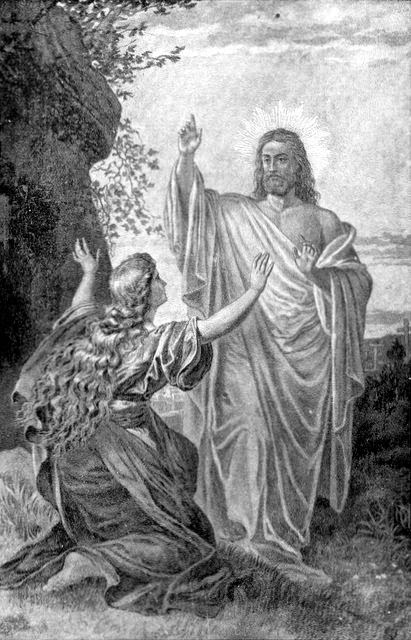
Friday, April 10, 2015

Recognizing Jesus

Mary Magdalene Sees Jesus Risen
- Artist unknown
From Treasures of the Bible

Mary Magdalene Sees Jesus Risen - Artist unknown
TODAY'S SPECIAL: John 20:1-18

TO CHEW ON: "Now when she had said this she turned around and saw Jesus standing there, and did not know it was Jesus." John 20:14

I have always been puzzled by Mary's failure to recognize Jesus. Didn't she know Him well? Hadn't she observed Him at close quarters as one of the women who served His itinerant ministry? Why this failure to recognize him?

The IVP New Testament Commentary says of her uncomprehending reaction:

"Such can be the blinding effect of profound emotions. In this case, her inability to recognize him also seems to be due to the character of Jesus' resurrection body, since such failure is typical of encounters with him (cf. Matthew 28:17; Mark 16:12; Luke 24:16, 37; John 21:4)" - IVP Commentary of the New Testament accessed through "Study This" on Biblegateway.com.

This is by no means the only time Jesus wasn't recognized, though. A failure to recognize who He really was in His person and work was a common reaction to Him while He was on earth.
  • Isaiah predicted this blindness - Isaiah 53:3.
  • Though the disciples were guilty of this same reaction for much of the time Jesus was with them (John 14:9), they eventually got it. Look at what John says in His gospel, written some 50 years after Jesus' death and resurrection: "He was in the world, and the world was made through Him and the world did not know Him" - John 1:10.
  • The Jewish leaders of Jesus' time who looked on Him as their rival clung tenacious to their unawareness - John 9:1-34.
  • Jesus predicted that bad things would happen to His followers because people in authority didn't and wouldn't recognize Him and His Father - John 16:1-4.

The above could and does impact Christians in the world today. So do two other things about recognizing Jesus:
  • People can see that we have seen and know Him by the bent of our lives. In his letter to early Christians, John says:
"Whoever abides in Him does not sin.* Whoever sins has neither seen Him nor known Him" - 1 John 3:6 (emphasis added).
"No one who lives in him keeps on sinning. No one who continues to sin has either seen him or known him" - 1 John 3:6 NIV.
  • Jesus may come to us even now in many ways through the needs of our fellowmen (Matthew 25:34-40). Do we recognize Him here?

PRAYER: Dear Jesus, please open my eyes to see You in the needy people all around me. Soften my heart to respond as surely as I would if it were You in person. Amen.

 ________________

* "…does not sin…"  or "no one who lives in him keeps on sinning…" does not mean that the person who is in Christ never sins. The IVP Commentary is helpful here: "What is meant, then, by the statement no one who lives in him keeps on sinning is quite simple: sin is not the identifying characteristic of those who live in him." (Emphasis added.)


 *********
Unless otherwise noted all Scripture quotations are taken from the New King James Version®. Copyright © 1982 by Thomas Nelson, Inc. Used by permission. All rights reserved.

Scripture quotations marked NIV are taken from THE HOLY BIBLE, NEW INTERNATIONAL VERSION®, NIV® Copyright © 1973, 1978, 1984, 2011 by Biblica, Inc.® Used by permission. All rights reserved worldwide.

Sunday, April 05, 2015

Trustworthy

"Women at the Sepulchre" by Harold Copping
TODAY'S SPECIAL: Mark 16:1-8

TO CHEW ON: "'But go tell His disciples—and Peter—that He is going before you into Galilee; there you will see Him, as He said to you.'" Mark 16:7.

The angel who welcomed the women at Jesus' empty tomb had obviously been listening in on Jesus' conversations with His followers. The little phrase at the end of our focus verse "...as He said to you" was like a rebuke that reminded them 'He told you all this would happen. You could have expected it.'

Did Jesus indeed predict His resurrection while He was still alive? Yes, many times, according to the Gospel writers:

  • "From that time Jesus began to show His disciples that He must ... be raised on the third day" - Matthew 16:21.
  • "...and the third day He will rise again" - Matthew 20:19.
  • "'But after I have been raised, I will go before you to Galilee'" Matthew 26:32.
  • "He commanded that they should tell no one the things they had seen till the Son of Man had risen from the dead" - Mark 9:9.
  • "Jesus answered and said to them, 'Destroy this temple and in three days I will raise it up'" - John 2:19.

So why were they so surprised? Perhaps they forgot? Perhaps Jesus' words had been so far from fitting into their scheme of what they thought possible, they never really heard them in the first place?

Jesus' words are still trustworthy. Just as what He said about Himself rising from the dead came about, so we can be confident that the things He said that have not yet happened will happen. As in:
- He will return (Matthew 24:27-28; Acts 1:11).
- There will be a day of judgment, reckoning, and rewards (Matthew 25:14-46).
- The earth and its systems will pass away (Matthew 13:47-50; 24:35).

Have we really heard these things? Do we believe them? Does our belief affect the way we live? Or will the angels need to someday break through our shock and incredulity with "It has happened as He said to you"?

PRAYER: Dear Jesus, You arose from the dead as You said You would. Help me to hear, believe, and adjust my life to the things You have said that have not yet happened. Amen.

MORE: He is risen. He is risen indeed!

Today is the day millions celebrates the resurrection of Christ from the dead. (Liturgy for Easter Day.)

The Collect prayer that begins the liturgy:
Almighty God, who through your only-begotten Son Jesus Christ overcame death and opened to us the gate of everlasting life: Grant that we, who celebrate with joy the day of the Lord's resurrection, may be raised from the death of sin by your life-giving Spirit; through Jesus Christ our Lord, who lives and reigns with you and the Holy Spirit, one God, now and for ever. Amen.

We join with Steve Green in singing the triumphant "Christ the Lord is Risen Today".


********
Unless otherwise noted all Scripture quotations are taken from the New King James Version®. Copyright © 1982 by Thomas Nelson, Inc. Used by permission. All rights reserved.

Bible Drive-Thru


Saturday, February 28, 2015

God's answer

"The Empty Tomb"
 Illustration from a book by Martin Luther.

The Empty Tomb - from a book by Martin Luther
TODAY'S SPECIAL: Psalm 22:16-31

TO CHEW ON: "You have answered Me." Psalm 22:21b

This psalm pivots at verse 21. There the speaker (prophetically Jesus, Messiah) comes to the triumphant conclusion "You have answered Me."

Up to that point He has dwelt on the dreadful things that would and did happen as His life spiraled toward death. Today's reading includes the howls of the suggestible crowed insisting Barabbas go free and Jesus die, His pierced hands and feet, the gawking scorn of onlookers, and the dice game for His robe. And then He proclaims, "You have answered Me."

But He died. So we ask,  how did God answer Him?

The answer came three days later. As explained by the writer of my Bible's Psalm footnotes: "The resurrection of Jesus was an answer to His prayer and to the agonizing prayer of every sin-laden human soul"-  K.R. "Dick" Iverson, New Spirit-Filled Life Bible, p. 702.

That last phrase snags my attention: "...every sin-laden human soul." That includes me. It prompts me to ask: How does Christ's resurrection impact me—and you?

Wayne Grudem devotes an entire chapter to the resurrection and ascension of Jesus in his Systematic Theology. Here are some bits, gleaned from that chapter to answer our question: 

How does Jesus' resurrection impact us?

1. We are made spiritually alive.
"When Jesus rose from the dead he had a new quality of life .... When we become Christians our bodies remain as they were .... But in our spirits we are made alive with new resurrection power."

2. The penalty for our sin is paid.
"When Christ was raised from the dead, it was God's declaration of approval of Christ's work of redemption .... There was no penalty left to pay for sin, no more wrath of God to bear, no more guilt or liability to punishment—all had been completely paid for."

3. There will be resurrection bodies for us.
"In calling Christ the 'first fruits' (1 Corinthians 15:20) Paul uses a metaphor from agriculture to indicate we will be like Christ .... Christ as the 'first fruits' shows what our resurrection bodies will be like when, in God's final 'harvest' he raises us from the dead and brings us into his presence" - quotes from Wayne Grudem, Systematic Theology, pp. 614-616.

The rest of Psalm 22 sparkles with the joy of this resurrection answer. Praise God, we can join in Messiah's celebration!

PRAYER: Dear God, "My praise shall be of You in the great assembly .... All the ends of the world shall remember and turn to the Lord, all the families of the nations shall worship before You. For the kingdom is the Lord's and He rules over the nations." Amen (quoting Psalm 22:25, 27-28)

*******
Unless otherwise noted all Scripture quotations are taken from the New King James Version®. Copyright © 1982 by Thomas Nelson, Inc. Used by permission. All rights reserved.
    Bible Drive-Thru


Related Posts Plugin for WordPress, Blogger...