Showing posts with label persecution. Show all posts

Saturday, November 10, 2018

When weak is strong

TODAY'S SPECIAL: 2 Corinthians 11-13; Psalm 4

TO CHEW ON: "Therefore I take pleasure in infirmities, in reproaches, in needs, in persecutions, in distresses for Christ's sake. For when I am weak, then I am strong." 2 Corinthians 12:10

Overshadowed as 2 Corinthians 12:10 is by grand verse 9, I've never before today noticed the list of things Paul takes pleasure in:

Infirmities [Astheneia. In English infirmity means the state or quality of being infirm: debility, weakness, a physical or mental defect or weakness.]

Reproaches [Hubris. "It means hurt, loss, injury arising from violence, damage caused by the elements, hardship, detriment, trouble, danger... In 2 Corinthians 12:10 hubris denotes insolence, impudence, a haughty attitude, insult, injury, outrage, persecution and affront. ... it is adversarial" - Word Wealth, New Spirit-Filled Life Bible p. 1540.]

Needs [Anagke - calamity, distress, straits. Several other translations render this hardships.]

Persecutions [Diogmos. The dictionary definition of persecute is to harass with cruel or oppressive treatment. To maltreat or oppress because of race, religion or beliefs, to annoy or harass persistently.]

Distresses [Stenochoria - narrowness of place, a narrow place (metaphorically). The Amplified translates this perplexities and distresses, the ESV calamities.]

Is there a negative condition we could encounter that we don't find here? And Paul says he "takes pleasure" in them because Christ comes through for him and in him via that weakness. The turnaround is not because of him but because of who indwells him: "My grace is sufficient for you for My strength is made perfect in weakness." That, for Paul, is a reason to welcome infirmities, reproaches, needs, distresses, persecutions and difficulties—so that he needs and depends on the power of Christ to flow through his needy self .

I ask myself, what item on Paul's list do I identify with today? What about you? Are we sick, beleaguered by the reproaches of nature or people, needy, persecuted, perplexed, distressed, in a tight spot?

Instead of viewing this as a negative thing, we can begin with Paul to thank God for our bad, challenging, overwhelming thing. We can invite Him into the circumstance or event for the first time, or again, with a more helpless, dependent attitude. Then we can watch Him turn our weakness into strength as He changes our attitude, gives us the ability and patience to cope while we wait for Him to bring about a change, or provides us a download of  wisdom to know how to improve or change things. 

PRAYER: Dear Jesus, thank You that Your grace (undeserved favour and blessing) is enough for any and every bad thing that could come my way. Help me to be like Paul—glad in negative circumstances, welcoming them as opportunities for Your abilities and resources to shine through my inability and disability. Amen. 

PSALM TO PRAY: Psalm 4

MORE: I Need Thee Every Hour - Fernando Ortega


****************
Unless otherwise noted all Scripture quotations are taken from the New King James Version®. Copyright © 1982 by Thomas Nelson, Inc. Used by permission. All rights reserved.

Wednesday, October 10, 2018

God brings us, not over but through

"Peter Released from Prison by an Ange" from Treasures of the Bible - Early Church
"Peter Released from Prison by an Angel" - from Treasures of the Bible

TODAY'S SPECIAL: Acts 11-12; Psalm 124

TO CHEW ON:
"… he (Peter) declared to them how the Lord had brought him out of the prison. … And he departed and went to another place." Acts 12:17

I have sometimes wondered, as I read this story and others in Acts, why God didn't do the entire job—here get the angel to deliver Peter out of danger completely. Instead, he just brought Peter through the prison gates, down the first street and poof! he was gone (Acts 12:10).

After telling his story to his friends at Mary's house, Peter had to use his common sense and decide what to do next. It was obviously not safe to stick around so, though it was the middle of the night, he "departed and went to another place" - Acts 12:17.

Perhaps this is how we should expect God to work in our lives too. He can, and sometimes does intervene miraculously when the situation is beyond us. But He doesn't do for us what we can do for ourselves, or take us permanently out of trouble and persecution. It is commonly thought that Peter died by crucifixion.

However, no doubt because of his own experience with it, Peter left us with some powerful benefits of suffering in his first letter:

  • It proves the authenticity of our faith - 1 Peter 1:6,7.
  • Suffering for righteousness brings a blessing - 1 Peter 3:14.
  • It purifies us - 1 Peter 4:1.
  • Through suffering we identify with Christ in a unique way - 1 Peter 4:12,13.
  • In suffering we experience the Holy Spirit and God's glory - 1 Peter 4:14, Acts 7:55.

So, it's not that God can't do the whole job, but that He knows we'll get a greater benefit from going through the tough stuff than floating over it.

PRAYER: Dear God, when I'm in the middle of a hard patch, please help me to remember that You allow suffering for my good—even though it doesn't feel good at the time. Amen.

PSALM TO PRAY: Psalm 124

*********
Unless otherwise noted all Scripture quotations are taken from the New King James Version®. Copyright © 1982 by Thomas Nelson, Inc. Used by permission. All rights reserved.


Sunday, August 19, 2018

Two Cautionary Tales

King Joash Repairs the Temple - 2 Chron. 24
TODAY’S SPECIAL: 2 Chronicles 21-24; Psalm 76

TO CHEW ON:
“Then the Spirit of God came upon Zechariah, the son of Jehoiada the priest, who stood above the people and said to them, ’Thus says God: “Why do you transgress the commandments of the LORD so that you cannot prosper? Because you have forsaken the LORD, He also has forsaken you”’

So they conspired against him, and at the command of the king they stoned him with stones in the court of the house of the LORD.” 2 Chronicles 24:20,21


Our reading today is the sad story of Joash. He came to Judah’s throne when he was a mere seven years old. Under the influence of priest Joehoiada, he made an excellent start, repairing the neglected temple and restoring worship.

But after Jehoiada died, Joash allowed the leaders of Judah to influence him. They had a very different agenda. They steered him away from the worshiping Yahweh to idols and his idolatry became so entrenched even the “wrath that came upon Judah and Jerusalem because of their trespass” didn’t move him from it.

When Zechariah, son of Joash’s old mentor Jehoiada, warned him in a bold Holy Spirit-inspired prophecy of the inevitable consequence (“Because you have forsaken the LORD, He also has forsaken you” - 2 Chronicles 24:20), Joash had him stoned to death.

Zecharaiah reminds us a a New Testament character who was also stoned when he spoke out against the perverted worship of his day. That would be Stephen. Their ends are eerily alike (Acts 7:51-60).

Two lessons jump out at me from these two tales:

1. We need to be aware of and intentional about who we allow to influence us. When Joash was under the tutelage of Jehoiada, he was inspired to honour God by fixing up the temple and restoring the worship of Yahweh. But when Jehoiada died, he allowed himself to be led by Judah’s leaders right back into the swamp of idolatry.

We too put ourselves under influencers. Who we spend time with, what we read, what we watch, listen to, the music we play—all affect our loyalties. Let’s not slip into modern idolatry by being careless about who and what we allow to influence us.

2. Being a mouthpiece for God can be dangerous. Zechariah and Stephen discovered that. As our society drifts ever farther from Judeo-Christian principles, we do well to remind ourselves of the price we too may be asked to pay when we allow the Holy Spirit carte blanche to our lives.

PRAYER: Dear Father, please help me to choose my influencers well. Help me, in turn, to be a good mentor to others. May I be willing to pay the price of being the temple of Your Spirit, no matter what the price. Amen.

PSALM TO PRAY: Psalm 76

 *********
Unless otherwise noted all Scripture quotations are taken from the New King James Version®. Copyright © 1982 by Thomas Nelson, Inc. Used by permission. All rights reserved.


Sunday, July 29, 2018

Yielded bodies

TODAY'S SPECIAL: Daniel 1-3; Psalm 55

TO CHEW ON: "Nebuchadnezzar spoke, saying, 'Blessed be the God of Shadrach, Meshach, and Abed-Nego,  who sent His Angel and delivered His servants who trusted in Him, and they have frustrated the king's word and yielded their bodies, that they should not serve nor worship any god except their own God." - Daniel 3:28

I love the way Nebuchadnezzar spells out what these three rebellious officials have done this day. He says, in effect, 'You thumbed your noses at my law, yielding your very bodies in order to obey God, whom I now see is greater than I am.' Not only had these men  faced the possibility of giving up their positions and reputations but their physical lives to stay loyal to God.

Similar sacrifice is found throughout scripture. In the Old Testament
  • Caleb and Joshua followed the Lord to the extent that their fellow Israelites were about to stone them when when they defended Moses after their spy mission - Numbers 14:10; 32:12.
  • King Josiah promised and then made good on his promise to follow God with all his heart, soul and might - 2 Kings 23:3,25.
  • In the New Testament Paul models that kind of surrender, facing stoning, riots, and imprisonments to spread the gospel.

Surrender to the point of physical pain—even death—is foreign to us, or to me at least. I wonder how I would have done under the pressures of Nebuchadnezzar's edict or the hounding that the first Christians lived with. No doubt the spirits of these stalwarts were first steeled in the mental, emotional and spiritual way Paul talks about in:


Romans 12:1
I beseech you therefore, brethren, by the mercies of God, that you present your bodies a living sacrifice, holy, acceptable to God, which is your reasonable service.


Galatians 2:20
I have been crucified with Christ; it is no longer I who live, but Christ lives in me; and the life which I now live in the flesh I live by faith in the Son of God, who loved me and gave Himself for me.


Galatians 5:24
And those who are Christ’s have crucified the flesh with its passions and desires.


2 Timothy 2:21
Therefore if anyone cleanses himself from the latter, he will be a vessel for honor, sanctified and useful for the Master, prepared for every good work.

PRAYER: Dear God, you are not asking me to yield my body to a fiery furnace, but to honour You and achieve Your purposes in my own setting. Help me to discern what Your purposes are, and to give myself, soul, spirit and body, to You. Amen.

The Bible Project VIDEO: DANIEL - (Read Scripture Series)


***********

Unless otherwise noted all Scripture quotations are taken from the New King James Version®. Copyright © 1982 by Thomas Nelson, Inc. Used by permission. All rights reserved.


Wednesday, June 27, 2018

Living out our trust in God

Image: Pixabay
TODAY’S SPECIAL: Jeremiah 37-39; Psalm 23

TO CHEW ON:
“‘For I will surely deliver you, and you shall not fall by the sword; but your life shall be as a prize to you, because you have put your trust in Me,’ says the LORD.” Jeremiah 39:18

The words of our focus verse were given to Jeremiah for Ebed Melech. In all the palace intrigue we find in Jeremiah 37-39, this African eunuch and servant of King Zedekiah was sympathetic to Jeremiah. When the king’s princes threw him into a dungeon of muddy quicksand, Ebed Melech went to Zedekiah and begged for Jeremiah’s life.

The king allowed him to rescue Jeremiah. He with others made ropes from rags and pulled him from the miry pit.

Then Nebuchadnezzar conquered the city just as Jeremiah had predicted (the predictions and his advice that the king should surrender that got him into so much trouble with the king and his princes). All that Jeremiah had prophesied, about how the king would be treated and the city burned if they did not surrender, came true.

But God did not forget Ebed Melech, the man who trusted in Him and lived out that trust by standing up for Jeremiah. God gave him his life “as a prize.”

I am writing this on the day that the Supreme Court has announced their decision to deny Trinity Western University the right to have a law school—a decision that will impact religious freedom in Canada in many other areas as well. In the days ahead it will become increasingly unpopular and politically incorrect to hold biblically based views on morality and lifestyle. We may encounter persecution.

I take encouragement from God’s remembrance of this servant who trusted Him and lived out that trust by supporting unpopular Jeremiah. Let us likewise continue doing things that are right and supporting and helping God’s servants, no matter how unpopular their biblically based message and stance.

PRAYER: Dear Father, help me to trust You and live out my trust when such trust is culturally popular and also when it’s not.  Amen.

PSALM TO PRAY: Psalm 23

MORE: An article that explains the impact of the Supreme Court decision to the church and Canadian society: "The Supreme Court Now Decides that Faith is Banned from Canada's Public Spaces" - National Post

*********
Unless otherwise noted all Scripture quotations are taken from the New King James Version®. Copyright © 1982 by Thomas Nelson, Inc. Used by permission. All rights reserved.

Thanks for reading! This year we are using The Bible Project "Timeless Reading Plan" to read through the Bible in 2018. If you'd like to read along in your own Bible, you can download a pdf of the reading plan HERE.

Monday, July 03, 2017

We need each other

Christians come together in Jerusalem / Pixabay
TODAY’S SPECIAL: Hebrews 10:32-11:2

TO CHEW ON: “But recall the former days in which, after you were illuminated, you endured a great struggle with sufferings: partly while you were made a spectacle both by reproaches and tribulations, and partly while you became companions of those who were so treated.” Hebrews 10:33


Today’s passage was written to first century Jewish Christians. From my Bible’s introduction:
“Apparently they expected Christ to return soon but the delay in His coming and the persecutions against them (Hebrews 10:32-34) caused them to wonder if they had made the right choice in becoming Christians… This epistle was written to wavering Jewish believers, encouraging them to stand fast in their faith” - Guy P. Duffield, “Introduction to Hebrews,” New Spirit-Filled Life Bible, p. 1728.

If we’re followers of history, we know that society’s attitude to Christianity, pro- and anti-, pendulums back and forth. In my growing up years, a generation or two after many European immigrants fled religious persecution to Canada as a place where they would be able to live their Christian convictions without fear of arrest, the attitude of society was much friendlier to Christianity than it is now.

Now the pendulum is swinging the other way. For example, a bill was passed in Ontario in June 2017, that gives the state power to apprehend a child from parents who don’t support the notion that gender is fluid, and who would oppose their child’s “human right” to change gender.  And in Camrose Alberta, the school board is attempting to limit which Bible verses a Christian school can use.

Thus the scenario pictured by our reading, of Christians suffering and struggling grows more possible for us. Apparently for the Hebrew believers it wasn’t a struggle of just ideas either but a very real physical set-to, with “plundering of goods” added to “reproaches” and “tribulations.” And this could happen to one for being a companion (friend, known associate) of a despised Christian - Hebrews 10:33.

I love this quote found in The Christian Almanac:
“There is a spiritual cancer at work in the world. The piracy of man’s fallen nature invariably mitigates against freedom and justice. Therefore voluntary associations must needs balance us—without force of state but nonetheless with the force of community—and hold us to accounts” - James Stuart (1849-1901)” - The Christian Almanac, July 3rd entry, p. 393.

What both Hebrews and Mr. Stuart drive home to me is that community is important. We in the church need each other in these times of the world’s increasing hostility.

PRAYER:
Dear Father, help me to remain loyal to You, Your word, and my Christian brothers and sisters. Amen.

MORE: Feast of St. Thomas
Today is the day the church celebrates the Apostle Thomas. (This is a feast day that has two dates attached to it - July 3rd and December 21st).

The liturgy for this day begins with this prayer:

Everliving God, who strengthened your apostle Thomas with firm and certain faith in your Son's resurrection: Grant us so perfectly and without doubt to believe in Jesus Christ, our Lord and our God, that our faith may never be found wanting in your sight; through him who lives and reigns with you and the Holy Spirit, one God, now and for ever. Amen.

 *********
Unless otherwise noted all Scripture quotations are taken from the New King James Version®. Copyright © 1982 by Thomas Nelson, Inc. Used by permission. All rights reserved.


Wednesday, June 21, 2017

Cost to a "sent out" one

"Take Up His Cross"- Pictures from 
Children's Bible Story Books.

TODAY'S SPECIAL: Matthew 10:32-11:1

TO CHEW ON: "He who finds his life will lose it, and he who loses his life for My sake will find it." Matthew 10:39

Matthew 10 is mostly a set of instructions Jesus gave to His twelve disciples before sending them out to their Jewish neighbours. Their mission was to preach and demonstrate the nearness of the Kingdom of Heaven (Matthew 10:7-8). By Jesus' instructions we can tell that the reaction to their message would be mixed. In other words this would be no sightseeing jaunt or cushy vacation.

In the end, this assignment seemed to be as much about the apprenticeship of the disciples as it was about the delivery of the Kingdom message to their countrymen. A warning that Jesus gave at least three times in this chapter was to expect opposition that would test their loyalties.

1. Their message and commitment to Jesus would get them in trouble with governing authorities to the extent of being forced to defend themselves before councils, governors, and kings. The will even be beaten (Matthew 10:17-20).

2. Their commitment to Jesus would test family ties. Jesus warned of treachery coming from even within their own households (Matthew 10:34-36).

3. Their commitment to Jesus would test their loyalty to themselves (Matthew 10:37-39). Jesus challenged His disciples to love Him more than their own lives. He couched it in the language of death — called it  taking up one's cross. Such a thing probably doesn't ring many alarm bells in our society where crosses aren't used for execution. To get the shock value of His statement let's say it differently. How about: "He who does not take with him his lethal injection and follow Me is not worthy of Me"?

Jesus' warning words are a stark reminder of humanity's default reaction to the gospel. Therefore you and I shouldn't be surprised when people respond to the good news of the Kingdom of Heaven (and all it entails of mankind's sinful state, our need for redemption and the ultimate lordship of Jesus over our life and all of creation) with incredulity, challenge, confrontation, ultimatums, anger... In fact, we're probably naive if we don't expect it.

And personally, am I ready to kill that part of me that wants the world to accept me and like me? On top of that, am I ready to put to death that part of me that wants to do as I please in choice of vocation, relationships, how I spend my time, money etc.? Am I that loyal to Jesus?

PRAYER: Dear Jesus, Your description of true discipleship in this chapter is sobering and startling. I don't think I've begun to be a disciple like this. Please show me what it means in daily living. Amen.

MORE: "Jesus I My Cross Have Taken"

This Bob Dylan-esque rendition of this old hymn is from the second Indelible Grace CD, Pilgrim Days. I love it! Many verses that's why it's so long. Read along with the singers by following the link to the lyrics below.


Follow the lyrics as you listen

**********
Unless otherwise noted all Scripture quotations are taken from the New King James Version®. Copyright © 1982 by Thomas Nelson, Inc. Used by permission. All rights reserved.

Sunday, June 11, 2017

Worry and Fear

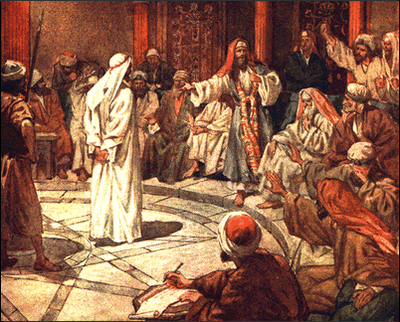
Sanhedrin - Artist unknown
Before the Sanhedrin - Artist unknown
TODAY'S SPECIAL: Matthew 10:16-31

TO CHEW ON:
" ' And do not fear those who kill the body but cannot kill the soul. But rather fear Him who is able to destroy both soul and body in hell.' " Matthew 10:28

What a grim result Jesus predicts for His disciples as He sends them out. Two words jump out at me from our reading: WORRY and FEAR.

Jesus says, when, as a result of their message, they are brought before synagogue councils, governors and kings, they are not to WORRY beforehand about how or what to say (Matthew 10:19).

[Worry - merimnao comes from merizo which means to divide into parts. The word suggests distraction, a preoccupation with things causing anxiety, stress, and pressure - Dick Mills, Word Wealth, New Spirit-Filled Life Bible, p. 1301.]

They are not to be distracted, preoccupied, stressed and pressured over how to defend themselves because if they are, they'll miss the best defense they could have—the one from the Holy Spirit: " 'For it will be given to you in that hour what you should speak; for it is not you who speak, but the Spirit of your Father who speaks in you' "  Jesus says - Matthew 10:19-20.

You'd think words coming from God Himself would guarantee freedom. But not so. For Jesus goes on to speak of continuing persecution and even death which they are not to FEAR (Matthew 10:26,28).

[Fear - phobeo is a panic that grips a person causing him to run away, be alarmed, scared, frightened, dismayed, fill with dread, intimidated, anxious, apprehensive. (Notice the similarity with our word phobia) - Dick Mills, Word Wealth, New Spirit-Filled Life Bible, p. 1308.]

At first this appears puzzling. If the persecutors can do the ultimate—kill one—why would the objects of their persecution not fear?

Because, Jesus implies, killing the body isn't the worst thing that could happen to one. The worst is something only God can do (and reason to fear Him): "destroy both soul and body in hell."

So, Jesus tells His disciples, take the long eternal view. Life doesn't stop here. So don't let your witness be extinguished by worry or fear of the worst that can happen in life. Rather, set your course by how you want to spend eternity.

Jesus' advice about worry and fear is timely for us in our day when expression of our Christian worldview and faith is being met with increasing hostility.

PRAYER: Dear Jesus, Your command to not worry or fear goes straight to my heart. Help me to be so controlled by Your Spirit that I will not only stop worrying about how to defend the gospel, but will speak it with Spirit-breathed boldness. Amen.

MORE: Trinity Sunday

I love how a reference to the trinity (God the Father, Jesus the Son, and the Holy Spirit) is embedded so subtly in our reading.  Persecution comes because of allegiance to Jesus. The Spirit of the Father gives the persecuted one the words to speak in a good defense (Matthew 10:19,20).

Today the church celebrates Trinity Sunday. The liturgy for the day begins with this prayer:

Almighty and everlasting God, you have given to us your servants grace, by the confession of a true faith, to acknowledge the glory of the eternal Trinity, and in the power of your divine Majesty to worship the Unity: Keep us steadfast in this faith and worship, and bring us at last to see you in your one and eternal glory, O Father; who with the Son and the Holy Spirit live and reign, one God, for ever and ever. Amen.
*********
Unless otherwise noted all Scripture quotations are taken from the New King James Version®. Copyright © 1982 by Thomas Nelson, Inc. Used by permission. All rights reserved.


Tuesday, May 16, 2017

What do you know about your inheritance?

Image: Pixabay
TODAY’S SPECIAL: 1 Peter 3:8-22

TO CHEW ON: “Not returning evil for evil or reviling for reviling, but on the contrary blessing, knowing that you were called to this that you may inherit a blessing.” 1 Peter 3:9

Here Peter challenges his readers to counteract evil and insults with blessing. I like how the Amplified Bible phrases our focus verse:
“Never return evil for evil or insult for insult—scolding, tongue lashing berating; but on the contrary blessing—praying for their welfare, happiness, and protection and truly pitying and loving them. For know that to this you have been called, that you may yourselves inherit a blessing [from God]—obtain a blessing as heirs bringing welfare and happiness and protection” - 1 Peter 3:9 AMP.

Peter connects this surprising reaction to evil and insults with a Christian’s inheritance. He says that an inheritance of blessing is a consequence of responding to evil and insults with blessing.

This connection of our reaction and the consequence of inheritance set me on a small search for other things that impact our inheritance or are part of it. Here are a few examples:

  • David connected getting a godly heritage with fearing God’s name - Psalm 61:5.
  • The writer of Psalm 119 considered God’s spoken / written word (“Your testimonies”) as his heritage - Psalm 119:111. Paul reminded the Christians at Ephesus of this aspect of God’s word in his farewell talk with them: “‘So now, brethren, I commend you to God and to the word of His grace, who is able to build you up and give you an inheritance among all those who are sanctified” - Acts 20:32.
  • The “servants of the Lord” are promised a heritage of God’s defense from words and weapons - Isaiah 54:17.
  • Paul urged King Agrippa to accept salvation through Christ. In his talk, he quoted the words that Jesus spoke to him on the Damascus Road. They include a heritage of going from spiritual darkness to light, being removed from the power of Satan to the power of God, and forgiven sins - Acts 26:18.
  • Our inheritance is in Jesus - Ephesians 1:11.
  • Someday we’ll get our inheritance reward from Jesus - Colossians 3:24.
  • It’s an inheritance that can’t be tinkered with or destroyed, awaiting us in heaven, as Peter explains it in 1 Peter 1:4: “…  an inheritance which is imperishable [beyond the reach of change] and undefiled and unfading, reserved in heaven for you” - AMP.

The inheritance we get from our parents and grandparents is largely out of our control. But this spiritual inheritance is one over which we have a lot of say as we:

1] Accept Christ’s forgiveness and leave Satan’s kingdom to enter God’s.

2] Take advantage of one of our Father’s greatest gifts to us—the Bible.

3] Serve Him and act like His kids (including how we return blessing for cursing—our focus verse).
4] Live in hope and expectation of the day Jesus will give us our inheritance in heaven.


PRAYER: Dear Father, thank You for this inheritance, awaiting me in heaven. Help me to live as Your child in the way I react to evil and insults with blessing. Amen.

 *********
Unless otherwise noted all Scripture quotations are taken from the New King James Version®. Copyright © 1982 by Thomas Nelson, Inc. Used by permission. All rights reserved.

Scripture quotations marked AMP are taken from the Amplified® Bible,
Copyright © 1954, 1958, 1962, 1964, 1965, 1987 by The Lockman Foundation
Used by permission." (www.Lockman.org)


Thursday, May 11, 2017

Word that cuts to the heart

Stephen before the Sanhedrin - Artist unknown
Stephen before the Sanhedrin - Artist Unknown
TODAY'S SPECIAL: Acts 7:35-8:1

TO CHEW ON: "When they heard these things they were cut to the heart, and they gnashed at him with their teeth." Acts 7:54

After taking his listeners (the High Priest and members of the Sanhedrin) on a trip through Old Testament history, recalling Israel's long record of rejecting the prophets, Stephen came to the climax of his message:
"'You stiff-necked and uncircumcised in heart and ears! You always resist the Holy Spirit; as your fathers did, so do you. Which of the prophets did your fathers not persecute? And they killed those who foretold the coming of the Just One, of whom you now have become the betrayers and murderers'" Acts 7:51,52.

The reaction was immediate:
"… they [the Jews] were cut to the heart and infuriated, and they ground their teeth against [Stephen]" Acts 7:54 AMP.

The same expression, "cut to the heart," is used another time when Peter and John were brought before the Sanhedrin. Peter was defiant about their orders to stop speaking of Jesus. He accused them of killing the One who was now exalted as "Prince and Leader and Savior and Deliverer and Preserver…"  - Acts 5:31 AMP.  Their reaction was identical:
"Now when they heard this they were cut to the heart and infuriated and wanted to kill the disciples" - Acts 5:33 AMP.

In both cases the speakers—Peter and Stephen—used Scripture to make their points, retelling its stories, quoting relevant verses, and making unpopular applications. The effect this use of scripture had on members of the Sanhedrin reminds me of another verse that flat out states that the word of God cuts:
" For the Word that God speaks is alive and full of power [making it active, operative, energizing, and effective]; it is sharper than any two-edged sword, penetrating to the dividing line of the breath of life (soul) and [the immortal] spirit, and of joints and marrow [of the deepest parts of our nature], exposing and sifting and analyzing and judging the very thoughts and purposes of the heart" - Hebrews 4:12 AMP.

As our society drifts ever farther from Judeo-Christian moorings, the message of scripture—the Bible—will become ever more controversial. But because it was authored by the One who created the human heart, who knows the deepest part of human nature, it continues to have the penetrating power to expose, sift, analyze and judge our thoughts and motivations. It still cuts to the heart.

This cutting can bring us to a place of obedience or resistance, as was the case with these Jewish leaders. Perhaps we should prepare ourselves for a time when the widespread reaction to it in our culture will be every bit as dangerous to us as it was to Stephen in Acts.

PRAYER: Dear God, thank You for Your Word which exposes me to myself. Help me not to resist it but to let it  cut, expose, sift, analyze, and judge me toward obedience. Amen.

 *********
Unless otherwise noted all Scripture quotations are taken from the New King James Version®. Copyright © 1982 by Thomas Nelson, Inc. Used by permission. All rights reserved.

Scripture quotations marked AMP are taken from the Amplified® Bible, Copyright © 1954, 1958, 1962, 1964, 1965, 1987 by The Lockman Foundation. Used by permission." (www.Lockman.org)

Sunday, December 11, 2016

Kingdom violence

"Saint John the Baptist Sees Jesus From Afar" 
James Tissot, 1886-1894

TODAY'S SPECIAL: Matthew 11:2-15

TO CHEW ON: "'And from the days of John the Baptist until now the kingdom of heaven suffers violence, and the violent take it by force.'" Matthew 11:12  (link is to five translations)


Jesus has just finished describing the opposition His disciples will encounter (Matthew 10:17-20). Then in the very next chapter we see in John the Baptist, a living example of what He is talking about.

King Herod has imprisoned John for criticizing his morals. From his prison cell, John sends two of his disciples to see Jesus and bring back a little reassurance. "Are you the One?" they ask. "Or do we look for another?"

Jesus, in His typical way gives them an answer that both probes their expectations and enlists their commitment (Matthew 11:4-6). Then He praises John the Baptist and makes this curious statement: "And from the days of John the Baptist until now the kingdom of heaven suffers violence, and the violent take it by force." What does that mean?

An article that discusses the themes of the Synoptic Gospels (Matthew, Mark & Luke) says this:

"A dominant theme of Jesus' teaching is the kingdom of God. Jesus presents numerous word-pictures of what this supernatural realm "is like." But the kingdom is not merely to be understood with the mind. Rather, it is spiritual and is to be comprehended and entered into by spiritual means and in practical living....Enter the kingdom of God by "violent" determination. Be aggressive about serving Christ" - New Spirit-Filled Life Bible, p. 1439.

Jack Hayford explains it another way:

"Jesus asserts the "violence" of the kingdom....Jesus' references to the nonreligious style of John and the confrontative, miraculous ministry of Elijah teach that the kingdom of God makes its penetration by a kind of violent entry opposing the human status quo ...The upheaval caused by the kingdom of God is not caused by political provocation or armed advance. It is the result of God's order shaking relationships, households, cities, and nations by the entry of the Holy Spirit's power working in people. (See also Luke 16:6)" - New Spirit-Filled Life Bible, p. 1310. (All emphases added.)
Whether Jesus was talking about:
- our violent determination as we enter the kingdom,
- or the violence with which it enters our lives (playing havoc with our old life),
- or the violence with which it penetrates society (as we its citizens are empowered by the Holy Spirit to be salt and light),
- or the violent reaction society has to it, Jesus' statement embodies an energy and determination we don't often equate with religious belief—at least not in our day and not about the Christian faith. It sounds almost fanatical.

I ask myself, am I such a determined, committed, "violent" one? Are you?

PRAYER: Dear God, I hate being labeled a fanatic and yet the martyr faith in Jesus of believers across the centuries and even in my own time illustrates the price I should be willing to pay. Help me to come to terms with the true cost of following You. Amen.

MORE: Third Sunday of Advent
Today is the third Sunday of Advent. The liturgy for the day begins with this collect:

"Stir up your power, O Lord, and with great might come among us; and, because we are sorely hindered by our sins, let your bountiful grace and mercy speedily help and deliver us; through Jesus Christ our Lord, to whom, with you and the Holy Spirit, be honor and glory, now and for ever. Amen."
**************
Unless otherwise noted all Scripture quotations are taken from the New King James Version®. Copyright © 1982 by Thomas Nelson, Inc. Used by permission. All rights reserved.


Bible Drive-Thru

Sunday, November 13, 2016

A Divine Lawyer

TODAY’S SPECIAL: Luke 21:1-19

TO CHEW ON: “‘Therefore settle it in your hearts not to meditate beforehand on what you will answer; for I will give you a mouth and wisdom which all your adversaries will not be able to contradict or resist.’” Luke 21:14,15

Here Jesus gives advice to the disciples on how to prepare themselves for being arrested and interrogated for their faith in Him. This bit snags my attention: “'… settle it in your hearts not to meditate beforehand on what you will answer.’”

Jesus’ advice goes against every instinct I have. If I was arrested and anticipating being questioned about my faith, my tendency would be to review my doctrine and apologetics textbooks, have my Romans Road scriptures at my fingertips, refresh my mind on how to make a logical and convincing argument, etc.

But the compelling defence Jesus describes (“‘… all your adversaries will not be able to contradict or resist…’”) comes a different way than through memory, intellect, or reasoning power. Our reading in Luke doesn’t name the source of this wisdom but in another place Jesus refers to it (Him) specifically.

“‘Now when they bring you to the synagogue and magistrates and authorities, do not worry about how or what you should answer, or what you should say. For the Holy Spirit will teach you in that very hour what to say.’” Luke 12:11,12.

Jesus speaks more about this divine ‘Lawyer’ in John 14-16.

“‘But the Helper, the Holy Spirit, whom the Father will send in My name, He will teach you all things and bring to remembrance all things that I said to you’” - John 14:26.

“‘If you abide in Me and My words abide in you, you will ask what you desire and it shall be done for you’” - John 15:7.

“‘… And when He has come, He will convict the world of sin, and of righteousness and of judgment’” - John 16:8.

Two further thoughts:

1. Maybe a greater dependence on the Holy Spirit is also a wiser, more effective way of sharing the gospel with friends and family than some of the rote methods we’ve been taught.

2. Waiting for the Holy Spirit to supply our words, takes work too—the work of refusing to worry and substituting worry with dependence on and obedience to the Holy Spirit at all times and in all situations.

PRAYER: Dear Jesus, thank You for Holy Spirit, Your wisdom and words, that are appropriate and come with convicting power, available to me. Amen.

 *********
Unless otherwise noted all Scripture quotations are taken from the New King James Version®. Copyright © 1982 by Thomas Nelson, Inc. Used by permission. All rights reserved.

Wednesday, November 02, 2016

The new normal?

Image: Pixabay.com
TODAY’S SPECIAL: Luke 6:17-36

TO CHEW ON: “‘Blessed are you when men hate you,
And when they exclude you,
And revile you, and cast out your name as evil,
For the Son of Man’s sake.
Rejoice in that day and leap for joy!
For indeed your reward is great in heaven,
For in like manner their fathers did to the prophets.’
” Luke 6:22-23


As I write this the U.S. is still in the thick of the run-up to the election. Recently Megyn Kelly on Fox News broke an item relevant to people of faith. It’s a Wikkileaked 2011 email chain between the high-ups of one of the candidate’s organization and John Halpin from the Centre for American Progress.

Speaking of Robert Murdoch (CEO of Fox News) and the News Corp Chairman Robert Thomson raising their children Catholic, Halpin says: “'They must be attracted to the systemic thought and severely backward gender relations.'”

To which Jennifer Palmieri, Clinton’s Communications Director replies: “'I imagine they think it is the most socially acceptable, politically conservative religion—their rich friends wouldn’t understand if they became evangelicals.'”

On Kelly’s show, Tony Perkins, President of the Family Research Council characterized these critics: “'They believe that people who actually want to live by their faith are backwater people. [They see religion as a] glorified social club—if you want to live your life according to [Scripture] you’re going to be in trouble with Hillary Clinton’” (read entire article).

Now I know people of faith get insults like this thrown at them all the time these days. But when they come from the highest officers of the person who wants to lead the U.S., Christians are justified in taking notice.

To most of the world, this is a non-story (it certainly wasn’t near the top of my news feed but buried deep in the topic of “Christianity” and only because I’ve selected “Christianity” as an area of interest on Google News). But for Christians it's notable for another reason. Isn’t the attitude exhibited toward believers here exactly what Jesus predicted—one of hatred, exclusion, reviling and mocking (Luke 6:22)?

Rather than being dismayed, maybe we should take His advice and “'...leap for joy...'” over this typical treatment as we anticipate the verdict of the One who really matters (Luke 6:23).

PRAYER: Dear Jesus, in countries where, up till now, faith in You and God has been accepted, even appreciated, it’s impossible not to notice the change in attitude. Please help me to remain unshaken in my faith, and true to Your example in my reactions to hatred reviling, exclusion, and mocking. Amen.

 *********
Unless otherwise noted all Scripture quotations are taken from the New King James Version®. Copyright © 1982 by Thomas Nelson, Inc. Used by permission. All rights reserved.


Thursday, October 27, 2016

Endure

TODAY'S SPECIAL: 2 Thessalonians 1:1-12

TO CHEW ON: "We are bound to thank God always for you, brethren, as it is fitting because your faith grows exceedingly, and the love of every one of you all abounds toward each other, so that we ourselves boast of you among the churches of God for your patience and faith in all your persecutions and tribulations that you endure." 2 Thessalonians 1:3-4

Paul had himself recently experienced the "persecutions and tribulations" he talks about. He and his companion Silas had found an active synagogue in Thessalonica. For three sabbaths Paul "reasoned with them from the Scriptures," trying to persuade the Jews that Jesus was indeed Messiah.

Some Jews believed, along with Greeks and prominent women. But the ones who didn't gathered a mob and attacked the house of Jason where they thought Paul and Silas were staying. The mob never found them, but later that night, the believers sneaked them out of the city. It's all in Acts 17:1-10.

So, in this letter, probably only weeks to months later, Paul is encouraging those believers, telling them that the patience and faith they are exhibiting is cause for him to boast about them in other churches he visits.

"That's fine for you," I can just hear the Thessalonian Christians say, as they read Paul's letter. "You could just leave. But we have to stay here and live with this."

God could, of course, have caused that persecution to stop. But here, throughout church history, and still around the world today the need for endurance in persecution, in sickness, and in personal trials, continues. What is the purpose of it?

Paul mentions three pluses of of toughing out persecution in these verses:
1. It grows faith.

2. It cements love (note also 1 Corinthians 13:7)

3. It is a source of inspiration for others (note also 2 Timothy 2:10).

Other Bible passages show us still more advantages of having to endure.


4. It proves we are God's sons and daughters when He deals with us like a parent does with a child (Hebrews 12:7).

5. It toughens us as Christians, giving us focus and developing strength (2 Timothy 2:3-4).

6. Paul implies that it might be the new normal and what one should expect when involved in ministry (2 Timothy 4:5).

7. Enduring puts us in the select company. Abraham (Hebrews 6:15), Jesus (Hebrews 12:3), and Paul (1 Corinthians 4:10-13; 2 Timothy 1:8) are all characterized for their endurance.

8. Endurance assures our salvation (Matthew 10:22). Only the ones who endure will receive the crown of life (James 1:12).

Are you living in endurance-challenging territory right now? Be encouraged. You are not unique or alone.

For us whose lives are going along relatively smoothly, let's pray for people who need endurance while we keep our expectations realistic. The need for endurance will come. Let's be ready!

PRAYER: Dear God, help me to endure the small trials and tribulations that come my way. Please make me aware of people whose endurance is being challenged, so I can pray for them. Amen.


Do your 8-12-year-olds have daily devotions? Point them to Bible Drive-Thru.

Thursday, July 14, 2016

Sifted

TODAY'S SPECIAL: Amos 9:1-15

TO CHEW ON:
"For surely I will command,
And I will sift the house of Israel among all nations
As Grain is sifted in a sieve;
Yet not the smallest grain shall fall to the ground." Amos 9:9


My earliest memories of sifting are from when I was a little girl and learning to bake. Mom taught me to make sure I always sifted the flour before putting it into anything. That was because beetles sometimes got into the large kitchen bin where we kept the 100 lb. quantities of flour we bought. I'm sure if I found beetles in my flour now, I'd throw out the whole lot. But not then. We'd simply remove the wriggling black interlopers and carry on, mixing the bread, cookies or whatever.

The act of sifting ("To pass through a sieve in order to separate the fine parts from the coarse") is referred to in the Bible at various times. It is God's way of revealing the covered or hidden things that shouldn't be there (e.g. Proverbs 20:26). The intention is to get rid of them.

However, the purpose of sifting is also to separate out and preserve what is good. Unlike the Ethiopians, Philistines and Syrians, which God says He will destroy, He will sift Israel so that he can preserve the "house of Jacob" (Amos 9:7-9). He'll separate out the bad stuff to preserve all that is good (down to the "smallest grain").

The process of sifting, when it affects our lives, is never fun. Just as the physical act of sifting disturbs every bit of the sifted product, so God's sifting of us is uncomfortable, painful, even life-shaking. Job is one man I think of when I think of the sifting of a life. Nothing he had was left untouched.

In the New Testament, Jesus refers to Satan asking to sift Peter. Though at first Peter failed the sifting test, Jesus told him that the sifting would eventually work toward him strengthening others (Luke 22:31-32).

Are you being sifted? All kinds of things can serve as sifters, from the normal tensions of work and family life to the unusual stresses of accidents, crimes, natural disasters, disease, unemployment, etc. If you feel like you are being sifted, remember the purpose of the process—to reveal what shouldn't be there so you can deal with it now, and to separate out what is worth preserving.

Peter speaks of the end result of such a purifying and separating process in 1 Peter 1:6-7 (using the metaphor of purifying gold in fire). "In this you greatly rejoice, though now for a little while, if need be, you have been grieved by various trials, that the genuineness of your faith, being much more precious than gold that perishes, though it is tested by fire, may be found to praise, honor and glory at the revelation of Jesus Christ."

PRAYER: Dear God, please help me to realize that problems in my life may be part of Your sifting and purifying process in me. Help me to endure so my life will glorify You. Amen.

MORE: Paul Baloche sings "Shaken"


Paul Baloche tells the story of writing the song "Shaken" in this 1.5 minute video.


Do your 8-12-year-olds have daily devotions? Point them to Bible Drive-Thru.

Thursday, July 07, 2016

Personal prophecies


"Agabus' prophecy concerning Paul"
Image courtesy Bizzell Bible Collection, University of Oklahoma Libraries

TODAY'S SPECIAL: Acts 21:17-40

TO CHEW ON: "When he had come to us, he took Paul's belt, bound his own hands and feet, and said, 'Thus says the Holy Spirit, "So shall the Jews at Jerusalem bind the man who owns this belt and deliver him into the hands of the Gentiles."' Acts 21:11


"Then the commander came near and took him, and commanded him to be bound with two chains; and he asked who he was and what he had done." Acts 21:33

The brutal beating and arrest that Paul experienced in our reading today were part of a bigger story. A little context:

- Just before this Jerusalem beating, Paul had concluded his third missionary journey (Acts 18:23-21:14).

- At the last several stops, he had been warned not to go to Jerusalem. In Tyre " … disciples … told Paul through the Spirit not to go up to Jerusalem" - Acts 21:4. Then at Caesarea Agabus " … took Paul's belt etc..." (verse quoted above) - Acts 21:11.

But Paul went anyway. Was it a mistake on his part? What about the personal prophecies we see delivered here—were they a legitimate word from the Lord? Should we be seeing such personal prophecy ministries in our churches.

Such ministry does happen in Pentecostal and charismatic churches, but it can be abused. Jack Hayford addresses the issue of personal prophecy in a sidebar article of the New Spirit-Filled Life Bible. He lists five safeguards against personal prophecy abuses:

1. The "word" will usually not be new to the mind of the person addressed. (This was true in Paul's case - Acts 20:22-24; 21:4.)
2. The character of the person bringing the "word" ought to be weighed. (Agabus had a reputation as a prophet - Acts 11:28; 21:10.)

3. Remember that the prophecy or "word" is not to be considered controlling. In other words, such prophecies should never be perceived as dominating anyone's free will.

4. All prophecy is "in part" (1 Corinthians 13:9) which means as true as the "part" may be it does not give the whole picture. (Paul's arrest led to a trip to Rome and an opportunity to share his testimony there.)
5. In the light of a "word" we should prayerfully consider that word as Mary did the shepherds' report (Luke 2:19). 
(All green-shaded areas are quotes from "The Issue of Personal Prophecy" by Jack Hayford, New Spirit-Filled Life Bible, p. 1531.

Paul was certainly not taken by surprise when he was mobbed, beaten, and bound. Instead he not only kept his wits about him but, as we will see tomorrow, used his infamy as a platform for his testimony.

PRAYER:
Dear Father, help me to be in tune with You and Your Spirit, regardless of the way how You choose to speak to me. Amen.

 *********
Unless otherwise noted all Scripture quotations are taken from the New King James Version®. Copyright © 1982 by Thomas Nelson, Inc. Used by permission. All rights reserved.


Wednesday, June 29, 2016

The fickle crowd

Image: Pixabay.com
TODAY'S SPECIAL: Acts 14:1-20

TO CHEW ON:
"But the multitude of the city was divided: part sided with the Jews, and part with the apostles … Now when the people saw what Paul had done, they raised their voices, saying in the Lycaonian language, 'The gods have come down to us...' … And having persuaded the multitudes, they stoned Paul." Acts 14:4,11,19

If you are a watcher of the news, you will doubtless have seen film footage of out-of-control crowds. Groups of people get riled up for lots of reasons: victory or defeat of a sports team; politics; perceived racial inequality; social issues like abortion, pot-smoking, or killing animals.

In our reading today the crowd and its reaction functions almost like another character. When the Iconium multitude was divided, half for, half against Paul and Barnabas, they continued to hold their meetings (Acts 14:1-4). But then something changed and the majority turned against them with murderous intent. When they became aware of the plans of the crowd they fled to Lystra (Acts 14:6).

There they healed a man who had never walked. The multitude's reaction was to recognize them as Zeus and Hermes (Greek gods) and the crowd tried to worship them (Acts 14:8-13). Paul quickly put a stop to this (Acts 14:14-18).

Shortly after Jews from Antioch and Iconium descended on Lystra and "…persuaded the multitudes, they stoned Paul," leaving him for dead (though he wasn't - Acts 14:19,20).

Crowds also played a big part in the life of Jesus. Throughout His ministry years Jesus was surrounded by multitudes (of sick, spiritually hungry, curious). The adoring, worshiping crowd that lined the streets of Jerusalem as He rode in on a donkey on Palm Sunday was soon replaced by a crowd that clamored for His death on the day He was crucified. Then where were those crowds who had heard His teaching, observed His miracles, welcomed Him into Jerusalem?

Crowd dynamics is a specialty area of study in psychology. Researchers who study crowd psychology have many theories about why crowds act like they do. They have identified at least two things that often contribute to mob behavior: an individual's feeling that he or she is anonymous (anonymity) and that everyone is doing it (universality).

I believe Satan is savvy about crowds, their power, and fickleness. He used them in the past and continues to use them now to incite opposition to the Gospel on one side while silencing and intimidating on the other. We need to be impervious to the ups and downs of crowds—both in the flesh and on social medial.

I love John's account of Jesus' reaction to a crowd:
"Now when He was in Jerusalem at the Passover, during the feast, many believed in His name when they saw the signs which He did. But Jesus did not commit Himself to them, because He knew all men, and had no need that anyone should testify of man, for He knew what was in man" - John 2:23-25 (emphasis added).

PRAYER: Dear Jesus, help me to live constantly aware that You always see me and that not everyone is doing it. Please make me aware of when I am being influenced by a negative crowd. Amen.
MORE: The Feast of Saint Peter and Saint Paul

Today the church celebrates the apostles Peter and Paul. The liturgy of the day begins with this collect:

"Almighty God, whose blessed apostles Peter and Paul glorified you by their martyrdom: Grant that your Church, instructed by their teaching and example, and knit together in unity by your Spirit, may ever stand firm upon the one foundation, which is Jesus Christ our Lord; who lives and reigns with you, in the unity of the Holy Spirit, one God, now and for ever. Amen."


 *********
Unless otherwise noted all Scripture quotations are taken from the New King James Version®. Copyright © 1982 by Thomas Nelson, Inc. Used by permission. All rights reserved.


Tuesday, June 28, 2016

Joy over opposition

"Paul Preached to the People"
from Treasures of the Bible - Church Age

Paul Preached to the People - Treasures of the Bible, Church Age

TODAY'S SPECIAL: Acts 13:32-52

TO CHEW ON: "And the disciples were filled with joy and with the Holy Spirit." Acts 13:52.


The story of Paul's first missionary journey (Acts 12:25-14:28) is a fascinating succession of ups and downs. In today's reading we see some of them.

Paul and Barnabas had reached Antioch in Pisidia. When attending the synagogue, Paul got invited to share his "exhortations for the people" - Acts 13:15. Those ended up being an explanation of the gospel (Acts 13:16-41). His emphasis on the fact that sins could be forgiven on the basis of Jesus and His death and resurrection alone (and not by keeping the law - Acts 13:38,39) was such good news to the Gentiles, they begged Paul to talk specifically to them (Acts 13:42).

Next Sabbath a huge crowd gathered ("almost the whole city"). They were enthusiastic about accepting Paul's message of hope for the Gentiles. Many of them believed (Acts 13:48,49).

But the jealous Jews "stirred up the devout and prominent women and the chief men of the city, raised up persecution against Paul and Barnabas, and expelled them from their region" - Acts 13:50.

We would expect Paul and Barnabas to be upset and discouraged by this. Not so! They were "filled with joy and with the Holy Spirit" - Acts 13:52.

What?! It's almost as if the persecution was a signal to them that they were on the right track.

Joy in the face of persecution is a theme that runs through the New Testament.
  • Jesus said to expect such treatment for His sake and to "'...rejoice and be exceedingly glad…'" - Matthew 5:11,12, Luke 6:22,23.
  • Peter and John considered it an honour to be persecuted for Jesus - Acts 5:41.
  • Paul and Silas prayed and sang hymns after being beaten in Philippi - Acts 16:23,25.
  • Paul taught about being joyful in suffering - Colossians 1:24.
  • The writer of Hebrews wrote to readers who "...joyfully accepted the plundering of your goods, knowing that you have a better and an enduring possession for yourselves in heaven" - Hebrews 10:34.
  • Peter encouraged readers who were in a fiery trial to "...rejoice to the extent that you partake of Christ's sufferings" - 1 Peter 4:12,13.

In our democratic culture where everyone is supposed to have equal rights and can stand up for them, we have the privilege and even feel responsible to stand up for our rights as Christians in the face of unfairness, hassling, put-downs, exclusions etc. (persecution).  When persecution comes we have the feeling, This shouldn't be happening to us. Maybe it's partly our fault in that we've let it happen; we haven't been watchful and outspoken enough.

But I suspect that persecution of Christians will only continue and get worse, even in democratic countries, and even where people are vigilant to do what they can to preserve rights and freedoms. It's time we (at least I) take a more realistic view of persecution, including joy in response to it.

Opposition may even be a backhanded compliment, in that it signifies we're doing something worth opposing.

PRAYER: Dear Jesus, help me to be as loyal to You and as willing to joyfully accept persecution as these New Testament people were. Amen.

 *********
Unless otherwise noted all Scripture quotations are taken from the New King James Version®. Copyright © 1982 by Thomas Nelson, Inc. Used by permission. All rights reserved.


Sunday, May 22, 2016

Will persecution stumble us?

TODAY'S SPECIAL: John 15:26-16:15


TO CHEW ON: "These things I have spoken to you that you should not be made to stumble." John 16:1

What "things" is Jesus referring to?
  • That the world will hate them (John 15:18,19).
  • That they will be persecuted (John 15:20).
  • That they will be hated without a cause (John 15:25).
  • That the Holy Spirit will be their Helper (John 15:26).

["Parakletos = called to one's side, intercessor, comforter, helper, advocate, counsellor ... The Holy Spirit leads believers to a greater apprehension of gospel truths. In addition to general help and guidance, He gives strength to endure the hostility of the world system" - Dick Mills, Word Wealth, New Spirit-Filled Life Bible, p. 1472.]

We in North America have had it pretty good in the persecution department. In many cases our forefathers fled to Canada and the U.S. from religiously oppressive regimes for the reason that they wanted to live in place where they could worship according to their convictions. As a result for several generations the prevailing culture of North America has been sympathetic toward Christians.

But that's changing. Read the comments under pro-Christian articles in secular media and you will often see scorn, mockery, disdain, name-calling, even hatred for Christianity and Christians.

As Jesus warns here, let's not let that reaction cause us to stumble—in confusion, discouragement, fear, intimidation. Because:
  • It's what we should expect - John 16:4.
  • It's part of our inheritance - John 15:18,19.
  • It proves whose we are - John 15:23.

Rather, let's claim the help of the Holy Spirit

  • To remind us of Jesus' predictions about such treatment - John 14:26.
  • To assure us that we belong to God's family - Romans 8:16.
  • To tell us what to say - Mark 13:11; Luke 21:14,15.
  • To give us boldness - Acts 4:29-31

PRAYER: Dear God, I don't like abuse, scorn, or ridicule. Please help me to have the spirit of Jesus under such treatment—of wisdom and Holy Spirit boldness. Prepare me now for what the future holds of negative reactions to Christ-followers. Amen.

MORE: Persecution.org

The website Persecution.org monitors persecution of Christians around the world. A little snooping around on that site shows us that though persecution in North America happens, it occurs much less frequently than in many other countries.

You can read news about persecution of Christians throughout the world as you search for news by country.

Bible Drive-Thru


Saturday, May 07, 2016

Singing through your stress test

TODAY’S SPECIAL: Acts 16:16-40

TO CHEW ON: “But at midnight Paul and Silas were praying and singing hymns to God, and the prisoners were listening to them.” Acts 16:25

What do you do when people keep you waiting, when someone from your family is unaccountably late, when you’ve been involved in a fender-bender, when you have just received the diagnosis – and it’s cancer or Alzheimer's? Our lives are full of stress tests. They range from mere annoyances to life-threatening situations. How we handle them says a lot about the real state of our faith in God.

Paul and Silas exorcised a demon spirit from a slave girl and so loosed her from spiritual and physical bondage. The result was outrage from the men who were making money by her fortune-telling ability – now lost. As a result the missionaries got a beating of “many stripes” and then imprisonment in the securest part of a Philippi prison with their feet immobilized by stocks. Their response to this stressful situation was to pray and sing. Pray I can understand – but sing? That seems like a whole new level of trust and relinquishment.

I can just imagine the reaction if this had happened to some of us.
  • Confusion: Maybe we didn’t get the Spirit’s leading to get to Macedonia right after all. Look at what has happened!
  • Self-pity: Why is this happening to me when I’m serving God.
  • Blame – loaded on ourselves or others: Did I or someone else sin to warrant this treatment? 
However, I guess we shouldn’t be surprised that the man who penned Romans 8:28 and Philippians 4:6-7 trusted God without reservation in the middle of something that looked so bad and could sing to prove it.

Of course Paul and Silas’s faith in God was well placed. That day God not only sent an earthquake to spring them from prison, but the jail keeper and his family trusted in God because of their testimony.

Back to our waiting and worrying, our fender-bender and diagnosis. Do we believe that God is in these circumstances too? Do we believe it to the extent that we get past the place of praying desperate prayers to the place of singing hymns of praise – even while we’re still in the middle of the test?

PRAYER: Dear God, please increase my faith that You are in every circumstance of my life. Help me to live today with the settled inner peace that knows You are in charge, and that Your plans are good. Amen.

************
Unless otherwise noted all Scripture quotations are taken from the New King James Version®. Copyright © 1982 by Thomas Nelson, Inc. Used by permission. All rights reserved.

Do your 8-12-year-olds have daily devotions? Point them to Bible Drive-Thru.

Related Posts Plugin for WordPress, Blogger...