Showing posts with label marriage. Show all posts

Friday, July 20, 2018

Ezra's prayer of 'Here is how it is...'

Ezra in Prayer by Gustave Dore
Ezra in Prayer - Gustave Dore

TODAY'S SPECIAL: Ezra 8-10; Psalm 47

TO CHEW ON:
"And I said, 'O my God, I am too ashamed and humiliated to lift up my face to You, my God; for our iniquities have risen higher than our heads, and our guilt has grown to the heavens.'" Ezra 9:6

Ezra was terribly distressed. His body language—torn clothes, pulled out hair, abject posture—tells us that, even before we read the first words that come out of his mouth.

The reason? It's because the Jewish citizens of Jerusalem, indeed even their leaders, had intermarried with the idol-worshiping women of the surrounding nations. And in general the people were arranging marriages for their sons and daughters with pagan neighbours.

There was a strong tradition of marital exclusivity among the Jews:
  • Abraham insisted Isaac not marry a Canaanite women (Genesis 24:3,37).
  • Rebekah insisted Jacob not take a wife from the Canaanites (Genesis 28:1) though Esau did, much to his parents' chagrin (Genesis 27:46).
  • When the Israelites were about to enter Canaan, Moses spoke the ban clearly:
"When the Lord your God brings you into the land...you shall conquer them and utterly destroy them (the "many nations" that inhabit it) ....Nor shall you make marriages with them. You shall not give your daughter to their son, nor take their daughter for your son. For they will turn your sons away from Me to serve other gods so the anger of the Lord will be aroused against you and destroy you suddenly" (Deuteronomy 7:1-4).

But intermarrying with Gentiles had happened over and over already in Israel's history with predictable results. A notable example was Solomon (1 Kings 3:1; 11:1-11).

Now Ezra was witnessing the old compromise, and he was clearly terrified that God would make good on His threat to destroy them. His prayer isn't  a direct request at all, but an implied call for mercy. We could paraphrase the end of his prayer: 'Here we are God; this is how it is.'

I wonder what Ezra would think about the marriages of our time. I know it isn't our custom to arrange marriages for our kids and when they fall in love with non-believers we look on helplessly. Well, not exactly helplessly, because we pray that they won't make unwise choices and give them as much guidance as they'll take.

Oh, I know stories abound of how the Christian partner leads the non-Christian to God. But I have also heard too many stories of heartbreak when spouses don't have the same beliefs and values. There is disagreement about how to raise the kids, how to spend money, and on and on. Way too often the unbelieving spouse leads the believing one off the "straight and narrow." There is a reason for Paul's words to the Corinthians to "Do not be unequally yoked together with unbelievers..." - 2 Corinthians 6:14.

PRAYER:
Dear God, Ezra's shock and grief at Israel's mixed marriages makes me look at our customs through a different lens. Please help us to raise our kids and grandkids by Your wise principles. Amen.

PSALM TO PRAY: Psalm 47


********************
Unless otherwise noted all Scripture quotations are taken from the New King James Version®. Copyright © 1982 by Thomas Nelson, Inc. Used by permission. All rights reserved.


Friday, June 15, 2018

Love is not for sissies

Image: Pixabay
TODAY’S SPECIAL: Song of Solomon Psalm 11

TO CHEW ON:
“My beloved is mine and I am his.” Song of Solomon 2:16


Whether you interpret Song of Solomon as a spiritual allegory or a lyrical poem to heterosexual love, I’m sure you’ll agree it’s a beautiful Bible book. Today I’m struck by the wisdom about love between a man and a woman found in our short reading:
  • The lovers enjoy each others physical presence. The Shulamite is alert to her beloved. She thrills to the sound of his voice and the sight of him (Song of Solomon 2:8,9,14). In other places, the Beloved extols the physical beauties of his loved one (like Song of Solomon 1:10, 2:2, 4:1-7).
Though the couple here may sound like they’re at the beginning of their relationship, I’ve found this can be true even after 36 years of marriage. I can pick my husband’s voice out of the crowd, recognize his form from a distance, and find reassurance even in his snoring beside me at night.
  • The couple enjoys spending time together—alone (Song of Solomon 2:10).
This is important, After the hectic years of child-rearing, when you may be hard pressed to find alone time together, come the empty nest years. God willing you’ll have lots of time for such togetherness. Hopefully it’s good.
  • However, it doesn’t take much to disturb paradise. Just some “little foxes” - Song of Solomon 2:15 (like impatience, sharp answers, sarcasm, unkindness, unforgiveness, nagging, ingratitude…etc. etc.).
  • They are secure in each other’s love - Song of Solomon 2:16.
I like how one of our church pastors and his wife flesh this out. Sometimes, even when they’re in the middle of a heated discussion (we won’t call it an argument or fight), his wife will say, “I’m committed to you,” reinforcing her commitment to her husband and the relationship even though they don’t always agree about everything.
  • Sometimes love is tested. Such tests help the lovers see their relationship with fresh eyes and cling to each other with new appreciation - Song of Solomon 3:1,2.
If you or your spouse has been ill, had a near-death experience, been incommunicado on a long trip or some such, you’ll know how such an experience helps you see your loved one through new eyes and gain a new appreciation for what you have.  
  • This love school is not for the immature. Don’t register for class until you’re ready for it - Song of Solomon 3:5.
Admittedly, this is my interpretation, but I think it’s advice that follows logically after the stresses and strains the lovers have just been through. Our Beloved and his Shulamite might tell a young man or woman, you could avoid all this by not falling in love in the first place. So hold off as long as you can, because once love has been awakened, it's a roller coaster ride. Love is not for sissies!


PRAYER: Dear Father, thank You for love and marriage. Help me to work at mine. I am reminded of the many times the Bible speaks of the church as Jesus’ bride. Help us, in our Christian marriages, to pursue the unity and beauty of this spiritual relationship. Amen.

PSALM TO PRAY: Psalm 11

The Bible Project VIDEO: Song of Solomonhttps://youtu.be/4KC7xE4fgOw (Read Scripture series)


*********
Unless otherwise noted all Scripture quotations are taken from the New King James Version®. Copyright © 1982 by Thomas Nelson, Inc. Used by permission. All rights reserved.


Wednesday, February 14, 2018

Are you a loyal bride?

TODAY'S SPECIAL: Numbers 17-18; Psalm 45

TO CHEW ON: "Listen, O daughter,
Consider and incline your ear;
Forget your own people also, and your father's house;
So the King will greatly desire your beauty;
Because He is your Lord, worship Him." Psalm 45:10-11

This psalm is subtitled "The Glories of the Messiah and His Bride" in my Bible. The picturesque images of a middle-eastern marriage ceremony with a king welcoming his new bride grow heavy with meaning as we think of them in terms of the spiritual wedding of Christ and His bride. Of course we recognize this as a theme that flows through the Bible.

One aspect of this theme is the couple leaving their childhood homes and establishing a new home together. It's a principle as old as creation: "Therefore a man shall leave his father and mother and be joined to his wife and they shall become one flesh" - Genesis 2:24.

Of all the expressions in the Bible, Ruth's declaration of loyalty to her mother-in-law (even after her husband was dead) is the most poignant. Not surprisingly it is often used in wedding ceremonies:  
“Entreat me not to leave you,
Or to turn back from following after you;
For wherever you go, I will go;
And wherever you lodge, I will lodge;
Your people shall be my people,
And your God, my God - Ruth 1:16,17.

My Bible's commenter explains how the instructions for a bride to leave her old home apply to Christians in the church age: "The bride of a king was often from another nation, and so she had to break with her own culture to marry, just as Christians now must forsake marriage to worldly things in order to be part of the bride of Christ" - Dick Iverson, notes on Psalms, New Spirit-Filled Life Bible, p. 723 (emphasis added).

And so we do well to ask ourselves, are we living totally and unreservedly in the home of our husband the Lord Jesus? Or do we still hang on to bits and pieces of our worldly homes from the past?

PRAYER: Dear Jesus, I am so honored to be part of Your Bride. Help me to be faithful bride who incites Your desire because my loyalty is all to You. Amen.

PSALM TO PRAY: Psalm 45

MORE: Spiritual adultery

We recall how many of the prophets speak of Israel's backsliding and worshiping idols in terms of marital unfaithfulness--adultery. The prophet Hosea was even commanded to marry a harlot (Gomer) and when she left to go after other men, he had to repeatedly bring her back home. This was a picture to Israel of how God pursued them.

Andrew Peterson's powerful song "Hosea" pictures Gomer's waywardness and her final response to Hosea persistently coming after her (just as God pursues us).

*******

 Unless otherwise noted all Scripture quotations are taken from the New King James Version®. Copyright © 1982 by Thomas Nelson, Inc. Used by permission. All rights reserved.


Thursday, January 18, 2018

The Zipporah spirit

Moses, Zipporah and her sisters
by James Tissot

Moses, Zipporah and her sisters by James Tissot
TODAY'S SPECIAL: Exodus 4-6

TO CHEW ON: "Then Zipporah took a sharp stone and cut off the foreskin of her son and cast it at Moses' feet, and said, 'Surely you are a husband of blood to me!'" Exodus 4:25


In a curious little side story we read of Moses, his wife Zipporah, and their two sons Gershom and Eliezer on their way to Egypt. But something serious happened to Moses along the way. He was at death's door, having apparently roused God's wrath. Zipporah remedied the situation by circumcising their son.

Male circumcision was the sign of God's covenant. We don't know why Moses omitted doing this when Eliezer was a baby (it was to be done at eight days old - Genesis 17:10-12). Herbert Lockyer, author of  All the Women of the Bible* suggests: "Zipporah as a woman of Midian, did not share the spiritual values of her notable husband who found himself acting against the sacred tradition of Israel. … To keep the peace, Moses compromised with his unbelieving wife and withheld circumcision, the sign of God's covenant, from Eliezer."

However, Zipporah was not gracious about this, as she exclaimed (in abhorrence, anger?) "You are a husband of blood!" It would seem at that point relations between them were so strained, Zipporah and the boys turned around and went home to dad (Jethro) while Moses traveled on alone.

Zipporah appears only one more time in the Bible when she, her sons, and father meet Moses during the Israelites' wanderings (Exodus 18:2-5). After that "She disappears without comment from the history of the Jewish people in which her husband figured so prominently. … Neither as the wife of her husband nor as the mother of her children did she leave behind her a legacy of spiritual riches" - Ibid.

I take this as a cautionary tale. We too can become infected with the Zipporah spirit that would resist spiritual expression, growth, and obedience in our husbands. Rather than doing that, let's support and encourage them in their biblical role as the head of the home (Ephesians 5:23).

PRAYER: Dear God, help me to uphold Your pattern in marriage and in supporting and encouraging my husband in spiritual things. Amen.

PSALM TO PRAY: Psalm 18

The Bible Project VIDEO: Exodus 1-18 (Torah Series)


*********
*  All the Women of the Bible  by Herbert Lockyer, Zondervan, 1988, one of the Related Resources available for this passage on BibleGateway.com

Unless otherwise noted all Scripture quotations are taken from the New King James Version®. Copyright © 1982 by Thomas Nelson, Inc. Used by permission. All rights reserved.

Saturday, July 29, 2017

What we can learn from an unloved wife

"Leah and Rachel" by Johann Friedrich Overbeck
TODAY'S SPECIAL: Genesis 29:19-35

TO CHEW ON: "And she conceived again and bore a son, and said, 'Now I will praise the Lord.' Therefore she called his name Judah. Then she stopped bearing." Genesis 29:35

Trickery ran in the family it seems. Just as Rebekah had set up Jacob to trick Isaac about his identity, so Laban, Rebekah's older brother, set up Leah to trick Jacob about her identity on his wedding night. I'm sure the irony wasn't lost on the groom.

Leah, who was probably a willing participant, ended up being the third wheel in this marriage—at least affection-wise. But not otherwise. For in the area of having babies, which mattered a lot in that culture, she conceived and birthed son after beautiful son for Jacob.

Her reaction to each is interesting:
- "Now my husband will love me," she said after Reuben, son #1.

- "Because the Lord has heard that I am unloved, He has therefore given me this son also," she said after Simeon, son #2.

- "Now this time my husband will become attached to me," she said after Levi, #3.

- But after son #4, her focus shifted from her husband to God. "Now I will praise the Lord," she said and named the baby Judah which means 'praised.' Jacob later blessed Judah with the highest blessing of all his sons (Genesis 49:8-12). And indeed, King David and Jesus are descendants of Judah.

Some lessons from life we can take from Leah's story:

1. Our choices have consequences. They can last a lifetime.

2. We can praise God in spite of our circumstances—in our circumstances, as Leah did. After Judah's birth her focus was no longer on what, in the situation, she wanted to change, but on God.

3. God can bring good things out of bad. Unloved Leah was the mother of both Levi—the ancestor of Moses, Aaron and all Israel's priests, and Judah, the ancestor of David and Jesus. My Bible's study notes: "God's love for Leah is displayed in her becoming mother to the priestly and kingly tribes, Levi and Judah" - R. Russell Bixler, New Spirit-Filled Life Bible, p. 44.

One aspect of bringing good out of bad is conveyed by the word redemption. One of my favorite redemption passages underlines God's abilities here:

"So I will restore to you the years that the swarming locust has eaten,
The crawling locust,
The consuming locust,
And the chewing locust,
My great army which I sent among you.
You shall eat in plenty and be satisfied,
And praise the name of the Lord your God,
Who has dealt wondrously with you;
And my people shall never be put to shame."
- Joel 2:25,26

PRAYER: Dear God, please help me to consider my choices carefully, mindful of the consequences they hold.  Help me to praise You in the middle of right now, whatever my right now holds. Thank You that You can redeem  any situation. Amen.  

 ********* *********
Unless otherwise noted all Scripture quotations are taken from the New King James Version®. Copyright © 1982 by Thomas Nelson, Inc. Used by permission. All rights reserved.

Monday, July 10, 2017

Relationship thoughts from Isaac and Rebekah

Image: Pixabay
TODAY’S SPECIAL: Genesis 24:50-67

TO CHEW ON: “Then Isaac brought her into his mother Sarah’s tent; and he took Rebekah and she became his wife, and he loved her.” Genesis 24:67.

Who doesn’t utter an “Awww” at a beautiful love story—and this one sure fits that category. Even though the customs are quite different from our own, here are some elements that I think enhance its beauty.
  • God’s presence at every stage. The servant recognized and acknowledged God’s presence in the situation (and repeatedly: Genesis 24:27,40,48). Rebekah’s father and brother agreed - Genesis 24:50. Similarly we can invite God into every situation, especially courtship and marriage.
  • The generosity of Abraham (through the servant). Beautiful gifts went to everyone (Genesis 24:22, 53).  I’m sure it was expected to load the bride and her family with dowry. Still, it speaks to me of God’s largesse with us when we align ourselves with Him and His plans for us.
  • The understandable hesitance of Rebekah’s family to let her go at overnight notice—perhaps never to see her again (Genesis 24:55). They loved this beautiful young woman. No doubt her mother had had thoughts that someday she’d be asked to give her up. But so suddenly? And to so far away? This reminds me that thorns may be present, even on occasions of joy.
  • The family’s regard for Rebekah’s wishes in this. They didn’t force her but asked her what she wanted (Genesis 24:58). This reminds me that God also gives us choices to follow Him and His best for us—in marriage and in life.
  • The family’s blessing. Rebekah left with positive words of her family’s blessing ringing in her ears (Genesis 24:60). If only we realized, when we married, how important family was. The approval and blessing of both families is a huge asset to the establishment of a new home.
  • Rebekah’s modesty, veiling her face in preparation to meet her groom (Genesis 24:65). In this way she acknowledged current cultural custom, and that this was a very special meeting. Similarly in our relationships, physical demonstrations of respect and modesty can be a sort of dramatization of our feelings and can help enhance them.

May we and our children experience similar storybook endings to God-filled relationships.


PRAYER:
Dear Father, thank You for the love of human marriage. We want Your presence in these comings together, for us and our children.

MORE: Teaching based on this story.
Philosopher and author Ravi Zacharias has produced a powerful message about love and marriage based on Isaac and Rebekah’s love story. His talk “I Isaac take you Rebekah” is available (on YouTube) in five parts, linked below.

"I Isaac take you Rebekah" - Part 1 | Part 2 | Part 3 | Part 4 | Part 5


 *********
Unless otherwise noted all Scripture quotations are taken from the New King James Version®. Copyright © 1982 by Thomas Nelson, Inc. Used by permission. All rights reserved.


Saturday, July 08, 2017

The language of jewelry

Image: Pixabay
TODAY’S SPECIAL: Genesis 24:28-48

TO CHEW ON:
“Then I asked her and said, ‘Whose daughter are you?’ And she said, ‘The daughter of Bethuel, Nahor’s son, whom Milcah bore to him.’ So I put the nose ring on her nose and bracelets on her wrists.” Genesis 24:47

Jewelry appears often in the Bible and says many things.
  • For Judah and Tamar it was a pledge to render full payment later for sexual services rendered - Genesis 38:18.
  • For an Amalekite warrior and David it was Saul’s I.D. - 2 Samuel 1:10.
  • For the Israelites plundering the Egyptians it was payment for years of slavery,  payment that was later used in the making of the Tabernacle - Exodus 3:22; 35:22.
  • For the prophet it was a metaphor of God’s care for His people - Ezekiel 16:11.
  • For the prodigal son it was “Welcome home—You are still my son” - Luke 15:22.

Abraham’s servant made a great impression on Rebekah’s family when they saw their daughter / sister decked out in rich jewels. Brother Laban took note and immediately became all gush and hospitality - Genesis 24:29-31. The rich sparkling rings and bracelets now on Rebekah asked a question and made a promise.
  • Question: Will Rebekah marry my master’s son?
  • Promise: She will be well cared for.

Warren Wiersbe’s BE Commentary makes a wonderful comparison of Rebekah’s story to the church:

“But the chapter goes beyond history into theology. It gives us a picture of the heavenly Father getting a bride for His Son (Matt. 22:1-14). The church is compared to a bride (2 Cor. 11:2-3; Eph. 5:22-33), and during this present age, the Holy Spirit is calling people to trust Christ and be “married to … him” (Rom. 7:4). The elements involved in the marriage of Isaac and Rebekah are also involved in the marriage of Christ and His church” - Warren Wiersbe Commentary accessed through Bible Gateway.com.

Isaiah helps us, as part of the church, to express thanks for this adornment:
“I will greatly rejoice in the LORD,
My soul shall be joyful in my God;
For He has clothed me with the garments of salvation.
He has covered me with the robe of righteousness.
As a bridegroom decks himself with ornaments
And as a bride adorns herself with her jewels
” - Isaiah 61:10 (emphasis added).

Let's remind ourselves of this wonderful promissory, salvation, Bride-of-Christ message of jewelry as we put on our trinkets today.

PRAYER:
Dear Father, thank You for choosing the church as Your bride. Help me to live as one You have chosen and adorned today. Amen.

 *********
Unless otherwise noted all Scripture quotations are taken from the New King James Version®. Copyright © 1982 by Thomas Nelson, Inc. Used by permission. All rights reserved.


Monday, January 23, 2017

A wedding made in heaven

Image: Pixabay
TODAY’S SPECIAL: Revelation 21:1-21

TO CHEW ON: “Then one of the seven angels who had the seven bowls filled with the seven last plagues came to me and talked with me saying, ‘Come, I will show you the bride, the Lamb’s wife.’
And he carried me away in the Spirit to a great and high mountain and showed me the great city, the holy Jerusalem descending out of heaven from God.” Revelation 21:9,10


Imagery of God taking a bride is present already in the Old Testament. The book Song of Solomon—a celebration of married love all the way through—is interpreted on one level as “… the covenant love relationship enjoyed by God’s church” Donald Pickerill, “Introduction to the Song of Solomon,” New Spirit-Filled Life Bible, p. 860.

Isaiah prophesied a time when the relationship of God and His people would resemble a marriage. About Zion (Jerusalem) he said:
“For as a young man marries a virgin,
So shall your sons marry you;
And as a bridegroom rejoices over the bride,
So shall your God rejoice over you” - Isaiah 62:5.

Bride imagery comes to us again through Jesus. When John the Baptist’s disciples came to Him and asked Him why His disciples didn’t fast while they and the Pharisees did, Jesus’ answer (“‘Can the friends of the bridegroom mourn as long as the bridegroom is with them? But the days will come when the bridegroom will be taken away from them, and they they will fast’” - Matthew 9:15) implied that He was the Bridegroom and was not going to be around forever.

John the Baptist also recognized Jesus as the bridegroom. When people came to him (John) wanting a reaction to Jesus’ success at attracting crowds, John said, “‘He who has the bride is the bridegroom; but the friend of the bridegroom, who stands and hears him, rejoices greatly because of the bridegroom’s voice. Therefore this joy of mine is fulfilled’” - John 3:29,30.

Paul picked up this imagery in his letters. In writing to the church in Rome, he spoke of their life of faith in Christ:
“Therefore my brethren, you also have become dead to the law through the body of Christ that you may be married to another—to Him who was raised from the dead…’” - Romans 7:4.

And to the Corinthian church he wrote:
“For I have betrothed you to one husband that I may present you as a chaste virgin to Christ” - 2 Corinthians 11:2.

Finally, in Revelation, John had several visions that included brides, weddings and wedding feasts. Among them is the vision of Revelation 19:7,8  when he heard the multitudes of heaven proclaim:
“‘Let us be glad and rejoice to give Him the glory, for the marriage of the Lamb has come and His wife has made herself ready.’ And to her it was granted to be arrayed in fine linen, clean and bright, for the fine linen is the righteous acts of the saints.”

And then we have the beautiful image in our passage of Jerusalem, descending from heaven like a bride - Revelation 21:2,9,10.

Several thoughts come to mind in response to this:


1. The Christian community’s outrage at changes in society’s definition of marriage is easily understood in the light of the sacred covenant and union marriage symbolizes in the Bible. It’s one of the reasons some of us will never give in to demands that we change our stand on this.

2. The beauty and purity of the Bride, as pictured here, is a challenge to each one of us to keep ourselves ready, dressed in that “fine linen clean and bright,” our wedding garment, gifted and made possible through the shed and cleansing blood of our Bridegroom.

PRAYER: Dear Jesus, help me to live in a spirit of repentance and purity, always aware of whose I am. Amen.

 *********
Unless otherwise noted all Scripture quotations are taken from the New King James Version®. Copyright © 1982 by Thomas Nelson, Inc. Used by permission. All rights reserved.


Monday, November 21, 2016

Harmonious family relationships

Image: Pixabay
TODAY’S SPECIAL: Ephesians 5:21-6:4

TO CHEW ON: “Wives, submit to your own husbands as to the Lord.” Ephesians 5:22


In marital relationships the fashion has changed. Nowadays if you say the word “submit” when you’re talking about how a wife should relate to her husband, some would have you wash your mouth out with soap. A wife submitting to her husband is considered so yesterday—no, not even yesterday, so archaic!

[The word translated “submit” comes from the Greek hypotasso. It means “to arrange under, subordinate, subject, put in subjection, subject oneself, obey, submit to one’s control; yield to one’s admonition or advice.”] Nothing ambivalent about that!

In fact Paul has something (controversial to modern ears) to say to every member of the family:

Wife: Submit to your husband as to the Lord. Be subject to (same “submit” word)  your own husband in the same way the church is subject to Christ, deferring to him as your head* like the church defers to Christ as its  head (Ephesians 5:22-24).

[*Head: kephale: literal head, where the loss of the head destroys life; metaphorical - anything supreme, chief; of persons: master, lord; of husband in relation to his wife; of Christ, the Lord of the husband and of the church.]

Husband: love your wife like Christ loved the church in a selfless, giving way, to the same extent that you love and care for yourself, working for her well-being, beauty, and purity (Ephesians 5:25-29).

As a couple: leave your parents’ home and become joined and intimate as a new entity - Ephesians 5:31.

 Children: Obey your parents, honor them (which comes with a promise of well-being and longevity) - Ephesians  6:1-3.

Fathers: Don’t provoke [parorigizo - rouse to wrath, provoke, exasperate, anger] your children. Bring them up, and train them to know and obey the the Lord - Ephesians 6:4.

As old-fashioned as this advice may sound, can you imagine our society if everyone lived by it? God’s design for marriage and the family is to reflect His sacrificial love to us and our submission to Him. It might be out of modern favor but I don’t know of any modern model for the family that sounds more harmonious and functional (but difficult to live out in one's own strength).


PRAYER: Dear Father, I need  faith that You know best and Your power to live these things in my imperfect, everyday life. Amen.

 *********
Unless otherwise noted all Scripture quotations are taken from the New King James Version®. Copyright © 1982 by Thomas Nelson, Inc. Used by permission. All rights reserved.


Thursday, November 10, 2016

Till Alzheimer's do us part?

TODAY'S SPECIAL: Malachi 2:1-17

TO CHEW ON: "Did he not make them one with a portion of the Spirit in their union? And what was the one God seeking? Godly offspring. So guard yourselves in your spirit and let none of you be faithless to the wife of your youth." Malachi 2:15


Pat Robertson's answer to the question of what to do when a spouse has Alzheimer's sent shock waves through the audience of the 700 Club show. "He should divorce her and start all over again," he said. "Since Alzheimer's is a kind of living death," he went on, "divorce and remarriage wouldn't be violating the marriage vows of being faithful 'till death do us part.'"

Dr. Robert McQuilkin did the opposite. When this theologian's wife took ill, he stayed faithfully at the side of his wife of 40 years to the extent of quitting his job so he could provide around-the-clock care. He cared for her until she died--a total of 25 years.

Sickness is one of many reasons we could find, if we're looking, to rationalize breaking our marriage vows. But the Bible is clear that marital separation should be a rare thing. Here are some things the Bible says about the marriage bond:

  • Husbands are to love their wives as themselves and as sacrificially as Christ loved the church, while wives are to respect their husbands (Ephesians 5:25,28, 33; Colossians 3:19).
  • Wives of unbelieving husbands should stay with them, hopefully winning them to belief by their outer and inner beauty (1 Peter 3:1-4).
  • Our prayers may be hindered by marital strife (1 Peter 3:7).
...and there's no expiry date on any of these.

PRAYER: Dear God, my heart goes out to people whose spouses are ill with dementia or any debilitating condition. Help me to find no crack in my resolve to be true to my husband, no matter what. Amen.


MORE: This story in more depth

ABC News story "Pat Robertson Says Alzheimer's Makes Divorce OK"

"Living By Vows" by Dr. Robert McQuilkin (download pdf of the article)

************
Unless otherwise noted all Scripture quotations are taken from the New King James Version®. Copyright © 1982 by Thomas Nelson, Inc. Used by permission. All rights reserved.


Bible Drive-Thru


Tuesday, July 19, 2016

Two love stories

Boaz and Ruth - Artist unknown
TODAY'S SPECIAL: Ruth 3:1-18

TO CHEW ON:
"And she said to her, 'All that you say to me I will do.'" Ruth 3:5

The plot grows more intriguing as Naomi sets Ruth up to push for what the older woman has probably had in mind since she heard Boaz was in the picture—a marriage between Boaz and Ruth.

Some lovely bits that jump out at me from today's chapter:
  • Ruth's absolute trust of Naomi.
This trust comes out in her reply to Naomi's plan for the night visit to Boaz at the threshing floor: "All that you say to me, I will do." Doesn't that remind you of the reply of young Mary who was to be part of another risky chain of events (Luke 1:38)?

  • Ruth's words to Boaz: "'Take your maidservant under your wing…'"
We read similar words yesterday coming from Boaz: "'The Lord repay your work and a full reward be given you by the Lord God of Israel, under whose wings you have come for refuge" - Ruth 2:12. I wonder if, when Boaz said them, he had any idea that he would soon be the very embodiment of those wings for Ruth?.

  • Boaz was a "close relative."
That sounds innocent enough to us, but in the Hebrew the meaning of "close relative" is way more load involving duties and responsibilities.

[Close relative - gaal  means to redeem, to act as kinsmen redeemer, avenge, revenge, ransom, do the part of a kinsman. To redeem from slavery. To redeem by payment.]

The story of Boaz and Ruth is a beautiful human love story. But it is also a type of the spiritual love story between God and us.

We people are Ruth.

 We come to Him in Ruth-like abandonment, as Paul did on the Damascus Road: "'Lord, what do you want me to do?'" - Acts 9:6.
 

Jesus is our Redeemer.
" Christ has redeemed us from the curse of the law, having become a curse for us (for it is written, “Cursed is everyone who hangs on a tree” - Galatians 3:13.

"But when the fullness of the time had come, God sent forth His Son, born of a woman, born under the law, to redeem those who were under the law, that we might receive the adoption as sons" - Galatians 4:4,5.


"In Him we have redemption through His blood, the forgiveness of sins, according to the riches of His grace" - Ephesians 1:7.

"…knowing that you were not redeemed with corruptible things, like silver or gold, from your aimless conduct received by tradition from your fathers, 19 but with the precious blood of Christ, as of a lamb without blemish and without spot" 1 Peter 1:18,19.

He longs to take His lost ones under His wings.

"'O Jerusalem, Jerusalem, the one who kills the prophets and stones those who are sent to her! How often I wanted to gather your children together, as a hen gathers her chicks under her wings, but you were not willing!'" - Matthew 23:37.


PRAYER: Dear Jesus, thank You for paying with Your life to redeem me by buying my freedom from sin and the demands of the law. Amen.

 *********
Unless otherwise noted all Scripture quotations are taken from the New King James Version®. Copyright © 1982 by Thomas Nelson, Inc. Used by permission. All rights reserved.


Wednesday, January 27, 2016

Double-minded Solomon

T

Solomon with one of his wives - Artist unknown
ODAY'S SPECIAL: 1 Kings 3:1-15

TO CHEW ON:
"And Solomon loved the Lord, walking in the statues of his father David, except that he sacrificed and burned incense at the high places. 1 Kings 3:3

The snippet of Solomon's life in today's reading is a study in contradictions.
  • Solomon loved the Lord yet sacrificed at the high places.
(High places were "...hilltop open air shrines for Israelite worship prior to the temple. Their hilltop location followed Canaanite practice, and many probably stood on existing centers of Baal worship" - NIV Study Bible notes - Kindle Location 78,262.)
    • The law forbade worshiping at these sites - Numbers 33:52; Deuteronomy 7:5.)
    • The law also limited altar building to locations of God's choice - Deuteronomy 12:2-5, 13,14.
  • Still, God spoke to Solomon in a dream after he had sacrificed at Gibeon "the great high place." In his dream, Solomon's answer to God's question: "What shall I give you?" pleased God and He promised to answer Solomon's request for wisdom in governing the people.
  • On waking, Solomon traveled to Jerusalem and worshiped there (1 Kings 3:15), so we see that he knew where offerings were to be made.

We can see some interesting trends here early in Solomon's life—tendencies that, in the end, took him down.

Here at the beginning of his reign he married his first unbelieving wife, Pharaoh's daughter - 1 Kings 3:1. He kept up this practice throughout his life and these hundreds of idol-worshiping wives were the one big cause of his eventual downfall - 1 Kings 11:1-13.

His mixing high places into Yahweh worship produced apostasy and syncretism which persisted and displeased God - 2 Kings 17:17-18; 21:2-9.

Solomon's double-mindedness in his youth and middle age led to an old age that was characterized by cynicism, aimlessness and depression. Read Ecclesiastes, e.g. Ecclesiastes 1:2.

There's much to learn here for us: 

  • Early sinful tendencies will only grow stronger if we don't nip them in the bud. 
  • Though God often blesses us despite sin in our lives, our tolerance of it will inevitably angle the trajectory of our entire life.  
  • Double-mindedness can indeed lead to instability and a bad end, as James warns us - James 1:8; 4:8-10.


PRAYER:
Dear God, please help me to love You and demonstrate that love by my obedience. Amen.

 *********
Unless otherwise noted all Scripture quotations are taken from the New King James Version®. Copyright © 1982 by Thomas Nelson, Inc. Used by permission. All rights reserved.


Thursday, January 07, 2016

You are Mine

TODAY'S SPECIAL:  Isaiah 43:1-13

TO CHEW ON: "But now, thus says the Lord who created you, O Jacob,
And He who formed you, O Israel:
'Fear not for I have redeemed you;
I have called you by your name
You are Mine.' " Isaiah 43:1-2.


Before I was married, I used to watch with yearning the little signs of belonging between husbands and wives. A man would put his arm across the back of the pew behind his wife as they sat in church, or around her waist as they walked. A woman would pick a piece of lint off her husband’s suit or straighten his tie (that was back when men still wore ties!). I watched and longed to belong to someone like that. God’s words to Isaiah about Israel remind me of these intimacies between man and wife: “I have called you by your name; You are Mine.”

Like the ideal earthly husband God is there at our side when life goes sideways. No, He won’t keep trouble away, but He will go through it with us, keeping the rivers from overflowing us, the fires from burning us, bringing back the strays, restoring sight to blind eyes and hearing to deaf ears.

Whatever your life situation, you don’t need to be alone. Feel God pulling you close today and whispering in your ear, “You are Mine.”

PRAYER: Dear God, thank You for wanting me. Thank You for sending Jesus to redeem me. I love belonging to you!

MORE: Some things God says about you:
1. You are His chosen possession - Deuteronomy 7:6.
2. He will answer your prayers - Psalm 4:3.
3. He chose you, not on the basis of who you are, but so your very inadequacies will point to His abilities - 1 Corinthians 1:24-30.
4. The presence of the Holy Spirit in your life is your receipt to prove that you belong to God - Ephesians 1:13, 14.
5. You are set to inherit all that is His - James 2:5.
6. Just like marriage changes your identity, belonging to Him does too - 1 Peter 2:9,10.

************
Unless otherwise noted all Scripture quotations are taken from the New King James Version®. Copyright © 1982 by Thomas Nelson, Inc. Used by permission. All rights reserved.


Sunday, September 06, 2015

Courtship and marriage lessons in Solomon's Song

TODAY'S SPECIAL: Song of Solomon 8:5-14

TO CHEW ON: "Set me as a seal upon your heart,
As a seal upon your arm
For love is as strong as death..." Song of Solomon 8:6


The Song of Solomon when viewed as a poem about marital love—which it is—can give us many pointers on courtship and marriage.

In the area of courtship:
  • It speaks of not awakening love too seen (Song of Solomon 2:7; 3:5). I shudder when I think of how we have violated this principle in our society with sexually charged images and language targeted at even preteens. Then there is the whole area of child sexual abuse—taboo, but still happening way more often than we acknowledge, taking away innocence and robbing kids of the beauty and goodness of this relationship for a lifetime.
  • Christian families should get involved in the development of children's views and choices (Song of Solomon 8:8,9).
  • Wedding day purity is the ideal: "You are all fair my love and there is no spot in you...A garden enclosed ... A spring shut up" - Song of Solomon 4:7,12.

Once love has been awakened and marriage established:
  • We move from a mindset of "me" and "mine" to "we" and "ours" (Song of Solomon 1:4, 16-17).
  • We enthusiastically acknowledge the rightness of this relationship by:
- Expressing love to our partner verbally in positive and creative ways (Song of Solomon 5:10-16; 7:1-9).
- Giving free rein to the physical expression of our love (Song of Solomon 1:2-13; 4:9, 11; 7:6-9).
- Being available to each other (Song of Solomon 5:2-8).
- Getting away together (Song of Solomon 7:10-13).
- Remaining faithful to each other (Song of Solomon 8:6-7).
- Staying friends, not only lovers (Song of Solomon 5:16). 
(These points adapted from "Truth-In-Action through Song of Solomon" by Leslyn Musch, New Spirit-Filled Life Bible, pages 868-869.)

I love how Ms. Musch acknowledges that for some of us this is only an ideal. For those who have violated these principles she says:
"Keep yourself sexually pure .... If it is too late for that, ask God to forgive you, purify you and redeem what has been lost. Ask your fiancé or spouse for their forgiveness too. Seek godly counsel, if needed, to work through this potentially difficult issue. Pray together and ask the Lord to restore and heal your relationship" - L. Musch, New Spirit-Filled Life Bible, p. 869.

PRAYER: Thank You, God, for this beautiful love poem that affirms Your plan for love and marriage. Help me to take its lessons to heart in my own marriage and as I give direction to others. Amen.

********
Unless otherwise noted all Scripture quotations are taken from the New King James Version®. Copyright © 1982 by Thomas Nelson, Inc. Used by permission. All rights reserved.

Bible Drive-Thru


Saturday, September 05, 2015

Marriage = 1+1

TODAY'S SPECIAL: Song of Solomon 6:4-8:4

TO CHEW ON: "There are sixty queens
And eighty concubines
And virgins without number.
My dove, my perfect one,
Is the only one..." Song of Solomon 6:8,9


The TV trailers are full of intense conversation and emotion between four women and one man. The scene usually ends in one of the women dissolving into tears. I'm talking about Sister Wives, the TV reality show about a polygamous marriage that looks nothing but painful.

Our society supposedly frowns on multiple marriage partners. Yet our actions show us to be hypocritical. Books, shows, and real life are full of adultery. The use of pornography (a type of unfaithfulness), is rampant not only among men and women but even teens.

Though the Bible contains many examples of polygamy (Solomon being its most numerous polygamist - 1 Kings 11:3) its ideal is monogamy.
  • God instituted marriage between one man and one woman when He formed the first couple - Genesis 2:24.
  • Moses' instructions to Israel's future king was "neither shall he multiply wives for himself..." Deuteronomy 17:17.
  • Malachi 2 talks about being faithful to "the wife of your youth."
  • Jesus referred to God's plan of one woman being joined to one man in Matthew 19:4-6  and quoted Genesis 2:24.
  • Paul's instructions to a leader was that he was to be "the husband of one wife" - 1 Timothy 3:2.

I like how Leslyn Musch sums up the Song of Solomon's message about satisfying one-man-one-woman marriage:

"Faithfulness, verbal affirmation, friendship, romantic getaways, working through conflict, and availability are but a few of the keys given in the Song of Solomon to building a godly marriage. It is not Solomon's life we are to examine for instruction in a godly marriage. However, this Song—God's inspired picture of what a godly loving marriage can be—invites us to reach toward it wholeheartedly" - Leslyn Musch, Truth-In-Action through Song of Solomon, New Spirit-Filled Life Bible, p 868.

PRAYER:
Dear God please help me to stay completely faithful to my husband and to work at making my marriage the best it can be. Amen.

MORE: "10 Reasons not to have sex outside of marriage"

Though the heading above is the title of an article written for the not-yet-married person, many of its reasons also apply to  extramarital relationships. A few of them are:

- We will be physically healthier.
- We will be emotionally healthier.
- we will be spiritually healthier.

Read all 10 reasons and the scriptures to back them up HERE


********
Unless otherwise noted all Scripture quotations are taken from the New King James Version®. Copyright © 1982 by Thomas Nelson, Inc. Used by permission. All rights reserved.

Bible Drive-Thru


Thursday, August 27, 2015

The locked garden

My "garden enclosed" at our former home.
TODAY'S SPECIAL: Song of Solomon 3:6-5:1

TO CHEW ON:
"A garden enclosed (locked or barred)
Is my sister, my spouse
A spring shut up
A fountain sealed." Song of Solomon 4:12


The garden is another theme Solomon picks up in this love poem.

Gardens are woven throughout the Bible. Mostly they are places you want to be—peaceful, refreshing, nourishing, their fruitfulness symbolic of the Creator's favour.

Some Bible gardens are:

The garden home
Man's first home was a garden - Genesis 2:8.

The contentious garden
Lust for Naboth's garden had Ahab and Jezebel eventually murdering its owner so they could have it - 1 Kings 21:2

The status garden
King Solomon was a great planter of showy gardens - Ecclesiastes 2:4

The soothing garden
King Xerxes went to his garden to cool his temper after discovering Haman's treachery - Esther 7:7.

The fruitful garden
God's promises to Israel were often made in terms of the garden. He promised to turn their desert back into a garden - Isaiah 51:3. He told those who pursued Him with fasting and passion "You shall be like a watered garden..." Isaiah 58:11. And through  Jeremiah He promised that the remnant that returned from exile would be like a "well watered garden" - Jeremiah 31:12.

The garden of betrayal
Jesus and His disciples went to a garden (Gethsemane) after their Passover meal together. This is where Judas, His betrayer, found Him - John 18:1.

And our focus verse alerts us to another type of garden. It is

The exclusive garden
We notice, perhaps curiously, that the garden in our focus verse is enclosed, locked or barred. Why is that?

The writer of my Bible's notes explains "She (the Shulamite) is not a garden enclosed locking him out, but a private protected garden for royal use into which she invites her beloved to enter. The Shulamite, along with all her choice products is now his" — Donald Pickerill, notes on Song of Solomon, New Spirit-Filled Life Bible, p. 864.

This exclusivity speaks to us on two levels. It is essential for marriage. It is also true of us in our relationship with God, our spiritual husband.

Want to wreck your life's garden? A guaranteed way is to fool around on your spouse, or cheat on God.

PRAYER:
Dear God, these garden pictures hold so much attraction. Help me to protect the garden of my marriage and the garden of my relationship to You with complete fidelity. Amen.

MORE: Gardening books

Throughout my life I have enjoyed gardening. My bookshelf has a healthy section of gardening books. Some favorites are a series by a British writer, Dr. D. G.Hessayon (The Complete Garden Expert and The Flowering Shrub Expert). These books have been especially useful to me because the climate in Britain is similar to the climate where I live.

Another beautiful gardening book is Almost Eden written by fellow Canadian Kim Burgsma. I almost owned it a few Christmases ago, but ended giving away the copy I meant to keep. The book is full of gorgeous photos, information, and thoughtful reflection about gardens. Here's a bit about the book from Kim's website:

"Almost Eden captures the absolute wonder of the earth and teaches us how we can create a little bit of this wonder in our own backyards. Readers will discover how their gardens can be in tune with God’s original plan of earthly stewardship and be creative and well designed.

*********
Unless otherwise noted all Scripture quotations are taken from the New King James Version®. Copyright © 1982 by Thomas Nelson, Inc. Used by permission. All rights reserved.


Bible Drive-Thru


Wednesday, August 26, 2015

Little foxes

TODAY'S SPECIAL: Song of Solomon 2:8-3:5

TO CHEW ON: "Catch us the foxes
The little foxes that spoil the vines
For our vines have tender grapes." Song of Solomon 2:15

Our reading today is a sample of one of the richest love poems in literature, and the only such writing in the Bible. It is first and foremost a celebration of love between a man and a woman. As such it has a happy lighthearted playfulness that is contagious. It is also sensuous with the colour of flowers, the sound of the dove and of singing, and fragrant with new growth on the vines. However, as is often the case with romantic love, there is also trouble. "Little foxes that spoil the vines."

In marital love it's not hard to imagine what some of those little foxes could be: disagreements over money, a critical spirit toward one's mate that comes out in words and actions that undermine, disunity over how to bring up the children, coldness and lack of receptiveness toward each other...

An introductory paragraph about the Song of Solomon in my Bible comments on how to read this book as a sort of marriage manual:

"The Song is a constant goad to drifting marriages with its challenge to seek for openness, growth, and joyous relationship. It also makes an excellent premarital manual. As biblical archetype it can bring healing to the core of our being with its hope of covenant love as it reshapes our marriages..." - Donald Pickerill,  New Spirit-Filled Life Bible, p. 860.

But the Song of Solomon can also be interpreted as an allegory of Christ and the church. Carrying on with the introductory paragraph above.

"Its portrayal of the covenant relationship also has application to the covenant love relationship enjoyed by God's church. In this regard, the Song can be rich in symbolism but should not be read as an arbitrary allegory with mysterious meanings supplied by the whim of the reader; rather any such personal application of one's love relationship with Christ should be interpreted with solid application, using obvious biblical parallels" - Ibid.

Keeping that last warning to not stretch comparisons in mind, I think it's safe to say that little foxes, seemingly small issues, can also attack our relationship with God. A footnote in my Bible names a few of these: unbelief, resistance, hardness of heart. "Hardness of heart is the great enemy of love, since everything depends on receptivity and openness - Read Numbers 13 and 14)" Op. Cit p. 863.

Let's examine our lives for "little foxes." In our marriages what are the little annoyances that threaten our relationships? As believers in the body of Christ, the church (the Bride of Christ) are we guilty of unbelief, resistance, hardness of heart toward Jesus, our spiritual bridegroom?


PRAYER: Dear God, please help me to be aware of the little issues that so sneakily spoil my relationship with my husband, and the tolerated sin that compromises my relationship with You.

MORE: Just a little...

  • laziness leads to poverty (Proverbs 6:10-11).
  • foolishness leads to a wrecked reputation (Ecclesiastes 10:1).
  • tolerated sin leads to its exponential growth in one's life and in the church (1 Corinthians 5:6).
*********
Unless otherwise noted all Scripture quotations are taken from the New King James Version®. Copyright © 1982 by Thomas Nelson, Inc. Used by permission. All rights reserved.


Bible Drive-Thru

Sunday, December 28, 2014

A devotional spirit

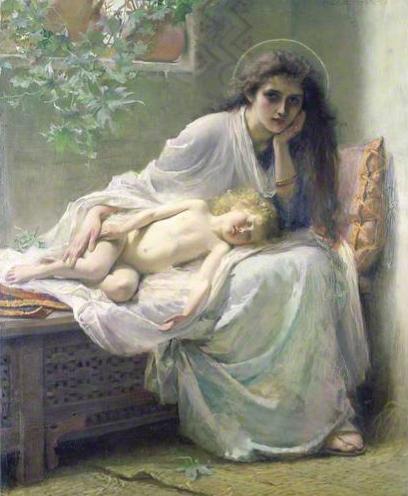
"But Mary kept all these things and 
pondered them in her heart" - by Alice Havers

TODAY'S SPECIAL: Luke 2:15-21

TO CHEW ON: "But Mary kept all these things and pondered them in her heart." Luke 2:51

I have always loved this little aside about Mary's reaction to the events of the Christmas story. It makes her seem so human, while directing our attention toward God as we ask with her, what do all these things mean?

Bible writers speak of many women whose hearts are tuned to God. The Thompson Chain Bible lists these examples under the heading: Women - Crowning Qualities - Devotional Spirit. What are some areas of life into which Bible women brought this devotional spirit?

1. Their attitude toward their mates:
  • The ideal wife of Proverbs is  "virtuous" - Proverbs 31:10.
  • Peter characterizes a godly wife as having a beauty of the heart—"… a gentle and quiet spirit, which is very precious in the sight of God" - 1 Peter 3:1-6.

2. Their motherhood:
  • Hannah prays for a son, makes a promise to God, and keeps it - 1 Samuel 1:15,26.
  • Rebekah "inquires of the Lord" when she senses there is something unusual about her pregnancy - Genesis 25:22.
  • Mary willingly gives her body to carry Jesus and after He is born, ponders all the unusual phenomenon that accompany His birth - Luke 1:38; 2:19 (our focus verse).

3. Their role as singles:
  • Philip's four daughters are single prophetesses - Acts 21:9.

4. Their position as leaders:
  • Miriam leads the women of Israel in worship with her tambourine, singing, and dancing - Exodus 15:20.
  • Huldah is a prophetess who even the priest consults - 2 Kings 22:14.
  • Queen Esther's first thought is to pray and fast before attempting to approach the king - Esther 4:16.

5. Their personal devotion and worship:

  • Eighty-four-year-old Anna spends all her time in the temple, fasting and praying - Luke 2:36-37.
  • Mary of Bethany sits at Jesus feet to listen to Him teach instead of getting caught up in her sister's fussing and worrying - Luke 10:38-42.
  • Jesus' women disciples, follow Him, minister to Him and stick with him to the cross (and beyond) - Mark 15:40.

6. Let's not get the idea, though, that a devotional spirit is seen only in women who listen to teaching, fast, and pray. A devotional spirit can be seen too in Their busyness and business:
  • Dorcas is full of very practical good works - Acts 9:36.
  • Lydia is a businesswoman, a seller of purple who worships God and "opened her heart to heed the things spoken by Paul" - Acts 16:14.
  • "Leading women" join Paul and Silas in Thessalonica - Acts 17:4.
  • Paul asks his readers in Rome to help Phoebe in her business - Romans 16:1.

I love how these women demonstrate a devotional spirit in so many roles and activities of life. Let's bring their attitude of alertness to God into whatever our today brings of meditation, worship and prayer; singleness, marriage and parenting; leading and following; business and crafts; play and leisure.

PRAYER: Dear God, please help me to be aware of and acknowledge You in every aspect of my life. Amen.

 *********
Unless otherwise noted all Scripture quotations are taken from the New King James Version®. Copyright © 1982 by Thomas Nelson, Inc. Used by permission. All rights reserved.


Monday, June 30, 2014

What authority determines your course?

telescope observing night sky
TODAY'S SPECIAL: 2 Timothy 4:1-18

TO CHEW ON: "For the time will come when they will not endure sound doctrine, but according to their own desires, because they have itching ears, they will heap up for themselves teachers; and they will turn their ears away from the truth and be turned aside to fables." 2 Timothy 4:3,4

Such a time has come for the church, especially over the issue of blessing same sex marriages. Numerous books have lately come out by professing Christians that are pro same-sex unions (see this Publisher's Weekly article).

Writers of these books usually argue that Bible passages that speak clearly against homosexuality* have been misinterpreted and are saying something different than what they seem to say.

Dr. Albert Mohler, president of Southern Baptist Theological Seminary, has put together a book (God and the Gay Christian? A Response to Matthew Vines**)) refuting one of these books (God and the Gay Christian by Matthew Vines). In Mohler's book, Mohler and four other theologians speak to the arguments Vines makes.

In the chapter titled "What Has the Church Believed and Taught?" Denny Burk quotes liberal theologian Luke Timothy Johnson who, to his credit, is one who admits that the Bible doesn't come out favoring same-sex relationships. In fact, he names the authority that proponents of gay marriage are really following. He says:

"I have little patience with efforts to make Scripture say something other than what it says, through appeals to linguistic or cultural subtleties. The exegetical situation is straightforward: we know what the text says. But what are we to do with what the text says? … I think it is important to state clearly that we do, in fact, reject the straightforward commands of Scripture, and appeal instead to another authority when we declare that same-sex unions can be holy and good. And what exactly is that authority? We appeal explicitly to the weight of our own experience and the experience thousands of others have witnessed to, which tells us that to claim our own sexual orientation is in fact to accept the way in which God has created us" (quoted in God and the Gay Christian - A Response to Matthew Vines? p. 54)

More and more churches and individual Christians that hold to the traditional interpretation of the Bible on contentious issues like gay marriage are being pushed into a corner by the powers of political correctness and public opinion. In this context it's really important that we settle for ourselves (corporately and personally) who and what our authority is in these matters.

Do we set our course by the Bible's authority or are we too heaping up for ourselves fables (new authorities like experience)? We need to determine to set our course by the true North Star of God's word, not the flashy satellites of experience and public opinion that orbit the sky of our culture.

PRAYER: Dear God, in these times when the authority of Your word is being questioned, help me to stay true to it and You. Help me to live my life by Your standards, not the standards of the society around me. Amen.


* Bible passages that speak about homosexuality are: Genesis 19:5; Leviticus 18:22; Leviticus 20:13; Romans 1:26-27; 1 Corinthians 6:9; and 1 Timothy 1:10. 

** Download the free pdf of God and the Gay Christian? A Response to Matthew Vines HERE.


 *********
Unless otherwise noted all Scripture quotations are taken from the New King James Version®. Copyright © 1982 by Thomas Nelson, Inc. Used by permission. All rights reserved.


Bookmark and Share


Thursday, March 06, 2014

Our setting according to God

TODAY'S SPECIAL: Genesis 2:4-25

TO CHEW ON: "This is the history of the heavens and the earth when they were created; in the day that the Lord God made the earth and the heavens." Genesis 2:4

When a science fiction writer sets out to spin her tale, she describes early on in the story the setting, letting us observe her made-up universe and explaining its rules. In some ways our reading today does that for our home — the earth. We find at least seven foundational pillars that hold up and explain, according to God, the way life on earth came about and functions best:

1. God created the heaven and the earth (Genesis 2:4).

2. God formed man and gave him life (Genesis 2:7). Out of the lowliest, commonest part of creation — dust — God shaped him and intimately "breathed into his nostrils the breath of life; and man became a living being."

3. God gave man work — a purpose for living as the keeper of a garden (Genesis 2:15).

4. God set boundaries for human behaviour — an opportunity for man to exercise his will to obey and live or disobey and die (Genesis 2:17).

5. God created animals and charged Adam with the task of naming them (Genesis 2:19,20). This implies a human precedence over the animal kingdom. We're not the same. For example, killing an animal is not murder, like killing a human being is.

6. God made woman and Adam recognized her as his "comparable" (Genesis 2:22, 23). "'Comparable to him' denotes complementarity. The needed help is for daily work, procreation, and mutual support through companionship" - Russell Bixler, notes on Genesis,  New Spirit-Filled Life Bible, p. 7.

7. God established marriage (vs. 24).
"Therefore shall a man leave his father and mother..." Leave tells us there is a change of priorities here. Mom and Dad (Mom-in-law, Dad-in-law) are no longer the focus of this relationship.
"...and be joined to his wife..." They are to be joined in passion and permanence.
"...and they shall become one flesh." One flesh implies sexual union, conceiving children, being spiritually and emotionally intimate, and living with each other in the same way one does with one's blood family of birth.

These pillars have been under attack from the first Eden days ("Then the serpent said to the woman, 'You shall not surely die.'" - Genesis 3:4) till now. However, ignoring or flaunting any one of them in belief and behaviour does, I think, put us on a wrong track and cause our lives to be out-of-kilter with the way God designed us to work best.

The challenge for us is to stand firm on God's order of things in spite of society's clamouring against aspects of it, like the questioning of God's existence, the fact that He is the creator, the existence of an objective moral standard, the eternal implications of disobeying God, and the sanctity of marriage, to name a few.

PRAYER: Dear God, thank You for laying out our setting so clearly. Help me to stay focused on the way You say things are and not be distracted or swayed by the world's arguments against Your order. Amen.


*************
Unless otherwise noted all Scripture quotations are taken from the New King James Version®. Copyright © 1982 by Thomas Nelson, Inc. Used by permission. All rights reserved.

Bookmark and Share

Related Posts Plugin for WordPress, Blogger...