Showing posts with label John Piper. Show all posts

Saturday, June 16, 2018

A pest in the garden

"Rise up my love, my fair one
and come away"
by James Shaw Crompton

"Rise up my love..." by James shaw Crompton
TODAY'S SPECIAL: Song of Solomon 5-8; Psalm 12


TO CHEW ON: "I had put off my garment;
how could I put it on?
I had bathed my feet;
how could I soil them." Song of Solomon 5:3


Even this idyllic garden of love has a pest or two. In today's reading we see glimmers of selfishness when Beloved comes to the door, but Bride doesn't feel like getting dressed or soiling her clean feet. So she delays. When she does eventually open the door no one is there.  Beloved has gone. She has delayed too long.

We may recognize Bride's selfishness in reactions that well up within us. We don't like to be interrupted, pulled away from activities that we have planned, or have our sleep broken by the telephone.

After ignoring the summons to respond we may be filled with regret just like Bride was. But when we try to back-track, we often find, just like she did that once an opportunity to show love has been squandered, it is lost forever.

PRAYER: Dear God, I recognize Bride's selfishness in me. Help me to respond to opportunities to show love and think more of others than myself. Amen.

PSALM TO PRAY:
Psalm 12

MORE: The sober truth

John Piper explores selfishness in a February 2011 sermon entitled "I Act the Miracle":
"Selfishness is virtually the same as pride and is the deep, broad corruption that is at the bottom of it all. I would give it six traits.
    •    My selfishness is a reflex to expect to be served.
    •    My selfishness is a reflex to feel that I am owed.
    •    My selfishness is a reflex to want praise.
    •    My selfishness is a reflex to expect that things will go my way.
    •    My selfishness is a reflex to feel that I have the right to react negatively to being crossed.
And the reason I use the word “reflex” to describe the traits of selfishness is that there is zero premeditation. When these responses happen, they are coming from nature, not reflection. They are the marks of original sin.
Now what happens when this selfishness is crossed?"
 
By John Piper. ©2012 Desiring God Foundation. Website: desiringGod.org

Read all of I Act the Miracle and discover ANTHEM (an acronym for victory over selfishness and its nasty symptoms).


********
Unless otherwise noted all Scripture quotations are taken from the New King James Version®. Copyright © 1982 by Thomas Nelson, Inc. Used by permission. All rights reserved.

Monday, May 14, 2018

The pouting prophet

TODAY'S SPECIAL: Jonah 1-4; Psalm 129

TO CHEW ON: "But it (God's relenting from the disaster He said He would bring on Nineveh - Jonah 3:11) displeased Jonah exceedingly and he became angry." Jonah 4:1

At a church conference I attended some years ago, I heard Rich Wilkerson sum up each of the church offices in a catchy way.

Apostles: Entrepreneurs who start new things for God.
Evangelists: Salesmen—"You need Jesus."
Pastors: Encouragers—"Everything is going to be okay."
Teachers: Always looking for the teachable moment.
Prophets: Concerned with keeping things in the right category—"That's just not right!"

Isn't that last so Jonah! After preaching, he camped outside the city—his front-row seat for the fireworks—but they never came. And so he said to God (my paraphrase): I told you so! I knew Your merciful nature. That's exactly why I ran away to Tarshish—because I knew in the end You'd change Your mind.

Then God gave this pouting prophet an object lesson from his own reaction to circumstances. When a fast-growing vine sprung up providing shelter from the sun, he was happy. But when a worm nibbled at it till it died he had pity on the plant, simply because it affected his own comfort. In this way God showed him his shallowness and how very different Jonah was from God, whose compassion went way beyond a plant to embrace all people (as well as animals - Jonah 4:11).

How readily we too get hung up on our own ideas of how God should work and like Jonah get swept into self-righteous anger when things don't happen according to our little prophetic 'that's not right' categories. A sidebar article in my Bible leaves us with some advice on how to neutralize such an attitude:

"Do not allow anger or pride to remain in your heart. They led to Jonah's disobedience. Turn away from these attitudes, and seek to have God's character of mercy, grace, patience, forgiveness and lovingkindness" - Leslyn Musch, "Truth-In-Action Through Jonah," New Spirit-Filled Life Bible, p. 1199.


PRAYER: Dear God, please help me to have Your heart of compassion and pity on the people around me in the spirit of being a fellow traveler. Help me to be a conduit of your mercy, grace, patience, forgiveness, and love to everyone around me. Amen.

PSALM TO PRAY: Psalm 129

The Bible Project VIDEO: Jonah (Read Scripture Series)


MORE: God's patience with His Jonahs
"...God not only treats Nineveh with pity and mercy, but also treats his stiff-necked prophet that way too. He is slow to anger and ready to relent in his wrath toward Nineveh, and toward Jonah" - By John Piper. © Desiring God. Website: desiringGod.org. (Read all of "Should I not Pity That Great City Minneapolis.")

**********
Unless otherwise noted all Scripture quotations are taken from the New King James Version®. Copyright © 1982 by Thomas Nelson, Inc. Used by permission. All rights reserved.

Monday, February 19, 2018

Beyond a buddy God

 "Psalm 50 - The Lord Summons the Earth" by Moshe Tzvi HaLevi Berger


TODAY'S SPECIAL:
 Numbers 31-32; Psalm 50

TO CHEW ON: 
"You sit and speak against your brother;
You slander your own mother's son.
These things you have done, and I kept silent;
You thought that I was altogether like you;
but I will rebuke you,
And set them in order before your eyes" - 50:20,21


We put ourselves in danger of making some of the most serious errors about God when we think of Him as being just like us.

How could a God who is all-loving and all-powerful allow evil, we ask,  and manufacture a God who is either not all-powerful or not love.

How can a God who tells us to be humble, demand that we praise Him, we wonder, and manufacture a God who is all ego or so meek and mild as to be of no consequence.

In Psalm 50, Asaph challenges the misconception that God is altogether like us. He points out that:
- God is the creator (Psalm 50:1,2).
- God's presence is mysterious and awe-inspiring (Psalm 50:3).
- He is an altogether capable, righteous judge (Psalm 50:4-6).
- He doesn't need us or our possessions (Psalm 50:7-13).
- Rather, we need Him (Psalm 50:14-15).
- His silence and lack of reaction to our rebellion don't mean that He doesn't see or care (Psalm 50:16-21).

Our human minds and imaginations, limited as they are by time and space, find it hard to conceive of a God who encompasses all the descriptions of Him in the Bible. There comes a time when we need to throw up the hands of our human understanding and opt for a different response. It is a response of faith. It expresses itself in an attitude of praise,  thanksgiving, and compliance to the rules and principles-of-living given to us by this God who is beyond our understanding. It's how Asaph responds in verse Psalm 50:23:


"Whoever offers praise glorifies Me;
And to him who orders his conduct aright
I will show the salvation of God."

PRAYER: Dear God, thank You that You are beyond my imagining. When I don't understand You, I choose faith. Help me to resist the temptation to keep You in the box of my human ability to figure You out. Amen.

PSALM TO PRAY: Psalm 50

The Bible Project VIDEO: HOLINESS (Theme series)


MORE: More thoughts along the line of Psalm 50
"Beware of a mindset that belittles and insults God. God is an absolutely unstoppable, unfailing, constant, volcano of power and fire and joy and help. He never wearies in the slightest and is omnipotently enthusiastic about his gracious purposes in your life. Never let a weak or miserly or tightfisted or weary or boring God enter your mind. He owns all and loves to glorify his power and grace by delivering people who call on him. Keep God great in your eyes for the rest of this year.") By John Piper. © Desiring God. Website: desiringGod.org emphasis added.

****************
Unless otherwise noted all Scripture quotations are taken from the New King James Version®. Copyright © 1982 by Thomas Nelson, Inc. Used by permission. All rights reserved.


Sunday, February 04, 2018

Superstition

TODAY'S SPECIAL: Leviticus 16-18; Psalm 35

TO CHEW ON: "They shall no more offer their sacrifices to demons after whom the have played the harlot. This shall be a statute forever for them throughout their generations." Leviticus 17:7

Were these people knowingly sacrificing to demons? The word "demons" - "having the form of a goat or a satyr" has overtones of animism. The picture I get is of a people puzzled by and fearful of natural phenomenon. But instead of acknowledging God as the creator and sustainer of life, they are trying to appease some folk god (goat or satyr) thought to be in charge of these things.

However it came about, this false worship offended God at the deepest level. An end note in my Bible expands on this:

"The greatest sin in ancient Israel was idolatry (see Deuteronomy 32:17)...The essence of the Jewish monotheistic faith was contained in the verse, "Hear O Israel: The Lord our God, the Lord is one!" - Deuteronomy 6:4 (New Spirit-Filled Life Bible, p. 153).

Though we ourselves may eschew any overt involvement with the demonic, I wonder if there remains a vestige of it even in the lingering hold superstitions have on us. Do we ever find ourselves thinking, after a day has got off to a bad start: There's bound to be more because bad things always come in threes? Or saying things like "Gesundheit" after a sneeze, or "Touch wood" after mentioning that things are going well? Or fearing Friday the 13th? Or avoiding black cats and walking under ladders? Or needing to wear certain lucky clothes and go through certain luck-generating routines before a sports event?

Any fear we feel, any changes in behaviour we make that are inspired by superstition show that at some level we're sacrificing — to what? Demons? God's prohibition to Israel through Moses's words in Leviticus ring across the centuries to us today: "They shall no more offer their sacrifices to demons..."

PRAYER: Dear God, help me to recognize false worship in my life in whatever form it takes. Please free me from bondage to superstition or anything else that would make me a slave to anyone but You. Amen.

PSALM TO PRAY: Psalm 35

MORE: Do you believe in bad luck?

Well don't! As John Piper writes in article he wrote on a Friday that was also the 13th day of the month:

"In Christ there is no Bad Luck"
"Today is Friday the 13th! Bad luck day.

In case this or any other superstition frightens you or, worse, controls you, take the sword of the Spirit and kill it.

Here’s a few sword thrusts that I use.

There is no enchantment against Jacob, 
no divination against Israel; 
now it shall be said of Jacob and Israel, 
“What has God wrought!” (Numbers 23:23)

Does this apply to us Christians? Yes. Because “It is those of faith who are the sons of Abraham” (Galatians 3:7).  That’s us. We are Jacob. We are Israel.
And because we are, "all the promises of God find their Yes in him” (2 Corinthians 1:20).

So in Christ we cannot be cursed. There is no jinx or hex that can stick against those who are in Christ Jesus. 

Christ redeemed us from the curse of the law by becoming a curse for us. (Galatians 3:13)

Christ took on himself every curse that is against me. God is for me and no one can successfully be against me.

He who is in you is greater than he who is in the world. (1John 4:4)

© 2011 Desiring God

****************
Unless otherwise noted all Scripture quotations are taken from the New King James Version®. Copyright © 1982 by Thomas Nelson, Inc. Used by permission. All rights reserved.


Friday, September 15, 2017

Super-natural

"Mount Sinai" - Artist unnamed
TODAY’S SPECIAL: Psalm 113:1-114:8

TO CHEW ON:
“Tremble, O earth, at the presence of the Lord,
At the presence of the God of Jacob
Who turned the rock into a pool of water
The flint into a fountain of waters.” Psalm 114: 7-8


The psalmist has packed years of history into this 16-line poem. It speaks of the time Israel left Egypt and slavery. In the desert, God lived with them – hovering close in a cloud and overshadowing the tabernacle with His glory.

Nature complied with God’s plans. The Read Sea parted to let them cross (Exodus 14:16). After 40 years of wandering in the desert, the Jordan River likewise divided up so they could walk to the other side (Joshua 3:17).


The mountains and hills skipping like rams and lambs probably refers to the rolling and shaking of Mount Sinai when God met with Moses there (Exodus 19:18). The “rock into a pool of water" and “flint into a fountain of water” refer to God supplying their drinking water from rock – at least twice (Exodus 17:6; Numbers 20:11).

Don’t you just love the psalmist’s saucy questioning of these inanimate natural objects: “What ails you, O sea, that you fled? O Jordan that you turned back? O mountains that you skipped like rams? O little hills like lambs?” It’s a type of rhetorical question – to which the answer would have been, “We couldn’t help it. What would you do but comply (tremble) in the presence of God?”

We know, however, that at the time these things were happening the Israelites were anything but confident that God knew what He was doing. It was only in retrospect that His modus operandi became evident.

Does God still intervene in miraculous ways on our behalf? I believe so. I can just see us in heaven, with the benefit of perfect hindsight and insight, thanking and praising God for the stayed storms, the just-missed auto accidents, the at-the-time annoying delays which kept us from being in the wrong place at the right time.

PRAYER: Dear God, thank You that even inanimate nature is under Your control. Help me to have confidence in You as the God of everything.

MORE: In “The Laws of Physics as God” John Piper makes a defense for a God who is behind the laws of nature, and above them.

************
Unless otherwise noted all Scripture quotations are taken from the New King James Version®. Copyright © 1982 by Thomas Nelson, Inc. Used by permission. All rights reserved.

Do your 8-12-year-olds have daily devotions? Point them to Bible Drive-Thru.

Friday, August 18, 2017

Who gets the glory?

TODAY'S SPECIAL: Genesis 41:1-24


TO CHEW ON: "So Joseph answered Pharaoh, saying, 'It is not in me; God will give Pharaoh an answer of peace'" - Genesis 41:16

Joseph had no illusions about where he got his unusual wisdom and insight into dreams. "It is not in me," he told Pharaoh plainly. "God will give Pharaoh an answer."

He reminds me of another dream interpreter. The young exile Daniel had a similar ability to interpret dreams. When he came before King Nebuchadnezzar to not only interpret his dream but to tell him what he had dreamed in the first place, Daniel too reflected the glory back to God:

"...There is a God in heaven who reveals secrets, and He has made known to King Nebuchadnezzar what will be in the latter days..." Daniel 2:28.

When we experience success, how easy it is to accept praises and compliments never giving a thought or word to deflecting the glory back to God. Let's follow the example of Joseph, making it very clear that God is the source of any wisdom, or insight or special skill. Let's give Him the glory and not take it for ourselves.

PRAYER: Dear God, please forgive me for accepting praise for myself when it rightfully belongs to You. Help me to habitually give You glory for the abilities and successes You have made possible. Amen.


MORE: God delights in His glory
"...God's own glory is uppermost in His own affections. In everything He does, His purpose is to preserve and display that glory. To say that His own glory is uppermost in His own affections means that He puts a greater value on it than on anything else. He delights in His glory above all things. ...


This is the same as saying: He loves Himself infinitely. Or He Himself is uppermost in His own affections. A moment's reflection reveals the inexorable justice of this fact. God would be unrighteous (just as we would) if He valued anything more than what is supremely valuable. But He Himself is supremely valuable. If He did not take infinite delight in the worth of His own glory, He would be unrighteous. For it is right to take delight in a person in proportion to the excellence of that person's glory" - John Piper, Desiring God, p. 41-43.
********
Unless otherwise noted all Scripture quotations are taken from the New King James Version®. Copyright © 1982 by Thomas Nelson, Inc. Used by permission. All rights reserved.

********
Subscribe to my newsletter. Next one coming September 1st, with book recommendations and author news.

Sign up below:


Sunday, July 30, 2017

Offending wisdom

TODAY'S SPECIAL: Matthew 13:47-58

TO CHEW ON: "When He had come to His own country, He taught them in their synagogue, so that they were astonished and said, 'Where did this Man get this wisdom and these mighty works?'" Matthew 13:54

The kingdom of heaven parables poured out of Jesus. In today's reading, we read the last of a series recorded in Matthew 13. In it, Jesus compared the kingdom to a mixed catch of fish (Matthew 13:47-50).

We take from it the message that the church's responsibility is to spread the gospel wherever it can, even to those who appear unlikely to accept it, for it attracts people of all kinds. And like the parable of the wheat and tares, here the 'fish'  who survive a sorting by the angels at the end of the age will be preserved while the wicked will be cast into a place that sounds a lot like hell - Matthew 13:50.

"Where did this Man get this wisdom?" the people in Jesus' home town inquired. Even though they may not have been referring to His kingdom of heaven speech specifically (He had in the meantime traveled to the place where he grew up - Nazareth), His teaching was invariably wise, thought-provoking, stimulating, and controversial.

Unfortunately even though townspeople called Jesus' teaching wise, they were offended by it (Matthew 13:57). It's the same reaction Jesus' teaching receives today (e.g. the ongoing controversy within Christianity about the existence and meaning of hell).

Two applications come to mind:

1. I wish I had a tiny iota of Jesus' wisdom, don't you? We are reminded of Peter and John and the reaction to their teaching: "Now when they (rulers, elders, scribes etc.) saw the boldness of Peter and John and perceived that they were uneducated and untrained men, they marveled. And they realized that they had been with Jesus" - Acts 4:13 (emphasis added). Is the secret to wisdom spending time with Jesus?

2. We need to be mindful of our own reaction to Jesus' teaching. Our generation has a tendency to select what it will believe and live by. A popular emphasis today is Jesus' message about caring for the poor, while we gloss over His message of judgment. Are we personally guilty of letting society's preferences dictate which of Jesus' words we take seriously and which we don't because they offend?

PRAYER: Dear Jesus, thank You for the record of Your wisdom in the Bible. Help me to assimilate it into my life. I want my mind, life and speech to be changed by time spent with You. Amen.

MORE: What is wisdom?

Charles Spurgeon writes:
"Wisdom is the right use of knowledge. To know is not to be wise. Many men know a great deal, and are all the greater fools for it. There is no fool so great a fool as a knowing fool. But to know how to use knowledge is to have wisdom."
J. I. Packer writes:
"Wisdom is the power to see, and the inclination to choose, the best and highest goal, together with the surest means of attaining it. Wisdom is, in fact, the practical side of moral goodness. As such, it is found in its fulness only in God. He alone is naturally and entirely and invariable wise."
John Piper writes:
"Wisdom is the practical knowledge of how to attain that happiness. Therefore, wisdom is hearing and doing the Word of God."
For further reflection, see John Piper's 1981 sermon titled "Get Wisdom."

(From the website DesiringGod.org)

*********
Unless otherwise noted all Scripture quotations are taken from the New King James Version®. Copyright © 1982 by Thomas Nelson, Inc. Used by permission. All rights reserved.


Tuesday, January 31, 2017

Do you love God's rules?

TODAY'S SPECIAL: Psalm 112:1-10

TO CHEW ON: "Blessed is the man who fears the Lord.
Who delights greatly in His commandments." Psalm 112:1

When was the last time you delighted in commandments or rules?

["Delights" (chaphets) means to take pleasure in, be bent or inclined toward, to cherish or be favourably disposed toward, to love and desire.] The psalmist calls the person who has this attitude toward God's commandments "blessed."

It may seem strange to us that Old Testament writers extolled the law that included odd-to-us rules about using materials in their pure forms, avoiding certain foods and observing standards of hygiene that included clothes washing, hand-washing, and observing specific procedures when it came to things like mildew-infested houses.

Yet, when we look deeper, we see in the Rule-maker a heart that was for the people, that sought to protect them from dangers of which they were unaware. For though we're still not clear about the reason for some of these commandments, others now make a lot of sense (ask anyone who has had to live in a mold-infested house).

Perhaps that is why these writers found "delight" in God's commandments. They knew God was for them and had given them these boundaries and limits for their own good.

We need to have the same attitude about the principles of holy living which apply to us today. Even if we don't understand the reason for them we know:
- They are given for our benefit.
- They come from Someone who loves us and has our best interests at heart.
- They come from Someone who we value and esteem. Our delighted inspection gives us information and knowledge about the Lawgiver.

PRAYER: Dear God, please help me to delight in Your word — not only its promises but also its commandments. Help me to see beyond their apparent restrictiveness to how You show Yourself to be for me in them. Amen.

**********
Unless otherwise noted all Scripture quotations are taken from the New King James Version®. Copyright © 1982 by Thomas Nelson, Inc. Used by permission. All rights reserved.

Tuesday, April 19, 2016

Faith food

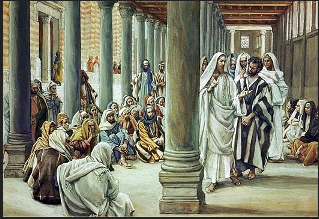
Jesus at the Feast of Dedication - James Tissot
TODAY’S SPECIAL: John 10:22-42

TO CHEW ON: ‘I told you and you do not believe…. But you do not believe because you are not My sheep, as I said to you. My sheep hear My voice and I know them and they follow me.’” John 10:25-27

When the Jews surrounded Jesus in the temple during the Feast of Dedication demanding “'If you are the Christ tell us plainly,'” they had one goal – to get Jesus to incriminate Himself. They were not asking for proof of His deity in order to reassure themselves that He was God and believe in Him. They were not even looking to Him as a potential Messiah to free their nation from the Romans. They completely overlooked the miracles that pointed to the fact He was no ordinary man. All they wanted was proof (again) from His own mouth, of blasphemy. Then they planned to arrest Him and get rid of Him as a rival.

The same teachings and miracles of Jesus referred to when talking to the Jews had a far different effect on the “many who came to Him… and believed in Him.” The difference: a willingness to believe.

The same is true for people of our generation. Though we don’t have Jesus in person as they did, we have the Bible. I’m sure you’ve noticed its different effects on people. Some laugh it off as a collection of archaic writings that have nothing at all to say to them. Others read it with reservations and attempt to twist it to say what they want it to say. Still others consider it truth, the very words of God. To them it is direction for life and hope in death. Whatever one’s perception of Jesus and what He said according to the Bible, it hinges on one thing: a decision to believe - or not.

How do we come to that point of belief? How do we encourage it in others? Through exposure to the Bible. John Piper says:
“The Word of God begets and sustains spiritual life because it begets and sustains faith: “These are written,” John says, “so that you may believe that Jesus is the Christ, the Son of God, and that by believing you may have life in his name (John 20:31). “Faith comes from hearing,” writes the apostle Paul, “and hearing through the word of Christ” (Romans 10:17). The faith that starts our life in Christ and by which we go on living comes from hearing the Word of God.” - John Piper, Desiring God, p. 146 (emphasis his).

If you are having trouble believing in and hearing the voice of your Shepherd, spend time in the Bible. Read it, memorize it, think about it, do it. Your exposure to God’s word will plant the seed of faith and grow it into the desire and ability to live an obedient life.

PRAYER: Dear God, I want to hear Your voice. Help me to read, understand and obey Your Word. Amen

MORE: At the age of 19 Abraham Piper, son of John Piper, was an avowed atheist. He came to faith one morning by reading the book of Romans. His advice to parents with prodigal kids:
"When you read something in the Bible that encourages you and helps you love Jesus more, write it up in a couple of lines and send it to your child. The best exhortation—better than any correction—is for them to see Christ’s joy in your life.


Don’t stress out when you’re composing these as if each one needs to be singularly powerful. Just whip them out and let the cumulative effect of your satisfaction in God gather up in your child’s inbox. God’s Word is never useless."

Read his story: “Let Them Come Home.

*********
Unless otherwise noted all Scripture quotations are taken from the New King James Version®. Copyright © 1982 by Thomas Nelson, Inc. Used by permission. All rights reserved.

Do your 8-12-year-olds have daily devotions? Point them to Bible Drive-Thru.

Friday, November 06, 2015

Welcoming wings


"Having checked all were present and correct,
 the mother swan gently tucked back her wings 
to stop them falling off before gliding back to her nest" 
From "All Aboard"

TODAY'S SPECIAL: Ruth 2:1-23

TO CHEW ON: "'The Lord repay your work and a full reward be given you by the Lord God of Israel under whose wings you have come for refuge.'" Ruth 2:12

Ruth was in Bethlehem, the home of her mother-in-law, where she was an outsider. However, that didn't stop her from taking the initiative in getting food on their table. Perhaps Naomi told her about the Israeli custom of gleaning, where the farmer purposely left some of his crop for the poor to pick up after his harvesters were done. For she seemed to know about it and offered to glean food for them.

Her first morning out she 'happened' to choose the field of Boaz to glean in. He noticed her, perhaps not surprisingly, for it seems her arrival with Naomi had been all the buzz around town.

 If Ruth had any fears about the reaction of this wealthy farmer, she needn't have. For his attentions were all good. How comforting his words must have sounded: "The Lord repay your work and a full reward be given you by the Lord God of Israel, under whose wings you have come for refuge."

In many places God expresses His tender-heartedness for the alien, foreigner, orphan and widow. Do we have a similarly welcoming attitude toward immigrants, outsiders, newcomers with strange customs, language, clothes, and food? The recent debate in Canada over whether Muslim women immigrants to Canada should be allowed to wear the face-covering niqab during citizenship swearing in has brought feelings and discussion about foreigners into the open. I know I need to constantly check my own heart on this, asking, am I as welcoming as Boaz was?

God's wings are big enough for us all. He invites us all to come to Him for comfort, rest, protection, safety, healing and renewal:

"How precious is Your lovingkindness, O God!
Therefore the children of men put their trust under the shadow of Your wings" - Psalm 36:7
(See also Psalm 91:1-6 and Malachi 4:2)


PRAYER:
Dear God, thank You for Your welcome to all people. Help me to reflect Your welcoming attitude toward others, especially newcomers, immigrants and foreigners. Amen.

MORE: We are all aliens
"The divide could not have been larger between sinful human beings and the infinitely holy Son of God. But Christ did not despise us. He came to us. He loved us. He died in our place to give us life. And he did all this when we were more alien to him than anyone has ever been alien to us. When we feel or think or act with disdain or disrespect or avoidance or exclusion or malice toward a person simply because he or she is of another race or another ethnic group, we are, in effect, saying that Jesus acted in a foolish way toward us. You don’t want to say that."   By John Piper- read all of "Probability, Prejudice and Christ"   ©2012 Desiring God Foundation. Website: desiringGod.org.  
*********
Unless otherwise noted all Scripture quotations are taken from the New King James Version®. Copyright © 1982 by Thomas Nelson, Inc. Used by permission. All rights reserved.

Bible Drive-Thru


Saturday, August 22, 2015

What's the devil doing in heavenly places?


TODAY'S SPECIAL: Ephesians 6:10-24

TO CHEW ON: "For we do not wrestle against flesh and blood, but against principalities, against powers, against the rulers of the darkness of this age, against spiritual hosts of wickedness in the heavenly places." Ephesians 6:12

"Heavenly places"—the phrase brings to mind heaven, paradise, a place beyond the petty conflicts of earth. But according to Paul, conflict abounds there too—conflict of the most intense variety.

Paul talks about "heavenly places" several times in Ephesians (as pointed out by Jack Hayford,  the writer of my Bible's notes on Ephesians):

  • The spiritual blessings available to the church through Christ are located in heavenly places - Ephesians 1:3.
  • Christ's post-resurrection power and authority issues from heavenly places - Ephesians 1:19-22.
  • After we have accepted God's good news and have come alive in Christ, we are spiritually seated with Christ in heavenly places - Ephesians 2:4-6.
  • The church's destiny is to make known the will of God to the principalities and power in heavenly places - Ephesians 3:10.

Hayford concludes: "On these grounds this passage announces the church's corporate assignment to prayer warfare in order that evil can be driven back and the will of God advanced" - notes on Ephesians, New Spirit-Filled Life Bible, p. 1654.

I like that: prayer warfare. But what exactly does it mean?

Daniel Henderson in his book Transforming Prayer dispels some of the mystique around prayer that does spiritual warfare:

"Many who write about spiritual warfare seem to think that we must be astute in a variety of extra-biblical tactics and special insights about the names and addresses of demons. Some people promote grandiose sketches of the evil hierarchy and fascinating geographical exposes of their organizational battle plan....

I may be naive compared to the warfare experts but I have discovered that a life of passionate worship—one that delights in biblical truth about God's character, seeks the empowerment of the Spirit for application and articulation, then surrenders in every way as prompted by this intimate encounter, is equipped to 'fight the good fight' every day. Jesus, on the heels of forty days of prayer and fasting, wielded the truth of God's Word in facing down the devil in the wilderness (Matthew 4:4-11). We, too, are equipped by His sufficiency to brandish the 'sword of the Spirit,' which is the spoken word of God - Ephesians 6:17" - Daniel Henderson, Transforming Prayer, pp. 143, 144 (emphasis added).

PRAYER: Dear God, thank you that You have won the battle over evil. Help me to face the onslaughts of the devil and his demonic cohorts with the truth of Your word in my mind, and praise and worship for that victory on my tongue. Amen.

MORE: Prayer: a wartime walkie-talkie

"The number one reason why prayer malfunctions in the hands of believers is that they try to turn a wartime walkie-talkie into a domestic intercom. Until you believe that life is war, you cannot know what prayer is for. Prayer is for the accomplishment of a wartime mission" - John Piper, (quoted in Transforming Prayer, p. 143) from the sermon "Prayer: the Work of Missions."

********

Unless otherwise noted all Scripture quotations are taken from the New King James Version®. Copyright © 1982 by Thomas Nelson, Inc. Used by permission. All rights reserved.


Bible Drive-Thru


Tuesday, August 04, 2015

Sin's bitter consequences

David's grief over Absalom - Artist unknown
TODAY'S SPECIAL: 2 Samuel 18:19-33

TO CHEW ON: "Then the king was deeply moved, and went up to the chamber over the gate, and wept. And as he went he said thus: 'O my son Absalom—my son, my son Absalom—if only I had died in your place! O Absalom, my son, my son!'" 2 Samuel 18:33

David's only reaction to his army's victory over Absalom is grief. In fact he is so overwhelmed with that one emotion that Joab, his army captain, lectures him about the effect this is having on the army's morale (2 Samuel 19:1-7).

The writer of my Bible's notes makes an astute observation about David's sorrow: "Part of his grief has to be the awareness that his sin ultimately had killed his sons" - Jerry Cook, notes to 2 Samuel, New Spirit-Filled Life Bible, p. 425.

How so?

Remember the words of prophet Nathan who pronounced this consequence of his sin with Bathsheba and the murder of her husband? "'Now therefore the sword shall never depart from your house, because you have despised Me, and have taken the wife of Uriah the Hittite to be your wife'" 2 Samuel 12:10.

Witness the fulfillment of that when:
  • Absalom killed his brother Amnon in revenge for Amnon defiling Absalom's sister Tamar - 2 Samuel 13:28-29.
  • Absalom himself was killed in battle - 2 Samuel 18:14.
  • After David's death, Solomon executed his half-brother Adonijah after Adonijah's sneaky attempt to wrest power back into his hands by asking for Abishag (who had been King David's companion) as his wife - 1 Kings 2:25.

If anything, I believe it is easier than ever for us to feel that we will escape sin's consequences, living as we do in the era of grace. But maybe we shouldn't be so sure about that. For though God forgives our sins and casts them away "as far as the east is from the west" (Psalm 103:12), we may still need to deal with their aftermath and consequences in health, wealth, relationships, reputation etc.

Realizing this is an incentive for us to live life from this moment on with more attention than ever to uprightness and integrity.

PRAYER: Dear God, please point out to me areas in my life where there will be bad consequences if I stay the course. Help me to clean up my act and life with integrity before you and others. Amen.

MORE: Consequences of forgiven sin
"...the aim of God-sent consequences of forgiven sin is not to settle accounts demanded by retributive justice. The aim of the God-sent consequences of forgiven sin are (1) to demonstrate the exceeding evil of sin, (2) to show that God does not take sin lightly even when he lays aside his punishment, (3) to humble and sanctify the forgiven sinner

Thus Hebrews 12:6 teaches that “the Lord disciplines him whom he loves, and chastises every son whom he receives.” This is immensely important to teach in a day when there is an imbalance of emphasis on the Father’s forgiving tenderness to the exclusion of the Father’s forgiving toughness. Thus many people have no categories to handle the consequences of the sins in their lives except to become less biblical and God-centered in their interpretation of life.

... We must not equate forgiveness with absence of painful impact. David’s life is a vivid illustration of this truth. May God give us the grace to learn it and live it."

- By John Piper, © 2012 Desiring God Foundation. Website: desiringGod.org (emphasis added).  Read all of Consequences of Forgiven Sin.
*********

Unless otherwise noted all Scripture quotations are taken from the New King James Version®. Copyright © 1982 by Thomas Nelson, Inc. Used by permission. All rights reserved.


Bible Drive-Thru

Monday, May 25, 2015

The pure and passionate early church

TODAY'S SPECIAL: Acts 2:22-47

TO CHEW ON: "So continuing daily with one accord in the temple and breaking bread from house to house, they ate their food with gladness and simplicity of heart, praising God and having favour with all the people. And the Lord added to the church daily those who were being saved." Acts 2:46-47


What a contrast is this band of happy, praising people with the cowed and timid group that had clung to each other a few weeks earlier. Jesus' resurrection and the coming of the Holy Spirit had changed everything.

We can learn a lot from this honeymoon stage of the church. Some things that stand out:

1.Their singleness of purpose.
So taken with and absorbed in this new life were these early Christ-followers that they sold their possessions and shared the proceeds with each other so that no one had material needs.

2. Their simplicity.
They pared down their lives and activities to a few essentials:
- spending time with God in the temple.
- spending time with one another, sharing hospitality and eating together.

3. Their success.
Their Spirit-inspired lifestyle caught the attention of onlookers who, noting their God-focus, generosity, the way they took care of each other, and their satisfaction with life's basics, wanted it too. The result was that every day the Lord drew people to be saved and join them.

Through the years people have tried to copy these elements of early church life, with mixed success. I don't think God expects us to mimic them by quitting our jobs and adopting a communal lifestyle. But there is much we can learn from them.

I ask, do I have the singleness of Kingdom purpose, so immune from materialism, that these early Christians had? Do I take joy in the simple activities of fellowship / koinonia?

[koinonia: sharing, unity, close association, partnership, participation, a society, a communion, a fellowship, contributory help, the brotherhood. koinonia is a unity brought about by the Holy Spirit. In koinonia the individual shares in common an intimate bond of fellowship with the rest of the Christian society. Koinonia cements the believers to the Lord Jesus and to each other" - Word Wealth, New Spirit-Filled Life Bible, p. 1494]

Is there about my interactions with my Christian family such an attractiveness that those around would like to be part of it?


PRAYER: Dear God, thank You for this picture of the church in its pure and passionate beginnings. Help me to be infected with that same God-hunger, generosity, contentment with simple things, gladness and gratitude. Amen.

MORE: What's the difference between the early church and us?

In a message called "The Fear of God and the Freedom from Goods," John Piper lists the elements of early church life from this passage:

They focused a lot on the teaching of the apostles (which we have in the New Testament).
• They experienced wonders and signs .
• They lived in a state of wonder and awe as they saw day in and day out the stark reality of God in healings and deliverances and changed lives of people being added to the church.
• They shared their possessions as freely with the needy as though they didn't even own them.
• They spent time in big groups in the temple.
• They ate together in their homes almost every day.
• And when they met each other, they met God. They prayed and they praised.

Then he asks:
"What makes all this hang together? What's the driving force that made those believers free from their possessions, and eager to meet needs, and full of gladness and generosity and praise and prayer when they ate together day after day?


I think the key is found in verse 43 in the phrase, "fear came upon every soul"—a joyful, trembling sense of awe that you don't trifle with the God of the apostles. That is not our experience. Today for most people, including most professing Christians, God is an idea to talk about, or an inference from an argument, or a family tradition to be preserved. But for very few people is God a stark, fearsome, stunning, awesome, shocking present REALITY. He is tame. He is distant. He is silent. Where are the churches of whom Luke could say today, "Fear—awe, wonder, trembling—is upon every soul"?
The absence of this fear has a direct effect on the way we accumulate possessions for ourselves, the way we ignore the needy, the way we trivialize fellowship, and the way we play more than we pray." - By John Piper. © Desiring God. Website: desiringGod.org

************
Unless otherwise noted all Scripture quotations are taken from the New King James Version®. Copyright © 1982 by Thomas Nelson, Inc. Used by permission. All rights reserved.


Bible Drive-Thru


Saturday, April 04, 2015

Secret disciple

"Joseph of Arimathea" 
by James Tissot

Joseph of Arimathea by James Tissot
TODAY'S SPECIAL: Mark 15:40-47


TO CHEW ON: "Joseph of Arimathea, a prominent council member who was himself waiting for the kingdom of God, coming and taking courage, went to Pilate and asked for the body of Jesus." Mark 15:43

Joseph of Arimathea is an interesting character in the story of Jesus' passion. Our focus verse tells us five things about him.

1. "Joseph of Arimathea"
His name and address. Matthew also mentions that he was rich (Matthew 27:57) and Luke describes him as a "good and just man" (Luke 23:50).

2. He was "a prominent council member."
This is the council that Mark mentions several times in his account. After Jesus' arrest, the soldiers delivered him to the council who "sought testimony against Jesus to put him to death but found none" - Mark 14:55. It was in the council meeting that the beatings began (Mark 14:65). And it was the council that the chief priests, elders, and scribes consulted before they led Jesus to Pilate (Mark 15:1).

3. He "was himself waiting for the kingdom of God."
Matthew says more particularly "who himself had become a disciple of Jesus" (Matthew 27:57). John sheds even more light when he describes Joseph as a secret disciple "for fear of the Jews" (John 19:38).

4. "...coming and taking courage..."
Despite his wealth, prominence, and reputation, asking Pilate for Jesus' body demanded courage from Joseph. John's mention of Joseph's fear of the Jews makes us suspect he also needed courage to face them when he finally showed himself loyal to Jesus in this way. He wasn't alone, though. Nicodemus, another secret disciple, joined him in caring for Jesus' body (John 19:38-42).

5. He "asked for the body of Jesus."
He procured Jesus' body and then used his own resources to prepare and bury it in a new tomb, never used, but that he had prepared for himself (Mark 15:45-46; Matthew 27:59-60; Luke 23:53).


Some thoughts about Joseph of Arimathea and us:

1. Even the council had its disciples.  

Still today God has "spies" in the most unusual places.

2. One can only imagine the anguish Joseph went through as he listened to the council discuss Jesus' case. Should he stand up for Jesus or not? What would happen to him if he did? Then, when Jesus was crucified and died, how he must have berated himself. Maybe if he had spoken up, he could have made a difference. 

Are we ever secret disciples? Have we considered what that means in terms of regret, guilt, and final consequence (Mark 8:38; 2 Timothy 2:12)?

3. I love how Joseph finally gave the best that he had, even though it appeared to be too late. He filled a practical need by caring for Jesus with his resources.

His act makes me ask, how can I help? It may be in ways that don't appear remotely spiritual.


PRAYER: Dear Jesus, Joseph of Arimathea is a sobering character to me. Help me to be a public, not a secret disciple. Amen.

MORE: Joseph of Arimathea - a poem

John Piper has written a lengthy and imaginative poem about Joseph of Arimathea.

Here is one stanza from Part 2, where we see Joseph removing Jesus from the cross:

Then Joseph stood and raised his plain

And heavy ladder high, and placed

It on the bloody beam, and braced

It just above the Savior's pale

Gray arm. He bound with rope the frail,

Limp body of the Lord on beam

And post. And then, against a scream

From Jesus' mother, stifled in

Her hand, he slowly cut through skin

And ligament beside the spikes

With heads made flat by many strikes

From Roman mallets. Then he clenched

The knife between his teeth and wrenched

Each hand of Jesus off its rough

And jagged nail through tendons tough,

But careful not to break a bone.

- By John Piper. © Desiring God. Website: desiringGod.org

Read entire: Joseph of Arimathea - Part 1 | Joseph of Arimathea - Part 2

***********
Unless otherwise noted all Scripture quotations are taken from the New King James Version®. Copyright © 1982 by Thomas Nelson, Inc. Used by permission. All rights reserved.

Bible Drive-Thru


Friday, November 28, 2014

Watch!

security guard
TODAY'S SPECIAL: Mark 13:24-37


TO CHEW ON: "And what I say to you, I say to all: Watch!" - Mark 13:37

When a word occurs multiple times in a bit of scripture, we'd better pay attention. In Mark 13:32-37 Jesus tells us four times to WATCH.

"Watch and pray," He says (Mark 13:34), "for you do not know when the time is." The time He is referring to is the time of Jesus' return (Mark 13:26). [The Greek word for watch here (agrepneo) means to be sleepless, to keep awake.]

He repeats the command: "It is like a man going to a far country who ... commanded the doorkeeper to watch.... Watch therefore .... Watch!" (Mark 13:34, 35, 37). [The Greek word for watch in these three instances is gregoreuo. As well as meaning alert and wakeful, it also signifies mental alertness and caution.]

The disciples are to be as alert as doorkeepers, guarding the house from thieves. They are to stay awake through all four watches of the night. They will find themselves in big trouble if the master finds them asleep. The picture is of the captain of the temple making his rounds. "The guards had to rise at his approach and salute him in a particular manner. Any guard found asleep on duty was beaten or his garments set on fire" - Vincent's Word Studies. Oh my!

The command to watch continues for us today. Though we are not to speculate about the date when Jesus will return (Mark 3:32 tells us it's pointless because only God the Father knows) we are to continue in this state of readiness and alertness.

Of course Jesus may come to some of us through death before He physically returns to earth. Here too we need to be watchful. As Matthew Henry puts it:

"We know not whether our Master will come in the days of youth, or middle age, or old age; but, as soon as we are born, we begin to die, and therefore we must expect death. Our great care must be, that, whenever our Lord comes, he may not find us secure, indulging in ease and sloth, mindless of our work and duty..." Matthew Henry's Commentary.
PRAYER: Dear Jesus, help me to be more mindful of Your anticipated return, and to live life alert to the possibility of You bursting on the scene at any moment. Of course I could meet You through death in the same sudden, unexpected way. Teach me to live a watchful lifestyle. Amen.

MORE: Watchful praying

From a 1982 sermon preaching from the text Colossians 4:2-4 John Piper makes these observations about watchful prayer.

“Be watchful in your prayers.” This means, be alert! Be mentally awake! Paul probably learned this from the story of what happened in Gethsemane. Jesus asked the disciples to pray, but found them sleeping. So he said to Peter, “Could you not watch one hour? Watch and pray, that you may not enter into temptation” (Mark 14:37f). We must be on the watch as we pray—on the watch against a wandering mind, against vain repetitions, against trite and meaningless expressions, against limited, selfish desires. And we should also watch for what is good. We should especially be alert to God’s guidance of our prayers in Scripture. It is God who works in us to will our prayers but we always experience this divine enablement as our own resolve and decision..." Read all of "Persevere in Prayer" by John Piper. © Desiring God. Website: desiringGod.org. (Emphasis added.)

**********


Unless otherwise noted all Scripture quotations are taken from the New King James Version®. Copyright © 1982 by Thomas Nelson, Inc. Used by permission. All rights reserved.


Sunday, October 05, 2014

Do you need a lens adjustment?

TODAY'S SPECIAL Philippians 3:1-11


TO CHEW ON: “But what things were gain to me, these I have counted loss for Christ. Yet indeed, I also count all things loss for the excellence of the knowledge of Christ Jesus my Lord, for whom I have suffered the loss of all things and count them as rubbish that I may gain Christ.” Philippians 3:7-8

So much of our satisfaction with life depends on our perspective. If we look at life mainly as an opportunity to get rich and collect things, we’ll grow bitter and disappointed when we don't get rich or that wealth doesn’t last. The results will be the same if we set our sites on pleasure, happiness, fame, influence, prestige and a whole lot of other things. Though all of these things bring transitory pleasure for sure, the satisfaction is fleeting and leaves us with a thirst for more.

In our reading today Paul tells his readers why he has joy despite the fact that he’s in prison and has lost all the things that formerly give his life significance. It’s because when he became a Christ-follower his perspective changed. The passion of his life shifted from keeping the law and all that went with it—prestige and power as a leader, reputation as a scholar, the satisfaction of being a self-made man—to knowing Jesus. That’s why he could wave off all the terrible things that happened to him as if they were nothing. Even his suffering benefited him because it helped him know the God who gave His life to save him.

John Piper in the preface to the 2003 edition of his classic Desiring God says:

“This is the great business of life – to 'put our mouths out of taste for those pleasures with which the tempter baits his hooks.' I know of no other way to triumph over sin long-term than to gain a distaste for it because of a superior satisfaction in God…. God remains gloriously all-satisfying. The human heart remains a ceaseless factory of desires. Sin remains powerfully and suicidally appealing. The battle remains: Where will we drink? Where will we feast? ….Feast on God.” p. 12

Do you see your life—from its humdrum events, to the big life-defining moments—as a series of opportunities to know God better and enjoy Him more? I know I certainly need a change of perspective in that department.

PRAYER: Dear God, please help me to know what it means to “count all things loss” in order to know You better. Amen.

*********
Unless otherwise noted all Scripture quotations are taken from the New King James Version®. Copyright © 1982 by Thomas Nelson, Inc. Used by permission. All rights reserved.

Monday, August 25, 2014

Antidotes to evil

TODAY'S SPECIAL: Romans 12:9-21


TO CHEW ON: "Do not be overcome by evil, but overcome evil with good." Romans 12:21

What a rich list we have in today's reading. Let's look at it as a list of evils (implied or stated) and the antidotes to them that Paul suggests.


[Antidote: Anything that will counteract or remove the effects of poison, disease or any evil.]


Hypocrisy  
Antidote: Kindness; affection; brotherly love, i.e. that looking-out-for-each-other kind of love that siblings show each other; giving others preference above yourself.

Indifference 
Antidote: Diligence; cultivating a "fervent spirit" i.e. warmth, showing intensity of emotion or enthusiasm, ardent; serve the Lord with this attitude.

Depression 
Antidote: Rejoice in (focus on) hope.

Tribulation 
Antidote: Patience (perseverance); prayer.


Lack 
Antidote: Look for needs and fill them; extend hospitality.

Persecution
Antidote: Bless your persecutor.

Isolation
Antidote: Empathy - "Rejoice with those who rejoice, weep with those who weep."

Pride
Antidote: Treat everyone the same way; refrain from acknowledging class or status and associate with everyone; be humble yourself.

Quarrelling
Antidote: Be the peaceful one, not the instigator of quarrels.

Wrongs done to you
Antidote: Refuse to repay in kind; let God be your avenger, treat your enemy with kindness.

Can you relate to any of these evils and their antidotes? I certainly can! Though the words are straightforward and the concepts simple, there's a lifetime of sanctification implied here.


PRAYER: Dear God, please show me how, and help me to work these excellent antidotes to evil into the fabric of my life. May they become my lifestyle. Amen.

MORE: Overcoming evil with good

John Piper:

 "Don’t be overcome by evil means. Don’t be overcome by his evil. Don’t let another person’s evil make you evil. Oh, how crucial that is.


"[...] When you let your adversary make you evil he is the victor. If you let a person’s sin govern your emotions so that your sinful anger or your misery or your depression is owing to their evil, then you are being overcome by evil. And Paul says, You don’t have to be overcome that way.
"[...] When someone does evil to you, you should say, “You are not my Lord. I will not be controlled by you. I will not have my attitudes and thoughts and actions dictated by your evil. Christ is my Lord. Christ dictates my attitudes and thoughts and actions..."
Read all of "Christ Overcame Evil with Good—Do the Same" By John Piper. © Desiring God. Website: desiringGod.org

*********
Unless otherwise noted all Scripture quotations are taken from the New King James Version®. Copyright © 1982 by Thomas Nelson, Inc. Used by permission. All rights reserved.

*********

Subscribe to my newsletter coming September 1st. 

Get book recommendations, Bible study tips, author news plus a full-colour 18-month Pathways Scripture text calendar when you sign up!  

Sign up below:


Bookmark and Share

Thursday, August 07, 2014

Family strife

"Joseph Tells His Dreams"
by Rembrandt

TODAY'S SPECIAL: Genesis 37:1-20


TO CHEW ON: "Now Israel loved Joseph more than any of his other sons..." Genesis 37:3 NIV

The events in today's reading make for a great story—but not so great if they are happening to you. Joseph, son of Jacob's best-loved wife Rachel is now a teenager and out in the field with some of his brothers. The list of family frictions recorded in this story begins with his tattletale reaction to their misbehaviour (Genesis 37:2). It carries on, illustrating family dysfunctions of:

Favouritism: Joseph's father makes him a distinctive coat (Genesis 37:3).

Jealousy: This special treatment makes his brothers hate him even more so they can't even be civil to him (Genesis 37:4).

Boasting vanity: Joseph rubs in his favoured status by telling his two dreams where family members bow to him (Genesis 37:6-11).

Hatred — and murder (almost): All this bad will eventually ripen into the brothers' scheme, when the opportunity presents itself, to murder Joseph. (This plan changes when a Midianite caravan passes by. Selling Joseph to these slave traders makes it possible for the brothers to rid themselves of their sibling pest without actually killing him (Genesis 37:20, 27-28).

And in tomorrow's reading, there's more.

Of course we know how the story ends—that even in and through those dysfunctions, God works for good so that Joseph and all his scheming brothers are eventually preserved. Joseph himself understands and explains God's hand in these things years later: "...as for you, you meant evil against me; but God meant it for good in order to bring it about as it is this day to save many people alive" Genesis 50:20-21.

Most families have some dysfunction in them. Inevitably circumstances dovetail with personalities to bring about unfairness, misunderstandings, hurt feelings, deep-rooted grievances... But this story gives hope to crippled families. God is able to turn even the most unlikely family situation into something good.

PRAYER: Dear God, You know the issues in my family. I pray that You are even now transforming them into something that will work for good. Amen.

MORE: The irony of Joseph's dreams

Speaking of Joseph's dreams in a 1981 sermon, John Piper says:

"They helped produce their fulfillment. They made Joseph's brothers so angry that they sold him to some Midianite tradesmen on their way to Egypt. The irony here is terrific: by sending Joseph to Egypt to get rid of the vain dreamer, they set in motion the very events that fulfilled the dream. That's the way it is every time we try to resist the purposes of God. We always wind up fulfilling them—even when we do it like Judas" - John Piper, from a 1981 sermon "God Meant it for Good" (By John Piper. © Desiring God. Website: desiringGod.org)

**************
Scripture quotations marked NIV are taken from THE HOLY BIBLE, NEW INTERNATIONAL VERSION®, NIV® Copyright © 1973, 1978, 1984, 2011 by Biblica, Inc.® Used by permission. All rights reserved worldwide.

**************

Don't miss out! Get book tips, info on the newest in Bibles and Bible study resources, and my author news...


Bookmark and Share

Related Posts Plugin for WordPress, Blogger...