Showing posts with label love. Show all posts

Friday, December 14, 2018

Loving God, loving each other

TODAY'S SPECIAL: 2 John 1 & 3 John 1; Psalm 38

TO CHEW ON:
"And now I plead with you, lady, not as though I wrote a new commandment to you, but that which we have had from the beginning: that we love one another." 2 John 5


When I first posted this devo some years ago (it is a re-post) we were in the middle of our annual church conference. One night visiting speaker Joel A'Bell (Hillsongs Church, Australia) talked about loving each other. He said something like, "We want deep teaching, to know what the colors of the priest's robes mean. But we don't obey Jesus' most basic commands to love the Lord our God with all our heart, soul, mind, and strength and our neighbour as ourselves - Mark 12:29-31."

"Have you ever thought about what it means to love God this way?" he asked. He went on to explain how we love God with our heart, soul, mind and strength. Here are some of his thoughts (via my scribbled notes):

- Loving God with all my heart means having a heart to let go.
"We struggle when there's more in our heart than Jesus."

- Loving God with all my soul means to go slow.
"We're speedy; make decisions quickly, we're too fast on the inside, don't take time to think, meditate, pray."

- Loving God with all my mind is having a mind to change (i.e. repent).
"Maturity is evidenced by the decreasing time gap between the challenge to change and the actual obedience."

- Loving God with all my strength is endurance.
An example he gave of this is our tendency to become familiar with the things of God so they no longer move us. The person that loves with strength pulls his/her mind back to focus on the truths of God's word, the lyrics of the familiar worship song etc. and does "not give in to the weakness of familiarity."

Loving God this way will make us ever more convinced and sure and secure in God's love for us. The natural outflow of such love is for us to love others. I like how Leslynn Musch puts it in her Truth-In-Action in 2 John article: "If we are truly loved, then that love should affect the way we love others. Love others as Jesus has loved you" - New Spirit-Filled Life Bible, p. 1795.

PRAYER: Dear God, I know I often fall short of loving You with my heart, soul, mind, and strength and so it is no wonder my relationships with others are tainted by insecurity, fear, comparison, and competition etc. Please help me to bask in Your love, love You back, and from that loop, to love my Christian family and the world. Amen.

PSALM TO PRAY: Psalm 38

********

 Unless otherwise noted all Scripture quotations are taken from the New King James Version®. Copyright © 1982 by Thomas Nelson, Inc. Used by permission. All rights reserved.

Friday, November 30, 2018

Gentled by love

TODAY'S SPECIAL: Philemon 1-25;
 Psalm 24

TO CHEW ON:
"It's as none other than Paul—an old man and now also a prisoner of Christ Jesus—that I appeal to you for my son Onesimus, who became my son while I was in chains." Philemon 9,10.

There is something in Paul's voice that is sweet and appealing. Perhaps it's his reference to himself as old. Or maybe it's the helplessness he implies with the use of the words "prisoner" and "chains."

The tone with which he requests mercy for Onesimus could have been far bolder, he reminds Philemon: "... although in Christ I could ... order you to do what you ought to do..." Paul softens his request. It's tempered with love: "Yet I appeal to you on the basis of love" - Philemon 1:9.

I'm thinking that our relationships, within our human families and the church family would run more smoothly, and that there would be a greater will to comply with each others wishes if we communicated with the same gentleness. May God fill our hearts with the oil of love to lubricate our relationships and our speech.

PRAYER:
Dear Father, I need Your love to pervade and gentle my interactions with others. Amen.

PSALM TO PRAY: Psalm 24

The Bible Project VIDEO: Philemon (Read Scripture Series)


 *********
Unless noted otherwise, all Scriptures quoted in this meditation are taken from THE HOLY BIBLE, NEW INTERNATIONAL VERSION®, NIV® Copyright © 1973, 1978, 1984, 2011 by Biblica, Inc.® Used by permission. All rights reserved worldwide.


Saturday, November 24, 2018

A guard against deception

TODAY’S SPECIAL: 2 Thessalonians 1-3; Psalm 18

TO CHEW ON: “The coming of the lawless one is according to the working of Satan, with power, signs, and lying wonders, and with all unrighteous deception among those who perish, because they did not receive a love of the truth, that they might be saved.” 2 Thessalonians 2:9,10


In this interesting chapter of 2 Thessalonians, Paul gives his readers (who are confused about whether Jesus has already returned) some signs to watch for that will precede “that day.”

  • It will be a time of “falling away”—people losing their faith in Jesus and the gospel - 2 Thessalonians 2:3.
  • A charismatic leader will come on the scene. He will demand everyone’s allegiance, even worship. He will work miracles by Satan’s power - 2 Thessalonians 2:3,4,9,10.
  • People will be gullible because restraint has been removed - 2 Thessalonians 2:6,7. (There are varying opinions about “what is restraining” [vs. 6] and “He [or he] who now restrains” [vs. 7] is—the Holy Spirit, the church, human government. I think it is safe to say whatever that restraining power, God is behind it being in place and then being removed.)
  • People will be ripe for deception because they’ve rejected the truth. Paul’s words are explicit here: “The coming of the lawless one is according to the working of Satan, with all power, signs, and lying wonders, and with all unrighteousness deceptions among those who perish, because they did not receive the love of the truth, that they might be saved.”

What we can take for our lives from this passage is that a love of the truth is a guard against deception. This is more than just a head knowledge or intellectual assent, though. John Piper expresses it well in this sermon on 2 Thessalonians 2:

“Notice: it is not merely an issue of knowing or believing in a merely mental sense: it is an issue of loving….Therefore the only defense against this appeal (signs and miracles of the man of lawlessness) will be a deeper desire for God. If Christ is our portion and our treasure, if he satisfies our longings, and if we love the glory of his gospel, then the mystery of lawlessness will not overcome us, and our love will not grow cold and we will endure to the end and be saved”  
- John Piper, quote from message on the DesiringGod website (emphasis added). Read or listen to entire…

PRAYER: Dear God, help me to know, love, and live by the truth of Your word. Please make me sensitive to deception in whatever form it comes. Amen.

PSALM TO PRAY: Psalm 18

The Bible Project VIDEO: 2 Thessalonians (Read Scripture Series)


*********
Unless otherwise noted all Scripture quotations are taken from the New King James Version®. Copyright © 1982 by Thomas Nelson, Inc. Used by permission. All rights reserved.


Friday, November 23, 2018

The final transformation

White robe
Graphic courtesy Pixabay.com
TODAY'S SPECIAL: 1 Thessalonians 3-4; Psalm 16

TO CHEW ON:
"And may the Lord make you increase and abound in love to one another and to all, just as we do to you, so that He may establish your hearts blameless in holiness before our God and Father at the coming of our Lord Jesus Christ with all His saints." 1 Thessalonians 3:12,13

Sometimes I have a little trouble sorting out exactly what Paul is saying in his maze-like and run on sentences. But after puzzling the long sentence in our focus verses, I'm hearing him say that he wants the Thessalonians to abound in [have plenty of, be rich in] love toward each other and the world beyond the church walls. He wants them to be as rich in love toward others as he (Paul) is rich in love toward them.

The result of pursuing such love will be that God establishes their hearts "blameless in holiness"—something that will be completed, however, only at the coming of the Lord Jesus.

As we continue to focus on the theme of Christ's second coming through 1 Thessalonians, these verses give us more insights about that anticipated event. They tell us:
  •  the love we cultivate toward each other is preparation for Christ's return.
  • this process of making love abound in us and establishing us blameless in holiness—we call it sanctification— is "brought to glorious completion at the Second Coming of the Lord" - Reformation Study Bible.

The truth of God completing the work of sanctification in us at His return is repeated many times in the Bible: 1 Thessalonians 5:23; 1 Corinthians 1:8; Philippians 1:6; 2 Thessalonians 3:3; Jude 24.

What a relief, that God makes provision to complete this process. My Bible's explanation of the world "holiness"  here gives us an idea of what a deep-clean it is and will be:

["Holiness - hagiosune - is the principle that separates the believer from the world…. It causes every component of our character to stand God's inspection and meet His approval" - Dick Mills, "Word Wealth," New Spirit-Filled Life Bible, p. 1686, emphasis added.]

PRAYER:
Dear God, thank You that my lifelong pursuit of holiness and blamelessness will be divinely completed at Jesus' return. Amen. 

PSALM TO PRAY: Psalm 16

 *********
Unless otherwise noted all Scripture quotations are taken from the New King James Version®. Copyright © 1982 by Thomas Nelson, Inc. Used by permission. All rights reserved.


Tuesday, November 13, 2018

The force in us

Image: Pixabay.com
TODAY'S SPECIAL: Galatians 5-6; Psalm 7

TO CHEW ON: "For in Christ Jesus neither circumcision nor uncircumcision avails anything, but faith working through love." Galatians 5:6

Paul states his position about the need for circumcision. He says it doesn't "avail" anything.

Different Bible translations use different words for "avail": "… neither circumcision nor uncircumcision counts for anything" (AMP); "… means anything" (NASB); "… has any value" (NIV);  "…amounts to anything" (MSG); "… there is no benefit" (NLT).

[Ischyo is the Greek word translated "avail."  It means to be strong in body, robust, in sound health; to have power, be a force, avail, be serviceable, able.]

What does avail? It's "… faith working through love." That sounds wonderful and simple, though also somewhat ethereal. What does "faith working through love" look like in real life? Other places in the Bible help fill in the picture.

  • This love is a fruit of the Spirit - Galatians 5:22.
  • It grows in us as we make a home for Christ in our hearts and He reveals to us the extent of His love for us - Ephesians 3:17-19.
  • It is demonstrated through the body-like workings of the church - Ephesians 4:16.
  • As individuals "faith working through love" looks like:
    • Obedience: "But whoever keeps His word, truly the love of God is perfect in him. But this we know that we are in Him" - 1 John 2:5.
    • Love for our brothers and sisters: "He who loves his brother abides in the light and there is no cause for stumbling in him" - 1 John 2:10.
    • Avoiding the things that are against what the Father stands for: "Do not love the world or the things in the world. If anyone loves the world, the love of the Father is not in him" - 1 John 2:15. "World" is defined in the next verse as the "lust of the flesh, lust of the eyes, pride of life" - 1 John 2:16.
The Message translation of this passage is so clear: "Don’t love the world’s ways. Don’t love the world’s goods. Love of the world squeezes out love for the Father. Practically everything that goes on in the world—wanting your own way, wanting everything for yourself, wanting to appear important—has nothing to do with the Father" - 1 John 2:15,16 MSG (emphasis added). (See also 1Timothy 6:9-11.)

Wow! We might concur with the sentiments the Galatians may have had when they understand the extent of what "faith working through love" meant—Circumcision was a lot easier! But thank God they weren't left to do achieve this by themselves and neither are we. For it's all Jesus working both the faith and the love in us and through us by the Holy Spirit.

PRAYER: Dear Jesus, I need this force of faith working through love strengthened in my life. Thank You for living in my heart through Your Spirit and broadening my practical understanding of that what truly avails (counts, means something, has value, amounts to something, benefits). Amen. 

PSALM  TO PRAY: Psalm 7

 *********
Unless otherwise noted all Scripture quotations are taken from the New King James Version®. Copyright © 1982 by Thomas Nelson, Inc. Used by permission. All rights reserved.

Scripture quotations marked NIV are taken from THE HOLY BIBLE, NEW INTERNATIONAL VERSION®, NIV® Copyright © 1973, 1978, 1984, 2011 by Biblica, Inc.® Used by permission. All rights reserved worldwide.


Scripture quotations marked AMP are taken from the Amplified® Bible, Copyright © 1954, 1958, 1962, 1964, 1965, 1987 by The Lockman Foundation. Used by permission." (www.Lockman.org)

Scripture quotations marked NASB are taken from the New American Standard Bible®,Copyright © 1960, 1962, 1963, 1968, 1971, 1972, 1973,1975, 1977, 1995 by The Lockman Foundation. Used by permission." (www.Lockman.org)

Scripture quotations marked MSG are taken from The Message. Copyright © 1993, 1994, 1995, 1996, 2000, 2001, 2002. Used by permission of NavPress Publishing Group.

Scriptures marked NLT are taken from the Holy Bible, New Living Translation, copyright © 1996, 2004, 2015 by Tyndale House Foundation. Used by permission of Tyndale House Publishers Inc., Carol Stream, Illinois 60188. All rights reserved.


Thursday, November 01, 2018

Things that build up

building blueprints
TODAY'S SPECIAL: 1 Corinthians 9-10; Psalm 145


TO CHEW ON:
"All things are lawful for me, but not all things are helpful; all things are lawful for me, but not all things edify." 1 Corinthians 18:23

We have dwelt in the past on how we as Christians may have freedoms which we intentionally restrict in order to help and not hinder or offend others. Today, let's change our focus from what we shouldn't do to what we should. Let's look at the things that "edify."

[The word edify transliterated oikodomeo, is a word for building. It is used here in the metaphorical sense for the construction and well-being of the church. Used this way it means "to found, establish; to promote growth in Christian wisdom, affection, grace, virtue' to grow in wisdom and piety."]

Edify used in this way appears often in the New Testament. As I look through verses that speak of it, I see them fitting into two categories:

1. How we are edified
  • Through God's word. Paul's parting speech to the elders at Ephesis brings this out: "I commend you to God and to the word of His grace which is able to build you up…" Acts 20:32.
  • Through church leaders. Again and again the visits of the early church leaders to the various congregation are described as edifying, or building up: Acts 14:22; 15:32,41; 18:23,27.
  • Our leaders' authority is for our edification - 2 Corinthians 10:8.
  • We're edified through the different roles in which they come to us, such as apostles, prophets, evangelists, pastors and teachers - Ephesians 14:12,29
  • Even their scoldings and rebukes are meant to build us up—as Paul assured the Corinthians - 2 Corinthians 13:10.

2. How we edify others:
  • Like the early church did to grow, we walk "… in the fear of the Lord and the comfort of the Holy Spirit" - Acts 9:31. This works itself out in many practical ways:
  • We pursue harmony and peace - Romans 14:19.
  • We comfort each other - 1 Thessalonians 5:11.
  • We seek to please our neighbors and pursue their well-being - Romans 15:2; 1 Corinthians 10:24 (part of our reading).
  • We use our spiritual gifts - 1 Corinthians 14:3, 12.
  • We take part in corporate worship: "… Whenever you come together, each of you has a psalm, has a teaching, has a tongue, has a revelation, has an interpretation. Let all things be done for edification" - 1 Corinthians 14:26.
  • We love - 1 Corinthians 8:1.

Today, let's focus on building others up and being built up through God's word and the Christian community, rather than how close we can live to the line of things that are not lawful or edifying. 

PRAYER: Dear God, thank You for the reach means of edification we have in You and through the church. Help me to build up others today. Amen. 

PSALM TO PRAY: Psalm 145

 *********
Unless otherwise noted all Scripture quotations are taken from the New King James Version®. Copyright © 1982 by Thomas Nelson, Inc. Used by permission. All rights reserved.


Wednesday, October 31, 2018

When should someone else's conscience rule your behavior?

Emoticon drinking wine
TODAY'S SPECIAL: 1 Corinthians 7-8; Psalm 144

TO CHEW ON: "But beware lest somehow this liberty of yours become a stumbling block to those who are weak." 1 Corinthians 8:9

Are you aware of your conscience? We all have one, you know, though this part of our consciousness gets little attention in the secular world. However, writer Joe Carter believes the conscience is making a comeback among Christians. In an article on The Gospel Coalition, he describes what the conscience is and isn't, does and doesn't do for us. He makes these points:
1. Conscience is an internal rational capacity that bears witness to our value system.
He likens a bothered conscience to physical pain, alerting us to the fact that we've done something we consider wrong.

2. Conscience is a trustworthy guide only when it is informed and ruled by God.

3. Conscience is to be subordinated to and informed by the revealed Word of God.

4. To willfully act against conscience is always a sin.

5. Conscience can be suppressed by sin.

Paul here is going one further, telling his readers not to merely follow their own consciences (he assumes they already do) but to alter their behavior so as not to offend the conscience of a more sensitive brother or sister.

And why would they do that?

Out of genuine care for that more sensitive Christian, realizing that when they indulge their greater freedom, their example may encourage the person with the sensitive conscience to join in the activity and thus go against his conscience and thus sin (1 Corinthians 8:9).

The example Paul uses—eating meat offered to idols—will hardly apply to us. But many modern behaviors could. For example, if your conscience allows you to drink alcohol in moderation, would you refrain from drinking it if you were with someone who had scruples against drinking alcohol?

Jim Cymbala in the book Storm makes an impassioned plea for this kind of consideration of others exactly in this area. His dad, who was an alcoholic, didn't even attend his wedding. Cymbala says:

"That's what I always think about when I hear people flaunting their so-called 'freedom in Christ' or their enlightened view of twenty-first century ethics. One drink at one party did my dad in. And I don't know what weakness lies resident in me. That's why I forgo anything with alcohol content. Not because wine with a meal is wrong, but rather who knows where that drink might lead me? Or someone who watches me drink it? ...  Can't we all, regardless of our differing views on what's 'lawful,' put other people's welfare first?" - Jim Cymbala, Storm, Kindle Location 1576.

PRAYER: Dear God, please help me to put into practice the principle of caring as much about others and their spiritual welfare as I care about my own. Amen. 

PSALM TO PRAY:
Psalm 144

 *********
Unless otherwise noted all Scripture quotations are taken from the New King James Version®. Copyright © 1982 by Thomas Nelson, Inc. Used by permission. All rights reserved.


Sunday, October 28, 2018

The wordless wisdom of unity

Singers in church sharing hymn book
TODAY'S SPECIAL: 1 Corinthians 1-2; Psalm 141

TO CHEW ON: "Now I plead with you, brethren, by the name of our Lord Jesus Christ, that you all speak the same thing, and that there be no divisions among you, but that you be perfectly joined together in the same mind and in the same judgment." 1 Corinthians 1:10

If there's one thing our society is not, it's united. Listen to any open line talk show and you will hear a variety of points of view on most subjects. Perhaps it's our democratic outlook that makes us value individualism along with knowing and speaking our own minds. And so Paul's plea for unity: "Speak the same thing … no divisions … perfectly joined together" seems impossible—even undesirable—to us.

Yet Paul wasn't the only one with the ideal of unity in mind for people of faith. It was Jesus' idea in the first place. He talked about "'one flock and one shepherd'" (John 10:16) and pleaded in prayer for oneness among His disciples: "'… that they may all be one, as You Father, are in Me, and I in You; that they also may be one in us, that the world may believe that You sent Me'" (John 17:21).

The persuasive apologetic of unity may be what Paul is referring to in the last verse of our reading when he says: "For Christ did not send me to baptize, but to preach the gospel, not with wisdom of words…" What other wisdom would preach and convince?  Perhaps the wisdom of lifestyle—like a body of people supernaturally united in love?

Maintaining unity is work though, otherwise why would Paul have had to "plead" with them to be united? It might be even more work for us individualists.

  • It may mean keeping silent when issues come up that would divide us, especially issues non-essential to salvation - Galatians 3:28.
  • It means body-part-like cooperation instead of competition - 1 Corinthians 12:12.
  • It means, above all things, other-centred love - 1 Peter 3:8.

I ask myself, is my church community a persuasive wisdom-without-words apologetic for the gospel? Is yours? What are you and I doing to make it more so?

PRAYER: Dear God, so often I lose sight of Your ideal of unity as I glory in my own opinions and rightness. Help me to catch Your vision of a united body of believers. Amen. 

PSALM TO PRAY: Psalm 141

The Bible Project VIDEO: 1 Corinthians (Read Scripture Series)


***********

New King James Version (NKJV) Used with permission. The Holy Bible, New King James Version Copyright © 1982 by Thomas Nelson, Inc.


Thursday, August 30, 2018

Moved to mercy

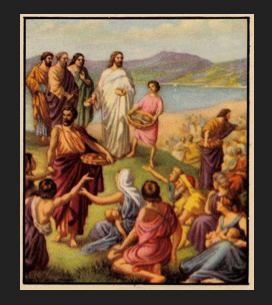
Jesus feeds the multitude - artist unknown
TODAY'S SPECIAL: Matthew 13-14; Psalm 87

TO CHEW ON:
"And when Jesus went out He saw a great multitude; and He was moved with compassion for them, and healed their sick." Matthew 14:14

Our reading today starts out with Jesus trying to get away from the crowds: "When Jesus heard it, He departed from there by boat…" The "it" is news that his friend and relative John (the Baptist) has just been killed (decapitated no less!) by Herod, instigated by Herod's concubine Herodias.

We can understand Jesus' need to be alone at such a time. But when He gets to land, a crowd is there to meet Him. However, instead of being annoyed at this (how I would have felt if my expectations of a quiet afternoon had been dashed like that) He is "moved with compassion."

["Moved with compassion" is splanchnizomai is from the word splanchna - bowels. The Hebrews regarded splanchna as the place where tender mercies and feelings of affection, compassion, sympathy, and pity originated - Dick Mills, Word Wealth, New Spirit-Filled Life Bible, p. 1317.]

Out of this compassion Jesus spends the afternoon healing the sick and, when it gets late, multiplying the five loaves and two fish to feed everyone before He sends them home.

Jesus performed other miracles as a result of splanchnizomai.
  • He fed another large crowd after a three-day healing and teaching 'conference' (Matthew 15:32).
  • He restored the sight of two blind men who sat beside the road calling out, even as the people around told them to shut up (Matthew 20:34).
  • He healed a leper (Mark 1:41).
  • He raised a widow's son back to life (Luke 7:13).
  • He gave this compassion to two parable characters: the Good Samaritan (Luke 19:33) and the father of the prodigal son (Luke 15:20).

I need more of this compassion in my life. Instead of seeing people as threats, or irritants, or losers, or rivals, or… I would like to see under and beyond behavior to the need of which it's a symptom—a need that's best filled by Jesus and what He offers.

What about you?

PRAYER: Dear Jesus, please give me a softer heart, that is moved by the things that move You. Amen.

PSALM TO PRAY: Psalm 87

**********
Unless otherwise noted all Scripture quotations are taken from the New King James Version®. Copyright © 1982 by Thomas Nelson, Inc. Used by permission. All rights reserved.


Bookmark and Share


Saturday, August 04, 2018

Practical piety

Shopping carts of the homeless - Photo V. N.
TODAY'S SPECIAL: Zechariah 5-8; Psalm 61

TO CHEW ON: "Yes, they made their hearts like flint, refusing to hear the law and the words which the Lord of hosts had sent by His Spirit through the former prophets. Thus great wrath came from the Lord of hosts." Zechariah 7:12


The people's representatives Sherezer, Regem-Melech, and his men came to the temple priests with a question: "Should I weep in the fifth month and fast as I have done for so many years?"

It is likely that they were inquiring about commemorating the destruction of the temple in 587 B.C. (according to the writer of my Bible's study notes, D.W. Shibley - New Spirit-Filled Life Bible, p. 1255).

God's message back to them through Zechariah may have come as a surprise. It contained no congratulations for their past piety. Instead, it pointed out things they had left undone: practicing true justice, showing mercy and compassion, treating widows and orphans well, and acting with integrity toward their neighbors (Zechariah 7:9,10).

These lacks, God said, were proof of the actual condition of their hearts—stubborn, refusing to hear, and hard ("hearts like flint") toward what really mattered to God (Zechariah 7:11,12).

I think there is a warning in this vignette for us too. We also easily reassure ourselves with spiritual activities and practices even while we may be glossing over the hard but practical aspects of obedience and what it means to love God—that is, to love our human brothers and sisters. Often our lack of love comes out in how we treat the poorest.

For me right now, I think of the homeless that trek the streets of my town. For the last few years I've seen them outside, summer through winter. The places they call home remind me of the tent city ghettos I've seen in the photos of faraway cities. I must admit these scenes stir up mixed feelings in me... not all of them positive.

I often ask myself—how do I show justice, mercy, and compassion to these, whose problems are complex (mental illness, addiction, poverty)? Is our household doing enough by supporting the local Salvation Army and the home missions arm of our church? May God never have to say to us (to me) "they refused to heed, shrugged their shoulders and stopped their ears… yes, they made their hearts like flint."

PRAYER: Dear Father, I bring to You the homeless and poor in my neighborhood. Please give me creative ideas of how to show mercy and compassion to them. Amen. 

PSALM TO PRAY: Psalm 61

 *********
Unless otherwise noted all Scripture quotations are taken from the New King James Version®. Copyright © 1982 by Thomas Nelson, Inc. Used by permission. All rights reserved.


Friday, June 15, 2018

Love is not for sissies

Image: Pixabay
TODAY’S SPECIAL: Song of Solomon Psalm 11

TO CHEW ON:
“My beloved is mine and I am his.” Song of Solomon 2:16


Whether you interpret Song of Solomon as a spiritual allegory or a lyrical poem to heterosexual love, I’m sure you’ll agree it’s a beautiful Bible book. Today I’m struck by the wisdom about love between a man and a woman found in our short reading:
  • The lovers enjoy each others physical presence. The Shulamite is alert to her beloved. She thrills to the sound of his voice and the sight of him (Song of Solomon 2:8,9,14). In other places, the Beloved extols the physical beauties of his loved one (like Song of Solomon 1:10, 2:2, 4:1-7).
Though the couple here may sound like they’re at the beginning of their relationship, I’ve found this can be true even after 36 years of marriage. I can pick my husband’s voice out of the crowd, recognize his form from a distance, and find reassurance even in his snoring beside me at night.
  • The couple enjoys spending time together—alone (Song of Solomon 2:10).
This is important, After the hectic years of child-rearing, when you may be hard pressed to find alone time together, come the empty nest years. God willing you’ll have lots of time for such togetherness. Hopefully it’s good.
  • However, it doesn’t take much to disturb paradise. Just some “little foxes” - Song of Solomon 2:15 (like impatience, sharp answers, sarcasm, unkindness, unforgiveness, nagging, ingratitude…etc. etc.).
  • They are secure in each other’s love - Song of Solomon 2:16.
I like how one of our church pastors and his wife flesh this out. Sometimes, even when they’re in the middle of a heated discussion (we won’t call it an argument or fight), his wife will say, “I’m committed to you,” reinforcing her commitment to her husband and the relationship even though they don’t always agree about everything.
  • Sometimes love is tested. Such tests help the lovers see their relationship with fresh eyes and cling to each other with new appreciation - Song of Solomon 3:1,2.
If you or your spouse has been ill, had a near-death experience, been incommunicado on a long trip or some such, you’ll know how such an experience helps you see your loved one through new eyes and gain a new appreciation for what you have.  
  • This love school is not for the immature. Don’t register for class until you’re ready for it - Song of Solomon 3:5.
Admittedly, this is my interpretation, but I think it’s advice that follows logically after the stresses and strains the lovers have just been through. Our Beloved and his Shulamite might tell a young man or woman, you could avoid all this by not falling in love in the first place. So hold off as long as you can, because once love has been awakened, it's a roller coaster ride. Love is not for sissies!


PRAYER: Dear Father, thank You for love and marriage. Help me to work at mine. I am reminded of the many times the Bible speaks of the church as Jesus’ bride. Help us, in our Christian marriages, to pursue the unity and beauty of this spiritual relationship. Amen.

PSALM TO PRAY: Psalm 11

The Bible Project VIDEO: Song of Solomonhttps://youtu.be/4KC7xE4fgOw (Read Scripture series)


*********
Unless otherwise noted all Scripture quotations are taken from the New King James Version®. Copyright © 1982 by Thomas Nelson, Inc. Used by permission. All rights reserved.


Sunday, May 20, 2018

Accuser

"Inter filios die affuit etiam Satan 
Job 2 6 1967 " by Salvidor Dali

TODAY'S SPECIAL: Job1-3; Psalm 135

TO CHEW ON: "Now there was a day when the sons of God came to present themselves before the Lord, and Satan also came among them.
And the Lord said to Satan, 'From where do you come?' So Satan answered the Lord and said, 'From going to and fro on the earth, and from walking back and forth on it.'" Job 1:6-7


Here we get a rare behind-the-scenes glimpse of cosmic persons—God and Satan—in conversation. God draws attention to Job and what a unique, upright man he is.

We recognize the sly, cynical tone in Satan's response. It's the same voice we heard in the Garden:
* Satan to Eve in Eden: "Has God indeed said, 'You shall not eat of every tree of the garden?'" - Genesis 3:1
* Satan to God about Job: "Does Job fear God for nothing?" - Job 1:9.

Who is this Satan? A Word Wealth article in my Bible explains him in terms of the meaning of his name:

[Satan - satan - means an Opponent or the Accuser; the hater, adversary, enemy; one who resists, obstructs and hinders whatever is good. Satan comes from the verb which means to 'be an opponent,' or 'to withstand.' - Dick Mills, "Word Wealth - Satan" - New Spirit-Filled Life Bible, p. 648.]

Where did Satan come from? Wayne Grudem says of the origins of Satan and demons:
"When God created the world, he 'saw everything that he had made, and behold, it was very good (Genesis 1:31). This means that even the angelic world that God had created did not have evil angels or demons in it at that time. But by the time of Genesis 3, we find that Satan, in the form of a serpent, was tempting Eve to sin (Genesis 3:1-5). Therefore sometime between the events of Genesis 1:31 and Genesis 3:1, there must have been a rebellion in the angelic world with many angels turning against God and becoming evil" - Wayne Grudem, Systematic Theology, p. 412.

Though no human witnessed Satan's fall, God gave Bible authors insight into it: 2 Peter 2:4; Jude 6, and Isaiah 14:12-15.

Satan, as the hater, is the polar opposite of God who is love (1 John 4:7,8). And we align ourselves with one or the other. John says that we prove we are either children of God or children of the devil by the way we live and love - 1 John 3:10-15.

When I read this beginning of Job passage, I often wonder, what would God say about me? Would He recognize me as one of His own, demonstrated by my family trait of love? And how would Satan reply?

Finally, my response to pressure and temptation can change if I realize I am in the fire of a test that God allows because of His confidence that I'll pass that test—as my Bible's commenter on Job explains:
 "God does not allow trials to see if we will fail; He allows trials to strengthen our faith. The trial is, in fact, a statement of God's faith in our faithfulness and integrity" - Charles E. Blair, New Spirit-Filled Life Bible, p. 648 (emphasis added).

PRAYER:
Dear God, when I am tested, help me to remember that there are bigger issues at play than my comfort and well-being. Amen.

PSALM TO PRAY: Psalm 135

The Bible Project VIDEO: Job (Read Scripture Series)


***********
Unless otherwise noted all Scripture quotations are taken from the New King James Version®. Copyright © 1982 by Thomas Nelson, Inc. Used by permission. All rights reserved.


Thursday, April 12, 2018

Listening to a child

TODAY'S SPECIAL: 2 Kings 4-7; Psalm 102

TO CHEW ON: "And the Syrians had brought back captive a young girl from the land of Israel. She waited on Naaman's wife. Then she said to her mistress, 'If only my master were with the prophet who is in Samaria! For he would heal him of his leprosy.'" 2 Kings 5:2,3


I love the unnamed little Israelite girl in this story. She gets past any resentment she may have felt at being captured and enslaved. She overcomes any fear or shyness she may have felt toward her mistress. It's her testimony of compassion and faith that gets this story started, and Naaman on the road to recovery.

In our time and place children are probably given a lot more credit and listened to more readily than were the youngsters (especially slave children) of Elisha's time. As parents, grandparents, teachers, and leaders, interaction with children is often a balancing act between training and disciplining them versus appreciating, doting on, and loving them.

The Bible tells stories of children who were obviously brought up well.
  • Samuel assisted Eli in the temple - 1 Samuel 2:18.
  • A boy alertly retrieved arrows for Jonathan prior to his secret meeting with David - 1 Samuel 20:36.
  • Joash was crowned king at seven - 2 Chronicles 24:1.
  • Jesus at twelve years was engrossed in fulfilling his destiny to be about His "'Father's business'" - Luke 2:49.
  • A lad gave his lunch to Jesus - John 6:9.

There are also Bible stories of children that imply failed training.
  • Elisha himself was the butt of a mocking gang of youths - 2 Kings 2:23.
  • The prophet Isaiah includes disrespectful children in his list of things that will oppress people - Isaiah 3:5.

Jesus' attitude toward children is a good one to study and imitate.
  • He invited them to come to Him and blessed them - Mark 10:14; Matthew 19:14.
  • He warned against causing them to stumble - Mark 9:42.
  • He appreciated and encouraged their praise as He recalled David's psalm about the potential of a child's words: "'Out of the mouths of babes and nursing infants / You have perfected praise'" - Matthew 21:15,16, quoting: "Out of the mouths of babes and nursing infants / You have ordained strength, / Because of Your enemies, / That you may silence the enemy and the avenger" Psalm 8:2.

Let's keep these things in mind as we relate to the children in our lives.

PRAYER:
Dear Father, thank You for the potential in each child. Help me to listen to and love well the children in my life. Amen.

PSALM TO PRAY: Psalm 102 

 *********
Unless otherwise noted all Scripture quotations are taken from the New King James Version®. Copyright © 1982 by Thomas Nelson, Inc. Used by permission. All rights reserved.


Saturday, April 07, 2018

Love and hate


TODAY'S SPECIAL: 1 Kings 11-13; Psalm 97

TO CHEW ON:  "You who love the Lord, hate evil." Psalm 97:10

Henry Blackaby's Experiencing God course is  challenging and inspiring. While going through the study some years ago, I marked up my workbook by underlining statements like:

"Obedience is the outward expression of your love for God" p. 74.


"If you have an obedience problem, you have a love problem" p. 75.

Though our focus verse from Psalm 97  doesn't contain the word "obey" or "obedience" isn't that what hating evil is all about? It's obedience in reverse. It's our negative response to evil which helps bring about our positive obedient response to God. And it's the litmus test of our love for God. (A footnote in my Bible says about this verse: "This is an extremely simple but an extremely accurate means of evaluating our regard for God" - New Spirit Filled Life Bible, p. 761),

What, then, is this evil we are to hate?

The Hebrew word for evil is Ra and is loaded with badness. In English the word evil is defined: "morally bad, wicked deeds causing injury, damage or any other undesirable result, wrongdoing, wickedness."

It is interesting that sin in relation to evil is a cousin word, a once-removed synonym. One of the definitions of sin in Hebrew  is to "miss the mark." This implies there is a mark or an objective standard to miss. I'm sure the psalmist had that at the back of his mind as he spoke of evil. For him evil included the sin of worshiping idols instead of God, neglecting to keep the ten commandments, and ignoring the rules of feasts and sacrifices.

As we read today's 1 Kings chapters we see just such a falling away in Israel. It started with Solomon and his thousand wives and concubines who drew his heart away from worshiping Yahweh to the worship of Ashtoreth, Chemoch and Milcom (1 Kings 11:5,6). It continued with Jeroboam, who led ten tribes to split from Judah and Benjamin then set up worship centers in Bethel and Dan with golden calf images, new feast days, and a rogue priesthood (1 Kings 12:31-33).

The evil we are to hate isn't all that different. Our obedience in keeping the ten commencements is a good start. But when we truly love God, we will go deeper, following the example of Jesus as we examine even the motives from which our actions spring (Matthew 5:21-32). We will begin to recognize sin's subtlety as it tempts us to wrest controls of our lives from the Holy Spirit, back into our own hands.

Blackaby has an interesting definition of sin:
"The essence of sin is a shift from God-centredness to self-centredness. The essence of salvation is denying self instead of affirming self. We must deny ourselves and return to God-centredness in our lives" Experiencing God, p. 32.

I ask myself, do I love God to the extent that I see loving and serving myself — with my seemingly legitimate plans, ambitions and desires — above loving and obeying Christ, as sin. It's sobering to realize that not my words  but the quickness with which I obey when He interrupts my day with a phone call or an emergency is the real demonstration of my love for Him.

PRAYER: Dear God, please help me to recognize selfishness/self-centredness as evil, and to hate it. Help me to prove my love for You with quick and enthusiastic obedience. Amen.

PSALM TO PRAY: Psalm 97

**********
Unless otherwise noted all Scripture quotations are taken from the New King James Version®. Copyright © 1982 by Thomas Nelson, Inc. Used by permission. All rights reserved.

Sunday, February 18, 2018

The "sweet aroma" of sacrifice

Offering a sacrifice (Image: Pixabay)
TODAY’S SPECIAL: Numbers 28-30; Psalm 49

TO CHEW ON:
“Command the children of Israel, and say to them, ‘My offering, My food for My offerings made by fire as a sweet aroma to Me, you shall be careful to offer Me at their appointed time.” Numbers 28:2

Do you have a favorite smell? Have you noticed how smells have the power to jog your memory and trigger your emotions? It’s interesting to note that apparently God too has a sense of smell, and that smells also cause Him pleasure or displeasure. At least ten times in Numbers 28 and 29 following the introduction of the idea in Numbers 28:2 (our focus verse), we read the expression “a sweet aroma to the LORD.”

This “sweet aroma” was not the scent of perfume, flowers, or the seaside, but the smell of burning. Every one of the “sweet aroma”s in our passage came as a result of a burnt sacrifice of an animal alone or offered with flour and oil.

The first time we read of God being moved by the aroma of a sacrifice is in Genesis 8:21, when Noah offered clean animals after leaving the ark. “The idea is that Noah’s sacrifice was a propitiation or satisfaction of God’s righteous requirement,” explains an article on GodQuestions.org.

The same is true of the sacrifices we read of in Leviticus and here in Numbers: “As in the case of Noah’s offering, what pleased the Lord was the commitment to offer worship in His name as He commanded” (above article).

God’s pleasure at the smell of a burning sacrifice was not an automatic reaction, however, but very much in tune with the attitude and actions of the worshiper. For when instituting this sacrifice system, God said to Moses: “And after all this, if you do not obey Me but walk contrary to Me … I will not smell the fragrance of your sweet aromas” - Leviticus 26:27,31.

There are at least two references to that sacrificial aroma in the New Testament that help to connect us today to God’s olfactory reaction to offerings in the Old.

In 2 Corinthians 2:14-15 Paul challenges Christians to be the aroma of Christ to all. We know that Christ was the final sacrifice, the one by which we have life. Since His was a sacrifice of both His death and our life, the aroma of our lives should affect all around us (“…those who are being saved… and those who are perishing”) with reminders of life or death.

I ask, are we so dead to self, alive to Christ that our lives actually remind those being saved of life, those unsaved of death?

In Ephesians 5:2 Christ’s sacrifice to God (“for a sweet-smelling aroma”) is connected with His love. Paul challenges readers of His day and us today to walk in Christ’s sacrificial love.

Do we live with such love?


PRAYER:
Dear Father, Your reaction to the smell of sacrifice challenges me to be more complete in offering myself to You in the way Paul describes it, “… present your bodies a living sacrifice, holy, acceptable to God …” (Romans 12:1). Amen.
 
PSALM TO PRAY: Psalm 49

 *********
Unless otherwise noted all Scripture quotations are taken from the New King James Version®. Copyright © 1982 by Thomas Nelson, Inc. Used by permission. All rights reserved.
Thanks for reading! This year we are using The Bible Project "Timeless Reading Plan" to read through the Bible in 2018. If you'd like to read along in your own Bible, you can download a pdf of the reading plan HERE.

Saturday, December 30, 2017

Discerning truth and error

Image: Pixabay
TODAY’S SPECIAL: 2 JOHN 1-13

TO CHEW ON: “Whoever transgresses and does not abide in the doctrine of Christ does not have God. he who abides in the doctrine of Christ has both the Father and the Son.” 2 John 9


This short book/letter of only 13 verses is nevertheless deep and thought provoking. Its key words are “love” (four occurrences) and “truth” (five occurrences). Its main themes are truth and error—concepts we’d expect to see addressed by the philosophical Apostle John. With efficiency John lays out the territory of each.

What is truth and how does it relate to the believer? *
  • It unites them in fellowship - 2 John 1
  • It lives in them forever - 2 John 2.
  • They remind each other of the truth they believe and affirm it in their greeting of each other - 2 John 3.
  • It manifests itself in their obedience to God - 2 John 4-6.  

What is error?
  • Its advocates are deceitful - 2 John 7.
  • They deny Christ’s incarnation - 2 John 7.
  • They ignore the teachings of Jesus and disobey Him - 2 John 9.
  • They are to be guarded against, even shunned (John tells his readers to not even invite them into their homes) - 2 John 8, 11.

In our time when a smorgasbord of Bible teaching is available through books and online, maybe we should keep some of John’s points in mind as we evaluate who speaks truth and whose teachings come with shades of deceit and error. Some questions we might ask as we evaluate what we read and hear:
  • Does this teacher acknowledge the deity of Jesus?
  • Does he/she teach what Jesus taught, or are they selective, leaving out controversial bits?
  • Is their teaching clear or filled with questions and an unwillingness to state clearly what they believe (so that what they really believe remains fuzzy; we can’t pin them down)?
  • What does their lifestyle say about their beliefs?

Such spiritual perception implies a familiarity with the Bible and Jesus' teachings on our part in the first place, so we can tell what’s off. Let’s be studious and biblically literate so we can be discriminating in choosing what teachers to put ourselves under.

PRAYER: Dear Father, please fill me with Your Spirit of wisdom so I will recognize truth and error. Amen.

* These points are taken from the Study Notes on 2 John from the NKJV Thompson Chain Bible, p. 2099.

 *********
Unless otherwise noted all Scripture quotations are taken from the New King James Version®. Copyright © 1982 by Thomas Nelson, Inc. Used by permission. All rights reserved.


Thursday, November 30, 2017

The dark and glorious conclusion

film graphic
Image: Pixabay
TODAY’S SPECIAL: John 12:12-26

TO CHEW ON: “Now there were certain Greeks among those who came up to worship at the feast. Then they came to Philip …and asked him, saying, ‘Sir, we wish to see Jesus.’ … But Jesus answered them, saying, ‘The hour has come that the Son of Man should be glorified.’” John 12:20, 21, 23.

Jesus had just swept into Jerusalem on the back of a donkey accompanied by the delirious cheers of the crowd. Their Messiah had arrived at last! But when some Greek proselytes approached Philip asking to see Jesus, Jesus answered Philip with a cryptic and mysterious statement about being glorified. Then He added to the puzzlement by talking about His death. How does His answer relate to the Greeks who have come to see Him? And how is death glorification?

The IVP New Testament Commentary Series comments on John 12.

“…now we come to the beginning of the end. Instead of seeing Jesus doing signs, we see signs occurring through what others do to him."
- Mary anointed Jesus’ feet (John 12:1-8)
- Jesus made His triumphal entry into Jerusalem to the applause of the crowd (John 12:12-15).
- Gentiles came to Him. “… which signals that the long expected hour has arrived. Jesus announces the coming of his hour and speaks of his death.”
- The Father endorsed Him - John 12:27-28. 
- IVP New Testament Commentary Series, accessed through Biblegateway.com

So perhaps Jesus’ answer to Philip speaks, as this commentary suggests, to the larger issue of what the visit of these Gentiles portends.  The nations are being drawn to Him. It’s prophecy being fulfilled so that His story can continue (see Psalm 2:8; Isaiah 2:2,3).

Jesus, speaking of His death, began by saying: “‘The hour has come that the Son of Man should be glorified.’” How can death be glorification?

IVP Commentary again:

“…death is at the heart of the Son's revelation of the Father, for God is love and love is the laying down of one's life (cf. 1 John 4:8;  3:16). So in the cross the heart of God is revealed most clearly” - Ibid.

Today, the last day of November, we're on the verge of Advent.  During the next 24 days we prepare to celebrate the early part of Jesus’ life—the cute, happy, cuddly part. But that wasn’t all there was to it.

Now is a good time to pause and think about the whole story, including its hard end.

It’s an end that is stitched into Jesus’ story from its beginning when Simeon said to Mary: “‘Behold this Child is destined for the fall and rising of many in Israel, and for a sign which will be spoken against (yes, a sword will pierce through your own soul also)'” Luke 2:34,35. 

It’s an end Jesus Himself was well aware of, for we hear Him say, just beyond the scope of today’s reading: “‘Now my soul is troubled and what shall I say? ‘Father, save Me from this hour’? But for this purpose I came to this hour’” - John 12:27.

That purpose again? To come as a baby, live the Father before us, fulfill the plan God had set in motion from the beginning of revelation (Genesis 3:15), conclude its earthly chapter by loving you and me to the extent of laying down His life in our stead, and then defeating death in resurrection.

PRAYER: Dear Father, thank You for sending Jesus, who became that sacrificial grain of wheat for me. Jesus, I want to follow You, serve You, and be with You now and forever (John 12:26). Amen.

MORE: Feast of St. Andrew
Today the church celebrates the Feast of St. Andrew, apostle. The day's liturgy begins with this collect prayer:

Almighty God, who gave such grace to your apostle Andrew that he readily obeyed the call of your Son Jesus Christ, and brought his brother with him: Give us, who are called by your Holy Word, grace to follow him without delay, and to bring those near to us into his gracious presence; who lives and reigns with you and the Holy Spirit, one God, now and for ever. Amen.
 *********
Unless otherwise noted all Scripture quotations are taken from the New King James Version®. Copyright © 1982 by Thomas Nelson, Inc. Used by permission. All rights reserved.


Wednesday, November 08, 2017

God's heart for the poor

homeless shopping cart
TODAY'S SPECIAL: Micah 2:1-13

TO CHEW ON: "You who are named the house of Jacob,
Is the Spirit of the Lord restricted?
Are these His doings?
Do not my words do good
To him who walks uprightly?" - Micah 2:7


From Micah's scoldings we begin to understand the extent of Judah's sin. Not only were the people guilty of idolatry but also injustice.

Micah paints the picture of someone lying awake at night, conniving how he can add to his property and in the morning enacting that plan (Micah 2:1,2). Instead of protecting society's most vulnerable, the powerful act like returning warriors as they ruthlessly strip their trusting neighbours of life's essentials and evict women (probably widows) and their children from their homes (Micah 2:8,9).

If there's one thing God hates, it's injustice to the poor, the alien, and the helpless. His passion for the vulnerable comes out again and again in the Bible, no less here in Micah's condemning words: "Arise and depart for this is not your rest." In plain English: "Those who had removed others from a restful life would be removed themselves because they had defiled God's land with their sinfulness" - Willard S. Elijahson's commentary on Micah, New Spirit-Filled Life Bible, p. 1206.

At this time of year, when we tend to focus on ourselves and the upcoming Advent season and Christmas celebration, let's not neglect to remember the poor. How might we do that?
  • Put money in the Salvation Army kettles when they make their appearance in December. Or volunteer to man a kettle for a few hours (it's probably not too soon to contact them now and arrange to be a volunteer in December).
  • Take part in church and community initiatives that help the poor (collecting toys and food for special Christmas hampers, contributing to Christmas funds like our local Christmas Bureau).
  • Donate to the local foodbank (grocery items or money).
  • Welcome the poor when they come to church and perhaps invite them for a meal to get to know them.
  • Pray for wisdom when panhandlers and beggars approach on the street asking for money. Consider buying them a meal instead of giving cash.
  • Volunteer to help out with Christmas dinner events served to the poor and homeless (locally Union Gospel Mission serves an annual Thanksgiving and Christmas dinners).
  • Give money in your loved one's name to World Vision or other organizations that offer proxy gifts to impoverished peoples in the world, instead of lavishing on each other gifts we really don't need.  (Browse the World Vision Gift Catalogue)

PRAYER: Dear God, please give me Your heart for the poor and unfortunate. Help me to be obedient when I sense You stirring me to love in practical ways. Amen.

****************
Unless otherwise noted all Scripture quotations are taken from the New King James Version®. Copyright © 1982 by Thomas Nelson, Inc. Used by permission. All rights reserved.

Bible Drive-Thru


Saturday, October 28, 2017

Love—antibiotic for a toxic church

TODAY'S SPECIAL: Jude 1:1-25

TO CHEW ON: "Keep yourselves in the love of God, looking for the mercy of the Lord Jesus Christ unto eternal life." Jude 1:21


The first part of Jude's letter is a warning about "certain men" who have "crept in" to the church. Jude exposes their behaviors and teachings which include immoral and sensual lifestyles, a denial of Jesus, slandering authority, made-up teachings, greed which shows itself in an over-concern about profit, grumbling, complaining, flattering people in order to take advantage of them, mocking, dividing the congregation and all this obviously without the Holy Spirit. If there ever was a toxic church, this sounds like one!

In the face of this mess, Jude gives two instructions:
- Build yourselves up in your faith.
and
- Keep yourselves in the love of God.

I've written about building ourselves up in the faith in other devos about this passage, so today let's drill down a bit into what it means to keep oneself in the love of God. Though we can't know for certain what this meant to the people in the church to which Jude was writing, we'll make some assumptions. And because we're still part of imperfect churches and living in a hostile world, this focus on love remains as relevant for us today as it ever was.

I can see keeping oneself in the love of God as having three parts.

First, we remind ourselves of the quality and extent of God's love for us. This helps to counteract the twisted doctrine that interlopers are so eager to dispense.
"The Lord has appeared of old to me, saying:
“Yes, I have loved you with an everlasting love;
Therefore with lovingkindness I have drawn you" - Jeremiah 31:3.
"For God so loved the world that He gave His only begotten Son, that whoever believes in Him should not perish but have everlasting life" - John 3:16.
"But God demonstrates His own love toward us, in that while we were still sinners, Christ died for us" - Romans 5:8.

Second, we put muscle into loving God back. This sets us on the path of the morally straight and narrow, to live a lifestyle that  pleases God, who loved us so much.

"You shall love the Lord your God with all your heart, with all your soul, and with all your strength" - Deuteronomy 6:5.

"Oh, love the Lord, all you His saints!
For the Lord preserves the faithful,
And fully repays the proud person" - Psalm 31:23.

"Now may the Lord direct your hearts into the love of God and into the patience of Christ" - 2 Thessalonians 3:5.

Third, we express the love God has showered on us and which we reciprocate to Him, to others in the church and in the world around us. This sets a guard in our lives against ways we would sin against others.
" Love suffers long and is kind; love does not envy; love does not parade itself, is not puffed up; does not behave rudely, does not seek its own, is not provoked, thinks no evil; does not rejoice in iniquity, but rejoices in the truth; bears all things, believes all things, hopes all things, endures all things" - 1 Corinthians 13:4-7.

"And walk in love, as Christ also has loved us and given Himself for us, an offering and a sacrifice to God for a sweet-smelling aroma" - Ephesians 5:2.

"But above all these things put on love, which is the bond of perfection" - Colossians 3:14.

Love—it's a simple yet powerful antibiotic against moral bacteria of every strain.


PRAYER: Dear God, when I'm troubled by the evil in the church and life in this world, help me remember this simple instruction about keeping myself in love. Amen. 

MORE: Feast of St. Simon and St. Jude

Today the church celebrates the Feast of St. Simon and St. Jude. (Simon and Jude, the writer of our reading today, were brothers of Jesus - Mark 6:3). The day's liturgy begins with this prayer:

"O God, we thank you for the glorious company of the apostles, and especially on this day for Simon and Jude; and we pray that, as they were faithful and zealous in their mission, so we may with ardent devotion make known the love and mercy of our Lord and Savior Jesus Christ; who lives and reigns with you and the Holy Spirit, one God, for ever and ever. Amen."

 *********
Unless otherwise noted all Scripture quotations are taken from the New King James Version®. Copyright © 1982 by Thomas Nelson, Inc. Used by permission. All rights reserved.


Thursday, October 26, 2017

Paul's mother-care

TODAY'S SPECIAL: 1 Thessalonians 2:1-8

TO CHEW ON: "But we were gentle among you, just as a nursing mother cherishes her own children. So, affectionately longing for you, we were well pleased to impart to you not only the gospel of God but our own lives, because you had become dear to us." 1 Thessalonians 2:7-8


What untypical words to read from Paul, who is usually so instructional and corrective. They remind me of a little saying:

"People do not care how much you know until they know how much you care" - John C. Maxwell.

This might be a good time to refresh our memory about who these people were that Paul was writing to (the Thessalonians) and how the church at Thessalonica came into existence.

It was only the second church started on the European continent. The first was in Philippi, about 90 miles northeast. You will recall how Paul and Silas traveled from Troas to Macedonia (on the continent of Europe) in response to a vision (Acts 16:9). The mission at Philippi took a bad turn when Paul and Silas were thrown into prison. But an earthquake sprung them from their cell. They then led the jailor to Jesus and soon left town. (Their Philippian adventures are recorded in Acts 16:11-40.)

Their next stop was Thessalonica. Their stay there was just as troubled. Paul spent mere weeks with them, teaching for three Sabbaths in the synagogue where he "...reasoned with them from the Scriptures, explaining and demonstrating that the Christ had to suffer and rise again from the dead saying, 'This Jesus whom I preach to you is the Christ'" - Acts 17:1-3).

His message kindled a big response: "...a great multitude of the devout Greeks, and not a few of the leading women joined Paul and Silas" - Acts 17:4. But the gospel was too controversial for the Jews, who also envied the missionaries their success, hassled Jason their host, provoked a riot, and essentially ran Paul and Silas out of town (Acts 17:5-10).

It is to these believers Paul had known only a matter of weeks that he wrote this letter. It demonstrates the bond of love that Christians everywhere can feel for each other even though they have barely met. For Paul the relationship was especially poignant, as the people he had left behind were brand new believers. And so he used the language of motherhood, assuring these spiritual babies of his mother care for them: "...we were gentle among you just as a nursing mother cherishes (literally 'keeps warm') her own children.... pleased to impart to you not only the gospel...but our own lives."

I ask myself, do I have that spirit of sacrificial mother-love, especially toward those who are new and immature in the faith? Physical babies take a lot of time. Toddlers can tax one's patience. It's not so different with spiritual babies. I want Paul's words to be a model of Christian nurture to me as I interact with believers in all stages of maturity. You too?

PRAYER: Dear God, please grow in me love and gentle care for other believers, especially those who are new in their faith. Amen.


********
Unless otherwise noted all Scripture quotations are taken from the New King James Version®. Copyright © 1982 by Thomas Nelson, Inc. Used by permission. All rights reserved.


Related Posts Plugin for WordPress, Blogger...