Showing posts with label God's omniscience. Show all posts

Wednesday, September 12, 2018

Jesus the people-watcher

Bible story book illustration - Artist unknown
TODAY'S SPECIAL: Mark 11-12; Psalm 100

TO CHEW ON: "So He called His disciples to Himself and said to them, 'Assuredly I say to you that this poor widow has put in more than all those who have given to the treasury; for they all put in out of their abundance but she out of her poverty put in all that she had, her whole livelihood.'" Mark 12:43-44

I love the story of Jesus and His disciples people-watching—and Jesus' attention caught by a poor widow. She stood out because she put so little into the treasury.

Jesus drew His disciples' attention to her, not to hold her up as an example of stinginess, but generosity. Because of His divine insight, He saw and understood the extent of her gift and praised her as the greatest giver of the day.

This story can speak to us on two levels—as the watcher and the watched.

We watch people—observe what they give (not only money in church but time, hospitality, friendship, service...), and make judgments about them. Without Jesus' interpretation of her act, the disciples may well have drawn a different conclusion about her and her gift. We need to be careful not to jump to judgment on the basis of appearances.

We are also being watched. Realizing that the God who knows our circumstances and motivations is constantly watching us can be comforting or unnerving.

If we give with honesty, integrity, courage and stretched faith out of our love for Him we have the comfort of knowing He sees and appreciates, even if our gifts' outward appearances are small.

Of course if we give with mixed motives—to impress others, or as a down-payment on blessings we hope we'll get from Him, or out of habit or duty, He sees that too and is probably as unimpressed by our gift as Jesus was with the "much" given by the wealthy.


PRAYER: Dear God, please help me not to judge people by the appearance of what they give. When I give, please reveal any unworthy motives to me. Amen. 

PSALM TO PRAY: Psalm 100


********************
Unless otherwise noted all Scripture quotations are taken from the New King James Version®. Copyright © 1982 by Thomas Nelson, Inc. Used by permission. All rights reserved.


Tuesday, June 26, 2018

Tap into God's mysteries

book against a background of mysterious symbols (castle, dragon, birds)
Image from Pixabay.com
TODAY'S SPECIAL: Jeremiah 33-36; Psalm 22

TO CHEW ON: " 'Call to Me and I will answer you and show you great and mighty things which you do not know.' " Jeremiah 33:3

Everywhere around us there is change in the air.
  • In Canada regular elections mean that we frequently have changes in leadership with changes in leadership philosophy, from left to right or right to left policies. 
  • Popular science insists that the recent increase of world temperature and the severity of weather events (storms, droughts, floods) are the result of human activity. As a result we are being pressured to change our ways and lifestyles in order to slow this "man-made global warming."
  • Strange diseases and strains of infection resistant to medicine are appearing and wiping out thousands.
  • Radical groups are terorizing whole nations. In the last years we've seen streams of refugees emptying out of countries in the Middle East and Africa.

In the middle of this uncertainty and flux, God's words to Jeremiah here come as a welcome invitation to us. Two words in Jeremiah 33:3 stand out:

"Call to Me and I will answer you…"

["Call (qara) means to call out, to cry out, to address, shout or speak to someone. It is often a loud cry meant to get someone's attention. It can also mean to call something by its name (as God named light and darkness - Genesis 1:5) or name places, holidays or children (Genesis 29:35) - from "Word Wealth" by Dick Mills - New Spirit-Filled Life Bible, p. 1006.]

God invites us to call on Him!

"… and show you great and mighty things which you do not know."


["Mighty (batsar) could also be translated "secrets," "mysteries," or "inaccessible things."] 

God is telling Jeremiah that He will give him privileged information, showing him things that, without God's revelation, would be hidden from him.

The sidebar article in my Bible that introduced me to this thought concludes:  
"Such 'revelational insight' has always been essential for a clear understanding of victorious spiritual warfare. One cannot pray effectively without insight into how to pray as well as into what things God truly longs for us to seek after in prayer" - Dick Eastman, "Divine Revelation and Spiritual Warfare" - New Spirit-Filled Life Bible, p. 1007.

I love these thoughts for myself and all of us during our times of change, upheaval and uncertainty.

  • God invites us to call on Him.
  • He promises to show us things that only He knows, to give understanding about our times so we will know how to pray and live.

PRAYER:
Dear God, thank You for the invitation to call on You. Help me to make a habit of doing this first when I encounter things I don't understand. Please give me ears to hear Your "great and mighty things" answers and the faith to live by them. Amen.

PSALM TO PRAY: Psalm 22

*********
Unless otherwise noted all Scripture quotations are taken from the New King James Version®. Copyright © 1982 by Thomas Nelson, Inc. Used by permission. All rights reserved.


Thursday, May 31, 2018

You don't know what you don't know

Behemoth - Job 40:15-24
Leviathan - Job 41:1-34

Behemoth and Leviathan - Wm. Blake
Behemoth & Leviathan - Wm. Blake
TODAY'S SPECIAL: Job 40-42; Psalm 146

TO CHEW ON:
"'Now prepare yourself like a man;
I will question you, and you shall answer Me.'" Job 40:7


Have you heard the saying, "You don't know what you don't know"? I've heard it quoted to writers who think their work is perfect just the way it is and needs no editing. But this little truism could also apply to life in general. It reminds us that there are a multitude of things about which we don't have a clue.

This is, in effect, what God says to Job in our reading today, along with "You can't do what you can't do." I love how Eugene Peterson puts it in The Message:

6-7 God addressed Job next from the eye of the storm, and this is what he said:
“I have some more questions for you,
    and I want straight answers.
8-14 “Do you presume to tell me what I’m doing wrong?
    Are you calling me a sinner so you can be a saint?
Do you have an arm like my arm?
    Can you shout in thunder the way I can?
Go ahead, show your stuff.
    Let’s see what you’re made of, what you can do.
Unleash your outrage.
    Target the arrogant and lay them flat.
Target the arrogant and bring them to their knees.
    Stop the wicked in their tracks—make mincemeat of them!
Dig a mass grave and dump them in it—
    faceless corpses in an unmarked grave.
I’ll gladly step aside and hand things over to you—
    you can surely save yourself with no help from me! - Job 40:6-14 MSG

I need—we all need to remind ourselves of God's comeback to Job here when we hear people criticizing Him for His mishandling of the earth and the people on it—indeed, when we ourselves question His goodness, His wisdom, His justice, His power… For we see only part of the picture. We have only limited information. And we're impotent to do much about what we do think we know and understand.

So what is our realistic stance here?
  • Humility in admitting our limitations - Ecclesiastes 8:7; 9:12; 11:5.
  • Repentance for our arrogance - Job 42:5,6.
  • Prayer for God's help to be able to live wisely during the time and in the place God has set us - James 1:5-8


PRAYER:
Dear God, please help me to face life realistically. I don't think You want me to throw up my hands in despair that I'm powerless. At the same time, You don't need my help and advice on how to run the world. Please help me to fulfill the destiny You have for me in humility and obedience as I trust You with the big picture. Amen.

PSALM TO PRAY: Psalm 146

 *********
Unless otherwise noted all Scripture quotations are taken from the New King James Version®. Copyright © 1982 by Thomas Nelson, Inc. Used by permission. All rights reserved.

Scripture quotations marked MSG are taken from The Message. Copyright © 1993, 1994, 1995, 1996, 2000, 2001, 2002. Used by permission of NavPress Publishing Group.

Wednesday, May 30, 2018

Do you know?

Mountain goat kid
Mountain goat kid - Photo from Pixabay.com
TODAY'S SPECIAL: Job 38-39; Psalm 145

TO CHEW ON: "Do you know…?" Job 39:1

In His reply to Job, God draws Job's attention to several animals that humans only observe from afar. They have little or no use to mankind and we often don't understand their mysterious ways.

The wild mountain goats go through their cycles of bearing young without any help or attention from people. They even seem heartless in the way they abandon them - Job 39:1-4.

The wild donkeys shun the city and are useless as beasts of burden that would obey and help people - Job 39:5-8.

The wild ox, though strong, is not an animal people would entrust with their precious harvest - Job 39:9-12.

The ostrich is without wisdom. She challenges the horse for speed but doesn't even have the good sense to incubate her eggs in a safe place - Job 39:13-18.

I'm sure we could all come up with similar lists of things about creation that we don't understand. Much of it may be of little use to us and even seem frivolous. For example, what's the point of high alpine meadows filled with summer flowers when there's no one there to see? Why did God create the vast expanse of stars and galaxies or the mysterious creatures of the ocean depths?

However, there is also much we do understand. Modern microscopes, telescopes, and nature cameras have revealed things to us that the people of Job's day had no idea about.  

The wonderful thing is that the more closely we look and drill down, the more (not less) awed we become at our creator God's wisdom, foresight, creativity, and design smarts. It brings us to the place of admitting that there's enough we do understand to be confident of the intelligence and intention of the One behind all the things about creation and life that we don't know.


PRAYER: Dear God, I am amazed at the intricacy and intelligence that's obvious in creation. Thank You for the beauty, variety, and attention to detail that You gave to created things. I worship you! Amen. 

PSALM TO PRAY: Psalm 145

 *********
Unless otherwise noted all Scripture quotations are taken from the New King James Version®. Copyright © 1982 by Thomas Nelson, Inc. Used by permission. All rights reserved.


Sunday, May 27, 2018

Prayer from the cave

Image: Pixabay
TODAY’S SPECIAL: Job 29-31; Psalm 142

TO CHEW ON:
“Bring my soul out of prison,
That I may praise Your name;
The righteous shall surround me,
For you shall deal bountifully with me.” Psalm 142:7


It’s interesting to know the circumstances that sparked a piece of writing. Under Psalm 142’s title is a note that gives us a clue about this psalm: “A Contemplation of David. A Prayer when he was in the cave.”

My Bible’s notes cite two instances this might have been: the Cave of Adullum (2 Samuel 22) or En Gedi (1 Samuel 24). In both cases he was on the run from King Saul, his father-in-law, former boss, and man to whom he had shown nothing but loyalty and respect. His physical life was in danger, the rift between them was deeply personal and hurtful, and he was forced to live in settings (like this cave) that were inconvenient, physically demanding, and challenging. Considering all that, we would not be surprised if he were angry, resentful, vengeful, full of self-pity, even shaking his fist at God.

But that was not his stance in this contemplation.

Instead he:
1] Consoled himself in God’s knowledge and awareness of him--God's omniscience:
“When my spirit was overwhelmed within me, then you knew my path” - Psalm 142:3.

2] Begged God for His help:
“I cried out to You Lord;
Attend to my cry…
Deliver me from my persecutors…
Bring my soul out of prison…" - Psalm 142:5,6.


3]  Affirmed his faith in God’s goodness:
“For You shall deal bountifully with me” - Psalm 142:7.

Perhaps we could use Psalm 142 as a model next time we’re in a “cave”:
- Remind ourselves that God knows and sees us and everything about and around us (Psalm 139).
- Pour out our requests to God. Make a list, write a journal entry, enumerate these things on our prayer list…
- End with faith and affirmations of God’s goodness. Use David’s (“For you shall deal bountifully with me” - Psalm 142:7) or compile a list of your own.


PRAYER: Dear Father, thank You that You supervise my bad times as well as my good. Help me to develop a theology of suffering that is faith- and hope-filled. Amen.

PSALM TO PRAY: Psalm 142

 *********
Unless otherwise noted all Scripture quotations are taken from the New King James Version®. Copyright © 1982 by Thomas Nelson, Inc. Used by permission. All rights reserved.

Thanks for reading! This year we are using The Bible Project "Timeless Reading Plan" to read through the Bible in 2018. If you'd like to read along in your own Bible, you can download a pdf of the reading plan HERE.

Saturday, May 26, 2018

God's whispers

TODAY'S SPECIAL: Job 24-28; Psalm 141

TO CHEW ON: "Indeed these are the mere edges of His ways,
And how small a whisper we hear of Him!
But the thunder of His power who can understand?" Job 26:14


Job did not struggle with the fact of God's existence. He found evidence of God wherever he looked, and credits Him with the massive brush strokes of creation (for a man in physical distress, he sure hadn't lost his knack for poetry!):

"He hangs the earth on nothing
He binds up the water in His thick clouds,
Yet the clouds are not broken under it
He drew a circular horizon on the face of the waters
At the boundary of light and darkness..." Job 26:7-10

And these things, Job says, are just the 'edges of His ways,' a mere whisper of what He is really like.

I wonder if, in that mention of God's whisper, there isn't a hint too of Job's longing to hear God's voice more clearly? He seems to be saying, evidences of God's power are everywhere but does He see me? Is He aware of what's going on in my life? Couldn't He speak to me more loudly about why these things are happening?

I have felt this way. Perhaps you have too. That's why I'm glad that the Bible also contains passages that reassure us of God's detailed knowledge of us. Psalm 139 is one. If you're feeling abandoned or ignored by God as Job was so often during his illness, let the words of David reassure you:

"O Lord, You have searched me and known me.

You know my sitting down and my rising up.
You understand my thought afar off.
You comprehend my path and my lying down,
And are acquainted with all my ways..." Read all of Psalm 139:1-24.


PRAYER: Dear God, thank You for seeing me completely down to my thoughts, always and everywhere, and that Your eyes are eyes of love. Amen.

PSALM TO PRAY: Psalm 141

****************
Unless otherwise noted all Scripture quotations are taken from the New King James Version®. Copyright © 1982 by Thomas Nelson, Inc. Used by permission. All rights reserved.


Thursday, May 24, 2018

Limited days

TODAY'S SPECIAL: Job 16-19; Psalm 139

TO CHEW ON: "Your eyes saw my substance, being yet unformed.
And in Your book they all were written,
The days fashioned for me,
When as yet there were none of them." Psalm 139:16

There is nothing like being in the presence of impending death to give one a sense of how much of life is out of one's control. About two years before he died, my brother's diagnosis of untreatable cancer had us all wondering how his life would play out. Would the doctor's diagnosis prove as fatal as it sounded, or would God give a miracle of healing? When, in July of 2010 he took a turn for the worse, we hurried to be by his side. Would this be the end? He soldiered on for six more months after that. None of us, not even his wife and children who were with him every day, could predict exactly when or how he would die.

Though such a limitation may make us feel frustrated, it is also a source of comfort when viewed within the context of God's knowledge and power. David refers to God's knowledge of our lifespan several times in this psalm:


"You know my sitting down and my rising up" (vs. 2).
"You... are acquainted with all my ways" (vs. 3).
"...in Your book they all were written,
The days fashioned for me,
When as yet there were none of them" (vs. 16).

But God doesn't only know the number of our days — He has determined it:

"You have hedged me behind and before
And laid Your hand in me" (vs. 16).

And so we know that every day of our lives is meant to be. If we are still here, God is allowing it, indeed ordaining it, to accomplish our part in His plan on earth.

The challenge for me, and you, is to use up these years, days, hours, and minutes wisely and well. To find the "way everlasting" and walk in it.

PRAYER: "Search me O God and know my heart;
Try me and know my anxieties;
And see if there is any wicked way in me
And lead me in the way everlasting" (vs. 23-24).

PSALM TO PRAY: Psalm 139

***********

Unless otherwise noted all Scripture quotations are taken from the New King James Version®. Copyright © 1982 by Thomas Nelson, Inc. Used by permission. All rights reserved.
 

Monday, April 09, 2018

God's questions

God Speaks to Elijah - Treasures of the Bible collection.

TODAY'S SPECIAL: 1 Kings 17-19; Psalm 99

TO CHEW ON:
"'What are you doing here, Elijah?'" 1 Kings 19:9,13

God often communicates with us humans through questions. God asked:

  • Adam and Eve in Eden: "'Where are you?'" and "'What is this you have done?'" - Genesis 3:9,13.
  • Job: "'Where were you when I laid the foundations of the earth?'" - Job 38:4.
  • Abraham: "'Is anything too hard for the Lord?'" - Genesis 18:14.
  • Moses: "'What is that in your hand?'" and "'Who made man's mouth?'" - Exodus 4:2,11.
  • Solomon: "'Ask! What shall I give you?'" - 1 Kings 3:5.
  • And Elijah: "'What are you doing here?'" - 1 Kings 19:9,13.

God knows everything so the questions He asks and the answers they draw from  people can't be for His benefit. They must be for the benefit of the ones questioned. There are at least three things I notice about His questions that may give us clues to understanding their purpose.


1. God's questions were situation-specific.
From our knowledge of the stories, above, we know how well each question fit the questioned one and the place he or she was. When God asked a question it was related to something the person needed to notice about him- or herself and their current situation or state of mind.

2. God's questions probed.
They were great at helping the questioner get to the root of something—the enormity of what they'd just done, perhaps (Adam and Eve), or what they really knew and understood (Job), or who they trusted in (Abraham, Moses), or what they wanted above everything else (Solomon), or where they were and why (Adam and Eve, and Elijah).
3. God's questions often led to understanding the next step the questioner needed to take.
For Elijah, God's question, '"What are you doing here?'" forced him to look at where his lapse of faith had taken him. In that place he felt a complete failure. But God didn't want him to stay in isolation and discouragement. He had more assignments for Elijah—dangerous ones: a king to anoint (treason!) and a successor to commission. He wasn't going to be able to stay "here" if those things were to get done.

Does God ever ask you questions? One He often asks me, especially when I'm tempted to envy the accomplishments of others is, "Did I ask you to do that?" (a personal application of the conversation between Peter and Jesus in John 21:20-22).

* What does God ask you? 

* What insight does it give you about yourself and your situation? 

* What root does it pull at? 

* What does it reveal to you about the next step?

PRAYER: Dear Father, Your questions are gentle, yet compelling. Help me to be quiet  enough in my spirit to hear them and self-aware enough to answer them honestly. Amen.
 
PSALM TO PRAY: Psalm 99

*********
Unless otherwise noted all Scripture quotations are taken from the New King James Version®. Copyright © 1982 by Thomas Nelson, Inc. Used by permission. All rights reserved.


Friday, March 30, 2018

Secret?

Nathan Confronts David
TODAY'S SPECIAL: 2 Samuel 9-12; Psalm 89

TO CHEW ON: "But what David had done was evil in the Lord's eyes .... 'You did what you did secretly, but I will do what I am doing before all Israel in the light of day.'" 2 Samuel 11:27b, 12:12.

On the day of Nathan the prophet's visit, at least nine months, perhaps a year or more had passed since David had begun his affair with Bathsheba, been foiled in his attempt to cover it up with a visit from the front by her husband Uriah, and then had Uriah murdered. Now, with his relationship to Bathsheba legitimized by marriage, he probably thought that he'd gotten away with what he'd done. Not so fast, David!

Nathan told David of God's deep displeasure. This showed David that his attempt to be sneaky with God was useless. No wonder David penned the words:

"If I say, 'Surely the darkness shall fall on me,'
Even the night shall be light about me;
Indeed, the darkness shall not hide from you,
But the night shines as the day;
The darkness and the light are both alike to You'" - Psalm 139:11,12.

Other Bible incidents remind us of God's all-seeing ability:
  • Adam and Even couldn't hide from God - Genesis 3:18
  • The garment and the gold and silver Achan secretly took from Jericho were uncovered - Joshua 7:18
  • Ananias's and Sapphira's lie to Peter came to light - Acts 5:1-11
And there are many more Bible examples of secrets becoming public knowledge.

Our attempts to sneak around behind God's back will prove just as futile. He still knows, sees, and has the ability to expose us. Let's let the words of Jesus Himself warn us:

"For there is nothing covered that will not be revealed, nor hidden that will not be known. Therefore whatever you have spoken in the dark will be heard in the light, and what you have spoken in the ear in inner rooms will be proclaimed on the housetops" -Luke 12:2,3 (emphasis added).

PRAYER: Dear God, help me to be honest in the way I live, first with myself, and then with You and others. If I have committed secret sins, please give me the courage to confess them and make them right. Amen. 

PSALM TO PRAY: Psalm 89

MORE: A false declaration

I remember exactly where I was when I recalled that I had lied on my declaration of the value of goods I brought into Canada after my Europe trip (back in the '70s). Seemingly from out of the blue, as I was walking down the hallway at Bible School where I was attending an alumni event, the realization came to me, and the thought: I'm going to have to make this right.

Don't kid yourself, it was a struggle. I had a mighty argument with myself:
- This happened a while ago. Why bring it up now? I just won't do anything like this again.
- I don't have the precise numbers.
-  What would the consequences be? Could Canadian Customs and Excise go after me?

Eventually, though, I wrote and mailed a letter, and felt better. Now there was nothing between God and me. And, as often occurs with such confessions, all my fears were groundless. I think I received a confirmation that they got my letter, but nothing more happened. It was an action so worth doing to have my relationship with Jesus clear and open again.

*****************
Unless otherwise noted all Scripture quotations are taken from the New King James Version®. Copyright © 1982 by Thomas Nelson, Inc. Used by permission. All rights reserved.

Friday, March 23, 2018

The "see" that really matters

Image from The Story of the Bible
 by Charles Foster (© 1873-84)
Drawings by F. B. Schell and others
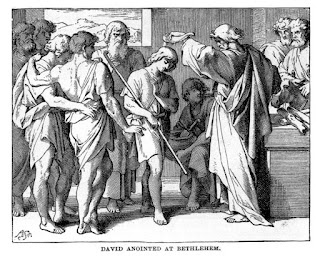
David anointed at Bethlehem - F.B. Schell
David anointed at Bethlehem
TODAY’S SPECIAL: 1 Samuel 15-17; Psalm 82

TO CHEW ON: “But the LORD said to Samuel, ‘Do not look at his appearance or at his physical stature, because I have refused him. For the LORD does not see as man sees; for man looks at the outward appearance, but the LORD looks at the heart.’” 1 Samuel 16:7


In 1 Samuel 16 and 17 we have at least seven different views of David, who was soon to become an important character for the people of Israel and a pivotal player in the story of redemption.

The Parent (Jesse, David’s father):
In the eyes of his earthly father, David didn’t even rate the day off to meet with Samuel. When Samuel had gone through the first seven and asked if that was it for sons, Jesse replied: “‘There remains yet the youngest, and there he is, keeping the sheep’” - 1 Samuel 16:11. David was the youngest. He was needed for work when the other older, more distinguished looking, filled out, fully grown sons got an invitation to worship with the prophet.

The Prophet (Samuel):
According to 1 Samuel’s introduction in my Bible, scholars believe that Samuel wrote 1 Samuel. So this description of David in the narration: “… ruddy, with bright eyes, and good looking” is probably how David looked to Samuel at this, their first meeting (1 Samuel 16:12).

A Fellow Citizen (Saul’s servant):
Later, when King Saul had “distressing spirit” problems and asked for help finding someone who could ease him with music, a servant who knew the populace suggested David. This is how he saw him: “‘… a son of Jesse the Bethlehemite, who is skillful in playing, a mighty man of valour, a man of war, prudent in speech and a handsome person; and the LORD is with him” - 1 Samuel 16:18. Talk about a fabulous referral!

The Boss (King Saul):

So Saul summoned David for a job interview and he was hired on the spot for Saul “… loved him greatly.” David obviously passed his employment probation, for Saul soon requested of Jesse that David be released from shepherding to work for him full-time because David had “found favour” with him and could also chase the dark spirit away from Saul with his music - 1 Samuel 16:21-23.

Eliab, Joseph’s older brother:
I sense a little sibling rivalry in Eliab’s view of David and his insulting comments to his “baby” brother. He belittled David’s occupation, called him proud and insolent, and implied that he was a shirker. David’s nonchalant response: ”’What have I done now?’” tells me that this was not the first time Eliab was on his case (1 Samuel 17:28,29.

Goliath:

This Philistine giant was beyond scornful of the insignificant champion and his weapons the Israelites sent out to spar with him.  His sarcastic “Am I a dog that you come to me with sticks” was followed by a string of curses and threats (1 Samuel 17:42-44). 

God:
God’s reaction to David is found in his words to Samuel: “‘Arise, anoint him for this is the one!’” - 1 Samuel 16:12. God chose David by what He saw in David’s heart, for he had just had Samuel turn down seven of Jesse’s sons on the basis of what was, or wasn’t, in their hearts: “‘I have refused him (and him, and him…). For the LORD… looks at the heart’” - 1 Samuel 16:7.

What came next is also significant, for following Samuel’s anointing of David “The Spirit of the LORD came on David from that day forward” - 1 Samuel 6:13. The story of Goliath's defeat at David's hand is proof of that something remarkable took place.


Two take-aways:


1. God still sees and evaluates us by our hearts. No matter how young or old, ugly or beautiful, insignificant or important, skillful or klutzy we are, He sees beyond all exteriors to our inner selves. There’s no fooling Him with a fancy outside.

2. I love how David’s anointing and the Spirit’s coming upon him only enhanced his appearance, reputation, and favour. Even strangers like Saul’s servant noticed that “… the LORD is with him.” And his boss Saul experienced it through David’s work and then through the defeat of Goliath. May we, in this time when the Spirit is available for all who accept Jesus, be so filled that others would say: “The Lord is with him /her.”

PRAYER: Dear Father, I know You see my heart. Help me to see and understand myself better. And may Your Spirit on and in me be evident in the skill with which I do my work, my courageous attitude, my prudent speech, and in the favour my life attracts. Amen.

PSALM TO PRAY: Psalm 82

 *********
Unless otherwise noted all Scripture quotations are taken from the New King James Version®. Copyright © 1982 by Thomas Nelson, Inc. Used by permission. All rights reserved.


Saturday, March 17, 2018

Man's wrath turned inside-out

Image: Pixabay
TODAY’S SPECIAL: Judges 19-21; Psalm 76

TO CHEW ON: “Surely the wrath of man shall praise You;
With the remainder of wrath You shall gird Yourself” - Psalm 76:10


As we read the last horrible chapters of Judges, we find our selves saddened, even repulsed. Israel has degenerated into violence, civil war, and chaos.But the last verse in the book gives us a clue to how this dreadful state might be setting them up for change: “In those days there was no king in Israel; everyone did what was right in his own eyes” Judges 21:26.

The “wrath of man” and its consequences were preparing Israel for a king. Samuel warned them it was not the best option. A king, he cautioned, would be the type of ruler to claim their sons for his army, their daughters as his perfumers, cooks, and bakers. He would manage their farms, seize their land for his servants, help himself to their best servants and livestock, and tax them to boot - 1 Samuel 8:10-18.

But this development would also lead to their second king—David—who was the ancestor of Jesus, the Messiah. And so the wrath of man was turned around to give praise to God.

This is one of God’s characteristic ways of working. He did something similar:
  • When Pharaoh refused to let the Israelites leave Egypt - Exodus 14:14.
  • When David’s son Absalom, in his attempt to wrest the throne from his father, chose the advice of Hushai (his father’s secret ally) over Ahithophel - 2 Samuel 7:14. (God’s control in this is expressed in the words of another of David’s sons—Solomon: “A man’s heart plans his way, / But the Lord directs his steps” - Psalm 16:9).
  • When God spoke to Israel’s prophets explaining international events before they happened:
- Concerning Assyria and its King Sennacherib - Isaiah 37:29
- Concerning an Israelite king, a puppet of Babylon, who secretly broke a covenant - Ezekiel 17:20.
- Concerning Pharaoh, king of Egypt - Ezekiel 29:4.
- Concerning Babylon and Egypt - Ezekiel 20:24.
(… the above illustrative of another of Solomon’s proverbs: “The king’s heart is in the hand of the Lord, / Like the rivers of water; He turns it wherever He wishes” - Proverbs 21:1).
  • When Jesus’ life was preserved until “His hour” had come - John 8:20.

God will continue to work this way. An example is predicted in Revelation, when God will cause unity among 10 kingdoms to accomplish His purpose: “For God has put it into their hearts to fulfill His purpose to be of one mind and to give their kingdom to the beast until the works of God are fulfilled” - Revelation 17:17.

We, with our limited vision are easily flummoxed by what is happening in our world’s halls of power. Often it looks like God and the causes of His kingdom are losing. But the story is not over. The Bible assures us that God is in control, no matter how things may look when we’re in the middle of them.

PRAYER: Dear Father, when I am troubled by apparent Kingdom of God setbacks, buoy my faith as I recall Your ability to turn man’s wrath around to praise You. Amen.

PSALM TO PRAY: Psalm 76

 *********
Unless otherwise noted all Scripture quotations are taken from the New King James Version®. Copyright © 1982 by Thomas Nelson, Inc. Used by permission. All rights reserved.


Friday, February 02, 2018

God's eyes on you

TODAY'S SPECIAL: Leviticus 11-13; Psalm 33

TO CHEW ON: "Behold the eye of the LORD is on those who fear him,
On those who hope in His mercy." Psalm 33:18


After drawing attention to the grandeur of God's creation, the heavens, the seas, the earth and its nations, the psalmist zooms in. Speaking from God's point of view, first His lens catches the crowds: "....He looks on all the inhabitants of the earth." And then with several clicks on the + button, He's looking right at individuals — you and me. With each person He sees something unique:"He fashions their hearts individually". He sees and comprehends everything each one does: "He considers [understands] all their works" - Psalm 33:15.

His attention is caught particularly by those who are linked to Him in a trust relationship. What does He see and know?
  • That we trust in Him (Nahum 1:7).
  • Our days from beginning to end; both their number and what will fill them (Psalm 37:18, Psalm 139:15-16).
  • Our everyday comings and goings (Psalm 139: 2-3).
  • Our names (John 10:3).
  • Our minds and hearts (Jeremiah 20:12).
  • Our thoughts (Matthew 12:25; Luke 11:17)
  • Our motivations (John 2:25)
  • Our secrets (Psalm 44:21).
  • That we are loyal to Him. In 2 Chronicles 16 we have the story of Hanani the seer who came with a message to King Asa of Judah. It was a disappointing word about how because Asa had gone to Syria for help and not to God, he would suffer ultimate defeat. Then Hanani makes this insightful comment about God's help: "For the eyes of the Lord run to and fro throughout the whole earth, to show Himself strong on behalf of those whose heart is loyal to Him" 2 Chronicles 16:9.

Psalm 33 underlines this aspect of God's sight and knowledge. "Behold the eye of the Lord is on those who fear Him...To deliver their soul from death, and to keep them alive in famine."

What are our needs today? Are we going to God first for help with them? Or are we relying on our own devices, casting about for ways to help ourselves? Whether it's sickness, business trouble, a stalled career, tangled relationships or whatever, let's bring our cares to Him first and in this way, draw the attention of His searching eyes.

PRAYER: Dear God, it is reassuring to know that You see me personally. Today I am troubled by ___. I know You have a solution to my problem. Please show Yourself strong on my behalf. Amen.

PSALM TO PRAY: Psalm 33


***************
Unless otherwise noted all Scripture quotations are taken from the New King James Version®. Copyright © 1982 by Thomas Nelson, Inc. Used by permission. All rights reserved.

Friday, January 26, 2018

Integrity

TODAY'S SPECIAL: Genesis 28-29; Psalm 26

TO CHEW ON: Vindicate me O Lord,
For I have walked in my integrity ...
But as for me, I will walk in my integrity ..." Psalm 26:1,11


In this psalm David twice uses the word integrity—a word we don't run across often in the Bible. He uses it to describe his own life and lifetyle.

[Integrity means (according to my Funk and Wagnalls)
1. Uprightness of character, honesty, probity (virtue or integrity tested and confirmed; strict honesty).
2. The condition or quality of being unimpaired or sound.
3. The state of being complete or undivided.]

The first definition (uprightness of character, honesty, probity) is most likely the meaning we would think of when we describe someone's life. However, I would suggest that a life lived that way leads to a life and reputation that would embody the other aspects of integrity as well (i.e. a life unimpaired, sound, complete, and undivided).

David gives us some clues in this psalm about how he conducted his life so it would have integrity. Perhaps we can pick up some pointers from him about how we too can live that way.


1. David lived with the consciousness that God sees everything. 
David, it seems, had dealt with secret and public matters in his life to the extent that he was confident in inviting God's scrutiny (Psalm 26:1-3). This is surely the attitude of someone with no skeletons in his closet.

Have we cultivated such a clear conscience before God and people?

2. David was intentional about the company he kept.
He avoided spending time with hypocrites, evildoers, the wicked, and people who worshiped idols (Psalm 26:4-5). He was not naive about his own susceptibility to corruption and didn't want to end up with the corrupters (Psalm 26:9-10).

Though Jesus' great assignment gives us a reason to spend time with non-believers, and He Himself was a loving example of this, I believe we need to be as intentional about the company we keep as David was. The company we keep also includes the movies and TV we watch, the books, magazines, and online content we read.

3. He voiced his praise and thanksgiving.
David's guilt-free living ("I will wash my hands in innocence"  - Psalm 26:6) expressed itself in praise and thanksgiving to God (Psalm 26:7). 

What we express in words and song, even if at first half-hearted, is bolstered even as we speak and sing the words.


4. David loved to spend time in God's house and with fellow believers.
The fact that David loved God's presence is another witness to his integrity. He would not have been able to bask in God's glory (Psalm 26:8) if his life had been full of known sin. The "congregation" gave him a safe place to identify with like-minded people and encourage them with his presence and the aroma of his relationship with God (Psalm 26:12).

Our desire to attend church (whether that's going to a building or just being with fellow believers wherever) and spend time with other Christians can be both an evidence of our integrity and a way to reinforce it (with mutual encouragement and example).

Can we say with David, "I have walked in integrity .... I will walk in my integrity"? If not, let's make the integrity of our lives a matter of attention today.


PRAYER: Dear God, thank You for David and his articulate transparency that helps me find ways to examine my own life. I pray with him, "Search me, O God .... Try me .... see if there is any wicked way in me, and lead me in the way everlasting" (Psalm 139:23-24). Amen.


Psalm to pray: Psalm 26

MORE: More about integrity


"Keeping your word is the essence of integrity," says Michael Hyatt (former CEO of Thomas Nelson Publishing) in the blog post "Keeping Your Word." He goes on, "As Stephen Covey points out, 'honesty is making your words conform to reality. Integrity is making reality conform to your words.' It is essential to leadership. Without it, you cannot be an effective leader."

Read all of "Keeping Your Word" to discover the organic link between integrity and leadership.

*************
Unless otherwise noted all Scripture quotations are taken from the New King James Version®. Copyright © 1982 by Thomas Nelson, Inc. Used by permission. All rights reserved.

Saturday, January 20, 2018

One particular day

TODAY'S SPECIAL: Exodus 10-12

TO CHEW ON: "And it came to pass at the end of the four hundred and thirty years—on that very same day—it came to pass that all the armies of the Lord went out from the land of Egypt." Exodus 12:41

Here was the fulfillment of what God had told Moses would happen (Exodus 3:8,10; 6:6; 7:4). It's comforting to read words like "… at the end of the four hundred and thirty years—on that very same day—it came to pass." Israel's days of slavery in Egypt had a definite ending, a point in time when they were finished.

The Bible speaks of human activities in time as within God's knowledge and control. A phrase that is sometimes used to describe this is "the fullness of time." That's the title of one of the chains of verses in my Thompson Chain Bible. "The fullness of time" is defined as "God's appointed time when everything is ready" - NKJV Thompson Chain Bible, p. 1771.
Some fullness-of-time verses:

  • There was a definite moment in time when Joshua and the Israelites had followed all God's instructions to conquer Jericho "…and it happened" (Joshua 6:16, 20).
  • John the Baptist preached "The time is fulfilled" (Mark 1:15) just before Jesus arrived on the scene.
  • Paul explained Jesus' life on this earth in those terms: "But when the fullness of time had come, God sent forth His son…" Galatians 4:4.
  • He also speaks of Jesus' return still to come "… which He will manifest in His own time" - 1 Timothy 6:15.

God doesn't have a fulness of time for only the big theological events of history, but also for our lives. David talks about this in Psalm 139:
"You comprehend my path and my lying down
And are acquainted with all my ways
You have hedged me behind and before
And laid Your hand on me

And in Your book they all are written.
The days fashioned for me,

When as yet there were none of them" - Psalm 139: 5, 15, 16 (emphasis added).

We can trust God with His "fullness of time" for us. Whatever trial we're in of sickness, difficult circumstances, money troubles, family issues, He knows and will help us through them until we come to the very day our trial will pass.

PRAYER: Dear God, thank You for Your knowledge of my times, and how You have brought me through hard stuff in the past. Help me to trust You to bring me through the things I face today. Amen.

PSALM TO PRAY: Psalm 20

*********
Unless otherwise noted all Scripture quotations are taken from the New King James Version®. Copyright © 1982 by Thomas Nelson, Inc. Used by permission. All rights reserved.

Sunday, September 17, 2017

When the enemy is nipping at your heels

TODAY’S SPECIAL: Exodus 14:1-18


TO CHEW ON: “The LORD will fight for you and you shall hold your peace.” - Exodus 14:14

“The LORD will fight for you and you need only to be still.” Exodus 14:14 NIV


Even read from the easy chair of hindsight, the incident in today’s passage is riveting. Can you imagine living it? Yet I believe some of us are in the middle of similar things.

When we’re in the thick of our plot of trouble with the ending still uncertain (to us, not to God) it’s easy to panic. So today, let’s look at this story to see how God was at work here with a view to discovering how He might be at work in our story as well.

  • God set things up
God directed Moses to lead the Israelites into a location from which there was no natural way to escape a rear pursuit. Then Moses told of Pharaoh’s change of mind and how he came after them. He interpreted it as God hardening Pharaoh’s heart (Exodus 14:1-4).  It looks like a setup to me.

For us too, God’s ways involve a lot of little and big setups.

  • The Israelites weren’t consulted
God told Moses what He was going to do. Whether Moses got this insight before the Egyptians appeared on the horizon, or when they were already within sight we don’t know. At any rate, he had a basis for relief. But the multitude of weary travelers didn’t have a clue what was up. Their emotions careened through fear, desperation, anger, blame, resignation over inevitable death (Exodus 14:9-12).

Even though God is in our circumstances doesn’t mean we won’t live through times of stress. We don't know what's going on and we don't like uncertainty.


  • Moses told them to look at God, not circumstances
Moses encouraged the people with affirmations about God and His ability to accomplish things for them. He told them the Egyptians would not enter their lives again after this and that God would fight for them, and they didn’t have to do anything (Exodus 14:13,14).
  
We too need to focus our attention on God, not our troubles. If we truly had confidence in Him and took our hands off the situation, maybe it would be become less complicated as we got out of His way and allowed Him to work.

  • There came a time to stop praying and start doing
Though the Israelites didn’t have to get involved in hand-to-hand combat with the Egyptians, there was something they needed to do. God spoke to Moses rather sharply, telling him it was time to stop praying and start moving this crowd across the sea (Exodus 14:15,16).

There is also a time for us to take the next step.


  • God’s purposes were bigger than the incident
God told Moses His purpose behind this frightening encounter: “So I will gain honor over Pharaoh and over all his army, his chariots, and his horsemen. Then the Egyptians shall know that I am the LORD…” - Exodus 14:17,18. 

When God works in our lives, He is also out to accomplish big-picture purposes that we may have no idea about.


Let’s continue walking with Him through our troubles in faithfulness and trust.


PRAYER:
Dear God, please help me to trust You, especially when I’m in circumstances that threaten, frighten, and challenge me. Amen.

 *********
Unless otherwise noted all Scripture quotations are taken from the New King James Version®. Copyright © 1982 by Thomas Nelson, Inc. Used by permission. All rights reserved.

Scripture quotations marked NIV are taken from THE HOLY BIBLE, NEW INTERNATIONAL VERSION®, NIV® Copyright © 1973, 1978, 1984, 2011 by Biblica, Inc.® Used by permission. All rights reserved worldwide.


Tuesday, September 12, 2017

God's answers in real time

Image: Pixabay
TODAY’S SPECIAL: Exodus 12:29-51

TO CHEW ON:
“And it came to pass at the end of four hundred and thirty years—on that very same day—it came to pass that all the armies of the LORD when out from the land of Egypt …. And it came to pass on that very same day that the LORD brought the children of Israel out of the land of Egypt …” Exodus 12:41,51

When the day of freedom from Egypt finally came for the Israelites, it was a big surprise—to them at least. For we read that they had made their usual night-time preparations for the next day (mixed dough to which they usually added leaven in the morning). But then came the tenth plague and they were “driven out of Egypt and could not wait, nor had they prepared provisions for themselves” (Exodus 12:39).

It was no surprise to God, though. The writer of Exodus (most likely Moses) even points out that the date of their leaving was a significant one—the 430th anniversary of their arrival.

The phrase “on that very day” occurs twice in this account, as if to emphasize the fact that God’s decisive action came in the real time of human history.

I take comfort form this for my life. God is still able and does answer our prayers on a particular day in time and space. I am looking forward to the day I can point to a date on the calendar and say, on this very day the project I bathed in prayer was completed, the healing occurred, the prodigal came home… Do you join me?

PRAYER:
Dear Father, I love the fact that You know my upcoming days as if they had already happened (“And in Your book they were all written, / The days fashioned for me, / When as yet there were none of them” - Psalm 139:16). I know You will answer the things for which I have been burdened to pray in “that very day” that you have foreseen they will occur. Amen.

 *********
Unless otherwise noted all Scripture quotations are taken from the New King James Version®. Copyright © 1982 by Thomas Nelson, Inc. Used by permission. All rights reserved.


Saturday, August 26, 2017

Living well in the big picture

TODAY’S SPECIAL: Exodus 1:1-14

TO CHEW ON: “And Joseph died, all his brothers, and all that generation. But the children of Israel were fruitful and increased abundantly, multiplied, and grew exceedingly mighty; and the land was filled with them …
And they (Egyptians) made their (Israelites) lives bitter with hard bondage—in mortar, in brick, and in all manner of service in the field. All their service in which they made them serve was with rigor” - Exodus 1:6,7,14


Our reading today continues telling the story of Jacob’s family in broad strokes. Two short verses (Exodus 1:6,7) take us through over 400 years of time: “The book of Exodus is a continuation of the Genesis account, dealing with the 430-year development of a family group of 70 into a large nation” - J.C. Tollett, study notes on Exodus, New Spirit-Filled Life Bible, p. 77.

The Israelites had, for all intents and purposes, become Egyptians. Or at least they had lived in Egypt long enough to identify that way. But God had other plans for them, plans hinted at in a promise made to Abraham centuries earlier (Genesis 15:18). And so began the discomfort of hard labor and slavery for Israel, that would eventually dislodge them permanently from Egypt.

The tricky thing about living in time is we don’t understand the times we’re in and the significance of day-to-day events as we’re living them. “Life can only be understood backwards; but it must be lived forwards” - Søren Kierkegaard.

Like the oppression of the Egyptians no doubt vexed and puzzled the Israelites, so many happenings in our time vex and puzzle us too. We won’t know, in the near term, the significance of the 2016 American election of Donald Trump as president of the U.S. or the recent defeat of a long-governing political party in my province. Only time will tell how current events affect history.

But we take comfort in knowing that history never gets away from God. As He declared through Isaiah:
Remember the former things of old,
For I am God, and there is no other;
I am God, and there is none like Me,
Declaring the end from the beginning,
And from ancient times things that are not yet done,
Saying, ‘My counsel shall stand,
And I will do all My pleasure,’

Calling a bird of prey from the east,
The man who executes My counsel, from a far country.
Indeed I have spoken it;
I will also bring it to pass.
I have purposed it;
I will also do it. - Isaiah 46:9-11 (my emphasis)


We can also, pray and trust God for wisdom to understand and live well during our short span of years on earth. Let's aspire to have the reputation of the "Sons of Issachar" in David's army who were known as those "who had understanding of the times, to know what Israel ought to do" - 1 Chronicles 12:32.

PRAYER:

Dear God, thank You that You know the end from the beginning and will bring about the things You have purposed. Please give me insight into my time and wisdom to live well in it. Amen.

 *********
Unless otherwise noted all Scripture quotations are taken from the New King James Version®. Copyright © 1982 by Thomas Nelson, Inc. Used by permission. All rights reserved.


Tuesday, June 27, 2017

Registered in Zion

International flags

TODAY'S SPECIAL: Psalm 87:1-7

TO CHEW ON: "And of Zion it will be said,
'This one and that one were born in her; …
The Lord will record,
When He registers the peoples;
This one was born there.'" Psalm 87:5,6


"The most resistant Gentile peoples will find spiritual birth in Zion," is my Bible's footnote explanation of this psalm (K. R. "Dick" Iverson, New Spirit-Filled Life Bible, p. 752).

I love how the psalmist names specific nations as representative of its inhabitants: Rahab (symbolic of Egypt - Isaiah 30:7), Babylon, Philistia, Tyre, Ethiopia. These were Israel's neighbours.  Some had been or were enemies. Of individuals from these tribes/nations the writer says, "This one and that one were born in her; … The Lord will record, When He registers the peoples; This one was born there."

"He shall enrigister every individual among the converted nations as a true citizen of Zion, entitled to all covenant privileges" - Pulpit Commentary.

I see a picture of God, constantly scanning the peoples of earth, looking for signs of movement toward Him: "… to show Himself strong on behalf of those whose heart is loyal to Him" - 2 Chronicles 16:9.

I see Him writing the names of these from every nation in His book: "…The Lord will record, /  When He registers the peoples…"  They are holy (separate). They are His - Isaiah 4:3.

Finally, I see this international crowd, before the throne, praising God:

After these things I looked, and behold, a great multitude which no one could number, of all nations, tribes, peoples, and tongues, standing before the throne and before the Lamb, clothed with white robes, with palm branches in their hands, and crying out with a loud voice, saying, “Salvation belongs to our God who sits on the throne, and to the Lamb!” - Revelation 7:9-10.

There is no basis to the criticism that Christianity is a European/North American religion foisted on other nations and people groups by the white man. It is, from its inception, truly international. It knows no borders and has no language or race barriers.


PRAYER: Dear God, thank You for sending Jesus to die for everyone. Regardless of skin color, language or location, all of us can be born again ("born in her [Zion]").  We thank you for drawing and claiming the most resistant heart. Amen.

 *********
Unless otherwise noted all Scripture quotations are taken from the New King James Version®. Copyright © 1982 by Thomas Nelson, Inc. Used by permission. All rights reserved.

Monday, June 05, 2017

We're under some pretty special care

Rock hyrax mother and child
Rock hyrax mother and child from Wikipedia
TODAY'S SPECIAL: Psalm 104:1-18

TO CHEW ON: "…The stork has her home in the fir trees. The high hills are for the wild goats; The cliffs are a refuge for the rock badgers." Psalm 104:17-18.

The stork is a large bird that makes a huge nest (it can be over 6 ft. in diameter and 10 ft. in depth). It needs a sturdy tree like a cedar to hold that nest (info from  Stork on  Wikipedia).

Goats have a hoof structure that makes it possible for them to climb to places most animals would never go. Thus wild goats can roam the hills for their food (info from Goat-Antelope on Wikipedia)

The rock badger of this psalm is most likely what we call the rock hyrax. These guinea pig-like rodents live in habitats with rock crevices in groups of ten to eighty, forage as a group, and use sentries—one or more animals to take up positions on vantage points—to warn the group when danger is approaching (info from Rock hyrax on Wikipedia).

In drawing our attention to these creatures the psalm writer gives us examples of what we call God's providence. [The dictionary defines providence as "The care exercised by God over the universe.]

Though the word providence isn't found in the Bible, it is the word that is traditionally used to describe God's continuing relationship to His creation. Wayne Grudem defines providence in his Systematic Theology:

"God is continually involved in all created things in such a way that he 1] keeps them existing and maintaining the properties with which he created them; 2] cooperates with created things in every action, directing their distinctive properties to cause them to act as they do; and 3] directs them to fulfill his purposes" - p. 315"

God's providence doesn't include only to animals but extends to people too. Jesus said: "Look at the birds of the air, for they neither sow nor reap nor gather into barns; yet your heavenly Father feeds them. Are you not of more value than they?" - Matthew 6:26.

In what ways do we experience God's providence? Consider these (condensed from Grudem, pp. 320-321):

  • In our daily provision - Matthew 6:11; Philippians 4:19.
  • In God's knowledge of and plan for our existence before we ever came into being - Psalm 139:16; Job 14:5; Galatians 1:15.
  • Even our minutest actions are performed under His watchful eye and direction: - Acts 17:28; Jeremiah 10:23; Proverbs 10:24; 16:9.
  • He sends success and failure - Psalm 75:6-7; Luke 1:52.
  • He gives us our talents and abilities - 1 Corinthians 4:7; Psalm 18:34.
  • He influences the decisions of our rulers - Proverbs 21:1; Ezra 6:22.
  • He especially guides the desires and inclinations of believers - Philippians 2:13.

Most of the time I take all this for granted. Perhaps you do too? Today, let's pause, consider God's providence, give thanks, and worship.

PRAYER: Dear God, thank You for the extent and detail of Your care for the universe and that it covers every aspect of my life. You are beyond amazing! Amen.

MORE: Good to be Alive by Jason Gray


***********

The Holy Bible, New King James Version Copyright © 1982 by Thomas Nelson, Inc. - Used with permission.

Bible Drive-Thru


Monday, May 22, 2017

Your life—a finished story

books
TODAY'S SPECIAL: Ephesians 1:1-23

TO CHEW ON:
"… He chose us in Him before the foundation of the world that we should be holy and without blame before Him in love." Ephesians 1:4

Do you realize that your life's course is old news, a finished story, a foreordained destiny to God? One word the Bible uses to describe this is predestine (predestined/predestination).

[Predestine, from pre - before, and destiny. It means to destine or decree beforehand. Predestined: to foreordain by divine decree or purpose - Funk and Wagnall's Dictionary]

Here are some things the Bible says about His predestination (some other words used to express this concept are election, foreknowledge and foreordained):

1. God has something in mind for each person He created - Proverbs 16:4. For example, Paul explains the fate of Jacob and Esau on the basis of each having a foreordained place in God's plan - Romans 9:11.
2. God's plan of salvation as it unfolded in history with all its characters playing their parts was predestined - Acts 4:27-28.

3. Jesus was "foreordained before the foundation of the world" to be our sacrificial "lamb without blemish and without spot" - 1 Peter 1:18-20.
 

4. We—Paul's first century readers, down to us Christ followers all these millennia later are chosen, were chosen "before the foundation of the world for holiness" - Ephesians 1:4 (our focus verse).

5. We're called to be changed people, known and predestined to "… be conformed to the image of His Son" - Romans 8:28,29.

6. We're predestined to adoption as Sons by Jesus Christ to Himself - Ephesians 1:5.

7. God has good works planned beforehand for us to accomplish - Ephesians 2:10.

8. Our inheritance is predestined according to His purpose - Ephesians 1:11.
10. The church is part of God's predestined plan and the means, Paul says, to make God's plan known to demons and angels - Ephesians 3:10.

When we try to completely understand the idea of God's predestining of events and lives, we run smack into a wall of human thought limitation. We ask, how can a just God predestine some lives for wicked evil purposes that will take them to a bad end? Isn't that unjust? On the other hand, we ask, how can an omniscient God not know the path that every person will  take, the choices they will make?

The way I harmonize the Bible's teaching on God's predestination / foreknowledge / election with His justice is to reflect that as far as I'm concerned I have choices. I am not aware of a Divine Puppet-master, pulling my strings.  You too have choices. Everyone on this planet has choices. The choices we make in this life reveal and prove what God knew/knows about us all along—our pre-destiny.

PRAYER: Dear God, thank You for being bigger than my mind can comprehend. May my life today, the way I live and the choices I make, demonstrate that I am Yours. Amen.

 *********
Unless otherwise noted all Scripture quotations are taken from the New King James Version®. Copyright © 1982 by Thomas Nelson, Inc. Used by permission. All rights reserved.

Related Posts Plugin for WordPress, Blogger...