Showing posts with label self denial. Show all posts

Saturday, December 08, 2018

Two tests for our to-do lists

TODAY'S SPECIAL: James 4-5; Psalm 32

TO CHEW ON: "Therefore, to him who knows to do good and does not do it, to him it is sin." James 4:17


In this practical section of James' practical letter, I see two filters or tests for our to-do lists for today, tomorrow, and into the future.

1. Is this God's will (James 4:13-16)?


After years of walking with the Lord, I still often find myself making plans and then feeling a check in my spirit and the question: "Have you consulted Me about this?" Or realizing that I want something to happen or work out NO MATTER WHAT and then getting the insight: this thing is self-conceived, self-imposed, and self-generated.

Author Janette Oke came face to face with such a dilemma when she began writing. At first she prayed:
"'God, I'm going to write this book. And if it works and if I discover that I have talent, I'll give it all to You.'"

But she quickly sensed that was not what God wanted. His response as she recalls it:
"'I'm not interested in your book after you're done with it. I'm not even particularly interested in your talent. If you are really serious about writing as a ministry, then I want it all, right now before you start.'"

At that early stage in her career, then, she made a hands-off commitment  and the result:

"She was free. She was free to write without worrying about the outcome. She was free from the pressure of getting sales. She was free from the temptation of pride'" -  Janette Oke: A Heart for the Prairie by Laurel Oke Logan, Kindle Location 3167.

2. Am I doing the good I know to do (James 4:17)?

The IVP commentary says about this verse:
"Suddenly James shifts his emphasis from whether we know God's will to whether we do God's will… The adverb oun ("Then"—in the NKJV "Therefore") provides grammatical evidence James intends a connection in thought. The picture is of one who knows the good he ought to do and doesn't do it" - IVP commentary accessed through Bible Gateway.

I see this enacted in author Oke's life as well. Once she'd had her first book published, she started planning another. But then letters began pouring in from people who wanted to know what happened next to the characters in her story and her editor asked her to write a sequel. So she abandoned her plans and did her duty to the publishing company.

Throughout the active years of her writing career, she continued to do the good she knew to do, delivering three books a year. And it wasn't always easy. In this interview she describes writing as " ... very time consuming and frankly, it’s hard work."

That, folks, is knowing the good one should do, and doing it!

PRAYER: Dear Father, help me to make plans subject to Your lordship in my life and to faithfully perform the good and humble duties You set before me. Amen.


MORE: The Reward
The reward to Janette Oke for relinquishing her work to God and faithfully doing her duty is still being seen. Her books have sold over 30 million copies. In 2002, Michael Landon Jr. chose that first book she wrote—Love Comes Softly—as the basis of his first TV movie for the Hallmark Channel. Over the years many more of her books have been made into movies, including the When Calls the Heart TV series, based on her Canadian West books.

But it would be my guess that the reward she is most looking forward to is meeting Jesus and hearing His: "Well done, good and faithful servant."

My  short biography of Janette Oke, posted in the Encyclopedia of Canadian Christian Leaders is HERE.


*********
Unless otherwise noted all Scripture quotations are taken from the New King James Version®. Copyright © 1982 by Thomas Nelson, Inc. Used by permission. All rights reserved.


Monday, August 27, 2018

Skewed priorities

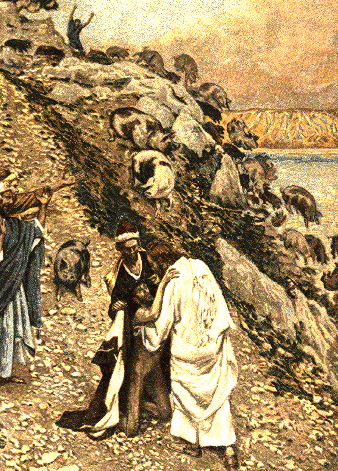
"Swine Driven Into the Sea" by James Tissot

TODAY’S SPECIAL: Matthew7-8; Psalm 84

TO CHEW ON:
“And behold, the whole city came out to meet Jesus…” - Matthew 8:34

Just prior to our focus verse, we see Jesus do something truly amazing—liberate two demon-possessed men (Matthew 8:28-33). These men have, till now, spooked all passersby. No one even comes close to the tomb-caves where they live because they’re too scary.

With a word Jesus frees them from the demonic spirits that have been controlling them. He gives those spirits permission to enter a nearby herd of pigs. True to their destructive nature, the demons cause the pigs to stampede to their briny deaths in the sea.

Then the swine-herders rush back to the city with word of what has happened. The whole city comes out and we (at least I) expect them to welcome with open arms Jesus, this Man who works wonders, who frees enslaved brothers. We expect another Samaritan Woman saga, when the whole town, responding to the woman’s testimony, becomes receptive to Jesus (John 4:28-42).

But no. The end of our story isn’t like that. The last part of Matthew 8:34 is a whiplash of surprise: “And when they saw Him, they begged Him to depart from their region” (emphasis added).

Oh no. Lost pigs are obviously more important to them than found men. We ask, how could they be that way—begging someone who has freed these men to leave? Obviously their priorities are skewed.

Yet, am I, are we so different? Who wins when we sense that introducing others to Jesus by responding to their needs will impinge on our time, our plans, our bank accounts, our peaceful tidy homes?  

PRAYER:
Dear Jesus, please help my life to be an open door to You and people meeting You, not a closed door sending You and others away because I am self-centered.  Amen.

PSALM TO PRAY: Psalm 84

 *********
Unless otherwise noted all Scripture quotations are taken from the New King James Version®. Copyright © 1982 by Thomas Nelson, Inc. Used by permission. All rights reserved.


Monday, December 11, 2017

The impossible life

TODAY'S SPECIAL: 1 Thessalonians 5:12-28

TO CHEW ON: "Now may the God of peace Himself sanctify you completely; and may your whole spirit, soul and body be preserved blameless at the coming of our Lord Jesus Christ." 1 Thessalonians 5:23

Reading through this passage, I'm struck by how impossible its instructions are:
"… be patient with all …. always pursue what is good, for yourselves and for all … Rejoice always, pray without ceasing, in everything give thanks …. Test all things … Abstain from every form of evil…"

Can you do it? Neither can I!

The process Paul is describing here is sanctification. He uses a form of the word in a sum-up verse after naming the specifics above: "Now may the God of peace Himself sanctify you completely..." - 1 Thessalonians 5:23.

The Encyclopedia of the Bible defines sanctification:
[…  the process of acquiring sanctity or holiness as a result of association with deity. Its synonyms are consecration, dedication, holiness and perfection" - Encyclopedia of the Bible, accessed through biblegateway.com.]

It's an impossibly tall order. However, the next verse has the reassurance that we're not expected to do it by ourselves. This process of sanctification is not, finally, our project but His:

"He who calls you is faithful, who also will do it" - 1 Thessalonians 5:24

Whew! So we can just sit back and it will happen? Not exactly. We have a part to play. It's really a joint effort.

An article in The Dictionary of Bible Themes lists means and obstacles to sanctification (each undergirded by many Bible verses*):

Means of sanctification:
  • The work of the Holy Spirit
  • Meditation on the Scriptures.
  • Our active pursuit of holiness and righteousness.
  • Obedience and self-denial.
  • Prayer.

Obstacles to sanctification:
  • A lack of faith.
  • Rebellion against God.
  • Satanic temptation.
  • Self-indulgence and greed.
  • Yielding to sinful desires.

Let's view the specifics of the sanctified life (the 'be patient with all," the "rejoice always," the "pray without ceasing," the "in everything give thanks" etc.) through the grid of these means and obstacles. Are we allowing the Holy Spirit to put His finger on where we need to change—be more joyful, pray more, give thanks etc.? Do we read the Bible? Do we meditate on it? Do we actually obey the things God tells us to do? Do we pray, confessing the times we resist, rebel, mess-up?

Or do we throw up our hands with "This is too hard!" and carry on as usual, resisting the voice of conviction to be joyful, pray, give thanks, procrastinating on obedience, telling ourselves, everyone else can live like they please—why can't I?

PRAYER: Dear God, thank You for the means You have given to bring about this set-apart life. I love the part of the definition that says it comes about through "association with deity." I want to hang out with You today. Amen.

MORE: *Access the article on Sanctification and view supporting Scriptures:
1. Click on the link 1 Thessalonians 5:12-28 (passage on biblegateway.com).
2. Click on "Study This" - the blue box that displays to the right of the reference.
3. In the right sidebar that opens, click on "Dictionary of Bible Themes."
4. Select #6745 "Sanctification."

 *********
Unless otherwise noted all Scripture quotations are taken from the New King James Version®. Copyright © 1982 by Thomas Nelson, Inc. Used by permission. All rights reserved.


Friday, November 18, 2016

Under whose authority do we live?

 Jesus' authority extended over nature. 
(Image from Standard Bible Story Readers Book 2 
Used with permission)

TODAY’S SPECIAL: Luke 20:1-8

TO CHEW ON: “Now it happened on one of those days, as He taught the people in the temple and preached the gospel, that the chief priests and scribes together with the elders confronted Him and spoke to Him saying, ‘Tell us by what authority are You doing these things? Or who is it who gave You this authority?’” Luke 20:1,2

The religious leaders were justified, in their own minds, to challenge Jesus’ authority. As this IVP New Testament Commentary article points out:

“He has had no official training. He comes from Galilee, an area not known for its religious instruction or anything else of stature (John 7:52). He has never sat under a rabbi. Where does his authority come from? How can he justify the things he has been doing? This is really a fundamental question for the entire gospel (Luke 4:32,36; 5:24; 9:1; 10:19)” - IVP Commentary accessed through BibleGateway.com.

Jesus’ answer with another question was right in line with the back-and-forth discussion style of the day. (“This style of disputation was popular in the ancient world. It was designed to show who could ask the wiser question and expose the weaknesses in the opponent” - IVP Commentary).

His question (“’The baptism of John—was it from heaven or from men?’”) accomplished several things:
- It equated the authority of His ministry with the authority of John the Baptist’s.
- It revealed the religious leaders as unwilling to believe that either John or Jesus came from God.
- It put them in a dilemma (Luke 20:5,6)
- It silenced them for now (but they would be back - Luke 20:19-22).

The claims of Jesus’ authority are still an issue today, to unbelievers and believers alike.

To unbelievers, His words, “‘You must be born again’” (John 3:7) are an affront to the human spirit, which is quite happy with its state.

To believers, His words: “‘If anyone desires to come after Me, let him deny himself, and take up his cross daily,and follow Me. For whoever desires to save his life will lose it, but whoever loses his life for My sake will save it ‘“  (Luke 9:23,24) show how demanding living under His authority will be.

PRAYER: Dear Jesus, when Your authority challenges my self-will, help me not to play mind games but to be honest with myself and deal with heart issues. Amen.

 *********
Unless otherwise noted all Scripture quotations are taken from the New King James Version®. Copyright © 1982 by Thomas Nelson, Inc. Used by permission. All rights reserved.


Friday, October 14, 2016

The kingdom within


"Christ Enthroned" - Master of the Ingeborg Psalter
(France, 1195-1210) from the Getty Trust. 
Used with Permission.


TODAY'S SPECIAL: Luke 17:20-37

TO CHEW ON:
Now when He was asked by the Pharisees when the kingdom of God would come, He answered them and said, 'The kingdom of God does not come with observation; nor will they say, "See here!" or "See there!" For indeed the kingdom of God is within you.'"  Luke 20:20,21NKJV

"'For behold, the kingdom of God is within you (in your hearts) and among you (surrounding you).'" Luke 20:21 Amplified


The Pharisees are expecting and looking for an external, visible, physical kingdom. But Jesus tells them that the kingdom of God is not that at all. Rather it's "within you" and "among you."

One of the ways we understand the "among you" part is that Jesus Himself brings that kingdom. Note how, early in His ministry, He claims Himself the kingdom-bringer when He reads from the Isaiah scroll in His hometown synagogue. After reading these words:  "The Spirit of the Lord is upon Me / Because He has anointed Me to preach the gospel to the poor… etc." (Luke 4:18,19), He says, "'Today this Scripture is fulfilled in your hearing.'" His hearers understand these Isaiah prophecies to refer to Messiah and His reign.

Clues to how the kingdom of God is "within" us are scattered throughout the New Testament.
  • Jesus tells Nicodemus he can't enter the kingdom without being born again - John 3:3.
  • Jesus says of the "poor in spirit" and the "persecuted" that "theirs is the kingdom of heaven" - Matthew 5:3,10.
  • Persecution and suffering are also linked with the kingdom of God in Acts 14:22 and 2 Thessalonians 1:5.
  • Those who have looked after the needy and homeless "inherit" the kingdom - Matthew 25:34,35.
  • Perseverance proves us fit for the kingdom - Luke 9:62.

Jack Hayford in an article commenting on this passage explains how Jesus' kingdom anointing becomes ours:

"Jesus has sent the Holy Spirit to cause the anointing of His messiahship to be transmitted to us (Isaiah 61:1-3; Luke 4:18; John 1:16; 1 John 2:20,27; 4:17). So it is, and on these terms only, that a human being can say 'The kingdom of God is within me'" - Jack Hayford, "The Kingdom Within You," New Spirit-Filled Life Bible, p. 1423 (emphasis added).

I ask myself, is my heart the kingdom of God, and not of me (1 Corinthians 6:19-20)? Are there evidences of the kingdom of God in my life—the humility, the willingness to be persecuted and suffer,  the concern for the down-and-out, the perseverance, to name a few? Can Jesus' words, "'The kingdom of God is within you'" truly be said of me? Of you?

PRAYER: Dear Jesus, I want Your kingdom to have full sway in my life. Please show me where I have left myself on my life's throne. Help me dethrone self and put You there. Amen.

***********

New King James Version (NKJV) Used with permission. The Holy Bible, New King James Version Copyright © 1982 by Thomas Nelson, Inc.

Bible Drive-Thru

Thursday, January 28, 2016

The gift of discernment

"The Wisdom of Solomon" by James Tissot

TODAY'S SPECIAL: 1 Kings 3:16-28

TO CHEW ON: "And all Israel heard of the judgment which the king had rendered, and they feared the king, for they saw that the wisdom of God was in him to administer justice." 1 Kings 3:28


Solomon prayed for discernment when God came to him and asked "What shall I give you?" (1 Kings 3:5,9). In our reading today we see in a real life situation, the answer to Solomon's prayer.

Every time I read this story I marvel at the audacity of Solomon's suggestion (cut a child in two—really?!) and the innate understanding of human nature that it showed (the strength of a mother's love for her child).

[The word discern used in 1 Kings 3:9 is the Hebrew word transliterated biyn. Some of the many English words and phrases used to render it are act wisely, consider carefully, gaze, interpret, investigate, observe, ponder, and perceive.]

Biyn occurs 28 times in Proverbs (thought to be written mainly by Solomon). These proverbs alert us to some of the many aspects of discernment.

1. Discernment is present in God, comes from God, and is enhanced by seeking after God (Proverbs 24:12; 2:6-11; 28:5).

2. It involves listening to and taking advice from the wise, and being willing to learn (Proverbs 1:5,6; 18:15).

3. Its presence or absence is revealed in the words that come out of one's mouth (Proverbs 10:13; 16:21; 17:28).

4. The discerning person learns from rebuke and reproof (Proverbs 17:10; 23:1).

5. He/she also pays attention to circumstances (Proverbs 23:1).

6. Discernment in citizens makes them an asset to the community (Proverbs 28:2; 29:7).

7. Discernment isn't determined by class or position (Proverbs 28:11).

8. Self-discipline is an aspect of discernment (Proverbs 28:7).

9. Some of discernment's enemies are scoffing, naiveté, and foolishness (Proverbs 14:6; 14:15; 15:33).

Some Old Testament characters known for their discernment (in addition to Solomon) were Joseph (Genesis 41:33,39) and Daniel and his three friends (Daniel 1:4,17).

In the New Testament Paul reiterates the fact that spiritual discernment is available only through God, the Holy Spirit (1 Corinthians 2:14).

The writer of Hebrews says that practicing and using discernment makes it stronger (Hebrews 5:14).

In these early days of 2016, let's follow Solomon's example of asking God for the gift of discernment, even as we do what we can to weave the threads of wise and discerning behavior into our lives.

PRAYER:
Dear God, please give me discernment that is demonstrated in wise living. Amen.

 *********
Unless otherwise noted all Scripture quotations are taken from the New King James Version®. Copyright © 1982 by Thomas Nelson, Inc. Used by permission. All rights reserved.


Saturday, October 03, 2015

One secret of self-denial

Jesus' Sermon on the Mount - Artist unknown

TODAY'S SPECIAL: Mark 9:38-50

TO CHEW ON: " ' If your hand causes you to sin, cut it off … And if your foot causes you to sin, cut it off … And if your eye causes you to sin, pluck it out…' " Mark 9:43,45,47.

Yikes, it sounds like Jesus is talking about self-mutilation here! But I don't believe He means for us to actually slice ourselves apart—not, at least, if we take to heart the meaning of His message. He's talking about the need for self-denial that's so important, so necessary, it warrants extreme measures.

I'm reminded of a passage I came across in the last few days in a book I'm reading:
"There is but one check that provides the balance to all appetites. It's the word we'd rather not agree to, at least push as far to the side as we can—'self denial.' But without self-denial, every eater is a glutton, every earner a larcenist, every lover is a rapist. So at the outset of our call to follow Jesus is his entreaty—stern yet beautiful—'If any man will come after me, let him deny himself, and take up his cross daily, and follow me' - Luke 9:23 KJV" - Calvin Miller, Into the Depths of God, Kindle Location (KL) 165.

Miller goes on to elaborate on the challenges of self-denial. One he brings up is the tendency we have to focus on what we have to give up—to quit. It could be a lot of things: that third piece of cake our hand reaches for; that party our feet would take us to; that movie we can't take our eyes away from.

Miller says, "So then, why don't we do it— why don't we deny ourselves? We fail at self-denial for three reasons. First, our focus is usually on the braking system rather than the steering wheel" - KL 169. (And you'll have to get the book to find out what the other two are.)

And here is Miller's solution for that braking vs. steering focus:
"… I needed to quit quitting. Quitting involves a cathexis that is focused on what or what not to quit. Those who focus on Christ rarely have to quit anything because their desire for union with Christ prohibits them from starting anything they might later want to quit" - KL 243.

Now there's a challenge to take up: start to focus on Christ—His excellence, His example, His friendship, the well-being of an intimate relationship with Him … I'm reminded of the words of the old hymn:

"Turn your eyes upon Jesus
Look full in His wonderful face
And the things of earth will grow strangely dim
In the light of His glory and grace." - Helen H. Lemmel 1922 (public domain)


PRAYER:
Dear Jesus, please help me to take my focus off what I need to quit and keep my eyes on You today. Amen.

 *********
Unless otherwise noted all Scripture quotations are taken from the New King James Version®. Copyright © 1982 by Thomas Nelson, Inc. Used by permission. All rights reserved.


Sunday, March 22, 2015

Is our goal God's glory?

germinating seed
"Unless a grain of wheat ... dies, it remains alone"
TODAY'S SPECIAL: John 12:20-36a

TO CHEW ON:
" 'Father, glorify Your name.' Then a voice came from heaven, saying, 'I have both glorified it and will glorify it again.' " John 12:28

I see three upside-down realities of the kingdom of God in today's reading:

1. To preserve life, we give ours away—like a seed dies to produce the next crop of seedlings (John 12:24-25).

2. To get honor that really counts—God's honor—we don't king it over people but serve (John 12:26).

3. To attract the world Jesus had to be "lifted up" in crucifixion (John 12:32-33).

How easy it is for us to lose sight of these counter-intuitive aspects of God's kingdom as we respond and react to life's daily challenges. We are careful to preserve our lives for ourselves instead of flinging them on Jesus. We like to be served instead of serve. We find Jesus' death almost an embarrassment instead of an attraction  because of the way it draws attention to the sinful and helpless condition of each person on earth. In our humanistic self-sufficient culture, such a thing is politically incorrect.

Perhaps we're also so often unmotivated to pursue this kingdom point-of-view in our lives because we aren't fully invested in its eventual goal—that God get the glory. We secretly want glory for ourselves.

Theologian J.I. Packer confronts this tension of viewpoints in his book Knowing God:

"The Christians instincts of trust and worship are stimulated very powerfully by knowledge of the greatness of God. But this is knowledge which Christians today largely lack and that is one reason why our faith is so feeble and our worship so flabby. We are modern men, and modern me, though they cherish great thoughts of man, have, as a rule, small thoughts of God. ...

"Today vast stress is laid on the thought that God is personal, but this truth is so stated as to leave the impression that God is a person of the same sort as we are—weak, inadequate, ineffective, a little pathetic ...

"Like us He is personal, but unlike us He is great. In all its constant stress on the reality of God's personal concern for His people, and on the gentleness, tenderness, sympathy, patience, and yearning compassion that He shows towards them, the Bible never lets us lose sight of His majesty, and His unlimited dominion over all His creatures" - J.I. Packer, Knowing God pp. 87,88 (italic emphasis in the original, bold emphasis added).

When we feast our minds on the greatness of God, we begin to understand why He (not us) deserves glory. Then investing our lives for the furthering of His glory begins to make sense. And the price we may be asked to pay of losing our lives, of serving, and of spreading the good news of rescue becomes every bit worth it.

PRAYER:
Dear God, help me to know You better and be fully committed to furthering the glory of Your being, name, and reputation. Amen.

 *********
Unless otherwise noted all Scripture quotations are taken from the New King James Version®. Copyright © 1982 by Thomas Nelson, Inc. Used by permission. All rights reserved.


Friday, February 06, 2015

The sport of Christian ministry

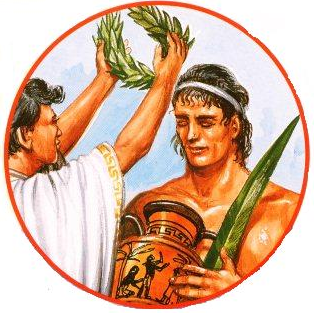
athlete crowned - ancient Greek games
TODAY'S SPECIAL: 1 Corinthians 9:15-27

TO CHEW ON: "And everyone who competes for the prize is temperate in all things. Now they do it to obtain a perishable crown, but we for an imperishable crown." 1 Corinthians 9:25


Paul here alludes to the Greek games, which he may well have attended. They were accompanied by as much pomp and ritual as our Olympic Games are today. Smith's Bible Dictionary gives some facts about these games:
  • There were two classes of events:
The pancratium consisted of boxing and wrestling events.
The pentathlon consisted of leaping, running, quoiting, hurling the spear, and wrestling.
  • The competitors trained long and hard. Their training included an enforced diet. For the Olympic Games the training lasted 10 months. During the final months athletes trained under the supervision of appointed officers.
  • Huge crowds came to watch the spectacle of the athletes competing.
  • The judge, who had a spotless reputation, was tasked with deciding any disputes and awarding the prize.
  • The prize consisted of a crown—leaves of wild olive at the Olympic Games, pine or ivy at the Isthmian Games. - Smith's Bible Dictionary, accessed through biblegateway.com.

Paul here compares his work as a minister of the gospel to being a competitor in these games.

He has the determined mindset of a competitor.
No easygoing "whatever" attitude. He is determined to win - 1 Corinthians 9:24.

He lives like a competitor. 
He has just taken considerable space showing why he could ask for their money support but doesn't (1 Corinthians 9:1-18) and how he subjugates his desires and preferences to be able to relate to any kind of person (1 Corinthians 9:19-23). Here he comes out and states clearly: "… I discipline my body and bring it into subjection…" - 1 Corinthians 9:27.

His goal is to win the prize:
The "imperishable crown" versus the plant-based crown of the winning athlete - 1 Corinthians 9:25.

I ask do I, do we view our ministry as seriously as Paul did?

Do we have his determination to finish well—to win?

Is our mindset that of an athlete?
One of my favorite sports to watch is curling—a sport that may look easy but is actually physically demanding in the precision and strength departments. To prepare, competitors spend hours in the gym building up muscles and stamina for sweeping, hours at the rink practicing shots, many weekends at bonspiels pitting their skills and smarts against each other.

How would such dedication translate to one's life as a Christian? It could mean spending more time in the Bible, reading it, studying it, and memorizing it. It could mean learning and practicing how to explain and teach the gospel to others. It could mean spending more time in fasting and prayer…

Do we "compete" with the reward in mind?
Nothing beats the victorious high-fives and hugs of a triumphant rink, their proud march to the podium, and their glowing smiles as they receive the cup and medals.

Do we live with our prize in mind? Do we ever imagine the presentation ceremony, when we'll be crowned with a prize, perhaps...
  • the Imperishable Crown of 1 Corinthians 9:25?
  • the Crown of Righteousness of 2 Timothy 4:8?
  • The Crown of Life, of James 1:12?
  • The Crown of Glory of 1 Peter 5:4 and Revelation 2:10?

PRAYER: Dear God, Paul shows me I need to get as serious about life and ministry for You as a competing athlete is about sport. Help me to translate this seriousness into everyday life. Amen.

 *********
Unless otherwise noted all Scripture quotations are taken from the New King James Version®. Copyright © 1982 by Thomas Nelson, Inc. Used by permission. All rights reserved.


Wednesday, November 26, 2014

Discipleship's costs

Jesus heals the demoniacs - Artist unknown
TODAY'S SPECIAL: Matthew 8:18-34

TO CHEW ON: "Then a certain scribe came and said to Him, 'Teacher, I will follow You wherever You go.' And Jesus said to him, 'Foxes have holes and birds of the air have nests but the Son of Man has nowhere to lay His head.' " Matthew 8:20

Yesterday we saw Jesus the mentor/rabbi pouring Himself into crowds and individuals, Jews and Gentiles, strangers and friends, untouchables and undiagnosables. I'm sure His disciples were getting the idea—this teacher is a challenge to emulate!

In our reading today He outright says some things about the cost of discipleship that probably left no doubt in His disciples' minds that they had embarked on a humanly impossible life.

Translated into today-speak for us:

1. Discipleship may cost some of the things to which we think we're entitled
—like a home address (Matthew 8:19-20).

2. Discipleship will impinge on relationships and obligations
—like family responsibilities (Matthew 8:21-22).

3. Discipleship may thrust us into situations that feel dangerous and where our faith will be stretched.
In our reading the disciples drift right into a storm. In the tempest-tossed boat, Jesus says to them, " 'Why are you fearful, O you of little faith,' " before He takes care of the storm (Matthew 8:23-26).

4. Discipleship can be thankless.
The people of the Gergesene-area city near where Jesus cast demons from two men have no compassion for the men or gratitude that they've been set free. Rather, they are upset because of the drowned hogs and beg Jesus to leave (Matthew 8:28-34).

I ask myself am I realistic about discipleship's costs? Are you? Or are we caught off-guard when life's hand is out, demanding such payments from us?


PRAYER: Dear Jesus, help me to count the cost of discipleship and choose day by day to continue as Your disciple. Amen.

 *********
Unless otherwise noted all Scripture quotations are taken from the New King James Version®. Copyright © 1982 by Thomas Nelson, Inc. Used by permission. All rights reserved.


Related Posts Plugin for WordPress, Blogger...