Showing posts with label Jesus our example. Show all posts

Tuesday, November 20, 2018

We can sift our words and actions through this

flour sifter
TODAY'S SPECIAL: Colossians 3-4; Psalm 14

TO CHEW ON: "And whatever you do in word or deed, do all in the name of the Lord Jesus, giving thanks to God the Father through him." - Colossians 3:17

In Colossians 3:1-16 Paul gives his readers back in Colosse and us now, a list of specifics—ways to act Christianly:
- control your thoughts (Colossians 3:1-4).
- stop responding to sinful urges (Colossians 3:5-6).
- clean up your speech (Colossians 3:8,9).
- become blind to race, adherence to religious practices like circumcision, and social status among Christian brothers and sisters (Colossians 3:10,11).
- adopt the right attitude toward fellow believers being quick to forgive, and governed by love (Colossians 3:12-14).
- cultivate peace and gratitude in your own heart (Colossians 3:14,15).
- spend so much time in the word that it flows from your lives (Colossians 3:16).

In verse 17, it's as if Paul is saying, 'If I've forgotten anything'—"And whatever you do in word or deed"—it's included in this command:  "... do all in the name of the Lord Jesus..."

  • Doing something in someone's name is to act as their representative or stand-in. In a way, this verse is another way of phrasing the popular saying, What Would Jesus Do?
  • Acting in someone's name has overtones of authority. A policeman who levies fines and makes arrests doesn't do this in his own name but in the name of the government that employs him. In Acts we see an interesting example of two parties using the authority of Jesus name to exorcise evil spirits (Acts 19:11-17).
  • There is also an ambassador-type relationship implied. As people who call ourselves Christians (Christ-ones) and in this way identify with Jesus, we are ambassadors of the kingdom He represents and is establishing—the kingdom of heaven.

What an awesome privilege—to live ("whatever you do in word or deed") in the name of the Lord Jesus. At the same time it's sobering. This verse becomes a kind of screen through which we can sift all our words and actions, asking: Is this thing I am planning to say, write or act on, something I can do in the name of Jesus?

PRAYER:
Dear Jesus, please remind me of these words and how I am to live in Your name as I go through the activities of this day. Amen. 

PSALM TO PRAY: Psalm 14

*********
Unless otherwise noted all Scripture quotations are taken from the New King James Version®. Copyright © 1982 by Thomas Nelson, Inc. Used by permission. All rights reserved.

Monday, September 03, 2018

Available wisdom

Jesus teaches about paying taxes - Artist unknown
TODAY'S SPECIAL: Matthew 21-22; Psalm 91

TO CHEW ON: "When they had heard these words, they marveled, and left Him and went their way. … And when the multitudes heard this, they were astonished at His teaching." Matthew 22:22,33

The Pharisees were determined to trip up and silence Jesus. And they had the perfect way to do it. They would out Him as an enemy of Rome by getting him to declare Himself on the contentious issue of taxes.

To add clout and witnesses they took along their disciples—probably the brightest minds in Jerusalem—and some Herodians. The Herodians were a political party that sympathized with the Herods in their policies of governing and introducing new social customs into Jewish society.

But when the troupe got to Jesus and confronted Him, He saw right through their little scheme. Those pharisaic wolves, who had circled their prey and were licking their chops in anticipation of the take-down, were disappointed, while the surrounding crowd marveled at the wisdom of Jesus' answer (Matthew 22:17-21). The same thing happened to the Sadducees who tried to trap Him later (Matthew 22:23-32). For Jesus was wise.

  • Isaiah prophesied Jesus' wisdom - Isaiah 11:2; 53:11.
  • He was wise from childhood - Luke 2:40.
  • He astonished all who heard Him, especially His neighbours - Matthew 13:54.
  • The amazing thing is that His wisdom can be ours! In Colossians 2:3, Paul describes Christ as the One: "… in whom are hidden all the treasures of wisdom and knowledge." Paul goes on to encourage his readers, "As you therefore have received Christ Jesus the Lord, so walk in Him, rooted and built up in him … For in Him dwells all the fullness of the Godhead bodily; and you are complete in Him" - Colossians 2:3-9.

Let's ask to receive His wisdom for all kinds of situations. And then let's move ahead in faith, acting on the answers He gives - James 1:5-8.

PRAYER: Dear Jesus, I need the spirit of wisdom and revelation for everyday living as much as for special problems. I ask for Your wisdom today. Help me to trust and act on what You tell me through Your word and in prayer. Amen.

PSALM TO PRAY: Psalm 91

 *********
Unless otherwise noted all Scripture quotations are taken from the New King James Version®. Copyright © 1982 by Thomas Nelson, Inc. Used by permission. All rights reserved.

Wednesday, August 29, 2018

Convincing the skeptic

Jesus eats with publicans and sinners - Alexandre Bida

TODAY'S SPECIAL: Matthew 11-12; Psalm 86

TO CHEW ON: " ' For John came neither eating nor drinking, and they say, "He has a demon." The Son of Man came eating and drinking, and they say, "Look, a glutton and winebibber, a friend of tax collectors and sinners!" But wisdom is justified by her children.' " Matthew 11:19

Have you noticed how, when a segment of the population disagrees with government's position on an issue (like developing land or extracting oil or ore from the earth) they demand a study. When that study comes back but doesn't support their position, they ask for another? It seems there is within us an unwillingness to move from strongly held beliefs and convictions no matter what arguments or proofs we're presented with.

That's what we see in the people of Jesus' time. They were having a hard time believing God had actually showed up.

They flocked out to see John who preached repentance in his unusual get-up and abrasive way (Matthew 3:4-7). But instead of linking him with the fulfillment of the prophecy (Matthew 11:10 compare Malachi 3:1), they said, "He has a demon."

They came to Jesus and listened to His words with amazement but when they saw Him socializing with the wrong set, they discounted Him as a party boy, glutton and drunkard.

Jesus summed up the situation with a little proverb: "But wisdom is justified by her children."

The Amplified renders it:
"Yet wisdom is justified and vindicated by what she does (her deeds) and by her children" - Matthew 11:19 AMP.

and The Message:
"Opinion polls don't count for much, do they? The proof of the pudding is in the eating" - Matthew 11:19 MSG.

I take that to mean, judge the wisdom of a teacher and his / her teaching (Jesus's John's, ours) by the fruit of that life and its influence.

This is encouraging to us as we seek to win family members and friends to Jesus. They will probably be swayed from skepticism more readily by the example of lives of love and service than by any of our intellectual apologetic arguments, no matter how clever or convincing.


PRAYER: Dear God, in the end, You by Your Holy Spirit, break down barriers of unbelief in the hearts of family members and friends. Help me to live a life that will help, not hinder, them along the path to belief. Amen.

PSALM TO PRAY: Psalm 86

 *********
Unless otherwise noted all Scripture quotations are taken from the New King James Version®. Copyright © 1982 by Thomas Nelson, Inc. Used by permission. All rights reserved.

Scripture quotations marked AMP are taken from the Amplified® Bible,
Copyright © 1954, 1958, 1962, 1964, 1965, 1987 by The Lockman Foundation
Used by permission." (www.Lockman.org)

Scripture quotations marked MSG are taken from The Message. Copyright © 1993, 1994, 1995, 1996, 2000, 2001, 2002. Used by permission of NavPress Publishing Group.

Tuesday, November 28, 2017

Poured-out life

Jesus heals Peter's mother-in-law - Artist unknown
Jesus heals Peter's mother-in-law.
TODAY'S SPECIAL: Matthew 8:1-17

TO CHEW ON: "… that it might be fulfilled which was spoken by Isaiah the prophet, saying: 'He Himself took our infirmities And bore our sicknesses.' " Matthew 8:17

Jesus is busy and popular. We see him, at the beginning of today's reading (having just come down from a mountain teaching session followed by a huge crowd), talking with and then healing a man with leprosy. He walks to Capernaum and on entering the city gets waylaid by a Gentile centurion. At Peter's house one of his hostesses is sick so Jesus heals her. Then in the evening Peter's property becomes an impromptu healing and deliverance clinic for the town.

Now I realize that the Matthew narrative makes it sound like these things happened one after the other in close succession. There may well have been more time between the incidents than it seems. But even if these events occurred over days to a week, Jesus had a full schedule, which He carried out with not a whiff of a bad attitude.

There is no eye-shift of impatience when the man with leprosy stops Him. Rather, " ' I am willing (to heal). Be cleansed.' "

There is not a watch-glance of schedule-keeping when the centurion stops him. Rather, there is close listening, honest admiration of the man's faith, a mini-lecture to take advantage of the teachable moment, and the promise of an answered prayer.

At Peter's house, after a full day, He  heals before supper and then ministers healing and release from demonic bondage till long after dark.

No wonder Matthew recognizes Him as the fulfillment of Isaiah 53:4. It doesn't happen through His looking on but because of His intimate involvement with and service of humanity—of us.

I watch Jesus here and get convicted as I imagine what my reactions to the things He encountered would have been:
- I would have been irritated by all those interruptions.
- I would have been overwhelmed by all the needs.
- I would have been self-protective, insisting, for example, that we take a break after supper instead of getting back to work.

Later in the New Testament, we see the disciples living with the same bold, people- and ministry-centred focus that they had seen in Jesus. Where did they get this spirit? From being with Jesus (Acts 4:19)

Maybe if I, if all of us, hung around Jesus more, allowed His Spirit to take over ours, we too would be known for the assured yet compassionate, identifying-with-human-needs, poured-out life that characterized Him.

PRAYER: Dear Jesus, I am full of awe at the way You handled life and its demands. I need the ability to see beyond my list of urgencies to what's eternally important, and the courage to pour my life into those things. Amen.

 *********
Unless otherwise noted all Scripture quotations are taken from the New King James Version®. Copyright © 1982 by Thomas Nelson, Inc. Used by permission. All rights reserved.


Saturday, October 21, 2017

Would you say "Imitate me"?

Image: Pixabay
TODAY’S SPECIAL: 1 Thessalonians 1:1-10

TO CHEW ON: “And you became followers of us and of the Lord, having received the word in much affliction, with joy in the Holy Spirit, so that you became examples to all in Macedonia and Achaia who believe.” 1 Thessalonians 1:6,7

A few weeks ago in a church Bible study I’m part of, the topic of mentorship came up. Paul’s description here sounds a lot like that: “And you became followers of us” - 1 Thessalonians 1:6.


[Mentor:  (Noun) 1] A wise and trusted counselor; 2] an influential sponsor or supporter. (Verb) To advise or train.

"Mentorship is a relationship in which a more experienced or more knowledgeable person helps to guide a less experienced or less knowledgeable person. The mentor may be older or younger than the person being mentored, but he or she must have a certain area of expertise" - from Wikipedia]

This business of mentorship (though that specific word is never used) is mentioned in more places in the New Testament:
  • Paul to the church in Corinth: “Imitate me” and listen to Timothy who “will remind you of my ways” - 1 Corinthians 4:16.
  • Paul to the church in Philippi: Copy everything about me: “The things which you learned and received and heard and saw in me, these do” - Philippians 4:9.
  • Paul in a later letter to the Church in Thessalonica: Imitate me in the way you work for a living - 2 Thessalonians 3:9.
  • The writer of Hebrews also encourages his readers to be enterprising and diligent - Hebrews 6:12.
  • Hebrews urges, as well, that readers imitate and submit to leaders - Hebrews 13:7,17.

 But mentorship is not meant to be a dead end that stops with the person being mentored. I love how Paul proposes it continue. “And you became followers of us and the Lord…so that you became examples to all…” 1 Thessalonians 1:6,7 - emphasis added.
The goal of mentorship is to produce more mentors. There’s a place for everyone.

Are we  being mentored—by a person or by books (in a class discussion answering the question, “Who have been your mentors?” a large number of us named books and their authors as significant mentors)? Are we, in turn, becoming mentors, to our children and those newer in the faith?

Let’s keep the mentor chain growing!

PRAYER: Dear Father, thank You for the life of Jesus in the Bible, and for flesh-and-blood and book teachers and mentors to learn from and imitate. Help me to live in such a way that I could say to anyone, “Imitate me.” Amen.

 *********
Unless otherwise noted all Scripture quotations are taken from the New King James Version®. Copyright © 1982 by Thomas Nelson, Inc. Used by permission. All rights reserved.


Friday, August 04, 2017

Jesus' hospitable heart

Image: Pixabay
TODAY’S SPECIAL: Matthew 14:13-21

TO CHEW ON: “But Jesus said to them, ‘They do not need to go away. You give them something to eat.’” Matthew 14:16

The amazing banquet of fish and bread we read of today took place in the context of  grief. Jesus had just heard of the death of His relative and friend, John the Baptist. He went to a deserted place, no doubt to process this sad news by Himself. But he wasn’t alone for long (Matthew 14:12-14).

The city crowds that found Him stirred up His emotions even more. On this day Jesus experienced the reality of human existence: death, sickness, hunger. His was no stingy, there-may-not-be-enough response. Rather, His every reaction was welcoming—a testimony to the enoughness of God in every category.
  • He welcomed the crowds with compassion, showing not a ripple of annoyance that they had intruded on his solitude.
  • He healed their sick.
  • He fed them. When His disciples suggested, very practically after this long day that He send them off to find food, Jesus turned their suggestion around to “You feed them.”

I love this glimpse into the generous hospitality of God. It’s an example to us of how we, as those indwelt by His Spirit, can count on, should count on Him to be enough for every situation in our lives and the lives of those around us. It includes having hearts, not full of ourselves but softened with compassion [splanchnizomai - tender mercies, feelings of affection, compassion, sympathy, pity] for those around us.

The last bit of the story, where the disciples picked up the leftovers, now multiplied to many times more than the original source (Matthew 14:20), speaks to me of how generosity and hospitality typically gets repaid many times over what was put in.

PRAYER:
Dear Father, please give me the faith to believe You are sufficient to meet the needs of those around me using me. I need Your generous, hospitable, compassionate heart. Amen.

 *********
Unless otherwise noted all Scripture quotations are taken from the New King James Version®. Copyright © 1982 by Thomas Nelson, Inc. Used by permission. All rights reserved.


Tuesday, July 25, 2017

Jesus - model servant

Foot-washing - at my daughter's wedding
 (they both washed each other's feet).

TODAY'S SPECIAL: Matthew 20:17-34

TO CHEW ON: " 'And whoever desires to be first among you, let him be your slave — just as the Son of Man did not come to be served but to serve, and to give His life a ransom for many.' " Matthew 20:27-28

Jesus didn't just point the disciples to the way they should live, He modelled it. He lived and breathed service during His time of ministry on earth. Skim through any of the synoptic gospels and you may come away exhausted yourself by his gruelling schedule of traveling, teaching, healing and then, when he tried to get away to rest, teaching and healing some more when the crowds followed Him to even remote places.

He also spelled out the importance of service. Our passage today is one such place (as is Mark 10:35-45). His washing of the disciples' feet (John 13:3-5; 14,15) was another dramatic object lesson of service where He again said plainly how this was something His followers should emulate: " 'Now that I, your Lord and Teacher, have washed your feet, you also should wash one another’s feet. I have set you an example that you should do as I have done for you.' "

Paul in Philippians describes the extremity of His service. The New Living Translation says it so clearly:

Though he was God,
      he did not think of equality with God
      as something to cling to.
Instead, he gave up his divine privileges;
      he took the humble position of a slave
      and was born as a human being.
   When he appeared in human form..." Philippians 2:6-7 - NLT

The NKJV says He came "taking the form of a bondservant..." A bondservant was a Hebrew slave who had served out his six years of required service but instead of going free, insisted on continuing to serve the household he loved. His master would then pierce his ear as a sign of his state and accept his service for life (see Exodus 21:1-6).

A sidebar article in my Bible talks about the faithful servant:

"The character of a faithful servant reveals devotion to the interests of others; the thoughtfulness of rendering untiring care, the delight in the prosperity, honour and happiness of someone besides himself" -Fuchsia T. Pickett  New Spirit-Filled Life Bible p. 1328.

We can personalize such servanthood by asking — in my role as wife, mother, teacher, clerk, bank teller, waitress, CEO or... what does it look like to:
  • Devote myself to the interests of others?
  • Render untiring care?
  • Delight in the prosperity, honour and happiness of others?

PRAYER: Dear Jesus, thank You for Your clear teaching about the importance of having a servant's heart and Your modelling of service. Help me to make a permanent paradigm shift and pursue this quality above the ways to be great that my culture recognizes. Amen.

MORE: Feast of St. James the Apostle

It's a pity that James the Apostle is remembered most for this rather crass request (made by his mother, for sure, but it's clear that he and his brother John were in on it, for she "came to Him with her sons..."). I wonder how Jesus' teaching on this occasion, impacted him.

Here is a little more about this close friend of Jesus's:

Not much is known of his ministry after Jesus' resurrection.  It is believed, however, that he lived another 14 years before his martyrdom.  In fact, the apostle James was the first apostle to suffer martyrdom.  By order of Herod Agrippa I, James was beheaded in Jerusalem about the feast of Easter, 44 AD.


It is believed that within this 14 year period, James visited the Jewish colonist and slaves in Spain to preach the Gospel.
from "The Apostle James, son of Zebedee"
from this Bible Path article.

There is a church in Spain where the Apostle James' is believed to be buried.

Today is the day the church celebrates James the Apostle. The liturgy for the day begins with this collect:

"O gracious God, we remember before you today your servant and apostle James, first among the Twelve to suffer martyrdom for the Name of Jesus Christ; and we pray that you will pour out upon the leaders of your Church that spirit of self-denying service by which alone they may have true authority among your people; through Jesus Christ our Lord, who lives and reigns with you and the Holy Spirit, one God, now and for ever. Amen."
************
Unless otherwise noted all Scripture quotations are taken from the New King James Version®. Copyright © 1982 by Thomas Nelson, Inc. Used by permission. All rights reserved.

Scripture quotations marked NLT are taken from the Holy Bible, New Living Translation, copyright © 1996, 2004, 2007 by Tyndale House Foundation. Used by permission of Tyndale House Publishers, Inc., Carol Stream, Illinois 60188. All rights reserved.


Saturday, April 29, 2017

Being with Jesus—it’s a choice

Image: Pixabay

TODAY’S SPECIAL: Luke 24:13-35

TO CHEW ON: “Then they drew near to the village where they were going, and He indicated that He would have gone farther. But they constrained Him, saying, ‘Abide with us, for it is toward evening, and the day is far spent.’ And He went in to stay with them.” Luke 24:28,29.

This is one of my favourite stories in the whole Bible. There is much to love in it:
  • The irony of the disciples walking and talking to the One they grieved but never recognized.
  • Jesus opening Torah to them and showing how His own life was its fulfillment.
  • Jesus leaving the moment after they recognized Him.
  • Their “Aha” moment of understanding their own spiritual response: “‘Did not our heart burn within us while He talked with us on the road, and while He opened the Scriptures to us’?” (Luke 24:32).  And there’s more.

Disciple Crossroads

Our pastor recently pointed out a story detail I never dwelt on before—the fact that the disciples had a choice here. They could have let Jesus travel on. But in their desire to spend more time with Him, they pushed past His apparent intention to walk further by begging Him to stop and stay with them.

This wasn’t the only time Jesus put such a crossroad before His disciples.
  • Way back when He walked across windy Galilee to them, “straining at the oars,” we read, “He … would have passed them by”—but they cried out to Him and He responded by coming over - Mark 6:48-50.
  • Another time, after He gave His controversial ultimatum: “‘I am the living bread … unless you eat the flesh of the Son of Man and drink His blood, you have no life in you,’” many disciples left Him. Jesus then confronted His close followers with: "'Does this offend you … Do you also want to go away?’” Peter’s answer “‘Lord, to whom shall we go?” reflected their sentiments. They wanted to stay (John 6:51-68).

Whether we choose to spend time with Jesus or not is a decision we also face every day. He didn’t force Himself on the Emmaus disciples and doesn’t force Himself on us.

May we respond with Peter and these disciples: “‘Lord, to whom shall we go? You have the words of eternal life…” and “Abide with us” - John 6:68; Luke 24:29.


PRAYER: Dear Jesus, help me to recognize the times I could be spending with You but choose other things. May I respond to the burning in my heart for You. Amen.

 *********
Unless otherwise noted all Scripture quotations are taken from the New King James Version®. Copyright © 1982 by Thomas Nelson, Inc. Used by permission. All rights reserved.


Thursday, April 06, 2017

WWJD?

Jesus in the midst of the doctors - Alexandre Bida
Jesus in the Midst of the Doctors - Alexandre Bida
TODAY'S SPECIAL: Isaiah 50:1-11

TO CHEW ON: "The Lord God has given Me
The tongue of the learned,
That I should know how to speak
A word in season to him who is weary.
He awakens Me morning by morning,
He awakens My ear
To hear as the learned
The Lord God has opened My ear
And I was not rebellious
Nor did I turn away.
" Isaiah 50:4-5


By the context it's easy to identify the Servant in this Song as Jesus (Just go on to Isaiah 50:6 and compare to Matthew 27:30). We have in Isaiah's words a wonderful Jesus-template on which to pattern our lives.

  • Wisdom
We see Jesus' wisdom on display already when He was 12 and talking with the temple rulers. We acknowledge our own need for wisdom, praying along with young king Solomon: "But I am only a little child and do not know how to carry out my duties..." (1 Kings 3:7 NIV). But do we take James seriously when he tells us what godly wisdom consists of: "...pure, peaceable, gentle, willing to yield, full of mercy and good fruits, without partiality and without hypocrisy..." (James 3:13-17)?

  • Appropriate speech
Jesus' speech wasn't always meek and mild. He could be fiery and funny, probing and gentle. Of course His speech was tied to His wisdom (Matthew 13:34) and ours needs to be too (Matthew 5:37; Colossians 4:6; James 3:2).

  • A disciplined spirit
Have you noticed how many times Jesus sneaked away from His disciples to be with His Father? Sometimes he got up early. Sometimes He went off by Himself after a long day of teaching and doing miracles. Sometimes He stayed up all night. His words to His disciples about disciplined prayer are a warning to us too: "...'Stay here and watch ... Watch and pray lest you enter into temptation'" (Matthew 26:38,41).

    • A personal relationship with God
    "He awakens me... He awakens My ear" are the words of Christ through Isaiah. We get the sense of not dutiful but joyous voluntary meetings. Jesus' heart for us is to have such a relationship with Him and the Father (John 17:20-26).

    • A compliant heart
    Who can forget the scene of Jesus praying in Gethsemane and how He battled through to pray "Not as I will but as You will" (Matthew 26:39)? He brought home to Peter the necessity of such total surrender when they met after Jesus' resurrection when He accepted Peter back into ministry with the simple "'Follow Me'" (John 21:19,22). They are the same words He says to us (Luke 9:23).

    What would Jesus do (WWJD)? We have many answers to that question in this Servant Song. Will we follow His lead?

    PRAYER: Dear God, Jesus' example life is beautiful but impossible for me to copy without the activity of the Holy Spirit in my life. Help me to live out these qualities of wisdom, good speech, a teachable spirit, and a compliant heart. May my relationship with You be personal, honest, and strong. Amen.

    MORE: "Lily of the Valley" - David Ruis and Kelly McMechan


    **********
    Unless otherwise noted all Scripture quotations are taken from the New King James Version®. Copyright © 1982 by Thomas Nelson, Inc. Used by permission. All rights reserved.

    Scripture quotations marked NIV are taken from THE HOLY BIBLE, NEW INTERNATIONAL VERSION®, NIV® Copyright © 1973, 1978, 1984, 2011 by Biblica, Inc.® Used by permission. All rights reserved worldwide.

    Bible Drive-Thru


    Sunday, February 19, 2017

    The love gene

    Image: Pixabay
    TODAY’S SPECIAL: Matthew 5:38-48

    TO CHEW ON: “‘But I say to you, love your enemies, bless those who curse you, do good to those who hate you, and pray for those who spitefully use you and persecute you that you may be sons of your Father in heaven.'”  Matthew 5:44,45


    The list of do’s and don’ts in our passage today reminds us a lot of yesterday’s list from Leviticus 19. There is even the same motivation: love (Leviticus 19:18; Matthew 5:44).

    However, Jesus goes further than the command to love one’s neighbor (hard enough) to say that disciples—we—should love even our enemies.

    How can He expect this of us?

    He showed us how by His example

    • By what He said: John 3:16; Matthew 5:44
    • Through His life:
     * He had compassion on the crowds, whatever their beliefs (Matthew 9:36; 14:14).

    * He cried over Jerusalem whose citizens were rejecting Him (Matthew 9:36).

    * He healed the ear of one of the soldiers who came to arrest Him and prayed for forgiveness of those who mocked Him while on the cross (Luke 22:41; 23:34).

    • In His death: 
    * It’s how His followers (here Paul) understood His death: “ For when we were still without strength, in due time Christ died for the ungodly. For scarcely for a righteous man will one die; yet perhaps for a good man someone would even dare to die. But God demonstrates His own love toward us, in that while we were still sinners, Christ died for us”  Romans 5:6-8.

    The Holy Spirit gives us this heart transplant. 
    It is only through the Holy Spirit that we become carriers of this family love gene.


    * “'But you shall receive power when the Holy Spirit has come upon you; and you shall be witnesses to Me in Jerusalem, and in all Judea and Samaria, and to the end of the earth'” - Acts 1:8

    *“Now hope does not disappoint, because the love of God has been poured out in our hearts by the Holy Spirit who was given to us.” Romans 5:5.

    *“But the fruit of the Spirit is love…” Galatians 5:22


    *“Since you have purified your souls in obeying the truth through the Spirit in sincere love of the brethren, love one another fervently with a pure heart, 1 Peter 1:22.

    Perhaps the extent to which we do (or don’t) love our neighbors and our enemies says something about how much of our lives the Holy Spirit has access to.

    PRAYER: Dear Jesus, the command to display this family trait of love, even when it feels entirely unnatural, is a wake-up call to me to allow Your Spirit greater control of my life. Please help me in this. Amen.

     *********
    Unless otherwise noted all Scripture quotations are taken from the New King James Version®. Copyright © 1982 by Thomas Nelson, Inc. Used by permission. All rights reserved.


    Tuesday, November 29, 2016

    The Spirit we want

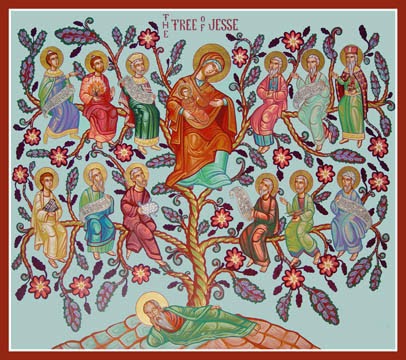
    Tree of Jesse - Artist unknown
    Tree of Jesse - Artist unknown
    TODAY'S SPECIAL: Isaiah 11:1-10

    TO CHEW ON:
    "The Spirit of the Lord shall rest upon Him,
    The Spirit of wisdom and understanding,
    The Spirit of counsel and might,
    The Spirit of knowledge and of the fear of the Lord." Isaiah 11:2


    The rich Spirit of the Lord—that Spirit of wisdom, understanding, counsel, might, knowledge "and of the reverential and obedient fear of the Lord" (AMP) rests on the Jesse branch (Isaiah 11:1). That would be a descendant of David, who was a son of Jesse. We understand this prophecy to be of Jesus.

    As we read this list, His early wisdom comes to mind:
    "And the Child grew and become strong in spirit, filled with wisdom; and the grace of God was upon Him" - Luke 2:40.

    When His ministry commenced, we recall the visible descent of the Holy Spirit on Jesus at His baptism - Matthew 3:16.

    Throughout Jesus' life, Godly qualities were lived out in Him. My Thompson Chain Bible has a longer (than the Isaiah 11) list of qualities that typified the Spirit of Christ:
    • Divine - Isaiah 11:2
    • Wise - Isaiah 11:2
    • Just and Fearless - Isaiah 11:4.
    • Faithful - Isaiah 11:5.
    • Tender - Isaiah 40:11
    • Quiet - Isaiah 42:2
    • Gentle - Isaiah 42:3
    • Persevering - Isaiah 42:4
    • Liberating - Isaiah 61:1
    • Saving - Isaiah 63:1
    • Compassionate - Matthew 9:36
    • Meek and lowly - Matthew 11:29
    • Longsuffering - Luke 9:55-56
    • Forgiving - Luke 23:34
    • Zealous - Acts 10:38
    • Loving - Ephesians 5:2

    The exciting thing is that when we become His children, He gives us the same Spirit: "The Spirit of truth … He dwells with you and will be in you" - John 14:7.

    His Spirit is life-giving - Romans 8:11.

    He guides and leads us - Romans 8:14.

    He opens up truth to us and gives insights into the future - John 16:13.

    His Spirit gives wisdom (what is needed to enact all the other qualities) that is not only theoretical but also practical. I love how my Bible's notes on wisdom includes this sum-up:
    "Biblical wisdom unites God, the Source of all understanding, with daily life, where the principles of right living are put into practice" - Dick Mills, Word Wealth, New Spirit-Filled Life Bible, p. 888.

    And so we are brought back to earth with convicting passages like this one from James that describes what Jesus' heavenly wisdom does not and does look like:
    "But if you have bitter envy and self-seeking in your hearts, do not boast and lie against the truth. This wisdom does not descend from above but is earthly, sensual, demonic …. But the wisdom that is from above is first pure, then peaceable, gentle, willing to yield, full of mercy and good fruits, without partiality and without hypocrisy" - see all of James 3:13-18.

    PRAYER: Dear God, please help me to recognize worldly versus the heavenly wisdom of the Spirit of Jesus. Quicken my will toward instant obedience of Your Spirit's voice. Amen.


     *********
    Unless otherwise noted all Scripture quotations are taken from the New King James Version®. Copyright © 1982 by Thomas Nelson, Inc. Used by permission. All rights reserved.

    Scripture quotations marked AMP are taken from the Amplified® Bible, Copyright © 1954, 1958, 1962, 1964, 1965, 1987 by The Lockman Foundation. Used by permission." (www.Lockman.org)

    Friday, May 13, 2016

    Abide

    TODAY'S SPECIAL: John 15:1-17

    TO CHEW ON: "'Abide in Me and I in you. As the branch cannot bear fruit of itself unless it abides in the vine, neither can you unless you abide in Me.'" John 15:4

    The word "abide" occurs nine times in the span of eight verses of today's reading (John 15:4-10) all in red-letters in my Bible, i.e. the teachings of Jesus as John recalls them. When Jesus repeats a word that many times, we do well to take notice.

    The English word "abide" means: 1] to remain, continue, stay; 2] to have one's abode, dwell, reside; 3] to continue in a particular condition.

    The Greek word transliterated abide (meno) means to remain, abide: 1] in reference to a place, to sojourn, tarry; 2] to continue to be present; 3] to be held, kept, continually; 4] in reference to a station or condition, to remain as one, not become another or different.


    Keeping these definitions in mind, let's burrow down a bit into what Jesus tells us about abiding.

    1. It goes both ways. We abide in Jesus and He abides in us - John 15:4.

    2. Abiding in Him is the only way we can bear fruit (He uses the metaphor of the branch connected to the vine) - John 15:4,5. The fruit we bear out of this abiding brings glory to God - John 15:8.

    3. If we don't abide in Him—aren't connected to Him in a branch-vine way—we'll wither and find ourselves "'...cast out...'" - John 15:6.

    4. Abiding in Him changes us at a very foundational level
    —a thought level ("'…My words abide in you…'")—that leads to right praying and answered prayer - John 15:7.

    5. This abode is a home of love - John 15:9.

    6. This love leads to our obedience
    - John 15:10.

    John talks about abiding in his letters as well. References there add even more depth to our understanding of what it means to abide:

    7. When we abide in Jesus, He is our example of how to live - 1 John 2:6.

    8. Our abiding in Him helps us to face the future with confidence, including looking forward, without shame, to His return - 1 John 2:28.

    9. Abiding in Him equals not sinning
    - 1 John 3:6. I read this as not that we will never sin, but that we aren't cavalier about sin, we don't live in sin, it isn't our lifestyle.

    10.  Abiding includes believing the doctrine Jesus taught about His connection to God - 2 John 1:9.

    I love the peace, contentment, loyalty, and perseverance the word abide conveys. When we abide in Christ we're stable, rooted, not looking to move to another spiritual home. Not only that, but as we live with the sap of our creator God flowing through us, our prayers are answered and we bear fruit!

    PRAYER:
    Dear Jesus, help me to realize, day to day, this abiding connection with You in love, obedience, answered prayer, and fruitfulness. Amen.

     *********
    Unless otherwise noted all Scripture quotations are taken from the New King James Version®. Copyright © 1982 by Thomas Nelson, Inc. Used by permission. All rights reserved.


    Thursday, May 12, 2016

    Painfully conformed


    TODAY'S SPECIAL: Romans 8:18-39

    TO CHEW ON:
    "For whom He foreknew, He also predestined to be conformed to the image of His Son, that He might be the firstborn among many brethren." Romans 8:29

    "And we know that all things work together for good to those who love God, to those who are called according to His purpose. -  Romans 8:28

    It's likely you have at some time quoted the above to comfort a person who is grieving, reassure the one who is confused, or remind the one who has just suffered a seemingly senseless tragedy that God has things in hand and everything will work out okay. I know I have.

    But when we say those comforting words, do we think to add on verse 29? It really is a continuation of the thought and helps to answer the question "Why are these painful things happening?"

    The little word "For" at the beginning of verse 29 signals the connection between the two. The verse goes on to state that the "all things" we are experiencing (that are supposedly "working together for good" - Romans 8::28) have a purpose and that purpose is that we, whom God knew before we were ever on the scene would accept Him and be born into His family, will "be conformed" to the image of His Son (Jesus).

    The idea of conformity is not an especially attractive one, at least not  to us in our individualistic culture. My Funk and Wagnalls dictionary defines conform: 1] to be or act in accordance; show identity or resemblance; correspond; to conform to a specification; 2] to adhere to conventional behavior; 3] to make the same or similar; 4] to bring into harmony or agreement.

    How do we make things conform in life?
    • If the thing is made of wood, we carve, mill or sand it. 
    • If it is made of plaster or cement we pour it liquid into a mold. 
    • It it is metal we heat it until we can hammer or even pour it into the desired shape. 
    • If it is a tree or plant we prune it, that is, cut it. 
    • If it's a life that God is conforming to the image of Jesus ...?
    Perhaps the list of stressors Paul names further on is something we should expect rather than be surprised by as God subjects us to His process of conforming:

    "Who shall separate us from the love of Christ? Shall tribulation, or distress, or persecution, or famine, or nakedness, or peril, or sword? ... Yet in all these things we are more than conquerors through Him who loved us" - Romans 8:35,37.

    PRAYER: Dear God, I know the goal of my life is not my happiness, comfort, ease, prosperity, success or any number of other things I so readily go after. Rather, it is to become like Jesus. Help me to see the painful things that enter my life in the light of this. Amen.

    MORE: Handel's Messiah Alert

    Words from three verses of today's reading are included in Handel's Messiah. Follow along with the soprano soloist as she sings "If God Be For Us" - Chorus 52 (sung here by the Brisbane Concert Choir).

    Lyrics from Romans 8:31, 33, 34:
    31. If God be for us, who can be against us? 33. Who shall lay any thing to the charge of God's elect? It is God that justifieth. 34. Who is he that condemneth? It is Christ that died, yea rather, that is risen again, who is at the right hand of God, who makes intercession for us.


    ***********

    The Holy Bible, New King James Version Copyright © 1982 by Thomas Nelson, Inc. - Used with permission.

    Bible Drive-Thru

    Saturday, March 12, 2016

    Gain from loss

    germinating seed
    Image: Skeeze / pixabay.com
    TODAY'S SPECIAL: Philippians 3:1-11

    TO CHEW ON:
    "Yet indeed I also count all things loss for the excellence of the knowledge of Jesus Christ my Lord, for whom I have suffered the loss of all things and count them as rubbish that I may gain Christ." Philippians 3:8

    Would we, like Paul, have a list of things we've given up to "gain Christ"? Paul once had status as a model Jewish man and a Pharisee. Not just any Pharisee either but one who put hands and feet to his convictions against the upstart Christ-following sect  by hunting them down, persecuting and killing them. But the Damascus Road incident took place. Paul met Jesus. Then ".. what things were gain I have counted loss for Christ" - Philippians 3:7.

    It's a paradox: gain from loss.

    Jesus' teaching had many references to this paradox:

    To a rich young man who wanted to be perfect and assured Jesus he had kept the law, Jesus said: " '… go, sell what you have and give to the poor, and you will have treasure in heaven; and come, follow Me' " - Matthew 19:21.

    Later in answering His disciples' questions about what He has just said, Jesus said: " ' And everyone who has left houses or brothers or sisters or father or mother or wife or children or lands, for My name’s sake, shall receive a hundredfold, and inherit eternal life. But many who are first will be last, and the last first' " - Matthew 19:29,30.

    After Peter rebuked Jesus for talking about dying, Jesus explained to Peter and all the disciples the sobering choice they were making: " 'Whoever desires to come after Me, let him deny himself, and take up his cross, and follow Me. For whoever desires to save his life will lose it, but whoever loses his life for My sake and the gospel’s will save it' " - Mark 8:34,35.

    Another time Jesus spoke about position and made this startling claim: " 'If anyone desires to be first, he shall be last of all and servant of all' ” - Mark 9:35.

    Still another time He taught: " 'Most assuredly, I say to you, unless a grain of wheat falls into the ground and dies, it remains alone; but if it dies, it produces much grain' " - John 12:24,25.

    So we see that in his willingness to lose everything for the sake of knowing Christ, Paul was just tapping into the mindset of his Master.

    I ask myself, have I done that? Have you? What does it mean to "deny" myself, to "take up my cross," to "save" or "lose" my life, to "hate it" or "love it," to "count all things as loss" in exchange for knowing Christ. Does it have implications for what I do with my money and possessions, my time, relationships, goals, ambitions, the career I choose? I'll be pondering these questions today.


    PRAYER:
    Dear Jesus, please help me to understand in terms of everyday living, this paradox of gain from loss, and be willing to test it in my life. Amen.

     *********
    Unless otherwise noted all Scripture quotations are taken from the New King James Version®. Copyright © 1982 by Thomas Nelson, Inc. Used by permission. All rights reserved.


    Saturday, October 03, 2015

    One secret of self-denial

    Jesus' Sermon on the Mount - Artist unknown
    Jesus' Sermon on the Mount - Artist unknown

    TODAY'S SPECIAL: Mark 9:38-50

    TO CHEW ON: " ' If your hand causes you to sin, cut it off … And if your foot causes you to sin, cut it off … And if your eye causes you to sin, pluck it out…' " Mark 9:43,45,47.

    Yikes, it sounds like Jesus is talking about self-mutilation here! But I don't believe He means for us to actually slice ourselves apart—not, at least, if we take to heart the meaning of His message. He's talking about the need for self-denial that's so important, so necessary, it warrants extreme measures.

    I'm reminded of a passage I came across in the last few days in a book I'm reading:
    "There is but one check that provides the balance to all appetites. It's the word we'd rather not agree to, at least push as far to the side as we can—'self denial.' But without self-denial, every eater is a glutton, every earner a larcenist, every lover is a rapist. So at the outset of our call to follow Jesus is his entreaty—stern yet beautiful—'If any man will come after me, let him deny himself, and take up his cross daily, and follow me' - Luke 9:23 KJV" - Calvin Miller, Into the Depths of God, Kindle Location (KL) 165.

    Miller goes on to elaborate on the challenges of self-denial. One he brings up is the tendency we have to focus on what we have to give up—to quit. It could be a lot of things: that third piece of cake our hand reaches for; that party our feet would take us to; that movie we can't take our eyes away from.

    Miller says, "So then, why don't we do it— why don't we deny ourselves? We fail at self-denial for three reasons. First, our focus is usually on the braking system rather than the steering wheel" - KL 169. (And you'll have to get the book to find out what the other two are.)

    And here is Miller's solution for that braking vs. steering focus:
    "… I needed to quit quitting. Quitting involves a cathexis that is focused on what or what not to quit. Those who focus on Christ rarely have to quit anything because their desire for union with Christ prohibits them from starting anything they might later want to quit" - KL 243.

    Now there's a challenge to take up: start to focus on Christ—His excellence, His example, His friendship, the well-being of an intimate relationship with Him … I'm reminded of the words of the old hymn:

    "Turn your eyes upon Jesus
    Look full in His wonderful face
    And the things of earth will grow strangely dim
    In the light of His glory and grace." - Helen H. Lemmel 1922 (public domain)


    PRAYER:
    Dear Jesus, please help me to take my focus off what I need to quit and keep my eyes on You today. Amen.

     *********
    Unless otherwise noted all Scripture quotations are taken from the New King James Version®. Copyright © 1982 by Thomas Nelson, Inc. Used by permission. All rights reserved.


    Saturday, May 23, 2015

    The best is yet to come!


    Photo from RGBStock.com
    TODAY'S SPECIAL: Romans 8:18-30

    TO CHEW ON:
    "Moreover whom He predestined, these He also called; whom He called, these He also justified; and whom He justified, these He also glorified." Romans 8:30

    A few weeks ago our pastor preached a series of sermons on the Holy Spirit. He listed four works of the Spirit in our lives: 1)Salvation; 2) Sanctification; 3) Power for Ministry and 4) Glorification.

    Until he pointed it out, I had never thought of glorification as a work of the Spirit in my life. But our focus verse today bears that out as well, when it talks about Christians—the predestined, called and justified—also being glorified.

    We've done a little study on Jesus' glory in the past little while so today I'm going to dig into the hope of glory for Christians.

    [Glory - doxa was originally an opinion or estimation in which one was held. Then it came to mean reputation, good standing and esteem given to a person. It morphed then to mean honor or glory given to people nations and individuals. In the New Testament it means splendor, radiance and majesty centered in Jesus - from Word Wealth by Dick Mills, New Spirit-Filled Life Bible p. 1446.]

    What's fascinating about the concept of glory is its interplay between the now and the not-yet.
    • For the disciples and people who saw Jesus in the flesh, glory was now. His glory was manifested in Jesus' miracles and His life generally - John 2:11.
    • For Jesus, His glory was also past—eternity past. He laid it aside to come to earth - John 17:5; Philippians 2:5-7.
    • In Jesus' John 17 prayer, He mentions glory several times both as a present reality and future hope. He prays that He will be glorified in His disciples (then and those who would believe in the future through their unity) - John 17:10,23. But He also prays that they will join Him in the future: "…be with Me where I am" to "… behold My glory" - John 17:24.
    • Paul talks about life on earth as a prequel to glorification—but not unrelated to it. He reminds the Romans in our passage that life's hardships are a contrast to the glory that's ahead - Romans 8:18.
    • He reminds the believers in Corinth that their hardships and sufferings also prepare or change them for that anticipated state, are "working for us a far more exceeding weight of glory" - 2 Corinthians 4:17.
    • And he tells Timothy that the way we endure hardships can help to encourage our fellow Christians as we journey together toward this glorified state (2 Timothy 2:10).
    • But these are just glimmerings of a hope that is future—a hope that is as old as Asaph and the Sons of Korah. "You will guide me with Your counsel, And afterward receive me to glory" Psalm 73:24, see also Psalm 84:11.

    What does this have to do with you and me today?
    - We live in a way that reflects Jesus' glory.
    - We understand that our hardships are part of our ripening for future glory.
    - We face death—the death of believing loved ones and our own deaths—with hope,
    even anticipation of future glory.


    Cheer up. The best is yet to come!

    PRAYER: Dear Holy Spirit, have Your way in me to help me live to the glory of Jesus in my life now. And may I cooperate with you as You prepare me for glorious heaven that is still to come. Amen.

     *********
    Unless otherwise noted all Scripture quotations are taken from the New King James Version®. Copyright © 1982 by Thomas Nelson, Inc. Used by permission. All rights reserved.


    Sunday, March 08, 2015

    The case for realism about people

    With Passover Approaching, Jesus Goes Up to Jerusalem - James Tissot
    "With Passover Approaching, Jesus Goes Up to Jerusalem" by James Tissot

    TODAY'S SPECIAL: John 2:13-25

    TO CHEW ON: "But Jesus did not commit Himself to them, because He knew all men, and had no need that anyone should testify of man, for He knew what was in man." John 2:24-25.

    In Canada we're coming quickly to the time of another federal election and the pundits have their noses to the ground. Every resignation or intention not to run again, every defection or new name in the ring has them abuzz as they sift the past and prognisticate about the future. How will this new person affect the fortunes of the party currently in power or help the opposition? What do the polls say? Will he or she affect the result of the next election?

    No matter how things turn out, we will be pleasantly surprised by some of our politicians and disappointed by others. For we do not have the insight Jesus had, of whom it was said, "He knew all men, and had no need that anyone should testify of man for He knew what was in man."

    Though no other human will ever have His insight, I believe we should be more like Him in our realism toward our fellowmen, especially our faith leaders. When we idolize them—expecting them to be practically perfect—we set ourselves up to be disappointed and disillusioned. Some even abandon faith altogether when human leaders fail.

    Jesus is the only human leader who will never let us down. Let's keep our eyes on Him (Hebrews 12:1-2).

    PRAYER: Dear Jesus, thank You for the way You held back Your endorsement of people. Help me to be as realistic. I look to You as the only human hero worthy of complete trust and worship. Amen.

    MORE: Jesus—a man forever

    I did not slip the phrase "human hero" into my prayer, above, without some thought. Because we need to keep in mind that Jesus was and is truly human and as such is one with whom we can identify and who can identify with us. He can truly be our human example and hero. As Wayne Grudem elaborates in his Systematic Theology:

    "Jesus did not give up his human nature after his death and resurrection, for he appeared to his disciples as a man after the resurrection, even with the scars of the nail prints in his hands (John 20:24-27) ....


    All of these texts (Luke 24:39; Luke 24:41-42; Acts 1:11; Acts 7:56; Acts 9:5; 1 Corinthians 9:1; 15:8; Revelation 1:13-17 cited within the ellipses) indicate that Jesus did not temporarily become man but that his divine nature was permanently united to his human nature, and he lives forever not just as the eternal Son of God, the second person of the Trinity, but also as Jesus, the man who was born of Mary and as Christ Messiah and Savior of his people. Jesus will remain fully God and fully man" - Wayne Grudem, Systematic Theology, pp. 542, 543.

    *********
    Unless otherwise noted all Scripture quotations are taken from the New King James Version®. Copyright © 1982 by Thomas Nelson, Inc. Used by permission. All rights reserved.

    Bible Drive-Thru


    Wednesday, November 26, 2014

    Discipleship's costs

    Jesus heals the demoniacs - Artist unknown
    Jesus heals the demoniacs - Artist unknown
    TODAY'S SPECIAL: Matthew 8:18-34

    TO CHEW ON: "Then a certain scribe came and said to Him, 'Teacher, I will follow You wherever You go.' And Jesus said to him, 'Foxes have holes and birds of the air have nests but the Son of Man has nowhere to lay His head.' " Matthew 8:20

    Yesterday we saw Jesus the mentor/rabbi pouring Himself into crowds and individuals, Jews and Gentiles, strangers and friends, untouchables and undiagnosables. I'm sure His disciples were getting the idea—this teacher is a challenge to emulate!

    In our reading today He outright says some things about the cost of discipleship that probably left no doubt in His disciples' minds that they had embarked on a humanly impossible life.

    Translated into today-speak for us:

    1. Discipleship may cost some of the things to which we think we're entitled
    —like a home address (Matthew 8:19-20).

    2. Discipleship will impinge on relationships and obligations
    —like family responsibilities (Matthew 8:21-22).

    3. Discipleship may thrust us into situations that feel dangerous and where our faith will be stretched.
    In our reading the disciples drift right into a storm. In the tempest-tossed boat, Jesus says to them, " 'Why are you fearful, O you of little faith,' " before He takes care of the storm (Matthew 8:23-26).

    4. Discipleship can be thankless.
    The people of the Gergesene-area city near where Jesus cast demons from two men have no compassion for the men or gratitude that they've been set free. Rather, they are upset because of the drowned hogs and beg Jesus to leave (Matthew 8:28-34).

    I ask myself am I realistic about discipleship's costs? Are you? Or are we caught off-guard when life's hand is out, demanding such payments from us?


    PRAYER: Dear Jesus, help me to count the cost of discipleship and choose day by day to continue as Your disciple. Amen.

     *********
    Unless otherwise noted all Scripture quotations are taken from the New King James Version®. Copyright © 1982 by Thomas Nelson, Inc. Used by permission. All rights reserved.


    Sunday, February 23, 2014

    Indiscriminate love

    "Give to him who asks you."
    Published in 1899 - Artist unknown.

    TODAY'S SPECIAL: Matthew 5:38-48

    TO CHEW ON: "But I say to you, love your enemies, bless those who curse you, do good to those who hate you, and pray for those who spitefully use you and persecute you, that you may be sons of your Father in heaven..." Matthew 5:44,45

    How do I handle people stepping on my toes, not literally, but figuratively? That's the question I'm asking myself as I read the list of personal rights infractions with which Jesus challenges His listeners (Matthew 5:38-42). I realize, as I read the way Jesus told His disciples to react, that I'm pretty entrenched in the modern I-have-my-rights way of thinking. I would never naturally turn the other cheek for another slap, give my sweater to a thief who has just taken my jacket, volunteer to work extra hours of forced labour, or willingly lend to the neighbourhood mooch who never returns things.

    The behaviour Jesus taught is love that goes way beyond the usual tit-for-tat. It's me and you loving:
    - By choice. It takes a firm act of the will to react in such an anti-intuitive way.
    - Indiscriminately. Everybody is a candidate for this kind of love, no matter what their behaviour.
    - Practically. Besides giving in, it blesses, does good and prays for the loved one.

    The point is not to be a pushover but to prove that we are children of God, whose very DNA is love, and who went to the greatest length to prove His love to us (John 3:16).

    So how do I change from an I'll-scratch-your-back-if-you-scratch-mine type of lover to the indiscriminate lover Jesus describes? A sidebar article in my Bible sheds some light on this:
    "A major emphasis of Jesus' teaching is how to build and maintain right relationships with God and others. He views these relationships as neither unimportant nor extraneous, but as vital components of our Christian lives. Knowing God is our highest priority, but this pursuit should not replace or diminish our interpersonal relationships with others. Rather, our personal interaction with God should produce within us the qualities of character that build and sustain all our relationships" - Leslyn Musch, New Spirit Filled Life Bible, p. 1439 (emphasis added).

    PRAYER: Dear God, I read these things and realize how little family likeness is in me. Help me to get to know You so well, to be so much Your daughter, that demonstrating Your love to others will become second nature. Amen.


    ***********
    Unless otherwise noted all Scripture quotations are taken from the New King James Version®. Copyright © 1982 by Thomas Nelson, Inc. Used by permission. All rights reserved.


    Bookmark and Share

    Sunday, February 09, 2014

    A salty life

    Salt being added to a pot of food
    TODAY'S SPECIAL: Matthew 5:13-20

    TO CHEW ON: "'You are the salt of the earth; but if the salt loses its flavour, how shall it be seasoned? It is then good for nothing but to be thrown out and trampled underfoot by men.'" Matthew 5:13


    Jesus' metaphors of how kingdom citizens penetrate secular society by being salt and light ignite the imagination. Let's take a close look at SALT.
    • We know how as a seasoning it enhances flavours.
    • We are familiar with its antiseptic properties that make it a preservative and a germ killer. No doubt many of us have  gargled salt water when we're fighting a cold.
    An article titled "Over 60 Ways to Use Salt" includes these additional diverse uses of salt, many of which I was not aware.
    Salt:
    • relieves insect bites.
    • removes mineral deposits from glass.
    • helps lift stuck food from baking dishes.
    • speeds up the cooking time of boiling water.
    • stops cut fruit from browning. And on… *

    Salt is a pretty useful compound!

    About salt, we also know that:
    • A little goes a long way. One of the easiest ways to spoil the edibility of food is to over salt it.
    • It's invisible. The way salt dissolves in liquids means that its presence is difficult to detect except by taste. So it can easily penetrate all kinds of places without us even knowing it.
    • Once salt is in something, it's virtually impossible to remove it.

    How might these properties of salt correlate to the influence of our lives in the world around us?

    * By our lives and speech we can be an antiseptic against evil and a preservative of God's ways—the righteous principles of holy living found in the Bible.

    * The cleansing properties of salt may be represented by our attitudes of grace, compassion, and forgiveness.

    * We need to trust the integrity of the small pinch of salt each one of us is in our surroundings. We may feel that our influence is hardly noticeable, but like a few grains of salt perk up a batch of bread or a pot of porridge, so our small but salty influence makes a difference.

    * We can penetrate, practically invisibly, into many places. As part of our communities, we can be that salty presence wherever we are, from our homes to places of political office, in person to impersonally as we spread our words  through the media and online. And let them try and flush us away. It won't work. Like taking the salt out of a pot of soup, it will be virtually impossible!

    PRAYER:
    Dear God, help me to be that penetrating influence for good in my community that salt is in our natural world. Amen.

    *Read entire article "Over 60 Ways to Use Salt"

     *********
    Unless otherwise noted all Scripture quotations are taken from the New King James Version®. Copyright © 1982 by Thomas Nelson, Inc. Used by permission. All rights reserved.


    Bookmark and Share


    Related Posts Plugin for WordPress, Blogger...