Showing posts with label Jesus our teacher. Show all posts

Sunday, August 26, 2018

The counterintuitive Be-Attitudes

man on ladder peeling back the sky
TODAY'S SPECIAL: Matthew 5-6; Psalm 83

TO CHEW ON: "Blessed are the poor in spirit,
For theirs is the kingdom of heaven."


The seven verses at the beginning of Jesus' Sermon on the Mount (Matthew 5:3-10) are called the "Beatitudes." The word comes the Latin word beatitudo. So much for my fancy that beatitudes was a modern word grafted together from be and attitudes, i.e. attitudes worth assimilating into one's state of being. [Beatitudo means blessedness from beatus - happy.]

On looking over the beatitudes, it strikes me that at least four are states which we would not readily seek out.

  • It's not trendy to be "'poor in spirit'" (Matthew 5:3)— "… those who recognize their spiritual poverty and, casting aside all self-sufficiency, seek God's grace" - Lyle Story, commentary on Matthew, New Spirit-Filled Life Bible, p. 1296.

  • Who wants to "'mourn'" (Matthew 5:4)?  Though our commenter assures us this doesn't refer to being bereaved but to  "… those who experience the sorrow of repentance" - Ibid.

  • We readily equate "meek" with "weak (Matthew 5:5) though again our commenter disabuses us of that notion, defining "'meek'" as "…controlled strength. The word carries the idea of humility and self-discipline" - Ibid.

  • Finally, do any of us relish the thought of persecution (Matthew 5:10)?

Our reading today reminds me again of how humanly unintuitive the Kingdom of Heaven is. Accustomed to operating in the natural we would hardly equate blessedness or a state of happiness with a majority of the beatitude qualities.

Two things come to mind:

1. We can't trust our instincts to pilot us to a place of God's blessing. Jesus said, "'My kingdom is not of this world.'" He said this as He stood meek before a puzzled Pilate. He went on to elaborate on his counterintuitive behaviour: "'If My kingdom were of this world, My servants would fight, so that I should not be delivered to the Jews; but now My kingdom is not from here'" - John 18:36.  

2. It's only as we familiarize ourselves with the Bible that we will know what Kingdom of Heaven principles are, and as we submit to them will experience the happy blessedness and that the beatitudes promise.

PRAYER: Dear God please help me to accept my own poverty of spirit. Please infuse me with a hunger and thirst for righteousness as I seek, with the help of the Holy Spirit, to incorporate these be-attitudes into my life. Amen. 

PSALM TO PRAY Psalm 83

***********
Unless otherwise noted, all Bible quotes are taken from the New King James Version (NKJV) Used with permission. The Holy Bible, New King James Version Copyright © 1982 by Thomas Nelson, Inc.


Saturday, December 30, 2017

Discerning truth and error

Image: Pixabay
TODAY’S SPECIAL: 2 JOHN 1-13

TO CHEW ON: “Whoever transgresses and does not abide in the doctrine of Christ does not have God. he who abides in the doctrine of Christ has both the Father and the Son.” 2 John 9


This short book/letter of only 13 verses is nevertheless deep and thought provoking. Its key words are “love” (four occurrences) and “truth” (five occurrences). Its main themes are truth and error—concepts we’d expect to see addressed by the philosophical Apostle John. With efficiency John lays out the territory of each.

What is truth and how does it relate to the believer? *
  • It unites them in fellowship - 2 John 1
  • It lives in them forever - 2 John 2.
  • They remind each other of the truth they believe and affirm it in their greeting of each other - 2 John 3.
  • It manifests itself in their obedience to God - 2 John 4-6.  

What is error?
  • Its advocates are deceitful - 2 John 7.
  • They deny Christ’s incarnation - 2 John 7.
  • They ignore the teachings of Jesus and disobey Him - 2 John 9.
  • They are to be guarded against, even shunned (John tells his readers to not even invite them into their homes) - 2 John 8, 11.

In our time when a smorgasbord of Bible teaching is available through books and online, maybe we should keep some of John’s points in mind as we evaluate who speaks truth and whose teachings come with shades of deceit and error. Some questions we might ask as we evaluate what we read and hear:
  • Does this teacher acknowledge the deity of Jesus?
  • Does he/she teach what Jesus taught, or are they selective, leaving out controversial bits?
  • Is their teaching clear or filled with questions and an unwillingness to state clearly what they believe (so that what they really believe remains fuzzy; we can’t pin them down)?
  • What does their lifestyle say about their beliefs?

Such spiritual perception implies a familiarity with the Bible and Jesus' teachings on our part in the first place, so we can tell what’s off. Let’s be studious and biblically literate so we can be discriminating in choosing what teachers to put ourselves under.

PRAYER: Dear Father, please fill me with Your Spirit of wisdom so I will recognize truth and error. Amen.

* These points are taken from the Study Notes on 2 John from the NKJV Thompson Chain Bible, p. 2099.

 *********
Unless otherwise noted all Scripture quotations are taken from the New King James Version®. Copyright © 1982 by Thomas Nelson, Inc. Used by permission. All rights reserved.


Tuesday, November 28, 2017

Poured-out life

Jesus heals Peter's mother-in-law - Artist unknown
Jesus heals Peter's mother-in-law.
TODAY'S SPECIAL: Matthew 8:1-17

TO CHEW ON: "… that it might be fulfilled which was spoken by Isaiah the prophet, saying: 'He Himself took our infirmities And bore our sicknesses.' " Matthew 8:17

Jesus is busy and popular. We see him, at the beginning of today's reading (having just come down from a mountain teaching session followed by a huge crowd), talking with and then healing a man with leprosy. He walks to Capernaum and on entering the city gets waylaid by a Gentile centurion. At Peter's house one of his hostesses is sick so Jesus heals her. Then in the evening Peter's property becomes an impromptu healing and deliverance clinic for the town.

Now I realize that the Matthew narrative makes it sound like these things happened one after the other in close succession. There may well have been more time between the incidents than it seems. But even if these events occurred over days to a week, Jesus had a full schedule, which He carried out with not a whiff of a bad attitude.

There is no eye-shift of impatience when the man with leprosy stops Him. Rather, " ' I am willing (to heal). Be cleansed.' "

There is not a watch-glance of schedule-keeping when the centurion stops him. Rather, there is close listening, honest admiration of the man's faith, a mini-lecture to take advantage of the teachable moment, and the promise of an answered prayer.

At Peter's house, after a full day, He  heals before supper and then ministers healing and release from demonic bondage till long after dark.

No wonder Matthew recognizes Him as the fulfillment of Isaiah 53:4. It doesn't happen through His looking on but because of His intimate involvement with and service of humanity—of us.

I watch Jesus here and get convicted as I imagine what my reactions to the things He encountered would have been:
- I would have been irritated by all those interruptions.
- I would have been overwhelmed by all the needs.
- I would have been self-protective, insisting, for example, that we take a break after supper instead of getting back to work.

Later in the New Testament, we see the disciples living with the same bold, people- and ministry-centred focus that they had seen in Jesus. Where did they get this spirit? From being with Jesus (Acts 4:19)

Maybe if I, if all of us, hung around Jesus more, allowed His Spirit to take over ours, we too would be known for the assured yet compassionate, identifying-with-human-needs, poured-out life that characterized Him.

PRAYER: Dear Jesus, I am full of awe at the way You handled life and its demands. I need the ability to see beyond my list of urgencies to what's eternally important, and the courage to pour my life into those things. Amen.

 *********
Unless otherwise noted all Scripture quotations are taken from the New King James Version®. Copyright © 1982 by Thomas Nelson, Inc. Used by permission. All rights reserved.


Wednesday, October 25, 2017

Exploring Jesus' authority

Image: Pixabay
TODAY’S SPECIAL: Matthew 7:15-29

TO CHEW ON:
“And so it was when Jesus had ended these sayings, that the people were astonished at His teaching, for He taught them as one having authority and not as the scribes.”  Matthew 7:29

Oh, I wish I could have sat in on one of Jesus’ hillside lectures! Mathew puts his finger on at least one aspect of Jesus' appeal—the authority with which He taught. Our passage contrasts it to the scribes.

What was the scribe’s teaching like. The IVP New Testament Commentary says:
“Other Jewish teachers regularly cited earlier sages' opinions, and though later teachers sometimes came to regard their tradition as tantamount to God's Word, Jesus' contemporaries never would have claimed, like Jesus, that people would be judged according to how they treated their words.

With greater authority than the scribes who expound the law, greater authority than Moses who gave it (5:1), the authority indeed of the One who will judge humanity on the final day (7:21-23), Jesus declares God's word, and the people recognize that he speaks with authority unlike their other teachers” - IVP New Testament Commentary accessed through Biblegateway.com.

The word authority here is exousia. It means:
1. The power of choice - liberty of doing as one pleases.
2. Physical and mental power - the ability or strength with which one is endued.
3. The power of authority (influence) and of right (privilege).
4. The power of rule or government (the power of him whose will and commands must be submitted to by others and obeyed.


The lexicon I used to look up exousia lists other places in the Bible this word is used. I checked out the ones from the gospels and have tried to pair the times Jesus claimed or showed this authority with the various definitions:

1. Power of choice:
“'Therefore My Father loves Me, because I lay down My life that I may take it again. No one takes it from Me, but I lay it down of Myself. I have power to lay it down, and I have power to take it again.'" John 10:17,18
2. Physical or mental power, ability or strength:
"Then they were all amazed and spoke among themselves, saying, 'What a word this is! For with authority and power He commands the unclean spirits, and they come out'" - Luke 4:36
3. Power of authority (influence) and right (privilege): 
"But as many as received Him, to them He gave the right to become children of God, to those who believe in His name'" John 1:12 
"'For as the Father has life in Himself, so He has granted the Son to have life in Himself, and has given Him authority to execute judgment also, because He is the Son of Man'" John 5:26,27.

4. Power of rule or government:

"Then Pilate said to Him, “Are You not speaking to me? Do You not know that I have power to crucify You, and power to release You?”
Jesus answered, 'You could have no power at all against Me unless it had been given you from above. Therefore the one who delivered Me to you has the greater sin'” John 19:10,11

 Furthermore, Jesus gave His followers His authority:
- Over demons, disease and Satan’s power: 
"Then He called His twelve disciples together and gave them power and authority over all demons, and to cure diseases" Luke 9:1.

"'Behold, I give you the authority to trample on serpents and scorpions, and over all the power of the enemy, and nothing shall by any means hurt you'" Luke 10:19.
- At Jesus' ascension, on the strength of His authority He commissioned His followers—us—to use that authority:
 "And Jesus came and spoke to them, saying, 'All authority has been given to Me in heaven and on earth. Go therefore and make disciples of all the nations, baptizing them in the name of the Father and of the Son and of the Holy Spirit, teaching them to observe all things that I have commanded you; and lo, I am with you always, even to the end of the age.' Amen"  - Matthew 28:18-20.

PRAYER: Dear Jesus, help me to experience Your authority coursing through me by the presence of the Holy Spirit to fulfill Your great commission. Amen.

 *********
Unless otherwise noted all Scripture quotations are taken from the New King James Version®. Copyright © 1982 by Thomas Nelson, Inc. Used by permission. All rights reserved.


Saturday, April 29, 2017

Being with Jesus—it’s a choice

Image: Pixabay

TODAY’S SPECIAL: Luke 24:13-35

TO CHEW ON: “Then they drew near to the village where they were going, and He indicated that He would have gone farther. But they constrained Him, saying, ‘Abide with us, for it is toward evening, and the day is far spent.’ And He went in to stay with them.” Luke 24:28,29.

This is one of my favourite stories in the whole Bible. There is much to love in it:
  • The irony of the disciples walking and talking to the One they grieved but never recognized.
  • Jesus opening Torah to them and showing how His own life was its fulfillment.
  • Jesus leaving the moment after they recognized Him.
  • Their “Aha” moment of understanding their own spiritual response: “‘Did not our heart burn within us while He talked with us on the road, and while He opened the Scriptures to us’?” (Luke 24:32).  And there’s more.

Disciple Crossroads

Our pastor recently pointed out a story detail I never dwelt on before—the fact that the disciples had a choice here. They could have let Jesus travel on. But in their desire to spend more time with Him, they pushed past His apparent intention to walk further by begging Him to stop and stay with them.

This wasn’t the only time Jesus put such a crossroad before His disciples.
  • Way back when He walked across windy Galilee to them, “straining at the oars,” we read, “He … would have passed them by”—but they cried out to Him and He responded by coming over - Mark 6:48-50.
  • Another time, after He gave His controversial ultimatum: “‘I am the living bread … unless you eat the flesh of the Son of Man and drink His blood, you have no life in you,’” many disciples left Him. Jesus then confronted His close followers with: "'Does this offend you … Do you also want to go away?’” Peter’s answer “‘Lord, to whom shall we go?” reflected their sentiments. They wanted to stay (John 6:51-68).

Whether we choose to spend time with Jesus or not is a decision we also face every day. He didn’t force Himself on the Emmaus disciples and doesn’t force Himself on us.

May we respond with Peter and these disciples: “‘Lord, to whom shall we go? You have the words of eternal life…” and “Abide with us” - John 6:68; Luke 24:29.


PRAYER: Dear Jesus, help me to recognize the times I could be spending with You but choose other things. May I respond to the burning in my heart for You. Amen.

 *********
Unless otherwise noted all Scripture quotations are taken from the New King James Version®. Copyright © 1982 by Thomas Nelson, Inc. Used by permission. All rights reserved.


Sunday, July 03, 2016

Kingdom of Heaven primer

TODAY'S SPECIAL: Luke 10:1-20

TO CHEW ON:
 "'And heal the sick there and say to them, 'The Kingdom of God has come near to you.'" Luke 10:9

If there is one subject of Jesus' teaching that is mysterious, fascinating and exciting all at once it is His teaching about the Kingdom of God. "The Kingdom of Heaven or Kingdom of God is the central theme of Jesus' preaching," says a New Bible Dictionary article on the subject. It goes on to give an overview of the Kingdom of God (Heaven) as it spans history.

Though there are intimations of this kingdom in the Old Testament (borne out by their teaching of a deliverer, Messiah), it really comes into focus in the New. John the Baptist proclaims that the Kingdom is at hand - thus his emphasis on repentance, because God is coming as King to purify, sift, and judge (Matthew 3:1-12).

Jesus takes up the message from John adding to the repentance theme the aspect of salvation. He declares that the kingdom is already among them (Matthew 12:28). "His whole preaching and ministry are marked by this dominant reality. In Him the great future has already become 'present time.'" The Kingdom in his ministry is characterized by His casting out of demons (Luke 11:20), healing of sickness (our focus verse today) and actually breaks Satan's grip of control on this world (Luke 10:17,18).

But in Jesus' teaching, the Kingdom of God also has a future, mysterious, hidden aspect. In His parables (the whole purpose of which, He explains, is to teach about this Kingdom - Mark 4:10-12) the Kingdom is seed growing secretly, leaven, a tiny mustard seed, a hidden treasure, a pricey pearl (Mark 4:26-29; Luke 13:20,21; Mark 4:30-32; Matthew 13:44, 45, 46).

"Indeed the hiddeness of the kingdom is deeper still,"
says the Bible Dictionary entry. "The King Himself comes in the form of a slave….The Kingdom has come; the Kingdom will come. But it comes by the way of the cross before the Son of man exercises His authority over all the kingdoms of the earth (Matthew 4:8; 28:18) He must tread the path of obedience to His Father in order thus to fulfill all righteousness (Matthew 3:15)."

 And so the Kingdom has an ongoing history. The whole world is vulnerable to it (Matthew 13:38). It spreads to all nations (Matthew 28:19).

We in the church age are a part of it:

"The Church is the assembly of those who have accepted the gospel of the kingdom in faith, who participate in the salvation of the kingdom…. They are also those in whose life the kingdom takes visible form, the light of the world, the salt of the earth; those who have taken on themselves the yoke of the kingdom, who live by their king's commandments and learn from Him (bold mine).

The Church as the organ of the kingdom is called to confess Jesus as the Christ, to the missionary task of preaching the gospel in the world; she is also the community of those who wait for the coming of the kingdom in glory, the servants who have received their Lord's talents in prospect of His return. The Church receives her whole constitution from the kingdom..." New Bible Dictionary, Op. Cit.

Do you begin to see the bigness of this thing of which you and I are a part, yet still anticipating? It loads the phrases which we repeat so glibly from the Lord's Prayer (Luke 11:1-4): "Your Kingdom come, Your will be done on earth as it is in heaven" with a weight of added meaning. It makes me want to give myself to kingdom pursuits with renewed passion, so that it could be said to those in my sphere of influence: "Know this, that the Kingdom of God has come near you."

PRAYER: Dear God, help my inadequate mind and spirit grasp the truth of Your kingdom. Help it to be evident in my life in wisdom, power, humility, love and all its manifestations. Amen.

All quotes taken from The New Bible Dictionary (Eerdmans, © 1962, reprinted 1979) pp. 693-695.

********
Unless otherwise noted all Scripture quotations are taken from the New King James Version®. Copyright © 1982 by Thomas Nelson, Inc. Used by permission. All rights reserved.

Thursday, May 05, 2016

Forty-day seminar

"Jesus appears to His disciples" - Alexandre Bida

TODAY'S SPECIAL: Acts 1:1-11


TO CHEW ON: "…to whom He also presented Himself alive after His suffering by many infallible proofs, being seen by them during forty days and speaking of the things pertaining to the kingdom of God." Acts 1:3

How I would love to have been present in the room with the disciples during Jesus' post-resurrection teaching sessions!

Matthew describes the disciples meeting with Jesus on the mountain in Galilee. He left them with the assignment we call the Great Commission (Matthew 28:18-20).

Mark describes Jesus meeting the eleven disciples for a meal when he rebuked them for not believing the word of previous eye-witnesses. Mark ends His gospel with another version of the Jesus' Great Commission - Mark 16:15-18.

Luke's gospel has the story of the disciples on the road to Emmaus where Jesus says to the two (after they have told Him their tale of grief over Jesus' death and disappointment over dashed hopes that He would have redeemed Israel): "'O foolish ones … Ought not the Christ to have suffered these things and to enter into His glory?'" And beginning at Moses and all the Prophets, He expounded to them an all the Scriptures the things concerning Himself" - Luke 24:25-27.

When these same two disciples hurried back to Jerusalem to tell the others, Jesus appeared among them and again ended up teaching: "He opened their understanding that they might comprehend the Scriptures" - Luke 24:45.

And here in Acts, author Luke talks of Jesus "speaking of the things pertaining to the kingdom of God."

Even so, some didn't get it. For they ask, "'Lord, will You at this time restore the kingdom to Israel?'" Jesus' answer gently turns their attention away from immediate national concerns to the next step. It's not your business to know what God has planned, he tells them, but you will receive Holy Spirit power to witness to Me everywhere (Acts 1:7,8).


Jesus' teaching does eventually sink in. I know of no record in the New Testament or tradition that tells of any of the eleven disciples defecting from faith because the political scene didn't change.Their protegé Paul, who wrote many of the New Testament books, was clear on the place of Jesus in the continuum of God's plan and explained it explicitly. So it's obvious that these disciples came to understand what Jesus was talking about. Still, it  would have been wonderful to hear Jesus explain it firsthand.

The challenge to us is, do we believe the rich body of evidence we have? Do we take advantage of the many resources that help us coordinate the Jesus of history with the Jesus of prophecy? Do we understand our place in history? Or would Jesus' rebuke of some His disciples of having hard, unbelieving hearts, way too often fit us?


PRAYER: Dear God, thank You for Your rich word—the story of Your plan to save humankind from sin. Help me to understand  it, believe it, and myself become part of the story of the kingdom of God. Amen.

MORE: Ascension Day

Today the church celebrates the ascension of Christ into heaven. The Ascension Day liturgy begins with this collect:

Almighty God, whose blessed Son our Savior Jesus Christ ascended far above all heavens that he might fill all things: Mercifully give us faith to perceive that, according to his promise, he abides with his Church on earth, even to the end of the ages; through Jesus Christ our Lord, who lives and reigns with you and the Holy Spirit, one God, in glory everlasting. Amen.

*********
Unless otherwise noted all Scripture quotations are taken from the New King James Version®. Copyright © 1982 by Thomas Nelson, Inc. Used by permission. All rights reserved.

Saturday, October 03, 2015

One secret of self-denial

Jesus' Sermon on the Mount - Artist unknown

TODAY'S SPECIAL: Mark 9:38-50

TO CHEW ON: " ' If your hand causes you to sin, cut it off … And if your foot causes you to sin, cut it off … And if your eye causes you to sin, pluck it out…' " Mark 9:43,45,47.

Yikes, it sounds like Jesus is talking about self-mutilation here! But I don't believe He means for us to actually slice ourselves apart—not, at least, if we take to heart the meaning of His message. He's talking about the need for self-denial that's so important, so necessary, it warrants extreme measures.

I'm reminded of a passage I came across in the last few days in a book I'm reading:
"There is but one check that provides the balance to all appetites. It's the word we'd rather not agree to, at least push as far to the side as we can—'self denial.' But without self-denial, every eater is a glutton, every earner a larcenist, every lover is a rapist. So at the outset of our call to follow Jesus is his entreaty—stern yet beautiful—'If any man will come after me, let him deny himself, and take up his cross daily, and follow me' - Luke 9:23 KJV" - Calvin Miller, Into the Depths of God, Kindle Location (KL) 165.

Miller goes on to elaborate on the challenges of self-denial. One he brings up is the tendency we have to focus on what we have to give up—to quit. It could be a lot of things: that third piece of cake our hand reaches for; that party our feet would take us to; that movie we can't take our eyes away from.

Miller says, "So then, why don't we do it— why don't we deny ourselves? We fail at self-denial for three reasons. First, our focus is usually on the braking system rather than the steering wheel" - KL 169. (And you'll have to get the book to find out what the other two are.)

And here is Miller's solution for that braking vs. steering focus:
"… I needed to quit quitting. Quitting involves a cathexis that is focused on what or what not to quit. Those who focus on Christ rarely have to quit anything because their desire for union with Christ prohibits them from starting anything they might later want to quit" - KL 243.

Now there's a challenge to take up: start to focus on Christ—His excellence, His example, His friendship, the well-being of an intimate relationship with Him … I'm reminded of the words of the old hymn:

"Turn your eyes upon Jesus
Look full in His wonderful face
And the things of earth will grow strangely dim
In the light of His glory and grace." - Helen H. Lemmel 1922 (public domain)


PRAYER:
Dear Jesus, please help me to take my focus off what I need to quit and keep my eyes on You today. Amen.

 *********
Unless otherwise noted all Scripture quotations are taken from the New King James Version®. Copyright © 1982 by Thomas Nelson, Inc. Used by permission. All rights reserved.


Wednesday, November 26, 2014

Discipleship's costs

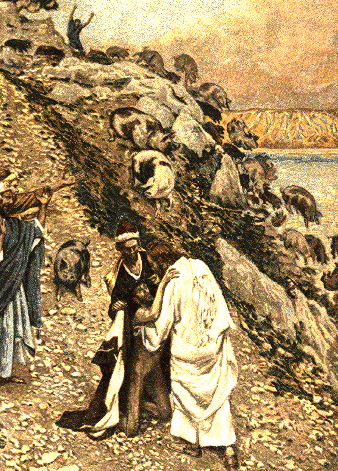
Jesus heals the demoniacs - Artist unknown
TODAY'S SPECIAL: Matthew 8:18-34

TO CHEW ON: "Then a certain scribe came and said to Him, 'Teacher, I will follow You wherever You go.' And Jesus said to him, 'Foxes have holes and birds of the air have nests but the Son of Man has nowhere to lay His head.' " Matthew 8:20

Yesterday we saw Jesus the mentor/rabbi pouring Himself into crowds and individuals, Jews and Gentiles, strangers and friends, untouchables and undiagnosables. I'm sure His disciples were getting the idea—this teacher is a challenge to emulate!

In our reading today He outright says some things about the cost of discipleship that probably left no doubt in His disciples' minds that they had embarked on a humanly impossible life.

Translated into today-speak for us:

1. Discipleship may cost some of the things to which we think we're entitled
—like a home address (Matthew 8:19-20).

2. Discipleship will impinge on relationships and obligations
—like family responsibilities (Matthew 8:21-22).

3. Discipleship may thrust us into situations that feel dangerous and where our faith will be stretched.
In our reading the disciples drift right into a storm. In the tempest-tossed boat, Jesus says to them, " 'Why are you fearful, O you of little faith,' " before He takes care of the storm (Matthew 8:23-26).

4. Discipleship can be thankless.
The people of the Gergesene-area city near where Jesus cast demons from two men have no compassion for the men or gratitude that they've been set free. Rather, they are upset because of the drowned hogs and beg Jesus to leave (Matthew 8:28-34).

I ask myself am I realistic about discipleship's costs? Are you? Or are we caught off-guard when life's hand is out, demanding such payments from us?


PRAYER: Dear Jesus, help me to count the cost of discipleship and choose day by day to continue as Your disciple. Amen.

 *********
Unless otherwise noted all Scripture quotations are taken from the New King James Version®. Copyright © 1982 by Thomas Nelson, Inc. Used by permission. All rights reserved.


Monday, October 27, 2014

Who is your audience?

man on stage in front of an audience
TODAY'S SPECIAL: Matthew 23:1-12

TO CHEW ON: " 'But all their works they do to be seen by men.' " Matthew 23:5


In his book The Call, Os Guinness tells a story about the American philanthropist Andrew Carnegie and his mother. The Carnegies started out in Pittsburgh as a poor family. One day Andrew found his mother weeping in despair. Trying to console her, he said:

"Someday I'll be rich. We'll ride in a fine coach driven by four horses."

"That will do no good over here," his mother snorted, "if no one in Dunfermline (Scotland) can see us" - Os Guinness, The Call, p. 69.

Have you ever felt that way? What good is this accomplishment if  __x___ (my boss, my family, my Facebook friends, my colleagues, the people in my church, my city) don't see it?

Guinness says:
"Only madmen, geniuses, and supreme egoists do things purely for themselves. … Most of us, whether we are aware of it or not, do things with an eye to the approval of some audience or other. The question is not whether we have an audience but which audience we have" - Ibid, p. 70.

Here Jesus revealed to the crowds and the disciples who the audience of the sanctimonious scribes and Pharisees was: other people ("men"). The irony of this is that they posed their religious observances as done for God. But their actions—exaggerating the religious parts of their clothing (phylacteries and borders), loving the best places at feasts, insisting they be addressed as "Rabbi" demonstrated who they were really trying to impress.

I ask myself, who is my main audience? Whose opinion do I value most? What about you? If it's Jesus, as we say it is, then we will do the things that He values. Several of them are named here:
  • Serve.
  • Humble ourselves.

I love how Guinness concludes this chapter in his book:
"Do you wish to be inner-directed rather than other-directed and truly make one Audience decisive, the Audience of One? Listen to Jesus of Nazareth; answer His call" - Ibid p. 74.


PRAYER: Dear Jesus, how often I get distracted from living first and foremost for You, letting my thirst for the praise and attention of people dictate my actions. Help me to value Your opinion more than any person's so that my life will show that my audience truly is You.  Amen.

 *********


Unless otherwise noted all Scripture quotations are taken from the New King James Version®. Copyright © 1982 by Thomas Nelson, Inc. Used by permission. All rights reserved.


Bookmark and Share


Sunday, February 23, 2014

Indiscriminate love

"Give to him who asks you."
Published in 1899 - Artist unknown.

TODAY'S SPECIAL: Matthew 5:38-48

TO CHEW ON: "But I say to you, love your enemies, bless those who curse you, do good to those who hate you, and pray for those who spitefully use you and persecute you, that you may be sons of your Father in heaven..." Matthew 5:44,45

How do I handle people stepping on my toes, not literally, but figuratively? That's the question I'm asking myself as I read the list of personal rights infractions with which Jesus challenges His listeners (Matthew 5:38-42). I realize, as I read the way Jesus told His disciples to react, that I'm pretty entrenched in the modern I-have-my-rights way of thinking. I would never naturally turn the other cheek for another slap, give my sweater to a thief who has just taken my jacket, volunteer to work extra hours of forced labour, or willingly lend to the neighbourhood mooch who never returns things.

The behaviour Jesus taught is love that goes way beyond the usual tit-for-tat. It's me and you loving:
- By choice. It takes a firm act of the will to react in such an anti-intuitive way.
- Indiscriminately. Everybody is a candidate for this kind of love, no matter what their behaviour.
- Practically. Besides giving in, it blesses, does good and prays for the loved one.

The point is not to be a pushover but to prove that we are children of God, whose very DNA is love, and who went to the greatest length to prove His love to us (John 3:16).

So how do I change from an I'll-scratch-your-back-if-you-scratch-mine type of lover to the indiscriminate lover Jesus describes? A sidebar article in my Bible sheds some light on this:
"A major emphasis of Jesus' teaching is how to build and maintain right relationships with God and others. He views these relationships as neither unimportant nor extraneous, but as vital components of our Christian lives. Knowing God is our highest priority, but this pursuit should not replace or diminish our interpersonal relationships with others. Rather, our personal interaction with God should produce within us the qualities of character that build and sustain all our relationships" - Leslyn Musch, New Spirit Filled Life Bible, p. 1439 (emphasis added).

PRAYER: Dear God, I read these things and realize how little family likeness is in me. Help me to get to know You so well, to be so much Your daughter, that demonstrating Your love to others will become second nature. Amen.


***********
Unless otherwise noted all Scripture quotations are taken from the New King James Version®. Copyright © 1982 by Thomas Nelson, Inc. Used by permission. All rights reserved.


Bookmark and Share

Related Posts Plugin for WordPress, Blogger...