Saturday, May 21, 2011

God wants relationship

TODAY'S SPECIAL: Hosea 6:1–7:7

TO CHEW ON: "For I desire mercy and not sacrifice;
And the knowledge of God more than burnt offerings." Hosea 6:6

In this meaning-packed little verse we discover what God did and didn't want from Israel back in Hosea's time.


He didn't want sacrifices and offerings that were insincere and showy piety. His feelings about sacrifices made with the wrong attitude is clear. Here, for example, are His strong words through prophet Micah:

What can we bring to the Lord?
      What kind of offerings should we give him?
   Should we bow before God
      with offerings of yearling calves?
 Should we offer him thousands of rams
      and ten thousand rivers of olive oil?
   Should we sacrifice our firstborn children
      to pay for our sins?
 No, O people, the Lord has told you what is good,
      and this is what he requires of you:
   to do what is right, to love mercy,
      and to walk humbly with your God. - Micah 6:6-8, NLT

What He did want was relationship. It's the kind of relationship wrapped up in the phrase "knowledge of God."

[Knowledge = da'ath  means knowledge, understanding, intelligence, wisdom, discernment, skills.]

Earlier in his message, Hosea had pointed to a lack of knowledge as the reason why the people were in their present distressed state: "My people are destroyed for lack of knowledge" Hosea 4:6

Jesus referred to this knowledge not as knowing something intellectually, but knowing a person: "And this is eternal life, that they may know You, the only true God and Jesus Christ whom You have sent" - John 17:3. It's a relationship powerful enough to change mere life to eternal life.

He also wanted mercy. The way Jesus applied this verse (He quoted Hosea 6:6 at least twice - both times in response to criticism from the Pharisees) sheds light on what receiving and extending mercy might look like in our own lives.

In one instance it was after the Pharisees chided Him for eating with tax collectors and sinners. He replied: "Those who are well have no need of a physician but those who are sick. But go and learn what this means, 'I desire mercy and not sacrifice.' For I did not call the righteous but sinners to repentance" - Matthew 9:13.

Another time the Pharisees were critical of Jesus' hungry disciples harvesting a few grain heads on the Sabbath. According to the Pharisees, this was work and work of any kind on the Sabbath was a strict no-no. Jesus debunked their rule with examples of historical exceptions, concluding: "But if you had known what this means, 'I desire mercy and not sacrifice,' you would not have condemned the guiltless. For the Son of Man is Lord even of the Sabbath" Matthew 12:7-8.

For us today, this little verse speaks on at least two issues:
  • God is still more concerned with our knowing Him than serving Him or keeping rules — especially when those two things are done in a rote way to soothe our consciences so that we can keep on living the way we like.
  • He extends mercy to us, but also expects us to give this mercy to others, so that they too will know God in relationship.
PRAYER: Dear God, Thank You for pursuing a relationship with me by sending Jesus. Now Jesus' words, "Go and learn what this means, 'I desire mercy and not sacrifice,'" feel like a stone in my shoe. Help me to understand this mercy, and live it out in the circumstances of my life. Amen.

MORE: Mercy

Enjoy the lively "Mercy is Falling".


Bible Drive-Thru


Bookmark and Share

Friday, May 20, 2011

Seek (baqash) My face

TODAY'S SPECIAL: Hosea 5:1-15

TO CHEW ON: "I will return again to My place
Till they acknowledge their offense.
Then they will seek My face;
In their affliction they will earnestly seek Me." Hosea 5:15

Though it is surely more 'politically correct' these days to speak about how God responds to our sinful ways with grace (and He does that) another response is on display in our passage today. Hosea warns of three negative ways God will respond to Israel's the habitual sinning:

1. He will withdraw from them (Hosea 5:6)
God will be silent. He will feel distant.

2. He will come as destruction from within (Hosea 5:12).
A wool garment taken out of storage and found to be riddled with moth holes, or a bathroom wall covering mould and dry rot come to mind. Inner destroyers like moths and rot work silently, secretly, but surely. They may refer to hidden sins like cheating, stealing, and sexual secrets.

3. He will come as a predator (Hosea 5:14).
For Israel this happened when they were carried away into exile. For us it could be natural disasters, political troubles or personal tragedy.

God does not send or allow these things because He is mean or vindictive. Rather they are to get our attention so that they will again seek him.

[Seek = baqash  means to seek, to diligently look for, to search earnestly until the object of the search is located. Baqash can apply to seeking a person, a particular item, or a goal. Peace is to be searched for earnestly - Psalm 34:14. The Lord's face, that is His presence, must be especially sought (Psalm 27:8) "Word Wealth - seek," New Spirit-Filled Life Bible, p. 1149).]

We too can examine our lives to see if God's apparent absence is His discipline. He has not interfered with us as we have allowed secret sins to feed on our integrity like moths on wool, or rot on organic material. He has not intervened as outright tragedy has carried away our comfortable existence. If not us, maybe these things are happening to someone we love.

Let's resist allowing bitterness or anger toward God take root in our lives as a result of these devastations. Rather, may we understand them as God's invitation to seek Him more fervently with baqash earnestness, diligence and perseverance.

PRAYER: Dear God, help me to see the things that happen in my world — both the big, grand-scale things and the day-to-day of my life — through spiritual eyes. Help me to search my heart for reasons why You feel absent. Help me to root out secret sins. May I understand trouble as an invitation to crowd closer to You.

MORE: "God is determined to make you pure and holy and right..."

"There is no heaven with a little corner of hell in it. God is determined to make you pure and holy and right; He will not allow you to escape for one moment from the scrutiny of the Holy Spirit. He urged you to come to judgment right away when He convicted you, but you did not; the inevitable process began to work and now you are in prison, and you will only get out when you have paid the uttermost farthing. 

'Is this a God of mercy, and of love?' you say. Seen from God's side, it is a glorious ministry of love. God is going to bring you out pure and spotless and undefiled; but He wants you to recognize the disposition you were showing - the disposition of your right to yourself. 

The moment you are willing that God should alter your disposition, His recreating forces will begin to work. The moment you realize God's purpose, which is to get you rightly related to Himself and then to your fellow men, He will tax the last limit of the universe to help you take the right road. Decide it now - 'Yes, Lord, I will write that letter to-night;' 'I will be reconciled to that man now'"  - Oswald Chambers, My Utmost for His Highest, July 1 reading.


Bible Drive-Thru


Bookmark and Share

Wednesday, May 18, 2011

A temporal spanking?

TODAY'S SPECIAL: Hosea 2:2-23

TO CHEW ON: "For she did not know
That I gave her grain, new wine, and oil,
And multiplied her silver and gold —
Which they prepared for Baal.
Therefore I will return and take away
My grain in its time
And My new wine in its season
And will take back My wool and My linen
Given to cover her nakedness." Hosea 2:8-9

When children are little, physical punishment is something they understand often better than words and reasoning (even though spanking is certainly out of favour with the modern parenting gurus). Here God threatens to administer a temporal spanking to Israel, who has been pursuing affairs with idols, just as Hosea's wife Gomer has gone after other men.

God's tone is one of hurt aroused to the point of indignation as He speaks to Israel about her unfaithfulness:

"She did not know that I gave her grain, new wine, oil; Therefore I will return and take away My grain...and new wine...She has said 'These are my wages that my lovers have given me,' so I will make them a forest..." Hosea 2: 8, 9, 12.

Israel is interpreting her physical abundance as the payment for her allegiance to Baal instead of coming from the God of heaven. So God says, in effect, I'll take it away. Maybe that will drive you back to Me.

As I read this, I think how we are often like that too. We attribute success, provision, all the good stuff we have as resulting from our own hard work, or keen intellect, or stable government, or luck, or karma — anything but God. It's interesting to view, as a contrast, the range of temporal blessings that the Bible says come from God's hand and are an evidence of His favour:*

  • The wealth of the patriarchs - Genesis 24:35; Genesis 26:12.
  • The sturdiness of the Israelites' clothes and shoes while they wandered for 40 years over rough desert terrain - Deuteronomy 29:5.
  • The well-being of Obed-Edom's household while he housed the Ark of the Covenant - 2 Samuel 6:11.
  • The riches and honour of Solomon, given as a by-product of his request for wisdom - 1 Kings 3:13.
  • Rain and the seasons to make earth productive - Psalm 65:9; Acts 4:17.
  • The success of secular rulers to the extent that even the animal kingdom is on their side, as they serve God's purposes (though they may not realize or acknowledge it) - Jeremiah 27:6
  • Along with material wealth, the ability to flourish spiritually - 2 Corinthians 9:10.

Do we acknowledge the real Source of the myriad blessings in our lives? When week after week there is food in the fridge, money for gas, health to live comfortably, do we thank God? Or do we, like the Israelites, attribute those blessings to ourselves or someone else? If we do we may, like them, be at risk of God withdrawing His bounty as He seeks to draw our attention back to Him.


PRAYER: Dear God, help me to understand the degree to which I am dependent on You for all the good things in life. Help me to be a person of habitual thankfulness for Your blessings to me throughout my days. Amen.


MORE: "How is God making my life full right here, right now?"

In her book One Thousand Gifts, Ann Voskamp writes about how nurturing an attitude of gratitude toward God changed the outlook of her life. Moira Brown of 100 Huntley Street interviewed Ann about the book in March 2011. In the two segments below, Ann explains what brought about the focus of gratitude in her life and how she continues to foster it.

Part 1 − 8:30 minutes

Part 2 − 9:38 minutes

*Email subscribers: to read the verses without looking them up, visit the article on the web, where a text box widget displays the verse when you hover the mouse over the reference.


Bible Drive-Thru


Bookmark and Share

Monday, May 16, 2011

New Testament star

TODAY'S SPECIAL: Acts 7:51-60

TO CHEW ON: "And they stoned Stephen as he was calling on God and saying, 'Lord Jesus, receive my spirit.'" Acts 7:59

Stephen is like a shooting star on the New Testament scene — spectacular, bright, but short-lived. He shows us how inspiring a short but well-lived life can be.

Stephen makes his first Bible appearance in Acts 6. There he is one of the men hand-picked to work in the widows' feeding program. He is chosen, along with six others, for good reputation and being full of the Holy Spirit and wisdom.

In Acts 6:5 he gets special mention as "a man full of faith and the Holy Spirit." In Acts 6:8 he is singled out as a person of faith, power and the ability to do signs and wonders. Acts 6:9 shows that he is also a gifted apologist, for when members of the Synagogue of the Freedmen debate with him, they are unable to resist his wisdom. They are so humiliated, they set up Stephen with false accusations.

As he stands before his accusers, Stephen takes the opportunity to explain God's plan through Jewish history, concluding with the Jews' recent killing of Jesus. Our reading today is the end of that speech where he is condemning them for this: "You stiff-necked and uncircumcised in heart and ears! You always resist the Holy Spirit; as your fathers did, so do you."

They stone him for that. But even in death he is admirable, asking God to forgive them.

My thoughts, as I read his story, are What a waste! He seems like too gifted a man to merely serve tables. His reasoning and speaking talents could have been so useful in the church. But God had other plans.

What challenges can we take from Stephen's life?

1. To take every assignment, no matter how insignificant and unspiritual it seems, as  from God and worthwhile. It's interesting that the disciples looked for men who were full of the Holy Spirit to distribute food. We can learn from that that for even mundane jobs, maybe especially mundane jobs, we need Holy Spirit fullness to complete successfully.

2. To realize that God's plan for a successful, full and finished life are not measured by our criteria. "It was too soon for him/her to die," we say whenever a young person dies. But God sometimes has different plans.

“For My thoughts are not your thoughts,
      Nor
are your ways My ways,” says the LORD.
       “ For
as the heavens are higher than the earth,
      So are My ways higher than your ways,
      And My thoughts than your thoughts."  - Isaiah 55:8-10

3. To nurture within us a genuine faith that will stand up, even under pressure. Stephen's faith in God never faltered, even as the stones were  bruising his arms and legs, crushing his ribs and smashing his skull. Though God didn't miraculously swoop down to rescue him he didn't exhibit one iota of bitterness, using his last breath to pray for forgiveness for his killers.

PRAYER: Help me to be like Stephen, full of Your Spirit for every job, concerned with Your kingdom more than my own comfort or longevity, and with a heart so in tune with Yours that I can forgive my enemies. Amen.

MORE: Modern Martyrs

Dying for one's faith continues into our time. Check out these sites:

Links to stories about some modern martyrs

Worthy News


Bible Drive-Thru


Bookmark and Share

Sunday, May 15, 2011

Letting God get a word in

TODAY'S SPECIAL: John 15:1-17

TO CHEW ON: "'If you abide in Me and My words abide in you, you will ask what you desire and it shall be done for you.'" John 15:7

Here we see an important part of abiding — or living — in the vine (Jesus) is prayer. And an effective way of praying, that is praying prayers that get answered, is making God's words part of our prayers.

This happens on several levels.

1. God's words change us so we ask for the right things.
As we get familiar with God's heart as expressed in the Bible and we let it change us, our desires will come into line with His will. When that happens we'll pray for things that are His will. When we and God want the same thing, His answers to our prayers will be "Yes."

2. We pray God's words back to Him.
God's word has unique power. Jeremiah describes it as a hammer and a fire. Isaiah tells us it will not fail in the purpose for which God sends it out. So why not pray these powerful, unable-to-fail words back to God.

Daniel Henderson (author of Transforming Prayer) quotes Calvin Miller in this regard:

"Too often we go into God's presence with a list of pleas, trying to talk God into granting our desire. But this kind of praying makes us 'one big mouth' and God 'one grand ear.' But when we pray the Scriptures, it makes God the voice and leaves us the ear. In short, God gets His turn at getting a word in edgewise" - Calvin Miller, from The Path to Celtic Prayer, p. 57, quoted in Transforming Prayer p. 103.

Henderson tells us how he does this practically:

"On a personal level, I read the Scriptures using the Bible program on my laptop. As specific passages speak to me, I paste them into my journal program. Then I take time to allow those Bible segments to speak deeply to my heart and write out my prayers in response. This sense of Christ's presence and the substance of His Word guide my praying for that day" - Transforming Prayer, p. 105.

Let's ask God to show us ways we too can adjust our prayer times to combine Bible words and prayer.

PRAYER: Dear Jesus, please teach me to pray using the power of Your words. May they change me. Help me to find and recognize Bible passages that express Your will for the people and circumstances in my life. May I then be alert to use them in prayer. Amen.

MORE: Praying the Bible

There are many resources available to help us pray God's word. Some I am aware of:

Praying with Fire

Take Words With You (a pdf book you can download from this page)

You can also write your own scripture prayers for the people you love, your circumstances, your career, your city, and your country. I've posted two such prayers on the "Prayer" page of this blog. Try writing one of these for yourself and your circumstances.


Bible Drive-Thru


Bookmark and Share

Saturday, May 14, 2011

Not chosen

TODAY’S SPECIAL: Acts 1:12-26

TO CHEW ON: “And they prayed and said, ‘You O Lord who know the hearts of all, show which of these two You have chosen….And they cast lots and the lot fell on Matthias. And he was numbered with the eleven apostles.” Acts 1:24,26

I’m sure you know what it feels like to be overlooked, the one not chosen. You let your name stand for a committee and the other person is picked. You enter a contest and when you look at the list of winners, your name isn’t there. You let the boss know you're interested in an open position, but he gives it to someone else.

This is what happened to Joseph Barsabas Justus, one of the two men the apostles chose to fill the vacancy on their ‘board’ left by Judas. They cast lots to make the final choice and the lot fell to the other man, Matthias. I wonder how J. B. Justus felt after that – rejected, slighted, discouraged, snubbed by the very God he worshiped? For the belief was that God revealed His will by how the lot fell.

Though the disappointments in our lives come at the hands of others and not as directly from God as it appeared here, our belief that God is in the details of life may make our failure seem just as much a verdict from Him. So how do we handle situations when we’re not chosen? Here are a few suggestions:

1. Look for reasons we were disqualified. We can ask God to show us if there is some lack of qualification or skill, or some attitude or action that would disqualify us. In a passage that talks about physical healing, James says that dealing with our known sins impacts whether or not our prayers will be answered. (James 5:13-16)

2. We can ask ourselves why we feel so disappointed. This helps us uncover our expectations and motivations. Were they self-serving?

3. We can focus on becoming the people that are pleasing to God in the hidden places. These include prayer, living in forgiveness, fasting, and giving (money, charity, time) without fanfare and hope of being rewarded.

4. We can give our lives to God anew, surrendering everything including our confusing expectations and motivations.

We never hear again about Joseph B. Justus. I hope he didn’t scoop his ball and run home in a sulk. I hope he stayed around to serve tables, head the prayer chain or fix widows’ roofs, realizing he was chosen for those things or something else just as important.

PRAYER: Dear God, it’s hard for me not to feel disappointed when I’m not chosen for things on which I’ve set my heart. Help me to learn from these disappointments and to live the life You’ve chosen for me with joyful acceptance. Amen.

MORE: "We Bow Down" - Viola Grafstrom, Kingsway Thankyou Music


(This is a re-post from May 14, 2010.)

Sunday, May 08, 2011

Eyes - closed or open?


TODAY'S SPECIAL: Luke 24:13-35

TO CHEW ON: "But their eyes were restrained, so that they did not know Him...Then their eyes were opened and they knew Him." Luke 24:16, 31

It's easy for us to be hard on the disciples, wondering how they could not know Jesus. How could they not have expected all that happened to happen? After all, Jesus tried to tell them so often and so clearly that He would die but would rise again.

However, I'm not at all sure I wouldn't have been just like those thick-headed unseeing people of Jesus' day. A little study on lack of spiritual insight reveals these things about it:

1. It was often a result of interpreting things literally instead of spiritually.
  • In Matthew 16:11 Jesus' disciples took His warning about the leaven of the Scribes and Pharisees that way (thinking He was talking about literal bread when He was actually referring to doctrine).
  • In John 3:4, Nicodemus at first thought Jesus was telling him he must be physically reborn to enter the Kingdom of God.
  • In John 6:53-58 where Jesus spoke prophetically abut His death as commemorated in communion (eating His flesh and drinking His blood) many people were turned off and left Him (John 6:60,66).

2. Sometimes it was the result of a skeptical nature - like that of Thomas (John 20:25).


3. Sometimes it came from not wanting to hear the bad news. It seems that the disciples' inability to comprehend Jesus' words fell largely in that category (Mark 9:30-32).

4. At other times it seems to have come from the good news being too good to be true (actually a lack of faith).
  • The inability for the disciples to believe that Jesus had actually risen would be an instance of that (John 20:2,8-9)
  • So would today's story of the Emmaus disciples.
  • As would the believers' disbelief that Peter had escaped from prison and was at the door, as Rhoda the doorlady reported in Acts 12:15.

5. Paul tells us that spiritual perception can be impeded by carnality (worldly or fleshly-mindedness) in 1 Corinthians 3:1.


6. He also gives us the secret to understanding the Old Testament. In 2 Corinthians 3:12-18 he explains how when we acknowledge Jesus as the fulfillment of God's plan, the veil is taken from our eyes in regard to what is written there in type, symbol and prophecy.

7. And here's the good news for us today: spiritual insight is available to each one of us now, through the help of the Holy Spirit! 2 Corinthians 2:9-11 says:

9 That is what the Scriptures mean when they say,
   “No eye has seen, no ear has heard,
      and no mind has imagined
   what God has prepared
      for those who love him.”
 10 But it was to us that God revealed these things by his Spirit. For his Spirit searches out everything and shows us God’s deep secrets. 11 No one can know a person’s thoughts except that person’s own spirit, and no one can know God’s thoughts except God’s own Spirit.- NLT

We don't have to be blind. We have the Holy Spirit - the Bible's inspiration - to help us understand it and apply it rightly to our lives and our times.

PRAYER: Dear God, thank You for Your Spirit which gives insight into the Bible. Help me to be alert and clear-visioned, understanding and interpreting life through the truth of Your word. Amen.

MORE: "Open the Eyes of My Heart" - sung by Michael W. Smith


TODAY IS MOTHER'S DAY! A bouquet to mothers everywhere. We love, value and appreciate you!


Bible Drive-Thru


Bookmark and Share

Tuesday, May 03, 2011

That was close!

TODAY'S SPECIAL: Psalm 116:1-19

TO CHEW ON: "I love the Lord because He has heard my voice and my supplications." Psalm 116:1

Writings where the author expresses what we are feeling are pieces we read over and over. Psalm 116 is such a passage for anyone who has been through a life-threatening, near-death experience. Note the writer's varied reactions to the resolution of his too-close-for comfort event. To which can you relate?

1. Uninhibited love: "I love the Lord..." - Psalm 116:1
It's obvious the speaker was desperate when he cried out to God. Now he is full of love for the God who responded.

2. Resolve to pray more - Psalm 116:2
Because God answered his prayer, he is now determined to pray as long as he lives.


3. Fresh testimony - Psalm 116:3-6; 10-11
He can't help but relive the close call he had. "I was at death's door when I prayed," he tells us. "All I could do was utter a simple call out to God."


4. Time to get back to normal living - Psalm 116:7-8
"Soul, you can relax again," he says to his overwrought emotions.


5. New commitment to do God proud - Psalm 116:9
When he resolves, "I will walk before the Lord in the land of the living," it's as if he's saying, 'You won't be sorry you rescued me, God. I'll show you that I was worth it.'

6. New appreciation of salvation - Psalm 116:12-13
I see the writer here, holding up his cup that is full of salvation wine, giving a toast to God.

7. Determined to keep sickbed promises - Psalm 116: 14, 18-19
He obviously did a little bargaining with God, a little vowing and promising when he was down. Now he reminds himself of these promises and determines to keep them.


8. New insights into death - Psalm 116:15
It's as if the writer has looked death in the face and realized it wasn't all terror. For death would usher him into the presence of God, and God's celebration of their being face to face.


9. Renewed commitment to serve God - Psalm 116:16
"I am Your servant," he says, and repeats it, as if determined that his servant role will define him from now on.


10. An overflow of thanksgiving - Psalm 116:17
What else but thanksgiving could flow from an experience like that?

Don't these responses ring true — the overwhelming love we feel for God after He answers a desperate prayer, the urge to tell everyone what has just happened, the remembrance of promises made to God when in the thick of trouble, new insights into death, a strengthened resolve to serve God and be thankful for extraordinary and ordinary blessings...

If you're in a desperate place right now, let Psalm 116 be the light at the end of your tunnel. You might even want to pray its words and promises over your situation in faith. If you've come through such a time, let this psalm express your love, renewed loyalty and gratitude to God.


PRAYER: I love You Lord, because You hear my prayer. I will walk before You now, in the land of the living. I will keep my promises to You and be full of thanksgiving. Amen.


MORE: Prayer and Hope

"After you've worshiped and petitioned to the best of your Holy-Spirit-energized ability, rest it all with Him. The answers may not come in the size packages you suppose, or be delivered at the moment you have in mind. But trust in Him. All power and glory are His. And in freely and praisefully speaking that, you open the door to His invitation that you share it with Him...in His way, at His time." Jack Hayford quoted in Prayer Powerpoints, p.223 (taken from Prayer is Invading the Impossible p. 107).


Bible Drive-Thru


Bookmark and Share

Friday, April 29, 2011

Privileged above prophets and angels

TODAY'S SPECIAL: 1 Peter 1:1-12

TO CHEW ON: "To them it was revealed that, not to themselves but to us they were ministering the things which now have been reported to you through those who have preached the gospel to you by the Holy Spirit sent from heaven — the things which angels desire to look into." 1 Peter 1:12

Though it took Peter a while (as we saw yesterday) by the time he wrote this letter he was completely convinced that Jesus was the fulfilment of Old Testament prophecies. Can't you just sense the thrill he feels knowing he had actually witnessed the things that prophets and angels had strained to see?

A commentary on 1 Peter in my Bible gives this advice:
"Devote yourself to loving Jesus, even though you cannot see Him. Loving and believing in Him with faith releases unspeakable joy and glory in your life. Spend time studying the Old Testament prophecies about Jesus and their fulfillment in the New Testament. Realize that angels long to look on these things and that studying the Bible is a privilege" - "Truth-In-Action In 1 Peter," New Spirit-Filled Life Bible, p. 1771.

To help carry out that good advice, here us a little bit elementary school fun for you. Below is a list of seven aspects of Jesus' death recorded in the Gospel of John. Under that are some prophetic references. Can you match each prophecy with its fulfillment? (One prophecy reference predicts two events.)

Aspects of Jesus' death prophesied in the Old Testament:

1. In obedience to His Father (John 18:11). _____
2. Announced by Himself (John 3:14; 18:31-32). _____
3. In the place of His people (John 18:14). _____
4. With evildoers (John 19:18). _____
5. In innocence (John 19:6). _____
6. By crucifixion (John 19:18). _____
7. Buried in a rich man's tomb (John 19:38-42). _____

Old Testament Prophecies:

A. Numbers 21:8-9    B. Psalm 22:16   C. Psalm 40:7-8   D. Isaiah 53:4-6   E. Isaiah 53:9   F. Isaiah 53:12

(Answers below)

PRAYER: Dear God, I worship You for the wisdom of Your plan, put in motion "from the foundation of the earth". Open my eyes to see and understand where I fit into the part of the story playing out in my time. Amen.

MORE: Jesus and prophecy

"Nobody in the history of the world has foreknown and foretold and carried out his life and death and resurrection the way Jesus did. The overwhelming impact of reading the gospel accounts of the life of Jesus is that here is a man who knows what is coming, describes what is coming, and performs what is coming, according the purpose of God foretold in Scripture, that he was sent to fulfil. He sets his face like flint to do everything written of him, and he will not turn to the right hand or to the left lest one prediction of his Father in the Old Testament should fall to the ground." - (Read all of "The Sovereign Sacrifice: Foreknown, Foretold, For Faith) By John Piper. © Desiring God. Website: desiringGod.org


Answers: 1. C |  2. A  | 3. D  | 4. F  | 5. E |  6. B |  7. E


Bible Drive-Thru


Bookmark and Share

Thursday, April 28, 2011

Who is Jesus?

TODAY'S SPECIAL: Acts 2:22-36

TO CHEW ON: "This Jesus God has raised up, of which we are all witnesses .... Therefore let all the house of Israel know assuredly that God has made this Jesus both Lord and Christ." Acts 2:32,36

Understanding Jesus' identity was a process, even for the disciples. It is illuminating to see how many times Jesus alerts His close followers to who He is and how that will play out. Here's a sampling:


Still they don't understand. Peter is especially forward in voicing his disapproval of Jesus' prediction that He will suffer and die. In Mark 8 after Jesus says plainly what His fate will be, Peter takes Him aside and rebukes Him.

Later, when Jesus asks His disciples, who they say He is and Peter gives the right answer: "The Christ of God," Jesus again reminds them of His fate, that He will "be rejected by the elders and chief priests and scribes, and be killed, and be raised the third day” Luke 9:22.

When these predictions become actual events Peter is the most adamant that Jesus' arrest is a big mistake (he actually attacks one of the soldiers, cutting off his ear). He is then so shaken that he betrays Jesus by insisting to those who identify him as one of Jesus' disciples, that he doesn't even know Him.

Despite this thickness, God doesn't give up on Peter or the rest of the disciples. At the tomb, the angels reiterate what Jesus has been saying (Luke 24:6-7). Later, the disciples who encounter Jesus on the road to Emmaus get another teaching session about how Jesus is the fulfillment of prophecies in the writings of Moses, the psalms and the prophets (Luke 24:13-27).

In our reading today we see that Peter finally gets it. He proclaims boldly, "This Jesus God has raised up of which we are all witnesses .... Therefore let all the house of Israel know assuredly that God has made this Jesus both Lord and Christ."

Watching this process brings two things to mind:

1. I wonder how often we don't hear the things we don't want to hear. That seems to have been the disciples' problem. They had an idea of who Jesus was but thought that He would establish an earthly kingdom. So anything that didn't fit with that, they didn't hear. Are we so different? Do we take to heart the things Jesus said, for example, about the last days in Matthew 24 and 25, and as a result live alert?

2. Each one of us must come to our own conclusion about who Jesus is. Do we believe He is just another good prophet in a parade of prophets that have walked this earth — as a majority of earth's inhabitants would believe? Or do we believe He really is who He said He was — God the Son, who died in our stead so that we can be reconciled with God the Father? Our eternal fate hangs on our answer.

May we, through the Holy Spirit, experience what the disciples did that day on the Road to Emmaus: "And He opened their understanding that they might comprehend the Scriptures" (Luke 24:46).

PRAYER: Dear Jesus, thank You for coming as the fulfillment of prophetic scripture to die for me. Help me to understand the Bible and apply it to my life. Amen.

MORE: "My Deliverer is Coming" - Rich Mullins


Bible Drive-Thru


Bookmark and Share

Wednesday, April 27, 2011

Camping in His presence

TODAY'S SPECIAL: Psalm 16:1-11

TO CHEW ON: "You will show me the path of life; In Your presence is fullness of joy; At Your right hand are pleasures forevermore." Psalm 16:11

This psalm is called a Michtam — a title which, a footnote in my Bible says, refers to deliverance from death. Peter quotes from Psalm 16 on the day of Pentecost, referring to Jesus' deliverance from death in resurrection. Peter had done his memory work — note how closely his speech followed Psalm 16:8-11:

"I foresaw the LORD always before my face,
      
For He is at my right hand, that I may not be shaken.
      
Therefore my heart rejoiced, and my tongue was glad;
      
Moreover my flesh also will rest in hope.
      
For You will not leave my soul in Hades,
      
Nor will You allow Your Holy One to see corruption.
      
You have made known to me the ways of life;
      
You will make me full of joy in Your presence." - Acts 2:25-28

Peter then applied the message of the psalm to their current situation. My paraphrase: 'See, this is what David prophesied, that from his (David's) line Christ would come to sit on his throne. He foresaw this Christ's resurrection which God fulfilled in Jesus. And it's Jesus who is now at the right hand of God, who pours out the Holy Spirit on us today.'

And so as we now think about "the path of life" David asked God to show him, we interpret it in the light of Jesus' resurrection. When we claim this verse for ourselves, and pray it over our lives, we do it knowing Jesus has conquered death and the "path of life" winds into eternity.

But we don't have to wait till eternity to experience the joy of it. We can have it whenever we camp in His presence. A commentary article in my Bible expands on what that means:

"Radical, passionate, life-changing devotion bursts forth in our lives from one primary source: consistently being in the presence of the Lord.
  • Know that abundant life, fulfillment, delight and joy are found in the presence of the Lord (Psalm 16:11 - our focus verse).
  • Stay in God's presence for there you will find wisdom and protection from those who would rise up against you (Psalm 17:2-9).
  • Follow David's example by recognizing that it is in God's presence that you will find grace, honor, mercy, faithfulness, great joy, and gladness (Psalm 21:1-7).
  • Hide in God's presence. It is a place of shelter and safety (Psalm 31:20)."
"Truth-In-Action Through Psalms" - New Spirit-Filled Life Bible, p. 719.

PRAYER: Dear Jesus, thank You for making the round trip from heaven to earth. Help me to absorb all that Your resurrection means and avail myself of eternal life's delights by intentionally and consistently living in Your presence now. Amen.

MORE: The Jesus Way - Brian Doerksen


Bible Drive-Thru


Bookmark and Share

Monday, April 25, 2011

Rebuked

"Jesus appears to the eleven"
Artist unknown

TODAY'S SPECIAL: Mark 16:9-20

TO CHEW ON: "He appeared to the eleven as they sat at table; and He rebuked their unbelief and hardness of heart because they did not believe those who had seen Him after He had risen." Mark 16:14

How sobering to be the object of Jesus' rebuke. This stern passage had me wondering about other times Jesus rebuked people. On doing a little study, I found at least six categories of rebukes (oneidizo: reproach, revile, suffer reproach, upbraid) that Jesus issued:

1. He rebuked the demonic. When a demon speaking through a demon-possessed man in the synagogue exposed and opposed Him, Jesus said, "Be quiet and come out of Him" - Mark 1:25.

2. He rebuked those who criticized the extravagant love showed to Him by others.
  • During the incident of Mary anointing His head with oil at Simon's dinner, Jesus rebuked Simon and all those critical to Mary's lavish demonstration of love. (Mark 14:6-9, also Luke 7:44 and John 12:7).
  • When Martha hosted Jesus in their Bethany home and complained that Mary wasn't helping, Jesus rebuked her for having chosen the wrong priorities  (Luke 10:41).

3. Jesus rebuked those who followed Him for selfish reasons:
  • He rebuked the people who followed Him simply because He had fed them (Luke 6:26).
  • He also rebuked a man who came to him trying to get his inheritance by having Jesus intervene on his behalf (Luke 12:14).

4. Jesus rebuked those (and these were His followers) whose weak faith made them powerless.
  • He scolded the disciples, calling them a "faithless and perverse generation" when they couldn't cast out a demon from an oppressed boy (Luke 9:41).
  • He also rebuked them when, in Gethsemane, they slept instead of watching and praying (Luke 22:46).

5. Jesus had many rebukes for those who didn't understand the part He played in God's plan. He rebuked His opponents for this:
  • The Scribes and Pharisees because they couldn't read the signs of the times (Matthew 16:3).
  • Those who questioned His authority to say, "Your sins are forgiven you..." to the paralyzed man (Mark 2:8).
  • The synagogue ruler for being more concerned with following man-made Sabbath-keeping than the well-being of a woman He healed (Luke 13:15).
But His disciples didn't understand His role either. He was no less harsh in rebuking them.
  • When Jesus prophesied His torture and death and Peter took Him aside, rebuking Jesus for saying those things, Jesus rebuked him right back, identifying the spirit behind Satan's words as satanic (Matthew 16:23, also Mark 8:33).
  • Jesus rebuked His followers for not getting the connection between His life and fulfilled prophecy in Luke 24:25.
  • Later when Peter tried to defend Him with a sword, Jesus rebuked Peter and healed the damaged ear (John 18:11).
  • Our focus verse today (Mark 16:14) would be another rebuke in this category. His eleven disciples, who had been with Him for almost three years, and who had heard what He taught and been eye-witnesses to all that He did, still remained cynical of the reports of those who had seen Him after His resurrection.

In Revelation when the resurrected Jesus gives John messages for the early churches, He gives a reason for His rebukes. It's because of His love: "As many as I love, I rebuke and chasten" (Revelation 3:19).

I ask myself, am I in any of the above categories? Haven't I been guilty of criticizing the extravagant worship of some?  Haven't I been weak-faithed and powerless to do the things Jesus said His disciples would do? Haven't I sometimes been a cynic when it comes to believing eye-witness miracle testimonies?

What about you?

Let's welcome Jesus' love shown through constructive rebuke, and ask Him for faith and courage to change our ways.

PRAYER: Dear Jesus I know that I am as vulnerable to rebuke as were the people in Bible days. Please forgive me and show me my real self so I can grow as Your disciple. Amen.


MORE: Easter Monday

Today the church celebrates "The Monday In Easter Week,"  or Easter Monday.

The collect for the day that begins the liturgy:

"Grant, we pray, Almighty God, that we who celebrate with awe the Paschal feast may be found worthy to attain to everlasting joys; through Jesus Christ our Lord, who lives and reigns with you and the Holy Spirit, one God, now and for ever. Amen."


Bible Drive-Thru


Bookmark and Share

Thursday, April 21, 2011

Envy

TODAY'S SPECIAL: Matthew 27:3-31


TO CHEW ON: "For he knew that they had handed Him over because of envy." Matthew 27:18

Envy - what a seemingly small and innocuous motivation was behind the death of Jesus. Who of us hasn't, at one time or another, referred to ourselves as being envious of someone for their possessions, talents, or lot in life?

The Greek word used in the original Matthew 27:18, "because of envy"--  phthonos --  means simply "envy, prompted by envy".

When we speak of envy we refer to "a feeling of resentment or discontent over another's superior attainments, endowments or possessions. It is often accompanied by dislike, ill-will, even hatred" - Funk & Wagnalls Standard College Dictionary.

(Note that the Scriptures below are not linked to Bible Gateway. If you view this post online, hovering your mouse over the reference will bring up a little text box with the verse inside.)

Envy is an emotion that threads through the Bible. A quick look at examples show its destructiveness:
  • Cain killed Abel because he was envious of the fact that God had accepted Abel's animal sacrifice (in compliance to God's directions) over Cain's sacrifice of produce (Genesis 4:5,8; 1 John 3:12).
  • Envy caused the Philistines to sabotage Isaac's wells (Genesis 26:14).
  • Envy was rife in Jacob's family:
- his wife Rachel was envious of Leah (Genesis 30:1).
- His uncle Laban's sons were envious of him (Genesis 31:1).
- He favoured Joseph, which caused envy and hatred to grow among his sons (Genesis 37:3-5, 11).
I could go on and on with examples but I'm sure you get the picture.

The scary thing about envy is how common it is, and how readily it springs up in anyone — in us.
  • Asaph the psalmist warns against the righteous envying the wicked (Psalm 73:3).
  • Solomon warns of envying our successful neighbour because of his hard work and skill (Ecclesiastes 4:4).
  • Proverbs characterizes envy as "rottenness to the bones" (Proverbs 14:30).
  • Paul calls it carnal behaviour (Corinthians 3:3), anti-love (1 Corinthians 13:4), the opposite of walking in the day (Romans 13:13).
  • James refers to envy as sensual, demonic wisdom whose symptoms are confusion and every evil thing (James 3:14-16).

The wake-up call is that whether or not we are envious is entirely within our control:

"Do not let your heart envy sinners..." says Proverbs 23:17.


"Let us not become conceited, provoking one another, envying one another" says Paul in Galatians 5:26.

A  bit of envy is not merely a natural and harmless reaction to life's perceived unfairnesses. Envy is not okay. It's a dangerous little murder seed that was powerful enough to initiate the death of Jesus.

PRAYER: Dear God, please show me the envy that is hiding inside me. Help me to see it as the poison it is and to destroy every trace of it. Amen.


MORE: Maundy Thursday

Today is Maundy Thursday:

"Maundy Thursday, also known as Holy Thursday, Covenant Thursday, Great & Holy Thursday, and Thursday of Mysteries, is the Christian feast or holy day falling on the Thursday before Easter that commemorates the Last Supper of Jesus Christ with the Apostles as described in the Canonical gospels. It is the fifth day of Holy Week, and is preceded by Holy Wednesday and followed by Good Friday" definition from Wikipedia.

And here is the liturgy for Maundy Thursday. 


Bible Drive-Thru


Bookmark and Share

Saturday, April 16, 2011

Do WHAT?

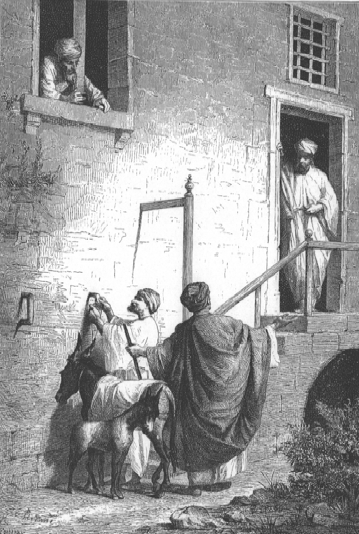
"The donkey and her colt"
by Alexandre Bida

TODAY'S SPECIAL: Matthew 21:1-11

TO CHEW ON: "Jesus sent two disciples, saying to them, 'Go into the village opposite you, and immediately you will find a donkey tied, and a colt with her. Loose them and bring them to Me.'" Matthew 21:1b-2.

At a luncheon I attended recently I heard a talk by a young woman who heads the Athletes In Action ministry at a local university. As she described her typical day — going on campus early to meet with a sports club and talk about how faith in God can enhance athletic performance, then camping out in the coffee shop or other place athletes gather to meet with them one-on-one, build relationships, and so walk with them through things like performance anxiety, sexual pressure, sexual identity confusion etc.— I thought: I could never do that!

It's the same reaction I feel welling up when I read Jesus' command to the two disciples in today's reading. What do you mean, "Go...find a donkey and a colt....loose them ... bring them to Me"? You mean just go and take someone's donkey? You've got to be kidding!

Of course Jesus' disciples were well broken in by now. His out-of-the-box directives had seen them through scarcities of fish, food needed to feed a large crowd, a supply of tax money , a poorly supplied missions trip, and many other incidents. We don't read that they demurred for a second. Instead, they did exactly what Jesus said, and became part of the fulfillment of prophecy.

Two thoughts:
1. We don't all have the same job in God's kingdom. I love Paul's comparison of the church with the human body. We're not all the same organ or part and so we will have different functions. The Athletes in Action staffer was herself once a part of a varsity soccer team and has credibility in the world of university athletes. I know God isn't expecting me to do what she's doing.

2. Even so, sometimes what God tells me to do may not make sense. Obeying what He says may stretch my faith.

May my history of doing whatever God has asked me to do in the past prepare me for whatever kingdom errand he has for me today. And may my obedience today prepare me to do whatever He asks tomorrow.

PRAYER: Dear God, please help me to do whatever assignment You give me today. Amen.

MORE: Why did Jesus need that donkey?

"Jesus sends two of his disciples to get a donkey... Why? What is he doing? Why does he want a ride into Jerusalem on a donkey? Never before has he done such a thing. 

Matthew tells us why in verses 4-5, 'This took place to fulfill what was spoken through the prophet: "Say to the daughter of Zion [that is, to Israel], 'Behold your king is coming to you, gentle, and mounted on a donkey, even on a colt, the foal of a beast of burden,''"


This is a quote from the prophet Zechariah (9:9). Jesus has chosen to act out the fulfillment of this prophecy and to declare his kingship in the action of riding on a donkey. This means, yes, I am king, for that's what the prophet says it means: 'Behold your king.' 

'But,' he is saying, 'I am gentle and lowly. I am not, in my first coming, on a white war-horse with a sword and a rod of iron. I am not coming to slay you. I am coming to save you. This time. Today is the day of salvation.'"

- "Jesus Declares His Kingship" - By John Piper. © Desiring God. Website: desiringGod.org.


Bible Drive-Thru


Bookmark and Share

Thursday, April 14, 2011

Powerful name

"Triumphal entry into Jerusalem" 
- Alexandre Bida

TODAY'S SPECIAL: Psalm 118:1-29

TO CHEW ON: "Blessed is he who comes in the name of the Lord." Psalm 118:26

Parts of Psalm 118 were what the "very great multitude" shouted as Jesus approached the city riding on a donkey - the event we now celebrate as Palm Sunday (Matthew 21:1-10). Those crowds recognized the prophetic scene painted in Psalm 118 as Jesus entered Jerusalem's gates:
"Open to me the gates of righteousness;
I will go through them....
This is the gate of the Lord
Through which the righteous shall enter" - Psalm 118:19,20.

Their shout "Hosanna" is the Hebrew rendering of "Save now" (Psalm 118:25). Their chant, "Blessed is He who comes in the name of the Lord" is a direct quote from Psalm 118:26.

Their declaration that Jesus came "in the name of the Lord" is weighty with meaning. Daniel Henderson in his book Transforming Prayer devotes a whole chapter to exploring "the name of the Lord." Here are some bits that help us understand what the crowds were shouting that day and what we do when we invoke that powerful name:

"The 'name of the Lord' represents more than a title for God. It is the essence of His identity and character revealed to the hearts of men....


Throughout His ministry Jesus brought great clarity to us about His character and identity by declaring His unique names....He excited worship, for example, with the 'I am' statements made in the gospel of John:
  • 'I am the resurrection had they life' (John 11:25).
  • 'I am the way, the truth, and the life' (John 14:6).


Later the New Testament books will explode additional truths about our Christ, telling us that He is the Alpha and Omega (Revelation 1:8), the author and finisher of our faith (Hebrews 12:2), the chief cornerstone of the household of God (Ephesians 2:20), the head of the church (Ephesians 1:22), the very Word of the God (Revelation 19:13), and the King of Kings and Lord of Lords (Revelation 19:16)" - Daniel Henderson, Transforming Prayer, p. 127-129.


Obviously the Jerusalem crowd didn't recognize Jesus in all His fullness. For only days later another crowd shouted "Crucify Him!" But we, with all of the Bible at our disposal, can now see the depth of meaning and power in "the name of the Lord." And it is on the strength of that name (which we often invoke so casually) that Jesus promises God the Father will answer our prayers:
"23 At that time you won’t need to ask me for anything. I tell you the truth, you will ask the Father directly, and he will grant your request because you use my name.24 You haven’t done this before. Ask, using my name, and you will receive, and you will have abundant joy" - John 16:23-24 NLT.


PRAYER: Dear Jesus, thank You for coming to earth to be the incarnation of all that God is. Help me to begin to comprehend the massiveness of this, and understand the privilege it is to be able to pray in Your name. Amen.

MORE: Praying in the name of Christ

"To pray in the Name of Christ is to pray as one who is at one with Christ, whose mind is the mind of Christ, whose desires are the desires of Christ, and whose purpose is one with that of Christ. Prayers offered in the Name of Christ are scrutinized and sanctified by His nature, His purpose, and His will. Prayer is endorsed by the Name when it is in harmony with the character, mind, desire and purpose of the Name" - Samuel Chadwick (The Path of Prayer, London: Hodder & Stoughton, 1936, p. 52) quoted in Transforming Prayer, p.131.


Bible Drive-Thru


Bookmark and Share

Related Posts Plugin for WordPress, Blogger...