Showing posts with label Acts. Show all posts

Thursday, October 18, 2018

Assigned to our own

TODAY'S SPECIAL: Acts 25-26; Psalm 131

TO CHEW ON: "I will deliver you from the Jewish people, as well as from the Gentiles, to whom I now send you, to open their eyes, in order to turn them from darkness to light, and from the power of Satan to God, that they may receive forgiveness of sins and an inheritance among those who are sanctified by faith in Me." Acts 26:17-18

What a huge assignment Paul received, the day he was struck blind on the road to Damascus. As he recounted his experience of that day to Agrippa (today's reading), his memory of it was clear enough for him to repeat Jesus' words verbatim.

We may not think it surprising to hear he was to tell the Gentiles about their state. But the Jews too? Those were his people, his family members, relatives, neighbours and colleagues.

And what a precarious state they were in:
- They had closed eyes, for he was sent to open their eyes.
- They were in darkness, for he would turn them to light.
- They were under Satan's power, for he would tell them how to escape those clutches.

It's not difficult to think of people in lands far away as needing such information. But do we believe that our people, our unbelieving friends, family members, and colleagues are in as desperate a condition — blind, in darkness, under the power of Satan? Do we take seriously our job to alert them to their condition, to tell them how to get free so they can live in Jesus' kingdom and look forward to life in eternity with God?

PRAYER: Dear God, please give me the courage to alert my neighbours, friends and family members to their need of You. Amen.

PSALM TO PRAY: Psalm 131


***************
Unless otherwise noted all Scripture quotations are taken from the New King James Version®. Copyright © 1982 by Thomas Nelson, Inc. Used by permission. All rights reserved.

Tuesday, October 16, 2018

Tell your story

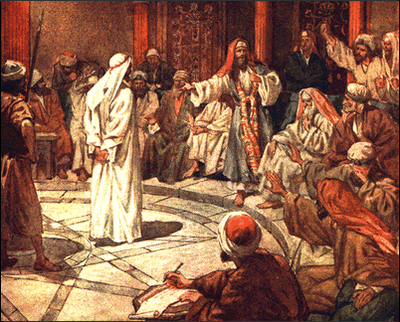
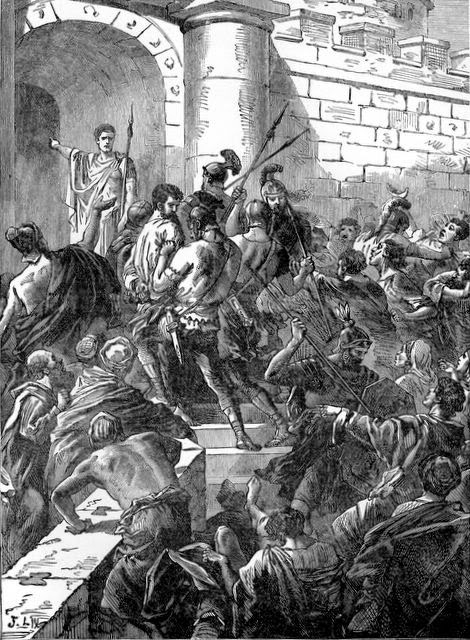
Paul arrested in a riot in Jerusalem (Acts 21:31-36)   - Artist unknown
 Paul arrested in a riot in Jerusalem (Acts 21:31-36) - Artist unknown

TODAY'S SPECIAL: Acts 21-22; Psalm 129

TO CHEW ON:
" 'For you will be His witness to all men of what you have seen and heard.' " Acts 22:15

I never tire of hearing stories of how God draws people to Himself and works in their lives. These tales—as original and varied as the people who tell them—range from stories of quiet pilgrimages to dramatic visions that turn life around in an instant. Paul's story was of the latter variety.

At the time it happened, his experience was reinforced by Ananias coming to him. Ananias was an entirely different sort of person. Paul describes him here as "… a devout man according to the law, having  a good testimony with all the Jews who dwelt there…" (Acts 22:12).

We know that sage Ananias had his own side of the story (Acts 9:10-18). His word to Saul/Paul was: God has chosen you. Now go and tell your story (my paraphrase of Acts 22:14-15).

Now, following his arrest by the Jerusalem mob, Paul gets to tell his story to the crowd that has just rioted and nearly taken his life (Acts 21:31-36). Of course this experience itself is a new installment in Paul's story.

Ananias' assignment to Paul is ours as well. Let's stay alert to God working in our lives so we recognize the continuing installments of our own "seen and heard" with God. Then let's retell the fresh chapters as conversations and situations, riots and debates open up along those lines.

PRAYER: Dear God, thank You for working uniquely in each life. Help me to recognize Your presence and action in my life and give me the courage to tell others. Amen.

PSALM TO PRAY: Psalm 129

*********
Unless otherwise noted all Scripture quotations are taken from the New King James Version®. Copyright © 1982 by Thomas Nelson, Inc. Used by permission. All rights reserved.


Monday, October 15, 2018

Is it time for a burning?

"Saint Paul and the burning of pagan books 
at Ephesus" by Lucio Massari (1559-1633)

TODAY'S SPECIAL: Acts 19-20; Psalm 128

TO CHEW ON: "Also, many of those who had practiced magic brought their books together and burned them in the sight of all. And they counted up the value of them and it totaled fifth-thousand pieces of silver." Acts 19:19. 

I love the beginning of a year. I like starting new calendars and a new daybook. I get the urge to purge old papers from my files and junk from my closets and the garage. I want to unburden myself of the past and make a new start.

The people in Ephesus made such a new start too. However, for them it wasn't a new year thing where they rid themselves of their abundance of clutter, but a spiritual housecleaning where they gathered and destroyed their how-to-do-magic books.

At dinner with friends a few weeks ago, a couple told of how they did something similar. Shortly after they became Christians, the man burned all his masonic artifacts, the woman her astrology jewelry. No pastor or leader told them to. They just knew it was necessary to make this spiritual break with the past. Why? Because physical objects can be weighted with spiritual power for good or bad. Earlier in this chapter we see how people used handkerchiefs or aprons that had touched Paul to bring healing to the sick (Acts 19:12). And in our focus verse, they destroyed those magic books.

Perhaps we need to do more of this—physically destroy those objects in our lives that signify and bind us to our life before Christ: the CDs, books, jewelry, good luck charms, masks...whatever.

Occult expert Kurt Koch says:
"Every object of sorcery must be destroyed. In the great revival which Paul experienced in Ephesus, many of those who were now believers brought their books on magic arts and burned them in the sight of all (Acts 19:19).


In the revival in Indonesia the natives brought their fetishes and occult objects together in heaps and destroyed them in a similar way.


Magical books and occult objects carry with them a hidden ban. Anyone not prepared to rid himself of the ban will be unable to free himself from the influence of the powers of darkness" - Kurt Koch, Occult Bondage and Deliverance, p. 90.
PRAYER: Dear God, please open my eyes to anything that is keeping me in Satan's bondage. Help me to make a break with any darkness from my past. Amen.

MORE: Collecting masks and objects of heathen worship

PSALM TO PRAY: Psalm 128

Kurt Koch makes this observation about collecting what some might call anthropological artifacts:

"Some missionaries are actually enthusiastic collectors of devil's masks and similar objects of heathen ritual worship. Through hanging the trophies up in their homes they burden the whole house and all who live in it .... These idols have sometimes been used for years or even decades in heathen rituals. In this way they become crystallization points for demonic powers in houses where they are displayed as works of art. The Spirit of God does not dwell with idols, even in a so-called Christian home" - Kurt Koch, Occult Bondage and Deliverance, p. 92.


****************
Unless otherwise noted all Scripture quotations are taken from the New King James Version®. Copyright © 1982 by Thomas Nelson, Inc. Used by permission. All rights reserved.


Sunday, October 14, 2018

The ready Christian

alter to the unknown god
TODAY'S SPECIAL: Acts 17-18; Psalm 127

TO CHEW ON:
"Now while Paul waited for them at Athens, his spirit was provoked within him when he saw that the city was given over to idols." Acts 17:16.

Paul is such a good example of the ready Christian: "… always be ready to give a defense to everyone who asks you a reason for the hope that is in you…" - 1 Peter 3:15. Here, in new-to-him Athens, watch how he does it:

1. He starts by observing his surroundings (Acts 17:16).

2. He goes to the hotbeds of thought and discussion—the synagogue and the marketplace to listen and talk. (Acts 17:17-18).

3. He accepts an invitation to speak at the Areopagus, even though the invite is hardly given in a  complimentary way. (They call him a babbler - Acts 17:18. According to my Bible's footnotes, a babbler was one who picked up scraps of learning here and there and peddled them. It seems this is a better description of those who "… spent their time in nothing else but either to tell or hear some new thing" - Acts 17:21).

4. He grabs their interest with something from their own culture—an inscription to an Unknown God seen on an altar. He dangles this need for something they haven't yet found in front of them: "Wouldn't you like to know Him?" (Acts 17:22-23)

5. He's a good closer. At the end of his message he urges them to take action: repent because judgment is coming (Acts 17:30-31).

6. He does all this while killing time in Athens—waiting for ministry partners to join him.

I ask myself, what would I have done if I had been in Paul's shoes? Sightsee? Probably. But with a view to giving my testimony and sharing the gospel? I don't know. I'd probably have viewed this as time off from ministry.

But for Paul—really for all of us—there is no time off. This story shows us that all kinds of situations can be a springboard for the gospel.

Though the fruit of Paul's ministry here is minimal ("For reasons Luke does not explain, results here were meagre—no baptisms, no new church, and no letter to the Athenians in the New Testament" - Gary Kinnaman, notes on Acts, New Spirit-Filled Bible, p. 1524), some believed. But Luke/Paul don't dwell on the low numbers. Paul has been faithful, and now it's time to move on (Act 18:1).

PRAYER: Dear God, please help me to become a ready Christian—alert to any and all opportunities to tell about and defend my faith in You, and not discouraged by small results. Amen.

PSALM TO PRAY: Psalm 127

*********
Unless otherwise noted all Scripture quotations are taken from the New King James Version®. Copyright © 1982 by Thomas Nelson, Inc. Used by permission. All rights reserved.


Saturday, October 13, 2018

Called and led

Image: Pixabay
TODAY’S SPECIAL: Acts 15-16; Psalm 126

TO CHEW ON: “Now when they had gone through Phrygia and the region of Galatia, they were forbidden by the Holy Spirit to preach the word in Asia. After they had come to Mysia, they tried to go into Bithynia but the Spirit did not permit them… Now after he had seen the vision (of a man saying ‘Come over to Macedonia to help us’) immediately we sought to go to Macedonia concluding that the Lord had called us to preach the gospel there.” Acts 16:6-7,10

A reader, Judy, tells of a missions trip she took to South Africa (used with her permission):

First of all God supplied the funds. In 1966 I taught school on First Nations reserves north of Souix Lookout. I bought two large paintings for $35 each from Norval Morrisseau when he visited the isolated community I was teaching in. During our years of teaching in the Arctic they hung unframed, tacked up with push pins in several homes.

Fast forward ahead to 2008 when after reading something on Becky's blog I said to Christian, Where are those paintings? I'd done some research on the Internet and realized they just may have some value. I sold one of the paintings for $6,500. Christian said immediately that I should do something very special with this unexpected windfall. I like to imagine our Lord saying on the day I bought the painting, "Do I ever have a surprise for you. It will be arriving in 42 years."

I heard about the volunteer group in South Africa, again through Becky's blog. One of her daughters had worked in an orphanage and had had a very positive experience. I wanted to teach and found a school along the east coast that seemed to be a good fit. I did make it clear that I did not want to teach computers or run an after school recreation program. They said that was fine I could just be in a classroom.

I was picked up in East London by a different volunteer group than the one I'd communicated with. I thought that was a little unusual. The next day I found out that the first group had contracted me out to a second group AND . . . . . perhaps you can guess what is coming; they wanted me to teach computers and run an after school recreational program. For a few moments to use my mother's term, I was floored. Then I thought about the lessons I'd learned in home studies the previous winter studying the life of Abraham. Don't focus on the "problem." Focus on God.

I was sure God could/would enable me to do the tasks but I also knew the desire of my heart and where my strengths lie. I had immediate assurance from Him that there would be a solution to the situation. It took a couple of days until I was at King's Playschool. That was the last name of the people who ran a rural facility out of their home. I had noticed the verse "They shall shine like stars in his crown" from the song "When He Cometh" based on Zech. 9:16, on their sign. So .. . . I knew they were believers but they didn't know I was.

When I had the opportunity I told Tracy that I was a follower of Jesus Christ, that I knew He had led me to South Africa but that I didn't know what I was supposed to do. She said she'd been praying for someone to relieve her of classroom duties while she dealt with the rest of her life. Here's what was on her plate.

Pentecostal Pastor's wife of a growing church.
Home schooling their 3 children
Running the school of 50 children and 10 employees
In the process of adopting two black babies who had been abandoned
Teaching a class

I had three glorious weeks of teaching eager 5 year olds. Most of my ideas were new for them… Both Tracy and I felt so blessed…. Who, but our loving Father, would take a woman from northern North America and team her up with a woman from Southern South Africa at exactly the right time! These kinds of experiences just light a fire under my faith which was already strong. An entire year later I still marvel at it and hope I always do.

They light a fire under my faith too! I never cease to marvel at God’s way of putting together the circumstances of our lives to work for His kingdom and our blessing if that’s our desire.

(Even as I'm preparing to repost this, a song is playing on my husband's computer, reminding me of the same truth: "In His time, in His time, He makes all things beautiful in His time")

In today’s reading Paul and Silas were shunted off the track they were on by the Holy Spirit. How that looked, I’m not sure – a feeling of uneasiness, a prophetic message? However it happened, they knew they were not to go to Asia. At Bithynia likewise “the Spirit did not permit them.” The vision to go to Macedonia, then, was most welcome. Here was clear direction .

In Philippi – one of the largest cities in Macedonia – was Lydia and a band of believers who met at the riverside regularly for worship. Can you imagine how she must have felt the morning Paul and Silas showed up and told her the story of how they got there.

Judy’s story shows us that God still works in behind-the-scenes ways. It freights these familiar verses with a new and personal relevance:

“Now He who searches the hearts knows what the mind of the Spirit is, because He makes intercession for the saints according to the will of God. And we know that all things work together for good to those who love God and to those who are called according to His purpose. Romans 8:27-28

PRAYER: Dear God, please put my life in the stream of Your usefulness. Help me to hear Your Spirit’s instructions and obey them. Amen.


PSALM TO PRAY: Psalm 126

**************
Unless otherwise noted all Scripture quotations are taken from the New King James Version®. Copyright © 1982 by Thomas Nelson, Inc. Used by permission. All rights reserved.

Friday, October 12, 2018

One secret to perseverance

Illustration from Lyman Abbot Commentary on Acts

Oriental Prayer Meeting - Illustration from Lyman Abbot Commentary on Acts
Oriental Prayer Meeting
TODAY'S SPECIAL: Acts 13-14; Psalm 125

TO CHEW ON: "So being sent out by the Holy Spirit, they went down to Seleucia, and from there they sailed to Cyprus." Acts 13:4

What strikes me about the disciples here is their lack of personal agendas. They have no five-year plan to evangelize the world. There seem to be only two items on their to-do list: hear and follow God's instructions.

When those instructions come via the Holy Spirit saying "Separate to Me Barnabas and Saul for the work to which I have called them" there is immediate obedience. No hanging back with—'Well, we had planned to visit our families, take a vacation, write a book…'

Their sense of being appointed and sent by God Himself on this mission was, I think, key to how they would handle what was ahead on this, Paul's first missionary journey (called Saul here, but his name was later changed to Paul). They didn't know it yet, but they would face opposition from a sorcerer, city-to-city hassling by the Jews, the desertion of a team member,  the threat of stoning in one place and actual stoning in another (Acts 13 & 14).

The lesson I take from this is  that I too need to listen to God's voice when I see opportunities to be sure that what I take on is by His leading and not my own idea. I need to be open to new tasks in areas I hadn't even considered. And when I don't hear anything specific, I need to be content to carry on faithfully with what I'm doing, knowing He is perfectly able to let me know when it's time to change course.

This sense of God's call is important because it is sure that I, that you, will face opposition, discouragement, misunderstanding, maybe even threats and physical danger while on Kingdom assignments. The knowledge that God has called us to any specific task will help us to persevere.

PRAYER: Dear God, thank You for this clear picture of how You worked in Bible times. Help me to be as available as Paul and Barnabas were, and to follow Your direction, knowing that if You call me to a job, You will see me through it no matter what comes my way. Amen.

PSALM TO PRAY: Psalm 125

The Bible Project VIDEO: Acts - Part 2 of 2 (Ch. 13-28) Read Scripture Series 


***********

Unless otherwise noted all Scripture quotations are taken from the New King James Version®. Copyright © 1982 by Thomas Nelson, Inc. Used by permission. All rights reserved.


Wednesday, October 10, 2018

God brings us, not over but through

"Peter Released from Prison by an Ange" from Treasures of the Bible - Early Church
"Peter Released from Prison by an Angel" - from Treasures of the Bible

TODAY'S SPECIAL: Acts 11-12; Psalm 124

TO CHEW ON:
"… he (Peter) declared to them how the Lord had brought him out of the prison. … And he departed and went to another place." Acts 12:17

I have sometimes wondered, as I read this story and others in Acts, why God didn't do the entire job—here get the angel to deliver Peter out of danger completely. Instead, he just brought Peter through the prison gates, down the first street and poof! he was gone (Acts 12:10).

After telling his story to his friends at Mary's house, Peter had to use his common sense and decide what to do next. It was obviously not safe to stick around so, though it was the middle of the night, he "departed and went to another place" - Acts 12:17.

Perhaps this is how we should expect God to work in our lives too. He can, and sometimes does intervene miraculously when the situation is beyond us. But He doesn't do for us what we can do for ourselves, or take us permanently out of trouble and persecution. It is commonly thought that Peter died by crucifixion.

However, no doubt because of his own experience with it, Peter left us with some powerful benefits of suffering in his first letter:

  • It proves the authenticity of our faith - 1 Peter 1:6,7.
  • Suffering for righteousness brings a blessing - 1 Peter 3:14.
  • It purifies us - 1 Peter 4:1.
  • Through suffering we identify with Christ in a unique way - 1 Peter 4:12,13.
  • In suffering we experience the Holy Spirit and God's glory - 1 Peter 4:14, Acts 7:55.

So, it's not that God can't do the whole job, but that He knows we'll get a greater benefit from going through the tough stuff than floating over it.

PRAYER: Dear God, when I'm in the middle of a hard patch, please help me to remember that You allow suffering for my good—even though it doesn't feel good at the time. Amen.

PSALM TO PRAY: Psalm 124

*********
Unless otherwise noted all Scripture quotations are taken from the New King James Version®. Copyright © 1982 by Thomas Nelson, Inc. Used by permission. All rights reserved.


Who scripts your life?

Image: pixabay.com
TODAY'S SPECIAL: Acts 9-10; Psalm 123

TO CHEW ON: "And as he talked with him, he went in and found many who had come together." Acts 10:27

I love the sense of order and planning that fills this story—divine, not human order and planning.

Peter's thrice repeated vision, followed by the explicit instructions of the Holy Spirit (Acts 10:19,20), followed by the arrival of Cornelius's servants and Peter's trip to Caesarea with them, followed by his meeting of Cornelius, hearing his story and seeing the crowd gathered in anticipation of his arrival—it all feels scripted. That's because it was, by God the Spirit Himself!

Suppose Peter had done what I am too often prone to do? What if he had rationalized away the vision (I sure get crazy when I'm hungry), doubted the voice of the Spirit (it's probably just my imagination), and refused to drop everything and go with Cornelius's servants (but my day is all planned)? But he didn't and we have the wonderful story of Acts 10 with its reverberations down to our day as a result.

A snippet from the devotional book I read last night comes to mind. In his meditation on James 4:5, Rick Renner concludes:
"So make your relationship with the Holy Spirit your top priority. Don't give Him a reason to feel betrayed by or envious of other things in your life that have taken His place. Get to know the Holy Spirit's voice in your spirit so He can help you set your life in order. Make sure every area of your life is under His loving control" - Rick Renner, Sparkling Gems from the Greek, Kindle Location 3791.

PRAYER: Dear Holy Spirit, I want to get to know You so well that I always recognize Your voice. Then help me to have a willing spirit that allows You to script my life. Amen.

PSALM TO PRAY: Psalm 123

 *********
Unless otherwise noted all Scripture quotations are taken from the New King James Version®. Copyright © 1982 by Thomas Nelson, Inc. Used by permission. All rights reserved.


Tuesday, October 09, 2018

Cut Hearts

Image: Pixabay
TODAY’S SPECIAL: Acts 7-8; Psalm 122

TO CHEW ON:
“‘You stiff-necked and uncircumcised in heart and ears! You always resist the Holy Spirit; as your fathers did, so do you’ … When they heard these things they were cut to the heart, and they gnashed at him with their teeth.” Acts 7:51,54

Eloquent Stephen concluded his speech of defense to the high priest and the council by condemning them. His description of them as “stiff-necked and uncircumcised in heart and ears” certainly stirred them up, though not in a safe way. It was the last speech Stephen ever made.

A couple of things snag attention here.
1. We can be in the presence of God’s truth, as the religious Jews were, and still not be touched by it. Our unregenerate hearts readily filter out what our ears don’t want to hear.

2. If and when we are “cut” by God’s truth about us and our lives, our reaction can be negative or positive.
Stephen’s speech to the council cut their hearts not to “circumcise” or alter them in the way of being marked for God’s kingdom, but to make them angry; they “gnashed at him with their teeth.” In this way they sealed their own fates—though young Saul at whose feet the stoning people laid their clothes (Acts 7:57)* later had his own heart circumcision encounter.

Let’s take seriously the fact that being in the presence of God’s truth about us isn’t enough. We still have the choice to resist the Spirit or let His words to us cut and mark us as His own.

PRAYER: Dear Father, help me to have a heart and ears that are sensitive to what Your Holy Spirit says to me. Amen.
PSALM TO PRAY: Psalm 122


* A note in my NKJV Cultural Background Study Bible comments on the stone throwers laying clothes at a Saul’s feet (Acts 7:57):
“Because the activity was physically strenuous, they could lay aside their outer garments, as was customary during exercise. … Ancient practice, however, specified not the stripping of the executioners but rather the stripping of the person being executed. Luke may ironically emphasize their stripping themselves to remind the reader who is really on trial” - Kindle Location 206,939.

 *********
Unless otherwise noted all Scripture quotations are taken from the New King James Version®. Copyright © 1982 by Thomas Nelson, Inc. Used by permission. All rights reserved.

Thanks for reading! This year we are using The Bible Project "Timeless Reading Plan" to read through the Bible in 2018. If you'd like to read along in your own Bible, you can download a pdf of the reading plan HERE.

Monday, October 08, 2018

The gifted speaker who served food

TODAY’S SPECIAL: Acts 5-6; Psalm 121

TO CHEW ON: “Then the word of God spread, and the number of the disciples multiplied greatly in Jerusalem … “ Acts 6:7

When the distraction of serving food to widows became too much for “the twelve” they called a meeting of “the multitude of the disciples” and put a new committee—a food committee— into place. Stephen was one of the men chosen for that committee (Acts 6:1-6).

As we read on we find out, however, that Stephen was also a gifted speaker—perhaps more powerful and anointed and talented than some of the original twelve (Acts 6:8-10). I suppose he could have said, “Why must I give up speaking and teaching to do this menial work? What makes your seminars more important than mine?”

Of course he didn’t say or give us any reason to believe he thought that, but served, without a ripple, along with the rest of the committee.

The result: “Then the word of God spread and the number of the disciples multiplied greatly in Jerusalem…” Acts 6:7.

I see in this an important example for myself, indeed the contemporary church. When we put ourselves at God’s disposal to use in any way He wishes, we may not always be doing the things we think are our strengths or especially enjoy. But we do launch ourselves into the river of God’s activity—a productive and exciting place to be.

So let’s not be too proud or picky to accept even the humblest jobs we’re asked to do. God needs and uses chair stackers, pancake flippers, parking lot attendants, spreadsheet makers etc. as well as preachers, teachers, and worship leaders. It’s the full complement of all of us doing the behind-the-scenes and upfront jobs that causes the gospel to flourish.

PRAYER: Dear Father, help me to be willing to do any job You have for me. Amen. 

PSALM TO PRAY: Psalm 121


 *********
Unless otherwise noted all Scripture quotations are taken from the New King James Version®. Copyright © 1982 by Thomas Nelson, Inc. Used by permission. All rights reserved.


Sunday, October 07, 2018

Would people say we've been with Jesus?

"Peter and John before the Sanhedrin"
- Artist unknown

TODAY'S SPECIAL: Acts 3-4; Psalm 120

TO CHEW ON: "Now when they saw the boldness of Peter and John, and perceived that they were uneducated and untrained men, they marveled. And they realized that they had been with Jesus." Acts 4:13

Peter and John have just got into their first scrap with the Jewish religious leaders. The lame man healed at the temple gate has opened the door to Peter's presentation of Jesus—who He was and is—and the receptivity of the audience galls the temple officials. They arrest Peter and John and, after a night in jail, these two appear before the high priest who asks, "By what power or by what name have you done this?"

Peter, with his post-Pentecost boldness declares, "...by the name of Jesus Christ of Nazareth .... Nor is there salvation in any other, for there is no other name under heaven, given among men, by which we must be saved" - Acts 4:10,12.

It is then these rulers make their telling observation: "... they realized they had been with Jesus." I like how Barnes Notes on the Bible enlarges on this moment:

"It is not said in what way they obtained this evidence, but the connection leads us to suppose it was by the miracle which they had performed, by their firm and bold declaration of the doctrines of Jesus, and perhaps by the irresistible conviction that none would be thus bold who had not been personally with him, and who had not the firmest conviction that he was the Messiah.


They had not been trained in their schools, and their boldness could not be attributed to the arts of rhetoric, but was the native, ingenuous, and manly exhibition of a deep conviction of the truth of what they spoke, and that conviction could have been obtained only by their having been with him..." Barnes Notes on the Bible.
This passage always pricks me, and leaves me with the question: Would people interacting with me, talking to me, reading me, detect that I have been with Jesus? What about you? Do we have that boldness of rock-solid faith in Him who said, "I am the way the truth and the life. No one comes to the Father except through me" (John 14:6)? Is there about our lives the perfume of His presence (2 Corinthians 2:14-16)?.

PRAYER: Dear Jesus, I want people to say of me, She has been with Jesus. Perhaps, in order for that to happen, I need to rearrange my priorities so that I actually spend more time with You. Amen.

PSALM TO PRAY: Psalm 120


The Bible Project VIDEO: The Holy Spirit (Theme Series)


***************
Unless otherwise noted all Scripture quotations are taken from the New King James Version®. Copyright © 1982 by Thomas Nelson, Inc. Used by permission. All rights reserved.

Saturday, October 06, 2018

The word that cuts


TODAY'S SPECIAL: Acts1-2; Psalm 119:153-176

TO CHEW ON: "Now when they heard this, they were cut to the heart, and said to Peter and the rest of the apostles, 'Men and brethren, what shall we do?'" Acts 2:37

 Lydia Christensen was a 36-year-old Danish teacher who had it all—a great career, loving family, and a good man who wanted to marry her. But the Christmas of 1926 found her dissatisfied and searching for more.

Back in her apartment after celebrating with her family, she felt like reading and went to her bookshelf:

"I read off the names of the authors: Kierkegaard, Oenslaeger, Ibsen, Shakespeare, Dickens, Tolstoy, Plato. I had read them, quoted them, lectured about them—but they offered me no answer now. At the extreme right of the top row, my eye rested on a plain volume bound in black. … For a moment I hesitated, then I reached up and pulled it down" - Appointment in Jerusalem, Derek & Lydia Prince, Kindle Location 409.

The book Lydia pulled down was a Bible. She had been required to read it for one of her college courses. Soon she was immersed in the story of Jesus from Matthew and then the Sermon on the Mount.

"At the fourth beatitude I suddenly caught my breath: 'Blessed are they which do hunger and thirst after righteousness: for they shall be filled" (Matthew 5:6). Hunger and thirst … Could this be the very longing that I felt for something I could not express in words? Did I dare to apply these words to myself?" Ibid, KL 419.

Lydia did apply those words to herself and her life was changed that day. Her experience is just another example of the power of God's word which cut to the heart of the listeners in Acts (notice how much of Peter's sermon is Scripture quotes), and continues to impact people around the world.

I ask, am I opening myself to this enlightening (Psalm 119:105), burning, pulverizing (Jeremiah 23:29), growing (Acts 19:20), cutting (Hebrews 4:12) word? Are you?

PRAYER: Dear God, thank You for the power of Your word. Help me to be guided, broken, cut,  molded, formed, disciplined, fertilized, encouraged, and challenged by it today. Amen. 

PSALM TO PRAY: Psalm 119:153-176

The Bible Project VIDEO: Acts - Part 1 (Read Scripture Series)


Quotes taken from Appointment in Jerusalem by Derek & Lydia Prince, Kindle Edition. Read my review of it HERE.


*********
Unless otherwise noted all Scripture quotations are taken from the New King James Version®. Copyright © 1982 by Thomas Nelson, Inc. Used by permission. All rights reserved.


Friday, June 09, 2017

Hope for quitters

Image: Pixabay
TODAY’S SPECIAL: Acts 15:36-41

TO CHEW ON: “Now Barnabas was determined to take with them John called Mark. But Paul insisted that they should not take with them the one who had departed from them in Pamphylia, and had not gone with them to the work.” Acts 15:37,38

A disagreement over taking John Mark with them (Paul and Barnabas) on Paul’s second trip resulted in a split. Paul went with Silas to Syria and Cilicia while Barnabas and his cousin John Mark sailed to Cyprus.

We might view this as a blot on the church’s history. It’s what so easily happens when leaders have different styles and they clash. Barnabas’s style was encouragement. He had launched Paul himself into ministry. Paul seems to have been more idealistic (You never quit) and practical (We don’t want quitters on this trip!).

But it seems that it all worked out for the good. Though Barnabas is never again mentioned in Acts, Paul’s letters speak of John Mark as a co-worker, testimony to the wisdom of giving him this second chance (Colossians 4:10; 2 Timothy 4:11; Philemon 1:24). In addition, John Mark went on to write the Gospel of Mark (scholars date its writing sometime after the deaths of Peter and Paul—65-70 A.D.).

My Bible’s introductory notes to Mark’s Gospel make this observation about the book:
“Mark’s Gospel teaches that the life of discipleship means following Jesus along the same path of misunderstanding and rejection that He encountered. For followers of Jesus in all ages the warning and promise are sure: ‘Whoever desires to come after Me, let him deny himself, and take up his cross, and follow Me. For whoever desires to save his life will lose it, but whoever loses his life for My sake and the gospel’s will save it’ - Mark 8:34,35)” - J. Lyle Story, Introduction to Mark, New Spirit-Filled Life Bible, p. 1347 (emphasis added).

Perhaps Mark’s emphasis on Jesus’ self-denial message was birthed by his disappointment in himself when he refused to deny himself and quit. Sometimes our most positive life lessons begin with a negative experience.

PRAYER: Dear Jesus, thank You for using even the bad things on our resumés by redeeming them for good (Romans 8:28). Amen.

 *********
Unless otherwise noted all Scripture quotations are taken from the New King James Version®. Copyright © 1982 by Thomas Nelson, Inc. Used by permission. All rights reserved.


Sunday, June 04, 2017

Power for ALL

Stained glass window from 
Good Shepherd Lutheran Church,
Moorhead MN.

TODAY'S SPECIAL: Acts 2:1-21

TO CHEW ON: "
And they were all filled with the Holy Spirit. And began to speak with other tongues as the Spirit gave them utterance." Acts 2:4


When someone gives you a job, in order for you to be successful it is important that you have the capability to carry it out. Thus Jesus gave the large assignment -- to spread around the world the good news of what He had done -- with a proviso. The disciples were to refrain from doing anything about it until God gave them the enabling. His instructions: "And you are witnesses of these things….but tarry in the city of Jerusalem until you are endued with power from on high." Luke 24:49.

And so the disciples gathered in Jerusalem to wait -- for what? I'm sure they didn't know exactly. But when it came, they did know this was it. An interesting fact to note is that the Holy Spirit came, He came on all.

Holy Spirit was no stranger to the Jews. He had come upon and indwelt numerous people in the Old Testament.

The Holy Spirit came upon or lived in:

  • Bezalel to give him wisdom and skill to design and create the Tabernacle and its furnishings - Exodus 31:1-5.

  • Balaam, Ezekiel, and other Old Testament prophets to enable them to prophecy -- bless, curse, give the people messages from God, and predict future events - Numbers 24:2; Ezekiel 11:24,25; 2 Peter 1:21.

  • Gideon, giving him courage and a plan by which to lead the people into battle - Judges 6:33-35.

  • Samson  for exploits of physical strength needed to challenge and defeat the Philistines - Judges 14:6.

  • King Saul giving him a new heart and a prophetic gift to prove it - 1 Samuel 10:6

  • Simeon to enable him to wait with hope, and then recognize, announce and prophecy over Jesus - Luke 2:25-32.

Each of these indwellings was  given to accomplish a specific task. The people in general were not so empowered. But here, on the Day of Pentecost, all were filled. And the Holy Spirit's filling is still available to all.

That filling is not to give us spiritual thrills or make us feel good. It is empowerment for service just as it was in the Old Testament. And I would suggest that such infilling can enable in the same ways it did then, depending on the need of the task and of the moment. We can claim the Holy Spirit's infilling to give us a new heart. We can claim it for wisdom and skill in the arts. We can claim it for help in leading and governing, for words to say, for courage, even for exploits of physical strength. Let's claim the Holy Spirit's presence and empowering afresh for our life, work, and ministry today!


PRAYER:
Dear Holy Spirit, thank You for Your availability to all. Help me to allow You to work in and through me today. Amen.

MORE: Pentecost Sunday - and  "Holy Spirit Rain Down" sung by Hillsong

Today is Pentecost Sunday. The liturgy for today begins with this collect:
Almighty God, on this day you opened the way of eternal life to every race and nation by the promised gift of your Holy Spirit: Shed abroad this gift throughout the world by the preaching of the Gospel, that it may reach to the ends of the earth; through Jesus Christ our Lord, who lives and reigns with you, in the unity of the Holy Spirit, one God, for ever and ever. Amen.


*********
Unless otherwise noted all Scripture quotations are taken from the New King James Version®. Copyright © 1982 by Thomas Nelson, Inc. Used by permission. All rights reserved.

Do your 8-12-year-olds have daily devotions? Point them to Bible Drive-Thru.

Wednesday, May 24, 2017

A Holy Spirit drenching

Image: pixabay
TODAY’S SPECIAL: Acts 1:1-11

TO CHEW ON: “‘For John truly baptized with water, but you will be baptized with the Holy Spirit not many days from now.’” Acts 1:5

My pastor spoke on this passage two days ago (from when I’m writing this). What a happy ‘coincidence’!

One of the parts from his talk that sticks in my mind is the part about the baptism of the Holy Spirit.

On Easter Sunday in our church, 50 people were water baptized in front of the congregation in two services (eight planned, 42 decided that day in church, when pastor gave the invitation and made available T-shirts, towels, dryers, etc.). So the image of people getting baptized is fresh in my mind. They start out dry, they end up drenched and dripping.

The baptism of the Spirit is like that. I love how pastor expressed it:
 “Being baptized is being soaked, saturated, drenched. Jesus told the disciples to wait to be soaked, saturated, drenched in the Holy Spirit. He wants you to get caught in the rain of the Spirit” - Rev. Derrick Hamre, in “Making Room for the Spirit.”

Where I live, we get lots of rain and I know what it’s like to get caught in it. It soaks your hair and trickles down your neck. It spots your glasses and makes your jeans clammy and cold. It even squishes into your socks and shoes. I ask myself, have I ever been so Spirit drenched?

An aspect of this baptism Pastor brought out is that it’s not salvation. We do receive the Holy Spirit when we ask Jesus into our lives and make Him Lord (Ephesians 5:1-21, specifically verse 18). But this Holy Spirit baptism experience is often (but not always) subsequent to salvation. It was for the disciples. Jesus had already breathed the Spirit on them (John 20:22) but here they were baptized. It was also a second experience for the new believers in Samaria (Acts 8:13-17). For Cornelius and his family, though, it occurred at the time they first believed (Acts 10:44-48).

Finally, we need to keep in mind the reason for this baptism. It’s not for spiritual thrills and chills but for power to carry out Jesus’ final assignment to us:
“‘But you shall receive power when the Holy Spirit has come upon you, and you shall be witnesses to Me in Jerusalem, and in all Judea, and Samaria, and to the end of the earth’” Acts 1:8.

Let’s not get drawn into theological arguments over this Holy Spirit baptism (and I know there are many). Rather, let’s just read what Jesus says and be open to the Holy Spirit’s baptism of empowering as He came on the Christians in Acts—however and whenever He chooses.

PRAYER: Dear Holy Spirit, I open my life to You today. Drench me, fill me, use me in any way You choose. Amen.

 *********
Unless otherwise noted all Scripture quotations are taken from the New King James Version®. Copyright © 1982 by Thomas Nelson, Inc. Used by permission. All rights reserved.


Friday, May 19, 2017

The fair-minded Christian

Bible study
TODAY'S SPECIAL: Acts 17:1-15

TO CHEW ON: "These were more fair-minded than those in Thessalonica, in that they received the word with all readiness and searched the scriptures daily to find out whether these things were so." Acts 17:11


"These" were the members of the Jewish synagogue in Berea. Though not necessarily believers (yet), they reacted differently to Paul's teaching than "those."

"Those" were a segment of the synagogue attenders in Thessalonica. Paul reasoned with them for three weeks using the Old Testament writings to prove that Jesus was the Christ—the Messiah. There were two reactions. Some were persuaded so that "…a great multitude of the devout Greeks and not a few of the leading women joined Paul and Silas" (Acts 17:4). Others—"those"—became jealous, sparked a riot and ran Paul and Silas out of town.

"These" Bereans, on the other hand, "received the word with all readiness." They probably followed along (if they had their own copies) and read the passages around those Paul quoted to make sure he was using them in context. Perhaps they asked questions. They didn't let personal insecurity, jealousy and fear interfere with how they read and understood scripture.

The Bereans are a good example for us to follow when we hear Bible teaching of any kind, but especially when it clashes with what we believe. J. Norton Sterrett in his book How To Understand Your Bible talks about  Bible study principles that can guide us as we interpret any passage of scripture.  (Below is his bare bones list; he devotes a chapter to each item.)

1. Interpret a passage in the light of its context - p. 49. This means to read the verses before and after the verse you're focusing on.

2. Interpret according to the correct meaning of the words - p. 55. This could include looking up a word in the dictionary, noting the word's context, and using a concordance and lexicon.

3. Interpret according to the grammar of the sentence … the form of words and the relationship of words - p. 61.

4. Interpret according to the author's purpose and plan. … The purpose of the author is the object he has in mind for writing (e.g. 1 John 5:13). … The plan of the author is the way he structures the writing in order to carry out his purpose - p. 71.

5. Interpret in the light of the historical, geographical, and cultural background as far as that can be known - p. 77.

6. Interpret each passage in the light of the Bible's teaching as a whole"- p. 85.
As we follow these principles, perhaps we'll also gain the reputation of being fair-minded ("better disposed and more noble" - Amplified) Christians.

PRAYER:
Dear God, thank You for the Bible and those who teach it. Help me to dig into it in a fair-minded way for myself. Please teach me by Your Holy Spirit. Amen.


*********
Unless otherwise noted all Scripture quotations are taken from the New King James Version®. Copyright © 1982 by Thomas Nelson, Inc. Used by permission. All rights reserved.


Thursday, May 18, 2017

Letters old and new

Image: Pixabay
TODAY’S SPECIAL: Acts 15:22-35

TO CHEW ON:
“So when they were sent off, they came to Antioch; and when they had gathered the multitude together, they delivered the letter.
When they read it, they rejoiced over its encouragement.” Acts 15:30,31


In these days of instant messaging across the world, it’s interesting to try to put ourselves in the place of these early Gentile Christians. Their missionaries had gone to Jerusalem to get a verdict from church leaders (the Apostles) on how they were to conduct themselves in this new life. Now Paul, Barnabas, and a delegation had returned with the Apostles' decision in a letter. What would the letter say?

Letters played an important role in Bible times.


Sometimes letters sealed a fate.
  • Uriah carried his own death sentence letter from David to Joab at the battlefront - 2 Samuel 11:14.
  • Jezebel (King Ahab’s wife) sent letters to Israel’s leaders with a plot to kill Naboth so Ahab could take his garden - 1 Kings 21:8.

Kings sent threatening letters to their rivals and enemies.
  • The king of Assyria sent one such to Hezekiah, prompting a panicked prayer meeting and divine help - 2 Kings 19:14.

Sometimes kings sent letters on behalf of their subjects.
  • The king of Syria asked the king of Israel to heal Naaman of leprosy - 2 Kings 5:5.
  • King Artaxerxes sent letters on behalf of Nehemiah asking for safe passage  for him through territory and wood for rebuilding Jerusalem - Nehemiah 2:7-8.

The book of Esther is full of letters.

  • The king sent letters mandating male authority in the home - Esther 1:22.
  • Haman’s plan to annihilate the Jews was spread by letter - Esther 3:13.
  • Mordecai’s victory allowing the Jews to defend themselves was spread by letter as was the establishment of a holiday to remember this event - Esther 8:10; 9:20.

Of course we know how the New Testament is largely made up of letters
—missives that, thankfully, do more than threaten or carry evil plots. The letter in our reading today is one such. We discover that the reading of it brought joy and encouragement (Acts 15:31), as did most of the letters of Paul, John, Peter, and James (along with teaching, reproof, and training in righteousness, delivered with large amounts of love).

Do you still write letters? I suppose emails and even text messages could be considered modern letters.

What can we moderns do with letters?
  • Send information about plans and events.
  • Think through and discuss ideas about anything—how to garden, to faith in God
  • Express gratitude and appreciation.
  • Assure the recipient of our care, concern, and prayers.
  • Tell someone we’re remembering them on a special day (birthday, anniversary etc) 
  • Encourage and cheer.

Let’s continue to use this old-to-new way of communicating for good today!


PRAYER: Dear Father thank You for distance communication that has survived the centuries. Help me to use the amazing modern communication resources at my fingertips for good today. Amen.

 *********
Unless otherwise noted all Scripture quotations are taken from the New King James Version®. Copyright © 1982 by Thomas Nelson, Inc. Used by permission. All rights reserved.


Saturday, May 13, 2017

The first thing God looks at on your resumé

TODAY'S SPECIAL: Acts 1:12-26

TO CHEW ON: "And they prayed and said, 'You, O Lord, who know the hearts of all, show which of these two You have chosen.' " Acts 1:24

Peter instigated the choice of another disciple to take Judas Iscariot's place. It's interesting to read how the early believers went about doing this:

1. They didn't choose just anyone, but someone who had been a faithful follower of Jesus to the extent that the original twelve were: "… who have accompanied us all the time that the Lord Jesus went in and out among us" - Acts 1:21.

2. They picked two men and prayed " 'O Lord, who know the hearts of all, show which of these two You have chosen.' "

3. They cast lots (drew straws, flipped a coin, however they did it; it's interesting to note that after the Pentecost baptism of the Holy Spirit there is no more mention of casting lots in the Bible) believing that the outcome was a revelation of God's choice.

I wonder, are we as focused on who God has chosen for a job as they were? When we need to fill a ministry vacancy, what's the first thing we look at—talents, appearance, experience, or the person's heart toward God? Maybe that should be the thing we ask for help with and pray for insight about above everything else.

The story of Samuel at Jesse's home on the assignment of anointing a new king comes to mind. When he sees Eliab, Jesse's handsome oldest, Samuel thinks, surely he's the one. But God says to him: " ' Do not look at his appearance or at his physical stature because I have refused him. For the Lord does not see as man sees; for man looks at the outward appearance, but the Lord looks at the heart.' " 1 Samuel 16:7 (emphasis added).

PRAYER: Dear God, please help me on two fronts: to be the person with the right heart for ministry, and to get Your insight on workers whenever I am tasked with finding someone for a job. Amen.

MORE: Eliab revealed
Eliab. David's oldest brother who Samuel thought was such great king material, shows his heart in the next chapter of 1 Samuel, when David (the youngest son of Jesse who Samuel anoints as the next king) comes to the battlefield and suggests the army should do more than quake in fear over Goliath's appearances. Eliab reveals himself as a carnal, sarcastic, bitter, and faithless man - 1 Samuel 17:28. Good thing Samuel didn't follow his original instincts to anoint him king!

 *********
Unless otherwise noted all Scripture quotations are taken from the New King James Version®. Copyright © 1982 by Thomas Nelson, Inc. Used by permission. All rights reserved.


Thursday, May 11, 2017

Word that cuts to the heart

Stephen before the Sanhedrin - Artist unknown
Stephen before the Sanhedrin - Artist Unknown
TODAY'S SPECIAL: Acts 7:35-8:1

TO CHEW ON: "When they heard these things they were cut to the heart, and they gnashed at him with their teeth." Acts 7:54

After taking his listeners (the High Priest and members of the Sanhedrin) on a trip through Old Testament history, recalling Israel's long record of rejecting the prophets, Stephen came to the climax of his message:
"'You stiff-necked and uncircumcised in heart and ears! You always resist the Holy Spirit; as your fathers did, so do you. Which of the prophets did your fathers not persecute? And they killed those who foretold the coming of the Just One, of whom you now have become the betrayers and murderers'" Acts 7:51,52.

The reaction was immediate:
"… they [the Jews] were cut to the heart and infuriated, and they ground their teeth against [Stephen]" Acts 7:54 AMP.

The same expression, "cut to the heart," is used another time when Peter and John were brought before the Sanhedrin. Peter was defiant about their orders to stop speaking of Jesus. He accused them of killing the One who was now exalted as "Prince and Leader and Savior and Deliverer and Preserver…"  - Acts 5:31 AMP.  Their reaction was identical:
"Now when they heard this they were cut to the heart and infuriated and wanted to kill the disciples" - Acts 5:33 AMP.

In both cases the speakers—Peter and Stephen—used Scripture to make their points, retelling its stories, quoting relevant verses, and making unpopular applications. The effect this use of scripture had on members of the Sanhedrin reminds me of another verse that flat out states that the word of God cuts:
" For the Word that God speaks is alive and full of power [making it active, operative, energizing, and effective]; it is sharper than any two-edged sword, penetrating to the dividing line of the breath of life (soul) and [the immortal] spirit, and of joints and marrow [of the deepest parts of our nature], exposing and sifting and analyzing and judging the very thoughts and purposes of the heart" - Hebrews 4:12 AMP.

As our society drifts ever farther from Judeo-Christian moorings, the message of scripture—the Bible—will become ever more controversial. But because it was authored by the One who created the human heart, who knows the deepest part of human nature, it continues to have the penetrating power to expose, sift, analyze and judge our thoughts and motivations. It still cuts to the heart.

This cutting can bring us to a place of obedience or resistance, as was the case with these Jewish leaders. Perhaps we should prepare ourselves for a time when the widespread reaction to it in our culture will be every bit as dangerous to us as it was to Stephen in Acts.

PRAYER: Dear God, thank You for Your Word which exposes me to myself. Help me not to resist it but to let it  cut, expose, sift, analyze, and judge me toward obedience. Amen.

 *********
Unless otherwise noted all Scripture quotations are taken from the New King James Version®. Copyright © 1982 by Thomas Nelson, Inc. Used by permission. All rights reserved.

Scripture quotations marked AMP are taken from the Amplified® Bible, Copyright © 1954, 1958, 1962, 1964, 1965, 1987 by The Lockman Foundation. Used by permission." (www.Lockman.org)

Wednesday, May 10, 2017

God brings us full-circle

Image: Pixabay
TODAY’S SPECIAL: Acts 7:9-34

TO CHEW ON: “For he supposed that his brethren would have understood that God would deliver them by his hand, but they did not understand.” Acts 7:25.

Stephen’s retelling of Moses’ story adds some interesting details that the original telling (Exodus 2:11-14) doesn’t include.

  • Stephen makes it sound as if Moses never visited the Hebrews until he was 40 years old. Maybe he didn’t even know his origins—although since his own mother nursed him, probably through toddlerhood (“Children were not weaned until they were three to five years of age," study notes on Exodus, New Spirit-Filled Life Bible, p. 78), her training was no doubt a memory. I love how Stephen phrases it: “.. it came into his heart to visit his brethren…” Acts 7:23.
  • Stephen gives us an insight into Moses’ thoughts at that time: “For he supposed that his brethren would have understood that God would deliver them by his hand” - Acts 7:25.
I wish we knew more. Did Moses’ mother whisper her dreams for his future into his ear when he was just a child? Had he been sitting for years on the notion that he’d been spared for the purpose of freeing the Hebrew slaves, perhaps not quite sure what to do next?

Of course his attempt to realize that destiny went horribly wrong. It took another 40 years before one surprising day God came to him.

I can only imagine the emotion Moses felt when Yahweh Himself acknowledged the legtimacy of his Egypt emotions: “‘I have surely seen the oppression of My people … I have heard their groaning and have come down to deliver them’” - Acts 7:34. Now God’s plan was to use Moses for the job Moses had earlier dreamed of, but in God's time and way.

We can take away from this, I think, that the things that are in our hearts, the memories, pulls, old dreams, are not there by accident. We know who put it into Moses’ heart to visit his brothers and hope to free them. Surely it was God.

We also know that God took a long time to incubate that dream. By Moses’ reaction to God’s assignment, we can conclude that he had all but given up on it (Exodus 3:11). But God hadn’t. And it didn’t matter to Him that Moses was now 80 years old (Exodus 7:7). He would still use the faux Egyptian prince-turned-shepherd to accomplish the dream He had planted in Moses’ heart 40+ years prior.

So let’s not give up on the dreams God has planted in our hearts, even if they are decades old. God brought Moses’ full-circle, back to his dream, and has wonderful ways of bringing us there too.

PRAYER: Dear Father, help me to be alert to Your signals and quick to follow Your directions, delighted when You in Your wisdom lead me back to see the fulfillment of youthful dreams. Amen.

 *********
Unless otherwise noted all Scripture quotations are taken from the New King James Version®. Copyright © 1982 by Thomas Nelson, Inc. Used by permission. All rights reserved.


Related Posts Plugin for WordPress, Blogger...