Showing posts with label legalism. Show all posts

Monday, November 06, 2017

Woe to hypocrites!

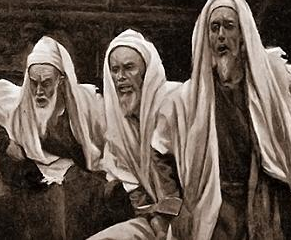
Pharisees by James Tissot
TODAY'S SPECIAL: Matthew 23:13-39

TO CHEW ON: " 'But woe to you scribes and Pharisees, hypocrites! For you shut up the kingdom of heaven against men; for you neither go in yourselves, nor do you allow those who are entering to go in.' " Matthew 23:13

In one of His most impassioned speeches, Jesus denounces seven examples of Pharisaic hypocrisy:

1. They were legalistic. The Pharisees' strict legalism kept them and everyone else out of the kingdom (Matthew 23:13).

2. They were unjust. The Pharisees' long prayers, meant to impress others with their righteousness, were contrary to the way they treated the poorest people, like widows - Matthew 23:14.

3. They were evangelists of evil - Matthew 23:15. One thinks of a missionary or evangelist as one doing a good thing. But these missionaries were converting others to become fanatics of a tarnished religion.

4. They were blind guides
- Matthew 23:16-22. If anyone should be able to see, it's a guide! Yet Jesus showed how blind these men were by poking holes in the reasoning by which they came to rules about which oaths were binding and which weren't. The IVP Commentary explains the custom:
"An oath involved invoking a deity as a witness to the veracity of one's claim. On the popular level people had begun using many surrogate phrases for God's name hoping to avoid judgment if they broke the oath. Pharisees endeavoured to distinguish which oath phrases were actually binding" - IVP Commentary, accessed via biblegateway.com.
Jesus' attack was not just against these oath standards, though, but also against the Pharisees' inconsistent standards of holiness and the profanity of using God's name in such frivolous ways.

5. Their standards were inconsistent and out of proportion - Matthew 23:23-24. The Pharisees emphasized tithing the tiniest of spices while ignoring big issues like practicing justice, mercy, and faith.

6. Their lives were superficial - Matthew 23:25-28. Their fine exteriors masked a polluted inner condition.

7. They were self-deceived - Matthew 23:29-36. They claimed that if they'd lived in the time of the prophets, they would never have treated God's servants the way their countrymen did. Jesus' response: " 'Serpents, brood of vipers!' " You will prove how deceived you are by the way you kill, crucify and scourge the prophets, wise men, and scribes that come to your generation (my paraphrase).

Before we look with too much disdain on this lot, we do well to examine our own lives for similar hypocritical behavior:

  • Have we developed legalistic standards of our own that are barriers to people entering God's kingdom?
  • Do we give lip service to a holiness we don't practice?
  • Do we have self-made, inconsistent-with-God's-word standards that, for example, rail against body sins like smoking and overeating, but are indulgent toward TV and movies that pollute the mind?
  • Do our priorities line up with Scripture's? Do our lives reflect the things that matter to God? Or do we break fellowship over sidebar matters like which version of the Bible to read and the order of prophesied end-time events?
  • Are our lives authentic—the same in private as public? Or do we practice secret sin?
  • Are we realistic about who we are? Or does our lifestyle contradict what comes out of our mouths?

PRAYER:
Dear Jesus, Your denunciation of the hypocritical scribes and Pharisees shows me that my nature is not all that different. Please help me to detect hypocrisy in my life and to deal with it. Amen.

 *********
Unless otherwise noted all Scripture quotations are taken from the New King James Version®. Copyright © 1982 by Thomas Nelson, Inc. Used by permission. All rights reserved.


Wednesday, June 15, 2016

Law-living—so yesterday

Image: Pixabay.com
TODAY'S SPECIAL: Galatians 3:6-25

TO CHEW ON:
"What purpose then does the law serve?" Galatians 3:19


Paul attempts to dissuade the Galatians from reverting back to living by the Jewish law. His argument includes some facts about the law. Embedded in those facts are ways that the law is inferior to faith.

1. The law makes us aware of sin (without giving us a way to deal, finally, with sin). I love how clearly the Amplified puts it: "It (the Law) was added—later on, after the promise, to disclose and expose to men their guilt…" - Galatians 3:19 AMP.

2. It was given by angels and Moses
(while faith came through the "Seed," Jesus). The Amplified again: "…and [the Law] was ordained through angels and delivered to Israel by the hand of a mediator [Moses, the mediator between God and Israel, to be in effect] until the Seed would come to whom the promise had been made" - Galatians 3:19 AMP.

3. The law was complementary to the promises of God, not contrary to them. Though it couldn't give life, it led to Jesus fulfilling it and offering His life in our stead - Galatians 3:21,22.

4. Paul pictures the law as a set of rules that has people under arrest, in jail to sin, guarded by the law, which no one could ever completely live up to:  "But the Scripture has imprisoned everyone [everything—the entire world] under sin..." Galatians 3:22 (AMP); " But before faith came, we were kept under guard by the law" - Galatians 3:23 NKJV.

5. The law is also a tutor or trainer
to prepare its adherents for full privileges as sons: "Therefore the law was our tutor to bring us to Christ..."  Galatians 3:24

What do these things have to do with us who have never struggled with the pressure of living under the Jewish law? Some things that come to mind:
  • Viewing the Galatians' struggle between law-based versus faith-based righteousness helps us understand God's plan and His gradual revealing of it.
  • The contrast between law vs. faith helps us appreciate the immensity of what Christ did on the cross.
  • The comparison between the two also gives us an understanding of how living by faith is better than living by law.
  • We are warned of the danger of getting enslaved by any set of laws.

I love the way Paul concludes his thought, one verse beyond today's prescribed reading: "For you are all sons of God through faith in Christ" - Galatians 3:26.

By faith we're not guilty and helpless to change, not jailed as prisoners to a set of rules we can never fulfill, not  students under discipline and training, but have the privileges of family, called God's very sons (and daughters)!

PRAYER: Dear Father, help me understand at a life-level how Your death and resurrection has set me free from earning my salvation by fulfilling any set of law requirements. Amen.

 *********
Unless otherwise noted all Scripture quotations are taken from the New King James Version®. Copyright © 1982 by Thomas Nelson, Inc. Used by permission. All rights reserved.

Scripture quotations marked AMP are taken from the Amplified® Bible, Copyright © 1954, 1958, 1962, 1964, 1965, 1987 by The Lockman Foundation. Used by permission." (www.Lockman.org)


Tuesday, June 14, 2016

Don't slip back into legalism

Image: Pixabay.com
TODAY'S SPECIAL: Galatians 2:15-3:5

TO CHEW ON: "'For if I build again those things which I destroyed, I make myself a transgressor.'" Galatians 2:18

It's easy for us to slip back into legalistic ways if we have been brought up under a legalistic system. Our reading today is Paul's reasoning against that.

In the first part, Paul repeats to the Galatians what he said to Peter and other apostles (Galatians 2:14-21). It is the argument he made in Jerusalem for justification (appearing pure before God—"just as if I had never sinned") by faith, not by keeping the law (Galatians 2:16).

Then he addresses the Galatians directly about their tendency to do the same thing: "O foolish Galatians! … Did you receive the Spirit by the works of the law, or by the hearing of faith?" (Galatians 2:1,2).

I love how Leslyn Musch sums up this principle in the "Truth-In-Action Through Galatians" article in my Bible. Under the title "The Walk of Faith" she writes:
"Faith accepts God's testimony in a trusting, childlike manner and salvation as a free gift. The Law was given to lead us to Christ; thus any use of the Law as a means of earning our salvation is a distortion. By nature mankind presumes to seek salvation by works. It seems offensive to the flesh to believe we cannot. But God's word says it is an offense to Him to believe we can" - New Spirit-Filled Life Bible, p. 1641.

And so Paul would say to us, who feel in our heart of hearts that God loves us more and accepts us on the basis of what we do and how we live—No.
 "Tell me this one thing: did you receive God's Spirit by doing what the Law requires or by hearing the gospel and believing it? How can you be so foolish! You began by God's Spirit; do you now want to finish by your own power? " - Galatians 3:2,3 (GNT).

Let's not rebuild for ourselves and others the legalistic structures of our time—church attendance, financial giving, time spent in fasting and prayer, amount of serving and ministry we do, etc.,—as ways to gauge how well we and they are living the Christian life and how much we're pleasing God and earning His love. For it's all a gift:

"Saving is all his idea, and all his work. All we do is trust him enough to let him do it. It’s God’s gift from start to finish! We don’t play the major role. If we did, we’d probably go around bragging that we’d done the whole thing! No, we neither make nor save ourselves. God does both the making and saving. He creates each of us by Christ Jesus to join him in the work he does, the good work he has gotten ready for us to do, work we had better be doing" - Ephesians 2:8-10 (MSG) emphasis added.  

PRAYER: Dear Jesus, thank You for paying the complete price for my salvation. Help that my motivation for living in ways You condone arises from my love for You and the realization that Your ways are designed for my best present and future. Amen.

 *********
Unless otherwise noted all Scripture quotations are taken from the New King James Version®. Copyright © 1982 by Thomas Nelson, Inc. Used by permission. All rights reserved.

Scripture quotations marked GNT are from the Good News Translation® (Today’s English Version, Second Edition). Copyright © 1992 American Bible Society. All rights reserved.


Scripture quotations marked MSG are taken from The Message. Copyright © 1993, 1994, 1995, 1996, 2000, 2001, 2002. Used by permission of NavPress Publishing Group.


Friday, June 28, 2013

Legalism--still alive and well?

TODAY'S SPECIAL: Galatians 4:21-5:6

TO CHEW ON: "You have become estranged from Christ, you who attempt to be justified by law; you have fallen from grace …. For in Christ Jesus neither circumcision nor uncircumcision avails anything, but faith working through love." Galatians 5:4,6

Though the legalism that insists circumcision is mandatory to be 'in'  has never been an issue in my life, there are other legalism manifestations. What about the legalism that insists on a certain mode of baptism, that judges lifestyle liberties (like drinking alcohol), that insists on certain versions of the Bible? What about the legalism that comes in the guise of its symptoms—irrational, unexplainable fears (like the fear of dying because at some level I feel like I haven't measured up to God's standard)?

Paul's theme in this whole letter is to explain and extol how the gospel is not the good news of which laws to keep but the good news of grace that results in spiritual liberty.

A brief overview of that LIBERTY shows its rich dimensions:

  • It frees us from the fear of death - Psalm 107:14; Romans 8:2.
  • It puts us in a servant / master relationship of choice, not coercion - Psalm 116:16; Romans 6:18.
  • It springs us from the prison of spiritual blindness - Isaiah 42:7; John 8:32.
  • It gives us a compelling message - Isaiah 61:1; Luke 4:18.
  • It impacts all of creation - Romans 8:21.
  • It makes for a liberated life - 2 Corinthians 3:17; Galatians 2:4.

The "Introduction to Galatians "in my Bible sums up the book's message and impact well:
'The same perversion of the gospel that Paul combats in this letter keeps appearing in various forms. Legalism, which teaches that justification or sanctification depends upon a person's own efforts, thus denying the sufficiency of the Cross, is the most persistent enemy of the gospel of grace. Circumcision and other requirements of the Mosaic Law may no longer be issues pertaining to salvation, but oftentimes the observance of certain rules, regulations, or religious rites is made coordinate with faith in Christ as the condition of Christian maturity. Galatians clearly declares the perils of legalism and establishes the essential truth of salvation by faith alone" - Jerry Horner, Introduction to Galatians, New Spirit-Filled Life Bible, p. 1629.

PRAYER: Dear God, thank You for Your gift of salvation. Help me to never make it something I have to earn or expect others to try and earn. Amen.

***********

The Holy Bible, New King James Version Copyright © 1982 by Thomas Nelson, Inc. - Used with permission.
Bible Drive-Thru


Bookmark and Share


Friday, June 14, 2013

Hypocrisy Exposé

"Paul turns to the Gentiles (Acts 13)" by F. Laporta
"Paul turns to the Gentiles (Acts 13)" by F. Laporta - Bible Artwork Vol. 10

TODAY'S SPECIAL: Galatians 2:1-21

TO CHEW ON: "For before certain men came from James, he (Peter) would eat with the Gentiles; but when they came he withdrew and separated himself, fearing those who were of the circumcision. And the rest of the Jews also played the hypocrite with him, so that even Barnabas was carried away with their hypocrisy."  Galatians 2:12-13

Here it seems Peter let his actions be influenced by peer pressure In spite of his championing the cause of the Gentiles in front of the Jerusalem Council (Acts 15:6-11) he was again distancing himself from them. While before he had been happy to eat with them, the presence of "certain men … from James" caused him to withdraw. Peter had influence and so his actions were causing others, even the encourager Barnabas, to follow suit.

Paul named Peter's actions hypocrisy.

[Hypocrisy - hypokrisis was used of play-acting, role-playing, pretending and thus acting insincerely.]

I see a double warning in Paul's exposé of Peter's hypocrisy:


1. We too can be influenced by the legalists among us, letting our actions be governed by what these 'super-spirituals' will think and say rather than by what God has revealed in the Bible. Paul's foundation is rock-solid in this regard. This incident is the setting from which he wrote his inspirational living-by-faith-not-works manifesto:

"For I have been crucified with Christ; it is no longer I who live, but Christ lives in me; and the life which I now live in the flesh I live by faith in the Son of God who loved me and gave Himself for me" - Galatians 2:20  (emphasis added).

2. We can be the legalists whose emphasis on outer things causes others to act hypocritically. Let's examine our pet standards. They may come from good sources: our upbringing, denominational emphases, life experience. Still we need to ask, does the Bible support them? Or are they the type of burden Paul accused the false brethren of imposing here?

PRAYER: Dear God, please give me the wisdom to spot hypocrisy in my attitudes and that of others. Help me to live in Your freedom and not in the shadow of human-made restrictions and rules of exclusivity that change according to which group I'm with. Amen.

***********

The Holy Bible, New King James Version Copyright © 1982 by Thomas Nelson, Inc. - Used with permission.
Bible Drive-Thru


Bookmark and Share


Wednesday, January 19, 2011

Milestone of grace

TODAY'S SPECIAL: Acts 15:1-21

TO CHEW ON: "But we believe that through the grace of the Lord Jesus Christ we shall be saved in the same manner as they." Acts 15:11

If you dislike conflict as much as I do, you would join me in staying away from the Jerusalem Council meetings of the first century (not that the public and especially no-name women were even allowed into that assembly!). The clash was between "certain men" from Judea and the apostles over making converted Gentiles submit to circumcision and other points of Moses' law.

The certain men (also known as Judaizers) insisted that the Gentile converts needed circumcision to legitimize their salvation. They came to Antioch, where Paul was preaching and many Gentiles were getting saved, to enforce this.

The apostles disagreed. Barnabas and Paul eventually went to Jerusalem to resolve the matter with all the apostles and elders. We can learn some valuable things form the council meeting that followed (which my Bible's footnotes call "a theological milestone in the history of Christianity" - New Spirit-Filled Life Bible p. 1518):

  • Sometimes conflict is a good thing.
I love the way Paul and Barnabas decided this issue was too big for them to deal with on their own and so took it to the church at large. I love how Luke describes the humanness of the interactions. Paul and Barnbas's description of God's mighty work amongst the Gentiles versus the Pharisees, "It is necessary to circumcise them" (vs. 5) caused "much dispute" (vs. 7 - can't you just hear voices raised in passion and conviction, interrupting and talking over each other?).

"It is not unusual for Christian leaders to strongly disagree," says a footnote in my Bible. "Acts 15 shows how through the Spirit and open dialogue they are able to resolve their differences" New Spirit-Filled Life Bible, p. 1519).

  • Sometimes circumstantial evidence is admissible.
That's what Peter gave. He referred to his experience with the uncircumcised Cornelius (Acts 10), concluding that because God had responded to Cornelius and his household by sending the Holy Spirit, circumcision wasn't essential to God's acceptance.

Then Barnabas and Paul recounted the miracles and wonders God had performed through them among uncircumcised Gentiles.

James clinched the argument by bringing up God's intention to save the Gentiles even as far back as Amos (in verses 16 & 17 he quotes Amos 9:11-12)

  • Sometimes it's possible to reach a good compromise.
The council's decision was that certain law rules be followed. Circumcision wasn't one of them (vs. 20-21).

  • Through it all, God's grace can be on display.
The possibility of disagreeing without needing to part company, the review of all that God had done since Jesus ascended to heaven, the reminder of Gentile inclusion from the prophets — they were all gifts of God's grace. Peter's sum-up articulates the climax of such undeserved favour:

"But we believe that through the grace of the Lord Jesus Christ we (circumcised Jews) shall be saved in the same manner as they (uncircumcised Gentiles, saved by virtue of grace and nothing else)" Acts 15:11.

May that be the message of our lives too — through disagreements and discussions, through our testimonies and the words of Scripture we cling to — we're in only because of His grace.

PRAYER: Dear God, I'm such a performance-oriented person, it's hard to accept that there is nothing I can add, or need to add to Your grace to me. I take it with thanks. Help me to extend grace to others — grace of the quality You give to me. Amen.


MORE: "Grace, Greater than All My Sin" and "My Heart Your Home"

(video begins playing in 21 seconds)


Bible Drive-Thru

Related Posts Plugin for WordPress, Blogger...