Showing posts with label Paul. Show all posts

Sunday, November 11, 2018

Taking a principled stand

Peter and Paul by El Greco
"Peter and Paul" by El Greco
TODAY'S SPECIAL: Galatians 1-2; Psalm 5

TO CHEW ON: "And I went up by revelation and communicated to them that gospel which I preach among the Gentiles." Galatians 2:2

In Galatians 1, Paul told the Galatians (a collection of churches in Galatia) that he had special revelation from Jesus (Galatians 1:12). In chapter 2 he goes on to explain how, after fourteen years of ministry, he went to see the leadership in Jerusalem to explain his position.

What was his position? That Christ's work on the cross alone was sufficient for salvation. The law-keeping work of circumcision was not needed to be saved (Galatians 5:1-6).

But in Jerusalem he got push-back.  Some "false brothers" insisted Titus (a Greek) be circumcised. He and Titus resisted this (Galatians 2:3-5).

The Jerusalem leadership did eventually accept his message and ministry to the Gentiles (Galatians 2:7-9), but not without reluctance from Peter, who had started avoiding fellowship with Gentile Christians. Paul pointed out the hypocrisy of this. Peter had earlier championed freedom from dietary laws so why was he now reverting back to separating himself in a "holier-than-thou" way (Galatians 2:11-14)?

What I admire about Paul here is his principled stand and how he stuck with it no matter what others said. He wasn't swayed by "false brethren." Nor did he change his message for "those who were of reputation"—the church leadership.

There's a lot of pressure on Christian leaders to change message of Christianity these days. That pressure is coming form outside the church and within it, to soften official positions especially in the realm of sexual ethics.

Though the Bible takes a clear position on things like adultery, fornication, homosexuality and gender identity, pressure is exerted from all sides (within and without the church) for churches to move from biblical positions of calling these things sin to accepting them as normal. Will our pastors and leaders have the courage to continue to uphold what the Bible says, even when it's unpopular? What about us in the pews?

PRAYER: Dear Father, help me to live first and foremost for Your approval. Help me especially to not be swayed by social pressure. Amen. 

PSALM TO PRAY:  Psalm 5

The Bible Project VIDEO: Galatians (Read Scripture Series)


 *********
Unless otherwise noted all Scripture quotations are taken from the New King James Version®. Copyright © 1982 by Thomas Nelson, Inc. Used by permission. All rights reserved.


Saturday, October 27, 2018

Making plans

TODAY'S SPECIAL: Romans 15-16; Psalm 140

TO CHEW ON: "...and having a great desire these many years to come to you, whenever I journey to Spain I shall come to you." Romans 15:23,24


When Paul wrote Romans he had not yet met the Christians there. In his letter he introduces himself to them in anticipation of seeing them — and it sounds like he hopes it is soon.

Our reading today is full of his plans. He wants to go eventually to Spain and his visit of Rome will be on the way. Presently he is anticipating a trip to Jerusalem (from Corinth where scholars believe Romans was written). In the meantime, he asks them to help Phoebe a businesswomen from Cenchrea, and to give his greetings to fellow tentmakers Priscilla and Aquila.

It is a normal and good thing for us to make plans. They help us look toward to the future with expectation and optimism, and to tailor the present with realism. For example, our plan to buy a car next year will give us the discipline to live frugally this year so that we can save the needed money for our purchase. Right now we're making plans to visit Israel next year.

Did Paul eventually get to Rome? Yes he did, but hardly in the way he anticipated. For his trip to Jerusalem ended in arrest and imprisonment. And though God affirmed to Paul in a dream that he would someday realize his goal of visiting Rome (Acts 23:11) it wasn't for a while.

To prevent the Jews from lynching him, his Roman captors soon transferred him to Caesarea. There he was held in prison for two years and when it looked like Felix's successor was going to hand him over to the Jews again — which would mean certain death — Paul appealed to Caesar (Acts 23-25). This meant traveling to Rome.

However, even the last leg of his journey wasn't straightforward. On his voyage from Caesarea to Rome, his ship met with a deadly storm at sea that saw him and his shipmates washed up on the island of Malta for the winter. Only in spring could they continue toward their destination.

So Paul eventually got to Rome, only several years later as a prisoner. And though the Acts history ends with him still in Rome, tradition would support a later trip to Spain before he was martyred by Nero in 67 A.D.

Though it may be normal, and healthy to make plans (and in fact for the Christian these plans may be divinely inspired and initiated — as it seems Paul's desire to visit Rome was) let's not be surprised when God modifies them, adding all manner of twists, turns, and adventures. (For our trip, trip cancellation insurance is offered and we're taking it.)

Two Bible passages come to mind.

"We can make our plans, but the Lord determines our steps" - Proverbs 16:9, NLT.
"Look here, you who say, “Today or tomorrow we are going to a certain town and will stay there a year. We will do business there and make a profit.”  How do you know what your life will be like tomorrow? Your life is like the morning fog—it’s here a little while, then it’s gone. What you ought to say is, “If the Lord wants us to, we will live and do this or that” - James 4:13-15, NLT

PRAYER: Dear God, thank You for Your plan for my life. Help me to live in sync with your purposes, to catch Your vision, and to make plans according to Your promptings. Then help me to hang onto them loosely, allowing You to craft my circumstances in their fulfillment. Amen.

PSALM TO PRAY: Psalm 140

************
Unless otherwise noted all Scripture quotations are taken from the New King James Version®. Copyright © 1982 by Thomas Nelson, Inc. Used by permission. All rights reserved.

Scriptures marked NLT are taken from the Holy Bible, New Living Translation, copyright © 1996, 2004, 2015 by Tyndale House Foundation. Used by permission of Tyndale House Publishers Inc., Carol Stream, Illinois 60188. All rights reserved.

Thursday, October 18, 2018

Assigned to our own

TODAY'S SPECIAL: Acts 25-26; Psalm 131

TO CHEW ON: "I will deliver you from the Jewish people, as well as from the Gentiles, to whom I now send you, to open their eyes, in order to turn them from darkness to light, and from the power of Satan to God, that they may receive forgiveness of sins and an inheritance among those who are sanctified by faith in Me." Acts 26:17-18

What a huge assignment Paul received, the day he was struck blind on the road to Damascus. As he recounted his experience of that day to Agrippa (today's reading), his memory of it was clear enough for him to repeat Jesus' words verbatim.

We may not think it surprising to hear he was to tell the Gentiles about their state. But the Jews too? Those were his people, his family members, relatives, neighbours and colleagues.

And what a precarious state they were in:
- They had closed eyes, for he was sent to open their eyes.
- They were in darkness, for he would turn them to light.
- They were under Satan's power, for he would tell them how to escape those clutches.

It's not difficult to think of people in lands far away as needing such information. But do we believe that our people, our unbelieving friends, family members, and colleagues are in as desperate a condition — blind, in darkness, under the power of Satan? Do we take seriously our job to alert them to their condition, to tell them how to get free so they can live in Jesus' kingdom and look forward to life in eternity with God?

PRAYER: Dear God, please give me the courage to alert my neighbours, friends and family members to their need of You. Amen.

PSALM TO PRAY: Psalm 131


***************
Unless otherwise noted all Scripture quotations are taken from the New King James Version®. Copyright © 1982 by Thomas Nelson, Inc. Used by permission. All rights reserved.

Tuesday, October 16, 2018

Tell your story

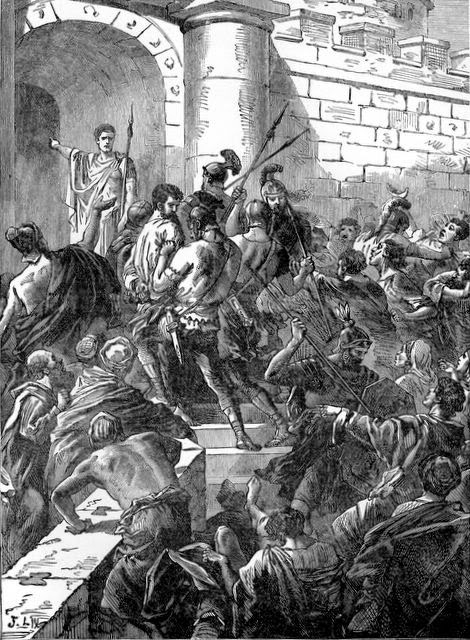
Paul arrested in a riot in Jerusalem (Acts 21:31-36)   - Artist unknown
 Paul arrested in a riot in Jerusalem (Acts 21:31-36) - Artist unknown

TODAY'S SPECIAL: Acts 21-22; Psalm 129

TO CHEW ON:
" 'For you will be His witness to all men of what you have seen and heard.' " Acts 22:15

I never tire of hearing stories of how God draws people to Himself and works in their lives. These tales—as original and varied as the people who tell them—range from stories of quiet pilgrimages to dramatic visions that turn life around in an instant. Paul's story was of the latter variety.

At the time it happened, his experience was reinforced by Ananias coming to him. Ananias was an entirely different sort of person. Paul describes him here as "… a devout man according to the law, having  a good testimony with all the Jews who dwelt there…" (Acts 22:12).

We know that sage Ananias had his own side of the story (Acts 9:10-18). His word to Saul/Paul was: God has chosen you. Now go and tell your story (my paraphrase of Acts 22:14-15).

Now, following his arrest by the Jerusalem mob, Paul gets to tell his story to the crowd that has just rioted and nearly taken his life (Acts 21:31-36). Of course this experience itself is a new installment in Paul's story.

Ananias' assignment to Paul is ours as well. Let's stay alert to God working in our lives so we recognize the continuing installments of our own "seen and heard" with God. Then let's retell the fresh chapters as conversations and situations, riots and debates open up along those lines.

PRAYER: Dear God, thank You for working uniquely in each life. Help me to recognize Your presence and action in my life and give me the courage to tell others. Amen.

PSALM TO PRAY: Psalm 129

*********
Unless otherwise noted all Scripture quotations are taken from the New King James Version®. Copyright © 1982 by Thomas Nelson, Inc. Used by permission. All rights reserved.


Sunday, October 14, 2018

The ready Christian

alter to the unknown god
TODAY'S SPECIAL: Acts 17-18; Psalm 127

TO CHEW ON:
"Now while Paul waited for them at Athens, his spirit was provoked within him when he saw that the city was given over to idols." Acts 17:16.

Paul is such a good example of the ready Christian: "… always be ready to give a defense to everyone who asks you a reason for the hope that is in you…" - 1 Peter 3:15. Here, in new-to-him Athens, watch how he does it:

1. He starts by observing his surroundings (Acts 17:16).

2. He goes to the hotbeds of thought and discussion—the synagogue and the marketplace to listen and talk. (Acts 17:17-18).

3. He accepts an invitation to speak at the Areopagus, even though the invite is hardly given in a  complimentary way. (They call him a babbler - Acts 17:18. According to my Bible's footnotes, a babbler was one who picked up scraps of learning here and there and peddled them. It seems this is a better description of those who "… spent their time in nothing else but either to tell or hear some new thing" - Acts 17:21).

4. He grabs their interest with something from their own culture—an inscription to an Unknown God seen on an altar. He dangles this need for something they haven't yet found in front of them: "Wouldn't you like to know Him?" (Acts 17:22-23)

5. He's a good closer. At the end of his message he urges them to take action: repent because judgment is coming (Acts 17:30-31).

6. He does all this while killing time in Athens—waiting for ministry partners to join him.

I ask myself, what would I have done if I had been in Paul's shoes? Sightsee? Probably. But with a view to giving my testimony and sharing the gospel? I don't know. I'd probably have viewed this as time off from ministry.

But for Paul—really for all of us—there is no time off. This story shows us that all kinds of situations can be a springboard for the gospel.

Though the fruit of Paul's ministry here is minimal ("For reasons Luke does not explain, results here were meagre—no baptisms, no new church, and no letter to the Athenians in the New Testament" - Gary Kinnaman, notes on Acts, New Spirit-Filled Bible, p. 1524), some believed. But Luke/Paul don't dwell on the low numbers. Paul has been faithful, and now it's time to move on (Act 18:1).

PRAYER: Dear God, please help me to become a ready Christian—alert to any and all opportunities to tell about and defend my faith in You, and not discouraged by small results. Amen.

PSALM TO PRAY: Psalm 127

*********
Unless otherwise noted all Scripture quotations are taken from the New King James Version®. Copyright © 1982 by Thomas Nelson, Inc. Used by permission. All rights reserved.


Friday, October 12, 2018

One secret to perseverance

Illustration from Lyman Abbot Commentary on Acts

Oriental Prayer Meeting - Illustration from Lyman Abbot Commentary on Acts
Oriental Prayer Meeting
TODAY'S SPECIAL: Acts 13-14; Psalm 125

TO CHEW ON: "So being sent out by the Holy Spirit, they went down to Seleucia, and from there they sailed to Cyprus." Acts 13:4

What strikes me about the disciples here is their lack of personal agendas. They have no five-year plan to evangelize the world. There seem to be only two items on their to-do list: hear and follow God's instructions.

When those instructions come via the Holy Spirit saying "Separate to Me Barnabas and Saul for the work to which I have called them" there is immediate obedience. No hanging back with—'Well, we had planned to visit our families, take a vacation, write a book…'

Their sense of being appointed and sent by God Himself on this mission was, I think, key to how they would handle what was ahead on this, Paul's first missionary journey (called Saul here, but his name was later changed to Paul). They didn't know it yet, but they would face opposition from a sorcerer, city-to-city hassling by the Jews, the desertion of a team member,  the threat of stoning in one place and actual stoning in another (Acts 13 & 14).

The lesson I take from this is  that I too need to listen to God's voice when I see opportunities to be sure that what I take on is by His leading and not my own idea. I need to be open to new tasks in areas I hadn't even considered. And when I don't hear anything specific, I need to be content to carry on faithfully with what I'm doing, knowing He is perfectly able to let me know when it's time to change course.

This sense of God's call is important because it is sure that I, that you, will face opposition, discouragement, misunderstanding, maybe even threats and physical danger while on Kingdom assignments. The knowledge that God has called us to any specific task will help us to persevere.

PRAYER: Dear God, thank You for this clear picture of how You worked in Bible times. Help me to be as available as Paul and Barnabas were, and to follow Your direction, knowing that if You call me to a job, You will see me through it no matter what comes my way. Amen.

PSALM TO PRAY: Psalm 125

The Bible Project VIDEO: Acts - Part 2 of 2 (Ch. 13-28) Read Scripture Series 


***********

Unless otherwise noted all Scripture quotations are taken from the New King James Version®. Copyright © 1982 by Thomas Nelson, Inc. Used by permission. All rights reserved.


Thursday, October 26, 2017

Paul's mother-care

TODAY'S SPECIAL: 1 Thessalonians 2:1-8

TO CHEW ON: "But we were gentle among you, just as a nursing mother cherishes her own children. So, affectionately longing for you, we were well pleased to impart to you not only the gospel of God but our own lives, because you had become dear to us." 1 Thessalonians 2:7-8


What untypical words to read from Paul, who is usually so instructional and corrective. They remind me of a little saying:

"People do not care how much you know until they know how much you care" - John C. Maxwell.

This might be a good time to refresh our memory about who these people were that Paul was writing to (the Thessalonians) and how the church at Thessalonica came into existence.

It was only the second church started on the European continent. The first was in Philippi, about 90 miles northeast. You will recall how Paul and Silas traveled from Troas to Macedonia (on the continent of Europe) in response to a vision (Acts 16:9). The mission at Philippi took a bad turn when Paul and Silas were thrown into prison. But an earthquake sprung them from their cell. They then led the jailor to Jesus and soon left town. (Their Philippian adventures are recorded in Acts 16:11-40.)

Their next stop was Thessalonica. Their stay there was just as troubled. Paul spent mere weeks with them, teaching for three Sabbaths in the synagogue where he "...reasoned with them from the Scriptures, explaining and demonstrating that the Christ had to suffer and rise again from the dead saying, 'This Jesus whom I preach to you is the Christ'" - Acts 17:1-3).

His message kindled a big response: "...a great multitude of the devout Greeks, and not a few of the leading women joined Paul and Silas" - Acts 17:4. But the gospel was too controversial for the Jews, who also envied the missionaries their success, hassled Jason their host, provoked a riot, and essentially ran Paul and Silas out of town (Acts 17:5-10).

It is to these believers Paul had known only a matter of weeks that he wrote this letter. It demonstrates the bond of love that Christians everywhere can feel for each other even though they have barely met. For Paul the relationship was especially poignant, as the people he had left behind were brand new believers. And so he used the language of motherhood, assuring these spiritual babies of his mother care for them: "...we were gentle among you just as a nursing mother cherishes (literally 'keeps warm') her own children.... pleased to impart to you not only the gospel...but our own lives."

I ask myself, do I have that spirit of sacrificial mother-love, especially toward those who are new and immature in the faith? Physical babies take a lot of time. Toddlers can tax one's patience. It's not so different with spiritual babies. I want Paul's words to be a model of Christian nurture to me as I interact with believers in all stages of maturity. You too?

PRAYER: Dear God, please grow in me love and gentle care for other believers, especially those who are new in their faith. Amen.


********
Unless otherwise noted all Scripture quotations are taken from the New King James Version®. Copyright © 1982 by Thomas Nelson, Inc. Used by permission. All rights reserved.


Saturday, October 21, 2017

Would you say "Imitate me"?

Image: Pixabay
TODAY’S SPECIAL: 1 Thessalonians 1:1-10

TO CHEW ON: “And you became followers of us and of the Lord, having received the word in much affliction, with joy in the Holy Spirit, so that you became examples to all in Macedonia and Achaia who believe.” 1 Thessalonians 1:6,7

A few weeks ago in a church Bible study I’m part of, the topic of mentorship came up. Paul’s description here sounds a lot like that: “And you became followers of us” - 1 Thessalonians 1:6.


[Mentor:  (Noun) 1] A wise and trusted counselor; 2] an influential sponsor or supporter. (Verb) To advise or train.

"Mentorship is a relationship in which a more experienced or more knowledgeable person helps to guide a less experienced or less knowledgeable person. The mentor may be older or younger than the person being mentored, but he or she must have a certain area of expertise" - from Wikipedia]

This business of mentorship (though that specific word is never used) is mentioned in more places in the New Testament:
  • Paul to the church in Corinth: “Imitate me” and listen to Timothy who “will remind you of my ways” - 1 Corinthians 4:16.
  • Paul to the church in Philippi: Copy everything about me: “The things which you learned and received and heard and saw in me, these do” - Philippians 4:9.
  • Paul in a later letter to the Church in Thessalonica: Imitate me in the way you work for a living - 2 Thessalonians 3:9.
  • The writer of Hebrews also encourages his readers to be enterprising and diligent - Hebrews 6:12.
  • Hebrews urges, as well, that readers imitate and submit to leaders - Hebrews 13:7,17.

 But mentorship is not meant to be a dead end that stops with the person being mentored. I love how Paul proposes it continue. “And you became followers of us and the Lord…so that you became examples to all…” 1 Thessalonians 1:6,7 - emphasis added.
The goal of mentorship is to produce more mentors. There’s a place for everyone.

Are we  being mentored—by a person or by books (in a class discussion answering the question, “Who have been your mentors?” a large number of us named books and their authors as significant mentors)? Are we, in turn, becoming mentors, to our children and those newer in the faith?

Let’s keep the mentor chain growing!

PRAYER: Dear Father, thank You for the life of Jesus in the Bible, and for flesh-and-blood and book teachers and mentors to learn from and imitate. Help me to live in such a way that I could say to anyone, “Imitate me.” Amen.

 *********
Unless otherwise noted all Scripture quotations are taken from the New King James Version®. Copyright © 1982 by Thomas Nelson, Inc. Used by permission. All rights reserved.


Wednesday, September 27, 2017

God glorified through our hard times

Image: Pixabay
TODAY’S SPECIAL: Philippians 1:15-30

TO CHEW ON: “Christ will be magnified in my body, whether by life or by death” - Philippians 1:20b


Paul would have had a lot to complain about if that had been his style. He was in prison as he wrote Philippians. Though fellow Christians were being emboldened by his clear witness to the palace guard (a good thing) some were preaching in a competitive spirit (out of “selfish ambition, not sincerely, supposing to add affliction to my chains” - Philippians 1:16).

But Paul was determined not to let any of this get him down. He saw the bright side of his captivity—the men guarding him were being exposed to his bold witness (Philippians 1:12,13). Because he was already in chains, they couldn’t use the threat of arrest to silence him, so he was bolder and more fearless than ever (Philippians 1:14). The competitive spirit of the fellow preachers didn’t please him. But he was happy that even through them the gospel was advancing (Philippians 1:18).

And in the matter underlying it all, the fact that he had lost his freedom, he seemed to be at perfect peace. We don’t see him whining that God didn’t send an angel to spring him from jail, as He did for Peter. Instead, Paul declared “For I know … that in nothing I shall be ashamed, but with all boldness as always so now also Christ will be magnified in my body, whether by life or death” (emphasis added).

I need more of that spirit. You too? So often my attitude is, Lord, I need you to take this problem away (this illness, condition, obstacle, lack…) so that You will be glorified.

But no. Instead I need the faith that God can be glorified as I go through the difficult things in my life: “Christ magnified in my body whether by life or death.”

PRAYER: Dear Jesus, thank You that Your deliverance from and through our problems comes “through the supply of the Spirit of Jesus Christ" (Philippians 1:19). Please fill my life with that supply today. Amen.

 *********
Unless otherwise noted all Scripture quotations are taken from the New King James Version®. Copyright © 1982 by Thomas Nelson, Inc. Used by permission. All rights reserved.


Tuesday, September 26, 2017

Come and get prayed for

Image: Pixabay
TODAY’S SPECIAL: Philippians 1:1-14

TO CHEW ON: “‘And this I pray…’”  Philippians 1:9


In our church we have a Sunday morning prayer time. It’s an interlude during congregational worship when people people can come to members of the prayer team and get prayed for.

I’m on the prayer team. When I take my place during prayer time I never know what it will bring. Sometimes no one comes. At other times I pray for two or three. The needs are as various as the people that come. I always pray beforehand that God will, by His Spirit, give me the thoughts and words to pray for each person so that what is really needed, even below the felt need, is exposed and brought to God.

Paul, in his prayer for the Philippians, prays with a broad brush. His would be a prayer to fit a lot of requests in the way it addresses the deep issues of heart and life.

  • He prays for the quality of their love (Philippians 1:9).
Doesn’t that need—for a growing, intelligent, discerning love—cover a lot of requests that have to do especially with relationships (marriage, family, friend, work, ministry). A list of what a growing, intelligent, discerning love would look like is found in 1 Corinthians 13:1-13.

  • He prays for their excellence (Philippians 1:10).
The NKJV expresses it: “… that you may approve the things that are excellent…” The Amplified Bible enlarges on that thought:
“So that you may surely sense what is vital, and approve and prize what is excellent and of real value—recognizing the highest and the best, and distinguishing the moral differences.”

Doesn’t that sound a lot like a prayer for wisdom? It reminds me of a list of excellent thought destinations Paul gives us later in Philippians  (“Finally, brethren, whatever things are true, whatever things are noble, whatever things are just, whatever things are pure, whatever things are lovely, whatever things are of good report, if there is any virtue and if there is anything praiseworthy—meditate on these things” - Philippians 4:8.)

  • He prays that their lives will produce good fruit - Philippians 1:11.
Doesn’t that sound a lot like a prayer for success—a success whose goal is God’s glory not ours (“… to the glory and praise of God” - Philippians 1:11b)? Another list comes to mind: the fruits of the Spirit: "But the fruit of the Spirit is love, joy, peace, longsuffering, kindness, goodness, faithfulness, gentleness, self-control. Against such there is no law" - Galatians 5:22,23. 

What a great example of an all-encompassing prayer! Praying it for ourselves or for someone else brings to God a multitude of needs, many of which we’re aware of, others we may not even know we have.

PRAYER: Dear Father, I pray that my love will grow in knowledge and discernment, that I will dwell on and give expression to that which is excellent, and that my life will be filled with the fruits of righteousness today. May I bring glory to You. Amen.

 *********
Unless otherwise noted all Scripture quotations are taken from the New King James Version®. Copyright © 1982 by Thomas Nelson, Inc. Used by permission. All rights reserved.

Scripture quotations marked AMP are taken from the Amplified® Bible, Copyright © 1954, 1958, 1962, 1964, 1965, 1987 by The Lockman Foundation. Used by permission." (www.Lockman.org)


Wednesday, January 25, 2017

The necessity of Jesus School

"Saul Stricken" - Rubens
TODAY’S SPECIAL: Galatians 1:11-24

TO CHEW ON: “But when it pleased God … to reveal His Son to me, that I might preach Him among the Gentiles, I did not immediately confer with flesh and blood, nor did I go up to Jerusalem to those who were apostles before me; but I went to Arabia, and returned again to Damascus.” - Galatians 1:15-17


Today the church celebrates the conversion of the Apostle Paul (first known as Saul). The story of his miraculous turnaround is in Acts 9:1-21.

Those of us who have switched careers or taken on new roles can begin to appreciate what a whiplash experience Paul’s conversion must have been to him. His whole world had been rocked. Everything he had staked his life on as a Jewish leader and Pharisee was now in question. He had been an expert but now he was a baby, a complete novice in this new belief system. All he knew was that Jesus was real, had knocked him off his feet, spoken to him, called him, made him helplessly blind, then sent someone to pray for him.

Our reading in Galatians talks about a three-year silent period in Paul’s life (Galatians 1:17,18). During this time he went off somewhere secluded—Arabia—and received divine instruction. We could probably put this period of time between Acts 9:21 (where news of his conversion sparked amazement) and Acts 9:22 (where we see him confounding the Jews in his hometown of Damascus).

I think there is something we can learn here about the timing of placing people in ministry (and going into ministry ourselves). When a big name celebrity comes to faith, the temptation is to schedule them on the rounds of radio and TV shows and display them on a pedestal as Christianity’s latest trophy and voice.

I’m not saying we shouldn’t give popular personalities a platform to share their coming-to-faith stories. But I do think we should be wary of looking to them as experts in the Christian faith.

If even the brilliant and theologically savvy Apostle Paul needed three years of Jesus School, how much more a movie, pop music, or sports personality needs a little time in Arabia before we lean on them for teaching and direction.

PRAYER: Dear Father, help me not to be star-struck by new Christians who  have been successful by the world’s standards. Please give me discernment about who I allow to speak into my life and influence me. Amen.

MORE: The Conversion of St. Paul

Today the church celebrates Conversion of St. Paul. Here is the collect prayer that begins the day’s liturgy:

O God, by the preaching of your apostle Paul you have caused the light of the Gospel to shine throughout the world: Grant, we pray, that we, having his wonderful conversion in remembrance, may show ourselves thankful to you by following his holy teaching; through Jesus Christ our Lord, who lives and reigns

 *********
Unless otherwise noted all Scripture quotations are taken from the New King James Version®. Copyright © 1982 by Thomas Nelson, Inc. Used by permission. All rights reserved.


Friday, December 16, 2016

What's your mission statement?

TODAY'S SPECIAL: Romans 1:1-17

TO CHEW ON: "Paul, a bondservant of Jesus Christ, called to be an apostle, separated to the gospel of God...To all who are in Rome, beloved of God, called to be saints." Romans 1:1, 7a

Paul sure knew how to economize with words. Here using just a few, he spells out what his whole life is about. It's a lot like a modern mission statement.

Mission statements—formal short written statements of purpose—are normally connected to companies or organizations. According to Wikipedia, they often include:
1. The purpose and aim of the organization.
2. The organization's primary stakeholders.
3. Responsibility of the organization to those stakeholders.
4. Products and services offered.

If we substitute the word "person" for "organization" we have the framework for a personal mission statement. Paul's declaration about himself plugs in comfortably. We can learn a lot about determining our own priorities by studying his.

1. The purpose and aim of the person: "Paul a bondservant of Jesus Christ..."

My Bible's study notes explain:
"Bondservant — also translated 'servant' or 'slave' refers to an employee who was paid wages, often had considerable skills and responsibilities...But a bondservant could not resign and work for another employer. Highly educated and skilled people, as well as ordinary labourers were bondservants" Wayne Grudem, footnotes on Romans, New Spirit Filled Life Bible, p. 1548.
Paul's purpose was to serve Jesus in this lifelong bondservant way.

2. The person's primary stakeholders: "To all who are in Rome, beloved of God, called to be saints..."

In his letters to the Romans Paul is addressing Roman Christians. Of course we know his "stakeholders" were far more numerous than that; his mission field included much of the then-known world. But I'm sure he never imagined that his words would reverberate through centuries, crossing continents and oceans, reaching us here in 2016!

3. Responsibility of the person to those stakeholders: "...called to be an apostle."
"Apostle here refers to the unique officers in the early church who had the power to govern the churches with absolute authority and to speak and write the very words of God without error..." Ibid).
Paul was clear about his job title and what responsibilities his position gave him toward the Christians who were his contemporaries.

4. Products and services offered: "...separated to the gospel of God."

Paul elaborates on the magnificence of his product of "good news" often through his writings, several times even within Romans 1:1-17. He reminds the Roman Christians that this gospel:
  • was promised by the Old Testament prophets (Romans 1:2).
  • is about Jesus—who was born physically as a son of David (Romans 1:3).
  • and who was shown to be the son of God because He rose from the dead (Romans 1:4).
  • is part and parcel of his (Paul's) service to God (Romans 1:9).
  • is news he is proud, not ashamed of (Romans 1:16).
  • is powerful to the extent of providing salvation to everyone who believes, both Jew and Gentile (Romans 1:16).

Paul's impact was no doubt due, somewhat at least, to his focus. He knew who he was, whom he served, the role he was to play in their lives, and the supernatural "product" he offered. I ask myself, would my life benefit from some of Paul's focus? Would yours?

PRAYER: Dear God, thank You for Paul's purposeful, passionate life. Help me to sharpen my own life by studying his example. Amen.

MORE: Your mission statement
Have you ever written a statement of mission for your life? Try writing one. If you like, use the sentences below as a guide.

1. The purpose or aim of my life is to _____ .
2. My "stakeholders" are ______ .
3. I will fulfill my purpose to my stakeholders by _____ .
4. The product I offer is _____ .

******************
Unless otherwise noted all Scripture quotations are taken from the New King James Version®. Copyright © 1982 by Thomas Nelson, Inc. Used by permission. All rights reserved.


Bible Drive-Thru

Thursday, October 27, 2016

Endure

TODAY'S SPECIAL: 2 Thessalonians 1:1-12

TO CHEW ON: "We are bound to thank God always for you, brethren, as it is fitting because your faith grows exceedingly, and the love of every one of you all abounds toward each other, so that we ourselves boast of you among the churches of God for your patience and faith in all your persecutions and tribulations that you endure." 2 Thessalonians 1:3-4

Paul had himself recently experienced the "persecutions and tribulations" he talks about. He and his companion Silas had found an active synagogue in Thessalonica. For three sabbaths Paul "reasoned with them from the Scriptures," trying to persuade the Jews that Jesus was indeed Messiah.

Some Jews believed, along with Greeks and prominent women. But the ones who didn't gathered a mob and attacked the house of Jason where they thought Paul and Silas were staying. The mob never found them, but later that night, the believers sneaked them out of the city. It's all in Acts 17:1-10.

So, in this letter, probably only weeks to months later, Paul is encouraging those believers, telling them that the patience and faith they are exhibiting is cause for him to boast about them in other churches he visits.

"That's fine for you," I can just hear the Thessalonian Christians say, as they read Paul's letter. "You could just leave. But we have to stay here and live with this."

God could, of course, have caused that persecution to stop. But here, throughout church history, and still around the world today the need for endurance in persecution, in sickness, and in personal trials, continues. What is the purpose of it?

Paul mentions three pluses of of toughing out persecution in these verses:
1. It grows faith.

2. It cements love (note also 1 Corinthians 13:7)

3. It is a source of inspiration for others (note also 2 Timothy 2:10).

Other Bible passages show us still more advantages of having to endure.


4. It proves we are God's sons and daughters when He deals with us like a parent does with a child (Hebrews 12:7).

5. It toughens us as Christians, giving us focus and developing strength (2 Timothy 2:3-4).

6. Paul implies that it might be the new normal and what one should expect when involved in ministry (2 Timothy 4:5).

7. Enduring puts us in the select company. Abraham (Hebrews 6:15), Jesus (Hebrews 12:3), and Paul (1 Corinthians 4:10-13; 2 Timothy 1:8) are all characterized for their endurance.

8. Endurance assures our salvation (Matthew 10:22). Only the ones who endure will receive the crown of life (James 1:12).

Are you living in endurance-challenging territory right now? Be encouraged. You are not unique or alone.

For us whose lives are going along relatively smoothly, let's pray for people who need endurance while we keep our expectations realistic. The need for endurance will come. Let's be ready!

PRAYER: Dear God, help me to endure the small trials and tribulations that come my way. Please make me aware of people whose endurance is being challenged, so I can pray for them. Amen.


Do your 8-12-year-olds have daily devotions? Point them to Bible Drive-Thru.

Monday, October 17, 2016

Poured out life

David pours out water - Caspar Luiken
TODAY'S SPECIAL: 2 Timothy 4:1-22

TO CHEW ON: "For I am already being poured out as a drink offering, and the time of my departure is at hand." 2 Timothy 4:6

Paul uses the image of a drink offering to speak of his own impending death.

These liquid offerings were part of Old Testament worship.

  • Jacob worshiped God that way when he returned to Bethel, the place God had first met him on his flight from home (Genesis 35:14-15).
  •  A drink offering was part of the consecration of Aaron and his sons (Exodus 29:40), the Feast of Firstfruits (Leviticus 23:13), and the Feast of Weeks (Leviticus 23:18).

We can't help but think of other pourings.

  • David poured out the precious gift of Bethlehem water—his way of acknowledging God was worthy of the best and most desirable (2 Samuel 23:15-17).
  • Mary poured out precious perfume, the most valuable thing she had, on Jesus' feet (John 12:1-8).
  • Paul's picture of his life as a libation here implies that he may expect to be martyred (as in poured out blood).
  •  He uses the drink offering image in another place as well. In Philippians 2:17 the picture is of his drink-offering-life poured over their sacrifice and service. It's as if his life and theirs work together to complete the sacrifice—a "living sacrifice" he calls it in Romans 12:1.

Can we live drink offering lives? They will seem wasted, perhaps, as David's poured out Bethlehem water and Mary's perfume seemed a waste. But in the apparent waste is new and surprising life. Read words of Jesus:

"Most assuredly I say to you, unless a grain of wheat falls into the ground and dies, it remains alone; but if it dies, it produces much grain.
He who loves his life will lose it, and he who hates his life in this world will keep it for eternal life." John 12:24,25.

PRAYER: Dear God, please help me to live my life like a drink offering—poured out for You. Amen.

MORE: Pour My Love on You (by Phillips, Craig and Dean)


*************
Unless otherwise noted all Scripture quotations are taken from the New King James Version®. Copyright © 1982 by Thomas Nelson, Inc. Used by permission. All rights reserved.
Bible Drive-Thru


Thursday, July 07, 2016

Personal prophecies


"Agabus' prophecy concerning Paul"
Image courtesy Bizzell Bible Collection, University of Oklahoma Libraries

TODAY'S SPECIAL: Acts 21:17-40

TO CHEW ON: "When he had come to us, he took Paul's belt, bound his own hands and feet, and said, 'Thus says the Holy Spirit, "So shall the Jews at Jerusalem bind the man who owns this belt and deliver him into the hands of the Gentiles."' Acts 21:11


"Then the commander came near and took him, and commanded him to be bound with two chains; and he asked who he was and what he had done." Acts 21:33

The brutal beating and arrest that Paul experienced in our reading today were part of a bigger story. A little context:

- Just before this Jerusalem beating, Paul had concluded his third missionary journey (Acts 18:23-21:14).

- At the last several stops, he had been warned not to go to Jerusalem. In Tyre " … disciples … told Paul through the Spirit not to go up to Jerusalem" - Acts 21:4. Then at Caesarea Agabus " … took Paul's belt etc..." (verse quoted above) - Acts 21:11.

But Paul went anyway. Was it a mistake on his part? What about the personal prophecies we see delivered here—were they a legitimate word from the Lord? Should we be seeing such personal prophecy ministries in our churches.

Such ministry does happen in Pentecostal and charismatic churches, but it can be abused. Jack Hayford addresses the issue of personal prophecy in a sidebar article of the New Spirit-Filled Life Bible. He lists five safeguards against personal prophecy abuses:

1. The "word" will usually not be new to the mind of the person addressed. (This was true in Paul's case - Acts 20:22-24; 21:4.)
2. The character of the person bringing the "word" ought to be weighed. (Agabus had a reputation as a prophet - Acts 11:28; 21:10.)

3. Remember that the prophecy or "word" is not to be considered controlling. In other words, such prophecies should never be perceived as dominating anyone's free will.

4. All prophecy is "in part" (1 Corinthians 13:9) which means as true as the "part" may be it does not give the whole picture. (Paul's arrest led to a trip to Rome and an opportunity to share his testimony there.)
5. In the light of a "word" we should prayerfully consider that word as Mary did the shepherds' report (Luke 2:19). 
(All green-shaded areas are quotes from "The Issue of Personal Prophecy" by Jack Hayford, New Spirit-Filled Life Bible, p. 1531.

Paul was certainly not taken by surprise when he was mobbed, beaten, and bound. Instead he not only kept his wits about him but, as we will see tomorrow, used his infamy as a platform for his testimony.

PRAYER:
Dear Father, help me to be in tune with You and Your Spirit, regardless of the way how You choose to speak to me. Amen.

 *********
Unless otherwise noted all Scripture quotations are taken from the New King James Version®. Copyright © 1982 by Thomas Nelson, Inc. Used by permission. All rights reserved.


Tuesday, June 28, 2016

Joy over opposition

"Paul Preached to the People"
from Treasures of the Bible - Church Age

Paul Preached to the People - Treasures of the Bible, Church Age

TODAY'S SPECIAL: Acts 13:32-52

TO CHEW ON: "And the disciples were filled with joy and with the Holy Spirit." Acts 13:52.


The story of Paul's first missionary journey (Acts 12:25-14:28) is a fascinating succession of ups and downs. In today's reading we see some of them.

Paul and Barnabas had reached Antioch in Pisidia. When attending the synagogue, Paul got invited to share his "exhortations for the people" - Acts 13:15. Those ended up being an explanation of the gospel (Acts 13:16-41). His emphasis on the fact that sins could be forgiven on the basis of Jesus and His death and resurrection alone (and not by keeping the law - Acts 13:38,39) was such good news to the Gentiles, they begged Paul to talk specifically to them (Acts 13:42).

Next Sabbath a huge crowd gathered ("almost the whole city"). They were enthusiastic about accepting Paul's message of hope for the Gentiles. Many of them believed (Acts 13:48,49).

But the jealous Jews "stirred up the devout and prominent women and the chief men of the city, raised up persecution against Paul and Barnabas, and expelled them from their region" - Acts 13:50.

We would expect Paul and Barnabas to be upset and discouraged by this. Not so! They were "filled with joy and with the Holy Spirit" - Acts 13:52.

What?! It's almost as if the persecution was a signal to them that they were on the right track.

Joy in the face of persecution is a theme that runs through the New Testament.
  • Jesus said to expect such treatment for His sake and to "'...rejoice and be exceedingly glad…'" - Matthew 5:11,12, Luke 6:22,23.
  • Peter and John considered it an honour to be persecuted for Jesus - Acts 5:41.
  • Paul and Silas prayed and sang hymns after being beaten in Philippi - Acts 16:23,25.
  • Paul taught about being joyful in suffering - Colossians 1:24.
  • The writer of Hebrews wrote to readers who "...joyfully accepted the plundering of your goods, knowing that you have a better and an enduring possession for yourselves in heaven" - Hebrews 10:34.
  • Peter encouraged readers who were in a fiery trial to "...rejoice to the extent that you partake of Christ's sufferings" - 1 Peter 4:12,13.

In our democratic culture where everyone is supposed to have equal rights and can stand up for them, we have the privilege and even feel responsible to stand up for our rights as Christians in the face of unfairness, hassling, put-downs, exclusions etc. (persecution).  When persecution comes we have the feeling, This shouldn't be happening to us. Maybe it's partly our fault in that we've let it happen; we haven't been watchful and outspoken enough.

But I suspect that persecution of Christians will only continue and get worse, even in democratic countries, and even where people are vigilant to do what they can to preserve rights and freedoms. It's time we (at least I) take a more realistic view of persecution, including joy in response to it.

Opposition may even be a backhanded compliment, in that it signifies we're doing something worth opposing.

PRAYER: Dear Jesus, help me to be as loyal to You and as willing to joyfully accept persecution as these New Testament people were. Amen.

 *********
Unless otherwise noted all Scripture quotations are taken from the New King James Version®. Copyright © 1982 by Thomas Nelson, Inc. Used by permission. All rights reserved.


Monday, June 27, 2016

Are you a quitter?

Barnabas & Paul disagree - Artist unknown
TODAY'S SPECIAL: Acts 13:13-26

TO CHEW ON: "Now when Paul and his party set sail from Paphos, they came to Perga in Pamphylia; and John departing from them, returned to Jerusalem." Acts 13:13

Have you ever been a quitter? I have. It's not a good feeling when you're in the middle of it, and the fact that you've quit can come back to bite you.

Here Luke slips into his story, almost like an aside, the fact that John (John Mark - Acts 15:37) leaves their ministry party at this time—no reason given. Later, how significant a fact it becomes when, on the next missionary jaunt Barnabas wants to take John Mark with them again but Paul refuses (Acts 15:37-38).

Both dig in their heels, a rift develops, and one missionary team becomes two as Barnabas takes Mark and they sail to Cypress while Paul finds Silas to accompany him through Syria and Cilicia.

The Bible isn't kind to quitters. Some things it says to those with such an attitude:

  • Jesus says the person "…having put his hand to the plow, and looking back…") is not fit for the kingdom of God (Luke 9:62).
  • In another place He talks about how impossible it is to serve two masters (Matthew 6:24).
  • Paul describes those driven by doubt as "tossed to and fro and carried about…" (Ephesians 4:14).
  • James uses the same sea metaphor and calls doubters "double-minded" (James 1:6,8).

So what if we've quit. Have we blown our whole lives?

Not necessarily. There was another chance for John Mark. In the end, the fallout between Paul and Barnabas resulted in two missionary parties going out. And this was the Mark who later wrote Gospel of Mark.

We may not be able to undo our giving up but we can learn from it:

- The importance of perseverance.

- The importance of relying on God and not ourselves when we're tempted to give up (James 4:8).

- The fact that with God in the equation, nothing is too hard: "I can do all things through Christ who gives me strength" (Philippians 4:13).

PRAYER: Dear God, please alert me to attitudes that precede quitting, like self-pity, comparing myself to others, laziness… Help me to remember that with You I can do anything You ask. Amen. 

 *********
Unless otherwise noted all Scripture quotations are taken from the New King James Version®. Copyright © 1982 by Thomas Nelson, Inc. Used by permission. All rights reserved.

Wednesday, June 15, 2016

Law-living—so yesterday

Image: Pixabay.com
TODAY'S SPECIAL: Galatians 3:6-25

TO CHEW ON:
"What purpose then does the law serve?" Galatians 3:19


Paul attempts to dissuade the Galatians from reverting back to living by the Jewish law. His argument includes some facts about the law. Embedded in those facts are ways that the law is inferior to faith.

1. The law makes us aware of sin (without giving us a way to deal, finally, with sin). I love how clearly the Amplified puts it: "It (the Law) was added—later on, after the promise, to disclose and expose to men their guilt…" - Galatians 3:19 AMP.

2. It was given by angels and Moses
(while faith came through the "Seed," Jesus). The Amplified again: "…and [the Law] was ordained through angels and delivered to Israel by the hand of a mediator [Moses, the mediator between God and Israel, to be in effect] until the Seed would come to whom the promise had been made" - Galatians 3:19 AMP.

3. The law was complementary to the promises of God, not contrary to them. Though it couldn't give life, it led to Jesus fulfilling it and offering His life in our stead - Galatians 3:21,22.

4. Paul pictures the law as a set of rules that has people under arrest, in jail to sin, guarded by the law, which no one could ever completely live up to:  "But the Scripture has imprisoned everyone [everything—the entire world] under sin..." Galatians 3:22 (AMP); " But before faith came, we were kept under guard by the law" - Galatians 3:23 NKJV.

5. The law is also a tutor or trainer
to prepare its adherents for full privileges as sons: "Therefore the law was our tutor to bring us to Christ..."  Galatians 3:24

What do these things have to do with us who have never struggled with the pressure of living under the Jewish law? Some things that come to mind:
  • Viewing the Galatians' struggle between law-based versus faith-based righteousness helps us understand God's plan and His gradual revealing of it.
  • The contrast between law vs. faith helps us appreciate the immensity of what Christ did on the cross.
  • The comparison between the two also gives us an understanding of how living by faith is better than living by law.
  • We are warned of the danger of getting enslaved by any set of laws.

I love the way Paul concludes his thought, one verse beyond today's prescribed reading: "For you are all sons of God through faith in Christ" - Galatians 3:26.

By faith we're not guilty and helpless to change, not jailed as prisoners to a set of rules we can never fulfill, not  students under discipline and training, but have the privileges of family, called God's very sons (and daughters)!

PRAYER: Dear Father, help me understand at a life-level how Your death and resurrection has set me free from earning my salvation by fulfilling any set of law requirements. Amen.

 *********
Unless otherwise noted all Scripture quotations are taken from the New King James Version®. Copyright © 1982 by Thomas Nelson, Inc. Used by permission. All rights reserved.

Scripture quotations marked AMP are taken from the Amplified® Bible, Copyright © 1954, 1958, 1962, 1964, 1965, 1987 by The Lockman Foundation. Used by permission." (www.Lockman.org)


Wednesday, June 01, 2016

Regrets

TODAY’S SPECIAL: 1 Corinthians 15:1-28

TO CHEW ON: “For I am the least of the apostles, who am not worthy to be called an apostle because I persecuted the church of God. But by the grace of God I am what I am….” I Corinthians 15: 9-10a

Are you one of those people who are haunted by the life you lived before coming to Christ? Perhaps you slept around, wrecked a marriage, had an abortion, or abused your body with drugs and alcohol. I gave my heart to Jesus when I was a little girl but turned my back on God for some years in my 20s. I still get flashbacks of scenes from that old life. They fill me with shame and regret.

Paul speaks of such regrets. Memories of his zeal in persecuting the church before he met Jesus make him feel unworthy to be an apostle. I wonder if scenes from events like the stoning of Stephen (in which he participated) dogged him even after his conversion.

“But…” Paul continues, and with that great little hinge word he opens the door on light: “…by the grace of God I am what I am.” So many thoughts flow out of this eleven-word sentence:
  • God knows about me and my past and He forgives.
  • I can’t do anything to change the past; I must forgive myself too.
  • God knows why He put me in the place I am today; it’s not my job to understand His ways or to justify them to others.

If there’s one good thing that can come out of a shadowy past, it’s the way it keeps you from becoming self-righteous. Because when you see someone caught in sin, you know at a gut level that but for the grace of God, it could be you.

PRAYER: Dear God, thank You for Your grace (favor I don’t merit and didn’t earn) that takes me the way I am and makes me useful to Your kingdom. Amen.

MORE: “Just As I Am”
God takes us the way we are. The familiar invitation hymn “Just As I Am” expresses it so well. Charlotte Elliott (a once miserable old maid) wrote the words to this hymn. Robert J. Morgan tells the story in Then Sings My Soul.

A bitter women with broken health, Charlotte railed against God. Her family, trying to help her, invited a Swiss minister, Dr. Cesar Malan to their home for a meal. During the dinner conversation Charlotte lost her temper and denounced God. Family members left the room in embarrassment. Alone with the pastor, he confronted her:
“You are tired of yourself aren’t you? he asked. “You are holding to your hate and anger because you have nothing else in the world to cling to. Consequently, you have become sour, bitter and resentful.”

“What is your cure?” asked Charlotte.

“The faith you are trying to despise.”

As they talked, Charlotte softened. “If I wanted to become a Christian and to share the peace and joy you possess,” she finally asked, “What would I do?”

“You would give yourself to God just as you are now, with your fightings and fears, hates and loves, pride and shame.” (Then Sings My Soul, p. 113)
Charlotte did come as she was that day and was forever changed. She wrote the poem “Just As I Am” some years later to help her brother raise funds for a school to educate the children of poor clergymen. It was later set to music by William B. Bradbury.

Here it is, sung by Brian Doerksen

*******
Unless otherwise noted all Scripture quotations are taken from the New King James Version®. Copyright © 1982 by Thomas Nelson, Inc. Used by permission. All rights reserved.

Friday, May 06, 2016

Church fights

Image: pixabay.com
TODAY’S SPECIAL: Acts 15:36-16:15

TO CHEW ON: “Then the contention became so sharp that they parted from one another. Acts 15:39.

I’ll never forget some of the first church member-only meetings I attended after  joining when I was about 14. At these meetings sensitive issues were brought into the open and discussed pro and con – sometimes with a lot of heat. Seeing adults who I respected speaking passionately for one solution, while others I also respected were just as passionate for another solution shook me up and gave my youthful idealism a dose of this-is-the-way-it-really-is in the church.

It’s interesting to see that the early church had disagreements too. The first part of Acts 15 talks how they dealt with the contentious problem of circumcision. The discussion was whether or not to demand that Gentile believers submit themselves to this rite. The letter recorded in verses 23-29 lays out the compromise decision the leadership came to about this.

In the latter part of the chapter we have a personnel problem. Barnabas wanted to take John Mark on the next missionary trip. Paul didn’t because they took him on an earlier trip and he deserted them partway through. Their disagreement “became so sharp that they parted from one another.”

If you are part of a local church you are probably no stranger to these kinds of problems. The church is made up of individuals. Many of us have strong opinions. The sad thing is that such intra-church conflict often has permanent negative effects. The aftermath of disagreements can be bitterness, unforgiveness, church splits, a party spirit, negativity toward the church as a whole, and on and on.

We can learn some positive things about how to deal with church problems from Acts 15.

1. Discussion is good (Acts 15:6,7). People feel better when their concerns have been heard. 

2. A decision is necessary. Leadership is important to reach this point. In the circumcision dispute Peter talked about his experience. The leaders who had gathered to discuss this listened. James helped to spell out a compromise (Acts 15:7-12). If some were unhappy with the final outcome, they didn’t make a big deal about it and the church remained united.

3. Publicize and explain the new policy to everyone concerned. In Acts 15:22-29 the disciples crafted a letter and sent it via “chosen men” to the affected congregations.

4. Part ways if you must, but do it amicably. In Paul and Barnabas’s disagreement, two mission teams were sent out as a result of their split (Acts 15:39-41).  Like a cell divides to help growth, their painful separation served, in the end, to help spread the gospel even more. Thankfully there was no permanent damage. Later John Mark became a faithful co-worker with Paul - 2 Timothy 4:11

Are you scarred from church fights? What are your thoughts?

PRAYER: Dear God, please help me to love the church and be a part of finding solutions when there are problems. Amen.

***********
Unless otherwise noted all Scripture quotations are taken from the New King James Version®. Copyright © 1982 by Thomas Nelson, Inc. Used by permission. All rights reserved.

Do your 8-12-year-olds have daily devotions? Point them to Bible Drive-Thru.

Related Posts Plugin for WordPress, Blogger...