Showing posts with label hypocrisy. Show all posts

Wednesday, October 03, 2018

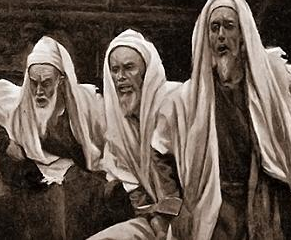
Jesus and the religious superstars

"Jesus Teaches" by A. Bida
TODAY’S SPECIAL: Luke 19-20; Psalm 119:65-96

TO CHEW ON: “Then, in the hearing of all the people, He said to His disciples, ‘Beware of the scribes…’” Luke 20:45,46


The cat-and-mouse game the scribes and chief priests played with Jesus was serious. They wanted to get Him arrested, turned over to the governor, and sentenced (hopefully to death) for something.

They went to great lengths to try to make this happen.
  • They sent spies who pretended to be righteous but with the intent to catch Jesus saying something seditious (Luke 20:21,22).
  • They followed him around. It seems like wherever Jesus taught, there was a coterie of scribes, chief priests and Pharisees frowning and muttering in the background (Luke 20:20, 26, 39).
  • They flattered him (Luke 20:21,39).

Jesus was never tripped up or intimidated. Just the opposite. To His disciples but in the hearing of everyone (Luke takes pains to point out) He condemned the scribes for their religious show, their love of being honored and deferred to, their sanctimonious prayers, and their hypocrisy (Luke 20: 46,47).

Just as Jesus wasn’t  awestruck or taken in by these first century religious superstars, neither should we be starstruck by the religious big names of our time, or try to become one of them.

When we find ourselves tempted to fawn over popular preachers, singers, or authors, or trying to impress others with our learning and insight let’s remind ourselves:
  • God sees past education, cleverness, and talent. Let’s not be too impressed with these things in others or ourselves.
  • Religious showing off is abhorrent to God. Let’s avoid it and not be fooled by it in others.
  • In the end, each of us will stand with our own heart naked before Him. Let’s guard ourselves against sanctimoniousness, the love of human praise, and hypocrisy.

PRAYER:
Dear Jesus, Your insight into human nature and refusal to be impressed or intimidated by the religious big names of Your time is inspiring. Help me to live for Your approval, not the approval or praise of people. Amen.

PSALM TO PRAY: Psalm 119:65-96

The Bible Project VIDEO: Luke ch. 19-23 (Gospel of Luke mini-series)


*********
Unless otherwise noted all Scripture quotations are taken from the New King James Version®. Copyright © 1982 by Thomas Nelson, Inc. Used by permission. All rights reserved.


Tuesday, September 18, 2018

Exposed

TODAY'S SPECIAL: John 7-8; Psalm 106

TO CHEW ON: "Then Jesus spoke to them again saying, 'I am the light of the world. He who follows me shall not walk in darkness, but have the light of life.'" John 8:12

The scribes and Pharisess who brought the adulterous woman to Jesus figure largely in many incidents in the gospels. My Thompson Chain Bible (NKJV) gives a simple description of them:

"Scribes: Writers or secretaries who copied the Scriptures.


Pharisees: A party among the Jews of Jesus' time that laid great stress upon the observance of rites and ceremonies. They made a pretense of superior piety and separated themselves from the common people. They were believers in the immortality of the soul, the resurrection of the body and the existence of angels and spirits" (p. 1939).

Most people of that day held the scribes and Pharisees in awe because of their showy saintliness. But not Jesus. And not the Gospel writers. Matthew, for example shows the Pharisees and scribes as:

  • Not righteousness enough to get into the Kingdom of Heaven (Matthew 5:20).
  • Murderous (Matthew 12:14).
  • Insincere when they pretended to be on the verge of following Jesus if He would give them just one more sign (Matthew 12:38).
  • Hypocritical when they tried to entrap others over transgressing the fine points of the law (like hand-washing) while they themselves transgressed the big points (like failing to honor parents) (Matthew 15:1-9).
  • Conniving as they attempted to trap Jesus into saying or doing something they considered wrong (Matthew 19:3).

Today's story from John 8 shows them in just such a scheming mode. And though there was no question that the woman they hauled before Jesus was a sinner, He was masterful in staying out of their trap. When they insisted that she be stoned:

"He raised Himself up and said, 'Let him who is without sin among you be the first to throw a stone at her.' Then He bent down and went on writing on the ground with His finger" - John 8:7-8.

Surprise of surprises, instead of picking up stones and getting to work they began, one by one, to leave. Why? Obviously each one was convicted of his own sin.

Some say that the source of their sin-conviction was what Jesus was writing on the ground — that he was listing their sins right in front of their eyes. But I believe it was His simple presence. For, Jesus' declaration of being the light of the world (John 8:12) follows the narrative as if it's the lesson or point of the story. Their slinking away showed that in the light of Him, each one became painfully aware of his own sin and knew he could not be the one to start the stoning.

Like the self-righteous Pharisees we too find it easy to categorize sin and stand in judgment over those whose sin is, in our eyes, worse than our own. Until, that is, we come into the presence of Jesus, the light, and see our own soiled selves.

PRAYER: Dear Jesus, please keep me from being pharisaical and judgmental. Help me to view myself realistically and to treat fellow travelers with the same grace that I need. Amen.

PSALM TO PRAY: Psalm 106

***************
Unless otherwise noted all Scripture quotations are taken from the New King James Version®. Copyright © 1982 by Thomas Nelson, Inc. Used by permission. All rights reserved.


Monday, November 06, 2017

Woe to hypocrites!

Pharisees by James Tissot
TODAY'S SPECIAL: Matthew 23:13-39

TO CHEW ON: " 'But woe to you scribes and Pharisees, hypocrites! For you shut up the kingdom of heaven against men; for you neither go in yourselves, nor do you allow those who are entering to go in.' " Matthew 23:13

In one of His most impassioned speeches, Jesus denounces seven examples of Pharisaic hypocrisy:

1. They were legalistic. The Pharisees' strict legalism kept them and everyone else out of the kingdom (Matthew 23:13).

2. They were unjust. The Pharisees' long prayers, meant to impress others with their righteousness, were contrary to the way they treated the poorest people, like widows - Matthew 23:14.

3. They were evangelists of evil - Matthew 23:15. One thinks of a missionary or evangelist as one doing a good thing. But these missionaries were converting others to become fanatics of a tarnished religion.

4. They were blind guides
- Matthew 23:16-22. If anyone should be able to see, it's a guide! Yet Jesus showed how blind these men were by poking holes in the reasoning by which they came to rules about which oaths were binding and which weren't. The IVP Commentary explains the custom:
"An oath involved invoking a deity as a witness to the veracity of one's claim. On the popular level people had begun using many surrogate phrases for God's name hoping to avoid judgment if they broke the oath. Pharisees endeavoured to distinguish which oath phrases were actually binding" - IVP Commentary, accessed via biblegateway.com.
Jesus' attack was not just against these oath standards, though, but also against the Pharisees' inconsistent standards of holiness and the profanity of using God's name in such frivolous ways.

5. Their standards were inconsistent and out of proportion - Matthew 23:23-24. The Pharisees emphasized tithing the tiniest of spices while ignoring big issues like practicing justice, mercy, and faith.

6. Their lives were superficial - Matthew 23:25-28. Their fine exteriors masked a polluted inner condition.

7. They were self-deceived - Matthew 23:29-36. They claimed that if they'd lived in the time of the prophets, they would never have treated God's servants the way their countrymen did. Jesus' response: " 'Serpents, brood of vipers!' " You will prove how deceived you are by the way you kill, crucify and scourge the prophets, wise men, and scribes that come to your generation (my paraphrase).

Before we look with too much disdain on this lot, we do well to examine our own lives for similar hypocritical behavior:

  • Have we developed legalistic standards of our own that are barriers to people entering God's kingdom?
  • Do we give lip service to a holiness we don't practice?
  • Do we have self-made, inconsistent-with-God's-word standards that, for example, rail against body sins like smoking and overeating, but are indulgent toward TV and movies that pollute the mind?
  • Do our priorities line up with Scripture's? Do our lives reflect the things that matter to God? Or do we break fellowship over sidebar matters like which version of the Bible to read and the order of prophesied end-time events?
  • Are our lives authentic—the same in private as public? Or do we practice secret sin?
  • Are we realistic about who we are? Or does our lifestyle contradict what comes out of our mouths?

PRAYER:
Dear Jesus, Your denunciation of the hypocritical scribes and Pharisees shows me that my nature is not all that different. Please help me to detect hypocrisy in my life and to deal with it. Amen.

 *********
Unless otherwise noted all Scripture quotations are taken from the New King James Version®. Copyright © 1982 by Thomas Nelson, Inc. Used by permission. All rights reserved.


Friday, April 28, 2017

Tainted living-—recognize it, lay it aside

TODAY’S SPECIAL: 1 Peter 1:17-2:3

TO CHEW ON: “Therefore, laying aside all malice, all deceit, hypocrisy, envy, and all evil speaking, as newborn babes desire the pure milk of the word, that you may grow thereby.” 1 Peter 2:1,2


I have recently found a new way to meditate on Bible passages—through Bible journaling. A book that introduced me to this activity describes what it is:
“Bible journaling is a way to express your faith creatively. Putting pen to paper is a great way to remember and record biblical concepts that are meaningful and relevant to your life. Whether you are drawing, coloring, and writing right inside your Bible—the most commonly understood definition—or writing and illustrating scripture verses in a separate book or on paper alongside your Bible, the essential thing to understand is that Bible journaling is about creating while reflecting on God’s word” - Joanne Fink & Regina Yoder, Complete Guide to Bible Journaling, p. 8.

The guidebook has tons of ideas, introduces prominent Bible journalers and their work, and suggests ways and places to share Bible journaling, doodles and lettering.

I was instantly attracted, dug out an old notebook New Testament with wide margins, and tried my hand at it.

My first attempts were meaningful and rich. As I drew and lettered, my mind dwelt on what I was illustrating. More snippets of Bible verses came to me, and I added them to the design. It was worthwhile and uplifting to me spiritually.

Then I searched #biblejournaling on Facebook, Twitter, and Instagram. I found many wonderful ideas—brilliant and bold artwork, flawless lettering that looked like it came from a computer. I joined a Facebook group where members share their work with each other. And slowly the purity leaked out of this activity for me as it became about comparison, envy, wanting "likes" for my work, pride. Yuck!

Today’s Bible text is right-on for this situation. It reminds me, and us, of the tendencies inherent within us (toward malice, deceit, hypocrisy, envy, evil speaking) and that they can infect any aspect of living (even studying the Bible!). It tells us in plain words that we need to lay them aside as we give attention to taking in, with the focus and single-mindedness that babies give to drinking a bottle, wholesome Bible truth.

May this be my (our) template for thought and action:

“Let every detail in your lives—words, actions, whatever—be done in the name of Jesus (not myself), thanking God the Father every step of the way” - Colossians 3:17 MSG).

“And whatever you do or say, do it as a representative of the Lord Jesus, giving thanks through him to God the Father” Colossians 3:17 NLT.

“Whatever you do [no matter what it is] in word or deed, do everything in the name of the Lord Jesus [and in dependence on Him], giving thanks to God the Father through Him” Colossians 3:17 AMP.

PRAYER:
Dear Father, help me to not only recognize the carnal tendencies within myself, but to lay them aside by starving them—refusing to give them what they want. Amen.

 *********
Unless otherwise noted all Scripture quotations are taken from the New King James Version®. Copyright © 1982 by Thomas Nelson, Inc. Used by permission. All rights reserved.


Monday, February 20, 2017

Hypocrisy

The Prayer in Secret - Alexandre Bida
TODAY’S SPECIAL: Matthew 6:1-15

TO CHEW ON:
“‘Therefore, when you do a charitable deed, do not sound a trumpet before you as the hypocrites do in the synagogue and in the streets, that they may have glory from men. Assuredly, I say to you, they have their reward.’” Matthew 6:2

Hypocrite (hypokrites) is an interesting word. My study Bible describes how it comes from the Greek word hypokrinomai—the dialogue of actors who wore masks that amplified their voices. A hypokrites was one who acted in a play or read a script.

The dictionary definition of hypocrite is:
1] A person who pretends to have virtues, moral or religious beliefs, principles etc. that he or she does not actually possess; 2] A person who feigns some desirable or publicly approved attitude, whose private life, opinions or statements belie his or her public statements.

A short survey of “hypocrisy” in the Bible shows us some of its faces.
Hypocrisy can be:

  • Words that don’t agree with intentions, especially when they relate to others, like our neighbours - Isaiah 55:21 also Psalm 28:3; Isaiah 62:4; Jeremiah 9:8.

  • Flattery -  Psalm 78:36; Matthew 22:16.

  • Actions or words that set a trap - Jeremiah 9:8; Proverbs 7:15; Mark 12:15.

  • Actions or words that shirk responsibility - e.g. Pilate, when he washed his hands of Jesus making like he was helpless to do anything but give in to the wishes of the mob was a hypocrite - Matthew 27:24.

  • Religious words or actions that are insincere- Jeremiah 12;2; 22:20.

  • Religious words or actions performed to fool God- Jeremiah 3:10.

  • Religious words or actions performed to manipulate God - Isaiah 58:3.

  • Religious words or actions to further one’s own ends - Zechariah 7:5, our passage Matthew 6:1-15;  James 2:1-4.

I love the picturesque language Jesus used to describe hypocrisy (which He pointed out often in the Pharisees and scribes):
- He said hypocrites were like whitewashed tombs, beautiful on the outside but inside full of uncleanness and dead bones (Matthew 23:28).
- He said they were like cups and dishes, clean on the outside but full of greed and wickedness inside - Luke 11:39.
- He said the hypocrisy of the Pharisees permeated everything they did, like yeast permeates bread - Luke 12:1.

What a mess! Who'd want to have anything to do with a hypocrite or hypocrisy? Yet when I’m honest with myself, I have to admit I’ve been a hypocrite in both my dealings with others and God.

To eliminate hypocrisy, a good place to start is to be self-aware and recognize hypocrisy where it first appears—in our thoughts. Proverbs says of the miser, who invites you to eat and drink but is inwardly critical: “As he thinks in his heart, so is he” - Proverbs 23:7.

Then we need to acknowledge it as sin - 1 John 1:10.

Finally, we need to make a conscious effort to purge hypocrisy from our lives
as we  love everyone—God and our fellow humans—sincerely and with pure motives. “Let love be without hypocrisy” - Romans 12:9.


PRAYER: Dear Father, help me to be aware of hypocrisy in my life, to acknowledge it as sin and to learn to love sincerely. Amen.

 *********
Unless otherwise noted all Scripture quotations are taken from the New King James Version®. Copyright © 1982 by Thomas Nelson, Inc. Used by permission. All rights reserved.


Wednesday, November 04, 2015

All is not as it appears

The Widow's Mite by Harold Copping
TODAY'S SPECIAL: Mark 12:34-44

TO CHEW ON:
"'Beware of the scribes … who devour widows' houses …. Assuredly I say to you that this poor widow has put in more than all those who have given to the treasury.'" Mark 12:38,40,43

In our reading in Mark today the message seems to be "Watch out—all is not as it appears." Jesus has just had a discussion with a scribe who got it right (Mark 12:32-34). But for the most part, these religious leaders were in Jesus' bad books because of their pretentious behavior (long robes, effusive greetings, going after the best seats). Their elevated place in society was permission, it seemed, for doing things that were downright evil (preying on the most vulnerable—widows).

It's no mistake that the person Jesus next drew the disciples' attention to was a widow—the very class that the scribes oppressed. Jesus watched her give her pittance into the treasury and then said, " '… this poor widow has put in more than all those who have given to the treasury' " - Mark 12:43.

How so? She only gave 2 mites (the smallest coin in circulation).

Because proportionately it was more. It was her all. Perhaps she was one of those widows whose house had been devoured by a scribe. Whatever the reason for poverty and despite her poor clothes and low status her heart was right and she stayed generous toward God.

This incident has lessons for us.
  • Let's not let social custom or status blind us to wrongdoing—our own or someone elses.
  • Let's examine our behaviors for pride and a desire to be seen doing the right things, in the right places, so that we're welcomed and cultivated by the right people.
  • Let's remember, though people can be fooled, God can't. Just as Jesus saw through the behavior of the scribes and widow, He sees down into us  and understands us even better than we understand ourselves.

PRAYER: Dear Jesus, please help me to know myself, to become aware of my own devious attempts at showing off and getting honor, to understand how repulsive these things are to You. Amen.

 *********
Unless otherwise noted all Scripture quotations are taken from the New King James Version®. Copyright © 1982 by Thomas Nelson, Inc. Used by permission. All rights reserved.


Tuesday, June 16, 2015

The leaven of hypocrisy

Saul tears Samuel's robe - Julius Schnorr von Carolsfeld (1851-1860)
TODAY'S SPECIAL: 1 Samuel 15:10-31


TO CHEW ON: "Then he said,'I have sinned, yet honour me now, please, before the elders of my people and before Israel, and return with me, that I may worship the Lord your God.'" 1 Samuel 15:30.

Saul was an ancient Pharisee in that he was a hypocrite. He wanted Samuel to attend the sacrifice with him in front of Israel's elders as if nothing was wrong, even though Samuel had just caught him in a bold-faced lie and told him that God had rejected him as king.

[Hypocrisy: The pretense of having feelings or characteristics one does not possess; especially the deceitful assumption of praiseworthy qualities - Funk & Wagnalls Standard College Dictionary.]

The ancients were well acquainted with hypocrisy. Note this vivid description of a hypocrite:
"The words of his mouth were smoother than butter, but war was in his heart; His words were softer than oil, yet they were drawn swords" Psalm 55:21.

Jesus' hypocrisy meter clicked fast and furious whenever a Pharisee was around. For example there was the day He was invited to dinner at a Pharisee's home and He neglected the ceremonial washing. His host "...marveled that He had not first washed before dinner." Jesus responded: "Now you Pharisees, make the outside of the cup and dish clean, but your inward part is full of greed and wickedness" - Luke 11:37-39.

Jesus called the hypocrisy of the scribes and Pharisees "leaven" (yeast) (Luke 12:1). We know how yeast acts. It starts out small and isolated, but gradually grows and expands to permeate the whole lump of dough. Jesus was in effect saying that everything the Pharisees did was infected with hypocrisy.

Other New Testament references to hypocrisy show us how it can infect us too.
  • Jesus warned about the temptation to do even our religious practice (like giving and praying) with a view to impress. But God who sees us through and through is not fooled (Matthew 6:2-6).
  • James talks about the hypocrisy of partiality as we defer to those among us who appear wealthy and influential while ignoring the person who is humble and poor (James 2:1).
  • John warns about generally thinking of ourselves as better than we are and without sin, and thus self-deceived and separated from God (1 John 1:8-10).
The picture of hypocrisy as leaven sticks with me. How subtly it comes in. How silently it grows. How widespread it becomes. Is there any of that yeast in my life? In yours?

PRAYER: Dear God, please alert me to the hypocrisy in my life. Help me to recognize it and get rid of it, just like the Israelites rid their homes of leaven before feast days. Amen.

********
Unless otherwise noted all Scripture quotations are taken from the New King James Version®. Copyright © 1982 by Thomas Nelson, Inc. Used by permission. All rights reserved.
Bible Drive-Thru


Sunday, January 18, 2015

Leaven alert

Yeast cells

TODAY'S SPECIAL: Matthew 16:1-20

TO CHEW ON: "Then Jesus said to them, 'Take heed and beware of the leaven of the Pharisees and Sadducees.'" Matthew 16:6

We can't help but smile at the little comedy of misunderstanding near the beginning of today's reading. Jesus had just had an encounter with the unbelieving Pharisees and Sadducess where they goaded Him for a heavenly sign. His reply cut to the bone: "Hypocrites...a wicked and adulterous generation seeks after a sign..."

Then He and the disciples got into a boat and crossed the Sea of Galilee. When they reached the other side, the disciples realized they had forgotten to bring bread.

Into that setting Jesus interjected, "'Take heed and beware of the leaven of the Pharisees and Sadducees.'"

I can just see the wheels trying to turn in the disciples' heads: What does that have to do with anything? They tried, among themselves, to connect Jesus' statement with their present lack of bread.

But that wasn't the connection Jesus wanted them to make. So what was He talking about?

Not physical bread. His words in Matthew 16:8-11 show us that. Even the literal-minded disciples realized by the end of that conversation that Jesus was warning them not about some literal brand of leaven to avoid, but false doctrine.

It wasn't a specific teaching that Jesus was referring to either. Because the Pharisees and Sadducees beliefs contradicted each other. According to the study notes in my Bible:

"The Pharisees had a strong commitment to the Law as interpreted by 'the tradition of the elders.' They were strong ritualists and were legalistic.


The Sadducees came from leading social families and were rationalists and materialists. They rejected "the tradition of the elders" and denied the supernatural, including the possibility of a bodily resurrection. The Pharisees and Sadducees are best known for their mutual hostility" - J. Lyle Story, commentary on Matthew in the New Spirit-Filled Life Bible, p. 1320.

Jesus was, it seems to me, warning them about the leaven of false doctrine of any kind.

Leaven or yeast, is a fungus that we add to bread dough. In the right conditions just a little grows in a matter of several hours to permeate a large lump of dough. Its presence is evident by the air bubbles that make the bread light and fluffy.

False doctrine is like that. Just a little imbalance or false teaching can quickly work its way through our whole teaching about God, resulting in aberrations as dissimilar as the cults and Christian liberalism.

How do we know when truth has been mixed with leaven? By getting familiar with teaching that is pure—that is, by immersing ourselves in the Bible. As we get to know its message from cover to cover, we will not be easily lured away by doctrines of a bloodless atonement, or angelic guides or any other leaven-permeated diversion from what Peter confessed later in the chapter: "You are the Christ the Son of the living God," or the simple gospel that Paul preached: "...Jesus Christ and Him crucified" 1 Corinthians 2:2.

PRAYER: Dear God, please sharpen my spiritual awareness so I will recognize the leaven of false teaching. Please guide me into truth by Your Holy Spirit. Amen.

MORE: Feast of the Confession of St. Peter

Today is the day the church celebrates the Confession of Saint Peter. It begins with this prayer:

Almighty Father, who inspired Simon Peter, first among the apostles, to confess Jesus as Messiah and Son of the living God: Keep your Church steadfast upon the rock of this faith, so that in unity and peace we may proclaim the one truth and follow the one Lord, our Savior Jesus Christ; who lives and reigns with you and the Holy Spirit, one God, now and for ever. Amen.

Liturgy for this day

***********
Unless otherwise noted all Scripture quotations are taken from the New King James Version®. Copyright © 1982 by Thomas Nelson, Inc. Used by permission. All rights reserved.


Wednesday, March 05, 2014

Hypocrisy test

Jesus teaching His disciples
TODAY'S SPECIAL: Matthew 6:1-21

TO CHEW ON: " 'For where you treasure is, there your heart will be also.' " Matthew 6:21


We have, in our reading today, a good way to test where our hearts (and thus our treasure) is. Jesus talks about three things—spiritual things—and two ways in which we can do them. Done one way they gain us points with people. Done another they get God's attention:

Perform good deeds
We can broadcast that we're about to do or have done such a thing to gain a reputation for generosity. Or we can do our deeds (such as giving to the poor) so secretively we're scarcely aware of it ourselves.

Pray
We can pray long flowery prayers in public and so gain a reputation for piety, or pray secretly where no one but God sees us.

Fast
We can make a point of broadcasting our practice by going around wan and unkempt or carrying on as usual, spruced up and attractive, albeit hungry.

In each case, Jesus commends the secretive action and condemns the showy one because at the root of the showy one is a desire to impress, not God but other people.

In our day, showing off our piety is no less a temptation and just as hypocritical. And so the next time I (you?) am tempted to slip a self-congratulatory bit into conversation, framed in spiritual language  something like: "Thousands are reading my books and I am humbled that God would use me in this way," or "I am blessed to be able to give millions to my church" or "I spend most of the day in the word and prayer,"* I need to check myself. Why do I have the urge to say things like this? Could it be that I want a little praise for myself? That the ministry, speech, and action part for my life isn't only for God at all but to amass a little earth treasure in the form of a good reputation for me?

*All made-up statements, by the way.

PRAYER:
Dear God, my heart is deceitful and creative in thinking of ways to draw attention to myself instead of doing things purely for You. Please forgive me and alert me to when I'm tempted to do this. Amen.

MORE: Ash Wednesday

Today is the day the church celebrates Ash Wednesday. Ash Wednesday is the first day of Lent. The "ash" part of the day comes from the practice of painting, with ash, the form of a cross on the worshiper's forehead. The ash is a symbol of repentance. In Bible times, actions to do with ashes were a symbol of grief, remorse, and repentance. 

The liturgy for Ash Wednesday begins with this Collect:

Almighty and everlasting God, you hate nothing you have made and forgive the sins of all who are penitent: Create and make in us new and contrite hearts, that we, worthily lamenting our sins and acknowledging our wretchedness, may obtain of you, the God of all mercy, perfect remission and forgiveness; through Jesus Christ our Lord, who lives and reigns with you and the Holy Spirit, one God, for ever and ever. Amen.

 *********
Unless otherwise noted all Scripture quotations are taken from the New King James Version®. Copyright © 1982 by Thomas Nelson, Inc. Used by permission. All rights reserved.


Bookmark and Share


Sunday, November 17, 2013

How would Jesus describe you?

Jesus with scribes and Pharisees by James Tissot

TODAY'S SPECIAL: Luke 20:41-21:6

TO CHEW ON: "Them, in the hearing of all the people, He said to His disciples, 'Beware of the scribes, who desire to go around in long robes, love greetings in the marketplaces, the best seats in the synagogues, and the best places at feasts. …'" Luke 20:45,46

I wonder how the scribes felt about Jesus' public "Beware the scribes..." So who were these people that Jesus spoke of so negatively?

The Victor Handbook of Bible Knowledge says of scribes:
"Reading and writing were skills learned by only a select few in Bible times. Scribes were the writers of the ancient world, and an Israelite man was usually trained for 15-20 years to become one."

And of New Testament scribes it says:
"All three (chief priests, scribes, and elders of the people) were religious leaders of the Jews. … The scribes were scholars who knew the Jewish law. They could be either Pharisees or sadducees. Some of them later became rabbis" - V. Gilbert Beers, Victor Handbook of Bible Knowledge pp. 281 & 479.

It wasn't for their work as Scripture scholars Jesus criticized them though. Rather it was for their attitudes, which they showed in various ways.
  • They were showy - "they desire to go around in long robes …" Luke 20:46.
  • They loved attention and deference - "…love greetings in the marketplaces."
  • They loved prominence - "…the best seats in the synagogues and the best places at feasts."
  • They were greedy, stooping to prey on the poorest and most vulnerable - "…who devour widows' houses" - Luke 20:47.
  • They were sanctimonious, praying long showy prayers meant to impress onlookers with their piety - "…and for  pretense make long prayers."

Jesus declared them false—a sham. In his lengthy denunciation of them in Matthew 23, He describes their fate: "'Serpents, brood of vipers! How can you escape the condemnation of hell?'" - Matthew 23:33.

Chilling words. They make us pause and examine our own lives. Do we have some of their ambitions—the desire to be seen and noticed, the love of attention and prominence? What's our attitude toward the poor and vulnerable? Do we ever pray with the secret desire to be thought pious and spiritually mature?

How would Jesus view us? Let's ask for His perspective and then repent of and clear out the rubble of sinful attitude and action. For we would never want to hear the words "Beware ___" with our names in the blank!


PRAYER: Dear Jesus, it's easy to feel superior as I read about these religious hypocrites. But help me to view my own attitudes and life through Your eyes and deal with the sin You show me. Amen. 

***********

New King James Version (NKJV) Used with permission. The Holy Bible, New King James Version Copyright © 1982 by Thomas Nelson, Inc.

Bible Drive-Thru


Bookmark and Share


Friday, June 14, 2013

Hypocrisy Exposé

"Paul turns to the Gentiles (Acts 13)" by F. Laporta
"Paul turns to the Gentiles (Acts 13)" by F. Laporta - Bible Artwork Vol. 10

TODAY'S SPECIAL: Galatians 2:1-21

TO CHEW ON: "For before certain men came from James, he (Peter) would eat with the Gentiles; but when they came he withdrew and separated himself, fearing those who were of the circumcision. And the rest of the Jews also played the hypocrite with him, so that even Barnabas was carried away with their hypocrisy."  Galatians 2:12-13

Here it seems Peter let his actions be influenced by peer pressure In spite of his championing the cause of the Gentiles in front of the Jerusalem Council (Acts 15:6-11) he was again distancing himself from them. While before he had been happy to eat with them, the presence of "certain men … from James" caused him to withdraw. Peter had influence and so his actions were causing others, even the encourager Barnabas, to follow suit.

Paul named Peter's actions hypocrisy.

[Hypocrisy - hypokrisis was used of play-acting, role-playing, pretending and thus acting insincerely.]

I see a double warning in Paul's exposé of Peter's hypocrisy:


1. We too can be influenced by the legalists among us, letting our actions be governed by what these 'super-spirituals' will think and say rather than by what God has revealed in the Bible. Paul's foundation is rock-solid in this regard. This incident is the setting from which he wrote his inspirational living-by-faith-not-works manifesto:

"For I have been crucified with Christ; it is no longer I who live, but Christ lives in me; and the life which I now live in the flesh I live by faith in the Son of God who loved me and gave Himself for me" - Galatians 2:20  (emphasis added).

2. We can be the legalists whose emphasis on outer things causes others to act hypocritically. Let's examine our pet standards. They may come from good sources: our upbringing, denominational emphases, life experience. Still we need to ask, does the Bible support them? Or are they the type of burden Paul accused the false brethren of imposing here?

PRAYER: Dear God, please give me the wisdom to spot hypocrisy in my attitudes and that of others. Help me to live in Your freedom and not in the shadow of human-made restrictions and rules of exclusivity that change according to which group I'm with. Amen.

***********

The Holy Bible, New King James Version Copyright © 1982 by Thomas Nelson, Inc. - Used with permission.
Bible Drive-Thru


Bookmark and Share


Tuesday, January 15, 2013

When God hates our worship

"Let justice run down like water..." Amos 5:24
TODAY’S SPECIAL: Amos 5:16-27

TO CHEW ON:“I hate, I despise your feast days
And I do not savor your sacred assemblies…
Take away from me the noise of your songs
for I will not hear the melody of your stringed instruments.
But let justice run down like water
And righteousness like a mighty stream.” Amos 5:21,23-24

Have you ever heard waitresses say that they dislike serving church groups, or people in business say Christian companies are the worst to deal with? Does this make sense? Shouldn’t a stingy, difficult-to-work-for, or hard-to-get-fair-service-and-timely-payment-from person who calls himself a Christian be an oxymoron?

In this passage God scolds Israel for putting on an outward religious show but neglecting justice and righteousness. What are justice and righteousness?
- justice: 1) The quality of being just (fair, evenhanded, impartial). 2) The rendering of what is due or merited.

- righteous: 1) Conforming in disposition and conduct to a standard of right and justice; upright, virtuous. 2) Morally right, equitable.

In plain words, justice is how we act toward others. Righteousness is our personal moral code–what we do and are even when no one is looking.

God hates it when our real self–what we are like privately and when we’re away from those we’re hoping to impress, doesn’t line up with our outward show of worship. In fact, He rejects this worship entirely. Despite our raised hands and rapturous Sunday morning faces, God’s blessing will not fill our lives if, at the same time, they are full of deceit, envy, gossip, fighting, bitterness, unforgiveness etc.

How do I measure up in the justice and righteousness departments? How do you? God can show us where and how to make changes.

PRAYER: Dear God, I want streams and justice and righteousness to run through my life. Please show me how this can happen. Amen.

MORE: A noble double-standard
“Never look for right in the other man, but never cease to be right yourself. We are always looking for justice; the teaching of the Sermon on the Mount is – Never look for justice, but never cease to live it.”
- Oswald Chambers, My Utmost for His Highest
Bible Drive-Thru


Bookmark and Share


Tuesday, October 25, 2011

Exposed!

"The scribes and Pharisees sit in Moses' seat"
- Matthew 23:2, by Alexandre Bida

TODAY'S SPECIAL: Matthew 23:23-39


TO CHEW ON: "Woe to you scribes and Pharisees, hypocrites! For you pay tithe of mint and anise and cumin, and have neglected the weightier matters of the law: justice and mercy and faith. These you ought to have done, without leaving the others undone." Matthew 23:23

It's easy to cheer Jesus on as He exposes the scribes and Pharisees. A footnote in my Bible about verse 23 says:

"They were flagrantly inconsistent, having lost all sense of proportion in the importance of spiritual matters. Scrupulously attentive to external things of the most trivial kind, such as tithing small seeds and plants, they forgot the major principles of morality" New Spirit-Filled Life Bible, p. 1333.

Jesus goes on to denounce them for hypocrisy (Matthew 23:25), lawlessness (Matthew 23:28), and being in the line of the Old Testament prophet-killers with blood on their hands (Matthew 23:31-36).

But even as I cheer, there is in me a vague sense of uneasiness. For have I not been guilty of some of these things myself—dwelling critically on externals (the music style, the sometimes inappropriate dress, behaviour, and speech of people who call themselves Christians) while my own heart is ugly—full of judgement, condemnation, and self-righteousness.

Some of these things are simply matters of taste (and I'd better get over them). About the ones that are issues of holy living, I believe God would say to me: "These things you ought to have done without leaving the other (weightier matters of the law: justice, mercy and faith) undone."

PRAYER: Dear God, please help me to see my own hypocrisy. May my heart be ruled by justice, mercy, and faith. Amen.

MORE: Cleansing

In Matthew 23:25-27 Jesus talks about the Pharisees' focus on external hygiene and cleansing. This obsession comes up again in Mark 7:1-5 when the Pharisees accuse Jesus' disciples of eating with unwashed hands. My Bible's footnote gives some background on this:

"The charge was not that the disciples were guilty of poor hygiene, but that they did not observe rituals of cleansing. The Pharisees taught that religious defilement could be spread by touch, so they prescribed elaborate ceremonies of cleansing that were part of the tradition or oral law, which they regarded as having equal authority with the written law" New Spirit-Filled Life Bible, p. 1361.

A parallel in our day might be us, setting up our own "traditions" by which we condemn, reject, and even deign others untouchable (those with tattoos and piercings, guys wearing hats in church). We need to ask ourselves, is this a thing of substance, or just a style that I don't understand? This kind of tradition-keeping also raises its head in intergenerational conflict, when one generation doesn't understand and so condemns the styles of another. Whatever is behind it, judging anyone as 'untouchable' is so not Jesus' way!

Bible Drive-Thru


Bookmark and Share

Wednesday, March 09, 2011

Staged Christianity

TODAY'S SPECIAL: Matthew 6:1-18

TO CHEW ON: "Therefore, when you do a charitable deed, do not sound a trumpet before you as the hypocrites do....And when you pray, you shall not be like the hypocrites.... Moreover when you fast, do not be like the hypocrites...." Matthew 6:2a, 5a, 16a.

What is this hypocrite business Jesus so condemns here?

A word study article in my Bible explains:

"In Bible days actors wore masks, which included mechanisms for amplifying the voice. Since the dramas were questions and answers, the word describing the dialogue was hupokrinomai, to reply or to answer. Hupokrites is one who is playacting, reading a script, or one who puts on an act. The hypocrite conceals his true motives under a cloak of make-believe" - New Spirit-Filled Life Bible, p. 1299.

Our modern definition bears out the above. My dictionary defines "hypocrite" as one who practices "hypocrisy: The pretense of having feelings or characteristics one does not possess, especially the deceitful assumption of praiseworthy qualities; insincerity; masking or disguising one's true nature."

Jesus puts His finger on three practices the Pharisees of His time performed with insincerity. While charitable deeds, prayer, and fasting are all things easily performed in secret, they made sure everyone noticed a good work was about to be performed by sounding a trumpet. They prayed prominently in the synagogue or street corner where they were sure to be visible. When they fasted, their facial expressions broadcast to everyone that their stomachs were empty. They had corrupted these practices which were meant to minister to God, into advertisements for themselves and their piety.

Do we ever playact in a similar way? Oh, it may not look exactly the same but any act that should be God-directed but we're using to get something for ourselves is hypocritical. We volunteer at the mission and love the admiration we get for it. We give, and enjoy our reputation for being generous. We bless and encourage others with the real view to get them to reciprocate.

We may get what we want. But that's the extent of it. We have our reward.

How much better to examine our motives and expunge any vestige of self-interest. Sometimes that will mean we do things secretly, where there is no chance that anyone will see and compliment. At other times that will mean checking at the door any expectation of having the favour returned by the person who we bless. For "...your Father who sees in secret will reward you openly." (And doesn't even this promise feed into potentially self-serving motives? It could, although I believe God's rewards are often not in kind, but come along a different avenue)

PRAYER: Dear God, please help me to recognize the hypocrisy living in me. I repent of hypocritical, pride-inspired actions. Help me to do my acts of devotion secretly, for the right reasons, and for Your eyes only. Amen.

MORE: Ash Wednesday

Today is Ash Wednesday on the church calendar. This About.com article tells us a bit about the day:

"In Western Christianity, Ash Wednesday marks the first day, or the start of the season of Lent, which begins 40 days prior to Easter (Sundays are not included in the count).

Lent is a time when many Christians prepare for Easter by observing a period of fasting, repentance, moderation and spiritual discipline. During some Ash Wednesday services, the minister will lightly rub the sign of the cross with ashes onto the foreheads of worshipers."
...read the entire article

The liturgy for Ash Wednesday begins with the following collect:

Almighty and everlasting God, you hate nothing you have made and forgive the sins of all who are penitent: Create and make in us new and contrite hearts, that we, worthily lamenting our sins and acknowledging our wretchedness, may obtain of you, the God of all mercy, perfect remission and forgiveness; through Jesus Christ our Lord, who lives and reigns with you and the Holy Spirit, one God, for ever and ever. Amen.


Bible Drive-Thru


Bookmark and Share

Sunday, November 07, 2010

Beware of...

"The Scribes and Pharisees 
sit in Moses' seat" 
by Alexandre Bida, c. 1874

TODAY'S SPECIAL: Luke 20:27-47

TO CHEW ON: "Then in the hearing of all the people, He said to His disciples, 'Beware of the scribes, who desire to go around in long robes, love greetings in the marketplaces, the best seats in the synagogues and the best places at feasts, who devour widows' houses, and for a pretense make long prayers. These will receive greater condemnation.'" Luke 20:45-47

Jesus' sharp public criticism of the scribes in this passage, coming seemingly out of nowhere, may surprise us.

To set the scene, Jesus and the various religious experts are going back and forth on the fine "what if" points of religion. The Sadducees try to catch Jesus in a question about the resurrection — their hobby horse: they claim there is none. Jesus shows them from Scripture that there is.

Then He goes on to talk about David addressing Christ — who is his son or descendant — as "Lord." "How is He then his son?" Jesus asks, rhetorically posing a theological riddle that insists on the answer that Christ is more than just David's descendant.

And after that He lashes out against the scribes.

However, a parallel passage of this incident shows that Jesus was here actually critiquing what the scribes taught: "How is it that the scribes say that the Christ is the Son of David..." (Mark 12:35-37).

Such sharp criticism from Jesus comes out only when He speaks to or about the religious leaders of the time. We can come to some conclusions about what offends God as we watch Jesus interacting with and responding to them here.
  • He is not impressed with their fine-points questions — designed more as a way to show Him up than as sincere inquiries about how to believe and live (vs. 27-44).
  • "Beware the scribes..." (vs. 46) Jesus warns, pointing out their love of display and public deference. I think His warning is double-edged, telling the disciples don't get taken in by their show, and don't do this yourselves.
  • He disdains their show of piety that would saddle others with the rules they make. In this example, Jesus unmasks its root of greed (vs. 47).
  • He singles them out for "greater condemnation" — to a worse punishment than others would get because they should know better (vs. 47).

We search our hearts to see if they contain similar hypocrisy. Do we ever discuss and argue for the sake of proving our brilliance instead of with a sincere desire to know? Do we love the respect and praise of people? Are we ever guilty of priggish religiosity that would make others conform to our rules and has at its root a different motivation than to bring glory to God? Would Jesus ever tell people to "Beware" of us?

PRAYER: Dear God, sometimes the thought of how well You know human nature is unnerving. Help me to know myself with the same insight and, with the help of Holy Spirit, to make the changes you point out. Amen.

MORE: Jason Upton sings "Freedom"

Vs. 2: "Well, we live in a country supposedly Pharaohless
But all over town and in churches abide
Powerful weaklings who practice their politics
Stealing from Jesus his beautiful bride
Whether you're Pharisees, Sadducees, heresies
You best get outta God's way!
(God is sayin')


Freedom..."


Do your 8-12-year-olds have daily devotions? Point them to Bible Drive-Thru.

Thursday, September 16, 2010

Are there dead flies in your life?

TODAY'S SPECIAL: Ecclesiastes 10:1-20

TO CHEW ON: "Dead flies putrefy the perfumer's ointment,
And cause it to give off a foul odour;
So does a little folly to one respected
for wisdom and honour.
...The words of a wise man's mouth are gracious
But the lips of a fool shall swallow him up." Ecclesiastes 10:1,12

In this day of the internet, when anyone can post on blogs, forums, chat-rooms, and twitter, can comment on news features, editorials, blogs, and columns, Solomon's advice to avoid words of folly is more apropos than ever.

It is advice especially applicable to people of faith. The world, rightly or wrongly, holds people who call themselves Christians to a high standard.

I believe we are justified in holding each other to a level of consistency. How disappointing would it be if you discovered your pastor, whose teaching nourishes you on Sundays, was in the habit of disparaging his parishioners on a pastor's forum, and sometimes forwarded off-colour jokes?

For those of us who have an online presence the danger of messing up is always present. Perhaps the best protection against being betrayed by your own tongue and actions is to have a guileless heart, where you have already dealt with unworthy thoughts, words, and temptations to act impetuously (we all have them) before God. ("A wise man's heart guides his mouth and his lips promote instruction" - Proverbs 16:23 NIV.)

How much better to be known as a person whose speech (in every venue: blog posts, e-news comments, forums, chats, Facebook) and life, is characterized by grace.

Some of my favourite verses in this regard:

"She opens her mouth with wisdom
And on her tongue is the law of kindness" - Proverbs 31:26  (said of the virtuous wife by King Lemuel).

"A gentle response defuses anger,
but a sharp tongue kindles a temper-fire. " Proverbs 15:1 Message

"Pleasant words are a honeycomb
Sweet to the soul and healing to the bones" - Proverbs 16:24

PRAYER: Dear God, please show me the dead flies in my life — the places where my stated beliefs and words / actions don't line up. Amen.

MORE: "May the Words of My Mouth" - Tim Hughes


Do your 8-12-year-olds have daily devotions? Point them to Bible Drive-Thru.

Friday, January 15, 2010

When God hates our worship

TODAY’S SPECIAL: Amos 5:16-27


TO CHEW ON: “I hate, I despise your feast days
And I do not savor your sacred assemblies…
Take away from me the noise of your songs
for I will not hear the melody of your stringed instruments.
But let justice run down like water
And righteousness like a mighty stream.” Amos 5:21,23-24


Have you ever heard waitresses say that they dislike serving church groups or people in business say Christian companies are the worst to deal with? Does this make sense? Shouldn’t a stingy, difficult-to-work-for, or hard-to-get-fair-service-and-timely-payment-from person who calls himself a Christian be an oxymoron?

In this passage God scolds Israel for putting on an outward religious show but neglecting justice and righteousness. What are justice and righteousness?
- justice: 1) The quality of being just (fair, evenhanded, impartial). 2) The rendering of what is due or merited.

- righteous: 1) Conforming in disposition and conduct to a standard of right and justice; upright, virtuous. 2) Morally right, equitable.

In plain words, justice is how we act toward others. Righteousness is our personal moral code- what we do and are even when no one is looking.

God hates it when our real selves – what we are like privately and when we’re away from those we’re hoping to impress, don’t line up with our outward show of worship. In fact, He rejects this worship entirely. Despite our raised hands and rapturous Sunday morning faces, God’s blessing will not fill our lives if, at the same time, they are full of deceit, envy, gossip, fighting, bitterness, unforgiveness etc.

How do I measure up in the justice and righteousness departments? How do you? God can show us where and how to make changes.

PRAYER: Dear God, I want streams and justice and righteousness to run through my life. Please show me how this can happen. Amen.

MORE:
“Never look for right in the other man, but never cease to be right yourself. We are always looking for justice; the teaching of the Sermon on the Mount is – Never look for justice, but never cease to live it.”
- Oswald Chambers, My Utmost for His Highest

Friday, March 30, 2007

Everybody is I

"The journey only took twelve minutes, but on this occasion that was long enough for a startling new truth to penetrate my ten-year-old consciousness so profoundly that it has affected almost everything I have done since that day.

As I sat on the front seat of the big green Maidstone and District bus, a sixpenny bit and a penny clutched in my hand ready for the conductor, a phrase I had read earlier repeated itself over and over in my mind.

“Everybody is I.”

For some reason I sensed an important inner core of meaning in the words. But I was unable to dig it out.

Everybody is I... Everybody is I ...

Suddenly I stiffened. Body erect, hands flat on the ledge of the window, I pressed my forehead against the glass and stared in amazement at the crowds on the pavement below. The true meaning of those three simple, but puzzling words had exploded into my mind, destroying the illusion that I was the center of the universe, and leaving me to cope, for the rest of my life, with a burden of knowledge. Every one of those people down there in the street, walking the pavements, driving cars, waiting for buses – every single one, whatever they were, whatever they looked like, whatever I thought of them, were as important to themselves as I was to myself!

I shook my head trying to clear it of this incredible notion. Everybody is I ... That funny, bent old lady with the mouth drooping on one side – she mattered, she was vital – central. The bus conductor who had interrupted my mental churning earlier; he wasn’t just a bit player in my world. He was the star in his own. He had a head full of thoughts and feelings; a life inside him; he was the reason that the earth went on turning. My own father and mother, my brothers, aunts, uncles, all my friends – all were “I”. Everybody was I, and at that moment I was somehow aware that I would probably never learn a more important lesson."

– Adrian Plass, from Growing Up Pains

I thought of this bit from Adrian Plass this morning when I read the words of Jesus in Luke 6:41,42. It’s where He exposes people who find fault with others for doing the same things they’re doing themselves, as hypocrites.

I wonder if part of our problem with specks and planks – things like complaining how people in church are unfriendly, but being standoffish ourselves, whining about bad drivers but bending the rules ourselves, all that hypocritical stuff – doesn’t have its roots here. Perhaps we’ve never learned the lesson that 10-year-old Adrian learned that day. We still think and act like we’re the center of the universe, and behave with great indulgence toward our egostically centered selves to boot.

I know I’ve been guilty. I need to grow up. Otherwise, how will I ever be able to obey that most unhypocritical command of Jesus just a few verses earlier: “And just as you want men to do to you, you do to them likewise” (Luke 6:31)?

Related Posts Plugin for WordPress, Blogger...