Thursday, April 14, 2016

Responding to our shepherds

Shepherds (Image: Pixabay.com)
TODAY'S SPECIAL: Zechariah 11:1-17

TO CHEW ON: "Then I said, 'I will not feed you. Let what is dying die, and what is perishing, perish. Let those who are left eat each others flesh.'" Zechariah 11:9


One of the contradictory things about human nature is how we need leadership yet often resist it. There is something within us that wants our own way. When a leader (parent, teacher, pastor, boss) reins us in, we push back. At such a time, sometimes a leader gives up.

That seems to be the case here in Zechariah. In explanation of Zechariah 11:9, the Reformation Study Bible says:
"The prophet is appointed to be a good shepherd, but because he is rejected, he forsakes the flock (vs. 9) As a good shepherd, the prophet is a type of the coming messianic Shepherd, Jesus Christ, who came as the Good shepherd and laid down His life for the sheep (John 19:11-18)" - Reformation Study Bible, accessed through BibleGateway.com.

The consequences of this rejection are sobering. For starters the good, but finished shepherd of Zechariah breaks his rods of Beauty and Bonds.

Remember in Psalm 23 where David says, "Your rod and staff, they comfort me"? These shepherd tools of rod and staff were used to discipline the sheep, protect them, and rescue them from danger. Though perhaps sometimes misunderstood, they were part of the shepherd's care.

Now in the face of the rebellious people these tools of discipline and care— Beauty, the covenant between God and Israel (Zechariah 11:10), and Bonds, the unity of the nation (Zechariah 11:14)—are broken.

In addition to the prophetic overtones of this passage (in it we see predicted Judas' betrayal—compare Zechariah 11:12,13 with Matthew 26:14-16 and Matthew 27:3-10), it serves as a warning to any of us tempted to stray from our Shepherd Jesus and resist the leadership He has put us under.

His ways may sometimes seem harsh but His wounds are wounds of love, the rod and staff of wise care. Contrast that with the shepherds that God gives the people over to in  Zechariah's time—uncaring, callous toward the vulnerable, unresponsive to the needs of the flock, selfish and brutal - Zechariah 11:16.

So how are we to respond to leadership? Four examples from the Bible come to mind.

  • Paul tells the Christians in Rome to obey governing authorities - Romans 13:1-7.
  •  He tells Timothy to remind his parishioners to pray for leaders (1 Timothy 2:1-3).
  • However, the disciples also resisted the commands of the religious leaders of the day when they were told to cease preaching the gospel (Acts 5:29). 
  • Above all and in every sphere we need to recognize and respond to the voice of our Jesus, our spiritual Shepherd (John 10:4).


PRAYER: Dear Jesus my Good Shepherd, help me to submit to You and the rod and staff of the "shepherds" you have placed over me. When their leadership is ungodly, show me when to resist and when to obey even as I continue to ask You to help and guide all those in leadership over me. Amen.

 *********
Unless otherwise noted all Scripture quotations are taken from the New King James Version®. Copyright © 1982 by Thomas Nelson, Inc. Used by permission. All rights reserved.


Wednesday, April 13, 2016

Living in God's house

church - house
TODAY'S SPECIAL: Psalm 23:1-6

TO CHEW ON: "… And I will dwell in the house of the Lord
Forever"  Psalm 23:6 NKJV


"…and through the length of days the house of the Lord [and His presence] shall be my dwelling place."  Psalm 23:6 Amplified

Most of us spend only a tiny percentage of our week in church. David, the writer of this psalm, may have spent more time in the temple than we spend in church, but he surely didn't live there. So what did he mean by "I will dwell in the house of the Lord / Forever"? Isn't that even a little weird?

Let's start answering that by thinking about what happens in God's house—in David's time and still today. There is worship, praise, and thanksgiving in word, music and singing. There is prayer, repentance, fellowship, testimony, and giving.

Of course all of the things above are also things we could do in other places as well. So we might ask, could dwelling in the house of the Lord mean bringing more of what happens in church into other places, like our everyday living? Could we bring more gratitude, worship and praise expressed in singing and speaking, more sensitivity to sin and quickness to repent, more eagerness to share what God is doing with those our lives touch every day, more generosity with our time, our stuff, ourselves, our home...?

The way the Amplified Bible adds "[and His presence] shall be my dwelling place" gives us another clue concerning this type of life. How do we live in God's presence?
  • "I have set the Lord always before me" says David in Psalm 16:8, implying a conscious effort to remember God is here.
  • We cultivate a humble attitude - Psalm 34:18.
  • We concentrate on His goodness to us - Psalm 75:1.
  • We call on him (pray) - Psalm 145:18.
  • We trust Him - Psalm 73:28.
  • We purify our consciences of known sin - Hebrews 10:22.
  • We draw near to Him even when He doesn't feel near to us and suddenly we realize He was there all the time - James 4:8.
  • And of course we live in Him, He in us, as we allow His life to flow to/through us - John 15:5,7,10.

Maybe it's not so impossible, or weird, to live in God's house all the time after all!

PRAYER: Dear God, please help me to live in Your 'house,' conscious of Your presence today. Amen.

MORE: "Better Is One Day In Your House" by Matt Redman


********
The Holy Bible, New King James Version Copyright © 1982 by Thomas Nelson, Inc. - Used with permission.

Amplified Bible (AMP) Copyright © 1954, 1958, 1962, 1964, 1965, 1987 by The Lockman Foundation - Used with permission.
Bible Drive-Thru

Tuesday, April 12, 2016

All nations, tribes, peoples and tongues


TODAY’S SPECIAL: Revelation 7:1-17

TO CHEW ON: “After these things I looked, and behold a great multitude, of all nations, tribes, peoples and tongues, standing before the throne and before the Lamb, clothed with white robes, with palm branches in their hands and crying out with a loud voice, saying, ‘Salvation belongs to our God who sits on the throne and to the Lamb!’” Revelation 7:9-10


We have an annual missions emphasis month in our church, which in years past opened with a flag parade. As I watched people march in carrying the national flags from around the world, I invariably got a choke in my throat and tears in my eyes. The verse above always came to mind.

Despite what critics say about Christianity being a religion for only certain races or nations of people (and the rest should hold to their traditional beliefs and customs as a birthright for them and an anthropological curiosity for us), faith in Christ is available for and has been found and claimed by at least some citizens of almost all countries on all earth’s continents. Here John sees this multinational crowd in heaven, praising God and Jesus.

When he asks from where they come, an elder answers, “These are the ones who come out of the great tribulation.” An end note in my Bible explains about “come out”:


“Literally ‘ones coming out’ a present participle, expressing a continuous and repeated action, not a once-for-all action. This is not a post-consummation picture. Therefore, tribulation is to some degree taking place throughout the entire church age. The great tribulation describes the acceleration and intensification of troublesome times as this age comes to an end, climaxing in the Rapture and Second coming”- Earl Wesley Morey, in the commentary on Revelation, New Spirit Filled Life Bible, p. 1827.

[The word tribulation used here (thlipsis) is the same one Jesus used to describe our lot on earth in John 16:33. It means pressure, oppression, stress, anguish, tribulation, adversity, affliction, crushing, squashing, squeezing, distress.] 

Though those of us living in free societies may label our treatment by those opposed to Christ as tribulation, books like Tortured for Christ and Kabul 24 give us instances of real tribulation in graphic color. It’s happening right now, and all around the world.

The amazing thing about the tribulation victims pictured in Revelation 7 is that they not only come through such an experience with their faith intact, but full of praise to God. When I hear or read about people living through tribulation, I often ask myself, how would I do? The persevering  power of the gospel illustrated here fills me with hope!  

PRAYER: Dear God, thank You for Canada where I have freedom to believe and worship according to my conscience. Please be with those who are suffering tribulation now. Help them to have the courage to persevere and hold onto their faith.

**********
Unless otherwise noted all Scripture quotations are taken from the New King James Version®. Copyright © 1982 by Thomas Nelson, Inc. Used by permission. All rights reserved.
 
Bible Drive-Thru

Monday, April 11, 2016

Six sinister seals

Image: Pixabay.com
TODAY’S SPECIAL: Revelation 6:1-17

TO CHEW ON:
 “And the kings of the earth, the great men, the rich men, the commanders of the mighty men, every slave and every free man hid themselves in the caves and in the rocks of the mountains, and said to the mountains and rocks, ‘Fall on us and hide us from the face of Him who sits on the throne and from the wrath of the Lamb! For the great day of His wrath has come and who is able to stand?’” Revelation 6:15-17

Revelation 6 reminds me of some poetry. Even though I don’t understand specifics, the images and tone are enough to send shivers up and down my back.

My Bible includes notes about the interpretation of the six seals described here (New Spirit-Filled Life Bible Revelation study notes written by Earl Wesley Morey, p. 1825, 1826).

1. Seal 1 (Revelation 6:2): The white horse could be symbolic of international power politics in the form of military conquest, or it could be a symbol of Christ moving in triumph through His church during the events that follow.

2. Seal 2 (Revelation 6:3,4): The red horse is symbolic of civil war and strife.

3. Seal 3 (Revelation 6:5,6): The black horse is symbolic of economic disruption – not famine but inflation and scarcity.

4. Seal 4 (Revelation 6:7,8): The pale horse symbolizes disease and death.

5. Seal 5 (Revelation 6:9-11): The fifth seal is the souls of martyrs praying for the vindication of God’s justice. God assures them the day of vindication will come – but not until all those predestined to join them, as people who have died because of their faith, is complete. (“God is concerned for justice but even more for mercy” New Spirit Filled Life Bible p. 1826.)

6. Seal 6 (Revelation 6:12-14): Cosmic natural disaster or disasters in the form of earthquakes and galactic events that will impact the sun, moon and stars. This last seal climaxes in the humans left alive on earth screaming for something – anything, to come between them and God’s wrath.

Lately, when hearing news of economic upheaval, or watching the ebola virus ravage whole countries in Africa, or observing scenes from natural disasters like the recent floods in India (together with hearing how they have affected people on the ground from those who live there), or watching
geopolitical disasters on TV like the thousands of Syrian refugees camped on Europe's borders in winter's cold,  I have asked – could it get any worse? This passage assures us – it can, and will!

The question for me and you, then, is what are we doing now, in the light of these coming events? Are we living awake or asleep, prepared or unprepared (Matthew 25:1-12)?  Are we recognizing the tremors that are already shaking our world – the precursors to “the big one”? (Matthew 24:3-8)  Are we busy with God’s assignments  or absorbed in our own business (Matthew 28:18-20; Matthew 24:45-51)?

PRAYER:
Dear God, please help me to live with the awareness of Your plan, present and future. Help me to be expectant and wise, redeeming the time I have. Amen
**********
Unless otherwise noted all Scripture quotations are taken from the New King James Version®. Copyright © 1982 by Thomas Nelson, Inc. Used by permission. All rights reserved.
 
Do your 8-12-year-olds have daily devotions? Point them to Bible Drive-Thru.

Sunday, April 10, 2016

Jesus—ideal missionary

Christ eating with His disciples - James Tissot
TODAY'S SPECIAL: John 21:1-19

TO CHEW ON:
"So when they had eaten breakfast, Jesus said to Simon Peter, 'Simon, son of Jonah, do you love Me more than these?' He said to Him, 'Yes, Lord; You know that I love You.' He said to him, 'Feed my lambs.'" John 21:15


We can learn much from Jesus, not least of which in the area of how He went about fulfilling His mission. Here, near the end of HIs time on earth, He goes about his 'job' and does it in ways that teach us about how to do our job as spreaders of the good news.

In our story we see that:

1. He went to the people.
He made the effort to interact with His disciples in their setting—the Sea of Tiberias—and early in the morning after their night shift of fishing.

2. He understood and met their needs. He realized they would be far more apt to listen if they weren't hungry and made them breakfast.  I don't  believe he served them in a manipulative way though, but out of a genuine concern for their well-being. He loved them and cared for their needs. I like to think He would have made them breakfast in any case whether they (Peter in this case) would respond positively to Him or not.

3. He dealt with outstanding issues. Here he cleared the air between Himself and Peter. We can only imagine the self-recrimination Peter had after denying Jesus. It seems he was ready to pitch the last three-ish years of following Jesus and go back to his old life. Jesus didn't pretend there was nothing wrong. Rather, He acknowledged Peter's denial by singling him out and making him face the love-loyalty issue between them.

4. He commissioned them,
here specifically Peter, to join in the work of growing the kingdom.

Here are some questions we can ask ourselves as we try to apply these principles to our job of continuing to grow the Kingdom of God:

  • Do we  go to the people where they are? Yes, it's fine to invite folks to come to church, but we need to also seek them out on their turf—invite them for coffee, to play a round of golf, go shopping, organize playdates with the kids…
  • Do we genuinely care about people? Is our first thought meeting their needs? And is our love genuine, our attention to their needs given with a no-strings-attached attitude?
  • Do we have outstanding issues with anyone? How can we clear them up? Jesus' example of acknowledging what happened between Him and Peter in a subtle, face-saving way is worth study and thought.
  • Do we enlist the help of others? Do we see their God-given potential and plant dreams of spiritual usefulness by affirming them?

PRAYER:
Dear Jesus, please help me to learn from both people in this story. I need to do the things Jesus did here. And I need, also, to be like Peter, leaving once and for all the old life of "fishing' to do kingdom work. Amen.

MORE: "So Send I You"

The hymn "So Send I You," written by the late Margaret Clarkson, came to mind as I thought about Jesus' commission to Peter. Clicking on the linked title will take you to a video of a choir from South Africa singing it. Follow along with the lyrics—and be challenged!

So Send I You

So send I you to labor unrewarded,

To serve unpaid, unloved, unsought, unknown,

To bear rebuke, to suffer scorn and scoffing-

So send I you to toil for Me alone.

So send I you to bind the bruised and broken,

O’er wand’ring souls to work, to weep, to wake,

To bear the burdens of a world aweary-

So send I you to suffer for My sake.

So send I you to loneliness and longing,

With heart ahung’ring for the loved and known,

Forsaking home and kindred, friend and dear one-

So send I you to know My love alone.

So send I you to leave your life’s ambition,

To die to dear desire, self-will resign,

To labor long, and love where men revile you-

So send I you to lose your life in Mine.

So send I you to hearts made hard by hatred,

To eyes made blind because they will not see,

To spend, tho’ it be blood, to spend and spare not-

So send I you to taste of Calvary.

***********

The Holy Bible, New King James Version Copyright © 1982 by Thomas Nelson, Inc. - Used with permission.

Bible Drive-Thru


Saturday, April 09, 2016

Ultimate worship

TODAY’S SPECIAL: Revelation 5:1-14

TO CHEW ON: “And every creature which is in heaven and on the earth and under the earth and such as are in the sea, and all that are in them, I heard saying:

‘Blessing and honor and glory and power
Be to Him who sits on the throne
And to the Lamb forever and ever.’” Revelation 5:13-14

Who praises here? “Every creature.” [Creature (kitsma) means created thing, formation, product, the thing founded. It denotes the component parts of creation.] Here it includes every part of creation from heavenly angels to the snailfish that inhabit the oceans’ deepest depths. All of them praise God and Jesus.

The fact of sin’s impact on creation is no secret. “Cursed is the ground for your sake,” God said on the day He told Adam and Eve the consequences of their disobedience (Genesis 3:17). God used the curse of nature to discipline the Hebrews, and motivate them toward obedience (Deuteronomy 28:40-45). When the people sinned the land suffered as well as the humans who lived on it (Deuteronomy 28:15-24).

The reverse was true as well. God’s near presence caused nature to respond. When the Ark of God was temporarily stored on the property of Obed Edom for three months “the Lord blessed the house of Obed Edom and all that he had” 1 Chronicles 13:14.

But in the main, creation suffers in sin’s grip. Paul describes its response in Romans: “…creation eagerly waits for the revealing of the sons of God.” He speaks of a day it will be “delivered from the bondage of corruption into the glorious liberty of the children of God.” In the meantime, it “groans and labors with birth pangs..."  (Romans 8:18-22).

Here in John’s vision we see that liberation. What do the liberated creatures do? Offer uninhibited, vocal praise to God and Jesus. And that is something we can do even though we still live in a world under Satan’s influence. Let’s choose to do it often, and in every situation.

PRAYER: Dear God, You deserve blessing, honor, glory and power. Jesus, thank You for taking my place as the Lamb of God. Thank You that someday even nature will join in the chorus of ultimate worship. Amen.

MORE:  Handel's Messiah Alert

Handel used words from Revelation 5:9 and 12-14 in Chorus 53: "Worthy is the Lamb" performed here by Canada's own Tafelmusik.

**********
Unless otherwise noted all Scripture quotations are taken from the New King James Version®. Copyright © 1982 by Thomas Nelson, Inc. Used by permission. All rights reserved.

Bible Drive-Thru


Friday, April 08, 2016

Church report card - 4

TODAY’S SPECIAL: 

Revelation 3:14-4:11

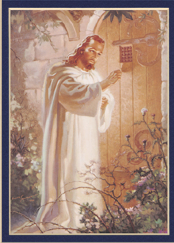
TO CHEW ON: Behold I stand at the door and knock. If anyone hears My voice and opens the door, I will come in to him and dine with him and he with Me. To him who overcomes, I will grant to sit with Me on My throne, as I also overcame and sat down with My Father on His throne.’” Revelation 3:20-21


The  final church of the seven, Laodicea, has a pretty discouraging report card. It is described as nauseating. It thinks well of itself while it is actually “wretched, miserable, poor, blind and naked." We could call it a church in denial. It is the only church to which Jesus gives no commendation at all.


Some Bible scholars have interpreted these seven messages to the churches as seven dispensations.* They see them as an outline of stages in church history. In their reading:


1. The Ephesus church represents the church at the close of the first century.


2. The Smyrna church represents the church from the beginning of the 2nd century until Constantine (beginning of the 4th century).


3. The Pergamos church is the church of the 4th through 7th centuries.


4. The Thyratira church is the church of the Middle Ages.


5. The Sardis church  represents the church just prior to the Protestant Reformation.


6. the Philadelphia church represents the “true church” throughout all of church history, especially the segment that experiences revival prior to the last days.


7. The Laodicea church represents the church in its final days, prior to its pretribulation rapture. It is characterized by apostasy.


Many Bible teachers feel we’re living in those last days. If we look at current events and line them up with Bible predictions, it’s easy to agree. On many fronts the modern church has fallen into apostasy. Does that mean we’re doomed to capitulate to the same thing ourselves?


No. Because in the end, it is not as a group that we respond to Jesus but individually. That’s why Revelation 3:20 is one of my favorite verses. Jesus comes to me (and you). He knocks on the door of our hearts. He wants to spend time with us, eat with us. As those of us who have welcomed Him into our lives join together, we will continue as a church that delights Him.

PRAYER:
Dear Jesus, come in! Make Yourself at home. Let’s visit, eat together, and live together. Please make Your home in my heart. Amen.

* E. A. Morey, in the study notes to Revelation, New Spirit-Filled Life Bible, pp. 1818-1822.

 *********
Unless otherwise noted all Scripture quotations are taken from the New King James Version®. Copyright © 1982 by Thomas Nelson, Inc. Used by permission. All rights reserved.


Thursday, April 07, 2016

Church report card - 3 (D- to A+)

Image: extrabrandt / pixabay.com
TODAY'S SPECIAL: Revelation 3:1-13

TO CHEW ON: "He who has an ear, let him hear what the Spirit says to the churches." Revelation 3:6,13.


We are in the middle of reading messages to seven early churches from Jesus via the Apostle John.  If we look at them as if they are report cards, we can gain understanding about what God expects of the church that is still Christ's body on earth.

The church at Sardis had a reputation of being alive, but it was actually dead. (Would we call that a D- in report card lingo?) Jesus only commends the faithful few “who have not defiled their garments.”

The church at Philadelphia has the best report so far. It existed in a place of opportunity—an "open door." It was hard-working, persevering and obedient and was promised a place in God’s presence, destined to live with Him forever.

What can we learn about the church and God’s standards for her from Sardis and Philadelphia?


1. God expects us to be watchful and guard our relationship with Him. When we fall, we need to repent (Revelation 3:2,3).

2. God keeps a Book of Life in which He records our names. How we spend our lives on earth will have repercussions in heaven (Revelation 3:4,5).

3. Christ’s ideal for the church is purity. Again and again this purity is pictured as special clothes. Often these are clothes or robes of white (Revelation 3:5, Isaiah 61:10; Revelation 7:9).

4. Some seasons and places are more spiritually fruitful than others. We need to be alert to doors of opportunity that God opens for us (Revelation 3:8).

5. God values our overcoming. Perseverance has an eternal reward (Revelation 3:10-12).

Applying these things to ourselves, we might ask:

  • Are we developing our own relationship with God, or depending on others—our pastor and his Sunday sermon, TV messages, and internet podcasts for spiritual food? Those things are good, but nothing substitutes for getting to know God personally through reading the Bible and prayer.  (I was at the funeral of an old saint yesterday, who was known for his saying: "Get to know God for yourself.")
  • Are we sensitive to the Spirit, and quick to repent when He points out where we've sinned? What do we do when He convicts us, in our reading, watching, thinking, that we're getting tolerating impurity?   
  • Are we alert to opportunities to share Jesus with those around us—the "open doors"?
  • Are we persistent overcomers, or do we find ourselves giving up, giving in, in the face of our society's continued drift from the beliefs and standards we cling to?


PRAYER: Dear Jesus, I wonder what a letter from You to my church would contain. Help me, as an individual church member, to warrant praise from You and not a warning. Amen. 


 *********
Unless otherwise noted all Scripture quotations are taken from the New King James Version®. Copyright © 1982 by Thomas Nelson, Inc. Used by permission. All rights reserved.


Wednesday, April 06, 2016

Church report card - 2 (not straight A's)

TODAY’S SPECIAL: Revelation 2:18-29


TO CHEW ON: "And he who overcomes and keeps My works until the end, to him I will give power over the nations." Revelation 2:26.

Continuing on with these church report cards, today’s reading contains an evaluation for the church at Thyatira.

The Thyratira church was given an A for its work, love, service, faith, and patience. But they tolerated a Jezebel figure  (1 Kings 16:29-31) who “led people into literal and spiritual fornication” (endnotes – New Spirit Filled Life Bible, p. 1820). Jesus warned them that their tolerance and unwillingness to rid themselves of this influence would lead to deadly consequences.

After the warning, Jesus' message to Thyatira continues in a sympathetic tone. To those who have resisted this evil influence, He says, "... I will put on you no other burden. But hold fast what you have till I come." 

Finally He gives them a promise. For those who overcome and stay true to Jesus, the ending is triumphant rule over nations (Revelation 2:27 - compare Psalm 2:8,9).

What can we learn about the church and God’s standards for her from Thyratira?


1. The church has enemies. 1 Peter 4:12-16. Possibly some of the worst are those who infiltrate its membership, causing dissension and disunity (as in Thyratira’s case).

2. Jesus prayed for the unity of His followers (present and future) (John 17:20,21). Unity in the church was also one of the Apostle Paul’s great aspirations for it (1  Corinthians 1:10). 


3. God sometimes uses harsh and unpleasant circumstances to discipline us toward maturity  (James 1:2-4) and repentance(Matthew 18:15-17).  This discipline sometimes comes as punishment for a refusal to repent (1 Corinthians 5:1-5,12)

4. Jesus is sympathetic to our humanity and its challenges. In this regard I love verses like: "A bruised reed He will not break, / And smoking flax He will not quench..." Isaiah 42:3 and
"'Take My yoke upon you and learn from Me, for I am gentle and lowly in heart, and you will find rest for your souls'" (Matthew 11:29).

5. Our lives here on earth are a proving ground and basis for eternal reward (Matthew 19:28,29; 2 Timothy 2:11,12; Revelation 20:6). 


The things in the above list apply to and impact not only church congregations but individuals who make up those churches. Are we experiencing opposition? It shouldn’t surprise us. Are we working for unity. We should be. Are we learning from God’s discipline? Are we persevering, and living in hope because of the amazing future God has prepared for us?


PRAYER: Dear Jesus, what a privilege it is to be part of Your church. Help me to be a healthy member in this, Your body on earth. Amen.


 *********
Unless otherwise noted all Scripture quotations are taken from the New King James Version®. Copyright © 1982 by Thomas Nelson, Inc. Used by permission. All rights reserved.

Tuesday, April 05, 2016

Church report card - 1

This cute little church sits on the Fraser River near Fort Langley, B.C. 

TODAY’S SPECIAL: Revelation 2:1-17

TO CHEW ON: “‘He who has an ear, let him hear what the Spirit says to the churches.’” Revelation 2:7a, 11a, 17a

In a two-chapter section of Revelation, Jesus  speaks to John in a vision and gives him a message for seven early church congregations. It is a type of report card – the kind we got in school – and like all good evaluations, each church’s report begins with a mention of something positive.

Jesus commends the church at Ephesus for its labor, patience and revulsion of all that is evil. He gives kudos to the church at Smyrna for the way it clings to true riches despite outward poverty and opposition. He compliments the church at Pergamos for its steadfastness even though it is located in the very hub of Satan’s territory.

Then comes the bad news. The Ephesus church has lost its first love. The Smyrna church is tolerating some blasphemers and is fearful of suffering. The Pergamos church is giving a platform to false teachers. To each congregation Jesus ends with the admonition to listen to what the Spirit says to the church.

It’s easy to see a reflection of ourselves and our local churches in these particular congregations. However, this passage has me also asking about the big picture. What does the Spirit expect of the church as a whole? What is the standard to which it was, and is being held? What are God’s ideals, hopes and aspirations for it?

There are many. I’ll address several in each of today, tomorrow and the next day when we spend time in this part of Revelation. Here are six as a beginning:

1. The church is God’s idea. It was divinely instituted - 1 Timothy 3:15. 
2. It is called the Body of Christ - 1 Corinthians 12:27.
3. Jesus is the head of it - Ephesians 2:19,20.
4. The church is precious to Him - Ephesians 5:25-29.
5. The Bible refers to the church as Christ’s marriage partner through whom we "bear fruit" - Romans 7:4.
6. Some of His main concerns for her are that she present herself faithful and pure - 2 Corinthians 11:2.

In our time where, in some circles, church-bashing is fashionable, let’s get our focus back on the fact that God loves the church and has a wonderful plan for it. Are you part of a local church congregation? Are you supportive of it? Or do you criticize it and its leaders? What is God’s Spirit saying to you about your local church and your part in it?

PRAYER: Dear God, thank You for the church. Help me to be an asset to my local congregation and uphold its integrity and reputation as part of Your body. Amen

MORE: “New Name” e-card

“And I will give him a white stone, and on the stone a new name...” Revelation 2:17b

When I read this part of today’s passage, I immediately thought of the e-cards available from artist Donna Smallenberg, and specifically the one that was inspired by this verse. If you send e-cards, you may want to check these out. There is a yearly subscription fee – but I’d say it’s well worth it to have a set of such beautiful and inspirational cards at your fingertips.

************
Unless otherwise noted all Scripture quotations are taken from the New King James Version®. Copyright © 1982 by Thomas Nelson, Inc. Used by permission. All rights reserved.

Monday, April 04, 2016

Revelation - cover copy

Image: Pixabay.com
TODAY'S SPECIAL: Revelation 1:1-20

TO CHEW ON: "Grace to you and peace from Him who is and who was and who is to come, and from the seven Spirits who are before His throne and from Jesus Christ, the faithful witness, the first born from the dead, and the ruler over the kings of the earth." Revelation 1:4,5


During the month of April we're going to be reading passages from the book of Revelation one third of the time. Perhaps, like me, you prefer to start a book with a little background—the cover copy, book flaps and endorsements—to see what you're getting into. Today I'm going to do a little of that for Revelation. It's a difficult book at the best of times and I can use all the help available.

So, to start, some big-picture stuff about Revelation (taken from the Introduction of Revelation in the New Spirit-Filled Life Bible, Introduction and notes written by Earl Wesley Morey, pp. 1811-1814 - emphasis added):
Author: John, Jesus' apostle.

Date: 70-95 (some scholars suggest an early, other a later date).

Literary form: A letter: "…Revelation begins (1:4-7) and ends (22:21) as a typical New Testament letter. … Within this letter is "the prophecy" (1:3; 10:11;19:10, 22:6, 7, 10, 18, 19)."

Occasion and Purpose: "The purpose of this message was to provide pastoral encouragement to persecuted Christians by comforting, challenging, and proclaiming the sure and certain Christian hope, together with the assurance that in Christ they were sharing in the sovereign God's method of totally overcoming the forces of evil in all its manifestations." (Wow! Now that puts life, with all its difficulties, in a hopeful perspective.)

Central Message: "the Lord God omnipotent reigns" - Revelation 19:6.

Method of Communication: (This, I think, is key to understanding this kind of writing.) "The Revelation is a cosmic pageant—an elaborate, colorful series of tableaux, accompanied and interpreted by celestial speakers and singers. The spoken word is elevated prose… The music is similar to a cantata. Repeatedly, themes are introduced, later reintroduced, combined with other themes, and developed. … Signs and symbols are essential because spiritual truth and unseen reality must always be communicated to human beings through their senses. Symbols point to what is ultimately indescribable."

Christ in Revelation: "Nearly every title employed elsewhere in the New Testament to describe the divine-human nature and the redemptive work of Jesus is mentioned at least once in Revelation, which, together with numerous additional titles, provides us with our only multidimensional unveiling of the present position, continuing ministry, and ultimate victory of the exalted Christ."

Holy Spirit in Revelation: "The description of the Holy Spirit as 'the seven Spirits of God'   (1:4; 3:1; 4:5; 5:6) is distinct in the New Testament. The number seven is a symbolic, qualitative number conveying the idea of completeness, and when related to God, the idea of perfection. The Holy Spirit is thus denoted in terms of the perfection of His dynamic, manifold activity."

One thing that really fascinates me in the bits I shared above is the claim that Revelation employs nearly all the titles for Jesus found elsewhere in the NT and more. Here's my challenge to myself and to you, if you care to take it up. How many names and titles of Jesus can we find in Revelation? Here's the beginning of my list from Revelation 1:

  • Jesus Christ (Revelation 1:1,2,5)
  • faithful witness (Revelation 1:5)
  • first born from the dead (Revelation 1:5)
  • ruler over the kings of the earth (Revelation 1:5)
  • Alpha and Omega (Revelation 1:8, 11)
  • the Beginning and the End (Revelation 1:8)
  • I am… who is (Revelation 1:8)
  • I am… who was (Revelation 1:8)
  • I am… who is to come (Revelation 1:8)
  • Almighty (Revelation 1:8)
  • the First and the Last (Revelation 1:11,17)
  • Son of Man (Revelation 1:13)

PRAYER:
Dear Jesus, thank You for this encouraging, victorious book. Please open my eyes to its messages to me and application to my life in the days ahead. Amen.

 *********
Unless otherwise noted all Scripture quotations are taken from the New King James Version®. Copyright © 1982 by Thomas Nelson, Inc. Used by permission. All rights reserved.


Sunday, April 03, 2016

Peace

TODAY'S SPECIAL: John 20:19-31


TO CHEW ON: "'Peace be with you....Peace to you!....Peace to you!'" John 20:19,21,26

The peace symbol of the 60s had a subversive message. The U.S. was at war with Vietnam at the time and the peace symbol was in many ways a protest against that war. You wore it around your neck or painted it on your VW as a way of saying you didn't like what your government was doing.

In a way Jesus' pronouncement of peace is just as subversive. He is saying, even though things look bad, even though you disciples have made yourselves some powerful enemies, everything is okay.

Why could He say that?

Because He had settled once and for all the sin issue for them and all mankind. The most important peace there is—peace with God—was now available for them, as it is available for us now.

We know that their lives after the resurrection were anything but peaceful outwardly. They were made fun of, called names, persecuted, arrested, driven from their homes. Yet from this time on the blessing and benediction of "Peace" is sprinkled throughout the New Testament (Ephesians 6:23; Colossians 1:2; 1 Thessalonians 1:1; 2 Thessalonians 3:16; 1 Peter 5:14).

A lack of outward peace may also be our situation. But to us too, Jesus comes saying "Peace be with you! Peace to you... Peace to you." Why? Because we are completely secure in His love. Read what Paul says to the Christians in Rome:

"Since he did not spare even his own Son but gave him up for us all, won’t he also give us everything else? Who dares accuse us whom God has chosen for his own?

No one—for God himself has given us right standing with himself. Who then will condemn us? No one—for Christ Jesus died for us and was raised to life for us, and he is sitting in the place of honor at God’s right hand, pleading for us.

Can anything ever separate us from Christ’s love? Does it mean he no longer loves us if we have trouble or calamity, or are persecuted, or hungry, or destitute, or in danger, or threatened with death? As the Scriptures say, “For your sake we are killed every day; we are being slaughtered like sheep.” No, despite all these things, overwhelming victory is ours through Christ, who loved us.

And I am convinced that nothing can ever separate us from God’s love. Neither death nor life, neither angels nor demons, neither our fears for today nor our worries about tomorrow—not even the powers of hell can separate us from God’s love. No power in the sky above or in the earth below—indeed, nothing in all creation will ever be able to separate us from the love of God that is revealed in Christ Jesus our Lord." Romans 8:32-39 NLT


PRAYER: Dear Jesus, thank You for making a way for us to have peace with God. Help me to experience this peace at a heart level as I trust in You to work everything out in my life for Your good purposes.

MORE: '... a gracious benediction of peace"

"Are you looking unto Jesus now, in the immediate matter that is pressing and receiving from Him peace? If so, He will be a gracious benediction of peace in and through you. But if you try to worry it out, you obliterate Him and deserve all you get. We get disturbed because we have not been considering Him. When one confers with Jesus Christ the perplexity goes, because He has no perplexity, and our only concern is to abide in Him. Lay it all out before Him, and in the face of difficulty, bereavement and sorrow, hear Him say, "Let not your heart be troubled" - Oswald Chambers, My Utmost for His Highest August 26 reading.
*****
Unless otherwise noted all Scripture quotations are taken from the New King James Version®. Copyright © 1982 by Thomas Nelson, Inc. Used by permission. All rights reserved.

Scripture quotations marked NLT are taken from the Holy Bible, New Living Translation, copyright © 1996, 2004, 2007 by Tyndale House Foundation. Used by permission of Tyndale House Publishers, Inc., Carol Stream, Illinois 60188. All rights reserved.


Bible Drive-Thru

Saturday, April 02, 2016

Jesus: cornerstone

“The Cornerstone” by James Tissot (1836-1902)
“The Cornerstone” (1886-1894) 
by James Tissot (1836-1902)

TODAY’S SPECIAL: Psalm 118:15-29

TO CHEW ON: “The stone which the builders rejected
Has become the chief cornerstone.” Psalm 118:22

Psalm 118 was a hymn for the Feast of Tabernacles called a Hallel. The procession of the king, priests and people carried palm branches and sang this song as they approached the temple. In the first part of the psalm the king recalls his victories. In the second (our reading today), the procession moves from the temple gateway to the altar.

Maybe it was the sight of the impressive temple building that brought up the cornerstone imagery. The verses we are focusing on talk about this most important stone  (“It could have been a large stone over a doorway like a lintel; a keystone holding up an arch; or a cornerstone at the base of perpendicular walls” Quest Study Bible, p. 837). The builders in the psalm neglect to put it in, or reject it. The psalmist leaves unstated what will happen to that unfortunate building, but we can imagine!

In our reading in Zechariah a few days ago, we noted that the cornerstone was one of the metaphors used for Messiah (Zechariah 10:4). Here  Jesus quotes the reference to the cornerstone from Psalm 118 as a reference to Himself (Matthew 21:42).  He says that just like the king’s subjects kill the king's son, in the story He has just told, the scribes and Pharisees are rejecting Him and by doing that turning their backs on the foundation or cornerstone of God’s plan of salvation.

In the Easter season just past, as we remembered how Jesus was rejected by the people of His time and crucified, we may have been tempted to look with haughtiness on them, thinking we would never do that if He were with us in person now. But I wonder, sometimes, if we don’t do just that in subtle ways, as we try to twist the gospel  into a more socially acceptable message for the people of our time – people who don’t like to be told that God has set an objective standard of right and wrong, that on our own we can’t attain that standard, and that God sent Jesus to die and rise again so we can be reconciled to Him. He (His incarnation, death and resurrection) is still and will always remain the chief cornerstone and foundation of God’s plan.

PRAYER: Dear Jesus, thank You for coming to earth to fulfill God’s plan to reconcile us to Himself. Help me, as Your child, to make You the cornerstone of my life. Amen


***********
Unless otherwise noted all Scripture quotations are taken from the New King James Version®. Copyright © 1982 by Thomas Nelson, Inc. Used by permission. All rights reserved.


Friday, April 01, 2016

Remember—and thank!

Building a booth - Feast of Tabernacles
Building a booth for the Feast of Tabernacles
TODAY'S SPECIAL: Psalm 118:1-14

TO CHEW ON: "Oh give thanks to the Lord for He is good!
For His mercy endures forever."  Psalm 118:1


You have no doubt noticed how the pain and stress of past torments and troubles fades with time. When I look back on events of ten, fifteen years ago, they have a rosy glow about them. Even the hard times feel like "the good old days."

That phenomenon seems to be in evidence in this psalm. The writer recalls dangers, times of distress, being surrounded by enemies, attacked as if by "bees," manhandled and pushed. Yet the main memory is of God coming to the rescue.

Psalm 118 was part of the Feast of Tabernacles celebration. The Feast of Tabernacles was a main feast of the Jewish year, taking place in our October, five days after the Feast of Atonement. One of its main purposes was to keep alive the memory of how God helped and preserved Israel during her sojourn in the wilderness.

On the first day of that eight-day feast each person helped gather twigs of willow, palm, myrtle or bulrushes to build temporary huts or booths. These booths reminded them of God's protection, preservation, and shelter from heat and storm during their wilderness wanderings. Everyone from children to servants joined in the celebration.

On the eighth and final day of the feast Israel's high priest led a procession of priests and thousands of worshipers. They descended from the Temple Mount to the Pool of Siloam. There the priest filled a pitcher with water, then the procession took another route back to the temple. The priest poured the water on the altar in a ceremony to invoke God's blessing of the "early rains," of October and November, ensuring a spring crop.

As the water was being poured out the temple music (Hallel) began. Psalm 118 was part of the Hallel (Psalm 113-118). Israel's memories of trouble and God coming to their rescue—setting them "in a broad place," being on their side, quenching enemies "like a fire of thorns," being their strength, song and salvation.

We don't have to wait for a special feast day to praise God for how He has similarly been with us and helped us. Let's take some time today to "Give thanks to the Lord for He is good! For His mercy endures forever."


PRAYER: Dear God, thank You for all the times You have preserved me and my family—through childbirth, accidents, work firings, illnesses, moves, travels and trips… You are good! Amen.


MORE: More about the feast of Tabernacles (also called Feast of Booths, and Sukkot)

Learn more about the Feast of Tabernacles from these web articles:

  • Sukkot (Article on Wikipedia)


***********

Unless otherwise noted all Scripture quotations are taken from the New King James Version®. Copyright © 1982 by Thomas Nelson, Inc. Used by permission. All rights reserved.

Bible Drive-Thru

Thursday, March 31, 2016

Metaphors for Messiah

Tent anchored with tent pegs (Image: pixabay.com)
TODAY'S SPECIAL: Zechariah 10:1-12

TO CHEW ON: "From him [Judah] comes the cornerstone,
From him the tent peg,
From him the battle bow
From him every ruler together." Zechariah 10:4


In this passage, which Bible scholars believe to be prophetic of Messiah, we get some interesting metaphors. Messiah is likened to a:

"Cornerstone": As part of a building, the cornerstone can be ceremonial but is most often used in the Bible to signify an essential, indispensable, and basic element of the Kingdom of God. Jesus referred obliquely to Himself as the cornerstone in Matthew 21:42-44, Paul referred to Jesus as the cornerstone in Ephesians 2:20, as did Peter in 1 Peter 2:6-8.

"Tent peg": Israelites used tent pegs in much the same way we do: "…the [tent] covering is spread over poles, which are fastened in the ground. The edges of the cover have leather loops, to which are attached cords of the tent, which are sometimes stretched out tight and fastened to the ground by means of iron or wooden pins…" - James M. Freeman, Manners and Customs of the Bible, p. 244, 245.

"Battle bow": "The war bow used in fighting" - Easton's Bible Dictionary.

"Ruler" - This is not so much a metaphor as a statement of how Messiah is related to the people. He is the ruler of rulers. I like how the Amplified Bible puts this verse: "Every ruler shall proceed from him" - Zechariah 10:4 AMP.

My Bible's notes give this cryptic interpretation of Zechariah 10:4:
"The Messiah is the cornerstone, the tent peg on which humankind's destiny hinges, the battle bow that conquers, and the ruler over all" - D. W. Shibley, New Spirit-Filled Life Bible, p. l259.

Is Jesus, who we believe is the fulfillment of these Messiah prophecies, these things to us:

- Our cornerstone—the  foundation and essential element of our faith (Ephesians 2:19-22)?

- Our tent peg—that earthly connection of our human tent to God the Father (Romans 14:8)?

- Our battle bow—the weapon by which we conquer our own sinful bent and wage war on the sin around us (2 Corinthians 10:3-6)?

- Our ruler—the boss of bosses to us (Galatians 2:20)?


PRAYER:
Dear Father, thank You for Jesus, who fulfilled these Messianic prophecies of the Old Testament and is still at work in the world and in me through the Holy Spirit. May He be my cornerstone, tent peg, battle bow and supreme ruler today. Amen.

 *********
Unless otherwise noted all Scripture quotations are taken from the New King James Version®. Copyright © 1982 by Thomas Nelson, Inc. Used by permission. All rights reserved.

Scripture quotations marked AMP are taken from the Amplified® Bible,
Copyright © 1954, 1958, 1962, 1964, 1965, 1987 by The Lockman Foundation
Used by permission." (www.Lockman.org)

Wednesday, March 30, 2016

Heaven - a fabled or real destination?


TODAY'S SPECIAL: Isaiah 65:17-66:6

TO CHEW ON: "For behold I create new heavens and a new earth; And the former shall not be remembered or come to mind." Isaiah 65:17

I used to subscribe to "A Word A Day" a five times per week article that focused on interesting words. At one point the featured words were all names of what writer Anu Garg called "fabled destinations, places that exist only in our collective imagination." He included the Land of Oz, Shangri-la, the Garden of Eden, utopia and cockaigne. On reading today's passage, I think the "new heaven and new earth" the prophet describes would fit right in. Only, as people of faith, we resist the implication that this is a "fabled destination" existing only in imagination. Instead, we believe that the description is of someplace real, and that someday we will actually experience its delights.

Let's take a minute to note them:

1. New heavens and a new earth (Isaiah 65:17). A brand new creation? That's what it sounds like.

2. It will be a place where regrets and bad memories don't come to mind (Isaiaj 65:17).

3. There will be an abundance of joy ("the voice of weeping shall no longer be heard in her, nor the voice of crying" Isaiah 65:18,19).

4. There will be longevity (Isaiah 65:20).

5. There will be productive, satisfying work (Isaiah 65:21,22).

6. Families will be blessed (Isaiah 65:23).

7. God's responsiveness will not be hindered (Isaiah 65:24).

8. Even members of the animal kingdom that now prey on each other will coexist in peace (Isaiah 65:25).

When will these things happen? A footnote in my Bible says, "These conditions will likely begin during the Millennium (Revelation 20:4-6)."

With our feet firmly planted on earth and our lungs full of the oxygen of here and now, it's easy to be cynical when reading such a description. It does all sound like someone's hopeful imagination gone wild. Until we look our mortality square in the face. As Joni Eareckson Tada says in her book Heaven:
"We really don't believe it's all going to end, do we? If God hadn't told us differently, we'd all think this parade of life would go on forever.
"But it will end. This life is not forever, nor is it the best life that will ever be. The fact is that believers are headed for heaven. It is reality. And what we do here on earth has a direct bearing on how we will live there. Heaven may be as near as next year, or next week; so it makes good sense to spend some time here on earth thinking candid thoughts about that marvelous future reserved for us." p. 15

PRAYER: Dear God, thank You for these glimpses of Your future for me. Help me to live with their reality in mind. Amen.


MORE:  Victor Hugo at 80+

"When Victor Hugo was past eighty years of age he gave expression to his religious faith in these sublime sentences:

'I feel in myself the future life. I am like a forest which has been more than once cut down. The new shoots are livelier than ever. I am rising toward the sky. The sunshine is on my head. The earth gives me its generous sap, but Heaven lights me with its unknown worlds.


'You say the soul is nothing but the resultant of the bodily powers. Why, then, is my soul more luminous when my bodily powers begin to fail? Winter is on my head, but eternal spring is in my heart. I breathe at this hour the fragrance of the lilacs, the violets, and the roses as at twenty years. The nearer I approach the end the plainer I hear around me the immortal symphonies of the worlds which invite me. It is marvelous, yet simple."

Quoted in Streams in the Desert by Mrs. Charles E. Cowman (May 31st reading).

*********
Unless otherwise noted all Scripture quotations are taken from the New King James Version®. Copyright © 1982 by Thomas Nelson, Inc. Used by permission. All rights reserved.

Do your 8-12-year-olds have daily devotions? Point them to Bible Drive-Thru.

Tuesday, March 29, 2016

What a teacher!

TODAY’S SPECIAL: Luke 24:33-53

TO CHEW ON: “And He opened their understanding that they might comprehend the Scriptures.” Luke 24:45


The resurrected Jesus appeared to His disciples numerous times. Their conflicted states of mind when they saw Him are evident by His words to them: Peace to you,” “Why are you troubled? And why do doubts arise in your hearts? He knew they needed convincing that He really was Jesus. And they needed an understanding of the meaning of His life and death. They had had the right idea of His identity (Messiah) but the wrong idea of what kind of kingdom He would establish and how He would do it.

Jesus taught them how His life and death fulfilled plans of a kingdom way bigger than any they had imagined – one that would encompass “all nations” Luke 24:47. He showed them how it was all there, in the prophetic Old Testament Scriptures. His explanation helped them 'get it.'

Still today we have blind spots about what God’s plan is about. Various teachers get on their various hobby horses to expound their views of how it works. Emphasis on certain Bible passages can lead to beliefs that the Gospel is mainly about personal prosperity or gaining God’s favor by living a prescribed outward lifestyle. Putting faith in human ideas that seem to make more sense than God’s, can lead to a lopsided gospel that focuses on God’s mercy and grace to the exclusion of His holiness, righteousness and justice.

How can we know that what we believe is truth? I would suggest three principles - two of them modeled by Jesus in this passage:

1. Jesus used the Scriptures. In His time this was the writings of the patriarchs and prophets. He frequently quoted the Psalms, Isaiah and other writers. God’s truth is based on the Scriptures and that means all of it, not just proof texts.

2. We need God as our teacher. Here the disciples’ teacher was Jesus - God the Son. Our teacher, now that Jesus has ascended to heaven, is God the Holy Spirit. (1 Corinthians 2:10-13; John 14: 16-17, 26)

3. We need to line up our lives with what we know; the word for that would be obedience. Romans 1 gives us a sobering picture of what happens to our “understanding” when we live in disobedience.

PRAYER:
 Dear Holy Spirit, please open my understanding to comprehend God's plan and my part in it. Then fill me with the power to share it with others.

MORE: I believe that two ways the Holy Spirit uses to teach us what the Bible means is through the use of our own common sense and  the wisdom of others. An article titled “22 Principles of Biblical Interpretation: How to Eliminate Apparent Bible Contradictions” begins:

“One of the major reasons why people have different ideas concerning what the Bible says is that they use different rules or standards for interpreting it. We believe that the following principles, called “canons of interpretation” are essential to understand and apply if there is to be any hope of Christians getting to the truth when they read the Bible.”
It suggests some excellent principles to use when interpreting the Bible.

"22 Principles of Biblical Interpretation: How to Eliminate Apparent Bible Contradictions" 

Are there any of these principles with which you disagree?

**********
Unless otherwise noted all Scripture quotations are taken from the New King James Version®. Copyright © 1982 by Thomas Nelson, Inc. Used by permission. All rights reserved.

Monday, March 28, 2016

Open my eyes

"Supper at Emmaus" - Rubens
TODAY'S SPECIAL: Luke 24:13-32

TO CHEW ON: "But their eyes were restrained …. Then their eyes were opened…" Luke 24:16,31


This is one of my favorite stories in the Bible, perhaps because it's been my experience.

It's the third day after the crucifixion. Two disciples are walking from Jerusalem to Emmaus, deep in discussion about what has lately happened with their rabbi, Jesus. At one point they're joined by a stranger. He asks them the subject of their sad conversation. They explain it all—what Jesus was like, their hopes for and in Him, His very recent death by crucifixion, followed by the mysterious disappearance of his body, and the hearsay sightings of Him, alive.

He listens and then He speaks. I love how Henri Nouwen tells this next part in his little book With Burning Hearts—A Meditation on the Eucharistic Life.

"He speaks of things they already knew: their long past with all that happened during the centuries before they were born…. It was an all-too-familiar story. Still it sounded as if they were hearing it for the first time.

The difference lay in the storyteller! … The loss, the grief, the guilt, the fear, the glimpses of hope, and the many unanswered questions that battled for attention in their restless minds, all of these were lifted up by this stranger and placed in the context of a story much larger than their own. What had seemed so confusing began to offer new horizons; what had seemed so oppressive began to feel liberating; what had seemed so extremely sad began to take on the quality of joy! As he talked to them, they gradually came to know that their little lives weren't as little as they had thought, but part of a great mystery that not only embraced many generations, but stretched itself out from eternity to eternity" - p. 45,46 (emphasis added).

And isn't that what we discover too when we meet Jesus? After we've dumped on Him our whole sad situation, He opens our eyes to our place in a story much bigger than our own. And we begin to understand that there is a reason for the hardest parts of our lives, while other aspects, those that we've nurtured perhaps to make us feel good about ourselves or look good in the eyes of the world, don't really fit and should be heaved overboard.


PRAYER:
Dear Jesus, please open my eyes. Help me to see Your story and my place in it as it relates to my circumstances and the everyday situations that I face. Amen.

 *********
Unless otherwise noted all Scripture quotations are taken from the New King James Version®. Copyright © 1982 by Thomas Nelson, Inc. Used by permission. All rights reserved.


Sunday, March 27, 2016

Pinch me - is this really happening?

He is risen! He is risen indeed! (An Easter coloring page) - Image: pixabay.com

TODAY’S SPECIAL: Luke 24:1-12

TO CHEW ON: “And their words seemed to them like idle tales, and they did not believe them.” Luke 24:11

Joanna  woke before it was light. Her first moments in the sweet forgetfulness of just-waking were pleasant. But then the heavy sense of something wrong returned. Oh yes. Jesus, her rabbi, friend and hero, was dead (Luke 8:1-3). 

Ugly scenes replayed in her memory: Word that Jesus had been arrested. The terrifying bloodthirsty shouts of the mob. Jesus bruised, bloody and half-naked, dragging His cross through the city. Soldiers nailing Him to the wood and hoisting the structure upright on Golgotha. Hours hanging there. The uncanny darkness. His last agony-filled cries. His last labored breath. Dead.

Now she disentangled herself from her coverings. It was early but their errand demanded the cover of pre-dawn darkness. Dressed, she picked up the bundle of embalming spices and hurried out to meet the others at the appointed place.

Their discussion of their oversight in forgetting to bring someone to roll away the heavy stone from the tomb entrance stopped as the site came into view. The mouth of the grave was black – open. What? Who?

They went in. No body. Instead, two men in shining clothes. Their words – “Why do you seek the living among the dead? He is not here but is risen!” – it took a while for them to sink in. It couldn’t be, could it?

Incredulous and filled with questions they returned to the others with the news of what they had seen and heard. Some recalled His predictions of just this happening. Others were suspicious of the Jews and the Romans. It took hours, days and numerous post-death appearances by Jesus before they were all convinced He really had risen.

The disciples’ reluctance to accept this incredible good news shouldn’t surprise us. For Jesus’ death and resurrection had changed everything – and it takes a while to recast paradigms and rebuild frames of reference. Now His teaching about the Kingdom of Heaven took on a new significance. His explanations of who He was and what He had come to accomplish began to make sense. He was a triumphant king, but in an altogether different way than they had expected Him to be. He had paid the price for sin. He had conquered death.

Joanna probably awoke the next morning – and the next and the next – with the sense you and I feel on the morning after our favorite team has won the Stanley Cup, or the World Series, or the Brier or the Scotties, or our favorite athlete has won a gold medal at the Olympics, or we had just successfully birthed (after months of anticipation, and hours of painful labor) a baby!

PRAYER: Thank You, Jesus, for all that Your death and resurrection accomplished for the world – and for me. Please give me a greater appreciation for their meaning and significance. Amen.


MORE:
See What a Morning (Resurrection Hymn)” Stuart Townend


Today the church celebrates Easter. Ponder and enjoy the liturgy for Easter.

Collect that begins the service:

"O God, who for our redemption gave your only-begotten Son to the death of the cross, and by his glorious resurrection delivered us from the power of our enemy: Grant us so to die daily to sin, that we may evermore live with him in the joy of his resurrection; through Jesus Christ your Son our Lord, who lives and reigns with you and the Holy Spirit, one God, now and for ever. Amen."
**********
Unless otherwise noted all Scripture quotations are taken from the New King James Version®. Copyright © 1982 by Thomas Nelson, Inc. Used by permission. All rights reserved.

Saturday, March 26, 2016

Be afraid of the dark

Image: Jingoba / pixabay.com
TODAY’S SPECIAL: Luke 23:26-56

TO CHEW ON: “Now it was about the sixth hour, and there was darkness over all the earth until the ninth hour. Then the sun was darkened.” Luke 23:44-45a


Darkness is not a real, tangible thing. Rather it is the absence of something real, tangible and measurable – light. There can be degrees of darkness with complete, utter darkness being the complete and utter absence of any light.

God’s first positive act of creation, which began to bring order to the chaos of earth, was to create light (before He created the sun, moon and stars (Genesis 1:2,3), which brings up the question – what was that light like; did it emanate from something, or somewhere, or Someone?).

This physical phenomenon of light and darkness is used throughout the Bible in a symbolic way, where light is equated with God and darkness the absence of God. At various times (this being one of them) God sent or allowed supernatural darkness. Another such time was the ninth plague of Egypt when the darkness was so thick the people felt it, couldn't see each other, and were confined to their homes for three days (Exodus 10:21-23).

I imagine there was some of that quality of palpability and isolation to the noon to 3:00 p.m. darkness that accompanied Jesus' death on the cross. Did He feel cut off from God as He hung there?  In Matthew’s telling of this incident just after he describes the darkness, come the words of Jesus: My God, My God, why have You forsaken Me?” ( (Matthew 27:45,46) ). This was the utter darkness of God having withdrawn Himself completely.

It’s easy to shrug this off as a phenomenon that has nothing to do with us. But it does.
- The power of darkness controls us before we come to God (Colossians 1:13,14).
- Our preference is for darkness (John 3:19).
- When we come to God we pass into the realm of light (Ephesians 5:8-13).
- But even here we can quench light by living in darkness (1 John 1:6). 
- Jesus warned against the possibility of being thrown into darkness that lasts forever (Matthew 25:14-30).

How awesome and frightening must have been the darkness on the day of Jesus’ death with its effect on even hardened soldiers. His identification of what made it terrible – God’s absence – is instruction to us. The more God has of us, and we of Him, the more there is no room for darkness.

PRAYER: Dear Jesus, thank You for enduring the agony of the darkness of God’s absence to buy my salvation. Help me to live always in Your light.

MORE:  Today some churches celebrate Holy Saturday, others the Vigil of Easter
  • The liturgy for Easter Vigil is HERE.
  • The liturgy for Holy Saturday is HERE. It begins with this collect:
"O God, Creator of heaven and earth: Grant that, as the crucified body of your dear Son was laid in the tomb and rested on this holy Sabbath, so we may await with him the coming of the third day, and rise with him to newness of life; who now lives and reigns with you and the Holy Spirit, one God, for ever and ever. Amen."
*********
Unless otherwise noted all Scripture quotations are taken from the New King James Version®. Copyright © 1982 by Thomas Nelson, Inc. Used by permission. All rights reserved.

Related Posts Plugin for WordPress, Blogger...