Showing posts with label mission. Show all posts

Saturday, October 13, 2018

Called and led

Image: Pixabay
TODAY’S SPECIAL: Acts 15-16; Psalm 126

TO CHEW ON: “Now when they had gone through Phrygia and the region of Galatia, they were forbidden by the Holy Spirit to preach the word in Asia. After they had come to Mysia, they tried to go into Bithynia but the Spirit did not permit them… Now after he had seen the vision (of a man saying ‘Come over to Macedonia to help us’) immediately we sought to go to Macedonia concluding that the Lord had called us to preach the gospel there.” Acts 16:6-7,10

A reader, Judy, tells of a missions trip she took to South Africa (used with her permission):

First of all God supplied the funds. In 1966 I taught school on First Nations reserves north of Souix Lookout. I bought two large paintings for $35 each from Norval Morrisseau when he visited the isolated community I was teaching in. During our years of teaching in the Arctic they hung unframed, tacked up with push pins in several homes.

Fast forward ahead to 2008 when after reading something on Becky's blog I said to Christian, Where are those paintings? I'd done some research on the Internet and realized they just may have some value. I sold one of the paintings for $6,500. Christian said immediately that I should do something very special with this unexpected windfall. I like to imagine our Lord saying on the day I bought the painting, "Do I ever have a surprise for you. It will be arriving in 42 years."

I heard about the volunteer group in South Africa, again through Becky's blog. One of her daughters had worked in an orphanage and had had a very positive experience. I wanted to teach and found a school along the east coast that seemed to be a good fit. I did make it clear that I did not want to teach computers or run an after school recreation program. They said that was fine I could just be in a classroom.

I was picked up in East London by a different volunteer group than the one I'd communicated with. I thought that was a little unusual. The next day I found out that the first group had contracted me out to a second group AND . . . . . perhaps you can guess what is coming; they wanted me to teach computers and run an after school recreational program. For a few moments to use my mother's term, I was floored. Then I thought about the lessons I'd learned in home studies the previous winter studying the life of Abraham. Don't focus on the "problem." Focus on God.

I was sure God could/would enable me to do the tasks but I also knew the desire of my heart and where my strengths lie. I had immediate assurance from Him that there would be a solution to the situation. It took a couple of days until I was at King's Playschool. That was the last name of the people who ran a rural facility out of their home. I had noticed the verse "They shall shine like stars in his crown" from the song "When He Cometh" based on Zech. 9:16, on their sign. So .. . . I knew they were believers but they didn't know I was.

When I had the opportunity I told Tracy that I was a follower of Jesus Christ, that I knew He had led me to South Africa but that I didn't know what I was supposed to do. She said she'd been praying for someone to relieve her of classroom duties while she dealt with the rest of her life. Here's what was on her plate.

Pentecostal Pastor's wife of a growing church.
Home schooling their 3 children
Running the school of 50 children and 10 employees
In the process of adopting two black babies who had been abandoned
Teaching a class

I had three glorious weeks of teaching eager 5 year olds. Most of my ideas were new for them… Both Tracy and I felt so blessed…. Who, but our loving Father, would take a woman from northern North America and team her up with a woman from Southern South Africa at exactly the right time! These kinds of experiences just light a fire under my faith which was already strong. An entire year later I still marvel at it and hope I always do.

They light a fire under my faith too! I never cease to marvel at God’s way of putting together the circumstances of our lives to work for His kingdom and our blessing if that’s our desire.

(Even as I'm preparing to repost this, a song is playing on my husband's computer, reminding me of the same truth: "In His time, in His time, He makes all things beautiful in His time")

In today’s reading Paul and Silas were shunted off the track they were on by the Holy Spirit. How that looked, I’m not sure – a feeling of uneasiness, a prophetic message? However it happened, they knew they were not to go to Asia. At Bithynia likewise “the Spirit did not permit them.” The vision to go to Macedonia, then, was most welcome. Here was clear direction .

In Philippi – one of the largest cities in Macedonia – was Lydia and a band of believers who met at the riverside regularly for worship. Can you imagine how she must have felt the morning Paul and Silas showed up and told her the story of how they got there.

Judy’s story shows us that God still works in behind-the-scenes ways. It freights these familiar verses with a new and personal relevance:

“Now He who searches the hearts knows what the mind of the Spirit is, because He makes intercession for the saints according to the will of God. And we know that all things work together for good to those who love God and to those who are called according to His purpose. Romans 8:27-28

PRAYER: Dear God, please put my life in the stream of Your usefulness. Help me to hear Your Spirit’s instructions and obey them. Amen.


PSALM TO PRAY: Psalm 126

**************
Unless otherwise noted all Scripture quotations are taken from the New King James Version®. Copyright © 1982 by Thomas Nelson, Inc. Used by permission. All rights reserved.

Friday, October 12, 2018

One secret to perseverance

Illustration from Lyman Abbot Commentary on Acts

Oriental Prayer Meeting - Illustration from Lyman Abbot Commentary on Acts
Oriental Prayer Meeting
TODAY'S SPECIAL: Acts 13-14; Psalm 125

TO CHEW ON: "So being sent out by the Holy Spirit, they went down to Seleucia, and from there they sailed to Cyprus." Acts 13:4

What strikes me about the disciples here is their lack of personal agendas. They have no five-year plan to evangelize the world. There seem to be only two items on their to-do list: hear and follow God's instructions.

When those instructions come via the Holy Spirit saying "Separate to Me Barnabas and Saul for the work to which I have called them" there is immediate obedience. No hanging back with—'Well, we had planned to visit our families, take a vacation, write a book…'

Their sense of being appointed and sent by God Himself on this mission was, I think, key to how they would handle what was ahead on this, Paul's first missionary journey (called Saul here, but his name was later changed to Paul). They didn't know it yet, but they would face opposition from a sorcerer, city-to-city hassling by the Jews, the desertion of a team member,  the threat of stoning in one place and actual stoning in another (Acts 13 & 14).

The lesson I take from this is  that I too need to listen to God's voice when I see opportunities to be sure that what I take on is by His leading and not my own idea. I need to be open to new tasks in areas I hadn't even considered. And when I don't hear anything specific, I need to be content to carry on faithfully with what I'm doing, knowing He is perfectly able to let me know when it's time to change course.

This sense of God's call is important because it is sure that I, that you, will face opposition, discouragement, misunderstanding, maybe even threats and physical danger while on Kingdom assignments. The knowledge that God has called us to any specific task will help us to persevere.

PRAYER: Dear God, thank You for this clear picture of how You worked in Bible times. Help me to be as available as Paul and Barnabas were, and to follow Your direction, knowing that if You call me to a job, You will see me through it no matter what comes my way. Amen.

PSALM TO PRAY: Psalm 125

The Bible Project VIDEO: Acts - Part 2 of 2 (Ch. 13-28) Read Scripture Series 


***********

Unless otherwise noted all Scripture quotations are taken from the New King James Version®. Copyright © 1982 by Thomas Nelson, Inc. Used by permission. All rights reserved.


Saturday, December 16, 2017

What has God chosen you for?

Signet ring - with the image of Childeric

TODAY'S SPECIAL: Haggai 2:1-23

TO CHEW ON: "'In that day,' says the Lord of hosts, 'I will take you Zerubbabel My servant, the son of Shealtiel,' says the Lord, 'and will make you like a signet ring; for I have chosen you,' says the Lord of hosts." Haggai 2:23

Zerubbabel was a leader of the Hebrew exiles returning from Babylon in 537 B.C. He was a governor and is mentioned in Ezra, Nehemiah, Haggai and Zechariah. In the New Testament, he shows up in the lineage of Jesus (Matthew 1:1-17 - Zerubbabel is mentioned in verse 12).

In our reading today we see one reason he was a significant Bible character. It is because God had a specific and special role for Zerubbabel in accomplishing His purposes. Here's what God wanted to do:

"I will shake heaven and earth. I will overthrow the throne of kingdoms; I will destroy the strength of the Gentile kingdoms. I will overthrow chariots and those who ride in them... (Haggai 2:21-22).

Zerubbabel was the man God picked for that task:

"I will take you, Zerubbabel...and will make you like a signet ring; for I have chosen you..." Haggai 2:23.

Throughout the Bible we can trace the pattern of God choosing an individual when He wants to accomplish some special purpose.
  • When God wanted to do something about wicked humanity but still save some, He chose Noah (Genesis 6:5-14).
  • When God planned to free the Israelites from the tyranny of Midian, He chose Gideon (Judges 6:11-16).
  • When God wanted the Gospel spread to Gentiles, kings, and Jews, He chose Saul/Paul (Acts 9:1-16).

In his book Experiencing God, Henry Blackaby says:

God never asks people to dream up something to do for Him. We do not sit down and dream what we want to do for God and then call God in to help us accomplish it. The pattern in Scripture is that we submit ourselves to God. Then we wait until God shows us what He is about to do, or we watch what God is already doing around us and join Him"  - Henry Blackaby, Experiencing God, Workbook, p. 34.

The challenge for us, then, is to resist going down a self-determined path. It means placing our confidence in God, not ourselves. We seek God's kingdom instead of what the world approves of and admires. We look for God's perspective in every circumstance instead of looking at how circumstances can serve us. Applying this viewpoint to life and work, we wait until we perceive God's activity before we decide what projects we should work on, instead of starting something on our own initiative and then asking God to bless it.

PRAYER: Dear God, please help me to put this into practice in my life. I need the spiritual perception to see where You are at work. I need wisdom to understand what this means for me. I need courage to cast aside self-generated projects in favour of assignments that come from You. Amen.

MORE: Signet rings

In ancient times, official documents contained a seal.  This was an impression or imprint on the document often made in a blob of wax. It told the recipient that the document was authentic.

Such seals were sometimes imprinted by pressing the ring the ruler wore (a signet ring) into the soft wax.

Wikipedia says of signet rings:
The wearing of signet rings (from Latin "signum" meaning sign) goes back to ancient Egypt; the distinctive personal signature was not developed in antiquity and most documents needed a seal. The tradition continues, especially among the armigerous, in European and some other cultures.  
Because it is used to attest the authority of its bearer, the ring has also been seen as a symbol of his power, which is one explanation for its inclusion in the regalia of certain monarchies. 
From "Seal (emblem)"
 So we see, when God calls Zerubbabel a signet ring, He is referring to the power and authority He has given this man He has chosen for this job.

*********
Unless otherwise noted all Scripture quotations are taken from the New King James Version®. Copyright © 1982 by Thomas Nelson, Inc. Used by permission. All rights reserved.

Saturday, September 30, 2017

Shining legacy

Milky Way (Image: Pixabay)
TODAY’S SPECIAL: Daniel 12:1-13

TO CHEW ON: “Those who are wise shall shine
Like the brightness of the firmament
And those who turn many to righteousness
Like the stars forever and ever." Daniel 12:3


Some years ago when we were cleaning up Mom’s apartment, preparing to move her to a tiny suite a fraction of the size of where she had lived, there was much stuff to dispose of. “Take this or that as a keepsake,” she’d urge us kids and grandkids. Very often the answer was “No thanks.” Mom's stuff was not what her family wanted as the legacy of this lovely lady.

Like my mom’s main legacy did not consist of stuff, neither does the legacy of the wise that Daniel speaks of in Daniel 12. Instead, we all understand the wish to leave a lasting legacy and hope that ours will be just that. Our verse today tells us that we do this when we “turn many to righteousness.” What does that mean?

The Amplified version expands on the phrase: “turn many to righteousness” (to uprightness and right standing with God).” The Message rephrases it to: “…those who put others on the right path to life ...” An expression used in many Christian circles to describe this activity is soul winning. Here are some conclusions about soul winning we can draw as we look at Bible passages that talk about it and the people who do it.

1. Soul-winning springs from the fellowship-desiring heart of God.- Luke 14:16-23.
2. It flows out of a right relationship with God - Psalm 51:12,13.
3. Soul-winners are motivated by their concern for others- James 5:20
4. The first soul-winners were trained by Christ.  He is the great soul-winning trainer - Matthew 4:19; Mark 1:17
5. Soul-winners are willing to make great personal sacrifice to succeed - 1 Corinthians 9:19,20.
6. They are vigilant over the authenticity of their lives and what they teach - 1 Timothy 4:16.
7. Successful soul-winners realize their actions count as much as – may be more than – their words - 1 Peter 3:1.
8. Soul-winners are wise - Proverbs 11:30.
9. They consider soul-winning an assignment from God - 1 Thessalonians 2:1-4
10. Soul-winners don’t need ideal circumstances to be successful- Philemon 1:10
11. They persevere despite a lack of visible results - 1 Corinthians 7:12-16
12. The legacy they leave “…will shine… like the stars forever and ever.” - Daniel 12:3.

I ask myself, am I working on leaving such a legacy? Are you?

PRAYER:  Dear God, thank You for entrusting me with the privilege and responsibility of influencing lives for You. Please teach me how to do this better. Amen.


MORE: Rita Springer: "All My Days"


*************
Unless otherwise noted all Scripture quotations are taken from the New King James Version®. Copyright © 1982 by Thomas Nelson, Inc. Used by permission. All rights reserved.


Friday, August 11, 2017

How to have beautiful feet

TODAY’S SPECIAL: Romans 10:1-21

TO CHEW ON: "How then shall they call on Him in whom they have not believed? And how shall they believe in Him of whom they have not heard? And how shall they hear without a preacher? And how shall they preach unless they are sent? As it is written: 'How beautiful are the feet of those who preach the gospel of peace, Who bring glad tidings of good things!'" - Romans 10:14,15


This passage tells us some foundational things about the gospel (good news).
1. Its content is simple. To be saved (that would be saved from eternal separation from God) all we need to do is call on Jesus.

2. We nail it down with our words. This faith (calling on Jesus) works together with our confession (speaking about our faith) to cement God’s work in our hearts.

3. The gospel is for any- and everyone. Race or ethnic background is no consideration.

4. God needs and uses people to spread it.

Has it ever struck you that the feet of the gospel spreaders are called beautiful, and not their mouths? This says something about the importance of spreading the gospel far and wide.

Though not all of us may be sent to do this in a physical, cross-the-ocean kind of way, we can still all have a part in Operation Beautiful Feet.
  • We can support the ones God calls to go physically – with money, prayers, and thoughtful service when they return on furlough (like supplying a place to live, vehicle etc.).
  • We can support organizations that translate and distribute the Bible to peoples around the world (like Wycliffe, and our national Bible Society).
  • We can now go virtually. With the internet, distance and boundaries have all but disappeared. Web sites proclaiming the gospel abound. (Over the 2+ years my children’s devotional has been running, for example, people from dozens of countries have visited. If you write a blog, I’m sure you’ve had the same experience.)
  • Of course, no matter how much we feel “sent” to stay home, there’s nothing stopping us from taking the good news next door, across the street, across town – using our beautiful feet to reach our neighbors.

I ask myself, how have I done in the beautiful feet department? How have you? As we work together, we can accomplish the beautiful feet goal: “Their sound has gone out to all the earth, and their words to the end of the world.” Romans 10:18


PRAYER: Dear God, please make me more aware of my responsibility (and privilege) to share the gospel wherever I am and by whatever means I have. Amen.

MORE:
“Shout to the North” by Delirious


***********
Unless otherwise noted all Scripture quotations are taken from the New King James Version®. Copyright © 1982 by Thomas Nelson, Inc. Used by permission. All rights reserved.

Saturday, June 10, 2017

The Kingdom—already, not yet

TODAY'S SPECIAL: Matthew 10:1-15

TO CHEW ON: " ' And as you go, preach saying, "The kingdom of heaven is at hand." Heal the sick, cleanse the lepers, raise the dead, cast out demons. Freely you have received, freely give.' " Matthew 10:7,8

Jesus spoke a lot about a spiritual kingdom (sometimes called the kingdom of heaven, sometimes the kingdom of God).
  • He promised that the poor in spirit and the persecuted would inherit it (Matthew 5:3,10).
  • He taught us to pray for its coming (Matthew 6:10).
  • He told Nicodemus the way to enter it was to be born again (John 3:3).
  • He told Pilate that His kingdom was not of this world (John 18:36).
  • And yet here, He tells His disciples it is "at hand" ("has drawn near").

It's interesting to notice the details of the job on which Jesus sends the disciples and what they say about the kingdom. I think we can conclude, by Jesus' job description, that some things are incompatible with His kingdom:

- Sickness ("heal the sick").

- Leprosy ("cleanse the lepers"). How was leprosy different from other sickness? For one it was a chronic condition or conditions. Two - it made those infected unclean outcasts. There is no place for such stigma in the kingdom.

- Death ("raise the dead").

- Demons ("cast out demons"). I don't know how much power and influence in this world and our society we credit to the demonic. That its influence is more pervasive than ever I have no doubt, given modern curiosity about and fascination with the paranormal.

Though the kingdom is something we have yet to see in its full flower, we do see glimmerings of it now in the operation of Christ's body on earth—the church. For Jesus said while still on earth, " '… the Kingdom of God is within you' " - Luke 17:21. And He commissioned the disciples (who became the church) to be witnesses to Him and His teachings, which included this message of the kingdom (Acts 1:8).

May the kingdom of heaven find fertile ground in my life and yours!

PRAYER: Dear Jesus, I long to see and experience kingdom life to the full, as much as it's possible here on earth. May its presence be operating in and through my life. Amen.

MORE: The Kingdom—"already," and "not yet"

Wayne Grudem in his Systematic Theology: An Introduction to Biblical Doctrine quotes George Ladd on this topic. Ladd summarizes five ways the church and the kingdom are related (I'll just quote the points; he elaborates on each point and supports with scriptures):
1. The church is not the kingdom.
2. The kingdom creates the church.
3. The church witnesses to the kingdom.
4. The church is the instrument of the kingdom.
5. The church is the custodian of the kingdom.

Grudem concludes:
 "Therefore we should not identify the kingdom of God and the church, nor should we see the kingdom of God as entirely future. … Rather we should recognize that there is a close connection between the kingdom of God and the church. As the church proclaims the good news of the kingdom, people will come to the church and begin to experience the blessings of God's rule in their lives. The kingdom manifests itself through the church and thereby the future reign of God breaks into the present (it is "already" here - Matthew 12:28; Romans 14:17; and "not yet" here fully - Matthew 25:34; 1 Corinthians 6:9-10)" - Wayne Grudem, Systematic Theology, pp. 863, 864 (emphasis added).


 *********
Unless otherwise noted all Scripture quotations are taken from the New King James Version®. Copyright © 1982 by Thomas Nelson, Inc. Used by permission. All rights reserved.

Friday, June 09, 2017

Hope for quitters

Image: Pixabay
TODAY’S SPECIAL: Acts 15:36-41

TO CHEW ON: “Now Barnabas was determined to take with them John called Mark. But Paul insisted that they should not take with them the one who had departed from them in Pamphylia, and had not gone with them to the work.” Acts 15:37,38

A disagreement over taking John Mark with them (Paul and Barnabas) on Paul’s second trip resulted in a split. Paul went with Silas to Syria and Cilicia while Barnabas and his cousin John Mark sailed to Cyprus.

We might view this as a blot on the church’s history. It’s what so easily happens when leaders have different styles and they clash. Barnabas’s style was encouragement. He had launched Paul himself into ministry. Paul seems to have been more idealistic (You never quit) and practical (We don’t want quitters on this trip!).

But it seems that it all worked out for the good. Though Barnabas is never again mentioned in Acts, Paul’s letters speak of John Mark as a co-worker, testimony to the wisdom of giving him this second chance (Colossians 4:10; 2 Timothy 4:11; Philemon 1:24). In addition, John Mark went on to write the Gospel of Mark (scholars date its writing sometime after the deaths of Peter and Paul—65-70 A.D.).

My Bible’s introductory notes to Mark’s Gospel make this observation about the book:
“Mark’s Gospel teaches that the life of discipleship means following Jesus along the same path of misunderstanding and rejection that He encountered. For followers of Jesus in all ages the warning and promise are sure: ‘Whoever desires to come after Me, let him deny himself, and take up his cross, and follow Me. For whoever desires to save his life will lose it, but whoever loses his life for My sake and the gospel’s will save it’ - Mark 8:34,35)” - J. Lyle Story, Introduction to Mark, New Spirit-Filled Life Bible, p. 1347 (emphasis added).

Perhaps Mark’s emphasis on Jesus’ self-denial message was birthed by his disappointment in himself when he refused to deny himself and quit. Sometimes our most positive life lessons begin with a negative experience.

PRAYER: Dear Jesus, thank You for using even the bad things on our resumés by redeeming them for good (Romans 8:28). Amen.

 *********
Unless otherwise noted all Scripture quotations are taken from the New King James Version®. Copyright © 1982 by Thomas Nelson, Inc. Used by permission. All rights reserved.


Friday, December 16, 2016

What's your mission statement?

TODAY'S SPECIAL: Romans 1:1-17

TO CHEW ON: "Paul, a bondservant of Jesus Christ, called to be an apostle, separated to the gospel of God...To all who are in Rome, beloved of God, called to be saints." Romans 1:1, 7a

Paul sure knew how to economize with words. Here using just a few, he spells out what his whole life is about. It's a lot like a modern mission statement.

Mission statements—formal short written statements of purpose—are normally connected to companies or organizations. According to Wikipedia, they often include:
1. The purpose and aim of the organization.
2. The organization's primary stakeholders.
3. Responsibility of the organization to those stakeholders.
4. Products and services offered.

If we substitute the word "person" for "organization" we have the framework for a personal mission statement. Paul's declaration about himself plugs in comfortably. We can learn a lot about determining our own priorities by studying his.

1. The purpose and aim of the person: "Paul a bondservant of Jesus Christ..."

My Bible's study notes explain:
"Bondservant — also translated 'servant' or 'slave' refers to an employee who was paid wages, often had considerable skills and responsibilities...But a bondservant could not resign and work for another employer. Highly educated and skilled people, as well as ordinary labourers were bondservants" Wayne Grudem, footnotes on Romans, New Spirit Filled Life Bible, p. 1548.
Paul's purpose was to serve Jesus in this lifelong bondservant way.

2. The person's primary stakeholders: "To all who are in Rome, beloved of God, called to be saints..."

In his letters to the Romans Paul is addressing Roman Christians. Of course we know his "stakeholders" were far more numerous than that; his mission field included much of the then-known world. But I'm sure he never imagined that his words would reverberate through centuries, crossing continents and oceans, reaching us here in 2016!

3. Responsibility of the person to those stakeholders: "...called to be an apostle."
"Apostle here refers to the unique officers in the early church who had the power to govern the churches with absolute authority and to speak and write the very words of God without error..." Ibid).
Paul was clear about his job title and what responsibilities his position gave him toward the Christians who were his contemporaries.

4. Products and services offered: "...separated to the gospel of God."

Paul elaborates on the magnificence of his product of "good news" often through his writings, several times even within Romans 1:1-17. He reminds the Roman Christians that this gospel:
  • was promised by the Old Testament prophets (Romans 1:2).
  • is about Jesus—who was born physically as a son of David (Romans 1:3).
  • and who was shown to be the son of God because He rose from the dead (Romans 1:4).
  • is part and parcel of his (Paul's) service to God (Romans 1:9).
  • is news he is proud, not ashamed of (Romans 1:16).
  • is powerful to the extent of providing salvation to everyone who believes, both Jew and Gentile (Romans 1:16).

Paul's impact was no doubt due, somewhat at least, to his focus. He knew who he was, whom he served, the role he was to play in their lives, and the supernatural "product" he offered. I ask myself, would my life benefit from some of Paul's focus? Would yours?

PRAYER: Dear God, thank You for Paul's purposeful, passionate life. Help me to sharpen my own life by studying his example. Amen.

MORE: Your mission statement
Have you ever written a statement of mission for your life? Try writing one. If you like, use the sentences below as a guide.

1. The purpose or aim of my life is to _____ .
2. My "stakeholders" are ______ .
3. I will fulfill my purpose to my stakeholders by _____ .
4. The product I offer is _____ .

******************
Unless otherwise noted all Scripture quotations are taken from the New King James Version®. Copyright © 1982 by Thomas Nelson, Inc. Used by permission. All rights reserved.


Bible Drive-Thru

Sunday, April 10, 2016

Jesus—ideal missionary

Christ eating with His disciples - James Tissot
TODAY'S SPECIAL: John 21:1-19

TO CHEW ON:
"So when they had eaten breakfast, Jesus said to Simon Peter, 'Simon, son of Jonah, do you love Me more than these?' He said to Him, 'Yes, Lord; You know that I love You.' He said to him, 'Feed my lambs.'" John 21:15


We can learn much from Jesus, not least of which in the area of how He went about fulfilling His mission. Here, near the end of HIs time on earth, He goes about his 'job' and does it in ways that teach us about how to do our job as spreaders of the good news.

In our story we see that:

1. He went to the people.
He made the effort to interact with His disciples in their setting—the Sea of Tiberias—and early in the morning after their night shift of fishing.

2. He understood and met their needs. He realized they would be far more apt to listen if they weren't hungry and made them breakfast.  I don't  believe he served them in a manipulative way though, but out of a genuine concern for their well-being. He loved them and cared for their needs. I like to think He would have made them breakfast in any case whether they (Peter in this case) would respond positively to Him or not.

3. He dealt with outstanding issues. Here he cleared the air between Himself and Peter. We can only imagine the self-recrimination Peter had after denying Jesus. It seems he was ready to pitch the last three-ish years of following Jesus and go back to his old life. Jesus didn't pretend there was nothing wrong. Rather, He acknowledged Peter's denial by singling him out and making him face the love-loyalty issue between them.

4. He commissioned them,
here specifically Peter, to join in the work of growing the kingdom.

Here are some questions we can ask ourselves as we try to apply these principles to our job of continuing to grow the Kingdom of God:

  • Do we  go to the people where they are? Yes, it's fine to invite folks to come to church, but we need to also seek them out on their turf—invite them for coffee, to play a round of golf, go shopping, organize playdates with the kids…
  • Do we genuinely care about people? Is our first thought meeting their needs? And is our love genuine, our attention to their needs given with a no-strings-attached attitude?
  • Do we have outstanding issues with anyone? How can we clear them up? Jesus' example of acknowledging what happened between Him and Peter in a subtle, face-saving way is worth study and thought.
  • Do we enlist the help of others? Do we see their God-given potential and plant dreams of spiritual usefulness by affirming them?

PRAYER:
Dear Jesus, please help me to learn from both people in this story. I need to do the things Jesus did here. And I need, also, to be like Peter, leaving once and for all the old life of "fishing' to do kingdom work. Amen.

MORE: "So Send I You"

The hymn "So Send I You," written by the late Margaret Clarkson, came to mind as I thought about Jesus' commission to Peter. Clicking on the linked title will take you to a video of a choir from South Africa singing it. Follow along with the lyrics—and be challenged!

So Send I You

So send I you to labor unrewarded,

To serve unpaid, unloved, unsought, unknown,

To bear rebuke, to suffer scorn and scoffing-

So send I you to toil for Me alone.

So send I you to bind the bruised and broken,

O’er wand’ring souls to work, to weep, to wake,

To bear the burdens of a world aweary-

So send I you to suffer for My sake.

So send I you to loneliness and longing,

With heart ahung’ring for the loved and known,

Forsaking home and kindred, friend and dear one-

So send I you to know My love alone.

So send I you to leave your life’s ambition,

To die to dear desire, self-will resign,

To labor long, and love where men revile you-

So send I you to lose your life in Mine.

So send I you to hearts made hard by hatred,

To eyes made blind because they will not see,

To spend, tho’ it be blood, to spend and spare not-

So send I you to taste of Calvary.

***********

The Holy Bible, New King James Version Copyright © 1982 by Thomas Nelson, Inc. - Used with permission.

Bible Drive-Thru


Saturday, December 12, 2015

Refugees—a crisis or…?

Refugee Crisis - silhouetted refugees against a yellow background
Graphic from Pixabay.com
TODAY'S SPECIAL: Philippians 2:12-29

TO CHEW ON: "For all seek their own, not the things which are of Christ Jesus."  Philippians 2:21

As I write this, the world is still in the thick of the Syrian refugee crisis. Justin Trudeau made a promise during the recent election campaign to take in 25,000 by year's end. Now that he's our Prime Minister, he's beginning to make good on that promise.

Not surprisingly, the media is full of chatter about this. Social media too. Often I see in my Facebook updates links to articles, and images designed to make me afraid of what an influx of refugees will do to our country. And there's no question the thousands refugees that pundits project will be settled in B.C., mostly the Lower Mainland where I live, will put a strain on schools, hospitals, medical facilities, organizations who integrate newcomers, not to speak of where will they all live and the biggie: ARE THEY SAFE?! Or by inviting them in, are we opening ourselves up to terrorist attacks like France experienced on November 13th?

I easily get swept up into this line of thinking and yet something about it troubles me deeply. That's why, when I saw the article title: "Building His Church in a Refugee Crisis" on my Twitter stream last night, I clicked through. What a breath of fresh air—scented with the fragrance of Christ—is this piece by David Crabb on John Piper's Desiring God blog. Here are a few choice bits:

    "What if, while America was asking questions about safety and risk management, Christians were asking, What is God doing? What if, through the senseless evil of civil war, God was bringing unreached people groups to our cities? What if, through great tragedy, God was bringing about the triumph of the gospel?
    Syria has over twenty million Muslims in eighteen unreached people groups. Christian missionaries have spent years praying, strategizing, and risking everything to go to these people. Now, God is bringing them here.
    ...One of the things that hinders Christian witness most is simply that the primary voice speaking in our heads, influencing our thoughts, and determining our behavior is not the Bible, but media pundits....   
    How would we view Muslims if we were steeped in God’s words so that we were thinking his thoughts after him? What would be our perspective on the refugee crisis if the Bible, and not our favorite news channel, was guiding our thoughts and directing our behavior?" (emphasis added - article linked below*).

So this morning, when I read in Philippians: "For all seek their own, not the things which are of Christ Jesus," I can't help but look at myself in the mirror and feel convicted: 'That's been you, sister, seeing this crisis from a human, not a Jesus perspective, listening to the wrong voices!'

With God's help I'm going to do better with my thoughts and prayers about this refugee crisis and with whatever else is going on in my country, province, city, family…

PRAYER: Dear God, please help me to become steeped in Your thoughts so that the thoughts and fears of the world would seem the foreign ones. Help me to be open to what You would do through me as I "…seek … the things which are of Jesus Christ." Amen. 


*Read the article "Building His Church in a Refugee Crisis".

 *********
Unless otherwise noted all Scripture quotations are taken from the New King James Version®. Copyright © 1982 by Thomas Nelson, Inc. Used by permission. All rights reserved.


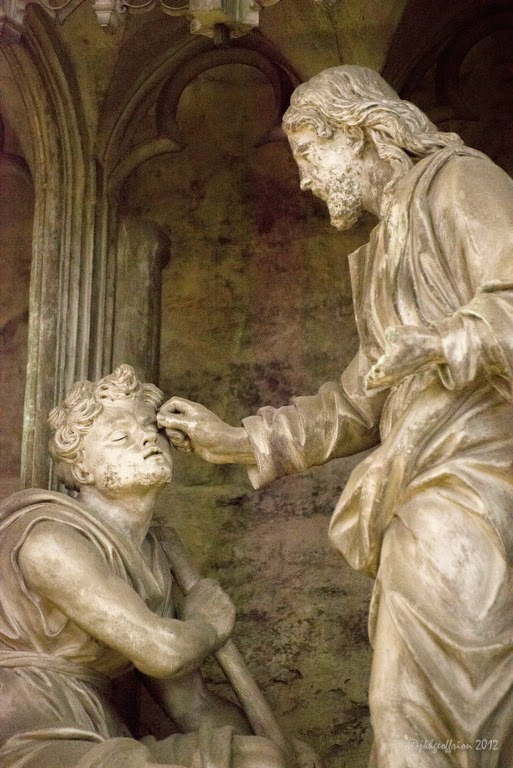
Sunday, March 01, 2015

A disposable life

"Jesus heals a bind man"
- Chartres Cathedral

"Jesus heals a bind man"  - Chartres Cathedral
TODAY'S SPECIAL: Mark 8:22-9:1

TO CHEW ON: " ' For whoever desires to save his life will lose it, but whoever loses his life for My sake and the gospel's will save it.' " Mark 8:26,30,31


It is interesting what Peter (Mark is believed to be John Mark's recording of what he heard from Peter) recalls of a time about a year before the crucifixion.

Jesus heals a blind man, then commands him to tell no one (Mark 8:26). Jesus asks the disciples who they think He is. Peter answers, " ' You are the Christ.' " Jesus tells Peter and all of them to " ...tell no one about Him" (Mark 8:30).  Then He predicts His suffering, rejection by the Jewish leaders, death and resurrection "openly" (Mark 8:32).

Why this secrecy about some things and openness about others? '

My thought is that we view these things, about which Jesus asks for secrecy, in the light of His death and resurrection and see how His ability to heal and His title as Messiah fit into God's scheme of things. But Jesus' contemporaries had no such advantage. His reputation and resulting popularity as a healer and Messiah (who the Jews thought would be their political savior from the Romans) would conflict with His real mission. And so He hushed up these things, or tried to.

I wonder if we still don't do something similar with Jesus. We ask for His healing and invoke His power, but without a view to the price He paid and what it means for us if our lives are to actually connect with His plans and purposes. It means:  " 'Whoever desires to come after Me, let him deny himself and take up his cross … lose his life for My sake and the gospel…' ",  be proud of Jesus' unpopular work and words - Mark 8:34-38.

His power and popularity then, and through the Holy Spirit in our lives now, are not to serve our relief from pain or desire to be on the winning side. Rather, they are to serve the purposes of the kingdom of God, to fit into a picture that is way bigger than any one life, or even lifetime. Our part may not feel like health or winning at all, but like losing.

PRAYER: Dear Jesus, thank You for becoming a man and living clear-sighted about Your mission. Help me to see my life as similarly disposable—for You and the gospel. Amen.

 *********
Unless otherwise noted all Scripture quotations are taken from the New King James Version®. Copyright © 1982 by Thomas Nelson, Inc. Used by permission. All rights reserved.


Friday, July 05, 2013

Undemanding workers


bedroom
TODAY'S SPECIAL: Luke 10:1-12


TO CHEW ON: "And remain in the same house, eating and drinking such things as they give, for the labourer is worthy of his wages. Do not go from house to house. Whatever city you enter, and they receive you, eat such things as are set before you." Luke 10:7-8

In talking about the nitty gritty of the mission on which He was sending seventy disciples, Jesus gets right down to details about practical things.
  • They were to go in twos.
  • When they went from town to town, they were to:
- Bless their host house with peace.
- Stay in one house, not house-hop from place to place.
- Eat the food they were given. In fact He gives the food instruction twice.
Bible scholars suggest that these disciples were giving some unspoken signals as they followed Jesus' instructions:

1. Contentment with their accommodations: "…avoiding even the appearance of caring or wishing for dainties" (*Pulpit Commentary).

2. Their accommodations were not a freebie or a "beggar's alms"* but like earned wages.

3. They were to eat what was set before them. For these Jewish men, did this include carelessness about whether or not the food was ceremonially clean or unclean? Was this the beginning of Jesus breaking down their repugnance toward the Gentiles? Our commenter again: "There seems a quiet recommendation not to be rigid in inquiring as to the cleanness or uncleanness of the viands…. It seems probable that extreme rigidness in this particular, now that mission work on a broad scale had commenced, here began to be relaxed."* Of course this relaxation came out clearly in Paul's letter to the Corinthians (1 Corinthians 10:27).

Although these instructions may not seem relevant to us, especially if we're not involved in foreign missions, there are things in them we can apply wherever we spread the good news. (On the other hand, with the world coming to us, they may be absolutely relevant as we interact with immigrant neighbours.)  
1. It's good to go out with a buddy (it could be a spouse). Matthew Henry says: "Christ sent the seventy disciples as two and two that they might strengthen and encourage one another." 

2. Contentment with our surroundings, and eating what is put before us, takes the focus off the comfort and aesthetic of the surroundings, the food and drink so the gospel can be the main feature.

3. Our contentment with whatever the setting in which we spread the gospel demonstrates God's acceptance of the people with whom we interact.
(Of course these days we host most of our itinerant speakers, evangelists, workshop leaders etc. in hotels. I wonder whether we don't lose something by no longer hosting these leaders in our homes… just thinking out loud.)

PRAYER: Dear God, please help me to live by principles of contentment and acceptance in my everyday life. Amen.

MORE: Your home—a tool of ministry?

"Each of us can participate in some way in evangelism through hospitality—the use of the home as a tool of ministry. The genius of the home is that it is universal to each Christian. We all abide somewhere—in a room or a dormitory or an apartment or a bungalow. In this inhospitable world a Christian home is a miracle to be shared. Perhaps a child needs shelter from her mother's shrieks by resting on our stairs. Maybe someone will knock on our door with tears in her eyes looking for peace. There's not one of us who can't say, 'Come in. Why don't you come in?'" - Karen Burton Mains, Open Heart, Open Home, p. 137
***********

The Holy Bible, New King James Version Copyright © 1982 by Thomas Nelson, Inc. - Used with permission.
Bible Drive-Thru


Bookmark and Share


Wednesday, April 03, 2013

The power of God's word

TODAY'S SPECIAL: Romans 10:5-21

TO CHEW ON: "So then faith comes by hearing, and hearing by the word of God." Romans 10:17


Kusum, a woman from Nepal, lived in Mumbai's Red Light District. She offered teenage girls from her homeland a better life. When they came with her, she immediately sold them to local pimps or got them into prostitution herself.

A local missionary, Arokiasamy, introduced Kusum to the Bible and kept in contact with her. But nothing changed—until a year later. Then Kusum found herself in big trouble with rival gangs. Fearful for her life she ran to Arokiasamy. He again shared God's word with her, explaining how God could forgive all the bad things she'd ever done.

She repented that day, gave God her life, and then what a change! She began sharing God's word with the prostitutes in her home and for the first time took care of them. Instead of trapping them in a life of sin, she now freed them to return home to Nepal with the news of the gospel which could free them and their families to live for Jesus. She is raising one of the prostitutes' abandoned babies.

As a young boy Shankar's mother locked him in a closet while she entertained men as a prostitute, also in Mumbai. One day Shankar was rescued by a missionary and given a Bible. He said, "It gave me hope. If it hadn't been for the Bible I would be on drugs and worse than that, I would have become a man who used women." Now Shankar has two goals: "I want to finish my studies and rescue my mom."

Beulah was lured to Mumbai's Red Light District form South India. A missionary sneaked a Bible to her and she found hope in Psalm 91:3: "Surely He will save you from the fowler's snare and from the deadly pestilence."

She continued reading the Bible and one day, alone in her third floor room, she invited Jesus into her life. Shortly after, she escaped by climbing down a drain pipe and found shelter in the home of a pastor and his wife.

These stories of the power of God's word were in the November 2012 Canadian Bible Society newsletter. Every month there are similar stories of God's powerful word seeding faith in lives all around the world.

Consider supporting an organization that translates or spreads the Bible. It's an investment that will be there to meet you on the long side of eternity!


PRAYER: Dear God, thank You for Your word, the Bible, which seeds our faith in You and Your life-changing power. Help me to do all I can to spread this word where I live and around the world. Amen.

MORE: Handel's Messiah Alert!

 Two verses from today's reading are in Handel's Messiah:

Romans 10:15 is found in Chorus 38 - "How Beautiful Are the Feet."

"How beautiful are the feet of them
that preach the gospel of peace,
and bring glad tidings of good things!"


Romans 10:18 is found in - Chorus 39 - "Their Sound is Gone Out."

"Their sound is gone out into all lands,
and their words unto the ends of the world."


 ***********

The Holy Bible, New King James Version Copyright © 1982 by Thomas Nelson, Inc. - Used with permission.
Bible Drive-Thru


Bookmark and Share


Thursday, February 11, 2010

Portable glory

TODAY’S SPECIAL: Luke 9:28-43a

TO CHEW ON: “And they were all amazed at the majesty of God.” Luke 9:43a

“…the appearance of His (Jesus’) face was altered, and His robe became white and glistening.” Ping! Haven’t we seen this somewhere before? Doesn’t this hearken us back to Moses and his shining face after being with God on Mount Sinai (yesterday’s devotion)?

It must have been quite the awesome yet disturbing experience for the disciples, being dazzled by incredible light while hearing Jesus talk about his “decease” – death – with the glorified patriarchs. It must have left them with an overwhelming sense of rightness, goodness and well-being. Otherwise why would Peter suggest they build tents and stay?

But when it was time, they left and headed back to the rough-and-tumble, grubby and confusing world below. The contrast was stark. The very next day from out of the crowd came a desperate man.

His sad tale of the disciples’ inability to cast a demon out of his little boy brought Jesus’ rebuke (even after all they had experienced, they were still ‘faithless') and an invitation to fetch the boy. Even as he came the demon threw him down in a convulsion. Then Jesus rebuked the dirty spirit, cast him out and at least one father and son went home that day knowing, at a see-and-touch level, the majesty of God.


We too know the contrast of this story. From times of ecstatic worship, when we’re in the very presence of God’s clean, holy light, we’re inevitably ejected back to earth with its broken-down cars, clamoring kids, aging parents, and sinister lab reports. Just as Jesus didn’t stay on the rarified mountaintop, neither can we. For that’s why Jesus came – to spread the majesty of God to all. And that’s still our mission today.


PRAYER: Dear God, may my times with You translate into stronger faith and more usefulness to my troubled world. Amen.

MORE: Oswald Chambers says:
“It is a great thing to be on the mount with God, but a man only gets there in order that afterwards he may get down among the devil-possessed and lift them up. We are not built for the mountains and the dawns and aesthetic affinities, those are for moments of inspiration, that is all. We are built for the valley, for the ordinary stuff we are in, and that is where we have to prove our mettle. Spiritual selfishness always wants repeated moments on the mount. We feel we could talk like angels and live like angels, if only we could stay on the mount. The times of exaltation are exceptional, they have their meaning in our life with God, but we must beware lest our spiritual selfishness wants to make them the only time.”
- Oswald Chambers, My Utmost For His Highest (October 1 reading)

Related Posts Plugin for WordPress, Blogger...