Showing posts with label secrets. Show all posts

Friday, July 06, 2018

The burden of concealment

Achan hides his loot - Artist Unknown

TODAY'S SPECIAL: Ezekiel 5-8; Psalm 32

TO CHEW ON: "When I kept silent my bones grew old through my groaning all day long." Psalm 32:3


David writes Psalm 32 from a place of relief. He had covered a sin, then come clean and confessed it.  He contrasts the way it feels to be holding his secret with the relief of having confessed. Let's take a look at the effects of covering or concealing sin on David - Psalm 32:3,4:

"When I kept silent…
  • "…my bones grew old…" - He felt a sense of fragility and weakness.
  • "…through my groaning all day long." - He experienced day-long agony of spirit.
  • "For day and night Your hand was heavy upon me;" - God's presence felt heavy, not comforting.
  • "My vitality was turned into the drought of summer" - he felt useless and unproductive, like a plant shrivels and grows weak without water.

A brief overview of others who practiced concealment in the Bible show more side effects of covering sin:
  • Adam and Eve attempted to hide from God (Genesis 3:8), though it was and is impossible (Psalm 139:11; Luke 12:2; Revelation 6:16).
  • Achan and Gehazi had to sneak around and hide their stolen treasures - Joshua 7:21; 2 Kings 5:24.
  • Isaiah talks about permanent deep changes to the person who lives a life of concealment. He calls it becoming "warped" - Isaiah 47:10.

I don't know if you have ever refused to confess a known sin, but I have.  I can witness to how accurate David is in describing what it feels like.

Contrast those feelings with how everything changes for him following his confession:
He feels:

  • a desire to be with God again - Psalm 32:6.
  • security in God's presence -  Psalm 32:7.
  • joy, expressed in singing and shouting - Psalm 32:7, 11.
  • direction and purpose - Psalm 32:8.
  • gratitude for God's mercy - Psalm 32:10.

If you are holding onto a secret sin thinking you can live like this indefinitely, stop kidding yourself. Expose your secret. Make it right with God and any person involved. Then watch the vitality and joy flow back into your relationship with God and others.

PRAYER: Dear God, thank You for David's vivid and accurate description of concealment. Help me to live my life clear and transparent before you and others. Amen.

PSALM TO PRAY: Psalm 32

***********

The Holy Bible, New King James Version Copyright © 1982 by Thomas Nelson, Inc. - Used with permission.


Friday, March 30, 2018

Secret?

Nathan Confronts David
TODAY'S SPECIAL: 2 Samuel 9-12; Psalm 89

TO CHEW ON: "But what David had done was evil in the Lord's eyes .... 'You did what you did secretly, but I will do what I am doing before all Israel in the light of day.'" 2 Samuel 11:27b, 12:12.

On the day of Nathan the prophet's visit, at least nine months, perhaps a year or more had passed since David had begun his affair with Bathsheba, been foiled in his attempt to cover it up with a visit from the front by her husband Uriah, and then had Uriah murdered. Now, with his relationship to Bathsheba legitimized by marriage, he probably thought that he'd gotten away with what he'd done. Not so fast, David!

Nathan told David of God's deep displeasure. This showed David that his attempt to be sneaky with God was useless. No wonder David penned the words:

"If I say, 'Surely the darkness shall fall on me,'
Even the night shall be light about me;
Indeed, the darkness shall not hide from you,
But the night shines as the day;
The darkness and the light are both alike to You'" - Psalm 139:11,12.

Other Bible incidents remind us of God's all-seeing ability:
  • Adam and Even couldn't hide from God - Genesis 3:18
  • The garment and the gold and silver Achan secretly took from Jericho were uncovered - Joshua 7:18
  • Ananias's and Sapphira's lie to Peter came to light - Acts 5:1-11
And there are many more Bible examples of secrets becoming public knowledge.

Our attempts to sneak around behind God's back will prove just as futile. He still knows, sees, and has the ability to expose us. Let's let the words of Jesus Himself warn us:

"For there is nothing covered that will not be revealed, nor hidden that will not be known. Therefore whatever you have spoken in the dark will be heard in the light, and what you have spoken in the ear in inner rooms will be proclaimed on the housetops" -Luke 12:2,3 (emphasis added).

PRAYER: Dear God, help me to be honest in the way I live, first with myself, and then with You and others. If I have committed secret sins, please give me the courage to confess them and make them right. Amen. 

PSALM TO PRAY: Psalm 89

MORE: A false declaration

I remember exactly where I was when I recalled that I had lied on my declaration of the value of goods I brought into Canada after my Europe trip (back in the '70s). Seemingly from out of the blue, as I was walking down the hallway at Bible School where I was attending an alumni event, the realization came to me, and the thought: I'm going to have to make this right.

Don't kid yourself, it was a struggle. I had a mighty argument with myself:
- This happened a while ago. Why bring it up now? I just won't do anything like this again.
- I don't have the precise numbers.
-  What would the consequences be? Could Canadian Customs and Excise go after me?

Eventually, though, I wrote and mailed a letter, and felt better. Now there was nothing between God and me. And, as often occurs with such confessions, all my fears were groundless. I think I received a confirmation that they got my letter, but nothing more happened. It was an action so worth doing to have my relationship with Jesus clear and open again.

*****************
Unless otherwise noted all Scripture quotations are taken from the New King James Version®. Copyright © 1982 by Thomas Nelson, Inc. Used by permission. All rights reserved.

Monday, July 17, 2017

Kingdom secrets

The Sower - Artist unknown
TODAY'S SPECIAL: Matthew 13:1-17

TO CHEW ON: "The disciples came to him and asked, 'Why do you speak to the people in parables?' He replied, 'Because the knowledge of the secrets of the kingdom of heaven has been given to you, but not to them.' " Matthew 13:10,11 NIV

We all love to be in-the-know. Here Jesus told His disciples, you are.

Though the parables appear to be simple stories which Jesus' listeners loved because they were so homey and relatable to life, they also hold deeper truths than what  appears to the eye / ear. "…secrets of the kingdom of heaven" Jesus called them.

[Secret = musterion  from mueo "to initiate into the mysteries" hence a secret known only to the initiated, something hidden, requiring special revelation. In the NT the word denotes something that people could never know by their own understanding and that demands a revelation from God. The secret thoughts, plans and dispensations of God remain hidden from unregenerate mankind, but are revealed to all believers" - Dick Mills, Word Wealth, New Spirit-Filled Live Bible, NIV - Kindle Location 232,200.*]

Though Jesus told His disciples the knowledge of the kingdom had been given to them, they still needed Jesus' explanation, His "Listen then to what the parable of the sower means" (Matthew 13:18). As we read Jesus' interpretation of the sower story (the verses that follow today's reading) we see what kind of metaphor this was and how Jesus intended his listeners and us readers to interpret it from a literary standpoint.

But there is another level of understanding possible, beyond literary interpretation and to which Jesus referred when He said to the disciples: "… the knowledge of the secrets of the kingdom of heaven has been given to you, but not to them" (Matthew 13:11).

What distinguished the you from the them? It was that the you—the disciples—believed in Him. They were open to the truths He taught and willing to line up their lives with them. The them, the crowds, the Pharisees and religious leaders didn't believe. Some were downright hostile.

Jesus goes on to describe these believers as those who had (knowledge, insight, obedience) and so would be given more whereas those who didn't have would lose even the little understanding they already possessed (Matthew 13:12).

Jesus' truths are revealed:
  • to little children - Matthew 11:25.
  • by God in heaven - Matthew 16:17.
  • to those enabled by the Father - John 6:65.
  • by His Spirit - 1 Corinthians 2:10,14.
  • "to the Lord's people" - Colossians 1:26, 27.
  • through "an anointing from the Holy One" - 1 John 2:20, 27.

As we study the Bible and read it's parables and stories, let's not lose sight of the supernatural help necessary to really get them. That help leads to understanding that comes not only from our heads, but also involves our hearts.

PRAYER:
Dear Jesus, help me to be the kind of listener that has, and will be given an abundance. Amen.


 **********
Unless otherwise noted all Scripture quotations are taken from the THE HOLY BIBLE, NEW INTERNATIONAL VERSION®, NIV® Copyright © 1973, 1978, 1984, 2011 by Biblica, Inc.® Used by permission (*Kindle version). All rights reserved worldwide.


Thursday, January 05, 2017

Human nature on display

Image: Pixabay
TODAY’S SPECIAL:  Genesis 3:1-15

TO CHEW ON:
“And they heard the sound of the LORD God walking in the garden in the cool of the day, and Adam and his wife hid themselves from the presence of the LORD God among the trees of the garden.” Genesis 3:8

As I read the account of Adam and Eve’s fall into sin, I see things that are surprisingly (or, maybe not surprisingly) familiar. Even before Eve yielded to the temptation to eat that fruit, some of these things were present:

  • A tendency to exaggerate or embellish
Eve’s report to the serpent of what God had said about the tree: “‘You shall not eat of it, nor shall you touch it, lest you die.’” wasn’t exactly what God had said. He really said, simply, “‘You shall not eat…’” Genesis 3:3, cf. Genesis 2:17 (emphasis added).

  • Intellectually gullible
Eve never even questioned the serpent’s claims but took them at face value - Genesis 3:4-6.

  • Easily swayed to disbelieve what God had said.
For Eve this included considering and believing the serpent’s suggestion that God didn’t have their best interests at heart but was really keeping the best back from them - Genesis 3:4-6.

  • Undue trust in appearance.
Eve was easily taken in by the fruit’s appearance when she looked at it closely and saw that it looked delicious, was beautiful and, according to the serpent, had great benefits - Genesis 3:6.

  • Secrecy
After they sinned, both Adam and Eve gave in the overwhelming compulsion to hide from God - Genesis 3:8.

  • Blame-shifting
Both refused to take responsibility for their action. Adam blamed Eve. Eve blamed the serpent - Genesis 3:12,13.

Seeing the first four qualities in Eve even before the fall and the latter two in both Adam and Eve immediately after, leads me to believe these tendencies are part of our human nature. We all have them. They strut their stuff especially when we’re under the pressure of temptation. So let’s be on guard against ourselves and not taken in by the serpent's empty accusations against God, false claims, and half-truth promises.


PRAYER: Dear Father God, help me to know myself—to recognize my human tendencies and weaknesses that would draw me away from You. Amen.

 *********
Unless otherwise noted all Scripture quotations are taken from the New King James Version®. Copyright © 1982 by Thomas Nelson, Inc. Used by permission. All rights reserved.


Tuesday, December 01, 2015

Caught away

TODAY'S SPECIAL: 1 Thessalonians 4:1-18

TO CHEW ON: "For the Lord Himself will descend from heaven with a shout, with the voice of an archangel, and with the trumpet of God. And the dead in Christ will rise first. Then we who are alive and remain shall be caught up together with them in the clouds to meet the Lord in the air. And thus we shall always be with the Lord." 1 Thessalonians 4:16-17

Have you ever heard Christians talking about the "Rapture." Well, this is it. A note in my Bible explains:

"'Caught up together with them': The chief biblical source of the doctrine of the Rapture—the catching away to heaven of those, dead or living, who have trusted in Christ and await His return. The exact word "rapture" does not occur in Scripture: it was formed from a word in the Latin translation of the Bible which, for this phrase, reads simul rapiemur cum illis. 2 Thessalonians 2:3-12 gives the additional information that a great rebellion by humankind against God's authority and the emergence of the Man of Sin will precede the return of the Lord" - Russell P. Spittler,  New Spirit Filled Life Bible, p. 1687.

First Thessalonians isn't the only place in the Bible where such things are mentioned, though.
  • Paul in 1 Corinthians 15:51-55 talks about the instantaneous change that happens to believers at the "last trumpet."
  • The Old Testament prophet Daniel saw a vision of "one like a son of man coming in the clouds of heaven..." Daniel 7:13.
  • John, in Revelation, speaks of Jesus as "...coming with the clouds, and every eye will see Him..." Revelation 1:7.

Not surprisingly, this teaching—that Jesus will come again to raise the dead and snatch the living from their activities—has attracted scorn throughout the centuries. In fact it was ridiculed already in the days of the New Testament church (see 1 Peter 3:1-13), where Peter concluded with this encouragement: "But the day of the Lord will come as a thief in the night....Therefore since all these things will be dissolved, what matter of persons ought you to be in holy conduct and godliness" - 1 Peter 3:11-12.

Paul, in our 1 Thessalonians passage, speaks of this sudden coming as a source of comfort (1 Thessalonians 4:18).

I ask myself, is the fact that Jesus will someday return in bodily form something that comforts me, or does it make me uneasy?

The 2 Peter passage talks about that thief-in-the-night day accompanied by the heavens passing away, great noise, elements melting in fervent heat when "the earth and the works that are in it will be burned up" - 2 Peter 3:10.

If I am too much in love with this earth and the things in it, my possessions and accumulations, then being removed from them will be a day of tragedy for sure. But it doesn't have to be. If my focus is on accumulating heavenly treasure and my great hope is being with Jesus (John 12:25-26) it can be a comfort indeed.

PRAYER: Dear Jesus, help me to live with the fact of Your anytime return always in mind. I want to be found expectant, waiting, and unashamed. Amen.

MORE: Views of the end

Over the centuries theologians have developed different views of how end-time prophecy will play out. (This Wikipedia article on Christian eschatology, for example, will probably make your head spin. Here is the part that details various prophetic end-time views.) Who's right? Who's wrong? Only God knows.

Personally, I don't concern myself too much with the details, but rather, focus on general themes that recur when the Bible speaks of Jesus' return:
1. It will be sudden and unexpected.
2. It will be a day when secrets are revealed.
3. It will be a day of facing consequences.
4. It will be a day of meeting Jesus!

That's enough to keep me living with sober hope.

*********

Unless otherwise noted all Scripture quotations are taken from the New King James Version®. Copyright © 1982 by Thomas Nelson, Inc. Used by permission. All rights reserved.

Sunday, March 01, 2015

A disposable life

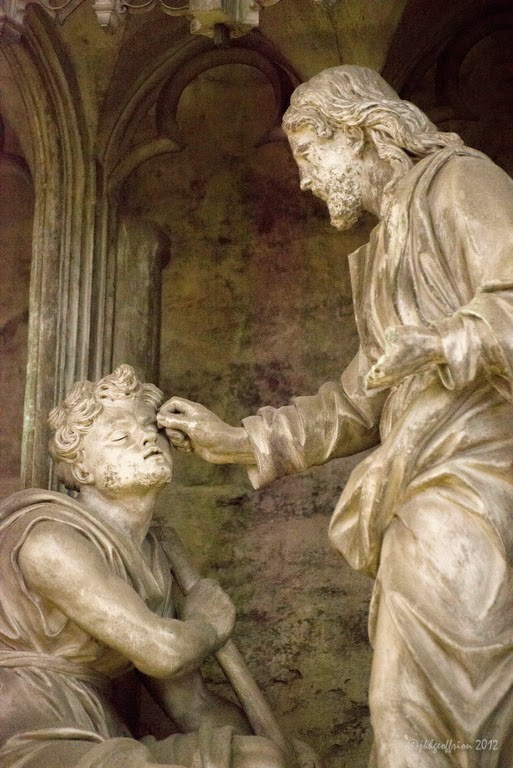
"Jesus heals a bind man"
- Chartres Cathedral

"Jesus heals a bind man"  - Chartres Cathedral
TODAY'S SPECIAL: Mark 8:22-9:1

TO CHEW ON: " ' For whoever desires to save his life will lose it, but whoever loses his life for My sake and the gospel's will save it.' " Mark 8:26,30,31


It is interesting what Peter (Mark is believed to be John Mark's recording of what he heard from Peter) recalls of a time about a year before the crucifixion.

Jesus heals a blind man, then commands him to tell no one (Mark 8:26). Jesus asks the disciples who they think He is. Peter answers, " ' You are the Christ.' " Jesus tells Peter and all of them to " ...tell no one about Him" (Mark 8:30).  Then He predicts His suffering, rejection by the Jewish leaders, death and resurrection "openly" (Mark 8:32).

Why this secrecy about some things and openness about others? '

My thought is that we view these things, about which Jesus asks for secrecy, in the light of His death and resurrection and see how His ability to heal and His title as Messiah fit into God's scheme of things. But Jesus' contemporaries had no such advantage. His reputation and resulting popularity as a healer and Messiah (who the Jews thought would be their political savior from the Romans) would conflict with His real mission. And so He hushed up these things, or tried to.

I wonder if we still don't do something similar with Jesus. We ask for His healing and invoke His power, but without a view to the price He paid and what it means for us if our lives are to actually connect with His plans and purposes. It means:  " 'Whoever desires to come after Me, let him deny himself and take up his cross … lose his life for My sake and the gospel…' ",  be proud of Jesus' unpopular work and words - Mark 8:34-38.

His power and popularity then, and through the Holy Spirit in our lives now, are not to serve our relief from pain or desire to be on the winning side. Rather, they are to serve the purposes of the kingdom of God, to fit into a picture that is way bigger than any one life, or even lifetime. Our part may not feel like health or winning at all, but like losing.

PRAYER: Dear Jesus, thank You for becoming a man and living clear-sighted about Your mission. Help me to see my life as similarly disposable—for You and the gospel. Amen.

 *********
Unless otherwise noted all Scripture quotations are taken from the New King James Version®. Copyright © 1982 by Thomas Nelson, Inc. Used by permission. All rights reserved.


Thursday, January 29, 2015

Talebearing—is it a big deal?

Telling a secret
TODAY'S SPECIAL: Leviticus 19:1-19

TO CHEW ON: "You shall not go about as a talebearer among your people." Leviticus 19:16

In the middle of Leviticus (a book we tend to ignore because we think it's mostly a set of dry instructions for Old Testament Israelites), comes a down-to-earth chapter on practical holiness. In it are several guidelines about the use the tongue: against lying (Leviticus 19:11); against using God's name in oaths and profanity (Leviticus 19:12); against cursing the deaf (Leviticus 19:14); against being partial in judgment (Leviticus 19:15) and then something we might consider almost too trivial to include in this list of grave sins—against being a talebearer (Leviticus 19:16).  What is this, and could God's ban on this activity for the Israelites be relevant for us today?

What is talebearing?
[Talebearer = rakiyl  is also translated slander, slanderer and informer.]

Talebearers are characterized by activities that include:
  • Revealing secrets (Proverbs 11:13).
  • "… idle wandering about from house to house … also gossips and busybodies, saying things which they ought not," Paul says in describing their activity to Timothy in 1 Timothy 6:13.
  • They concern themselves "… in other people's matters," says Peter - 1 Peter 4:15.

Talebearing is hard to resist, though.
  • The writer of Proverbs describes talebearing words as "tasty trifles" - Proverbs 18:8.
  • It's also a social activity that may fill a need. The people Paul described as talebearers were young widows. We can easily see how doing the gossip circuit could fill a hole in their lonely lives, getting them out and circulating "house to house" with something important to pass on.

The effects of this type of talk are devastating.
  • It can impact hearers at a deep level. Those tasty morsels "… go down into the inmost body" - Proverbs 18:8.
  • Talebearers and their words separate friends - Proverbs 17:9.
  • They cause strife in the larger community - Proverbs 26:20.

I would submit that those talebearing words that God told the people to avoid thousands of years ago are just as dangerous and destructive today—to both spread and hear. How can they be avoided?
  • Don't associate with people known for any sort of insincere speech advises the writer of Proverbs (Proverbs 29:19).
  • Stamp it out (by not listening to it and not spreading it) and thus calm strife in the larger community - Provers 26:20.
  • And we could pray this prayer that David prayed, sincerely and often:
Set a guard, O Lord, over my mouth;
Keep watch over the door of my lips.

Do not incline my heart to any evil thing,
To practice wicked works
With men who work iniquity;
And do not let me eat of their delicacies. - Psalm 141:3,4 (emphasis added)


PRAYER:  Dear God, I admit, I have at times been a talebearer. Please forgive me. Set that watch in front of my mouth and prick my conscience when I entertain talebearing thoughts, so that I can stop them at their source and they never get as far as crossing my lips.  Amen.

 *********
Unless otherwise noted all Scripture quotations are taken from the New King James Version®. Copyright © 1982 by Thomas Nelson, Inc. Used by permission. All rights reserved.


Thursday, June 05, 2014

Secret disciple

Nicodemus seeks Jesus by night - Alexandre Bida
TODAY'S SPECIAL: John 7:32-52

TO CHEW ON: "Nicodemus (he who came to Jesus by night being one of them) said to then, 'Does our law judge a man before it hears him and knows what he is doing?' " John 7:51

On the last day of the feast Jesus stood in the temple and shouted out, "If anyone thirsts let him come to Me and drink."  

That sparked discussion ("Truly this is the Prophet." "This is the Christ." "Will the Christ come out of Galilee?") and opposition. The chief priests and Pharisees wanted Him arrested but the officers they assigned to arrest Jesus came back empty-handed saying, "No man ever spoke like this Man." The rulers responded, "Are you also deceived? Have any of the rulers or the Pharisees believed in Him"

I wonder if Nicodemus answered in his head, "I have." This Pharisee, who had earlier come to Jesus by night (John 3:1-21) does here, to his credit, speak in Jesus' defense (though not directly) with: "Does our law judge a man before it hears him and knows what he is doing?"

The others put forward their objection trump card: A prophet won't come out of Galilee. Discussion closed.

We can only imagine Nicodemus's discomfort in the days ahead as the Pharisees bargained with Judas to betray Jesus and then convinced Pilate to sentence Him to die. Nicodemus did appear one more time, after Jesus' death when he and another secret, afraid-of-the-Jews Sanhedrin member disciple, Joseph of Arimathea, bound Jesus' body with spices and buried him in the garden tomb (John 19:38-42).

I wonder if Nicodemus had regrets about not being more forward in defending Jesus? No doubt if he had been, circumstances would have taken a different turn—not for Jesus perhaps, but for him. He may have lost his position as a Pharisee and with that his source of income, prestige, maybe even the support of his family. But I can only think if he had had the courage of his convictions, he would have respected himself more. To me his story is heavy with regrets.

In our time, when Christian values are trampled on more and more in the media and entertainment, are we much different than Nicodemus? When our unbelieving neighbours or friends or workmates make fun of our beliefs and mock our Saviour, do we have the courage of even Nicodemus's subtle defense of Jesus? Or do we, with our silence, also keep our discipleship secret?


PRAYER:
Dear God, I'm too much like Nicodemus. Help me to have the courage to speak up about my beliefs. Amen.

 *********
Unless otherwise noted all Scripture quotations are taken from the New King James Version®. Copyright © 1982 by Thomas Nelson, Inc. Used by permission. All rights reserved.


Bookmark and Share


Friday, March 07, 2014

Shame and hiding

Eve and Adam - painting by Phillip Ratner

TODAY'S SPECIAL: Genesis 3:1-15

TO CHEW ON: "And they heard the sound of the Lord walking in the garden in the cool of the day, and Adam and his wife hid themselves from the presence of the Lord God among the trees of the garden." Genesis 3:8

 Yesterday's reading with its idyllic scene of Adam and Eve in sweet companionship with each other and God is ripped apart by the entrance of sin. Adam and Eve's eating the fruit of the Knowledge-of-Good-and-Evil tree did a lot more than set them in the direction of death. One thing that happened was an immediate urge to hide.

This urge grew out of guilt and shame.
[guilt: The fact or condition of having committed an offense, especially a willful violation of a legal or moral code,
shame: a painful sense of guilt or degradation caused by consciousness of guilt or of anything degrading, unworthy or immodest...a state or condition of regret, dishonour or disgrace."]

So they went from "naked and unashamed" (Genesis 2:25) to hiding their bodies from each other and hiding themselves from God.

Throughout the Bible we discover a similar urge to hide in the presence of guilt over having committed sin. It was often accompanied by drastic results which impacted more people than just the ones who sinned:
  • Achan took spoil from Jericho, hid it in his tent and as a result 36 men were killed in the battle with Ai before he was discovered. Then he and his family paid the price (Joshua 7).
  • Gehazi, Elisha's servant, tried to hide the fact that he had taken Naaman's gift, offered earlier to his boss. He ended up with leprosy (2 Kings 5:20-27).
  • We smile at the irony of the Israelites secretly building "high places" for idol worship. "High places"! And they thought God couldn't see? (2 Kings 17:9).

David, whose hiding episode included adultery and murder, got it right when he asked, rhetorically in Psalm 139, "Where can I go from Your Spirit? Or where can I flee from Your presence?" and answered, in effect, nowhere (Psalm 139:7-12).

I ask myself, am I keeping secrets from God? One sign that I may be is a reluctance to meet with Him (just like Adam and Eve). For I have found that when such is the case and we do get together, He invariably puts His finger on my supposed secret.

If we're not sure, we can pray the prayer David prayed at the end of Psalm 139:

"Search me, O God, and know my heart;
         Try me, and know my anxieties;
 And see if there is any wicked way in me,
         And lead me in the way everlasting."

If God exposes concealed sins, Psalm 32:5 is the perfect way to deal with them:
"I acknowledged my sin to You, And my iniquity I have not hidden. I said, “I will confess my transgressions to the LORD,” And You forgave the iniquity of my sin.  Selah  

PRAYER: Dear God, please help me to realize the futility of trying to hide things from You. Help me to recognize "secret sins," to acknowledge and confess them, and to deal with any interpersonal fallout. Amen.

************
Unless otherwise noted all Scripture quotations are taken from the New King James Version®. Copyright © 1982 by Thomas Nelson, Inc. Used by permission. All rights reserved.

Bookmark and Share

Saturday, September 15, 2012

Shame and hiding

Eve and Adam - painting by Phillip Ratner

TODAY'S SPECIAL: Genesis 3:1-15

TO CHEW ON: "And they heard the sound of the Lord walking in the garden in the cool of the day, and Adam and his wife hid themselves from the presence of the Lord God among the trees of the garden." Genesis 3:8

Adam and Eve in sweet companionship with each other and God  (Genesis 2:23-25) is ripped apart by sin. Adam and Eve's eating the fruit of the Knowledge-of-Good-and-Evil tree did a lot more than set them in the direction of death. One thing that happened was an immediate urge to hide.

This urge grew out of guilt and shame.
[guilt: The fact or condition of having committed an offense, especially a willful violation of a legal or moral code,
shame: a painful sense of guilt or degradation caused by consciousness of guilt or of anything degrading, unworthy or immodest...a state or condition of regret, dishonour or disgrace."]

So they went from "naked and unashamed" (Genesis 2:25) to hiding their bodies from each other and hiding themselves from God.

Throughout the Bible we discover a similar urge to hide in the presence of guilt over having committed sin. It was often accompanied by drastic results which impacted more people than just the ones who sinned:
  • Achan took spoil from Jericho, hid it in his tent and as a result 36 men were killed in the battle with Ai before he was discovered. Then he and his family paid the price (Joshua 7).
  • Gehazi, Elisha's servant, tried to hide the fact that he had taken Naaman's gift, offered earlier to his boss. He ended up with leprosy (2 Kings 5:20-27).
  • We smile at the irony of the Israelites secretly building "high places" for idol worship. "High places"! And they thought God couldn't see? (2 Kings 17:9).

David, whose hiding episode included adultery and murder, got it right when he asked, rhetorically in Psalm 139, "Where can I go from Your Spirit? Or where can I flee from Your presence?" and answered, in effect, nowhere (Psalm 139:7-12).

I ask myself, am I keeping secrets from God? One sign that I am may be is a reluctance to meet with Him (just like Adam and Eve). For I have found that when such is the case and we do get together, He invariably puts His finger on my supposed secret.

If we're not sure, we can pray the prayer David prayed at the end of Psalm 139:
"Search me, O God, and know my heart;
         Try me, and know my anxieties;
 And see if there is any wicked way in me,
         And lead me in the way everlasting."

If God exposes concealed sins, Psalm 32:5 is the perfect way to deal with them:
"I acknowledged my sin to You, And my iniquity I have not hidden. I said, “I will confess my transgressions to the LORD,” And You forgave the iniquity of my sin.  Selah  

PRAYER: Dear God, please help me to realize the futility of trying to hide things from You. Help me to recognize "secret sins," to acknowledge and confess them, and to deal with any interpersonal fallout. Amen.

MORE: Shame versus guilt
Mark Yarhouse in his book Homosexuality and the Christian, makes a distinction between guilt and shame:
"Guilt is about feeling bad for something you've done. Shame is about feeling bad for who you are" - p. 158.

Keeping that in mind, shame would be the appropriate response to humanity's (and thus our own) reluctance to appear before God caused by Adam and Eve's sin. But through belief in Jesus and His death on the cross, the shame of our inherent sinfulness is no longer necessary (see Revelation 3:18-20).

(From the archives)

Bible Drive-Thru


Bookmark and Share


Related Posts Plugin for WordPress, Blogger...