Showing posts with label motives. Show all posts

Friday, February 02, 2018

God's eyes on you

TODAY'S SPECIAL: Leviticus 11-13; Psalm 33

TO CHEW ON: "Behold the eye of the LORD is on those who fear him,
On those who hope in His mercy." Psalm 33:18


After drawing attention to the grandeur of God's creation, the heavens, the seas, the earth and its nations, the psalmist zooms in. Speaking from God's point of view, first His lens catches the crowds: "....He looks on all the inhabitants of the earth." And then with several clicks on the + button, He's looking right at individuals — you and me. With each person He sees something unique:"He fashions their hearts individually". He sees and comprehends everything each one does: "He considers [understands] all their works" - Psalm 33:15.

His attention is caught particularly by those who are linked to Him in a trust relationship. What does He see and know?
  • That we trust in Him (Nahum 1:7).
  • Our days from beginning to end; both their number and what will fill them (Psalm 37:18, Psalm 139:15-16).
  • Our everyday comings and goings (Psalm 139: 2-3).
  • Our names (John 10:3).
  • Our minds and hearts (Jeremiah 20:12).
  • Our thoughts (Matthew 12:25; Luke 11:17)
  • Our motivations (John 2:25)
  • Our secrets (Psalm 44:21).
  • That we are loyal to Him. In 2 Chronicles 16 we have the story of Hanani the seer who came with a message to King Asa of Judah. It was a disappointing word about how because Asa had gone to Syria for help and not to God, he would suffer ultimate defeat. Then Hanani makes this insightful comment about God's help: "For the eyes of the Lord run to and fro throughout the whole earth, to show Himself strong on behalf of those whose heart is loyal to Him" 2 Chronicles 16:9.

Psalm 33 underlines this aspect of God's sight and knowledge. "Behold the eye of the Lord is on those who fear Him...To deliver their soul from death, and to keep them alive in famine."

What are our needs today? Are we going to God first for help with them? Or are we relying on our own devices, casting about for ways to help ourselves? Whether it's sickness, business trouble, a stalled career, tangled relationships or whatever, let's bring our cares to Him first and in this way, draw the attention of His searching eyes.

PRAYER: Dear God, it is reassuring to know that You see me personally. Today I am troubled by ___. I know You have a solution to my problem. Please show Yourself strong on my behalf. Amen.

PSALM TO PRAY: Psalm 33


***************
Unless otherwise noted all Scripture quotations are taken from the New King James Version®. Copyright © 1982 by Thomas Nelson, Inc. Used by permission. All rights reserved.

Wednesday, January 10, 2018

When giving is receiving

TODAY'S SPECIAL: Genesis 32-34

TO CHEW ON: "'Please accept my blessing that is brought to you, because God has dealt graciously with me, and because I have enough.' Then he urged him, and he took it." Genesis 33:11

Esau's first refusal of Jacob's gift may have been inspired by Middle East etiquette. But I believe Jacob was genuinely relieved when his brother finally accepted his present of goats, sheep, camels, cattle and donkeys (Genesis 32:13-15).

The impulse to give springs from a variety of motivations:

Sometimes we give because it is just the thing we do in our culture, as in leaving a small gift for someone after staying in their home or when celebrating someone's birthday or wedding anniversary.

At other times we give because we don't want to feel beholden or in the debt of someone.

And sometimes we give because we are so full of the generosity poured out on us, we can't help but spill it over onto others.

Esau didn't have a gift for Jacob, so perhaps one can assume this gift of Jacob's was not given to conform to custom. I'm sure there was some assuaging of guilt on Jacob's part. Maybe he saw his material gift as a sort of payback for absconding with the birthright and blessing, which were rightfully Esau's as firstborn son. However, Jacob also cites God's gracious dealings with him as a reason for his generosity.

In the end Esau's acceptance of Jacob's gift (signifying, perhaps, that he forgave Jacob?) was itself the greatest gift Jacob could have wished for.

Let's be aware of the dynamics of gift-giving, and be motivated above all by God's generosity to us. And let's also be alert to the fact that sometimes our gracious receiving a gift from someone is in itself a gift to them.

PRAYER: Dear God, thank You for Your generous gift of Jesus. Help me to give out of a heart that is full of gratefulness to You, and to be sensitive to times when giving means receiving. Amen.

PSALM TO PRAY: Psalm 10

MORE: Gift-giving customs

Giving gifts, especially in business, carries a different significance in the various regions of the world. The article "International Gift-giving Protocol" explains appropriate gift-giving customs in various countries and cultures in the world.

*************
Unless otherwise noted all Scripture quotations are taken from the New King James Version®. Copyright © 1982 by Thomas Nelson, Inc. Used by permission. All rights reserved.


Thanks for reading! This year we are using The Bible Project "Timeless Reading Plan" to read through the Bible in 2018. If you'd like to read along in your own Bible, you can download a pdf of the reading plan HERE.

Saturday, July 15, 2017

The "evil treasure" of criticism

TODAY'S SPECIAL: Matthew 12:22-37

TO CHEW ON: " 'Brood of vipers! How can you, being evil, speak good things? For out of the abundance of the heart the mouth speaks.' " Matthew 12:34

Though Jesus did at times withdraw from confrontation with the Pharisees (as we saw yesterday), it was never because He was intimidated by them. In our reading today He calls them a "brood of vipers."

His harsh name for them was in response to their reaction to His miracle of freeing a demon-possessed blind and mute man to see and speak. They said He did this miracle by Satan's power.

He showed the lack of logic in that (Matthew 12:25-30), called what they said blasphemy against the Holy Spirit, named it the unforgivable sin (Matthew 12:31-32), and then exposed the root of their problem: hearts full of "evil treasure" (Matthew 12:33-37).

We would call what's in our hearts our thoughts. The Pharisees' words here showed that their thoughts were critical and judgmental. Do you ever struggle with critical, judgmental thoughts? I do.

Joyce Meyer in her book Battlefield of the Mind says:

"Judgment and criticism are fruit of a deeper problem—pride. When the 'I' in us is bigger than it should be, it will always cause problems...The Bible repeatedly warns us about being high-minded" - p. 125.

She goes on to cite Bible verses for judgmental, critical people to consider:

  • Romans 14:4 tells us some things about which we judge others others are simply none of our business.
  • Matthew 7:1-2 reminds us that the principle of sowing and reaping apply to judgment. If we judge others habitually and harshly, that same judgmental attitude will be unleashed on our lives.
  • Matthew 7:3-5 tells us to judge ourselves before we judge others.
  • 1 Corinthians 13:7 says we should make a practice of believing the best about other people rather than assuming their actions spring from bad motives.
  • Galatians 6:1-3 makes it clear that sometimes judgment is appropriate and necessary. It shows us how to deal with sin and misconduct in someone's life in a constructive way: with gentleness, with watchfulness so as not to fall into the same temptation, and with humility and knowledge of our own vulnerability.

Jesus' little proverb — "Out of the abundance of the heart the mouth speaks" — let's take it seriously. Let's listen to ourselves. What is spilling out of the abundance of our own hearts? If it's criticism and judgment, let's ask God to change our prideful hearts.

PRAYER: Dear Jesus, these are sobering thoughts. Help me to hear my words today and gain insight into the state of my heart. Then help me to change by applying and obeying Your Bible words. Amen.

****************
 Unless otherwise noted all Scripture quotations are taken from the New King James Version®. Copyright © 1982 by Thomas Nelson, Inc. Used by permission. All rights reserved.


Friday, April 28, 2017

Tainted living-—recognize it, lay it aside

TODAY’S SPECIAL: 1 Peter 1:17-2:3

TO CHEW ON: “Therefore, laying aside all malice, all deceit, hypocrisy, envy, and all evil speaking, as newborn babes desire the pure milk of the word, that you may grow thereby.” 1 Peter 2:1,2


I have recently found a new way to meditate on Bible passages—through Bible journaling. A book that introduced me to this activity describes what it is:
“Bible journaling is a way to express your faith creatively. Putting pen to paper is a great way to remember and record biblical concepts that are meaningful and relevant to your life. Whether you are drawing, coloring, and writing right inside your Bible—the most commonly understood definition—or writing and illustrating scripture verses in a separate book or on paper alongside your Bible, the essential thing to understand is that Bible journaling is about creating while reflecting on God’s word” - Joanne Fink & Regina Yoder, Complete Guide to Bible Journaling, p. 8.

The guidebook has tons of ideas, introduces prominent Bible journalers and their work, and suggests ways and places to share Bible journaling, doodles and lettering.

I was instantly attracted, dug out an old notebook New Testament with wide margins, and tried my hand at it.

My first attempts were meaningful and rich. As I drew and lettered, my mind dwelt on what I was illustrating. More snippets of Bible verses came to me, and I added them to the design. It was worthwhile and uplifting to me spiritually.

Then I searched #biblejournaling on Facebook, Twitter, and Instagram. I found many wonderful ideas—brilliant and bold artwork, flawless lettering that looked like it came from a computer. I joined a Facebook group where members share their work with each other. And slowly the purity leaked out of this activity for me as it became about comparison, envy, wanting "likes" for my work, pride. Yuck!

Today’s Bible text is right-on for this situation. It reminds me, and us, of the tendencies inherent within us (toward malice, deceit, hypocrisy, envy, evil speaking) and that they can infect any aspect of living (even studying the Bible!). It tells us in plain words that we need to lay them aside as we give attention to taking in, with the focus and single-mindedness that babies give to drinking a bottle, wholesome Bible truth.

May this be my (our) template for thought and action:

“Let every detail in your lives—words, actions, whatever—be done in the name of Jesus (not myself), thanking God the Father every step of the way” - Colossians 3:17 MSG).

“And whatever you do or say, do it as a representative of the Lord Jesus, giving thanks through him to God the Father” Colossians 3:17 NLT.

“Whatever you do [no matter what it is] in word or deed, do everything in the name of the Lord Jesus [and in dependence on Him], giving thanks to God the Father through Him” Colossians 3:17 AMP.

PRAYER:
Dear Father, help me to not only recognize the carnal tendencies within myself, but to lay them aside by starving them—refusing to give them what they want. Amen.

 *********
Unless otherwise noted all Scripture quotations are taken from the New King James Version®. Copyright © 1982 by Thomas Nelson, Inc. Used by permission. All rights reserved.


Thursday, April 13, 2017

Devilish Judas spirit

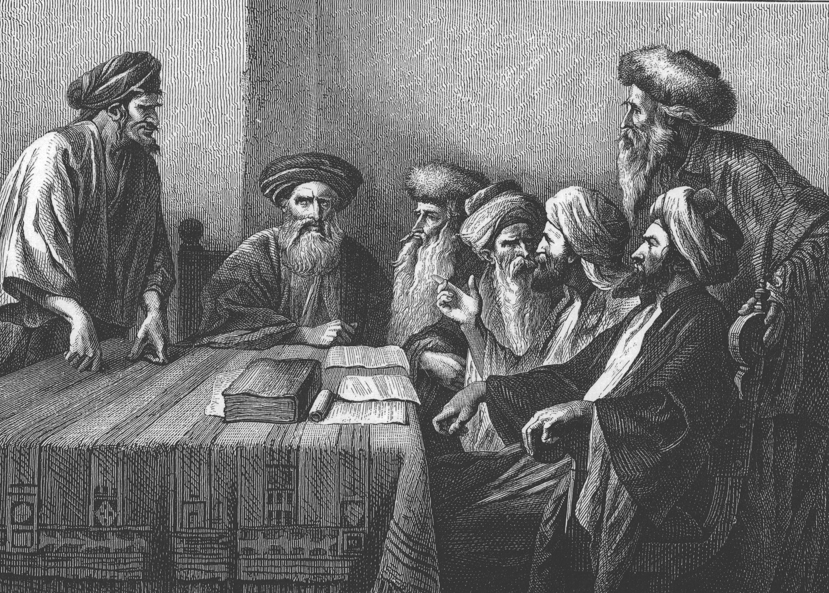
Judas before the Sanhedrin - Alexandre Bida
Judas before the Sanhedrin - by Alexandre Bida

TODAY'S SPECIAL: Matthew 27:1-26

TO CHEW ON: "Then Judas, His betrayer, seeing that He had been condemned, was remorseful and brought back the thirty pieces of silver to the chief priests and elders."  Matthew 27:3

I have thought a lot about Judas. What drove him to betray Jesus? What inner need was he giving in to?

Our passage today implies (when it says "…seeing He had been condemned, was remorseful…") that he may have thought his actions of betrayal would force Jesus' hand. Perhaps he thought that Jesus would again slip out of the grasp of the scribes and Pharisees as He had at other times. And this time, He would assert Himself as Messiah and show Himself to be the human King of the Jews.

We know that the other disciples had co-ruler ambitions. The mother of James and John asked that her sons have special positions in Jesus' kingdom. How much more Judas, who handled the money and already dipped into their common purse for his own use? In other words. I believe Judas thought his relationship with Jesus was a means to improve his own fortunes.

Are we so different? Don't we also often think of ourselves as the privileged chosen who, because of our relationship with Jesus will escape sickness and money problems, will have good families and successful businesses? What happens when things don't turn out the way we expect? Might we also be tempted to try to manipulate Him to follow our agenda? (You didn't hold up your end of the bargain, so I'll turn my back on You. Pout, pout.)

But Jesus had told them that following Him would include more than blessing and well-being:

"'Assuredly I say to you, there is no one who has left house or brothers or sisters of father or mother or wife or children or lands for My sake and the gospel's who shall not receive a hundredfold now in this time—house and brothers and sisters and mothers and children and lands, with persecutions—and in the age to come, eternal life'" - Mark 10:29,30 (emphasis added).

Let's be watchful over our own motivations, careful to recognize and deal with any selfish ambition that might, if left to grow, sabotage our loyalty to Him when His plans for us turn out to be entirely different than we had imagined.

(Jesus' description of Judas is strong: "…one of you is a devil" - John 6:70.)

PRAYER: Dear Jesus, please help me to love and follow You, not for selfish gain but because You are truth and life (John 6:67,68). Amen.

MORE: Maundy Thursday

Today is Maundy Thursday, the church feast that commemorates the Last Supper Jesus celebrated with His disciples. Here is the Collect that begins the day's liturgy.

Almighty Father, whose dear Son, on the night before he suffered, instituted the Sacrament of his Body and Blood: Mercifully grant that we may receive it thankfully in remembrance of Jesus Christ our Lord, who in these holy mysteries gives us a pledge of eternal life; and who now lives and reigns with you and the Holy Spirit, one God, for ever and ever. Amen.

 *********
Unless otherwise noted all Scripture quotations are taken from the New King James Version®. Copyright © 1982 by Thomas Nelson, Inc. Used by permission. All rights reserved.

Monday, February 20, 2017

Hypocrisy

The Prayer in Secret - Alexandre Bida
TODAY’S SPECIAL: Matthew 6:1-15

TO CHEW ON:
“‘Therefore, when you do a charitable deed, do not sound a trumpet before you as the hypocrites do in the synagogue and in the streets, that they may have glory from men. Assuredly, I say to you, they have their reward.’” Matthew 6:2

Hypocrite (hypokrites) is an interesting word. My study Bible describes how it comes from the Greek word hypokrinomai—the dialogue of actors who wore masks that amplified their voices. A hypokrites was one who acted in a play or read a script.

The dictionary definition of hypocrite is:
1] A person who pretends to have virtues, moral or religious beliefs, principles etc. that he or she does not actually possess; 2] A person who feigns some desirable or publicly approved attitude, whose private life, opinions or statements belie his or her public statements.

A short survey of “hypocrisy” in the Bible shows us some of its faces.
Hypocrisy can be:

  • Words that don’t agree with intentions, especially when they relate to others, like our neighbours - Isaiah 55:21 also Psalm 28:3; Isaiah 62:4; Jeremiah 9:8.

  • Flattery -  Psalm 78:36; Matthew 22:16.

  • Actions or words that set a trap - Jeremiah 9:8; Proverbs 7:15; Mark 12:15.

  • Actions or words that shirk responsibility - e.g. Pilate, when he washed his hands of Jesus making like he was helpless to do anything but give in to the wishes of the mob was a hypocrite - Matthew 27:24.

  • Religious words or actions that are insincere- Jeremiah 12;2; 22:20.

  • Religious words or actions performed to fool God- Jeremiah 3:10.

  • Religious words or actions performed to manipulate God - Isaiah 58:3.

  • Religious words or actions to further one’s own ends - Zechariah 7:5, our passage Matthew 6:1-15;  James 2:1-4.

I love the picturesque language Jesus used to describe hypocrisy (which He pointed out often in the Pharisees and scribes):
- He said hypocrites were like whitewashed tombs, beautiful on the outside but inside full of uncleanness and dead bones (Matthew 23:28).
- He said they were like cups and dishes, clean on the outside but full of greed and wickedness inside - Luke 11:39.
- He said the hypocrisy of the Pharisees permeated everything they did, like yeast permeates bread - Luke 12:1.

What a mess! Who'd want to have anything to do with a hypocrite or hypocrisy? Yet when I’m honest with myself, I have to admit I’ve been a hypocrite in both my dealings with others and God.

To eliminate hypocrisy, a good place to start is to be self-aware and recognize hypocrisy where it first appears—in our thoughts. Proverbs says of the miser, who invites you to eat and drink but is inwardly critical: “As he thinks in his heart, so is he” - Proverbs 23:7.

Then we need to acknowledge it as sin - 1 John 1:10.

Finally, we need to make a conscious effort to purge hypocrisy from our lives
as we  love everyone—God and our fellow humans—sincerely and with pure motives. “Let love be without hypocrisy” - Romans 12:9.


PRAYER: Dear Father, help me to be aware of hypocrisy in my life, to acknowledge it as sin and to learn to love sincerely. Amen.

 *********
Unless otherwise noted all Scripture quotations are taken from the New King James Version®. Copyright © 1982 by Thomas Nelson, Inc. Used by permission. All rights reserved.


Wednesday, February 15, 2017

Oh shiny!

TODAY’S SPECIAL: Psalm 119:33-48

TO CHEW ON: “Turn away my eyes from looking at worthless things,
And revive me in Your way.” Psalm 119:37


Are you attracted by beautiful things? By the tempting challenges that promise to further your career? By the once-in-a-lifetime opportunity that might just set you up for the foreseeable? Oh shiny!

The Bible has a lot to say, indirectly and directly, about what we see and respond to.

  • Way back in Eden it was the sight of that tempting fruit that first got Eve in trouble (Genesis 3:6).
  • Lot too was attracted by the sight of that well-watered Jordanian plain. It drew him to move close to corrupt Sodom (Genesis 3:10,12).
  • Achan’s eyes got him in trouble when they dwelt on the beautiful Babylonian garment, the silver and the gold. His covetous look led to taking, hiding, and a whole lot of trouble for him, his clan, and Israel (Joshua 7:21 - read the whole story in Joshua 7:10-26).
  • Rich and wise King Solomon made several observations about setting one’s eyes on and directing one’s life by the attractive. By his own admission he lived that way (Ecclesiastes 2:4-8). And though he claimed to have kept his wisdom (Ecclesiastes 2:9), in the end all he went after turned out to be futile (Ecclesiastes 2:11). His advice: Go ahead and let your heart follow your eyes, but there will come a day of reckoning for this (Ecclesiastes 11:9).
  • Even Jesus faced the temptation of the attractive (Matthew 4:8). He was not taken in. And on that mountaintop of temptation, Satan’s proffered exchange exposed what’s at stake here: “‘All these things I will give you if You will fall down and worship me” - Matthew 4:8 (emphasis added).

Perhaps that last is key to unveiling what’s behind such “Oh Shiny!” temptations for us too.  Their appeal and our response to them reveals to us and the world what our heart is worshiping. So the prayer of the psalmist becomes as relevant today as ever.

PRAYER: “Incline my heart to Your testimonies
And not to covetousness.
Turn away my eyes from looking at worthless things.
And revive me in Your way” Amen.


MORE: Extracurricular
Another passage that we might consider when facing the “shiny” opportunities and challenges that come our way is Paul’s advice to Timothy in 2 Timothy 2:4,

“No one engaged in warfare entangles himself with the affairs of this life that he may please him who enlisted him as a soldier.”

We might ask—is this shiny possession / opportunity / deal, consistent with my role in the Kingdom of God? Or will it prove a distraction?

 *********
Unless otherwise noted all Scripture quotations are taken from the New King James Version®. Copyright © 1982 by Thomas Nelson, Inc. Used by permission. All rights reserved.


Friday, February 03, 2017

Will our work be rewarded?

Image: Pixabay
TODAY’S SPECIAL: Revelation 22:6-21

TO CHEW ON: “‘And behold, I am coming quickly and my reward is with Me, to give to every one according to his work.’” Revelation 22:12.

Though the Bible is clear that our work doesn’t save us (Titus 3:5-7), work is mentioned often in the Bible. So, if we are not working to gain heaven, what compels us to work?

Here are a few of the motivations the Bible mentions;

  • To be a bridge between God and a hurting world - Isaiah 50:4.
  • To serve Jesus, who comes to us as the hungry, thirsty, homeless stranger - Matthew 25:35-40.
  • Because as God’s children, we see the world, and the people around us through our Father’s eyes of compassion so that our neighbour’s need becomes our assignment - Luke 10:30-37.
  • It is our way of following, obeying, and mimicking Christ in spirit and deed, as Paul explains it in Philippians 2:3-15.

Our passage implies that all work is not equal. We may be driven by wrong motives (for example, to be seen and praised by others) to do good things. And so this end-of-time reward ceremony is a revelation, an unveiling of our work’s quality: “… to give to everyone according to his work.”

[The word “reward” (misthos) means pay, salary, recompense for service. “The word especially describes wages, divine rewards given to believers for the moral quality of their actions” - Dick Mills, Word Wealth, New Spirit-Filled Life Bible, p. 1847 - emphasis added.]

May this someday heavenly reward ceremony compel us to examine our own actions or non-actions and the attitude we have when we do act.

I confess this is convicting. Just yesterday on my way to the track where I walk on rainy days, I passed a homeless camp-out right on the sidewalk of a busy street. The cheery “good morning” from one of the street dwellers elicited a grumpy reply from me. I felt annoyed and irritated, for though our city has worked to house these folks, many insist on living outside.

Lord, please give me Your eyes and a heart of compassion—even when I don’t understand.

PRAYER: Dear Jesus, help me to face and understand my own motives. Replace my judgemental heart of stone with a heart of flesh - Ezekiel 11:19,20. Amen.

 *********
Unless otherwise noted all Scripture quotations are taken from the New King James Version®. Copyright © 1982 by Thomas Nelson, Inc. Used by permission. All rights reserved.


Wednesday, July 06, 2016

Heart probe

Naaman: "Please take a gift from your servant."
Elisha: "I will receive nothing..." 
(Artist unknown)


TODAY'S SPECIAL: 2 Kings 5:15-27

TO CHEW ON: "Then he (Elisha) said to him (Gehazi), 'Did not my heart go with you when the man turned back from his chariot to meet you? Is it time to receive money and to receive clothing, olive groves, vineyards, sheep and oxen, male and female servants?'" 2 Kings 5:26

When Gehazi ran after Naaman to get some of the "my precious" that Naaman had offered Elisha, and then lied about it, he showed himself to be more than just deceitful. Elisha's rhetorical question (2 Kings 5:26) exposed his underlying materialism and covetousness.

God's ability to see/read/know our hearts and actions is reiterated throughout the Bible:
  • God to Noah: "'I have seen that you are a righteous man before Me in this generation'" Genesis 7:1. 
  • David:
"O Lord, You have searched me and known me.
You know my sitting down and my rising up;
You understand my thought afar off.
You comprehend my path and my lying down,
And are acquainted with all my ways….etc." Psalm 139:1-12 
  • Solomon:
"Hell and Destruction are before the Lord;
So how much more the hearts of the sons of men" - Proverbs 15:11.
  • Jesus:
"But Jesus knew their thoughts…" - Matthew 12:25 
"But Jesus perceived their wickedness…" - Matthew 22:18.
"But immediately when Jesus perceived in His spirit that they reasoned thus within themselves…" - Mark 2:8.

God, who knows our thoughts, motivations, and actions can communicate them to others, as He did here.

He can also reveal our hearts to us. We can pray as David did:
"Behold You desire truth in the inward parts
And in the hidden part You will make me to know wisdom" - Psalm 51:6 (emphasis added).

And:

"Search me, O God and know my heart;
Try me and know my anxieties
And see if there is any wicked way in me,
And lead me in the way everlasting" - Psalm 139:23,24 (emphasis added).

PRAYER: Dear God, please give me insights into, and the desire to deal with my own sneaky heart. Amen.

 *********
Unless otherwise noted all Scripture quotations are taken from the New King James Version®. Copyright © 1982 by Thomas Nelson, Inc. Used by permission. All rights reserved.


Saturday, June 20, 2015

Weapons of choice

"Armor of God" Illustrator 
of Henry Davenport Northrop's 
'Treasures of the Bible', 1894

Armor of God
TODAY'S SPECIAL: 1 Samuel 17:41-58

TO CHEW ON: "Then David said to the Philistine, 'You come to me with a sword, with a spear, and with a javelin. But I come to you in the name of the Lord of hosts, the God of the armies of Israel, whom you have defied.'" 1 Samuel 17:45

I don't think it was the sling that was David's most powerful weapon. Rather, it was the spiritual armor he wore and used. The "name of the Lord of Hosts" was both motivation, defense and offense to David. Defending God's honor against Goliath's blasphemy was reason enough to volunteer his life. God's strong name served as protection and tested weapon. The sling was just the physical weapon God chose to use in this case to win a physical and spiritual battle.

Spiritual weapons take various forms in the Bible.

  • Jesus, when Satan tempted Him, talked about living by every word that proceeds from the mouth of God (Matthew 4:4).
  • Paul described the armor of God in detail in Ephesians 6:10-20. The sword—that part of the armor that not only defends but also takes new territory—is the word of God (Ephesians 6:7).
  • Hebrews 4:12 tells us about that Word-sword in more detail. The writer calls it living, powerful, sharp, piercing, dividing and laying bare soul and spirit, thoughts and intentions.
  • In Paul's view of battle, the fight begins in our own minds. He tells the Corinthian Christians to use spiritual weapons, especially that Word-sword, to pull down strongholds and arguments, and to bring every thought captive to Christ (2 Corinthians 10:4,5).

What battles are we facing today? Is God's honor at stake in them? If we are known as His, His children, on His side, eager for Him to have a good reputation, then it is.

Have we subjected our own selves—our thoughts and motives—to the sword of God's word?

Then, sure of our cause and motives, we can use those spiritual weapons to fight our battles too, trusting God to take our ineffectual physical weapons, our pathetic slings whatever they are, and transform them into effective and dangerous stones, bullets, bombs, missiles. 

PRAYER: Dear God, please help me to see the spiritual aspect of the battles in my life, and to learn how to use spiritual weapons. May they be my "tested" weapons of choice. Amen.

MORE: The attitude of the warrior

One aspect of spiritual warfare I didn't mention above is prayer. It is the attitude of alertness, persistence and constant connection with our Commander with which all weapons (spiritual and physical) should be wielded:

"Pray in the Spirit at all times  and on every occasion. Stay alert and be persistent in your prayers for all believers everywhere." - Ephesians 6:18
*********
Unless otherwise noted all Scripture quotations are taken from the New King James Version®. Copyright © 1982 by Thomas Nelson, Inc. Used by permission. All rights reserved.


Bible Drive-Thru

Monday, April 27, 2015

Diagnosis: bitter and bound

TODAY’S SPECIAL: Acts 8:4-24

TO CHEW ON: “But there was a certain man called Simon, who previously practiced sorcery in the city and astonished the people of Samaria, claiming that he was someone great….And when Simon saw that through the laying on of the apostles’ hands the Holy Spirit was given, he offered them money, saying, “Give me this power…” Acts 8:9, 18-19.

When the Samaritan sorcerer became a believer, the Samaritan Christians may have celebrated–as Christians often do when celebrities come to the Lord. The local papers may have been a tad more cynical: “Wizard Converts – what new trick is up his sleeve?” In his case, such skepticism would have been warranted. For as we read the whole story, we discover that all is not right with Simon’s attitude. He has an ulterior motive for following Jesus.

Though he is genuinely impressed with the signs and wonders the disciples perform and wants to be on the side of such power, he still has the mindset that this new religion is going to work wonders for business. Because when he sees the Holy Spirit coming on people in response to Peter and John laying hands on them, he comes with money and says, “Give me this power also, that anyone on whom I lay hands may receive the Holy Spirit.”

Of course Peter will have none of that. With a word of knowledge he names the wellspring of Simon’s request: bitterness and the bondage to sin, and admonishes him to repent.

Sometimes I think we’re not that different from Simon. He was trying to manipulate God to achieve his own purposes. Don’t we often do the same? We ask for help in our work–not so He gets the glory, but so we do. Our prayers are full of requests designed to further our comfort, ease and well-being.

How can we know if our attitudes are wrong? And how can we deal with the roots of them? We need an outside perspective on our own heart-condition. Like the Holy Spirit revealed things about Simon to Peter, He can enlighten us by His word to our own poisons and bondages (Hebrews 4:12).

PRAYER: Dear God, please show me inner attitudes and motivations that displease You. Help me understand their origins so I can deal with them at their roots. Amen.

MORE: Peter pronounces Simon “bound by iniquity.”
“For I see that you are in the gall of bitterness and a bond forged by iniquity to fetter souls” Acts 8:23 AMP

What is this ‘iniquity’?
[Iniquity: adikia – ad-ee-kee-ah: “Misdeeds, injustice, moral wrongdoing, unjust acts, unrighteousness, iniquity.”* (That sounds pretty bad!). “It is the opposite of truthfulness, faithfulness and rightness.” (Oh oh – that brings it closer to home; you mean even a little sneakiness, a shade of untruth can begin to forge a bondage?)
*From “Word Wealth” – The New Spirit Filled Life Bible.]

**********

Unless otherwise noted all Scripture quotations are taken from the New King James Version®. Copyright © 1982 by Thomas Nelson, Inc. Used by permission. All rights reserved.

 Scripture quotations marked AMP are taken from the Amplified® Bible, Copyright © 1954, 1958, 1962, 1964, 1965, 1987 by The Lockman Foundation Used by permission." (www.Lockman.org)

Monday, October 27, 2014

Who is your audience?

man on stage in front of an audience
TODAY'S SPECIAL: Matthew 23:1-12

TO CHEW ON: " 'But all their works they do to be seen by men.' " Matthew 23:5


In his book The Call, Os Guinness tells a story about the American philanthropist Andrew Carnegie and his mother. The Carnegies started out in Pittsburgh as a poor family. One day Andrew found his mother weeping in despair. Trying to console her, he said:

"Someday I'll be rich. We'll ride in a fine coach driven by four horses."

"That will do no good over here," his mother snorted, "if no one in Dunfermline (Scotland) can see us" - Os Guinness, The Call, p. 69.

Have you ever felt that way? What good is this accomplishment if  __x___ (my boss, my family, my Facebook friends, my colleagues, the people in my church, my city) don't see it?

Guinness says:
"Only madmen, geniuses, and supreme egoists do things purely for themselves. … Most of us, whether we are aware of it or not, do things with an eye to the approval of some audience or other. The question is not whether we have an audience but which audience we have" - Ibid, p. 70.

Here Jesus revealed to the crowds and the disciples who the audience of the sanctimonious scribes and Pharisees was: other people ("men"). The irony of this is that they posed their religious observances as done for God. But their actions—exaggerating the religious parts of their clothing (phylacteries and borders), loving the best places at feasts, insisting they be addressed as "Rabbi" demonstrated who they were really trying to impress.

I ask myself, who is my main audience? Whose opinion do I value most? What about you? If it's Jesus, as we say it is, then we will do the things that He values. Several of them are named here:
  • Serve.
  • Humble ourselves.

I love how Guinness concludes this chapter in his book:
"Do you wish to be inner-directed rather than other-directed and truly make one Audience decisive, the Audience of One? Listen to Jesus of Nazareth; answer His call" - Ibid p. 74.


PRAYER: Dear Jesus, how often I get distracted from living first and foremost for You, letting my thirst for the praise and attention of people dictate my actions. Help me to value Your opinion more than any person's so that my life will show that my audience truly is You.  Amen.

 *********


Unless otherwise noted all Scripture quotations are taken from the New King James Version®. Copyright © 1982 by Thomas Nelson, Inc. Used by permission. All rights reserved.


Bookmark and Share


Related Posts Plugin for WordPress, Blogger...