Showing posts with label testimony. Show all posts

Thursday, December 27, 2018

The Christmas story with prequel and sequel

The woman and the Dragon - Rev. 12 (Artist unknown)
TODAY'S SPECIAL: Revelation 12-13; Psalm 44

TO CHEW ON: "She bore a male Child who was to rule all nations with a rod of iron. And her child was caught up to God and His throne." Revelation 12:5


After our Christmas focus during this month, do you recognize the Christmas story in today's reading? John skips telling the story of the Nativity in his gospel, but he gives his version of it here in Revelation. As we read, we see that he puts the events of Jesus' birth into a far larger story.

It's a story told here in apocalyptic literature style using lots of symbols. But they're not hard to unlock. Even common readers like us can get their meanings.
  • The woman (Revelation 12:1 and on) is Israel ("garland of twelve stars" = the twelve tribes of Israel).
  • The child to which she gives birth is Jesus.
  • The fiery red dragon is Satan.
  • Revelation 12:7-9 is a flashback scene (the prequel) of Satan being cast out of heaven to earth. (Remember Jesus' words: "'I saw Satan fall like lightning from heaven'" Luke 10:18?)
  • Satan's current battle is with Israel and her offspring (Christians) - Revelation 12:7.

This view of history explains so much. It helps us understand:


  • The persistent persecution of the Jews and their survival (Revelation 12:13-16). 
  • The force behind all the evil on earth—the bloodshed, hatred, natural disasters, sickness, interpersonal conflict in wars and terrorism etc. Our world is in its desperate state because it's under the influence of Satan "… who deceives the whole world; he was cast to earth and his angels were cast out with him. … For the devil has come down to you, having great wrath because he knows that he has a short time" - Revelation 12:9,12 (emphasis added).
  • Where we fit in. This story isn't finished. We are right now part of the sequel of the Christmas installment, involved in the thick of the battle of the last verse: "And the dragon was enraged with the woman and he went to make war with the rest of her offspring who keep the commandments of God and have the testimony of Jesus Christ" - Revelation 12:17 (emphasis added).

However, victory over this red, angry, teeth-gnashing, tail-lashing dragon is possible. How?
"And they overcame him by the blood of the Lamb and by the word of their testimony" - Revelation 12:10 (emphasis added).

Our weapons are the blood of Jesus painted on the doorposts of our hearts that keeps out the death angel and the word—God's plan in history and our own involvement in it ("the word of their testimony" in both the Bible and our lives). When we find ourselves in the thick of any battle, let's not forget what our weapons are and not cease to use them.


PRAYER: Dear God, thank You for giving us this behind-the-scenes glimpse of history. Help me to keep this big picture in mind and my weapons in hand when I'm in the thick of battle. 


PSALM TO PRAY: Psalm 44

The Bible Project VIDEO: Revelation - Part 2 of the Read Scripture series


 *********
Unless otherwise noted all Scripture quotations are taken from the New King James Version®. Copyright © 1982 by Thomas Nelson, Inc. Used by permission. All rights reserved.


Tuesday, December 11, 2018

Seeing beyond sight

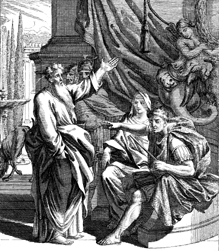
"The Transfiguration" Artist unknown

TODAY'S SPECIAL: 2 Peter 1-3 Psalm 35

TO CHEW ON: "For we did not follow cunningly devised fables when we made known to you the power and coming of our Lord Jesus Christ, but were eyewitnesses of His majesty. For He received from God the Father honor and glory when such a voice came to Him from the Excellent Glory: 'This is my beloved Son, in whom I am well pleased.'" 2 Peter 1:16,17.


Do you think first-person accounts of people seeing visions of heaven and Jesus are believable? Or hoax? Or maybe you view them as sacrilege? In the last few years many such modern stories have surfaced. Several—Heaven is for Real and Miracles from Heaven—have even been made into movies.

I wonder if Peter's account of Jesus' transfiguration, which he refers to here (and is told in full in Luke 9:28-36) met with the same mixed response. There was no doubt in Peter's mind, though, as to the reality of what he had seen and heard. He used this vision as grounds for his authority (2 Peter 1:18-21). Indeed, most if not all of the prophetic writings in the Bible derive from God's communicating with people in ways we would call extrasensory or supernatural.

Most of us humans, though, live in a state of limited reception, especially to the spiritual realm. So when someone claims to have a vision, even Christians, especially us 21st century ones, influenced by the prove-it-in-the-lab-or-I-won't-believe-it mentality of humanistic naturalism, are skeptical.

I know there is room for caution when we hear stories of people experiencing the supernatural. Still, I hope that I am not so cautious as to disqualify myself from hearing from God in any way He should want to speak to me.

In this regard, let me leave you with some quotes from a book by author Mike Mason. The e-book Adventures in Heaven is the story Mason tells of his friend who claimed to have many supernatural and heavenly experiences. Mike himself saw Jesus only once. Here is some of his account:

"No sooner had he said these words than I found myself looking at Jesus! He was right there in front of me, larger than life. … The first thing that struck me was His joy. He was positively beaming like ten thousand suns. … And that face—how full of character! … And what is revealed in the face of Jesus is all love, all beauty, all wisdom, all goodness…." Kindle Location 3399.

This is how that vision affected him:

"Seeing Jesus, it turned out, far from leaving me with my head stuck in the clouds, was absolutely the best thing that could have happened. I didn't tell anyone else my experience. I didn't have to. I'd been filled with the joy and the love of God, and so all my contacts with people over the next few days took on a wholly different quality" - Kindle Location 3433.

PRAYER:
Dear Jesus, I'm glad that You are not bound by the limitations I feel within my human tent. Help me to perceive You in whatever way You choose to reveal Yourself to me. Amen.
 

PSALM TO PRAY: Psalm 35

The Bible Project VIDEO: 2 Peter (Read Scripture Series)


 *********
Unless otherwise noted all Scripture quotations are taken from the New King James Version®. Copyright © 1982 by Thomas Nelson, Inc. Used by permission. All rights reserved.


Friday, October 19, 2018

The Christian's memory

Return of the Ark to Bethshemesh by Gustave Dore
"Return of the Ark" - Gustave Dore (1 Samuel 6:13)
TODAY'S SPECIAL: Acts 27-28; Psalm 132

TO CHEW ON: "Behold we heard of it in Ephratheh
We found it in the fields of the woods." - Psalm 132:6


What is the "it" the psalmist is talking about? It is the ark—that box that symbolized the presence of God among the Israelites.

The first verses of this psalm refer to specific stories about the ark that pilgrims marching to Jerusalem* would have known. They recall the time that David vowed to bring the ark back to Jerusalem. They remember an even earlier time when Samuel located it in "the field of the woods," that is, Kirjath Jearim ("City of Forests") - 1 Samuel 7:1,2.

What's the point of bringing up these memories? It is to help the people get a vision for their future with God (Psalm 132:11-18).

Eugene Peterson enlarges on this psalm in A Long Obedience in the Same Direction. He says about the importance of memory in matters of faith:

"This history is important, for without it we are at the mercy of whims. Memory is a databank we use to evaluate our position and make decisions. With a biblical memory we have two thousand years of experience from which to make the off-the-cuff responses that are required each day in the life of faith.

"[...] The past is not, for the person of faith, a restored historical site that we tour when we are on vacation; it is a field that we plow and harrow and plant and fertilize and work for a harvest" - Eugene Peterson, A Long Obedience in the Same Direction, pp. 166, 168 (emphasis added).

What are we facing today that is making us nervous, upset, panicky, desperate, scared? Let's recall our history with God and how He has proved Himself faithful to help us in the past. Let's obey His instructions to us, whatever they are in the situation. Maybe it's to:
  • acknowledge Him and trust Him for directions (Proverbs 3:5-6).
  • pray and not worry (Philippians 4:6-7).
  • tell the truth and live with integrity (Matthew 5:37)
  • be single-hearted (Luke 6:13; James 1:5-8)
  • or ...
Peterson again:

"What we require is obedience—the strength to stand and the willingness to leap, and the sense to know when to do which. Which is exactly what we get when an accurate memory of God's ways is combined with a lively hope in his promises" - p. 171.

PRAYER: Dear God, I bring the specific situation of ___ to You. You know the dis-ease I have in my spirit over it. Please settle me down as I remember Your faithfulness to me in the past. Help me to hear Your instructions about what to do (or perhaps it's to be still)  and to obey. Amen.

PSALM TO PRAY: Psalm 132

MORE: Defective memory

"A Christian with a defective memory has to start everything from scratch and spends far too much of his or her time backtracking, repairing, starting over. A Christian with a good memory avoids repeating old sins, knows the easiest way through complex situations and instead of starting over each day continues what was begun in Adam" - Peterson, p. 167 (emphasis added). 

*This psalm is one of the "Songs of Ascent" which pilgrims sang as they went to Jerusalem to celebrate the yearly festivals.

********
Unless otherwise noted all Scripture quotations are taken from the New King James Version®. Copyright © 1982 by Thomas Nelson, Inc. Used by permission. All rights reserved.


Tuesday, October 16, 2018

Tell your story

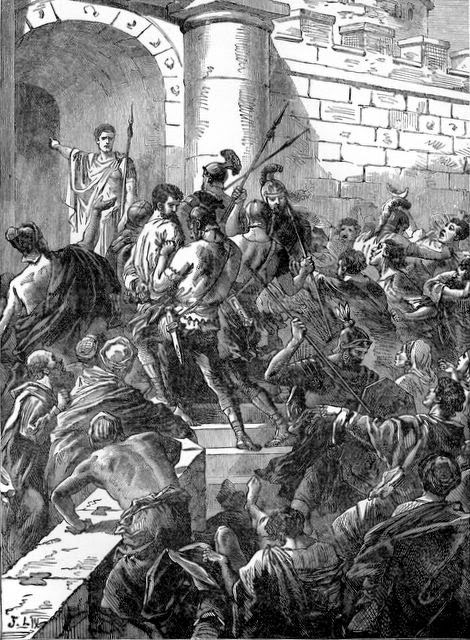
Paul arrested in a riot in Jerusalem (Acts 21:31-36)   - Artist unknown
 Paul arrested in a riot in Jerusalem (Acts 21:31-36) - Artist unknown

TODAY'S SPECIAL: Acts 21-22; Psalm 129

TO CHEW ON:
" 'For you will be His witness to all men of what you have seen and heard.' " Acts 22:15

I never tire of hearing stories of how God draws people to Himself and works in their lives. These tales—as original and varied as the people who tell them—range from stories of quiet pilgrimages to dramatic visions that turn life around in an instant. Paul's story was of the latter variety.

At the time it happened, his experience was reinforced by Ananias coming to him. Ananias was an entirely different sort of person. Paul describes him here as "… a devout man according to the law, having  a good testimony with all the Jews who dwelt there…" (Acts 22:12).

We know that sage Ananias had his own side of the story (Acts 9:10-18). His word to Saul/Paul was: God has chosen you. Now go and tell your story (my paraphrase of Acts 22:14-15).

Now, following his arrest by the Jerusalem mob, Paul gets to tell his story to the crowd that has just rioted and nearly taken his life (Acts 21:31-36). Of course this experience itself is a new installment in Paul's story.

Ananias' assignment to Paul is ours as well. Let's stay alert to God working in our lives so we recognize the continuing installments of our own "seen and heard" with God. Then let's retell the fresh chapters as conversations and situations, riots and debates open up along those lines.

PRAYER: Dear God, thank You for working uniquely in each life. Help me to recognize Your presence and action in my life and give me the courage to tell others. Amen.

PSALM TO PRAY: Psalm 129

*********
Unless otherwise noted all Scripture quotations are taken from the New King James Version®. Copyright © 1982 by Thomas Nelson, Inc. Used by permission. All rights reserved.


Sunday, October 14, 2018

The ready Christian

alter to the unknown god
TODAY'S SPECIAL: Acts 17-18; Psalm 127

TO CHEW ON:
"Now while Paul waited for them at Athens, his spirit was provoked within him when he saw that the city was given over to idols." Acts 17:16.

Paul is such a good example of the ready Christian: "… always be ready to give a defense to everyone who asks you a reason for the hope that is in you…" - 1 Peter 3:15. Here, in new-to-him Athens, watch how he does it:

1. He starts by observing his surroundings (Acts 17:16).

2. He goes to the hotbeds of thought and discussion—the synagogue and the marketplace to listen and talk. (Acts 17:17-18).

3. He accepts an invitation to speak at the Areopagus, even though the invite is hardly given in a  complimentary way. (They call him a babbler - Acts 17:18. According to my Bible's footnotes, a babbler was one who picked up scraps of learning here and there and peddled them. It seems this is a better description of those who "… spent their time in nothing else but either to tell or hear some new thing" - Acts 17:21).

4. He grabs their interest with something from their own culture—an inscription to an Unknown God seen on an altar. He dangles this need for something they haven't yet found in front of them: "Wouldn't you like to know Him?" (Acts 17:22-23)

5. He's a good closer. At the end of his message he urges them to take action: repent because judgment is coming (Acts 17:30-31).

6. He does all this while killing time in Athens—waiting for ministry partners to join him.

I ask myself, what would I have done if I had been in Paul's shoes? Sightsee? Probably. But with a view to giving my testimony and sharing the gospel? I don't know. I'd probably have viewed this as time off from ministry.

But for Paul—really for all of us—there is no time off. This story shows us that all kinds of situations can be a springboard for the gospel.

Though the fruit of Paul's ministry here is minimal ("For reasons Luke does not explain, results here were meagre—no baptisms, no new church, and no letter to the Athenians in the New Testament" - Gary Kinnaman, notes on Acts, New Spirit-Filled Bible, p. 1524), some believed. But Luke/Paul don't dwell on the low numbers. Paul has been faithful, and now it's time to move on (Act 18:1).

PRAYER: Dear God, please help me to become a ready Christian—alert to any and all opportunities to tell about and defend my faith in You, and not discouraged by small results. Amen.

PSALM TO PRAY: Psalm 127

*********
Unless otherwise noted all Scripture quotations are taken from the New King James Version®. Copyright © 1982 by Thomas Nelson, Inc. Used by permission. All rights reserved.


Saturday, October 13, 2018

Called and led

Image: Pixabay
TODAY’S SPECIAL: Acts 15-16; Psalm 126

TO CHEW ON: “Now when they had gone through Phrygia and the region of Galatia, they were forbidden by the Holy Spirit to preach the word in Asia. After they had come to Mysia, they tried to go into Bithynia but the Spirit did not permit them… Now after he had seen the vision (of a man saying ‘Come over to Macedonia to help us’) immediately we sought to go to Macedonia concluding that the Lord had called us to preach the gospel there.” Acts 16:6-7,10

A reader, Judy, tells of a missions trip she took to South Africa (used with her permission):

First of all God supplied the funds. In 1966 I taught school on First Nations reserves north of Souix Lookout. I bought two large paintings for $35 each from Norval Morrisseau when he visited the isolated community I was teaching in. During our years of teaching in the Arctic they hung unframed, tacked up with push pins in several homes.

Fast forward ahead to 2008 when after reading something on Becky's blog I said to Christian, Where are those paintings? I'd done some research on the Internet and realized they just may have some value. I sold one of the paintings for $6,500. Christian said immediately that I should do something very special with this unexpected windfall. I like to imagine our Lord saying on the day I bought the painting, "Do I ever have a surprise for you. It will be arriving in 42 years."

I heard about the volunteer group in South Africa, again through Becky's blog. One of her daughters had worked in an orphanage and had had a very positive experience. I wanted to teach and found a school along the east coast that seemed to be a good fit. I did make it clear that I did not want to teach computers or run an after school recreation program. They said that was fine I could just be in a classroom.

I was picked up in East London by a different volunteer group than the one I'd communicated with. I thought that was a little unusual. The next day I found out that the first group had contracted me out to a second group AND . . . . . perhaps you can guess what is coming; they wanted me to teach computers and run an after school recreational program. For a few moments to use my mother's term, I was floored. Then I thought about the lessons I'd learned in home studies the previous winter studying the life of Abraham. Don't focus on the "problem." Focus on God.

I was sure God could/would enable me to do the tasks but I also knew the desire of my heart and where my strengths lie. I had immediate assurance from Him that there would be a solution to the situation. It took a couple of days until I was at King's Playschool. That was the last name of the people who ran a rural facility out of their home. I had noticed the verse "They shall shine like stars in his crown" from the song "When He Cometh" based on Zech. 9:16, on their sign. So .. . . I knew they were believers but they didn't know I was.

When I had the opportunity I told Tracy that I was a follower of Jesus Christ, that I knew He had led me to South Africa but that I didn't know what I was supposed to do. She said she'd been praying for someone to relieve her of classroom duties while she dealt with the rest of her life. Here's what was on her plate.

Pentecostal Pastor's wife of a growing church.
Home schooling their 3 children
Running the school of 50 children and 10 employees
In the process of adopting two black babies who had been abandoned
Teaching a class

I had three glorious weeks of teaching eager 5 year olds. Most of my ideas were new for them… Both Tracy and I felt so blessed…. Who, but our loving Father, would take a woman from northern North America and team her up with a woman from Southern South Africa at exactly the right time! These kinds of experiences just light a fire under my faith which was already strong. An entire year later I still marvel at it and hope I always do.

They light a fire under my faith too! I never cease to marvel at God’s way of putting together the circumstances of our lives to work for His kingdom and our blessing if that’s our desire.

(Even as I'm preparing to repost this, a song is playing on my husband's computer, reminding me of the same truth: "In His time, in His time, He makes all things beautiful in His time")

In today’s reading Paul and Silas were shunted off the track they were on by the Holy Spirit. How that looked, I’m not sure – a feeling of uneasiness, a prophetic message? However it happened, they knew they were not to go to Asia. At Bithynia likewise “the Spirit did not permit them.” The vision to go to Macedonia, then, was most welcome. Here was clear direction .

In Philippi – one of the largest cities in Macedonia – was Lydia and a band of believers who met at the riverside regularly for worship. Can you imagine how she must have felt the morning Paul and Silas showed up and told her the story of how they got there.

Judy’s story shows us that God still works in behind-the-scenes ways. It freights these familiar verses with a new and personal relevance:

“Now He who searches the hearts knows what the mind of the Spirit is, because He makes intercession for the saints according to the will of God. And we know that all things work together for good to those who love God and to those who are called according to His purpose. Romans 8:27-28

PRAYER: Dear God, please put my life in the stream of Your usefulness. Help me to hear Your Spirit’s instructions and obey them. Amen.


PSALM TO PRAY: Psalm 126

**************
Unless otherwise noted all Scripture quotations are taken from the New King James Version®. Copyright © 1982 by Thomas Nelson, Inc. Used by permission. All rights reserved.

Saturday, October 06, 2018

The word that cuts


TODAY'S SPECIAL: Acts1-2; Psalm 119:153-176

TO CHEW ON: "Now when they heard this, they were cut to the heart, and said to Peter and the rest of the apostles, 'Men and brethren, what shall we do?'" Acts 2:37

 Lydia Christensen was a 36-year-old Danish teacher who had it all—a great career, loving family, and a good man who wanted to marry her. But the Christmas of 1926 found her dissatisfied and searching for more.

Back in her apartment after celebrating with her family, she felt like reading and went to her bookshelf:

"I read off the names of the authors: Kierkegaard, Oenslaeger, Ibsen, Shakespeare, Dickens, Tolstoy, Plato. I had read them, quoted them, lectured about them—but they offered me no answer now. At the extreme right of the top row, my eye rested on a plain volume bound in black. … For a moment I hesitated, then I reached up and pulled it down" - Appointment in Jerusalem, Derek & Lydia Prince, Kindle Location 409.

The book Lydia pulled down was a Bible. She had been required to read it for one of her college courses. Soon she was immersed in the story of Jesus from Matthew and then the Sermon on the Mount.

"At the fourth beatitude I suddenly caught my breath: 'Blessed are they which do hunger and thirst after righteousness: for they shall be filled" (Matthew 5:6). Hunger and thirst … Could this be the very longing that I felt for something I could not express in words? Did I dare to apply these words to myself?" Ibid, KL 419.

Lydia did apply those words to herself and her life was changed that day. Her experience is just another example of the power of God's word which cut to the heart of the listeners in Acts (notice how much of Peter's sermon is Scripture quotes), and continues to impact people around the world.

I ask, am I opening myself to this enlightening (Psalm 119:105), burning, pulverizing (Jeremiah 23:29), growing (Acts 19:20), cutting (Hebrews 4:12) word? Are you?

PRAYER: Dear God, thank You for the power of Your word. Help me to be guided, broken, cut,  molded, formed, disciplined, fertilized, encouraged, and challenged by it today. Amen. 

PSALM TO PRAY: Psalm 119:153-176

The Bible Project VIDEO: Acts - Part 1 (Read Scripture Series)


Quotes taken from Appointment in Jerusalem by Derek & Lydia Prince, Kindle Edition. Read my review of it HERE.


*********
Unless otherwise noted all Scripture quotations are taken from the New King James Version®. Copyright © 1982 by Thomas Nelson, Inc. Used by permission. All rights reserved.


Sunday, March 18, 2018

Tell your story—and tell it well

Image: Pixabay.com
TODAY'S SPECIAL: Ruth1-4; Psalm 77

TO CHEW ON: "There was a relative of Naomi's husband, a man of great wealth of the family of Elimelech. His name was Boaz." Ruth 2:1

Don't you just love reading a story as skilfully told as this one? The tale that starts out with two unfortunate widows expands as wealthy Boaz comes on the scene. There is just enough detail and zoom in on specific incidents to make the characters come alive.

We see conscientious Ruth doing all she can to provide for her aging mother-in-law. Her stellar reputation has reached the ears of landowner Boaz who arrives in a flourish of hoofbeats and dust (my imagination here). We watch his gentleness with her and her trusting response. We notice Naomi perk up when Ruth tells her of the day. We look forward to what will happen next as the at-a-safe-distance Boaz-Ruth relationship continues through the harvest season.

The question, Who wrote this? occurred to me. My Bible's introduction to Ruth suggests Samuel:
"It is also reasonable to suppose that Samuel, who witnessed the decline of Saul's rule and was directed by God to anoint David as God's heir-apparent to the throne, could have penned this himself. The lovely story would already have attracted oral retelling among the people of Israel, and the concluding genealogy would have secured a link with the patriarchs—thus giving a steady answer to all in Israel who would desire their king's family background" - Jack Hayford, Introduction to Ruth, New Spirit-Filled Life Bible, p. 349.

Ruth's story brings to mind the power and usefulness of our stories. I love hearing accounts of how God works in lives—stories that reassure us of God's faithfulness and thus build our own faith. Hayford's defense of Samuel as author (above) suggests other things about stories. They are sometimes first told orally before being written down. They serve as a link to the past. They also provide valuable information about the background of a prominent person.

We can tell our stories in many ways:

  • Orally to friends and family, and especially to the next generation.
  • More formally as part of a talk, presentation, or sermon.
  • In a written devotional.
  • In a memoir.
  • Through poetry. 
  • Via the actions and words of a fictional character in a novel.
  • In a play.

Do you tell your story? Do you know how to tell it well?
Are you conscious of things like how and when to introduce characters and events with a view to timing, tension and keeping the listener or reader on the interest hook?

Your story is worth telling—and worth telling well!


PRAYER: Dear God, thank You for the beautiful narrative of Ruth and the stories You are telling through each of our lives. Help me to tell my story with skill and Holy Spirit anointing. Amen. 

PSALM TO PRAY: Psalm 77

The Bible Project VIDEO: Ruth (Read Scripture series)


MORE: More on story-telling

Another word Bible writers use for story is testimony Here are a few verses that encourage us to tell our stories / testimonies:
  • Psalm 60:4
  • Psalm 107:2
  • Isaiah 12:4
  • Acts 1:8
  • 2 Timothy 1:81 Peter 3:15
  • Revelation 12:11

Get some story-telling hints from Jeff Goins:


 *********
Unless otherwise noted all Scripture quotations are taken from the New King James Version®. Copyright © 1982 by Thomas Nelson, Inc. Used by permission. All rights reserved.


Sunday, March 11, 2018

All it takes is one generation

Image: Pixabay
TODAY’S SPECIAL: Judges 1-3; Psalm 70

TO CHEW ON:
“When all that generation had been gathered to their fathers, another generation arose after them who did not know the LORD, nor the work which He had done for Israel.” Judges 2:10


In our reading through the Bible, we’ve just finished the book of Joshua. The Israelites have finally arrived in the Promised Land. They have divided it into sections for the twelve tribes and begun routing the Canaanites living there. But they have not utterly destroyed them, as told to, for very soon we see them adopting Canaanite ways, especially religious ways (Judges 2:11-13).

Thirty-two years have elapsed between when Joshua took over from Moses and Joshua's death. During those years and a few beyond that, the old timers who had experienced God’s miracles firsthand—the miraculous crossing of the Red Sea, the manna and water from the rock, the path through the Jordan and the crumbling Jericho walls—have kept alive the memories of Yahweh at work in Israel.

But of the generation following we read that they DIDN’T KNOW GOD.

God had warned that this could and would happen, had given the people feasts and holidays to commemorate their experiences with Him, their escape from Egypt (Passover) and His care during their years of wilderness wandering (Feast of Booths). Moses had lectured them in specifics of keeping God and His laws uppermost in their homes  and families (Deuteronomy 6:5-9). They had pledged with Joshua to cultivate familiarity with God’s words (Joshua 1:8,16). But still they forsook Him in the very next generation.

This is a huge warning to me—to us. Because for us too, all it takes is one generation.  

So let’s keep telling and writing the stories of our personal history with God, planting God’s word in our children from infancy on, establishing family altars of Bible reading, prayer, and story telling so that it can never be said of us: “... Then another generation grew up that didn’t know anything of God or the work he had done…” Judges 2:10 MSG.

PRAYER: Dear Father, please help me to be faithful to You and the next generation by continuing to tell my children and grandchildren about You and instilling in them a deep love and respect for the Bible. Amen.

PSALM TO PRAY: Psalm 70

The Bible Project VIDEO:  Judges (Read Scripture series)


*********
Unless otherwise noted all Scripture quotations are taken from the New King James Version®. Copyright © 1982 by Thomas Nelson, Inc. Used by permission. All rights reserved.

Scripture quotations marked MSG are taken from The Message. Copyright © 1993, 1994, 1995, 1996, 2000, 2001, 2002. Used by permission of NavPress Publishing Group.


Thanks for reading! This year we are using The Bible Project "Timeless Reading Plan" to read through the Bible in 2018. If you'd like to read along in your own Bible, you can download a pdf of the reading plan HERE.

Sunday, December 31, 2017

Are you worth imitating?

TODAY'S SPECIAL: 3 John 1-14

TO CHEW ON: "Beloved, do not imitate what is evil, but what is good. He who does good is of God, but he who does evil has not seen God."  3 John 11


John mentions three men in this letter: Gaius, Diotrephes, and Demetrius.

Gaius is the man to whom John writes. John loves him, calls him "Beloved" three times after describing him "the beloved Gaius" in his greeting (3 John 1, 2, 5,11). John feels his "soul prospers" (though we're not as sure about his physical health - 3 John 2). John commends him for walking in truth. He is faithful in ministry especially hospitality, both to those he knows and strangers. He may have been young and impressionable for John tells him not to be influenced and copy Diotrephes.

Diotrephes is apparently a church leader who feels John and Co. threaten his leadership (his "preeminence among them"). He refuses to take these apostles in and spreads malicious stories about them. As if his cold shoulder isn't enough, he also forbids others to receive them (3 John 9-11).

Demetrius, on the other hand "has a good testimony from all and from the truth itself" (3 John 12).

We humans, being the social creatures we are, influence and imitate each other. We can choose good or bad people to copy. And others watch us. What if one of our church leaders wrote about us. Would he or she call us "beloved," commend us for walking in truth and being faithful in ministry, and recommend us as someone to imitate? Or would that letter contain a warning about us because we are rebellious, self-serving, undisciplined in speech and divisive?

PRAYER:
Dear God, I often minimize and even forget about the impact that my life has on others. Help me to be a person of truth and genuine good deeds that flow out of love for You. Please forgive me for times that I have undermined leadership. Help me to remember that I am always on display—before others, but especially before You. Amen.

MORE: Spiritual reputation
Over our lifetime with the Lord and in church, you and I build a spiritual reputation.

  • Demetrius had a "good testimony from all."
  • The early church had "favor with all people" - Acts 2:47.
  • Joses had the reputation of being an encourager to the extent that the apostles nicknamed him Barnabas (Son of Encouragement) - Acts 4:36.
  • Stephen had a reputation of being full of faith and power - Acts 6:8.
  • Hebrews 11 is full of examples of people whose lives were characterized by faith.

I ask myself: What is my spiritual reputation? What is yours?  

**********
Unless otherwise noted all Scripture quotations are taken from the New King James Version®. Copyright © 1982 by Thomas Nelson, Inc. Used by permission. All rights reserved.


Bible Drive-Thru


Tuesday, September 05, 2017

Spiritual weapons for spiritual battles

Image: Pixabay
TODAY’S SPECIAL: Exodus 12:1-14

TO CHEW ON:
“‘For I will pass through the land of Egypt on that night, and will strike all the firstborn in the land of Egypt, both man and beast; and against all the gods of Egypt I will execute judgment: I am the LORD.’” Exodus 12:12

What I find interesting in this passage is that this night was to be a night of judgment “against all the gods of Egypt.” God’s pronouncement here reminds us of the war between God and Satan declared in Genesis 3:15 when God told Satan:
"'And I will put enmity
Between you and the woman,
And between your seed and her seed;
He shall bruise your head
And you shall bruise His heel.'”

I believe that spiritual battling continues to be present in the conflicts around us in greater measure than we realize or like to admit. From petty arguments between individuals to national riots and international wars, there is a “gods of Egypt” (read ‘spirit of whatever country and age we’re in with its accompanying deities’) element involved.

God judged these spiritual “gods of Egypt” with spiritual weapons—a slaughtered animal, blood, food prepared in a prescribed way, eaten within a time frame, and then the leftovers burned. Who would predict victory from this? It makes no logical sense.

Are there spiritual weapons we can use to oppose the “Gods of Canada” (or whatever place you live)?

Yes there are. Here are some of the verses that speak of the weapons we use to confront the spiritual foes in our lives and the world system around us, collected from the “Victory” section of my recipe card verse collection:

"For the weapons of our warfare are not carnal but mighty in God for pulling down strongholds, casting down arguments and every high thing that exalts itself against the knowledge of God, bringing every thought into captivity to the obedience of Christ”- 2 Corinthians 10:4,5

"For whatever is born of God overcomes the world. And this is the victory that has overcome the world—our faith. Who is he who overcomes the world, but he who believes that Jesus is the Son of God?" - 1 John 5:4,5.

"But put on the Lord Jesus Christ, and make no provision for the flesh, to fulfill its lusts" - Romans 13:14

"Finally, my brethren, be strong in the Lord and in the power of His might. Put on the whole armor of God, that you may be able to stand against the wiles of the devil.  Ephesians 6:10,11,13-18.

"Therefore submit to God. Resist the devil and he will flee from you. Draw near to God and He will draw near to you. Cleanse your hands, you sinners; and purify your hearts, you double-minded.  James 4:7,8

And finally, here’s one that takes us right back to today’s passage:

"And they overcame him by the blood of the Lamb and by the word of their testimony, and they did not love their lives to the death" - Revelation 12:11

PRAYER: Dear Father, please open my eyes to the spiritual battle behind the conflicts in my life and world. Help me to habitually pick up spiritual weapons to fight these battles. Amen.

 *********
Unless otherwise noted all Scripture quotations are taken from the New King James Version®. Copyright © 1982 by Thomas Nelson, Inc. Used by permission. All rights reserved.


Friday, August 11, 2017

How to have beautiful feet

TODAY’S SPECIAL: Romans 10:1-21

TO CHEW ON: "How then shall they call on Him in whom they have not believed? And how shall they believe in Him of whom they have not heard? And how shall they hear without a preacher? And how shall they preach unless they are sent? As it is written: 'How beautiful are the feet of those who preach the gospel of peace, Who bring glad tidings of good things!'" - Romans 10:14,15


This passage tells us some foundational things about the gospel (good news).
1. Its content is simple. To be saved (that would be saved from eternal separation from God) all we need to do is call on Jesus.

2. We nail it down with our words. This faith (calling on Jesus) works together with our confession (speaking about our faith) to cement God’s work in our hearts.

3. The gospel is for any- and everyone. Race or ethnic background is no consideration.

4. God needs and uses people to spread it.

Has it ever struck you that the feet of the gospel spreaders are called beautiful, and not their mouths? This says something about the importance of spreading the gospel far and wide.

Though not all of us may be sent to do this in a physical, cross-the-ocean kind of way, we can still all have a part in Operation Beautiful Feet.
  • We can support the ones God calls to go physically – with money, prayers, and thoughtful service when they return on furlough (like supplying a place to live, vehicle etc.).
  • We can support organizations that translate and distribute the Bible to peoples around the world (like Wycliffe, and our national Bible Society).
  • We can now go virtually. With the internet, distance and boundaries have all but disappeared. Web sites proclaiming the gospel abound. (Over the 2+ years my children’s devotional has been running, for example, people from dozens of countries have visited. If you write a blog, I’m sure you’ve had the same experience.)
  • Of course, no matter how much we feel “sent” to stay home, there’s nothing stopping us from taking the good news next door, across the street, across town – using our beautiful feet to reach our neighbors.

I ask myself, how have I done in the beautiful feet department? How have you? As we work together, we can accomplish the beautiful feet goal: “Their sound has gone out to all the earth, and their words to the end of the world.” Romans 10:18


PRAYER: Dear God, please make me more aware of my responsibility (and privilege) to share the gospel wherever I am and by whatever means I have. Amen.

MORE:
“Shout to the North” by Delirious


***********
Unless otherwise noted all Scripture quotations are taken from the New King James Version®. Copyright © 1982 by Thomas Nelson, Inc. Used by permission. All rights reserved.

Tuesday, May 02, 2017

The apologetic of unity

Community pastors onstage - Good Friday service, 2017

A shot of the crowd disbursing - Good Friday 2017

TODAY’S SPECIAL: Acts 2:40-47


TO CHEW ON: “Now all who believed were together…” Acts 2:44a

I am writing this the day after Good Friday. It’s a tradition in our community for all the churches to meet on Good Friday in a joint service. We attended our town’s joint service yesterday morning.

At least three of the officiating pastors mentioned what a joy it was to see the church community gathered in one place. Two young pastors, who grew up here, mentioned remembering these services from when they were kids. One said, “I recall feeling happy that the Christians could get along and met together like this.”

There is Someone else who is happy when believers get along. In fact, Jesus prayed for not only His disciples at the time but for us years-later disciples in this regard:
'Father, keep through Your name those whom You have given Me that they may be one as We are … I… pray for those who will believe in Me through their word, that they all may be one, as You, Father, are in Me, and I in You, that they also may be one in Us, that the world may believe that You sent Me'” - John 17:11,20,21.

The word used to describe how they got along (“fellowship” - Acts 2:42) is the Greek word koinonia. It means “…sharing, unity, close association, partnership… koinonia is unity bought about by the Holy Spirit” - Dick Mills, Word Wealth, New Spirit-Filled Life Bible, p. 1494.

Our Christian unity is one part of the apologetic that convinces the world that Jesus really is God’s Son. Here in Acts it caused “fear” to come upon every soul (Acts 2:41). In Jesus’ prayer, unity of believers would make possible‘…that the world may believe that You sent Me’” - John 17:21.

I ask myself, do I, and do we, work for Christian unity, or do we rather focus on differences, make comparisons, and act like we’re in competition? I know how as a parent I really want my children to get along with each other. I’m sure God also feels that way about His.

Let’s be challenged and encouraged by the Christians in Acts to be a positive testimony and a convincing apologetic for the truth of Jesus and His teachings by working for Christian unity in our small corners of the 21st century world.

PRAYER: Dear Father, I love my local church and believe You have put me there. But help me also to love and support, with word and actions, all Christians and their churches in my town. Amen. 

 *********
Unless otherwise noted all Scripture quotations are taken from the New King James Version®. Copyright © 1982 by Thomas Nelson, Inc. Used by permission. All rights reserved.


Monday, March 06, 2017

How has God brought you out?

People gathered around a campfire
Image: Pixabay
TODAY’S SPECIAL: Deuteronomy 6:10-25

TO CHEW ON: “When your son asks you, in time to come, saying, ‘What is the meaning of the testimonies, the statutes, and the judgements which the LORD our God has commanded you?’ then you shall say to your son: “We were slaves of Pharaoh in Egypt, and the LORD brought us out of Egypt with a mighty hand…’”  Deuteronomy 6:20-21

Here Moses, in one of his last sermons to the Israelites, commanded them to tell their story to the next generation.

The psalmist Asaph gave a similar instruction:
“I will open my mouth in a parable;
I will utter dark sayings of old,
 Which we have heard and known,
And our fathers have told us.
We will not hide them from their children,
Telling to the generation to come the praises of the Lord,
And His strength and His wonderful works that He has done….

That they may set their hope in God,
And not forget the works of God,
But keep His commandments.” - Psalm 78: 2-4, 7

I am currently involved in a weekly Bible study of Judges. The book is an illustration of what happens when people don’t pass on their stories of faith to the next generation. Judges 2:10 summarizes it in one verse:
“When all that generation had been gathered to their fathers, another generation arose after them who did not know the LORD nor the work which He had done for them” (emphasis added).

Why didn’t they know the Lord or His work? Because no one had bothered to tell them the stories—of Passover night and the escape from Egypt, the crossing of the Red Sea, the daily manna and the cloud that never left them by day or night, the sweetened water at Mara… etc.

Asaph recognized that lack and referred to it and the resulting up and down cycles (sin, conquest, repentance deliverance, and freedom) that Israel went through time and again in Judges (Psalm 78:56-64).

The example of Israel is a lesson to us. Faith for us too is one generation away from extinction. How do we keep that from happening? One way is to tell the stories of God at work in history and in our lives:

1. Read Bible stories to our children and grandchildren.

2. Encourage our elders (parents, grandparents) to tell their faith stories and record them in some way (written, audio, video).

3. Tell our own faith stories to our children, write them in journals or books to pass on and / or make audio and video recordings.

4. Read the stories of Christian pioneers and missionaries (biographies, autobiographies, memoirs) to our children and grandchildren.

In our fast-paced world:
  • We may need to become intentional about this, making time and space to do it. 
  • We need to be aware of the best moments to share: with children—at bedtime, around the campfire, during car rides. 
  • We may need to take a writing course on the best way to write our story, or join a writers group that encourages us along those lines.

Whatever it takes, let’s not neglect to tell our stories, to pass on the stories of how God has brought our forefathers (and how God has brought us and is bringing us) out!

PRAYER: Dear Father, thank You for the way You have worked in my life. Help me to be faithful in passing on my story to the next generation. Amen.
 *********
Unless otherwise noted all Scripture quotations are taken from the New King James Version®. Copyright © 1982 by Thomas Nelson, Inc. Used by permission. All rights reserved.


Friday, January 13, 2017

Trial template

"David Lifting Up His Soul to God"
by Franco dei Russi - The Getty Trust

TODAY'S SPECIAL: Psalm 40:1-17

TO CHEW ON: "But I am poor and needy;
Yet the Lord thinks upon me.
You are my help and my deliverer;
Do not delay, O my God." - Psalm 40:17


The editors of my Bible have helpfully summed up this psalm with the title "Faith Persevering In Trial." So we know that trial will be one of its subjects. In it the writer (David) talks about two aspects of trial:

I - He shows us what a trial looks and feels like. According to David a trial feels:

  • Like it's going on too long. "I waited patiently … make haste to help me … Do not delay" He says (Psalm 40:1, 13, 17).
  • Disorienting, dangerous, life-threatening. David calls it a "horrible pit" and "miry clay" (Psalm 40:2). He's in the dark. I imagine him feeling helpless and terrified as quicksand sucks him downward. He fears for his life (Psalm 40:14).
  • Evil. He senses evil all around him and searches his own heart; maybe the evil within him is to blame for this trouble (Psalm 40:12).

II - He shows us how to bring God into our trial.
  • He cries out to God until he gets a sense that God is with him. He uses the image of God setting his feet on a rock (out of that miry clay - Psalm 40:2).
  • He praises and sings (Psalm 40:3-4).
  • He focuses on God's creativity and "wonderful works" (Psalm 40:5).
  • He re-commits himself to God (Psalm 40:6-8).
  • He testifies in church (the "great assembly" - Psalm 40:9-10).
  • After again giving in to feelings of despair, desperation, and panic (Psalm 40:11-15) he refocuses on God. He makes God big: "The Lord be magnified," even though in the last verse plummets us down to earth and trouble's reality again: "But I am poor and needy … Do not delay, O my God" (Psalm 40:16-17).

Though some of what David says in this psalm makes it seem like his trial has already passed, sprinkled throughout are reminders that he's still in the middle of it (Psalm 40:1, 13, 17). I would suggest that the things David does to bring God into the middle of his trial are things we can do too. We don't have to wait for trials to pass to sense God's presence, to praise Him, to testify to others and, if we find our thoughts again slipping into fear, to pull our focus back to God, who will also be our "help" and "deliverer."

May this psalm be our template as we go through trials of our own.


PRAYER: Dear God, thank You for David's honesty as he describes what he's going through. What a wonderful example hs is of someone changing his focus from trouble to God. Help me to do that with big and little things that come against me. Amen. 


***********
Unless otherwise noted, all scripture quotations are taken from the New King James Version (NKJV) Used by permission. The Holy Bible, New King James Version Copyright © 1982 by Thomas Nelson, Inc.


Tuesday, October 18, 2016

The altar call of written words

Simone Martini (Italian (Sienese), about 1284 - 1344)
St. Luke, 1330s, Tempera and gold leaf on panel
Panel: 67.5 x 48.3 x 3.8 cm (26 9/16 x 19 x 1 1/2 in.)
The J. Paul Getty Museum, Los Angeles 
 

(Image used with permission of the Getty Open Content Program)

TODAY’S SPECIAL: Luke 1:1-4

TO CHEW ON: “… it seemed good to me, also, having had perfect understanding of all things from the very first, to write to you an orderly account, most excellent Theophilus.” Luke 1:3

Today the church celebrates the Feast of St. Luke. Our short reading of the four-verse introduction to the Gospel of Luke communicates a surprising amount about this Bible-time physician and gospel author.

1. He hung out with and heard the stories of eyewitnesses of the life of Jesus (“… those things which have been fulfilled among us…”) - Luke 1:1,2.

2. He felt that he understood what had happened - Luke 1:3.

3. His goal was to write an “orderly account” - Luke 1:3.

4. He cared for the spiritual well-being of Theophilus to the extent he was willing to write a book for him (a lot harder in his day than simply hauling out a laptop and banging away).

5. He had confidence in the written word—the story—to help birth and nurture faith in his reader - Luke 1:4.

It’s that last that resonates with me. I have probably come to more spiritual forks in the road, wept more tears, made more decisions as the result of something I’ve read than I have as the result of any altar call. Books have been my altar call!

And so as someone who loves to read (and write) these early verses of Luke are a reminder of one of the ways God brings people to Himself, and an affirmation of writing as a tool of the soul-winner. If you’re a writer, don’t underplay the importance of your calling!

PRAYER: Dear Father, thank You for inspiring Luke to write the stories of Jesus for his friend. Help me—help all kingdom writers—to stay true to our calling and put down words with faith that You will use them in some way. Amen.
 
MORE: Feast of St. Luke
Today the church celebrates the Feast of St. Luke the Evangelist. The liturgy of the day begins with this prayer:

"Almighty God, who inspired your servant Luke the physician to set forth in the Gospel the love and healing power of your Son: Graciously continue in your Church this love and power to heal, to the praise and glory of your Name; through Jesus Christ our Lord, who lives and reigns with you, in the unity of the Holy Spirit, one God, now and for ever. Amen."

 *********
Unless otherwise noted all Scripture quotations are taken from the New King James Version®. Copyright © 1982 by Thomas Nelson, Inc. Used by permission. All rights reserved.


Tuesday, August 02, 2016

Speech seasoned with salt

TODAY'S SPECIAL: Colossians 4:2-18

TO CHEW ON:
"Let your speech always be with grace, seasoned with salt, that you may know how you ought to answer each one." Colossians 4:6

When Paul told his readers that their speech was to be "seasoned with salt" I don't think he was instructing them to vent rage or sprinkle their conversation with coarse or racy words. So what does it mean to season one's speech with salt (metaphorically, of course)?

We know salt has two main uses:
  • Seasoning: As a seasoning agent, just a little is usually enough. Salt enhances other flavours, it doesn't seek to be the star of the food. Too much salt in a dish and we can't eat it.
  • Preservative: When we don't have the means to can or freeze, meat or fish is preserved with salt. Apparently salt doesn't burn either.

Salt in the Bible:

  • Salt was part of the OT sacrifices and symbolic of Yahweh's covenant with Israel: "And every offering of your grain offering you shall season with salt; you shall not allow the salt of the covenant of your God to be lacking from your grain offering. With all your offerings you shall offer salt."
What did this salt symbolize? Different commenters speak of it in slightly different ways:
    • Reformation Study Bible: "Probably because it is indestructible by fire, salt symbolizes the enduring covenant between God and Israel" (accessed through Study Tools on biblegateway.com).
    • Asbury Bible Commentary: "Salt of the covenant: emphasizes the binding character of God's covenant with His people" (accessed through Study Tools on biblegateway.com).
  • Jesus referred to that salty sacrifice and told the disciples they needed salt in themselves:  'For everyone will be seasoned with fire, and every sacrifice will be seasoned with salt. Salt is good, but if the salt loses its flavor, how will you season it? Have salt in yourselves, and have peace with one another'” Mark 9:49,50.
  • And here Paul tells his readers to season their speech with salt - Colossians 4:6

Matthew Henry's commentary ties these passages together.
"Among the ancients salt was a symbol of friendship. The salt for the sacrifice was not brought by the offerers, but was provided at the public charge, as the wood was, Ezra 7:20-22. And there was a chamber in the court of the temple called the chamber of salt, in which they laid it up. Can that which is unsavoury be eaten without salt? God would hereby intimate to them that their sacrifices in themselves were unsavoury.
"The saints, who are living sacrifices to God, must have salt in themselves, for every sacrifice must be salted with salt (Mark 9:49, 50), and our speech must be always with grace (Col. 4:6), so must all our religious performances be seasoned with that salt. Christianity is the salt of the earth" - Matthew Henry's Commentary (accessed through Study Tools on biblegateway.com).

Applying this salt metaphor to speech, we might say that for the Christ follower, speech seasoned with the salt:
  • Reflects the possibility of a relationship with God (covenant).
  • Includes the fact that we are His forever (the binding character of that relationship).
  • Communicates that this relationship preserves from judgment (preservative).
  • Is seasoning—just a bit is enough; it doesn't need to overpower or dominate all we say. But neither should we leave it out.

PRAYER: Dear Father, Help me to learn how to season my speech with the salt of the above, and deliver what I say with grace. Amen.

 *********
Unless otherwise noted all Scripture quotations are taken from the New King James Version®. Copyright © 1982 by Thomas Nelson, Inc. Used by permission. All rights reserved.


Sunday, May 22, 2016

Will persecution stumble us?

TODAY'S SPECIAL: John 15:26-16:15


TO CHEW ON: "These things I have spoken to you that you should not be made to stumble." John 16:1

What "things" is Jesus referring to?
  • That the world will hate them (John 15:18,19).
  • That they will be persecuted (John 15:20).
  • That they will be hated without a cause (John 15:25).
  • That the Holy Spirit will be their Helper (John 15:26).

["Parakletos = called to one's side, intercessor, comforter, helper, advocate, counsellor ... The Holy Spirit leads believers to a greater apprehension of gospel truths. In addition to general help and guidance, He gives strength to endure the hostility of the world system" - Dick Mills, Word Wealth, New Spirit-Filled Life Bible, p. 1472.]

We in North America have had it pretty good in the persecution department. In many cases our forefathers fled to Canada and the U.S. from religiously oppressive regimes for the reason that they wanted to live in place where they could worship according to their convictions. As a result for several generations the prevailing culture of North America has been sympathetic toward Christians.

But that's changing. Read the comments under pro-Christian articles in secular media and you will often see scorn, mockery, disdain, name-calling, even hatred for Christianity and Christians.

As Jesus warns here, let's not let that reaction cause us to stumble—in confusion, discouragement, fear, intimidation. Because:
  • It's what we should expect - John 16:4.
  • It's part of our inheritance - John 15:18,19.
  • It proves whose we are - John 15:23.

Rather, let's claim the help of the Holy Spirit

  • To remind us of Jesus' predictions about such treatment - John 14:26.
  • To assure us that we belong to God's family - Romans 8:16.
  • To tell us what to say - Mark 13:11; Luke 21:14,15.
  • To give us boldness - Acts 4:29-31

PRAYER: Dear God, I don't like abuse, scorn, or ridicule. Please help me to have the spirit of Jesus under such treatment—of wisdom and Holy Spirit boldness. Prepare me now for what the future holds of negative reactions to Christ-followers. Amen.

MORE: Persecution.org

The website Persecution.org monitors persecution of Christians around the world. A little snooping around on that site shows us that though persecution in North America happens, it occurs much less frequently than in many other countries.

You can read news about persecution of Christians throughout the world as you search for news by country.

Bible Drive-Thru


Saturday, November 14, 2015

Arrested—oh no. Oh yes!

Felix and Drusilla - Johann Christoph Weigel
Paul before Felix and Drusilla - J.C.Weigel
TODAY'S SPECIAL: Mark 13:1-13

TO CHEW ON: "'But watch out for yourselves, for they will deliver you up to councils, and you will be beaten in the synagogues. You will be brought before rulers and kings for My sake, for a testimony to them .... But when they arrest you and deliver you up, do not worry beforehand, or premeditate what you will speak. But whatever is given you in that hour, speak that; for it is not you who speak, but the Holy Spirit'" Mark 13:9,11.

Jesus' prophetic words in Mark 13 always make me squirm a little. False Christs, wars and war rumors, earthquakes, famines, and troubles are bad enough but beatings and jail time for believers too?

However when I read this passage closely, it sinks in why—to give rulers and kings an opportunity to accept Jesus: "You will be brought before rulers and kings for My sake for a testimony to them." Believers will be brought before these government officials to tell their stories and relay the good news that Jesus died for them too.

[Testimony (marturion) means proof, evidence, witness, proclamation of personal experience. Compare "martyr" and "martyrology" - Dick Mills, Word Wealth, New Spirit-Filled Bible, p. 1837.]

Don't you hear Jesus' heart beating with love for all people,  His attitude of "...not willing that any should perish but that all should come to repentance" (2 Peter 3:9)? He wants to reach even secular rulers for whom the most convincing testimony may be the witness of someone arrested because of belief in Jesus.

Mark 13:11 tells us why it is so important to keep clear our connection with God the Holy Spirit. For when you or I have a chance to speak and the communication lines between God and us are open, He can 'feed' the words to say to those needy lost rulers, or any lost soul—words straight from the heart of God—through our mouths.

Suddenly such a possible arrest and incarceration become a privilege!

PRAYER: Dear God, too often I see my circumstances through my desire for life to be safe, comfortable and stress-free rather than through Your eyes of love for every person. Please change my point of view. Amen.  

MORE: Example of Paul
The apostle Paul is a great example of someone God used in this way. As a result of his arrest some of the rulers he gave his testimony to were:
  • Governor Felix (Acts 24:10-22)
  • Felix's wife Drusilla (Acts 24:24,25)
  • Festus (Acts 25:6-12)
  • King Agrippa and Bernice (Acts 25:23-26:32)

********
Unless otherwise noted all Scripture quotations are taken from the New King James Version®. Copyright © 1982 by Thomas Nelson, Inc. Used by permission. All rights reserved.


Bible Drive-Thru


Tuesday, October 06, 2015

Purim

TODAY'S SPECIAL: Esther 9:20-10:3

TO CHEW ON:

"And Mordecai wrote these things and sent letters to all the Jews, near and far, who were in all the provinces of King Ahasuerus, to establish among them that they should celebrate yearly the fourteenth and fifteenth days of the month of Adar, as the days on which the Jews had rest from their enemies, as the month which was turned from sorrow to joy for them, and from mourning to a holiday; that they should make them days of feasting and joy, of sending presents to one another and gifts to the poor." - Esther 9:20-22

Every time I log onto Facebook I get a little reminder of whom among my friends is celebrating a birthday on this day. Sending people greets and having parties on birthdays is one way we celebrate individuals in our culture.

We also celebrate special days: love on Valentine's Day, all things Irish on St. Patrick's Day, Mothers and Fathers on their respective days, our country on our national holiday...

God is a great believer in celebrations. The Old Testament is full of parties (called "Feasts") that He instituted for the Israelites to celebrate. In some ways they were a lot like our holidays. The Israelites were to take time off work and they often ate special food.

But these feasts were also different. Most of our celebrations are only a day or a weekend long. Some of the Israelites' feasts lasted a whole week or longer. And while our celebrations are often all about us–what gifts we’ll get, what we’ll eat, how much fun we’ll have–the Israelites’ holidays helped them focus on God.

Some of them, like the Passover, helped them remember how God had helped in the past. Others, like the Feast of First fruits, were times they gave God the first things they harvested. The Feast of Purim (instituted by Mordecai here) reminded them of the miraculous turn of events that began when Queen Esther took her life in her hands to approach the king and beg for the life of her people.

In addition to helping the people remember what God had done, celebrations were also one way the Israelites were to fulfill God's command to teach His ways to their children. Moses instructed them on this in Deuteronomy 6. Not only were parents to explain God's laws to their children in the course of everyday life (Deuteronomy 6:6-9) but they were also to explain God's miracle interventions in the context of His testimonies, statutes and judgements (which included observing the special feasts - Deuteronomy 6:20-22).

Perhaps it wouldn't be a bad idea to add some spiritual celebrations to our secular ones—having  parties, for example, commemorating the day we were born again, the day we were baptized, or the day God answered a significant prayer for us or our family. Because we also need to keep these memories strong and pass the stories on to our kids!

PRAYER: Dear God, thank You for reasons to celebrate and times of celebration. Help me to take time to recall and retell the stories of how You have worked in my life and the life of my family. Amen.

MORE: Purim

The Jewish people still celebrate the Feast of Purim. Here are some things they do on that day:


1. They read the story of Esther from the Hegillah (the Scroll). They cheer whenever Esther’s name is mentioned, boo at Haman’s name and wave graggers or noisemakers. They also act out the story in plays.


2. They wear costumes, disguises and masks to remind them of how Esther had to hide the fact that she was Jewish.


3. They send gifts to each other and the poor. They also invite people to join them in a special Purim meal.


4. They make special food. One treat is called Hamantaschen (Haman’s Hat). It is a three-cornered pastry filled with poppy seeds or prunes.

(Adapted from the Bible Drive-Thru devotion "From Sadness to Celebration")

The Feast of Purim is celebrated on the 14th of Adar (Hebrew calendar), which changes from year to year on the secular calendar. 
2015 - March 3 & 4; 
2016 - March 23 & 24; 
2017 - March 9 & 12.

***********

Unless otherwise noted all Scripture quotations are taken from the New King James Version®. Copyright © 1982 by Thomas Nelson, Inc. Used by permission. All rights reserved.

Bible Drive-Thru


Related Posts Plugin for WordPress, Blogger...