Showing posts with label belief. Show all posts

Wednesday, October 24, 2018

Say the words and seal your faith

The Crucifixion - Alexandre Bida
TODAY'S SPECIAL: Romans 9-10; Psalm 137

TO CHEW ON: "If you confess with your mouth the Lord Jesus and believe in your heart that God has raised Him from the dead, you will be saved." Romans 10:9

In this passage, which gets at the nub of the good news—that we can be saved from our default sinful state—Paul makes several points.

1. Christ is the end of the law. He fulfilled it.
My Bible's notes explain: "Thus Paul emphasizes the sufficiency of faith in receiving the righteousness of God because in fulfilling the law's demands, Christ terminated its claim" - Wayne Grudem, notes on Romans, New Spirit-Filled Life Bible, p. 1565.
We no longer have to be concerned about keeping the law perfectly to earn salvation—something we could never do in any case. Jesus did it for us.

2. Accepting this good news and having it apply to our lives is not hard or complicated. It involves two steps:
- Confessing our belief with our mouth—aloud, to ourselves, to others.
- Believing in our hearts that Jesus' death and resurrection (not keeping the rules of the law, not our good works) are the basis of our being saved from the death penalty our sins deserve.

I find the order of Paul's words here interesting. Wouldn't you think the sensible order would be to believe first and then confess? But he says confess, then believe.

I submit this order is no mistake. For though the germ of belief exists in thoughts (before they are uttered as words) there is something about saying the words that nails down the belief. As my Bible commenter puts it: "Oral confession declares, confirms and seals the belief in the heart" - Ibid.

If you're a believer who never expresses your faith aloud, complete the process. Say the words to yourself and to others. Say something like this (or put it in your own words): "I believe Jesus' death was not for His sins but for the sins of the world—mine included. I believe that God raised Him from the dead. Because I trust in His death and resurrection (not my own efforts), I am saved."

PRAYER: Dear God, thank You for making this way for me to be saved from my sinful condition and sinful acts. Help me to express my beliefs out loud and often. Amen. 

PSALM TO PRAY: Psalm 137

 *********
Unless otherwise noted all Scripture quotations are taken from the New King James Version®. Copyright © 1982 by Thomas Nelson, Inc. Used by permission. All rights reserved.


Friday, September 28, 2018

Words that need to sink into our ears

Image: Openicons / Pixabay.com
TODAY'S SPECIAL: Luke 8-9; Psalm 116

TO CHEW ON: " ' Let these words sink down into your ears, for the Son of Man is about to be betrayed into the hands of men.'
But they did not understand this saying, and it was hidden from them so that they did not perceive it; and they were afraid to ask Him about this saying." Luke 9:44,45


Three times in Luke 9 we see Jesus speaking of His death. In Luke 9:22, after Peter called Him the Christ (Messiah), Jesus told them, in confidence: "'The Son of man must suffer many things and be rejected and be killed and be raised the third day.'"

Then on the mountain, groggy as they were, they overheard Jesus, Elijah and Moses speaking of Jesus' "decease" - Luke 9:31.

And again in our reading today, after healing the demon-possessed boy (to the amazement and marveling of the crowds) Jesus' words to His disciples were urgent and insistent: "'Let these words sink down into your ears, for the Son of Man is about to be betrayed into the hands of men'" Luke 9:44.

They didn't get it (Luke 9:45)!

Some questions that come to me about this story:
- Why was it so important to Jesus that they understand?
- How could they not understand such plain language?
- Are there spiritual things to which I'm similarly deaf?


One reason I can think of for the importance of their understanding was that it would prepare them for what was ahead.

As to why they didn't  understand, I believe their expectation of Messiah and his role played a big part in their inability to hear and absorb what Jesus was saying. They saw the adulation of the crowd and that part of Jesus' ministry fit in with Him being an earthly savior, so that was the belief they clung to. In fact, in the verses after Jesus pleaded with them to hear Him, they were arguing about who was the greatest, no doubt  thinking of position in His "cabinet."

Finally, I ask myself, are there things to which I am (perhaps all of us are) similarly dull? As I examine my beliefs and compare them to what the Bible says, I do see some things that make me squirm. One is Jesus' teaching that He is the only way to God (John 10:9; Acts 4:1,2 etc.). I believe it in my head, but do my actions support what I say I believe?

Then there's the whole teaching about those rejecting Him ending up in the other place—"hell"—a concept that doesn't sit at all well in modern ears. Yet Jesus Himself speaks of it at the end of the chapter in Mark that tells the very incidents we've read about in Luke. He describes a place of utter torment and separation from God: "'Where "Their worm does not die / And the fire is not quenched"'" - Mark 9:42-47.

Like the disciples, it's important that I (we) hear what the Bible is actually saying and not be swayed by human interpretations and the ideas of a culture that seek to explain away what is hard for us to accept and understand. Like the disciples, there is no excuse for us to enter the future (now and eternity) unprepared.

PRAYER: Dear Jesus, please open my eyes, mind, and heart to Bible truths that clash with the values of humanism or any other belief systems. Amen.

PSALM TO PRAY: Psalm 116

The Bible Project VIDEO: Luke ch. 9-19 (Luke mini-series)


********
Unless otherwise noted all Scripture quotations are taken from the New King James Version®. Copyright © 1982 by Thomas Nelson, Inc. Used by permission. All rights reserved.


Thursday, September 27, 2018

When doing nothing is doing something

"Jesus converses with the doctors of the law"
 - Alexandre Bida

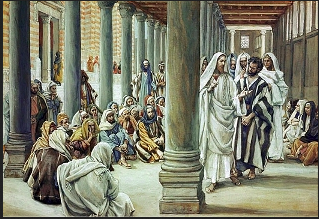
Jesus converses with the doctors of the law - Alexandre Bida
TODAY'S SPECIAL: Luke 6-7; Psalm 115

TO CHEW ON:
"And when all the people heard Him, even the tax collectors justified God, having been baptized with the baptism of John. But the Pharisees and lawyers rejected the will of God for themselves, not having been baptized by him." - Luke 7:29-30

There are moments of decision, crossroads where we must choose one direction or another. John the Baptist was one of the people who confronted his listeners with their path options. His message was repentance. The graphic way people showed they chose this repentance road was to submit to John's baptism.

After John's disciples asked Jesus John's question ("Are You the Coming One?" - yesterdays reading), Jesus explained John to the people (Luke 7:24-28). And then the writer Luke adds his author observations about what was going on here (Luke 7:29,30). Here's how the Amplified Bible puts it:

"And all the people who heard Him (Jesus), even the tax collectors acknowledged the justice of God [in calling them to repentance and pronouncing future wrath on the impenitent] being baptized with the baptism of John" - Luke 7:29 Amplified Bible.

However, two groups of people—the Pharisees and lawyers—steeled their hearts against this truth. How did they show their resistance? Apparently by doing nothing. Luke again:

"But the Pharisees and the lawyers [of the Mosaic Law] annulled and rejected and brought to nothing God's purpose concerning themselves, by [refusing and] not being baptized by [John]." - Luke 7:30 Amplified Bible (emphasis added). 

Jesus goes on to describe them as utterly resistant to wisdom (Luke 7:31-35). My Bible's commenter says it well:

"Jesus illustrates the fickle and even caustic response of the people to John's ministry and to His own. Unbelief will not respond to the truth, however well it is presented and demonstrated" - J. Lyle Story, commentary on Matthew 11:16-19, New Spirit-Filled Bible, p. 1310 (emphasis added).

There is a subtle warning in this for us. For we too can choose one way over another by doing nothing—by refusing to respond to the Holy Spirit's tug on our consciences, by resisting His invitation to change direction. How sobering to think that it could be said of me or you: "She / He annulled, rejected, brought to nothing God's purpose concerning themselves by refusing …"

PRAYER:
Dear God, please help me understand the danger of passivity. I want to have a heart that is sensitive to You and quick to respond. Amen.

PSALM TO PRAY: Psalm 115

***********

Unless otherwise noted, all Bible quotes are from The Holy Bible, New King James Version Copyright © 1982 by Thomas Nelson, Inc. - Used with permission.

Amplified Bible (AMP) Copyright © 1954, 1958, 1962, 1964, 1965, 1987 by The Lockman Foundation - Used with permission.


Friday, September 07, 2018

Would Jesus be grieved at our hard hearts?

Christ healing the withered hand by James Tissot

TODAY'S SPECIAL: Mark 1-2; Psalm 95

TO CHEW ON:
"And when He had looked around at them with anger, being grieved by the hardness of their hearts, He said to the man, 'Stretch out your hand.' And he stretched it out, and his hand was restored as whole as the other." Mark 3:5

In our reading today we see a rare thing—Jesus angry. What angered Him? It was the attitude of the Pharisees. They objected to Him healing the withered hand of a fellow worshipper because it was against their rules of what's allowed on the Sabbath. Mark described the source of Jesus' anger as "being grieved by the hardness of their hearts"  - Mark 2:5.

["Hard/hardness  is porosis— hardening, callousness. It's a medical term used to describe the process by which fractured bones are set by an ossifying or calloused petrifying. Sometimes it describes a hard substance in the eye that blinds. Used metaphorically porosis denotes a dulled spiritual perceptivity, spiritual blindness and hardness" - Dick Mills, New Spirit-Filled Life Bible p. 1568.]

We find lots of hard hearts in the Bible, in both Old and New Testaments.

1. People's hearts are hard towards believing in God even after seeing supernatural evidences of Him.
  • Pharaoh's heart is described as "hard" during the plagues. Repeatedly when a plague ends, he reneged on his promise to let the people go - Exodus 8:15; 9:34.
  • Even the Israelites had hard hearts despite seeing signs and experiencing wonders during the exodus and the years they spent in the wilderness - Psalm 78:32.

2. Hard-heartedness toward God continued throughout Israel's OT history
- Jeremiah 5:3; Zechariah 7:8-14.

3. It was often a top-down attitude, beginning with the king.
  • Judah's King Zedekiah was only 21 when he took the throne and his 11-year reign was summed up: "…he stiffened his neck and hardened his heart against turing to the LORD God of Israel" - 2 Chronicles 36:13.
  • It caused King Jehoiakim to systematically burn the scroll Jeremiah had just dictated to Baruch the scribe - Jeremiah 36:24.

4. Some hard heart causes and characteristics:

  • It was caused by pride (Daniel 5:20) and the the deceitfulness of sin (Hebrews 3:13).
  • It resulted in a lack of compassion (Mark 3:2-6—our reading), spiritual dullness (Mark 8:17), doubt and unbelief (Mark 16:14), broken relationships (Mark 10:4,5), and a withdrawal of God's presence (through His people and the Holy Spirit - Acts 19:9).  

5. It is remedied by repentance and confession
- Nehemiah 9:17.

6. If persisted in, its end consequence is judgement - Romans 2:5.

I would have loved to be a synagogue spider watching this interchange between Jesus and the Pharisees. But then the thought occurs, what if He came to my church—to yours? Is there a chance He would be grieved and angered by what He sees there of our attitude toward the withered hand types—the homeless, the mentally ill, the poor, the sexually broken, the addicts?

PRAYER:
Dear Jesus, please help me to see my heart as You see it, and to recognize any hard-heartedness. I need You to replace it with a heart of flesh (Ezekiel 36:26). Amen. 

PSALM TO PRAY: Psalm 95

The Bible Project VIDEO: Mark (Read Scripture Series)


 *********
Unless otherwise noted all Scripture quotations are taken from the New King James Version®. Copyright © 1982 by Thomas Nelson, Inc. Used by permission. All rights reserved.


Monday, April 30, 2018

Clay backtalk

TODAY'S SPECIAL: Isaiah 45-48; Psalm 119:33-64

TO CHEW ON: "Woe to him who strives with his Maker!
Let the potsherd strive with the potsherds of the earth!
Shall the clay say to him who forms it
'What are you making?'
Or shall your handiwork say, 'He has no hands'?" Isaiah 45:9

Included in today's amazing prophecy about Cyrus (the Persian king whom Isaiah predicted would free Israel from captivity 100 years before it happened) is a warning. It begins "Woe to him..." signalling that all who find themselves described in the words should pay attention. It answers the person who would take exception to God's method of using a heathen king to accomplish His work.

The warning pictures a lump of clay complaining to the potter about the way it is being shaped. I like how the NLT translates it:

"What sorrow awaits those who argue with their Creator.
Does a clay pot argue with its Maker?
Does the clay dispute with the one who shapes it,
saying 'Stop, you're doing it wrong!'
Does the pot exclaim, 'How clumsy can you be'?"

Do we ever do this--find ourselves discontented with the way we were created physically, mentally, emotionally? Do we wish we were taller or more athletic? Smarter and more creative?  More expressive, or less?

Accepting how God has made us is an aspect of belief or unbelief. Practicing contentment with our lot in life, including our physical appearance and the strengths and weaknesses with which we were born is part of the fabric of our confidence in God.

I love how the idea that God knew what He was doing when he intentionally created each one of us is echoed in Ephesians 2:10. Here it is in the Amplified:

"For we are God's [own] handiwork (His workmanship), recreated in Christ Jesus, [born anew] that we may do those good works which God predestined (planned beforehand) for us [taking paths which He prepared ahead of time], that we should walk in them [living the good life which He prearranged and made ready for us to live]."

How amazing to be His handiwork. [The NLT translates it "masterpiece." The Greek word for "handiwork" is poiema - get it—poem.] What an adventure to discover and then do those "good works which God prepared beforehand" and find those works a perfect fit for us because we were made just for them.


PRAYER: Dear God, I so readily question and talk back to you about the way I am and my apparent weaknesses and lacks. Help me to have the uttermost confidence in Your wisdom when forming me. Help me to find and do those "works" that are my destiny. Amen.

PSALM TO PRAY: Psalm 119:33-65

**********
Unless otherwise noted all Scripture quotations are taken from the New King James Version®. Copyright © 1982 by Thomas Nelson, Inc. Used by permission. All rights reserved.

Scripture quotations marked NLT are taken from the Holy Bible, New Living Translation, copyright © 1996, 2004, 2007 by Tyndale House Foundation. Used by permission of Tyndale House Publishers, Inc., Carol Stream, Illinois 60188. All rights reserved.

Scripture quotations marked Amplified are taken from the Amplified® Bible, Copyright © 1954, 1958, 1962, 1964, 1965, 1987 by The Lockman Foundation. Used by permission." (www.Lockman.org)


Monday, October 23, 2017

Building Blocks of Belief

Image: Pixabay
TODAY’S SPECIAL: Matthew 22:34-46

TO CHEW ON:
“‘The LORD said to my Lord,
Sit at My right hand,
Till I make Your enemies Your footstool’
” - Matthew 22:44


After the Jewish leaders had come to the end of their questions, Jesus had one for them: “‘What do you think about the Christ? Whose Son is He?’”

Of course they gave Him the right answer: “‘The Son of David.’”

Jesus volleyed back with, What about the words of King David Himself, spoken by the Spirit: “‘The LORD said to my Lord / Sit at My right hand, ‘ Till I make Your enemies Your footstool’” - a quote from Psalm 110 written by David and believed by the Jews to be full of Messianic references.

Jesus’ questioners were silenced. They left Him realizing that the logical implication of His observation was that Messiah, the Christ, was not only the physical descendant of David. My Bible’s study notes explain:

“A father does not call his son Lord but rather the reverse, a son calls his father, 'Lord.' Therefore, if the LORD (God) said to my Lord (Messiah) how can the Messiah be the Son of David? Thus the title ‘Son of David’ is inadequate. To be sure Jesus Christ is the “Son of David” (Matthew 1:1) but no less is He the ’Son of God.’” - J. Lyle Story, New Spirit-Filled Life Bible p. 1332.

Despite all the arguments in which Jesus bested these clever men, did He convince them? Not many. Which brings us to the question, what would it have taken to win them over to belief in Him if apologetics (what many of us consider evangelization's trump card) didn’t?

Similarly in our time we tend to think that having convincing apologetic points at our fingertips and winning arguments with them should convince unbelievers to believe in Jesus. But they rarely do.

John Dickson, author of Jesus: Who He is and Why He Matters, explores the foundations of belief in the book’s opening chapters (posted online as the article “Jesus: God’s Tangible Sign"). He quotes the findings of the ancient philosopher Aristotle, who identifies three building blocks of belief:
“… people form their beliefs on the combination of three factors: What is called logos, pathos and ethos.”

Logos is the intellectual dimension that would be influenced by convincing arguments.

Pathos is the personal or emotional aspect. “… an argument with pathos is one with a beauty and poignancy that resonates with our deepest selves.”

Ethos
is the social aspect of persuasion: “What we believe is hugely influenced by our upbringing, our education and the circle of friends we find ourselves in.”

If even Jesus could not sway these religious teachers by his astute apologetics, perhaps we should not be as fixated on coming up with the airtight right answer, the undeniable proof. For belief is multifaceted.  When some religious leaders believed in Jesus, they changed sides not after hearing Him win an argument but after seeing Him raise Lazarus from the dead (John 11:45). And Pharisees like Nicodemus and Joseph kept their belief in Jesus secret because of “ethos”—their fear of their peers - John 19:38.

A segment from Mr. Dickson sums up well how Aristotle’s building blocks of belief function today:

“When Christians talk about how they 'became Christians,' they will often mention an intellectual component, a personal component and a social component. They will talk about some book they read or sermon they heard that laid out the facts about God and Christ. Their intellect was nourished and impressed. 
But they will also happily tell you, for example, how one day while pondering the significance of Jesus they felt a deep resonance with the Christian gospel. The message somehow became attractive and personally satisfying. It answered deep longings and clarified certain confusions. 
And very often such people will admit to having been drawn into a community of Christians, at school, church or wherever, whose lives had an authenticity and goodness that was hard to argue with” - John Dickson. This segment of Mr. Dickson’s book is published online at rzim.org. Read  entire article “JESUS: God’s Tangible Sign”.

Let’s keep these things in mind as we interact with an unbelieving world.

PRAYER:
Dear Jesus, help me to be  always conscious of how You draw people to Yourself using many means. Help me to live and speak in a way that will draw people to, not repel them from You. Amen.

 *********
Unless otherwise noted all Scripture quotations are taken from the New King James Version®. Copyright © 1982 by Thomas Nelson, Inc. Used by permission. All rights reserved.


Sunday, October 01, 2017

Let your reasoning lead to faith

Religious leaders - Artist unknown
TODAY'S SPECIAL: Matthew 21:18-32

TO CHEW ON:
"And they reasoned among themselves saying, 'If we  say, "From heaven," He will say to us "Why then did you not believe him?" But if we say, "From men," we fear the multitude, for all count John as a prophet.' " Matthew 21:25,26


These chief priests, scribes and elders had the mindset of the conniving politician down pat. Their reasoning showed that they were more concerned with the impression they were making on observers than about searching their own hearts.

Jesus' claims often pulled out of His hearers such a reasoning response. That's what happens when what you see doesn't line up with what you have always thought possible. For example, after He said to the paralytic (whose friends lowered him to Jesus through a roof), "Your sins are forgiven," the scribes "reasoned" in their hearts that He had made a blasphemous statement (Mark 2:6-12).

When He talked about being the bread of life, the Jews "quarreled" with His claim (John 6:52).

Though such back-and-forth conversations in a reasoning, what-might-appear-to-us-as-argumentative style was the manner of Jewish teachers, Jesus never left the discussion on the theoretical plane. He inevitably pushed for a decision and a commitment.

In our reading today, Jesus refused to answer the leaders' insincere question about His authority to do miracles (Matthew 21:23-27). What was the point? It would just have produced more 'reasoning.'

In the story about the paralytic, from Mark, after forgiving the paralytic's sins, Jesus healed him physically, challenging the onlookers' assumptions that He was an ordinary man.

In the John account, after hearing the objections to His claims of being the bread of life, Jesus challenged the Jews to eat His flesh and drink His blood (a metaphorical allusion to the Last Supper and His death) - John 6:53-58.

Another time, when Jesus heard the wise answer of a scribe to His question, "Which is the greatest commandment?" He concluded, "You are not far from the Kingdom of God"  Mark 12:34) (the implication being, 'Why don't you just take that next step and enter it?').

Paul does a good job of summing up the tension between reasoning and going farther.
"Where is the wise? Where is the scribe? Where is the disputer of this age? Has not God made foolish the wisdom of this world? For since in the wisdom of God, the world through wisdom did not know God, it pleased God through the foolishness of the message preached to save those who believe" - 1 Corinthians 1:20,21 (emphasis added).

It's fine for us to discuss and reason. But at the end of the day we need to take that step of admitting who He really is and, in the perfect reasonableness of believing faith, surrender to Him the lordship of our lives.

PRAYER: Dear God, there is in our age more than ever the tendency to reason away Your claims. Help me to go beyond playing with words and ideas, and to commit myself to You in action-changing belief. Amen.

***********

New King James Version (NKJV) Used with permission. The Holy Bible, New King James Version Copyright © 1982 by Thomas Nelson, Inc.

Thursday, September 14, 2017

Whose side are you really on?

TODAY'S SPECIAL: John 12:27-41


TO CHEW ON: "But although He had done so many signs before them, they did not believe in Him."


We see a tug-of-war between faith and skepticism over Jesus' identity as God in this passage. It's clearly stated in the two verses just beyond our reading: "Nevertheless even among the rulers many believed in Him but because of the Pharisees they did not confess Him lest they should be put out of the synagogue" - John 12:42.

First we observe a serious Jesus who said disturbing things like "'My soul is troubled and what should I say? 'Father, save Me from this hour''?..." right in front of a crowd.  
 An onlooker might be skeptical and ask, could someone who is divine be a victim?

A thunderous heavenly voice answered Jesus' prayer. This caused confusion in the bystanders. They had various natural explanations about what this voice was, but Jesus told them it was God speaking for their benefit giving His very stamp of approval on Jesus.  

Faith: God speaking from heaven was a pretty strong endorsement of Jesus and His claims OR 
Skepticism: It was just thunder; He was deluded about what He was hearing.

Jesus then talked about being lifted up from the earth and drawing all people to Himself (John 12:32). As astute students of the Old Testament, which many of those in the crowd were, they would have recognized this allusion to the brass serpent that Moses erected during the Israelites' wandering, which those bitten by deadly serpents needed only to look to, to be saved (Numbers 21:4-9). 

Faith: Jesus is making some pretty powerful claims OR 
Skepticism: He's obviously crazy!

When they questioned, "You say 'The Son of Man must be lifted up'? Who is this Son of Man?" Jesus again predicted that He would leave them and pleaded with them to "'Walk while you have the light... While you have the light believe in the light that you may become sons of light'" John 12:34-36.

Skepticism: could a man linking Himself so openly with deity actually be subject to death?
Faith: He talked before about being light - John 8:12-30.)

Of course in addition to these verbal interchanges, there are all the signs and wonders Jesus performed - John 12:37.
Faith: Who but Someone with God's power could perform such powerful miracles?

All this back-and-forth did not move the skeptics, who had long since made up their minds about who Jesus was, from their position of skepticism. And yet "Nevertheless, even among the rulers many believed in Him, but because of the Pharisees they did not confess Him, lest they should be put out of the synagogue; for they loved the praise of men more than the praise of God" - John 12:42,43.

They believed, but they didn't make it public by changing sides!

Ouch! Isn't there a temptation for us to do this as well? In a world where faith in Christ is scorned and ridiculed for many reasons, isn't it also our temptation to be secret believers, even though our fears of what would happen if we confessed Jesus openly are as well founded as the fears of these rulers were (John 7:13; 9:22)?

But if silent, embarrassed, ashamed belief is our temptation for whatever reason, there is another consequence we should bear in mind—a consequence far more serious than losing the popularity and praise of people.

"'Therefore, everyone who acknowledges Me before men and confesses Me [out of a state of oneness with Me], I will also acknowledge him before My Father Who is in heaven and confess [that I am abiding in] him. But whoever denies and disowns Me before men, I also will deny and disown him before My Father Who is in heaven'" Matthew 10:32-33 (Amplified)

PRAYER: Dear Jesus, help me to come out of the closet, as it were, about my faith in you. Help me to be confess You in all company. Amen. 

"I'd Rather Have Jesus"

MORE: Holy Cross Day

Today the church celebrates the cross. The liturgy for Holy Cross Day begins with this collect:

Almighty God, whose Son our Savior Jesus Christ was lifted high upon the cross that he might draw the whole world to himself: Mercifully grant that we, who glory in the mystery of our redemption, may have grace to take up our cross and follow him; who lives and reigns with you and the Holy Spirit, one God, in glory everlasting. Amen.
************
Unless otherwise noted all Scripture quotations are taken from the New King James Version®. Copyright © 1982 by Thomas Nelson, Inc. Used by permission. All rights reserved.

Scripture quotations marked AMP are taken from the Amplified® Bible, Copyright © 1954, 1958, 1962, 1964, 1965, 1987 by The Lockman Foundation. Used by permission." (www.Lockman.org)

Bible Drive-Thru


Friday, June 16, 2017

The birth of Laughter

TODAY'S SPECIAL: Genesis 21:1-21

TO CHEW ON:
 "And Abraham called the name of his son who was born to him — whom Sarah bore to him — Isaac....And Sarah said, 'God has made me laugh, and all who hear will laugh with me.'" Genesis 21:3,6
Have you noticed how many times laughter bubbles up in the story of Isaac?

Abraham's reaction to God's reassurance that he would have a child by Sarah — a child that would be the first in a line of descendants that would one day become a nation— was: "Then Abraham fell on his face and laughed..." (Genesis 17:17).

When the angel visitor reiterated that message to Abraham, Sarah, who "...had passed the age of childbearing" overheard their conversation and "...laughed within herself" (Genesis 18:11-12).

After Isaac was born, Sarah said, "God has made me laugh and all who hear with laugh with me" (Genesis 21:6).

Is it any wonder they called the baby Isaac, which means laughter?

My dictionary's first definition of laugh not only describes the physical act of laughing but also names some of the reasons we laugh: "To produce the characteristic explosive or inarticulate sounds, facial expression and other physical manifestations expressive of merriment, elation, derision, discomposure etc."

Robert Hemley on the topic of what makes something laughable says:
"Unpredictability. We laugh at what surprises us...we laugh because we have been shaken out of our normal perceptions" - Robert Hemley in "Relaxing the Rules of Reason" from How to Write Funny, p. 15.

"Shaken out of normal perceptions" — that would describe Abraham and Sarah. Who would blame 100-year-old Abraham or menopausal Sarah for laughing when God told them they would parent a son? However, their initial laughter of skepticism, cynicism, even derision turned to that of sheer joy when this most unlikely thing happened.

Isaac was the beginning of the nation from which Jesus was born--a birth that was also full of unpredictability. That the creator of the universe would shrink Himself to embryo size to be born in a barn?! Our incredulous laughter at the unlikelihood of such a thing turns to the laughter of elation as we ponder why He did it (John 3:16).

PRAYER: Dear Jesus, thank You for coming as a baby, born to humble parents, in the lowliest place. Thank You for what Your coming means to me. It is beyond laughing incredible! Amen.

************
Unless otherwise noted all Scripture quotations are taken from the New King James Version®. Copyright © 1982 by Thomas Nelson, Inc. Used by permission. All rights reserved.


Bible Drive-Thru

Sunday, May 28, 2017

God keeps us

hand cradling feet
TODAY'S SPECIAL: John 17:1-11

TO CHEW ON: " ' Now I am no longer in the world, but these are in the world, and I come to You. Holy Father keep through Your name those whom You have given Me, that they may be one as We are.' " John 17:11

How wonderful to hear Jesus pray for us—because this prayer was not only for the disciples present but also " ' … for those who will believe in Me through their word' " John 17:20. He prays that God will keep us. the need for such a prayer signals a danger of which we need to be aware: the possibility we could lose faith.

A short sweep through the Bible shows us some of the ways.  God keeps us:

  • Wherever we go. Like He was with Jacob, God is with us - Genesis 28:15; Proverbs 2:8.
  • Physically. The psalmist expresses it: "He guards all his bones. Not one of them is broken" - Psalm 34:20.
  • Always. He never sleeps - Psalm 121:4.
  • Through His name. What does it mean to be kept "through His name"? The Amplified Bible expresses John 17:11: " 'Holy Father, keep in You name [in the knowledge of Yourself] them whom You have given Me' " - John 17:11 AMP. I understand it as getting to know the breadth and depth of His essence (His name) and seeing how capable He is of whatever we need.
  • As we lay our anxieties on Him. He then guards our hearts and minds with His peace - Philippians 4:6,7.
  • From the evil one - 2 Thessalonians 3:3.
  • ...and what we have committed to Him - 2 Timothy 1:12. If we have committed our lives, His power can keep us through our lifespan until we see our salvation - 1 Peter 1:5.
  • From stumbling, so we will be able to stand in His presence with joy - Jude 1:24.
  • From the extreme test of end-time events, the "...  the hour of trial which shall come upon the whole world to test those who dwell on the earth" - Revelation 3:10.

When we feel we are on precarious footing in our faith—perhaps after going through a test of sickness, bereavement, family troubles or whatever, we can take comfort in the fact that Jesus prayed for us to be kept. We can trust Him to make a way for us, through the difficulties, back to a firm footing of faith.

PRAYER: Dear God, thank You for Your keeping power. When my grip on faith in You is weak, please send an answer to Jesus' prayer for me. Amen.

 *********
Unless otherwise noted all Scripture quotations are taken from the New King James Version®. Copyright © 1982 by Thomas Nelson, Inc. Used by permission. All rights reserved.

Scripture quotations marked AMP are taken from the Amplified® Bible, Copyright © 1954, 1958, 1962, 1964, 1965, 1987 by The Lockman Foundation. Used by permission." (www.Lockman.org)


Sunday, March 12, 2017

Faith in God—not our words

woman praying on her knees
TODAY'S SPECIAL: Romans 4:13-25

TO CHEW ON:
"Therefore it is of faith …. God, who gives life to the dead and calls those things which do not exist as they they did…" Romans 4:17

In this passage, where Paul compares Abraham's faith in God's promise to make a nation of him to our faith in Jesus' death and resurrection to give us new life, these familiar words jump out at me: "God, who gives new life to the dead and calls those things which do not exist as though they did…"

I obviously haven't been paying attention for I have assumed that these words were a description of how the person of great faith prayed. But on a close reading, it isn't us who call things which do not exist as though they did, but God. Here is how the NIRV puts it:
"The God that Abraham believed in gives life to the dead. Abraham’s God also creates things that did not exist before" - Romans 4:17b (NIRV).

We're talking about the object of faith here. I like the simple definition of "faith" in the Dictionary of Bible Themes: "A constant outlook of trust towards God, whereby human beings abandon their own efforts and put their full confidence in him, his word and promises" (Dictionary of Bible Themes accessed through Biblegateway.com).

We put our faith not in the effort of our spoken words of faith but in God. It is only He who is able to "call those things which do not exist as though they did," to bring about the seemingly impossible for Abraham, for us in salvation, and for the requests about which we pray.

There is, in my mind, a big difference between this reading and how I've heard followers of the Word of Faith movement claim this verse—as a challenge to utter new things into being by the faith words one says or prays.

Yes, we make audacious requests, speaking in faith—that God will heal cancer, break addictions, turn whole nations around, etc. But we know it's not our words that will accomplish these things or our faith in these words, but God. I like how a sidebar article in my Bible explains this verse and how we can apply it when we pray:

"Notice that this verse does not say God calls things that are as though they do not exist but rather that God calls those things which do not exist as though they do exist. Thus we see that authentic faith does not deny the obstacle at hand, but declares that God is greater than the obstacle. Faith does not deny that a sickness is in the body, but declares Jesus' ability to heal the body (see Mark 5:23). Faith does not deny financial need, but acknowledges Jesus' ability to meet our needs (see Matthew 17:24-27)" - Gerald Brooks, "Pretending vs. Believing," New Spirit-Filled Life Bible, p. 1555.

The fact that we utter faith-filled words does matter. But those words are never the power behind answered prayer. Our creator God is.

PRAYER:
Dear God, who calls those things which do not exist as though they did, please strengthen my faith in Your ability to provide creative solutions to the problems I bring to You each day. Amen.

 *********
Unless otherwise noted all Scripture quotations are taken from the New King James Version®. Copyright © 1982 by Thomas Nelson, Inc. Used by permission. All rights reserved.

Scripture passages marked NIRV are taken from the New International Reader's Version, copyright © 1995, 1996, 1998, 2014 by Biblica, Inc.®. Used by permission. All rights reserved worldwide.

Monday, February 27, 2017

Fasting

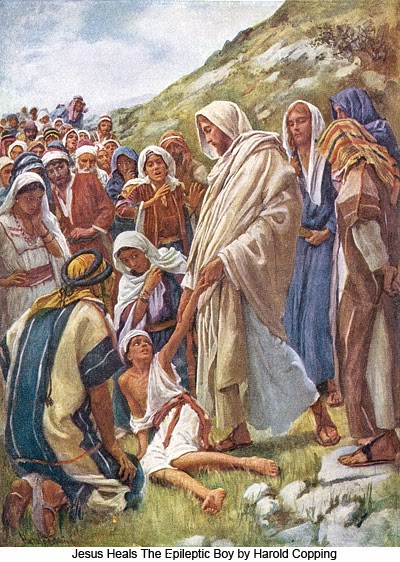
Jesus heals the epileptic boy by Harold Copping

TODAY'S SPECIAL: Matthew 17:14-27

TO CHEW ON: " ' However, this kind does not go out except by prayer and fasting.' " Matthew 17:21

How grieved the disciples must have been when Jesus called them a " 'faithless and perverse generation,' " though He did soften His scold a bit when He gave them an excuse for not being successful with the exorcism: "' However, this kind does not go out except by prayer and fasting.' "

This passage gives us some hints about what it takes to have real spiritual power:
Belief, which can be mustard-seed-small, but even in its smallness is genuine and persistent.

Prayer.

Fasting.

Of these three, fasting is the most mysterious to us. It is a spiritual practice we see a lot of in the Bible though.

  • Moses fasted for the 40 days he was with God on Mt. Sinai. It's as if that was a given—such concentrated time in the presence of the LORD Himself was all the food and drink he needed - Exodus 34:28.
  • Fasting was how people showed their respect for and grief over the death of Saul and Jonathan. Similarly David fasted over the death of General Abner - 2 Samuel 1:12; 3:35; 1 Chronicles 10:12.
  • King David fasted when his and Bathsheba's first baby was deathly ill (though his fast didn't save the baby's life) - 2 Samuel 12:16.
  • The Israelites fasted in repentance as they returned to God after a season of idolatry - 1 Samuel 7:6. They did this again in Nehemiah's time - Nehemiah 9:1.
  • Ahab put on sackcloth and fasted after hearing Elijah's prophecy of calamity about to come on him and his descendants. As a result of him humbling himself like this, God sent Elijah back to tell him these curses would not come on him during his (Ahab's) lifetime - 1 Kings 21:27-29.
  • Ezra fasted for the guilty people - Ezra 10:6.
  • Esther, her personal servants, and all the Jews in Sushan fasted and prayed for favour before she went in to request an audience with the king - Esther 4:15,16.
  • Saul fasted after he encountered Jesus on the Damascus Road - Acts 9:9.
  • Cornelius, a Gentile, was in a time of fasting and prayer when an angel appeared to him with instructions to fetch Peter. As a result, Cornelius and his household were saved and filled with the Holy Spirit - Acts 10:30.
  • The early church leaders fasted and prayed when seeking direction for their leaders - Acts 13:2,3; 14:23.
  • We read of Jesus fasting only once for the forty days of his temptation in the wilderness - Luke 4:1,2.  But it seems He assumed fasting would be part of a person's spiritual practice, for He said to His disciples: " 'But you when you fast, anoint your head and wash your face…' " - Matthew 6:17 (emphasis added). And here He explained His power over the tormenting spirit by implying that He had prepared for this encounter beforehand by fasting.

The experience of Bible characters paints a compelling case for the practice of fasting, not to get our way but to demonstrate our sincerity before God and to position ourselves intentionally in the powerful realm of His will and purposes.

PRAYER: Dear God, You know how hard I find fasting. Help me to grow in this spiritual discipline. Amen.

 *********
Unless otherwise noted all Scripture quotations are taken from the New King James Version®. Copyright © 1982 by Thomas Nelson, Inc. Used by permission. All rights reserved.

Wednesday, September 14, 2016

The either / or message of the cross

TODAY'S SPECIAL: John 8:12-30

TO CHEW ON: "Then Jesus said to them, 'When you lift up the Son of Man, then you will know that I am He, and that I do nothing of Myself, but as My Father taught Me, I speak these things.'" John 8:28


Here Jesus, in a reference to His death on the cross at the hands of the very people He is conversing with (" 'When you lift up the Son of Man' "), makes an interesting claim. He says " '...then you will know that I am He' " (the embodiment of all the other claims He has been making about Himself  - John 8:16, 19, 21, 22, 23, 26).

This is a bold prediction. How was it so?

Supernatural events at the time of Jesus' crucifixion:
If the hearts of the Pharisees were at all open to the possibility that what He said here was true, then the unnatural happenings at the time of the crucifixion (the day's premature darkness, the earthquake, the ripping of the temple curtain, the dead raised) would have been powerful witnesses.

Jesus' death on the cross was / is also a personal sifting:
I believe this knowledge was and is more personal—a sorting event that revealed to the Pharisees in Jesus' time and continues to reveal, down to us today, our very hearts.

"They may be confused now, but they will know then. Whether this knowledge will result in salvation or judgment is not said. The idea is probably that they will at that point see the revelation shining at its brightest and have their hearts revealed as, in the light of that revelation, they either embrace or reject Christ and the God He reveals" - IVP Commentary on John 8, accessed through Biblegateway.com - emphasis added.

Still today the message of the cross sifts us (the message that entails our innate sinfulness, our need of a Saviour, and God's mercy, love and grace in sending Jesus to die in the place of each one of us). Some believe and accept it, some don't. It's either / or. 

Paul expresses it so well in 1 Corinthians:
"For the message of the cross is foolishness to those who are perishing, but to us who are being saved it is the power of God. …For Jews request a sign, and Greeks seek after wisdom; but we preach Christ crucified, to the Jews a stumbling block and to the Greeks foolishness, but to those who are called, both Jews and Greeks, Christ the power of God and the wisdom of God" - 1 Corinthians 1:18, 22-24.

PRAYER:
Dear Jesus, thank You for obeying the Father in dying on the cross for us. Please continue to open the eyes and hearts of people all over the world to how this is the power and wisdom of God. Amen.

MORE: Holy Cross Day

Today the church celebrates HOLY CROSS DAY    .

The liturgy of the day begins with this prayer:

Almighty God, whose Son our Savior Jesus Christ was lifted high upon the cross that he might draw the whole world to himself: Mercifully grant that we, who glory in the mystery of our redemption, may have grace to take up our cross and follow him; who lives and reigns with you and the Holy Spirit, one God, in glory everlasting. Amen.

 *********
Unless otherwise noted all Scripture quotations are taken from the New King James Version®. Copyright © 1982 by Thomas Nelson, Inc. Used by permission. All rights reserved.


Monday, August 08, 2016

By faith

Israel marches around Jericho - Artist unknown
TODAY'S SPECIAL: Hebrews 11:17-31

TO CHEW ON:
"By faith…"- Hebrews 11:17,20,21,22,23,24,27,28,29,39,31


I love how various aspects of faith are illustrated in today's segment of Hebrews 11—the Bible's famous Faith Chapter. Through these examples we discover that faith has many facets. Let's identify some of them.

Abraham's faith involved obedience and overcoming rationalism as he compared God's mysterious instructions to sacrifice Isaac with His prior promise to provide a nation through this son - Hebrews 11:17-20.

Isaac and Jacob's faith in blessing their sons, and Joseph's faith in the request that he be burred in the promised land consisted of hope for the future and prophetic foresight - Hebrews 11:20-22.

Moses' parents hiding their baby boy showed the risk that faith sometimes involves, as well as hope for the future of their "no ordinary child" - Hebrews 11:23.

Moses' faith, demonstrated when he broke with his Egyptian upbringing, was anchored in spiritual belief about who the real God was - Hebrews 11:24-27. His instituting of the Passover demonstrated that too, along with the faith of obedience - Hebrews 11:28.

The Israelites passing through the Red Sea showed trust in God's power to accomplish the supernatural - Hebrews 11:29.

The Israelites march around Jericho showed the obedience and overcoming rationalism facets of faith - Hebrews 11:30.

Rahab's faith was an example of spiritual belief and obedience - Hebrews 11:31.

We could go on to parse the faith examples that continue, but you get the idea. For me, this realization of the many aspects of faith is helpful in that it's true for us too. The faith that's required when we pray for the future of our children and grandchildren, for example, is somewhat different from the faith we need when we pray for healing, or change our daily routine to do God's assignments. God sees, recognizes and blesses all the various shades of faith we need to exercise in our life with Him. 

For what do you and I need faith today? Are we exercising that particular faith muscle?

PRAYER: Dear Father, please help me to live by faith in big and little things today. Amen.

 *********
Unless otherwise noted all Scripture quotations are taken from the New King James Version®. Copyright © 1982 by Thomas Nelson, Inc. Used by permission. All rights reserved.


Saturday, July 23, 2016

Praying for a good land

Red Leaf House of Prayer: check it out.
TODAY'S SPECIAL: Psalm 85:1-13

TO CHEW ON: "Yes, the Lord will give what is good;
And our land will yield its increase." Psalm 85:12


Is the state of our land—the country we live in with its political borders, the very dirt under our feet—dependent on God's blessing? The sons of Korah, writers of this psalm, would make that connection. In this prayer for favour on their land they:
  • remind God of His past goodness to them including the fact that He has returned them from captivity  (Psalm 85:1-3).
  • beg for spiritual revival ("Restore us... revive us ... show us mercy ... grant Your salvation" - Psalm 85:4-7)
  • dream about how His mercy on the land will look (Psalm 85:8-13). It's a metaphorical picture of good qualities reunited: mercy and truth meeting; righteousness and peace kissing.  There's a new crop of truth springing from the ground like a germinating field. Righteousness looks down on it from heaven (we envision the sun, smiling down on new growth).

I do my share of complaining about the state of my country—its judicial foot-dragging, its penchant toward political correctness that turns a blind eye when some break the law while it clamps down hard on others, and its slide into immorality and ethical greyness. But do I bring these concerns to God as much as I bellyache about them to others?

If not, why not? I suspect it's because at some level I haven't made the connection between His power and the state of the country I love.

I want to pick up the slack so my land "will yield its increase" not only of physical plenty but of righteousness, truth, and mercy.

PRAYER: Dear God, thank You for being the God of nations and lands as well as individuals. Help me to cast my concerns about Canada on You. I pray for a time we will "make His footsteps our pathway" - Psalm 85:13.

MORE: Prayer for our country

In her book Praying with Fire, Barbara Billett writes prayers based on passages from the Bible. In her prayer for Leaders / Word Confession for Canada she writes the following—an excerpt from a longer passage  (substitute the name of your country in places there are references to Canada):


"Father, in the Name of Jesus, You have given me the keys of the kingdom; and whatever I bind on earth is bound in heaven; and whatever I loose on earth is loosed in heaven. Therefore in the mighty Name of Jesus, I cast down the wisdom of this world—that which is earthly, sensual and demonic from over our nation and the leaders of our nation in the Name of Jesus.

I command wrong mind sets, philosophies and belief systems to be utterly overthrown and demolished from the minds of our Canadian leaders in government, the law enforcement, and judicial systems, the Armed Forces, (the media [my insert]), and the educational system in the Name of Jesus.

It is written in Your Word that the heart of the king is in the hand of You, Lord, and that You turn it whichever way You desire. I believe that the hearts of our Prime Minister and the leaders of Canada are in Your hand and that their decisions are divinely directed by You..."

(Based on: Matthew 18:18-19; James 3:15; 2 Corinthians 10:4-5; Proverbs 21,1.

*********
Unless otherwise noted all Scripture quotations are taken from the New King James Version®. Copyright © 1982 by Thomas Nelson, Inc. Used by permission. All rights reserved.

Bible Drive-Thru

Monday, June 20, 2016

Choose to believe

Jesus raises Jairus' daughter - Artist unknown
TODAY'S SPECIAL: Luke 8:40-56

TO CHEW ON:
"And He said to her, 'Daughter, be of good cheer, your faith has made you well. Go in peace.' … But when Jesus heard it, He answered him saying, 'Do not be afraid; only believe, and she will be made well.'" Luke 8:48, 50


The powerful common denominator of faith links these two miracles.

The woman with a twelve-year bleeding problem had a faith that drew God's healing virtue at her touch of Jesus' robe  (Luke 8:48).

To distraught Jairus,  father of the little girl who has just died, Jesus says, "'Do not be afraid; only believe.'"  Jairus must have, for his little girl came back to life (Luke 8:50).

Under the heading "Faith Prescribed" my Thompson Chain Bible walks us down a Bible pathway lit by faith.

Faith assures success:

~In the wonderful OT story of Jehoshaphat defeating the armies of Ammon and Moab with troops led by worshippers, Jehoshaphat begins the day's instructions by telling his people, "Believe in the Lord your God, and you shall be established; believe His prophets, and you shall prosper" - 2 Chronicles 20:20.

Faith is our duty:

~How do we work the works of God, Jesus' disciples ask? Jesus replies: "This is the work of God, that you believe in Him whom He sent"" - John 6:28,29.

Faith is a weapon and a war:
~It is called a "shield" (Ephesians 6:16) and a "breastplate" (1 Thessalonians 5:8).
~Paul tells Timothy to "Fight the good fight of faith" - 1 Timothy 6:12.

Faith is essential to a relationship with God:

~ "But without faith it is impossible to please Him, for he who comes to God must believe that He is and that He is a rewarder of those who diligently seek Him" - Hebrews 11:6.

Faith is necessary for answered prayer:
~ "If any of you lacks wisdom, let him ask of God … But let him ask in faith, with no doubting…" James 1:5,6.

Faith must be united with love:
~ "And this is His commandment: that we should believe on the name of HIs Son Jesus Christ and love one another…" 1 John 3:23.

For what do you and I need faith today? We can choose to believe!

PRAYER: Dear Jesus, Your words and the Bible's entire tone show me that faith (or unbelief) are a choice. Help me to be a woman of faith. Amen.

***********

New King James Version (NKJV) Used with permission. The Holy Bible, New King James Version Copyright © 1982 by Thomas Nelson, Inc.

Bible Drive-Thru

Saturday, June 18, 2016

Panic or pistis?

Image: Pixabay.com
TODAY'S SPECIAL: Luke 8:4-25

TO CHEW ON: "And they came to Him and awoke Him, saying, 'Master, Master, we are perishing!' Then He arose and rebuked the wind and the raging of the water. And they ceased, and there was a calm. But He said to them, 'Where is your faith?'" Luke 8:24,25

I can totally relate to the disciples. Though my storms aren't always physical (they can include things like relationship problems, unexpected expenses, family crises, as well as the physical stuff of accidents, sicknesses and acts-of-nature emergencies) they feel as threatening to my life and person as the squall on Galilee felt to the disciples.

Jesus' answer to the disciples' panic was a simple question: "'Where is your faith?'" It implies that faith was the key to their peace of mind.

A "Word Wealth" article in my Bible explains the Greek word pistis used for faith here: "Conviction, confidence, trust, belief, reliance, trustworthiness, and persuasion. In the N.T. setting pistis is the divinely implanted principle of inward confidence, assurance, trust, and reliance in God and all that He says" - Dick Mills, New Spirit-Filled Life Bible, p. 1372.

It seems that Jesus expected the disciples to be familiar with God and His promises, and to trust Him.

Could that also be the secret to our peace of mind in the middle of our life storms? Faith? It means we need to have two simple things:
 

1] A knowledge of God and His promises.

2] Faith that He will keep His word.


PRAYER: Dear Jesus, help me to trust You and Your good intentions toward me and those I love. May my trust be so strong that it overwhelms the panic that naturally arises when I'm in life's storms. Amen.

 *********
Unless otherwise noted all Scripture quotations are taken from the New King James Version®. Copyright © 1982 by Thomas Nelson, Inc. Used by permission. All rights reserved.


Monday, April 25, 2016

The importance of BELIEF

Jesus appears to Mary - Artist unknown
TODAY'S SPECIAL: Mark 16:9-20

TO CHEW ON: "'He who believes and is baptized will be saved, but he who does not believe will be condemned.'" Mark 16:16

The word "believe" in one form or another occurs seven times in our reading. The dictionary defines believe as: "To have confidence in the truth, the existence, or the reliability of something, although without absolute proof that one is right in doing so."

What did these disciples believe or disbelieve? There seem to be two matters:
- That Jesus had actually appeared to those who told of seeing Him.
- That Jesus was who He said He was and could do what He said He could do (implied by what he says in Mark 16:16).

Their belief or lack of it affected them in several ways:


1. It made a difference in their relationship with each other. I'm sure wedges appeared in their friendships when they didn't believe the accounts of the eye witnesses—Mary Magdalene and the Emmaus disciples.

2. It affected their own spiritual health and receptivity. Jesus "… rebuked their unbelief and hardness of heart" - Mark 16:14.

3. Their belief or unbelief had the potential to determine their salvation and eternal destiny - Mark 16:16.

4. It affected their ability to do miracles. Jesus promised signs following and confirming the word preached to those who "'...believe...'" - Mark 16:17.

Before we're too hard on the disciples, though, let's look at ourselves. When we hear a story of an instant healing, or of someone having a vision, or of some unexplainable escape from disaster, do we believe the account, or in our hearts pooh-pooh it? Do we really believe that a person's faith in Jesus, or their disbelief, affects their eternal destiny? Do miracles confirm our ministry? Maybe we too are guilty of unbelief and hard hearts.


PRAYER: Dear Jesus, I confess I have been guilty of unbelief and having a hard heart. I want my faith to be an asset to Your Kingdom and the church. Amen.

 *********
Unless otherwise noted all Scripture quotations are taken from the New King James Version®. Copyright © 1982 by Thomas Nelson, Inc. Used by permission. All rights reserved.


Tuesday, April 19, 2016

Faith food

Jesus at the Feast of Dedication - James Tissot
TODAY’S SPECIAL: John 10:22-42

TO CHEW ON: “‘I told you and you do not believe…. But you do not believe because you are not My sheep, as I said to you. My sheep hear My voice and I know them and they follow me.’” John 10:25-27

When the Jews surrounded Jesus in the temple during the Feast of Dedication demanding “'If you are the Christ tell us plainly,'” they had one goal – to get Jesus to incriminate Himself. They were not asking for proof of His deity in order to reassure themselves that He was God and believe in Him. They were not even looking to Him as a potential Messiah to free their nation from the Romans. They completely overlooked the miracles that pointed to the fact He was no ordinary man. All they wanted was proof (again) from His own mouth, of blasphemy. Then they planned to arrest Him and get rid of Him as a rival.

The same teachings and miracles of Jesus referred to when talking to the Jews had a far different effect on the “many who came to Him… and believed in Him.” The difference: a willingness to believe.

The same is true for people of our generation. Though we don’t have Jesus in person as they did, we have the Bible. I’m sure you’ve noticed its different effects on people. Some laugh it off as a collection of archaic writings that have nothing at all to say to them. Others read it with reservations and attempt to twist it to say what they want it to say. Still others consider it truth, the very words of God. To them it is direction for life and hope in death. Whatever one’s perception of Jesus and what He said according to the Bible, it hinges on one thing: a decision to believe - or not.

How do we come to that point of belief? How do we encourage it in others? Through exposure to the Bible. John Piper says:
“The Word of God begets and sustains spiritual life because it begets and sustains faith: “These are written,” John says, “so that you may believe that Jesus is the Christ, the Son of God, and that by believing you may have life in his name (John 20:31). “Faith comes from hearing,” writes the apostle Paul, “and hearing through the word of Christ” (Romans 10:17). The faith that starts our life in Christ and by which we go on living comes from hearing the Word of God.” - John Piper, Desiring God, p. 146 (emphasis his).

If you are having trouble believing in and hearing the voice of your Shepherd, spend time in the Bible. Read it, memorize it, think about it, do it. Your exposure to God’s word will plant the seed of faith and grow it into the desire and ability to live an obedient life.

PRAYER: Dear God, I want to hear Your voice. Help me to read, understand and obey Your Word. Amen

MORE: At the age of 19 Abraham Piper, son of John Piper, was an avowed atheist. He came to faith one morning by reading the book of Romans. His advice to parents with prodigal kids:
"When you read something in the Bible that encourages you and helps you love Jesus more, write it up in a couple of lines and send it to your child. The best exhortation—better than any correction—is for them to see Christ’s joy in your life.


Don’t stress out when you’re composing these as if each one needs to be singularly powerful. Just whip them out and let the cumulative effect of your satisfaction in God gather up in your child’s inbox. God’s Word is never useless."

Read his story: “Let Them Come Home.”

*********
Unless otherwise noted all Scripture quotations are taken from the New King James Version®. Copyright © 1982 by Thomas Nelson, Inc. Used by permission. All rights reserved.

Do your 8-12-year-olds have daily devotions? Point them to Bible Drive-Thru.

Friday, April 15, 2016

Grace to believe

Traditional Jewish man (Image: Pixabay.com)
TODAY'S SPECIAL: Zechariah 12:1-14

TO CHEW ON: "And I will pour on the house of David and on the inhabitants of Jerusalem the Spirit of grace and supplication; then they will look on Me whom they pierced. Yes, they will mourn for his only son and grieve for Him as one grieves for a firstborn." Zechariah 12:10


In her 2015 memoir Love Triangles, Bobbie Ann Cole (a British-born Jew who recognizes Jesus as Messiah) tells the story of her sojourn in Israel where she, with her Gentile husband decided to become citizens. (For her it was called making aliyah.)

However, the cloud over the whole experience was the fact that she felt she had to hide her belief in Jesus as Messiah in order to be accepted. Though in public speeches the Prime Minister lauded Israeli democracy and tolerance, she knew of many Messianic Jews who experienced nothing but roadblocks in their attempts to become Israeli citizens. Her conclusion: "The nation whose vision I heartily embraced had a policy of waging war on Jewish believers like me" - Love Triangles, Kindle Location 1898.

The prophecy in our today's reading predicts a time when there will be a change, not only in Israel's political position from besieged to besieger (Zechariah 12:6), but also its spiritual position from rejection to acceptance of "… Me whom they pierced …"  (Zechariah 12:10).

"Me whom they pierced" sounds like Jesus.

How will this change take place? Through an outpouring of "the Spirit of grace and supplication." A sidebar article in my Bible explaining the word grace says:

"God's grace poured out upon Jerusalem enables them to look longingly and beseechingly toward their pierced King. God's grace will result in Israel's seeing Jesus as someone of infinite beauty" - Dick Mills, New Spirit-Filled Life Bible, p. 1261.

I would submit that God's grace is necessary to open the eyes of not only Jewish people but Gentiles as well concerning who Jesus is, what He did, and its personal significance. Let's pray for God to pour on all our unbelieving loved ones this "Spirit of grace and supplication" even as we continue to pray for currently beleaguered Jerusalem and its peace (Psalm 122:6).

PRAYER: Dear Father, Help me to never overlook the necessity of the wooing of Your Spirit to draw people to Jesus. I pray that He will be active in the lives of my loved ones who don't recognize Jesus for who He is and what He did. Amen.

 *********
Unless otherwise noted all Scripture quotations are taken from the New King James Version®. Copyright © 1982 by Thomas Nelson, Inc. Used by permission. All rights reserved.


Related Posts Plugin for WordPress, Blogger...