Wednesday, February 24, 2016

Encouragement to quitters

"Rebuilding the walls of Jerusalem" - Artist unknown

TODAY'S SPECIAL: Zechariah 4:1-5:4

TO CHEW ON: " 'The hands of Zerubbabel
Have laid the foundation of this temple,
His hands also shall finish it.
Then you will know
That the LORD of hosts has sent Me to you.' " Zechariah 4:9


You will recall that Zechariah was prophesying to exiles who had returned to Jerusalem from Babylon. They had begun rebuilding the temple but due to opposition, discouragement, and distraction had abandoned the job.

Zechariah's vision and words concern Zerubbabel—the governor—who had begun the build but quit midway through. The Message Bible puts our focus verse in everyday language:

"'Zerubbabel started rebuilding this temple and he will complete it. That will be Your confirmation that the God-of-the-Angel-Armies sent me to you' " Zechariah 4:9 MSG.

In addition to this encouraging prophecy to quitter / procrastinator Zerubbabel, two other thoughts from our reading jump out at me. To Zerubbabel and all of us who are tempted to quit or lay aside the assignments we've been given, I believe God would say:

1. "For who has despised the day of small things…" - Zechariah 4:10.
Don't judge the worth of a project by its small beginnings or its humble originator. There are no small jobs or insignificant people in God's family. I'm reminded of Paul's picture of the church as a body with no part more important than any other (1 Corinthians 12:12-24).

Leslyn Musch says of this verse in her "Truth-In-Action Through Zechariah" article: "Give yourself wholeheartedly to the things that God is asking you to do, and trust that He will bless. … Remember as you are faithful with little, God will entrust you with more  (Matthew 25:21)" - New Spirit-Filled Life Bible, p. 1265.

2. " 'Not by might or by power but by My Spirit,' says the Lord" - Zechariah 4:6
We can't do these things on our own. If ours are God-given assignments, we need His help to complete them and fit them into His grand design.

Musch again: "Ask God to fill you to overflowing with His Holy Spirit. The picture given is of an endless supply of oil representing the Holy Spirit" - Op. Cit, p. 1264.

PRAYER: Dear God, where I have given up or postponed doing those things You have asked of me, please forgive me. Help me to apply to these tasks these encouraging words of their significance and Your help. Amen.

 *********
Unless otherwise noted all Scripture quotations are taken from the New King James Version®. Copyright © 1982 by Thomas Nelson, Inc. Used by permission. All rights reserved.


Sunday, February 21, 2016

"I do not know you"

Jesus weeps over Jerusalem - James Tissot
TODAY’S SPECIAL: Luke 13:22-35

TO CHEW ON: “But He will say, ‘I tell you I do not know you, where you are from. Depart from me, all you workers of iniquity.’....O Jerusalem, Jerusalem, the one who kills the prophets and stones those who are sent to her! How often I wanted to gather your children together as a hen gathers her brood under her wings, but you were not willing!” Luke 13: 27,34

“He is not safe, but he is good.” I'm thinking this description of the lion Aslan from C. S.Lewis’s The Lion the Witch and the Wardrobe might be a caption for today’s reading.

The Jewish leaders thought they had God all figured out. In their theology, His favor was on the Jews. The very fact that someone was born one, and especially if that one tried to keep the law, guaranteed them a ticket to paradise with God.

In our reading today Jesus' teaching puts the boot to that notion. His illustrations of the narrow gate and broad gate and entry through only the narrow,  His stories of people coming to the Master of the house claiming familiarity only to be turned away from the door by, “I do not know you,” would breathe a chill into any heart. But simple knowledge of Him as a person when He was on earth, or about Him and His teachings now, was not and is not enough to secure us a place with Him in heaven. Here He seems dangerous – someone who will act in a way they (and perhaps some of us) would never expect.

A few verses later, though, we see Him weeping over Jerusalem, longing to protect her people like a hen protects her chicks. His goodness is shown in His tender love for even those who reject Him.

What a cameo of God – on one hand finding it necessary to exclude people from heaven because they refuse to come His way, on the other weeping over those same people.

So what is God’s way of coming? It is through Jesus (John 14:6). We must admit our sinfulness and inability to be acceptable to God on our own. (Isaiah 53:6; Isaiah 64:6). We need to realize that Jesus paid the penalty for our sin (Romans 5:8). When we accept and believe this about ourselves (John 3:16,17) and come to Him His way, we will never need to fear hearing those dreaded words – “I do not know you.”

PRAYER: Dear Jesus, thank You for making a way back to God for me. Help me to not only come to You for salvation, but to live my life on earth by the principles of Your kingdom. Amen.

**********
Unless otherwise noted all Scripture quotations are taken from the New King James Version®. Copyright © 1982 by Thomas Nelson, Inc. Used by permission. All rights reserved.

Bible Drive-Thru


Friday, February 19, 2016

Choose to linger


person in praise,  hands raised, music superimposed
Image: mccartyv / Pixabay.com
TODAY'S SPECIAL: Psalm 27:1-14

TO CHEW ON: "One thing I have desired of the Lord;
That I will seek:
That I may dwell in the house of the Lord
All the days of my life,
To behold the beauty of the Lord,
And to inquire in His temple."  Psalm 27:4


"This desire of David gives us a key to understanding why he was a 'man after God's own heart,' and so beloved and blessed by Him" says Dick Iverson, writer of my Bible's commentary on the Psalms (New Spirit-Filled Life Bible, p. 706).

Several other Bible characters also come to mind when we think of people desiring to linger in God's presence.

Moses spent days on end with God ("So the Lord speaks to Moses face to face as a man speaks to his friend" Exodus 33:11). When he returned to everyday life from these times he covered his face with a veil to shield the Israelites' eyes from the glory that shone there (Exodus 34:29-35).

Simeon and Anna
, two senior citizens of Jesus' day, seemed to have experienced that intimacy. Both were in the temple the day Jesus' parents presented Him to God. Of Simeon Luke says he was "… waiting for the consolation of Israel, and the Holy Spirit was upon him … So he came by the spirit into the temple" (Luke 2:25,27). Similarly Anna, the elderly widow "… who did not depart from the temple but served God with fasting and prayer day and night"  was there (Luke 2:37,38). To these two God told His secret, giving them a glimpse of Jesus—Messiah—and allowing them to hold Him, bless Him, and spread the news of Him (Luke 2:28-32,38).

And there was Mary of Bethany, sister of Martha and Lazarus. She sat at Jesus' feet, drinking in what He said and who He was while harried Martha fretted in the kitchen. When Martha complained and asked Jesus to put Mary to work, Jesus said, "'Martha, Martha, you are worried and troubled about many things. But one thing is needed, and Mary has chosen that good part, which will not be taken away from her'" - Luke 10:39-42.

The word "chosen" pops out at me (and, from our focus verse, "desire," "seek," "dwell," "behold," and "inquire"). For as spending time with God was an intentional choice for David, Moses, Simeon, Anna, and Mary, so it is for us. I ask myself, when given the array of ways to spend my minutes, hours, days, how much do I choose to spend with the Lord, beholding His beauty in the temple of His presence?

PRAYER: Dear God, please help me to tune out the noise and clamor of my life and spend quality and quantity time with You. Amen.

***********

New King James Version (NKJV) Used with permission. The Holy Bible, New King James Version Copyright © 1982 by Thomas Nelson, Inc.

Bible Drive-Thru


Thursday, February 18, 2016

The horror of darkness

"The Plague of Darkness" by Gustave Dore

TODAY'S SPECIAL: Genesis 15:1-21

TO CHEW ON: "Now when the sun was going down, a deep sleep fell upon Abram; and behold horror and great darkness fell upon him.
Then He said to Abram: Know certainly that your descendants will be strangers in a land that is not theirs, and will serve them, and they will afflict them four hundred years." Genesis 15:12,13


Have you ever had a dream from which you awoke with pounding heart, in a sweat of fear, about to scream? Abram's dream of darkness here may have been of that type. It seems the horror and darkness he felt were connected to the content of the dream itself—a prophecy of Israel's years in Egypt.

Remind you of anything? What about the ninth plague where God told Moses He would send "...darkness over the land of Egypt, darkness which may even be felt" and it came about - Exodus 10:21-22.

Such supernatural darkness came on the earth another time too—in the middle of the day of Jesus' crucifixion: "Now from the sixth hour until the ninth hour there was darkness over the land" - Matthew 24:45.

Darkness is mentioned a lot in Scripture.
  • It is figurative of punishment.
* Israel was threatened with darkness for ignoring the prophets - Micah 3:6.
* Jesus said the faithless Jews of His day would be "cast into outer darkness" - Matthew 8:12.
* Peter talks of a place of punishment that is made of "...the blackness of darkness forever" - 2 Peter 2:17.
  • It often describes the actions and lifestyle of the spiritually lost and confused - Matthew 6:23.
  • But God's light dispels it - John 1:5.
  • Though our natural inclination is to prefer darkness... - John 3:19.
  • ... it is something we can choose to come out of - Romans 13:12; Ephesians 5:8
  • and live in light - 1 Thessalonians 5:4,5.

If there is anything that ties all of these thoughts together, it is the idea that darkness is a picture of life without God. No wonder God was so hurt and disappointed when the Israelites, en-route to Canaan, repeatedly wanted to turn around and return to Egypt. Unfortunately, all too often they are a picture of us, wanting to go back to the old ways of darkness, not realizing that that place is, finally, a place of total horror and godforsakeness.

PRAYER:
Dear God, thank You for dispelling the darkness of our spiritual condition and destiny by sending Jesus. Help me to resist the lure of darkness whenever it tempts me. Amen.

MORE: The world's light
"Then Jesus spoke to them again saying, "I am the light of the world. He who follows Me shall not walk in darkness but have the light of life" John 8:12.

**********
Unless otherwise noted all Scripture quotations are taken from the New King James Version®. Copyright © 1982 by Thomas Nelson, Inc. Used by permission. All rights reserved.

Bible Drive-Thru


Wednesday, February 17, 2016

Jesus the BRANCH

Statue of crucified Jesus against the branches of a tree
Image: Peggy_Marco / Pixabay.com
TODAY'S SPECIAL: Zechariah 3:1-10

TO CHEW ON:
"'For behold, I am bringing forth My Servant the BRANCH.'" Zechariah 3:8

As the writer of my Bible's introductory notes on Zechariah promises, we find pictures of Messiah (Jesus) in this book. In our reading today He is called "BRANCH."

Other prophetic references to Messiah by this name show us that as the Branch:
  • He would be a descendant or branch of Jesse (King David's father) - Isaiah 11:1; Jeremiah 25:5; 33:15. (Following this lineage and going back even father than Jesse is the source of the "Jesse Tree" commemorations we often see and take part in during Advent.)
  • He is "beautiful and glorious" - Isaiah 4:2.
  • He is a fair king and a righteous judge - Jeremiah 23:5; 33:15.
  • His rule brings peace and cooperation to and between the civil and religious realms (He is called both King and Priest) - Zechariah 6:12,13.

This picture of Jesus as the fulfillment of the Messianic Branch prophecy is interesting, but does it have any useful application to our lives? I think it does.

A branch is a living part of nature. As a healthy appendage of a tree, shrub or vine it grows, leafs out, forms buds that open into flowers and bear fruit.

When Jesus is referred to as the branch, we are reminded of our connection to Him. Paul talks of that in Romans 11 where he refers to Israel as an olive tree. Some branches have been broken off because of their unbelief and other branches (Gentile ones) were grafted in. Indeed, the branches of ethnic Israel are also able to be reattached (Romans 11:11-24). In other words, regardless of our nationality, we can be attached to Jesus the Branch.

Branch imagery also reminds us of the fruitfulness that comes as a result of our union with Jesus. There is a beautiful description of it in John 15. There as we, secondary branches, stay attached to Jesus the main branch ("true vine") we bear fruit, are guaranteed answered prayers, and glorify the Father (John 15:1-8).

How wonderful to be a part of this family tree!

PRAYER: Dear God, thank You for the beautiful picture of Jesus as the main Branch and me attached to Him. May the sap flow freely between us today. Amen.

 *********
Unless otherwise noted all Scripture quotations are taken from the New King James Version®. Copyright © 1982 by Thomas Nelson, Inc. Used by permission. All rights reserved.


Tuesday, February 16, 2016

God's protection

Image: waldomiguez / pixabay.com
TODAY'S SPECIAL: Zechariah 1:18-2:13

TO CHEW ON: "'For I,' says the LORD, 'will be a wall of fire around her, and I will be the glory in her midst.'" Zechariah 2:5


Accompanying Zechariah's encouragement to the people to rebuild the temple, indeed all of Jerusalem, is his prophetic promise to the people of God's protection. The picture here (Zechariah 2:4,5) is of a town so bulging with people they spill out the city walls. But they don't need to worry about safety. God says: "'I will be a wall of fire around her and I will be the glory in her midst.'"

This scene takes us back to the exodus when the Egyptians pursued the Israelites to take them back into slavery. God used a cloud or wall (of light, darkness, fire) to protect the people from their enemies then, and here is His promise to do it again (Exodus 14:8,9, 19, 20, 24-28).

This situation reminds us as well of the heavenly army God sent to protect Elisha and his servant at Dothan when the King of Syria set out to capture him - 2 Kings 6:17.

There are many many verses in the Bible that promise God's protection to those who put their trust in Him. Some of my favorites:

 "For the eyes of the Lord run to and fro throughout the whole earth, to show Himself strong on behalf of those whose heart is loyal to Him" - 2 Chronicles 16:9.

"The angel of the Lord encamps all around those who fear Him,
And delivers them" - Psalm 34:7

"He shall cover you with His feathers
And under His wings you shall take refuge;
His truth shall be your shilled and buckler.

You shall not be afraid of the terror by night,
Nor of the arrow that flies by day,

Nor of the pestilence that walks in darkness,
Nor of the destruction that lays waste at noonday.

A thousand may fall at your side,
And then thousand at your right hand;
But it shall not come near you." Psalm 91:4-7

Let's claim God's protection today!

PRAYER: Dear God, thank You that "Your hand is not shortened that it cannot save, Your ear not heavy that it cannot hear" the cries of those who are Yours. Amen (quoting Isaiah 59:1).

 *********
Unless otherwise noted all Scripture quotations are taken from the New King James Version®. Copyright © 1982 by Thomas Nelson, Inc. Used by permission. All rights reserved.


Sunday, February 14, 2016

The Scripture weapon

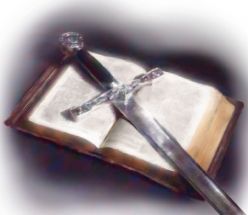
Bible and sword
TODAY'S SPECIAL: Luke 4:1-13

TO CHEW ON: "But Jesus answered him, saying, 'It is written, "Man shall not live by bread alined, but by every word of God."'" Luke 4:4

Play a little word association game with me. What do the words "wilderness," "hungry," and "test" bring to mind?

- Jesus' temptation of course—our reading today.
- And the Israelites wandering through the wilderness after their exodus from Egypt?

Jesus here quotes Moses, where he explained to the Israelites the meaning behind their wilderness testings and what God was trying to accomplish through them, specifically the test of hunger. Jesus is referring to Deuteronomy 8:2-3.

Of course we know how the Israelites failed again and again. When they got hungry, they showed their lack of trust by complaining and becoming fearful and rebellious. In today's reading Jesus is experiencing the same temptation but He is overcoming it. What is the secret to His success?

My Bible's study notes give an explanation:

"Jesus' appeal to Scripture provides the clue for interpreting the Temptation narrative. Using the Word of God He is victorious over the same temptations to which Israel had succumbed in the wilderness..." - J. Lyle Story, notes on Matthew 4:4, New Spirit-Filled Life Bible, p. 1294 (emphasis added).

We see the use of this weapon borne out twice more in our reading, when Jesus replies to Satan "'...For it is written...'" and "'It has been said...'" - Luke 4:8,12.

I believe capitulation to temptation can be engrained in our psyches. And so we say things like "My family has always had a problem with weight," or "Broken marriages run in our family," or "My grandmother and mother were grudge holders, and so am I"... etc. Here Jesus shows us how we can break out of the bondages of heredity, how we can change the ending to the story we've been telling ourselves about the way it has been and always will be. How? By resisting temptation with words from the Bible.

Which is why Scripture memorization is so important. For how will we be able to use this weapon  against temptation if we don't have it in our arsenal?

PRAYER: Dear God, please help me to be more consistent with memorizing and reviewing Your word, and using it to resist temptation. Amen. 

MORE: A verse to memorize
Joshua's advice to the Israelites at the beginning of his leadership is still relevant for us, and another good arrow for your quiver. You might want to memorize it, if you haven't already:
"This Book of the Law shall not depart from your mouth, but you shall meditate in it day and night, that you may observe to do according to all that is written in it. For then you will make your way prosperous, and then you will have good success" - Joshua 1:8 (NKJV).
*********
Unless otherwise noted all Scripture quotations are taken from the New King James Version®. Copyright © 1982 by Thomas Nelson, Inc. Used by permission. All rights reserved.


Bible Drive-Thru


Friday, February 12, 2016

First fruits - a custom to revive?

TODAY’S SPECIAL: Deuteronomy 26:1-15

TO CHEW ON: “…behold I have brought the first fruits of the land which you, O Lord, have given me. Then shall you set it before the Lord your God. So you shall rejoice in every good thing which the Lord your God has given to you and your house and the Levite and the stranger who is among you.” Deuteronomy 26:10-11


It is one thing to declare that we and all we have belongs to God. It is quite another to demonstrate it with action. The Israelites found this out when they were about to enter Canaan after wandering around in the desert for 40 years.

In today’s passage they were on the border of their new home and Moses was giving them farewell instructions. When they finally entered this land of legendary abundance, they were not supposed to stop trusting God. To illustrate this trust, they were to bring part of their first picking of grapes, olives, figs, wheat – whatever this land of ‘milk and honey’ produced – to God as an offering of first fruits.

Though these first fruit offerings were used to feed the Levites and the poor, that wasn’t their main purpose. Rather it was to remind the Israelites that God continued to be their source of supply. As my old New Bible Dictionary explains it:
“Their purpose was not to consecrate it but to deconsecrate it. All was God’s until the first portion had been offered and accepted in lieu of the whole. Only then was the restriction on the human use of the remains removed.” p. 1117.
Giving an offering of first fruits is no longer part of our tradition. But reviving it might not be a bad idea. There is nothing that drives home a theoretical point like a little action to illustrate it. So if you’ve entrusted yourself to God and yet continue to worry about how your needs are going to be met, maybe you should give yourself a little object lesson and in faith present a first fruit offering of your next cheque. Just saying…

PRAYER: Dear God, “I bring my tithes and offerings into the storehouse, and I believe and confess that You, Lord, open the windows of heaven and pour out a blessing that there shall not be room enough to receive it. I honor You, Lord, with the first fruits of my increase. I confess that my storage places are filled with plenty in the name of Jesus.” from Praying with Fire by Barb Billett, p. 91.

***********
Unless otherwise noted all Scripture quotations are taken from the New King James Version®. Copyright © 1982 by Thomas Nelson, Inc. Used by permission. All rights reserved.

Thursday, February 11, 2016

Safe!

TODAY’S SPECIAL: Psalm 91:1-16


TO CHEW ON: “Because you have made the Lord who is my refuge,
Even the Most High, your dwelling place,
No evil shall befall you,
Nor shall any plague come near your dwelling.” Psalm 91:9-10

This is one of my favorite chapters in the whole Bible. I don’t know how often I have sought it out when I have felt fearful, anxious about safety, or concerned about my health or the health of my family.

I love the images of God as protector and safe place.
  • We can live under His wings as baby birds find warmth, comfort, and safety from the elements under the wings of mother bird.
  • He is a fortress. Picture one of those castles in Europe, built on inaccessible mountainsides.
  • He is a refuge. In Israel, there were designated cities of refuge where a person could run to when accused of killing someone. Inside a city of refuge, the accused was guaranteed safety from revenge killing.
  • He is a deliverer. The picture is of someone springing the trap to loose a bird.
  • His truth is protection – both as a shield and a small shield (buckler).
  • His presence defends from personal attack, sickness and war.
  • He assigns our care to angels.
  • He transcends the natural order of nature to keep us safe.
  • He gives us a place of honor.
  • He answers our prayers.
  • He rewards us with long life.

Why all this special attention? “Because you have made the Lord who is my refuge, even the most High, your dwelling place.” (91:9)

A sidebar article in my Bible sheds light on "refuge" and "dwelling place":

[“The word makhseh translated “refuge” means “a shelter,” “a place of trust,” and derives from the root khawsaw meaning “to flee for protection,” “to confide in.”

Maween translated “dwelling place” indicates “a retreat.” It derives from the root 'onah which describes the security of “intimately dwelling together in marriage.”]

When we make the Lord our refuge and habitation by trusting Him – taking our cares, fears and needs to Him; by seeking His counsel, spending times of refreshing with Him, and by loving Him and walking closely with him through every day, we enter into a sheltered place of promise….New Spirit Filled Life Bible p. 758 – Nathaniel M. Van Cleave.)

Do we dwell in God like that? Do any of the images of God as savior and protector resonate with us? Let's take those pictures with us today. Let's revel and relax in His care today.

PRAYER: Dear God, thank You for Your intimate knowledge of and care for me. Help me to confide in You and make You my retreat. I make You my safe place today. Amen.

**********
Unless otherwise noted all Scripture quotations are taken from the New King James Version®. Copyright © 1982 by Thomas Nelson, Inc. Used by permission. All rights reserved.


Bible Drive-Thru


Tuesday, February 09, 2016

Veiled or unveiled?

The rending of the veil - 1890 by William Bell Scott (1811-1890)
“The rending of the veil” 1890 by William Bell Scott (1811-1890)
Copyright © 2016 Peter Nahum. All Rights Reserved.

TODAY’S SPECIAL: 2 Corinthians 3:12-4:5

TO CHEW ON: “But we all with unveiled face beholding as in a mirror the glory of the Lord are being transformed into the same image from glory to glory, just as by the Spirit of the Lord” 2 Corinthians 3:18

Moses had been away from the camp for a long time. His second 40-day absence didn’t end in a golden calf though, but a golden face. The joy that Aaron and the people of Israel felt when they saw the familiar figure approach turned to fear as he got closer. Something had happened to his face. It shone so brightly they could scarcely look at it. The time Moses had spent with God and the intimacy of their fellowship resulted in God’s visible glory remaining evident on his physical features (Exodus 34:29-35).

This is the incident to which Paul refers in this passage, so rich with veil imagery. Out of consideration for the people, Moses got into the habit of covering his face with a veil after he had spent time with God. That way the people didn’t have to fear him – or damage their eyes.

Paul refers to other types of veils here too. There is the veil of understanding (2 Corinthians 3:14-15). God the Holy Spirit is the One who removes that barrier to belief in Jesus by helping us make sense of the Bible (2 Corinthians 3:16-18).

The "veil taken away in Christ" (2 Corinthians 3:14) is the veil between the Holy Place and the Most Holy Place in the temple. Only select priests could go behind the veil into the Most Holy Place where the Ark of the Covenant sat and God’s glory rested. But at Jesus’ death that veil was torn in two. Now anyone can come to God.

That’s why we can approach Jesus face-to-face now. Actually Paul describes our interaction with Him as “beholding as in a mirror the glory of the Lord.” Jesus, the physical man, was God’s glory reflected in a human form.

As we study His face and His life, and make Him our example in attitude and action, an amazing thing happens. We ourselves are transformed, through the Holy Spirit’s work in us, into carriers of His glory.

Just as Moses didn’t realize his face shone, you might be unaware of the glory of God’s presence on you. But as you exalt Jesus, God’s light shines through you, illuminating dark hearts and drawing the veil from puzzled faces.

PRAYER: Dear God, what a privilege to be a reflector of Your glory. Please show me anything in my life that might obscure it from shining through. Amen.


************
Unless otherwise noted all Scripture quotations are taken from the New King James Version®. Copyright © 1982 by Thomas Nelson, Inc. Used by permission. All rights reserved.


Bible Drive-Thru


Monday, February 08, 2016

Glory that lasts

yellow sun
TODAY'S SPECIAL: 2 Corinthians 3:1-11

TO CHEW ON: "For if what is passing away was glorious, what remains is much more glorious." - 2 Corinthians 3:11

Throughout the Bible we read about mortals catching glimpses of God's glory. The Israelites saw it on the face of Moses. Elisha saw it in the chariot that came down to catch up Elijah and take him to heaven. Stephen reflected and saw it during his message to the Jewish council.

Paul in his treatise to the Corinthians argues, if the Old Covenant—that system of laws he calls the "ministry of death"—led to glory appearing on Moses' face, how much more will there be glory associated with Jesus whose victory over sin and death is a final one?

In our humdrum lives, where God's presence, and certainly His glory, often seem muted at best, it's easy to lose sight of the glorious destiny that awaits us. Here are a few promises God has given us about how we will experience and participate in this glory that remains:

Matthew 13:43 - "Then the righteous will shine forth as the sun in the kingdom of their Father."

Philippians 3:21- "...who will transform our lowly body that it may be conformed to His glorious body."

Colossians 3:4 - "When Christ who is our life appears, then you also will appear with Him in glory."

Revelation 7:9 - "After these things I looked, and behold a great multitude which no one could number of all nations, tribes, peoples, and tongues, standing before the throne and before the Lamb, clothed with white robes, with palm branches in their hands."

Revelation 22:5 - "There shall be no night there: They need no lamp nor light of the sun, for the Lord God gives them light."

PRAYER: Dear God, thank You for these promises of a future glory that is eternal and won't fade or change. Help me to keep my sights on lasting, eternal things as I go through this transitory life. Amen.

*************
Unless otherwise noted all Scripture quotations are taken from the New King James Version®. Copyright © 1982 by Thomas Nelson, Inc. Used by permission. All rights reserved.

Bible Drive-Thru


Saturday, February 06, 2016

God's glory brought down to earth

 Detail of "Transfiguration" by Raphael (1516-1520)
See the entire painting and read its history on Art and the Bible.

TODAY'S SPECIAL: Luke 9:21-36

TO CHEW ON: "Now it came to pass, about eight days after these sayings, that He took Peter, John, and James and went up on the mountain to pray." Luke 9:28


Luke links Jesus' sobering words of Luke 9:23-27 (where He speaks of His death, the need for the disciples to face their own deaths daily, the Father being ashamed of those who are ashamed of Jesus and His words, and some disciples not seeing death till they see the kingdom of God) with Jesus' transfiguration. It's as if Luke is saying, With Jesus' pronouncements ringing in their ears the disciples experienced this (Luke 9:28 - 36).

How might the two be connected?

  • The transfiguration conversation between Jesus, Moses and Elijah underlined the fact of Jesus' impending death - Luke 9:22,31. (My Bible's Harmony of the Gospels dates the transfiguration somewhere in the beginning to middle of AD 29, about a year before the crucifixion.)
  • The disciples were given a taste of the glory Jesus referred to in Luke 9:26. The glory the disciples experienced was visible. Jesus' clothes became white and glistening. It was a glory of well-being. Peter wanted to stay in it and the disciples only became fearful as the cloud that eventually separated them from it overshadowed them - Luke 9:34. This experience gave them a foretaste of what it was like to be in God's penetrating, all-seeing, all-knowing, all-revealing presence—a place they would not want to enter with the shame of having denied Jesus and His words.
  • God's words from the cloud ("This is My believed Son. Hear Him" - Luke 9:34) supported Jesus' claim of being on the side of His Father and the angels - Luke 9:26.

And then, kathunk! The voice was silent. The cloud lifted. They were alone with Jesus. I can imagine their thoughts: What just happened? Did it really happen? What does it mean? To their credit the puzzled disciples kept this experience to themselves for the time being.

Some takeaways from this story for me, for us...

1. God's  revelations, when He pulls back the curtain to show us glimpses of the divine, will line up with what He has said in other places, e.g. the teachings of the Bible.

2. We don't want to enter His presence ashamed because of our short-sighted fear of man.

3. It's okay to keep divine encounters to ourselves until we gain insight into what they mean.

PRAYER:
Dear Jesus, help me to live in such a way that I can someday stand unashamed before You in all Your glory. Amen.

 *********
Unless otherwise noted all Scripture quotations are taken from the New King James Version®. Copyright © 1982 by Thomas Nelson, Inc. Used by permission. All rights reserved.

Friday, February 05, 2016

More than just words

Detail of "Moses and the Tables of the Law" (1481-1482) 
by Cosimo Rosselli.
View entire painting and information at Art and the Bible.


TODAY'S SPECIAL: Exodus 34:19-35

TO CHEW ON:
"Then the Lord said to Moses, 'Write these words, for according to the tenor of these words, I have made a covenant with you and with Israel." Exodus 34:27


In the first part of Exodus 34, God warns the people about compromising with and adopting the religious practices of the idol-worshiping tribes of Canaan. In today's reading God gives specific things His people can do to guard against such syncretism and assimilation.

1. Keep the feasts and in this way remember what God has done for them in the past - Exodus 34:19,20.

2. Give God a portion of their possessions and in this way acknowledge that their stuff is really all His - Exodus 34:19,20.

3. Take off one day in seven from work as a day of rest to give life a healthy balance and remind them of their ultimate dependence on God - Exodus 34:21.

4. Obey God's instructions down to the detail. God's instructions about not offering a blood sacrifice with leaven had to do with the spiritual symbolism of blood (life) and leaven (sin). Whether they understood the connection or not, they were to follow these details that illustrated spiritual truths - Exodus 34:25

Though we don't observe the same rituals today, I would submit that doing some of these things could also be faith-building practices that might serve as preventative medicine against backsliding for us.  We too could:
  • Remember our history with God, commemorating not only the Bible events (like Christmas and Easter) but remembering and retelling the stories of God at work in our lives.
  • Give regularly to kingdom projects—our church, missions, the poor. Where we put our money is, after all, a good indication of what we truly value - Matthew 6:21.
  • Rest one day in seven from our work. Besides giving us the needed physical break, this practice reminds us that our ultimate trust is in God for the success of our work.
  • Obey God's instructions about how to live and conduct ourselves. No, we don't struggle with whether there is leaven in the house or how to handle the blood of a sacrifice.  But every day we do make choices that have spiritual implications. One area  we do this is in our family relationships, where our lifestyle is a testimony to the spiritual realm - Ephesians 5:22-6:12.

As it was for the Israelites so it is for us. Belief isn't just assent and words. We need to affirm, solidify, and protect what we say we believe with our actions.

PRAYER: Dear God, help me to give You not only lip service but demonstrate my loyalty to You with my life. Amen.

 *********
Unless otherwise noted all Scripture quotations are taken from the New King James Version®. Copyright © 1982 by Thomas Nelson, Inc. Used by permission. All rights reserved.


Thursday, February 04, 2016

Corruption's comet trail

TODAY'S SPECIAL: Exodus 34:1-18

TO CHEW ON: "'Take heed to yourself, lest you make a covenant with the inhabitants of the land where you are going lest it be a snare in your midst.'" Exodus 34:12

A comet, when it enters earth's atmosphere from outer space, is pulled toward the surface by gravity. As it descends, the friction of our atmosphere increases its heat so that it soon burns, leaving a visible trail of gas and vapor to mark its passage. In much the same way sin seems to exert a gravitational pull on our spirits, and in today's reading Moses describes the comet trail of nation's descent into it.

In Exodus 34 God sets before Moses two choices for the Israelites. One is a choice to be loyal to God — thus staying well away from sin's gravitational pull in the first place. The other involves covenanting with the nations of Canaan. When the Israelites do this, Moses warns them of how they will eventually descend into outright idolatry. A covenant with the pagan nations of Canaan will involve these steps:

1. A softening toward idol worship - Exodus 34:12-14.
2. Polite (or curious?) participation ("...eat of his sacrifice...") - Exodus 34:15.
3. Intermarriage - Exodus 34:16.
4. Idolatrous practices entering the family's culture and legacy - Exodus 34:16.
5. Absorption into the mainstream culture as individuals make idols for themselves - Exodus 34:17.

This portrayal of Israel's possible descent into spiritual corruption can serve as  caution for us. Some things that we as Christians can beware of and avoid as we seek to be wholly loyal to God in our culture are:

  • Intermarrying with non-Christians.
Of course if we're not married, we can place limits on whom we would consider as a possible spouse. As for our kids, in our time and culture where we have little say in who our children marry, we can pray.

  • Dabbling in the occult.
We can avoid things like getting fortunes told, reading horoscopes, involving ourselves with occultic medical practitioners etc

  • Participating in practices that have their origins in other religions.
One popular type of physical exercise, yoga, originates in Hinduism. Though many argue that they do yoga exercises without any acknowledgement of the spiritual aspects of it, others warn that any involvement with it is not spiritually wise. Another trap might be decorating our homes with the paraphernalia of other religions - e.g. Buddha statues or shamanistic masks.

  • Allowing our culture's ideal of syncretism to infiltrate our churches and our personal lives.
No matter what our culture's wise ones say, the Bible makes it clear that not all faith journeys lead to God (John 14:6).

The warnings, above, are not politically correct — but when did God ever concern Himself with our political correctness, except to warn against it? I would much rather err on the side of caution and inherit God's blessing (Exodus 34:6,7a) than allow my life to enter sin's atmosphere and be pulled down by its gravitational force.


PRAYER: Dear God, since You don't change, I need to take Your warnings to stay away from sin and idolatry very seriously. Please help me, by Your Spirit, to become aware of and root out any idolatrous thing in my life. Amen.

MORE: Christians and yoga.

Is it permissible for Christians to participate in yoga exercises? Here are some articles to read and consider from the writings of Albert Mohler:

Yahoo, Yoga and Yours Truly

The Subtle Body: Should Christians Practice Yoga?

Help from Hindu Quarters — The New York Times on "Take Back Yoga"

**********
Unless otherwise noted all Scripture quotations are taken from the New King James Version®. Copyright © 1982 by Thomas Nelson, Inc. Used by permission. All rights reserved.


Bible Drive-Thru


Wednesday, February 03, 2016

Relating to a holy God


Ark of the Covenant - by Phillip Martin
TODAY'S SPECIAL: Psalm 99:1-9


TO CHEW ON: "He is holy.... He is holy.... For the Lord our God is holy." - Psalm 99: 3b, 5b, 9b.

This short hymn-Psalm has three stanzas, each declaring at its end, "He (God) is holy."

It might be a good idea, here, to remind ourselves what "holy" means. Jerry Bridges in his book The Pursuit of Holiness says:

"To be holy is to be morally blameless. It is to be separated from sin and therefore consecrated to God. The word signifies 'separation to God and a conduct befitting those so separated' "- Kindle Location 84.

Stanza 1 (Psalm 99:1-3) starts with God, the other, the inaccessible. Though He is "high above all peoples," for Israel He lived "between the cherubim"—the two gold angels that topped the Ark of the Covenant (Exodus 25:22, 1 Samuel 4:4). Access to the Ark was limited. Its place in the Tabernacle was the Holy of Holies, guarded from all but the ministering priest by a heavy curtain.

The power and the mystery that surrounded the Ark was no fantasy. When the Philistines captured it, weird things happened to their idol (1 Samuel 5:1-4). When David tried to move it on an ox cart instead of the right way (carried with poles on the priests' shoulders), and Uzzah reached over to steady it, the touch killed him (2 Samuel 6:3-10).

The psalmist concludes this first stanza with "Let them (all the peoples) praise Your great and awesome name—He is holy."

In Stanza 2 (Psalm 99:4-5) the song moves to a celebration of how holy God is in justice. Addressing God directly the psalmist praises: "You have established equity;/ You have executed justice and righteousness in Jacob." He admonishes the people, "Exalt the Lord our God / And worship at His footstool."

In the final stanza (Psalm 99:6-9) the psalm gets human. The writer reminds the people, this God who is so holy we can't touch the place He lives, who is utterly just and righteous, also interacted with people. When Moses, Aaron and Samuel called on His name, He answered them. More than that, He was to them "God-Who-Forgives." Wow! This holy, completely just, completely righteous God not only relates to but forgives puny, flawed, sinful humans.

In our time, we tend to de-emphasize the fact of God's holiness, stressing instead, His grace, mercy and love. He is those things, of course. But those qualities stand out even more sharply when viewed against the background of His holiness and our unworthiness. We need His forgiveness. That He is completely righteous and at the same time chooses to forgive sin is grace we will contemplate and praise Him for through eternity.

PRAYER: Holy God, please grow in me the comprehension and respect Your holiness deserves. Thank You for being the God-Who-Forgives. Thank You for forgiving me. Amen.


MORE: Some practical thoughts on holy living

Bridges, in his book, makes a case for Christian holiness using 1 Thessalonians 4:3-7, 1 Peter 1:14-16, Revelation 22:11, and Ephesians 4:22-24. He asks, "If holiness, then, is so basic to the Christian life, why do we not experience it more in daily living." He gives a three-part answer:

1. "Our first problem is that our attitude toward sin is more self-centred than God-centered. We are more concerned with our own 'victory' over sin than we are about the fact that our sins grieve the heart of God....


2. Our second problem is that we have misunderstood 'living by faith' (Galatians 2:20) to mean that no effort at holiness is required on our part. In fact sometimes we have even suggested that any effort on our part is 'of the flesh.'...


3 Our third problem is that we do not take some sin seriously. We have mentally categorized sins into that which is unacceptable and that which may be tolerated a bit" - Jerry Bridges, The Pursuit of Holiness, Kindle Locations 92-10.
 ***********
Unless otherwise noted all Scripture quotations are taken from the New King James Version®. Copyright © 1982 by Thomas Nelson, Inc. Used by permission. All rights reserved.


Bible Drive-Thru


Tuesday, February 02, 2016

Spirit-led Simeon

Simeon - Luke 2:25-35
Simeon - Artist unknown
TODAY'S SPECIAL: Luke 2:22-40

TO CHEW ON: "And behold there was a man in Jerusalem whose name was Simeon, and this man was just and devout, waiting for the Consolation of Israel, and the Holy Spirit was upon him." Luke 2:25

The characters in this short incident fascinate. Two years ago on this day we took a look at Anna. Today let's look closely at Simeon to learn what kind of a man God tells His secrets to.

1. He was a spiritually attuned man, focusing on the spiritual solution to the political and natural situation as he lived in expectation "...waiting for the Messiah to come and rescue Israel" - Luke 2:24 NLT (compare to Isaiah 40:1,2).

2. The Holy Spirit was active in his life. Luke refers to the Holy Spirit in relation to Simeon three times in this short segment. The Spirit's presence seems to have been visible or obvious in some way. Luke wasn't there, so some eye-witness must have told him about these things. Who? Mary perhaps? What did she see that told her the Spirit was on Simeon? Or maybe the Holy Spirit within her gave witness in some way that here was a Spirit-filled and -controlled man.

3. Simeon's relationship with God the Holy Spirit was one of unquestioning obedience. Simeon went to the temple that day, even though he didn't know what was in store for him there. E. M. Bounds says of obedience:

"Unquestionably obedience is a high virtue, a soldier quality. To obey belongs eminently to the soldier. It is his first and last lesson, and he must learn how to practice it all the time without question, uncomplainingly.... The gift of the Holy Spirit in full measure and in richer experience depends upon loving obedience." E. M. Bounds, Complete Works of E. M. Bounds, Kindle Edition, p. 52.

4. He was bold in his blessing.
Upon meeting Joseph, Mary and Jesus, he took the infant in his arms and prayed a blessing of thanks to God and prophecy Jesus, saying things that were outrageous if they weren't true (Luke 2:29-32).

5. He held nothing back, even the uncomfortable bad news. After blessing Joseph and Mary, Simeon said some things to Mary ("yes, a sword will pierce through your own soul also" - Luke 2:35) that must have puzzled her and made her heart sink.

Let's determine to be like Simeon in these ways, looking to God for solutions to our problems and situations, allowing the Spirit access to our lives, responding to His promptings with obedience, even to the extent of uttering His words of blessing—and warning.

PRAYER: Dear God, may Your Spirit have full access to me today. Help me to grow in "loving obedience." Amen.

MORE: Feast of the Presentation
Today the church celebrates the Feast of the Presentation. The liturgy for today begin with this collect:

"Almighty and ever living God, we humbly pray that, as your only-begotten Son was this day presented in the temple, so we may be presented to you with pure and clean hearts by Jesus Christ our Lord; who lives and reigns with you and the Holy Spirit, one God, now and for ever. Amen."
********
Unless otherwise noted all Scripture quotations are taken from the New King James Version®. Copyright © 1982 by Thomas Nelson, Inc. Used by permission. All rights reserved.
Bible Drive-Thru


Monday, February 01, 2016

The power of praise

Photo - Microsoft clipart
TODAY’S SPECIAL: Psalm 71:12-24

TO CHEW ON: “Let my mouth be filled with Your praise
And with Your glory all the day…
My mouth shall tell of Your righteousness
And Your salvation all the day…
My lips shall greatly rejoice when I sing to you… (Psalm 71:8, 15, 23)

The tongue is a pesky body part for bad and a powerful one for good (James 3:5-6). What we say can bog our hearers in a swamp of contradictions (James 3:9-12)  or lift their attention Godward. There certainly seems to be a power in uttering things aloud, as in nailing down our thoughts in the physical act of speech.

That’s why Psalm 71 is so potent. It acknowledges the impact of out-loud utterance – by speech or singing – in the act of praising God. Eight times in this psalm the writer refers to speaking or singing our praise.

A footnote in my Bible puts it this way:
“His repetitious use of words such as mouth, praise, mention, declare, sing, lips, tongue, emphasizes the fact that praise is to be expressed openly in the congregation and not only as quiet thoughts in a secluded garden of meditation.” –Dick Iverson,  New Spirit Filled Life Bible p. 739
This week as we meet with fellow Christians in church, or host them in our homes, or share a meal with family or friends in a restaurant, or spend time with neighbors in recreation, let's add to our conversation a little praise of God – for who He is and what He has done for us!

PRAYER: Dear God, may praise of You and my mouth be close acquaintances, today and always. Amen.

MORE: When praise doesn’t come naturally
Sometimes the circumstances in our lives are so far from ideal, praise for and in them seems like a contradiction. But those are just the times we need to dial up the praise even more.

Harold Hill (author of How To Live Like A King’s Kid) in the introduction to his book How to Live in High Victory lists ten steps to a victorious lifestyle. Praise figures in three of them:

1. Wrap everything in PRAISE and turn it over to Jesus as joint heirs with Him of the results.

2. Refuse to be impressed by appearances.

3. Do the next thing, and trust Jesus for guiding your paths: Proverbs 3:5-6.

4. Form the habit of PRAISE in the midst of, in spite of, or on account of whatever is going on: 1 Thessalonians 5:16-18; Ephesians 5:18-20; Hebrews 13:15.

5. Learn to listen to God.

6. Don’t ask anyone else’s opinion about the guidance God gives you.

7. Stop doubting that God really did speak to you.

8. When God’s guidance comes, act immediately, PRAISING Him for results.

9. When doubt enters pray: “I’m going into action Lord. If I’m on a second-best course of action, it’s up to You to block me. But if I’m on the right road, open all doors and benefit everyone concerned.”

10. Pray: “Lord, make me as holy as You can make a sinner saved by grace.”

***********
Unless otherwise noted all Scripture quotations are taken from the New King James Version®. Copyright © 1982 by Thomas Nelson, Inc. Used by permission. All rights reserved.

Bible Drive-Thru


From youth to old age

Old telephone
TODAY'S SPECIAL: Psalm 71:12-24

TO CHEW ON: "O God, You have taught me from my youth;
And to this day I declare Your wondrous works.
Now also when I am old and grayheaded
O God, do not forsake me,
Until I declare Your strength to this generation,
Your power to everyone who is to come." Psalm 71:17,18


No matter what age you are, you can probably name many things that have changed noticeably over your lifetime. Take the telephone, for example. The first phone I remember was a big brown box attached to the wall. It looked like a face with two ringer bells as eyes, the horn-shaped microphone as nose, the crank and receiver on each side as ears. We rang up the telephone operator with our requested phone number, she contacted the other party with their signal ring (combination of short and long rings) and when they answered everyone else on that particular party line could listen in on the conversation.

Contrast that to the smart phones we use today. With them we can not only phone people (many of us hardly use that function at all) but send text messages, take photos and post them online, read books, play games, find information, get driving directions, etc.

Changes in technology aren't the only types of changes. Social and moral changes abound. For example, in my lifetime, the culture I'm a part of has gone from eschewing divorce and living together before marriage to divorce and common-law marriages now commonplace and, in the last few years, the recognition and celebration of gay marriage.

We find these changes in almost every department of life—except one: the spiritual. If we hold to the Bible and its teachings, not that much has changed. The God we worship is the God of the Old and New Testaments and we can still say with the psalmist: "O God, You have taught me from my youth…Now also, when I am old and grayheaded, O God, do not forsake me…"

God's teaching curriculum still involves:
  • Instruction in speech and what to say - Exodus 4:12; Matthew 10:19.
  • Respect for and obedience of God instead of fearing the society around us - Isaiah 8:11-13.
  • Discipline and faithfulness in coming to class - Isaiah 50:4.
  • Learning the difference between the right and wrong; the holy and the profane - Ezekiel 44:23.
  • Learning to love - 1 Thessalonians 4:9.
  • Staying in tune with our teacher, the Holy Spirit - 1 Corinthians 2:12; 1 John 2:27.

In a world that is constantly changing, I find God's unchangeableness a great comfort and security. Living by what He teaches may put us out of step with the culture around us, but how much better to be in sync with the God who is a strong, powerful, and faithful Redeemer across the generations  (Psalm 71:18,22,23) than to build our lives on the shifting trends and changing standards of modern society!

PRAYER:
Dear God, thank You for being a God I can worship through a lifetime. Amen.

 *********
Unless otherwise noted all Scripture quotations are taken from the New King James Version®. Copyright © 1982 by Thomas Nelson, Inc. Used by permission. All rights reserved.


Sunday, January 31, 2016

God doesn't age

aging statue
TODAY'S SPECIAL: Psalm 71:1-11

TO CHEW ON: "Do not cast me off in the time of old age;
Do not forsake me when my strength fails." Psalm 71:9


The longer we live, the more famous and powerful people we see come—and go. The movers and shakers of my youth, of even 20 years ago, are either dead or vastly changed.  International leaders like Maggie Thatcher and Ronald Reagan lose their minds to dementia. Beautiful people like Liz Taylor lose physical allure to aging and disease. Most sports figures are yesterday's news after age 40. If we see current photos of many of these once-prominent people, we hardly recognize their changed and wrinkled appearance. Age ravishes them like it does us all.

The writer of today's psalm, who appears to have been a prominent person himself, is feeling the vulnerabilities of aging. He is aware of his failing strength and of how he is now a sitting duck for his enemies—probably younger, more vigorous men who, he imagines, plot ways to take his life and lie in ambush poised to pounce on him.

In this time of old age trouble he reminds himself of the rock-solid God he trusts. He calls Him a "strong refuge," and a "rock and fortress" (Psalm 71:3,7).  He recalls how long God has been there for him—a hope and trust from his youth, upholding him even from birth (Psalm 71:5,6).

What a reassurance to all of us who are also in the process of aging. (That's everybody, of course, but after a certain birthday it encroaches ever more tangibly.) As the embrace of old age tightens, changing appearance, threatening health, sucking stamina, eroding influence, and stealing friends, even spouses, let's let this psalm remind us that God isn't going anywhere. He hasn't changed and won't change. The One who was our rock, refuge, fortress, hope, and trust in youth and middle age can and will be those things for us in old age as well.

PRAYER: Dear God, thank You for Your unchangeableness. Help me to recall this about You in the face of how I and my generation are wearing out. Amen.

MORE: God's unchangeableness
"We can define the unchangeableness of God as follows: 'God is unchanging in his being, perfections, purposes, and promises, yet God does act and feel emotions and he acts and feels differently in response to different situations.' This attribute of God is called God's immutability" - Wayne Grudem, Systematic Theoology, p. 163 (quoting Louis Berkhof's Systematic Theology).

Read more about the Immutability of God on Rebecca Writes (Theological Terms).

*********
Unless otherwise noted all Scripture quotations are taken from the New King James Version®. Copyright © 1982 by Thomas Nelson, Inc. Used by permission. All rights reserved.

Bible Drive-Thru


Saturday, January 30, 2016

Spiritual activewear

Runner - by Phillip Martin
TODAY'S SPECIAL: Jeremiah 1:11-19

TO CHEW ON: " ' Therefore, prepare yourself and arise …'" Jeremiah 1:17


Yesterday we read how God came to young Jeremiah, called him to be a prophet, answered his objections, and promised His presence. In today's reading God comes to Jeremiah again and begins to show him visions—symbolic scenes of Israel's demise such that when Jeremiah speaks of them, he won't be popular. In light of how his hearers will take him, God tells Jeremiah, " 'Therefore prepare yourself and arise…' "

"'Prepare yourself' means literally to 'gird your loins,' that is, arrange your clothing for activity" - R. E. Hayden, study notes on Jeremiah, New Spirit-Filled Life Bible, p. 960.

As we read on, we see God uses war words to describe the prepared Jeremiah: "' I have made you … a fortified city … iron pillar … bronze walls" - Jeremiah 1:18.  Jeremiah is to prepare for battle.

We read of a similar action ("girding the loins") on the night the Israelites were to eat the Passover before leaving Egypt: "This is how you are to eat it; with your cloak tucked into your belt, your sandals on your feet and your staff in your hand" - Exodus 12:11. The Israelites were to get ready for flight.

We see Elijah do the same thing after the Priest of Baal showdown on Mount Carmel and the coming of the rain: "The power of the Lord came on Elijah and, tucking his cloak into his belt, he ran ahead of Ahab all the way to Jezreel" - 1 Kings 18:46.  It appears he was preparing to celebrate victory.

All this getting prepared for spiritual action reminds us of the classic NT spiritual preparation metaphor, the Armour of God, that Paul tells Christians to put on:  Because our enemy is spiritual, dark, and wicked…"Therefore take up the whole armor of God that you may be able to withstand in the evil day, and having done all to stand" - Ephesians 6:13. We need spiritual armor to stand against spiritual attack (Ephesians 6:10-18).

Finally, we read of the life-race readiness pictured in Hebrews 12:1 "… let us lay aside every weight and the sin which so easily ensnares us, and let us run with endurance the race that is set before us." We need to be prepared to run our everyday race of faith.

I think we could say that whatever spiritual activity confronts us—whether it's battle, flight from the devil's clutches, a victory celebration, standing firm, or running the daily race of faith, we need to be sure we're wearing our spiritual activewear—have on  those bullet proof vests, are wearing our spiritual spandex, have the laces of our cross trainers tied tight i.e. live alert and always be dressed and prepared for spiritual action.


PRAYER: Dear God, thank You for this warning to Jeremiah to be prepared. Help me to be live prepared for whatever You allow to cross my path today. Amen.

 *********
Unless otherwise noted all Scripture quotations are taken from the New King James Version®. Copyright © 1982 by Thomas Nelson, Inc. Used by permission. All rights reserved.


Thursday, January 28, 2016

The gift of discernment

"The Wisdom of Solomon" by James Tissot

TODAY'S SPECIAL: 1 Kings 3:16-28

TO CHEW ON: "And all Israel heard of the judgment which the king had rendered, and they feared the king, for they saw that the wisdom of God was in him to administer justice." 1 Kings 3:28


Solomon prayed for discernment when God came to him and asked "What shall I give you?" (1 Kings 3:5,9). In our reading today we see in a real life situation, the answer to Solomon's prayer.

Every time I read this story I marvel at the audacity of Solomon's suggestion (cut a child in two—really?!) and the innate understanding of human nature that it showed (the strength of a mother's love for her child).

[The word discern used in 1 Kings 3:9 is the Hebrew word transliterated biyn. Some of the many English words and phrases used to render it are act wisely, consider carefully, gaze, interpret, investigate, observe, ponder, and perceive.]

Biyn occurs 28 times in Proverbs (thought to be written mainly by Solomon). These proverbs alert us to some of the many aspects of discernment.

1. Discernment is present in God, comes from God, and is enhanced by seeking after God (Proverbs 24:12; 2:6-11; 28:5).

2. It involves listening to and taking advice from the wise, and being willing to learn (Proverbs 1:5,6; 18:15).

3. Its presence or absence is revealed in the words that come out of one's mouth (Proverbs 10:13; 16:21; 17:28).

4. The discerning person learns from rebuke and reproof (Proverbs 17:10; 23:1).

5. He/she also pays attention to circumstances (Proverbs 23:1).

6. Discernment in citizens makes them an asset to the community (Proverbs 28:2; 29:7).

7. Discernment isn't determined by class or position (Proverbs 28:11).

8. Self-discipline is an aspect of discernment (Proverbs 28:7).

9. Some of discernment's enemies are scoffing, naiveté, and foolishness (Proverbs 14:6; 14:15; 15:33).

Some Old Testament characters known for their discernment (in addition to Solomon) were Joseph (Genesis 41:33,39) and Daniel and his three friends (Daniel 1:4,17).

In the New Testament Paul reiterates the fact that spiritual discernment is available only through God, the Holy Spirit (1 Corinthians 2:14).

The writer of Hebrews says that practicing and using discernment makes it stronger (Hebrews 5:14).

In these early days of 2016, let's follow Solomon's example of asking God for the gift of discernment, even as we do what we can to weave the threads of wise and discerning behavior into our lives.

PRAYER:
Dear God, please give me discernment that is demonstrated in wise living. Amen.

 *********
Unless otherwise noted all Scripture quotations are taken from the New King James Version®. Copyright © 1982 by Thomas Nelson, Inc. Used by permission. All rights reserved.


Related Posts Plugin for WordPress, Blogger...