Showing posts with label witness. Show all posts

Thursday, October 18, 2018

Assigned to our own

TODAY'S SPECIAL: Acts 25-26; Psalm 131

TO CHEW ON: "I will deliver you from the Jewish people, as well as from the Gentiles, to whom I now send you, to open their eyes, in order to turn them from darkness to light, and from the power of Satan to God, that they may receive forgiveness of sins and an inheritance among those who are sanctified by faith in Me." Acts 26:17-18

What a huge assignment Paul received, the day he was struck blind on the road to Damascus. As he recounted his experience of that day to Agrippa (today's reading), his memory of it was clear enough for him to repeat Jesus' words verbatim.

We may not think it surprising to hear he was to tell the Gentiles about their state. But the Jews too? Those were his people, his family members, relatives, neighbours and colleagues.

And what a precarious state they were in:
- They had closed eyes, for he was sent to open their eyes.
- They were in darkness, for he would turn them to light.
- They were under Satan's power, for he would tell them how to escape those clutches.

It's not difficult to think of people in lands far away as needing such information. But do we believe that our people, our unbelieving friends, family members, and colleagues are in as desperate a condition — blind, in darkness, under the power of Satan? Do we take seriously our job to alert them to their condition, to tell them how to get free so they can live in Jesus' kingdom and look forward to life in eternity with God?

PRAYER: Dear God, please give me the courage to alert my neighbours, friends and family members to their need of You. Amen.

PSALM TO PRAY: Psalm 131


***************
Unless otherwise noted all Scripture quotations are taken from the New King James Version®. Copyright © 1982 by Thomas Nelson, Inc. Used by permission. All rights reserved.

Sunday, October 14, 2018

The ready Christian

alter to the unknown god
TODAY'S SPECIAL: Acts 17-18; Psalm 127

TO CHEW ON:
"Now while Paul waited for them at Athens, his spirit was provoked within him when he saw that the city was given over to idols." Acts 17:16.

Paul is such a good example of the ready Christian: "… always be ready to give a defense to everyone who asks you a reason for the hope that is in you…" - 1 Peter 3:15. Here, in new-to-him Athens, watch how he does it:

1. He starts by observing his surroundings (Acts 17:16).

2. He goes to the hotbeds of thought and discussion—the synagogue and the marketplace to listen and talk. (Acts 17:17-18).

3. He accepts an invitation to speak at the Areopagus, even though the invite is hardly given in a  complimentary way. (They call him a babbler - Acts 17:18. According to my Bible's footnotes, a babbler was one who picked up scraps of learning here and there and peddled them. It seems this is a better description of those who "… spent their time in nothing else but either to tell or hear some new thing" - Acts 17:21).

4. He grabs their interest with something from their own culture—an inscription to an Unknown God seen on an altar. He dangles this need for something they haven't yet found in front of them: "Wouldn't you like to know Him?" (Acts 17:22-23)

5. He's a good closer. At the end of his message he urges them to take action: repent because judgment is coming (Acts 17:30-31).

6. He does all this while killing time in Athens—waiting for ministry partners to join him.

I ask myself, what would I have done if I had been in Paul's shoes? Sightsee? Probably. But with a view to giving my testimony and sharing the gospel? I don't know. I'd probably have viewed this as time off from ministry.

But for Paul—really for all of us—there is no time off. This story shows us that all kinds of situations can be a springboard for the gospel.

Though the fruit of Paul's ministry here is minimal ("For reasons Luke does not explain, results here were meagre—no baptisms, no new church, and no letter to the Athenians in the New Testament" - Gary Kinnaman, notes on Acts, New Spirit-Filled Bible, p. 1524), some believed. But Luke/Paul don't dwell on the low numbers. Paul has been faithful, and now it's time to move on (Act 18:1).

PRAYER: Dear God, please help me to become a ready Christian—alert to any and all opportunities to tell about and defend my faith in You, and not discouraged by small results. Amen.

PSALM TO PRAY: Psalm 127

*********
Unless otherwise noted all Scripture quotations are taken from the New King James Version®. Copyright © 1982 by Thomas Nelson, Inc. Used by permission. All rights reserved.


Friday, October 05, 2018

Burning hearts

"The disciples at Emmaus"
 - Alexandre Bida

The Disciples at Emmaus - Alexandre Bida
TODAY'S SPECIAL: Luke 23-24; Psalm 119:129-152

TO CHEW ON: "And they said t one another, 'Did not our heart burn within us while He talked with us on the road, and while He opened the Scriptures to us?'" Luke 24:32

The story of the travelers meeting Jesus on the road to Emmaus is one of my favourites. Perhaps it's because I see myself in those sight-restrained disciples. I've often wondered, why did they not recognize Him?

Perhaps Jesus' physical look had changed. We read the stories of other people not recognizing Him either (Mary Magdalene John 20:14; the disciples - Luke 24:36-37). He was the last person they expected to meet on that journey. And our reading says, "their eyes were restrained" suggesting that there was also a supernatural aspect to their blindness. (God operates, even in the smallest details, in the fullness of time.)

Then, after they had walked, talked, and listened to Jesus explain the Scriptures and convinced Him to eat with them, He went through those familiar motions: "… He took bread, blessed and broke it, and gave it to them…" Luke 24:30. They had seen this exact ritual before—at the feeding of the 5,000 (Matthew 14:19), the feeding of the 4,000 (Mark 8:6) and the last supper (Matthew 26:26). What a wonderful thing for which to be recognized!

Jesus left after that. It seems His purpose was not to hang out with them in the way He had before. That time was over. Now they simply needed to know He was alive and how the events that had just taken place fulfilled prophecy.

After he left, the disciples recalled and recognized their reaction to Jesus on the road: "…'Did not our hearts burn within us?'…" Henri Nouwen describes how Jesus may come to us in the same way:

"Jesus joins us as we walk in sadness and explains the scriptures to us. But we do not know that it is Jesus. We think of him as a stranger who knows less than we do of what is happening in our lives. And still—we know something, we sense something, we intuit something: our hearts begin to burn. At the very moment that he is with us we can't fully understand what is happening. We can't speak about it to each other. Later, yes, later, when it is all over, we might be able to say, 'Did not our hearts burn within us as he talked to us on the road and explained the scriptures to us?' But when he walks with us it is all too close for reflection" - Henri Nouwen, With Burning Hearts, p. 50.

PRAYER: Dear Jesus help me to recognize Your voice. Thank You for the witness of a burning heart. Please stir up the coals to a hotter fire. Amen.

MORE: Inner fire


  • Jesus came to ignite inner fire - Luke 12:49.
  • It is kindled by meditation, and bursts into speech - Psalm 39:3.
  • It is fed by fellowship with Jesus - Luke 24:32.
  • The light in our hearts is a reflection of "the glory of God in the face of Christ" - 2 Corinthians 4:6.
  • That inner fire makes it impossible not to speak - Jeremiah 20:9.

"So they rose up that very hour and returned to Jerusalem …. And they told about the things that had happened on the road, and how He was known to them in the breaking of bread" - Mark 24:33,35.

PSALM TO PRAY: Psalm 119:129-152

The Bible Project VIDEO: Luke Ch. 24 (Luke Mini-series)


***********

The Holy Bible, New King James Version Copyright © 1982 by Thomas Nelson, Inc. - Used with permission.


Sunday, March 11, 2018

All it takes is one generation

Image: Pixabay
TODAY’S SPECIAL: Judges 1-3; Psalm 70

TO CHEW ON:
“When all that generation had been gathered to their fathers, another generation arose after them who did not know the LORD, nor the work which He had done for Israel.” Judges 2:10


In our reading through the Bible, we’ve just finished the book of Joshua. The Israelites have finally arrived in the Promised Land. They have divided it into sections for the twelve tribes and begun routing the Canaanites living there. But they have not utterly destroyed them, as told to, for very soon we see them adopting Canaanite ways, especially religious ways (Judges 2:11-13).

Thirty-two years have elapsed between when Joshua took over from Moses and Joshua's death. During those years and a few beyond that, the old timers who had experienced God’s miracles firsthand—the miraculous crossing of the Red Sea, the manna and water from the rock, the path through the Jordan and the crumbling Jericho walls—have kept alive the memories of Yahweh at work in Israel.

But of the generation following we read that they DIDN’T KNOW GOD.

God had warned that this could and would happen, had given the people feasts and holidays to commemorate their experiences with Him, their escape from Egypt (Passover) and His care during their years of wilderness wandering (Feast of Booths). Moses had lectured them in specifics of keeping God and His laws uppermost in their homes  and families (Deuteronomy 6:5-9). They had pledged with Joshua to cultivate familiarity with God’s words (Joshua 1:8,16). But still they forsook Him in the very next generation.

This is a huge warning to me—to us. Because for us too, all it takes is one generation.  

So let’s keep telling and writing the stories of our personal history with God, planting God’s word in our children from infancy on, establishing family altars of Bible reading, prayer, and story telling so that it can never be said of us: “... Then another generation grew up that didn’t know anything of God or the work he had done…” Judges 2:10 MSG.

PRAYER: Dear Father, please help me to be faithful to You and the next generation by continuing to tell my children and grandchildren about You and instilling in them a deep love and respect for the Bible. Amen.

PSALM TO PRAY: Psalm 70

The Bible Project VIDEO:  Judges (Read Scripture series)


*********
Unless otherwise noted all Scripture quotations are taken from the New King James Version®. Copyright © 1982 by Thomas Nelson, Inc. Used by permission. All rights reserved.

Scripture quotations marked MSG are taken from The Message. Copyright © 1993, 1994, 1995, 1996, 2000, 2001, 2002. Used by permission of NavPress Publishing Group.


Thanks for reading! This year we are using The Bible Project "Timeless Reading Plan" to read through the Bible in 2018. If you'd like to read along in your own Bible, you can download a pdf of the reading plan HERE.

Friday, March 09, 2018

Company of proclaimers

magnifying glass focuses on 'communication'
TODAY'S SPECIAL: Numbers 13-21; Psalm 68

TO CHEW ON: "The Lord gave the word;
Great was the company of those who proclaimed it." Psalm 68:11


Some verses in the Bible remind me of icebergs—relatively small and seemingly simple. But below the surface they are huge. Psalm 68:11 is one such verse.

It seems a little out of place, sandwiched between words of praise to God and a poetic description of battle. It feels almost like David's thoughts in parenthesis—an aside: 

"The Lord gave the word; Great was the company of those who proclaimed it."

What word?

We may think of creation. The Genesis account is that—God creating with words: "Then God said 'Let there be light …' Then God said, 'Let there be a firmament…' Then God said, 'Let the waters under the heavens be gathered…'" Genesis 1 3,6,9.

Paul writes to the Romans about how this creation communicates or spreads the word about God: "For since the creation of the world His invisible attributes are clearly seen, being understood by the things that are made, even His eternal power and God head" - Romans 1:20.

But there's more. For word also brings to mind the beautiful passage in John 1 that links creation with Jesus God's Son: "In the beginning was the Word, and the Word was with God. … All things were made through Him. … And the Word became flesh and dwelt among us" - John 1:1,3,14.

So aspects of word are God's creation and Jesus (including all that He did and is)—two ways we come to know God. They are proclaimed by a company.

Who is that company?

  • It is the hosts of heaven—the stars, planets, black holes, galaxies, nebulae - Psalm 33:6.
  • It is the hosts of earth - Genesis 2:1.
  • It was Israel's leaders like Moses - Numbers 11:24.
  • It was individuals like the prophets and apostles - Ezekiel 2:7; Acts 18:9.
  • It was a couple of disciples set free from prison by angels - Acts 5:20.
  • It was bands of persecuted Christians - Acts 8:4; 1 Peter 4:9.10.
  • It was ministers in training - Titus 2:15
  • Someday it will be the armies of heaven - Revelation 19:11-14.
  • And today it is us, communicating the gospel using the written word (Bible) and our words - Matthew 28:18-20; Mark 16:14; Acts 1:8.

I ask myself, am I being faithful as part of that company of proclaimers? Are you?

PRAYER: Dear God, thank You for the word—Your creative power, Jesus the Word come in the flesh, the words of good news that His life accomplished as recorded in the Bible. Help me to be faithful as part of the company who proclaims this word. Amen. 

PSALM TO PRAY: Psalm 68

*********
Unless otherwise noted all Scripture quotations are taken from the New King James Version®. Copyright © 1982 by Thomas Nelson, Inc. Used by permission. All rights reserved.

Sunday, February 18, 2018

The "sweet aroma" of sacrifice

Offering a sacrifice (Image: Pixabay)
TODAY’S SPECIAL: Numbers 28-30; Psalm 49

TO CHEW ON:
“Command the children of Israel, and say to them, ‘My offering, My food for My offerings made by fire as a sweet aroma to Me, you shall be careful to offer Me at their appointed time.” Numbers 28:2

Do you have a favorite smell? Have you noticed how smells have the power to jog your memory and trigger your emotions? It’s interesting to note that apparently God too has a sense of smell, and that smells also cause Him pleasure or displeasure. At least ten times in Numbers 28 and 29 following the introduction of the idea in Numbers 28:2 (our focus verse), we read the expression “a sweet aroma to the LORD.”

This “sweet aroma” was not the scent of perfume, flowers, or the seaside, but the smell of burning. Every one of the “sweet aroma”s in our passage came as a result of a burnt sacrifice of an animal alone or offered with flour and oil.

The first time we read of God being moved by the aroma of a sacrifice is in Genesis 8:21, when Noah offered clean animals after leaving the ark. “The idea is that Noah’s sacrifice was a propitiation or satisfaction of God’s righteous requirement,” explains an article on GodQuestions.org.

The same is true of the sacrifices we read of in Leviticus and here in Numbers: “As in the case of Noah’s offering, what pleased the Lord was the commitment to offer worship in His name as He commanded” (above article).

God’s pleasure at the smell of a burning sacrifice was not an automatic reaction, however, but very much in tune with the attitude and actions of the worshiper. For when instituting this sacrifice system, God said to Moses: “And after all this, if you do not obey Me but walk contrary to Me … I will not smell the fragrance of your sweet aromas” - Leviticus 26:27,31.

There are at least two references to that sacrificial aroma in the New Testament that help to connect us today to God’s olfactory reaction to offerings in the Old.

In 2 Corinthians 2:14-15 Paul challenges Christians to be the aroma of Christ to all. We know that Christ was the final sacrifice, the one by which we have life. Since His was a sacrifice of both His death and our life, the aroma of our lives should affect all around us (“…those who are being saved… and those who are perishing”) with reminders of life or death.

I ask, are we so dead to self, alive to Christ that our lives actually remind those being saved of life, those unsaved of death?

In Ephesians 5:2 Christ’s sacrifice to God (“for a sweet-smelling aroma”) is connected with His love. Paul challenges readers of His day and us today to walk in Christ’s sacrificial love.

Do we live with such love?


PRAYER:
Dear Father, Your reaction to the smell of sacrifice challenges me to be more complete in offering myself to You in the way Paul describes it, “… present your bodies a living sacrifice, holy, acceptable to God …” (Romans 12:1). Amen.
 
PSALM TO PRAY: Psalm 49

 *********
Unless otherwise noted all Scripture quotations are taken from the New King James Version®. Copyright © 1982 by Thomas Nelson, Inc. Used by permission. All rights reserved.

Thanks for reading! This year we are using The Bible Project "Timeless Reading Plan" to read through the Bible in 2018. If you'd like to read along in your own Bible, you can download a pdf of the reading plan HERE.

Saturday, September 30, 2017

Shining legacy

Milky Way (Image: Pixabay)
TODAY’S SPECIAL: Daniel 12:1-13

TO CHEW ON: “Those who are wise shall shine
Like the brightness of the firmament
And those who turn many to righteousness
Like the stars forever and ever." Daniel 12:3


Some years ago when we were cleaning up Mom’s apartment, preparing to move her to a tiny suite a fraction of the size of where she had lived, there was much stuff to dispose of. “Take this or that as a keepsake,” she’d urge us kids and grandkids. Very often the answer was “No thanks.” Mom's stuff was not what her family wanted as the legacy of this lovely lady.

Like my mom’s main legacy did not consist of stuff, neither does the legacy of the wise that Daniel speaks of in Daniel 12. Instead, we all understand the wish to leave a lasting legacy and hope that ours will be just that. Our verse today tells us that we do this when we “turn many to righteousness.” What does that mean?

The Amplified version expands on the phrase: “turn many to righteousness” (to uprightness and right standing with God).” The Message rephrases it to: “…those who put others on the right path to life ...” An expression used in many Christian circles to describe this activity is soul winning. Here are some conclusions about soul winning we can draw as we look at Bible passages that talk about it and the people who do it.

1. Soul-winning springs from the fellowship-desiring heart of God.- Luke 14:16-23.
2. It flows out of a right relationship with God - Psalm 51:12,13.
3. Soul-winners are motivated by their concern for others- James 5:20
4. The first soul-winners were trained by Christ.  He is the great soul-winning trainer - Matthew 4:19; Mark 1:17
5. Soul-winners are willing to make great personal sacrifice to succeed - 1 Corinthians 9:19,20.
6. They are vigilant over the authenticity of their lives and what they teach - 1 Timothy 4:16.
7. Successful soul-winners realize their actions count as much as – may be more than – their words - 1 Peter 3:1.
8. Soul-winners are wise - Proverbs 11:30.
9. They consider soul-winning an assignment from God - 1 Thessalonians 2:1-4
10. Soul-winners don’t need ideal circumstances to be successful- Philemon 1:10
11. They persevere despite a lack of visible results - 1 Corinthians 7:12-16
12. The legacy they leave “…will shine… like the stars forever and ever.” - Daniel 12:3.

I ask myself, am I working on leaving such a legacy? Are you?

PRAYER:  Dear God, thank You for entrusting me with the privilege and responsibility of influencing lives for You. Please teach me how to do this better. Amen.


MORE: Rita Springer: "All My Days"


*************
Unless otherwise noted all Scripture quotations are taken from the New King James Version®. Copyright © 1982 by Thomas Nelson, Inc. Used by permission. All rights reserved.


Wednesday, September 27, 2017

God glorified through our hard times

Image: Pixabay
TODAY’S SPECIAL: Philippians 1:15-30

TO CHEW ON: “Christ will be magnified in my body, whether by life or by death” - Philippians 1:20b


Paul would have had a lot to complain about if that had been his style. He was in prison as he wrote Philippians. Though fellow Christians were being emboldened by his clear witness to the palace guard (a good thing) some were preaching in a competitive spirit (out of “selfish ambition, not sincerely, supposing to add affliction to my chains” - Philippians 1:16).

But Paul was determined not to let any of this get him down. He saw the bright side of his captivity—the men guarding him were being exposed to his bold witness (Philippians 1:12,13). Because he was already in chains, they couldn’t use the threat of arrest to silence him, so he was bolder and more fearless than ever (Philippians 1:14). The competitive spirit of the fellow preachers didn’t please him. But he was happy that even through them the gospel was advancing (Philippians 1:18).

And in the matter underlying it all, the fact that he had lost his freedom, he seemed to be at perfect peace. We don’t see him whining that God didn’t send an angel to spring him from jail, as He did for Peter. Instead, Paul declared “For I know … that in nothing I shall be ashamed, but with all boldness as always so now also Christ will be magnified in my body, whether by life or death” (emphasis added).

I need more of that spirit. You too? So often my attitude is, Lord, I need you to take this problem away (this illness, condition, obstacle, lack…) so that You will be glorified.

But no. Instead I need the faith that God can be glorified as I go through the difficult things in my life: “Christ magnified in my body whether by life or death.”

PRAYER: Dear Jesus, thank You that Your deliverance from and through our problems comes “through the supply of the Spirit of Jesus Christ" (Philippians 1:19). Please fill my life with that supply today. Amen.

 *********
Unless otherwise noted all Scripture quotations are taken from the New King James Version®. Copyright © 1982 by Thomas Nelson, Inc. Used by permission. All rights reserved.


Tuesday, October 18, 2016

The altar call of written words

Simone Martini (Italian (Sienese), about 1284 - 1344)
St. Luke, 1330s, Tempera and gold leaf on panel
Panel: 67.5 x 48.3 x 3.8 cm (26 9/16 x 19 x 1 1/2 in.)
The J. Paul Getty Museum, Los Angeles 
 

(Image used with permission of the Getty Open Content Program)

TODAY’S SPECIAL: Luke 1:1-4

TO CHEW ON: “… it seemed good to me, also, having had perfect understanding of all things from the very first, to write to you an orderly account, most excellent Theophilus.” Luke 1:3

Today the church celebrates the Feast of St. Luke. Our short reading of the four-verse introduction to the Gospel of Luke communicates a surprising amount about this Bible-time physician and gospel author.

1. He hung out with and heard the stories of eyewitnesses of the life of Jesus (“… those things which have been fulfilled among us…”) - Luke 1:1,2.

2. He felt that he understood what had happened - Luke 1:3.

3. His goal was to write an “orderly account” - Luke 1:3.

4. He cared for the spiritual well-being of Theophilus to the extent he was willing to write a book for him (a lot harder in his day than simply hauling out a laptop and banging away).

5. He had confidence in the written word—the story—to help birth and nurture faith in his reader - Luke 1:4.

It’s that last that resonates with me. I have probably come to more spiritual forks in the road, wept more tears, made more decisions as the result of something I’ve read than I have as the result of any altar call. Books have been my altar call!

And so as someone who loves to read (and write) these early verses of Luke are a reminder of one of the ways God brings people to Himself, and an affirmation of writing as a tool of the soul-winner. If you’re a writer, don’t underplay the importance of your calling!

PRAYER: Dear Father, thank You for inspiring Luke to write the stories of Jesus for his friend. Help me—help all kingdom writers—to stay true to our calling and put down words with faith that You will use them in some way. Amen.
 
MORE: Feast of St. Luke
Today the church celebrates the Feast of St. Luke the Evangelist. The liturgy of the day begins with this prayer:

"Almighty God, who inspired your servant Luke the physician to set forth in the Gospel the love and healing power of your Son: Graciously continue in your Church this love and power to heal, to the praise and glory of your Name; through Jesus Christ our Lord, who lives and reigns with you, in the unity of the Holy Spirit, one God, now and for ever. Amen."

 *********
Unless otherwise noted all Scripture quotations are taken from the New King James Version®. Copyright © 1982 by Thomas Nelson, Inc. Used by permission. All rights reserved.


Saturday, August 13, 2016

Unfruitful, or fruitful?

TODAY'S SPECIAL: Isaiah 5:1-7


TO CHEW ON: "He dug it up and cleared out its stones,
And planted it with the choicest vine.
He built a tower in its midst,
And also made a winepress in it;
So He expected it to bring forth good grapes,
But it brought forth wild grapes." - Isaiah 5:2

The disappointment in Isaiah's voice as he tells this parable is impossible to miss. The plea in the voice of the vineyard's owner (God) as He addresses the people directly sounds like someone at wit's end:
"What more could have been done to my vineyard
That I have not done in it?"
Of course we know Isaiah is not talking about a literal vineyard but about the nation of Israel (Isaiah 5:7) and her moral failures. The "good grapes" God is hoping for are a people of holiness. Instead, he gets "wild grapes"—a people characterized by injustice and unrighteousness.

Unfruitfulness is a sobering Bible theme.
  • Jesus identifies two of its causes as worldliness (Matthew 13:22) and a failure to invest life's resources (Luke 19:20).
  • It results in the Master's disappointment (Luke 13:6), judgment (Matthew 3:10), and rejection (Hebrews 6:8).
I ask, what kind of vineyard song would God sing over us? Over me? Let's take John 15:1-8 as our vineyard prayer and challenge to fruitfulness:
"Abide in Me and I in you. As the branch cannot bear fruit of itself, unless it abides in the vine, neither can you, unless you abide in Me .... If you abide in Me and My words abide in you, you will ask what you desire and it shall be done for you. By this is my Father glorified, that you bear much fruit, so you will be My disciples (John 15:4, 7-8).

PRAYER: Dear God, like literal vines, I have only a season—a short lifespan—to bear fruit. I don't want to be a disappointment to You. Help me to abide in You and bear much fruit. Amen.

MORE: What fruit?
"What is fruit-bearing? What is the fruit you are called to bear—indeed must bear? I think fruit in this chapter (John 15:1-16) is a broad term and embraces two things: love for people and the conversion of sinners. If you bear fruit, you love people and win people to Christ" - John Piper (from "I Choose You to Bear Fruit"  © Desiring God. Website: desiringGod.org).
*******
Unless otherwise noted all Scripture quotations are taken from the New King James Version®. Copyright © 1982 by Thomas Nelson, Inc. Used by permission. All rights reserved.


Tuesday, February 09, 2016

Veiled or unveiled?

The rending of the veil - 1890 by William Bell Scott (1811-1890)
“The rending of the veil” 1890 by William Bell Scott (1811-1890)
Copyright © 2016 Peter Nahum. All Rights Reserved.

TODAY’S SPECIAL: 2 Corinthians 3:12-4:5

TO CHEW ON: “But we all with unveiled face beholding as in a mirror the glory of the Lord are being transformed into the same image from glory to glory, just as by the Spirit of the Lord” 2 Corinthians 3:18

Moses had been away from the camp for a long time. His second 40-day absence didn’t end in a golden calf though, but a golden face. The joy that Aaron and the people of Israel felt when they saw the familiar figure approach turned to fear as he got closer. Something had happened to his face. It shone so brightly they could scarcely look at it. The time Moses had spent with God and the intimacy of their fellowship resulted in God’s visible glory remaining evident on his physical features (Exodus 34:29-35).

This is the incident to which Paul refers in this passage, so rich with veil imagery. Out of consideration for the people, Moses got into the habit of covering his face with a veil after he had spent time with God. That way the people didn’t have to fear him – or damage their eyes.

Paul refers to other types of veils here too. There is the veil of understanding (2 Corinthians 3:14-15). God the Holy Spirit is the One who removes that barrier to belief in Jesus by helping us make sense of the Bible (2 Corinthians 3:16-18).

The "veil taken away in Christ" (2 Corinthians 3:14) is the veil between the Holy Place and the Most Holy Place in the temple. Only select priests could go behind the veil into the Most Holy Place where the Ark of the Covenant sat and God’s glory rested. But at Jesus’ death that veil was torn in two. Now anyone can come to God.

That’s why we can approach Jesus face-to-face now. Actually Paul describes our interaction with Him as “beholding as in a mirror the glory of the Lord.” Jesus, the physical man, was God’s glory reflected in a human form.

As we study His face and His life, and make Him our example in attitude and action, an amazing thing happens. We ourselves are transformed, through the Holy Spirit’s work in us, into carriers of His glory.

Just as Moses didn’t realize his face shone, you might be unaware of the glory of God’s presence on you. But as you exalt Jesus, God’s light shines through you, illuminating dark hearts and drawing the veil from puzzled faces.

PRAYER: Dear God, what a privilege to be a reflector of Your glory. Please show me anything in my life that might obscure it from shining through. Amen.


************
Unless otherwise noted all Scripture quotations are taken from the New King James Version®. Copyright © 1982 by Thomas Nelson, Inc. Used by permission. All rights reserved.


Bible Drive-Thru


Tuesday, August 18, 2015

Overcome by glory

The priests brought in the ark 
to the most holy place" - Paul Hardy

The priests brought in the ark   to the most holy place" - Paul Hardy


TODAY'S SPECIAL: 1 Kings 8:1-21

TO CHEW ON: "And it came to pass, when the priests came out of the holy place, that the cloud filled the house of the Lord, so that the priests could not continue ministering because of the cloud; for the glory of the Lord filled the house of the Lord." 1 Kings 8:10-11

What a wonderful benediction fell on David and Solomon's temple project when God's glory filled it. The temple was so full, so thick with the shockingly awesome glory of God that the priests couldn't do their work.

We think of other times God's glory is mentioned in the Bible.
  • It appeared to the Israelites in the wilderness as a bright cloud by day, a fiery cloud by night - Exodus 16:7, 10.
  • It illumined the top of Mount Sinai when God met with Moses and the Israelites there (Exodus 24:17).
  • When the tabernacle was finished, God's glory filled it (Exodus 40:34), as it did the temple in today's reading.
  • Glory surrounded the angels who announced Jesus' birth - Luke 2:9.
  • Stephen saw the glory of God and Jesus as he gazed into heaven just before he died under a barrage of stones - Acts 7:55.
  • And here is the wonderful one: We are being transformed to reflect that same glory. As we see the glory of God through Jesus in the Bible and let the Holy Spirit change us, we "are being transformed into the same image from glory to glory" - 2 Corinthians 3:18.

Rick Warren gives us a great definition of God's glory in The Purpose Driven Life:
"What is the glory of God? It is who God is. It is the essence of his nature, the weight of his importance, the radiance of his splendour, the demonstration of his power, and the atmosphere of his presence. God's glory is the expression of his goodness and all his other intrinsic, eternal qualities" - page 53.

He goes on to list five things we can do to bring God glory:
1. Worship Him - Romans 6:13
2. Love other believers - 1 John 3:14.
3. Become like Christ - 2 Corinthians 3:18.
4. Serve others with our gifts - 1 Peter 4:10-11, 2 Corinthians 8:19.
5. Tell others about Him - 2 Corinthians 4:15 (from The Purpose Driven Life pp. 55-57).


PRAYER: Dear God, in the natural I live out the truth of the words: "For all have sinned and fall short of the glory of God." Please transform my life so that I will  give You glory and reflect Your glory. Amen.

MORE: Lord, Let Your Glory Fall − Matt Redman

**********

Unless otherwise noted all Scripture quotations are taken from the New King James Version®. Copyright © 1982 by Thomas Nelson, Inc. Used by permission. All rights reserved.

Bible Drive-Thru


Friday, April 10, 2015

Recognizing Jesus

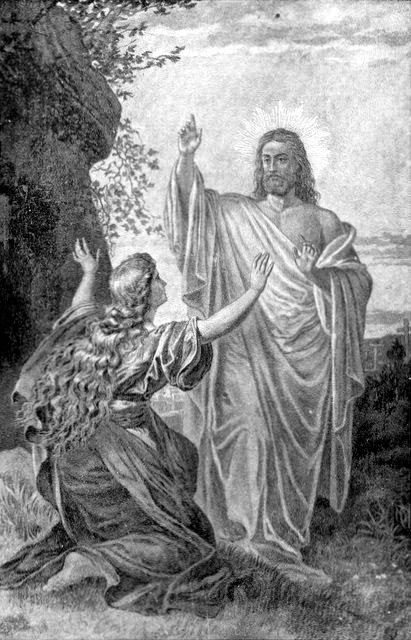
Mary Magdalene Sees Jesus Risen
- Artist unknown
From Treasures of the Bible

Mary Magdalene Sees Jesus Risen - Artist unknown
TODAY'S SPECIAL: John 20:1-18

TO CHEW ON: "Now when she had said this she turned around and saw Jesus standing there, and did not know it was Jesus." John 20:14

I have always been puzzled by Mary's failure to recognize Jesus. Didn't she know Him well? Hadn't she observed Him at close quarters as one of the women who served His itinerant ministry? Why this failure to recognize him?

The IVP New Testament Commentary says of her uncomprehending reaction:

"Such can be the blinding effect of profound emotions. In this case, her inability to recognize him also seems to be due to the character of Jesus' resurrection body, since such failure is typical of encounters with him (cf. Matthew 28:17; Mark 16:12; Luke 24:16, 37; John 21:4)" - IVP Commentary of the New Testament accessed through "Study This" on Biblegateway.com.

This is by no means the only time Jesus wasn't recognized, though. A failure to recognize who He really was in His person and work was a common reaction to Him while He was on earth.
  • Isaiah predicted this blindness - Isaiah 53:3.
  • Though the disciples were guilty of this same reaction for much of the time Jesus was with them (John 14:9), they eventually got it. Look at what John says in His gospel, written some 50 years after Jesus' death and resurrection: "He was in the world, and the world was made through Him and the world did not know Him" - John 1:10.
  • The Jewish leaders of Jesus' time who looked on Him as their rival clung tenacious to their unawareness - John 9:1-34.
  • Jesus predicted that bad things would happen to His followers because people in authority didn't and wouldn't recognize Him and His Father - John 16:1-4.

The above could and does impact Christians in the world today. So do two other things about recognizing Jesus:
  • People can see that we have seen and know Him by the bent of our lives. In his letter to early Christians, John says:
"Whoever abides in Him does not sin.* Whoever sins has neither seen Him nor known Him" - 1 John 3:6 (emphasis added).
"No one who lives in him keeps on sinning. No one who continues to sin has either seen him or known him" - 1 John 3:6 NIV.
  • Jesus may come to us even now in many ways through the needs of our fellowmen (Matthew 25:34-40). Do we recognize Him here?

PRAYER: Dear Jesus, please open my eyes to see You in the needy people all around me. Soften my heart to respond as surely as I would if it were You in person. Amen.

 ________________

* "…does not sin…"  or "no one who lives in him keeps on sinning…" does not mean that the person who is in Christ never sins. The IVP Commentary is helpful here: "What is meant, then, by the statement no one who lives in him keeps on sinning is quite simple: sin is not the identifying characteristic of those who live in him." (Emphasis added.)


 *********
Unless otherwise noted all Scripture quotations are taken from the New King James Version®. Copyright © 1982 by Thomas Nelson, Inc. Used by permission. All rights reserved.

Scripture quotations marked NIV are taken from THE HOLY BIBLE, NEW INTERNATIONAL VERSION®, NIV® Copyright © 1973, 1978, 1984, 2011 by Biblica, Inc.® Used by permission. All rights reserved worldwide.

Tuesday, June 03, 2014

How does the world feel about you?

Jesus converses with the doctors
of the law - Alexandre Bida

Jesus converses with the doctors of the law by Alexandre Bida
TODAY'S SPECIAL: John 7:1-24

TO CHEW ON: "The world cannot hate you, but it hates Me because I testify of it that its works are evil."  John 7:7

Though there have been times when Christians were in sync with their larger society, such times seem to be the exception rather than the rule. Even in my lifetime there has been a cooling toward Christians and Christianity due, partly at least, to the reason Jesus was hated by His neighbours--because he had the audacity to "testify of it that its works are evil." In other words, Jesus believed there was an objective standard of right and wrong and called evil, evil. The message of our prevailing culture is that everything is relative.

Jesus' words here tell us this reaction from the world ("hate") shouldn't surprise us. In fact, maybe we should be more surprised that we are as well accepted as we are.

So, how would a Jesus-type reaction look in our times? It's easy to imagine a holier-than-thou Christianity that puts people off with sanctimonious attitudes and words. None of us wants to be that person.

Perhaps 2 Corinthians 2:14-16 gives us a clue as to how we could live winsome, appealing lives, while being that influence for good:

"Now thanks be to God who ... through us diffuses the fragrance of His knowledge in every place. For we are to God the fragrance of Christ among those who are being saved and among those who are perishing. To the one we are the aroma of death leading to death, and to the other the aroma of life leading to life."

The image of our lives being perfume is a lovely one. Of course that perfume needs to be diffused and  words will probably be a part of that diffusing. And so even here we see that though some will like the 'smell' of those words and the life that backs them up,  others won't. And so, no matter how appealing the image, the hate element raises its head again. For how would we expect someone to react to the smell of death but to hate it?

I ask myself, am I willing to be hated for my loyalty to Christ? Are you?

PRAYER: Dear Jesus, may my loyalty to You be unwavering. Please show me where I am compromising that loyalty because I want to be liked. Help me to stand with You when unpopular, evil-condemning words need to be spoken. Amen.

MORE:  Compromise?

 "When Christians compromise with the kosmos, they may continue to attend church and even pray and read their Bibles. The problem is that the things of God occupy a section of their lives, while the main thrust of their affections is devoted to the world-system. Jesus' warning that 'no one can serve to masters' is illustrated on every side by Christians in the West today" - Dennis McCallum, Unlocking the Mysteries of Satan, Kindle Location 908 (emphasis added).
**********
Unless otherwise noted all Scripture quotations are taken from the New King James Version®. Copyright © 1982 by Thomas Nelson, Inc. Used by permission. All rights reserved.


Bookmark and Share


Tuesday, May 06, 2014

The gospel in words

TODAY'S SPECIAL: Acts 3:11-26


TO CHEW ON: "'Repent therefore and be converted that your sins may be blotted out, so that times of refreshing may come from the presence of the Lord.'" Acts 3:19

"Preach the gospel always, and if necessary use words"* is a saying sometimes used to defend living by gospel principles without explaining the who, what and why of the good news. Though our lives should be consistent with the gospel for sure, just living a certain way isn't enough to fulfill Jesus' final assignment to us (Acts 1:8) (and one senses that the above little saying may sometimes be an excuse for silence out of timidity or fear that one's words will offend).

A wordless gospel was certainly not Peter's philosophy. He grabbed the opportunity here, with the eyes of the whole crowd on him after healing the lame man, to not only explain the gospel but to challenge his hearers to close the deal: "Repent, therefore, and be converted."

It is interesting to notice how Peter, Paul, and other apostles frequently turned miracles and other life happenings into mini-pulpits:
  • After a night in custody, Peter and John were hauled in front of the high priest and his family where they again challenged their hearers with the gospel (Acts 4:5-12).
  • Stephen preached the gospel when he was brought before the Jewish counsel to defend against false accusations (Acts 7).
  • Philip explained the gospel to an Ethiopian eunuch who was reading Isaiah (Acts 8:30-35).
  • After healing a man, Paul and Barnabas restrained a pagan crowd from worshiping them as Hermes and Zeus, instead explaining the gospel (and getting into a lot of trouble for it ) (Acts 14).
  • Paul and Silas explained the gospel to their jailer after an earthquake sprung them from a Philippian prison (Acts 16:30-34).
  • Paul used the words of an inscription on a city monument as an opening for the gospel in Athens (Acts 17:22-32).
  • Paul turned an appearance before Roman rulers Festus, Agrippa, and Bernice into an opportunity to present the gospel (Acts 26).

I ask myself, am I as quick as these early Christians to recognize and take openings to explain the gospel in words? Peter's advice in this regard is more appropriate than ever:

"But sanctify the Lord God in your hearts, and always be ready to give a defense to everyone tho asks you a reason for the hope that is in you with meekness and fear." - 1 Peter 3:15


PRAYER: Dear God, what an example of ready speakers were these early Christians. Help me to recognize openings for the gospel and to have Holy Spirit boldness to take them. Amen.


*This saying is often attributed to St. Francis of Assissi.

********
Unless otherwise noted all Scripture quotations are taken from the New King James Version®. Copyright © 1982 by Thomas Nelson, Inc. Used by permission. All rights reserved.


Bookmark and Share

Sunday, January 26, 2014

Can I have a witness?

Paul before King Agrippa - Artist unknown
Paul before King Agrippa
TODAY’S SPECIAL: Acts 26:1-23

TO CHEW ON: “Therefore having obtained help from God to this day I stand witnessing both to small and great.” Acts 26: 22

[Witness comes from the word martureo (mar-too-reh-oh). It means to give evidence, attest, confirm, confess, bear record, speak well of, give a good report, testify, affirm that one has seen, heard or experienced something. (Interestingly, the word martyr has the same root.)]

Witnessing is the part of our faith life where we speak of (or write about) who God is to us and what our experience with Him has been like. Each person’s witness is different because we all experience God in different ways.

I love the Samaritan woman’s witness, “Come see a Man who told me all things that I ever did” John 4:29.  She experienced God, through Jesus, as someone who knew her completely.

Paul experienced God as the changer of his life mission. After his blinding introduction to Jesus, Paul realized that everything he had based his life on was wrong. In that instant he turned 180º and became a defender of Christians instead of a killer of them.

Whatever our experience with God – whether miracle-fraught or subtle and unspectacular, we can witness about it. And just as our stories are different, so will be the reaction to them. Some will discount what we say as Agrippa discounted Paul’s witness. Others will respond. When that response is immediate, our witness can lead to giving us the privilege of introducing someone to Jesus. Often the response will come later though. We may not be around to see or even know that our witness was a contributing factor in someone’s coming to faith.

PRAYER: Lord, how can I witness about You and what You’ve done for me today? Please open my mouth, and the ears of those who will hear. Amen

MORE:
“The primary means through which the Lord Jesus Christ transmits His life and love is through His people. There are probably few whose experience of finding Christ did not begin with an appetite created in their hearts through seeing the reality of Jesus Christ in other people. God will do it with you, however unwittingly on your part, for this is our privilege, this is our task, and this must be our confident expectation as we allow Christ to live His life in us and pour through us as “a river of living water.” – Charles Price in Our Journey – A daily walk in the Word, December 2009.
**********

Unless otherwise noted, all Scripture is taken from the New King James Version®. Copyright © 1982 by Thomas Nelson, Inc. Used by permission. All rights reserved.
 

Monday, September 23, 2013

That "great gulf"

The Rich Man and Lazarus - Artist unknown
TODAY'S SPECIAL: Luke 16:19-31


TO CHEW ON:
"'And besides all this, between us and you there is a great gulf fixed, so that those who want to pass from here to you cannot, nor can those from there pass to us.'" Luke 16:26


There is an aversion in our western society to the idea that some will miss eternity with God. The thought that they will instead spend time without end on the other side of that "great gulf," "tormented in this flame" is out of vogue. Even some who label themselves followers of Jesus have gone soft on the idea of what we call heaven and hell and that some will be in and others out.

Jesus Himself was clear on the subject.

  • He compared people to  wheat and weeds growing in the same field. Those who believe to salvation and those who don't will ripen side by side "until the harvest" when the weeds will be burned, the wheat put in the granary - Matthew 13:30.
  • Angels are the reapers of that harvest - Matthew 13:49.
  • Entire nations will stand before God for His separation judgment - Matthew 25:32,46.
  • And for those who are alive when Jesus returns to earth, the separation will happen right before their eyes - Matthew 24:40; Luke 17:34.

The plea of the rich man in Jesus' story, to send Lazarus to tell his unaware family members, shakes me. For I am still on this side of that "great gulf" with the ability to speak to my family and friends of the reality of what I believe is on the other side. Have I been clear? Or will I enter eternity with blood on my hands (Ezekiel 33:7-9)?

PRAYER: Dear Jesus, the thought of eternal separation from You is unimaginable. I need a sense of urgency to warn others—especially those in my close circle—about the possibility of this. Amen.

***********

New King James Version (NKJV) Used with permission. The Holy Bible, New King James Version Copyright © 1982 by Thomas Nelson, Inc.

Bible Drive-Thru


Bookmark and Share


Wednesday, February 27, 2013

List His benefits

(Photo: Morguefile.com)
TODAY'S SPECIAL: Psalm 68:1-20

TO CHEW ON: "Blessed be the Lord,
Who daily loads us with benefits,
The God of our salvation." Psalm 68:19


Have you ever listed the ways God has blessed you and your family, even your nation? That's what David is doing in Psalm 68.
  • He follows opening words of general praise to God (Psalm 68:1-6) with a history of the Israelites. 
  • He alludes to the nation's march through the wilderness (Psalm 68:7), how God appeared to them on Mount Sinai (Psalm 68:8) and provided for them in the desert (Psalm 68:8-10). The "rain" may refer to the daily manna (according to Matthew Henry's commentary).
  • Psalm 68:11 seems to be a reference to God giving the word against their enemies, in Canaan, and the people proclaiming the victory that resulted.
(I was surprised when at least half of the translations I consulted, spoke of those proclaimers as women e.g. "The Lord gives the command; The women who proclaim the good tidings are a great host" - NASB. Barnes notes on the Bible explain: "The word used is in the feminine gender and refers to the Oriental custom whereby females celebrated victories in songs and dances.")
  • The verses that follow continue to exult in Israel's triumphs. There is even a prophetic reference to Jesus: "You have ascended on high, You have led captivity captive..."  quoted by Paul in Ephesians 4:7-10.

Our reading ends with a rousing praise:
"Blessed be the Lord,
Who daily loads us with benefits,
The God of our salvation!"

Nothing changes my attitude faster than gratitude. You may find that doing something like David did—recalling your history and looking for God's load of benefits in it—will lift your spirit. Why don't you try it today!

PRAYER: Dear God, thank You for Your faithfulness to me. Help me to continually acknowledge You as the source of my blessings, and to have a heart of gratitude. Amen.
MORE: Messiah Alert!


Words from Psalm 68:11 are lyrics in the Handel's Messiah—Chorus 37: "The Lord Gave the Word.  Notice how the music illustrates the message. A solo voice singing "The Lord gave the word" is followed by a chorus: "Great was the company of the [preachers*],"   It's a chorus that grows larger, more complex and many-voiced as the song builds to a big-chord climax.


*It seems that Mr. Handel substituted "preachers" for the more cumbersome "company of those who proclaimed it" —at least I couldn't find any translation that translates Psalm 68:11 using the word "preachers."


Bible Drive-Thru


Bookmark and Share


Friday, June 03, 2011

Martyrdom

TODAY'S SPECIAL: 1 Peter 4:1-19

TO CHEW ON: "If you are reproached for the name of Christ, blessed are you, for the Spirit of glory and of God rests upon you. On their part He is blasphemed, but on your part He is glorified." 1 Peter 4:14

The story of the Ugandan martyrs of the1880s:
"On 3 June 1886, thirty-two young men, pages of the court of King Mwanga of Buganda, were burned to death at Namugongo for their refusal to renounce Christianity. In the following months many other Christians throughout the country died by spear or fire for their faith.

These martyrdoms totally changed the dynamic of Christian growth in Uganda. Introduced by a handful of Anglican and Roman missionaries after 1877, the Christian faith had been preached only to the immediate members of the court, by order of King Mutesa. His successor, Mwanga, became increasingly angry as he realized that the first converts put loyalty to Christ above the traditional loyalty to the king. Martyrdoms began in 1885. Mwanga first forbade anyone to go near a Christian mission on pain of death, but finding himself unable to cool the ardor of the converts, resolved to wipe out Christianity.

The Namugongo martyrdoms produced a result entirely opposite to Mwanga's intentions. The example of these martyrs, who walked to their deaths singing hymns and praying for their enemies, so inspired many of the bystanders that they began to seek instruction from the remaining Christians. Within a few years the original handful of converts had multiplied many times and spread far beyond the court. The martyrs had left the indelible impression that Christianity was truly African, not simply a white man's religion. Most of the missionary work was carried out by Africans rather than by white missionaries, and Christianity spread steadily. Uganda now has the largest percentage of professed Christians of any nation in Africa.

Several years ago I heard an African clergyman, born of pagan parents, tell of his conversion. He said:

'One afternoon I was bicycling along a road and met a young man about my own age bicycling in the opposite direction. He promptly turned about and began to ride beside me and to talk. He spoke with great enthusiasm about Jesus, whom I had never heard of before, and how He had destroyed the power of death and evil by dying and rising again, and how He was God become man to reconcile man with God. I heard what my companion had to say, and before we parted I had accepted Jesus Christ as my Lord and Savior. Now, the young man who preached the Good News of Jesus Christ to me that afternoon had himself heard of Jesus for the first time that morning.'"

by James Kiefer from the site James Kiefer's Christian Biographies (used with permission).

What strikes me about this story is these words: "The Namugongo martyrdoms produced a result entirely opposite to Mwanga's intentions. The example of these martyrs, who walked to their deaths singing hymns and praying for their enemies, so inspired many of the bystanders that they began to seek instruction from the remaining Christians."

We in the western church go out of our way to avoid persecution, adjusting our message, if need be, to make it more palatable to an offended public. At the same time we decry our anemic state. Maybe a little of what happened in Uganda a century and a quarter ago would do us more good than our predominantly comfortable,  safe environment ... not that I want persecution any more than the next person.

PRAYER: Dear God, thank You for these brave Ugandan Christians who modeled new life in Christ in such a compelling way that not even the possibility of persecution could deter people from coming to You. Please grow in me such a vital, loyal, and attractive faith. Amen.


MORE: The Feast of the Martyrs of Uganda

Today the church celebrates the Feast of the Martyrs of Uganda. The liturgy for this day begins with this Collect:

"O God, by your providence the blood of the martyrs is the seed of the Church: Grant that we who remember before you the blessed martyrs of Uganda, may, like them, be steadfast in our faith in Jesus Christ, to whom they gave obedience, even to death, and by their sacrifice brought forth a plentiful harvest; through Jesus Christ our Lord, who lives and reigns with you and the Holy Spirit, one God, for ever and ever. Amen."


Bible Drive-Thru


Bookmark and Share

Sunday, November 14, 2010

An occasion for testimony

TODAY'S SPECIAL: Luke 21:1-19

TO CHEW ON: "'But for all these things, they will lay their hands on you and persecute you delivering you up to the synagogues and prisons. You will be brought before kings and rulers for My name's sake. But it will turn out for you as an occasion for testimony.'" Luke 21:12-13

Jesus' words, "But it will turn out for you as an occasion for testimony," remind me of a story I heard this summer.

A missionary to the Middle East related an incident where he felt God was telling him to bring Bibles into a certain country.* Though he argued with God, "But that's illegal. It will get me arrested," he felt no release from the assignment.

So he went and, as he expected, his suitcase of Bibles was confiscated and he was put in jail. Fortunately he had one Bible on his person and was soon explaining the gospel to his cellmate. Before the night was over, that man had accepted Jesus.

In the morning the missionary was released. "But you must promise not to give away any more Bibles," the authorities said.

"I'll try," he said, "but I can't promise."

It was no good. He could not resist giving out more copies of the scriptures, and so later in the day found himself being hauled off to jail again. There he was put back in the same cell, where his last night's cellmate lingered on.

He, though, was ecstatic at the missionary's return. "I had so many questions," he said. "I was asking God to send me the answers. He sent you!"

Jesus' words, reinforced by this story, prompt me to ask, how differently would I view life if I looked at things that happen to me as potential occasions for testimony? Things that look bad on the surface — illnesses, hospital stays, accidents...could they be disguised occasions for witness?

I challenge myself, and all of us, to view the events of life with that possibility in mind. Instead of praying for release from the uncomfortable, inconvenient, even nasty incident, let's pray to have the insight to see the opportunity, and the courage to speak the good news about Jesus in it.

*names and identifying details have been left out to protect the people involved.

PRAYER: Dear God, help me to see that You allow every detail in my life for a reason — that things that feel like accidents, mistakes, even tragedies, are there by Your permission. Help me to use these events as occasions to witness about the reality of You in my life. Amen.

MORE: Gaither Vocal Band "Born Again"


Do your 8-12-year-olds have daily devotions? Point them to Bible Drive-Thru.

Related Posts Plugin for WordPress, Blogger...